

Submitted:
17 September 2026
Posted:
18 September 2026
You are already at the latest version
Abstract
We propose a decision-making framework, methodologically based on the Analytic Hierarchy Process (AHP), designed specifically for hybrid organizations whose activities are project-based. We adapt the AHP (a multi-criteria decision-making model) to the context of decision-making in hybrid organizations by including a preliminary screening stages (project identification and economic assessment) that ensures the financial viability of candidate projects. We also use artificial intelligence to improve the methodological robustness of the decision-making process. Our methodological adaptation of the AHP facilitates complex decision-making processes in hybrid organizations by enabling simultaneous analyses of multiple objectives and criteria and by using artificial intelligence to operationalize the AHP-based decision-making process, making the method accessible to most hybrid organizations, regardless of size. Although the proposed AHP-based method is solidly grounded in theory, the robustness and accuracy of its results ultimately depend on the quality of the information used, and the inclusion of biased or incomplete information may compromise the validity of the final ranking of alternatives. Our proposal contributes to the professionalization of decision-making in hybrid organizations, reduces reliance on intuitive approaches, enables all relevant information to be considered, and mitigates any possible biases of decision-makers.
Keywords:
social enterprise
; hybrid organization
; decision-making
; AHP
; social impact
; environmental impact
; AI tools
1. Introduction
The concept of sustainable development involves meeting the needs of the present generation without compromising the ability of future generations to meet their own needs while preserving ecosystems. This paradigm has progressively transformed organizational management in terms of revising traditional decision-making logic and adopting approaches capable of simultaneously integrating economic, social, and environmental criteria [1]. This transformation is especially evident in hybrid organizations that combine market logic with social purposes, where the integration of multiple economic, social, and environmental objectives becomes a particularly complex exercise [2,3] that requires the use of advanced decision-making methodologies. The complexity arises from the need for hybrid organizations to balance all these value dimensions, in contrast with traditional companies, which are more focused on maximizing profits. In this context, multi-criteria decision-making systems emerge as fundamental tools to support complex and multidimensional decision-making (MCDM) [4], such as those required by hybrid organizations.
MCDM techniques include the Technique for Order of Preference by Similarity to Ideal Solution (TOPSIS), Élimination et Choix Traduisant la REalité (ELECTRE), VIseKriterijumska Optimizacija I Kompromisno Resenje (VIKOR), Preference Ranking Organization Method for Enrichment of Evaluations (PROMETHEE), the Best-Worst Method (BWM), and the Analytic Hierarchy Process (AHP). However, implementation of MCDM techniques in hybrid organizations faces considerable challenges, as determining and assessing appropriate criteria is not straightforward, due to the fact that social and environmental objectives (mostly expressed in qualitative terms) are often difficult to assess.
There is a large body of scientific literature that evidences the need for organizations to measure their social and environmental impact in order to manage and enhance the visibility of their social mission [5,6]. However, more concrete studies show that hybrid organizations do not use such information in decision-making to its full potential and that progress is still needed in this [7]. This is probably due to the complex, multidimensional nature of decision-making in hybrid organization and the lack of a standardized methodology to guide this decision-making.
The purpose of this exploratory study is to address the need for a methodological decision-making framework for hybrid organizations that adopts a multi-criteria approach. Our procedure seeks to coherently integrate all information generated around sustainability, enabling commercial and social logics to be combined in a decision-making support tool aimed at improving sustainable business practices.
Our main contribution lies in the methodological approach, which involves the development of a decision-making framework tailored to the hybrid model of social enterprises. The framework integrates impact indicators derived from measurement or accreditation processes, with artificial intelligence (AI) tools used to convert qualitative information into quantitative indicators. Furthermore, AI tools have the advantage that they minimize the subjective bias that different decision-maker profiles may introduce into the decision-making process.
Our proposal is based on the AHP, one of the most widely utilized of the MCDM systems [4]. AHP enables complex problems to be organized into a hierarchy of more tractable subproblems, thereby facilitating the incorporation of multiple criteria and objectives into the decision-making process. Strategic and operational decision-making is thus fairer and mission and action are more closely aligned. We suggest that our framework will be useful for organizations aiming to balance financial sustainability with social impact, particularly those operating on a project basis.
The paper is structured as follows. Section 2 explains business model conflict in hybrid organizations. Section 3 addresses the role of impact indicators in decision-making. Section 4 introduces the AHP. Section 5 describes adaptation of the AHP to decision-making processes in hybrid organizations, illustrated using publicly available information in an application for a particular type of hybrid organization, namely a B Corp. Finally, the discussion and conclusions are presented in Section 6 and Section 7.
2. The Business Model Conflict in Hybrid Organizations
According to [8], the objectives of hybrid organizations are geared towards addressing social or environmental problems; however, to attract capital and become financially sustainable they must also generate a positive economic surplus, and, to do this, they compete with conventional commercial enterprises. Nevertheless, hybrid organizations usually compete in fields where significant value is generated for society and where commercial enterprises have not traditionally operated [9].
Some authors refer to these organizations as social enterprises [10], although, as Alberti and [11] point out, the hybrid organization concept is broader. Hybrid organizations combine elements from the for-profit and philanthropic sectors, employing mixed working models oriented towards both the market and their social or environmental mission [2,12,13,14]. Commercial organizations are expected to prioritize capturing value for their owners (subject to a series of social constraints) and third sector organizations are expected to prioritize creating value for their beneficiaries (subject to the mobilization of sufficient resources to continue operating). In contrast, hybrid organizations must reconcile the conflicting expectations of both value capture and impact generation, and, rather than focus on the needs of a dominant stakeholder, must do so in a systemic manner.
The scientific literature indicates that the dual social and commercial nature of hybrid organizations frequently leads to tensions arising between the social mission and commercial activities that may even jeopardize their very survival [3,15,16,17]. These tensions are affected by the degree of integration between social and commercial activities, as noted by [15], as better integration prevents the emergence of potential paradoxes in resource allocation. The central challenge for these organizations is, ultimately, to align profit-generating activities with impact-generating activities [10], thereby guaranteeing the economic growth necessary for their sustainability and the continuation of positive social and environmental impacts.
3. Impact Indicators in the Decision-Making Process
While there is a wealth of literature on social and environmental impact measurement (see, e.g., [5,6]), most studies link this measurement to the corporate desire to enhance transparency [18] and legitimacy [19], in turn bolstering the credibility of the commitment to sustainability in the eyes of external stakeholders [20,21], building customer loyalty, enhancing brand awareness [22], and limiting the potential for social and environmental initiatives aimed at greenwashing [23,24]. However, impact indicators also provide vital supplementary information that enhances decision-making in planning and monitoring processes [25]. Social enterprises that incorporate impact measurement frameworks can execute differentiation strategies [26,27] that generate sustainable and long-term competitive advantages [10].
Despite these potential benefits, the literature barely addresses whether, in practice, managers use the information provided by impact indicators in their internal decision-making processes, beyond using them to communicate their commitment to sustainability to stakeholders. Indeed, some authors suggest that companies may subordinate sustainability information to a logic of shareholder value maximization. In this vein, [28,29] demonstrate that certain organizations may provide this kind of information simply to create an unreal image of social and environmental commitment inconsistent with their activities.
To address this threat, an effective management system in hybrid organizations requires sustainability information that enables the calculation of social and environmental impacts that demonstrate benefits for society [30]. Those impact indicators must also be useful for decision-making by both managers [31] and external stakeholders [32], as they can be used to assess past performance and plan for the future [33].
However, use of this type of impact indicator in an organization’s day-to-day management and decision-making processes requires the availability of tools and operational methods. Hybrid organizations, in particular, need mechanisms that enable decision-making that takes account of the often conflicting social and economic logics [34] within which their objectives are framed. [35], in a case study of a project-based organization, points out that such tools are key to strategy implementation within social organizations and to the ongoing development of their operational practices. Consequently, effective deployment of these tools will contribute to the success of hybrid organizations.
One important issue for small-to-medium enterprises (SMEs) bearing in mind that a large proportion of hybrid organizations are small is their lack of technical resources to carry out planning tasks, including project evaluation [36,37]. Nevertheless, financial and strategic planning is also necessary from the outset for SMEs [38,39,40] if the business is to be sustainable over time and, ultimately, capable of generating a lasting impact.
For hybrid organizations, the concept of project success goes beyond the mere generation of economic wealth. A project is considered successful when it generates wealth and creates social value [41]. Essentially, success for hybrid organizations lies in an ability to ensure that their projects are sufficiently profitable to ensure survival and to keep generating the social value that fulfils their mission. Therefore, in hybrid organizations that operate on a project basis, project management involves selecting and prioritizing potential projects [42] according to their strategic value, and this process implies both a financial dimension and a social or sustainability dimension [43].
In this context, MCDM methods are effective tools that enable managers to prioritize among various projects or activities by helping evaluate alternatives according to the multiple dimensions that are relevant. As [44] point out, MCDM facilitates the selection of the best possible alternative based on the specific decision-making problem, allowing for a comparative analysis of different options. MCDM methods also allow the available alternatives to be ranked based on integrating quantitative and qualitative information in a coherent evaluation framework [45].
In the context of socially responsible investment, MCDM methods have been used as support tools to evaluate various resource allocation options (see, e.g., [46], and [47]). Studies also demonstrate how their use in non-profit organizations [48,49] and in social enterprises [50] contributes to more efficient decision-making. Application of MCDM criteria to the management of social entrepreneurial projects has also been documented [51].
For our study of decision-making in hybrid organizations, we adapt a specific MCDM method , namely, the AHP, which is widely used and has a wide scope of application [47]. Our choice of the AHP is based on the method’s versatility in breaking down complex problems into a hierarchy of criteria and sub-criteria, thereby facilitating a structured, participatory, and operational evaluation process. The integration of AI in our proposed decision-making framework allows for the use of certain reference frameworks for measuring organizational impacts, such as in our case the indicators leading to B Lab certification, which, although widely accepted, have not been used to date for day-to-day management.
4. Multi-Criteria Programming: The Analytic Hierarchy Process
The AHP, developed by Thomas Saaty [52], compares and ranks a set of alternatives according to their relative importance, based on a predefined set of criteria. Comparisons are made between pairs of alternatives, resulting in a hierarchical structure suitable for complex decision-making [53]. The AHP provides a rational and comprehensive framework for structuring a decision-making problem, representing and quantifying its elements, relating those elements to objectives, and evaluating alternative solutions.
While the method has occasionally been criticized for being very labour-intensive and difficult to implement when many alternatives are considered, its simplicity has led to its widespread use in many applications requiring an MCDM approach [54]. Moreover, the AHP is particularly suited to hybrid organizations, where a relatively small number of alternative projects must be ranked hierarchically. Therefore, the limitation that would arise from dealing with a large number of alternatives is not an impediment to use of the AHP for hybrid organizations.
Decision-making within the AHP is structured in three main phases [55]: modelling, evaluation, and prioritization and synthesis (see also Appendix A).
4.1. Modelling
A structure is created to represent all the relevant aspects of the decision-making process. The simplest structure is a three-tier hierarchy [56], within which the different elements are independent of one another: the top level for the objectives; the middle level for the criteria; and the bottom level for the alternatives (Figure 1). Obviously, the framework can be further expanded for complex problems (see [57,58]).
4.2. Evaluation
Actor preferences and desires are incorporated through judgements contained in what are known as pairwise comparison matrices, which are square reciprocal matrices in which elements a_ij encode the dominance of item i over j with respect to a particular attribute or property. [52] proposes the use of a fundamental scale ranging from 1 (equal importance) to 9 (extreme importance) to establish the relative value of the elements. This overcomes the problem that arises when making relative comparisons between elements with values ranging from 0 to infinity [59].
4.3. Prioritization and Synthesis
Local, global, and overall priorities are calculated in order to establish a hierarchy. Local priorities i.e., the priorities of elements linked to a common node are obtained from a reciprocal pairwise comparison matrix using the right-hand principal eigenvector method [52]. This method, based on the Perron-Frobenius theorem, yields the local priorities by solving Equation (1):
where
- A is the square reciprocal paired comparison matrix with elements aij
- λmax is the principal eigenvalue of A
- W = (w1, w2,..., wn) is the vector of local priorities, normalized to sum to 1.
An important consideration when applying the AHP is to assess the decision-maker’s consistency and the coherence of the data input into the model. To this end, we solve Equation (2):
where
- CR is the consistency ratio
- CI is the consistency index
- RCI is the random consistency index, which is obtained for different values of n by randomly simulating a large number of matrices (Table 1).
In practice, consistency ratios below 0.1 (10%) are considered acceptable. Values that exceed this threshold should be reviewed, as they signal inconsistency in the judgements and the information entered by the decision-makers.
Global priorities are derived from local priorities by applying the principle of hierarchical composition. The process culminates in an overall priority for each compared alternative calculated by aggregating the global priorities for each alternative along the different paths linking the alternative to the global goal (mission). Aggregation for AHP is typically based on the additive method.
5. Adapting the Analytic Hierarchy Process to Decision-Making in Hybrid Organizations
To illustrate how the AHP can be adapted to the decision-making process in hybrid organizations, we implement a theoretical exercise based on publicly available information. We used data from the sustainability reports of a company called Naria Tech S.L., part of the B Corp movement. The most recent report used [61] describes the company’s mission, vision, and purpose in the following terms:
- Mission. To develop comprehensive solutions to begin digitizing the third sector, promoting social and environmental wellbeing.
- Vision. To contribute to a more caring, sustainable, and efficient society through technology.
- Purpose. To generate a positive impact on people’s quality of life and on social inclusion, food security, and environmental protection.
Our simple three-tier model consists of objectives, criteria, and alternatives (as depicted in Figure 1), each described in detail further below for our example hybrid organization.
Managers need operational tools to evaluate and decide on a set of feasible alternatives that are likely to achieve their organization’s objectives. Adapting the AHP to the decision-making process in a hybrid organization requires implementing a preliminary stage, consisting of project identification and economic assessment, followed by a prioritization stage, which groups together the modelling, evaluation, and prioritization and synthesis phases defined previously. Figure 2 depicts a schematic representation of the proposed framework.
5.1. Preliminary Stage: Project Identification and Economic Assessment
5.1.1. Project Identification
The hybrid organization needs to identify the projects or activities that will achieve its objectives. Projects and activities may encompass various actions, ranging from the production of specific goods to the provision of services aimed at a particular group. The framework within which the decision-making process is set out is one in which there is a multiplicity of projects or activities through which the organization’s objectives can be achieved.
In our theoretical exercise, we assume that the projects requiring decision-making in Naria are those listed as flagship projects in Naria’s sustainability reports for 2023 and 2024:
- Launch of the Surplus Management platform
- Project with CODESPA and A+FAMILIAS
- Project with United Way
- Launch in Latin America: Mexico
- Open and collaborative innovation
- Ending food waste
- DIGIXIM project
- Response to the DANA weather event in Valencia
- Participation in the REDONA project.
5.1.2. Economic Assessment
Once a portfolio of projects and activities that potentially achieve the organization’s objectives has been identified, the next step is to assess their economic viability At this point, we can use the expected net present value (NPV) criterion, obtained by discounting the stream of expected net cash flows to the present using Equations (3) and (4):
where:
- E(NPV)j represents the expected NPV for project or activity j and m is the number of projects or activities that would enable the objectives to be achieved
- E(CF)ji represents the expected net cash flow for project j (expected to generate cash flows over n periods) in period i
- E(CIF)ji and E(COF)ji, within project j, represent, respectively, the expected receipts and payments in period i
- r is the discount rate for the expected net cash flows.
The discount rate, r, should correspond to the organization’s weighted average cost of capital (WACC), which depends on two factors [62]: the cost of debt and the cost of equity, i.e., the financial return or yield on their investment required by the organization’s owners. Therefore, the higher the interest an organization must pay on its debt and the higher the return the owners demand for their investment, the greater the net cash flows a project must generate to be economically viable.
For a hybrid organization, the interest paid on debt, as an exogenous variable that is negotiated directly with the lender, will not differ from that of a conventional company with similar risk characteristics. However, the situation regarding financial return is different. In a conventional company, the financial return depends on various factors, including interest rates, the stage of the economic cycle, the sector, and the market return on shares in other companies. However, in a hybrid organization, the financial return intuitively should tend to zero, i.e., it should be the minimum value that will guarantee the organic growth necessary for the organization to continue meeting its objectives.
Determining the theoretical value of the financial return for a hybrid organization is an interesting area of research that is beyond the scope of this paper. That said, this financial return and, consequently, the WACC should always be less than that of a conventional company. Hybrid organizations will view some projects and activities as economically viable when this would not be the case for a conventional company.
It is worth emphasizing that requiring projects to be first and foremost economically viable does not mean that economic objectives take precedence over social and environmental goals. If this were the case, the decision-making process would end at this stage, as economically viable projects would be prioritized solely according to their NPV. However, in our proposed framework, analysing economic viability simply enables the hybrid organization with a dual economic and non-economic business model to select feasible candidate projects and activities for subsequent prioritization according to criteria consistent with the non-economic dimension of its business model.
Within the scope of the theoretical exercise exemplifying how our proposed method works, we assume without making any calculations regarding their real-world economic viability that Naria’s first six flagship projects listed above meet the economic viability requirement, namely:
- P1: Launch of the Surplus Management platform
- P2: Project with CODESPA and A+FAMILIAS
- P3: Project with United Way
- P4: Launch in Latin America: Mexico
- P5: Open and collaborative innovation
- P6: Ending food waste.
Likewise, the remaining three projects, if undertaken, are assumed to place Naria in a vulnerable position that would jeopardize the continuity of its operations.
5.2. Prioritization Stage: Modelling, Evaluation, and Prioritization and Synthesis
5.2.1. Modelling
In order to develop an operational decision-making framework, the simplest three-tier structure illustrated in Figure 1 is implemented with inputs as follows:
Objectives. These are set out in [61], summarized as follows:
- Social. Expand its network to new countries and exceed a cumulative total of 10 million beneficiaries. Continue to train volunteers and staff in digital skills, empathetic leadership, and responsible data use. Develop an educational impact module (webinars and micro-courses) that certifies third sector organizations in advanced digital management.
- Environmental. Increase surplus management to prevent the emission of at least 2,000 tonnes of CO2. Implement a dashboard to measure the environmental impact of its digital and development tools. Cover 100% of its electricity consumption with certified renewable energy. Annually disclose its carbon footprint calculation.
- Economic. Grow through new international and collaborative projects to test its technology in new environments. Diversify revenue streams through new software-as-a-service (SaaS) modules and consultancy services for digitalization of the third sector. Consolidate its presence in existing markets before embarking on further expansion. Continue to scale up “No one without their daily ration” (an innovative socially aware initiative to digitalize the current food donation process) with the aim of connecting new retailers
Criteria. The set of criteria to be used must remain stable over time to steer the organization’s activities towards the achievement of its overall objectives. In the case of Naria, the impacts required for its accreditation as part of the B Corp network [63] are used as criteria:
- PSG: Purpose and stakeholder governance
- FW: Fair work
- JEDI: Justice, equity, diversity, and inclusion
- HR: Human rights
- CA: Climate action
- ESC: Environmental stewardship and circularity
- GACA: Government affairs and collective action.
Alternatives. The alternatives to be prioritized are the six projects (P1 to P6) deemed to be economically viable.
5.2.2. Evaluation
Quantitative evaluation in the AHP is carried out in accordance with the scale described in Table 2.
Evaluation is based on analysing both criteria and projects in relative terms, as follows:
- The importance of each criterion is assessed relative to each of the other criteria
The relative importance attached to each criterion is a matter addressed by the company’s decision-making bodies based on the contribution they believe each criterion may make towards achieving the organizational objectives. This is a technically complex process, as it involves synthesizing qualitative information with many different nuances in quantitative terms. Furthermore, the process may yield results with a high degree of subjectivity. Indeed, as [34] point out, the profile of the decision-maker in a hybrid organization (more socially oriented than economically oriented) can introduce biases when assessing and deciding the relative importance of one criterion over another.
For this stage of the process, our decision-making framework envisages the use of AI tools (see Figure 2), fed with the information on objectives, criteria, and projects, as well as an explanation of the AHP. The output is an initial matrix depicting the relative importance of each element in a pair of elements. The AI tools also provide summarized information giving the rationale behind the scores assigned to each pair of elements.
Taking the above information into account, the decision-maker may: (a) accept the AI-generated matrix and continue with the process; (b) make changes to the matrix, modifying certain scores before continuing with the process; or (c) interact with AI tools, refining inputted data or adding new information to generate a new matrix and then continue with the process.
Using AI at this stage simplifies the technical complexity of the AHP and makes its implementation feasible in all types of organizations, regardless of size. Obviously, the more comprehensive the data input to the AI tool, the more closely the results will align with organizational objectives. Furthermore, the use of AI reduces the bias that decision-makers might introduce into the process by eliminating the unconscious aspect of their subjective judgement.
In our theoretical exercise, we input the following data in the generic AI tool Gemini (3.5 Flash):
The results are shown in Table 3.
By way of example, below we reproduce the AI rationale behind some of the awarded scores:
- HR and GACA. Since Naria operates primarily through community coordination (food banks, the third sector, public authorities, and businesses) to guarantee fundamental rights to food and social inclusion, GACA and HR are at the top of the analytical scale.
- CA and ESC. Although closely coordinated and highly significant, they are functionally subordinate as the ecological vehicle through which social impact is achieved (preventing food waste to redistribute it).
- b. The importance of each project is assessed relative to each of the other projects
The information fed to the AI tool and the considerations applied to the criteria are likewise applied to the assessment of the relative importance of the projects.
By way of illustration, Table IV shows the relative importance of the projects in relation to the FW criterion.

Table 4.
Relative importance of Naria’s projects in terms of the FW criterion.
| Project | P1 | P2 | P3 | P4 | P5 | P6 |
|---|---|---|---|---|---|---|
| P1 | 1 | 1/2 | 1/2 | 3 | 2 | 5 |
| P2 | 2 | 1 | 1 | 4 | 3 | 6 |
| P3 | 2 | 1 | 1 | 4 | 3 | 6 |
| P4 | 1/3 | 1/4 | 1/4 | 1 | 1/2 | 3 |
| P5 | 1/2 | 1/3 | 1/3 | 2 | 1 | 4 |
| P6 | 1/5 | 1/6 | 1/6 | 1/3 | 1/4 | 1 |
Projects are as described in Section 5.1. Source: Author.
5.2.3. Prioritization and Synthesis
In this final phase of the procedure, consistency is assessed and overall priorities are then determined.
Consistency is assessed based on a vector of local priorities obtained for the criteria and for the projects conditional on each criterion. The corresponding consistency ratios are then calculated in accordance with Equations (1) and (2). In our theoretical exercise, the consistency ratio for the criteria is 0.034. For the projects conditional on each criterion, the consistency ratios are below the threshold of 0.1 (Table 5), meaning that project prioritization can proceed.
Note that results are entirely consistent since the matrices are generated by AI using the AHP information provided. In a real-world setting, however, any post-AI modification by the decision-maker may produce non-consistent results. Nonetheless, if interaction with the AI tool is appropriate, results will be both consistent and close to the desired outcomes.
Overall priorities for each project are next calculated by combining the local priorities of the criteria with those of the projects subject to those criteria, as calculated above. These overall priorities enable the alternative projects to be ranked according to social and environmental criteria. For our theoretical exercise, the results reported in Table 6 show that P2 (Project with CODESPA and A+FAMILIAS’) is ranked first, followed by P1 (Launch of the Surplus Management platform), while P5 (Open and collaborative innovation) is ranked last.
These (theoretical) results illustrate the outcome achieved from applying the decision-making process proposed in this article. Logically, this result depends on the data input to the AI tool. Also note that the projects deemed economically viable were selected at random and that the company’s decision-making body was not involved in the process. In sum, it can be seen that the proposed framework is operational in any type of hybrid organization that operates on a project basis, regardless of size.
6. Discussion
This paper proposes a decision-making framework based on the AHP, aimed at addressing the need for a decision-making framework for hybrid organizations, given the lack of a suitable standardized methodology to guide the complex and multidimensional nature of decision-making in such organizations. Below we discuss our proposed framework in relation to previous research that has employed MCDM approaches in sustainability contexts.
[64] used the BWM to identify key success factors in the transition to a circular economy in the leather industry. Their analysis, revealing that the most influential factor is senior management leadership and commitment, confirms the importance of managerial capabilities in the effective implementation of structured decision-making frameworks. Furthermore, the choice of the BWM highlights the usefulness of methods that allow criteria to be weighted efficiently when resources are limited as happens in hybrid organizational settings. [64] provide a validated set of pre-prioritized criteria that can be used in any decision-making framework (including ours) that seeks to align a hybrid organization’s strategy with the principles of the circular economy.
[1], who applied the AHP method to the selection of sustainable development projects, emphasize that input data quality is crucial to obtaining reliable results. This methodologically relevant observation reinforces the importance of clear and well-structured information (such as used in our theoretical exercise) for multi-criteria systems. Those authors also emphasize that the efficient management of complex systems requires managers need to fully understand the logic of complex systems to be able to interpret them appropriately and so ensure that sustainable development principles take precedence in project selection. They also point out, as a basic condition for effective AHP implementation, that managers need to be motivated to use systematic analytical approaches. In practice, many managers tend to overly rely on their intuition, thereby limiting the use of methodologies that could improve strategic decision-making, and especially in contexts featured by multiple sustainability criteria and potentially conflicting objectives. Those findings of [1] reinforce our methodological approach, as it equips decision-makers with measures of relative importance for criteria and projects that can be analysed intuitively (using a simple numerical scale from 1 to 9). Regarding our proposal, no specific technical knowledge is required to implement the AHP, and its rigorous and systematic framework ensures methodologically robust results for the decision-making process.
At the sectoral level, [65] apply a structured MCDM approach to align food SME strategies with the Sustainable Development Goals (SDGs), demonstrating that the application of circular economy and sustainability principles requires tools that take into account multiple value dimensions. Using the Criteria Importance Through Intercriteria Correlation (CRITIC) and VIKOR methods, they identify and prioritize five key performance criteria regarding the circular economy: investment in Corporate Social Responsibility (CSR), use of renewable energy, increased waste recycling rate, reduced total CO₂ emissions, and total water consumption. Although they do not use AHP, their empirical approach is consistent with the idea that sustainable decision-making requires multi-criteria methodologies that structure complexity and prevent misaligned priorities. Within our proposed AHP-based methodological framework, the circular economy factors identified by [65] can be incorporated in an orderly and prioritized manner into the strategic plans of hybrid organizations facing resource constraints. Our procedure would enable more structured, rational decisions that are aligned with their hybrid mission, even in scenarios where they cannot afford complex analyses or external consultancy.
Regarding decision-maker subjectivity, [34], although they do not use MCDM, point to the bias that decision-makers, depending on their profile, may introduce into decision-making in hybrid organizations. In a project-based organization, more finance-focused decision-makers might prioritize more profitable projects, even if not fully aligned with organizational objectives, whereas more socially focused decision-makers might favour projects with greater social or environmental impact. Our method mitigates subjectivity by first pre-selecting only projects that meet minimum expected profitability thresholds (i.e., that ensure that the organization survives), and then using AI to remove the bias that a decision-maker may unconsciously introduce when ranking projects according to the hybrid organization’s social and environmental criteria.
Taken together, the analysed studies highlight the need for MCDM support tools capable of integrating multiple criteria and dimensions in organizations focused on sustainability. Although not all the studies are based on the AHP, their findings underline the importance of business leaders using structured, participatory, and data-driven approaches to effectively address the complexity inherent in integrating economic, social, and environmental objectives. The methodology described in this paper addresses a gap in the literature on hybrid organizations by offering an operational framework validated and adaptable to real-world contexts that can take multiple criteria and stakeholder perspectives into account. In doing so, it reduces reliance on intuitive decision-making, contributes to the professionalization of decision-making within hybrid organizations, and ultimately facilitates strategic management aligned with sustainability and social responsibility principles.
7. Conclusions
MCDM approaches offer a robust methodology to support decision-making in hybrid organizations, enabling a balanced assessment of economic, financial, social, and environmental criteria. Although their implementation presents challenges, MCDM tools can overcome the limitations of traditional intuitive approaches to addressing the complexity inherent in sustainable management and facilitate sustainable and balanced development. Of the different MCDM techniques, the AHP stands out as the method offering the greatest potential
In hybrid organizations that operate on a project basis, our proposed AHP-based method can enhance understanding of a problem during the decision-making process and help decision-makers arrive at candidate solutions that best align with their organization’s objectives. Our framework structures, represents, and quantifies complex problem components, linking them to objectives and criteria, and facilitating the systematic evaluation of alternative solutions.
Our study addresses methodological gaps in the literature by offering an operational and adaptable framework, applicable in real-world settings, that facilitates strategic planning and decision-making for hybrid business models, ultimately representing an important step forward in the professionalization of sustainable management.
Our rigorous methodological AHP-based approach to supporting complex strategic decision-making allows for the incorporation of the social, environmental, and economic criteria that define the mission of hybrid organizations while enabling the views of stakeholders to be taken into account. It overcomes certain drawbacks identified in the literature regarding the application of the AHP in hybrid organizations, such as the need for technical training of decision-makers and the potential bias that may be introduced by decision-makers depending on their profile.
Although the proposed AHP-based method is solidly grounded in theory, the robustness and accuracy of its project prioritization results will ultimately depend on the quality of the data used, as clearly, biased or incomplete information can compromise the validity of the resulting project ranking.
Future research could focus on determination of the cost of capital for hybrid organizations, extension of the empirical validation of the proposed framework across various sectors and geographical contexts, and the development of digital tools to facilitate the real-time application and accessibility of similar methodologies.
Author Contributions
Conceptualization, Cabedo, Fuertes-Fuertes and Tirado Beltran; methodology, Cabedo, Fuertes-Fuertes and Tirado Beltran; software, no specific software was developed; validation, Cabedo, Fuertes-Fuertes and Tirado Beltran; formal analysis, Cabedo, Fuertes-Fuertes and Tirado Beltran; investigation, Cabedo, Fuertes-Fuertes and Tirado Beltran; resources, Cabedo, Fuertes-Fuertes and Tirado Beltran; data curation, Cabedo, Fuertes-Fuertes and Tirado Beltran; writing—original draft preparation, Cabedo, Fuertes-Fuertes and Tirado Beltran; writing—review and editing, Cabedo; visualization, Cabedo, Fuertes-Fuertes and Tirado Beltran.; supervision, Cabedo; project administration, Cabedo; funding acquisition, Cabedo, Fuertes-Fuertes and Tirado Beltran All authors have read and agreed to the published version of the manuscript.
Funding
This research was funded by Universitat Jaume I, Project 25I603. The APC was funded by Universitat Jaume I, Spain.
Conflicts of Interest
The authors declare no conflicts of interest. The funders had no role in the design of the study; in the collection, analyses, or interpretation of data; in the writing of the manuscript; or in the decision to publish the results.
Abbreviations
The following abbreviations are used in this manuscript:
| AHP | Analytic Hierarchy Process |
| AI | Artificial Intelligence |
| MCDM | Multidimensional decision-making |
Appendix A
SMA.1 The importance of each criterion is assessed relative to each of the other criteria
| Social & environmental criteria | ||||
| … | ||||
| … | ||||
| … | … | … | … | … |
| … | ||||
| … |
Cj, j=1, … s as defined in Figure 1. RSCij, i=1, … s j=1, … s represents the relative importance of criterion i (row) compared with criterion j (column), calculated in accordance with the scale for comparing pairs of elements defined in A.1. RSCij = 1 ∀ i = j.
SMA.2 The importance of each project is assessed relative to each of the other projects
| P1 | P2 | … | Pt | |
| P1 | … | |||
| P2 | … | |||
| … | … | … | … | |
| Pt | … | |||
Cz represents the social and environmental criteria on the basis of which we are calculating the relative importance of the various economically viable activities and projects. RSPijCz, i=1, … t j=1, … t represents the relative importance of project i (row) compared with project j (column), calculated for the social and environmental criterion z in accordance with the scale for comparing pairs of elements defined in A.1. RSPijCz = 1 ∀ i = j.
SMB. Prioritisation and synthesis
SMB.1 Assessment of consistency for the criteria.
SMB.1.1. Standardised matrix for criteria
SMB.1.1.1 Relative importance of the criteria
| Social & environmental criteria | ||||
| … | ||||
| … | ||||
| … | … | … | … | … |
| … | ||||
| … |
Cj, j=1, … s as stated in Figure 1. RSCij, i=1, … s j=1, … s represents the relative importance of criterion i (row) compared with criterion j (column), calculated in accordance with the scale for comparing pairs of elements defined in A.1.
RSCij = 1 ∀ i = j
SMB.1.1.2 Standardised matrix
| … | ||||
| … | ||||
| … | … | … | … | |
| … |
SMB.1.1.3 Identifying local priorities
| … | |||||
| … | |||||
| … | … | … | … | ||
| … |
SMB.1.1.4. Local priorities vector (for the criteria)
SMB.1.2 Criteria: assessing the consistency of local priorities
n = tr(AC)
SMB.2 Assessment of consistency in the projects.
SMB.2.1 standardised matrix for projects (to calculate for each of the criteria)
SMB.2.1.1 Relative importance of projects, subject to the criteria
| P1 | P2 | … | Pt | |
| P1 | … | |||
| P2 | … | |||
| … | … | … | … | |
| Pt | … | |||
Cz represents the social and environmental criteria on the basis of which we are calculating the relative importance of the various economically viable activities and projects.
RSPijCz, i=1, … t j=1, … t represents the relative importance of project i (row) compared with project j (column), calculated for the social and environmental criterion z in accordance with the scale for comparing pairs of elements defined in A.1.
RSPijCz = 1 ∀ i = j
SMB.2.1.2 Standardised matrix
| P1 | P2 | … | Pt | |
| P1 | … | |||
| P2 | … | |||
| … | … | … | … | |
| Pt | … |
SMB.2.1.3 Identifying local priorities
| P1 | P2 | … | Pt | ||
| P1 | … | ||||
| P2 | … | ||||
| … | … | … | … | ||
| Pt | … |
SMB.2.1.4. Local priorities vector (for projects, subject to the criteria)
SMB.2.2 Projects: assessment of the consistency of local priorities conditioned to the criteria
m = tr(APCz)
References
- Jurík, L.; Horňáková, N.; Šantavá, E.; Cagáňová, D.; Sablik, J. Application of AHP method for project selection in the context of sustainable development. Wirel. Netw. 2022, 28, 893–902. [Google Scholar] [CrossRef]
- Haigh, N.; Hoffman, A.J. Hybrid organizations: The next chapter of sustainable business. Organ. Dyn. 2021, 41(2), 126–134. [Google Scholar] [CrossRef]
- Lee, M.; Walker, J.; Dorsey, C.; Battilana, J. In Search of the Hybrid Ideal. Stanf. Soc. Innov. Rev. 2012, 10(3), 51–55. [Google Scholar] [CrossRef]
- Diaz-Balteiro, L.; González-Pachó, J.; Romero, C. Measuring systems sustainability with multi-criteria methods: A critical review. Eur. J. Oper. Res. 2017, 258(2), 607–616. [Google Scholar] [CrossRef]
- Kühnen, M.; Hahn, R. Systemic social performance measurement: Systematic literature review and explanations on the academic status quo from a product life-cycle perspective. J. Clean. Prod. 2018, 205, 690–705. [Google Scholar] [CrossRef]
- Corvo, L.; Pastore, L.; Manti, A.; Iannaci, D. Mapping Social Impact Assessment Models: A Literature Overview for a Future Research Agenda. Sustainability 2021, 13(9), 4750. [Google Scholar] [CrossRef] [PubMed]
- Fuertes-Fuertes, I.; Cabedo, J. D.; Tirado-Beltrán, J. M. How do hybrid organisations use socio-environmental impact information? An exploratory analysis in European B corps. Bus. Strategy Environ. 2024, 33(8), 9181–9196. [Google Scholar] [CrossRef]
- Haigh, N.; Kennedy, E.D.; Walker, J. Hybrid organizations as shape-shifters: altering legal structure for strategic gain. Calif. Manag. Rev. 2015, 57(3), 59–82. [Google Scholar] [CrossRef]
- Hoffman, A. J.; Badiane, K. K.; Haigh, N. Hybrid Organizations as Agents of Positive Social Change: Bridging the For-Profit & Non-Profit Divide, in Using a Positive Lens to Explore Social Change and Organizations: Building a Theoretical and Research Foundation K. Golden-Biddle; Dutton, J., Ed.; Routledge, Taylor and Francis Group: New York, USA, 2012; pp. 131–153. [Google Scholar]
- Santos, F.M.; Pache, A.C.; Birkholz, C. Making hybrids work: aligning business models and organizational design for social enterprises. Calif. Manag. Rev. 2015, 57(3), 36–58. [Google Scholar] [CrossRef]
- Alberti, F. G.; Varon Garrido, M. A. Can Profit and Sustainability Goals Co-Exist? New Business Models for Hybrid Firms. J. Bus. Strategy 2017, 38, 3–13. [Google Scholar] [CrossRef]
- Battilana, J.; Dorado, S. Building Sustainable Hybrid Organizations: The Case of Commercial Microfinance Organizations. Acad. Manag. J. 2010, 53(6), 1419–40. [Google Scholar] [CrossRef]
- Haigh, N.; Hoffman, A.J. The New Heretics: Hybrid Organizations and the Challenges They Present to Corporate Sustainability. Organ. Environ. 2014, 27(3), 223–241. [Google Scholar] [CrossRef]
- Smallbone, D.; Evans, M.; Ekanem, I.; Butters, S. Researching Social Enterprise. Final Report to the Small Business Service Centre for Enterprise and Economic Development Research; Middlesex University: London, UK, 2001. [Google Scholar]
- Battilana, J.; Lee, M. Advancing Research on Hybrid Organizing: Insights from the Study of Social Enterprises. Acad. Manag. Ann. 2014, 8(1), 397–441. [Google Scholar] [CrossRef]
- Smith, W.K.; Gonin, M.; Besharov, M.L. Managing Social-Business Tensions: A Review and Research Agenda for Social Enterprise. Bus. Ethics Q. 2013, 23(3), 407–442. [Google Scholar] [CrossRef]
- Kannothra, C.G.; Manning, S.; Haigh, N. How hybrids manage growth and social–business tensions in global supply chains: The case of impact sourcing. J. Bus. Ethics 2018, 148(2), 271–290. [Google Scholar] [CrossRef]
- Liute, A.; De Giacomo, M. R. The environmental performance of UK-based B Corp companies: An analysis based on the triple bottom line approach. Bus. Strategy Environ. 2022, 31(3), 810–827. [Google Scholar] [CrossRef]
- Lortie, J.; Cox, K.C.; Roundy, P.T. Social impact models, legitimacy perceptions, and consumer responses to social ventures. J. Bus. Res. 2022, 144, 312–321. [Google Scholar] [CrossRef]
- Chauhan, Y.; O'Neill, H.M. Strategic advantages through social responsiveness: The case of certified B-Corps. Available online at SSRN. 2020. (accessed on 2 June 2026). [CrossRef]
- Paelman, V.; Van-Cauwenberge, P.; Vander-Bauwhede, H. The impact of B Corp certification on growth. Sustainability 2021, 13, 7191. [Google Scholar] [CrossRef]
- Vázquez-Maguirre, M.; Benito, A. E. Impact or outputs? Exploring Multinational's CSR activities in Mexico. Sustainability 2022, 14(7), 4140. [Google Scholar] [CrossRef]
- Stecker, M. J. Awash in a sea of confusion: Benefit corporations, social enterprise, and the fear of greenwashing. J. Econ. Issues 2016, 50(2), 373–381. [Google Scholar] [CrossRef]
- Seele, P.; Schultz, M. D. From greenwashing to machinewashing: A model and future directions derived from reasoning by analogy. J. Bus. Ethics 2022, 178, 1063–1089. [Google Scholar] [CrossRef]
- Nigri, G.; Del Baldo, M. D. Sustainability reporting and performance measurement systems: How do small- and medium-sized benefit corporations manage integration? Sustainability 2018, 10(12), 4499. [Google Scholar] [CrossRef]
- Hynes, B. Growing the Social Enterprise: Issues and Challenges. Soc. Enterp. J. 2009, 5(2), 114–125. [Google Scholar] [CrossRef]
- Lee, M.; Jay, J. Strategic responses to hybrid social ventures. Calif. Manag. Rev. 2015, 57(3), 126–147. [Google Scholar] [CrossRef]
- Delmas, M. A.; Burbano, V. C. The drivers of greenwashing. Calif. Manag. Rev. 2011, 54(1), 64–87. [Google Scholar] [CrossRef]
- Laufer, W. S. Social accountability and corporate greenwashing. J. Bus. Ethics 2003, 43, 253–261. [Google Scholar] [CrossRef]
- Alexander, J.; Brudney, J.L.; Yang, K. Introduction to the Symposium: Accountability and Performance Measurement: The Evolving Role of Nonprofits in the Hollow State. Nonprofit Volunt. Sect. Q. 2010, 39, 565–570. [Google Scholar] [CrossRef]
- Luft, J.; Shields, M. D. Mapping management accounting: Graphics and guidelines for theory-consistent empirical research. Account. Organ. Soc. 2002, 28(2–3), 169–249. [Google Scholar] [CrossRef]
- Adams, C. A. Internal organizational factors influencing corporate social and ethical reporting. Beyond current theorizing. Account. Audit. Account. J. 2002, 15(2), 223–250. [Google Scholar] [CrossRef]
- Luke, B.; Barraket, J.; Eversole, R. Measurement as legitimacy versus legitimacy of measures: Performance evaluation of social enterprise. Qual. Res. Account. Manag. 2013, 10(3-4), 234–258. [Google Scholar] [CrossRef]
- Pache, A.C.; Batillana, J.; Spencer, C. An integrative model of hybrid governance: the role of boards in helping sustain organizational hybridity. Acad. Manag. J. 2024, 67(2), 437–467. [Google Scholar] [CrossRef]
- Lindenberg, M. Are we at the cutting edge or the blunt edge? Improving NGO organizational performance with private and public sector strategic management frameworks. Nonprofit Manag. Leadersh. 2001, 11(3), 247–270. [Google Scholar] [CrossRef]
- Williams, R. I., Jr.; Manley, S. C.; Aaron, J. R.; Daniel, F. The relationship between a comprehensive strategic approach and small business performance. J. Small Bus. Strategy 2018a, 28(2), 33–48. [Google Scholar]
- Williams, R. I., Jr.; Manley, S. C.; Aaron, J. R.; Daniel, F. The interactive effects of entrepreneurial orientation and a comprehensive strategic approach on small business firm performance. Am. J. Entrep. 2018b, 11(2), 52–81. [Google Scholar]
- Damke, E. J.; Gimenez, F. A. P.; Damke, J. F. W. Strategic configurations and performance: A study in micro and small business retailers. Rev. De Adm. 2018, 53(1), 11–22. [Google Scholar] [CrossRef]
- Kraus, S.; Harms, R.; Schwarz, E. J. Strategic planning in smaller enterprises – new empirical findings. Manag. Res. News 2006, 29(6), 334–344. [Google Scholar] [CrossRef]
- Sandada, M.; Pooe, D.; Dhurup, M. Strategic planning and its relationship with business performance among small and medium enterprises in South Africa. Int. Bus. Econ. Res. J. 2014, 13(3), 659–670. [Google Scholar] [CrossRef]
- Shah, S.; Ganji, N. E. Sustainability adoption in project management practices within a social enterprise case. Manag. Environ. Qual. An. Int. J. 2019, 30(2), 346–367. [Google Scholar] [CrossRef]
- Jonas, D.; Kock, A.; Gemünden, H.G. Predicting project portfolio success by measuring management quality—A longitudinal study. IEEE Trans. Eng. Manag. 2013, 60(2), 215–226. [Google Scholar] [CrossRef]
- Martinsuo, M.; Killen, C. P. Value Management in Project Portfolios: Identifying and Assessing Strategic Value. Proj. Manag. J. 2014, 45(5), 56–70. [Google Scholar] [CrossRef]
- Stanujkic, D.; Đorđević, B.; Đorđević, M. Comparative analysis of some prominent MCDM methods: a case of ranking Serbian banks. Serbian J. Manag. 2013, 8(2), 213–241. [Google Scholar] [CrossRef]
- Greco, S.; Ehrgott, M.; Figueira, J. R. (Eds.) Multiple criteria decision analysis: State of the art surveys; Springer: New York, USA, 2016. [Google Scholar] [CrossRef]
- Dos, A. Multicriteria decision-methods for CSR management – literature review. Manag. Econ. 2017, 18(1), 63–86. [Google Scholar] [CrossRef]
- Chowdhury, P.; Paul, S. K. Applications of MCDM methods in sustainable corporate performance: A systematic review. Manag. Environ. Qual. An. Int. J. 2020, 31(6), 1469–1493. [Google Scholar] [CrossRef]
- Sala-Rios, M.; Torres-Solé, T.; Farré-Perdiguer, M. Can a Multi-Criteria Methodology Fit with Non-Profit Institutions’ Decision-Making? An Application in a Spanish Non-Profit Association. Int. Rev. Public Nonprofit Mark. 2020, 17(3), 289–315. [Google Scholar] [CrossRef]
- Rahman, A.; Khatak, A. M. Multicriteria Decision Making Using TOPSIS Method: An Accurate Selection of Deserving Candidates”. (pp. 506–517). In Proceedings of the Future Technologies Conference (FTC) 2021, Volume 3. FTC 2021. Lecture Notes in Networks and Systems; Arai, K., Ed.; Springer: Cham, USA, 2021; Vol 360, pp. pp. 506–517. [Google Scholar] [CrossRef]
- Arias, M. L. B.; Arango-Botero, D. Evaluating the Impact of Social Entrepreneurship: A Multi-criteria Approach. Period. Polytech. Soc. Manag. Sci. 2019, 27(2), 141–153. [Google Scholar] [CrossRef]
- Hallak, J.; Özkurt, P.; Agduk, S. Social Entrepreneurial Projects Evaluation in Crisis Areas Through Multi-Criteria Decision Making. Eur. J. Sci. Technol. 2022, 41, 457–470. [Google Scholar] [CrossRef]
- Saaty, T.L. The Analytic Hierarchy Process: Planning, Priority Setting, Resource Allocation; McGraw-Hill: New York, USA, 1980. [Google Scholar]
- Saaty, T.L. Some Mathematical Concepts of the Analytic Hierarchy Process. Behaviormetrika 1991, 18(29), 1–9. [Google Scholar] [CrossRef]
- Alrawad, M.; Lutfi, A.; Almaiah, M. A.; Alsyouf, A.; Al-Khasawneh, A. L.; Arafa, H. M.; Ahmed, N. A.; AboAlkhair, A. M.; Tork, M. Managers’ Perception and Attitude toward Financial Risks Associated with SMEs: Analytic Hierarchy Process Approach. J. Risk Financ. Manag. 2023, 16(2), 86. [Google Scholar] [CrossRef]
- Aznar, J.; Guijarro, F.; Moreno-Jiménez, J. M. Mixed valuation methods: A combined AHP-GP procedure for individual and group multicriteria agricultural valuation. Ann. Oper. Res. 2011, 190(1), 221–238. [Google Scholar] [CrossRef]
- Moreno-Jimenez, J.M. El Proceso Analítico Jerárquico (AHP). Fundamentos, metodología y aplicaciones. Rev. Electrón. De Comun. Y Trab. De ASEPUMA 2002, 1(Extra1), 28–77. [Google Scholar]
- Saaty, T.L. Fundamentals of Decision Making; RSW Publications: Pittsburgh, USA, 1994. [Google Scholar]
- Saaty, T.L. The Analytic Network Process; RSW Publications: Pittsburgh, USA, 1996. [Google Scholar]
- Saaty, T.L. Decision making with the analytic hierarchy process. Int. J. Serv. Sci. 2008, 1, 83–98. [Google Scholar] [CrossRef]
- Aguaron, J.; Moreno, J.M. The geometric consistency index: Approximated thresholds. Eur. J. Oper. Res. 2003, 147(1), 137–145. [Google Scholar] [CrossRef]
- Naria. Naria. Tecnología más humana. Memoria de sostenibilidad 2024. 2024. Available online: https://naria.digital/transparencia (accessed on 2 June 2026).
- Berk, J.; DeMarzo, P.; Harford, J. Fundamentals of corporate finance; Pearson: Harlow, UK, 2019. [Google Scholar]
- B Lab Company. B Lab Standards V2.2. Body of Knowledge (BoK). 2026. Available online: https://www.bcorporation.net/en-us/eos/download/ (accessed on 2 June 2026).
- Moktadir, M.A.; Kumar, A.; Ali, S.M.; Paul, S.K.; Sultana, R.; Rezaei, J. Critical success factors for a circular economy: Implications for business strategy and the environment. Bus. Strategy Environ. 2020, 29, 3611–3635. [Google Scholar] [CrossRef]
- Ghosh, S.; Raut, R. D.; Cheikhrouhou, N.; Sinha, S.; Ray, A. Attaining Sustainable Development Goals through embedding circular economy principles: Evidence from food processing small- and medium-sized enterprises in India. Bus. Strategy Environ. 2024, 33(3), 2193–2224. [Google Scholar] [CrossRef]
Figure 1.
Three-tier hierarchy for the AHP. Source: Author.
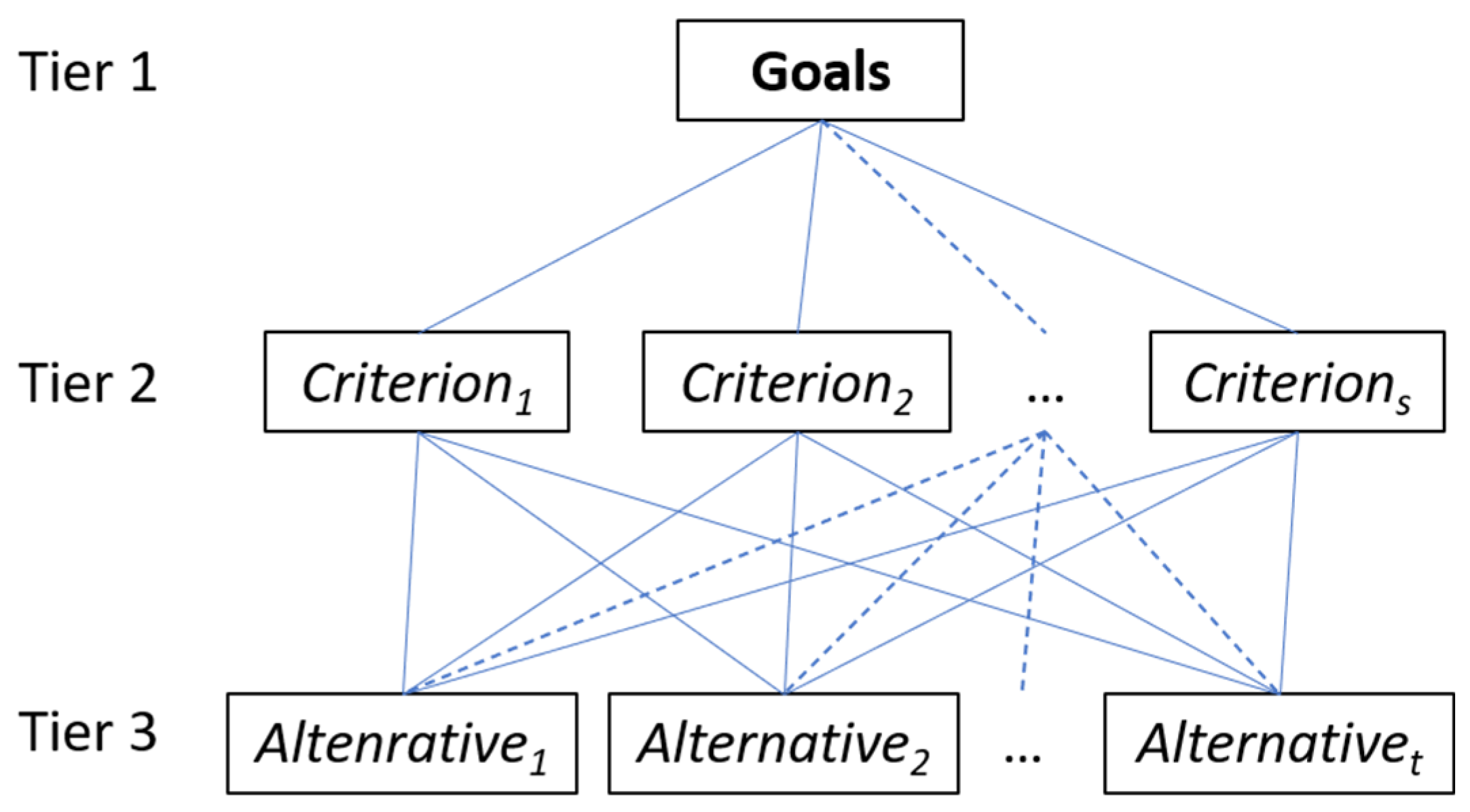
Figure 2.
Proposed framework for decision-making in a hybrid organization. Source: Author.
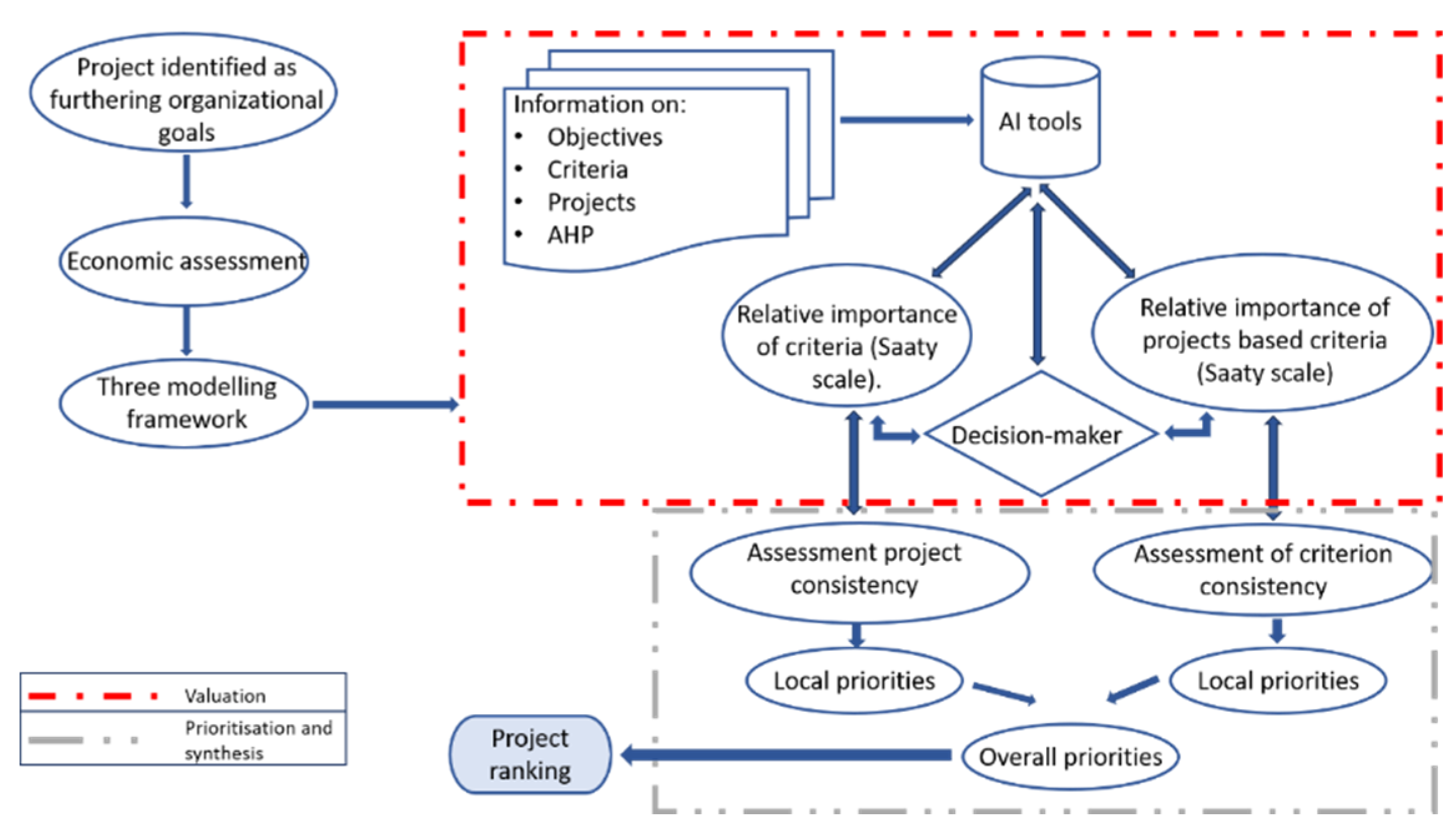
Table 1.
Random consistency index.
| n | 3 | 4 | 5 | 6 | 7 | 8 | 9 |
|---|---|---|---|---|---|---|---|
| RCI | 0.525 | 0.882 | 1.115 | 1.252 | 1.341 | 1.404 | 1.452 |
| n | 10 | 11 | 12 | 13 | 14 | 15 | 16 |
| RCI | 1.484 | 1.513 | 1.535 | 1.555 | 1.570 | 1.583 | 1.595 |
Source: [60].
Table 2.
Scale for pairwise comparison of elements.
| Numerical scale | Semantic scale | Meaning |
|---|---|---|
| 1 | Same importance | Both elements make a similar contribution to the criterion |
| 2 | Medium intensity between 1 and 3 | |
| 3 | One item is moderately more important than another |
Judgement and earlier experience favour one element over another |
| 4 | Medium intensity between 3 and 5 | |
| 5 | One item is significantly more important than another |
Judgement and earlier experience strongly favour one element over another |
| 6 | Medium intensity between 5 and 7 | |
| 7 | One item is much more important than another |
One element, proven in practice, dominates strongly |
| 8 | Medium intensity between 7 and 9 | |
| 9 | One item is very much more important than another |
One element dominates over the other with the greatest order or magnitude possible |
Note. Where the intensity of the relationship is the reverse of that specified, the scale is also ap-plied in reverse. For example, if the decision-maker decides that the first element is ‘much more important’ than the second element, then the level applied is 7. However, if the decision-maker decides that the second element is ‘much more important’ than the first element, then the level applied is 1/7. Source: Compiled by the author based on [55].
Table 3.
Relative importance of Naria’s criteria.
| Criterion | FW | JEDI | HR | CA | ESC | PSG | GACA |
|---|---|---|---|---|---|---|---|
| FW | 1 | 3 | 1/5 | 4 | 3 | 1/2 | 1/4 |
| JEDI | 1/3 | 1 | 1/7 | 2 | 2 | 1/3 | 1/5 |
| HR | 5 | 7 | 1 | 8 | 7 | 3 | 2 |
| CA | 1/4 | 1/2 | 1/8 | 1 | 1/2 | 1/4 | 1/6 |
| ESC | 1/3 | 1/2 | 1/7 | 2 | 1 | 1/3 | 1/5 |
| PSG | 2 | 3 | 1/3 | 4 | 3 | 1 | 1/3 |
| GACA | 4 | 5 | 1/2 | 6 | 5 | 3 | 1 |
Criteria are explained in Section 5.2. Source: Author.
Table 5.
Naria: Consistency ratio conditional on each criterion.
| Criterion | Consistency ratio |
|---|---|
| PSG | 0.027 |
| FW | 0.019 |
| JEDI | 0.015 |
| HR | 0.018 |
| CA | 0.009 |
| ESC | 0.009 |
| GACA | 0.013 |
Criteria are explained in Section 5.2. Source: Author.
Table 6.
Naria: Overall priorities and project ranking.
| Project | Overall priority | Project ranking |
|---|---|---|
| P1 | 0.272 | 2 |
| P2 | 0.335 | 1 |
| P3 | 0.215 | 3 |
| P4 | 0.085 | 5 |
| P5 | 0.081 | 6 |
Criteria are explained in Section 5.2. Source: Author.
Disclaimer/Publisher’s Note: The statements, opinions and data contained in all publications are solely those of the individual author(s) and contributor(s) and not of MDPI and/or the editor(s). MDPI and/or the editor(s) disclaim responsibility for any injury to people or property resulting from any ideas, methods, instructions or products referred to in the content. |
© 2026 by the authors. Licensee MDPI, Basel, Switzerland. This article is an open access article distributed under the terms and conditions of the Creative Commons Attribution (CC BY) license (http://creativecommons.org/licenses/by/4.0/).
Copyright: This open access article is published under a Creative Commons CC BY 4.0 license, which permit the free download, distribution, and reuse, provided that the author and preprint are cited in any reuse.