

Submitted:
17 September 2026
Posted:
18 September 2026
You are already at the latest version
Abstract
High-flow nasal cannula (HFNC) oxygen therapy is widely used in emergency, inten-sive care, perioperative, and procedural settings, but it is often conceptually assimilated to non-invasive positive pressure ventilation (NIPPV). This interpretation is physio-logically misleading. HFNC is an open high-flow oxygen system whose main effects derive from dead-space washout, improved stability of inspired oxygen fraction (FiO₂), heated humidification, patient comfort, and only modest flow-dependent positive airway pressure. Its open interface also facilitates eating, drinking, speaking, and se-cretion clearance. Clinical evidence supports HFNC mainly in selected patients with acute hypoxemic respiratory failure, where it may reduce intubation compared with conventional oxygen therapy. However, evidence is more heterogeneous in hypercap-nic respiratory failure, cardiogenic pulmonary edema, immunocompromised patients, obesity, and settings requiring substantial pressure support or ventilatory unloading. NIPPV or continuous positive airway pressure remain preferable when controlled positive pressure, alveolar recruitment, or ventilatory assistance are central to treat-ment. HFNC should therefore be regarded as optimized high-flow oxygen therapy rather than as “non-invasive ventilation through nasal prongs.” Recognizing this dis-tinction may improve patient selection, guide escalation, and avoid overinterpretation of its clinical effects.
Keywords:
high-flow nasal cannula
; HFNC
; respiratory failure
; oxygen therapy
; non-invasive respiratory support
; physiology
1. Introduction
High-flow nasal cannula (HFNC) oxygen therapy has progressively moved from a niche respiratory support technique to a widely used intervention in adult acute care [1]. It is now applied in emergency departments (EDs), intensive care units (ICUs), operating rooms, post-extubation pathways, peri-intubation management, and procedural sedation [2,3,4]. The appeal of HFNC is intuitive: it is easy to apply, generally well tolerated, and permits communication, oral intake, and secretion clearance while providing heated and humidified gas at high flow rates [5]. In the teaching material underlying this review, the device is presented as a system composed of a gas blender, flowmeter, humidifier, circuit, and nasal cannula or tracheostomy connector, with flows up to 60 L/min, fraction of inspired oxygen (FiO2) from 0.21 to 1, and gas heated and humidified to near-physiological conditions.
The clinical success of HFNC has also created conceptual ambiguity. HFNC is often grouped together with non-invasive positive pressure ventilation (NIPPV) and continuous positive airway pressure (CPAP) under the broad umbrella of “non-invasive respiratory support”. Its physiological profile differs substantially from pressure-based ventilatory modalities. This classification is practical but potentially misleading [6]. NIPPV and CPAP are pressure-based interventions. HFNC, by contrast, is an open high-flow oxygen system whose physiological effects are mediated mainly by washout of anatomical dead space, stabilization of FiO2, humidification, improved comfort, and only modest positive airway pressure.
This distinction matters because the clinical interpretation of HFNC is often overstated [7]. Improvement in oxygen saturation may be mistaken for resolution of respiratory failure. A modest increase in pharyngeal pressure may be described as clinically relevant positive end-expiratory pressure (PEEP) [8]. Reduced intubation rates compared with conventional oxygen therapy may be interpreted as evidence of equivalence to NIPPV [9]. These assumptions are physiologically problematic and may become clinically harmful if HFNC delays escalation in patients who require true ventilatory assistance.
The aim of this narrative review is to provide a physiology-oriented interpretation of HFNC in adult acute care. We discuss the main physiological mechanisms, summarize key supporting studies, integrate recent clinical evidence across major indications, and highlight persistent misconceptions that may affect bedside use.
2. Technical Characteristics of HFNC
HFNC systems deliver a heated and humidified gas mixture through large-bore nasal cannulas [10,11]. The clinician can independently set gas flow and FiO2, allowing a combination of high inspiratory flow delivery and controlled oxygen concentration. This differs from conventional low-flow oxygen devices, in which the effective FiO2 depends heavily on patient inspiratory flow, breathing pattern, minute ventilation, and room-air entrainment [10,11].
The technical ability to provide high flow is central to HFNC physiology [10,11]. When delivered flow approaches or exceeds patient inspiratory demand, entrainment of ambient air is reduced and the selected FiO2 more closely approximates the inspired FiO2. This mechanism is particularly relevant in tachypneic patients, whose peak inspiratory flow may far exceed the flow provided by standard nasal cannulas or simple face masks [10].
At the same time, HFNC remains an open system. The nasal prongs do not seal the airway, and gas can escape through the mouth and/or around the cannula. Therefore, pressure generation is not controlled in the same way as with NIPPV or CPAP. The airway pressure produced by HFNC depends on delivered flow, cannula size, nostril occlusion, mouth opening, patient anatomy, and respiratory pattern [11]. This technical feature explains why HFNC may generate measurable positive airway pressure without being equivalent to pressure-based ventilatory support (Figure 1).
3. Physiological Effects
3.1. Anatomical Dead-Space Washout
The most distinctive physiological effect of HFNC is washout of the upper-airway anatomical dead space [12]. Continuous high flow flushes carbon dioxide-rich gas from the nasopharynx during expiration, reducing rebreathing during the next inspiration [1,13]. This mechanism can improve ventilatory efficiency even when tidal volume and arterial carbon dioxide remain unchanged.
Itagaki et al. evaluated HFNC in critically ill adults and observed improved thoraco-abdominal synchrony, reduced respiratory rate, and reduced minute ventilation over a short observation period, while tidal volume and arterial partial pressure of CO2 (PaCO2) remained relatively stable [12]. This pattern is physiologically dominant. If PaCO2 remains stable while minute ventilation decreases, alveolar ventilation has likely been preserved despite lower total ventilation, implying a reduction in wasted ventilation.
This is one of the reasons why HFNC may be helpful in hypoxemic respiratory failure with tachypnea and high inspiratory demand. The device does not necessarily “ventilate” the patient in the way NIPPV does, but it may make spontaneous breathing more efficient by reducing rebreathing and improving the relationship between minute ventilation and alveolar ventilation.
3.2. Positive Airway Pressure Effect
HFNC can generate positive airway pressure, but the magnitude of this effect is limited and variable. Parke et al. showed that nasal high-flow therapy delivered low-level positive airway pressure in postoperative cardiac surgical patients [14]. At 35 L/min, nasopharyngeal pressure was higher with the mouth closed than with the mouth open, illustrating the importance of system leak and patient behavior.
Ritchie et al. similarly found that airway pressure increases with increasing flow, while Lampland et al. demonstrated flow-dependent pressure generation in a neonatal model [15,16]. These studies support the concept that HFNC can produce measurable distending pressure. However, the pressures reported are generally in the range of a few cmH2O and are not directly comparable with the controlled PEEP delivered by CPAP or NIPPV.
Corley et al. provided an important complementary observation by showing that HFNC increased end-expiratory lung volume and reduced respiratory rate in patients after cardiac surgery, using electrical impedance tomography as a surrogate of lung volume [17]. This suggests that even modest pressure and high-flow effects may influence lung volume and oxygenation. Nevertheless, it would be misleading to infer that HFNC provides the same recruitment, unloading, or pressure control as NIPPV.
The more accurate interpretation is that HFNC produces low-level, variable, flow-dependent pressure that may contribute to oxygenation and comfort but is insufficient to define the technique as non-invasive ventilation (Figure 2).
3.3. Stability of Inspired Oxygen Fraction
Another major advantage of HFNC is improved FiO2 stability. Wettstein et al. showed that delivered oxygen concentrations with low-flow nasal cannulas are variable and often lower than predicted, particularly during rapid breathing [18]. Ritchie et al. showed that, during nose breathing at rest, measured FiO2 with HFNC more closely approximated the set FiO2, particularly at higher flows [15].
This mechanism is clinically relevant because many patients with acute respiratory failure have high inspiratory flow demand. Conventional oxygen systems may deliver an apparently high oxygen concentration at the device level, while the patient inspires a substantially diluted mixture because of entrained room air. HFNC reduces this discrepancy by providing higher total flow and more predictable oxygen delivery.
3.4. Humidification and Airway Conditioning
HFNC also differs from conventional oxygen therapy because it provides heated and humidified gas. Cold and dry gas may worsen airway discomfort, impair mucociliary clearance, and increase airway resistance. Berk et al. showed that cold air can induce bronchoconstriction, while Fontanari et al. demonstrated changes in airway resistance during nasal inhalation of cold, dry, or moist air [19,20]. Salah et al. showed that nasal mucociliary transport is slower during dry-air breathing [21].
These physiological observations are often considered secondary, but they may be clinically central. Comfort, secretion clearance, and tolerance influence whether patients can remain on a therapy for prolonged periods. HFNC may therefore succeed not only because it improves gas exchange, but because patients tolerate it better than tight-fitting masks and dry oxygen systems.
4. Clinical Evidence
4.1. Acute Hypoxemic Respiratory Failure
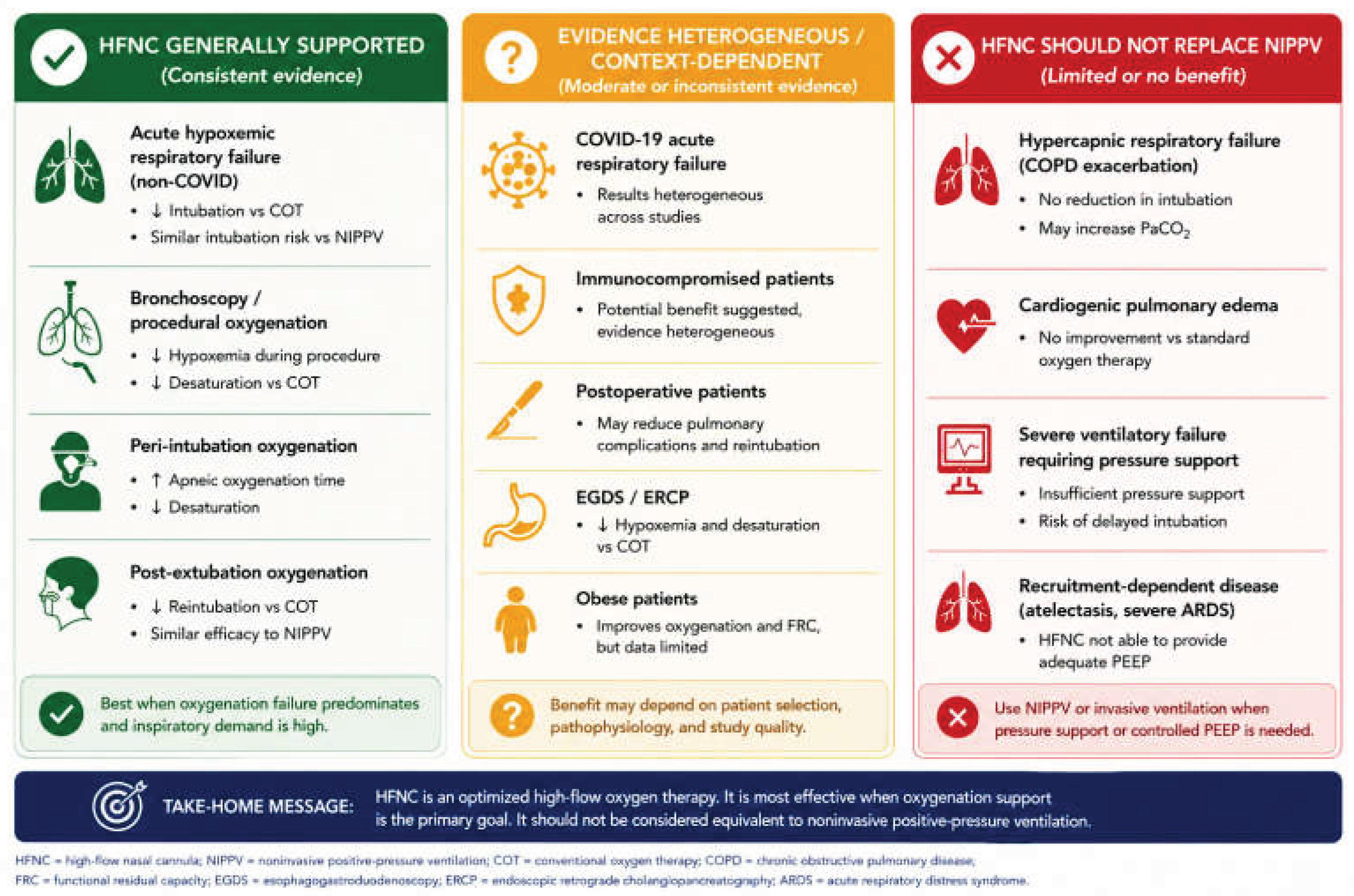
Acute hypoxemic respiratory failure is the setting in which HFNC has the strongest evidence base. Earlier systematic reviews suggested that HFNC may reduce intubation compared with conventional oxygen therapy, although mortality effects were less consistent [22,23]. More recent meta-analyses and network meta-analyses reinforced the concept that HFNC is superior to conventional oxygen therapy for some clinically relevant outcomes, while comparisons with NIPPV remain more nuanced [24,25]. The evidence-based clinical positioning of HFNC across major clinical settings is summarized in Figure 3.
The most recent and relevant evidence is the network meta-analysis by Lee et al., which included 44 randomized trials and 9704 patients with acute hypoxemic respiratory failure [26]. The authors compared CPAP, HFNC, and bilevel NIPPV with standard oxygen therapy and found that all three non-invasive respiratory supports probably reduce intubation. CPAP and HFNC may reduce mortality compared with standard oxygen therapy, but the certainty of evidence for mortality was low.
Recently, the SOHO trial provided contemporary randomized evidence in patients with acute hypoxemic respiratory failure [27]. Compared with standard oxygen therapy, HFNC reduced the need for endotracheal intubation, although no significant mortality benefit was observed. These findings reinforce the concept that HFNC is most effective when the primary therapeutic target is oxygenation support rather than ventilatory assistance.
This finding is crucial and should be interpreted physiologically. HFNC may be effective when the main problem is oxygenation failure with preserved or moderately increased work of breathing. It can improve FiO2 delivery, reduce dead-space rebreathing, and improve comfort. If the dominant problem is alveolar collapse, severe respiratory muscle load, or need for substantial pressure support, CPAP or NIPPV may be more physiologically appropriate.
4.2. Emergency Department Acute Respiratory Failure
Tinelli et al. evaluated HFNC in ED patients through systematic review and meta-analysis [28]. The evidence suggests that HFNC may be useful compared with conventional oxygen therapy in selected emergency presentations, but superiority over NIPPV is less certain.
HFNC in the ED is attractive because it can be applied rapidly, is well tolerated, and may stabilize oxygenation while diagnostic and therapeutic decisions are made. However, its ease of use should not obscure the need for early reassessment. Persistent tachypnea, high work of breathing, altered mental status, worsening gas exchange, or hemodynamic instability should prompt escalation rather than prolonged continuation of HFNC.
4.3. Viral and COVID-19 Acute Respiratory Failure
During the COVID-19 pandemic, HFNC became one of the most widely used non-invasive respiratory support strategies. Li et al. reported that HFNC reduced intubation in patients with COVID-19 acute respiratory failure, while Le Pape et al. focused on HFNC versus conventional oxygen therapy in COVID-19-related acute respiratory failure [29,30]. Carreño-Hernández et al. later synthesized evidence on non-invasive oxygenation and ventilation strategies for viral acute respiratory failure [31]. The overall interpretation is that HFNC is useful in selected patients with viral hypoxemic respiratory failure, particularly when oxygenation support and tolerance are priorities. However, COVID-19 also highlighted the danger of interpreting acceptable oxygen saturation as clinical stability. Patients may maintain oxygenation while respiratory effort remains high, potentially increasing the risk of delayed intubation or self-inflicted lung injury [32].
4.4. Hypercapnic Respiratory Failure
The evidence for HFNC in hypercapnic respiratory failure remains weaker than the others conditions [33,34]. The physiological rationale is plausible: dead-space washout may reduce rebreathing, humidification may improve secretion clearance, and comfort may improve tolerance. However, HFNC does not provide inspiratory pressure support and therefore cannot reliably replace NIPPV in patients with severe respiratory acidosis or marked ventilatory failure.
For this reason, HFNC should be considered cautiously in hypercapnic patients [33,34]. It may have a role when NIPPV is not tolerated, during breaks from NIPPV, or in mild hypercapnia without severe acidosis [33]. It should not be presented as equivalent to NIPPV in acute exacerbations of chronic obstructive pulmonary disease with significant acidosis.
4.5. Cardiogenic Pulmonary Edema
In acute cardiogenic pulmonary edema, the physiological target is not simply oxygen therapy. CPAP and NIPPV improve oxygenation while reducing preload and afterload, recruiting alveoli, and decreasing work of breathing through meaningful positive pressure [35]. HFNC may improve comfort and oxygenation but does not provide comparable pressure effects [36].
Therefore, HFNC may be reasonable in selected patients who do not tolerate masks or have milder forms of respiratory distress, but it should not replace CPAP or NIPPV when positive pressure is central to the therapeutic mechanism [36].
4.6. Post-Extubation Support
Several papers evaluated non-invasive respiratory support strategies after extubation and in relation to spontaneous breathing trial techniques [37,38,39]. These meta-analyses support the role of HFNC in selected post-extubation patients, especially when compared with conventional oxygen therapy.
However, NIPPV remains the priority in patients at very high risk of extubation failure, particularly those with hypercapnia, chronic respiratory disease, obesity with recruitment need, or overt respiratory muscle weakness. HFNC may improve oxygenation and tolerance, but NIPPV provides ventilatory unloading that HFNC cannot reproduce.
4.7. Immunocompromised Patients
Azoulay et al. tested HFNC versus standard oxygen therapy in immunocompromised patients with acute respiratory failure in the HIGH randomized clinical trial [40]. The trial did not demonstrate a clear 28-day mortality benefit.
This setting illustrates the difference between physiological plausibility and outcome efficacy. HFNC may be better tolerated and may improve oxygenation, but these advantages do not necessarily translate into survival benefit in complex populations whose outcomes are driven by severity of underlying disease, immune status, infection, and organ failure.
4.8. Preoxygenation and Peri-Intubation Management
HFNC has been evaluated for preoxygenation before intubation. Fong et al performed a network meta-analysis of preoxygenation strategies in adults with acute hypoxemic respiratory failure [41]. HFNC may be attractive because it allows apneic oxygenation and can remain in place during laryngoscopy. However, in patients with severe shunt physiology or very high work of breathing, NIPPV may provide superior recruitment before induction [41].
Thus, HFNC may be useful for selected patients, but it should not be assumed to be the best preoxygenation strategy in all forms of severe hypoxemia, such as the obese patients.
4.9. Postoperative Patients and Obesity
Some meta-analyses evaluated HFNC in the immediate postoperative period [42,43]. HFNC may reduce escalation of respiratory support or improve oxygenation compared with conventional oxygen therapy in selected postoperative patients, particularly when comfort and secretion clearance are important.
In obese patients, however, the situation is more complex. Two studies evaluated non-invasive respiratory support strategies after extubation or surgery in obese patients [44,45]. Because obesity is associated with reduced functional residual capacity, atelectasis, and increased recruitment needs, NIPPV or CPAP may be more physiologically appropriate when meaningful distending pressure is required.
4.10. Procedural Sedation, Endoscopy, and Bronchoscopy
HFNC may reduce hypoxemia during selected procedures, including gastrointestinal endoscopy, bronchoscopy, and procedural sedation [46,47,48,49,50]. The likely mechanisms are stable oxygen delivery, high-flow reservoir effect, and apneic oxygenation. Figure 3 summarizes this evidence as generally favorable for bronchoscopy and probably favorable for upper gastrointestinal endoscopy, although not uniformly consistent across meta-analyses.
4.11. Extra-Corporeal Membrane Oxygenation
HFNC may be used as an adjunctive oxygenation strategy during awake or extubated VV-ECMO, mainly to maintain upper-airway oxygen delivery, improve comfort, and facilitate avoidance of invasive ventilation [51]. However, available evidence is mainly observational and derives from broader awake-ECMO strategies rather than from studies specifically designed to evaluate HFNC itself. Observational cohorts, case series, and narrative reviews suggest that HFNC may facilitate spontaneous breathing, communication, and mobilization during awake VV-ECMO, but no robust comparative evidence demonstrates improved patient-centered outcomes attributable specifically to HFNC [52,53,54].
5. Complications and Safety
HFNC is generally well tolerated. Common adverse effects include nasal discomfort, abdominal distension, and dryness when humidification is inadequate. Lazovic et al. reviewed unusual complications of NIPPV and HFNC, including rare reports of barotrauma [55].
The most important safety concern is not direct device toxicity but delayed escalation. HFNC can improve oxygen saturation while respiratory effort remains high [56]. This dissociation may create false reassurance. Clinical monitoring should therefore include respiratory rate, accessory muscle use, mental status, gas exchange, hemodynamics, and trajectory over time, not oxygen saturation alone.
6. Common Misconceptions About HFNC
The first misconception is that HFNC is a form of NIPPV. HFNC is an open high-flow oxygen system, whereas NIPPV is a pressure-targeted ventilatory support strategy [57].
The second misconception is that HFNC provides clinically meaningful PEEP. HFNC can generate positive airway pressure, but the magnitude is modest and variable. The pressure depends on flow, mouth closure, cannula fit, and patient anatomy [13,14]. It should not be equated with set PEEP.
The third misconception is that improved SpO2 means respiratory failure is resolving. Oxygenation can improve while respiratory effort remains excessive [32].
In such cases, HFNC may conceal clinical deterioration rather than reverse it.
The fourth misconception is that reduction in intubation implies mortality benefit or equivalence to NIPPV [58]. The recent network meta-analysis by Lee et al. suggests that HFNC may reduce mortality compared with standard oxygen therapy, but certainty is low and the finding should not be extrapolated to all populations or interpreted as physiological equivalence to NIPPV [26].
7. Limitations of This Review
This article is a narrative, physiology-oriented review and should not be interpreted as a formal systematic review or guideline document. We did not perform a systematic search, risk-of-bias assessment, or quantitative evidence synthesis. However, for each clinical setting, we sought to preferentially discuss the highest available level of evidence, particularly systematic reviews, meta-analyses, and network meta-analyses when available. The interpretation of HFNC across clinical settings therefore reflects an integration of physiological rationale and the best available aggregated clinical evidence, rather than a formal grading process.
8. Conclusions
Given its low cost, simplicity, and excellent tolerability, HFNC is often an appropriate first-line strategy when oxygenation support is the primary goal. Nevertheless, HFNC should not become a destination therapy: if the expected physiological response is not observed within approximately 1–2 hours, escalation to NIPPV or invasive ventilation should be actively considered according to the underlying pathophysiology and clinical trajectory.
Author Contributions
DO and FM conceived the article. DO wrote the first draft of the manuscript. AB, ML, OS, IC, NF, and GDR critically revised the manuscript for important intellectual content. All authors contributed to manuscript development, approved the final version, and agree to be accountable for all aspects of the work.
Funding
This research received no external funding.
Institutional Review Board Statement
Not applicable.
Informed Consent Statement
Not applicable.
Data Availability Statement
Not applicable.
Acknowledgments
In this section, you can acknowledge any support given which is not covered by the author contribution or funding sections. This may include administrative and technical support, or donations in kind (e.g., materials used for experiments). Where GenAI has been used for purposes such as generating text, data, or graphics, or for study design, data collection, analysis, or interpretation of data, please add “During the preparation of this manuscript/study, the author(s) used [tool name, version information] for the purposes of [description of use]. The authors have reviewed and edited the output and take full responsibility for the content of this publication.”
Conflicts of Interest
The authors declare no conflicts of interest.
Abbreviations
The following abbreviations are used in this manuscript:
| Abbreviation | Full term |
| ARDS | Acute respiratory distress syndrome |
| COPD | Chronic obstructive pulmonary disease |
| COT | Conventional oxygen therapy |
| CPAP | Continuous positive airway pressure |
| ECMO | Extracorporeal membrane oxygenation |
| ED | Emergency department |
| EGDS | Esophagogastroduodenoscopy |
| ERCP | Endoscopic retrograde cholangiopancreatography |
| FiO2 | Fraction of inspired oxygen |
| FRC | Functional residual capacity |
| HFNC | High-flow nasal cannula |
| ICU | Intensive care unit |
| NIPPV | Noninvasive positive-pressure ventilation |
| PaCO2 | Arterial partial pressure of carbon dioxide |
| PEEP | Positive end-expiratory pressure |
| SpO2 | Peripheral oxygen saturation |
| VV-ECMO | Veno-venous extracorporeal membrane oxygenation |
References
- Nishimura, M. High-Flow Nasal Cannula Oxygen Therapy in Adults: Physiological Benefits, Indication, Clinical Benefits, and Adverse Effects. Respir. Care 2016, 61(4), 529–41. [Google Scholar] [CrossRef] [PubMed]
- Kang, Y.; Jung, H.M.; Chung, S.P.; Chung, H.S.; Cho, Y. Failure Prediction of High-Flow Nasal Cannula at the Conventional Oxygen Therapy Phase in the Emergency Department. Respiration 2024, 103(8), 488–495. [Google Scholar] [CrossRef] [PubMed]
- Frat, J.P.; Ricard, J.D.; Coudroy, R.; Robert, R.; Ragot, S.; Thille, A.W. on-behalf-of REVA network. Preoxygenation with non-invasive ventilation versus high-flow nasal cannula oxygen therapy for intubation of patients with acute hypoxaemic respiratory failure in ICU: the prospective randomised controlled FLORALI-2 study protocol. BMJ Open 2017, 7(12), e018611. [Google Scholar] [CrossRef] [PubMed] [PubMed Central]
- Al-Husinat, L.; Jouryyeh, B.; Rawashdeh, A.; Alenaizat, A.; Abushehab, M.; Amir, M.W.; Al Modanat, Z.; Battaglini, D.; Cinnella, G. High-Flow Oxygen Therapy in the Perioperative Setting and Procedural Sedation: A Review of Current Evidence. J. Clin. Med. 2023, 12(20), 6685. [Google Scholar] [CrossRef] [PubMed] [PubMed Central]
- Drake, M.G. High-Flow Nasal Cannula Oxygen in Adults: An Evidence-based Assessment. Ann. Am. Thorac. Soc. 2018, 15(2), 145–155. [Google Scholar] [CrossRef] [PubMed]
- Oczkowski, S.; Ergan, B.; Bos, L.; Chatwin, M.; Ferrer, M.; Gregoretti, C.; Heunks, L.; Frat, J.P.; Longhini, F.; Nava, S.; Navalesi, P.; Ozsancak Uğurlu, A.; Pisani, L.; Renda, T.; Thille, A.W.; Winck, J.C.; Windisch, W.; Tonia, T.; Boyd, J.; Sotgiu, G.; Scala, R. ERS clinical practice guidelines: high-flow nasal cannula in acute respiratory failure. Eur. Respir. J. 2022, 59(4), 2101574. [Google Scholar] [CrossRef] [PubMed]
- Rochwerg, B.; Einav, S.; Chaudhuri, D.; Mancebo, J.; Mauri, T.; Helviz, Y.; Goligher, E.C.; Jaber, S.; Ricard, J.D.; Rittayamai, N.; Roca, O.; Antonelli, M.; Maggiore, S.M.; Demoule, A.; Hodgson, C.L.; Mercat, A.; Wilcox, M.E.; Granton, D.; Wang, D.; Azoulay, E.; Ouanes-Besbes, L.; Cinnella, G.; Rauseo, M.; Carvalho, C.; Dessap-Mekontso, A.; Fraser, J.; Frat, J.P.; Gomersall, C.; Grasselli, G.; Hernandez, G.; Jog, S.; Pesenti, A.; Riviello, E.D.; Slutsky, A.S.; Stapleton, R.D.; Talmor, D.; Thille, A.W.; Brochard, L.; Burns, K.E.A. The role for high flow nasal cannula as a respiratory support strategy in adults: a clinical practice guideline. Intensive Care Med. 2020, 46(12), 2226–2237. [Google Scholar] [CrossRef] [PubMed] [PubMed Central]
- Onodera, Y.; Yarimizu, K.; Hayasaka, T.; Kawamae, K.; Nakane, M. Newly innovated system to generate adjustable PEEP with a high-flow nasal cannula. Intensive Care Med. Exp. 2024, 12(1), 43. [Google Scholar] [CrossRef] [PubMed] [PubMed Central]
- Zhao, H.; Wang, H.; Sun, F.; Lyu, S.; An, Y. High-flow nasal cannula oxygen therapy is superior to conventional oxygen therapy but not to noninvasive mechanical ventilation on intubation rate: a systematic review and meta-analysis. Crit. Care 2017, 21(1), 184. [Google Scholar] [CrossRef] [PubMed] [PubMed Central]
- Nishimura, M. High-flow nasal cannula oxygen therapy in adults. J. Intensive Care 2015, 3(1), 15. [Google Scholar] [CrossRef] [PubMed] [PubMed Central]
- Nishimura, M. High-Flow Nasal Cannula Oxygen Therapy Devices. Respir. Care 2019, 64(6), 735–742. [Google Scholar] [CrossRef] [PubMed]
- Itagaki, T.; Okuda, N.; Tsunano, Y.; Kohata, H.; Nakataki, E.; Onodera, M.; Imanaka, H.; Nishimura, M. Effect of high-flow nasal cannula on thoraco-abdominal synchrony in adult critically ill patients. Respir. Care 2014, 59(1), 70–4. [Google Scholar] [CrossRef] [PubMed]
- Li, J.; Albuainain, F.A.; Tan, W.; Scott, J.B.; Roca, O.; Mauri, T. The effects of flow settings during high-flow nasal cannula support for adult subjects: a systematic review. Crit. Care 2023, 27(1), 78. [Google Scholar] [CrossRef] [PubMed] [PubMed Central]
- Parke, R.; McGuinness, S.; Eccleston, M. Nasal high-flow therapy delivers low level positive airway pressure. Br. J. Anaesth. 2009, 103(6), 886–90. [Google Scholar] [CrossRef] [PubMed] [PubMed Central]
- Ritchie, J.E.; Williams, A.B.; Gerard, C.; Hockey, H. Evaluation of a humidified nasal high-flow oxygen system, using oxygraphy, capnography and measurement of upper airway pressures. Anaesth. Intensive Care 2011, 39(6), 1103–10. [Google Scholar] [PubMed]
- Lampland, A.L.; Plumm, B.; Meyers, P.A.; Worwa, C.T.; Mammel, M.C. Observational study of humidified high-flow nasal cannula compared with nasal continuous positive airway pressure. J. Pediatr. 2009, 154(2), 177–82. [Google Scholar] [CrossRef] [PubMed]
- Corley, A.; Caruana, L.R.; Barnett, A.G.; Tronstad, O.; Fraser, J.F. Oxygen delivery through high-flow nasal cannulae increase end-expiratory lung volume and reduce respiratory rate in post-cardiac surgical patients. Br. J. Anaesth. 2011, 107(6), 998–1004. [Google Scholar] [CrossRef] [PubMed]
- Wettstein, R.B.; Shelledy, D.C.; Peters, J.I. Delivered oxygen concentrations using low-flow and high-flow nasal cannulas. Respir. Care 2005, 50(5), 604–9. [Google Scholar] [CrossRef] [PubMed]
- Berk, J.L.; Lenner, K.A.; McFadden, E.R., Jr. Cold-induced bronchoconstriction: role of cutaneous reflexes vs. direct airway effects. J. Appl. Physiol. (1985) 1987, 63(2), 659–64. [Google Scholar] [CrossRef] [PubMed]
- Fontanari, P.; Burnet, H.; Zattara-Hartmann, M.C.; Jammes, Y. Changes in airway resistance induced by nasal inhalation of cold dry, dry, or moist air in normal individuals. J. Appl. Physiol. (1985) 1996, 81(4), 1739–43. [Google Scholar] [CrossRef] [PubMed]
- Salah, B.; Dinh Xuan, A.T.; Fouilladieu, J.L.; Lockhart, A.; Regnard, J. Nasal mucociliary transport in healthy subjects is slower when breathing dry air. Eur. Respir. J. 1988, 1(9), 852–5. [Google Scholar] [CrossRef] [PubMed]
- Rochwerg, B.; Granton, D.; Wang, D.X.; Helviz, Y.; Einav, S.; Frat, J.P.; Mekontso-Dessap, A.; Schreiber, A.; Azoulay, E.; Mercat, A.; Demoule, A.; Lemiale, V.; Pesenti, A.; Riviello, E.D.; Mauri, T.; Mancebo, J.; Brochard, L.; Burns, K. High flow nasal cannula compared with conventional oxygen therapy for acute hypoxemic respiratory failure: a systematic review and meta-analysis. Intensive Care Med. Epub. 2019, 45(5), 563–572. [Google Scholar] [CrossRef] [PubMed]
- Lewis, S.R.; Baker, P.E.; Parker, R.; Smith, A.F. High-flow nasal cannulae for respiratory support in adult intensive care patients. Cochrane Database Syst. Rev. 2021, 3(3), CD010172. [Google Scholar] [CrossRef] [PubMed] [PubMed Central]
- Chaudhuri, D.; Trivedi, V.; Lewis, K.; Rochwerg, B. High-Flow Nasal Cannula Compared With Noninvasive Positive Pressure Ventilation in Acute Hypoxic Respiratory Failure: A Systematic Review and Meta-Analysis. Crit. Care Explor 2023, 5(4), e0892. [Google Scholar] [CrossRef] [PubMed] [PubMed Central]
- Pitre, T.; Zeraatkar, D.; Kachkovski, G.V.; Leung, G.; Shligold, E.; Dowhanik, S.; Angriman, F.; Ferreyro, B.L.; Scales, D.C.; Rochwerg, B. Noninvasive Oxygenation Strategies in Adult Patients With Acute Hypoxemic Respiratory Failure: A Systematic Review and Network Meta-Analysis. Chest Epub. 2023, 164(4), 913–928. [Google Scholar] [CrossRef] [PubMed]
- Lee, K.G.; Hopkins, M.; Couban, R.; Kattakkayam, T.; Reardon, P.M.; Tomlinson, G.; Pitre, T.; Rochwerg, B.; Yarnell, C.J. Non-invasive respiratory supports and criteria for intubation in randomised trials of acute hypoxaemic respiratory failure: a systematic review and network meta-analysis. Lancet Respir. Med. Epub ahead of print. 2026, S2213-2600((26)00039-1). [Google Scholar] [CrossRef] [PubMed]
- Frat, J.P.; Quenot, J.P.; Guitton, C.; Coudroy, R.; Gacouin, A.; Badie, J.; Demoule, A.; Contou, D.; Carteaux, G.; Ehrmann, S.; Jarousseau, F.; Sedillot, N.; Rigaud, J.P.; Reignier, J.; Beloncle, F.; Dureau, A.F.; Ferré, A.; Daubin, C.; Bourreau, A.; Delbove, A.; Pradel, G.; Fatah, A.; Colin, G.; Deniel, G.; Lamouret, O.; La Combe, B.; Prat, G.; Galerneau, L.M.; Bourdin, G.; Julien, G.; Curtiaud, A.; Saint-Léger, M.; Turbil, E.; Reynaud, F.; Chamblet, L.; Ragot, S.; Thille, A.W. SOHO Trial Group and the REVA Network. High-Flow or Standard Oxygen in Acute Hypoxemic Respiratory Failure. N Engl. J. Med. Epub. 2026, 394(21), 2095–2106. [Google Scholar] [CrossRef] [PubMed]
- Tinelli, V.; Cabrini, L.; Fominskiy, E.; Franchini, S.; Ferrante, L.; Ball, L.; Pelosi, P.; Landoni, G.; Zangrillo, A.; Secchi, A. High Flow Nasal Cannula Oxygen vs. Conventional Oxygen Therapy and Noninvasive Ventilation in Emergency Department Patients: A Systematic Review and Meta-Analysis. J. Emerg. Med. Epub. 2019, 57(3), 322–328. [Google Scholar] [CrossRef] [PubMed]
- Li, Y.; Li, C.; Chang, W.; Liu, L. High-flow nasal cannula reduces intubation rate in patients with COVID-19 with acute respiratory failure: a meta-analysis and systematic review. BMJ Open 2023, 13(3), e067879. [Google Scholar] [CrossRef] [PubMed] [PubMed Central]
- Le Pape, S.; Savart, S.; Arrivé, F.; Frat, J.P.; Ragot, S.; Coudroy, R.; Thille, A.W. High-flow nasal cannula oxygen versus conventional oxygen therapy for acute respiratory failure due to COVID-19: a systematic review and meta-analysis. Ann. Intensive Care 2023, 13(1), 114. [Google Scholar] [CrossRef] [PubMed] [PubMed Central]
- Carreño-Hernández, F.L.; Prieto, S.; Abondando, D.; Gaitán, J.A.; Cárdenas-Bolívar, Y.R.; Beltrán, A.; Alvarado-Sánchez, J.I.; Nates, J.L. Noninvasive oxygenation and ventilation strategies for viral acute respiratory failure: a comprehensive systematic review and meta-analysis. Syst. Rev. 2025, 14(1), 33. [Google Scholar] [CrossRef] [PubMed] [PubMed Central]
- Gattinoni, L.; Gattarello, S.; Steinberg, I.; Busana, M.; Palermo, P.; Lazzari, S.; Romitti, F.; Quintel, M.; Meissner, K.; Marini, J.J.; Chiumello, D.; Camporota, L. COVID-19 pneumonia: pathophysiology and management. Eur. Respir. Rev. 2021, 30(162), 210138. [Google Scholar] [CrossRef] [PubMed] [PubMed Central]
- Ovtcharenko, N.; Ho, E.; Alhazzani, W.; Cortegiani, A.; Ergan, B.; Scala, R.; Sotgiu, G.; Chaudhuri, D.; Oczkowski, S.; Lewis, K. High-flow nasal cannula versus non-invasive ventilation for acute hypercapnic respiratory failure in adults: a systematic review and meta-analysis of randomized trials. Crit. Care 2022, 26(1), 348. [Google Scholar] [CrossRef] [PubMed] [PubMed Central]
- Huang, X.; Du, Y.; Ma, Z.; Zhang, H.; Jun, L.; Wang, Z.; Lin, M.; Ni, F.; Li, X.; Tan, H.; Tan, S. High-flow nasal cannula oxygen versus conventional oxygen for hypercapnic chronic obstructive pulmonary disease: A meta-analysis of randomized controlled trials. Clin. Respir. J. 2021, 15(4), 437–444. [Google Scholar] [CrossRef] [PubMed]
- Hieda, M. Noninvasive Positive Pressure Ventilation for Acute Decompensated Heart Failure. Heart Fail Clin. 2020, 16(3), 271–282. [Google Scholar] [CrossRef] [PubMed]
- Altunbas, E.; Bayram, N.; Unal, E.; Ozpolat, C.; Karacabey, S.; Akoglu, H.; Denizbasi, A. Is high-flow nasal oxygen as effective as non-invasive ventilation in acute cardiogenic pulmonary Edema? Am. J. Emerg. Med. Epub. 2025, 98, 93–99. [Google Scholar] [CrossRef] [PubMed]
- Fernando, S.M.; Tran, A.; Sadeghirad, B.; Burns, K.E.A.; Fan, E.; Brodie, D.; Munshi, L.; Goligher, E.C.; Cook, D.J.; Fowler, R.A.; Herridge, M.S.; Cardinal, P.; Jaber, S.; Møller, M.H.; Thille, A.W.; Ferguson, N.D.; Slutsky, A.S.; Brochard, L.J.; Seely, A.J.E.; Rochwerg, B. Noninvasive respiratory support following extubation in critically ill adults: a systematic review and network meta-analysis. Intensive Care Med. Epub. 2022, 48(2), 137–147. [Google Scholar] [CrossRef] [PubMed]
- Zheng, X.; Wang, R.; Giri, M.; Duan, J.; Ma, M.; Guo, S. Efficacy of preventive use of oxygen therapy after planned extubation in high-risk patients with extubation failure: A network meta-analysis of randomized controlled trials. Front Med. 2022, 9, 1026234. [Google Scholar] [CrossRef] [PubMed] [PubMed Central]
- Burns, K.E.A.; Sadeghirad, B.; Ghadimi, M.; Khan, J.; Phoophiboon, V.; Trivedi, V.; Gomez Builes, C.; Giammarioli, B.; Lewis, K.; Chaudhuri, D.; Desai, K.; Friedrich, J.O. Comparative effectiveness of alternative spontaneous breathing trial techniques: a systematic review and network meta-analysis of randomized trials. Crit. Care 2024, 28(1), 194. [Google Scholar] [CrossRef] [PubMed] [PubMed Central]
- Azoulay, E.; Lemiale, V.; Mokart, D.; Nseir, S.; Argaud, L.; Pène, F.; Kontar, L.; Bruneel, F.; Klouche, K.; Barbier, F.; Reignier, J.; Berrahil-Meksen, L.; Louis, G.; Constantin, J.M.; Mayaux, J.; Wallet, F.; Kouatchet, A.; Peigne, V.; Théodose, I.; Perez, P.; Girault, C.; Jaber, S.; Oziel, J.; Nyunga, M.; Terzi, N.; Bouadma, L.; Lebert, C.; Lautrette, A.; Bigé, N.; Raphalen, J.H.; Papazian, L.; Darmon, M.; Chevret, S.; Demoule, A. Effect of High-Flow Nasal Oxygen vs Standard Oxygen on 28-Day Mortality in Immunocompromised Patients With Acute Respiratory Failure: The HIGH Randomized Clinical Trial. JAMA 2018, 320(20), 2099–2107. [Google Scholar] [CrossRef] [PubMed] [PubMed Central]
- Fong, K.M.; Au, S.Y.; Ng, G.W.Y. Preoxygenation before intubation in adult patients with acute hypoxemic respiratory failure: a network meta-analysis of randomized trials. Crit. Care 2019, 23(1), 319. [Google Scholar] [CrossRef] [PubMed] [PubMed Central]
- Lu, Z.; Chang, W.; Meng, S.S.; Zhang, X.; Xie, J.; Xu, J.Y.; Qiu, H.; Yang, Y.; Guo, F. Effect of high-flow nasal cannula oxygen therapy compared with conventional oxygen therapy in postoperative patients: a systematic review and meta-analysis. BMJ Open 2019, 9(8), e027523. [Google Scholar] [CrossRef] [PubMed] [PubMed Central]
- Chaudhuri, D.; Granton, D.; Wang, D.X.; Burns, K.E.A.; Helviz, Y.; Einav, S.; Trivedi, V.; Mauri, T.; Ricard, J.D.; Mancebo, J.; Frat, J.P.; Jog, S.; Hernandez, G.; Maggiore, S.M.; Mbuagbaw, L.; Hodgson, C.L.; Jaber, S.; Goligher, E.C.; Brochard, L.; Rochwerg, B. High-Flow Nasal Cannula in the Immediate Postoperative Period: A Systematic Review and Meta-analysis. Chest 2020, 158(5), 1934–1946. [Google Scholar] [CrossRef] [PubMed]
- Pensier, J.; Naudet-Lasserre, A.; Monet, C.; Capdevila, M.; Aarab, Y.; Lakbar, I.; Chanques, G.; Molinari, N.; De Jong, A.; Jaber, S. Noninvasive respiratory support following extubation in critically ill adults with obesity: a systematic review and network meta-analysis. EClinicalMedicine 2024, 79, 103002. [Google Scholar] [CrossRef] [PubMed] [PubMed Central]
- Li, R.; Liu, L.; Wei, K.; Zheng, X.; Zeng, J.; Chen, Q. Effect of noninvasive respiratory support after extubation on postoperative pulmonary complications in obese patients: A systematic review and network meta-analysis. J. Clin. Anesth. Epub 2023 Oct 4. 2023, 91, 111280. [Google Scholar] [CrossRef] [PubMed]
- Zhang, Y.X.; He, X.X.; Chen, Y.P.; Yang, S. The effectiveness of high-flow nasal cannula during sedated digestive endoscopy: a systematic review and meta-analysis. Eur. J. Med. Res. 2022, 27(1), 30. [Google Scholar] [CrossRef] [PubMed] [PubMed Central]
- Doulberis, M.; Sampsonas, F.; Papaefthymiou, A.; Karamouzos, V.; Lagadinou, M.; Karampitsakos, T.; Stratakos, G.; Kuntzen, T.; Tzouvelekis, A. High-flow versus conventional nasal cannula oxygen supplementation therapy and risk of hypoxia in gastrointestinal endoscopies: a systematic review and meta-analysis. Expert Rev. Respir. Med. Epub. 2022, 16(3), 323–332. [Google Scholar] [CrossRef] [PubMed]
- Wang, J.; Tan, W.; Luo, J.; Qin, H.; Wang, R.; Zhang, W.; Longhini, F.; Irfan, M.; Zhou, H.; Song, X.; Zhang, W.; Li, J. High flow nasal cannula versus conventional oxygen therapy during bronchoscopy: A systematic review and individual participant data meta-analysis. Pulmonology Epub 2026 Jan 14. 2026, 32(1), 2613485. [Google Scholar] [CrossRef] [PubMed]
- Wang, W.; Zhang, P.; Xu, T.; Guo, H.; Zhu, S.; Yao, X. Efficacy of high-flow nasal cannula versus conventional oxygen therapy in high-risk patients undergoing bronchoscopy: a meta-analysis of RCTs. Respir. Med. 2026, 255, 108664. [Google Scholar] [CrossRef] [PubMed]
- Shukla, K.; Parikh, B.; Kumar, A.; Nakra, M. Comparative evaluation of efficacy of oxygenation using high flow nasal cannula vs. conventional nasal cannula during procedural sedation for endoscopic ultrasound: A pilot study. J. Anaesthesiol. Clin. Pharmacol. 2021, 37(4), 648–654. [Google Scholar] [CrossRef] [PubMed] [PubMed Central]
- Paternoster, G.; Bertini, P.; Belletti, A.; Landoni, G.; Gallotta, S.; Palumbo, D.; Isirdi, A.; Guarracino, F. Venovenous Extracorporeal Membrane Oxygenation in Awake Non-Intubated Patients With COVID-19 ARDS at High Risk for Barotrauma. J. Cardiothorac. Vasc. Anesth. Epub. 2022, 36 8 Pt B, 2975–2982. [Google Scholar] [CrossRef] [PubMed] [PubMed Central]
- Yu, X.; Gu, S.; Li, M.; Zhan, Q. Awake Extracorporeal Membrane Oxygenation for Acute Respiratory Distress Syndrome: Which Clinical Issues Should Be Taken Into Consideration. Front Med. 2021, 8, 682526. [Google Scholar] [CrossRef] [PubMed] [PubMed Central]
- Sklienka, P.; Burša, F.; Frelich, M.; Máca, J.; Vodička, V.; Straková, H.; Bílená, M.; Romanová, T.; Tomášková, H. Optimizing the safety and efficacy of the awake venovenous extracorporeal membrane oxygenation in patients with COVID-19-related ARDS. Ther. Adv. Respir. Dis. 2024, 18, 17534666241282590. [Google Scholar] [CrossRef] [PubMed] [PubMed Central]
- Mang, S.; Reyher, C.; Mutlak, H.; Natanov, R.; Lotz, C.; Gill-Schuster, D.; Bals, R.; Danziger, G.; Meybohm, P.; Combes, A.; Kühn, C.; Lepper, P.M.; Muellenbach, R.M. AWECO-Study Group. Awake Extracorporeal Membrane Oxygenation for COVID-19-induced Acute Respiratory Distress Syndrome. Am. J. Respir. Crit. Care Med. 2022, 205(7), 847–851. [Google Scholar] [CrossRef] [PubMed] [PubMed Central]
- Lazovic, B.; Dmitrovic, R.; Simonovic, I.; Esqoinas, A.; Mina, B.; Zack, S. Unusual complications of non-invasive mechanical ventilation (NIV) and high-flow nasal cannula (HFNC): A systematic review. Tuberk. Toraks;English 2022, 70(2), 197–202. [Google Scholar] [CrossRef] [PubMed]
- Roca, O.; Li, J.; Mauri, T. High-flow nasal cannula: evolving practices and novel clinical and physiological insights. Intensive Care Med. 2024, 50(5), 758–761. [Google Scholar] [CrossRef] [PubMed]
- Lu, X.; Miller, M.; Pearce, A.K.; Lam, J.Y.; Boussina, A.E.; Zheng, K.; Malhotra, A.; Nemati, S. Comparing high-flow nasal cannula and non-invasive ventilation in critical care: insights from deep counterfactual inference. npj Health Syst. 2025, 2(1), 45. [Google Scholar] [CrossRef] [PubMed] [PubMed Central]
- Yasuda, H.; Okano, H.; Mayumi, T.; Nakane, M.; Shime, N. Association of noninvasive respiratory support with mortality and intubation rates in acute respiratory failure: a systematic review and network meta-analysis. J. Intensive Care 2021, 9(1), 32. [Google Scholar] [CrossRef] [PubMed] [PubMed Central]
Figure 1.
Schematic overview of the technical components and principal physiological mechanisms of high-flow nasal cannula (HFNC). HFNC delivers heated and humidified gas at high flow rates with a set fraction of inspired oxygen (FiO2). Its principal effects include upper-airway dead-space washout, more stable FiO2 delivery, humidification, and low-level, flow-dependent positive airway pressure, which is not equivalent to the controlled pressure support provided by continuous positive airway pressure (CPAP) or noninvasive positive-pressure ventilation (NIPPV). These mechanisms may improve oxygenation, reduce work of breathing, and enhance comfort and secretion clearance. The magnitude of each effect varies with flow, cannula fit, mouth opening, breathing pattern, and patient characteristics.
Figure 1.
Schematic overview of the technical components and principal physiological mechanisms of high-flow nasal cannula (HFNC). HFNC delivers heated and humidified gas at high flow rates with a set fraction of inspired oxygen (FiO2). Its principal effects include upper-airway dead-space washout, more stable FiO2 delivery, humidification, and low-level, flow-dependent positive airway pressure, which is not equivalent to the controlled pressure support provided by continuous positive airway pressure (CPAP) or noninvasive positive-pressure ventilation (NIPPV). These mechanisms may improve oxygenation, reduce work of breathing, and enhance comfort and secretion clearance. The magnitude of each effect varies with flow, cannula fit, mouth opening, breathing pattern, and patient characteristics.
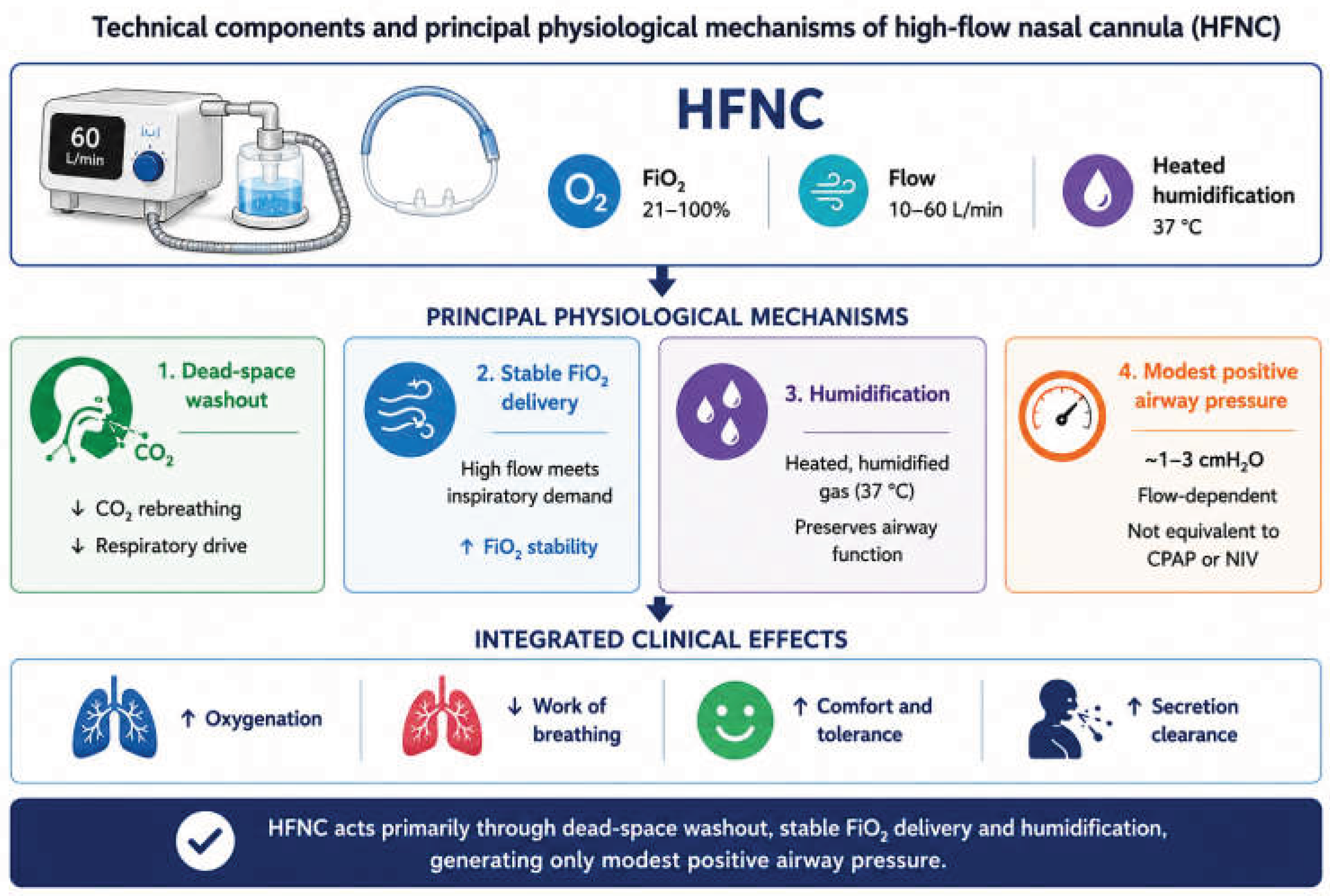
Figure 2.
Conceptual comparison of high-flow nasal cannula (HFNC) and noninvasive positive-pressure ventilation (NIPPV) across technical, physiological, and practical domains. HFNC is an open system delivering set high flow through nasal prongs, whereas NIPPV is a pressure-targeted system that provides higher and adjustable positive end-expiratory pressure (PEEP) and greater ventilatory unloading. Both modalities can provide stable fraction of inspired oxygen (FiO2), depending on flow, interface, and settings. HFNC additionally supports upper-airway dead-space washout and is generally better tolerated, allowing speaking, eating, and coughing. HFNC and NIPPV should therefore be considered complementary rather than interchangeable therapies.
Figure 2.
Conceptual comparison of high-flow nasal cannula (HFNC) and noninvasive positive-pressure ventilation (NIPPV) across technical, physiological, and practical domains. HFNC is an open system delivering set high flow through nasal prongs, whereas NIPPV is a pressure-targeted system that provides higher and adjustable positive end-expiratory pressure (PEEP) and greater ventilatory unloading. Both modalities can provide stable fraction of inspired oxygen (FiO2), depending on flow, interface, and settings. HFNC additionally supports upper-airway dead-space washout and is generally better tolerated, allowing speaking, eating, and coughing. HFNC and NIPPV should therefore be considered complementary rather than interchangeable therapies.
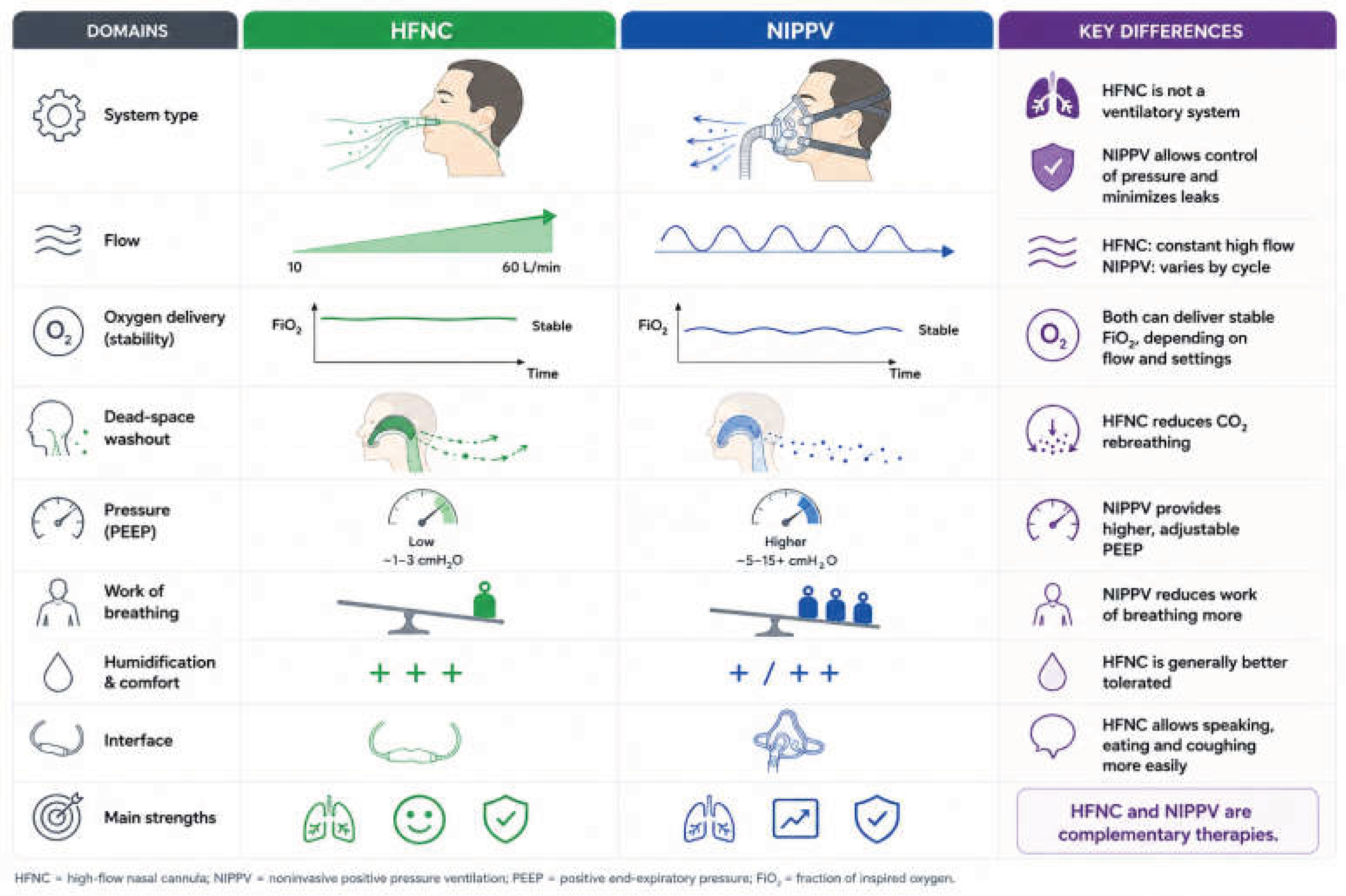
Figure 3.
Evidence-informed clinical positioning of high-flow nasal cannula (HFNC) in adult acute care. The green panel indicates settings with generally supportive evidence, including acute hypoxemic respiratory failure, bronchoscopy and procedural oxygenation, peri-intubation oxygenation, and selected post-extubation patients. The orange panel indicates settings in which benefit may depend on patient selection, underlying pathophysiology, and study quality, including COVID-19 acute respiratory failure, immunocompromised patients, postoperative patients, upper gastrointestinal endoscopy, endoscopic retrograde cholangiopancreatography, and obesity. The red panel indicates settings in which HFNC should not routinely substitute for NIPPV or invasive ventilation, including hypercapnic respiratory failure, cardiogenic pulmonary edema, severe ventilatory failure requiring pressure support, and recruitment-dependent disease such as atelectasis or severe acute respiratory distress syndrome. COT, conventional oxygen therapy; COPD, chronic obstructive pulmonary disease; FRC, functional residual capacity; EGDS, esophagogastroduodenoscopy; ERCP, endoscopic retrograde cholangiopancreatography; ARDS, acute respiratory distress syndrome. The figure summarizes the direction and heterogeneity of the available evidence and is not intended as a formal evidence-grading framework.
Figure 3.
Evidence-informed clinical positioning of high-flow nasal cannula (HFNC) in adult acute care. The green panel indicates settings with generally supportive evidence, including acute hypoxemic respiratory failure, bronchoscopy and procedural oxygenation, peri-intubation oxygenation, and selected post-extubation patients. The orange panel indicates settings in which benefit may depend on patient selection, underlying pathophysiology, and study quality, including COVID-19 acute respiratory failure, immunocompromised patients, postoperative patients, upper gastrointestinal endoscopy, endoscopic retrograde cholangiopancreatography, and obesity. The red panel indicates settings in which HFNC should not routinely substitute for NIPPV or invasive ventilation, including hypercapnic respiratory failure, cardiogenic pulmonary edema, severe ventilatory failure requiring pressure support, and recruitment-dependent disease such as atelectasis or severe acute respiratory distress syndrome. COT, conventional oxygen therapy; COPD, chronic obstructive pulmonary disease; FRC, functional residual capacity; EGDS, esophagogastroduodenoscopy; ERCP, endoscopic retrograde cholangiopancreatography; ARDS, acute respiratory distress syndrome. The figure summarizes the direction and heterogeneity of the available evidence and is not intended as a formal evidence-grading framework.
Disclaimer/Publisher’s Note: The statements, opinions and data contained in all publications are solely those of the individual author(s) and contributor(s) and not of MDPI and/or the editor(s). MDPI and/or the editor(s) disclaim responsibility for any injury to people or property resulting from any ideas, methods, instructions or products referred to in the content. |
© 2026 by the authors. Licensee MDPI, Basel, Switzerland. This article is an open access article distributed under the terms and conditions of the Creative Commons Attribution (CC BY) license (http://creativecommons.org/licenses/by/4.0/).
Copyright: This open access article is published under a Creative Commons CC BY 4.0 license, which permit the free download, distribution, and reuse, provided that the author and preprint are cited in any reuse.