

Submitted:
17 September 2026
Posted:
18 September 2026
You are already at the latest version
Abstract
Background/Objectives:
Out-of-hospital cardiac arrest (OHCA) is a major public health issue. During on-scene resuscitation, emergency medical services (EMS) must balance continued resuscitation against early transport for advanced in-hospital treatment.
We aimed to examine the time-dependent probabilities at the scene for favorable neurological outcomes of OHCA with an initial shockable rhythm.
Methods:
We conducted a retrospective study using a dataset that combined the Japanese national Utstein data and emergency transport data. Of the OHCA cases recorded between January 2017 to December 2022, 22,383 with an initial shockable rhythm were included. We examined the time-dependent probabilities of achieving return of spontaneous circulation (ROSC) with a favorable neurological outcome at each minute of on-scene time.
Results:
On-scene ROSC was achieved in 5,095 cases, and favorable neurological outcomes at 1 month were obtained in 3,182 cases. The probability of achieving on-scene ROSC fell below 10% after 10 min from EMS contact and decreased to ≤5% after 20 min. Among patients who achieved on-scene ROSC, the time-dependent probabilities of a favorable neurological outcome appeared similar according to sex, witness status, and bystander CPR, whereas patients aged < 75 years maintained higher probabilities than those aged ≥75 years.
Conclusions:
Under current resuscitation practices in Japan, the probability of achieving on-scene ROSC in patients with OHCA and an initial shockable rhythm fell below 10% after 10 min from EMS contact and decreased to ≤5% after 20 min. Patients aged < 75 years may remain candidates for prolonged on-scene resuscitation, regardless of witness status or bystander CPR.
Keywords:
out-of-hospital cardiac arrest
; initial shockable rhythm
; on-scene resuscitation
; return of spontaneous circulation
; neurological outcome
1. Introduction
Out-of-hospital cardiac arrest (OHCA) is a major public health issue. The percentages of associated survival with favorable neurological outcomes remain at 3.5% and 8.1% in Japan and the US, respectively, despite the various initiatives undertaken [1,2]. Furthermore, the survival rate for OHCA with an initial shockable rhythm is 20–30% [1,2], and improving the outcomes in this context is an urgent requirement. Public access defibrillation has been reported to be effective in such cases of OHCA; however, its frequency remains <20% [2,3], and defibrillation by emergency medical services (EMS) accounts for most prehospital defibrillations. Regarding cases in which EMS performs on-scene resuscitation, a longer on-scene time is associated with a poor prognosis [4,5,6]. Several studies have suggested that early transport to advanced medical centers may be considered in selected patients with refractory shockable OHCA [7,8,9]. However, other studies have reported the benefits of remaining at the scene and continuing resuscitation [10,11,12]. Therefore, a trade-off exists between leaving the scene early for further advanced in-hospital resuscitation and staying to continue on-scene resuscitation, and the acceptable on-scene time and its associated factors require further consideration. In this study, we aimed to examine the time-dependent probabilities at the scene for favorable neurological outcomes of OHCA with an initial shockable rhythm by using nationwide Utstein data in Japan. We further investigated the background factors associated with OHCA cases that favor staying on scene to continue resuscitation rather than leaving the scene early.
2. Materials and Methods
2.1. Study Design
This retrospective study used a database comprising two datasets: Japan’s national Utstein database and all emergency transport records.
2.2. EMS System in Japan
Japan’s emergency medical system, organized by local governments, uses a nationwide unified 119 emergency call system that dispatches the nearest available ambulance from the local fire departments. Ambulances carry an EMS crew of three, at least one of whom is a nationally certified emergency life-saving technician (ELT). An ELT can perform intravenous access, administer epinephrine intravenously, and establish an advanced airway under the direction of an online physician. All resuscitation procedures by EMS are regulated by local medical control protocols that are based on national resuscitation protocols issued by the Fire and Disaster Management Agency of the Ministry of Internal Affairs and Communications of Japan.
2.3. Data Collection
Data from Japan’s Utstein database and emergency transport records between January 2017 and December 2022 were collected from all fire departments in Japan. The Utstein dataset was recorded along with the Utstein guidelines. Both datasets include patients’ age, sex, area codes, and time of the emergency call; however, the Utstein dataset does not include on-scene time. To evaluate on-scene time for OHCA, the datasets were merged based on emergency call acceptance date/time, age, sex, and area codes. Duplicate data were excluded.
2.4. Inclusion and Exclusion Criteria
Adults (patient age of 18 years or more) and cardiogenic OHCAs with an initial shockable rhythm were included. Cases where bystander defibrillation was performed and advanced procedures were done by physicians at the scene were excluded. Cases with missing data on time, return of spontaneous circulation (ROSC), and outcome at 1 month were also excluded.
2.5. Outcomes
The outcome assessed was survival and a favorable neurological outcome, defined as cerebral performance category (CPC) 1 or 2 at 1 month.
2.6. Statistical Analysis
Data are presented as medians and interquartile ranges (IQRs) for continuous variables and numbers and percentages for categorical variables. Patients who achieved on-scene ROSC were compared with those who did not achieve on-scene ROSC using the Mann–Whitney U test for continuous variables and the chi-square test for categorical variables, with a significance threshold of p < 0.05. Using the approach described by Okubo et al. [13], two time-dependent probabilities were evaluated, with the time of EMS contact with the patient defined as 0 min. First, for each minute after EMS contact, the probability of achieving on-scene ROSC was calculated using the number of patients still undergoing resuscitation at that minute as the denominator and the number of patients achieving ROSC at that minute as the numerator. Second, among patients who achieved on-scene ROSC, the probability of a favorable neurological outcome at 1 month was calculated according to the time from EMS contact to ROSC, using the number of patients who achieved ROSC at each minute as the denominator and the number of those patients with CPC 1 or 2 at 1 month as the numerator. Further, differences in the time-dependent probability of a favorable neurological outcome were examined based on sex, age (<75 years vs. ≥75 years), witness status, and presence or absence of bystander CPR. As the time to the first defibrillation shock can significantly affect the on-scene time, sensitivity analysis was performed for cases in which defibrillation was performed by EMS within 1 min.
3. Results
Among the 778,807 OHCAs during the study period, 631,562 cases (81.1%) were merged, and the basic characteristics of the original and merged cases were comparable (Table S1). Of this dataset of 631,562 OHCAs, 22,383 OHCAs were included for further analysis (Figure 1).
The characteristics of the study subjects are shown in Table 1. Among these, 5,095 cases achieved ROSC at the scene (group with on-scene ROSC) and 17,288 did not (group without on-scene ROSC). The group with on-scene ROSC, compared to the group without on-scene ROSC, was younger (66 years vs 69 years, p < 0.001), had cases that were more likely to be witnessed (4,483 [88.0%] vs 13,655 [79.0%], p < 0.001), and had cases where patients were more likely to receive bystander chest compressions (3,552 [69.7%] vs 10,246 [59.3%], p < 0.001). On the other hand, prehospital airway device placement and epinephrine administration were frequent in the group without on-scene ROSC (9,196 [53.2%] vs 1,461 [28.7%], p < 0.001, and 7,885 [45.6%] vs 925 [18.2%], p < 0.001, respectively). The median prehospital time intervals (response time, on-scene time, and transport time) were comparable between the two groups (group with on-scene ROSC vs group without on-scene ROSC: 7 min vs 8 min, 13 min vs 12 min, and 9 min vs 9 min, respectively). A favorable neurological outcome, defined as CPC 1/2, was achieved in 4,983 cases, and was more frequent in the group with on-scene ROSC (3,182 [62.4%] vs 1,801[10.4%], p < 0.001).
Figure 2 shows the probabilities for on-scene ROSC among the eligible cases (n=22,383). The probability of achieving on-scene ROSC fell below 10% after 10 min from EMS contact and decreased to ≤5% after 20 min.
ROSC, return of spontaneous circulation; EMS, emergency medical services; OHCA, out-of-hospital cardiac arrest. The figure shows the relationship between the probability of achieving on-scene ROSC and the time from EMS contact to ROSC among 22,383 patients with defibrillation-eligible OHCA.
Figure 3 shows the results of a subanalysis of the time-dependent probability of a favorable neurological outcome among patients who achieved on-scene ROSC (n = 5,095), stratified by sex (male vs female, Figure 3a), age (under 75 years vs 75 years or older, Figure 3b), presence/absence of bystander chest compressions (Figure 3c), and witness status (Figure 3d). The time-dependent probabilities of a favorable neurological outcome among patients who achieved on-scene ROSC appeared similar between groups stratified by sex, witness status, and bystander chest compressions and decreased with increasing time from EMS contact. In contrast, a difference was observed according to age. Among patients aged ≥75 years who achieved on-scene ROSC, the probability of a favorable neurological outcome was <10% at 10 min after EMS contact, whereas it was approximately 30% among patients aged <75 years at the same time point.
ROSC: return of spontaneous circulation; CPR: cardiopulmonary resuscitation
Figure 4 shows the time distribution for the first defibrillation by EMS peaked at 1 min, and the proportion of the defibrillations within 1 min was 63.6% (2026 cases). Sensitivity analysis focusing on these 2026 cases in which defibrillation was performed within 1 min revealed that the time-dependent probabilities remained unchanged (Figure S1).
The figure shows the distribution of the number of defibrillation attempts among patients who achieved on-scene ROSC with favorable neurological outcomes. The peak time to the first defibrillation after EMS arrival was 1 min.
ROSC: return of spontaneous circulation; EMS: emergency medical services
4. Discussion
This study demonstrates that in OHCAs with an initial shockable rhythm, the probability of achieving on-scene ROSC under current resuscitation practices in Japan fell below 10% after 10 min from EMS contact and decreased to ≤5% after 20 min. Furthermore, among the cases that achieved on-scene ROSC, the effects of witness and bystander CPR, which generally are reported to be associated with a favorable outcome, were virtually eliminated when the on-scene time exceeded 5 min. However, this study demonstrated that patients younger than 75 years of age are more likely to be candidates for prolonged on-scene resuscitation efforts. When focusing on the cases in which early defibrillation was achieved (within 1 min from EMS contact), the results remained unchanged.
Previous studies have examined the optimal on-scene time for OHCA and indicated a limit of approximately 20 min [4,5,6]. Our findings in patients with initial shockable rhythms are consistent with these reports. However, when the first defibrillation fails, the chances of ROSC decrease with an increase in defibrillation attempts [14,15].
Several studies indicate that neurological outcomes are better in cases in which ROSC is achieved at the scene [10,11,12]. Grunau et al. compared intra-arrest transport with continued on-scene resuscitation by using propensity score matching in 43,969 OHCA cases from the Resuscitation Outcome Consortium (ROC) Cardiac Epidemiologic Registry. They reported no advantage for intra-arrest transport, and this trend was consistent even in cases of OHCA with an initial shockable rhythm [10]. Furthermore, in a study of OHCAs in Japan with propensity score matching, Yoshimura et al. reported no difference in neurological outcomes between cases involving intra-arrest transport and on-scene resuscitation. However, the study showed favorable outcomes for intra-arrest transport when the on-scene duration exceeded 20 min among OHCA cases with an initial shockable rhythm [11]. In addition, a recent randomized controlled trial on early transport versus on-scene retention by Burns et al. showed no overall advantage afforded by early transport in OHCA. Similarly, for OHCAs with an initial shockable rhythm, while no significant difference was found, the proportion of OHCAs with an initial shockable rhythm for which favorable neurological outcomes were achieved at 1 and 6 months was higher in cases of early transport than in those with continued on-scene resuscitation [12].
From the perspective of determining “how long EMS should remain on scene for OHCAs with an initial shockable rhythm?,” this study evaluated time-dependent probabilities. This study clarifies that factors traditionally recognized as favorable prognostic indicators, such as bystander CPR and witnessed cardiac arrest, do not support prolonged on-scene resuscitation efforts. Instead, patient age of less than 75 years emerges as the primary factor influencing an extended on-scene duration. Several studies indicate a favorable prognosis for OHCAs in patients younger than 75 years of age [16,17]. Pre-existing comorbidities increase with age, and the prognosis for OHCAs in older adults is thought to be poorer. However, the relationship between pre-existing comorbidities and OHCA prognosis remains inconclusive [17,18]. This study could not examine pre-existing comorbidities owing to a lack of data collection. However, it is reasonable to assume that younger individuals can tolerate a cardiac arrest for a longer duration compared to older individuals. Funada et al. reported that in cases in which prehospital ROSC was achieved, the low-flow time threshold for reaching CPC 1/2 tended to be longer in younger patients [16]. Furthermore, while no difference was observed between bystander CPR and witnessed cases, Huang et al. reported that these factors were associated with a favorable prognosis in younger patients [17].
This study indicates that the on-scene trend for OHCAs with an initial shockable rhythm would remain the same until the resuscitation practice changes in Japan. In this study cohort, only 63.6% of patients received the first defibrillation within 1 min. Further promotion of early defibrillation could potentially alter the acceptable framework for on-scene resuscitation time. Another key factor that can possibly alter the trend is the quality of prehospital CPR by bystander and EMS CPR, which could not be evaluated in our study cohort. Several animal experiments [19,20] and human observational studies [21,22,23] indicate that the quality of peri-defibrillation CPR, such as high chest compression fraction and minimized perishock pause, can increase the chance of defibrillation success. Further advances in resuscitation quality could potentially alter the time-dependent probabilities for ROSC of OHCA with initial shockable rhythm.
4.1. Limitations
This study has some limitations. First, because this was a retrospective observational study, establishing strict causality was difficult, and uncontrollable confounding factors may exist. Second, as high-rise buildings and apartments are common in urban areas, more time is required for patient transportation in cases involving high-rise buildings and apartments, which account for most of the on-scene time in some regions. Third, a total of 1,244 cases (approximately 5%) were excluded owing to missing data on time variables or EMS defibrillation. This exclusion may have introduced bias that could have affected the study results. Finally, because this study was based on a nationwide registry, differences in treatment protocols existing across regions may have affected the results.
5. Conclusions
Our study showed that, under current resuscitation practices in Japan, the probability of achieving on-scene ROSC in patients with OHCA and an initial shockable rhythm fell below 10% after 10 min from EMS contact and decreased to ≤5% after 20 min. OHCAs with initial shockable rhythm under 75 years of age may remain candidates for prolonged on-scene resuscitation, regardless of witness status or bystander CPR.
Supplementary Materials
The following supporting information can be downloaded at the website of this paper posted on Preprints.org, Table S1: Characteristics of the study subjects: original versus combined datasets; Figure S1: Sensitivity analysis of the time-dependent probability of on-scene ROSC with favorable neurological outcomes under various conditions among patients who received their first defibrillation within 1 min of EMS contact.
Author Contributions
Conceptualization, K.M.; methodology, K.M. and K.S.; formal analysis, K.M. and K.S.; investigation, K.M. and H.A.; data curation, K.M.; writing—original draft preparation, K.M.; writing—review and editing, K.M., A.K., K.Y., K.T., H.A., Y.K., K.S. and H.F.; visualization, K.M.; project administration, K.M. All authors have read and agreed to the published version of the manuscript.
Funding
This research received no external funding.
Institutional Review Board Statement
The study was conducted in accordance with the Declaration of Helsinki and approved by the Ethics Committee of Nara Medical University Hospital (approval number 3933; 21 January 2026).
Informed Consent Statement
The requirement for informed consent was waived by the Ethics Committee of Nara Medical University Hospital because the study used anonymized retrospective data.
Data Availability Statement
The datasets used and/or analyzed during he current study are available from the corresponding author on reasonable request.
Acknowledgments
We would like to thank Editage (www.editage.jp) for English language editing.
Conflicts of Interest
The authors declare no conflicts of interest.
Abbreviations
| OHCA | out-of-hospital cardiac arrest |
| EMS | emergency medical services |
| ELT | emergency life-saving technician |
| ROSC | return of spontaneous circulation |
| CPC | cerebral performance category |
References
- Igeta, R.; Otaka, S.; Imaizumi, T.; Kajino, K.; Khoujah, D.; Ito, F.; Endo, T.; Chiba, T.; Ikeda, S.; Shiga, T. Regional comparison in cerebral performance outcome of out-of-hospital cardiac arrest: The All-Japan Utstein Registry. Cureus 2024, 16, e72622. [Google Scholar] [CrossRef] [PubMed]
- Martin, S.S.; Aday, A.W.; Allen, N.B.; Almarzooq, Z.I.; Anderson, C.A.M.; Arora, P.; Avery, C.L.; Baker-Smith, C.M.; Bansal, N.; Beaton, A.Z.; et al. 2025 Heart disease and stroke statistics: A report of US and global data from the American Heart Association. Circulation 2025, 151, e41–e660. [Google Scholar] [CrossRef] [PubMed]
- Matsuyama, T.; Kiyohara, K.; Kitamura, T.; Nishiyama, C.; Kiguchi, T.; Iwami, T. Public-access defibrillation and favorable neurological outcome after out-of-hospital cardiac arrest during the COVID-19 pandemic in Japan. Crit. Care 2022, 26, 335. [Google Scholar] [CrossRef] [PubMed]
- Matsuyama, T.; Ohta, B.; Kiyohara, K.; Kitamura, T. Cardiopulmonary resuscitation duration and favorable neurological outcome after out-of-hospital cardiac arrest: A nationwide multicenter observational study in Japan (the JAAM-OHCA registry). Crit. Care 2022, 26, 120. [Google Scholar] [CrossRef] [PubMed]
- Reynolds, J.C.; Frisch, A.; Rittenberger, J.C.; Callaway, C.W. Duration of resuscitation efforts and functional outcome after out-of-hospital cardiac arrest: When should we change to novel therapies? Circulation 2013, 128, 2488–2494. [Google Scholar] [CrossRef] [PubMed]
- Coute, R.A.; Nathanson, B.H.; Kurz, M.C.; McNally, B.; Mader, T.J. CARES Surveillance Group. The association between scene time interval and neurologic outcome following adult bystander witnessed out-of-hospital cardiac arrest. Am. J. Emerg. Med. 2021, 46, 628–633. [Google Scholar] [CrossRef] [PubMed]
- Nakashima, T.; Noguchi, T.; Tahara, Y.; Nishimura, K.; Ogata, S.; Yasuda, S.; Onozuka, D.; Morimura, N.; Nagao, K.; Gaieski, D.F.; et al. Patients with refractory out-of-cardiac arrest and sustained ventricular fibrillation as candidates for extracorporeal cardiopulmonary resuscitation—Prospective multi-center observational study. Circ. J. 2019, 83, 1011–1018. [Google Scholar] [CrossRef] [PubMed]
- Choi, Y.; Park, J.H.; Jeong, J.; Kim, Y.J.; Song, K.J.; Shin, S.D. Extracorporeal cardiopulmonary resuscitation for adult out-of-hospital cardiac arrest patients: Time-dependent propensity score-sequential matching analysis from a nationwide population-based registry. Crit. Care 2023, 27, 87. [Google Scholar] [CrossRef] [PubMed]
- Yannopoulos, D.; Bartos, J.; Raveendran, G.; Walser, E.; Connett, J.; Murray, T.A.; Collins, G.; Zhang, L.; Kalra, R.; Kosmopoulos, M.; et al. Advanced reperfusion strategies for patients with out-of-hospital cardiac arrest and refractory ventricular fibrillation (ARREST): A phase 2, single centre, open-label, randomised controlled trial. Lancet 2020, 396, 1807–1816. [Google Scholar] [CrossRef] [PubMed]
- Grunau, B.; Kime, N.; Leroux, B.; Rea, T.; Van Belle, G.; Menegazzi, J.J.; Kudenchuk, P.J.; Vaillancourt, C.; Morrison, L.J.; Elmer, J.; et al. Association of intra-arrest transport vs. continued on-scene resuscitation with survival to hospital discharge among patients with out-of-hospital cardiac arrest. JAMA 2020, 324, 1058–1067. [Google Scholar] [CrossRef] [PubMed]
- Shimomura, Y.; Komukai, S.; Zha, L.; Kiyohara, K.; Shiozumi, T.; Matsuyama, T.; Kitamura, T. Intra-arrest transport versus continued on-scene resuscitation in patients with out-of-hospital cardiac arrest by first documented rhythm: A nationwide cohort study using time-dependent propensity score sequential matching. Crit. Care 2026, 30, 40. [Google Scholar] [CrossRef] [PubMed]
- Burns, B.; Marschner, I.C.; Buscher, H.; Coggins, A.; Oliver, M.; Maruno, K.; McNulty, R.; Hawkins, S.; Facer, R.; Pradhananga, B.; et al. Expedited transfer from the scene for refractory out-of-hospital cardiac arrest in Australia: A prospective, multicentre, parallel, open label, randomised clinical trial. Lancet Respir. Med. 2025, 13, 921–932. [Google Scholar] [CrossRef] [PubMed]
- Okubo, M.; Komukai, S.; Andersen, L.W.; Berg, R.A.; Kurz, M.C.; Morrison, L.J.; Callaway, C.W. American Heart Association’s Get With The Guidelines—Resuscitation Investigators. Duration of cardiopulmonary resuscitation and outcomes for adults with in-hospital cardiac arrest: Retrospective cohort study. BMJ 2024, 384, e076019. [Google Scholar] [CrossRef] [PubMed]
- Tateishi, K.; Saito, Y.; Kitahara, H.; Shiko, Y.; Kawasaki, Y.; Nonogi, H.; Tahara, Y.; Yonemoto, N.; Nagao, K.; Ikeda, T.; et al. Impact of number of defibrillation attempts on neurologically favourable survival rate in patients with out-of-hospital cardiac arrest. Resuscitation 2023, 186, 109779. [Google Scholar] [CrossRef] [PubMed]
- Harrysson, L.; Blick, E.; Awad, A.; Jonsson, M.; Claesson, A.; Magnusson, C.; Abazi, L.; Israelsson, J.; Hofmann, R.; Nordberg, P.; et al. Survival in relation to number of defibrillation attempts in out-of-hospital cardiac arrest. Resuscitation 2024, 205, 110435. [Google Scholar] [CrossRef] [PubMed]
- Funada, A.; Goto, Y.; Tada, H.; Teramoto, R.; Shimojima, M.; Hayashi, K.; Yamagishi, M. Age-specific differences in the duration of prehospital cardiopulmonary resuscitation administered by emergency medical service providers necessary to achieve favorable neurological outcome after out-of-hospital cardiac arrest. Circ. J. 2017, 81, 652–659. [Google Scholar] [CrossRef] [PubMed]
- Huang, J.B.; Lee, K.H.; Ho, Y.N.; Tsai, M.T.; Wu, W.T.; Cheng, F.J. Association between prehospital prognostic factors on out-of-hospital cardiac arrest in different age groups. BMC Emerg. Med. 2021, 21, 3. [Google Scholar] [CrossRef] [PubMed]
- Oving, I.; van Dongen, L.H.P.I.; Deurholt, S.C.; Ramdani, A.; Beesems, S.G.; Tan, H.L.; Blom, M.T. Comorbidity and survival in the pre-hospital and in-hospital phase after out-of-hospital cardiac arrest. Resuscitation 2020, 153, 58–64. [Google Scholar] [CrossRef] [PubMed]
- Yu, T.; Weil, M.H.; Tang, W.; Sun, S.; Klouche, K.; Povoas, H.; Bisera, J. Adverse outcomes of interrupted precordial compression during automated defibrillation. Circulation 2002, 106, 368–372. [Google Scholar] [CrossRef] [PubMed]
- Steen, S.; Liao, Q.; Pierre, L.; Paskevicius, A.; Sjöberg, T. The critical importance of minimal delay between chest compressions and subsequent defibrillation: A haemodynamic explanation. Resuscitation 2003, 58, 249–258. [Google Scholar] [CrossRef] [PubMed]
- Olsen, J.A.; Brunborg, C.; Steinberg, M.; Persse, D.; Sterz, F.; Lozano, M., Jr.; Westfall, M.; Travis, D.T.; Lerner, E.B.; Brouwer, M.A.; et al. Pre-shock chest compression pause effects on termination of ventricular fibrillation/tachycardia and return of organized rhythm within mechanical and manual cardiopulmonary resuscitation. Resuscitation 2015, 93, 158–163. [Google Scholar] [CrossRef] [PubMed]
- Iversen, B.N.; Meilandt, C.; Væggemose, U.; Terkelsen, C.J.; Kirkegaard, H.; Fjølner, J. Pre-charging the defibrillator before rhythm analysis reduces hands-off time in patients with out-of-hospital cardiac arrest with shockable rhythm. Resuscitation 2021, 169, 23–30. [Google Scholar] [CrossRef] [PubMed]
- Christenson, J.; Andrusiek, D.; Everson-Stewart, S.; Kudenchuk, P.; Hostler, D.; Powell, J.; Callaway, C.W.; Bishop, D.; Vaillancourt, C.; Davis, D.; et al. Chest compression fraction determines survival in patients with out-of-hospital ventricular fibrillation. Circulation 2009, 120, 1241–1247. [Google Scholar] [CrossRef] [PubMed]
Figure 1.
Flowchart of study participants with cardiogenic out-of-hospital cardiac arrest eligible for defibrillation.
Figure 1.
Flowchart of study participants with cardiogenic out-of-hospital cardiac arrest eligible for defibrillation.
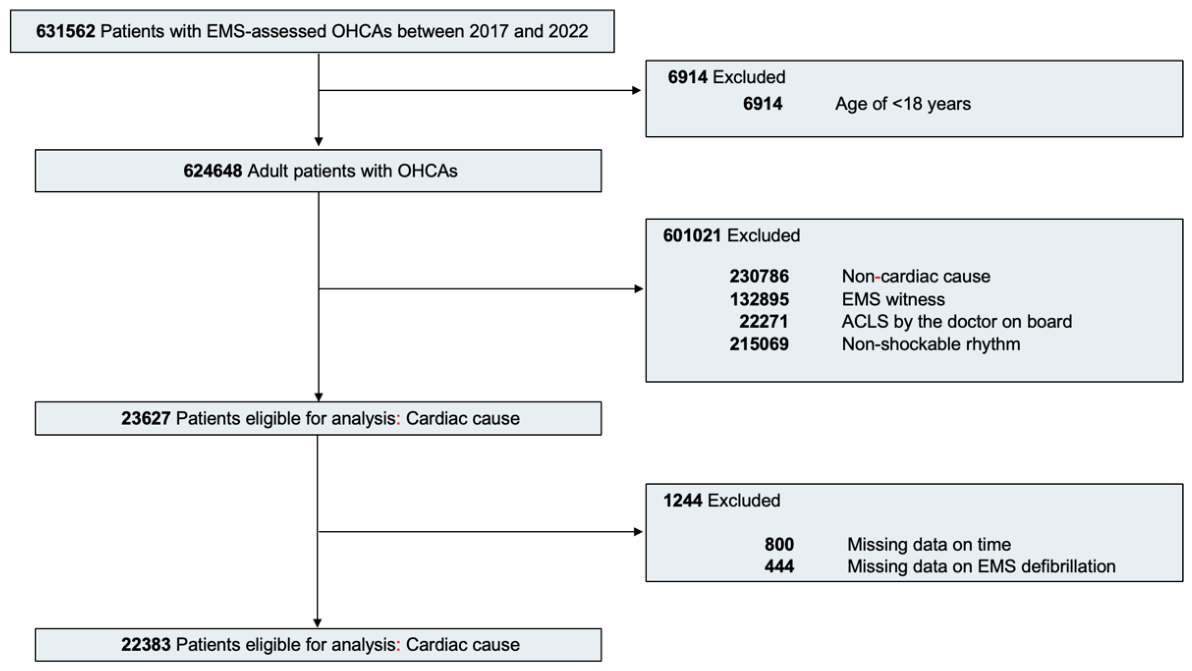
Figure 2.
Probability of ROSC at minute t among patients still undergoing resuscitation vs. time from EMS contact to ROSC.
Figure 2.
Probability of ROSC at minute t among patients still undergoing resuscitation vs. time from EMS contact to ROSC.
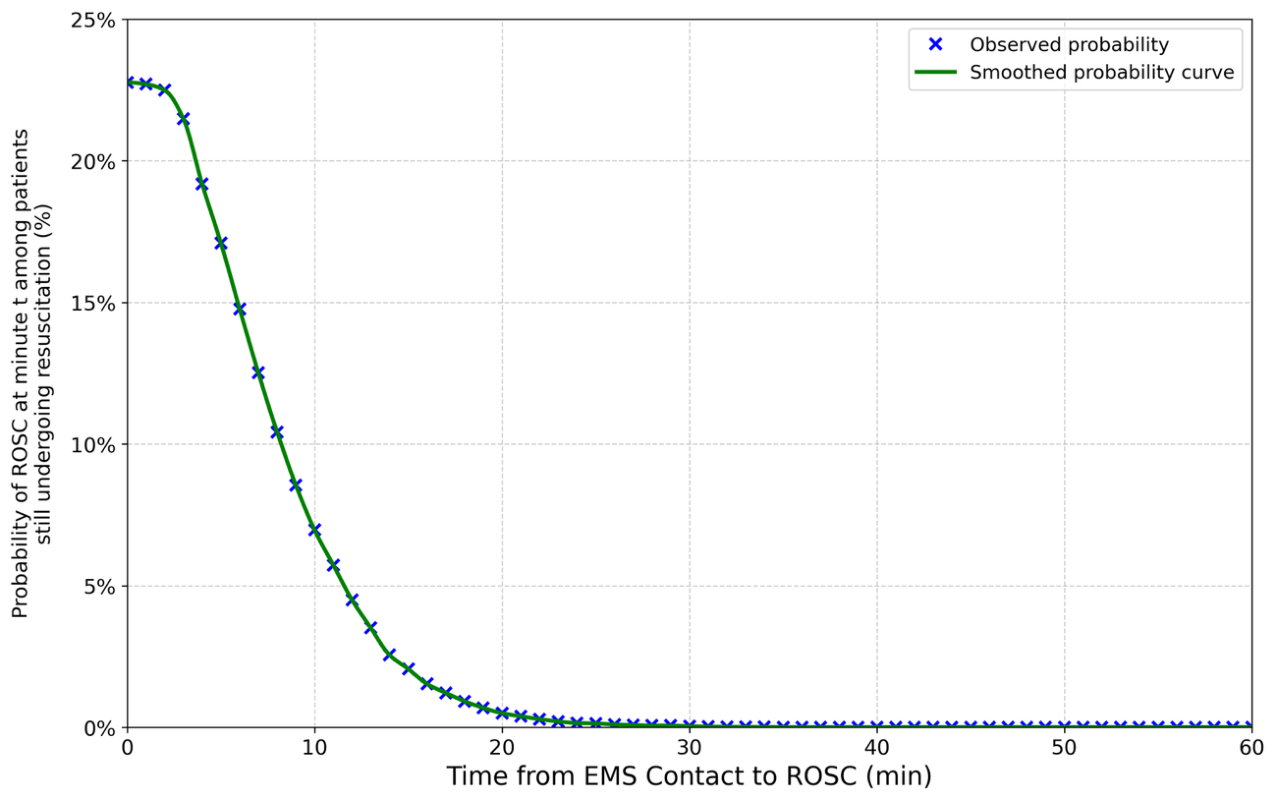
Figure 3.
Time-dependent probability of on-scene ROSC with favorable neurological outcomes under various conditions. a: male vs female patients, b: patient age of 75 years or more vs patient age of <75 years, c: presence/absence of bystander CPR, d: witnessed/non-witnessed cases.
Figure 3.
Time-dependent probability of on-scene ROSC with favorable neurological outcomes under various conditions. a: male vs female patients, b: patient age of 75 years or more vs patient age of <75 years, c: presence/absence of bystander CPR, d: witnessed/non-witnessed cases.
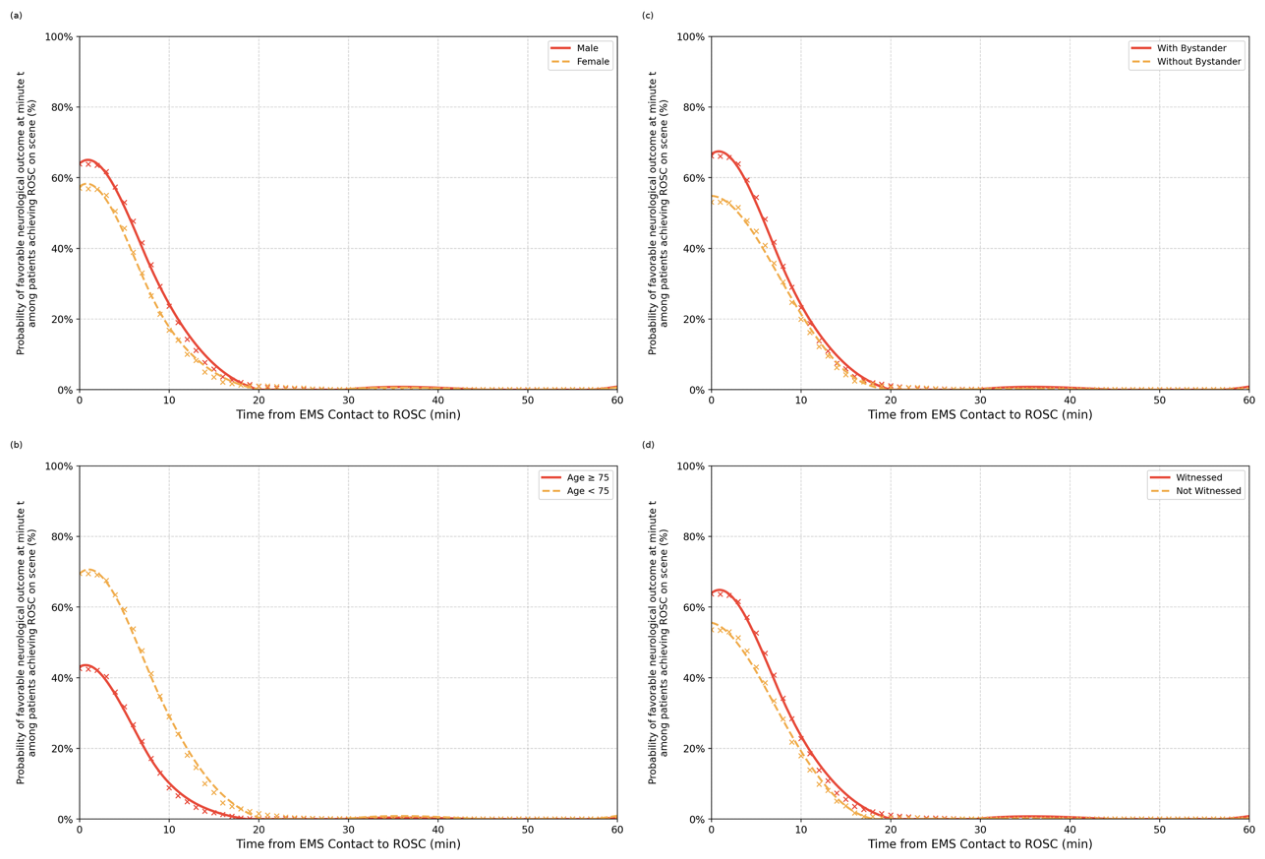
Figure 4.
Distribution of time to first defibrillation and the number of defibrillation attempts among patients achieving on-scene ROSC with favorable neurological outcomes.
Figure 4.
Distribution of time to first defibrillation and the number of defibrillation attempts among patients achieving on-scene ROSC with favorable neurological outcomes.
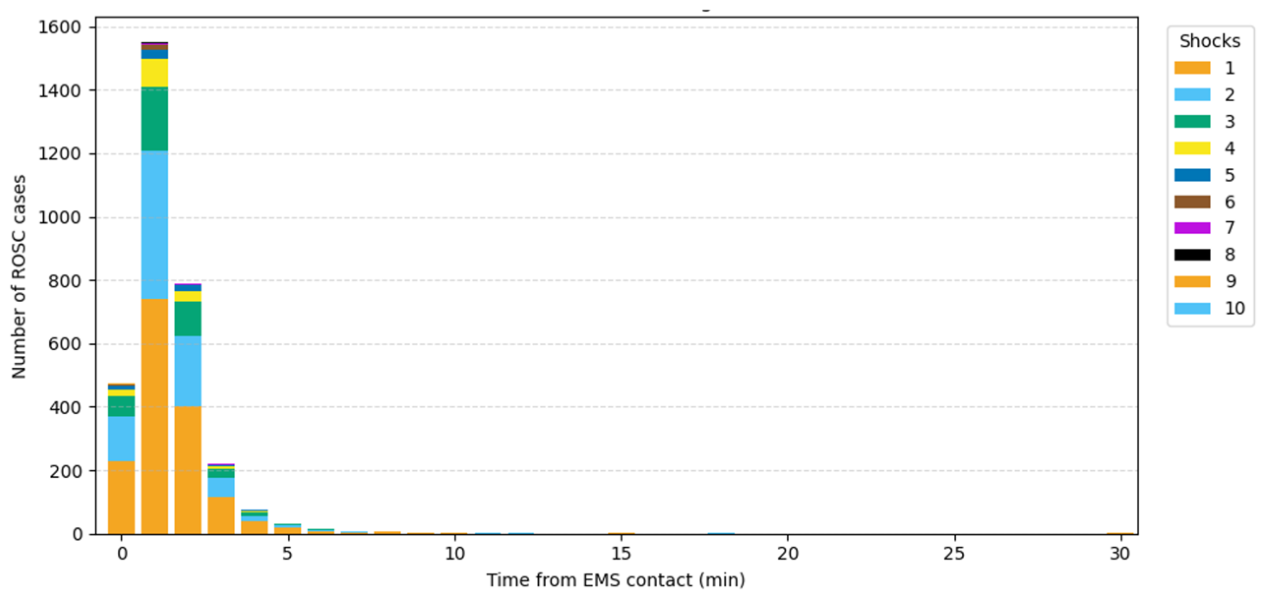

Table 1.
Characteristics of the study participants.
| Total | On-scene ROSC | Non-ROSC | p-values | |
| (n = 22,383) | (n = 5,095) | (n = 17,288) | ||
| Male sex, n (%) | 17,881 (79.9) | 4,025 (79.0) | 13,856 (80.1) | 0.07 |
| Age, years (IQR) | 69 (57-78) | 66 (55-75) | 69 (58-79) | <0.001 |
| Witness, n (%) | 18,138 (81.0) | 4,483 (88.0) | 13,655 (79.0) | <0.001 |
| Bystander chest compressions, n (%) | 13,798 (61.6) | 3,552 (69.7) | 10,246 (59.3) | <0.001 |
| Prehospital use of | ||||
| advanced airway devices, n (%) | 10,657 (47.6) | 1,461 (28.7) | 9,196 (53.2) | <0.001 |
| Epinephrine administration, n (%) | 8,810 (39.4) | 925 (18.2) | 7,885 (45.6) | <0.001 |
| Response time, min (IQR) | 8 (6-10) | 7 (6-9) | 8 (6-10) | <0.001 |
| On-scene time, min (IQR) | 12 (9-16) | 13 (10-17) | 12 (9-16) | <0.001 |
| Transport time, min (IQR) | 9 (6-14) | 9 (6-14) | 9 (6-14) | <0.001 |
| Survival at 1 month, n (%) | 7,509 (33.5) | 3,987 (78.3) | 3,522 (20.4) | <0.001 |
| Favorable neurological outcome, n (%) | 4,983 (22.2) | 3,182 (62.4) | 1,801 (10.4) | <0.001 |
IQR, interquartile range; ROSC, return of spontaneous circulation.
Disclaimer/Publisher’s Note: The statements, opinions and data contained in all publications are solely those of the individual author(s) and contributor(s) and not of MDPI and/or the editor(s). MDPI and/or the editor(s) disclaim responsibility for any injury to people or property resulting from any ideas, methods, instructions or products referred to in the content. |
© 2026 by the authors. Licensee MDPI, Basel, Switzerland. This article is an open access article distributed under the terms and conditions of the Creative Commons Attribution (CC BY) license.
Copyright: This open access article is published under a Creative Commons CC BY 4.0 license, which permit the free download, distribution, and reuse, provided that the author and preprint are cited in any reuse.