
Submitted:
03 September 2026
Posted:
17 September 2026
You are already at the latest version
Abstract
The Minimum Variance Distortionless Response (MVDR) beamformer offers optimal spatial selectivity but suffers from severe numerical instability in non-stationary acoustic environments. Target encroachment, steering vector mismatch, and finite-snapshot variance cause the spatial covariance matrix (SCM) to become acutely ill-conditioned. As the matrix approaches singularity, the norm of the inverted SCM diverges, leading to unbounded filter weights and a catastrophic collapse in White Noise Gain (WNG). While trace-relative diagonal loading mitigates this instability, utilizing a fixed regularization parameter forces an intractable compromise between spatial selectivity and numerical robustness. This paper proposes a spatially informed, time-frequency adaptive regularization framework for MVDR beamformers. We derive an orthogonal subspace leakage metric that quantifies the projection error between the assumed target steering vector and the dominant spatial subspace of the recursively estimated mixture SCM. This metric serves as a computationally efficient, instantaneous proxy for spatial difficulty. By mapping this leakage through a continuous logistic sigmoid clutch bounded by an empirically validated, array-scaled transition point (1/M), the proposed method continuously adapts the trace-relative loading. Quantitative evaluations across varying array geometries demonstrate that this continuous mapping reduces frame-to-frame filter weight jitter by an order of magnitude compared to binary thresholding. The proposed architecture autonomously navigates the feasible performance frontier, bounding WNG collapse during spatial degradation while preserving maximum selectivity in favorable geometries, all without requiring environment-specific threshold tuning or iterative convex solvers.
Keywords:
robust adaptive beamforming
; MVDR
; adaptive diagonal loading
; spatial covariance matrix
; white noise gain
; speech enhancement
1. Introduction
Multichannel beamforming is a standard approach to spatial filtering in speech enhancement and source separation. The minimum variance distortionless response (MVDR) beamformer is a fundamental adaptive beamforming formulation: it minimizes the output power subject to a distortionless response toward an assumed target, using the remaining spatial degrees of freedom to suppress interference [1,2,3]. MVDR-based spatial filtering is also widely used in multichannel speech enhancement, where spatial covariance estimates and target relative transfer functions (RTFs) are used to construct the beamformer [4,5,6].
The performance of an adaptive beamformer depends on the accuracy of these spatial statistics. Finite sample support introduces covariance estimation errors, while practical array imperfections and uncertainty in the assumed target response can produce model mismatch [7,8,9,10,11]. These effects can be particularly problematic for MVDR because the covariance matrix is inverted explicitly in the beamformer solution. Consequently, poorly estimated or unfavorable spatial covariance structure can result in large filter coefficients and reduced robustness. This sensitivity has motivated a broad class of robust adaptive beamforming methods, including worst-case formulations, steering-vector constraints, and projection-based approaches [9,11,12,13].
Diagonal loading provides another widely used mechanism for controlling this sensitivity. By adding a scaled identity matrix to the estimated covariance matrix, diagonal loading improves the numerical conditioning of the spatial filter, while the loading level determines the resulting trade-off between robustness and spatial selectivity. The problem of selecting this loading level has therefore received substantial attention, including finite-sample analysis, robust Capon formulations, and automatic loading procedures [7,8,10,14,15]. Rather than modifying only the numerical inversion, other robust approaches modify the spatial statistics themselves, for example through covariance reconstruction or steering-vector estimation [16,17]. These methods address different sources of uncertainty, but share the requirement of determining how much robustness should be introduced into the spatial filtering process.
A related line of work specifies robustness explicitly through the white-noise gain (WNG). WNG-constrained and robust superdirective beamformers control the spatial selectivity–robustness trade-off by imposing a lower bound on WNG [18,19]. Subspace-based beamforming provides another perspective in which the spatial structure of the covariance matrix is explicitly exploited, including eigenspace beamforming and subspace-based superdirective formulations [20,21,22]. In speech enhancement, spatial statistics can also be estimated or adapted within learned beamforming systems [23,24]. These approaches illustrate that robustness may be controlled through different descriptions of the current spatial state, rather than through a single fixed beamformer configuration.
More recent work has made the selection of the robustness level itself adaptive. Pei et al. formulate robust superdirective beamforming with a WNG constraint and identify the difficulty of prescribing a single WNG threshold when acoustic conditions and array characteristics vary; their approach estimates the threshold from observed multichannel signals [25]. Adaptive diagonal loading has also been formulated using covariance conditioning together with explicit WNG constraints, providing a frame-dependent loading level for changing acoustic conditions [26,27]. These developments suggest that the loading parameter need not remain fixed. They also raise a more specific question. What statistic of the current spatial state should be used as the control variable for adaptive regularization?
This work investigates whether the spatial statistics already computed for MVDR can provide such an internal control variable. We consider the relationship between the assumed target RTF and the dominant spatial content of the current mixture covariance matrix. The dominant eigenvector of the covariance matrix represents its principal spatial mode. Its normalized inner product with the assumed target RTF therefore measures the alignment between the current dominant spatial content and the target response. We use the corresponding projection error as a spatial-subspace control variable for regularization. Unlike the covariance condition number, which is determined by the eigenvalue spread of the covariance matrix, the proposed statistic incorporates both the dominant spatial direction and the assumed target response.
Based on this control variable, we develop a time-frequency adaptive regularization scheme for MVDR beamforming. The spatial-subspace projection error is mapped continuously to a trace-relative diagonal-loading factor through a sigmoid function, with an array-scaled transition point providing a common starting rule across the evaluated microphone configurations. The resulting formulation retains the standard MVDR structure while allowing the regularization level to respond to the current spatial state. We evaluate the proposed control variable against a condition-number-based alternative, study the effect of the loading policy and transition point, and compare the resulting operating behavior with fixed-loading and WNG-constrained references under changing source geometry and target RTF mismatch.
The contribution of this work is therefore centered on the choice of the internal control variable for adaptive MVDR regularization. Rather than introducing a separate robustness constraint or an externally trained estimator of the loading level, we investigate whether a spatial-subspace statistic derived directly from the covariance matrix and the assumed target response can provide a useful control signal for the regularization process.
2. Proposed Method
2.1. Signal Model and Regularized MVDR
Let denote the STFT vector observed by an M-microphone array at frequency bin f and time frame t. The observation is modeled as
where denotes the target speech coefficient, is the target relative transfer function (RTF), and contains the remaining acoustic components, including interfering sources and sensor noise. The target RTF is normalized with respect to a reference microphone and is assumed fixed over time for a given frequency bin.
The spatial covariance matrix (SCM) is estimated causally using an exponentially weighted recursive update:
where controls the temporal integration of the spatial statistics.
For a given SCM and target RTF, the MVDR beamformer is
This corresponds to the constrained optimization problem
When the SCM becomes poorly conditioned, its inversion becomes increasingly sensitive to estimation and model errors. In particular, as the smallest eigenvalue of the SCM approaches zero, the norm of its inverse grows without bound. The resulting beamformer can therefore require increasingly large filter coefficients, which reduces the white-noise gain and increases the amplification of sensor noise.
A standard approach to improve the numerical robustness of the beamformer is diagonal loading. By adding a scaled identity matrix to the covariance estimate, diagonal loading increases the lower end of the SCM spectrum and reduces the sensitivity of the matrix inversion to small eigenvalues. In this work, the regularized SCM is defined as
where controls the regularization strength. The trace is normalized by M so that the loading scale is referenced to the average spatial power per microphone. The corresponding regularized MVDR beamformer is
Since the loading term is proportional to the identity matrix, the eigenvalues of the regularized SCM satisfy
Thus, increasing raises the lower end of the SCM spectrum and improves numerical conditioning, while also increasing the regularization applied across the spatial modes. This introduces a trade-off between numerical robustness and spatial selectivity. A fixed value of therefore imposes the same operating point regardless of the spatial state of the acoustic scene.
2.2. Spatial-Subspace Control Variable
The proposed method uses the spatial structure of the current mixture SCM to determine the regularization level. Let the eigendecomposition of the SCM be
and let denote the eigenvector associated with the largest eigenvalue. The dominant eigenvector represents the spatial mode associated with the largest eigenvalue of the current SCM.
The dominant spatial mode can be compared with the assumed target RTF through their normalized inner product. We define the resulting spatial alignment measure as
where . A value of close to one indicates that the assumed target RTF and the dominant spatial mode are strongly aligned, whereas a smaller value indicates a larger component of the assumed target RTF outside the dominant spatial direction.
We define the spatial-subspace projection error as
or equivalently,
The quantity is the squared projection error of the assumed target RTF with respect to the one-dimensional subspace spanned by the dominant SCM eigenvector. It provides a measure of how closely the dominant spatial content of the current mixture agrees with the assumed target response. A larger value of therefore indicates a larger deviation between the two spatial responses.
For adaptive regularization, the choice of the control variable is important. A natural alternative is to use the condition number of the SCM,
which directly characterizes the spread of the covariance eigenvalues. In contrast, is determined by the alignment of the assumed target RTF with the dominant spatial mode. The two quantities therefore describe different aspects of the estimated spatial statistics: is governed by the extreme eigenvalues, whereas depends on the dominant spatial direction and the assumed target response. Their suitability as control variables for adaptive regularization is evaluated in Sec. III.
2.3. Array-Scaled Transition Rule
The regularization policy requires a transition point separating the low-loading and high-loading operating regions. Rather than selecting a separate threshold for each array configuration, we use the array-scaled rule
This rule is used as an empirically motivated operating point that scales with the number of microphones. It is not assumed to be the optimal threshold for a given array. The performance difference between this fixed rule and an oracle threshold selected from the observed operating range is evaluated in Sec. III.
2.4. Continuous Dynamic Regularization
The Continuous Dynamic Regularization (CDR) maps the spatial-subspace projection error to a time-frequency dependent loading factor:
where and define the lower and upper loading levels, respectively, and controls the transition slope.
At the transition point,
For , the mapping is monotonic in , with
The maximum slope occurs at and is
Thus, determines the center of the transition, while controls its steepness.
For sufficiently below the transition region, the loading approaches ; for values sufficiently above it, the loading approaches . Unlike a hard threshold, which switches directly between two loading levels when the control variable crosses a fixed boundary, the proposed mapping changes the loading continuously around . The effect of this continuous adaptation on spatial filtering and frame-to-frame filter variation is evaluated in Sec. III.
2.5. CDR-Regularized MVDR Beamformer
The adaptive loading factor is incorporated into the SCM as
The final CDR-regularized MVDR beamformer is
At each time-frequency bin, the causal SCM is updated, its dominant spatial mode is obtained, and the projection error is evaluated with respect to the assumed target RTF. The resulting value determines through the continuous mapping, which is then used to form the regularized SCM and compute the beamformer weights. The complete processing chain is illustrated in Figure 1.
3. Experimental Evaluation
3.1. Experimental Setup
Experiments are conducted using simulated multichannel speech mixtures sampled at 16 kHz. A uniform linear array (ULA) with microphones and an inter-element spacing of 8 cm is considered. The acoustic environment has an of s, with the remaining room, source-location, and signal-level parameters fixed across the compared methods. The nominal target and interference configuration is used for the controller ablations, while the source geometry is varied separately in the spatial-encroachment experiment.
The microphone signals are transformed to the STFT domain using a 1024-point FFT and a hop size of 256 samples. The mixture spatial covariance matrix (SCM) is updated causally using the recursive estimator in (2) with and is initialized as . The target RTF is obtained from the oracle target response, normalized with respect to reference microphone 0, and is frequency dependent but fixed over time.
Unless stated otherwise, the primary ablation results are averaged over 50 independent acoustic realizations. Target and interferer utterances, as well as the additive white Gaussian noise realizations, are randomized across trials. The same realization is used for all methods within a given experiment. Controller parameters are selected using a separate development set and subsequently fixed for evaluation on the test set. For the spatial encroachment sweep, the target and interferer utterances are held fixed across angular conditions within each realization so that changes in performance primarily reflect the change in spatial configuration.
All compared adaptive loading schemes use the mean-trace normalization defined in (6), i.e., . The loading bounds are fixed to and . For CDR-MVDR, the transition point is set to and the sigmoid slope is . The condition-number-based controller uses the same loading bounds and continuous mapping family, with its transition parameters selected independently on the development set. For the linear mapping ablation, the transition is centered at and its total transition width is set to , with the corresponding parameters selected on the development set.
We evaluate separation performance using scale-invariant signal-to-distortion ratio improvement (SI-SDRi). Array robustness is characterized using white noise gain (WNG), and temporal variation of the spatial filter is measured using the filter-jitter metric defined in Section II. For the controller ablations, we additionally report the saturation fraction , which measures the fraction of evaluated frames for which the loading factor exceeds .
The principal beamforming configurations used in the final comparisons are denoted as follows. Nominal MVDR uses the minimum loading , while Fixed Heavy Load uses the maximum loading . WNG-MVDR determines the diagonal-loading factor independently at each time-frequency bin so as to satisfy the specified WNG constraint. The proposed spatial-subspace statistic is used with either a hard threshold, denoted HDR-MVDR (Hard Dynamic Regularization), or the continuous sigmoid policy, denoted CDR-MVDR (Continuous Dynamic Regularization).
3.2. Spatial Control Variable: Versus
We first evaluate whether the choice of control variable affects the behavior of adaptive regularization. The proposed spatial-subspace projection error is compared with the covariance condition number
To isolate the effect of the control variable from that of the adaptation policy, both statistics are evaluated using a hard threshold and a continuous mapping. This gives four configurations: -Hard, -Continuous, -Hard, and -Continuous.
Figure 2 summarizes the resulting separation performance, loading behavior, and temporal filter variation. The -based controller achieves higher SI-SDRi than the condition-number-based controller under both adaptation policies. The effect of the adaptation policy is also statistic dependent: changing from a hard threshold to continuous adaptation produces only a limited change for the condition-number controller, whereas the -based controller shows a clear improvement with continuous adaptation.
The filter-jitter results provide a corresponding measure of temporal filter variation, with the continuous -based controller exhibiting substantially lower than its hard-threshold counterpart. The loading statistics further show that the two control variables produce different operating distributions. The condition-number-based controller places more probability mass at intermediate loading levels, whereas the continuous controller is more concentrated toward the lower and upper parts of the admissible loading range.
The factorial experiment therefore provides the primary test of the central hypothesis of this work: the spatial statistic used to control regularization affects the resulting beamformer behavior. The remaining experiments focus on the -based controller and establish how its loading policy and transition rule should be chosen.
3.3. Effect of the Loading Mapping
We next isolate the effect of the mapping used to convert the spatial projection error into the loading factor. A linear ramp and the proposed sigmoid mapping are evaluated using the same loading bounds and the same transition center . The linear transition width is selected on the development set, while the sigmoid uses the fixed slope .
Figure 3 compares the two mappings and their resulting separation performance and filter variation. CDR-MVDR provides higher SI-SDRi and substantially lower filter jitter than the tested linear mapping under the matched loading bounds and transition center. Thus, the observed benefit is not attributable solely to replacing a hard threshold with a continuous policy; the shape of the continuous mapping also affects the resulting beamformer behavior.
We therefore use the sigmoid mapping for the remaining experiments and refer to the resulting spatial-subspace beamformer as CDR-MVDR.
3.4. Array-Scaled Transition Rule
Having fixed the mapping policy, we next evaluate the transition point . For each microphone count, CDR-MVDR is evaluated over a sweep of transition thresholds, and the best evaluated threshold is compared with the proposed array-scaled rule
Figure 4 shows the SI-SDRi obtained across the evaluated thresholds for . The best evaluated transition point varies with microphone count and does not coincide exactly with for every array. The measured gaps between the rule and the best evaluated threshold are approximately dB, dB, and dB for , , and , respectively.
Thus, should not be interpreted as an optimality condition. Rather, it provides a simple array-scaled transition rule whose performance remains close to the best evaluated point without requiring an independently tuned threshold for every microphone configuration.
3.5. Robustness–Separation Operating Point
The preceding experiments establish the control statistic, mapping policy, and transition rule independently. We next examine the operating point of the resulting beamformer relative to fixed and explicitly constrained robustness strategies.
Figure 5 plots SI-SDRi against mean WNG for a static sweep of the loading factor, together with the operating points of Nominal MVDR, Fixed Heavy Load, WNG-MVDR, HDR-MVDR, and CDR-MVDR. The static-loading sweep illustrates the underlying robustness–separation trade-off: low loading preserves stronger spatial selectivity, whereas increasing the loading factor increases robustness to spatially white sensor noise at the cost of separation performance.
Nominal MVDR and Fixed Heavy Load occupy the two ends of this operating range. WNG-MVDR provides an explicit robustness-controlled operating point, while HDR-MVDR and CDR-MVDR select intermediate operating points without explicitly sweeping the loading factor during operation. CDR-MVDR achieves higher SI-SDRi than HDR-MVDR at a comparable mean-WNG range and occupies an intermediate region of the static-loading trade-off.
This comparison does not imply that CDR-MVDR optimizes a formal Pareto criterion. Rather, it shows that the proposed internal spatial-subspace control produces an operating point that retains spatial separation while providing increased robustness relative to Nominal MVDR.
3.6. Evaluation Under Spatial Encroachment
We next evaluate the complete controllers under changing source geometry. The target direction is fixed while the interferer is moved toward and away from the target, producing different target–interferer angular separations . Within each realization, the target and interferer utterances are kept fixed across the angular conditions so that the observed performance changes primarily reflect the spatial configuration.
Figure 6 reports SI-SDRi and mean WNG as functions of . As the angular separation decreases, the spatially selective beamformers experience reduced separation performance. CDR-MVDR maintains higher SI-SDRi across the evaluated range while increasing its WNG relative to Nominal MVDR as the spatial configuration becomes more difficult. Fixed Heavy Load provides substantially higher WNG but at the cost of lower separation performance.
WNG-MVDR provides an additional reference based on an explicit robustness constraint. Its trajectory illustrates the behavior of a prescribed WNG requirement under the same changing spatial conditions. CDR-MVDR instead determines its loading from the spatial-subspace control variable and maintains a favorable separation–robustness operating point throughout the evaluated range.
The encroachment experiment therefore tests the intended adaptive behavior of CDR-MVDR under changing source geometry rather than only under a single static configuration.
3.7. Evaluation Under Target RTF Mismatch
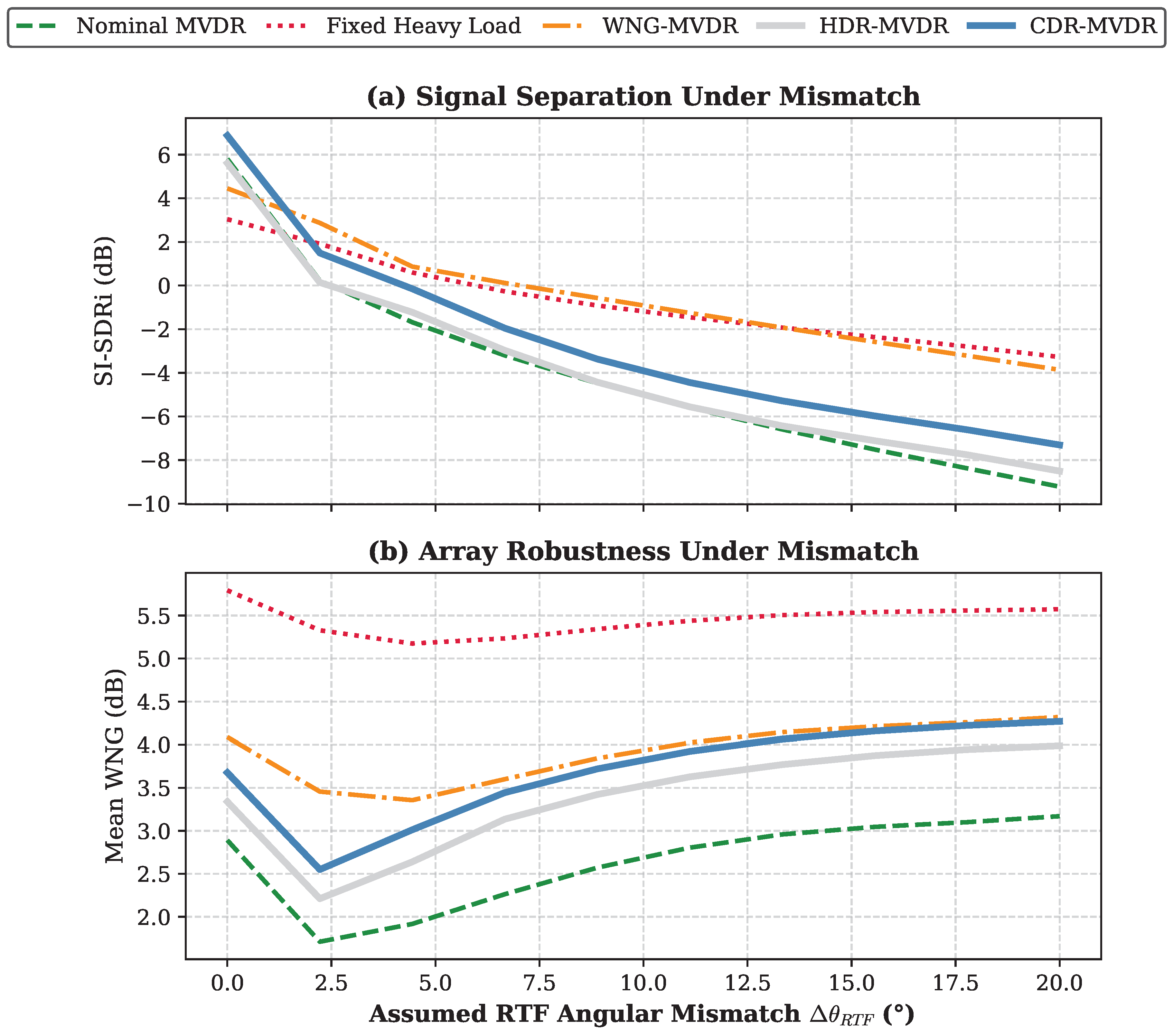
Finally, we evaluate the effect of mismatch between the true target response and the RTF supplied to the beamformer. The true target remains at the nominal broadside direction, while the assumed target RTF is generated from an anechoic configuration with an imposed angular offset . The SCM is still estimated from the true mixture, so the mismatch is introduced through the assumed target response.
Figure 7 reports SI-SDRi and mean WNG as the RTF mismatch is increased. Separation performance decreases for all spatially selective beamformers as the assumed target response departs from the true response. CDR-MVDR maintains higher WNG than Nominal MVDR and retains higher SI-SDRi than the strongly loaded baseline over much of the evaluated mismatch range. WNG-MVDR provides a complementary robustness reference through its explicit WNG constraint.
At larger mismatch values, the more strongly regularized baselines can provide higher separation performance than CDR-MVDR. This behavior is consistent with the robustness–selectivity trade-off observed in the static-loading experiment and indicates that the proposed controller does not eliminate the fundamental cost of severe target-model mismatch.
Taken together, the encroachment and mismatch experiments evaluate whether the control policy established in the preceding ablations remains useful when the spatial state or assumed target response changes. The results support adaptive adjustment of the regularization level while retaining the standard MVDR formulation.
References
- Capon, J. High-resolution frequency-wavenumber spectrum analysis. Proceedings of the IEEE 1969, 57, 1408–1418.
- Van Veen, B.D.; Buckley, K.M. Beamforming: A versatile approach to spatial filtering. IEEE ASSP Magazine 1988, 5, 4–24.
- Van Trees, H.L. Optimum Array Processing: Part IV of Detection, Estimation, and Modulation Theory; John Wiley & Sons, 2002.
- Gannot, S.; Burshtein, D.; Weinstein, E. Signal enhancement using beamforming and nonstationarity with applications to speech. IEEE Transactions on Signal Processing 2001, 49, 1614–1626.
- Habets, E.A.P.; Benesty, J.; Dmochowski, J.; Cohen, I.; Gannot, S. New insights into the MVDR beamformer in room acoustics. IEEE Transactions on Audio, Speech, and Language Processing 2010, 18, 158–170.
- Gannot, S.; Vincent, E.; Markovich-Golan, S.; Ozerov, A. A consolidated perspective on multimicrophone speech enhancement and source separation. IEEE/ACM Transactions on Audio, Speech, and Language Processing 2017, 25, 692–730.
- Carlson, B.D. Covariance matrix estimation errors and diagonal loading in adaptive arrays. IEEE Transactions on Aerospace and Electronic Systems 1988, 24, 397–401.
- Mestre, X.; Lagunas, M.A. Finite sample size effect on minimum variance beamformers: optimum diagonal loading factor for large arrays. IEEE Transactions on Signal Processing 2006, 54, 69–82.
- Feldman, D.D.; Griffiths, L.J. A projection approach for robust adaptive beamforming. IEEE Transactions on Signal Processing 1994, 42, 867–876.
- Li, J.; Stoica, P.; Wang, Z. On robust Capon beamforming and diagonal loading. IEEE Transactions on Signal Processing 2003, 51, 1702–1715.
- Vorobyov, S.A.; Gershman, A.B.; Luo, Z.Q. Robust adaptive beamforming using worst-case performance optimization: a solution to the signal mismatch problem. IEEE Transactions on Signal Processing 2003, 51, 313–324.
- Cox, H.; Zeskind, R.; Owen, M. Robust adaptive beamforming. IEEE Transactions on Acoustics, Speech, and Signal Processing 1987, 35, 1365–1376.
- Hassanien, A.; Vorobyov, S.A. Robust adaptive beamforming using direction-of-arrival constraints. IEEE Transactions on Signal Processing 2010, 58, 2026–2041.
- Yang, J.; Ma, X.; Hou, C.; Liu, Y. Automatic generalized loading for robust adaptive beamforming. IEEE Signal Processing Letters 2009, 16, 219–222.
- Du, L.; Li, J.; Stoica, P. Fully automatic computation of diagonal loading levels for robust adaptive beamforming. IEEE Transactions on Aerospace and Electronic Systems 2010, 46, 449–458.
- Li, X. Robust adaptive beamforming based on covariance matrix reconstruction with steering vector estimation. Signal Processing 2019, 155, 217–225.
- Zhou, J.; Bao, C.; Zhang, X.; Xiong, W.; Jia, M. Design of a robust MVDR beamforming method with low-latency by reconstructing covariance matrix for speech enhancement. Applied Acoustics 2023, 211, 109464.
- Mabande, E.; Schad, A.; Kellermann, W. Design of robust superdirective beamformers as a convex optimization problem. In Proceedings of the 2009 IEEE International Conference on Acoustics, Speech and Signal Processing (ICASSP). IEEE, 2009, pp. 77–80.
- Chen, X.; Benesty, J.; Huang, G.; Chen, J. On the robustness of the superdirective beamformer. IEEE/ACM Transactions on Audio, Speech, and Language Processing 2021, 29, 838–849.
- Markovich, S.; Gannot, S.; Cohen, I. Multichannel eigenspace beamforming in a reverberant noisy environment with multiple interfering speech signals. IEEE Transactions on Audio, Speech, and Language Processing 2009, 17, 1071–1086.
- Huang, G.; Benesty, J.; Chen, J. Superdirective beamforming based on the Krylov matrix. IEEE/ACM Transactions on Audio, Speech, and Language Processing 2016, 24, 2531–2543.
- Li, C.; Benesty, J.; Huang, G.; Chen, J. Subspace superdirective beamformers based on joint diagonalization. In Proceedings of the 2016 IEEE International Conference on Acoustics, Speech and Signal Processing (ICASSP). IEEE, 2016, pp. 400–404.
- Zhang, Z.; Xu, Y.; Yu, M.; Zhang, S.X.; Chen, L.; Yu, D. ADL-MVDR: All deep learning MVDR beamformer for target speech separation. In Proceedings of the 2021 IEEE International Conference on Acoustics, Speech and Signal Processing (ICASSP). IEEE, 2021, pp. 6089–6093.
- Zhang, Z.; Xu, Y.; Yu, M.; Zhang, S.X.; Chen, L.; Williamson, D.S.; Yu, D. Multi-channel multi-frame ADL-MVDR for target speech separation. IEEE/ACM Transactions on Audio, Speech, and Language Processing 2021, 29, 3526–3540.
- Pei, H.; Huang, G.; Jin, J.; Ma, J.; Wu, Z.; Chen, J.; Benesty, J. Data-driven white noise gain constrained robust superdirective beamformer for speech enhancement. In Proceedings of the 2025 IEEE International Conference on Acoustics, Speech and Signal Processing (ICASSP). IEEE, 2025, pp. 1–5.
- Zhang, Z. Adaptive diagonal loading for robust adaptive beamforming based on condition number. IEEE Access 2020, 8, 101347–101356.
- Mittal, M.; Corey, R.M.; Buck, J.R.; Singer, A.C. Adaptive diagonal loading for norm constrained beamforming. arXiv preprint arXiv:2605.04342 2026.
Figure 1.
Processing chain of the proposed method. The dominant spatial mode of the causally estimated mixture SCM is compared with the assumed target RTF to obtain the projection error . This quantity controls the time-frequency dependent MVDR loading through the CDR mapping.
Figure 1.
Processing chain of the proposed method. The dominant spatial mode of the causally estimated mixture SCM is compared with the assumed target RTF to obtain the projection error . This quantity controls the time-frequency dependent MVDR loading through the CDR mapping.
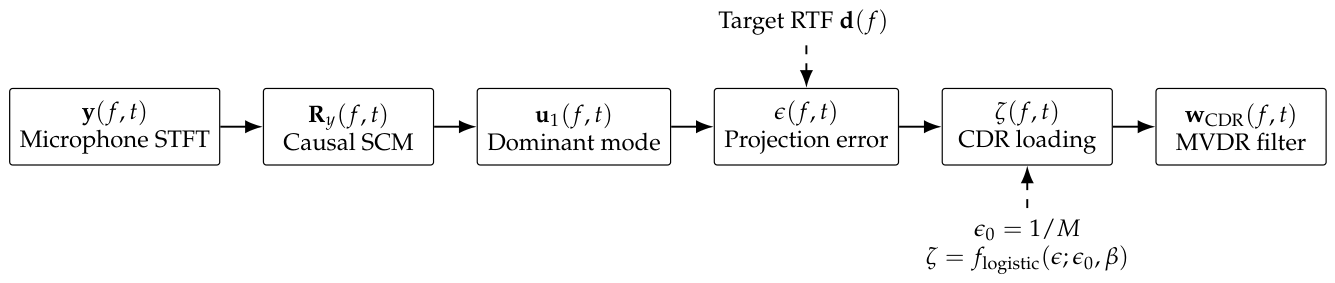
Figure 2.
Factorial ablation of the control variable and adaptation policy. Condition-number-based and spatial-subspace-based controllers are evaluated under hard and continuous adaptation. SI-SDRi, saturation fraction, loading variability, and filter jitter are reported.
Figure 2.
Factorial ablation of the control variable and adaptation policy. Condition-number-based and spatial-subspace-based controllers are evaluated under hard and continuous adaptation. SI-SDRi, saturation fraction, loading variability, and filter jitter are reported.
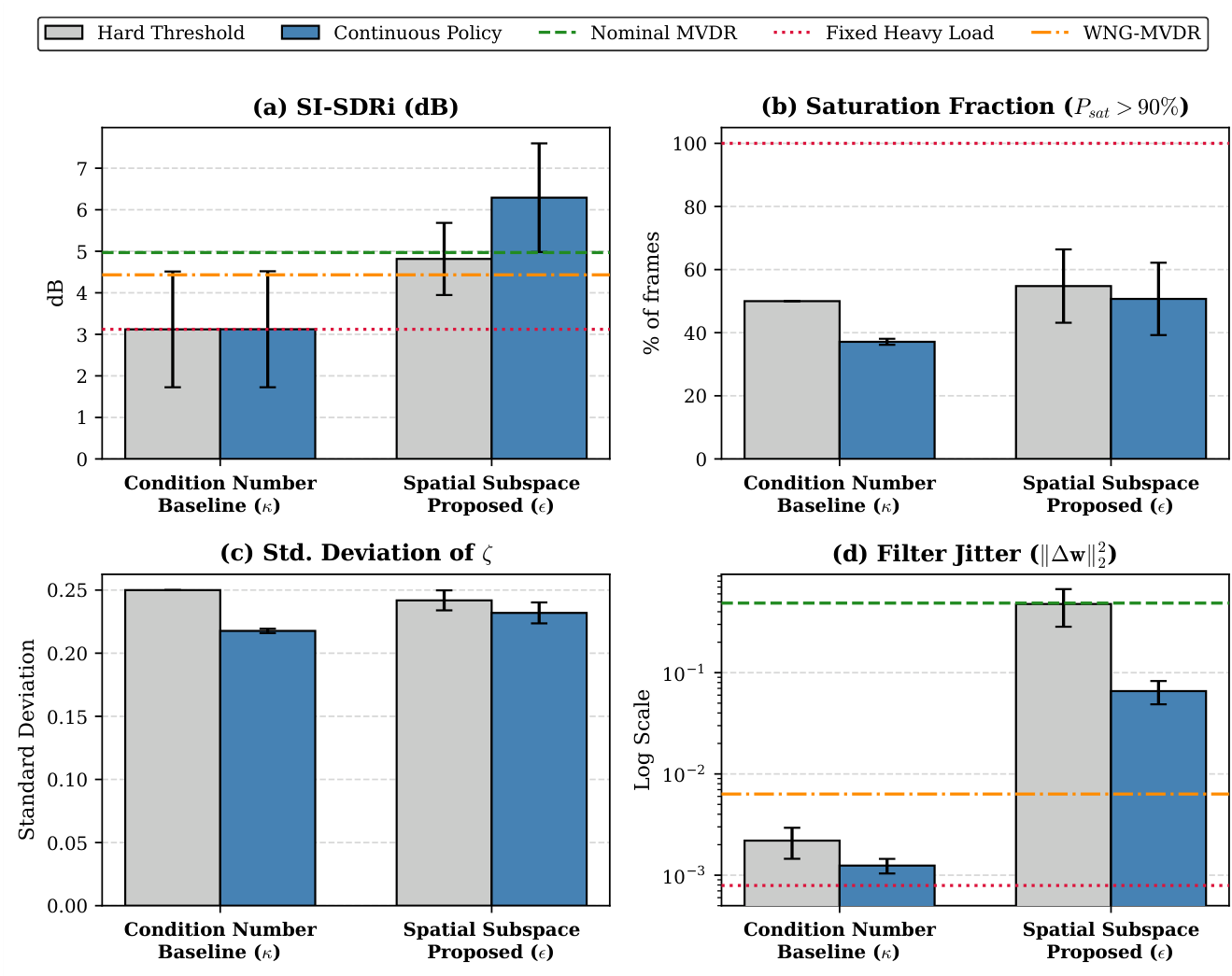
Figure 3.
Comparison of the tested linear -to- mapping with CDR-MVDR. The two mappings use the same loading bounds and transition center. SI-SDRi and filter jitter are shown for the resulting beamformers.
Figure 3.
Comparison of the tested linear -to- mapping with CDR-MVDR. The two mappings use the same loading bounds and transition center. SI-SDRi and filter jitter are shown for the resulting beamformers.
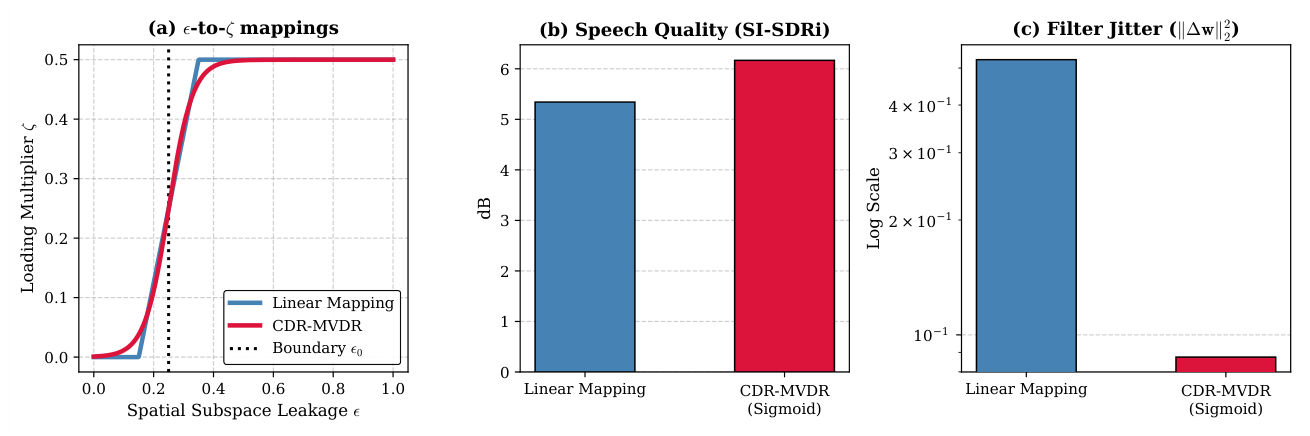
Figure 4.
CDR-MVDR transition-rule evaluation. The best evaluated transition threshold is compared with the proposed rule for . The reported gaps are measured relative to the best point within the evaluated sweep.
Figure 4.
CDR-MVDR transition-rule evaluation. The best evaluated transition threshold is compared with the proposed rule for . The reported gaps are measured relative to the best point within the evaluated sweep.
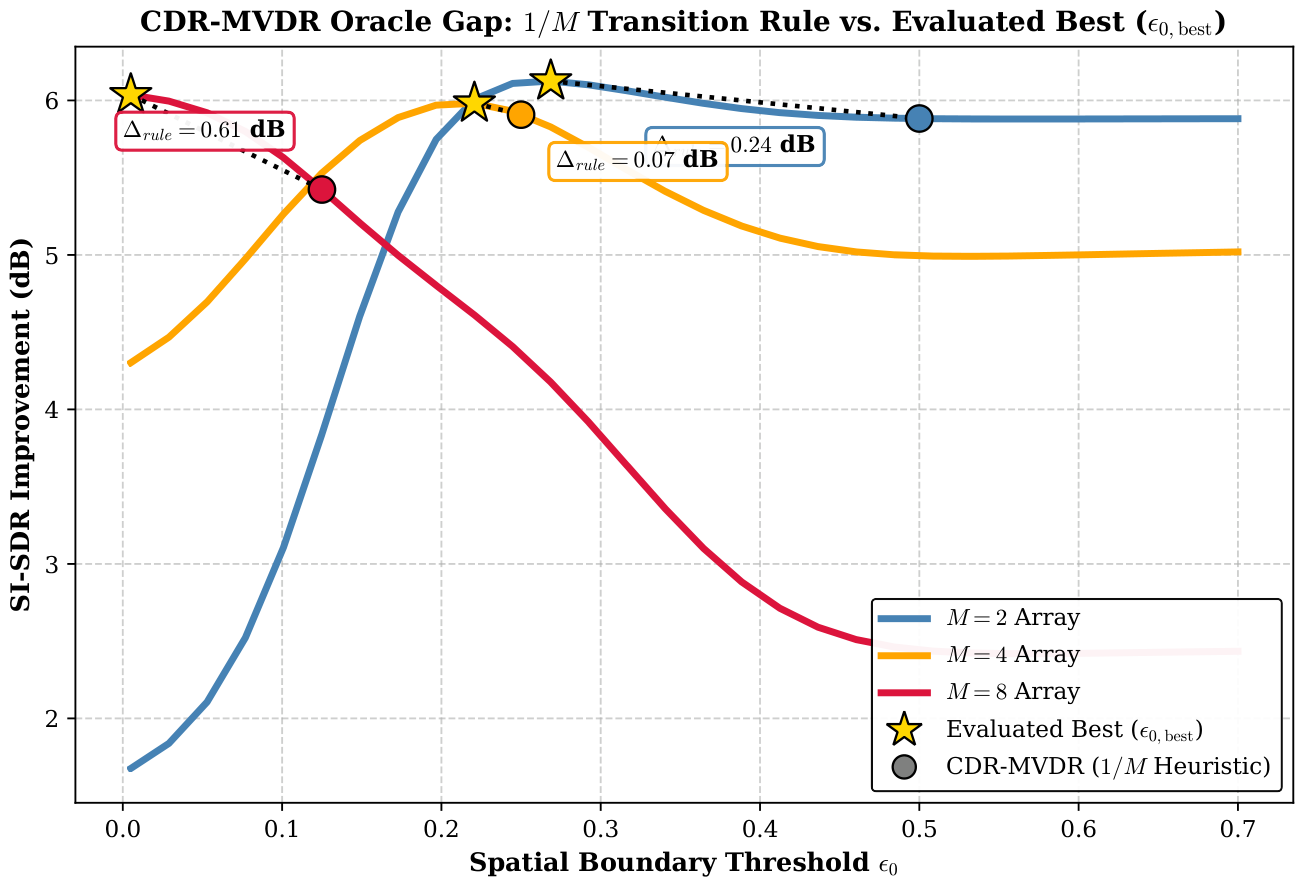
Figure 5.
Robustness–separation trade-off for the evaluated beamformers. The static-loading sweep is shown together with the operating points of Nominal MVDR, Fixed Heavy Load, WNG-MVDR, HDR-MVDR, and CDR-MVDR.
Figure 5.
Robustness–separation trade-off for the evaluated beamformers. The static-loading sweep is shown together with the operating points of Nominal MVDR, Fixed Heavy Load, WNG-MVDR, HDR-MVDR, and CDR-MVDR.
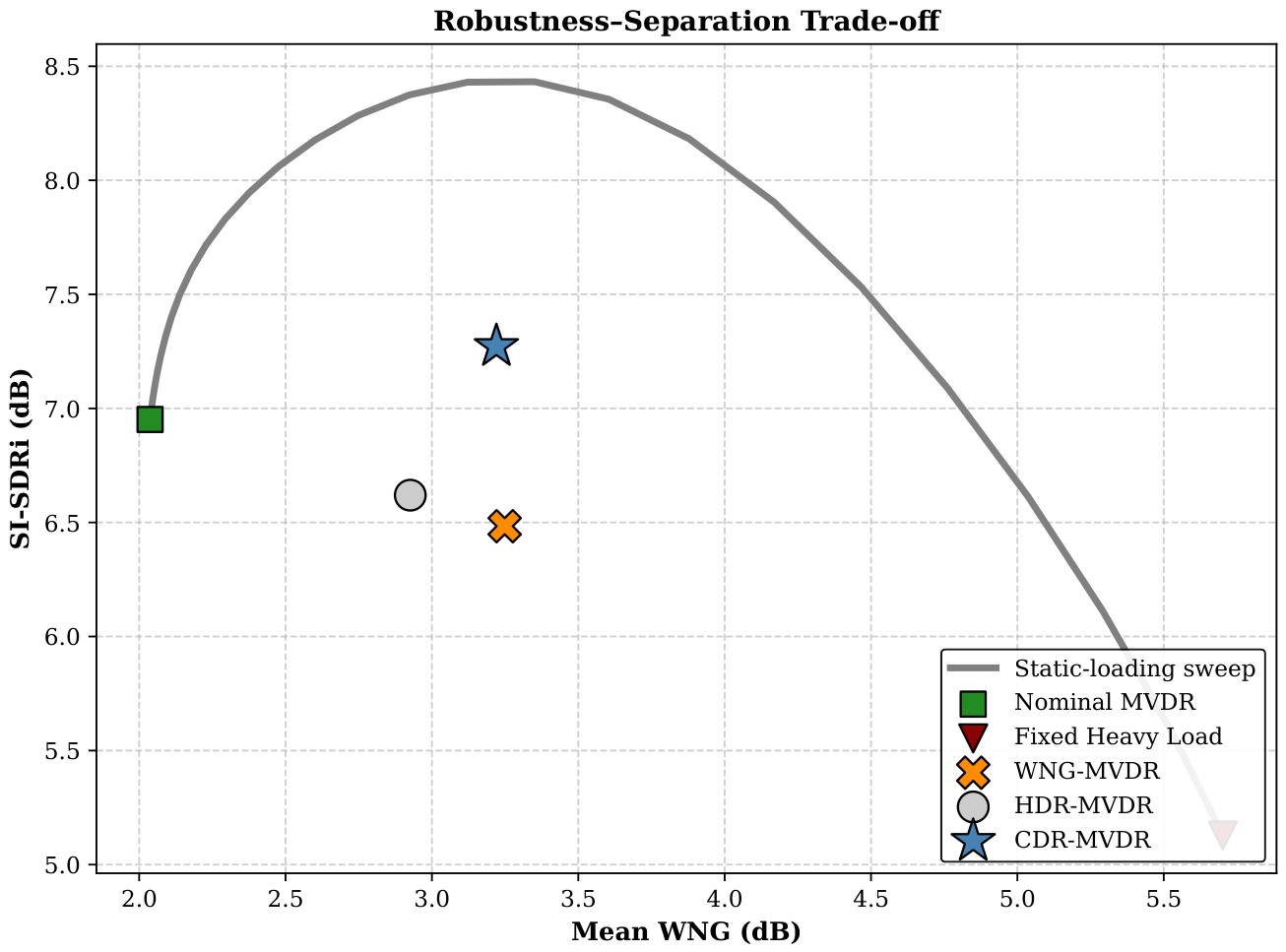
Figure 6.
Evaluation under changing target–interferer angular separation. Larger corresponds to greater spatial separation. SI-SDRi and mean WNG are shown for Nominal MVDR, Fixed Heavy Load, WNG-MVDR, HDR-MVDR, and CDR-MVDR.
Figure 6.
Evaluation under changing target–interferer angular separation. Larger corresponds to greater spatial separation. SI-SDRi and mean WNG are shown for Nominal MVDR, Fixed Heavy Load, WNG-MVDR, HDR-MVDR, and CDR-MVDR.
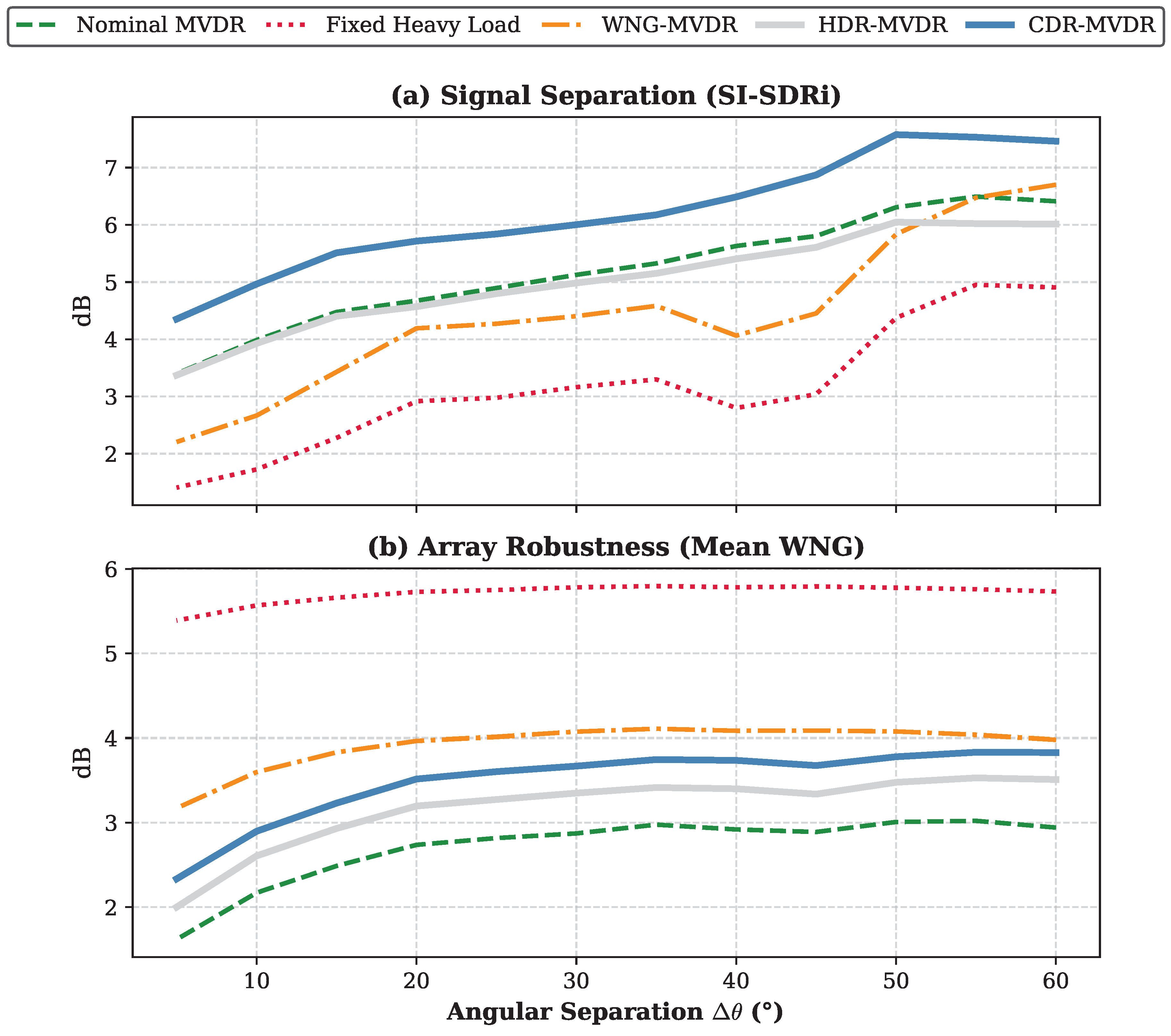
Figure 7.
Evaluation under target RTF mismatch. The true target response is fixed while the assumed RTF is generated with an angular offset . SI-SDRi and mean WNG are shown for Nominal MVDR, Fixed Heavy Load, WNG-MVDR, HDR-MVDR, and CDR-MVDR.
Figure 7.
Evaluation under target RTF mismatch. The true target response is fixed while the assumed RTF is generated with an angular offset . SI-SDRi and mean WNG are shown for Nominal MVDR, Fixed Heavy Load, WNG-MVDR, HDR-MVDR, and CDR-MVDR.
Disclaimer/Publisher’s Note: The statements, opinions and data contained in all publications are solely those of the individual author(s) and contributor(s) and not of MDPI and/or the editor(s). MDPI and/or the editor(s) disclaim responsibility for any injury to people or property resulting from any ideas, methods, instructions or products referred to in the content. |
© 2026 by the authors. Licensee MDPI, Basel, Switzerland. This article is an open access article distributed under the terms and conditions of the Creative Commons Attribution (CC BY) license (http://creativecommons.org/licenses/by/4.0/).
Copyright: This open access article is published under a Creative Commons CC BY 4.0 license, which permit the free download, distribution, and reuse, provided that the author and preprint are cited in any reuse.