
Submitted:
09 September 2026
Posted:
17 September 2026
You are already at the latest version
Abstract
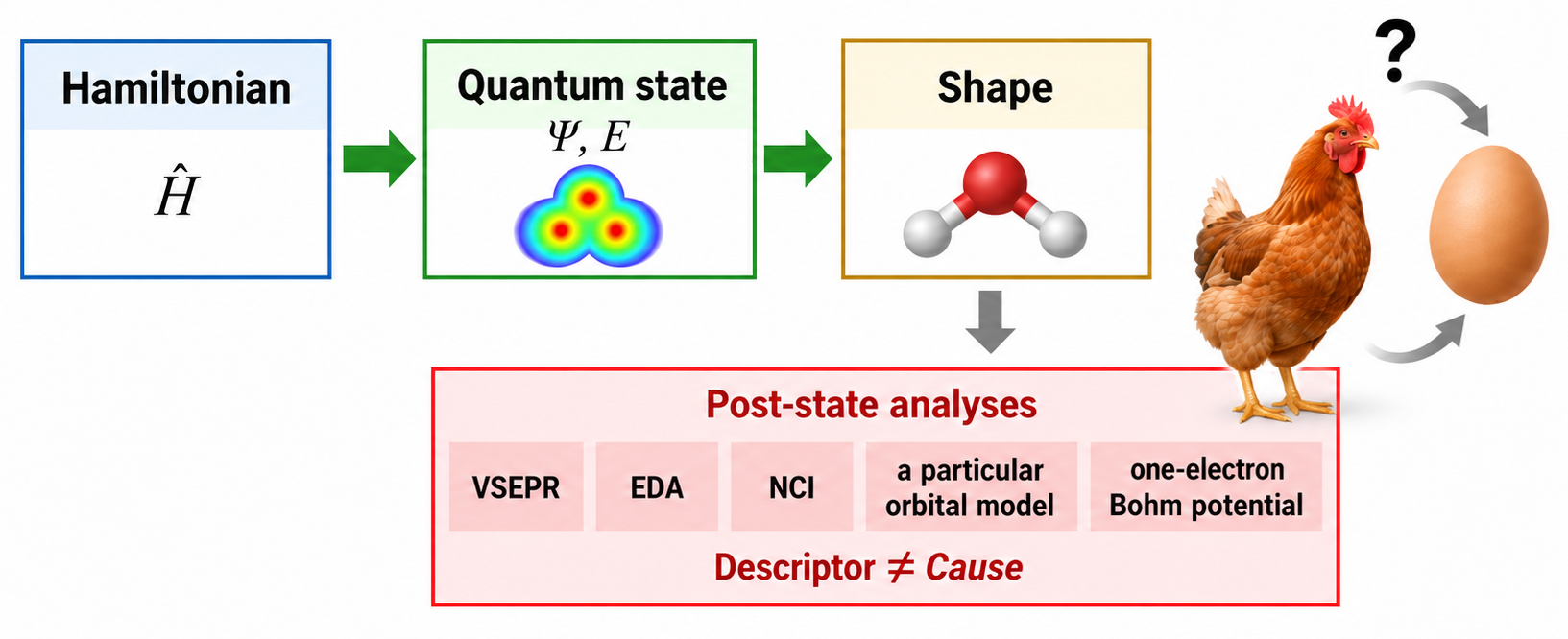
Molecular shape is routinely explained through bonding language: bonds impose angles, lone pairs repel ligands, steric contacts force torsion, orbital interactions favor conformations, and energy-decomposition components stabilize structures. These useful explanations can reverse the order of the underlying theory. In the full molecular Coulomb problem, a fixed geometry is not an intrinsic label of a stationary eigenstate. Standard quantum chemistry uses clamped-nuclei/Born-Oppenheimer approximation whereby a nuclear configuration, number of electrons, and any additional externally applied potentials, define the electronic Hamiltonian. The quantum state then yields energy and bonding descriptors at each geometry. Repeated calculations at different geometries generate the potential-energy landscape whose stationary structures are identified. We examine VSEPR, steric and Pauli repulsion, biphenyl and cis-2-butene, EDA auxiliary states and path/reference dependence, NCI, orbital representation dependence, QTAIM/IQA, localization-delocalization matrices, stable/metastable metals, nuclear transmutation, and the one-electron Bohm quantum potential. We also separate practical Born-Oppenheimer chemistry from the unresolved full-Coulomb structure problem. Stronger causal claims begin with an independent perturbation of the Hamiltonian, followed by responses of geometry, energy, density, and descriptors. Molecular shape is, therefore, a stationary-state or ensemble property, while bonding descriptors provide higher-level explanations rather than independent microscopic agents. This raises a deeper question: why does quantum matter generate robust, transferable chemical regularities, including recurring hydrogen-bonding patterns?
Keywords:
chemical bonding
; molecular shape
; causal explanation
; Born-Oppenheimer approximation
; energy decomposition analysis
; QTAIM
; NCI
; steric effects
; electron density
; metastability
Copyright: This open access article is published under a Creative Commons CC BY 4.0 license, which permit the free download, distribution, and reuse, provided that the author and preprint are cited in any reuse.