

Submitted:
16 September 2026
Posted:
17 September 2026
You are already at the latest version
Abstract
The article represents scale elemental analysis of three commercially important fishes Cyprinus carpio, Lates calcarifer, and Chrysochir aureus. The concentrations of As, Be, Cd, Co, Cr, Cu, Fe, Hg, Mn, Ni, Pb, Se, V, and Zn using Inductively Coupled Plasma Mass Spectrometry (ICP-MS). It was revealed that fish scale microchemistry differed in connection with their natural environment, habitat, and feeding habits. Higher levels of Be, Co, and Zn in the scales of C. carpio, which is a freshwater fish, are perhaps due to increased bioavailability of the elements, aquatic pollution, and fish’s interaction with sediment. L. calcarifer, collected from the brackish water environment, derived more Cu from mixing-zone chemistry and anthropogenic inputs, as well as from their prey. Marine fish, C. aureus, displayed significantly higher levels of As, Mn, Ni, and Se in their scales, likely due to the complexation process and their inherent seawater abundance. Significantly elevated As, Be, Cd, Co, Mn, Se, and Zn in the scales of benthopelagic fish may stem from prolonged exposure to water column particulates and dietary uptake. Omnivorous fish accumulate significantly higher levels of Be, Co, and Zn than their carnivorous counterpart that which might be attributed to a combination of their broad spectrum diet pattern. Although these differences could be caused by other variables such as species-specific physiology or geographic distribution, the findings suggests that fish scale microchemistry may be linked to trophic ecology and environmental exposure. The study might contribute to the future development of noninvasive approaches utilizing fish scales for ecological and environmental assessment.
Keywords:
fish scale
; scale microchemistry
; habitat
; trophic ecology
1. Introduction
Fish accumulate different elements through food consumption and absorption from the environment via the body surface [1,2]. Being the very outermost structure of the fish, the scale has a high likelihood of coming in contact with minerals in the water medium [3]. Fish scales possess osteoblastic cells and collagen in their structure, facilitating the formation of a molecular complex with different elements available in the water [4]. Scales have a good share of hydroxyapatite, an efficient metal adsorbent, in the composition by weight, permitting them to effectively absorb various elements from water [5,6]. Therefore, scale chemical properties have the potential to infer information about fish life history patterns, migration, and origin [7]. The chemical composition of the scales reflects the elemental profile of the body of water in which the fish dwell [8,9]. Scale elemental composition portrays the elemental makeup of the environment where fish reside [10]. Especially, trace element composition reflects habitat use and environmental circumstances over time and is pertinent to be used in life history research [11]. Scale microchemistry is related to the environment that fish live coupled with their feeding patterns [12].
Fish live in different aquatic environments with varying salinity levels, ranging from freshwater to seawater [2]. Freshwater differ greatly based on the variety of soil and rock with which the water comes into contact. Seawater, however, is normally constant in its composition and almost similar anywhere in the Earth’s basins [13]. Coastal waters, where land meets the sea, are one of the most bio-geochemically active areas of the marine environment [14]. Coastal brackish water features a broad spectrum of salinities, for example, in estuaries, where fresh and seawater come together [15]. Salinity affects the solubility of elements in aquatic systems, which governs their intake and disposition by the organisms that live there [16]. Effects on water solubility would consequently influence total bioavailability, and chemical sorption [17]. Thus, the level of elements accumulated in fish varies significantly with the status of the living environment (Laing et al., 2008; Moiseenko and Gashkina, 2020). Especially, water salinity exerts a noteworthy effect on the uptake of certain metals from water by organisms [20]. Different fish accumulate metals in different concentrations, and interspecies variation in accumulation is related to their environment and diet patterns [21].
Understanding fish life history and ecological characteristics is useful for sustainable management since it can be used to understand the general ecology and functional organization of fish populations [22]. In species where fatal procedures must be avoided, chemical analysis of scales may provide extensive insights on trophic interactions and movements [23]. Traditionally, fish are regarded as the finest bioindicators in aquatic environments [24]. That is why fish are frequently employed for such studies because of their long lifespan, relatively large bodies, availability in a range of trophic levels, wide species diversity, wide geographic distribution in a range of environments, and ease of availability [25,26]. However, usually fish otoliths are utilized for ecological and environmental analyses that entail cutting fish samples.
Whereas scales can be collected with almost no impairment on the fish, thus providing nonlethal and noninvasive sampling. Besides providing non-lethal sampling, this technique is scalable for a wide range of systems from small ponds to oceans. Additionally, scales remain present throughout their lives, facilitating the records of longer periods [27]. In pace with the continuous growth, scales preserve the chemical fingerprint of their environment. They seem like a promising environmental tool, suited for studies of rare and vulnerable fishes with minimal disturbance [11,27]. Moreover, scale analysis would allow continuous data to be taken from the same fish with particular intervals to assess deposition over time, supporting catch-and-release studies and long-term monitoring. Furthermore, scale analysis would enable studies from archival collections [28]. Employing scales also reduces ethical concerns. Finally, such methods should be more cost-effective and field-friendly, easier to collect, requiring only simple tools (forceps or a scalpel) and no specialized training. Thus, fish scales serve as a versatile tool for ecological and environmental studies, offering insights into growth, diet, stress, evolution, and pollution—all without harming the fish. The application of scale microchemistry is attracting increasing interest in a variety of domains of fisheries ecology and environmental research. Such as for tracking fish origin [7,29], distinction between freshwater and saltwater stock [30,31]; habitat and feeding habit association [32], habitat association [33,34], history of habitat occupancy and population structure [35], characterization of fish migration trends and life events [11,36], pollution assessment [27,37], a historical reconstruction of past environmental changes [28]. Yet, a few studies have been conducted on the scale elemental analysis from a wide range of aquatic systems to get a better understanding. Therefore, the current research aimed to analyze scale microchemistry of Cyprinus carpio, Lates calcarifer, and Chrysochir aureus to explore their potential connections with the trophic ecology and environmental exposure.
2. Materials and Methods
2.1. Species Selection
Species were selected based on their abundance and widespread distribution in the inhabited area, high tolerance to pollutants, commercial importance, and previous research records. Common carp, Cyprinus carpio (Linnaeus, 1758), Barramundi, Lates calcarifer (Bloch, 1790), and Reeve’s croaker, Chrysochir aureus (Richardson, 1846), were collected and studied. Samples were collected from the fishermen fishing in the respective water bodies. The ecological characteristics of the fish are shown in Table 1. The common carp, C. carpio is a commercially important, hardy, and adaptable fish species of Cyprinidae (Minnows or carps) family that can be found in a wide range of freshwater environments, including lakes, rivers, and ponds [38]. Its ubiquity makes it readily available for research in many regions. Common carp can grow to substantial sizes and have long lifespans [38], which means they can build up metals in their body over time, providing a history of exposure to pollutants. Carp can tolerate a range of environmental conditions, including polluted water [38]. Their ability to thrive in a variety of aquatic ecosystems makes them useful for studying heavy metal contamination in different environmental settings around the globe [39,40]. Common carp primarily live on the bottom but travel to the mid and top strata for food, found in the open and confined waters [41]. Barramundi, L. calcarifer, is a large, diadromous, euryhaline fish of the Latidae (Lates perches) family inhabiting rivers before returning to the estuaries for spawning [42]. It grows to substantial sizes and has relatively long lifespans [42]. Reeve’s croaker, C. aureus is a marine fish of the Sciaenidae family [43]. It is an offshore warm water demersal fish living mostly in the bottom water with a benthic feeding behavior [44,45]. C. aureus has been studied for heavy metal pollution [46,47,48], microplastics pollution [44,49].
2.2. Sample Collection and Preparation
The fish specimens were carefully cleaned with water to eliminate any adhering contaminants. Measurements of length and weight were taken for each fish. The total length and weight (Mean ± St. Dev.) of the fish were 37.81±1.74 cm and 1083.5±105.00 g for C. carpio (n=4), 42.01±2.63 cm and 1040±169.01g for L. calcarifer (n=4), and 41.99±0.66 cm and 881.50±58.43 g for C. aureus (n=4). After being gathered, the fish specimens were frozen at -20 °C and sent to the laboratory for study. The samples were washed with water and allowed to defrost at room temperature before the scales were collected. Scales were collected following the method described in previous research (Parvez et al., 2025). After collection dirt and mucus were removed from the scales using distilled water, and any remaining mucus was thoroughly cleansed using a soft bristle brush. Prior to the chemical analysis, the scales were allowed to air dry at room temperature.
2.3. Chemical Analysis
The chemical analysis was performed using an inductively coupled plasma mass spectrometry (ICP-MS, PerkinElmer NexION 2000). Prior to analysis, the samples underwent microwave-assisted acid digestion following the procedure outlined in Application Note HPR-FO-17 (Milestone Start D, Italy). Dried sample was weighed into individual TFM vessels (modified PTFE, copolymerized PTFE), which (0.50 g) were then placed inside a safety shield. To each vessel, 7 mL of ultrapure HNO3 and 1 mL of H2O2 were added, and the contents were gently mixed by hand for 1–2 minutes to ensure thorough interaction with the acids. The vessels were sealed, loaded into the rotor segment, and digested in the microwave system for 30 minutes at 200 °C. The rotor was left to cool to room temperature following digestion, and the digested solutions were transferred into pre-marked volumetric flasks. Approximately 0.4 mL/min of each sample was nebulized into the core of the argon plasma. At high plasma temperatures, the sample aerosols were vaporized, atomized, and subsequently ionized. The resulting ions were introduced into a quadrupole mass spectrometer, which separated them based on their mass-to-charge ratio (m/z). Elemental concentrations were quantified in parts per billion (ppb) using external calibration with ICP multielement standards. To ensure analytical accuracy and precision, digestion recoveries were assessed using certified reference materials (SRM 1946 and SRM 1947, specifically designed for fish matrices). Recovery rates for all target elements exceeded 94%, demonstrating the reliability of the method. The QC was also checked and maintained by using Rhodium (Rh) and Indium (In) as internal standards for ICP-MS. The limits of detection (LOD), which the instrument calculated automatically and were found between 0.1 and 0.5 parts per trillion (ppt). All measurements represent the mean of three replicate analyses, with standard deviations below 3%. Reported metal concentrations were blank-corrected using field blanks to account for any potential contamination.
2.4. Statistical Analysis
Statistical analysis of data was conducted using SPSS (Statistical Package for the Social Sciences, 26.0) and PAST (PAleontological Statistics, 4.15). Firstly, data were checked for normality (Shapiro–Wilk test) and homogeneity (Levene’s test). One-way analysis of variance (ANOVA) was performed for parametric data, followed by the post-hoc DMRT (Duncan Multiple Range Test). Kruskal-Wallis test was applied for non-parametric data followed by Dunn’s multiple pairwise comparison test.
3. Results and Discussion
3.1. Scale Microchemistry
The present study investigated the concentrations of fourteen trace elements in fish scales collected across freshwater, estuarine/brackish water, and marine habitats such as metals: Beryllium (Be), Cobalt (Co), Iron (Fe), Manganese (Mn), Nickel (Ni); transition metal Vanadium (V); metalloids: Arsenic (As), Selenium (Se), and potentially toxic elements Cadmium (Cd), Chromium (Cr), Copper (Cu), Mercury (Hg), Lead (Pb), Zinc (Zn). The mean concentrations of the elements are presented in Table 2. Among the analyzed elements, Be, Co, and Zn were significantly higher in freshwater fish scales compared to other habitat groups (P ≤ 0.05). Although Cr, Hg, and Pb showed higher mean concentrations in freshwater fish, these differences were not statistically significant (P > 0.05). Cu concentrations were numerically higher in estuarine or brackish water fish (L. calcarifer) (0.92 ± 1.25 mg kg−1), followed by freshwater (0.66 ± 0.22 mg kg−1) and marine fish (0.27 ± 0.22 mg kg−1); however, no statistically significant difference was observed among habitats (P = 0.092). Meanwhile, Marine fish (C. aureus) exhibited higher mean levels of As, Cd, Fe, Mn, Ni, Se, and V; among these, As, Mn, Ni, and Se differed significantly across habitats (P ≤ 0.05), while Cd, Fe, and V did not show statistically significant differences (Table 2).
The elevated Zn concentrations observed in freshwater fish scales in the present study are consistent with findings of Parvez et al., (2025). Similarly, Rahman et al., (2018) documented elevated Zn concentrations (110.313 ± 0.27 µg g−1) in the scales of L. calcarifer, further corroborating the capacity of fish scales to accumulate this metal at considerable levels. This pattern of Zn enrichment in scales is also supported by biosorption studies, which have demonstrated that fish scales are highly efficient at adsorbing trace metal ions, including Zn, from aqueous environments [52,53]. Few elements including Zn are reported to be assimilated into the calcified matrix more readily in higher water temperature [54,55]. Rahman et al., (2018) reported marked elevated concentrations (19.035 ± 0.05 µg g−1) of Cu in the scales of L. calcarifer, which are substantially higher than the values recorded for the same species in the present study. This discrepancy may reflect differences in ambient water quality, sediment geochemistry, or the degree of anthropogenic contamination between sampling sites and study periods. Parvez et al., (2025) also reported that Cu concentrations in certain freshwater species exceeded national reference thresholds, reinforcing concerns regarding Cu bioaccumulation in fish from contaminated freshwater systems. The high standard deviation observed for Cu in brackish water fish (L. calcarifer) (0.92 ± 1.25 mg kg−1) in the present study indicates considerable inter-individual variability in Cu accumulation, likely reflecting heterogeneous exposure conditions within the estuarine environment, including spatially variable contamination from anthropogenic sources (Hossain and Islam, 2006; Pesce et al., 2024). This variability may have also contributed to the lack of statistical significance despite the numerically higher mean concentration observed in brackish water fish. Jovičić et al., (2023) reported a significantly positive correlation between Hg concentrations in scales and muscle tissue of pikeperch (p < 0.01), consistent with earlier findings by Červenka et al., (2011), who demonstrated that predatory fish tend to accumulate substantial amounts of Hg in scales. These observations support the potential utility of scales as a non-lethal biomonitoring tool for Hg exposure in predatory species. In contrast, Valová et al., (2013) found no significant correlation between scale and muscle Hg concentrations in chub (Squalius cephalus). In a similar vein, Farrell et al., (2000) reported the absence of a meaningful relationship between Hg (and Se) concentrations in scales and muscle tissue of Arctic grayling (Thymallus arcticus), further illustrating that the reliability of scales as a Hg proxy may be species-dependent or influenced by trophic and physiological factors.
The elevated Fe concentrations observed in marine fish in the present study, though not statistically significant across habitats, are consistent with the documented biosorption capacity of scales for Fe ions [52,53]. The absence of statistical significance for Fe, Cd, and V across habitats in the present study may reflect the combined influence of species-specific physiology, dietary variability, and ambient geochemical gradients along the salinity gradient, rather than a uniform habitat-driven accumulation pattern. However, studies specifically examining trace element composition in fish scales remain comparatively scarce, despite being metabolically active, directly exposed to the aquatic environment, and capable of reflecting long-term metal exposure histories. The limited available evidence including Jovičić et al., (2023), Rahman et al., (2018), Seeley and Walther, (2018) and Parvez et al., (2025) suggests scales hold considerable promise as a non-invasive biomonitoring tool, yet inter-study comparability remains constrained by differences in target species and geographic context.
It is noticed that there are some heavy metals or potentially toxic elements (PTEs) included in the elements detected in the current study. Increased anthropogenic activities based on the utilization of different chemicals resulted in the pollution of aquatic environments through the discharge of effluents with such PTEs [61]. These elements are non-biodegradable, ubiquitously found in aquatic systems, and are readily taken up by different organisms, including fish [62,63]. In aquatic environments, a variety of fish species belong to the top consumers in trophic pyramids and can accumulate large amounts of PTE from polluted water [64]. However, the present work examined fish scales that are inedible and are not often used for human consumption.
Across all habitat groups, Fe, Zn, and Mn were consistently the most abundant elements in fish scales, regardless of species or environment, while Be, Cd, and Hg were the least abundant (Table 3). Minor differences in the ranking of intermediate elements were observed across freshwater, brackish water, and marine fish, with notable shifts in the positions of As, Co, and Cu across salinity gradients (Table 3).
The determined elements were classified into five categories based on their overall availability in the scales of all fish from fresh water, brackish water, and marine environment: most, Considerable, moderate, low, and least available Table 3. These groupings are also depicted in the network analysis (Figure 1) and classical cluster analysis, dendrogram (Figure 2). Regardless of the environment and species, Fe, Zn, and Mn, respectively, were the most plentiful, hence are in the most available group (first) of elements in the fish scales of freshwater-brackish water-marine environments. The overall mean concentrations of the elements in the group ranged from 18.38 to 562.08 mg kg-1. The second group (considerable availability) consists of Ni, Pb, and Cr, and the overall mean concentrations of the group ranged from 1.68 to 3.59 mg kg-1. However, As, Cu, Se, V, and Co form the third group of elements having considerable availability. Their overall mean concentrations varied between 0.27 mg kg-1 and 0.68 mg kg-1. The elements, Hg and Cd, have low availability (fourth group) and their overall mean concentrations range from 0.05 to 0.11 mg kg-1. While Be was found to have the least availability, with an overall mean concentration of 0.01 mg kg-1 only, it is therefore in the last group.
3.2. Correlation Matrix
The Pearson correlation coefficients (Figure 3) represent the correlation among the elements detected in the scales of C. carpio, L. calcarifer and C. aureus. In the scales of C. carpio, which live in the fresh water environment, concentrations of Co is significantly positively correlated with Ni while concentrations of Hg is significantly positively correlated with V (Figure 3a). However, there were significant positive correlations between the concentrations of Co-Zn, Co-Ni, Cu-Hg and Fe-Se in the scales of L. calcarifer collected from brackish water environment (Figure 3b). Whereas, concentrations of Be-Fe, Be-V, Cd-Mn, Cr-Fe, Cr-V and Fe-V were significantly positively correlated in the scales of C. aureus which is a marine fish (Figure 3c). In general, this suggests a likely shared origin or comparable environmental and ecological aspects. Highly significant (p < 0.01) positive correlations, such as Co-Ni and Hg-V in the fresh water and Be-V, Cd-Mn, and Cr-Fe in the marine fish scales suggest shared environmental uptake mechanisms [65] or biochemical synergies [66] potentially influenced by redox dynamics or metabolic processes. Numerous studies have reported that some mechanisms control the transfer of chemicals within the aquatic ecosystem, such as contamination sources, transportation, biotic or abiotic transformation, and sorption to sediment [67,68,69,70]. The bioavailability of chemicals to fish is eventually determined by these natural mechanisms. Moderate significant associations (p < 0.05) may reflect salinity-mediated bioavailability [71] or contamination pathways [72], while weak or non-significant correlations imply independent accumulation [73]. Negative trends highlight contrasting interactions. These patterns support the use of scales as a noninvasive proxy for tracking ecological traits and feeding nature across salinity zones by highlighting the role of salinity gradients in forming elemental microchemistry.
3.3. Elements Across the Fish Living Environment
3.3.1. Freshwater Fish C. carpio
The concentrations of Be, Co, and Zn were significantly higher in C. carpio scales, which is a freshwater fish compared to other habitat groups (P ≤ 0.05). Concentrations of Cr, Hg, and Pb were also numerically elevated, although these differences were not statistically significant (P > 0.05). These may reflect natural variation rather than habitat-specific accumulation. The weathering of the Earth’s surface causes metals like beryllium (Be), cobalt (Co), chromium (Cr), lead (Pb), and zinc (Zn) to be more prevalent in freshwater systems. Anthropogenic activities, like runoff from industry and agriculture could also be the source of these elements. Freshwater bodies are likely to receive metals from urban and industrial sources, such as Pb from the previous use of leaded gasoline, batteries, and paints; Zn from galvanizing and tires; and Cr from tanneries and electroplating [74]. Wide usage of Zn as an anticorrosive agent may potentially have an impact on its concentration levels in water because it oxidizes more quickly than other metals [51]. Coal combustion releases Hg, which can deposit onto terrestrial systems and finally wash into waterways [75]. Mercury (Hg), especially methylmercury, transforms into methyl-mercury in aquatic systems and then bio-accumulates in the food chain [76], reaching high levels in predatory species. Freshwater sediments tend to store metals such as Cr, Pb, Hg, and Zn [77]. With its voracious feeding nature, C. carpio seems to ingest sediment [78]. Thus, the heavy metals stored therein could be taken up by the fish during sediment ingestion. It was reported that, as a major metal sink in the water bodies, sediment plays a significant role in the metal uptake by C. carpio [79]. Furthermore, the dearth of chloride ions in freshwater reduces the precipitation of metals, resulting in enhanced bioavailability of metals for uptake by fish (Magalhães et al., 2015). Smaller water volumes in freshwater systems compared to oceans result in less dilution, allowing pollutants to accumulate more easily.
Additionally, the level of bioavailability of the metals gets affected by fish habitats and the nature of the water [18]. The characteristic low salinity in the freshwater ecosystem could influence the elevated uptake of certain elements owing to reduced competition from major cations (like Na+ and Ca2+) for uptake channels.. For example, Ali and Taylor (2022), demonstrated that the uptake rate of Zn becomes significantly higher at low water salinity. Also, Pb has been demonstrated to exhibit a substantial bioaccumulation reliance in water with low salinity [18]. Thus, the accumulation of these metals in higher concentrations could have been induced by their greater bioavailability in the low-salinity freshwater environment. The species-specific inherent biology and physiology could govern the elemental profile found in the fish. Absorption and excretion rates, as well as internal accumulation processes that are controlled by the organism’s biology, environmental factors, and ambient water element concentration, dictate how much of a given element accumulates in a given tissue [81].
3.3.2. Brackish Water Fish L. calcarifer
The highest mean concentration of Cu was observed in the scales of L. calcarifer which is a brackish water or estuarine fish. However, this difference was not statistically significant (P > 0.05). Estuaries are extremely dynamic habitats, where salinity can fluctuate over a relatively short distance and throughout the day due to tidal cycles [15]. Cu is typically found in water in a nonpolar or cationic state, allowing it to swiftly get into cell membranes [51]. In estuaries, organic ions could perform as metal ligands, creating coordination compounds that reduce free cations, thus lessening their bioavailability [82]. Coordination complexes are often not capable of crossing the barrier, for example, membranes, due to their greater molecular weights [83]. Estuarine brackish water environments are dynamic habitats that produce a wide array of organic and inorganic compounds when freshwater and seawater combine. Organic ions could originate from man-made sources such as complex compounds used in detergents, industrial processes, and exist naturally as well, like humic and fulvic acids [84]. Because of the region’s dense population, agricultural and industrial discharges, estuaries in Bangladesh are more likely to have abundant organic ions produced in combination with natural and man-made processes. For example, coastal mangrove plants possess tannins and lignins [85] that could be exuded into the estuarine waters. Thus, the organic compounds from Sundarbans, the world’s largest mangrove forest, along with other sources acting as metal ligands, could potentially hinder common metal cations from being absorbed into fish scales at higher levels.
Estuaries often lie near urban and industrial discharge sites, resulting in elevated copper contamination from antifouling coatings, wastewater, and stormwater drainage. Copper-based fungicides (e.g., Bordeaux) and fertilizers used in agriculture can leach into rivers and accumulate in estuaries [86]. Estuaries experience heavy vessel traffic, leading to possible Cu leaching from antifouling paints used in ships and boats. The shipbreaking industry on the Chittagong coast releases heavy metals, including Cu from antifouling paints, wiring, and hull corrosion, into the coastal and estuarine waters [56]. Besides receiving inland discharges, estuaries are also exposed to marine inputs, contributing to the further rise of Cu levels. However, being a dynamic zone where freshwater meets seawater, estuaries create a special physicochemical environment, causing specific metal ions like Cu to bind to sediments [87]. Cu has a higher affinity for organic binding phases in estuarine sediments than other metals such as Ni and Pb, because of its rapid water exchange rate, increased stability due to the Jahn-Teller phenomenon, and high ionic potential [88]. These make Cu more available in estuarine brackish water. Since L. calcarifer is a bottom-feeding predatory fish, it may accumulate Cu by consuming smaller contaminated prey and ingesting contaminated sediments. However, the considerable standard deviation (1.25) relative to the mean value (0.92) of Cu in brackishwater fish could be due to variability in levels of consumption across individual fish samples
3.3.3. Marine Water Fish C. aureus
Marine fish (C. aureus) exhibited significantly higher levels of As, Mn, Ni, and Se in their scales compared to the other habitat groups (P ≤ 0.05). Mean concentrations of Cd, Fe, and V were also numerically greater in marine fish, though these differences were not statistically significant (P > 0.05). Generally, marine water has the highest salinity, than its brackish and freshwater counterparts. The characteristic high salinity of the marine ecosystem could influence the increased uptake of certain elements owing to their specific chemical interactions with seawater. For instance, Ali and Taylor (2022) reported that the Zn uptake was interrupted at high water salinity. Salinity was also observed to largely increase the mobility of Cd (Laing et al., 2008). The accumulation of Cd in marine organisms is influenced by the levels of Cd in the surrounding water they inhabit [51]. Therefore, the elevated Cd levels found in the fish from this study reflect a higher Cd concentration in the marine environment. So, the higher salinity of seawater could have triggered the raised levels of accumulation of these metals in the marine fish scales. Marine water includes a high concentration of chlorine, as well as magnesium, sulfur, calcium, potassium, and a variety of trace elements [13]. Salts in water dissolve and transform into electrically charged ions that interact among them and with the water and organisms living there. In sea water, H+ competes with metal ions, which are reduced in higher pH, allowing metals to be more readily bioavailable for fish to absorb (Magalhães et al., 2015). Sea water has a higher pH than freshwater; hence, it could be a reason for the accumulation of comparatively more elements, like Fe, Mn, Ni, and V, in sea water. Davis and Gatlin (1996) reported that, instead of consumed food, the majority of marine fish obtain a great portion of their micronutrients from the surrounding water. Some metals, like Fe and Mn, are often higher in marine systems due to natural sedimentation and redox conditions coexisting in environment in different forms [90]. Mn and Fe are crucial for the growth and photosynthesis process of primary producers [91], thus entering the food chain at the base, which are then transferred into the fish’s body.
Marine environments in the Bay of Bengal may have higher baseline levels of As, Cd, Fe, Mn, Ni, Se, and V from natural geological and anthropogenic sources [92]. Anthropogenic inputs from coastal industries, for instance, shipbreaking activities on the Chittagong coast, contribute to the emission of different heavy metals into marine waters [56]. As is found in nature in large quantities, which can form stable chemical compounds through binding with other elements for instance, predominantly found as arsenobetaine in marine fish tissues [2,93]. Marine fish can accumulate As from the algal biomass by dietary intake [94]. Vanadium is a key trace component in fossil fuels [95], which could be released from the thousands of vessels plying on the seas using such fuels, and also from land-based sources. Se is essential for marine fish and often biomagnifies in the food chain. It was established by many researchers that Se has an antagonistic action with Hg; therefore, Hg level decreases with the rise of Se in the fish body [96,97]. The accumulation of lower Hg and significantly (P <0.05) higher Se at the same time in the marine fish during the current study agrees with the established Se-Hg antagonistic effect. The concentration of trace elements As and Cd, along with other elements, in the body of C. aureus was observed from the East China Sea coast [48]. Similarly, the accumulation of Cd, Mn, and Se, together with some other elements, in the tissues of C. aureus was reported from peninsular Malaysia [46].
3.4. Elements Across Fish Habitat
The concentrations of As, Be, Cd, Co, Mn, Se, and Zn were significantly (P ≤ 0.05) higher in the scales of benthopelagic fish (C. carpio and C. aureus) Table 4. This could be owing to prolonged exposure to the dissolved elements in the water column. Rejomon et al. (2010) found that Cyanoglossus macrostomus, a benthopelagic species, has a higher concentration of Co than other species. Demersal fish were reported to accumulate lower levels of Zn compared to their pelagic counterpart, which agrees with the findings of the present study [99].
Figure 4.
Fish scale element concentration across habitats. The 100% stacked bar shows the percentages of the average value of the mean concentrations of fish species types (demersal and Benthopelagic) contributing to the total of each element. The whole bar represents 100%, and the solid black line dissecting the middle of the plot indicates 50% of the bar for comparing the types (demersal and benthopelagic).
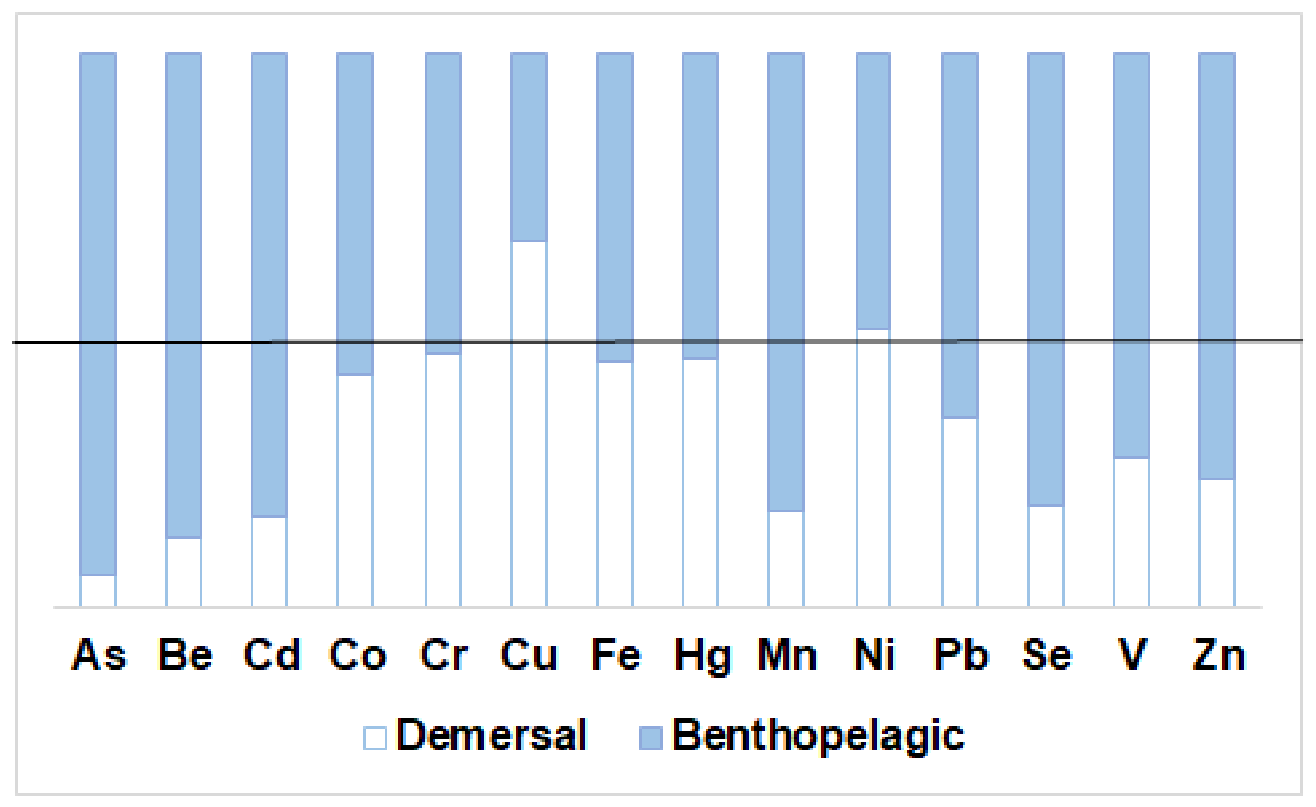
Fish incorporate various substances from the living environment and their diet into the scales (Parvez et al., 2025). Demersal fish have distinct diet tendencies relative to pelagic ones since they live at the bottom of the water bodies and thus mostly rely on organisms living on the basin floor. But demersal fish, L. calcarifer, have stronger sediment contact because of living close to the floor, where Cu and Ni often accumulate due to industrial and geological sources. In Bangladesh, Cu and Ni are prevalent industrial pollutants found in shipbreaking in Chittagong [56] and tannery, leather, and textile effluents in Dhaka [100]. The majority of heavy metals that reach aquatic systems eventually settle in the bottom sediments. After draining out into aquatic systems, these metals bind to estuarine organic matter and fine sediments because of their strong affinity for binding with organic matter and sulfides under anoxic conditions [88]. The estuarine demersal fish L. calcarifer, which lives in contact with contaminated sediments, frequently scrapes the seabed, resulting in scale exposure to these metals. As exterior structures, scales can directly absorb these metals from the surroundings, as well as assimilate them from food.
Compared to demersal fish, benthopelagic fish inhabit both the water column and near-bottom environments, where dissolved metals like Cd, Pb, and Hg are more abundant. Their broader vertical range may expose them to a wider array of pollutants in the water strata, including As, Cd, Pb, and Zn, which are often connected to agricultural runoff, sewage, or industrial effluents. These might result in greater As, Cd, Pb, Hg, and Zn levels in benthopelagic fish C. carpio and C. aureus, while lower levels in demersal fish L. calcarifer. Benthopelagic fish C. carpio, is recognized for its resilience to polluted surroundings and may store more metals in tissues, including scales, without causing rapid harm [39,40]. As is associated with groundwater leaching, more bioavailable in the water column [101]. Metals like Cd, Pb, Hg often originate from urban runoff, pesticides [102], and coal combustion [103] which are more likely to be dissolved and suspended in the water column and are more likely to be absorbed by benthopelagic species. Demersal fish (L. calcarifer) is more predatory, prey on benthic organisms that might have higher Cu and Ni from their own exposure, such as bioaccumulation through diet. Benthopelagic C. carpio and C. aureus feed more on detritus, benthic invertebrates, and sediments, expanding their exposure to a broader spectrum of metals, including As, Cd, Hg, Pb, and others that are more frequent in contaminated sediments.
3.5. Elements Across Fish Feeding Ecology
Omnivorous fish (C. carpio) is observed to have higher concentrations of Be, Cd, Co, Cr, Cu, Hg, Mn, Pb, Se, V, Zn where the levels of Be, Co, Zn are statistically significant (P ≤ 0.05), Table 4. Concentrations of As, Fe, and Ni were found higher in carnivorous fishes (C. aureus and L. calcarifer), where the concentration of Ni is statistically significant (P ≤ 0.05). The variations in the scale element levels may be attributed to their dietary discrepancies, coupled with environmental conditions [104]. Varying trophic features among fish species can result in the acquisition of altered levels of elements into their bodies [1,105].
Figure 5.
Fish scale element concentrations across feeding habits. The 100% stacked bar shows the percentages of the average value of the mean concentrations of fish species types (carnivorous and omnivorous) contributing to the total of each element. The whole bar represents 100%, and the solid black line dissecting the middle of the plot indicates 50% of the bar for comparing the types (carnivorous and omnivorous).
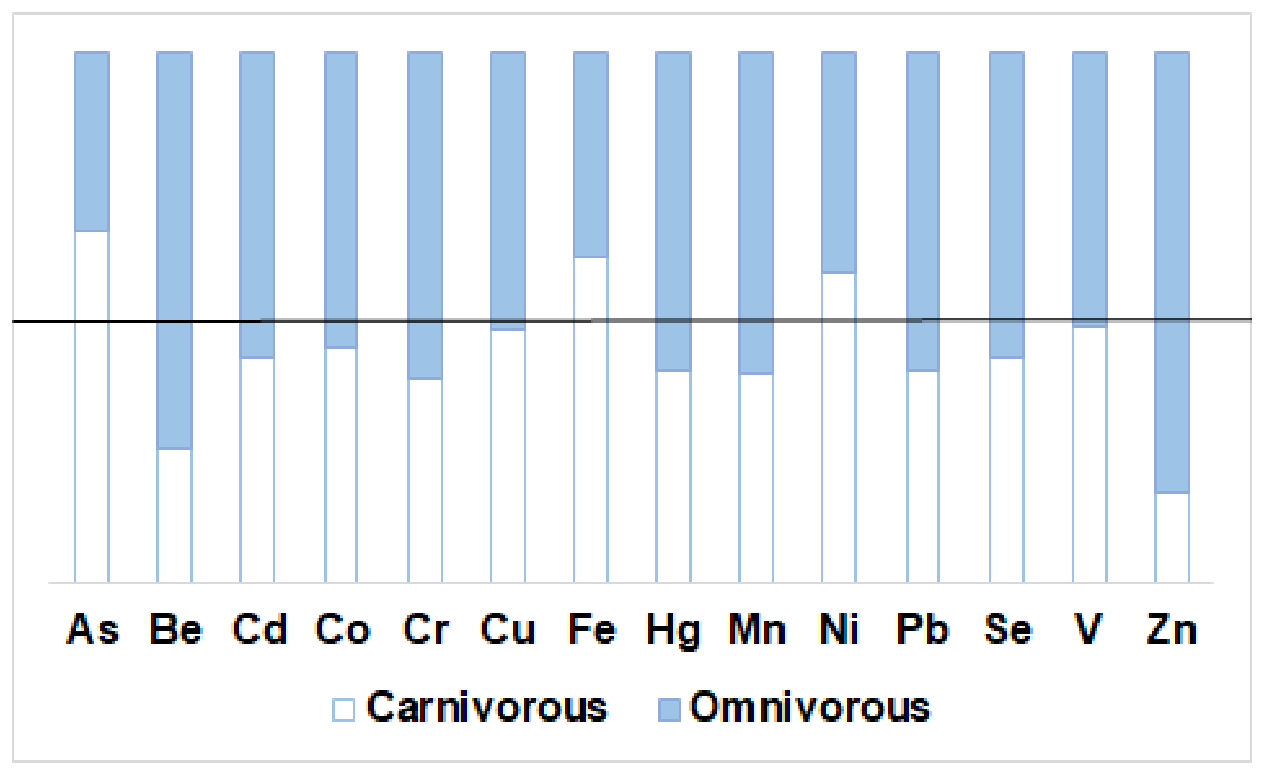
Higher quantities of Be, Cd, Co, Cr, Cu, Hg, Mn, Pb, Se, V, Zn in omnivorous fish might be attributed to a combination of their broad spectrum diet pattern and accumulation from environmental matrices. Sauliutė et al. (2020) demonstrated that omnivorous fish Rutilus rutilus acquired elevated levels of Cr, Cu, Ni, and Zn. In an experimental exposure to Cu, omnivorous fish (Astyanax altiparanae) presented greater sensitivity to Cu and accumulated the metal in their tissues, while the carnivorous fish (Hoplias malabaricus) did not absorb it [107]. The current results agree with these previous findings. Although it is believed that carnivorous fish generally have higher levels of copper than omnivores [108]. This is brought on by biomagnification since they occupy higher trophic levels and are likely to ingest copper-rich prey that may already have acquired copper. Some prey organisms, especially crustaceans and mollusks, have high copper levels because they use hemocyanin, a copper-based oxygen-transport protein [109]. Nevertheless, there are many scenarios where omnivorous fish may show higher Cu levels [106,107]. This could arise from the part of animal food they ingest, like carnivores, and also possibly from species-specific traits of slow Cu excretion. Being omnivorous, these fish eat a wider range of food items from both plant and animal communities, whereas carnivorous fish eat animal foods only. Such broad-spectrum feeding habits enable omnivores to acquire more elements from various food items consumed than their carnivore counterparts.
Similar to the current results, omnivorous fish were reported to acquire high levels of heavy metals, Cr, Cd, and Pb, in previous research, which they attributed to uptake from the environment [110]. Trace elements in the marine ecosystem, whether delivered by natural runoff or from local origin, are absorbed by algae, which are then absorbed by omnivores. Thus, the highest Zn concentrations were recorded in omnivorous fish, as Zn tends to accumulate in regions where significant volumes of organic waste are discharged and is found in higher levels in fish associated with or feeding on the substrata [111]. Additionally, omnivorous fish (C. carpio), being a benthopelagic fish, have prolonged mid-water stay, expanding their exposure to dissolved and suspended metals in the water column besides dietary intake. Although Eisler, (1981) observed greater levels of Hg in predatory (carnivore) fish owing to their trophic status. This metal exhibits biomagnification and follows an accumulation pattern, which varies by species and region. However, in the present research, Hg levels were more substantial in the omnivorous fish as they can occasionally choose to feed on animals as occasional carnivores rather than plants, resulting in higher metal levels [113]. Also, Zn was found with a higher concentration in omnivores than in carnivores, which is supported by the other finding reported in [113]. However, among the elements, Fe, Zn, and Mn were found excessively high both for omnivorous and carnivorous fishes. Khoshnood et al., (2012) reported similar findings, with Fe and Zn being the highest recorded elements.
Carnivorous fish (C. aureus and L. calcarifer) had elevated levels of As, Fe, and Ni, which may be linked to their prey and contamination in the environment. Several studies have demonstrated that sediment in water bodies serves as a key sink for metal contamination and plays a crucial role in heavy metal intake by fish [115]. Parvez et al. (2025) also found higher concentrations of Fe along with other elements in the carnivorous fish scales. Fe, for example, may be found in higher abundance in carnivorous fish (L. calcarifer) due to their demersal eating habits, since this metal accumulates rapidly in sediment [116]. The occurrence of Cr, Pb, Ni, Hg, and Zn was reported to follow a sedimentary pattern, with greater concentrations in clay deposits and organic matter, suggesting a higher affinity of such metals to demersal fishes [117]. Cr, for instance, is a supplementary element used in leather, inks, and steel production [111]. It frequently occurs in substantial quantities in coastal regions as a result of surface runoff, which might explain why omnivore fish have greater Cr concentrations than carnivorous fish. Cd and Pb are hazardous metals that may be ingested, retained, and concentrated by species throughout the food chain, eventually accumulating in marine bodies from agricultural wastewater and urban residential waste [118]. The present research demonstrated higher levels of Cd and Pb in omnivores, which might be attributed to their detritivore tendencies [119].
4. Conclusion
This present study analyzed scale microchemistry in three different fish species Cyprinus carpio, Lates calcarifer, and Chrysochir aureus. It was revealed that the concentrations of fish scale elements varied in relation to their natural environment, and feeding pattern. The study might contribute to the broader development of minimally invasive approaches for ecological and environmental assessment. However, these differences in elemental concentrations may arise from species-specific physiology, phylogeny, body size, age, metabolism, dietary characteristics, mobility, geographic distribution, or local environmental exposure also. Thus the study is need to be considered as a preliminary exploratory comparison of elemental profiles in scales from three ecologically distinct fish species occurring under contrasting salinity conditions. Future studies incorporating more species, along with environmental sampling could help the better understanding in the topic.
Acknowledgments
The authors acknowledge the help of Mr. Mohammad Eusuf Hasan (Marine Fisheries Survey Management Unit, Chattogram; Fisheries Training Institute, Chandpur; Department of Fisheries, Govt. of Bangladesh) and Mr. Md. Imdadul Hoque (Department of Urdu, University of Dhaka, Bangladesh).
Declaration of Generative AI and AI-Assisted Technologies in the Manuscript Preparation Process
During the preparation of this work the author(s) used generative AI and AI-assisted technologies in order to grammar checks, enhance sentence clarity and overall polishing the writeup. After using this tool/service, the author(s) reviewed and edited the content as needed and take(s) full responsibility for the content of the published article.
References
- Pourang, N. Heavy Metal Bioaccumulation in Different Tissues of Two Fish Species with Regards to Their Feeding Habits and Trophic Levels. Environ. Monit. Assess. 1995, 35, 207–219. [CrossRef]
- Lall, S.P.; Kaushik, S.J. Nutrition and Metabolism of Minerals in Fish. Animals 2021, 11, 1–41. [CrossRef]
- Coello, W.F.; Khan, M.A.Q. Protection against Heavy Metal Toxicity by Mucus and Scales in Fish. Arch. Environ. Contam. Toxicol. 1996, 30, 319–326. [CrossRef]
- Hidayati, D.; Sulaiman, N.; Othman, S.; Ismail, B.S. Fish Scale Deformation Analysis Using Scanning Electron Microscope: New Potential Biomarker in Aquatic Environmental Monitoring of Aluminum and Iron Contamination. AIP Conf. Proc. 2013, 1571, 563–568. [CrossRef]
- El-Sheikh, A.H.; Sweileh, J.A. Sorption of Trace Metals on Human Hair and Application for Cadmium and Lead Pre-Concentration with Flame Atomic Absorption Determination. Jordan J. Chem. 2008, 3, 87–97. [CrossRef]
- Dai, H.; Cao, Y.; Fu, Y.; Tang, M.; Feng, X.; Ma, L.; Zhang, Y. Sustainable and One - Pot Fabrication of Peptide Chelated Calcium from Fish Scale Hydrolysates. Collagen & Leather 2024, 6. [CrossRef]
- Pouilly, M.; Point, D.; Sondag, F.; Henry, M.; Santos, R. V. Geographical Origin of Amazonian Freshwater Fishes Fingerprinted by 87Sr/86Sr Ratios on Fish Otoliths and Scales. Environ. Sci. Technol. 2014, 48, 8980–8987. [CrossRef]
- Cobelo-García, A.; Morán, P.; Almécija, C.; Caballero, P. Historical Record of Trace Elements (1983–2007) in Scales from Atlantic Salmon (Salmo Salar): Study of Past Metal Contamination from a Copper Mine (Ulla River, NW Iberian Peninsula). Chemosphere 2017, 188, 18–24. [CrossRef]
- Moreau, G.; Barbeau, C.; Frenette, J.J.; Saint-Onge, J.; Simoneau, M. Zinc, Manganese, and Strontium in Opercula and Scales of Brook Trout ( Salvelinus Fontinalis) as Indicators of Lake Acidification ( Laurentian Park, Quebec). Can. J. Fish. Aquat. Sci. 1983, 40, 1685–1691.
- Wells, B.K.; Rieman, B.E.; Clayton, J.L.; Horan, D.L.; Jones, C.M. Relationships between Water, Otolith, and Scale Chemistries of Westslope Cutthroat Trout from the Coeur d’Alene River, Idaho: The Potential Application of Hard-Part Chemistry to Describe Movements in Freshwater. Trans. Am. Fish. Soc. 2003, 132, 409–424. [CrossRef]
- Tray, E.; Brophy, D.; Maoiléidigh, N.; Finlay, R.; de Eyto, E.; Poole, R.; Crowley, Q.G. Investigating Post-Depositional Alteration of Trace Elements in Fish Scales Using Tagged and Recaptured Wild Salmon. Fish. Res. 2022, 248. [CrossRef]
- Parvez, M.S.; Hoque, M.I.; Siddique, M.N.M.; Rahman, M.M.; Baranyai, E.; Sajtos, Z.; Döncző, B.; Aib, H.; Kader, M.A.; Simon, E.; et al. Elemental Analysis in the Scales of Commercially Important Coastal Fishes and Their Connections with Fish Feeding Habits and Habitats. Front. Mar. Sci. 2025, 12, 1–13. [CrossRef]
- Sverdrup, H.U.; Johnson, M.W.; Fleming, R.H. The Oceans Their Physics, Chemistry, and General Biology; Prentice-Hall: New York, 1942;
- Lønborg, C.; Müller, M.; Butler, E.C.V.; Jiang, S.; Ooi, S.K.; Trinh, D.H.; Wong, P.Y.; Ali, S.M.; Cui, C.; Siong, W.B.; et al. Nutrient Cycling in Tropical and Temperate Coastal Waters: Is Latitude Making a Difference? Estuar. Coast. Shelf Sci. 2021, 262. [CrossRef]
- Rich, V.I.; Maier, R.M. Aquatic Environments; Elsevier Inc., 2015; ISBN 9780123946263.
- Hooper, M.J.; Ankley, G.T.; Cristol, D.A.; Maryoung, L.A.; Noyes, P.D.; Pinkerton, K.E. Interactions between Chemical and Climate Stressors: A Role for Mechanistic Toxicology in Assessing Climate Change Risks. Environ. Toxicol. Chem. 2013, 32, 32–48. [CrossRef]
- Saranjampour, P.; Vebrosky, E.N.; Armbrust, K.L. Salinity Impacts on Water Solubility and N-Octanol/Water Partition Coefficients of Selected Pesticides and Oil Constituents. Environ. Toxicol. Chem. 2017, 36, 2274–2280. [CrossRef]
- Moiseenko, T.I.; Gashkina, N.A. Distribution and Bioaccumulation of Heavy Metals (Hg, Cd and Pb) in Fish: Influence of the Aquatic Environment and Climate. Environ. Res. Lett. 2020, 15. [CrossRef]
- Laing, G.D.; De Vos, R.; Vandecasteele, B.; Lesage, E.; Tack, F.M.G.; Verloo, M.G. Effect of Salinity on Heavy Metal Mobility and Availability in Intertidal Sediments of the Scheldt Estuary. Estuar. Coast. Shelf Sci. 2008, 77, 589–602. [CrossRef]
- Ali, M.; Taylor, A. The Effect of Salinity and Temperature on the Uptake of Cadmium and Zinc by the Common Blue Mussel, Mytilus Edulis with Some Notes on Their Survival. Mesopotamian J. Mar. Sci. 2022, 25, 11–30. [CrossRef]
- Jezierska, B.; Witeska, M. The Metal Uptake and Accumulation in Fish Living in Polluted Waters. In Soil and Water Pollution Monitoring, Protection and Remediation; Springer Netherlands: Dordrecht, 2006; pp. 107–114 ISBN 9781402047282.
- Frimpong, E.A.; Angermeier, P.L. Trait-Based Approaches in the Analysis of Stream Fish Communities. 2010, 109–136.
- Seeley, M.E.; Walther, B.D. Facultative Oligohaline Habitat Use in a Mobile Fish Inferred from Scale Chemistry. Mar. Ecol. Prog. Ser. 2018, 598, 233–245. [CrossRef]
- Jovičić, K.; Nikolić, D.M.; Višnjić-Jeftić, Ž.; Đikanović, V.; Skorić, S.; Stefanović, S.M.; Lenhardt, M.; Hegediš, A.; Krpo-Ćetković, J.; Jarić, I. Mapping Differential Elemental Accumulation in Fish Tissues: Assessment of Metal and Trace Element Concentrations in Wels Catfish (Silurus Glanis) from the Danube River by ICP-MS. Environ. Sci. Pollut. Res. 2015, 22, 3820–3827. [CrossRef]
- Pouil, S.; Bustamante, P.; Warnau, M.; Metian, M.; Pouil, S.; Bustamante, P.; Warnau, M.; Metian, M. Overview of Trace Elements Trophic Transfer in Fish through the Concept of Assimilation Efficiency. Mar. Ecol. Prog. Ser. 2018, 588, 243–254.
- Silva, E.; Costa, F.N.; Souza, T.L.; Viana, Z.C.V.; Souza, A.S.; Korn, M.G.A.; Ferreira, S.L.C. Assessment of Trace Elements in Tissues of Fish Species: Multivariate Study and Safety Evaluation. J. Braz. Chem. Soc. 2016, 27, 2234–2245. [CrossRef]
- Łuszczek-Trojnar, E.; Ryndak, D.; Drąg-Kozak, E. Cadmium Accumulation in the Scales of Prussian Carp (Carassius Gibelio Bloch, 1782) Following Exposure to Cadmium in Water. J. Elem. 2022, 27, 995–1006.
- Vašek, M.; Souza, A.T.; Říha, M.; Kubečka, J.; Znachor, P.; Hejzlar, J. Stable Isotope Evidence from Archived Fish Scales Indicates Carbon Cycle Changes over the Four-Decade History of the Římov Reservoir (Czechia). Sci. Total Environ. 2021, 755. [CrossRef]
- Mamede, R.; Patinha, C.; Díaz, S.; da Silva, E.F.; Calado, R.; Ricardo, F. Spatial and Temporal Variability of Elemental Fingerprints of European Sardine (Sardina Pilchardus) Scales: Implications for the Traceability of Geographic Origin and for Fisheries Management. Fishes 2026, 11, 138. [CrossRef]
- Belanger, S.E.; Cherry, D.S.; Ney, J.J.; Whitehurst, D.K. Differentiation of Freshwater versus Saltwater Striped Bass by Elemental Scale Analysis. Trans. Am. Fish. Soc. 1987, 116, 594–600. [CrossRef]
- Bagenal, T.B.; Mackereth, F.J.H.; Heron, J. The Distinction between Brown Trout and Sea Trout by the Strontium Content of Their Scales. J. Fish Biol. 1973, 5, 555–557. [CrossRef]
- Parvez, M.S.; Hoque, M.I.; Siddique, M.N.M. Elemental Analysis in the Scales of Commercially Important Coastal Fi Shes and Their Connections with Fish Feeding Habits and Habitats. Front. Mar. Sci. 2025, 12. [CrossRef]
- Coutant, C.C.; Chen, C.H. Strontium Microstructure in Scales of Freshwater and Estuarine Striped Bass (Morone Saxatilis) Detected by Laser Ablation Mass Spectrometry. Can. J. Fish. Aquat. Sci. 1993, 50, 1318–1323. [CrossRef]
- Wang, T.H.; Lai, Y.C.; Chiang, C.C.; Cheng, Y.R.; Hsieh, Y.K.; Wang, C.F. Element Distribution over the Surface of Fish Scales and Its Connection to the Geochemical Environment of Habitats: A Potential Biogeochemical Tag. Environ. Monit. Assess. 2016, 188, 1–12. [CrossRef]
- Pender, P.J.; Griffin, R.K. Habitat History of Barramundi Lates Calcarifer in a North Australian River System Based on Barium and Strontium Levels in Scales . Trans. Am. Fish. Soc. 1996, 125, 679–689. [CrossRef]
- Courtemanche, D.A.; Whoriskey, Jr., F.G.; Bujold, V.; Curry, R.A. Assessing Anadromy of Brook Char ( Salvelinus Fontinalis ) Using Scale Microchemistry. Can. J. Fish. Aquat. Sci. 2006, 63, 995–1006. [CrossRef]
- Aib, H.; Czédli, H.; Baranyai, E.; Sajtos, Z.; Döncző, B.; Parvez, M.S.; Berta, C.; Varga, Z.; Benhizia, R.; Nyeste, K. Fish Scales as a Non-Invasive Method for Monitoring Trace and Macroelement Pollution. Biology (Basel). 2025, 14, 344.
- Fishbase Fishbase Available online: https://www.fishbase.se/summary/cyprinus-carpio.html.
- Mancera-Rodríguez, N.J.; Galiano, D.R.; López-Montoya, A.J.; Llorent-Martínez, E.J.; Molina-García, L.; Azorit, C. Common Carp as an Ecological Indicator of Environmental Pollution in Reservoirs of Southern Spain: Inferring the Environmental Risks of Anthropogenic Activities. Environ. Sci. Pollut. Res. 2024, 31, 36192–36206. [CrossRef]
- Uçkun, A.A.; Uçkun, M. Evaluation of Some Biomarkers in Carp (Cyprinus Carpio Linnaeus, 1758) Depending on Water and Sediment Pollution of Atatürk Dam Lake. BEU J. Sci. 2021, 10, 744–753. [CrossRef]
- FAO FAO; Rome, 2024;
- Fishbase Lates Calcarifer, Barramundi : Fisheries, Aquaculture, Gamefish, Aquarium Available online: https://www.fishbase.se/summary/Lates-calcarifer.html (accessed on 18 October 2024).
- Fishbase Fishbase.
- Zhang, F.; Wang, X.; Xu, J.; Zhu, L.; Peng, G.; Xu, P.; Li, D. Food-Web Transfer of Microplastics between Wild Caught Fish and Crustaceans in East China Sea. Mar. Pollut. Bull. 2019, 146, 173–182. [CrossRef]
- Xu, H.; Fan, X.; Zhang, S. Texture Characterization of Otolith from Chrysochir Aureus by X-Ray Diffraction, Infrared Spectroscopy and Thermogravimetric Analysis. In Proceedings of the 3rd International Conference on Architectural Engineering and New Materials (ICAENM 2018); 2018; pp. 1–8.
- Azmi, W.N.F.W.; Ahmad, N.I.; Mahiyuddin, W.R.W. Heavy Metal Levels and Risk Assessment from Consumption of Marine Fish in Peninsular Malaysia. J. Environ. Prot. (Irvine,. Calif). 2019, 10, 1450–1471. [CrossRef]
- Zhu, G.; Noman, M.A.; Narale, D.D.; Feng, W.; Pujari, L.; Sun, J. Evaluation of Ecosystem Health and Potential Human Health Hazards in the Hangzhou Bay and Qiantang Estuary Region through Multiple Assessment Approaches. Environ. Pollut. 2020, 264, 114791. [CrossRef]
- Huang, H.; Li, Y.; Zheng, X.; Wang, Z.; Wang, Z.; Cheng, X. Nutritional Value and Bioaccumulation of Heavy Metals in Nine Commercial Fish Species from Dachen Fishing Ground, East China Sea. Sci. Rep. 2022, 12, 1–12. [CrossRef]
- Wang, Y.; Zhong, Z.; Chen, X.; Sokolova, I.; Ma, L.; Yang, Q.; Qiu, K.; Khan, F.U.; Tu, Z.; Guo, B.; et al. Microplastic Pollution and Ecological Risk Assessment of Yueqing Bay Affected by Intensive Human Activities. J. Hazard. Mater. 2024, 461, 132603. [CrossRef]
- FAO FAO; Rome, 2024;
- Rahman, S.A.; Abdullah, N.A.; Chowdhury, A.J.K.; Yunus, K. Fish Scales as a Bioindicator of Potential Marine Pollutants and Carcinogens in Asian Sea Bass and Red Tilapia within the Coastal Waters of Pahang, Malaysia. J. Coast. Res. 2018, 82, 120–125. [CrossRef]
- Zayadi, N.; Othman, N. Characterization and Optimization of Heavy Metals Biosorption by Fish Scales. Adv. Mater. Res. 2013, 795, 260–265.
- Othman, N.; Abd-Kadir, A.; Zayadi, N. Waste Fish Scale as Cost Effective Adsorbent in Removing Zinc and Ferum Ion in Wastewater. ARPN J. Eng. Appl. Sci. 2016, 11, 1584–1592.
- Gauldie, R.W.; Coote, G.; West, I.F.; Radtke, R.L. The Influence of Temperature on the Fluorine and Calcium Composition of Fish Scales. Tissue Cell 1990, 22, 645–654. [CrossRef]
- Gauldie, R.W.; West, I.F.; Coote, G. Seasonal and Environmental Codes in the Chemistry of the Scales of the Hoki Macruronus Novaezelandiae. Tissue Cell 1991, 23, 489–503. [CrossRef]
- Hossain, M.M.M.; Islam, M.M. Ship Breaking Activities and Its Impact on the Coastal Zone of Chittagong, Bangladesh: Towards Sustainable Management; Young Power in Social Action (YPSA): Chittagong, Bangladesh, 2006; ISBN 984-32-3448-0.
- Jovičić, K.; Janković, S.; Nikolić, D.M.; Đikanović, V.; Skorić, S.; Krpo-Ćetković, J.; Jarić, I. Prospects of Fish Scale and Fin Samples Usage for Nonlethal Monitoring of Metal Contamination: A Study on Five Fish Species from the Danube River. Knowl. Manag. Aquat. Ecosyst. 2023, 4. [CrossRef]
- Červenka, R.; Bednařík, A.; Komárek, J.; Ondračková, M.; Jurajda, P.; Vítek, T.; Spurný, P. The Relationship between the Mercury Concentration in Fish Muscles and Scales/Fins and Its Significance. Cent. Eur. J. Chem. 2011, 9, 1109–1116.
- Valová, Z.; Hudcová, H.; Roche, K.; Svobodová, J.; Bernardová, I.; Jurajda, P. No Relationship Found between Mercury and Lead Concentrations in Muscle and Scales of Chub Squalius Cephalus L. Environ. Monit. Assess. 2013, 185, 3359–3368.
- Farrell, A.P.; Hodaly, A.H.; Wang, S. Metal Analysis of Scales Taken from Arctic Grayling. Arch. Environ. Contam. Toxicol. 2000, 39, 515–522.
- Parvez, M.S.; Ullah, H.; Faruk, O.; Simon, E.; Czédli, H. Role of Microplastics in Global Warming and Climate Change: A Review. Water, Air, Soil Pollut. 2024, 235, 201. [CrossRef]
- Djedjibegovic, J.; Marjanovic, A.; Tahirovic, D.; Caklovica, K.; Turalic, A.; Lugusic, A.; Omeragic, E.; Sober, M.; Caklovica, F. Heavy Metals in Commercial Fish and Seafood Products and Risk Assessment in Adult Population in Bosnia and Herzegovina. Sci. Rep. 2020, 10, 1–8. [CrossRef]
- Rakocevic, J.; Sukovic, D.; Maric, D. Distribution and Relationships of Eleven Trace Elements in Muscle of Six Fish Species from Skadar Lake (Montenegro). Turkish J. Fish. Aquat. Sci. 2018, 18, 81–90. [CrossRef]
- Ismail, I.; Saleh, I.M. Analysis of Heavy Metals in Water and Fish (Tilapia Sp.) Samples from Tasik Mutiara, Puchong. Malaysian J. Anal. Sci. 2012, 16, 346–352.
- Villanueva-Espinosa, J.F.; Hernandez-Esparza, M.; Ruiz-Trevino, F.A. Adsorptive Properties of Fish Scales of Oreochromis Niloticus (Mojarra Tilapia) for Metallic Ion Removal from Waste Water. Ind. Eng. Chem. Res. 2001, 40, 3563–3569.
- McKim, J.M. Physiological and Biochemical Mechanisms That Regulate the Accumulation and Toxicity of Environmental Chemicals in Fish. Bioavailability 2024, 179–201.
- Knezovich, J.P. Chemical and Biological Factors Affecting Bioavailability of Contaminants in Seawater. In Bioavailability; CRC Press, 2024; pp. 23–30.
- Schrap, S.M.; Opperhuizen, A. Relationship between Bioavailability and Hydrophobicity: Reduction of the Uptake of Organic Chemicals by Fish Due to the Sorption on Particles. Environ. Toxicol. Chem. 1990, 9, 715–724.
- Arnot, J.A.; Mackay, D. The Influence of Chemical Degradation during Dietary Exposures to Fish on Biomagnification Factors and Bioaccumulation Factors. Environ. Sci. Process. Impacts 2018, 20, 86–97.
- Eggleton, J.; Thomas, K. V A Review of Factors Affecting the Release and Bioavailability of Contaminants during Sediment Disturbance Events. Environ. Int. 2004, 30, 973–980.
- Dutton, J.; Fisher, N.S. Salinity Effects on the Bioavailability of Aqueous Metals for the Estuarine Killifish Fundulus Heteroclitus. Environ. Toxicol. Chem. 2011, 30, 2107–2114.
- Hao, Y.; Chen, L.; Zhang, X.; Zhang, D.; Zhang, X.; Yu, Y.; Fu, J. Trace Elements in Fish from Taihu Lake, China: Levels, Associated Risks, and Trophic Transfer. Ecotoxicol. Environ. Saf. 2013, 90, 89–97.
- Meador, J.P.; Ernest, D.W.; Kagley, A.N. A Comparison of the Non-Essential Elements Cadmium, Mercury, and Lead Found in Fish and Sediment from Alaska and California. Sci. Total Environ. 2005, 339, 189–205.
- Parvez, M.S.; Czédli, H.; Hoque, M.I.; Rahman, M.M.; Anwar, A.; Uddin, A.H.M.M.; Hasan, M.S.; Bibi, D.; Tóthmérész, B.; Magura, T.; et al. Accumulation of Microplastics and Potentially Toxic Elements in Plant Leaves Along an Urbanization Gradient in Bangladesh. Toxics 2024, 12, 848. [CrossRef]
- Streets, D.G.; Lu, Z.; Levin, L.; ter Schure, A.F.H.; Sunderland, E.M. Historical Releases of Mercury to Air, Land, and Water from Coal Combustion. Sci. Total Environ. 2018, 615, 131–140. [CrossRef]
- Al-Sulaiti, M.M.; Soubra, L.; Al-Ghouti, M.A. The Causes and Effects of Mercury and Methylmercury Contamination in the Marine Environment: A Review. Curr. Pollut. Reports 2022, 8, 249–272. [CrossRef]
- Soetan, O.; Viteritto, M.; Qian, Y.; Feng, H. Evaluation of Toxic Metal Pollution in Freshwater Surficial Sediments Using Environmental Indices and Multivariate Statistical Approaches – A Systematic Review. Environ. Nanotechnology, Monit. Manag. 2024, 22, 100961. [CrossRef]
- Wahab, M.A.; Rahman, M.M.; Milstein, A. Environmental Effects of Common Carp Cyprinus Carpio (L.) and Mrigal Cirrhinus Mrigala (Hamilton) as Bottom Feeders in Major Indian Carp Polycultures. Aquac. Res. 2002, 33, 1103–1117. [CrossRef]
- Gwimbi, P.; Kotelo, T.; Selimo, M.J. Heavy Metal Concentrations in Sediments and Cyprinus Carpio from Maqalika Reservoir –Maseru, Lesotho: An Analysis of Potential Health Risks to Fish Consumers. Toxicol. Reports 2020, 7, 475–479. [CrossRef]
- de Paiva Magalhães, D.; da Costa Marques, M.R.; Baptista, D.F.; Buss, D.F. Metal Bioavailability and Toxicity in Freshwaters. Environ. Chem. Lett. 2015, 13, 69–87. [CrossRef]
- Hüssy, K.; Haase, S.; Mion, M.; Hilvarsson, A.; Radtke, K.; Thomsen, T.B.; Krüger-Johnsen, M.; Casini, M.; Sturrock, A.M. Into the Wild: Coupling Otolith and Archival Tag Records to Test Assumptions Underpinning Otolith Chemistry Applications in Wild Fish. Front. Mar. Sci. 2024, 11, 1–19. [CrossRef]
- Sánchez-Marín, P.; Lorenzo, J.I.; Blust, R.; Beiras, R. Humic Acids Increase Dissolved Lead Bioavailability for Marine Invertebrates. Environ. Sci. Technol. 2007, 41, 5679–5684. [CrossRef]
- Richards, J.G.; Burnison, B.K.; Playle, R.C. Natural and Commercial Dissolved Organic Matter Protects against the Physiological Effects of a Combined Cadmium and Copper Exposure on Rainbow Trout (Oncorhynchus Mykiss). Can. J. Fish. Aquat. Sci. 1999, 56. [CrossRef]
- Reeve, R.N. Introduction to Environmental Analysis; Wiley: UK, 2022; ISBN 978-0-470-84578-3.
- Irman, N.; Abd Latif, N.H.; Brosse, N.; Gambier, F.; Syamani, F.A.; Hussin, M.H. Preparation and Characterization of Formaldehyde-Free Wood Adhesive from Mangrove Bark Tannin. Int. J. Adhes. Adhes. 2022, 114, 103094. [CrossRef]
- Pesce, S.; Mamy, L.; Sanchez, W.; Artigas, J.; Bérard, A.; Betoulle, S.; Chaumot, A.; Coutellec, M.A.; Crouzet, O.; Faburé, J.; et al. The Use of Copper as Plant Protection Product Contributes to Environmental Contamination and Resulting Impacts on Terrestrial and Aquatic Biodiversity and Ecosystem Functions. Environ. Sci. Pollut. Res. 2024, 32, 2830–2846. [CrossRef]
- Skrabal, S.A.; Donat, J.R.; Burdige, D.J. Fluxes of Copper-Complexing Ligands from Estuarine Sediments. Limnol. Oceanogr. 1997, 42, 992–996. [CrossRef]
- Chakraborty, P.; Chakraborty, S.; Vudamala, K.; Sarkar, A.; Nath, B.N. Partitioning of Metals in Different Binding Phases of Tropical Estuarine Sediments: Importance of Metal Chemistry. Environ. Sci. Pollut. Res. 2016, 23, 3450–3462. [CrossRef]
- Davis, D.A.; Gatlin, D.M. Reviews in Fisheries Science Dietary Mineral Requirements of Fish and Marine Crustaceans Dietary Mineral Requirements of Fish and Marine Crustaceans. Rev. Fish. Sci. 1996, 4, 75–99.
- Liu, J.; Chen, Q.; Yang, Y.; Wei, H.; Laipan, M.; Zhu, R.; He, H.; Hochella, M.F. Coupled Redox Cycling of Fe and Mn in the Environment: The Complex Interplay of Solution Species with Fe- and Mn-(Oxyhydr)Oxide Crystallization and Transformation. Earth-Science Rev. 2022, 232, 104105. [CrossRef]
- Balaguer, J.; Koch, F.; Hassler, C.; Trimborn, S. Iron and Manganese Co-Limit the Growth of Two Phytoplankton Groups Dominant at Two Locations of the Drake Passage. Commun. Biol. 2022, 5, 1–12. [CrossRef]
- Khan, M.Z.H.; Hasan, M.R.; Khan, M.; Aktar, S.; Fatema, K. Distribution of Heavy Metals in Surface Sediments of the Bay of Bengal Coast. J. Toxicol. 2017, 2017. [CrossRef]
- National Research Council Mineral Tolerance of Animals; Second.; National Academies Press: Washington, D.C., 2005; ISBN 978-0-309-09654-6.
- Francesconi, K.; Kuehnelt, D. Arsenic Compounds in the Environment. In Environmental Chemistry of Arsenic; William T. Frankenberger, J., Ed.; New York, NY, USA, 2002; pp. 51–94 ISBN 0824706765.
- Hope, B.K. A Dynamic Model for the Global Cycling of Anthropogenic Vanadium. Global Biogeochem. Cycles 2008, 22, 1–16. [CrossRef]
- Okati, N.; Shahriari Moghadam, M.; Einollahipeer, F. Mercury, Arsenic and Selenium Concentrations in Marine Fish Species from the Oman Sea, Iran, and Health Risk Assessment. Toxicol. Environ. Health Sci. 2021, 13, 25–36. [CrossRef]
- Chen, Y.W.; Belzile, N.; Gunn, J.M. Antagonistic Effect of Selenium on Mercury Assimilation by Fish Populations near Sudbury Metal Smelters? Limnol. Oceanogr. 2001, 46, 1814–1818. [CrossRef]
- Rejomon, G.; Nair, M.; Joseph, T. Trace Metal Dynamics in Fishes from the Southwest Coast of India. Environ. Monit. Assess. 2010, 167, 243–255. [CrossRef]
- Gull, A.; Hayat, F.; Zafar, S. Seasonal Determination of Proximate Composition and Essential Elements in Commercial Fishes from Pakistan and Human Health Risk Assessment. Foods Raw Mater. 2024, 12, 361–372.
- Hossain, M.N.; Rahaman, A.; Hasan, M.J.; Uddin, M.M.; Khatun, N.; Shamsuddin, S.M. Comparative Seasonal Assessment of Pollution and Health Risks Associated with Heavy Metals in Water, Sediment and Fish of Buriganga and Turag River in Dhaka City, Bangladesh. SN Appl. Sci. 2021, 3, 1–16. [CrossRef]
- Anawar, H.M.; Akai, J.; Komaki, K.; Terao, H.; Yoshioka, T.; Ishizuka, T.; Safiullah, S.; Kato, K. Geochemical Occurrence of Arsenic in Groundwater of Bangladesh: Sources and Mobilization Processes. J. Geochemical Explor. 2003, 77, 109–131. [CrossRef]
- Parvin, F.; Haque, M.M.; Tareq, S.M. Recent Status of Water Quality in Bangladesh: A Systematic Review, Meta-Analysis and Health Risk Assessment. Environ. Challenges 2022, 6, 100416. [CrossRef]
- Munawer, M.E. Human Health and Environmental Impacts of Coal Combustion and Post-Combustion Wastes. J. Sustain. Min. 2018, 17, 87–96. [CrossRef]
- Kalvoda, J.; Novák, M.; Bábek, O.; Brzobohatý, R.; Holá, M.; Holoubek, I.; Kanický, V.; Škoda, R. Compositional Changes in Fish Scale Hydroxylapatite during Early Diagenesis; An Example from an Abandoned Meander. Biogeochemistry 2009, 94, 197–215. [CrossRef]
- Ling, M.; Wu, C.; Yang, K.; Hsu, H. Differential Accumulation of Trace Elements in Ventral and Dorsal Muscle Tissues in Tilapia and Milkfish with Different Feeding Habits from the Same Cultured Fishery Pond. Ecotoxicol. Environ. Saf. 2013, 89, 222–230. [CrossRef]
- Sauliutė, G.; Markuckas, A.; Stankevičiūtė, M. Response Patterns of Biomarkers in Omnivorous and Carnivorous Fish Species Exposed to Multicomponent Metal (Cd, Cr, Cu, Ni, Pb and Zn) Mixture. Part III. Ecotoxicology 2020, 29, 258–274. [CrossRef]
- de Paula, A.A.; Risso, W.E.; Martinez, C.B. dos R. Effects of Copper on an Omnivorous (Astyanax Altiparanae) and a Carnivorous Fish (Hoplias Malabaricus): A Comparative Approach. Aquat. Toxicol. 2021, 237. [CrossRef]
- Chen, H.; Li, Y.; Wang, L.C.; Wang, Z.; Wang, D.; Feng, L.; Li, S.; Shang, J.; Lu, L.; Mao, G.; et al. Carnivorous Fishes Can Possess Higher Mercury Levels than Omnivorous Fishes: A Selective Detection and Efficient Removal Strategy for Mercury Using Magnetic Melamine-Platinum Composites Fabricated by Supermolecular Self-Assembly. J. Hazard. Mater. 2025, 488, 137379. [CrossRef]
- Ji, R.; Guan, L.; Hu, Z.; Cheng, Y.; Cai, M.; Zhao, G.; Zang, J. A Comprehensive Review on Hemocyanin from Marine Products: Structure, Functions, Its Implications for the Food Industry and Beyond. Int. J. Biol. Macromol. 2024, 269, 132041. [CrossRef]
- Yi, Y.; Tang, C.; Yi, T.; Yang, Z.; Zhang, S. Health Risk Assessment of Heavy Metals in Fish and Accumulation Patterns in Food Web in the Upper Yangtze River, China. Ecotoxicol. Environ. Saf. 2017, 145, 295–302. [CrossRef]
- Junior, R.G. de S.L.; Araújo, F.G.; Maia, M.F.; Pinto, A.S. da S.B. Evaluation of Heavy Metals in Fish of the Sepetiba and Ilha Grande Bays, Rio de Janeiro, Brazil. Environ. Res. 2002, 89, 171–179.
- Eisler, R. Trace Metal Concentrations in Marine Organisms. 1981.
- Serviere-Zaragoza, E.; Lluch-Cota, S.E.; Mazariegos-Villarreal, A.; Balart, E.F.; Valencia-Valdez, H.; Méndez-Rodríguez, L.C. Cadmium, Lead, Copper, Zinc, and Iron Concentration Patterns in Three Marine Fish Species from Two Different Mining Sites inside the Gulf of California, Mexico. Int. J. Environ. Res. Public Health 2021, 18, 844.
- Khoshnood, Z.; Khoshnood, R.; Mokhlesi, A.; Ehsanpour, M.; Afkhami, M.; Khazaali, A. Determination of Cd, Pb, Hg, Cu, Fe, Mn, Al, As, Ni and Zn in Important Commercial Fish Species in Northern of Persian Gulf. J. Cell Anim. Biol. 2012, 6, 1–9.
- Yi, Y.; Yang, Z.; Zhang, S. Ecological Risk Assessment of Heavy Metals in Sediment and Human Health Risk Assessment of Heavy Metals in Fishes in the Middle and Lower Reaches of the Yangtze River Basin. Environ. Pollut. 2011, 159, 2575–2585.
- Hatje, V.; Bidone, E.D.; Maddock, J.L. Estimation of the Natural and Anthropogenic Components of Heavy Metal Fluxes in Fresh Water Sinos River, Rio Grande Do Sul State, South Brazil. Environ. Technol. 1998, 19, 483–487.
- de Souza-Araujo, J.; Hussey, N.E.; Hauser-Davis, R.A.; Rosa, A.H.; de Oliveira Lima, M.; Giarrizzo, T. Human Risk Assessment of Toxic Elements (As, Cd, Hg, Pb) in Marine Fish from the Amazon. Chemosphere 2022, 301, 134575.
- Kosanovic, M.; Hasan, M.Y.; Subramanian, D.; Al Ahbabi, A.A.F.; Al Kathiri, O.A.A.; Aleassa, E.M.A.A.; Adem, A. Influence of Urbanization of the Western Coast of the United Arab Emirates on Trace Metal Content in Muscle and Liver of Wild Red-Spot Emperor (Lethrinus Lentjan). Food Chem. Toxicol. 2007, 45, 2261–2266.
- Arain, M.B.; Kazi, T.G.; Jamali, M.K.; Jalbani, N.; Afridi, H.I.; Shah, A. Total Dissolved and Bioavailable Elements in Water and Sediment Samples and Their Accumulation in Oreochromis Mossambicus of Polluted Manchar Lake. Chemosphere 2008, 70, 1845–1856.
Figure 1.
Network analysis of the elements in the scales.
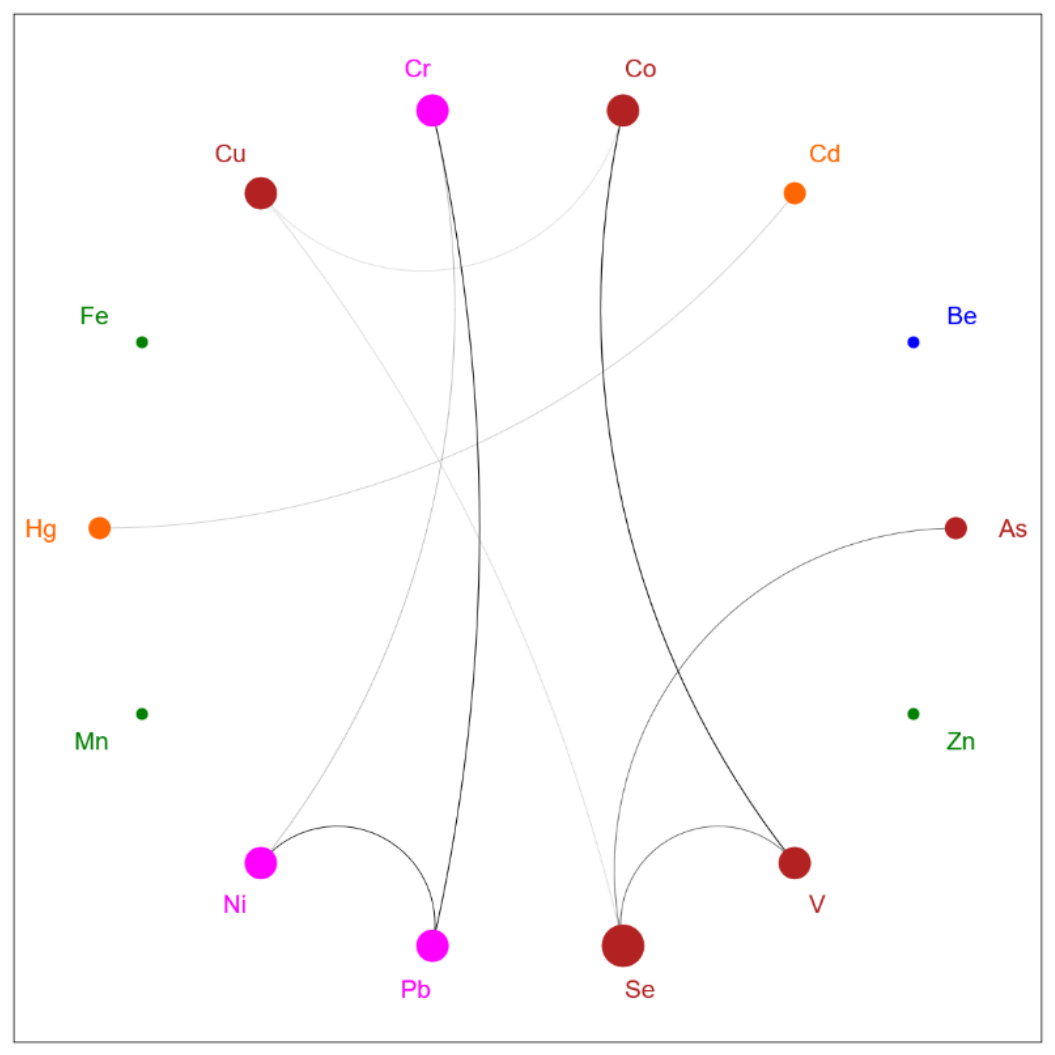
Figure 2.
Classical clustering (dendrogram) analysis of the elements in the scales.
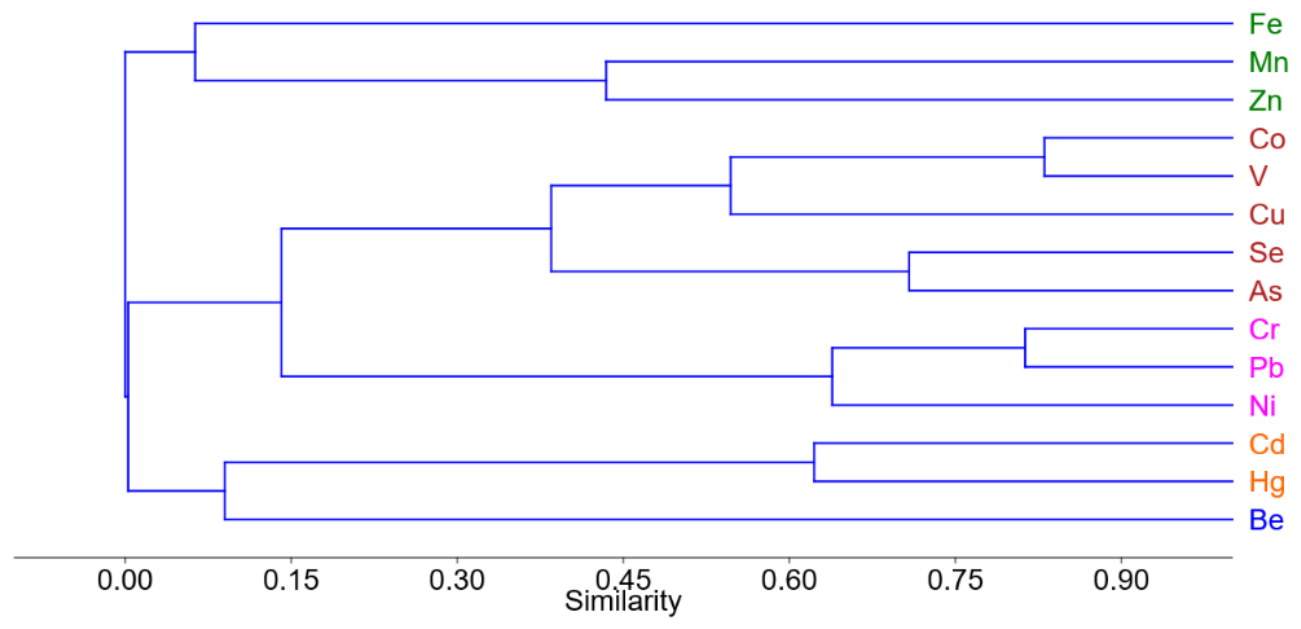
Figure 3.
The Pearson correlation coefficients of elements detected in scales; (a) C. carpio, (b) L. calcarifer, (c) C. aureus.
Figure 3.
The Pearson correlation coefficients of elements detected in scales; (a) C. carpio, (b) L. calcarifer, (c) C. aureus.
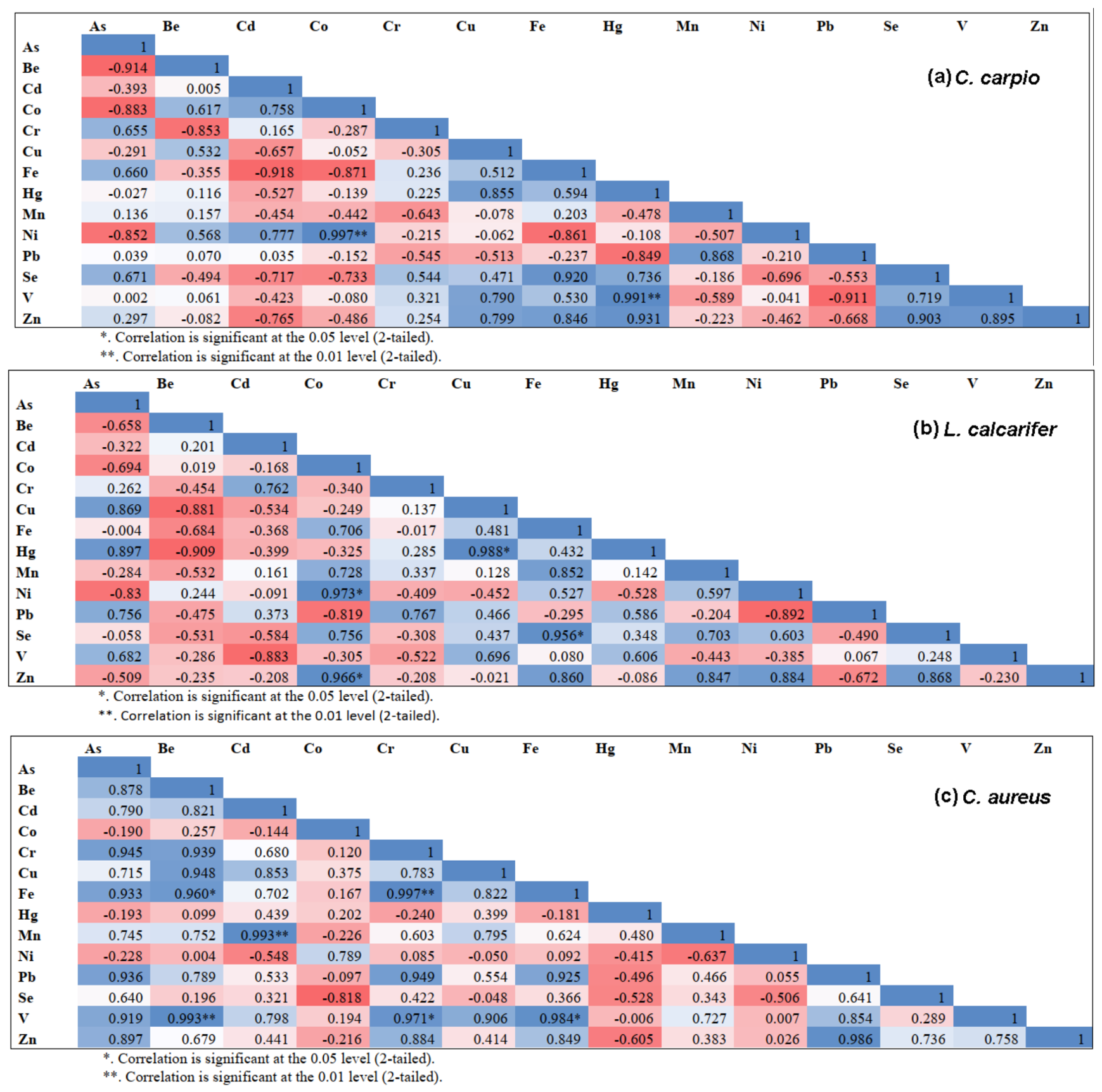

Table 1.
The ecological parameters of the fish species studied.
| Fish | Common name | Local name |
Habitat | Migration pattern | Feeding habit (food) | Ref. |
|---|---|---|---|---|---|---|
| Cyprinus carpio | Common carp | Karfu | Benthopelagic | Potamodromous | Omnivorous (benthic organisms and plant material) | [38,41] |
| Lates calcarifer | Asian seabass/Barramundi | Vetki | Demersal | Catadromous | Carnivorous (fishes & crustaceans) | (FAO, 2024b; Fishbase, 2024) |
| Chrysochir aureus | Reeve’s croaker/goldbelly croaker | Lal Poa | Benthopelagic | N/A | Carnivorous (small crustaceans) | [43] |
Table 2.
Concentration of elements in the fish scales studied. Values are in mean ± standard deviation. Different alphabets in the same row indicate significant differences in DMRT for parametric data, whereas asterisks (*) denote non-parametric Dunn’s pairwise multiple comparison post hoc test with Bonferroni correction, and significant P values (P ≤ 0.05) are in bold fonts.
| Elements | Observed mean concentrations (mg kg-1) | |||
|---|---|---|---|---|
| C. carpio | L. calcarifer | C. aureus | P value | |
| As | 0.42±0.06 | 0.06±0.06* | 1.56±0.95* | 0.007 |
| Be | 0.01±0.01* | 0.001±0.00* | 0.005±0.01 | 0.032 |
| Cd | 0.06±0.04 | 0.01±0.01 | 0.07±0.05 | 0.087 |
| Co | 0.32±0.03a | 0.22±0.03b | 0.28±0.03a | 0.005 |
| Cr | 2.25±0.84 | 1.51±0.66 | 1.30±0.71 | 0.218 |
| Cu | 0.66±0.22 | 0.92±1.25 | 0.27±0.22 | 0.092 |
| Fe | 403.57±73.49 | 482.69±70.59 | 799.98±470.58 | 0.098 |
| Hg | 0.14±0.13 | 0.09±0.13 | 0.09±0.08 | 0.666 |
| Mn | 24.14±2.28 | 5.25±1.05* | 25.77±6.64* | 0.021 |
| Ni | 2.84±0.33b | 3.61±0.75ab | 4.31±0.49a | 0.014 |
| Pb | 3.17±2.21 | 1.51±1.41 | 2.69±2.78 | 0.500 |
| Se | 0.73±0.13a | 0.18±0.11b | 0.88±0.13a | 0.000 |
| V | 0.35±0.17 | 0.16±0.02 | 0.50±0.49 | 0.292 |
| Zn | 141.13±29.85* | 25.56±7.28* | 32.03±2.81 | 0.015 |
Table 3.
The hierarchy of the elements in the scales (largest to smallest, starting at the top).
| SL no. | C. carpio | L. calcarifer | C. aureus | Overall | Availability |
|---|---|---|---|---|---|
| 1 | Fe | Fe | Fe | Fe | Most |
| 2 | Zn | Zn | Zn | Zn | |
| 3 | Mn | Mn | Mn | Mn | |
| 4 | Pb | Ni | Ni | Ni | Considerable |
| 5 | Ni | Pb | Pb | Pb | |
| 6 | Cr | Cr | As | Cr | |
| 7 | Se | Cu | Cr | As | Moderate |
| 8 | Cu | Co | Se | Cu | |
| 9 | As | Se | V | Se | |
| 10 | V | V | Co | V | |
| 11 | Co | Hg | Cu | Co | |
| 12 | Hg | As | Hg | Hg | Low |
| 13 | Cd | Cd | Cd | Cd | |
| 14 | Be | Be | Be | Be | Least |
Table 4.
The element concentrations across habitats and feeding habits of fishes.
|
Elements |
Habitat | Feeding habit | ||||
|---|---|---|---|---|---|---|
| Habitat | Mean ± SD | P value | Feeding habit | Mean ± SD | P value | |
| As | Benthopelagic | 0.99±0.87 | 0.02 | Omnivore | 0.42±0.06 | 0.31 |
| Demersal | 0.06±0.06 | Carnivore | 0.81±1.02 | |||
| Be | Benthopelagic | 0.01±0.01 | 0.01 | Omnivore | 0.01±0.01 | 0.05 |
| Demersal | 0.00±0.00 | Carnivore | 0.00±0.00 | |||
| Cd | Benthopelagic | 0.07±0.04 | 0.01 | Omnivore | 0.06±0.04 | 0.58 |
| Demersal | 0.01±0.01 | Carnivore | 0.04±0.05 | |||
| Co | Benthopelagic | 0.30±0.03 | 0.00 | Omnivore | 0.32±0.03 | 0.02 |
| Demersal | 0.22±0.03 | Carnivore | 0.25±0.05 | |||
| Cr | Benthopelagic | 1.77±0.88 | 0.61 | Omnivore | 2.25±0.84 | 0.08 |
| Demersal | 1.51±0.66 | Carnivore | 1.40±0.64 | |||
| Cu | Benthopelagic | 0.47±0.29 | 0.53 | Omnivore | 0.66±0.22 | 0.89 |
| Demersal | 0.92±1.25 | Carnivore | 0.60±0.90 | |||
| Fe | Benthopelagic | 601.78±376.98 | 0.55 | Omnivore | 403.57±73.49 | 0.22 |
| Demersal | 482.69±70.59 | Carnivore | 641.34±354.69 | |||
| Hg | Benthopelagic | 0.11±0.11 | 0.76 | Omnivore | 0.14±0.13 | 0.50 |
| Demersal | 0.09±0.13 | Carnivore | 0.09±0.10 | |||
| Mn | Benthopelagic | 24.95±4.68 | 0.00 | Omnivore | 24.14±2.28 | 0.08 |
| Demersal | 5.25±1.05 | Carnivore | 15.51±11.82 | |||
| Ni | Benthopelagic | 3.58±0.88 | 0.94 | Omnivore | 2.84±0.33 | 0.01 |
| Demersal | 3.61±0.75 | Carnivore | 3.96±0.69 | |||
| Pb | Benthopelagic | 2.93±2.34 | 0.30 | Omnivore | 3.17±2.21 | 0.44 |
| Demersal | 1.51±1.41 | Carnivore | 2.10±2.14 | |||
| Se | Benthopelagic | 0.81±0.14 | 0.00 | Omnivore | 0.73±0.13 | 0.22 |
| Demersal | 0.18±0.11 | Carnivore | 0.53±0.39 | |||
| V | Benthopelagic | 0.42±0.35 | 0.17 | Omnivore | 0.35±0.17 | 0.91 |
| Demersal | 0.16±0.02 | Carnivore | 0.33±0.37 | |||
| Zn | Benthopelagic | 86.58±61.53 | 0.03 | Omnivore | 141.13±29.85 | 0.00 |
| Demersal | 25.56±7.28 | Carnivore | 28.80±6.17 | |||
Disclaimer/Publisher’s Note: The statements, opinions and data contained in all publications are solely those of the individual author(s) and contributor(s) and not of MDPI and/or the editor(s). MDPI and/or the editor(s) disclaim responsibility for any injury to people or property resulting from any ideas, methods, instructions or products referred to in the content. |
© 2026 by the authors. Licensee MDPI, Basel, Switzerland. This article is an open access article distributed under the terms and conditions of the Creative Commons Attribution (CC BY) license (http://creativecommons.org/licenses/by/4.0/).
Copyright: This open access article is published under a Creative Commons CC BY 4.0 license, which permit the free download, distribution, and reuse, provided that the author and preprint are cited in any reuse.