

Submitted:
16 September 2026
Posted:
17 September 2026
You are already at the latest version
Abstract
Hypertension remains a major cause of cardiovascular morbidity and mortality among older adults, yet achieving adequate blood pressure control remains a significant chal-lenge. Pharmacists and community health workers (CHWs) may provide complementary clinical and community-based support for medication management and hypertension self-management. This review aimed to characterize pharmacist-led and CHW-supported interventions relevant to hypertension and blood pressure outcomes. PubMed, Scopus, and CINAHL were searched for peer-reviewed studies published from 2015 to 2026. Nine publications were included, comprising seven original primary studies and two study protocols. Across the included studies, pharmacists contributed medication therapy management, medication optimization, clinical monitoring, and home blood pressure monitoring support, while CHWs provided health education, self-management support, healthcare navigation, and connections to community resources. Collaborative models demonstrated improvements in selected blood pressure, medication-related, and self-management outcomes; however, intervention components and outcomes varied con-siderably. Few studies specifically focused on older adults, highlighting an important ev-idence gap. Pharmacist-CHW collaborative interventions varied in design and outcomes, and did not consistently result in improved clinical outcomes . Based on the findings of the review, this article describes a framework that provides a structured approach to coor-dinated hypertension management.
Keywords:
hypertension
; older adults
; pharmacists
; community health workers
; medication management
; home blood pressure monitoring
; digital health
; self‐management
1. Introduction
Hypertension is a leading modifiable risk factor for cardiovascular disease, stroke, chronic kidney disease, and premature mortality among older adults [1,2]. Despite the availability of effective antihypertensive medications and evidence-based treatment guidelines, blood pressure control remains a significant public health challenge. Nationally representative data showed that the proportion of U.S. adults with hypertension who achieved blood pressure control declined from 52.8% in 2009-2012 to 48.2% in 2017-2020, with declines also observed among adults aged 75 years and older [3].
Hypertension management in older adults is complicated by multimorbidity, polypharmacy, medication-related problems, complex treatment regimens, and an increased risk of medication-related adverse events [4]. Poor adherence to antihypertensive therapy and recommended lifestyle modifications, therapeutic inertia, and challenges with long-term self-management may further contribute to inadequate blood pressure control [1,2]. As the population of older adults continues to increase, identifying effective strategies to optimize medication use and support sustained blood pressure management remains an important public health priority.
Pharmacist-led interventions can support hypertension management through medication assessment, identification and resolution of medication-related problems, adherence counseling, and prescriptive authority through collaboration with prescribers. A meta-analysis of healthcare professional-led hypertension interventions found that pharmacist-led interventions produced the largest reductions in systolic and diastolic blood pressure, followed closely by community health worker-led interventions [5].
Community health workers can complement clinical care by providing patient education, reinforcing self-management behaviors, assisting with healthcare navigation, and connecting patients with community resources [6,7]. Digital health strategies, including self-measured blood pressure monitoring, telemonitoring, and mobile health technologies, may further extend hypertension management beyond traditional clinical settings.[8] However, relatively few studies have evaluated fully integrated pharmacist–community health worker collaborative models, and evidence specific to older adults remains limited.
Therefore, this review aims to identify and summarize evidence describing pharmacist-led and community health worker-supported interventions relevant to hypertension management. The review examines intervention components, medication management strategies, self-management support, digital health approaches, collaborative care processes, and the representation of older adults in the existing literature.
2. Methods
This structured literature review used a predefined search and study-selection approach to identify and characterize pharmacist-led, community health worker-supported, and collaborative interventions relevant to medication management, self-management, medication adherence, hypertension, and related hypertension outcomes. The reporting of the literature identification and study-selection process was informed by the PRISMA-ScR framework [9]. Findings were synthesized narratively according to intervention characteristics, study populations, and reported outcomes.
2.1. Literature Search
A comprehensive literature search was conducted in PubMed, Scopus, and CINAHL to identify peer-reviewed journal articles published between 2015 and 2026 that evaluated pharmacist-led, community health worker (CHW)-supported, or collaborative interventions for hypertension management. Medical Subject Headings (MeSH) search terms in the National Library of Medicine (NLM) vocabulary were used. Search terms included combinations of “pharmacists,” “medication therapy management,” “community health workers,” “patient navigation,” “hypertension,” “blood pressure control,” “medication adherence,” “self-management,” “digital health,” “telemedicine,” and “aged and geriatrics.” Boolean operators (“AND” and “OR”) were used to combine search concepts. Searches were completed between May and June 2026, and retrieved records were exported into Zotero, a reference management software for organization, duplicate removal, and screening.
The database searches identified 1,017 records, including 25 from PubMed, 12 from CINAHL, and 980 from Scopus.
2.2. Eligibility Criteria
Studies were eligible if they 1) evaluated pharmacist-led, CHW-led, or pharmacist-CHW collaborative interventions; 2) addressed hypertension management, medication management, medication adherence, blood pressure monitoring, or related hypertension outcomes; 3) were published in English; and 4) were peer-reviewed journal articles published between 2015 and 2026. Original primary studies and study protocols that met the eligibility criteria were included in the review. Review articles were not included in the evidence of synthesis but were retained to provide background, contextualize the findings, and compare the results of the included studies in the discussion section.
2.3. Study Selection
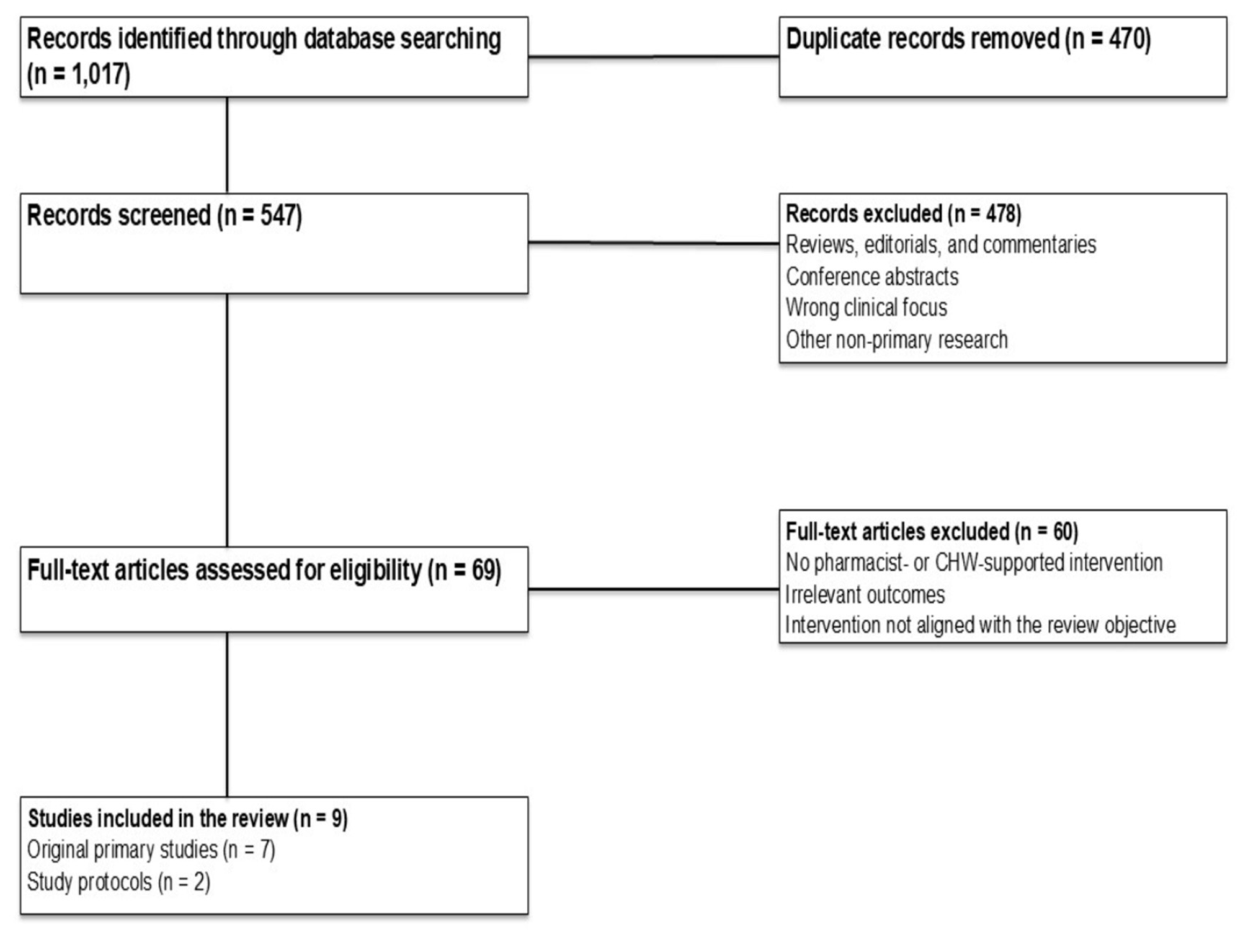
After duplicate removal, titles and abstracts were screened for relevance by a Doctor of Pharmacy (Pharm.D) postdoc fellow (RE). Full-text articles were subsequently reviewed to determine eligibility based on the predefined inclusion criteria. Studies were excluded if they 1) did not involve pharmacists or community health workers; 2) did not evaluate hypertension or medication-related interventions; 3) were conference abstracts, editorials, newsletters, or other non-primary literature; 4) were conducted outside the scope of community-based or ambulatory care relevant to the review objective. The study selection process is summarized in Figure 1.
3. Findings
The literature search identified 1,017 records through database searching. After the removal of 470 duplicate records, 547 titles and abstracts were screened. Following title and abstract screening, 69 full-text articles were assessed for eligibility. After full-text review, nine publications met the eligibility criteria for inclusion in the review (Figure 1). The final review included seven original primary literature and two study protocols. The included studies represented a range of research designs, including cross-sectional surveys, qualitative studies, randomized clinical trials, implementation studies, and protocol papers evaluating pharmacist-led, community health worker-supported, and collaborative hypertension interventions.

Table 1.
Studies Design and Key Results.
| Study | Country | Design | Population (Mean Age/Range) | Intervention | Major Findings | Key Limitations |
| Wees et al. (2024)[10] | United States | Cross-sectional survey across six Midwestern states | 163 pharmacists; participant age not applicable | Survey assessing pharmacists’ experiences with and perceptions of CHW collaboration | Pharmacists with prior CHW experience reported perceived benefits for patient empowerment, education, medication adherence, clinical outcomes, and healthcare-team workload. Most pharmacists with prior CHW experience expressed interest in continued collaboration. | Self-reported perceptions; potential selection bias; no patient-level or clinical outcomes. |
| Rahmawati and Bajorek (2015)[7] | Indonesia | Qualitative study in a rural community-based program | 11 older adults with hypertension aged ≥60 years; mean age 69.8 years; 3 CHWs and 1 district health staff member | CHW-supported blood pressure screening, health education, physical activity sessions, home visits, and linkage to healthcare services | CHWs served as community health gatekeepers and improved access to blood pressure monitoring, education, peer support, home visits, and healthcare referrals. | Small sample; single rural district; qualitative findings may not be generalizable; inconsistent screening, limited equipment, training, and follow-up services. |
| Sharp et al. (2018)[11] | United States | Two-arm, two-period randomized crossover trial in four Chicago primary care clinics | 244 African American and Hispanic adults with type 2 diabetes; age ≥21 years; mean age 54.2 years | Pharmacist-led medication therapy management alone compared with pharmacist care plus CHW home visits, education, social support, navigation, and community referrals | Adding CHW support increased lipid-lowering medication intensification but did not significantly improve HbA1c, blood pressure, LDL cholesterol, BMI, medication adherence, quality of life, or social support compared with pharmacist care alone. | No usual-care control group; possible crossover carryover; variable intervention exposure; reduced CHW engagement and participant follow-up over 24 months. |
| Gerber et al. (2023)[12] | United States | Two-arm randomized clinical trial with a delayed intervention/waiting-list design in academic and federally qualified health-center settings | 221 African American or Hispanic adults with type 2 diabetes; age 21–75 years; mean age 55.2 years | Pharmacist-delivered telehealth medication management combined with health-coach home visits, telephone support, text messaging, medication reconciliation, and self-management education | HbA1c decreased significantly more in the clinical pharmacist and health coach–delivered mHealth intervention group during the first 12 months, and the benefit was maintained through 24 months. Adjusted analyses found no significant effects on blood pressure or other secondary outcomes. | Multicomponent intervention prevented isolation of individual effects; participant and staff blinding was not possible; engagement and intervention delivery were disrupted during the pandemic; limited generalizability beyond similar urban clinical settings. |
| Struewing et al. (2025)[13] | United States | Single-center retrospective study in an urban no-cost clinic | 53 adults with hypertension across 231 visits; mean age 53 years | Pharmacist-led cardiovascular medication management and home BP education combined with CHW screening for social needs, navigation, and community referrals | SBP and DBP decreased significantly over time by predicted means of 9.63 and 7.57 mmHg, respectively. CHWs completed 100 referrals, primarily for additional medical services. | Small sample; single clinic; retrospective design; no comparison group; restricted clinic schedule and staffing challenges; referral completion and longer-term outcomes were not evaluated. |
| Chen et al. (2026)[14] | Taiwan | Nationwide observational implementation study across 54 community pharmacies | 1,216 adults; mean age 56.2 years; 30.8% were aged ≥65 years | Three-month pharmacist-led home blood pressure monitoring (HBPM) program using either digital telemonitoring or non-digital case management, education, reminders, feedback, and referral for abnormal BP | Among participants with hypertension, SBP decreased from 133.2 to 129.8 mmHg and DBP from 83.1 to 79.7 mmHg. Knowledge, attitudes, and self-management behaviors improved, with greater gains among older adults with diminished educational qualifications and residents of less urbanized regions. Digital and non-digital approaches had generally comparable outcomes. | Observational, nonrandomized design; intervention groups were based on participant preference; short three-month follow-up; missing BP and questionnaire data; findings may not generalize beyond Taiwan. |
| Cheng et al. (2026)[15], CHECK-IT | United States | Community and health-system implementation program | 1,462 adults with hypertension enrolled during the first 18 months; age statistics not reported | Four-month program integrating validated home BP monitoring, automated education and reminders, CHW outreach and service navigation, and virtual pharmacist medication management | Among enrolled participants, 70.3% remained active and 63.9% achieved BP control. Participants were more likely than eligible nonparticipants to achieve control and had larger SBP and DBP reductions. | Nonrandomized design; possible unmeasured confounding and self-selection; no systematic follow-up beyond four months referral completion was not tracked; patient and clinician experience outcomes were not collected. |
| Commodore-Mensah et al. (2023)[16], LINKED-BP | United States | Cluster-randomized hybrid type I effectiveness-implementation trial protocol | Planned n = 600 adults aged ≥18 years with elevated BP or untreated stage 1 hypertension; patients aged ≥65 years with stage 1 hypertension were excluded | Twelve-month HBPM and Sphygmo telemonitoring intervention with CHW education, lifestyle counseling, social-needs support, and BP-measurement training across 20 primary care practices | Protocol designed to evaluate changes in SBP at 6 and 12 months, progression to stage 2 hypertension, implementation, sustainability, and cost-effectiveness. No outcome data were available in the protocol. | Study in progress; clinical effectiveness has not yet been reported; excludes adults aged ≥65 years with stage 1 hypertension and patients already receiving antihypertensive medication. |
| Commodore-Mensah et al. (2024)[17], LINKED-HEARTS | United States | Cluster-randomized hybrid type I effectiveness-implementation trial protocol | Planned n = 428 adults with uncontrolled hypertension and diabetes or chronic kidney disease; age range not specified. | Twelve-month intervention combining HBPM, blood glucose telemonitoring, CHW visits, pharmacist telehealth medication management, provider education, and social-needs support across 18 practices | Protocol designed to evaluate BP control at 12 months and assess reach, adoption, sustainability, implementation, and cost-effectiveness. No clinical outcome results were available in the protocol. | Study in progress; effectiveness and implementation outcomes had not yet been reported; multilevel intervention may make it difficult to isolate the contribution of individual components. |
Abbreviations: BMI, body mass index; BP, blood pressure; CHW, community health worker; DBP, diastolic blood pressure; HbA1c, glycated hemoglobin; HBPM, home blood pressure monitoring; LDL, low-density lipoprotein; mHealth, mobile health; SBP, systolic blood pressure.
3.1. Pharmacists’ Perceptions of CHW Collaboration
Although community pharmacists are highly accessible, the successful integration of community health workers into pharmacy practice depends partly on pharmacists’ perceptions, prior experiences, and willingness to participate in collaborative care. Wees et al. (2024) conducted a cross-sectional survey of pharmacists across six Midwestern states to assess their experiences working with CHWs and their interests in future collaboration.
Among the 163 pharmacists included in the final analysis, 35.6% reported previous experience working with a CHW, while 64.4% had no prior experience. Pharmacists who worked with CHWs reported perceived benefits related to patient empowerment, medication adherence, patient education, clinical outcomes, and reduced workload for other healthcare professionals. Most pharmacists with prior CHW experience reported interest in continuing collaborative practice, while more than half of those without previous experience indicated interest in future collaboration [10].
The authors concluded that pharmacists generally recognized the potential value of CHWs in expanding community-based services and supporting patient care. However, the findings were based on self-reported perceptions, the specific pharmacy practice settings represented among respondents were not clearly characterized, and the study did not include patient-level or clinical outcomes. Despite these limitations, the study suggests that pharmacist acceptance may support the feasibility of broader pharmacist-CHW collaboration [10].
3.2. Community-Based CHW Hypertension Support
CHWs play an important role in extending hypertension care beyond traditional healthcare settings by providing culturally appropriate education, promoting self-management, and improving access to community-based services. Rahmawati and Bajorek (2015) conducted a qualitative study to evaluate a community-based hypertension program involving older adults, CHWs, and district health staff in rural Indonesia.
The study included 11 older adults with hypertension aged 60 years and older (mean age 69.8 years), three CHWs, and one district health staff member. CHWs supported hypertension management by conducting blood pressure screening, providing health education, organizing physical activity sessions, performing home visits, and facilitating referrals to healthcare providers. Participants reported that CHWs increased access to blood pressure monitoring, enhanced hypertension knowledge, encouraged lifestyle modification, and strengthened community engagement in hypertension management [7].
Although participants viewed the program positively, several barriers limited its effectiveness, including inconsistent blood pressure screening, inadequate equipment, limited CHW training, and challenges of accessing follow-up healthcare services. The small sample size and single rural setting also limit the generalizability of the findings. Nevertheless, the study highlights the potential contribution of CHWs in supporting hypertension self-management and improving community-based care for older adults [7].
3.3. Pharmacist-CHW Collaborative Interventions
Randomized clinical trials and implementation studies provide growing evidence that pharmacist-CHW collaborative interventions can improve medication management and chronic disease outcomes [11,12,13]. Across the included studies, pharmacists primarily delivered medication therapy management, medication optimization, and clinical monitoring, while CHWs reinforced self-management, addressed social barriers, and facilitated connections to healthcare and community resources.
In 2018, Sharp et al. conducted a two-year randomized crossover trial involving 244 African American and Hispanic adults with uncontrolled type 2 diabetes (mean age 54.2 years) to evaluate whether adding CHWs to pharmacist-led medication therapy management improved clinical outcomes. Participants received either pharmacist-led care alone or pharmacist care combined with CHW support, including home visits, diabetes self-management education, social support, healthcare navigation, and referrals to community resources [11].
Both groups experienced improvements in glycemic control; however, the addition of CHW support did not significantly improve blood pressure, HbA1c, LDL cholesterol, body mass index, medication adherence, quality of life, or perceived social support compared with pharmacist-led care alone. Participants receiving CHW support did experience greater lipid-lowering medication intensification, suggesting that CHWs may enhance medication optimization even when additional clinical outcomes are not observed. Limitations included the absence of a usual-care control group, the crossover study design, lower participant engagement with CHWs during the second year, and participant attrition over the 24-month follow-up [11].
Building on pharmacist-CHW collaboration, Gerber et al. (2023) evaluated a pharmacist- and health coach-delivered mobile health intervention among 221 African American and Hispanic adults with type 2 diabetes (mean age 55.2 years). Pharmacists provided telehealth medication management, medication reconciliation, and treatment intensification, while health coaches delivered home visits, self-management education, telephone follow-up, and text-message support.
Compared with usual diabetes care, participants receiving the clinical pharmacist and health coach–delivered mHealth intervention achieved significantly greater reductions in HbA1c during the first 12 months, and these improvements were sustained through 24 months. However, adjusted analyses showed no significant improvements in blood pressure or other secondary clinical outcomes. The multicomponent design, inability to isolate the independent contribution of each intervention component, disruptions during the pandemic, and limited generalizability beyond academic medical centers and federally qualified health centers were identified as important limitations [12].
More recently, Struewing et al. (2025) evaluated a pharmacist-CHW cardiovascular clinic model implemented within a free clinic serving adults with hypertension. Pharmacists provided medication therapy management, blood pressure assessment, medication optimization, and home blood pressure monitoring education, while CHWs addressed contextual barriers through patient navigation and referrals to community resources.
Among 53 patients followed across 231 clinic visits with a mean participant age of 53 years (SD 10.9), systolic and diastolic blood pressure decreased significantly over time by 9.63 mmHg and 7.57 mmHg, respectively. In addition, CHWs completed 100 referrals addressing transportation, insurance, food access, and additional medical services, demonstrating the complementary roles of pharmacists and CHWs in addressing both clinical and contextual barriers to hypertension management. Although limited by its retrospective design, single-center setting, and small sample size, the study supports the feasibility of pharmacist–CHW collaborative care in improving blood pressure outcomes [13].
3.4. Digital Health and Home Blood Pressure Monitoring
Advances in digital health technologies have expanded opportunities for pharmacists and CHW-supported hypertension management beyond traditional face-to-face encounters. Home blood pressure monitoring (HBPM), telemonitoring, and digital communication platforms enable continuous patient engagement while supporting medication management, self-monitoring, and timely clinical intervention [14,15].
Chen et al. (2026) evaluated a nationwide pharmacist-led hypertension management program implemented across 54 community pharmacies in Taiwan. The study included 1,216 adults (mean age 56.2 years), of whom approximately one-third were aged 65 years or older. Participants received a three-month HBPM intervention delivered through either a digital telemonitoring platform or a non-digital case management approach. Pharmacists provided blood pressure education, medication counseling, self-management support, and referrals when elevated blood pressure readings were identified [14].
Among participants with hypertension, significant reductions in both systolic and diastolic blood pressure were observed following the intervention. Improvements were also reported in hypertension knowledge, attitudes toward blood pressure management, medication adherence, and self-management behaviors. Older adults and participants with lower educational attainment, and those living in less urbanized regions, demonstrated meaningful improvements. Clinical outcomes were generally comparable between the digital and non-digital intervention groups, suggesting that pharmacist-led HBPM programs can improve hypertension management regardless of the mode of follow-up [14].
The study was limited by its observational design, participant self-selection into intervention groups, relatively short three-month follow-up, and potential limitations in generalizing the findings beyond the Taiwanese healthcare system [14].
Similarly, Cheng et al. (2026) evaluated the Community-based Hypertension Education and Control through Knowledge Translation (CHECK-IT) program, a large-scale implementation initiative integrating home blood pressure monitoring, CHW outreach, and virtual pharmacist-led medication management. The program enrolled 1,462 adults with hypertension and combined validated HBPM devices, automated education and reminders, CHW follow-up, assessment of social needs, and pharmacist medication optimization.
During the first 18 months of implementation, approximately 70% of participants remained actively engaged, and nearly two-thirds achieved blood pressure control. Participants enrolled in the program were more likely to achieve blood pressure control and experienced greater reductions in systolic and diastolic blood pressure than eligible individuals who did not participate. The integrated model also demonstrated the feasibility of combining pharmacist medication management with CHW support and digital health technologies to improve hypertension management at the population level [15].
Although the findings are encouraging, the study was limited by its nonrandomized design, potential self-selection bias, lack of systematic follow-up beyond the four-month intervention period, and the inability to evaluate completion of community referrals or patient experience outcomes [15].
3.5. Ongoing Clinical Trials
Although evidence supporting pharmacist–CHW collaborative hypertension management continues to grow, several ongoing clinical trials are evaluating more comprehensive, technology-enabled models designed to improve long-term blood pressure control and implementation in primary care settings.
3.5.1. Commodore-Mensah et al. (2023): LINKED-BP
The LINKED-BP study is a hybrid type I effectiveness-implementation cluster randomized clinical trial designed to evaluate a community health worker-led intervention for adults with elevated blood pressure or untreated stage 1 hypertension. Participants receive home blood pressure monitoring (HBPM), telemonitoring using the Sphygmo platform, lifestyle counseling, blood pressure measurement education, and support for social needs over a 12-month intervention period. The primary outcome is change in systolic blood pressure at 6 and 12 months, with secondary outcomes including progression to stage 2 hypertension, implementation outcomes, sustainability, and cost-effectiveness. As a study protocol, no clinical outcome data were available at the time of publication [16].
3.5.2. Commodore-Mensah et al. (2024): LINKED-HEARTS
Building upon the integration of digital health and multidisciplinary care, the LINKED-HEARTS study is a hybrid type I effectiveness-implementation cluster randomized clinical trial evaluating a pharmacist–CHW collaborative intervention among adults with uncontrolled hypertension and either diabetes or chronic kidney disease. The intervention combines home blood pressure monitoring, blood glucose telemonitoring, pharmacist-led medication management, CHW follow-up, patient education, and support for health-related social needs within primary care practices. The study will evaluate blood pressure control at 12 months while also assessing implementation outcomes, sustainability, and cost-effectiveness. As this publication describes the study protocol, clinical outcome data have not yet been reported [17].
3.5.3. Tyler, Poon, et al. (2026): Check, Monitor, Control
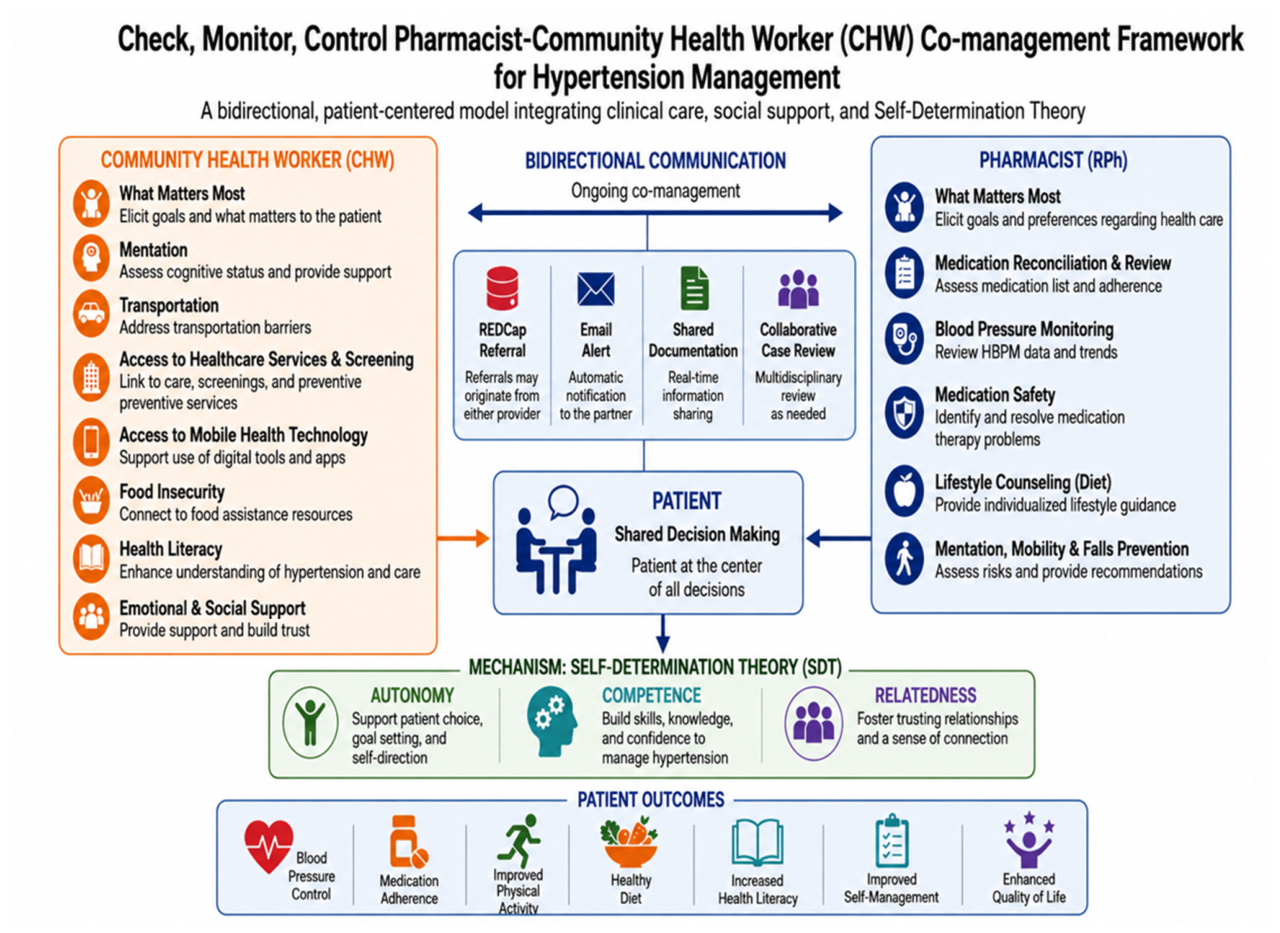
Collectively, the included studies demonstrate an evolution from traditional pharmacist- or CHW-led interventions toward integrated, team-based models that combine medication management, self-management support, home blood pressure monitoring, telehealth, and community resource navigation. However, few studies describe an operational workflow that clearly defines bidirectional communication, coordinated follow-up, and shared clinical decision-making between pharmacists and CHWs throughout hypertension management. To address this gap, Tyler & Poon, et al. propose a pharmacist-CHW co-management framework informed by the Check, Monitor, Control (CMC) study [18] that incorporates structured communication, electronic referral alerts, home blood pressure monitoring, and ongoing collaborative care to support medication optimization and long-term hypertension self-management (Figure 2). The Check, Monitor, Control (CMC) study is an ongoing randomized clinical trial evaluating a pharmacist-led medication management intervention with community health worker support for hypertension management. The study plans to enroll 480 adults aged 55 years or older with hypertension, who will be randomized to either a pharmacist-only intervention (n=240) or a pharmacist-plus-CHW intervention (n=240) for 24 months. Pharmacists provide medication assessment and optimization, blood pressure monitoring, medication safety review, and lifestyle counseling, while CHWs reinforce self-management and address barriers to care through navigation, education, and community resource support. The model uses bidirectional communication and referrals to coordinate care around participants’ individual needs. The CMC intervention uses Self-Determination Theory (SDT) as its behavioral intervention model to support autonomy, competence, and relatedness in hypertension self-management [18,19].
4. Discussion
This review analyzed current evidence describing pharmacist-led, community health worker (CHW)-supported, and collaborative interventions for hypertension management. Across the included studies, pharmacist-CHW collaborative interventions demonstrated the potential to improve medication management, support patient self-management, strengthen hypertension education, and enhance connections to healthcare and community resources. Pharmacists consistently contributed medication therapy management, medication optimization, and blood pressure monitoring, while CHWs complemented these interventions through patient education, lifestyle counseling, healthcare navigation, and addressing contextual barriers that influence hypertension management [7,11,12,13,15].
The included studies also demonstrated an evolution in collaborative care models using mobile health technologies. Earlier interventions primarily focused on community outreach, patient education, and home visits, whereas more recent studies incorporated home blood pressure monitoring (HBPM), telemonitoring, digital communication, and multidisciplinary team-based care to extend hypertension management beyond traditional clinical encounters [7,14,15,16,17].
Despite these advances, relatively few studies specifically evaluated older adults, and few described structured workflows supporting continuous bidirectional communication and coordinated co-management between pharmacists and CHWs. This highlights an important opportunity to further develop collaborative care models that clearly define team roles, communication pathways, and longitudinal follow-up for hypertension management in older adult populations.
The findings of this review are consistent with previous evidence demonstrating that multidisciplinary, community-based approaches can improve hypertension management. In a scoping review of community health worker interventions for noncommunicable diseases, Haregu et al. reported that CHWs contributed to chronic disease management by providing health education, medication support, home visits, telehealth services, and linkage to healthcare resources. Similarly, the present review found that CHWs consistently supported patient education, healthcare navigation, and self-management while complementing pharmacist-led medication management across community and primary care settings [6].
Likewise, Khoong et al. (2022) reviewed SMBP interventions that included populations experiencing worse hypertension outcomes or evaluated differences in clinical or process outcomes between populations. Among studies reporting clinical outcomes, SMBP improved outcomes when paired with clinical support. This observation aligns with the findings of the present review, where more recent interventions increasingly integrated home blood pressure monitoring, telemonitoring, and multidisciplinary collaboration to improve hypertension management [8].
The growing role of pharmacists observed in the present review is also supported by the meta-analysis conducted by Mills et al. (2024), which reported that pharmacist-led interventions achieved the greatest reductions in systolic and diastolic blood pressure among healthcare professional-led interventions, with CHW-led interventions also demonstrating meaningful improvements in blood pressure control. Collectively, these findings reinforce the complementary roles of pharmacists and CHWs in delivering team-based hypertension care [5].
4.1. Strengths and Limitations
This review has several strengths. First, it provides a structured synthesis of the current literature describing pharmacist-led, community health worker (CHW)-supported, and collaborative interventions relevant to hypertension management. By including randomized clinical trials, implementation studies, qualitative research, cross-sectional surveys, and ongoing clinical trial protocols, this review captures the breadth of existing evidence while illustrating the evolution of pharmacist-CHW collaborative care from community-based education to technology-enabled, team-based interventions. The inclusion of study protocols also provides insight into emerging models that may influence future hypertension management [16,17].
Several limitations should also be considered. First, relatively few studies specifically evaluated older adults, despite this population experiencing a high burden of hypertension, multimorbidity, polypharmacy, and medication-related problems. Although older adults were represented in some studies, many interventions enrolled broader adult populations, limiting the ability to determine whether collaborative care models produce similar benefits among older adults. Second, substantial heterogeneity existed across study designs, intervention components, duration of follow-up, and outcome measures, making direct comparisons between studies difficult. Finally, several of the included studies evaluated multicomponent interventions combining pharmacist services, CHW support, digital health technologies, and lifestyle interventions, making it difficult to determine the independent contribution of individual intervention components to the observed outcomes [11,12,14,15].
5. Conclusions
This review provides insight into the current evidence on pharmacist-led, CHW-supported, and pharmacist-CHW collaborative interventions for hypertension management. Across the included studies, interventions varied in design, population, setting, and outcomes, and pharmacist-CHW collaboration did not consistently result in improved clinical outcomes. Pharmacists primarily contributed medication management and blood pressure monitoring, while CHWs supported patient education, self-management, healthcare navigation, and connections to community resources. Relatively few studies specifically evaluated older adults or described structured workflows for pharmacist-CHW co-management. Further research is needed to determine the effectiveness and implementation of pharmacist-CHW collaborative models for hypertension management, particularly among older adults.
Author Contributions
Conceptualization, R.C.E. and I.O.P.; methodology, R.C.E. and I.O.P.; validation, R.C.E. and I.O.P.; investigation, R.C.E.; resources, R.C.E., K.N., J.N. and I.O.P.; data curation, R.C.E.; writing-original draft preparation, R.C.E.; writing-review and editing, R.C.E., J.N., K.N., J.W., T.H., W.L., C.C.T. and I.O.P.; visualization, R.C.E., J.N., K.N. and I.O.P.; supervision, I.O.P. and C.C.T.; project administration, R.C.E.
Funding
This project is supported by the NIMHD of the National Institutes of Health (NIH) under award number 2U54MD007605. The content is solely the responsibility of the authors and does not necessarily represent the official views of the NIH.
Acknowledgments
Generative AI was used only for refinement, correction, editing, or formatting of the manuscript to improve clarity of language. Figures were created using BioRender.
Conflicts of Interest
The authors declare no conflicts of interest.
Abbreviations
The following abbreviations are used in this manuscript:
| BP | Blood pressure |
| BMI | Body mass index |
| CHW | Community health worker |
| CMC | Check, Monitor, Control |
| DBP | Diastolic blood pressure |
| HbA1c | Hemoglobin A1c |
| HBPM | Home blood pressure monitoring |
| HTN | Hypertension |
| LDL | Low-density lipoprotein |
| mHealth | Mobile health |
| MTM | Medication therapy management |
| PRISMA-ScR | Preferred Reporting Items for Systematic Reviews and Meta-Analyses extension for Scoping Reviews |
| SBP | Systolic blood pressure |
| SDT | Self-Determination Theory |
| SMBP | Self-measured blood pressure |
References
- 2023 AHA/ACC/ACCP/ASPC/NLA/PCNA Guideline for the Management of Patients With Chronic Coronary Disease: A Report of the American Heart Association/American College of Cardiology Joint Committee on Clinical Practice Guidelines. Circulation 2023. [CrossRef] [PubMed]
- 2017 ACC/AHA/AAPA/ABC/ACPM/AGS/APhA/ASH/ASPC/NMA/PCNA Guideline for the Prevention, Detection, Evaluation, and Management of High Blood Pressure in Adults: Executive Summary: A Report of the American College of Cardiology/American Heart Association Task Force on Clinical Practice Guidelines. Hypertension 2018. [CrossRef] [PubMed]
- Muntner, P.; Miles, M.A.; Jaeger, B.C.; et al. Blood Pressure Control Among US Adults, 2009 to 2012 Through 2017 to 2020. Hypertension 2022, 79, 1971–1980. [Google Scholar] [CrossRef] [PubMed]
- Tinetti, M.E.; Han, L.; Lee, D.S.H.; et al. Antihypertensive Medications and Serious Fall Injuries in a Nationally Representative Sample of Older Adults. JAMA Intern. Med. 2014, 174, 588–595. [Google Scholar] [CrossRef] [PubMed]
- Mills, K.T.; O’Connell, S.S.; Pan, M.; Obst, K.M.; He, H.; He, J. Role of Health Care Professionals in the Success of Blood Pressure Control Interventions in Patients With Hypertension: A Meta-Analysis. Circ. Cardiovasc. Qual. Outcomes 2024, 17, e010396. [Google Scholar] [CrossRef] [PubMed]
- Haregu, T.; Delobelle, P.; Shrestha, A.; et al. Shifting roles of community health workers in the prevention and management of noncommunicable disease during the COVID-19 pandemic: A scoping review. Health Policy Plan. 2024, 39, 771–781. [Google Scholar] [CrossRef] [PubMed]
- Rahmawati, R.; Bajorek, B. A community health worker-based program for elderly people with hypertension in Indonesia: A qualitative study, 2013. Prev. Chronic Dis. 2015, 12. [Google Scholar] [CrossRef] [PubMed]
- Khoong, E.C.; Commodore-Mensah, Y.; Lyles, C.R.; Fontil, V. Use of Self-Measured Blood Pressure Monitoring to Improve Hypertension Equity. Curr. Hypertens. Rep. 2022, 24, 599–613. [Google Scholar] [CrossRef] [PubMed]
- Tricco, A.C.; Lillie, E.; Zarin, W.; et al. PRISMA Extension for Scoping Reviews (PRISMA-ScR): Checklist and Explanation. Ann. Intern. Med. 2018, 169, 467–473. [Google Scholar] [CrossRef] [PubMed]
- Wees, K.; Thoma, L.; Meredith, A.; Adeoye-Olatunde, O.A.; Gonzalvo, J. An assessment of pharmacist perceptions and experiences with community health workers. J. Am. Pharm. Assoc. 2024, 64. [Google Scholar] [CrossRef] [PubMed]
- Sharp, L.K.; Tilton, J.J.; Touchette, D.R.; et al. Community Health Workers Supporting Clinical Pharmacists in Diabetes Management: A Randomized Controlled Trial. Pharmacotherapy 2018, 38, 58–68. [Google Scholar] [CrossRef] [PubMed]
- Gerber, B.S.; Biggers, A.; Tilton, J.J.; et al. Mobile Health Intervention in Patients with Type 2 Diabetes: A Randomized Clinical Trial. JAMA Netw. Open 2023, 6, e2333629. [Google Scholar] [CrossRef] [PubMed]
- Struewing, M.L.; Adeoye-Olatunde, O.A.; Yang, Y.; Byrd, K.A.D.; Conklin, M.E.; Gonzalvo, J.D.; Smith, K.; Meredith, A.H. Outcomes of the Pharmacist and Community Health Worker Heart Healthy Clinic Model. J. Am. Coll. Clin. Pharm. 2025, 8, 850–859. [Google Scholar] [CrossRef]
- Chen, Y.T.; Yeh, W.Y.; Hu, Y.C.; et al. Effectiveness of a nationwide community pharmacist-led program promoting home blood pressure monitoring on hypertension control and self-management. Hypertens. Res. 2026, 49, 315–327. [Google Scholar] [CrossRef] [PubMed]
- Cheng, E.; Smart, B.; Roberts, T.; et al. The CHECK-IT Program—Controlling Hypertension in Black Communities through In-Person and Virtual Interventions. NEJM Catal. 2026, 7, CAT.25.0130. [Google Scholar] [CrossRef] [PubMed]
- Commodore-Mensah, Y.; Liu, X.; Ogungbe, O.; et al. Design and Rationale of the Home Blood Pressure Telemonitoring Linked with Community Health Workers to Improve Blood Pressure (LINKED-BP) Program. Am. J. Hypertens. 2023, 36, 273–282. [Google Scholar] [CrossRef] [PubMed]
- Commodore-Mensah, Y.; Chen, Y.; Ogungbe, O.; et al. Design and Rationale of the Cardiometabolic Health Program Linked with Community Health Workers and Mobile Health Telemonitoring to Reduce Health DisparitieS (LINKED-HEARTS) Program. Am. Heart J. 2024, 275, 9–20. [Google Scholar] [CrossRef] [PubMed]
- Tyler, C.C.; Poon, I.O.; et al. Check, Monitor, Control Hypertension in Older African American Adults (#Check, Monitor, Control): Protocol for a Randomized Clinical Trial. JMIR Preprints 2026. Available online: https://preprints.jmir.org/preprint/96183 (accessed on 4 September 2026).
- Ryan, R.M.; Deci, E.L. Self-determination theory and the facilitation of intrinsic motivation, social development, and well-being. Am. Psychol. 2000, 55, 68–78. [Google Scholar] [CrossRef] [PubMed]
Figure 1.
Literature identification and study-selection process.
Disclaimer/Publisher’s Note: The statements, opinions and data contained in all publications are solely those of the individual author(s) and contributor(s) and not of MDPI and/or the editor(s). MDPI and/or the editor(s) disclaim responsibility for any injury to people or property resulting from any ideas, methods, instructions or products referred to in the content. |
© 2026 by the authors. Licensee MDPI, Basel, Switzerland. This article is an open access article distributed under the terms and conditions of the Creative Commons Attribution (CC BY) license.
Copyright: This open access article is published under a Creative Commons CC BY 4.0 license, which permit the free download, distribution, and reuse, provided that the author and preprint are cited in any reuse.