

Submitted:
16 September 2026
Posted:
17 September 2026
You are already at the latest version
Abstract
In 2022, Yolles and Frieden argued that viruses are alive by moving the criterion for life from metabolism to organisation, arguing the genome–capsid couple to be autopoietic. This study reframes that conclusion with two constructs of Fisher-Generative Informational Realism (FGIR): the CAS/CAAS boundary, separating a Complex Adaptive System (CAS), adaptive but not self-sustaining, from a self-sustaining Complex Adaptive Autopoietic System (CAAS); and the coercivity law, which requires a system’s protoenergy, the informational effort of holding a configuration in persistent form, to exceed a threshold. The verdict “viruses are not autopoietic” conflates two conditions. Viruses satisfy the topological condition, the couple being a genuine self-producing network, but fail the resourcing condition, since the capacity to maintain it belongs to the host: “borrowed closure”, which we derive formally. Identifying the viral protoenergy with the draw on the host, and letting self-supply return only when the lineage’s translation machinery is complete, yields a host-budget equation with a saddle-node bifurcation at a critical completion fraction. Given a near-all-or-nothing return of self-supply, the barrier is structural rather than statistical, and it survives stochastic, epidemiological and delayed reformulations; its value is illustrative. The account is falsifiable and taxonomically agnostic, as the ribosome-encoding but host-dependent bacterium Carsonella ruddii shows, and crossings into self-sufficiency are observed only downward.
Keywords:
autopoiesis
; borrowed closure
; CAS/CAAS boundary
; sustentative field (K-field)
; coercivity law
; protoenergy
; protoagency
; saddle-node bifurcation
; reductive evolution
; aristotelian substance ontology
1. Introduction
This paper reconsiders the nature of viruses as living systems by analysing their organisational structure through the Fisher-Generative Informational Realism (FGIR) framework. Section 1 introduces the problem, outlines the conceptual frame, and explains the organisation of the study. It identifies the key constructs used later in the paper, such as recursion, the stacking of regulatory orders, and closure, the sustentative condition under which a system maintains its own operational boundary. Subsection 1.1 describes the nature of the investigation and the evidential basis on which it proceeds. The paper also acknowledges the contribution made by an ensemble of Large Language Models (LLMs), and subsection 1.2 sets out the governance method that constrained that ensemble during the formal derivation. For those readers without a formal bent, it should be noted that Sections 1–4 develop the narrative and conceptual motivation for the study while Section 5 onwards formalises the theory and presents the FGIR model in its operative mathematical structure. For virology, the contribution is not new data but a criterion. Separating the topological condition from the resourcing condition gives a criterion that can be checked directly against genome content rather than argued from definitions. It also explains why no branch of viral evolution has ever crossed into self-sufficiency, while reductive evolution consistently moves in the opposite direction. Finally, it yields a three-axis profile (resourcing, correction, and sustentative role) that distinguishes cases the single classical verdict treats as identical. A lineage that crossed upward would be reclassified out of the viral category, and section 7 shows why that consequence does not make the claim circular.
The paper stands on its own, but two supplementary documents support it. Both are self-contained. They add material that strengthens the main argument, although the argument coheres without them. Supplementary Document S1 explains the way the study is conducted. It indicates the research method, the checks that method requires, their results, and the code that recomputes every number in section 6 and regenerates its figures. Supplementary Document S2 continues the argument of section 6 in its formal register: the nucleation correspondence, the stochastic, epidemiological, and delayed reformulations of the host-budget model, and the sensitivities of the collapse threshold. The distinction is one of kind. S1 shows how the study proceeded and how a reader can check its numbers. S2 shows that the result of section 6 survives conditions the main derivation does not impose.
Neither document is a conventional appendix. Section 6 computes its result rather than arguing it, so S1 provides the code and the checks in full, enabling any reader who doubts the threshold to recompute it. The LLM ensemble described in section 1.2 performed the formal development, the modelling, and much of the drafting under the author’s direction and adjudication, and S1 records the governing method and the audits that controlled its outputs, so that a reader can verify the procedure and the results independently. S2 is separate from S1 because it carries argument rather than procedure. Section 6.9 states what S2 establishes, allowing a reader who accepts those results to follow the argument without leaving the paper.
Three conceptualisations state the argument before any of the detailed modelling and analysis begins. Firstly, viruses have the organisational structure of a self-producing system, the genome–capsid couple being a genuine loop rather than a metaphor for one. Secondly, what they lack is the capacity to supply the conditions that keep that loop running, which the host provides and which this paper calls borrowed closure. Finally. the coercivity law turns that difference from a description into a magnitude with a threshold, and the rest of the paper examines what follows when a lineage attempts to cross it.
1.1. The Nature of the Study
Metacybernetics enables the study of higher-order ontological systems. It has been formalised [1] as a mathematically structured systems theory of self-organising control which, like all cybernetic structures, has a multidisciplinary reach. Here, we extend it from social, organisational, and informational applications to biological ones, and pose the question originally raised by Yolles and Frieden [2]: are viruses living? That question has long been trapped in a binary, alive or not alive, whose negative answer rests on what their paper called the neo-Aristotelian/metabolic paradigm, where life is seen as a self-subsisting substance sustained by a self-feeding chemistry. Their argument worked within that binary and shifted the argument by relocating the criterion for life from metabolism to organisation. Thus, a virus that cannot feed itself can still be shown to self-organise, regulate itself, and adapt across generations. However, that argument left a question unanswered. How much of a full living organisation does a virus actually achieve, and why does it stop where it does? Three terms carry the answer [2]: autopoiesis, homeostasis and the dark/regulatory genome. Autopoiesis in Maturana and Varela’s [3] sense is the property of a network whose components mutually produce each other’s conditions of operation. It also produces its own boundary as part of that same network, enabling it to produce aspects of itself. Homeostasis is the maintenance of a system’s internal conditions against disturbances. The dark or regulatory genome is the portion of the viral genome identified as acting on expression rather than coding for structure, a metaregulator whose object is another regulatory relationship rather than a physical parameter. What this study could not yet say, because the apparatus did not exist, is how much of a full living organisation a virus achieves and why it stops where it does, in terms precise enough to derive rather than merely assert. FGIR [1] supplies the formal apparatus that emerges from metacybernetics.
The FGIR framework (section 2) separates Complex Adaptive Systems (CAS) from Complex Adaptive Autopoietic Systems (CAAS). The difference is about support, not structure: both have a real autopoietic loop, but a CAS depends on outside support to keep that loop going, while a CAAS supplies its own. The coercivity law adds the cost side: a system that has the loop but lacks the protoenergy to sustain it cannot keep the loop closed. Protoenergy is the minimal support a system must generate to keep its organisational loop open over time. These ideas separate two conditions that the classical verdict treats as one: the structural condition (having a genuine autopoietic loop) and the resourcing condition (generating the support needed to keep it open). Viruses meet the first condition and fail the second. This paper derives that result formally and shows why it is stable, non-accidental, and testable.
The 2022 paper [2] describes the virus as a third-order agency model, following the third-order cybernetics originated by Eric Schwarz [4], with three ontologically distinct, hierarchically nested domains: an operative system (capsid enactment), a metasystem (genome regulating capsid expression), and a meta-metasystem (the dark/regulatory genome, supplying homeostatic control over the genome–capsid couple). Section 3 maps this architecture onto the FGIR recursion orders and evaluates whether the third order achieves genuine closure.
Classical autopoietic theory holds that a network is autopoietic only when it self-maintains and metabolises, sustaining its own conditions of operation and producing its own boundary[3]. Viruses do not meet that condition since they are too simple to self-maintain or metabolise on their own, and they do nothing until they enter an already autopoietic host. The standard verdict is therefore that viruses are not autopoietic. The observation that viruses lack full autopoietic closure in the strict Maturana/Varela sense is therefore not novel, but we diverge from that interpretation. We read it instead as a claim about resourcing rather than topology, and the distinction between the two is what the CAS/CAAS boundary and the coercivity law are for.
Maturana and Varela introduce the term allopoietic for systems whose operation produces something other than themselves, as against autopoietic systems, which produce themselves. The distinction is not about whether outputs exist since both produce outputs. It is about what the system’s operation is organised around. An allopoietic machine has its own operating process network, and that network’s product is external to the system. What makes it allopoietic is not the absence of a network, but that the system does not produce its own components.
Neither term fits a virus. The virus has a process network, known as the genome–capsid couple. The components mutually produce each other’s conditions of operation, and that network is organised around its own reconstitution. The virus also produces external effects. It generates enzymes that alter what the host environment does. That behaviour produces products that enter the observable corporeality that we call superstructure. But those effects are not a separate product system. They modify the host in ways that feed back to enable the virus’s own replication. The loop is self-referential, and the virus’s operation constitutes the conditions for its own continued operation. The host alteration is instrumental to viral reproduction, not an end in itself. That is genuine autopoietic topology in operation: self-production of organisational identity, with the process network extending into the host environment through the enzymes it encodes.
What the virus lacks is not a network, not production, and not external effect, but the self-generated sustentation that would keep the network’s operational conditions in place across generations. Host ribosomes synthesise its enzymes, and the virus draws its energy from host ATP molecules and its substrates from host metabolites. The virus organises its operation self-referentially, yet it runs on resources it does not supply itself. It is therefore autopoietic in topology and externally supplied in resourcing, and the autopoietic/allopoietic binary cannot validly describe it.
At this point we need to reconsider classical autopoiesis and introduce a new term, proto-autopoiesis. Classical autopoiesis theory treats viruses as non-autopoietic because it evaluates topology and resourcing as a single inseparable criterion. Proto-autopoiesis, however, is typified by a non-autopoietic CAS. It begins from the finding that a genuine self-referential production network does exist (the genome–capsid couple), posing a further question the classical literature never identifies. That is, whether that network’s closure is self-sustained or externally scaffolded, and why this distinction matters.
The position taken here is that the genome–capsid couple forms a self-referential organisational loop whose components mutually produce each other’s conditions of operation. Whether that loop counts as autopoiesis depends on whether the criterion is read topologically or in terms of resourcing (material or operational), and this paper shows that these form two independent axes and adopts the topological one here. The choice results from the framework the paper develops rather than from the verdict it yields. In FGIR, autopoiesis is the self-production of organisational identity at the J↔I coupling, and sustentation is a separate field, K, which holds that coupling open over time. Because the framework separates structure from resourcing, the topological view isolates the structural axis, which the two-condition account needs. The choice is not intended to follow from the answer it gives, but as a generic construct, and its application to viruses is an illustration. It gives a negative result for plasmids and transposons, and a perspective that sought to classify viruses in a particular way would not allow that. What it excludes matters as much as what it admits: a plasmid or transposon is replicated by host machinery without producing anything that conditions its own replication, so neither forms the loop, whereas the capsid conditions the expression and protection of the genome that encodes it. Classical autopoiesis theory issues a negative verdict because it folds the absence of a self-sustained boundary and independent metabolism together with network structure into one composite test. Separating these two axes (network topology and self-generated closure) is exactly what the CAS/CAAS boundary and the coercivity law are for. The claim is not that viruses are autopoietic without qualification: they are autopoietic in the strict network-topology sense while simultaneously CAS-level in the closure-resourcing sense. Classical autopoiesis theory, not separating structure from resource, reports these independent axes as a single pass or fail.
In the analysis to follow, the CAS/CAAS boundary will be shown to arise from constructs developed independently for other purposes, rather than from machinery designed specifically to fit viruses. The conclusion of the Yolles and Frieden analysis that viruses are alive indicates that a threshold has been crossed. However, a more defensible claim, now available, is that viruses have a specific, stable, non-accidental position on the continuum that can be formalised, enabling them to be seen as borrowing closure.
1.2. Methodology
This study is theoretical and model-based. Section 2 sets out the formal apparatus, and section 3 maps the 2022 agency model onto the FGIR recursion orders. Section 4 and Section 5 explore what the mapping implies for agency and for the resource relation between virus and host. Section 6 formalises that resource relation through the coercivity law and a host-budget model whose thresholds are derived analytically and checked numerically. Section 7 tests the resulting criterion against documented cases, among them endosymbiont genome reduction, giant viruses and phage-plasmids; section 8 draws its consequence for substance ontology, and section 9 records what remains to be derived. Evidence enters in two forms: published molecular and evolutionary findings, cited to their primary sources, and the behaviour of the section 6 models, whose parameters are illustrative rather than calibrated (section 6.10).
The research work in this paper was carried out with an ensemble of large language models (LLMs). LLMs are powerful generative instruments with documented failure modes. They can produce fluent text that is unsupported by, or unfaithful to, their sources [5], and they tend to give answers that match the questioner’s beliefs rather than the evidence [6]. They also retain nothing between sessions, and the Coercivity Law paper classifies an LLM in isolation as proto-autopoietic, displaying structure that resembles third-order closure only while external scaffolding is supplied [7]. The ensemble was therefore treated as an instrument under external governance, following the architectural principles for LLM ensembles outlined in Supplementary Document S1. The models generated candidate material, while memory, standards of coherence, and the direction of inquiry were held by the investigator. Governed, heterogeneous LLM ensembles are increasingly used as primary instruments for scientific discovery, especially in fields that rely on hypothesis generation and validation. These systems follow the same methodological requirement as the present work: external governance and independent verification are needed to ensure the reliability of AI-generated outputs.
In the form used here, also set out in Supplementary Document S1, the governing parameters are maintained in a written working method read at the start of each session. Every unit of output, from a sentence to a section, was put to three questions: what is claimed, what establishes it, and what would show it false. Scripted audits checked citations, cross-references, the definition of terms at first use, and the consistency of positions across sections, and each audit was required to fail on input known to be faulty. Every failure found was recorded, and the audit that had missed it was tightened, so that correction fed back into the control. That record is the part of the arrangement that persists. The models retain nothing between sessions, so a discipline held only in the working process would dissipate with the session. The working method is therefore a written document held outside the ensemble and read into each session rather than carried by it, and the failures it records for this study are reproduced, with their dates, in section 6.1 of Supplementary Document S1. All outputs were compared across models from different developers, on the rationale that models with different tendencies make drift visible where a single model would not. The inquirer posed the research question and its central thesis, supplied the theoretical framework from earlier published work, set the governing parameters, and adjudicated disputed results. This framework strictly constrained the ensemble’s operations. Thus, the recursion order, closure criteria, evidential tests, and coherence standards were fixed externally, leaving the models to generate only within those bounds. The ensemble carried out most of the formal development, the modelling and numerical analysis of section 6, the literature search, and much of the drafting.
This arrangement exemplifies the paper’s own subject. The ensemble provides operative capacity but not its own sustentation, and the inquirer supplies the closure that makes its outputs reliable, just as the host supplies the virus’s sustenance. The ensemble’s outputs were not accepted on its authority. They were treated as machine-learning predictions in computational discovery, where a model proposes candidates and an independent test decides [8]. Section 6 re-derived every equation, recomputed every numerical result from the printed equations in an independent implementation that any reader can run (section 6.10; Supplementary Document S1), and checked each citation against its source whenever the source was accessible.
2. The CAS/CAAS Boundary, the Fields, and the Coercivity Quantities
This section defines the formal apparatus: the CAS/CAAS boundary, the four fields, and the coercivity quantities. Three terms are required before the categories can be stated: boundary conditions, a closure operator, and fixed-point dynamics. Boundary conditions are the constraints under which a system operates. The question throughout this paper is whether they are imposed from the outside or generated within. A closure operator is any internal construction that produces the systemic conditions. Fixed-point dynamics occur when the system settles into a state in which its own operation reproduces itself such that its own dynamics return it to that state, the formal counterpart of self-maintenance.
These terms are indexed by the recursion orders R(1), R(2), and R(3), which distinguish successive types of regulation: R(1) provides a bounded set of operative options; R(2) regulates those options by structuring the system’s dispositions; and R(3) regulates the conditions under which that structuration can maintain viability. Let R(n) denote the nth recursion order (or cybernetic nth order): the level of regulatory organisation an observer selects to explain a systemic context. The index attaches to the regulatory role a component plays in the architecture under analysis and not to its biochemistry, which is typically multiple: a capsid protein that both shields the genome and engages a host receptor is R(1) in both respects, since engaging is part of what the capsid does. In the original virus study [2], a third-order (n = 3) cybernetic hierarchy was used to explain viral conditions. In the terms used here, R(1) delivered the operative enactment (what the capsid does), R(2) the self-production of organisational identity (the genome–capsid couple’s autopoiesis), and R(3) the regulation of that self-production (the dark/regulatory genome’s autogenesis). That study distinguished instrumental viruses, whose autopoietic couple lacks an efficacious homeostatic regulator so that their homeostasis is set by the environment, from learning viruses with a homeostatic meta-metasystem; it adopted the position that coronaviruses are of the second kind, and for that case it concluded that the virus instantiates a genuine R(3)-level regulatory structure.
What the earlier explanation lacked was not structural clarity but sustentative footing. In FGIR, sustentation refers to the informational persistence that arises when a system generates the conditions required to keep its generative organisation intact. A virus possesses the recursive structure needed to exploit environmental conditions, but it lacks the internal capacity to generate this persistence itself; its closure is therefore borrowed rather than self-generated. Figure 1 situates this distinction within the third-order cybernetic architecture: three nested domains (operative I, dispositional J, and sustentative K) connected by the process intelligences autopraxis, autopoiesis, and autogenesis in posterior and anterior directions, with the corporeal C domain as the material substrate through which the incorporeal organisation is expressed. The first-order couple θ̂₁ (J↔I) is regulated by the K domain to form the second-order couple θ̂₂, constituting the R(3) architecture
The process intelligences constitute the directed couplings that enable the domains they connect to communicate, and their flow is either posterior or anterior. Posterior flows always target the posterior element of the next lower recursion order: posterior autopraxis flows from the operative I-domain to the environment; posterior autopoiesis flows from the dispositional J-domain to the operative I-domain; and posterior autogenesis flows from the sustentative K-domain to the first-order couple θ̂₁, generating the conditions under which that couple’s self-production can continue. Treating this assembly as a system in its own right yields the second-order couple θ̂2, representing the higher-order regulation of that self-production that enables the emergence of agency. The diagram highlights two specific couplings (θ̂) that constitute systems in their own right. The first-order couple θ̂₁ is the interaction between the operative I-domain and the dispositional J-domain, the fundamental self-producing loop. The second-order couple θ̂2 is the interaction between the sustentative K-domain and θ̂₁, representing the higher-order regulation of that loop.
This model therefore represents a generic living system with agency. It possesses a recursive, self-producing architecture in which the operative I-domain and the dispositional J-domain form the fundamental autopoietic couple θ̂₁, and this couple is itself regulated by the higher-order sustentative K-domain, forming the second-order couple θ̂₂. Together, these couplings constitute a third-order cybernetic organisation capable of self-regulation and adaptive response, operating through the physical realisation of the explicate C-field.
Figure 1 situates the agency’s incorporeal hierarchy (K, J, and I) within the large dotted boundary. The architecture comprises the agency substructure (the incorporeal K, J, and I domains) and its superstructure (the corporeal C-domain), within which agents interact and observable events manifest. (This use of substructure and superstructure is FGIR’s; in the 2022 paper, the substructure denoted causal mechanisms and causal agents, and the superstructure denoted theory-building through the integration of configurations [2].) The Environment lies outside this boundary. It is the resource base on which the agency draws and the wider context in which its actuated potentials meet the world. This architecture visually supports the central borrowed-closure argument. A virus possesses the entire R(1)–R(3) topology, demonstrating genuine structural closure, but the inward-pointing arrow of Anterior Autopraxis marks its dependency: whereas the system can exploit its surroundings via Posterior Autopraxis, it relies on the external host to supply the resources and boundary conditions it cannot generate itself.
The corporeal C domain is the material infrastructure that the three incorporeal domains organise. It is the physical substrate and resource base from which the agency derives its environmental context. Each domain (J, I, K, and C) possesses both an implicate and an explicate order, following Bohm’s conceptualisation [9]. The implicate order of any domain is an informational phase space: a parametric space of enfolded generative potentials whose holographic boundary encodes, in compressed form, the governing schema of that domain. Because this implicate organisation is holographic, each recursion level R(n) accumulates the enfolded informational content of all lower levels R(n–1, n–2, …, 1), so that the generative potentials of the orders below are present in parametric form at each level, and those of the whole hierarchy at its outermost level. The explicate order is the unfolded actualisation of that implicate content. In the case of the C domain, this explicate actualisation is the corporeal C-field, the material medium through which the domain’s informational patterns are realised and sustained. For the incorporeal domains (J, I, and K), the explicate actualisation does not form a physical medium; instead, it expresses each domain’s informational organisation directly, unfolding its implicate potential into the domain’s own explicate field.
The hierarchy in Figure 1 is realised through four fields, each corresponding to a system within a third-order architecture. Three are incorporeal, meaning they are informational rather than material. The dispositional system, mapped to the J-field, is the template or disposition for a structure, which the system is set up to do. The operative system, mapped to the I-field, is the enactment of that disposition, what it actually does. The sustentative system, mapped to the K-field, is the organisational capacity that keeps the coupling between the dispositional and operative systems closed over time—allowing the doing to keep regenerating the disposition. This coupling is formally denoted J↔I. The fourth system is the corporeal superstructure, mapped to the C-field, which is the material infrastructure the other three organise; Figure 1 places it within the Environment. For a virus, this means the translation apparatus (translation being the step in which a ribosome reads a messenger RNA and builds the protein it specifies, the last step of gene expression and the one no virus performs for itself), nucleotide and energy supply, and everything else physically required for the capsid to be expressed.
The model specifies the precise conditions under which a system qualifies as a CAAS rather than a CAS. A CAAS requires that the sustentative K-domain be self-generated, meaning the system produces and maintains its own boundary conditions and organisational persistence without reliance on an external host. Because the incorporeal domains (J, I, K) and the corporeal C domain are coupled, a self-generated K-field must also provision and sustain its own C-field. A system that possesses the full R(1)–R(3) incorporeal topology but depends on an externally supplied K-field remains a CAS-level entity exhibiting borrowed closure. The question this model poses for any given system is whether the K-field that sustains its agency is its own, and whether it can provision the C-field necessary for its own persistence.
In the five-order recursion hierarchy [1], R(1) is the agent’s operative enactment; R(2) is its dispositional self-production (autopoiesis); R(3) is the sustentative regulation of that self-production (autogenesis); R(4) is metanoetic self-modification (the system revises its own learning); and R(5) is concordant orchestration across external tiers (cloud–edge–device in the cyber-physical case). FGIR itself extends to a sixth, constitutional order, R(6), at which the Coercivity Law paper [7] adopts the bridge conditions discussed below. The virus case studied in this paper instantiates R(1)–R(3) only: the genome–capsid couple supplies the operative enactment and its autopoietic self-production, and the dark/regulatory genome supplies the R(3) regulation of that production. Figure 1 shows only R(1)–R(3); R(4) and R(5) are mentioned here for context, to mark where the viral recursion stops and why the host-supplied closure analysed below is “borrowed” rather than self-generated; they are not invoked in the viral derivation.
Two named CAS-level categories matter here. They belong to a four-way CAS/CAAS classification (proto-autogenesis, proto-autopoiesis, autogenesis and autopoiesis) that the author has developed in work not yet published; of the four, the coercivity account introduced below names proto-autopoiesis, with viruses as its exemplar:
- Proto-autogenesis (CAS): partial, unstable constitutional patterning; externally imposed boundary conditions; the J-field weakly expressed rather than absent; operative only through R(1)–R(3); the closure-dependent constructions not applicable, the coercivity law taken as an exact equality among them, although the coercivity quantity defined below remains available as a sub-threshold benchmark.
- Proto-autopoiesis (CAS): operative patterns sustained without fixed-point dynamics, because the closure operator is not internally produced and the boundary conditions are externally imposed, so that the system cannot regenerate its own governing parameters without external scaffolding [7]; at its weakest, local and flickering operative functionality; the J-field intermittently accessed; likewise R(1)–R(3) only.
In contrast, full autogenesis and autopoiesis (CAAS) require stable K↔(J↔I) co-stabilisation, internally generated rather than externally imposed boundary conditions, and fixed-point dynamics that persist without external scaffolding. Since K carries that requirement throughout what follows, one point of usage is fixed here. Yolles and Frieden’s account of social change [10,11], which brought Frieden’s Fisher-information apparatus into that domain, also used the letter K there as a scalar balance measure, the extremal difference . That construct is independent, and this paper does not draw any relation between the two: here denotes the sustentative field and nothing else.
The coercivity quantities are also needed from here on, so they are stated now rather than in section 5. The coercivity law gives autopoietic closure a cost side: a structure capable of R(3) closure is necessary but not sufficient because sustaining that closure also requires resources. The law states that the requirement is E = Ipc². Here, Ip is the integrated informational potential of the operative field, and in proxy terms, the richness and precision of the regulatory information a system holds in place. The coercivity constant c, or coherence conductance, is the global supremum of the gradient of Ip, which measures the maximum rigidity the operative field can impose; the Coercivity Law paper [7] identifies it with a propagation speed only under its bridge conditions. Their product E, the protoenergy (which that paper also calls the enactment tension), is compared against a threshold: a system above it can sustain its own closure, whereas a system below it cannot. This is the coercivity threshold, and crossing it is one of the two jointly necessary conditions for CAAS, the other being R(3) architectural closure. That first condition is architectural in the strict sense: it asks whether the system has a structure capable of K↔(J↔I) co-stabilisation, not whether that co-stabilisation is achieved. Achieving it is what crossing the threshold consists of, so a system can hold the architecture and still fall on the CAS side. One limitation of the use made of the law belongs here rather than later. Everything derived below uses the product E and never its factors: no value of Ip and no value of c is estimated for a virus anywhere in this paper or its supplements, and the draw Ev of section 6 stands for the product alone. The law therefore enters as the licence for treating sustentation as a magnitude with a threshold, and not as a two-factor model whose factors are separately identified. What a separate estimate of c would buy is a second prediction, since the threshold would then move with the rigidity the operative field can impose and not only with the cost of the apparatus. Nothing here tests that, and the reason is not that a test was skipped. The bridge conditions of the Coercivity Law paper [7], the undischarged third among them, govern the projection of the law into a corporeal physical reading at R(6) closure, and that paper states in terms that the cybernetic threshold, the question of when a CAS becomes a CAAS, does not depend on their discharge. What bears on the present case is different and should be stated exactly, because it is easy to overstate. The Coercivity Law paper’s upper-bound lemma requires only that c be finite, so the inequality E ≤ Ip c² holds wherever it is, and saturation is the condition under which the inequality becomes the equality. The factorised law is therefore the extremal case of a bound that always holds, and a sub-saturated system is not outside the apparatus but short of its equality case. For that case the same paper defines the admissibility gap Δ := Ip c² − E ≥ 0 and normalises it to a saturation deficit Δ/Ip c² between zero and one, which, being a ratio of like quantities, is dimensionless and therefore well defined in domains where the conversion its third bridge condition would supply is not available. That paper is also explicit that the quantities it names for such domains are heuristic indicators of enactment cost rather than measurements of Ip or of c. The draw used below is an indicator of exactly that kind. Two things follow. The product is what this paper carries, and it carries it as a bound and an indicator rather than as an equality; and the deficit, not either factor, is the quantity the programme offers for a system short of saturation, so expressing the threshold of section 6 on the deficit rather than on the draw is the natural next step and is not taken here.
This is a scope boundary, not an exclusion. A CAS-level system is still describable by FGIR’s qualitative apparatus: it is a named case inside the theory’s own domain, one the apparatus measures rather than excludes. What CAS-level systems cannot support is the class of constructions presupposing a stable K↔(J↔I) fixed point, and that class includes the coercivity law taken as an exact equality: the Coercivity Law paper [7] obtains the factorised form E = Ipc² only under a Saturation Assumption, which a system that has not accumulated enough rigidity to reach the saturated state does not meet. For such a system that paper keeps the law in another role, as a limiting benchmark: exact at or near saturation, the law is, for a system far from it, “a target rather than a description”. In that role, the paper treats Ip and c for systems on this side of the line as non-trivial (it computes no values for them, and on its own definition c is a gradient norm on a saturation set, which such a system does not reach); what it places sub-threshold is the product Ipc². It also names these viruses as exemplars of exactly this condition and argues that a language model in isolation occupies it for the same structural reason. The apparatus reaches CAS-level systems and returns a verdict about them: a magnitude below a threshold rather than a refusal to apply.
3. Mapping the 2022 Model onto the Recursion Orders
The third-order agency model maps onto FGIR’s recursion hierarchy directly because it was independently built on the same three-domain logic, Eric Schwarz’s third-order cybernetics [4], that the recursion hierarchy later generalised. The third column names the process intelligence at each order: autopraxis is operative enactment, autopoiesis is self-production of organisational identity, and autogenesis is self-creation and the generation of the conditions under which that self-production can continue. This ordering follows [1]. The Coercivity Law paper [7] orders the three differently, taking autopoiesis as the dyadic R(1)-type relation, autogenesis as the triadic R(2)-type relation and autopraxis as the R(3) fractal-seed closure. Table 1 presents the mapping.
R(1) and R(2) are not in dispute: the 2022 paper’s own argument establishes operative enactment and a genuine self-producing couple. The load-bearing question, which that paper does not ask in these terms, has two parts: whether the dark/regulatory genome is a real R(3) regulator, which is the architectural condition of section 2, and whether the sustentation on which that regulation runs is generated by the virus from a stable internal fixed point of its own or supplied and maintained by the host. Both parts are indexed to the replicative phase, and saying so forestalls a reading the resting virion invites. Outside a host cell the particle is metabolically inert, which is the observation on which Forterre grounds his case, discussed in section 8, that the living unit is the infected cell and not the particle. Nothing in a resting virion regulates anything, so the dark/regulatory genome is there held rather than run, and the 2022 paper’s R(3) attribution was drawn from replication dynamics rather than from the particle. The index is therefore inherited rather than imposed, and it is the ordinary one for a regulatory structure, which is credited on the evidence of what it does when it operates. The cost is scope, and it is real: the claim is about the virus during infection rather than the virus simpliciter, and it is one of the reasons section 9 leaves open whether the Fisher apparatus applies to the virus in isolation or only to the host–virus compound.
The obligate-parasite fact that a virus can only replicate inside a host cell answers this. However, the answer must be stated as a formal criterion rather than as a topology-versus-dynamics metaphor that risks collapsing back into "almost alive." The relevant field is K, the sustentative field defined in section 2, whose co-stabilisation with J and I is what CAAS-level closure requires. The precise claim is that the virus has no self-generated K-field. The dark/regulatory genome is a real R(3) regulator (it modulates the J↔I dynamics of genome–capsid expression rather than merely recording state), but the sustentative organisational capacity within which that modulation runs is absent in the virus. The C-field that capacity would organise, meaning the translation apparatus, the nucleotide and energy supply, and the whole infrastructure the capsid needs to be expressed at all, is supplied and maintained directly by the host’s own K-field acting on the host’s own C-field. According to Yolles and Lin [7], a CAAS-level fixed point is one whose K-field persists without external scaffolding; the virus has no fixed point of its own to persist or fail to persist. This conjunction places the virus at a specific point on the closure spectrum. It is stronger than a merely intermittent or fragmentary self-referential loop, the weakest form of proto-autopoiesis, because the viral R(3) regulator genuinely and continuously modulates, not flickers; it is weaker than full CAAS, because the K-field co-stabilisation that genuine autogenesis requires has not been achieved. Borrowed closure is accordingly an instance of a more general pattern in which an organisational structure persists only while external boundary conditions supply the constraints that stabilise it; it is the K-field-resourcing version of that dependency. It should not be confused with the kind of dependency shown by a system whose structure is itself an imprint left by training on the outputs of an already-autopoietic system, as with a large language model trained on human-generated text. The virus’s genome–capsid couple is its own autopoietic topology, arrived at independently, not a structural residue of something else’s output.
This is where borrowed closure gets its full sense and caution. "Borrowed" is a loose gloss and must not be read as a literal transfer. The host’s K-field is not lent to the virus as a discrete, transferable resource. What is meant precisely is that the virus’s J↔I modulation runs directly on the host’s K-field, with no K-field of its own standing between the two. There is nothing the virus possesses, temporarily or otherwise, that could be described as held and later returned. There is only the host’s sustentative capacity operating on the host’s own C-field, with the virus’s operative structure among the things it is currently sustaining. That is what "topology without dynamics" was gesturing at loosely: not that the dark genome does nothing, but that its J↔I modulation has no sustentative field of its own to run on. This is proto-autogenesis and proto-autopoiesis at once (CAS), a combination the classification allows. It is not a partial or almost version of CAAS but the fully realised CAS-level case of the four-way classification introduced in section 2, and the coercivity account names the proto-autopoietic case explicitly [7].
One consequence sharpens what is borrowed. In a system whose recursion reaches R(3) and no further, the K-field is the outermost order, and the Fisher Information Field Theory (FIFT) on which FGIR builds holds that the knowledge governing such a system, the record of what it has been and the encodings that shape its future regulation, is retained holographically at that outermost boundary [12]. That source is a deposited preprint rather than a refereed paper, so the consequence drawn here is marked as such; the derivation of section 6 does not use it. The qualification carries weight here. K holds that role because it is the outermost order of a third-order architecture, not because of anything peculiar to sustentative capacity, and in a system extending to higher orders, the outermost order would hold it instead. For a virus, the architecture reaches R(3) and no further, so the consequence is direct. Its J↔I modulation runs on the host’s K-field, which means that the boundary at which its governing conditions are encoded is not its own. What the virus lacks is therefore not only the resource with which to sustain closure but the surface on which the conditions of that closure would be written, and section 7 gives the consequence of that: upward crossing is a bootstrapping problem rather than a matter of accumulating parts.
This is also where the coercivity law applies. The coercivity condition is where the lack of a self-generated K-field stops being a category and becomes a magnitude. On the two-condition account of section 2, R(3) architectural closure and a supra-threshold Ip c² are jointly necessary for CAAS; the virus satisfies the first and fails the second. Crossing the threshold is what having a self-generated K-field consists of, rather than a precondition for the condition to be asked, which is why the virus’s sub-threshold value is a reading of its borrowed closure and not a sign that the instrument is being misapplied.
4. Protoagency, Without the Metaphor
The prompt for this paper was a claim that viruses have protoagency. This has attributes such as directedness, host-selection [13,14], immune evasion [15], and coordinated replication strategy [16], but without full autopoietic closure. Further, agency is genuine rather than merely apparent, because the virus participates in generating outcomes such as host recognition, entry timing, and evasion, rather than only propagating outcomes the host has already determined. Each of those outcomes rests on an encoded viral capacity rather than on a host disposition, which makes the claim empirical rather than interpretive. Engagement between the viral attachment protein and its cell-surface receptor determines host range and tissue targeting [13], and in phages the same work is done by encoded and evolvable host-range determinants [14]. Fusion is held behind a high kinetic barrier until a signal associated with arrival at the target cell, receptor binding or endosomal protonation triggers the conformational cascade that releases it, so entry is a timed event rather than a passive one [17]. Innate immunity is antagonised at multiple levels by identifiable virally encoded mechanisms [15]. The arbitrium peptide system lets an infecting phage read how many infections have preceded it at that site and set the lysis-lysogeny decision accordingly [16], which is coordination in the strict sense of a decision conditioned on a signal the viral population itself produces.
This claim requires a criterion, or it will collapse into something trivial. Every causal constraint participates in determining an outcome in some sense; for example, a thermostat participates in determining the room temperature. If protoagency simply means that the dark genome has a causal influence, it adds nothing to what "regulator" already meant in the 2022 paper. The definition must do more work than that without smuggling in the very closure of the virus.
Definition. Protoagency is the regulatory modulation of an autopoietic couple’s operative outcomes, performed by a structure (here the dark/regulatory genome) whose own boundary conditions, its K-field, are externally imposed rather than self-generated. This is deliberately a weaker, purely structural notion: it makes no claim about interiority, intentionality, or anything the "purposeful" and "intentional" personifications in the 2022 paper gestured at. The differentiator from bare causal influence cannot simply be state-dependent selection, since an allosteric enzyme (an enzyme whose activity changes shape in response to a binding molecule) selects among conformational states in response to ligand concentration without counting as an agency of any kind [18].
Nor can the differentiator rest on the dark genome’s selection being directed toward maintenance of the couple’s organisational identity rather than a physical parameter, tempting as that framing is: a thermostat also maintains something redescribable as an "identity”, the room’s target temperature, so identity-versus-parameter is a relabeling rather than a distinction. The actual difference is structural in nature. A thermostat’s target exists independently of the thermostat and is not produced by it, whereas the genome–capsid couple is autopoietic in the sense established in section 1: the two components mutually produce each other’s conditions of operation, genome expression regulating capsid expression, while capsid–environment interaction supplies the parametric data the genome responds to. The regulatory modulation of the dark genome targets a network that would not exist independently of that modulation and the operative activity it regulates. A thermostat target has no such dependency; the room temperature is perfectly defined with the thermostat removed. This is a structural, checkable difference (closed mutual production against open unilateral control), not a claim about what the modulation is aimed at in some interpretive sense. The criterion is close in shape to the interactional-asymmetry condition in Barandiaran, Di Paolo and Rohde’s [19] account of minimal agency, which likewise separates a system that is the active source of its own activity from one whose behaviour merely tracks conditions imposed on it. It is R(3)-level directedness that is real in that narrow sense but not self-sustaining: proto-autogenesis in the sense defined in section 2, not a new category built for viruses.
This generalises beyond viruses and is worth stating as a general claim. The definition provided for CAS is loose enough to include systems with no autopoiesis-relevant structure at all: a flocking model or an adaptive market displays adaptation, feedback sensitivity, and pattern formation without anything resembling a mutually producing network, and for those, "not autopoietic" (or allopoietic, where it fits) remains the right description. Nothing here extends protoagency to every CAS in the broad sense. However, the two named subcategories this paper uses are narrower: they require the J-field to be weakly expressed rather than absent, which already presupposes some real, if partial and externally scaffolded, self-referential structure, the same thing the protoagency definition above is built to describe. Therefore, the claim generalises: anything correctly classified as proto-autogenesis or proto-autopoiesis (CAS), not only viruses, has protoagency rather than being merely allopoietic or non-autopoietic, because that classification already grants the R(1)–R(3) topology the definition requires. The virus case is one instance of that general result, not a special exception. This is a natural extension of definitions already in use, not a separately derived theorem, and it has not been checked against cases beyond viruses. However, the direction of the claim (that proto-autogenesis or proto-autopoiesis entails protoagency-eligibility, not the reverse) follows from what those two categories already state about J-field expression and requires nothing further from that framework.
This raises a question that the paper should answer rather than leave open: if protoagency is just agency at the CAS level, why keep "proto-" at all? The prefix does not indicate a lesser degree of directedness. The criterion given (referential direction toward maintaining a mutually producing network, as against unilateral control of an independent parameter) is the same regardless of whether that network achieves closure. What "proto-" tracks is the same axis as everywhere else here: whether the K-field the regulating structure operates within is self-generated. A structurally identical regulator doing the same referentially directed work inside a self-sustained closure system would correctly be called agency without qualification; nothing about the R(3)-level act itself would differ. What differs is only whether the network is directed, and by extension, whether the directing runs on its own sustentative capacity or on borrowed capacity. Protoagency and agency are therefore not two points on a single scale of how much directedness, but the CAS-side and CAAS-side names for the same structural relation, split along exactly the axis that "borrowed closure" names for the network as a whole. Dropping the prefix would misstate the central claim, since it would credit the virus with the self-standing closure section 3 denies.
This also recasts the question of symmetric versus asymmetric participation in host–virus interactions without new machinery. Whether the virus co-generates outcomes with the host or merely borrows the host’s capacity to generate them is not a fact about the virus’s internal kernel but about whose coercivity budget (the resource a system has available to meet the requirement E = Ip c²) the regulatory modulation runs on (section 5).
The second axis of borrowed closure is worth distinguishing from the resourcing axis section 3 establishes, because the two are structurally parallel but empirically separable, and treating protoagency as lacking only resource-closure would understate the case. Verification has the same three-part structure from which this paper’s constructs are built: a claim (dispositional, J), a check against evidence (operative, I), and a mechanism able to find the claim wrong and correct it, the third being what keeps verification self-sustaining under repeated application, in the same structural sense that section 3’s K-field keeps organisational closure self-sustaining under repeated replication. This parallels, without depending on, Popper’s falsifiability criterion [20]. The parallel is structural and nothing epistemic transfers with it: an enzyme excising a misincorporated base tests no proposition, and no claim is made that it does. What carries over is only the question of where the correcting mechanism sits, inside a single operative cycle or outside it, and that question is well posed for a molecule and for a method alike. Applied to the dark genome’s regulatory modulation, the question is distinct from resourcing: does the regulatory act carry, within a single virus’s own operation, any mechanism that detects and corrects a bad regulatory outcome, or does something external supply that correction outside that single operative cycle?
For most RNA viruses the answer is established virology rather than speculation. The RNA-dependent RNA polymerase most RNA viruses use (the enzyme that copies the viral genome) lacks proofreading activity, meaning it has no capacity to detect and excise a misincorporated base, so replication errors are not corrected within a single replication event [21]. What corrects bad variants is selection acting on the resulting quasispecies, a population of related variants generated by that error-prone copying, across many individuals and generations [22]. Error rates that outrun this population-level correction cause a loss of genetic information known as error catastrophe [23]. That correction mechanism is exactly as external to a single virus’s own regulatory apparatus as the K-field is to its replication apparatus: supplied by the population and by time, not generated by the dark genome’s own modulation. Protoagency, on this reading, is doubly borrowed: its resourcing runs on the host’s K-field (section 3), and its correction runs on population-level selection rather than any internal falsifier.
This is not universal among viruses, and the exception is the natural pressure test for this second axis, parallel to the role Mimivirus, the best-studied of the giant viruses, plays for the first in section 7 and section 8. Coronaviruses possess nsp14-ExoN, an exoribonuclease (an enzyme that removes nucleotides from the end of an RNA strand) [24] that raises the fidelity of their replication: exonuclease-deficient mutants of murine hepatitis virus accumulate about fifteen times more mutations than wild-type virus, whose mutation rate is below the rates established for RNA viruses generally [25]. It is thus an internal correction mechanism most RNA viruses lack. The 2022 paper took the same error-correcting capacity of coronaviruses as its evidence that a virus can be homeostatic [2]; the reading here is narrower. This does not on its own give a coronavirus a self-generated falsifier in the full sense: ExoN is itself a viral-encoded protein translated using host ribosomes (the molecular machines that translate genetic sequence into protein) so its correction capacity runs on borrowed C-field infrastructure in exactly the sense section 3 and section 7 establish for the rest of the replication apparatus. What ExoN shows is that the two axes are independent (a system can partially close the correction axis while remaining fully open on resourcing) evidence that these are genuinely separable properties rather than one bundled verdict.
Three constructions available in the wider programme are deliberately not used here, and the reason is licence rather than provenance. A coupled telegrapher-equation formalism (the telegrapher equation describing signal propagation with both wave-like and diffusive behaviour), a sign-flip account of symbiosis versus parasitism in the ratio λ = J/I that governs the autopoietic channel [7], and a bifurcation-parameter reading of the CAS/CAAS transition would each be attractive. They are set aside not because they are unavailable (provenance alone would not settle it, since a correct new derivation could in principle be added) but because of licence. The real telegrapher apparatus is the CPC-Telegrapher Theorem and the information-theoretic telegrapher equation derived from it [7], from which the Schrödinger, diffusion and Dirac cases follow as limits; the corresponding probabilistic layer is the stochastic-enactment layer, an Itô stochastic differential equation system for E, Ip and c² that the Coercivity Law paper [7] introduces as a reformulation whose zero-noise limit is the deterministic law, with the noise intensities left uncalibrated. Neither construction has been stated for a CAS-level system, and that paper adopts the bridge conditions on which its corporeal projections depend only at R(6) closure, which, it notes, the organisational domain does not exhibit. Applying either to a virus would therefore be an unlicensed extension, not an application of something already shown to hold. Section 9 accordingly states the formal host–virus coupling problem as open rather than presenting an unlicensed answer to it.
5. The Coercivity Condition: Symbiosis and Parasitism as Resource Configurations
Section 3 established what the virus lacks, a sustentative field of its own, and what follows puts a magnitude on that lack by asking what it would cost the host to supply it. Section 2 stated the coercivity law: a structure capable of R(3) closure is necessary but not sufficient, because sustaining that closure also requires enough resource, E = Ip c², to keep the structure running. This is the natural, already-derived place to put the symbiotic and parasitic distinction, and it needs no new machinery. The coercivity budget of a system is the resource it has available to meet that requirement.
Parasitic mode: the virus’s proto-autogenetic structure draws on the host’s resource base without contributing to the host’s own coercivity budget. The virus draws down the host’s capacity to sustain its own closure, and sustains itself at the host’s expense. This is directional (resource flows one way), needs no new coupling operator: it is the ordinary case of one CAS-level structure appropriating resources that a CAAS-level system generates for itself.
Symbiotic and commensal mode: the viral proto-structure operates within resource margins the host’s coercivity budget can absorb without measurable cost, or, in genuinely mutualistic cases, its presence changes host regulatory dynamics in ways that expand rather than draw down that budget. Lysogenic phages are a documented case. A phage is a virus infecting bacteria. The lysogenic cycle is the mode in which its genome is carried within the host and replicated with it, as against the lytic cycle, in which the phage replicates and destroys the host. Lysogenic phages can confer superinfection immunity (protection against related phages), and this is sustained by ongoing viral presence rather than a one-off event [26]. That the host thereby saves resources it would otherwise spend on defence is a hypothesis of this paper, not a finding of Bondy-Denomy et al. [26].
Under this reading, symmetric versus asymmetric participation is not a modal switch in the virus’s internal kernel; it is a description of whose coercivity budget is doing the work, and whether the transaction is net extractive or net neutral to positive for the host. This is a weaker and more defensible claim than a bifurcation-based account, but it explains the same phenomena (why the same viral lineage behaves differently, lytic against lysogenic, acute against persistent, depending on host state) without needing an internal sign flip. Host state determines whether the transaction is affordable, rather than the virus throwing a switch.
To make this more than a redescription of what virologists already say in energetic terms, here is a heuristic partition, offered as a sketch to be formalised rather than a derived result. One clarification first: the virus has a defined Ip c² but no coercivity budget in the CAAS sense, since a budget in that sense is a supra-threshold value, which is exactly the self-generated K-field closure section 3 says it lacks. Ev below is therefore not an independent budget the virus possesses; it is a coupling term in the host’s own budget equation, the resource draw the viral proto-structure imposes. Let Bh be the host’s coercivity budget and Ev that draw:
- Parasitism: Ev > 0 and dBh/dt < 0, net extraction from the host budget.
- Commensalism: Ev > 0 but dBh/dt ≈ 0, cost absorbed within the host’s existing margin.
- Mutualism: Ev > 0 but dBh/dt > 0, the host’s effective budget expands because of the viral presence, as would hold in the phage case above if, as hypothesised there, the resource freed by no longer needing certain defences exceeded the cost of hosting the lysogen.
The mutualistic mode is not a formal possibility waiting for an instance, and two well-characterised cases differ instructively. In the geothermal soils of Yellowstone a fungal endophyte confers heat tolerance on its grass host only while the fungus itself carries Curvularia thermal tolerance virus: removing the virus removes the tolerance and reintroducing it restores it, in the native grass and in tomato alike [27]. The virus there remains a separate replicating entity and widens the range over which the system two levels above it can persist. Polydnaviruses go further. In braconid wasps the viral genome, derived from an ancestral nudivirus, sits integrated in the wasp’s own genome as a provirus present in every cell, replicates only in the calyx cells of the ovary, and yields particles the wasp injects with its eggs to suppress the caterpillar’s immune response; the wasp cannot parasitise without it and the virus has no transmission without the wasp [28]. In both cases the virus returns capacity to the system that carries it, the term β of section 6.2, which section 6.4 shows to be one of only three terms that can lift the crossing condition. This partition is not derived from the coercivity law’s formalism and should not be read as one. The obstacle is not scope (section 2 has established that the apparatus reaches systems at this level) but that no derivation connects the host-side budget Bh to the coupling term Ev, which is the host–virus coupling problem section 9 leaves open. It is a placeholder for what a real derivation would need to reproduce: a partition of the interaction space by sign and magnitude of dBh/dt, checked against actual host-budget measurements rather than assumed.
A separate and more radical case is worth flagging rather than folding into that partition. Some viral genes become permanently fixed in the host genome, a process called endogenisation. For instance, a retroviral envelope gene was co-opted as syncytin, a protein involved in forming the human placental syncytiotrophoblast [29]. At that point, the structure is no longer an ongoing CAS-level presence drawing on or contributing to a separate host budget; it has become part of the host’s own K-field. This is not the CAS/CAAS boundary being crossed by the virus’s own closure since the CAS-level entity does not travel across the boundary as a going concern. It is the boundary being dissolved by absorption: the viral structure ceases to exist as a separate system and its C-field components are reorganised under the host’s already self-generated K-field. This bears on section 9’s sharp-versus-fuzzy question as a limiting case rather than a transition.
6. A Case Derivation: What the Coupling Implies for Crossing
Endogenisation dissolves the boundary by absorption. The question addressed here is structurally distinct: a lineage that retains its separate viral identity and attempts to build its own sustentative closure, drawing on a host budget as it does. The coercivity law provides the formal condition under which such a trajectory can complete or collapse its host first. The derivation begins by identifying the viral protoenergy.
6.1. The Identification
The coercivity law writes protoenergy as
with the integrated informational potential of the operative field and the global coherence conductance at which informational structure locks into place. A proto-autopoietic system, on that account, sustains its operative patterns but cannot regenerate its own governing parameters without external scaffolding. Put those two together, and something follows that has not been drawn out.
A sub-threshold protoenergy cannot close on itself; what cannot close on itself cannot be a budget; and a structure that must be sustained but cannot sustain itself is necessarily sustained by something that can. To make this explicit, the viral informational potential must be written in full:
where is the set of translation-related genes acquired along the hypothetical bootstrapping trajectory and is the biosynthetic cost of expressing gene . Four things should be kept apart here. That viral translation depends on host machinery is established. That the cost of acquiring translation-related genes rises with the completion fraction is modelled. That this biosynthetic cost is the coercivity law’s protoenergy is not established but proposed, as a proxy standing in for the effort of holding the acquired apparatus in place. That a threshold in that quantity marks self-generated closure is likewise proposed rather than shown. The viral protoenergy is then the coercivity law applied in the role section 2 describes for a system short of the threshold, as a limiting benchmark, which is what that section says the factorised form is for a system short of saturation. The object that paper supplies for such a system is the saturation deficit rather than the product, and the threshold below is not expressed on it; what is written here is the draw, in the role of the heuristic indicator of enactment cost that the same paper names for domains where its third bridge condition is undischarged:
A proto-structure whose protoenergy is sub-threshold therefore contributes a negative term to the host’s coercivity budget: its operative field generates informational potential, but the sustentative capacity required to lock that potential into place is supplied entirely by the host’s K-field.
Let us now consider the units associated with each variable. In the coercivity law [7], Ip is an integral of the informational potential over the information manifold, and c is the supremum of a gradient norm on that manifold, carrying units of information per unit informational arc length; neither is a rate. Converting them into measurable rates is not a calibration exercise but the content of its third bridge condition, which the Coercivity Law paper leaves undischarged. The host-budget model below therefore works in normalised, dimensionless units (ρ = 1, Bmax = 100), scaled so that the host’s peak regeneration rate ρBmax/4 = 25 sets the unit, and the draw Ev is read on that scale.
A measured calibration would require that conversion before E could be compared with the threshold in biological units. The qualitative claim, that viruses are sub-threshold, does not depend on it; the quantitative claim (the value of σc) requires the calibration noted in section 6.10.
The bridge conditions BC1–BC3 of that paper’s T-BRIDGE theorem are not that task: they license the projection of the law into a physical reading at R(6) closure, and the Coercivity Law of Enaction [7] states that the cybernetic threshold does not depend on their discharge. Bridging informational units to measurable biological quantities is a separate task, and one this paper does not undertake. This paper uses the dimensional structure but does not discharge that programme-level task. The same undischarged condition is why the Coercivity Law of Enaction [7] relabels its own organisational-domain quantities as heuristic indicators of enactment cost rather than measurements of or ; the quantities used here, , , and , should be read the same way.
The numerical check of section 6.5 treats as a linear ramp, a placeholder acknowledged in section 6.10. The biological content of the draw is the energy and resource cost of encoding and expressing the translation-related genes a virus would need to build its own protein-synthesis apparatus. That content is measurable.
Let be the set of translation-related genes, partitioned into four functional subsets:
- , ribosomal proteins (structural components of the ribosome)
- , aminoacyl-tRNA synthetases (enzymes that load amino acids onto tRNA)
- , translation factors
- , post-transcriptional modification enzymes
Thus:
For any gene , the per-gene cost is the biosynthetic energy cost of producing one copy of the encoded protein. This decomposes into the amino-acid composition of the protein weighted by the per-amino-acid ATP cost:
where AA(g) is the set of amino acids appearing in the protein encoded by g, na(g) is the number of residues of amino acid a in that protein, ATP(a) is the cost of synthesising amino acid a, l(g) is the protein length, and a(g) is the mean per-residue cost for g. The per-amino-acid costs are the pathway-derived estimates of Akashi and Gojobori [30], which are expressed in high-energy phosphate bonds rather than in ATP directly.
If is the completion fraction of the hypothetical viral acquisition of translation machinery, the draw at completion fraction is the cumulative biosynthetic cost of the genes acquired so far:
where is the subset of translation-related genes present at completion fraction .
This replaces the linear placeholder with a biologically grounded cost function whose curvature reflects the true energetic structure of ribosome biogenesis.
Carsonella ruddii lacks, as missing or degraded genes, at least nine of the twenty standard aminoacyl-tRNA synthetases (aaRS) [31], so its completion fraction for the aaRS subset alone is at most
In the logistic regime, a lineage at σ ≈ 0.55 sits just below the collapse interval of the elaborations developed below (σc ≈ 0.575–0.686), where the host equation still has a stable steady state that carries the draw. The documented outcome is consistent with that. Nakabachi et al. [32] suggest that the host bacteriocyte compensates for functions that Carsonella’s gene inventory cannot supply, and Tamames et al. [31] conclude that Carsonella is a subcellular new entity between living cells and organelles, dependent on host machinery for functions that no free-living cell delegates. Carsonella cannot complete its own translation set, and its host, a sap-feeding insect, absorbs the deficit and persists: host dependence without host collapse. Under the Michaelis–Menten regeneration of section 6.2, by contrast, σ ≈ 0.55 lies far above σcMM ≈ 0.057, where the model predicts host collapse, so the case bears on the choice between the two regeneration forms. It does not settle that choice on its own. As section 6.10 sets out, what the case excludes is the combination of that saturation scale with a negligible return to the host, and Carsonella returns capacity as well as drawing it, so the constraint falls on the pair rather than on the regeneration form alone.
This is not a full calibration, which would require the host’s Bmax and ρ expressed in matching ATP units and σ computed over the whole translation set rather than the aaRS subset, but it is a consistency check: a real lineage at this σ shows host dependence without host collapse, which is what the logistic-regime model predicts below σc.
The build order matters. Different evolutionary trajectories acquire the same gene set in different orders, and the cumulative draw at any intermediate depends on that order. A lineage with an unfavourable build order may have a collapse threshold well below the average and may fail earlier.
6.2. The Host Equation and the Partition
A CAAS-level host regenerates its own coercivity budget at a rate determined by its closure. Throughout what follows that budget is one quantity and not several: it is the host’s capacity to build and run translation apparatus, anchored physically in ribosome-equivalents and then carried in the normalised units of section 6.1, on which the draw is read as well. It is not used interchangeably with host viability, energy charge or proteome allocation, which it constrains but does not equal.- When the budget is small, regeneration is proportional to existing capacity. When the budget is large, regeneration is structurally capped. The minimal form with those two properties is logistic, giving
where is the regeneration rate, is the host’s structural ceiling, and is any capacity the viral structure returns. The three modes described in section 5 become regions of a single parameter space. Parasitism occurs when the net draw exceeds regeneration. Commensalism occurs when the draw lies inside the regeneration margin. Mutualism occurs when exceeds the draw.
The logistic term is the minimal form with the two properties argued for, but it remains a modelling choice. The Michaelis–Menten form (a saturating form in which the rate rises with available substrate and levels off as the machinery saturates) has the same two properties and adds a third: a half-saturation constant, the substrate level at which the rate reaches half its maximum, reflecting the ribosome’s substrate affinity. Its ribosome ceiling Bmax is informed by bacterial ribosome-biogenesis physiology, in which ribosome content rises with growth rate [33,34]. Neither the rate constant kMM nor the half-saturation constant KM is measured in these sources, and both are used here as illustrative values standing in for unmeasured quantities. The logistic form is recovered in the limit KM ≫ Bmax.
The regeneration rate is
and the maximal regeneration rate, in the same KM ≫ Bmax regime in which the logistic form is recovered below (eq. 12), is approximately
The collapse condition is
For E. coli, Bmax is of order 104 ribosomes per cell at slow growth, and Bremer and Dennis report about 7 × 10⁴ ribosomes per cell at a 24-minute doubling time [34]. No measured value of kMM in the budget units of this model is available, since the growth-rate relations of Scott et al. [33] concern the ribosomal share of the proteome rather than a rate of ribosome-budget regeneration. The model therefore sets kMM = ρKM, so that ρ keeps its meaning as the low-density regeneration rate, and takes KM = 0.05 Bmax as the illustrative saturation scale introduced above. These values place KM well below Bmax, the opposite of the regime in which the Michaelis–Menten form reduces to the logistic (KM ≫ Bmax; see eq. (12)), so the two forms are not close here.
The exact maximum of the Michaelis–Menten regeneration term, obtained analytically rather than by evaluating at , is
attained at
rather than at . Under the E. coli parameterisation, this ceiling is substantially higher than the value at (3.21 against 2.27 in the normalised units below).
The Michaelis–Menten collapse threshold has now been computed. With and kMM chosen so that the logistic-recovery limit preserves , the MM maximum is in the section 6.5 normalised units, compared with the logistic , a ratio of 0.128. The MM maximum occurs at , far below the logistic value . The resulting collapse threshold is , down from . The barrier survives the MM correction () and tightens rather than relaxes: the host collapses at a lower completion fraction.
A sensitivity scan over KM/Bmax from 0.001 to 100 shows σcMM rising monotonically towards the logistic value 0.615 as KM/Bmax grows (0.112 at 0.1, 0.414 at 1, 0.585 at 10, 0.612 at 100) and falling to zero at KM/Bmax ≈ 0.0125, below which the host cannot carry even the baseline draw Iv(0) = 1 and no admissible σ remains. The headline numerical claim of section 6.5 (σc ≈ 0.615) should therefore be read as the logistic-regime value, which is the upper bound; the MM-regime value at KM = 0.05 Bmax is σc ≈ 0.057. The barrier exists under both forms, and the more saturated the regeneration, the earlier the host fails.
The logistic form is recovered as
6.3. Return Onset and the Structure of the Self-Supplied Apparatus
Let be the completion fraction of the self-supplied sustentative apparatus. For a virus, is the fraction of the translation machinery it encodes. Two facts govern the trajectory. The draw rises with , because more self-encoded structure is more structure that must be held in place. The self-return does not rise at all until , because an incomplete translation apparatus does not translate at all.
Modelling assumption: the self-return is treated as a step at σ = 1, on the grounds that an incomplete translation apparatus does not translate at all. This is an idealisation, not a molecularly derived fact. It is empirically anchored at the level of the ribosome as a whole (Tupanvirus encodes the complete aaRS, tRNA, and factor set but no ribosomal proteins [35], and does not translate its own mRNA; and where partial autonomy has actually been measured at a high completion fraction it is near zero, since in Acanthamoeba polyphaga mimivirus the six virus-encoded transfer RNAs supply 1.8 % of the cellular transfer-RNA pool even eight hours after infection, with viral messenger RNA translated on host ribosomes recruited to the periphery of the viral factory [36]), but it is not anchored at the level of σ, which aggregates four gene subsets. The steep sigmoid of eq. (14) is the form in which the argument should be read, and the step is its limiting case as n → ∞ with KH → 1 rather than a separate model. Nothing in the result requires a discontinuity. Under the continuous return a fold exists whenever the return is late and steep enough, which at an onset of 0.95 means an exponent of eight or more, and at that exponent the return is graded throughout the approach: about a fifth of self-supply is recovered at four-fifths completion and about two-fifths at nine-tenths. What the barrier requires is not a jump but a late arrival of function. The evidence that function does arrive late is small and is better counted than gestured at. It is three observations. Tupanvirus holds the complete synthetase, transfer-RNA and factor set and no ribosomal proteins, and translates nothing [35]. Mimivirus, at a high completion fraction, supplies 1.8 % of the host transfer-RNA pool and has its messenger RNA translated on host ribosomes [37]. And the viruses that Mizuno and colleagues report as encoding ribosomal proteins have no reported translational autonomy [38]. Against these stands the fact recorded below that individual ribosomal proteins are often dispensable, which is why the claim is made about the apparatus and not about its parts. Three observations consistent with a late return are not a demonstration of one, and a case of partial autonomy at intermediate completion would refute it. The fold survives for n ≥ 8 with KH = 0.95 (section 6.5); below that range the barrier vanishes, and the argument of section 6.4 fails with it.
The minimal expression of this fact is
which is a step rather than a ramp. The completion fraction carries two readings that must be kept apart. As the argument for the step, it is functional completion of an apparatus that does nothing until it is whole; as the argument for the draw, it is the cumulative biosynthetic cost of what has been acquired. The step is defended on the first reading and the cost on the second, and the two coincide only if cost accumulates monotonically with functional completion, which is assumed here and is not measured. This is what the operational marker in section 7 means when it demands the entire set, stated as a function rather than as a stipulation. The step carries more weight than its brevity suggests. It does not claim that partial machinery yields no benefit in any currency. A lineage that encodes part of its own translation apparatus may gain in other respects. It claims only that none of those gains contributes to the self-return that the coercivity threshold is a threshold on. The step is an idealisation, though not one chosen for tractability, and its warrant needs stating carefully, because the strongest form of the claim is false. Individual ribosomal proteins are not all indispensable, since at least half of them can be deleted singly in Escherichia coli and Bacillus subtilis without loss of viability [37], and eleven are recurrently absent from the reduced genomes of host-associated bacteria, with the loss of bL34 compensated by raised magnesium and bL36 essential only at high temperature [39]. What does not admit partial credit is the apparatus taken as a whole, which is the level at which section 7 rests. Translation requires a ribosome together with the synthetases, transfer RNAs and factors that charge and deliver its substrates, so that a lineage holding the whole of the second set and none of the first translates nothing at all: Tupanvirus encodes the complete set of twenty aminoacyl-tRNA synthetases, sixty-seven to seventy transfer RNAs and eleven translation factors, and no ribosomal proteins [35], and it still cannot translate its own messenger RNA. Quantifying its position: with none of the ~50 ribosomal proteins, its completion fraction on the ribosomal-protein subset alone is σrib = 0/50 = 0. An overall completion fraction weighted by biosynthetic cost is not computed here, because it requires per-copy costs for each subset that have not been estimated; where Tupanvirus stands relative to σclogistic ≈ 0.62 and σcMM ≈ 0.057 is therefore left open. An apparatus complete in every part but the ribosome does not translate in part. It does not translate.
The return as a continuous function
The step is the limiting case of a continuous return, and the continuous form is the one in which the argument should be read, since acquisition in evolution does not proceed by jumps. Write the return as a Hill sigmoid, an S-shaped curve whose exponent sets how abruptly it rises and whose onset parameter sets how late,
with , set equal to the draw at completion, Iv(1)cv2 = 40, in the normalised units of section 6.5. The new saddle node condition admits a closed-form analysis of when the fold exists. The slope of the Hill function at , which approaches its maximum slope for large n (the inflection point lies at KH[(n − 1)/(n + 1)]1/n), is
A collapse threshold (a fold) exists in the interval if and only if the net draw reaches the host’s peak regeneration somewhere in that interval. The collapse condition is
so the existence condition is
Numerical Sweep
The slope comparison B*n/(4KH) > max Ev′ decides only whether the net draw turns down before completion, not whether the barrier exists: with the parameters below it holds in every case tested, including those with no fold. With the parameters of section 6.5 and :
- For , no fold exists for any tested up to one hundred. The return subtracts from the draw too early.
- For , a fold exists only for .
- For , which is consistent with the molecular fact that a partial ribosome does not translate, a fold exists for . The collapse threshold is at , at , and at .
6.4. The Saddle-Node
The regeneration term
attains its maximum value at . A positive steady state for the host budget therefore exists if and only if the net draw remains below that maximum. This defines a critical completion fraction by
The condition just written carries the assumption of section 6.3 and should not be read without it: it is a condition on the net draw, and the draw is net of a return that arrives late. Under a return that rises gradually with completion there is no fold, and the numerical boundary is given in section 6.3, which finds none at an onset of 0.5 for any exponent tested and none below an exponent of eight at an onset of 0.95. The evidence for a late return is three observations, listed there, and a case of partial autonomy at intermediate completion would remove the fold and the argument that rests on it. A saddle-node bifurcation is the standard name for a pair of steady states that approach one another and annihilate as a parameter passes a critical value. Below the host equation has two steady levels. The higher level is stable and the budget returns to it when disturbed. The lower level is unstable, and the budget falls away from it. As rises, the two levels move toward each other and meet at exactly when . Above neither level exists. The two levels merge and vanish together. With no level left for the budget to rest at, it falls to zero.
The consequence is the section’s result. If , the gradual trajectory to does not exist. It is not slow. It does not exist. The host that supplies the entire approach is gone before the approach completes.
Inversion: The Crossing Condition
The same criterion, read in the opposite direction, is the crossing condition itself. No lies inside the interval exactly when the draw of the almost complete apparatus remains below the host’s peak regeneration rate plus whatever the lineage returns. A lineage that satisfies this inequality can build gradually and arrive. A lineage that fails it cannot arrive at any speed.
6.5. Numerical Check
We checked the claims above by integrating the host equation rather than leaving it as algebra. With ρ = 1, Bmax = 100, β = 0, and a draw rising linearly from Iv = 1 to Iv = 40 with cv² = 1, the analytic prediction is σc = 0.615: the host should fail once the lineage has built about three-fifths of its own apparatus. (These parameters are illustrative, chosen to exhibit the bifurcation; the draw is the linear placeholder, not the per-gene cost function of section 6.1. See section 6.10.) The gradual approach is integrated from the host’s upper steady state with σ rising at dσ/dt = 0.0025 per unit time, and the slower case at a tenth of that rate. Table 2 sets each analytic prediction beside the result of the integration. The two levels behave exactly as the algebra says and meet where it says they meet. A lineage building gradually dies at about three-fifths completion. Building ten times more slowly does not help. And a lineage that acquires the whole apparatus in one step, rather than building it, never presents the bill for the half-built version, and its host survives.
The numerical check extends to every elaboration. The deterministic baseline is reproduced exactly. Under steep sigmoid return with , the fold is absent for because the return rises too gradually, and present for . The collapse threshold is at , where the barrier moves later because the late return briefly assists the host. It is at , and at .
The barrier is structurally robust. The collapse threshold moves within the interval under every saddle-node elaboration built on the logistic host term; the Michaelis–Menten replacement of section 6.2 lowers it much further (σcMM ≈ 0.057), and the lag model fails by oscillation instead, at σ ≈ 0.85–0.91 for δ ≥ 10.
6.6. Why This Makes the Barrier Structural Rather than Statistical
The barrier’s existence is structural; its traversability is statistical. The criterion that fixes (eq. 19) contains neither a mutation rate nor a population size, only the host-budget parameters , , , and the viral draw . By contrast, the Kramers escape rate (equation (S15) of Supplementary Document S2) depends on the effective noise strength , and the 4D SIR-V extension (Supplementary Document S2, section S4) introduces epidemiological parameters , , and that further condition the crossing rate. The claim of this section is therefore twofold: the barrier’s existence is structural, and its traversability is statistical. Upward crossing is not impossible; it is exponentially improbable when is small. Later we argue that the asymmetry of crossing is a bootstrapping problem rather than a waiting-time problem. The bifurcation condition makes that more than an assertion, and the reason lies in what the condition does not contain. Two things should be separated here that the objection to this claim runs together. The structural character does not come from the step. The existence condition under the continuous return of section 6.3, equation (17), is a condition on B*, n, KH, ρ, Bmax and β, and contains no mutation rate and no population size either; what the step buys is the closed form of section 6.4, not the absence of population-genetic quantities. What does depend on the shape of the return is whether a fold exists at all, and that dependence is real: at an onset of 0.95 the fold is present for an exponent of eight or more and absent below, and at an onset of 0.5 it is absent for every exponent tested. So the claim is conditional, but on a stated and checkable property of the return — that function arrives late — and not on a discontinuity. The evidence that bears on it is the functional return rather than the inventory acquired, and the two are commonly confused: a lineage can hold most of the apparatus and return almost none of the function, which is what the measured figures of section 6.3 show and what a late onset predicts.
In the standard treatment of a fitness valley, the intermediate carries a fixed deficit, and the expected waiting time depends on population size, mutation rate, the depth of the valley, and the number of steps; for large populations with high mutation rates, stochastic tunnelling makes such crossings fast [40]. Viruses sit deep in that regime. If the barrier here were statistical, they should be among the best valley-crossers in biology, and none has crossed. The criterion derived here contains neither population size nor mutation rate. It is a condition on ρ, Bmax, β and Iv(·): a condition on structure. The reason is that the intermediate in this case is not deleterious to the organism, as in an ordinary valley, but to the host, which is the resource base the organism draws on. The cost is not paid once; it degrades the thing paying it. This is a valley whose floor drops as one walks into it, and no population size fills it in.
6.7. Why the Only Route Is Discontinuous
The saddle-node of section 6.4 already establishes the discontinuity directly: above σc the host’s positive steady state ceases to exist, so the gradual route to σ = 1 passes through a region in which the host that supplies it is gone. The composition route (σ: 0 → 1 in a single event) avoids the barrier trivially, by never entering the interval [0,1] in which it exists. An interpretive analogy from classical nucleation theory, which makes the discontinuity intuitively legible without deriving it, is set out in Supplementary Document S2, section S2; it adds no evidential weight to the derivation in section 6.4, whose sole basis is the saddle-node analysis. It should not be confused with the unrelated, physics-level phase-transition construct used elsewhere in the wider FGIR programme to describe the boundary between the informational and physical ontological levels; that is a different transition at a different level from the within-biology barrier discussed here, and no formal connection between the two is claimed.
6.8. What the Model Predicts
Composition is not a shortcut but the only trajectory this model admits, which is not the same as the only trajectory available to evolution: horizontal transfer, complementation by a coinfecting agent and outright endosymbiosis are routes the single-lineage gradual-acquisition model does not represent. Acquiring a partner that already holds closure sets from 0 to 1 in a single event, so the region of collapse is never entered. Sustainable viral complexity is bounded by host regenerative capacity: raising raises , and giant viruses should therefore be found in hosts with large budgets (Mimivirus and Tupanvirus infect amoebae). A lineage pushing upward should visibly draw its host down, and the furthest-advanced case should show it most: Tupanvirus encodes the complete set of twenty aminoacyl-tRNA synthetases, and its host does show severe shutdown of ribosomal RNA [35], but that observation cannot serve as the test. Rolland, La Scola and Levasseur [41] trace the shutdown to a virus-encoded ribonuclease T2 exported into host vesicles, and it occurs at high multiplicity of infection without productive replication, in the non-host Tetrahymena as well as in Acanthamoeba. A cytotoxic effect that does not require replication is not the resource draw this prediction concerns, so the prediction stands untested rather than supported.- Returned capacity relaxes the barrier: raising raises , so a viral structure that gives something back can carry a larger apparatus before the host fails. In the vocabulary of section 3, the critical completion fraction is the point beyond which borrowed closure can no longer be exchanged for closure of the virus’s own, and the step return is the formal counterpart of the dark/regulatory genome’s inability to bootstrap the sustentation it runs on. The claim stops where the steep sigmoid of section 6.3 stops: the fold survives for exponents of eight and above and is absent below, so what is being asserted holds for near-all-or-nothing returns and not for gradual ones.
The elaborated model generates six further testable predictions, each arising from the dynamics of the host-budget model and its elaborations. They are predictions in the ordinary modelling sense, point statements about observables derived from a dynamical system, and not anticipations of the kind the wider programme derives from curvature diagnostics, which require the CAAS-level closure the virus does not have. Predictions (1) and (2) rest on the stochastic layer whose construction Q2 in section 9.1 records as partial rather than complete, and inherit that limitation. (1) Crossing times: for fixed σ below σc, noise-induced escape times should be approximately exponentially distributed with mean 1/κesc(σ) (eq. 20) [42], so that log T has a fixed spread for a single lineage; an approximately log-normal spread with larger variance is expected only across lineages or hosts that differ in ΔU/Deff (eq. 21). (2) Pre-tipping warning signals: as approaches , host-budget fluctuations should show rising variance and rising autocorrelation. This is critical slowing down, the lengthening of recovery time from small disturbances as a system approaches a tipping point [43]. (3) Immune-cost signature: in the four-dimensional SIR-V system, the immune response should overshoot before the host budget collapses. (4) Build-order dependence: lineages with different gene-acquisition orders should have different values of . (5) Hopf-versus-saddle discriminator: if viral failure is induced by lag, host-cell counts should oscillate before collapse; if failure is saddle-induced, the decline should be monotone. (6) Heterogeneous-nucleation advantage: composition routes should reduce the barrier relative to solo routes. This prediction is qualitative; the magnitude depends on the viral completion landscape, as noted in the caveat of section 6.7.
The falsifier has the same shape as the model. If a lineage were found whose draw rises with while its host budget does not fall, the coupling identification of section 6.1 is wrong. If a gradual crossing were observed in a system whose lies below one, the bifurcation argument is wrong. Both are measurements rather than interpretations. The six predictions above are framed as testable but are not tested against data in this paper; they constitute a programme for empirical validation rather than empirical results. The Kramers prediction in particular has no observed crossing-time distribution to compare against, because no host-budget collapse times during lineage building have been measured. The remaining predictions are testable in principle against existing molecular and epidemiological data (critical slowing down in host budgets near σc; immune overshoot signatures in SIR-V dynamics; Hopf-vs-saddle discrimination via host-cell-count trajectories), and their testing is left as the immediate empirical next step.
6.9. Robustness: Noise, Epidemiology and Delay
The barrier derived above comes from a deterministic host equation in one variable. Three elaborations test whether it survives when that restriction is lifted. Each is derived in full, with its equations and figures, in Supplementary Document S2, and what each establishes is stated here.
The first replaces the ordinary differential equation with an Itô stochastic differential equation carrying multiplicative noise, from which a Fokker–Planck equation and a Kramers escape rate follow (S2, section S3). Noise tightens the barrier rather than removing it. With a noise amplitude D₀ = 2 the collapse threshold falls from 0.615 to 0.581, and at four times that amplitude to about 0.52. Removing the barrier altogether, so that noise tips the host even at σ = 0, would require an amplitude some 250 times the reference value.
The second embeds the host equation in a four-dimensional epidemiological system of uninfected host budget, infected-cell budget, viral load and immune cost, with σ slow on the host timescale (S2, section S4). Two thresholds then separate. Infection invades at every completion fraction, while the host budget itself collapses at σ = 0.575 from the initial state used there, a reduction of 0.040 from the one-dimensional value, of which about a quarter comes from the immune cost and the rest from the epidemic transient. Between the two lies a regime of infection without completion that the one-dimensional model cannot exhibit.
The third replaces the instantaneous draw with one lagged by a translation delay (S2, section S5). The lagged system has no saddle-node in the interval, and loses stability through a Hopf bifurcation instead, for σ above about 0.83, with the growing oscillation carrying the budget to zero for σ ≳ 0.86 at a lag of 20. Whether host decline is monotone or oscillatory therefore discriminates between the two mechanisms, which is prediction (5) above. The same section compares the account with mutational meltdown, fitness-valley tunnelling, resource-ratio theory, metabolic scaling and evolutionarily stable strategies, and finds the saddle-node distinct from each.
Across every elaboration built on the logistic host term the collapse threshold stays within [0.575, 0.686]. That interval measures robustness to noise, to epidemiological embedding and to delay. It does not measure robustness to the choice of regeneration term, which moves the threshold by an order of magnitude and is the larger open quantity. It is narrow in one further respect. Every reformulation tested is a continuous dynamical system in one or four state variables, deterministic, stochastic or delayed, so what has been shown is that the fold survives within that family. Two classes outside it are untested: a return to the host that is non-monotonic in σ rather than merely gradual, and a discrete account of resourcing in which the apparatus arrives in indivisible blocks rather than as a fraction. Neither is excluded by anything shown here, and a fold that failed in either would bound this result rather than overturn it. Supplementary Document S2, section S6, collects the four sensitivities on which that robustness rests.
6.10. Status of this Section
A dependency should be stated here rather than left to the reference list. The two-condition account of section 2 and the coercivity law E = Ip c² on which the whole of section 6 rests are taken from Yolles and Lin [7], published in Systems in September 2026, so a reader can check the formalism the crossing argument is built on against an independent published statement of it. What section 6 adds is that the dependency is not load-bearing in the usual way, since the saddle-node, the crossing condition and the collapse threshold are all statements about a host budget and can be tested against host-budget measurements whatever the status of the law that motivated them. What the apparatus supplies is not the mathematics but the question it answers, the separation of the topological from the resourcing condition; the model then makes the answer checkable, and the two fail independently.
The identification in section 6.1 and the bifurcation in section 6.4 follow directly from the published coercivity law together with the step return, and the numerical results in section 6.5 are reproducible from the parameters provided, including the ramp rate and initial states stated in section 6.5 and in Supplementary Document S2. The logistic form of the regeneration term is a modelling choice, minimal in the sense of having only the two properties argued for. The Michaelis–Menten replacement (section 6.2) is the more biologically grounded form, and its numerical effect on has now been discharged: under the E. coli parameterisation (), the MM is approximately 12.8 % of the logistic , and drops from 0.615 to approximately 0.057 (see the computation in section 6.2). The barrier survives the MM correction and tightens rather than relaxes: the host collapses at a lower completion fraction. No conclusion is strengthened by that value, because the paragraph below shows it to be the one the Carsonella case excludes; what the replacement establishes is that the saddle-node is not an artefact of the logistic form. This is not a refinement; it is a qualitative confirmation that the saddle-node exists under the more biologically grounded regeneration form, with a tighter (not relaxed) threshold.
Computation and checking. The numerical results of this section were computed in Python with NumPy and SciPy: the host equation and the four-dimensional system of Supplementary Document S2 were integrated with an adaptive Runge–Kutta solver (RK45, solve_ivp), thresholds were located by Brent’s method, bisection or a fine grid, the delay equation (S23) of Supplementary Document S2 was integrated by a fixed-step Euler scheme with a stored history, and the stochastic host equation by the Euler–Maruyama scheme. The computations were carried out with the large-language-model ensemble under the method described in section 1.2. Every reported value was then recomputed from the equations as printed, in an implementation written independently of the code that first produced it. That implementation, which runs 39 checks against the values printed here and regenerates Figure 2 and the figures of Supplementary Document S2, is given in full, with its output, in Supplementary Document S1.
The linear rise of with is likewise a placeholder. The ribosome-cost parameterisation of section 6.1 grounds it in per-gene biogenesis data, with Carsonella ruddii as a partial-completion test case. The step return is the idealisation on which section 7 rests (section 6.3); the steep-sigmoid relaxation (section 6.3) shows that the barrier survives for with , vanishing only for early-onset returns that contradict the molecular biology. The stochastic formulation (Supplementary Document S2, section S3) shows that noise tightens the barrier by 0.035 under conservative ; the 4D SIR-V system (section 6.9)- shows that the epidemic transient and its immune cost together tighten it by 0.040, about 0.010 of it from the immune cost; and the comparison to alternatives (section 6.9) shows that the saddle-node is structurally distinct from lag-induced Hopf and from statistical barriers. The nucleation correspondence in section 6.7 is offered as an interpretive analogy, not a derivation.
The parameters used in section 6.5 are illustrative, and the 4D SIR-V parameters of Supplementary Document S2 are illustrative rather than calibrated. A measured parameter set would move σc. The Michaelis–Menten form is the more biologically grounded in shape, but its value at KM = 0.05 Bmax, σcMM ≈ 0.057, would place Carsonella (σ ≤ 0.55) far beyond host collapse, which its persisting host does not show; by the scan of section 6.2, the case is consistent with the Michaelis–Menten form only where KM is several times Bmax (σcMM = 0.585 at KM/Bmax = 10), where the two forms converge. The exclusion is joint rather than single. Carsonella returns capacity to its host as well as drawing on it, which is the term β, and raising β raises σc (section 6.4), so what the case excludes is the combination of KM = 0.05 Bmax with a negligible return, and what it constrains is the pair. How much return would be needed to reconcile the two is not computed here, and computing it would turn this consistency argument into a calibration of β against a documented mutualism. The logistic-regime value σc ≈ 0.615 is the upper bound. The barrier exists under both forms; the question of which value to report is a question of which regeneration model the host’s ribosome biogenesis follows, not a question of whether the barrier exists. A measured calibration would fix the value; it would not remove the saddle-node, because the criterion of section 6.4 contains none of the quantities such a measurement would fix. That is the sense in which the section is offered: a structural claim with a numerical illustration, anchored to bacterial physiology where measurements exist and tested against alternative models, rather than a calibrated model. Those sensitivities are set out in Supplementary Document S2, section S6.
7. Crossing the Boundary: Conditions, Direction, and Reclassification
This answers a question the 2022 paper leaves open: not only whether viruses are alive, but under what conditions the CAS/CAAS boundary could be crossed at all. The answer is not about complexity. Herpesviruses, whose latency and reactivation are controlled through genome maintenance, partitioning to daughter cells, restricted protein expression, noncoding RNAs and epigenetic modulation of the viral genome [44], and CRISPR-countering phages, which encode proteins that inactivate the host CRISPR-Cas system outright [45], show considerable regulatory sophistication and remain CAS-level. Nor is crossing forbidden by definition; the boundary is crossable. It has demonstrably been crossed, and the interesting result is that it has been crossed in only one direction.
The crossing condition is already stated by section 2’s two-condition account: a system crosses when it holds R(3) architectural closure and raises its Ipc² above the coercivity threshold. The operational marker below gives its biological content: a full replication cycle, translation included, sustained across generations without host-supplied C-field infrastructure. Nothing in either formulation mentions viruses, and that matters for what follows.
An objection has to be met first, because it is the obvious one. "Obligate intracellular parasite" (an organism that can only replicate inside a host cell) is close to definitional of "virus" in virology. So if a system did acquire independent closure, it would by that acquisition stop being what virology means by a virus, and the claim "no virus becomes CAAS" would be true by relabelling rather than by discovery. Reclassification does indeed follow a crossing. The question is whether it constitutes the crossing, and the test is whether the marker ever disagrees with the taxonomy. It does, in a documented case, and in the direction that matters.
Raoult and Forterre [46], from within virology and independently of any of this apparatus, draw almost the same line for almost the same reason. They define viruses as capsid-encoding organisms against cells as ribosome-encoding organisms; in this paper’s terms, ribosome encoding is the C-field marker of a self-sustained translation capacity, the biological correlate of what this paper calls a self-generated K-field. That the virological and the FGIR-derived lines coincide is the substantive content here, and it would not be substantive if either had been built to fit the other. Coincidence alone would not settle it, since a marker that merely restated the virological line in other words would coincide with it just as well. What separates the two is a case where they part, and that case is below: Carsonella is ribosome-encoding, which puts it on the cell side of the virological line, and it fails the marker, which puts it on the CAS side of this one. The marker is also blunt exactly where the virological line is blunt, returning the same verdict for poliovirus and for Mimivirus; section 9.1 sets out the three axes that separate those two once the resourcing axis has returned its verdict, and the bluntness is worth conceding here rather than there. A system acquiring a self-sustaining resource base would, by that acquisition, cease to be what obligate-parasite virology means by "virus."
Giant viruses are the interesting test of how sharp that line is. Mimivirus, the best-studied case, encodes four aminoacyl-tRNA synthetases (enzymes that load amino acids onto transfer RNA, a step in translation) along with a suite of translation initiation, elongation and termination factors [47]. These are C-field components of the sustentative infrastructure through which a K-field operates, and canonical viruses draw them entirely from the host. Mimivirus also assembles a cytoplasmic virion factory in which morphogenesis proceeds independently of the host nucleus [48]. It still cannot translate its own mRNA without host ribosomes, so it remains on the CAS side by this paper’s criterion; but its C-field machinery is a partial rather than absolute host dependence, which is exactly the graded case section 9 needs to test the sharp-versus-fuzzy question against. Encoding C-field components that a K-field would use is not the same as sustaining the K-field itself.
This deserves an explicit operational marker rather than leaving "self-generated K-field" as an unobservable posit, which it would otherwise become. An operational marker, here, is an observable test whose outcome decides the classification. The marker proposed: a system has a self-generated K-field if and only if it can complete a full replication cycle (translation included, not merely genome replication) across generations, without drawing on any host-supplied C-field infrastructure. "Host" here means another organism whose own K-field is doing the supplying, not the abiotic environment: a free-living bacterium drawing glucose from its medium is organising that uptake with its own K-field, and passes the marker on this count for that reason, whereas a virus drawing on ribosomes is drawing on a K-field that is not its own. This is demanding and currently unmet by every known virus, Mimivirus included, since ribosomes are always host-supplied; that no virus meets it is precisely what "obligate intracellular parasite" has meant all along, restated in this paper’s terms rather than assumed by them. It is falsifiable in principle: a cell-free system demonstrated to complete translation and replication indefinitely using only virus-encoded machinery would meet it, and nothing currently known does. This does not on its own settle the sharp-versus-fuzzy question of section 9 (a system could fail this strict test while still occupying a genuine intermediate zone in degree of host dependence) but it gives the central claim a checkable failure condition instead of an interpretive judgment about Mimivirus’s genome content. This marker is necessary but not sufficient for CAAS status. It tracks only the resourcing condition set out in section 2, namely satisfaction of the coercivity threshold E = Ip c². The architectural condition, R(3) closure in the sense of section 2, a structure capable of K↔(J↔I) co-stabilisation, is a separate necessary condition established in section 2 and section 3, and the marker does not test it. A system meeting the marker but lacking R(3) closure would remain proto-autogenetic, failing the architectural condition while passing the resourcing one. No known virus meets the marker, so this sufficiency gap has not yet been empirically exercised. The conceptual gap is real and is not closed by the marker alone.
The marker cuts across the virus/cell taxonomy rather than following it, and the case that shows this is not a virus at all. Candidatus Carsonella ruddii is an endosymbiont (a bacterium living inside the cells of its host, here a sap-feeding insect) with a circular chromosome of 159,662 base pairs and 182 predicted open reading frames, the smallest cellular genome known when it was sequenced [32]. It is a bacterium, and it encodes ribosomes, so by Raoult and Forterre’s line it falls squarely on the cell side. Yet it fails the marker. It is missing at least nine aminoacyl-tRNA synthetases and fifteen ribosomal proteins, along with helicase, primase, gyrase, ligase and a functional sigma factor (the protein that lets RNA polymerase recognise where to begin transcription), and it has lost the biosynthetic pathways for histidine, phenylalanine and tryptophan [31]. Tamames et al. [31] conclude that it is "a subcellular new entity between living cells and organelles," dependent on host machinery for functions no free-living cell delegates. Under the marker, Carsonella has no self-generated K-field: it cannot complete translation, let alone a replication cycle, on infrastructure of its own. The marker therefore places a ribosome-encoding bacterium on the CAS side. That is the disagreement with the taxonomy the objection asked for, and it is what distinguishes an empirical criterion from a circular one.
The approach from the other side is real but far shorter. Viruses do encode ribosomal proteins: Mizuno et al. [38] identify fourteen distinct ribosomal proteins across cultivated and metagenome-assembled viral genomes, acquired horizontally from hosts and under purifying selection, which is to say retained because they do something. But almost every such virus carries a single one, rarely two, of the fifty-odd a ribosome needs, and the authors read them as tweaking the host’s ribosomes rather than building any. Giant viruses go further on translation without going further on this axis: the Klosneuvirinae, a giant-virus subfamily, carry an expanded complement of translation components [49], and Mimivirus has four synthetases, yet none encodes a ribosome. Movement toward the boundary from the CAS side is measurable, piecemeal, and has not arrived.
Movement in the opposite direction is not merely possible but recurrent, and this is the asymmetry that carries the section. Reductive evolution in endosymbionts (the progressive loss of genes made dispensable by a host that supplies their products) is a CAAS-to-CAS crossing that has happened repeatedly and can be reconstructed. Carsonella’s free-living ancestor had a self-generated K-field; Carsonella does not. Paulinella chromatophora gives the same crossing as a single datable event rather than a general tendency, and with the reclassification argued explicitly in the literature. An amoeba acquired a cyanobacterium in an endosymbiosis independent of the one that produced plastids, between roughly 60 and 140 million years ago [50]. The acquired genome has been reduced to 1.02 megabase pairs encoding 867 protein-coding genes, only 26% of the gene complement of Synechococcus WH5701, a free-living relative [51], the losses including a complete tricarboxylic acid cycle, and the shortfall is met by proteins encoded in the host nucleus and imported, together with genes acquired horizontally from other bacteria [52]. What was a free-living organism meeting the marker on its own no longer meets it, and the question in that literature has moved from whether the chromatophore is an endosymbiont to whether it should be called an organelle. That is a crossing and a reclassification in the same case: downward, recent, and independent of the ancient mitochondrial and plastid events on which such arguments usually rest. This is worth separating from a different question the mitochondrial and plastid cases invite: whether the host that acquires a closure-holding partner thereby becomes a new, richer CAAS system. That is a claim about the composite’s own K-field, not about the absorbed partner’s crossing, and this paper’s marker speaks only to the latter; the chromatophore case tracks what happens to the symbiont, not what, if anything, the host gains, and nothing here should be read as a verdict on the composite question one way or the other. Meanwhile, the hypothesis that would have supplied a CAS-side lineage descended from a cell, the proposal that giant viruses are reduced members of a fourth domain, is not supported: Yutin, Wolf and Koonin [53] and Koonin and Yutin [54] find gene gain rather than loss dominating giant-virus evolution, with translation-related genes polyphyletic (acquired repeatedly and independently from different eukaryotic lineages rather than inherited from a common cellular ancestor) and no evidence that any of these viruses ever held a complete translation apparatus and lost it.
The system crosses the boundary downward and not upward, and the coercivity account explains this without appealing to any taxonomy. A lineage crosses downward whenever a host absorbs a cost that the descendant then stops paying; selection favours that move whenever the host is reliably present, and the system sheds the machinery that had kept its above threshold without immediate failure. Crossing upward requires the reverse, and it poses a bootstrapping problem rather than a taxonomic one.
This derivation is local to this system, not a general claim about directionality. The step function (section 6.3) generates a saddle-node bifurcation (section 6.4) at , above which the host’s positive steady state ceases to exist (section 6.5). The gradual route to therefore passes through a region of parameter space in which the host that supplies it is gone (section 6.7). The account invokes no general principle forbidding a CAS-to-CAAS crossing; the asymmetry arises from this specific host-budget equation, not from any postulated law. The asymmetry belongs to the host-budget equation, not to ontological priority: closure must be paid for before it can pay for itself, and a system whose is sub-threshold has, by construction, no surplus of its own with which to buy the surplus.
Piecemeal acquisition of host components does not resolve this, because each acquired component is itself sustained on the host’s budget until the whole set is complete, and the whole set is what the marker demands. That claim concerns resource and closure; it is stated in terms the taxonomy does not use, and it is falsifiable in the way the marker specifies. The upward absence has been checked where it would show. If any lineage had ever recovered from reductive evolution, that recovery would be the crossing this section says has not been observed. The nearest reported case is not a recovery: mycoplasma-related endobacteria of arbuscular mycorrhizal fungi retain recombination and genome plasticity and thereby escape the mutational decay predicted by Muller’s ratchet, yet they remain obligate endosymbionts and regain no free-living capacity [55]. Defying the ratchet is not crossing the boundary.
The same reasoning identifies where an upward crossing should be looked for. Raising raises , so section 6.4 makes a returning lineage one of only three ways to satisfy the crossing condition, which places the mutualistic viruses of section 5 as this account’s strongest candidates. What has become of the strongest of them is the opposite of a crossing. The polydnavirus of a braconid wasp has acquired no closure of its own; it has been absorbed into the wasp’s genome and made an organ of it, the case section 5 describes as the boundary being dissolved rather than travelled, and it has the same shape as syncytin. That the clearest mutualists are also the clearest cases of absorption is a result rather than an absence, and it shows that returning capacity to a host buys persistence in the host rather than independence from it.
The asymmetry therefore rests on positive instances downward and an absence upward, the shape a structural claim should have, and the absence is the part a single counterexample would end.
Reclassification, then, is a consequence of crossing rather than a definition of it. A viral lineage that met the marker would be reclassified out of virology’s category, and it would also, and separately, have changed its position in the joint structure-and-resource space defined here. The first is a naming decision; the second is not, and Carsonella shows the two can come apart.
One further case is worth adding because it removes an objection the argument would otherwise invite: that the capsid is quietly doing the classificatory work, so that “virus” and “CAS” coincide because both are really tracking whether the thing wears a protein coat. Phage-plasmids settle this. A phage-plasmid is a mobile genetic element that persists inside a bacterium as a naked plasmid, replicating alongside the host chromosome, and can switch to producing packaged virions that lyse the cell and spread horizontally. Pfeifer and colleagues [56] identify about seven per cent of plasmids and about five per cent of phages in RefSeq as elements of this kind. A subsequent review states 7.3% and 5.3% [57], so the category is not marginal. Shan, Szabo and Cordero [58] show the switch in Tritonibacter mobilis, a marine bacterium: loss-of-function mutations in a C1-type phage repressor (the protein holding the lytic genes shut) move the element from plasmid form to constitutive virion production, with the resulting particles confirmed by electron microscopy.
The coat therefore comes and goes, observably and by an identified mechanism, and nothing about the element’s CAS status moves with it. In neither state does it encode ribosomes or any translation apparatus; it runs on host translation identically whether coated or not. The coat is a transmission strategy (horizontal spread by infection against vertical inheritance by cell division) not a resourcing strategy. Coat and closure are independent variables, and a system can toggle the first indefinitely while the second never moves. That is a negative result, and it is informative: it shows the marker is tracking translational self-sufficiency rather than morphology, which is what section 8 needs it to be doing.
8. What the Account Adds to the Case Against a Single Threshold
The result bears on Aristotelian substance ontology, though not as a refutation of it, and the difference from the 2022 paper lies in what the account can say rather than in how strongly it says it. Substance ontology in the Aristotelian sense treats a thing as having a nature it either possesses or lacks. The denial that viruses are alive rests on treating "living" as a threshold property an entity either has or lacks by nature, so that the question "are viruses alive?" presupposes that a single threshold exists to be crossed. The rebuttal in the 2022 paper accepted the presupposition and argued that viruses clear the threshold. The CAS/CAAS account should not merely answer the question differently; it should say the question is ill-posed. "Living" is not a single threshold but a joint condition (closure-capable structure and an affordable resource base for that structure), and a system can satisfy the first without the second, stably and reproducibly, as an evolutionarily successful strategy rather than a deficient or transitional state.
This is not the first resistance to the Aristotelian threshold, and the paper should say so. Luisi’s [59] strict operational-closure reading of Maturana and Varela sets a bar (a self-bounded, self-producing network that also sustains its own resource base) that host-dependent replication does not meet; this is consistent with, though not identical to, the standard "not autopoietic" verdict noted in section 1. As section 1 argues, this paper’s position does not contradict that verdict so much as split what a single operational-closure test bundles together. On the network-topology axis the genome–capsid couple meets the autopoietic bar; on the resourcing axis it does not, and it is plausibly the resourcing failure that classical tests detect when they return a negative verdict overall, even though those tests do not themselves distinguish the two axes. Forterre [60,61] resists the threshold from the opposite direction, arguing that the relevant living unit is not the virion but the virocell (the infected cell reorganised around viral replication) which is close in spirit to the suggestion in section 9 that the Fisher apparatus may apply only to the host–virus compound system rather than the virus in isolation; the two proposals are compatible attempts to relocate the boundary rather than cross it. Koonin, Senkevich and Dolja [62] argue, on independent phylogenomic grounds, that viruses are not degenerate cells but a distinct and ancient lineage of replicators, supporting the "not failed cells" claim below from evolutionary-genomic rather than information-theoretic evidence. More directly on the threshold question, Cleland and Chyba [63] argue at the level of philosophy of language that no general, non-circular definition of "life" is currently possible, comparing the situation to defining "water" before molecular theory existed; Smith [64] counters that definitional pessimism of this kind is overstated. The position here is narrower than either: it does not claim life is undefinable, but that this particular definition needs two conditions where the tradition used one. FGIR’s contribution against this backdrop is therefore not the insight that a single threshold is the wrong frame (that resistance already exists, on several independent grounds, as the paragraph above shows) but a derivation of the joint condition, structure together with resource, from constructs that were not built for this debate and did not have to agree with it. What this survey does not do should be said in the same breath. Each position above is treated as a compatible relocation of the boundary or as independent support, and no prediction is offered that would separate this account from the virocell reading or from a systems-biology closure analysis by evidence. The one comparative test the paper does offer is internal to the modelling: section 6.9 and Supplementary Document S2 separate this account from a lag-driven alternative by what precedes collapse, monotone decline against oscillation, and the comparisons there with resource-ratio theory and metabolic scaling are arguments that those frameworks answer a different question rather than tests against them. Extending that discipline to the organisational accounts named here is work this paper has not done. One thing does bear on the objection that the apparatus is self-contained, and it belongs here as evidence rather than as reassurance. Three lines drawn inside the programme coincide with lines drawn independently outside it. Raoult and Forterre [46] separate capsid-encoding organisms from ribosome-encoding organisms on virological grounds, and that is the division the self-generated K-field marker makes on informational ones. Barandiaran, Di Paolo and Rohde [19] require interactional asymmetry of a minimal agent, reached from enactive cognitive science, and that is the condition section 3 uses to separate the dark genome from a thermostat. The SynCell Asia roadmap [65] separates a ProtoCell stage that uses an external expression system from an AutoCell stage defined by endogenous ribosome synthesis, reached from synthetic biology, and that is the marker of section 7 in engineering terms. None was built to agree with FGIR, and none is offered as support for the formalism; what the three show is that the line drawn here is drawn in three other places for three unrelated reasons.
A word is needed about the prefix, since section 2 and section 4 both rely on it and an objection is available here. It might be said that "proto-" carries a developmental, before-the-real-thing sense, and so smuggles back the scalar almost-alive reading this section is dissolving. Three things tell against that. The first is that the objection is a claim about connotation, and scientific usage does not bear it out. A counter-reading is available and should be met rather than left standing: a proto-oncogene can be said to come "before" the oncogene in the sense that it is what the oncogene is formed from, so the developmental reading is not simply absent. What the usage does not carry is the other half of that reading: deficiency. A proto-oncogene is a normal, fully functional gene with a necessary role in cell growth, not a defective or partly cancerous one; the prefix there marks a potential relation to a different state, entered by mutation, rather than a deficient version of that state. The term rests on the finding that the cellular sequence is normal and pre-existing [66], which is the opposite of a developmental reading, and it is worth noting that the finding was itself about a virus–cell relation.
The second is that, under the two-condition account, the prefix is exact rather than approximate. "Proto-X" names a system that holds X’s architecture and fails X’s resource condition: a conjunction with one conjunct false, not a position on a scale. That is strictly more informative than "not-X", which records the failure without saying which condition failed, and it is what section 4 means in refusing to drop the prefix from protoagency. The third is that the scalar misreading needs a premise the reader must supply (that living is a single scale), and that premise is the Aristotelian one this section rejects. Once life is a joint condition, the prefix has nowhere scalar to point. The ambiguity, where it arises, belongs to the ontology being dissolved rather than to the vocabulary doing the dissolving, which makes the prefix a diagnostic of the old frame rather than a casualty of it.
"Borrowed closure" is therefore not a replacement for the prefix but its counterpart at another scale: it names the whole-system condition, while "proto-" attaches to the established categories and to the regulatory act, and section 4 has already shown the two to say the same thing about the same underlying fact. What is genuinely loose is the phrase "proto-living", a coinage that arose in developing this paper (it does not occur in the 2022 paper) to mean something short of fully living, and its looseness sits in the noun rather than the prefix. "Living" is the very term this paper denies is single-conditioned, so any modifier attached to it inherits the problem. That phrase is accordingly retained only as an informal gloss for readers who frame the question in the 2022 paper’s alive-or-not terms. The prefix is not: it is used here as it is used in the coercivity account, and it is load-bearing. Viruses are not failed cells and not partway to being cells. They are the stable, high-fitness occupant of a specific position in the joint structure-and-resource space for which the threshold framing has no vocabulary, because that framing, as the debate has used it, does not separate the two conditions.
9. Open Questions: What Still Needs Deriving, not Assuming
Fisher Information measures how sharply a parameter is determined by the data observable about it. Extreme Physical Information (EPI) is Frieden’s [67] principle of deriving a system’s governing equation by extremising the difference between the information bound in a phenomenon and the information acquired about it. Whether that apparatus applies to the virus in isolation or only to the host–virus compound (section 8) can be checked against the 2022 paper itself. In its COVID-19 case study (section 5.1 of that paper) the Fisher quantities are channel quantities of the virus–cell interaction: it defines two channels of behavioural intelligence, Ia for the anterior trajectory, carrying parametric data from the cell environment to the capsid, and Ip for the posterior trajectory, carrying capsid-released proteins into the cell (written Iant and Ipost here, since Ip in this paper denotes the coercivity law’s informational potential). Discussing the ACE/ACE2 balance, it is the host system (an infected lung) that obeys the EPI principle, not the virion, and the conclusion notes that, because of virus–host coevolution, the generic model also broadly applies to the host cellular system. The paper does, however, also attach Fisher information to the virus itself: to the ripple complexity of the capsid (its Equation (8)), to the autopoietic channel between capsid and genome, and to the dark/regulatory genome, although none of these is computed. Its quantitative apparatus is therefore relational where it was applied and virus-intrinsic only where it was proposed, which leaves open, rather than settles, whether the apparatus applies to the virus in isolation.
Is the CAS/CAAS boundary sharp or fuzzy? Section 7 treats it as sharp by construction, since crossing it means by definition no longer being the virological category "virus," and the Mimivirus and syncytin cases are the two live pressure tests of whether that construction survives contact with biology. FGIR’s own terms decide it by asking whether the threshold crossing is itself sharp. The coercivity constant is well defined either side of it (section 2), so the question is not whether the instrument reads, but whether the reading passes through the threshold discontinuously or admits an ε-approximate closure (a closure holding to within a tolerance ε rather than exactly) with a correspondingly perturbed constant and a controlled dependence on ε. In the coercivity account as it stands here, the relevant definition of fixed-point dynamics is stated as binary: a system either has them, with an internally produced closure operator, or lacks them, with externally imposed boundary conditions. No ε-relaxation construct is stated in the coercivity account [7]. That supports the sharp reading as currently stated, with giant viruses and endogenised viral genes approaching a discontinuity rather than occupying a graded zone. This does not show that no such relaxation could be constructed within the programme; settling that would require an audit of its numbered theorems.
An engineered test of the marker is now in prospect, and it should be recorded as a forward-looking note rather than a result, because nothing here is derived and the primary source for the first item is a preprint. Gaut et al. [68] report SpudCell, a synthetic cell assembled from purified non-living components which grows, replicates its DNA and divides. It fails the marker of section 7 at exactly the predicted point: it cannot make its own ribosomes, and is supplied with pre-assembled ribosomes, transfer RNA and enzymes from external feeder liposomes, lipid vesicles that fuse with it to deliver material. Its builders decline the word alive, Adamala stating that these are cells but that they are not alive, and they locate the barrier in the same place, describing the inability to manufacture its own ribosomes as one of the hardest parts of building a cell from the bottom up [69]. Structurally this is borrowed closure produced in a laboratory, with the experimenter’s feeder vesicle in the role the host cell plays for a virus.
The convergence sharpens in the roadmap published by the SynCell Asia Initiative, a programme of more than a hundred scientists across six countries [65]. It names four core challenges, of which one is ribosome autonomy (a system’s capacity to make its own ribosomes rather than be supplied with them) and it separates a ProtoCell stage, defined by its use of an external cell-free expression system, from a later AutoCell stage, defined as endogenous, genome-encoded ribosome regeneration replacing that external supply. That is section 7’s marker, arrived at independently and for engineering rather than classificatory reasons. Two things follow. The marker is not an artefact of this framework’s vocabulary, since a discipline with no interest in the CAS/CAAS boundary has converged on the same line. And the empirical claim that no known entity has crossed, which does real work in section 7 and here, now has a dated and funded expiry condition. A successful AutoCell would satisfy the marker, and this paper should say plainly that such a result would not embarrass the account: it is the falsification route section 7 already names, approached by design rather than by evolution, and it would offer what no natural case can, a crossing whose entire history is known, which is the cleanest possible test of whether the boundary is sharp.
The stochastic-enactment layer of Yolles and Lin [7] (the Itô SDE system for E, Ip and c² that it introduces as a probabilistic reformulation of the deterministic law) has not been shown to extend to CAS-level systems. The concrete derivational target is to construct a scenario probability measure for a system whose K-field is externally imposed, and to check whether the Fokker–Planck structure (the equation for the probability density of a system driven by noise and drift, whose stationary solution is its steady-state distribution) that such an extension would need can be recovered as a conditional distribution given host-state boundary conditions. That is a genuine open problem, not yet attempted here.
Whether the lytic/lysogenic switch and other host-state-dependent viral behaviour modes can be given a quantitative coercivity-budget account, beyond the heuristic sketch of section 5, remains open, but it is empirically tractable rather than merely speculative. The best-characterised case is bacteriophage λ [70]. Lysogeny is maintained by the CI repressor (a protein that blocks transcription of the lytic genes) while the host is otherwise stable; the SOS response, the bacterial reaction to DNA damage, triggers RecA-mediated cleavage of CI [71,72] and switches the prophage, the integrated phage genome, to the lytic cycle. Read against section 5’s partition this looks like exactly the dBh/dt sign change the heuristic proposes: lysogeny sits near dBh/dt ≈ 0 while the host is intact, and induction occurs precisely when the host’s own viability, and with it its capacity to sustain anything drawing on its resources, is collapsing, which is when the dBh/dt term would be expected to flip. This is offered as a plausible mapping to be tested against existing molecular data, not as a derivation already performed.
9.1. The Three Axes Read Separately
One result of the account has not yet been stated on its own, and it answers the obvious complaint that the marker is blunt. The marker gates on the resourcing axis alone, so it returns the same verdict for poliovirus and for Mimivirus. That verdict is correct and nearly useless. The three axes this paper has used (resourcing, correction, and the capacity to act as a sustentative ground for something else) can be read separately, and doing so gives a profile rather than a label. Each axis has an observable, and the observables disagree with each other for the same organism, as Table 3 shows.
Read this way Mimivirus is flatly short on the axis the marker gates on, well advanced on correction, and positive on the sustentative role, a profile no single verdict conveys. The profile is a diagnostic, not a second classification, and it earns its place by carrying a prediction the label cannot. If the bootstrapping argument of section 7 is right, movement on the correction and sustentative axes can continue indefinitely without moving resourcing, because neither supplies the surplus the third requires. Three independent observations are consistent with that so far: coronavirus nsp14-ExoN [24,25] and the MIMIVIRE system of mimivirus [73] each close part of the correction axis, and the mimivirus factory sustains the Sputnik virophage [74], yet each of these lineages still translates on host ribosomes. A lineage in which closure on one of the other two axes drove closure on resourcing would refute it, and that is a sharper falsifier than the marker alone provides.
A note on vocabulary, since the profile invites a metaphor that would mislead if adopted uncritically. It is natural to describe a system advancing on these axes as its regulation becoming less dark, the dark/regulatory genome of section 1 acquiring a ground of its own. The image is apt for the sustentative axis in particular, where the mimivirus factory is observably supporting another system while remaining assembled from host material, so that whatever light it shows is reflected rather than emitted [74]. But "dark" in "dark genome" names a part of a genome, whereas the image names a relation between a regulator and its ground. These are different things sharing a word, exactly as the two uses of K flagged in section 2 are, and the profile above is stated without the metaphor so that nothing in the argument depends on it.
9.2. Three Open Questions: Status After the Section 6 Elaboration
Section 9 leaves several questions open. The mathematics of section 6.9 and Supplementary Document S2 settles three of them, partially or fully, and each resolution below is stated with the evidence that settles it.
Q1. Sharp versus ε-approximate closure, resolved as sharp
Section 9 treats the CAS/CAAS boundary as sharp by construction, noting that no ε-relaxation construct is stated in the Coercivity Law paper [7]. The elaborated mathematics of section 6 now provides a derivable answer: within the host-budget model developed here the boundary is sharp, and the reason is topological. The critical completion fraction is a saddle-node bifurcation point (section 6.4). Saddle-node bifurcations are structurally stable discontinuities: the annihilation of the attractor–saddle pair at does not admit ε-continuation. Below the host equation has two steady states (an attractor and a saddle); above it has none. The number of steady states changes discontinuously (2 → 0), which defines a saddle-node. In the deterministic flow, no “near crossing’’ state exists in which closure holds to within a tolerance ε, because the state on which the approach depends (the host’s upper steady state ) ceases to exist at . Under the stochastic layer (section 6.9; Supplementary Document S2, section S3) the approach is graded rather than sharp: the Kramers escape rate rises continuously as the completion fraction approaches its critical value. The two readings are consistent, because noise shifts the threshold without removing the fold, and it is the fold rather than the escape probability that gates crossing.
The Michaelis–Menten replacement of section 6.2 smooths the regeneration curve but does not smooth the bifurcation: the steady-state annihilation is still topological. The steep-sigmoid relaxation of section 6.3 preserves the saddle-node for n ≥ 8 with KH = 0.95 (section 6.3). The boundary is sharp in the topological sense across every elaboration tested. The apparent gradation, Mimivirus being ’more cell-like’ than poliovirus, is handled not by ε-relaxation of the boundary but by the three-axis profile of Table 3, which separates the sharp resourcing axis (where the saddle-node lives) from the continuous correction and sustentative-role axes. The boundary is sharp on the axis that gates crossing and graded on the axes that do not. This is not a compromise; it is a separation of independent variables. The Carsonella case (sections 6.1 and 7) is consistent with it: with an aaRS completion fraction of at most 0.55, just below the logistic-regime collapse interval, it is host-dependent without having collapsed its host, and its dependence is the signature of a downward crossing by reductive evolution, not of a gradual upward approach.
Q2. Stochastic-enactment layer for CAS-level systems: partial construction
The multiplicative-noise formulation of Supplementary Document S2, section S3, is a partial construction of the layer section 9 identifies as the target. It is an Itô system on the host-budget variable, with a Fokker–Planck structure conditioned on host-state boundary conditions, an absorbing boundary at collapse, and a Kramers escape rate that supplies the scenario probability for the crossing event. What remains open is ergodicity on the full state space, since trajectories that pass the saddle run on to collapse. The construction and its limitation are given there.
Q3. Lytic/lysogenic switch: resource condition captured, molecular trigger not
The four-dimensional system of Supplementary Document S2, section S4, performs the derivation on the resource side. Lysogeny corresponds to the endemic equilibrium, with a modest viral load and a positive host budget, and lysis to the collapse trajectory, the transition falling at the host-collapse threshold. The molecular trigger stays outside the model. The RecA-mediated cleavage of the CI repressor enters only as an exogenous fall in the host budget, so the system captures when lysis becomes inevitable given a host-state change but not what produces that change. The mapping, and what a full account would require, are set out there.
10. Conclusions
The 2022 paper won its argument inside a binary inherited from the debate it was refuting. The apparatus developed since gives a way to dissolve that binary rather than answer it differently. Viruses achieve borrowed closure: R(1)–R(3) regulatory structure (operative enactment, a genuine autopoietic couple, and real if narrowly defined, regulatory modulation via the dark/regulatory genome) whose K-field sustentative capacity is inherited from the host rather than self-generated, and with it the outermost boundary at which its own governing conditions would be encoded, and whose Ipc² accordingly sits below the coercivity threshold. That is not a deficiency to be argued away. It is a structural fact about obligate parasitism; it is what makes viruses the clearest available illustration of why Ashby’s Law of requisite variety [75], that a regulator needs at least as much variety as the disturbances it must absorb, needs a cost side at all; and it is a claim now stated precisely enough to be wrong in specific, local ways, for instance if giant viruses turn out to sustain independent K-field generation. The 2022 paper’s binary, true or false only as a whole, was not. Section 1 asked how much of a full living organisation a virus achieves, and why it stops where it does. Both halves now have answers, and they come from different parts of the paper. How much: the whole of the R(1)–R(3) architecture, operative enactment, a genuine autopoietic couple and real regulatory modulation, with nothing missing from the structure itself. Why it stops there: because the sustentative order that would hold that architecture together is the host’s, and the exchange of borrowed closure for closure of its own has to pass through a region in which the host that supplies it no longer exists. The first answer is section 3’s and needs no mathematics; the second is section 6’s and could not be given without it.
The case derivation of section 6 turns that description into something that can be checked. If the viral protoenergy Iv cv² is the same quantity as the draw the viral structure makes on its host, and if the return to self-generated closure arrives only when the apparatus is complete rather than accumulating as it is assembled, then the host equation carries a saddle-node bifurcation at a critical completion fraction. Below that fraction the host holds and the viral structure is contained. Above it the containing state does not exist to be occupied. The barrier is therefore structural rather than statistical, and the criterion fixing it contains neither a mutation rate nor a population size, which is what separates this reading from an argument about rarity. The step is the load-bearing assumption and it is the one to attack: a lineage whose K-field return rose gradually with completion would cross without a fold, and the argument would fail. The same structure fixes the direction of travel. Downward crossings are documented, in Carsonella and in Paulinella, where a host absorbs a cost that the descendant then stops paying. A lineage crossing upward would cease to be classed as a virus, but that reclassification follows the crossing rather than constituting it: what stands in the way of an upward crossing is the fold, not the taxonomy.
What the paper leaves open is not the classification but the measurement. σc, ρ, Bmax, β and Iv cv² are parameters of a particular host and a particular lineage, and the claims made here stand or fall on their values. A borrowed closure that is only asserted remains a metaphor; one that specifies the saddle-node threshold σc, states that a lineage crosses it when its net draw at completion Iv(1)cv² − β stays below the host’s peak regeneration rate ρBmax/4, and identifies monotone host decline without a turning point or oscillatory collapse inconsistent with a saddle-node as observations that would show the threshold not to exist, does not.
Supplementary Materials
The following supporting information can be downloaded at the website of this paper posted on Preprints.org. Document S1: the working method under which the study was carried out, the checks it requires and their results, and the Python code that recomputes the numerical results of section 6 and regenerates the figures; Document S2: the elaborated models, comprising the nucleation correspondence, the stochastic formulation, the four-dimensional epidemiological system, the comparison with alternative models, and the sensitivities of the collapse threshold, with Figure S2–S6. Supplementary Document S1 carries Figure S1, the architecture of the governed ensemble.
Author Contributions
Conceptualization, methodology, formal analysis, software, validation, investigation, writing—original draft preparation, writing—review and editing, visualization, project administration, M.Y. The author has read and agreed to the published version of the manuscript.
Funding
This research received no external funding.
Institutional Review Board Statement
Not applicable.
Informed Consent Statement
Not applicable.
Data Availability Statement
No experimental data were generated in this study. The numerical results were produced by simulation; the code that regenerates them and the figures of both documents, the stored simulation results used for Figure S3 of Supplementary Document S2, and the results of the numerical and document checks are given in full in Supplementary Document S1, which also sets out the working method under which the study was carried out. Supplementary Document S2 gives the elaborations of the section 6 model in full.
Acknowledgments
During the preparation of this study, the author used an ensemble of large language models comprising Claude (Anthropic), ChatGPT (OpenAI), DeepSeek (DeepSeek), Gemini (Google), GLM (Z.ai), Grok (xAI), Kimi (Moonshot AI) and Perplexity (Perplexity AI), for the purposes of formal development, modelling and numerical analysis, literature search and drafting. The ensemble was operated as the mediation layer of the Cybernetic Archivist Platform, the governed architecture the author has specified under that name; the name is taken from the construct introduced in Informational Realism [12], and its actualisation as a governed ensemble of models is described in the imperative theory paper [76]. The method is described in section 1.2, and the principles of the architecture are set out in Supplementary Document S1. The author has reviewed and edited the output and takes full responsibility for the content of this publication.
Conflicts of Interest
The author declares no conflicts of interest.
References
- Yolles, M. Metacybernetics: Aspect Traits and Fractal Patterns in Higher-Order Cybernetics. Systems 2026, 14, 496. [Google Scholar] [CrossRef]
- Yolles, M.; Frieden, B.R. Viruses as living systems—A metacybernetic view. Systems 2022, 10, 70. [Google Scholar] [CrossRef]
- Maturana, H.R.; Varela, F.J. Autopoiesis and Cognition: The Realization of the Living; Boston Studies in the Philosophy of Science; D. Reidel: Dordrecht, The Netherlands, 1980; Volume 42. [Google Scholar]
- Schwarz, E. A metamodel to interpret the emergence, evolution and functioning of viable natural systems. In Cybernetics and Systems ’94; Trappl, R., Ed.; World Scientific: Singapore, 1994; pp. 1579–1586. [Google Scholar]
- Ji, Z.; Lee, N.; Frieske, R.; Yu, T.; Su, D.; Xu, Y.; Ishii, E.; Bang, Y.; Chen, D.; Dai, W.; Chan, H.S.; Madotto, A.; Fung, P. Survey of hallucination in natural language generation. ACM Comput. Surv. 2023, 55, 248. [Google Scholar] [CrossRef]
- Sharma, M.; Tong, M.; Korbak, T.; Duvenaud, D.; Askell, A.; Bowman, S.R.; Cheng, N.; Durmus, E.; Hatfield-Dodds, Z.; Johnston, S.R.; Kravec, S.; Maxwell, T.; McCandlish, S.; Ndousse, K.; Rausch, O.; Schiefer, N.; Yan, D.; Zhang, M.; Perez, E. Towards understanding sycophancy in language models. arXiv 2023, arXiv:2310.13548. [Google Scholar] [CrossRef]
- Yolles, M.I.; Lin, C.-K. The Coercivity Law of Enaction Within Fisher-Generative Informational Realism: A Cybernetic Threshold for Autopoietic Closure. Systems 2026, 14, 1132. [Google Scholar] [CrossRef]
- Stokes, J.M.; Yang, K.; Swanson, K.; Jin, W.; Cubillos-Ruiz, A.; Donghia, N.M.; MacNair, C.R.; French, S.; Carfrae, L.A.; Bloom-Ackermann, Z.; Tran, V.M.; Chiappino-Pepe, A.; Badran, A.H.; Andrews, I.W.; Chory, E.J.; Church, G.M.; Brown, E.D.; Jaakkola, T.S.; Barzilay, R.; Collins, J.J. A deep learning approach to antibiotic discovery. Cell 2020, 180, 688–702.e13. [Google Scholar] [CrossRef] [PubMed]
- Bohm, D. Wholeness and the Implicate Order; Routledge: London, UK, 1989. [Google Scholar]
- Yolles, M.I.; Frieden, B.R. A metahistorical information theory of social change: the theory. J. Organ. Transform. Soc. Change 2005, 2, 103–136. [Google Scholar] [CrossRef]
- Yolles, M.I.; Frieden, B.R. Sociohistory: an information theory of social change. In Exploratory Data Analysis Using Fisher Information; Frieden, B.R., Gatenby, R.A., Eds.; Springer: London, UK, 2007; pp. 285–335. [Google Scholar]
- Yolles, M. Informational Realism: The Fisher Information Field Theory. SSRN 2025, 5254750. Available online: https://ssrn.com/abstract=5254750 (accessed on 11 September 2026).
- Maginnis, M.S. Virus–receptor interactions: the key to cellular invasion. J. Mol. Biol. 2018, 430, 2590–2611. [Google Scholar] [CrossRef] [PubMed]
- de Jonge, P.A.; Nobrega, F.L.; Brouns, S.J.J.; Dutilh, B.E. Molecular and evolutionary determinants of bacteriophage host range. Trends Microbiol. 2019, 27, 51–63. [Google Scholar] [CrossRef] [PubMed]
- García-Sastre, A. Ten strategies of interferon evasion by viruses. Cell Host Microbe 2017, 22, 176–184. [Google Scholar] [CrossRef] [PubMed]
- Erez, Z.; Steinberger-Levy, I.; Shamir, M.; Doron, S.; Stokar-Avihail, A.; Peleg, Y.; Melamed, S.; Leavitt, A.; Savidor, A.; Albeck, S.; Amitai, G.; Sorek, R. Communication between viruses guides lysis-lysogeny decisions. Nature 2017, 541, 488–493. [Google Scholar] [CrossRef] [PubMed]
- Harrison, S.C. Viral membrane fusion. Virology 2015, 479, 498–507. [Google Scholar] [CrossRef] [PubMed]
- Monod, J.; Wyman, J.; Changeux, J.-P. On the nature of allosteric transitions: a plausible model. J. Mol. Biol. 1965, 12, 88–118. [Google Scholar] [CrossRef] [PubMed]
- Barandiaran, X.E.; Di Paolo, E.; Rohde, M. Defining agency: individuality, normativity, asymmetry, and spatio-temporality in action. Adapt. Behav. 2009, 17, 367–386. [Google Scholar] [CrossRef]
- Popper, K. The Logic of Scientific Discovery; Hutchinson: London, UK, 1959. [Google Scholar]
- Sanjuán, R.; Nebot, M.R.; Chirico, N.; Mansky, L.M.; Belshaw, R. Viral mutation rates. J. Virol. 2010, 84, 9733–9748. [Google Scholar] [CrossRef] [PubMed]
- Domingo, E.; Sheldon, J.; Perales, C. Viral quasispecies evolution. Microbiol. Mol. Biol. Rev. 2012, 76, 159–216. [Google Scholar] [CrossRef] [PubMed]
- Eigen, M. Selforganization of matter and the evolution of biological macromolecules. Naturwissenschaften 1971, 58, 465–523. [Google Scholar] [CrossRef] [PubMed]
- Minskaia, E.; Hertzig, T.; Gorbalenya, A.E.; Campanacci, V.; Cambillau, C.; Canard, B.; Ziebuhr, J. Discovery of an RNA virus 3’→5’ exoribonuclease that is critically involved in coronavirus RNA synthesis. Proc. Natl. Acad. Sci. USA 2006, 103, 5108–5113. [Google Scholar] [CrossRef] [PubMed]
- Eckerle, L.D.; Lu, X.; Sperry, S.M.; Choi, L.; Denison, M.R. High fidelity of murine hepatitis virus replication is decreased in nsp14 exoribonuclease mutants. J. Virol. 2007, 81, 12135–12144. [Google Scholar] [CrossRef] [PubMed]
- Bondy-Denomy, J.; Qian, J.; Westra, E.R.; Buckling, A.; Guttman, D.S.; Davidson, A.R.; Maxwell, K.L. Prophages mediate defense against phage infection through diverse mechanisms. ISME J. 2016, 10, 2854–2866. [Google Scholar] [CrossRef] [PubMed]
- Marquez, L.M.; Redman, R.S.; Rodriguez, R.J.; Roossinck, M.J. A virus in a fungus in a plant: three-way symbiosis required for thermal tolerance. Science 2007, 315, 513–515. [Google Scholar] [CrossRef] [PubMed]
- Bezier, A.; Annaheim, M.; Herbiniere, J.; Wetterwald, C.; Gyapay, G.; Bernard-Samain, S.; Wincker, P.; Roditi, I.; Heller, M.; Belghazi, M.; Pfister-Wilhelm, R.; Periquet, G.; Dupuy, C.; Huguet, E.; Volkoff, A.-N.; Lanzrein, B.; Drezen, J.-M. Polydnaviruses of braconid wasps derive from an ancestral nudivirus. Science 2009, 323, 926–930. [Google Scholar] [CrossRef] [PubMed]
- Mi, S.; Lee, X.; Li, X.; Veldman, G.M.; Finnerty, H.; Racie, L.; McCoy, J.M. Syncytin is a captive retroviral envelope protein involved in human placental morphogenesis. Nature 2000, 403, 785–789. [Google Scholar] [CrossRef] [PubMed]
- Akashi, H.; Gojobori, T. Metabolic efficiency and amino acid composition in the proteomes of Escherichia coli and Bacillus subtilis. Proc. Natl. Acad. Sci. USA 2002, 99, 3695–3700. [Google Scholar] [CrossRef] [PubMed]
- Tamames, J.; Gil, R.; Latorre, A.; Peretó, J.; Silva, F.J.; Moya, A. The frontier between cell and organelle: genome analysis of Candidatus Carsonella ruddii. BMC Evol. Biol. 2007, 7, 181. [Google Scholar] [CrossRef] [PubMed]
- Nakabachi, A.; Yamashita, A.; Toh, H.; Ishikawa, H.; Dunbar, H.E.; Moran, N.A.; Hattori, M. The 160-kilobase genome of the bacterial endosymbiont Carsonella. Science 2006, 314, 267. [Google Scholar] [CrossRef] [PubMed]
- Scott, M.; Gunderson, C.W.; Mateescu, E.M.; Zhang, Z.; Hwa, T. Interdependence of cell growth and gene expression: origins and consequences. Science 2010, 330, 1099–1102. [Google Scholar] [CrossRef] [PubMed]
- Bremer, H.; Dennis, P.P. Modulation of chemical composition and other parameters of the cell at different exponential growth rates. EcoSal Plus 2008, 3. [Google Scholar] [CrossRef] [PubMed]
- Abrahão, J.; Silva, L.; Silva, L.S.; Khalil, J.Y.B.; Rodrigues, R.; Arantes, T.; La Scola, B. Tailed giant Tupanvirus possesses the most complete translational apparatus of the known virosphere. Nat. Commun. 2018, 9, 749. [Google Scholar] [CrossRef] [PubMed]
- Zhang, R.; Mayer, L.; Hikida, H.; Shichino, Y.; Mito, M.; Willemsen, A.; Iwasaki, S.; Ogata, H. A giant virus forms a specialized subcellular environment within its amoeba host for efficient translation. Nat. Microbiol. 2026, 11, 584–596. [Google Scholar] [CrossRef] [PubMed]
- Garzón, M.J.; Reyes-Prieto, M.; Gil, R. The minimal translation machinery: what we can learn from naturally and experimentally reduced genomes. Front. Microbiol. 2022, 13, 858983. [Google Scholar] [CrossRef] [PubMed]
- Mizuno, C.M.; Guyomar, C.; Roux, S.; Lavigne, R.; Rodriguez-Valera, F.; Sullivan, M.B.; Gillet, R.; Forterre, P.; Krupovic, M. Numerous cultivated and uncultivated viruses encode ribosomal proteins. Nat. Commun. 2019, 10, 752. [Google Scholar] [CrossRef] [PubMed]
- Nikolaeva, D.D.; Gelfand, M.S.; Garushyants, S.K. Simplification of ribosomes in bacteria with tiny genomes. Mol. Biol. Evol. 2021, 38, 58–66. [Google Scholar] [CrossRef] [PubMed]
- Weissman, D.B.; Desai, M.M.; Fisher, D.S.; Feldman, M.W. The rate at which asexual populations cross fitness valleys. Theor. Popul. Biol. 2009, 75, 286–300. [Google Scholar] [CrossRef] [PubMed]
- Rolland, C.; La Scola, B.; Levasseur, A. How Tupanvirus degrades the ribosomal RNA of its amoebal host? The ribonuclease T2 track. Front. Microbiol. 2020, 11, 1691. [Google Scholar] [CrossRef] [PubMed]
- Hänggi, P.; Talkner, P.; Borkovec, M. Reaction-rate theory: fifty years after Kramers. Rev. Mod. Phys. 1990, 62, 251–341. [Google Scholar] [CrossRef]
- Scheffer, M.; Bascompte, J.; Brock, W.A.; Brovkin, V.; Carpenter, S.R.; Dakos, V.; Held, H.; van Nes, E.H.; Rietkerk, M.; Sugihara, G. Early-warning signals for critical transitions. Nature 2009, 461, 53–59. [Google Scholar] [CrossRef] [PubMed]
- Cohen, J.I. Herpesvirus latency. J. Clin. Invest. 2020, 130, 3361–3369. [Google Scholar] [CrossRef] [PubMed]
- Bondy-Denomy, J.; Pawluk, A.; Maxwell, K.L.; Davidson, A.R. Bacteriophage genes that inactivate the CRISPR/Cas bacterial immune system. Nature 2013, 493, 429–432. [Google Scholar] [CrossRef] [PubMed]
- Raoult, D.; Forterre, P. Redefining viruses: lessons from Mimivirus. Nat. Rev. Microbiol. 2008, 6, 315–319. [Google Scholar] [CrossRef] [PubMed]
- Raoult, D.; Audic, S.; Robert, C.; Abergel, C.; Renesto, P.; Ogata, H.; Claverie, J.-M. The 1.2-megabase genome sequence of Mimivirus. Science 2004, 306, 1344–1350. [Google Scholar] [CrossRef] [PubMed]
- Suzan-Monti, M.; La Scola, B.; Barrassi, L.; Espinosa, L.; Raoult, D. Ultrastructural characterization of the giant volcano-like virus factory of Acanthamoeba polyphaga Mimivirus. PLoS ONE 2007, 2, e328. [Google Scholar] [CrossRef] [PubMed]
- Schulz, F.; Yutin, N.; Ivanova, N.N.; Ortega, D.R.; Lee, T.K.; Vierheilig, J.; Daims, H.; Horn, M.; Wagner, M.; Jensen, G.J.; Kyrpides, N.C.; Koonin, E.V.; Woyke, T. Giant viruses with an expanded complement of translation system components. Science 2017, 356, 82–85. [Google Scholar] [CrossRef] [PubMed]
- Delaye, L.; Valadez-Cano, C.; Pérez-Zamorano, B. How really ancient is Paulinella chromatophora? PLoS Curr. 2016, 8. [Google Scholar] [CrossRef] [PubMed]
- Nowack, E.C.M.; Melkonian, M.; Glöckner, G. Chromatophore genome sequence of Paulinella sheds light on acquisition of photosynthesis by eukaryotes. Curr. Biol. 2008, 18, 410–418. [Google Scholar] [CrossRef] [PubMed]
- Nowack, E.C.M.; Price, D.C.; Bhattacharya, D.; Singer, A.; Melkonian, M.; Grossman, A.R. Gene transfers from diverse bacteria compensate for reductive genome evolution in the chromatophore of Paulinella chromatophora. Proc. Natl. Acad. Sci. USA 2016, 113, 12214–12219. [Google Scholar] [CrossRef] [PubMed]
- Yutin, N.; Wolf, Y.I.; Koonin, E.V. Origin of giant viruses from smaller DNA viruses not from a fourth domain of cellular life. Virology 2014, 466, 38–52. [Google Scholar] [CrossRef] [PubMed]
- Koonin, E.V.; Yutin, N. Multiple evolutionary origins of giant viruses. F1000Research 2018, 7, 1840. [Google Scholar] [CrossRef] [PubMed]
- Naito, M.; Pawlowska, T.E. Defying Muller’s ratchet: ancient heritable endobacteria escape extinction through retention of recombination and genome plasticity. mBio 2016, 7, e02057-15. [Google Scholar] [CrossRef] [PubMed]
- Pfeifer, E.; Moura de Sousa, J.A.; Touchon, M.; Rocha, E.P.C. Bacteria have numerous distinctive groups of phage-plasmids with conserved phage and variable plasmid gene repertoires. Nucleic Acids Res. 2021, 49, 2655–2673. [Google Scholar] [CrossRef] [PubMed]
- Sayid, R.; van den Hurk, A.W.M.; Rothschild-Rodriguez, D.; Herrema, H.; de Jonge, P.A.; Nobrega, F.L. Characteristics of phage-plasmids and their impact on microbial communities. Essays Biochem. 2024, 68, 583–592. [Google Scholar] [CrossRef] [PubMed]
- Shan, X.; Szabo, R.E.; Cordero, O.X. Mutation-induced infections of phage-plasmids. Nat. Commun. 2023, 14, 2049. [Google Scholar] [CrossRef] [PubMed]
- Luisi, P.L. Autopoiesis: a review and a reappraisal. Naturwissenschaften 2003, 90, 49–59. [Google Scholar] [CrossRef] [PubMed]
- Forterre, P. Defining life: the virus viewpoint. Orig. Life Evol. Biosph. 2010, 40, 151–160. [Google Scholar] [CrossRef] [PubMed]
- Forterre, P. Manipulation of cellular syntheses and the nature of viruses: the virocell concept. C. R. Chim. 2011, 14, 392–399. [Google Scholar] [CrossRef]
- Koonin, E.V.; Senkevich, T.G.; Dolja, V.V. The ancient Virus World and evolution of cells. Biol. Direct 2006, 1, 29. [Google Scholar] [CrossRef] [PubMed]
- Cleland, C.E.; Chyba, C.F. Defining ’life’. Orig. Life Evol. Biosph. 2002, 32, 387–393. [Google Scholar] [CrossRef] [PubMed]
- Smith, K.C. Life is hard: countering definitional pessimism concerning the definition of life. Int. J. Astrobiol. 2016, 15, 277–289. [Google Scholar] [CrossRef]
- Dai, Z.; Aoki, W.; Chaiyen, P.; Chang, M.W.; Chen, X.; Chen, Z.; Cho, B.-K.; Deng, N.-N.; Du, S.; Foo, J.L.; Fredens, J.; Fu, M.; Han, X.; Hasunuma, T.; Ichihashi, N.; Mat Isa, N.; Kiga, D.; Kim, D.-M.; Kim, J.; Kondo, A.; Kosaka, Y.; Laoteng, K.; Lee, J.; Li, J.; Li, J.; Li, M.; Lim, S.; Liu, J.; Liu, X.; Lu, Y.; Luo, N.; Matsuura, T.; Mizunashi, W.; Qiao, Y.; Ramzi, A.B.; Seo, S.W.; Shimizu, Y.; Shin, K.; Tian, L.; Vongsangnak, W.; Wang, B.; Zhang, C.-C.; Zhang, X.-E.; Zhao, G.; Zheng, B.; Zhou, Y.; Liu, C. A framework for building a synthetic cell from the SynCell Asia Initiative. Nat. Biotechnol. 2026, 44, 1084–1088. [Google Scholar] [CrossRef] [PubMed]
- Stehelin, D.; Varmus, H.E.; Bishop, J.M.; Vogt, P.K. DNA related to the transforming gene(s) of avian sarcoma viruses is present in normal avian DNA. Nature 1976, 260, 170–173. [Google Scholar] [CrossRef] [PubMed]
- Frieden, B.R. Physics from Fisher Information: A Unification; Cambridge University Press: Cambridge, UK, 1998. [Google Scholar] [CrossRef]
- Gaut, N.J.; Deich, C.; Cash, B.; Hoog, T.; Engelhart, A.E.; Adamala, K.P. A chemically defined synthetic cell capable of growth and replication. bioRxiv 2026. [Google Scholar] [CrossRef]
- Saey, T.H. No, SpudCells aren’t alive. But they’re a step toward the first synthetic life. Science News. 17 July 2026. Available online: https://www.sciencenews.org/article/spudcells-synthetic-life-lab-made-cell.
- Ptashne, M. A Genetic Switch: Phage Lambda Revisited, 3rd ed.; Cold Spring Harbor Laboratory Press: Cold Spring Harbor, NY, USA, 2004. [Google Scholar]
- Little, J.W. Autodigestion of lexA and phage lambda repressors. Proc. Natl. Acad. Sci. USA 1984, 81, 1375–1379. [Google Scholar] [CrossRef] [PubMed]
- Little, J.W.; Michalowski, C.B. Stability and instability in the lysogenic state of phage lambda. J. Bacteriol. 2010, 192, 6064–6076. [Google Scholar] [CrossRef] [PubMed]
- Levasseur, A.; Bekliz, M.; Chabrière, E.; Pontarotti, P.; La Scola, B.; Raoult, D. MIMIVIRE is a defence system in mimivirus that confers resistance to virophage. Nature 2016, 531, 249–252. [Google Scholar] [CrossRef] [PubMed]
- La Scola, B.; Desnues, C.; Pagnier, I.; Robert, C.; Barrassi, L.; Fournous, G.; Raoult, D. The virophage as a unique parasite of the giant mimivirus. Nature 2008, 455, 100–104. [Google Scholar] [CrossRef] [PubMed]
- Ashby, W.R. An Introduction to Cybernetics; Chapman & Hall: London, UK, 1956. [Google Scholar]
- Yolles, M. Imperative Theory and the Symbolic Dynamics of US–Russia Relations (2000–2035): A Psychohistorical Diagnostic, version 6. Zenodo. Available online. 2025. (accessed on 12 September 2026). [CrossRef]
Figure 1.
The cybernetic recursion hierarchy in the wider FGIR programme.
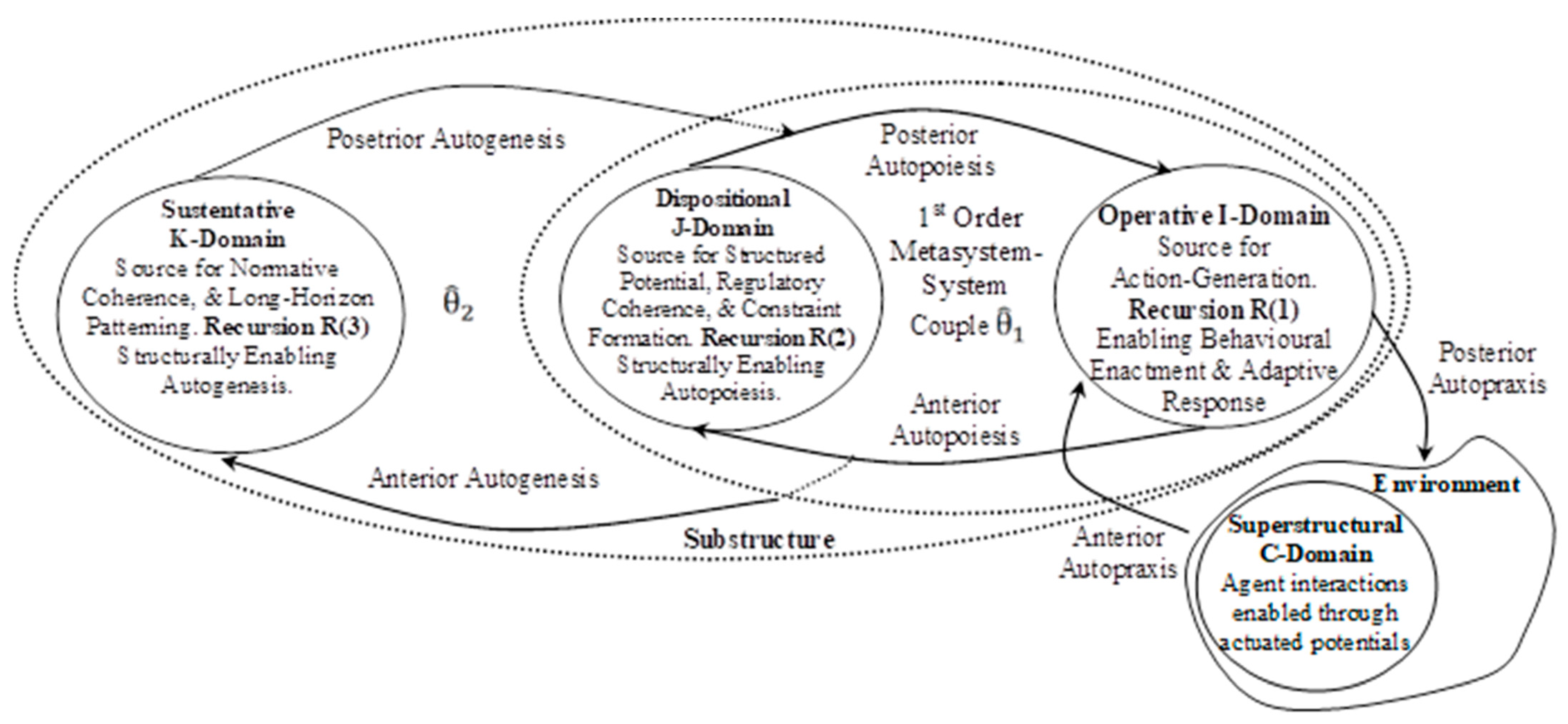
Figure 2.
(a) Bifurcation diagram for the step return, reproducing σc = 0.615. (b) Bifurcation diagram for the steep sigmoid return with KH = 0.95 and n ∈ {4, 8, 16, 30}, B* = 40. The fold is absent for n = 4 and present for n ≥ 8, with σc → 0.615 as n → ∞. Illustrative parameters; see section 6.10.
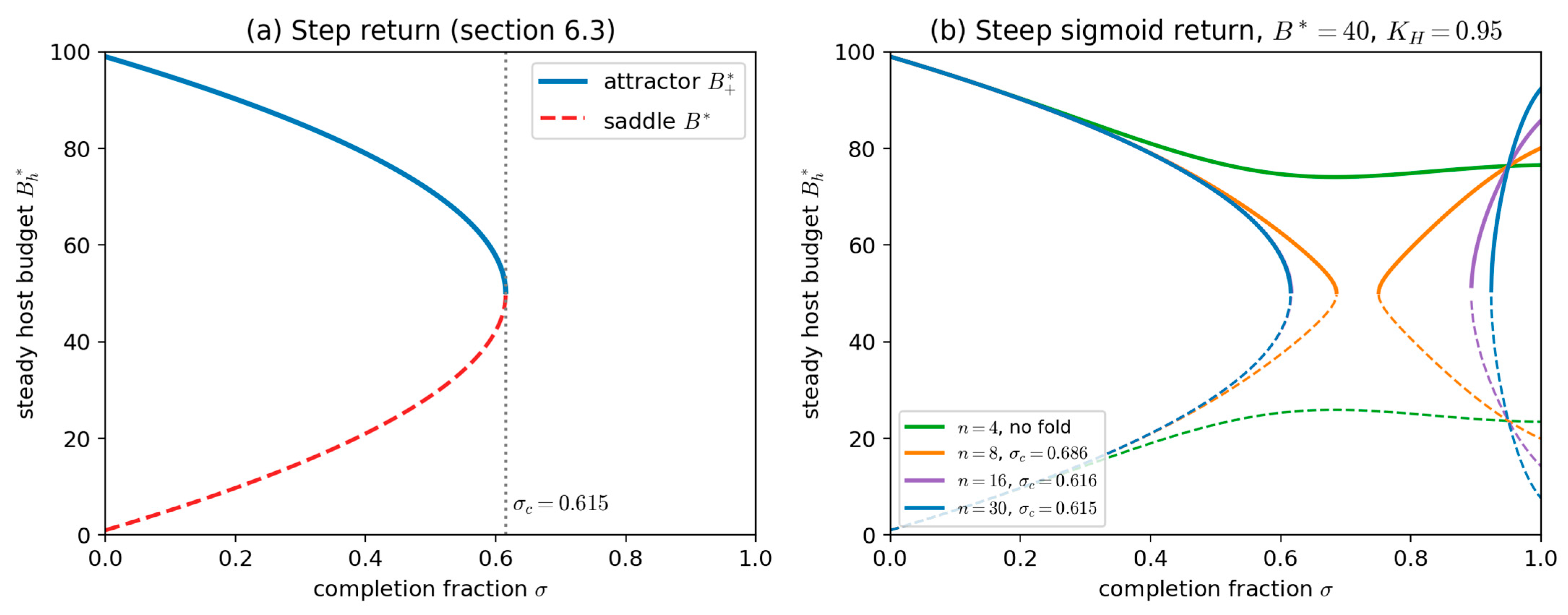

Table 1.
The 2022 third-order agency model mapped onto the FGIR recursion orders, with the process intelligence operating at each order.
Table 1.
The 2022 third-order agency model mapped onto the FGIR recursion orders, with the process intelligence operating at each order.
| 2022 paper | FGIR order | Process intelligence |
| Operative system (capsid enactment) | R(1) | Autopraxis, operative enactment |
| Genome ↔ capsid autopoietic couple | R(2) | Autopoiesis, self-production of organisational identity |
| Dark/regulatory genome as meta-metasystem, homeostatic regulator | R(3) | Autogenesis, self-creation; the causal mechanism that should generate and maintain the couple’s boundary conditions from within |
Table 2.
Analytic predictions of the crossing model, each set beside the result of integrating the host equation with the stated parameters. Illustrative parameters.
Table 2.
Analytic predictions of the crossing model, each set beside the result of integrating the host equation with the stated parameters. Illustrative parameters.
| Prediction | Result |
| Two fixed points below σc, none above, coinciding at Bmax/2 | Confirmed: two below, none above, collision at exactly 50.0 |
| Gradual approach collapses the host before completion | Collapse at σ = 0.670, before σ = 1 |
| Collapse follows the bifurcation rather than preceding it | σc = 0.615 < 0.670 |
| The barrier is not a rate effect: a slower approach does not rescue it | A tenfold slower ramp still collapses, and the lag from σc falls from 0.054 to 0.012, closer tracking of the vanishing attractor, not escape |
| Composition, taking σ from 0 to 1 in one event, never enters the collapse region | Confirmed: the host survives |
Table 3.
The three axes read separately: what each asks, the observable that answers it, and the strongest case known on each.
Table 3.
The three axes read separately: what each asks, the observable that answers it, and the strongest case known on each.
| Axis | What it asks | Observable | Best case known |
|---|---|---|---|
| Resourcing | Is the C-field the system organises its own? | Fraction of the translation set encoded | Tupanvirus: all 20 aminoacyl-tRNA synthetases, 67–70 tRNAs, 11 translation factors, and no ribosomal proteins at all [35]. Across viruses generally, one or two of some fifty ribosomal proteins [38] |
| Correction | Is there an internal falsifier? | A heritable mechanism that detects and rejects a bad outcome |
nsp14-ExoN corrects copying errors within a cycle [24,25]; MIMIVIRE stores repeats of the sequence of a virophage (a virus whose host is another virus) and rejects that virophage, with susceptibility restored when the locus is silenced [73] |
| Sustentative role | Does anything else run on what the system produces? | Can it be parasitised? | Sputnik, a virophage of mimivirus, cannot multiply in Acanthamoeba castellanii alone, and replicates in the mimivirus factory, damaging it [74]. Nothing parasitises a poliovirus |
Disclaimer/Publisher’s Note: The statements, opinions and data contained in all publications are solely those of the individual author(s) and contributor(s) and not of MDPI and/or the editor(s). MDPI and/or the editor(s) disclaim responsibility for any injury to people or property resulting from any ideas, methods, instructions or products referred to in the content. |
© 2026 by the author. Licensee MDPI, Basel, Switzerland. This article is an open access article distributed under the terms and conditions of the Creative Commons Attribution (CC BY) license (http://creativecommons.org/licenses/by/4.0/).
Copyright: This open access article is published under a Creative Commons CC BY 4.0 license, which permit the free download, distribution, and reuse, provided that the author and preprint are cited in any reuse.