

Submitted:
16 September 2026
Posted:
17 September 2026
You are already at the latest version
Abstract
Objective: to evaluate the feasibility, safety, and preliminary effectiveness of an integrated nutritional strategy combining a low-protein diet with structured micronutrient supplementation in patients with advanced CKD. Methods: A retrospective observational study was conducted in routine nephrology practice across two centers between January 2021 and June 2022. Seventeen adults aged 40–85 years with CKD stages III–V were included. Participants followed an individualized low-protein diet emphasizing plant-based foods and received a structured supplementation protocol containing vitamins, minerals, essential amino acids, and omega-3 fatty acids. Primary outcomes were feasibility, adherence, retention, safety, and tolerability. Secondary exploratory outcomes included changes in estimated glomerular filtration rate (eGFR), serum creatinine, and KDIGO stage classification. Results: The retention rate was 94% and the adherence rate was 100%. No serious adverse events or clinically significant electrolyte disturbances were reported. After a mean follow-up of 4.88 months, mean eGFR increased significantly from 43.3 to 59.8 mL/min/1.73 m² (p < 0.001), while serum creatinine decreased significantly from 1.70 to 1.25 mg/dL (p < 0.001). All patients demonstrated directional improvement, and 94.1% improved by at least one KDIGO stage. Conclusions: Integrated nutritional guidelines were feasible, well tolerated, and associated with significant short-term improvements in renal function among patients with advanced CKD. These findings support the need for a randomized controlled trial to confirm efficacy and assess long-term clinical benefits.
Keywords:
chronic kidney disease
; low-protein diet
; micronutrients
; estimated glomerular filtration rate
1. Introduction
Chronic kidney disease (CKD) represents a growing public health challenge and is associated with increased cardiovascular morbidity, premature mortality, and substantial healthcare resource utilization [1]. Disease progression is commonly linked to protein-energy wasting [2], systemic inflammation, and oxidative stress [3], all of which contribute to the gradual deterioration of kidney function [4].
Current clinical guidelines recommend individualized low-protein diets and strict control of blood pressure and proteinuria in selected patients. However, these guidelines rarely address micronutrient deficiencies in a systematic manner despite their high prevalence in CKD [5], resulting from dietary restrictions, pharmacological treatments, and disease-related metabolic disturbances. Available evidence suggests that deficiencies in vitamins, minerals, polyunsaturated fatty acids, and essential amino acids may exacerbate inflammation, sarcopenia, and CKD progression, whereas targeted correction of these deficiencies may be associated with potential renoprotective effects [6,7].
Before formally evaluating the efficacy of an integrated nutritional intervention through a randomized controlled trial, preliminary data regarding feasibility, safety, tolerability, and the magnitude and direction of changes in surrogate markers of renal function are required. In this context, a retrospective observational study was conducted using real-world clinical practice data from patients with advanced CKD who followed a nutritional regimen consisting of an individualized low-protein diet combined with a structured micronutrient supplementation protocol. The primary objective was to evaluate the feasibility, tolerability, and safety of these dietary recommendations. The secondary exploratory objective was to assess short-term changes in estimated glomerular filtration rate (eGFR), serum creatinine, and KDIGO stage classification in order to determine the preliminary efficacy of this strategy and the appropriateness of conducting a definitive randomized controlled trial.
2. Materials and Methods
2.1. Study Design and Population
A retrospective observational study was conducted within the framework of routine outpatient nephrology care at two centers between January 2021 and June 2022. Data were collected from adult male and female patients aged 40–85 years diagnosed with CKD stages III–V and under stable follow-up by the Nephrology Department. Patients with acute kidney injury or active malignancy within the previous 3 months were excluded. All participants underwent routine physical examination and standard nephrology laboratory evaluation as part of their usual clinical follow-up. The study is reported in accordance with the STROBE statement for observational studies [8].
2.2. Nutritional Recommendations
Under the supervision of their treating physician, all patients followed an individualized low-protein diet providing approximately 9–11% of total energy intake as protein, predominantly from plant-based sources. Total fat intake accounted for 30–40% of energy intake, with an emphasis on polyunsaturated and short-chain fatty acids, whereas carbohydrates contributed 50–60% of total energy intake, primarily from complex carbohydrate sources.
Patients also received detailed written dietary instructions, including the exclusion of fish, seafood, meat, and dairy products, preference for gentle cooking techniques (steaming, grilling, or raw preparations), and a minimum overnight fasting period of 12 hours between dinner and breakfast.
Animal protein intake was restricted exclusively to organic eggs (up to 10 whole eggs per week, with additional egg whites allowed according to individual tolerance), while all other animal-derived foods (meat, fish, dairy products, and derivatives) were excluded. This standardization was based on three complementary criteria: 1. provision of high-biological-value protein with a more favorable phosphorus-to-protein ratio compared with meat or processed dairy products [9]; 2. avoidance of the acid load and sodium content associated with processed meats; and 3. maintenance of an adequate supply of essential amino acids within the context of overall protein restriction.
The organic status of eggs was ensured through the prescription of certified organic eggs free of pesticide and antibiotic residues, a consideration particularly relevant in CKD patients in whom exposure to environmental contaminants may further compromise renal function.
In addition to dietary counseling, all patients received a structured micronutrient supplementation protocol consisting of three formulations marketed by LCN Laboratory (Barcelona, Spain) and administered throughout the day. Content and dosage were as follows:
CN Base—Vitamin, Mineral, and Mitochondrial Cofactor Capsules: This formulation provided a complete vitamin complex (vitamins A, C, D3, E, and B-group vitamins in their active forms: methylfolate, methylcobalamin, dibencozide, and pyridoxal-5-phosphate), essential minerals including zinc, copper, manganese, molybdenum, selenium, magnesium, and chromium, together with coenzyme Q10 and R-lipoic acid as mitochondrial antioxidants. Dosage: Three capsules daily, administered as two capsules with breakfast and one capsule with dinner.
Omega Base—Polyunsaturated Fatty Acid Capsules: This formulation combined Ahiflower® seed oil (Buglossoides arvensis L.), rich in alpha-linolenic acid (ALA) and stearidonic acid (SDA), with fish oil standardized for docosahexaenoic acid (DHA), as well as linoleic acid (LA) and gamma-linolenic acid (GLA). The combination of botanical and marine sources was designed to provide a comprehensive omega-3 (ALA, SDA, DHA) and omega-6 (LA, GLA) fatty acid profile. Dosage: Three capsules daily, administered as two capsules with breakfast and one capsule with dinner.
Amino Base—Essential Amino Acid and Nucleotide Sachets: This formulation provided all nine essential amino acids (leucine, lysine, valine, isoleucine, threonine, tryptophan, phenylalanine, methionine, and histidine), together with amino acids considered conditionally essential in CKD (cysteine, tyrosine, and proline). Particular emphasis was placed on leucine (2 g/day) because of its role as an activator of the mTOR signaling pathway involved in skeletal muscle protein synthesis. The formulation also included myo-inositol, choline, and the nucleotides cytidine and uridine, which serve as substrates for RNA synthesis and cellular repair, together with vitamin C and magnesium as metabolic cofactors. Dosage: Two sachets daily, dissolved in water and taken more than 20 minutes before breakfast and dinner to optimize bioavailability.
No relevant changes were made to baseline nephrology treatments during the observation period. All patients demonstrated good adherence to the prescribed dietary and supplementation regimen, and the dietary intervention was well tolerated, with no reports of relevant adverse events. The detailed composition of the micronutrient support, including daily doses of individual components, is provided in Supplementary Table S1.
2.3. Study Outcomes
Following the STROBE recommendations for observational studies, feasibility outcomes and exploratory efficacy outcomes were predefined separately.
Primary Feasibility Outcomes: Retention rate, defined as the proportion of patients who followed the nutritional recommendations for at least 4 months; adherence to the supplementation protocol, assessed through returned capsule and sachet counts and patient self-reporting; safety and tolerability, evaluated through systematic recording of adverse events and clinically relevant electrolyte abnormalities.
Secondary Exploratory Outcomes: Changes in eGFR and serum creatinine between baseline and the end of follow-up; reclassification of CKD stage according to KDIGO criteria; patient-reported tolerability and perceived adherence; changes in biochemical parameters including magnesium, sodium, potassium, and phosphorus obtained from routine laboratory assessments when available.
2.4. Statistical Analysis
Continuous variables were summarized using descriptive statistics. Normality of paired differences was assessed using the Shapiro–Wilk test. When the assumption of normality was met, paired Student’s t-tests were performed; otherwise, Wilcoxon signed-rank tests were used. Normally distributed variables are presented as mean ± standard deviation (SD), whereas non-normally distributed variables are presented as median and interquartile range (IQR). Formal hypothesis testing was not performed for micronutrient biochemical concentrations because these data were not available for all patients, resulting in reduced sample sizes. A stratified sensitivity analysis was conducted to evaluate the effect of individual variation in KDIGO stage and eGFR. The proportion of patients improving by at least one KDIGO stage was accompanied by an exact 95% binomial confidence interval calculated using the Clopper–Pearson method. All statistical analyses were performed using Python 3.11 and SciPy version 1.11. A significant level of α = 0.05 was considered in all analysis.
3. Results
The information of 17 patients was included over an 18-month period. The mean age was 69.5 years (range: 49–92 years), with 53% women and 47% men. The mean duration of the nutritional guidelines was 4.88 months. The predominant etiologies of CKD included hypertensive nephrosclerosis, longstanding hypertension, diabetic nephropathy, and mixed nephropathies associated with advanced age and cardiovascular comorbidity. The demographic and basal clinical measurements are in Table 1.
3.1. Feasibility, Retention, Adherence, and Safety
Sixteen out of the 17 patients followed the recommendations for at least four months, resulting in a retention rate of 94.11% (Figure 1A). Adherence to the supplementation protocol was 100% according to returned capsule and sachet counts, and all patients reported taking the supplements as recommended. No serious adverse events were recorded, and no clinically relevant electrolyte disturbances (hyperkalemia, hyperphosphatemia, or metabolic acidosis) requiring protocol modification occurred. Tolerability was rated as good or very good by all participants.
3.2. Changes in Renal Function Parameters
Changes in eGRF and serum creatinine are reported in Table 2. At baseline, the patients had a mean eGFR of 43.3 ± 14.7 mL/min/1.73 m² and a median serum creatinine level of 1.36 mg/dL. After a mean follow-up of 4.88 months, mean eGFR increased to 59.8 ± 17.9 mL/min/1.73 m², corresponding to a mean absolute increase of 16.47 mL/min/1.73 m² and a relative increase of 42.5%. Median serum creatinine decreased to 0.99 mg/dL, corresponding to a median absolute reduction of 0.29 mg/dL and a mean reduction of 0.46 mg/dL, representing a 24.4% decrease from baseline. Individual trajectories are shown in Figure 1, where every individual point is bellow or above the line.
KDIGO stage reclassification also shifted consistently toward improvement. Sixteen of seventeen patients (94.1%; exact 95% CI: 71.3%–99.9%) improved by at least one KDIGO stage, while the remaining patient remained stable. No patient experienced worsening of eGFR, serum creatinine, or KDIGO stage. Notably, the two patients classified as CKD stage V at baseline (eGFR <15 mL/min/1.73 m²) improved sufficiently to be reclassified as stage IV. Several patients initially classified as stage IIIa or IIIb improved to stage II during follow-up. Subgroup analysis according to baseline KDIGO stage demonstrated consistent improvements across disease stages: stage IIIa (n = 9; mean ΔeGFR +18.7 mL/min/1.73 m²; +37.6%), stage IIIb (n = 6; mean ΔeGFR +15.8 mL/min/1.73 m²; +42.9%), and stage V (n = 2; mean ΔeGFR +8.4 mL/min/1.73 m²; +63.7%). The patient who remained in KDIGO stage IIIa despite adherence to dietary recommendations, nevertheless exhibited a substantial numerical improvement (eGFR from 55 to 59 mL/min/1.73 m²; serum creatinine from 1.35 to 1.28 mg/dL) that did not cross the threshold required for stage reclassification. These changes occurred without renal adverse events and without relevant modifications to baseline nephrology medications.
3.3. Patient Perspective
Most patients considered the dietary and supplementation regimen acceptable and reported subjective improvements in general well-being and energy levels, together with good treatment adherence.
3.4. Sensitivity Analysis
To assess the potential contribution of regression to the mean, a stratified analysis was performed according to baseline eGFR. Patients with a baseline eGFR <40 mL/min/1.73 m² (n = 7) demonstrated a mean increase of 15.7 ± 8.5 mL/min (paired Cohen’s d = 1.36; 95% CI: 0.61–2.11), while patients with a baseline eGFR ≥40 mL/min/1.73 m² (n = 10) demonstrated a mean increase of 17.0 ± 11.2 mL/min (Cohen’s d = 2.28; 95% CI: 1.42–3.14). The overall effect size (Cohen’s d = 1.67; 95% CI: 0.93–2.40) corresponds to a very large effect according to conventional criteria.
3.5. Changes in Biochemical Parameters: Magnesium, Sodium, Potassium, and Phosphorus
Table 3 shows changes in serum magnesium (n = 8), sodium (n = 13), potassium (n = 12), and phosphorus (n = 9) concentrations that were assessed between baseline and the end of follow-up. Serum concentrations of all four minerals remained within standard clinical reference ranges in the vast majority of patients. No episodes of hyperkalemia (>5.5 mEq/L) or hyperphosphatemia (>5.5 mg/dL) were documented during the observation period. Serum magnesium showed an upward trend, increasing from 1.78 ± 0.58 mg/dL to 2.09 ± 0.58 mg/dL. Several patients who initially presented values near the lower limit of the normal range (1.7–2.2 mg/dL).
4. Discussion
In this retrospective study of patients who followed a specified dietary protocol, a consistent improvement in renal function parameters was observed, with a significant increase in eGFR and a significant reduction in serum creatinine (Table 2). In addition, adherence to the recom-mendations showed high clinical feasibility, with a retention and adherence rate of 94% and 100%, respectively. There were no relevant adverse events, and good acceptance by patients. These findings suggest that a structured nutritional strategy could constitute a complementary tool of interest in the comprehensive management of CKD.
CKD usually follows a course of progressive deterioration of renal function despite standard nephrological care. Observational cohorts have reported mean annual eGFR declines of 1.4 to 2.5 mL/min/year, with more than half of the patients classified as progressors during follow-up [10]. Population studies indicate that sustained stabilization or regression of CKD occurs in only 15–25% of patients, mainly in early stages and under strict control of blood pressure and proteinuria [11].
In this context, one of the most striking findings of the study is the magnitude of the improve-ment observed in renal function. eGFR increased by 42.5%, while serum creatinine decreased by 24.4% relative to baseline values. Targeted dietary interventions have previously shown ben-eficial effects on CKD progression, particularly through reduction of acid load, optimization of protein quality, and increased consumption of plant-based foods [12]. However, these findings should be interpreted with caution given the single-arm design and the limited sample size.
Likewise, the evolution of biochemical parameters is consistent with the magnesium intake de-rived from both the prescribed low-protein diet (plant sources and eggs) and the micronutritional support administered (Table 3). Several mechanisms may contribute to the observed changes. An adapted low-protein diet, with adequate caloric intake, can reduce the nitrogen and calcium-phosphate load without inducing protein-energy wasting when appropriately individualized. On the other hand, micronutrient dysregulation is frequent in CKD and has been associated with greater inflammation, oxidative stress, sarcopenia, and worse renal outcomes [13]. Deficiencies of B-group vitamins, vitamins C and D, zinc, and selenium have been described at all stages of CKD and may contribute to inflammatory and fibrotic processes even when circulating concen-trations appear to fall within the reference range, suggesting functional tissue-level deficiencies [14]. To restore this pattern, in the present study the dietary protocol combined several potential-ly renoprotective pathways, which deserve separate consideration. Vitamin D3 (45 µg/day ≈ 1800 IU) and its role on the renin–angiotensin–aldosterone system and mineral metabolism are well characterized in CKD [15]. Also, supplementation with omega-3 fatty acids (particularly the 1170 mg/day of DHA provided by fish oil) and with gamma-linolenic acid (93 mg/day) has been associated with a lower risk of progression to end-stage kidney disease, lower proteinuria, and better preservation of renal function [16,17]. Essential amino acids, and specifically leucine (2 g/day), act as key activators of the mTOR pathway of muscle protein synthesis, which is par-ticularly relevant in CKD, where sarcopenia is prevalent and worsens prognosis [18]. Besides, exogenous nucleotides (cytidine and uridine, 200 mg/day each) may support cellular recovery and RNA synthesis processes following renal injury [19]. Finally, the mitochondrial cofactors coenzyme Q10 (150 mg/day) and R-lipoic acid (150 mg/day), together with the group of B vit-amins in their active forms (methylfolate, methylcobalamin, pyridoxal-5-phosphate) and the minerals zinc, selenium, and magnesium, may contribute to reducing oxidative stress and to op-timizing cellular energy metabolism, both mechanisms implicated in the pathogenesis of CKD. In our cohort, this stepwise and synergistic approach, combined with protein restriction, may have contributed to a better nutritional, inflammatory, and metabolic balance, facilitating the short-term functional improvement observed.
Limitations of the study
Despite these results, the present study has limitations that should be carefully considered when interpreting the findings. First, the retrospective design and the absence of a control group pre-clude formally ruling out contributions of regression to the mean, variable natural history, or selection biases. Added to this is the small sample size, which limits statistical power to detect small effects and, in particular, prevents robust subgroup analyses by CKD etiology or comor-bidities. Third, the availability of mineral data was incomplete, so the biochemical analyses should be interpreted as exploratory. Fourth, follow-up time was variable and relatively short for assessing the durability of the effects over the long term. Finally, given that the dietary pro-tocol was multicomponent (diet + 3 supplementation products), it is not possible to attribute the observed effects to a specific component.
Implications for the design of a randomized controlled trial
The consistency, magnitude, and direction of the changes observed in this study, together with its favorable safety profile, support the conduct of an RCT that formally evaluates the efficacy of such an intervention. The definitive RCT should incorporate a control group receiving standard nutritional care, a minimum follow-up of 12 months, and a stratified analysis by baseline KDI-GO stage to assess the consistency of the effect in the subgroups of greatest clinical interest (stages IIIa/IIIb, in which the progression slope is typically steeper).
Regarding mineral profile (magnesium, sodium, potassium, and phosphorus), the diet was not associated with episodes of hyperkalemia or hyperphosphatemia, which are the most feared electrolyte complications in the dietary management of CKD. The stability of serum potassium within the reference range, as well as of phosphorus, is consistent with the exclusion of highly bioavailable sources of potassium and phosphorus (processed meats, dairy products, products with phosphate additives) and with the selection of organic eggs as the sole source of animal protein. The phosphorus present in eggs has a lower bioavailability (approximately 30% lower) than that of processed meats or dairy, which reduces the effective load of absorbed phosphorus despite a comparable total content9. This characteristic is particularly relevant in the context of low-protein diets, where the selection of protein sources with a favorable phosphorus-to-protein ratio is a recognized therapeutic principle [20]. Additionally, the improvement observed in mag-nesium concentrations (from 1.78 to 2.09 mg/dL on average) is of interest, given that hypomag-nesemia is frequent in patients with advanced CKD and has been associated with a higher risk of disease progression and cardiovascular events. Although the sample size of this sub-analysis is limited and should be interpreted with caution, the absence of clinically relevant electrolyte alterations reinforces the safety profile of the intervention and its potential applicability in routine nephrology practice.
Comparison with the natural history of CKD
The magnitude of the improvement observed in the present study is particularly relevant when contextualized against the expected trajectory of renal function in patients with stage III–V CKD. The literature documents eGFR decline rates of between −1.4 and −2.5 mL/min/year in this population10,11, with even more pronounced trends in patients with significant proteinuria or more advanced stages. In the present study, the annualized rate of eGFR change was +41.0 mL/min/year, which represents a difference of approximately +43 mL/min/year relative to the expected trajectory according to natural history. This absolute difference is clinically highly rele-vant: a change of +5 mL/min/year has been associated in the literature with 20–30% reductions in the risk of progression to ESRD and 15–20% reductions in the risk of major cardiovascular events. However, it is important to note that the retrospective design without a control group precludes establishing definitive causality, and part of the improvement could be explained by regression to the mean, better adherence to standard nephrological treatment, or spontaneous lifestyle modifications. The consistency of the effect across all subgroups analyzed (baseline eGFR <40 and ≥40 mL/min) and the magnitude of the effect size (d = 1.67) nevertheless sup-port the plausibility of a clinically significant effect of a structured diet.
5. Conclusions
This retrospective observational study suggests that an integrated nutritional intervention (indi-vidualized low-protein diet plus structured micronutrient supplementation) is feasible and safe in patients with advanced CKD, and is associated with a consistent and statistically significant sig-nal of improvement in short-term renal function parameters, with 94.1% of patients showing an improvement of at least one KDIGO stage. These results justify the launch of a randomized controlled trial that formally evaluates the efficacy of this strategy, preferably with a standard nutritional care comparator and a minimum follow-up of 12 months.
Supplementary Materials
The following supporting information can be downloaded at the website of this paper posted on Preprints.org: Table S1: detailed composition of the micronu-tritional support (daily doses per component).
Author Contributions
Conceptualization, F.C.B., N.C.M.; methodology, E.I.V., S.A.L.; patient recruitment and clini-cal management, F.C.B., E.I.V.; design of the nutritional protocol, F.C.B.; statistical analysis, J.E.R.O., B.P.; writing—original draft, N.C.M., J.E.R.O.; writing—review and editing, J.E.R.O., B.P. All authors have read and approved the published version of the manuscript.
Funding
This study was supported by Laboratorio Complementos Nutricionales (LCN), manufacturer of the supplementation products administered. LCN had no role in the study design, data analysis, interpretation of results, or the decision to submit the manuscript for publication. It is anticipated that the definitive RCT will receive funding independent of LCN.
Institutional Review Board Statement
This retrospective observational study was based on anonymized clinical data obtained within the context of routine outpatient nephrology practice. In accordance with applicable Spanish regulations (Law 14/2007, of 3 July, on Biomedical Research, and Organic Law 3/2018, of 5 December, on the Protection of Personal Data and the guarantee of digital rights). The study was conducted in accordance with the principles of the Declaration of Helsinki and with the good clinical practice standards applicable to this type of research. For the inclusion of data in this analysis, obtaining new informed consent was not required, as the study was based on anonymized secondary data extracted from medical records, in accord-ance with the provisions of Article 58.2 of Organic Law 3/2018 (LOPDGDD) and Regulation (EU) 2016/679 (GDPR). All patients had previously provided consent for the healthcare use of their clinical data at the corresponding healthcare center.
Informed Consent Statement
Not applicable.
Data Availability Statement
The data underlying this article originate from medical records obtained in routine nephrology practice. For reasons of confidentiality and applicable data protection regulations, these datasets are not publicly available. Anonymized data may be shared by the corresponding author upon reasonable request and subject to approval by the participating centers.
Acknowledgments
During the preparation of this work the authors used Copilot 365 in order to translate from Spanish to English; and MiniMax Code in order to conduct statistical analysis. After using these tools, the authors reviewed and edited the content as needed and take full responsibility for the content of the published article.
Conflicts of Interest
This study was funded by Laboratorio Complementos Nutricionales (LCN), manufacturer of the nutritional supplements administered. F.C. is Scientific Director of LCN and participated in the conceptualization of the study and in the design of the nutritional intervention, consistent with his institutional role. To reinforce the independence of the analysis, the following measures were implemented: the statistical analysis was performed by an external biostatistics consultant with no contractual relationship with LCN; the clinical interpretation of the results and the writing of the manuscript were performed independently by the clinical authors (E.I., S.A. and N.C.), without LCN’s participation in analytical decisions; LCN did not participate in the submission decision or in the choice of journal.
Abbreviations
The following abbreviations are used in this manuscript:
| Abbreviation | Definition |
| ALA | Alpha-Linolenic Acid |
| CI | Confidence Interval |
| CKD | Chronic Kidney Disease |
| CKD-MBD | Chronic Kidney Disease-Mineral and Bone Disorder |
| DHA | Docosahexaenoic Acid |
| eGFR | Estimated Glomerular Filtration Rate |
| ESRD | End-Stage Renal Disease |
| GLA | Gamma-Linolenic Acid |
| KDIGO | Kidney Disease: Improving Global Outcomes |
| KDOQI | Kidney Disease Outcomes Quality Initiative |
| IQR | Interquartile Range |
| LA | Linoleic Acid |
| mTOR | Mechanistic Target of Rapamycin |
| PEW | Protein-Energy Wasting |
| RCT | Randomized Controlled Trial |
| RNA | Ribonucleic Acid |
| SDA | Stearidonic Acid |
| SD | Standard Deviation |
| STROBE | Strengthening the Reporting of Observational Studies in Epidemiology |
References
- Gorostidi, M.; Sánchez-Martínez, M.; Ruilope, L.M. Prevalencia de enfermedad renal crónica en España: impacto de la acumulación de factores de riesgo cardiovascular. Nefrologia 2018, 38, 606–615. [Google Scholar] [CrossRef] [PubMed]
- Fouque, D.; Kalantar-Zadeh, K.; Kopple, J.; Cano, N.; Chauveau, P.; Cuppari, L.; Franch, H.; Guarnieri, G.; Ikizler, T.A.; Kaysen, G.; et al. A Proposed Nomenclature and Diagnostic Criteria for Protein-Energy Wasting in Acute and Chronic Kidney Disease. Kidney Int. 2008, 73, 391–398. [Google Scholar] [CrossRef] [PubMed]
- Carrero, J.J.; Thomas, F.; Nagy, K.; Arogundade, F.; Avesani, C.M.; Chan, M.; et al. Global Prevalence of Protein-Energy Wasting in Kidney Disease: A Meta-Analysis of Contemporary Observational Studies. J. Ren. Nutr. 2018, 28, 380–392. [Google Scholar] [CrossRef] [PubMed]
- Ikizler, T.A.; Burrowes, J.D.; Byham-Gray, L.D.; Campbell, K.L.; Carrero, J.J.; Chan, W.; Fouque, D.; Friedman, A.N.; Ghaddar, S.; Goldstein-Fuchs, D.J.; et al. KDOQI Clinical Practice Guideline for Nutrition in CKD: 2020 Update. Am. J. Kidney Dis. 2020, 76 (Suppl. 1), S1–S107. [Google Scholar] [CrossRef] [PubMed]
- MacLaughlin, H.L.; Friedman, A.N.; Ikizler, T.A. Nutrition in Kidney Disease: Core Curriculum 2022. Am. J. Kidney Dis. 2022, 79, 437–449. [Google Scholar] [CrossRef] [PubMed]
- Kim, S.M.; Jung, J.Y. Nutritional Management in Patients with Chronic Kidney Disease. Korean J. Intern. Med. 2020, 35, 1279–1290. [Google Scholar] [CrossRef] [PubMed]
- Xie, Y.; Liu, F.; Zhang, X.; Jin, Y.; Li, Q.; Shen, H.; Fu, H.; Mao, J. Benefits and Risks of Essential Trace Elements in Chronic Kidney Disease: A Narrative Review. Ann. Transl. Med. 2022, 10, 1400. [Google Scholar] [CrossRef] [PubMed]
- von Elm, E.; Altman, D.G.; Egger, M.; Pocock, S.J.; Gøtzsche, P.C.; Vandenbroucke, J.P.; STROBE Initiative. The Strengthening the Reporting of Observational Studies in Epidemiology (STROBE) Statement: Guidelines for Reporting Observational Studies. Ann. Intern. Med. 2007, 147, 573–577. [Google Scholar] [CrossRef] [PubMed]
- Tallman, D.A.; Sahathevan, S.; Karupaiah, T.; Khosla, P. Egg Intake in Chronic Kidney Disease. Nutrients 2018, 10, 1945. [Google Scholar] [CrossRef] [PubMed]
- Yuste, C.; Barraca, D.; Aragoncillo-Sauco, I.; Vega-Martínez, A.; Abad, S.; Verdalles-Guzmán, Ú.; Ruiz-Caro, C.; Ampuero, J.; López-Gómez, J.M. Factors Related with the Progression of Chronic Kidney Disease. Nefrologia 2013, 33, 685–691. [Google Scholar] [CrossRef] [PubMed]
- Borrelli, S.; Leonardis, D.; Minutolo, R.; De Nicola, L.; Conte, G.; Chiodini, P.; Zoccali, C.; Ravani, P. Epidemiology of CKD Regression in Patients under Nephrology Care. PLoS ONE 2015, 10, e0140138. [Google Scholar] [CrossRef] [PubMed]
- Carrero, J.J.; González-Ortiz, A.; Avesani, C.M.; Bakker, S.J.L.; Bellizzi, V.; Chauveau, P.; Clase, C.M.; Cupisti, A.; Espinosa-Cuevas, A.; Molina, P.; Moreau, K.; Piccoli, G.B.; Post, A.; Sezer, S.; Fouque, D. Plant-Based Diets to Manage the Risks and Complications of Chronic Kidney Disease. Nat. Rev. Nephrol. 2020, 16, 525–542. [Google Scholar] [CrossRef] [PubMed]
- Chen, C.Y.; Hung, C.C.; Hsu, C.Y.; Lin, Y.C.; Wang, H.H.; Kuo, M.C.; Chang, J.M.; Hwang, S.J.; Chen, H.C. Micronutrients and Renal Outcomes: A Prospective Cohort Study. Nutrients 2022, 14, 3063. [Google Scholar] [CrossRef] [PubMed]
- Jankowska, M.; Rutkowski, B.; Dębska-Ślizień, A. Vitamins and Microelement Bioavailability in Different Stages of Chronic Kidney Disease. Nutrients 2017, 9, 282. [Google Scholar] [CrossRef] [PubMed]
- Kidney Disease: Improving Global Outcomes (KDIGO) CKD-MBD Update Work Group. KDIGO 2017 Clinical Practice Guideline Update for the Diagnosis, Evaluation, Prevention, and Treatment of Chronic Kidney Disease-Mineral and Bone Disorder (CKD-MBD). Kidney Int. Suppl. 2017, 7, 1–59. [CrossRef] [PubMed]
- Hu, J.; Liu, Z.; Zhang, H. Omega-3 Fatty Acid Supplementation as an Adjunctive Therapy in the Treatment of Chronic Kidney Disease: A Meta-Analysis. Clinics (Sao Paulo) 2017, 72, 58–64. [Google Scholar] [CrossRef] [PubMed]
- Kim, D.H.; Yoo, T.H.; Lee, S.H.; Kang, H.Y.; Nam, B.Y.; Kwak, S.J.; Kim, J.K.; Park, J.T.; Han, S.H.; Kang, S.W. Gamma Linolenic Acid Exerts Anti-Inflammatory and Anti-Fibrotic Effects in Diabetic Nephropathy. Yonsei Med. J. 2012, 53, 1165–1175. [Google Scholar] [CrossRef] [PubMed]
- Massini, G.; D’Alessandro, C.; Giannese, D.; Cupisti, A. Nutritional Strategies to Prevent Muscle Loss and Sarcopenia in Chronic Kidney Disease. Nutrients 2023, 15, 3107. [Google Scholar] [CrossRef] [PubMed]
- Doke, T.; Mukherjee, S.; Mukhi, D.; Dhillon, P.; Abedini, A.; Davis, J.G.; Chellappa, K.; Chen, B.; Baur, J.A.; Susztak, K. NAD+ Precursor Supplementation Prevents mtRNA/RIG-I-Dependent Inflammation during Kidney Injury. Nat. Metab. 2023, 5, 414–430. [Google Scholar] [CrossRef] [PubMed]
- D’Alessandro, C.; Piccoli, G.B.; Cupisti, A. The “Phosphorus Pyramid”: A Visual Tool for Dietary Phosphate Management in Dialysis and CKD Patients. BMC Nephrol. 2015, 16, 9. [Google Scholar] [CrossRef] [PubMed]
Figure 1.
Changes in eGRF after nutritional recommendations. A) Individual trajectories from basal to final measurements, follow-up period was variable (median: 4 months, range: 1-19 months). B) Paired comparison basal vs. final measurements. Dotted line represents the absence of change. KDIGO stage is represented by color (Cohen’s d = 1.67).
Figure 1.
Changes in eGRF after nutritional recommendations. A) Individual trajectories from basal to final measurements, follow-up period was variable (median: 4 months, range: 1-19 months). B) Paired comparison basal vs. final measurements. Dotted line represents the absence of change. KDIGO stage is represented by color (Cohen’s d = 1.67).
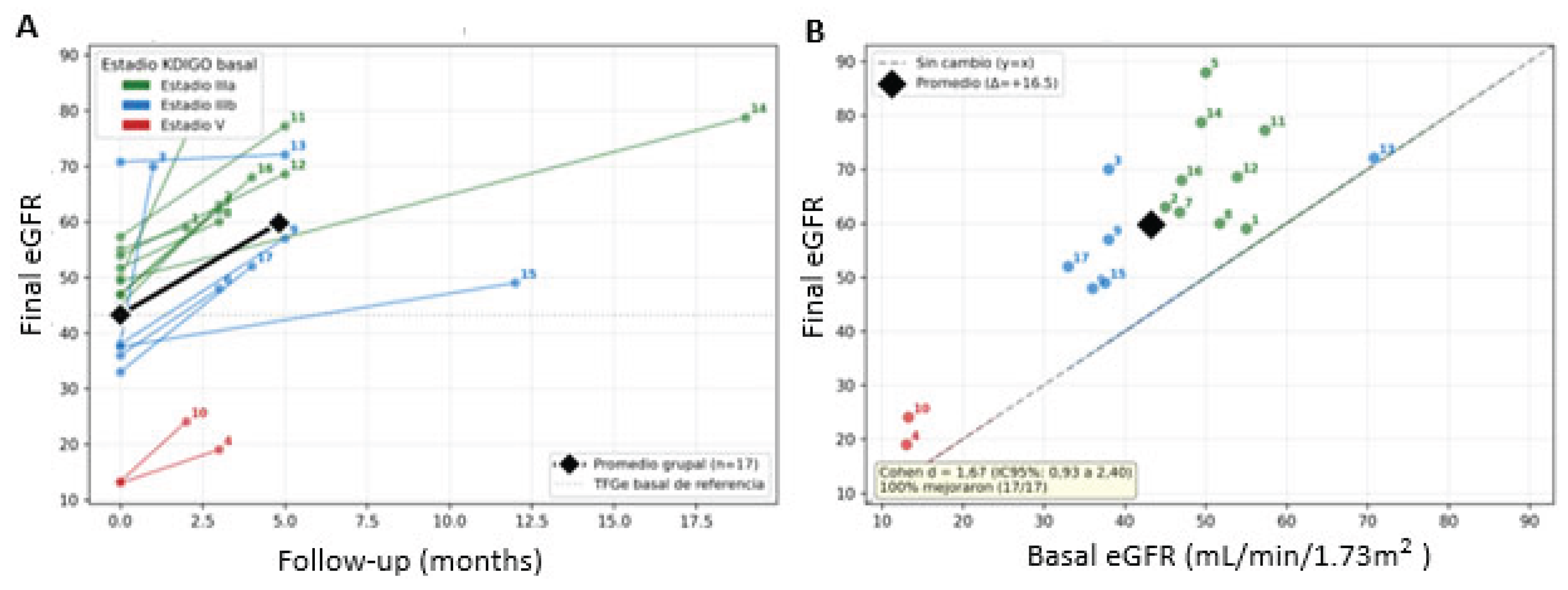

Table 1.
Demographic and basal clinical characteristics of CKD patients.
| Variable | Value |
|---|---|
| Age, years—mean (range) | 69,5 (49–92) |
| Sex, n (%) | |
| Women | 9 (53) |
| Men | 8 (47) |
| eGFR, mL/min/1,73 m² | |
| Mean ± SD | 43,3 ± 14,7 |
| Median [IQR] | 46,8 [37,6–51,7] |
| Serum creatinine, mg/dL | |
| Mean ± SD | 1,7 ± 0,9 |
| Median [IQR] | 1,36 [1,22–1,72] |
| KDIGO stage, n (%) | |
| IIIa | 9 (53) |
| IIIb | 6 (35) |
| V | 2 (12) |
SD: standard deviation; IQR: intercuartile range.
Table 2.
Changes in renal function parameters after the dietary guidelines.
| Variable | Pre | Post | Test | Δ mean | p-value | ||
|---|---|---|---|---|---|---|---|
| M | SD | M | SD | ||||
| eGFR | 43.28 | 14.687 | 59.75 | 17.929 | t | +16.47 | < 0.001 |
| Serum creatinine | 1.70 | 0.938 | 1.25 | 0.586 | w | −0.46 | < 0.001 |
M: mean; SD: estándar deviation; eGFR; estimated glomerular filtration rate (mL/min/1,73 m²); Serum creatinine: mg/dL; t: paired samples student t test; w: Wilcoxon test; Δ: delta.
Table 3.
Changes in mineral serum concentration.
| Mineral | n | Basal (M ± SD) | Final (M ± SD) | Δ mean |
|---|---|---|---|---|
| Magnesio (mg/dL) | 8 | 1,78 ± 0,58 | 2,09 ± 0,58 | +0,31 |
| Sodio (mEq/L) | 13 | 141,98 ± 3,10 | 141,15 ± 3,46 | −0,83 |
| Potasio (mEq/L) | 12 | 4,49 ± 0,43 | 4,38 ± 0,31 | −0,11 |
| Fósforo (mg/dL) | 9 | 3,60 ± 0,43 | 3,60 ± 0,56 | −0,01 |
SD: standard deviation; mEq/L: miliequivalentes per liter; mg/dL: miligrams per deciliter.
Disclaimer/Publisher’s Note: The statements, opinions and data contained in all publications are solely those of the individual author(s) and contributor(s) and not of MDPI and/or the editor(s). MDPI and/or the editor(s) disclaim responsibility for any injury to people or property resulting from any ideas, methods, instructions or products referred to in the content. |
© 2026 by the authors. Licensee MDPI, Basel, Switzerland. This article is an open access article distributed under the terms and conditions of the Creative Commons Attribution (CC BY) license.
Copyright: This open access article is published under a Creative Commons CC BY 4.0 license, which permit the free download, distribution, and reuse, provided that the author and preprint are cited in any reuse.