

Submitted:
12 September 2026
Posted:
17 September 2026
You are already at the latest version
Abstract
Background: Off-pump coronary artery bypass grafting (OPCAB) avoids cardiopulmonary bypass (CPB) and may reduce selected perioperative complications, but its technical and hemodynamic demands remain important limitations. Methods: We narratively reviewed literature indexed in PubMed/MEDLINE and Scopus, supplemented by Google Scholar and reference-list screening, covering January 2000 to September 2025. Priority was given to systematic reviews, meta-analyses, randomized trials, prospective studies, guidelines, and relevant landmark reports. Results: OPCAB may be particularly useful in selected patients at increased risk from CPB or aortic manipulation. Cardiac displacement and coronary stabilization can cause rapid changes in preload, ventricular function, myocardial perfusion, and cardiac output, making invasive monitoring, transesophageal echocardiography, and coordinated hemodynamic management central to anesthetic care. Current evidence does not establish superiority of volatile anesthesia or total intravenous anesthesia. Comparative studies suggest potential reductions in perioperative stroke, transfusion, renal complications, and hospital stay, but concerns remain regarding completeness of revascularization, graft durability, repeat revascularization, and long-term survival. Conclusions: OPCAB should be considered an individualized strategy rather than a universal alternative to on-pump CABG. Optimal outcomes depend on patient selection, surgical expertise, vigilant monitoring, and timely correction of hemodynamic compromise.
Keywords:
coronary artery bypass
; off-pump coronary artery bypass
; hemodynamic monitoring
; transesophageal echocardiography
; mixed venous oxygen saturation
; thoracic epidural analgesia
1. Introduction
Off-pump coronary artery bypass grafting (OPCAB) is a surgical myocardial revascularization strategy in which coronary anastomoses are performed on the beating heart without cardiopulmonary bypass (CPB). The technique was developed to avoid several physiological effects of extracorporeal circulation, including systemic inflammatory activation, coagulation disturbances, neurological complications, and end-organ dysfunction [1]. Contemporary evidence suggests that OPCAB can achieve outcomes broadly comparable with on-pump coronary artery bypass grafting (ONCAB), particularly for perioperative mortality and major adverse cardiovascular events, while avoidance of CPB may reduce selected complications such as perioperative stroke and transfusion requirements [2,3]. Nevertheless, OPCAB remains technically demanding, and concerns regarding incomplete revascularization, graft patency, repeat revascularization, and long-term outcomes continue to influence the choice between off-pump and on-pump surgery [4].
OPCAB is most often considered when avoidance of CPB or manipulation of the ascending aorta is expected to be beneficial. Potential candidates include selected patients with advanced aortic atherosclerosis, previous cerebrovascular disease, chronic kidney disease, chronic obstructive pulmonary disease, impaired left ventricular function, left main coronary artery disease, acute myocardial infarction, or previous cardiac surgery [5]. The technique has also been incorporated into selected hybrid and combined procedures [6,7]. Conversely, cardiogenic shock, severe ischemia-related arrhythmias, marked hemodynamic instability, severe ventricular dysfunction, or coronary anatomy that makes safe exposure and complete revascularization difficult may limit the feasibility of OPCAB [8].
Successful OPCAB therefore depends on careful patient selection, detailed preoperative assessment, surgical expertise, and close coordination between the surgical and anesthesia teams. The anesthesiologist must anticipate rapid physiological changes caused by cardiac displacement, mechanical stabilization, and temporary coronary occlusion, particularly when the lateral or posterior coronary territories are exposed [9]. This narrative review summarizes the anesthetic, hemodynamic, and perioperative considerations that are most relevant to contemporary OPCAB practice and places these considerations in the context of current evidence comparing OPCAB with ONCAB.
2. Literature Search and Review Approach
This narrative review was undertaken to summarize and critically discuss evidence on the anesthetic and perioperative management of adults undergoing OPCAB. A literature search was performed in PubMed/MEDLINE and Scopus, supplemented by Google Scholar and screening of reference lists from relevant systematic reviews, meta-analyses, guidelines, and landmark publications.
The search covered publications from January 2000 through September 2025. Medical Subject Headings (MeSH) and free-text terms were combined using Boolean operators. The principal concepts included “off-pump coronary artery bypass”, OPCAB, “beating-heart coronary surgery”, “off-pump CABG”, anesthesia/anaesthesia, perioperative management, hemodynamic monitoring, goal-directed therapy, transesophageal echocardiography, enhanced recovery, fast-track anesthesia, vasopressors, inotropes, hemodynamic optimization, and outcomes.
Priority was given to systematic reviews, meta-analyses, randomized controlled trials, prospective observational studies, international guidelines, and landmark publications providing important physiological or historical context. The review focused primarily on adult patients undergoing OPCAB. Conference abstracts, duplicate publications, non-English articles, and studies without sufficient methodological information were excluded.
Because this was a narrative review, no formal systematic-review protocol, quantitative meta-analysis, risk-of-bias assessment, or certainty-of-evidence grading was undertaken. The literature was instead considered according to study design, methodological quality, consistency of findings, and clinical relevance. Where evidence was conflicting, studies supporting and questioning OPCAB were considered to provide a balanced interpretation.
3. Anesthetic and Perioperative Considerations
The anesthetic management of OPCAB differs from conventional ONCAB because the heart remains beating throughout the operation and must be displaced and stabilized to expose the coronary targets. Cardiac manipulation and temporary coronary occlusion can produce rapid changes in preload, ventricular filling, myocardial perfusion, cardiac output, and rhythm. The principal anesthetic objective is therefore to preserve myocardial oxygen supply and systemic tissue perfusion while limiting increases in myocardial oxygen demand during periods of mechanical instability.
Successful management requires close communication between the anesthesiologist and surgeon, particularly during cardiac positioning and distal coronary anastomosis. Appropriate monitoring, anticipation of hemodynamic changes, and prompt treatment of hypotension, ischemia, ventricular dysfunction, and arrhythmias are central to completing OPCAB safely and avoiding unplanned conversion to CPB.
3.1. Preoperative Evaluation
Preoperative assessment should be individualized according to the severity of coronary artery disease, ventricular function, functional capacity, comorbidities, coronary anatomy, and the anticipated technical demands of OPCAB. The medical history and examination should identify conditions that may influence perioperative risk, including hypertension, diabetes, dyslipidemia, previous cerebrovascular disease, chronic kidney dysfunction, pulmonary disease, and previous cardiac surgery.
Formal cardiac-surgical risk estimation can be supported by EuroSCORE and EuroSCORE II, while functional status, ventricular function, coronary anatomy, comorbidities, and procedural complexity should be considered alongside any numerical risk estimate [10,17,18]. Risk assessment tools developed primarily for noncardiac surgery, such as the Revised Cardiac Risk Index, ACS NSQIP Surgical Risk Calculator, and NSQIP-MICA, may provide general perioperative context but should not replace cardiac-surgical risk models when evaluating CABG candidates [11,12,13]. Functional capacity can be assessed with validated measures such as the Duke Activity Status Index [14,15]. In patients undergoing elevated-risk surgery, BNP or NT-proBNP and cardiac troponin may provide additional information in appropriate clinical settings [16].
Risk assessment should therefore not rely on a single score. Formal models should be interpreted together with functional status, left ventricular function, coronary anatomy, comorbidities, aortic pathology, and the anticipated technical complexity of the procedure. This integrated assessment is particularly important when deciding whether OPCAB is appropriate for an individual patient.
3.2. Monitoring and Anesthesia Techniques
Monitoring during OPCAB is particularly important because cardiac displacement, mechanical stabilization, and temporary coronary occlusion can produce rapid changes in ventricular filling, cardiac output, and myocardial perfusion. Standard monitoring includes continuous electrocardiography with ST-segment analysis, invasive arterial blood pressure, pulse oximetry, temperature, urine output, coagulation parameters, neuromuscular monitoring, and appropriate assessment of anesthetic depth. In patients requiring more detailed hemodynamic assessment, pulmonary artery catheterization can provide continuous information on cardiac output, pulmonary artery pressures, central venous pressure (CVP), and mixed venous oxygen saturation (SvO2) [19,20].
Hemodynamic targets should be interpreted in the context of baseline physiology and the stage of the operation. Previous work in OPCAB has suggested maintaining a mean arterial pressure (MAP) above 70 mmHg and an SvO2 above 60% as practical targets during surgery [20]. These values should not be treated as isolated therapeutic thresholds but as components of a broader assessment of cardiac output, myocardial perfusion, and systemic oxygen delivery.
Transesophageal echocardiography (TEE) provides complementary information during cardiac manipulation. It can assess ventricular function, regional wall motion, preload, valvular function, ventricular interdependence, right ventricular compression, left ventricular outflow tract obstruction, and other causes of hemodynamic deterioration. TEE may be particularly useful when electrocardiographic interpretation is difficult during cardiac displacement [21]. Dynamic indices such as stroke volume variation (SVV) and pulse pressure variation (PPV) may assist assessment of fluid responsiveness, although their interpretation can be altered by changes in ventilation and cardiac position. SvO2 provides an additional estimate of the balance between oxygen delivery and consumption, while a rise in CVP relative to pulmonary artery diastolic pressure may suggest mechanical cardiac compression or impaired ventricular filling and should prompt reassessment of cardiac positioning.
General anesthesia remains the standard technique for OPCAB and may be maintained with either volatile anesthetics or total intravenous anesthesia (TIVA). Volatile anesthetics have been associated with potential myocardial protective effects, whereas propofol-based TIVA provides predictable hypnosis and can be incorporated into fast-track pathways. Short-acting opioids and intermediate-duration neuromuscular blocking agents are commonly used to facilitate early emergence and extubation [22].
Enhanced Recovery After Cardiac Surgery (ERACS) principles increasingly inform perioperative management. These pathways emphasize multimodal, opioid-sparing analgesia, appropriate fluid management, early extubation, early mobilization, and reduction of intensive care and hospital length of stay [22]. Their implementation should be individualized according to patient condition and surgical complexity.
The available comparative evidence does not establish superiority of volatile anesthesia or TIVA. A systematic review of randomized studies in on-pump and off-pump CABG reported better hemodynamic performance and less need for inotropic support with volatile anesthetics, but the certainty of these findings was limited by heterogeneity and methodological limitations [23]. An updated meta-analysis of 89 randomized trials involving more than 14,000 patients found no significant differences between volatile anesthesia and TIVA in operative or one-year mortality, myocardial infarction, stroke, heart failure, arrhythmias, acute kidney injury, or other major postoperative complications [24]. In a randomized study specifically involving OPCAB, propofol-based TIVA and balanced volatile anesthesia produced similar postoperative recovery, opioid consumption, extubation time, and hospital length of stay [25]. Thus, the choice of technique should be based on patient characteristics, anticipated hemodynamic changes, institutional practice, and team experience rather than presumed superiority of one anesthetic approach.
Hemodynamic management should anticipate the effects of cardiac positioning. Preload may be supported with intravenous fluids or temporary Trendelenburg positioning, while coronary perfusion pressure can be maintained with vasopressors such as norepinephrine or vasopressin. Selected patients may require inotropic support, including milrinone, to improve ventricular performance [26,27]. Heart rate should be controlled to limit myocardial oxygen consumption, and adjustments in positive end-expiratory pressure and tidal volume may help reduce right ventricular compression during cardiac displacement [28]. Goal-directed hemodynamic management and individualized vasoactive therapy may further support adequate tissue perfusion [28,29].
Neuraxial techniques have been used as adjuncts to general anesthesia, particularly high thoracic epidural analgesia and intrathecal morphine. These approaches may provide effective analgesia and facilitate pulmonary function, early extubation, and mobilization [30]. Awake OPCAB under thoracic epidural anesthesia with spontaneous ventilation has also been described, although this remains technically demanding and is not applicable to most patients [30]. Overall, anesthetic management should be individualized, with continuous reassessment of hemodynamics and close communication between the anesthesia and surgical teams.
3.3. Intraoperative Hemodynamic Changes
Hemodynamic instability during OPCAB is primarily related to the mechanical manipulation required to expose coronary arteries while the heart continues to beat. Elevation and rotation of the heart for lateral and posterior targets can increase right- and left-sided filling pressures, reduce ventricular end-diastolic volumes and cardiac output, and decrease mixed venous oxygen saturation [19,31]. The magnitude of these changes depends on the coronary territory being grafted and is generally greatest during circumflex artery revascularization, when cardiac displacement is most pronounced [32,33].
Mechanical stabilization can further impair ventricular filling and regional contractility. Local pressure applied to the myocardium may reduce global stroke volume, while displacement may compress the right ventricle or right ventricular outflow tract and reduce venous return to the left ventricle [34,35]. Changes in cardiac geometry may also transiently alter mitral and tricuspid valve function and forward flow. TEE can demonstrate these changes during cardiac positioning and confirm their resolution after the heart is returned to its normal position [36].
Temporary interruption of coronary blood flow during distal anastomosis is another potential cause of myocardial ischemia and hemodynamic deterioration. Coronary occlusion may produce ST-segment changes, new regional wall-motion abnormalities, impaired ventricular function, and arrhythmias. The clinical response depends on the severity and location of the coronary lesion, collateral circulation, and the myocardial territory at risk. Manipulation or occlusion of the right coronary artery is particularly important because impaired conduction-system perfusion may cause bradyarrhythmias or complete heart block [37,38].
Management requires continuous assessment of both the mechanism and severity of hemodynamic deterioration. Initial measures generally include optimization of preload, maintenance of coronary perfusion pressure, and correction of heart rate or rhythm abnormalities. Intravenous fluids and positioning maneuvers may improve ventricular filling, while vasopressors can maintain systemic arterial pressure. Selected patients may require inotropic support, and atrial pacing may be useful when bradycardia contributes to reduced cardiac output.
A reduction in cardiac output does not necessarily imply inadequate tissue perfusion if systemic oxygen delivery remains sufficient. Lactate, SvO2, arterial pressure, urine output, and echocardiographic findings should therefore be interpreted together rather than in isolation. Maintaining a MAP above 70 mmHg and an SvO2 above 60% has been proposed as a practical approach during OPCAB [28]. Persistent hypotension, severe myocardial ischemia, refractory arrhythmias, or significant ventricular dysfunction despite appropriate treatment should prompt consideration of conversion to CPB.
As illustrated in Figure 1, reduced cardiac output during off-pump CABG results from the interaction of altered cardiac geometry, impaired ventricular filling, increased afterload, myocardial ischemia, and rhythm disturbances. Early recognition using arterial pressure, cardiac output assessment, TEE, and markers of systemic perfusion enable mechanism-directed intervention and continuous reassessment, with escalation to mechanical circulatory support or conversion to cardiopulmonary bypass when hemodynamic instability persists.
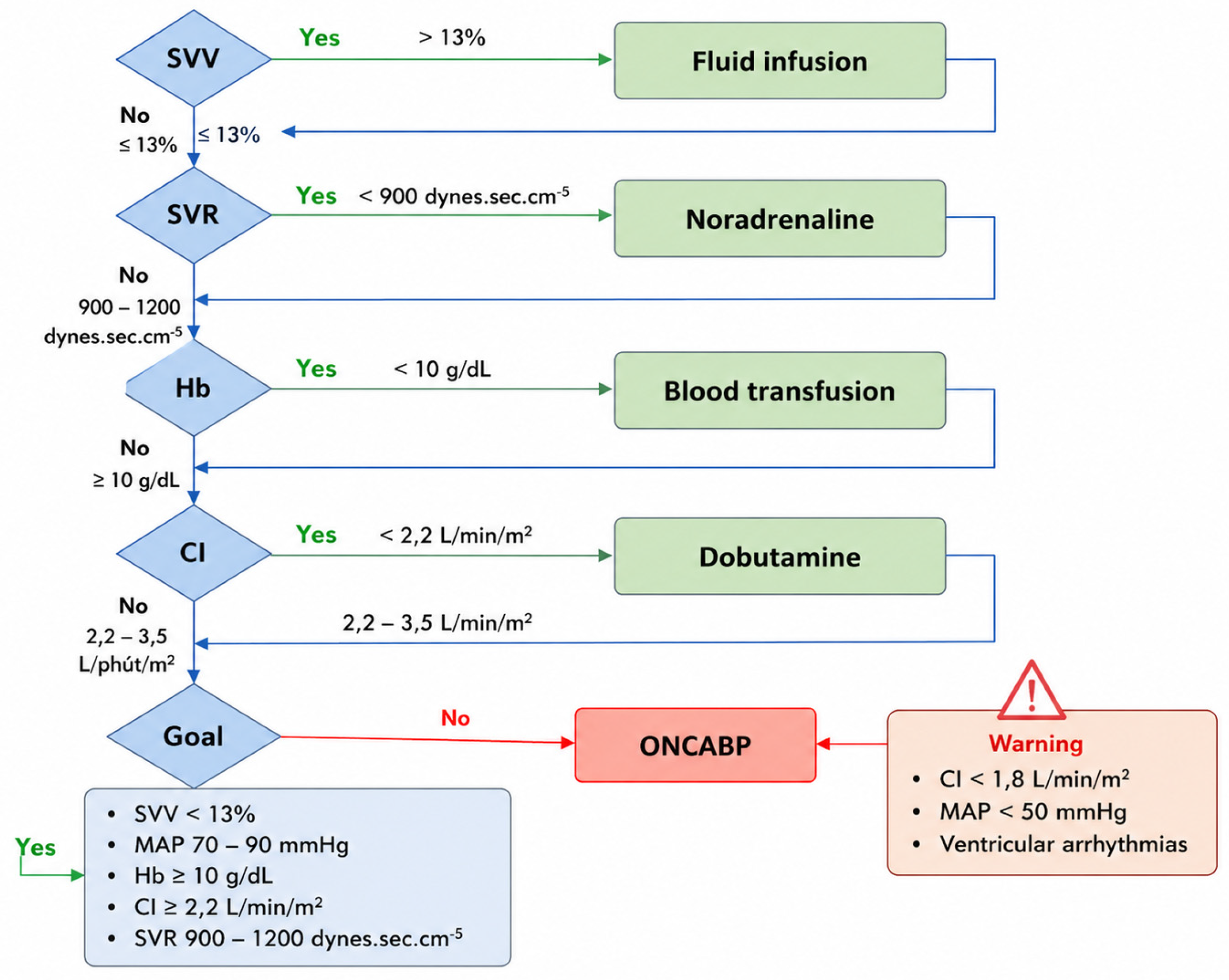
Protocolized hemodynamic management may improve intraoperative stability. Khanh et al. reported that an early goal-directed therapy protocol was associated with lower lactate concentrations, reduced vasoactive and inotropic requirements, and shorter mechanical ventilation, ICU, and hospital stays compared with conventional management [39]. These findings support the potential value of structured hemodynamic assessment, while specific treatment targets should remain individualized (Figure 2).
A stepwise goal-directed approach can integrate SVV, systemic vascular resistance (SVR), hemoglobin concentration, and cardiac index (CI) to guide fluid administration, vasopressor therapy, transfusion, and inotropic support. Conversion to ONCAB should be considered when severe hemodynamic compromise persists despite appropriate corrective measures [39]. Figure 2 summarizes this approach.
4. Opcab Versus Oncab: Current Evidence and Clinical Implications
The relative benefits of OPCAB and ONCAB depend on patient characteristics, surgical expertise, and the outcomes considered. In selected populations, OPCAB may provide early postoperative advantages, particularly regarding stroke, blood transfusion, renal complications, and ICU or hospital length of stay. These potential benefits must be balanced against concerns regarding completeness of revascularization, graft patency, repeat revascularization, and long-term survival.

Table 1.
Recent evidence comparing off-pump and on-pump coronary artery bypass grafting.
| Study | Design / Population | Principal Findings | Clinical Implications |
|---|---|---|---|
| Pansani et al. [40] | Systematic review and meta-analysis; left main coronary artery disease | Similar mortality, myocardial infarction, stroke, and MACCE; lower transfusion requirements, renal complications, and shorter ICU/hospital stay with OPCAB | Supports OPCAB as a safe short-term alternative in selected patients with left main disease |
| Comanici et al. [41] | Meta-analysis and meta-regression; total arterial revascularization | Reduced stroke, atrial fibrillation, renal dysfunction, prolonged ventilation, and blood transfusion requirements with TA-OPCAB; similar mortality and repeat revascularization | Total arterial OPCAB may optimize perioperative outcomes while maintaining revascularization efficacy |
| Rai et al. [42] | Retrospective cohort study (108 patients) | Comparable early mortality and postoperative complications; lower inotropic support requirements after OPCAB | Suggests equivalent early outcomes with a potential hemodynamic advantage for OPCAB |
| He et al. [43] | Meta-analysis of 28 RCTs (16,090 patients) | Lower perioperative stroke risk but higher repeat revascularization and increased long-term mortality after OPCAB | Highlights the trade-off between early neurological benefit and potential long-term disadvantages |
| Cappellaro et al. [44] | Systematic review and meta-analysis; COPD patients | Shorter mechanical ventilation time with OPCAB; no differences in mortality, pulmonary complications, atrial fibrillation, renal dysfunction, or bleeding | OPCAB offers modest respiratory benefits without improving major clinical outcomes |
| Xu et al. [45] | Retrospective cohort study (1,269 diabetic patients) | Lower postoperative stroke, atrial fibrillation, and 5-year mortality with OPCAB; similar MI and repeat revascularization rates | Suggests diabetic patients may particularly benefit from an off-pump strategy |
| Comanici et al. [46] | Systematic review, meta-analysis, and meta-regression; 10-year outcomes | Higher all-cause mortality at 10 years after OPCAB; findings associated with incomplete revascularization and reduced graft durability | Supports ONCAB as the reference technique for long-term survival, reserving OPCAB for selected cases and experienced centers |
Abbreviations: AF, atrial fibrillation; COPD, chronic obstructive pulmonary disease; ICU, intensive care unit; MACCE, major adverse cardiovascular and cerebrovascular events; MI, myocardial infarction; ONCAB, on-pump coronary artery bypass grafting; OPCAB, off-pump coronary artery bypass grafting; RCT, randomized controlled trial; TA-OPCAB, total arterial off-pump coronary artery bypass grafting.
4.1. Evidence in Selected Patient Populations
In patients with left main coronary artery disease, a recent systematic review and meta-analysis found no significant differences between OPCAB and ONCAB in mortality, myocardial infarction, stroke, or major adverse cardiovascular and cerebrovascular events, while OPCAB was associated with fewer transfusions and renal complications and shorter ICU and hospital stays [40]. These findings support OPCAB as a reasonable option in appropriately selected patients when avoidance of CPB is considered desirable.
The use of total arterial revascularization may modify the observed differences between strategies. A recent meta-analysis comparing total arterial OPCAB with ONCAB reported lower rates of stroke, atrial fibrillation, renal dysfunction, prolonged ventilation, and blood transfusion, without significant differences in operative mortality, myocardial infarction, or repeat revascularization [41]. The extent to which these benefits are attributable to the off-pump strategy itself, rather than to total arterial grafting, remains uncertain.
4.2. Early and Long-Term Outcomes
Smaller observational studies have generally shown similar early postoperative outcomes between OPCAB and ONCAB. In a retrospective cohort of 108 patients, Rai et al. reported comparable mortality, renal dysfunction, atrial fibrillation, ventilation time, and hospital stay, although OPCAB was associated with less postoperative inotropic support [42]. The observational design and sample size limit the strength of causal inference.
Longer-term comparisons are less consistent. A meta-analysis of 28 randomized trials involving more than 16,000 patients found that OPCAB reduced perioperative stroke but was associated with higher repeat revascularization and increased long-term mortality [43]. In patients with chronic obstructive pulmonary disease, a systematic review found a modest reduction in mechanical ventilation time without significant differences in mortality, pulmonary complications, atrial fibrillation, renal dysfunction, or re-exploration for bleeding [44]. In a retrospective cohort of 1,269 patients with diabetes, OPCAB was associated with lower postoperative stroke, atrial fibrillation, and 5-year mortality, while myocardial infarction, late stroke, and repeat revascularization rates were similar [45].
4.3. Overall Clinical Interpretation
An updated systematic review and meta-analysis of 10-year outcomes reported higher all-cause mortality after OPCAB and associated this finding with incomplete revascularization, lower graft patency, and differences in surgical expertise [46]. Overall, the evidence does not support a universal preference for OPCAB or ONCAB. OPCAB may be advantageous in selected patients, particularly when avoidance of CPB or aortic manipulation is important, but its benefits must be balanced against the possibility of incomplete revascularization, repeat intervention, reduced graft durability, and less favorable long-term outcomes. The decision should therefore be individualized according to coronary anatomy, comorbidities, aortic pathology, ventricular function, anticipated technical difficulty, and the experience of the surgical team.
4.4. Limitations and Future Directions
This review has several limitations. First, it is a narrative rather than a systematic review; although the search strategy and selection priorities were defined in advance, study selection and interpretation may still be influenced by the authors’ judgment. Second, no formal risk-of-bias assessment, certainty-of-evidence grading, or quantitative synthesis was performed. Third, the literature search ended in September 2025, and subsequent publications are not represented. Finally, heterogeneity in patient selection, surgical expertise, monitoring strategies, conversion thresholds, and outcome definitions limits direct comparison across studies. These limitations reinforce the need for cautious interpretation of comparative outcomes and for prospective studies evaluating standardized perioperative strategies in well-defined OPCAB populations.
5. Conclusions
OPCAB is an established revascularization strategy that can be valuable in carefully selected patients, particularly when avoidance of CPB or manipulation of a diseased ascending aorta is clinically desirable. From an anesthetic perspective, the principal challenge is the rapid and sometimes profound hemodynamic disturbance produced by cardiac displacement, mechanical stabilization, and temporary coronary occlusion. Continuous monitoring, TEE when indicated, individualized preload and vasoactive management, and close surgical–anesthetic communication are therefore central to safe practice.
Current evidence does not demonstrate a consistent clinical superiority of volatile anesthesia or TIVA. Comparative clinical studies suggest potential reductions in perioperative stroke, transfusion, renal complications, and hospital stay with OPCAB, but these possible early benefits must be balanced against concerns regarding complete revascularization, graft durability, repeat revascularization, and long-term survival. OPCAB should therefore be viewed as an individualized surgical strategy whose success depends on appropriate patient selection, experienced teams, and prompt recognition and treatment of hemodynamic compromise.
Author Contributions
Conceptualization, G.H. and R.D.; methodology, G.H. and R.D.; literature review, G.H., A.J., A.A., D.H., B.F., O.D., and E.A.; writing—original draft preparation, G.H.; writing—review and editing, R.D., D.B., F.C., F.G., V.N., I.M., K.L., V.E., A.-M.C.-P., and all co-authors; supervision, R.D. and senior co-authors. All authors have read and agreed to the published version of the manuscript. Note: The CRediT assignments above should be verified and amended by the authors to reflect actual individual contributions before submission.
Institutional Review Board Statement
Not applicable. This article is a narrative review and reports no new human or animal research.
Informed Consent Statement
Not applicable.
Data Availability Statement
No new data were created or analyzed in this study. Data sharing is therefore not applicable.
Acknowledgments
Not applicable.
Conflicts of Interest
To be confirmed by the authors. If no potential conflicts exist, use: “The authors declare no conflicts of interest.”.
GenAI Use Disclosure
During the preparation of this manuscript, generative artificial intelligence was used to assist with language editing, manuscript organization, and formatting. The authors reviewed and edited the output and take full responsibility for the content of this publication.
References
- Raja, S.G.; Benedetto, U. Off-pump coronary artery bypass grafting: misperceptions and misconceptions. World J. Methodol. 2014, 4, 6–10. [Google Scholar] [CrossRef]
- Lamy, A.; Devereaux, P.J.; Prabhakaran, D.; et al. Effects of off-pump and on-pump coronary-artery bypass grafting at 1 year. N Engl. J. Med. 2013, 368, 1179–88. [Google Scholar] [CrossRef]
- Sedrakyan, A.; Wu, A.W.; Parashar, A.; et al. Off-pump surgery is associated with reduced occurrence of stroke and other morbidity as compared with traditional coronary artery bypass grafting: a meta-analysis of systematically reviewed trials. Stroke 2006, 37, 2759–69. [Google Scholar]
- Raja, S.G.; Dreyfus, G.D. Impact of off-pump coronary artery bypass surgery on graft patency: current best available evidence. J. Card. Surg. 2007, 22, 165–9. [Google Scholar] [CrossRef]
- Marczin, N.; Raja, S.G. Off-pump coronary artery bypass grafting. AME Med. J. 2020, 5, 21. [Google Scholar] [CrossRef]
- Raja, S.G.; Husain, M.; Salhiyyah, K.; et al. Concomitant off-pump coronary artery bypass grafting results in improved in-hospital outcomes for patients with ischemic mitral regurgitation undergoing surgery. Heart Surg. Forum 2013, 16, E15-20. [Google Scholar] [CrossRef]
- Manoly, I.; Hasan, R.; Brazier, A.; et al. Feasibility of hybrid off pump artery bypass grafting and transaortic transcatheter aortic valve implantation: a case series. Catheter Cardiovasc Interv. 2017, 89, 1273–9. [Google Scholar] [CrossRef]
- Sarkar, M.; Prabhu, V. Anaesthetic implications during off-pump coronary artery bypass surgery. Indian J. Clin. Anaesth. 2018, 5(3), 311–314. [Google Scholar]
- Patel, N.N.; Angelini, G.D. Off-pump coronary artery bypass grafting: for the many or the few? J. Thorac. Cardiovasc Surg. 2010, 140, 951–3.e1. [Google Scholar] [CrossRef]
- Writing Committee Members; Thompson, A.; Fleischmann, K.E.; Smilowitz, N.R.; de Las Fuentes, L.; Mukherjee, D.; Aggarwal, N.R.; Ahmad, F.S.; Allen, R.B.; Altin, S.E.; Auerbach, A.; Berger, J.S.; Chow, B.; Dakik, H.A.; Eisenstein, E.L.; Gerhard-Herman, M.; Ghadimi, K.; Kachulis, B.; Leclerc, J.; Lee, C.S.; Macaulay, T.E.; Mates, G.; Merli, G.J.; Parwani, P.; Poole, J.E.; Rich, M.W.; Ruetzler, K.; Stain, S.C.; Sweitzer, B.; Talbot, A.W.; Vallabhajosyula, S.; Whittle, J.; Williams, K.A., Sr. 2024 AHA/ACC/ACS/ASNC/HRS/SCA/SCCT/SCMR/SVM Guideline for Perioperative Cardiovascular Management for Noncardiac Surgery: A Report of the American College of Cardiology/American Heart Association Joint Committee on Clinical Practice Guidelines. J. Am. Coll. Cardiol. 2024, 84(19), 1869–1969, Epub 2024 Sep 24. Erratum in: J Am Coll Cardiol. 2024 Dec 10;84(24):2416. doi: 10.1016/j.jacc.2024.10.107. PMID: 39320289. [Google Scholar] [CrossRef]
- Lee, T.H.; Marcantonio, E.R.; Mangione, C.M.; Thomas, E.J.; Polanczyk, C.A.; Cook, E.F.; Sugarbaker, D.J.; Donaldson, M.C.; Poss, R.; Ho, K.K.; Ludwig, L.E.; Pedan, A.; Goldman, L. Derivation and prospective validation of a simple index for prediction of cardiac risk of major noncardiac surgery. Circulation 1999, 100(10), 1043–9. [Google Scholar] [CrossRef] [PubMed]
- Bilimoria, K.Y.; Liu, Y.; Paruch, J.L.; Zhou, L.; Kmiecik, T.E.; Ko, C.Y.; Cohen, M.E. Development and evaluation of the universal ACS NSQIP surgical risk calculator: a decision aid and informed consent tool for patients and surgeons. J. Am. Coll. Surg. 2013, 217(5), 833-42.e1-3. [Google Scholar] [CrossRef] [PubMed] [PubMed Central]
- Gupta, P.K.; Gupta, H.; Sundaram, A.; Kaushik, M.; Fang, X.; Miller, W.J.; Esterbrooks, D.J.; Hunter, C.B.; Pipinos, I.I.; Johanning, J.M.; Lynch, T.G.; Forse, R.A.; Mohiuddin, S.M.; Mooss, A.N. Development and validation of a risk calculator for prediction of cardiac risk after surgery. Circulation 2011, 124(4), 381–7. [Google Scholar] [CrossRef] [PubMed]
- Hlatky, M.A.; Boineau, R.E.; Higginbotham, M.B.; Lee, K.L.; Mark, D.B.; Califf, R.M.; Cobb, F.R.; Pryor, D.B. A brief self-administered questionnaire to determine functional capacity (the Duke Activity Status Index). Am. J. Cardiol. 1989, 64(10), 651–4. [Google Scholar] [CrossRef] [PubMed]
- Silvapulle, E.; Darvall, J.; De Silva, A. Association between the Duke Activity Status Index and complications after noncardiac surgery: A systematic review. J. Clin. Anesth. 2025, 103, 111808. [Google Scholar] [CrossRef] [PubMed]
- Coverdale, G.; Camilleri, M.; Patteril, M. The role of biomarkers in the preoperative evaluation of cardiac surgical patients - A narrative review. Best Pract. Res. Clin. Anaesthesiol. 2025, 39(2), 90–94. [Google Scholar] [CrossRef] [PubMed]
- Roques, F.; Nashef, S.A.; Michel, P.; Gauducheau, E.; de Vincentiis, C.; Baudet, E.; Cortina, J.; David, M.; Faichney, A.; Gavrielle, F.; Gams, E.; Harjula, A.; Jones, M.T.; Pintor, P.P.; Salamon, R.; Thulin, L. Risk factors and outcome in European cardiac surgery: analysis of the EuroSCORE multinational database of 19,030 patients. Eur. J. Cardiothorac. Surg. 1999, 15(6), 816–822; discussion 822–823. [Google Scholar] [CrossRef]
- Nashef, S.A.; Roques, F.; Sharples, L.D.; Nilsson, J.; Smith, C.; Goldstone, A.R.; Lockowandt, U. EuroSCORE II. Eur. J. Cardiothorac. Surg. 2012, 41(4), 734-44; discussion 744-5. [Google Scholar] [CrossRef] [PubMed]
- Lee, K.; Kim, K.S.; Park, J.K.; Choi, J.H.; Kwak, Y.L.; Shim, J.K. Impact of transient decrease in mixed venous oxygen saturation on prognosis in off-pump coronary artery bypass surgery: a retrospective cohort study. Korean J. Anesthesiol. 2023, 76(2), 107–115. [Google Scholar] [CrossRef] [PubMed] [PubMed Central]
- Miura, N.; Yoshitani, K.; Kawaguchi, M.; Shinzawa, M.; Irie, T.; Uchida, O.; Ohnishi, Y.; Mackensen, G.B. Jugular bulb desaturation during off-pump coronary artery bypass surgery. J. Anesth. 2009, 23(4), 477–82. [Google Scholar] [CrossRef] [PubMed]
- Gurbuz, A.T.; Hecht, M.L.; Arslan, A.H. Intraoperative transesophageal echocardiography modifies strategy in off-pump coronary artery bypass grafting. Ann. Thorac. Surg. 2007, 83(3), 1035–40. [Google Scholar] [CrossRef] [PubMed]
- Engelman, D.T.; Ben Ali, W.; Williams, J.B.; Perrault, L.P.; Reddy, V.S.; Arora, R.C.; Roselli, E.E.; Khoynezhad, A.; Gerdisch, M.; Levy, J.H.; Lobdell, K.; Fletcher, N.; Kirsch, M.; Nelson, G.; Engelman, R.M.; Gregory, A.J.; Boyle, E.M. Guidelines for Perioperative Care in Cardiac Surgery: Enhanced Recovery After Surgery Society Recommendations. JAMA Surg. 2019, 154(8), 755–766. [Google Scholar] [CrossRef] [PubMed]
- El Dib, R.; Guimarães Pereira, J.E.; Agarwal, A.; Gomaa, H.; Ayala, A.P.; Botan, A.G.; Braz, L.G.; de Oliveira, L.D.; Lopes, L.C.; Mathew, P.J. Inhalation versus intravenous anaesthesia for adults undergoing on-pump or off-pump coronary artery bypass grafting: A systematic review and meta-analysis of randomized controlled trials. J. Clin. Anesth. 2017, 40, 127–138. [Google Scholar] [CrossRef] [PubMed]
- Jiao, X.F.; Lin, X.M.; Ni, X.F.; Li, H.L.; Zhang, C.; Yang, C.S.; Song, H.X.; Yi, Q.S.; Zhang, L.L. Volatile anesthetics versus total intravenous anesthesia in patients undergoing coronary artery bypass grafting: An updated meta-analysis and trial sequential analysis of randomized controlled trials. PLoS ONE 2019, 14(10), e0224562. [Google Scholar] [CrossRef] [PubMed] [PubMed Central]
- Kang, D.; Kim, M.; Bae, H.B.; Moon, S.; Kim, J. Comparison of Postoperative Recovery between Balanced and Total Intravenous Anesthesia in Patients Undergoing Off-Pump Coronary Artery Bypass (OPCAB) Surgery: A Prospective, Single-Blind Randomized Study. Int. J. Environ. Res. Public Health 2023, 20(3), 2310. [Google Scholar] [CrossRef] [PubMed] [PubMed Central]
- Guarracino, F.; Habicher, M.; Treskatsch, S.; Sander, M.; Szekely, A.; Paternoster, G.; Salvi, L.; Lysenko, L.; Gaudard, P.; Giannakopoulos, P.; Kilger, E.; Rompola, A.; Häberle, H.; Knotzer, J.; Schirmer, U.; Fellahi, J.L.; Hajjar, L.A.; Kettner, S.; Groesdonk, H.V.; Heringlake, M. Vasopressor Therapy in Cardiac Surgery-An Experts’ Consensus Statement. J. Cardiothorac. Vasc. Anesth. 2021, 35(4), 1018–1029. [Google Scholar] [CrossRef] [PubMed]
- Grant, M.C.; Salenger, R.; Lobdell, K.W. Perioperative hemodynamic monitoring in cardiac surgery. Curr. Opin. Anaesthesiol. 2024, 37(1), 1–9. [Google Scholar] [CrossRef] [PubMed]
- Shim, J.K.; Kim, K.S.; Couture, P.; Denault, A.; Kwak, Y.L.; Yoo, K.J.; Youn, Y.N. Hemodynamic management during off-pump coronary artery bypass surgery: a narrative review of proper targets for safe execution and troubleshooting. Korean J. Anesthesiol. 2023, 76(4), 267–279. [Google Scholar] [CrossRef] [PubMed] [PubMed Central]
- Edwards, M.R.; Kunst, G.; Forni, L.G.; Chappell, D.; Miller, T.E. PeriOperative Quality Initiative 11 (POQI-11) Group Members. Perioperative Quality Initiative consensus statement on goal-directed haemodynamic therapy. Br. J. Anaesth. 2025, 135(3), 547–560. [Google Scholar] [CrossRef] [PubMed]
- Stenger, M.; Fabrin, A.; Schmidt, H.; Greisen, J.; Erik Mortensen, P.; Jakobsen, C.J. High thoracic epidural analgesia as an adjunct to general anesthesia is associated with better outcome in low-to-moderate risk cardiac surgery patients. J. Cardiothorac. Vasc. Anesth. 2013, 27(6), 1301–9. [Google Scholar] [CrossRef] [PubMed]
- Kuiper, A.N.; Trof, R.J.; Groeneveld, A.J. Mixed venous O2 saturation and fluid responsiveness after cardiac or major vascular surgery. J. Cardiothorac. Surg. 2013, 8(1). [Google Scholar] [CrossRef]
- Mueller, X.M.; Chassot, P.G.; Zhou, J.; et al. Hemodynamics optimization during off-pump coronary artery bypass: the ‘no compression’ technique. Eur. J. Cardiothorac. Surg. 2002, 22, 249–54. [Google Scholar] [CrossRef]
- Omae, T.; Kakihana, Y.; Mastunaga, A.; Tsuneyoshi, I.; Kawasaki, K.; Kanmura, Y.; et al. Hemodynamic changes during off-pump coronary artery bypass anastomosis in patients with coexisting mitral regurgitation: improvement with milrinone. Anesth. Analg. 2005, 101, 2–8. [Google Scholar] [CrossRef]
- Sirivella, S.; Gielchinsky, I. Hemodynamic changes during off-pump coronary artery bypass graft surgery: experience using pericardial bands for target stabilization. World J. Cardiovasc Surg. 2013, 3(8), 151–7. [Google Scholar]
- Carvalho, A.R.; Guizilini, S.; Murai, G.M.; Begot, I.; Rocco, I.S.; Hossne, N.A., Jr.; et al. Hemodynamic Changes During Heart Displacement in Aorta No-Touch Off-Pump Coronary Artery Bypass Surgery: A Pilot Study. Braz. J. Cardiovasc Surg. 2018, 33(5), 469–75. [Google Scholar] [CrossRef]
- Ejibishvili, C.; Kiladze, M.; Begashvili, I.; Grigolia, G. Correlation between ejection fraction and coronary sinus blood flow during off-pump coronary artery bypass grafting surgery. Georgian Med. News 2024, (355), 163–166. [Google Scholar] [PubMed]
- Do, Q.B.; Goyer, C.; Chavanon, O.; Couture, P.; Denault, A.; Cartier, R. Hemodynamic changes during off-pump CABG surgery. Eur. J. Cardiothorac. Surg. 2002, 21(3), 385–90. [Google Scholar] [CrossRef]
- Mishra, M.; Malhotra, R.; Mishra, A.; Meharwal, Z.S.; Trehan, N. Hemodynamic changes during displacement of the beating heart using epicardial stabilization for off-pump coronary artery bypass graft surgery. J. Cardiothorac. Vasc. Anesth. 2002, 16, 685–90. [Google Scholar] [CrossRef]
- Khanh, B.Q.; Dung, N.C.; Van Viet, P.; et al. Efficacy of early goal-directed therapy for hemodynamics stability in off-pump coronary artery bypass surgery. Sci. Rep. 2025, 15, 44569. [Google Scholar] [CrossRef]
- Pansani, L.N.; de Paula Carvalho, P.E.; Gewehr, D.; Taramasso, M.; Burkhardt, G.; Almeidinha, L.; Ayala, R.; Grapow, M.T.R. Short-term outcomes of off-pump vs. on-pump coronary artery bypass grafting in left main coronary artery disease: a systematic review and meta-analysis. Indian J. Thorac. Cardiovasc Surg. 2025, 41(7), 852–862. [Google Scholar] [CrossRef] [PubMed] [PubMed Central]
- Comanici, M.; Bithi, N.; Raja, S.G. Comparison of Outcomes Between Total Arterial Off-Pump Versus On-Pump Coronary Artery Bypass Surgery: A Meta-Analysis and Meta-Regression. Am. J. Cardiol. 2025, 249, 43–50. [Google Scholar] [CrossRef] [PubMed]
- Rai, A.; et al. A Comparative Study on Early Outcomes of Off-Pump and On-Pump Coronary Artery Bypass Grafting (CABG): A Retrospective Study. J. Heart Valve Dis. 2025, 30(10), 96–102. [Google Scholar]
- He, L.; Tiemuerniyazi, X.; Chen, L.; Yang, Z.; Huang, S.; Nan, Y.; Song, Y.; Feng, W. Clinical outcomes of on-pump versus off-pump coronary-artery bypass surgery: a meta-analysis. Int. J. Surg. 2024, 110(8), 5063–5070. [Google Scholar] [CrossRef] [PubMed] [PubMed Central]
- Cappellaro, A.P.; de Almeida, L.F.C.; Pinto, M.L.; Martins, M.A.B.; Sousa, A.G.E.; Gadelha, J.G.; Vieira, A.C.P.; Rocha, L.F.R.; Thet, M.S. Off-pump versus on-pump coronary artery bypass grafting in patients with chronic obstructive pulmonary disease: a systematic review and meta-analysis. Gen. Thorac. Cardiovasc Surg. 2025, 73(4), 201–208. [Google Scholar] [CrossRef] [PubMed] [PubMed Central]
- Xu, F.; Li, L.; Zhou, C.; Wang, S.; Ao, H. On-Pump or Off-Pump Impact of Diabetic Patient Undergoing Coronary Artery Bypass Grafting 5-Year Clinical Outcomes. Rev. Cardiovasc Med. 2024, 25(9), 349. [Google Scholar] [CrossRef] [PubMed] [PubMed Central]
- Comanici, M.; Bulut, H.I.; Raja, S.G. 10-Year Mortality of Off-Pump Versus On-Pump Coronary Artery Bypass Grafting: An Updated Systematic Review, Meta-Analysis, and Meta-Regression. Am. J. Cardiol. 2024, 219, 77–84. [Google Scholar] [CrossRef] [PubMed]
Figure 1.
Hemodynamic Monitoring and Management of Reduced Cardiac Output During Off-Pump Coronary Artery Bypass Grafting.
Figure 1.
Hemodynamic Monitoring and Management of Reduced Cardiac Output During Off-Pump Coronary Artery Bypass Grafting.
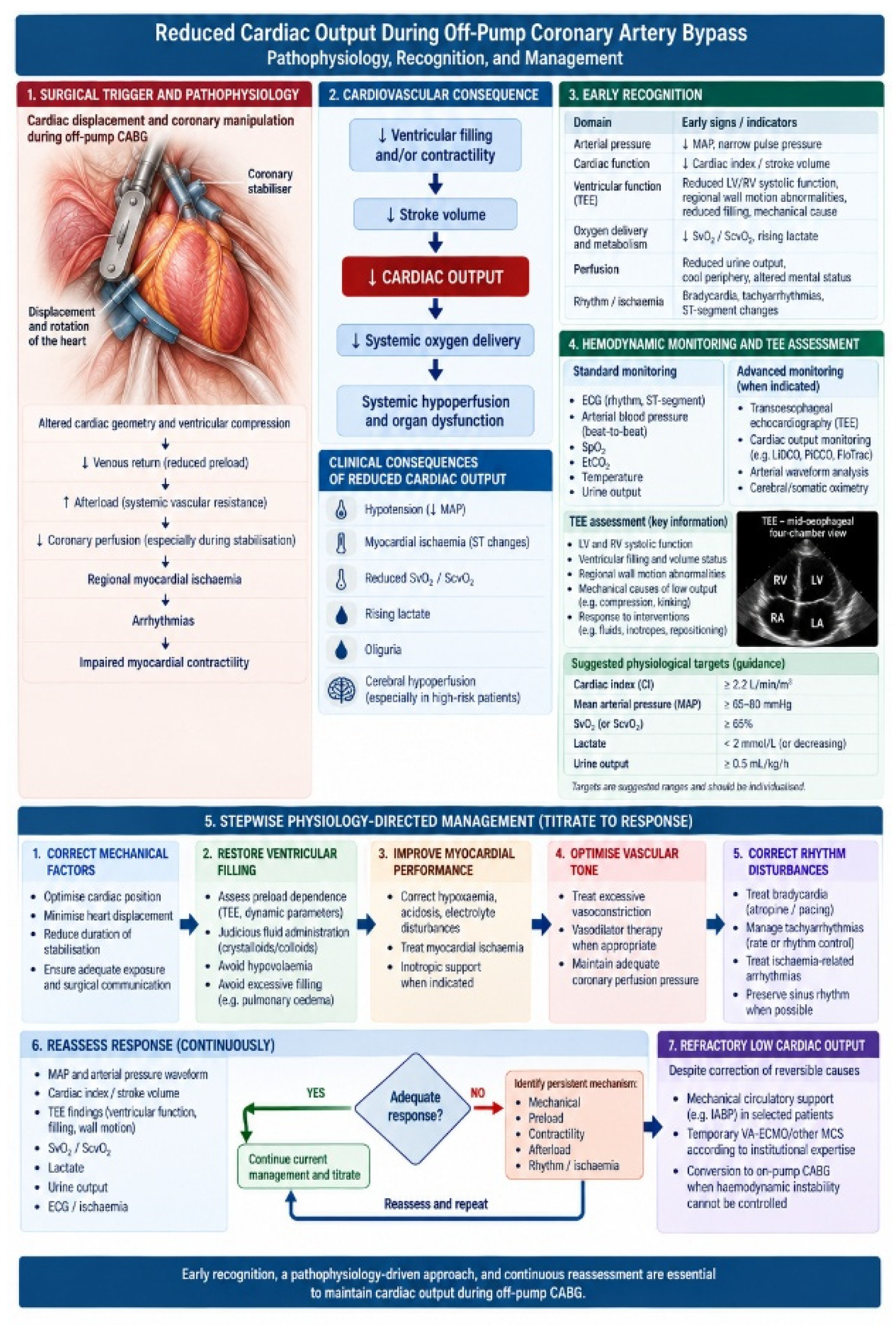
Figure 2.
Stepwise Algorithm for Hemodynamic Stabilization During Off-Pump Coronary Artery Bypass Grafting [39].
Figure 2.
Stepwise Algorithm for Hemodynamic Stabilization During Off-Pump Coronary Artery Bypass Grafting [39].
Disclaimer/Publisher’s Note: The statements, opinions and data contained in all publications are solely those of the individual author(s) and contributor(s) and not of MDPI and/or the editor(s). MDPI and/or the editor(s) disclaim responsibility for any injury to people or property resulting from any ideas, methods, instructions or products referred to in the content. |
© 2026 by the authors. Licensee MDPI, Basel, Switzerland. This article is an open access article distributed under the terms and conditions of the Creative Commons Attribution (CC BY) license.
Copyright: This open access article is published under a Creative Commons CC BY 4.0 license, which permit the free download, distribution, and reuse, provided that the author and preprint are cited in any reuse.