
Submitted:
16 September 2026
Posted:
16 September 2026
You are already at the latest version
Abstract
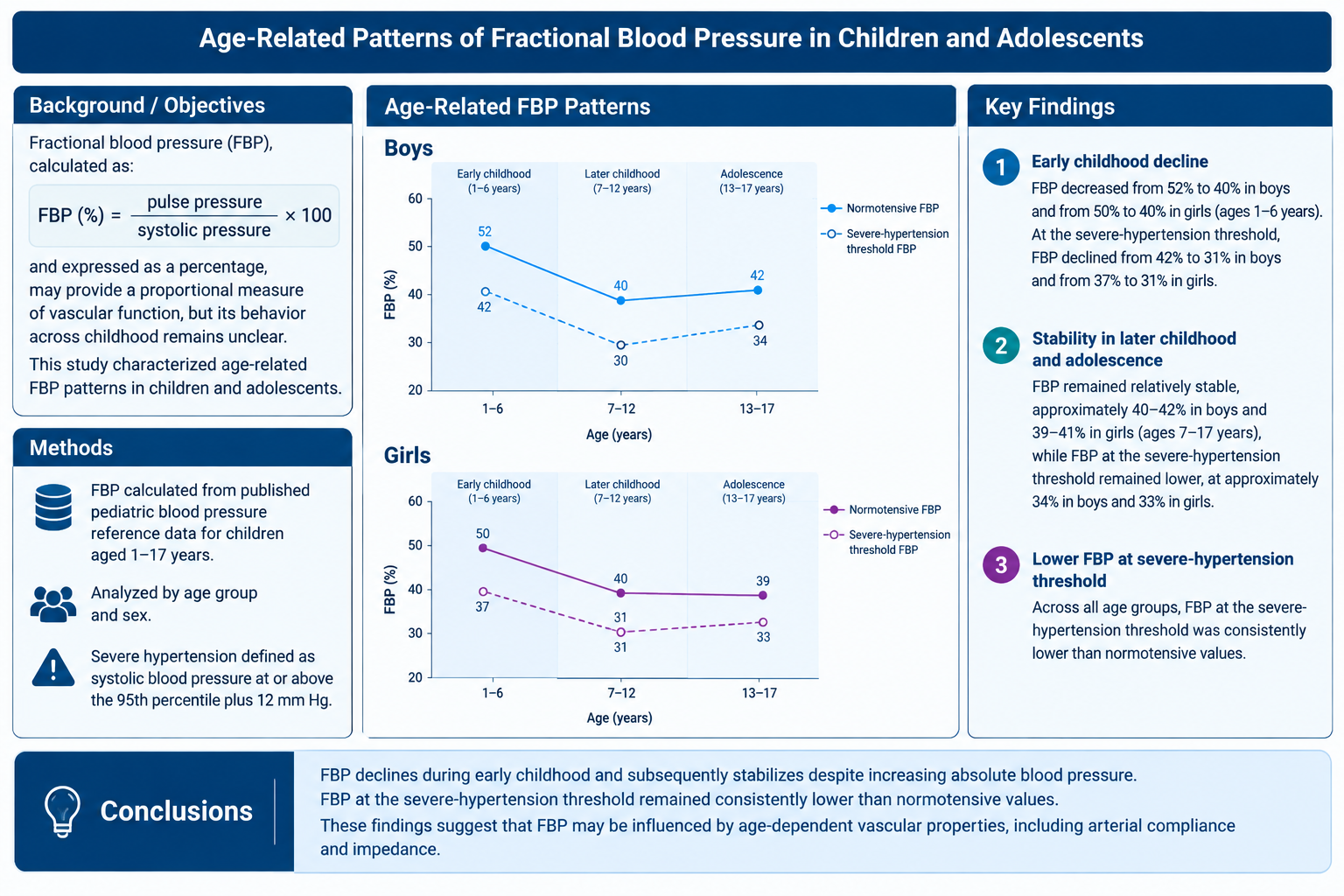
Background/Objectives: Fractional blood pressure (FBP), calculated as FBP (%) = (pulse pressure/systolic pressure) × 100 and expressed as a percentage, may provide a proportional measure of vascular function, but its behavior across childhood remains unclear. This study characterized age-related FBP patterns in children and adolescents. Methods: FBP was calculated from published pediatric blood pressure reference data for children aged 1–17 years and analyzed by age group, sex, and blood-pressure categories. Severe hypertension was defined as systolic blood pressure at or above the 95th percentile plus 12 mm Hg. Results: FBP declined in early childhood, from 52% to 40% in boys and from 50% to 40% in girls. At blood pressure values corresponding to the severe-hypertension threshold, FBP declined from 42% to 31% in boys and from 37% to 31% in girls. From later childhood through adolescence, FBP remained relatively stable, approximately 40%–42% in boys and 39%–41% in girls, while calculated values in adolescents at the severe-hypertension threshold were consistently lower, at approximately 34% in boys and 33% in girls. Conclusions: FBP declines during early childhood and subsequently stabilizes despite increasing absolute blood pressure. FBP at the severe-hypertension threshold remained consistently lower than normotensive values. These findings suggest that FBP may be influenced by age-dependent vascular properties, including arterial compliance and impedance.
Keywords:
Keywords: fractional blood pressure
; pulse pressure
; pediatric hypertension
; vascular maturation
; arterial compliance
; arterial impedance
; pediatric blood pressure
1. Introduction
Proportional blood pressure was first described by Peng-Lin and Yue-Chun in 2009 [1]. Fractional blood pressure (FBP) operationalizes this concept by expressing pulse pressure as a fraction of systolic pressure. Fractional blood pressure (FBP) is calculated as pulse pressure divided by systolic pressure × 100 and expressed as a percentage, thereby representing a proportional blood pressure measure. By normalizing pulse pressure to systolic pressure, fractional blood pressure may facilitate comparisons across ages despite marked developmental changes in absolute blood pressure.
Because blood pressure changes substantially during growth, a proportional measure may provide insights into vascular maturation that are not apparent from absolute blood pressure values alone.
In older adults, proportional blood pressure has demonstrated prognostic value for adverse cardiovascular outcomes. In an analysis of 10,796 elderly participants from the National Health and Nutrition Examination Survey, Fang et al. reported that the Pulse Pressure Index (PPI), defined as pulse pressure divided by systolic blood pressure, was independently associated with increased all-cause mortality, increased cardiovascular mortality, and a higher likelihood of coronary heart disease, with the highest PPI category showing greater cardiovascular risk [2]. These observations indicate that proportional blood pressure indices may provide clinically relevant information beyond conventional blood pressure measurements. Recent studies have demonstrated clinical utility for proportional blood pressure measures in adults. Jin et al., analyzing hypertensive participants from NHANES 1999-2018, found a U-shaped relationship between pulse pressure index and both all-cause and cardiovascular mortality with mortality increasing at both low and high PPI values, with PPI outperforming pulse pressure alone as a predictor of long-term outcomes [3]. Higher PPI values have been linked to increased carotid intima-media thickness, an established marker of subclinical atherosclerosis, adverse cardiovascular and renal outcomes in chronic kidney disease, altered hemodynamics in heart failure, and an increased risk of prediabetes and other metabolic disorders [4,5,6,7,8]. These findings suggest that proportional blood pressure indices may capture clinically important aspects of vascular function beyond conventional blood pressure measurements. Given its derivation from routine blood pressure measurements, FBP may have potential clinical utility as a simple, cost-effective marker of vascular maturation and early vascular aging. Because it can be calculated directly from standard blood pressure measurements without additional equipment, imaging, or testing, FBP could be readily incorporated into clinical practice. Nonetheless, the natural progression of proportional systemic blood pressure remains poorly defined in pediatric populations. Therefore, the objective of this study was to characterize age-related patterns of fractional blood pressure across childhood and adolescence and to examine differences according to sex and hypertension status.
2. Materials and Methods
Fractional blood pressure (FBP) was defined as FBP (%) = (pulse pressure / systolic pressure) × 100, and was calculated using previously published, publicly available pediatric blood pressure reference data for children aged 1–17 years. Blood pressure values were derived from American Academy of Pediatrics reference tables for children of median height [9].
Age-specific FBP values were calculated for each year of age. Inspection of the resulting age trends demonstrated three distinct phases: an early childhood decline (1-6 years), relative stability during later childhood (7-12 years), and continued stability throughout adolescence (13-17 years). Results are presented according to these empirically observed age groupings. Severe hypertension was defined as systolic blood pressure at or above the 95th percentile plus 12 mm Hg consistent with American Academy of Pediatrics guidelines [9].
Use of Artificial Intelligence: ChatGPT (GPT-5) was used solely to assist with language refinement, grammar correction, and editorial improvements. All AI-generated suggestions were reviewed by the authors, who independently evaluated, accepted, or rejected the suggested modifications. The authors take full responsibility for the final content of the manuscript.
3. Results
Fractional blood pressure demonstrated a characteristic age-dependent pattern across childhood and adolescence. In younger children aged 1–6 years, FBP decreased from 52% to 40% in boys and from 50% to 40% in girls. Calculated FBP values at the severe-hypertension threshold in this same age group declined from 42% to 31% in boys and from 37% to 31% in girls. In older children aged 7–12 years, FBP ranged from 40% to 42% in boys and from 40% to 41% in girls, while corresponding FBP values at the severe-hypertension threshold were lower and ranged from 30% to 34% in boys and 31% to 33% in girls. During adolescence (13–17 years), FBP remained stable at approximately 42% in boys and 39% to 41% in girls, while calculated FBP values at the severe-hypertension threshold were consistently lower, at approximately 34% in boys and 33% in girls. Calculated fractional blood pressures are shown in Figure 1 and Table 1.
4. Discussion
This study expands on prior work on proportional blood pressure by introducing fractional blood pressure (FBP), defined as pulse pressure divided by systolic pressure × 100 and expressed as a percentage. As a proportional blood pressure metric, FBP normalizes pulsatile load across absolute blood pressure levels, enabling intuitive comparisons across age and sex.
Across childhood and adolescence, FBP showed an early decline followed by relative stability. FBP values calculated at the severe-hypertension threshold were consistently lower across age groups. FBP declined in early childhood to a male–female convergence around age 7, followed by relative stability thereafter. A subtle male–female crossover was observed in early adolescence, while adolescents at the severe-hypertension threshold showed stable values, with boys remaining approximately 1% higher than girls.
An important observation is that, in contrast to adult populations in which higher proportional blood pressure indices are associated with hypertension and adverse outcomes [2,3,4], FBP values calculated at the severe hypertension threshold were lower than normotensive reference values. This discrepancy likely reflects fundamental age-dependent differences in vascular physiology and arterial remodeling across the lifespan.
In adults, hypertension is strongly associated with arterial stiffening, producing disproportionate increases in pulse pressure and thus higher proportional indices. In children, hypertension may predominantly manifest as elevations in systolic pressure without equivalent increases in pulsatile load, consistent with a more compliant arterial system. As a result, pulse pressure may not rise proportionally, yielding lower FBP values. These findings support the interpretation that FBP reflects vascular properties—such as arterial length, stiffness, and wave reflection—rather than blood pressure alone and therefore requires age-dependent interpretation.
Arterial impedance is the resistance of the arterial system to pulsatile blood flow and incorporates vascular stiffness, vessel geometry, and wave reflection. Pediatric studies of impedance show patterns that parallel the age-related changes observed in FBP. Sharp et al. measured aortic input impedance in infants and children and reported values substantially higher than those in adults, with values decreasing toward adult levels early in life as arteries lengthened with growth [10]. This pattern is consistent with the decline in FBP observed in early childhood.
Gender-related differences in large-artery properties have also been reported; Ahimastos et al. found comparable arterial impedance-related measures in adolescents across sexes, consistent with the relatively small sex differences observed in adolescent FBP [11]. Collectively, these findings underscore the distinction between pulse pressure, which increases during growth, and FBP, which remains comparatively stable across later childhood and adolescence.
Similar to arterial impedance, measurements of arterial stiffness are recommended in adults with hypertension and may be assessed by carotid-femoral pulse wave velocity (cfPWV), pulse wave analysis, and ambulatory arterial stiffness index derived from 24-hour ambulatory blood pressure monitoring. In children, these measurements may be challenging because of patient movement, the need for specialized equipment, and the requirement for highly trained technicians capable of applying appropriate pressure to tonographic devices. Despite these limitations, cfPWV is increasingly recognized as an important marker of cardiovascular risk in children and adolescents and has been shown to increase in association with pediatric hypertension, obesity, diabetes, and chronic kidney disease [12]. Because pulse pressure is influenced by arterial stiffness, wave reflection, and vascular impedance, the age-related changes in FBP observed in the present study may reflect developmental changes in these vascular properties. Given its derivation from routine blood pressure measurements, FBP may represent a simple and accessible candidate index of vascular maturation; however, clinical utility requires validation in individual-level and longitudinal pediatric datasets.
Early-life vascular remodeling may provide additional insight into the physiologic basis of fractional blood pressure. Increased arterial stiffness and pulse wave velocity have been reported in children born prematurely or small for gestational age, suggesting that adverse fetal and neonatal hemodynamic conditions can influence vascular development [13,14]. Proposed mechanisms include altered elastin deposition, endothelial dysfunction, changes in arterial geometry, and increased vascular impedance [13]. These observations support the concept that proportional blood pressure measures may reflect vascular properties established during growth and development rather than blood pressure alone.
Childhood obesity and overweight affect up to one-third of children worldwide and are increasingly recognized as important contributors to early vascular aging. Pathological studies have demonstrated that atherosclerotic changes begin in childhood, with fatty streaks and early fibrous lesions present in the aorta and coronary arteries of children and young adults. These lesions have been associated with obesity, hypertension, dyslipidemia, and other cardiovascular risk factors, suggesting that adverse vascular remodeling may begin decades before the clinical manifestation of cardiovascular disease [15]. These observations further support the concept that proportional blood pressure measures may reflect early changes in vascular health and aging.
This study is limited by reliance on previously published, publicly available reference data rather than individual-level measurements. Because of this limitation, variability estimates, longitudinal trajectories, and measures of dispersion were unavailable. Consequently, statistical comparisons between groups could not be performed. Further work using individual-level and longitudinal pediatric datasets is needed to establish normative distributions and evaluate clinical utility. These findings suggest that FBP may serve as a developmentally sensitive surrogate for vascular function and, if confirmed in longitudinal outcome studies, may have value for pediatric risk stratification and early intervention. Potential applications in physiologic stress testing or altered loading conditions, including valvular heart disease, remain speculative and require further study.
5. Conclusions
Fractional blood pressure demonstrates an early decline followed by relative stability across childhood and adolescence despite increases in absolute blood pressure. In contrast to adult populations, blood-pressure values corresponding to the pediatric severe-hypertension threshold are associated with lower fractional blood pressure values. These findings are consistent with the possibility that FBP may be influenced by developmental changes in vascular properties, such as arterial compliance and impedance, and may represent a candidate marker of vascular maturation.
Author Contributions
Conceptualization, J.L., J.G. and S.G.; formal analysis, J.L.; writing—original draft preparation, J.L.; writing—review and editing, J.G. and S.G. All authors have read and agreed to the published version of the manuscript.
Funding
This research received no external funding.
Institutional Review Board Statement
Not applicable. Under United States federal human-subjects regulations, Institutional Review Board approval was not required because this work does not meet the definition of research involving “human subjects” under 45 CFR § 46.102(e).
Informed Consent Statement
Not applicable. The study did not involve intervention or interaction with living individuals and did not involve obtaining, using, studying, analyzing, or generating identifiable private information or identifiable biospecimens. All analyses were based solely on previously published, publicly available aggregate pediatric blood pressure reference tables. Therefore, informed consent was not applicable.
Data Availability Statement
Data were derived from previously published, publicly available pediatric blood pressure reference tables.
Conflicts of Interest
The authors declare no conflicts of interest.
References
- Peng-Lin, Y.; Yue-Chun, L. Pulse pressure index (pulse pressure/systolic pressure) may be better than pulse pressure for assessment of cardiovascular outcomes. Med. Hypotheses 2009, 72, 729–731. [Google Scholar] [CrossRef] [PubMed]
- Fang, L.X.; Wu, Y.H.; Yao, T.; Wang, Z.N.; Qian, S.; Jiang, T.; Xu, J.; Lin, Y.N.; Li, Y.C. Use of pulse pressure index for cardiovascular outcomes assessment and development of a coronary heart disease model for the elderly. BMC Cardiovasc. Disord. 2025, 25, 297. [Google Scholar] [CrossRef] [PubMed]
- Jin, H.; Fang, S.; An, S.; Ding, Y. Association of pulse pressure index with mortality in patients with hypertension: Results from NHANES 1999–2018. J. Clin. Hypertens. 2025, 27, e70004. [Google Scholar] [CrossRef] [PubMed]
- Cai, A.; Mo, Y.; Zhang, Y.; Li, J.; Chen, J.; Zhou, Y.; Feng, Y. Relationship of pulse pressure index and carotid intima–media thickness in hypertensive adults. Clin. Exp. Hypertens. 2015, 37, 267–270. [Google Scholar] [CrossRef] [PubMed]
- Raina, R.; Polaconda, S.; Nair, N.; et al. Association of pulse pressure, pulse pressure index, and ambulatory arterial stiffness index with kidney function in a cross-sectional pediatric chronic kidney disease cohort from the CKiD study. J. Clin. Hypertens. 2020, 22, 1059–1069. [Google Scholar] [CrossRef] [PubMed]
- Petrie, C.J.; Ponikowski, P.; Metra, M.; Mitrovic, V.; Ruda, M.; Fernandez, A.; Vishnevsky, A.; Cotter, G.; Milo, O.; Laessing, U.; Zhang, Y.; Dahlke, M.; Zymlinski, R.; Voors, A.A. Proportional pulse pressure relates to cardiac index in stabilized acute heart failure patients. Clin. Exp. Hypertens. 2018, 40, 637–643. [Google Scholar] [CrossRef] [PubMed]
- Namasivayam, M.; Lau, E.S.; Zern, E.K.; Schoenike, M.W.; Hardin, K.M.; Sbarbaro, J.A.; Cunningham, T.F.; Farrell, R.M.; Rouvina, J.; Kowal, A.; Bhat, R.R.; Brooks, L.C.; Nayor, M.; Shah, R.V.; Ho, J.E.; Malhotra, R.; Lewis, G.D. Exercise blood pressure in heart failure with preserved and reduced ejection fraction. JACC Heart Fail. 2022, 10, 278–286. [Google Scholar] [CrossRef] [PubMed]
- Pan, Y.; Meng, H.; Guo, L.; Kong, B.; Shuai, W.; Huang, H. Examination of nonlinear associations between pulse pressure index and incident prediabetes susceptibility: A five-year retrospective cohort investigation. Sci. Rep. 2024, 14, 17948. [Google Scholar] [CrossRef] [PubMed]
- Flynn, J.T.; Kaelber, D.C.; Baker-Smith, C.M.; Blowey, D.; Carroll, A.E.; Daniels, S.R. Clinical practice guideline for screening and management of high blood pressure in children and adolescents. Pediatrics 2017, 140, e20171904. [Google Scholar] [CrossRef] [PubMed]
- Sharp, M.K.; Pantalos, G.M.; Minich, L.; Tani, L.Y.; McGough, E.C.; Hawkins, J.A. Aortic input impedance in infants and children. J. Appl. Physiol. 2000, 88, 2227–2239. [Google Scholar] [CrossRef] [PubMed]
- Ahimastos, A.A.; Formosa, M.; Dart, A.M.; Kingwell, B.A. Gender differences in large artery stiffness pre- and post-puberty. J. Clin. Endocrinol. Metab. 2003, 88, 5375–5380. [Google Scholar] [CrossRef] [PubMed]
- Savant, J.D.; Furth, S.L.; Meyers, K.E.C. Arterial stiffness in children: Pediatric measurement and considerations. Pulse 2014, 2, 69–80. [Google Scholar] [CrossRef] [PubMed]
- Varley, B.J.; Nasir, R.F.; Craig, M.E.; Gow, M.L. Early life determinants of arterial stiffness in neonates, infants, children and adolescents: A systematic review and meta-analysis. Atherosclerosis 2022, 355, 1–7. [Google Scholar] [CrossRef] [PubMed]
- Muñiz Fontán, M.; Oulego Erroz, I.; Revilla Orias, D.; Muñoz Lozón, A.; Rodriguez Núñez, A.; Lurbe I Ferrer, E. Thoracic aortic intima-media thickness in preschool children born small for gestational age. J. Pediatr. 2019, 208, 81–88.e2. [Google Scholar] [CrossRef] [PubMed]
- Strong, J.P.; Malcom, G.T.; McMahan, C.A.; Tracy, R.E.; Newman, W.P.; Herderick, E.E.; Cornhill, J.F. Prevalence and extent of atherosclerosis in adolescents and young adults: Implications for prevention from the Pathobiological Determinants of Atherosclerosis in Youth (PDAY) Study. JAMA 1999, 281, 727–735. [Google Scholar] [CrossRef] [PubMed]
Figure 1.
Age-related changes in fractional blood pressure (FBP), defined as pulse pressure/systolic pressure × 100, across childhood and adolescence (1–17 years). Values are shown for boys and girls and stratified by normotensive reference values and blood-pressure values corresponding to the severe-hypertension threshold. FBP declines in early childhood and remains relatively stable thereafter, with consistently lower values at the severe-hypertension threshold.
Figure 1.
Age-related changes in fractional blood pressure (FBP), defined as pulse pressure/systolic pressure × 100, across childhood and adolescence (1–17 years). Values are shown for boys and girls and stratified by normotensive reference values and blood-pressure values corresponding to the severe-hypertension threshold. FBP declines in early childhood and remains relatively stable thereafter, with consistently lower values at the severe-hypertension threshold.
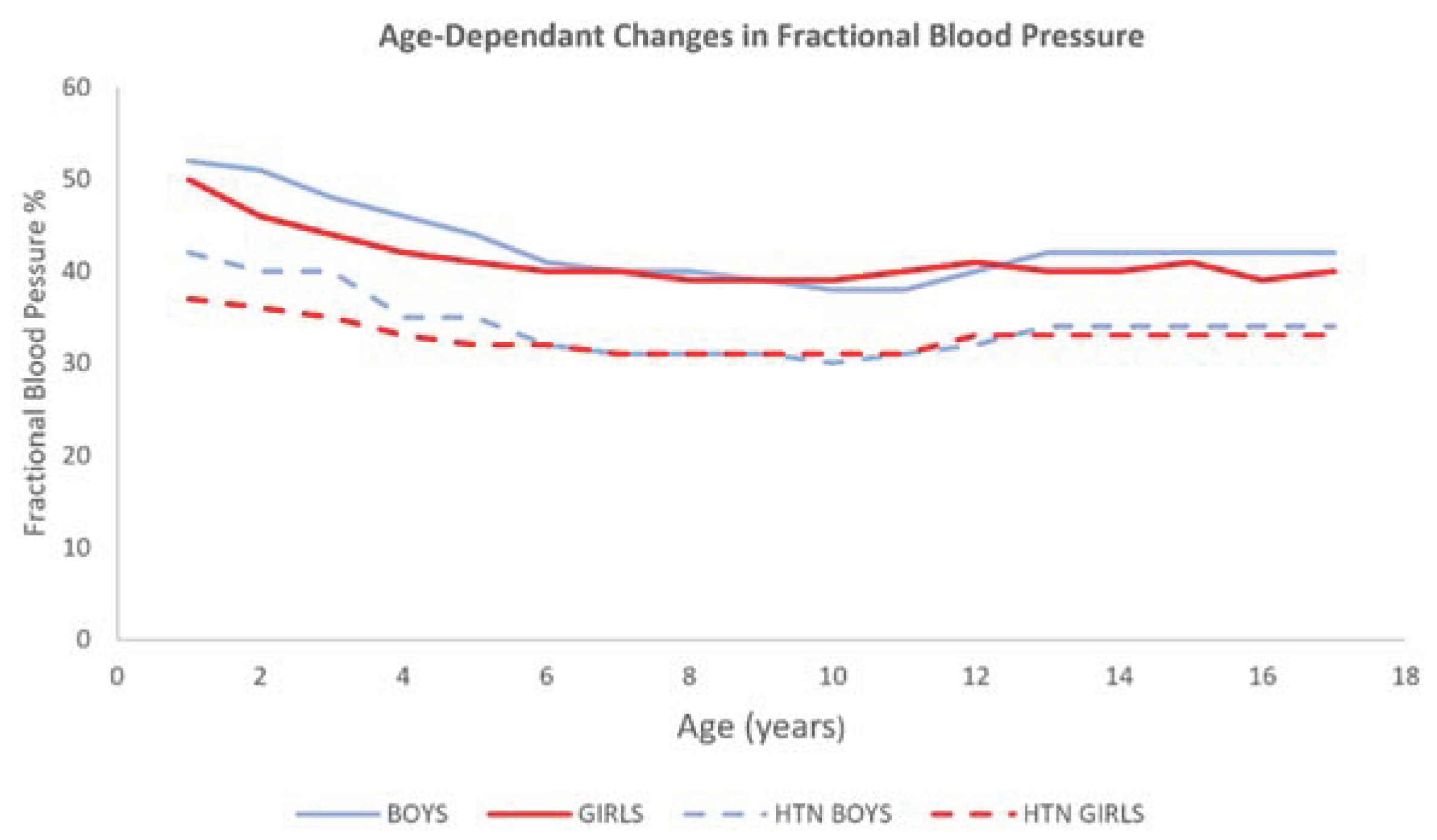

Table 1.
Fractional blood pressure by age group, sex, and blood pressure category in children aged 1–17 years.
Table 1.
Fractional blood pressure by age group, sex, and blood pressure category in children aged 1–17 years.
| Age group (years) | Sex | Normotensive FBP (%) | Severe HTN threshold FBP (%) |
| 1–6 | Boys | 52 → 40 | 42 → 31 |
| Girls | 50 → 40 | 37 → 31 | |
| 7–12 | Boys | 40–42 | 30–34 |
| Girls | 39–41 | 31–33 | |
| 13–17 | Boys | ~42 (stable) | ~34 (stable) |
| Girls | 39–41 | ~33 (stable) |
Note: FBP = fractional blood pressure, calculated as pulse pressure/systolic pressure × 100; HTN= hypertension. Severe hypertension was defined as systolic blood pressure at or above the 95th percentile plus 12 mm Hg.
Disclaimer/Publisher’s Note: The statements, opinions and data contained in all publications are solely those of the individual author(s) and contributor(s) and not of MDPI and/or the editor(s). MDPI and/or the editor(s) disclaim responsibility for any injury to people or property resulting from any ideas, methods, instructions or products referred to in the content. |
© 2026 by the authors. Licensee MDPI, Basel, Switzerland. This article is an open access article distributed under the terms and conditions of the Creative Commons Attribution (CC BY) license (http://creativecommons.org/licenses/by/4.0/).
Copyright: This open access article is published under a Creative Commons CC BY 4.0 license, which permit the free download, distribution, and reuse, provided that the author and preprint are cited in any reuse.