
Submitted:
15 September 2026
Posted:
16 September 2026
You are already at the latest version
Abstract
AI agents driven by foundation models have shown potential for industrial automation beyond rule-based control. However, existing studies mainly examine single agents or multi-agent systems with fixed roles, leaving networked coordination among heterogeneous industrial agents insufficiently explored. This paper examines the intersection of networked agents and industrial automation, where industrial signals, communication constraints, contextual information, and operational requirements must be considered jointly. It introduces the Industrial Internet of Agents (IIoA) and presents a conceptual architecture for analyzing industrial deployment requirements. Building on the Internet of Agents (IoA) framework, IIoA re-specifies sensing, communication, decision-making, and execution through eleven industrial extensions, including industrial signal awareness, operational technology (OT) protocol bridging, tiered latency design, feasibility-coupled planning, and semantic execution gateways. Representative studies are synthesized across shopfloor operations, autonomous plant operation and maintenance, supply chain collaboration, and digital twin systems. The analysis indicates that industrial agent networking requires the joint design of semantic coordination, OT interoperability, latency-aware deployment, trust governance, and verifiable physical execution. Finally, seven open challenges are identified, covering reliability, latency, protocol integrity, scalability, physical grounding, adaptability, and evaluation.
Keywords:
AI agent
; foundation model
; Industrial Internet of Agents
; Industrial Internet of Things
; industrial networks
; semantic communication
; network management
1. Introduction
The Industrial Internet of Things (IIoT) has emerged over the past decade as a core infrastructure for industrial digitalization by enabling large-scale sensing, device interconnection, and data-driven optimization [1,2]. However, as industrial systems become more heterogeneous and interconnected, conventional IIoT remains limited in semantic data utilization, cross-system coordination, and proactive response to unexpected events [3,4,5]. Concurrently, Foundation Models (FMs), especially large language model (LLM)-based agents following paradigms such as ReAct [6], have improved natural-language understanding, tool use, memory, and multi-step reasoning. These capabilities make it possible to move part of industrial automation from fixed rule execution toward intent-driven task planning.
Existing intelligent industrial architectures can be grouped into three lines. Cloud-centric AI analytics support global optimization but suffer from latency, centralization, and limited device-level intelligence [7,8,9]. Edge AI and federated learning improve latency and privacy but provide limited inter-node semantic coordination [10,11,12,13]. IIoT architectures enhanced with LLM agents can handle natural-language intent and support multi-agent negotiation, but often rely on predefined roles or static topologies [14,15,16]. Meanwhile, general Internet-of-Agents studies address scalable collaboration beyond industrial settings [17,18]. Existing surveys mainly cover general agent capabilities or single dimensions of industrial intelligence, while few jointly examine networked agent collaboration and heterogeneous deployment requirements. Although recent work has begun to use the notion of the Industrial Internet of Agents for communication-control reconfiguration [19], a conceptual architecture that connects FM-driven agents with industrial communication, OT interoperability, tiered latency, and verifiable execution remains under-explored.
To help address this gap, this paper conceptualizes the Industrial Internet of Agents (IIoA) and presents a conceptual architecture for analyzing its industrial requirements. As shown in Figure 1, IIoA is derived from the Internet of Agents (IoA) framework of Wang et al. [20], which provides the general scaffold for sensing, communication, decision-making, and execution, but re-specifies it for industrial deployment. Compared with general IoA, IIoA foregrounds operational technology (OT) interoperability, real-time latency, physical safety, execution verification, traceability, human oversight, and cross-enterprise governance, organizing them into constraint-oriented extensions across sensing, communication, decision-making, and execution. The architecture also highlights two deployment tensions: probabilistic FM behavior versus deterministic industrial requirements, and networked agent collaboration versus resource constraints in edge and end environments.
To keep the discussion grounded in current research, this paper synthesizes representative studies connecting AI-agent research with industrial systems. The discussion emphasizes 2023–2026 publications, while retaining earlier works that provide foundational context for IIoT, MAS, communication, and industrial safety. These studies are used as reference points for the conceptual synthesis and for positioning IIoA within existing industrial-intelligence research.
The main contributions are summarized as follows.
- 1.
- This paper defines the Industrial Internet of Agents (IIoA) as a networked industrial-agent concept characterized by FM-driven node cognition, networked collaboration, and end-to-end industrial constraints.
- 2.
- This paper presents an IoA-based conceptual architecture for IIoA, covering hierarchical foundation models and industrial extensions across sensing, communication, decision-making, and execution, and clarifies how networked collaboration is conditioned by OT interoperability, latency, safety, and trust.
- 3.
- Representative work is synthesized across Shopfloor Operations, Autonomous Plant Operations and Maintenance (O&M), Supply Chain Collaboration, and Digital Twin Systems to identify architectural coverage, networking requirements, and engineering bottlenecks.
The remainder of this paper is organized as follows. Section 2 defines IIoA and presents the architectural design. Section 3 discusses recent advances in the context of representative industrial scenarios. Section 4 analyzes the open challenges facing IIoA deployment and identifies directions for future research. Section 5 concludes the paper.
2. Conceptual Architecture
2.1. Concept of IIoA
IIoA extends the lineage of industrial MAS that predates LLMs. Early industrial agents relied primarily on hard-coded rules, statistical algorithms, or task-specific machine learning models to execute predefined tasks. These systems achieved reliable performance in constrained settings, with limited generalization and contextual understanding. Table 1 clarifies the position of IIoA relative to adjacent concepts in industrial intelligence. Accordingly, the Industrial Internet of Agents (IIoA) is defined as a distributed industrial intelligence system in which heterogeneous AI agent nodes are interconnected via network protocols. Given natural-language goals or structured task requests, IIoA supports autonomous sensing, collaborative decision-making, and verifiable execution across nodes. The framework complements IIoT, CPS/CPPS, and industrial MAS through an agent-oriented architectural lens. This lens brings FM-enabled cognition, semantic coordination, and industrial execution constraints into one analytical frame.
Specifically, IIoA has three key characteristics:
- 1.
- FM-driven node cognition. Each agent node may be enabled by or connected to foundation models, supporting independent parsing, planning, and agent-level execution for natural-language goals or structured task requests.
- 2.
- Networked collaboration. Isolated agents cannot support complex industrial workflows. IIoA therefore enables heterogeneous agents to collaborate through dynamic service discovery, cross-node semantic communication, and state-aware multi-turn interaction. Such semantic communication helps reduce integration complexity and supports tighter system integration.
- 3.
- End-to-end industrial constraints. Sensing, communication, decision-making, and execution must all satisfy real-time, physical feasibility, safety, and interoperability constraints, which define the operational and compliance boundaries of both semantic cognition and networked collaboration.
Building on the definitions above, this paper adopts the IoA framework of Wang et al. [20] as its architectural starting point, while re-specifying its sensing, communication, decision-making, and execution modules around industrial constraints. As shown in Figure 1, the following sections identify the industrial limitations of each IoA module and derive the corresponding IIoA extensions, which serve as the basis for the application analysis. The analysis compares the network mechanism, motivating industrial constraint, and available evidence for each extension. It also follows dependencies across modules, since sensing errors, communication delays, planning uncertainty, and execution feedback can propagate through the industrial loop.
2.2. Foundation Models
In the IoA framework, foundation models (FMs) provide the cognitive backbone for sensing, communication, decision-making, and execution. Their deployment model remains open under industrial constraints. For IIoA, model placement directly affects latency, reliability, resource efficiency, and safety, so FM configuration belongs within the system architecture. Throughout this paper, FM or FMs refers collectively to LLMs, VLMs, VLAs, and related model families, while retaining original terminology for specific works.
Industrial missions impose multi-level latency and reasoning requirements that are less prominent in general-purpose deployment. Global planning may tolerate second-level responses, inter-node coordination often requires sub-100 ms interaction, and end-side perception or control may require millisecond-level reaction. A single FM scale cannot satisfy all tasks. Large models support complex reasoning with higher inference latency, while lightweight models respond faster with narrower planning capacity [21,22]. A second constraint is domain adaptation. General-purpose pretraining provides limited coverage of equipment terminology, process specifications, safety constraints, and industrial operating knowledge, so direct deployment may weaken industrial reasoning performance [9]. Table 2 summarizes FM deployment across the three tiers.
To address the heterogeneity of cognitive load, IIoA organizes FMs in a cloud-edge-end tiered architecture. Latency budgets and cognitive complexity guide the partition, with parameter count serving as a secondary consideration. Cloud-tier models handle global intent decomposition and complex cross-node reasoning; edge-tier models support local anomaly diagnosis, task reallocation, and coordination; end-tier models focus on rapid perception and device-level response. Techniques such as quantization, pruning, acceleration, and cloud-edge collaborative inference further support latency-aware deployment [21,22].
To address domain knowledge adaptation, IIoA introduces knowledge injection at each tier through weight post-training, retrieval augmentation, fine-tuning, and cross-tier knowledge distillation. Industrial Foundation Model (IFM) illustrates domain post-training for industrial knowledge injection [23], while cloud-side RAG and edge-side fine-tuning provide lighter mechanisms for adapting general FMs to industrial tasks [9,28]. These mechanisms help bridge gaps between general-purpose FMs and industrial terminology, process rules, and safety logic. Model updates in industrial environments also differ from internet-facing deployment: version transitions should pass offline verification and safety certification before production use.
2.3. Sensing
IoA partitions sensing into modality sensing and functional sensing. These categories cover observable input channels and self-monitoring of reasoning budget, knowledge boundaries, and tool availability. Industrial deployment adds two constraints to this design foundation. Industrial field signals use specialized formats and streaming protocols with engineering-specific semantics. IoA also treats nodes largely in isolation, leaving factory topology outside the sensing context needed for cross-node coordination. Table 3 summarizes the corresponding extensions.
Industrial Signal Awareness. The IoA sensing pipeline targets general modalities such as text, GUI, speech, and video. Industrial perception also depends on vibration, acoustic, thermal, electrical, and other physical signals with distinct spectral structures, sampling densities, and unit semantics. Direct tokenization of numerical streams can weaken temporal continuity and physical meaning. General FMs also show limited alignment with engineering time-series, anomaly patterns, and operating-condition associations [30]. An industrial sensing layer must convert physical streams from the OT Protocol Bridge into representations that preserve temporal and engineering semantics. It must also fuse cross-modal evidence for device-state understanding. Existing studies span successive levels of specialization. Time-LLM explores general time-series reprogramming [29], FD-LLM aligns engineering signals with LLM embedding spaces [30], and QwIndustry combines industrial vibration, acoustic, and visual inputs [31]. The literature therefore progresses from generic sequence representation to domain alignment and multimodal state interpretation. Validation remains concentrated on individual tasks, modalities, and operating regimes.
Physical Context Awareness. IoA sensing is primarily node-centric and provides limited support for factory topology. In IIoA, agents correspond to physical units whose decisions depend on production-line position, process dependencies, and neighboring states. Disturbances can propagate along these dependencies, so topology-blind sensing may classify system-level disruptions as local events [32]. IIoA can represent equipment locations, line structures, and inter-node dependencies as agent-queryable knowledge graphs. Digital twins or world models can update this context when nodes move, fail, or lose sensor coverage. Topology-aware scheduling and digital-twin studies indicate that physical context can improve cross-node coordination [33,34]. Qin and Lu also report sensitivity to changes in machine and job settings [33]. This result places topology maintenance inside the runtime sensing problem. The topology layer must remain synchronized with changing shopfloor configurations and available for agent queries.
2.4. Communication
The IIoA communication module builds on the IoA three-layer semantic stack [20]. The environment layer covers deployment and observation-action interfaces. The interaction layer covers naming, routing, session management, and topology. The semantic layer covers message representation and long-term memory.
Industrial communication adds three engineering constraints to this stack. Proprietary fieldbus protocols separate OT networks from semantic agent networks. Control, coordination, and planning tasks also impose latency requirements that differ by orders of magnitude. Cross-organizational collaboration adds data-sovereignty, identity, and cybersecurity requirements. Table 4 summarizes the resulting Industrial Communication Extensions.
Industrial agent networking also depends on capability discovery. Agents must advertise machine-interpretable capabilities and update them as device state, availability, and permissions change. A two-stage IoA framework combines autonomous capability announcement with task-driven discovery and composition [18]. Its simulation results provide a transferable mechanism for industrial service discovery. Industrial use additionally requires capability records that remain synchronized with equipment state, physical topology, and authorization policies.
OT Protocol Bridge. IoA environments are mainly web, desktop, or simulated systems. Industrial devices communicate through Modbus TCP, OPC UA, and related protocols with distinct frame formats, sampling periods, addressing rules, and safety constraints [35]. IIoA therefore calls for an OT Protocol Bridge that translates fieldbus data into agent-consumable states and converts agent intents into standardized command-write interfaces. Gateway experiments demonstrate millisecond-scale acquisition cycles for ModbusE-to-OPC UA communication [35]. LLM-assisted AAS generation reports effective generation rates of 62–79% under tested configurations [36]. Text-to-OPC UA modeling and LLM-agent control provide additional evidence for exposing device semantics to agent workflows [37,38]. These results establish protocol exposure and model generation as feasible building blocks. End-to-end semantic consistency still requires verification from field signals through agent reasoning to executable commands.
Tiered Latency Design. Industrial tasks occupy several latency classes. Local control requires millisecond responses, edge coordination operates at hundreds of milliseconds, and global planning may take seconds [25]. A uniform message class would expose time-sensitive synchronization to congestion from semantic planning traffic. IIoA therefore stratifies communication by latency budget and task criticality. Control, coordination, and planning traffic use separate service classes while retaining semantic exchange across tiers. CE-CoLLM shows that contextual-data transfer can dominate cloud-edge inference latency [39]. Dual-loop architectures also provide a basis for hierarchical edge-terminal coordination [40]. Evidence is stronger for inference placement than for deterministic multi-agent messaging under OT timing. Industrial deployment must jointly preserve semantic flexibility, bounded latency, reliability, and schedulability.
Security & Trust Design. Cross-organizational collaboration must preserve data sovereignty, verify agent identity, and satisfy cybersecurity requirements. DID-based verification addresses identity across trust domains [41]. Federated and eavesdropping-aware learning address protected model and data exchange [42,43]. IEC 62443 supplies zone-and-conduit governance and lifecycle controls for industrial systems [44]. These studies cover complementary security layers. Integrated policies that connect identity, intent, data access, and executable authority remain scarce. IIoA therefore extends zone protection with controls over what agents may know, infer, request, and execute.
2.5. Decision-Making
The IoA decision-making module comprises task-level planning, uncertainty awareness, and collaborative reasoning. Industrial deployment adds step-wise feasibility checking, task routing across heterogeneous FM tiers, and structured human intervention. Feasibility checks must cover device capabilities, process precedence, and safety exclusion zones during plan generation. Task routing must account for model capacity, latency, and physical criticality. Human engineers also need defined escalation and override interfaces for uncertain or high-risk decisions. Table 5 summarizes these extensions.
Feasibility-Coupled Planning. Industrial plans must satisfy device limits, process precedence, and safety exclusion zones. Errors can propagate along task dependencies when verification occurs after complete plan generation. IIoA therefore embeds constraint solvers and formal checkers into the sense-think-act loop for progressive verification and correction. SMT-based planning and VeriPlan demonstrate solver-backed generation and rule refinement [45,47]. ConstraintLLM evaluates formalization on the 140-task IndusCP benchmark [46]. The evidence supports toolized feasibility reasoning at the planning stage. Plant integration must still reconcile rigorous verification with open-ended task generation and changing operating states.
Tiered Inference Allocation. IIoA’s tiered deployment creates capability asymmetry across cloud, edge, and end agents. Large models support complex reasoning with higher latency, while lightweight agents respond faster with narrower planning capacity. Bidirectional allocation lets upper-tier agents decompose intent and dispatch subtasks. Lower-tier agents return execution states, same-tier agents exchange local evidence, and low-confidence tasks escalate upward. HuggingGPT, HiPlan, and DynTaskMAS provide mechanisms for model routing, hierarchical planning, and dynamic task-graph execution [48,49,50]. Most evidence comes from general-purpose agent settings. Industrial routing must combine model capacity with latency, dependency structure, confidence, and physical task criticality.
Human Oversight Interface. Operations governed by safety or compliance rules require defined conditions for human intervention. IIoA links intervention to confidence and risk through confirmation, guided correction, and override. KnowNo calibrates help requests to uncertainty [51]. General human-in-the-loop studies support guided correction [52]. VeriPlan adds user refinement of verification rules [47]. AgentSpec demonstrates rule-based termination of unsafe actions across several agent domains [53]. These mechanisms remain largely outside industrial deployment. An auditable oversight interface must record the trigger, human response, affected plan, and resumed execution state.
Across the decision literature, formal planning and rule enforcement have the clearest evaluation protocols. Evidence for tiered industrial coordination and risk-triggered human escalation is less mature. A complete decision layer must connect solver outcomes, routing decisions, confidence estimates, and human authority within one traceable workflow.
2.6. Execution
Industrial execution adds three requirements to IoA’s software-oriented design. Device-specific commands need syntax and safety certification before dispatch. Physical failures need staged responses that separate immediate safe-state control, local recovery, and decision-layer escalation. Compliance auditing also requires structured traces that connect reasoning, commands, outcomes, and responsible agents. Table 6 presents the corresponding IIoA extensions.
Semantic Execution Gateway. Industrial execution translates semantic intent into PLC, CNC, AGV, and robotic commands that directly affect physical assets. The execution interface must therefore include syntax compliance and safety verification. A Semantic Execution Gateway converts validated plans into device-specific commands and certifies them before dispatch. PLC workflows may combine IEC 61131-3 Structured Text generation, compilation, formal verification, and iterative repair. CNC and AGV systems require equivalent validation for G-code or motion commands. LLM4PLC demonstrates iterative verification on a manufacturing testbed [54]. Agents4PLC and MPC-Coder extend this direction through closed-loop generation and repair [55,56]. MPC-Coder reports 100% syntactic correctness and 78% functional consistency in its evaluation [56]. These results support a certification boundary between semantic plans and physical control.
Execution Fault Recovery. Physical-device failures can be irreversible and may require responses within millisecond control cycles. IIoA therefore separates immediate safety response from agent-level recovery. Hardware interlocks or safety PLCs first bring the system to a safe state independently of FM inference. Local agents then generate recovery sub-plans and escalate cases that exceed local capability. Recent work combines behavior-tree recovery, ontology-triggered replanning, and constraint monitoring for embodied or industrial agents [57,58,59]. Response time and physical risk determine the recovery stage and escalation path.
Decision Traceability. Industrial deployment requires compliance auditing, incident reconstruction, and accountability for high-risk actions. IIoA binds each executed action to records covering agent identity, reasoning summary, command, timestamp, and outcome. Provenance graphs and runtime rule enforcement support auditability [53,60]. Failure-localization records can support post-incident root-cause reconstruction [61]. Traceability therefore turns execution records into evidence for safety governance and cross-agent accountability. Distributed records still need causal links when several agents contribute to one physical outcome.
Together, the four modules form a coupled industrial loop. The OT Protocol Bridge exposes field states, and sensing converts them into signal and topology context. Communication discovers suitable agents and carries this context across latency tiers. Decision-making allocates reasoning, verifies feasibility, and invokes human authority when required. The execution layer certifies commands, manages recovery, and returns provenance-linked outcomes to subsequent sensing and planning cycles.
This coupling creates recurring design tensions. Semantic exchange supports flexible collaboration, while control traffic requires bounded timing. Cloud reasoning expands global context, while edge and end autonomy protect response time and availability. Adaptive planning also depends on certification before physical execution. Current evidence is strongest for individual building blocks such as protocol gateways, constrained planning, and PLC verification. Dynamic discovery, cross-tier coordination, and full-loop traceability still rely largely on transferable mechanisms or limited prototypes. The application scenarios below show how far these components have progressed toward integrated deployment.
3. Applications
Section 3 examines how the architecture appears in representative industrial deployment contexts. As shown in Figure 2, Shopfloor Operations covers device-level collaboration and execution. Autonomous Plant O&M covers factory networks, computing resources, and equipment management. Supply Chain Collaboration extends coordination across organizations. Digital Twin (DT) Systems also provide shared infrastructure for simulation, safety checking, and pre-execution validation. Across these scenarios, the analysis compares coordination scope, networking role, physical coupling, and validation setting. Representative works are summarized in Table 7.
3.1. Shopfloor Operations
Shopfloor control has traditionally relied on Manufacturing Execution Systems (MES) for order decomposition and centralized dispatching. This architecture is effective in stable, high-volume production, but less adaptable in high-mix, low-volume settings, where disruptions, combinatorial scheduling constraints, and device-level variability require faster local coordination.
Under IIoA, shopfloor entities such as CNC machines, robotic arms, and AGVs can be represented as agent nodes. These nodes parse production intent, announce capabilities, negotiate task allocation, and form temporary collaborative subnetworks according to real-time device states. Existing work can be organized into two lines.
LLM-Based Scheduling. This line focuses on the decision path from production intent to task assignment. MASC, RAG-based scheduling, and evolutionary dispatch-rule generation suggest that LLMs can support dynamic rescheduling, constraint-aware assignment, and localized adaptation under changing shopfloor states [16,24,62]. These studies make scheduling more responsive to real-time context and operational knowledge, although the transition from generated schedules to verified device-level execution remains weakly connected.
Decentralized Agent Collaboration. This line is closer to IIoA’s networked coordination logic. Resource agents negotiate task allocation through bidding, natural language, or G-code-mediated interaction, reducing dependence on centralized schedulers and allowing more flexible shopfloor reconfiguration [14,15]. Compared with scheduling-centered studies, these works shift attention toward distributed coordination, yet protocol-based reassignment under node joining, departure, and failure remains insufficiently tested in real-scale shopfloor environments.
Shopfloor evidence is strongest for schedule generation and negotiation under modeled constraints. Decentralized studies add capability exchange and local task allocation, although their evaluations cover limited node dynamics and physical scale. Verified execution remains the least developed stage. An end-to-end IIoA workflow must connect scheduling and negotiation with certified PLC, CNC, robot, and AGV commands. It must also preserve motion constraints, hard real-time loops, and fault recovery across devices.
3.2. Autonomous Plant O&M
Factory infrastructure management covers industrial networks, edge computing resources, and equipment maintenance. Expert operators have traditionally managed these systems through fixed rules. Growing edge-node counts and high-frequency alarms make manual response and local rule optimization increasingly difficult. IIoA coordinates infrastructure, computing, and equipment agents around operational intent, with engineers retaining supervisory authority. Existing work can be organized along three dimensions.
Network Management. Research on network management explores how LLM agents support optimization, diagnosis, and workflow execution. NetLLM covers multiple network tasks, while NetAssistant exposes diagnostic workflows through natural-language interaction [63,64]. Confucius translates operational intent into verifiable action sequences through specialized agents and DAG workflows [65]. It has operated in Meta’s production network for two years and supports more than 60 applications. This is strong production evidence for data-center network management. Its transfer to industrial OT remains untested under fieldbus interoperability, hard real-time constraints, safety procedures, and plant-level compliance.
Edge Computing Resource Management. Edge resource management focuses on dynamic allocation of computing, communication, and deployment resources under changing production loads. Existing studies cast network slicing, task offloading, and microservice deployment as agent-mediated decision problems, using LLMs or specialized agents to parse intent, decompose constraints, and coordinate resource decisions [66,67,68]. The main deployment issue is whether such negotiation can remain stable and timely when edge nodes frequently join, leave, or shift workloads under real-time industrial constraints.
Equipment Maintenance. Equipment maintenance applies LLM agents to prognostics and health management (PHM), fault diagnosis, and maintenance recommendation. PHM-agent and fault-diagnosis studies provide examples of agents translating operational intent into maintenance workflows and interpreting raw sensor data with natural-language explanations [69,70]. PHM Copilot further grounds maintenance support in standard protocols and copilot-style interaction [71]. The emphasis remains largely device- or task-specific. Collaborative maintenance would let a device agent coordinate detected degradation with scheduling, spare-parts, digital-twin, and execution agents. This coordination could form an autonomous response loop.
Autonomous Plant O&M has uneven evidence across its three functions. Network management includes production-scale data-center deployments, while resource orchestration is evaluated mainly through modeled communication and computing environments. Maintenance studies often use historical data or copilot workflows with human experts. A plant-level IIoA must integrate these functions under OT protocols, real-time constraints, safety procedures, and maintenance authority. Such integration would connect diagnosis, resource adjustment, maintenance planning, and safe execution.
3.3. Supply Chain Collaboration
Traditional supply chain management relies on centralized enterprise resource planning (ERP) and supply chain management (SCM) systems with fixed interfaces. This limits visibility beyond tier-one suppliers, amplifies the bullwhip effect through local optimization, and keeps disruption response largely reactive.
From an IIoA perspective, supply-chain participants can be represented as agent nodes. Semantic exchange can operate above electronic data interchange (EDI) and predefined application programming interfaces (APIs). Cross-enterprise collaboration also faces conflicts of interest, data-sovereignty constraints, and trust barriers. Current studies therefore concentrate on intra-enterprise optimization, public-information sensing, and simplified negotiation settings. Existing work can be organized along three dimensions.
Supply Chain Planning. Planning studies use agents to support demand forecasting, inventory allocation, and replenishment negotiation. LLM-agent negotiation, InvAgent, and SCPA show that agents can improve consensus formation, node-level replenishment decisions, and intent-driven planning across large stock keeping unit (SKU) spaces [72,73,74]. This line moves supply chain planning from fixed optimization routines toward more adaptive semantic coordination, but privacy-preserving cross-enterprise negotiation is still only lightly explored.
Production Logistics Coordination. Logistics coordination focuses on real-time scheduling and response from raw material intake to finished goods delivery. ChatSync links IIoT data, expert knowledge, and spatio-temporal graphs of resources to support production coordination. In a manufacturing case involving air conditioners, it achieved a 91.2% delivery punctuality rate [75]. A related line uses agentic knowledge synthesis to convert unstructured work orders and operational records into structured knowledge bases for retrieval and decision support [76]. Together, these studies suggest that logistics agents depend on both planning algorithms and continuously maintained operational knowledge.
Risk Sensing and Response. Risk-oriented work addresses the limited visibility of multi-tier supplier networks. Supplier knowledge graphs and GenAI-based relationship prediction infer hidden links from public unstructured sources [77,78]. Multi-agent disruption monitoring further maps external signals to cascading risk propagation [79]. The latter framework is evaluated on 30 synthesized disruption scenarios. Current evidence therefore supports external risk sensing and network reconstruction. Reciprocal collaboration among firms remains largely unevaluated.
Supply chain studies extend IIoA beyond the factory through planning, logistics knowledge, and risk sensing. Their evidence is strongest for simulated inventory decisions, single-enterprise logistics, and public-data relationship inference. Cross-enterprise deployment requires agents to negotiate and coordinate while protecting sensitive operational data. Identity, permissions, incentives, and enforceable commitments therefore become part of the networking problem.
3.4. Digital Twin Systems
Digital twins are already used for monitoring, simulation, and predictive maintenance. Their deployment still depends heavily on expert-led model construction, heterogeneous protocol integration, and manual interpretation. Under IIoA, digital twins support agent-assisted modeling, calibration, and querying. They also provide virtual infrastructure for simulation, safety checking, and pre-execution validation. This section discusses agent-driven twin construction and twin-supported agent reasoning.
Agent-Driven Twin Modeling. This direction uses agents to reduce manual effort in digital twin construction and operation. LLM multi-agent calibration shows how agents can explore parameter spaces and inject model prior knowledge into DT parameterization [80]. More broadly, agent-DT integration studies point to a shift toward agent-assisted twin workflows [81]. CNC-oriented RAG querying and MTConnect-based legacy-device integration further show how agents can provide semantic access to machine states and specialized supervision over heterogeneous equipment [7,82]. The main shift is from manually configured twin models to agent-assisted twin services, though current systems are still mostly validated on specific machines, protocols, or modeling tasks.
DT-Driven Agent Reinforcement. Digital twins provide resettable environments for agent training and strategy evaluation, reducing the cost and risk of production exploration. Collaborative DT training, inverse-reinforcement-learning (RL) trajectory optimization, and dual-twin transfer learning provide mechanisms for reinforcement and generalization [83,84,85]. Several studies target conventional learning agents. Their results still inform policy learning, failure memory, and sim-to-real adaptation within IIoA.
DT-Driven Reasoning Simulation. DTs can serve as pre-execution sandboxes where agents test strategies before physical dispatch. Process-plant and reactor studies combine twin knowledge bases, simulation tools, OPC UA invocation, and formal constraints [86,87]. These components support an agent-generate, twin-verify, physically-execute loop. Current demonstrations focus on individual systems or bounded agent workflows. Shared DT infrastructure must also maintain state consistency, data freshness, model validity, and access control across multiple agents.
Digital-twin evidence spans laboratory machine integration, simulation-based learning, and constrained control evaluation. Gautam et al. connect legacy and smart machines through MTConnect and specialized agents [7]. The system demonstrates physical data access and bounded diagnostic functions, while broader machine coverage and composite multi-agent queries remain future work. DTs therefore provide the clearest bridge between virtual reasoning and physical context. Their value as shared IIoA infrastructure depends on synchronized models and validated sim-to-real transfer.
Across the four scenarios, application evidence forms an uneven maturity profile. Shopfloor and DT studies provide the strongest physical or testbed coupling, but usually within bounded tasks and small system scopes. Plant O&M includes production-scale agent deployment in data-center networks, with industrial OT transfer still open. Supply-chain work relies more heavily on simulation, synthesized disruptions, and public information. The literature concentrates on signal awareness, physical context, tiered inference, and feasibility planning. Security and trust, human oversight, execution fault recovery, and decision traceability receive much less application-level validation. This imbalance defines the transition from task-specific industrial agents to an integrated IIoA system.
4. Challenges and Outlook
The preceding sections introduced IIoA’s conceptual architecture and related research progress. Large-scale industrial deployment, however, faces unresolved tensions that span multiple modules. Table 8 summarizes seven challenge dimensions: execution reliability, inference latency, OT protocol integration, collaboration scalability, physical foundation, continuous adaptability, and evaluation.
Across these challenges, networking is the mechanism that couples agent cognition to industrial execution. Semantic messages must coexist with deterministic control traffic, while agent discovery, routing, and coordination must remain stable as edge nodes join, leave, or fail. This creates a need for cross-layer evaluation that links communication delay and jitter to reasoning quality, task completion, and physical safety. Future benchmarks should report task success together with protocol-translation fidelity, communication overhead, tail latency, coordination convergence, churn resilience, and recovery time. Reproducible OPC UA and Modbus testbeds, combined with digital-twin sandboxes, can provide controlled settings for tracing failures across the sensing–communication–decision–execution pipeline. Security and trust also need evaluation at the interaction level. Identity and zone protection remain incomplete when authenticated agents can request unauthorized information or issue semantically unsafe commands. Communication, inference placement, trust governance, and execution verification therefore form a coupled set of design variables.
Progress on these coupled design variables requires early coordination among AI researchers, industrial-control experts, and standards bodies. The coordination agenda includes agent identity, OT protocol semantics, execution traceability, formal safety constraints, and industrial semantic alignment. Early agreement can reduce fragmentation as technical approaches mature.
5. Conclusions
This paper introduces the Industrial Internet of Agents (IIoA) as a concept for networked industrial agents and presents a conceptual architecture for analyzing industrial requirements. The synthesis places agent cognition, network coordination, OT interoperability, and verifiable execution within a jointly designed industrial stack. Progress remains uneven across shopfloor operations, plant O&M, supply-chain collaboration, and digital twin systems. The gap becomes most visible when capabilities from isolated or controlled settings move into heterogeneous industrial networks. Grounded in representative literature, the paper contributes an analytical framework and a cross-scenario synthesis of current evidence. Empirical evaluation remains a priority for subsequent work. End-to-end prototypes, shared testbeds, and longitudinal operational evidence should examine protocol-translation fidelity, latency, coordination scalability, trust governance, execution reliability, and recovery from node or communication failures.
Author Contributions
Conceptualization, R.L. and J.W.; investigation, R.L. and J.W.; writing—original draft preparation, R.L. and J.W.; writing—review and editing, R.L., J.W., J.D. and H.N.; supervision, J.D. and H.N. All authors have read and agreed to the published version of the manuscript.
Funding
This research received no external funding.
Institutional Review Board Statement
Not applicable.
Informed Consent Statement
Not applicable.
Data Availability Statement
No new data were created or analyzed in this study. Data sharing is not applicable to this article.
Acknowledgments
During the preparation of this manuscript, the authors used OpenAI Codex for language editing and manuscript refinement. The authors reviewed and edited the output and take full responsibility for the content of this publication.
Conflicts of Interest
The authors declare no conflicts of interest.
References
- Xu, H.; Yu, W.; Griffith, D.; Golmie, N. A Survey on Industrial Internet of Things: A Cyber-Physical Systems Perspective. IEEE Access 2018, 6, 78238–78259. [Google Scholar] [CrossRef]
- Ahmed, S.F.; Alam, M.S.B.; Hoque, M.; Lameesa, A.; Afrin, S.; Farah, T.; Kabir, M.; Shafiullah, G.; Muyeen, S. Industrial Internet of Things enabled technologies, challenges, and future directions. Comput. Electr. Eng. 2023, 110, 108847. [Google Scholar] [CrossRef]
- Marjani, M.; Nasaruddin, F.; Gani, A.; Karim, A.; Hashem, I.A.T.; Siddiqa, A.; Yaqoob, I. Big IoT Data Analytics: Architecture, Opportunities, and Open Research Challenges. IEEE Access 2017, 5, 5247–5261. [Google Scholar] [CrossRef]
- Sisinni, E.; Saifullah, A.; Han, S.; Jennehag, U.; Gidlund, M. Industrial Internet of Things: Challenges, Opportunities, and Directions. IEEE Trans. Ind. Inform. 2018, 14, 4724–4734. [Google Scholar] [CrossRef]
- Awaisi, K.S.; Ye, Q.; Sampalli, S. A Survey of Industrial AIoT: Opportunities, Challenges, and Directions. IEEE Access 2024, 12, 96946–96996. [Google Scholar] [CrossRef]
- Yao, S.; Zhao, J.; Yu, D.; Du, N.; Shafran, I.; Narasimhan, K.; Cao, Y. ReAct: Synergizing Reasoning and Acting in Language Models. arXiv 2023, arXiv:2210.03629. [Google Scholar] [CrossRef]
- Gautam, A.; Aryal, M.R.; Deshpande, S.; Padalkar, S.; Nikolaenko, M.; Tang, M.; Anand, S. IIoT-enabled digital twin for legacy and smart factory machines with LLM integration. J. Manuf. Syst. 2025, 80, 511–523. [Google Scholar] [CrossRef]
- Garcia, C.I.; DiBattista, M.A.; Letelier, T.A.; Halloran, H.D.; Camelio, J.A. Framework for LLM applications in manufacturing. Manuf. Lett. 2024, 41, 253–263. [Google Scholar] [CrossRef]
- Li, Y.; Zhao, H.; Jiang, H.; Pan, Y.; Liu, Z.; Wu, Z.; Shu, P.; Tian, J.; Yang, T.; Xu, S.; et al. Large Language Models for Manufacturing. arXiv 2024, arXiv:2410.21418. [Google Scholar] [CrossRef]
- Padmavathi, V.; Kanimozhi, R.; Saminathan, R. Digital twin driven smart factories: real time physics based co-simulation using edge a.i. and federated learning. Sci. Rep. 2025, 15, 43373. [Google Scholar] [CrossRef]
- Li, Q.; Li, L.; Liu, Z.; Sun, W.; Li, W.; Li, J.; Zhao, W. Cloud–Edge Collaboration for Industrial Internet of Things: Scalable Neurocomputing and Rolling-Horizon Optimization. IEEE Internet Things J. 2025, 12, 19929–19943. [Google Scholar] [CrossRef]
- Wu, Y.; Yang, H.; Wang, X.; Yu, H.; El Saddik, A.; Hossain, M.S. An effective Federated Learning system for Industrial IoT data streaming. Alex. Eng. J. 2024, 105, 414–422. [Google Scholar] [CrossRef]
- Hu, X.; Cai, H.; Alazab, M.; Zhou, W.; Haghighi, M.S.; Wen, S. Federated Learning in Industrial IoT: A Privacy-Preserving Solution That Enables Sharing of Data in Hydrocarbon Explorations. IEEE Trans. Ind. Inform. 2024, 20, 4337–4346. [Google Scholar] [CrossRef]
- Zhao, Z.; Tang, D.; Liu, C.; Wang, L.; Zhang, Z.; Zhu, H.; Chen, K.; Nie, Q.; Ji, Y. A Large language model-based multi-agent manufacturing system for intelligent shopfloors. Adv. Eng. Inform. 2026, 69, 103888. [Google Scholar] [CrossRef]
- Lim, J.; Vogel-Heuser, B.; Kovalenko, I. Large Language Model-Enabled Multi-Agent Manufacturing Systems. In Proceedings of the 2024 IEEE 20th International Conference on Automation Science and Engineering (CASE); IEEE, 2024; pp. 3940–3946. [Google Scholar] [CrossRef]
- Li, X.; Zhou, X.; Li, J.; Di, Q.; Jing, L.; Fan, B. Retrieval-Augmented LLM-Driven Multi-Agent Optimization Framework for Intelligent Manufacturing Scheduling. In Proceedings of the 2025 IEEE International Conference on High Performance Computing and Communications (HPCC); IEEE, 2025; pp. 1471–1476. [Google Scholar] [CrossRef]
- Chen, W.; You, Z.; Li, R.; Guan, Y.; Qian, C.; Zhao, C.; Yang, C.; Xie, R.; Liu, Z.; Sun, M. Internet of Agents: Weaving a Web of Heterogeneous Agents for Collaborative Intelligence. arXiv 2024, arXiv:2407.07061. [Google Scholar] [CrossRef]
- Guo, S.; Wang, Y.; Su, Z.; Pan, Y.; Hu, Q.; Luan, T.H. Agent Discovery in Internet of Agents: Challenges and Solutions. IEEE Netw. 2026, 1–9. [Google Scholar] [CrossRef]
- Chen, L.; Ma, Z.; Dong, P.; Zhang, R.; Niu, Z.; Wang, J. Communication-control collaborative atomic reconfiguration mechanism for Industrial Internet of Agents. J. Commun. 2026. [Google Scholar]
- Wang, J.; Ning, H.; Ding, J.; Zhu, T.; Daneshmand, M. Internet of Agents (IoA): Sensing, Communication, Decision-Making and Execution. TechRxiv 2026. [Google Scholar] [CrossRef]
- Zhang, M.; Shen, X.; Cao, J.; Cui, Z.; Jiang, S. EdgeShard: Efficient LLM Inference via Collaborative Edge Computing. IEEE Internet Things J. 2025, 12, 13119–13131. [Google Scholar] [CrossRef]
- Chen, J.; Wang, J.; Chen, L.; Cai, C.; Lu, J. NanoVLA: Routing Decoupled Vision-Language Understanding for Nano-sized Generalist Robotic Policies. arXiv 2025, arXiv:2510.25122. [Google Scholar] [CrossRef]
- Wang, Y.; Yang, C.; Lan, S.; Fei, W.; Wang, L.; Huang, G.Q.; Zhu, L. Towards Industrial Foundation Models: Framework, Key Issues and Potential Applications. In Proceedings of the 2024 27th International Conference on Computer Supported Cooperative Work in Design (CSCWD); IEEE, 2024; pp. 1–6. [Google Scholar] [CrossRef]
- Wang, Z.; Wan, C.; Liu, J.; Zhang, X.; Wang, H.; Hu, Y.; Hu, Z. MASC: Large language model-based multi-agent scheduling chain for flexible job shop scheduling problem. Adv. Eng. Inform. 2025, 67, 103527. [Google Scholar] [CrossRef]
- Zhang, T.; Wang, G.; Xue, C.; Wang, J.; Nixon, M.; Han, S. Time-Sensitive Networking (TSN) for Industrial Automation: Current Advances and Future Directions. ACM Comput. Surv. 2025, 57, 1–38. [Google Scholar] [CrossRef]
- Semerikov, S.O.; Vakaliuk, T.A.; Kanevska, O.B.; Ostroushko, O.A.; Kolhatin, A.O. Edge intelligence unleashed: a survey on deploying large language models in resource-constrained environments. J. Edge Comput. 2025, 4, 179–233. [Google Scholar] [CrossRef]
- Qu, G.; Chen, Q.; Wei, W.; Lin, Z.; Chen, X.; Huang, K. Mobile Edge Intelligence for Large Language Models: A Contemporary Survey. IEEE Commun. Surv. Tutor. 2025, 27, 3820–3860. [Google Scholar] [CrossRef]
- Zheng, Y.; Chen, Y.; Qian, B.; Shi, X.; Shu, Y.; Chen, J. A Review on Edge Large Language Models: Design, Execution, and Applications. ACM Comput. Surv. 2025, 57, 1–35. [Google Scholar] [CrossRef]
- Jin, M.; Wang, S.; Ma, L.; Chu, Z.; Zhang, J.Y.; Shi, X.; Chen, P.Y.; Liang, Y.; Li, Y.F.; Pan, S.; et al. Time-LLM: Time Series Forecasting by Reprogramming Large Language Models. arXiv 2024, arXiv:2310.01728. [Google Scholar] [CrossRef]
- Lin, L.; Zhang, S.; Fu, S.; Liu, Y. FD-LLM: Large language model for fault diagnosis of complex equipment. Adv. Eng. Inform. 2025, 65, 103208. [Google Scholar] [CrossRef]
- Guo, X.; Li, Y.; Cui, S.; Xu, Y.; Zhong, R.Y. Knowledge-guided multimodal LLM with mixture-of-experts for interpretable defect detection and fault diagnosis: An industrial AI copilot. J. Manuf. Syst. 2026, 85, 662–677. [Google Scholar] [CrossRef]
- Pei, F.; Jiang, R.; Zhuang, C.; Liu, J.; Yuan, M. Knowledge-graph-enhanced disturbance control in manufacturing systems: a state-of-the-art review. Int. J. Comput. Integr. Manuf. 2025, 1–27. [Google Scholar] [CrossRef]
- Qin, Z.; Lu, Y. Knowledge graph-enhanced multi-agent reinforcement learning for adaptive scheduling in smart manufacturing. J. Intell. Manuf. 2025, 36, 5943–5966. [Google Scholar] [CrossRef]
- Stavropoulou, G.; Tsitseklis, K.; Mavraidi, L.; Chang, K.I.; Zafeiropoulos, A.; Karyotis, V.; Papavassiliou, S. Digital Twin Meets Knowledge Graph for Intelligent Manufacturing Processes. Sensors 2024, 24, 2618. [Google Scholar] [CrossRef]
- Ventuneac, C.; Gaitan, V.G. Industrial Internet of Things Gateway with OPC UA Based on Sitara AM335X with ModbusE Acquisition Cycle Performance Analysis. Sensors 2024, 24, 2072. [Google Scholar] [CrossRef]
- Xia, Y.; Xiao, Z.; Jazdi, N.; Weyrich, M. Generation of Asset Administration Shell With Large Language Model Agents: Toward Semantic Interoperability in Digital Twins in the Context of Industry 4.0. IEEE Access 2024, 12, 84863–84877. [Google Scholar] [CrossRef]
- Wang, R.; Gu, C.; He, S.; Chen, J. Text2UA: Automatic OPC UA Information Modeling from Textual Data With Large Language Model. IEEE/CAA J. Autom. Sin. 2025, 12, 2168–2170. [Google Scholar] [CrossRef]
- Xia, Y.; Jazdi, N.; Zhang, J.; Shah, C.; Weyrich, M. Control Industrial Automation System with Large Language Model Agents. In Proceedings of the 2025 IEEE 30th International Conference on Emerging Technologies and Factory Automation (ETFA); IEEE, 2025; pp. 1–8. [Google Scholar] [CrossRef]
- Jin, H.; Wu, Y. CE-CoLLM: Efficient and Adaptive Large Language Models Through Cloud-Edge Collaboration. In Proceedings of the 2025 IEEE International Conference on Web Services (ICWS), 2025; pp. 316–323, ISSN 2836-3868. [Google Scholar] [CrossRef]
- Qu, Z.; Wang, W.; Yu, Z.; Sun, B.; Li, Y.; Zhang, X. LLM Enabled Multi-Agent System for 6G Networks: Framework and Method of Dual-Loop Edge-Terminal Collaboration. IEEE Commun. Mag. 2026, 64, 54–60. [Google Scholar] [CrossRef]
- Zhang, B.; Shi, R.; Li, X.; Zhang, M. Decentralized identifiers based IoT data trusted collection. Sci. Rep. 2025, 15, 4796. [Google Scholar] [CrossRef]
- Cheng, Y.; Zhang, W.; Zhang, Z.; Zhang, C.; Wang, S.; Mao, S. Toward Federated Large Language Models: Motivations, Methods, and Future Directions. IEEE Commun. Surv. Tutor. 2025, 27, 2733–2764. [Google Scholar] [CrossRef]
- Xu, L.; Xu, D.; Yi, X.; Deng, C.; Chai, T.; Yang, T. Decentralized Federated Learning Algorithm Under Adversary Eavesdropping. IEEE/CAA J. Autom. Sin. 2025, 12, 448–456. [Google Scholar] [CrossRef]
- Cindrić, I.; Jurčević, M.; Hadjina, T. Mapping of Industrial IoT to IEC 62443 Standards. Sensors 2025, 25, 728. [Google Scholar] [CrossRef]
- Hao, Y.; Chen, Y.; Zhang, Y.; Fan, C. Large Language Models Can Solve Real-World Planning Rigorously with Formal Verification Tools. Proceedings of the Proceedings of the 2025 Conference of the Nations of the Americas Chapter of the Association for Computational Linguistics: Human Language Technologies 2025, Volume 1, 3434–3483. [Google Scholar] [CrossRef]
- Shi, W.; Liu, M.; Zhang, W.; Shi, L.; Jia, F.; Ma, F.; Zhang, J. ConstraintLLM: A Neuro-Symbolic Framework for Industrial-Level Constraint Programming. In Proceedings of the Proceedings of the 2025 Conference on Empirical Methods in Natural Language Processing, 2025; Association for Computational Linguistics; pp. 16010–16030. [Google Scholar] [CrossRef]
- Lee, C.P.; Porfirio, D.; Wang, X.J.; Zhao, K.C.; Mutlu, B. VeriPlan: Integrating Formal Verification and LLMs into End-User Planning. In Proceedings of the Proceedings of the 2025 CHI Conference on Human Factors in Computing Systems, 2025; ACM; pp. 1–19. [Google Scholar] [CrossRef]
- Shen, Y.; Song, K.; Tan, X.; Li, D.; Lu, W.; Zhuang, Y. HuggingGPT: Solving AI Tasks with ChatGPT and its Friends in Hugging Face. In Proceedings of the Advances in Neural Information Processing Systems; Oh, A., Naumann, T., Globerson, A., Saenko, K., Hardt, M., Levine, S., Eds.; Curran Associates, Inc., 2023; Vol. 36, pp. 38154–38180. [Google Scholar]
- Li, Z.; Chang, Y.; Yu, G.; Le, X. HiPlan: Hierarchical Planning for LLM-Based Agents with Adaptive Global-Local Guidance. arXiv 2025, arXiv:2508.19076. [Google Scholar] [CrossRef]
- Yu, J.; Ding, Y.; Sato, H. DynTaskMAS: A Dynamic Task Graph-driven Framework for Asynchronous and Parallel LLM-based Multi-Agent Systems. Proc. Int. Conf. Autom. Plan. Sched. 2025, 35, 288–296. [Google Scholar] [CrossRef]
- Ren, A.Z.; Dixit, A.; Bodrova, A.; Singh, S.; Tu, S.; Brown, N.; Xu, P.; Takayama, L.; Xia, F.; Varley, J.; et al. Robots That Ask For Help: Uncertainty Alignment for Large Language Model Planners. arXiv 2023, arXiv:2307.01928. [Google Scholar] [CrossRef]
- Takerngsaksiri, W.; Pasuksmit, J.; Thongtanunam, P.; Tantithamthavorn, C.; Zhang, R.; Jiang, F.; Li, J.; Cook, E.; Chen, K.; Wu, M. Human-In-The-Loop Software Development Agents. In Proceedings of the 2025 IEEE/ACM 47th International Conference on Software Engineering: Software Engineering in Practice (ICSE-SEIP); IEEE, 2025; pp. 342–352. [Google Scholar] [CrossRef]
- Wang, H.; Poskitt, C.M.; Sun, J. AgentSpec: Customizable Runtime Enforcement for Safe and Reliable LLM Agents. arXiv 2025, arXiv:2503.18666. [Google Scholar] [CrossRef]
- Fakih, M.; Dharmaji, R.; Moghaddas, Y.; Quiros, G.; Ogundare, O.; Al Faruque, M.A. LLM4PLC: Harnessing Large Language Models for Verifiable Programming of PLCs in Industrial Control Systems. In Proceedings of the Proceedings of the 46th International Conference on Software Engineering: Software Engineering in Practice, 2024; ACM; pp. 192–203. [Google Scholar] [CrossRef]
- Liu, Z.; Zeng, R.; Wang, D.; Peng, G.; Liu, X.; Liu, Q.; Liu, P.; Wang, W.; Wang, J. Agents4PLC: Automating Closed-loop PLC Code Generation and Verification in Industrial Control Systems using LLM-based Agents. IEEE Trans. Softw. Eng. 2026, 1–16. [Google Scholar] [CrossRef]
- Zhang, Y.; Xia, W.; Zhao, B.; Yuan, T.; Yu, X. MPC-Coder: A Dual-Knowledge Enhanced Multi-Agent System with Closed-Loop Verification for PLC Code Generation. Symmetry 2026, 18, 248. [Google Scholar] [CrossRef]
- Ahmad, F.; Ismail, H.; Styrud, J.; Stenmark, M.; Krueger, V. A Unified Framework for Real-Time Failure Handling in Robotics Using Vision-Language Models, Reactive Planner and Behavior Trees. In Proceedings of the 2025 IEEE 21st International Conference on Automation Science and Engineering (CASE); IEEE, 2025; pp. 887–894. [Google Scholar] [CrossRef]
- Cornelio, C.; Diab, M. Recover: A Neuro-Symbolic Framework for Failure Detection and Recovery. In Proceedings of the 2024 IEEE/RSJ International Conference on Intelligent Robots and Systems (IROS); IEEE, 2024; pp. 12435–12442. [Google Scholar] [CrossRef]
- Guo, Y.; Wang, Y.J.; Zha, L.; Chen, J. DoReMi: Grounding Language Model by Detecting and Recovering from Plan-Execution Misalignment. In Proceedings of the 2024 IEEE/RSJ International Conference on Intelligent Robots and Systems (IROS); IEEE, 2024; pp. 12124–12131. [Google Scholar] [CrossRef]
- Souza, R.; Gueroudji, A.; DeWitt, S.; Rosendo, D.; Ghosal, T.; Ross, R.; Balaprakash, P.; Da Silva, R.F. PROV-AGENT: Unified Provenance for Tracking AI Agent Interactions in Agentic Workflows. In Proceedings of the 2025 IEEE International Conference on eScience (eScience); IEEE, 2025; pp. 467–473. [Google Scholar] [CrossRef]
- Wang, C.; Zhang, X.; Lu, R.; Lin, X.; Zeng, X.; Zhang, X.; An, Z.; Wu, G.; Gao, J.; Tian, C.; et al. Towards LLM-Based Failure Localization in Production-Scale Networks. In Proceedings of the Proceedings of the ACM SIGCOMM 2025 Conference, 2025; ACM; pp. 496–511. [Google Scholar] [CrossRef]
- Huang, J.; Teng, Y.; Liu, Q.; Gao, L.; Li, X.; Zhang, C.; Xu, G. Leveraging large language models for efficient scheduling in Human–Robot collaborative flexible manufacturing systems. npj Adv. Manuf. 2025, 2, 47. [Google Scholar] [CrossRef]
- Wu, D.; Wang, X.; Qiao, Y.; Wang, Z.; Jiang, J.; Cui, S.; Wang, F. NetLLM: Adapting Large Language Models for Networking. In Proceedings of the Proceedings of the ACM SIGCOMM 2024 Conference, 2024; ACM; pp. 661–678. [Google Scholar] [CrossRef]
- Wang, H.; Abhashkumar, A.; Lin, C.; Zhang, T.; Gu, X.; Ma, N.; Wu, C.; Liu, S.; Zhou, W.; Dong, Y.; et al. NetAssistant: Dialogue Based Network Diagnosis in Data Center Networks. In Proceedings of the Proceedings of the 21st USENIX Symposium on Networked Systems Design and Implementation (NSDI), 2024; pp. 2011–2024. [Google Scholar]
- Wang, Z.; Lin, S.; Yan, G.; Ghorbani, S.; Yu, M.; Zhou, J.; Hu, N.; Baruah, L.; Peters, S.; Kamath, S.; et al. Intent-Driven Network Management with Multi-Agent LLMs: The Confucius Framework. In Proceedings of the Proceedings of the ACM SIGCOMM 2025 Conference, 2025; ACM; pp. 347–362. [Google Scholar] [CrossRef]
- Wang, X.; Feng, L.; Zhang, R.; Zhou, F.; Du, H.; Li, W.; Niyato, D.; Jamalipour, A.; Zhang, P. LLM-Empowered Agentic AI for QoE-Aware Network Slicing Management in Industrial IoT. IEEE Netw. 2026, 1–9. [Google Scholar] [CrossRef]
- Ren, Y.; Zhang, H.; Yu, F.R.; Li, W.; Zhao, P.; He, Y. Industrial Internet of Things With Large Language Models (LLMs): An Intelligence-Based Reinforcement Learning Approach. IEEE Trans. Mob. Comput. 2025, 24, 4136–4152. [Google Scholar] [CrossRef]
- Gao, S.; Wang, Z.; Zhao, Y.; Li, Z. Enhancing Edge Microservice Deployment Efficiency with an LLM-Empowered Multi-agent Framework. In Proceedings of the Neural Information Processing; Taniguchi, T., Leung, C.S.A., Kozuno, T., Yoshimoto, J., Mahmud, M., Doborjeh, M., Doya, K., Eds.; Springer Nature Singapore, 2026; pp. 372–387. [Google Scholar]
- Cha, M.; Yoon, S.i.; Kim, S.; Kang, D.; Nam, K.; Lee, T.; Kim, J.Y. Large Language Model-Based Autonomous Agent for Prognostics and Health Management. Machines 2025, 13, 831. [Google Scholar] [CrossRef]
- Lee, X.Y.; Vidyaratne, L.; Farahat, A.; Gupta, C. Exploring LLM-based Agentic Frameworks for Fault Diagnosis. Annu. Conf. PHM Soc. 2025, 17. [Google Scholar] [CrossRef]
- Lukens, S.; McCabe, L.H.; Gen, J.; Ali, A. Large Language Model Agents as Prognostics and Health Management Copilots. Annu. Conf. PHM Soc. 2024, 16. [Google Scholar] [CrossRef]
- Jannelli, V.; Schöpf, S.; Bickel, M.; Netland, T.; Brintrup, A. Agentic LLMs in the supply chain: towards autonomous multi-agent consensus-seeking. Int. J. Prod. Res. 2025, 1–31. [Google Scholar] [CrossRef]
- Quan, Y.; Liu, Z. InvAgent: A Large Language Model based Multi-Agent System for Inventory Management in Supply Chains. arXiv 2025, arXiv:2407.11384. [Google Scholar] [CrossRef]
- Yin, J.; Qi, Y.; Zhang, J.; Geng, D.; Chen, Z.; Hu, H.; Qi, W.; Shen, Z.J.M. Rethinking Supply Chain Planning: A Generative Paradigm. arXiv 2026, arXiv:2509.03811. [Google Scholar] [CrossRef]
- Li, J.; Zhao, Z.; Yang, C.; Huang, S.; Lee, L.H.; Huang, G.Q. ChatSync: Large-Language-Model-Enabled Spatial–Temporal Knowledge Reasoning for Production Logistics Synchronization. IEEE Internet Things J. 2025, 12, 47499–47518. [Google Scholar] [CrossRef]
- Zhang, Y.; Shang, Z.; Patel, S.; Zuniga, M. From Unstructured Communication to Intelligent RAG: Multi-Agent Automation for Supply Chain Knowledge Bases. arXiv 2025, arXiv:2506.17484. [Google Scholar] [CrossRef]
- AlMahri, S.; Xu, L.; Brintrup, A. Enhancing supply chain visibility with knowledge graphs and large language models. Int. J. Prod. Res. 2026, 64, 2178–2209. [Google Scholar] [CrossRef]
- Zheng, G.; Brintrup, A. Enhancing supply chain visibility with generative AI: an exploratory case study on relationship prediction in knowledge graphs. Int. J. Prod. Res. 2025, 1–23. [Google Scholar] [CrossRef]
- AlMahri, S.; Xu, L.; Brintrup, A. Automating Supply Chain Disruption Monitoring via an Agentic AI Approach. arXiv 2026, arXiv:2601.09680. [Google Scholar] [CrossRef]
- Xia, Y.; Dittler, D.; Jazdi, N.; Chen, H.; Weyrich, M. LLM experiments with simulation: Large Language Model Multi-Agent System for Simulation Model Parametrization in Digital Twins. In Proceedings of the 2024 IEEE 29th International Conference on Emerging Technologies and Factory Automation (ETFA); IEEE, 2024; pp. 1–4. [Google Scholar] [CrossRef]
- Yang, L.; Luo, S.; Cheng, X.; Yu, L. Leveraging Large Language Models for Enhanced Digital Twin Modeling: Trends, Methods, and Challenges. arXiv 2025, arXiv:2503.02167. [Google Scholar] [CrossRef]
- Jeon, J.; Sim, Y.; Lee, H.; Han, C.; Yun, D.; Kim, E.; Nagendra, S.L.; Jun, M.B.; Kim, Y.; Lee, S.W.; et al. ChatCNC: Conversational machine monitoring via large language model and real-time data retrieval augmented generation. J. Manuf. Syst. 2025, 79, 504–514. [Google Scholar] [CrossRef]
- Hua, Z.; Oikonomou, P.; Djemame, K.; Tziritas, N.; Theodoropoulos, G. A Digital Twin-Based Multi-agent Reinforcement Learning Framework for Vehicle-to-Grid Coordination. In Proceedings of the Algorithms and Architectures for Parallel Processing; Liu, H., Ibrahim, S., Rauber, T., Eds.; Springer Nature, 2026; pp. 512–530. [Google Scholar] [CrossRef]
- Yang, X.; Lozano, A.; Abe, N.; Bhavya; Jha, S.; Zheutlin, N.; Arora, R.R.; Deng, Y.; Sow, D.M. A Context Engineering Framework for Improving Enterprise AI Agents based on Digital-Twin MDP. arXiv 2026, arXiv:2603.22083. [Google Scholar] [CrossRef]
- Laukaitis, A.; Šareiko, A.; Mažeika, D. A Dual Digital Twin Framework for Reinforcement Learning: Bridging Webots and MuJoCo with Generative AI and Alignment Strategies. Electronics 2025, 14, 4806. [Google Scholar] [CrossRef]
- Gill, M.S.; Vyas, J.; Markaj, A.; Gehlhoff, F.; Mercangöz, M. Leveraging LLM Agents and Digital Twins for Fault Handling in Process Plants. In Proceedings of the 2025 IEEE 30th International Conference on Emerging Technologies and Factory Automation (ETFA); IEEE, 2025; pp. 1–8. [Google Scholar] [CrossRef]
- Ndum, Z.N.; Lim, D.; Ford, J.; Adu, S.; Tao, J.; Hassan, Y.; Liu, Y. Large language model-assisted digital twin for remote monitoring and control of advanced reactors. Prog. Nucl. Energy 2026, 192, 106172. [Google Scholar] [CrossRef]
- Cemri, M.; Pan, M.Z.; Yang, S.; Agrawal, L.A.; Chopra, B.; Tiwari, R.; Keutzer, K.; Parameswaran, A.; Klein, D.; Ramchandran, K.; et al. Why Do Multi-Agent LLM Systems Fail? Proc. Adv. Neural Inf. Process. Syst. 2025, Vol. 38. [Google Scholar]
- Wang, H.; Poskitt, C.M.; Wei, J.; Sun, J. ProbGuard: Probabilistic Runtime Monitoring for LLM Agent Safety. arXiv 2026, arXiv:2508.00500. [Google Scholar] [CrossRef]
- Zhu, J.; Lu, C.; Li, J.; Wang, F.Y. Secure Consensus Control on Multi-Agent Systems Based on Improved PBFT and Raft Blockchain Consensus Algorithms. IEEE/CAA J. Autom. Sin. 2025, 12, 1407–1417. [Google Scholar] [CrossRef]
- Velioglu, M.; Zhai, S.; Rupprecht, S.; Mitsos, A.; Jupke, A.; Dahmen, M. Physics-informed neural networks for dynamic process operations with limited physical knowledge and data. Comput. Chem. Eng. 2025, 192, 108899. [Google Scholar] [CrossRef]
- Liu, J.; Jiang, F.; Tashiro, S.; Chen, S.; Tanaka, M. A physics-informed and data-driven framework for robotic welding in manufacturing. Nat. Commun. 2025, 16, 4807. [Google Scholar] [CrossRef]
- Shi, H.; Xu, Z.; Wang, H.; Qin, W.; Wang, W.; Wang, Y.; Wang, Z.; Ebrahimi, S.; Wang, H. Continual Learning of Large Language Models: A Comprehensive Survey. ACM Comput. Surv. 2026, 58, 1–42. [Google Scholar] [CrossRef]
- Mohammadi, M.; Li, Y.; Lo, J.; Yip, W. Evaluation and Benchmarking of LLM Agents: A Survey. In Proceedings of the Proceedings of the 31st ACM SIGKDD Conference on Knowledge Discovery and Data Mining V.2., 2025; ACM; pp. 6129–6139. [Google Scholar] [CrossRef]
Figure 1.
IIoA Conceptual Architecture Proposed.
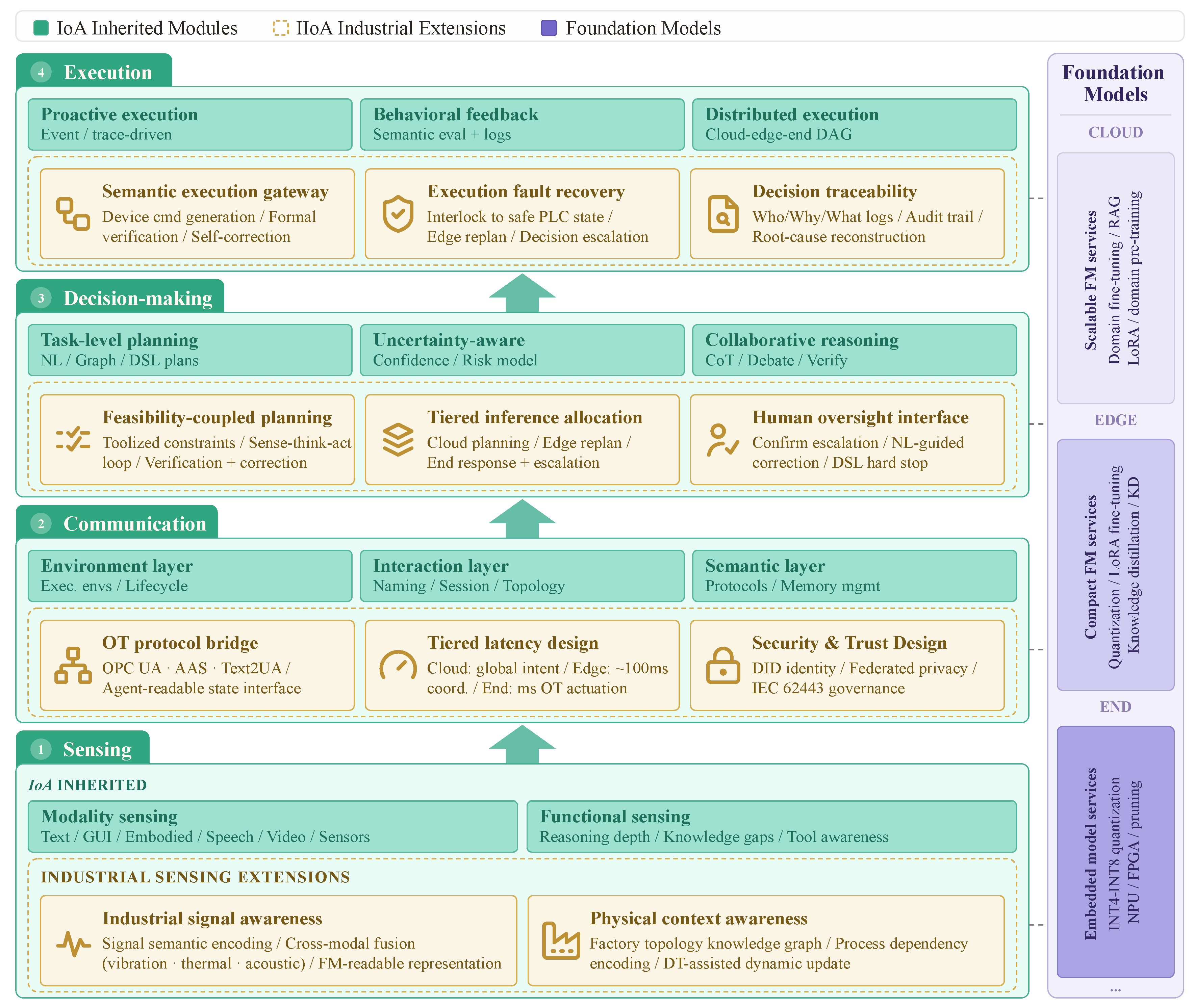
Figure 2.
Deployment Scenarios.
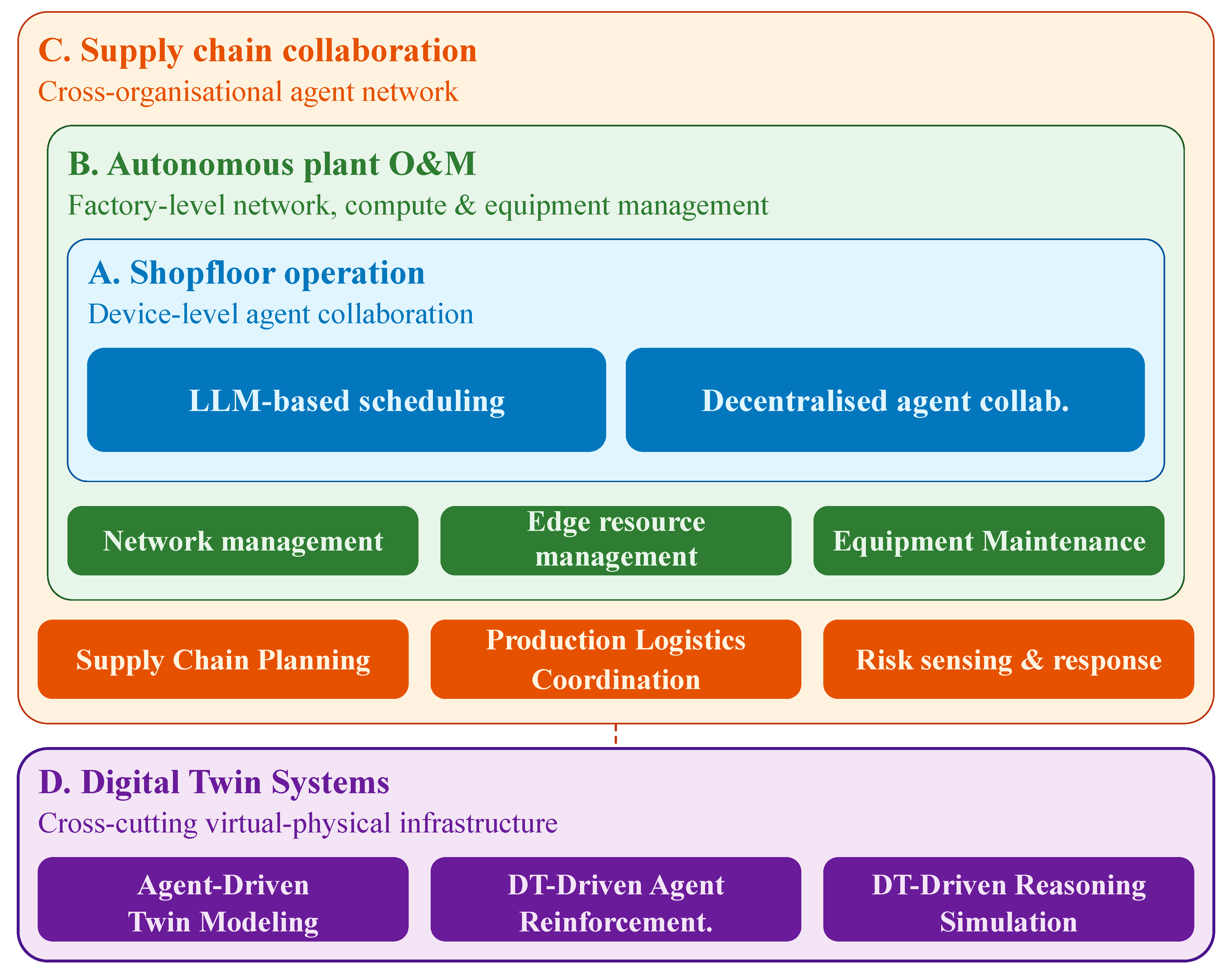

Table 1.
Conceptual Boundary of IIoA
| Concept | Core Unit | Coordination Logic | Relation to IIoA | Boundary Emphasis | ||||
|---|---|---|---|---|---|---|---|---|
| Conn. | Agent | FM | Phys. | OT | ||||
| IIoT | Devices, sensors, platforms | Connectivity and industrial data flow | Data substrate | • | – | – | ∘ | ∘ |
| Industrial MAS | Task-oriented agents | Rule- or model-based negotiation | Agent-system lineage | ∘ | • | – | ∘ | ∘ |
| IoA | Networked AI agents | General agent-network scaffold | Architectural scaffold | – | • | • | – | – |
| CPS/CPPS | Cyber-physical assets | Computation-physical feedback | Cyber-physical context | ∘ | ∘ | – | • | ∘ |
| IIoA | FM-enabled industrial agents | Semantic coordination under industrial constraints | Target architecture | • | • | • | • | • |
Table 2.
Industrial deployment comparison of FMs
| Deployment Tier | Typical Latency | Cognitive Complexity & Tasks | Model Scale* | Model Type | Industrial Adaptation | Representative Works |
|---|---|---|---|---|---|---|
| Cloud | Seconds (s) | Global intent decomposition, cross-domain planning, multi-step reasoning, node collaboration | >30B | LLM/VLM | Industrial post-training, RAG, domain pre-training | IFM[23],LLM-MANUF[9] |
| Edge | Hundreds of ms (∼100ms) | Local anomaly diagnosis, task reallocation, node collaboration | 3B-30B | SLM/VLM | LoRA/QLoRA, knowledge distillation, INT8 quantization | EdgeShard[21], MASC (QLoRA 7B)[24] |
| End | Milliseconds (ms) | Device-state interpretation, command assistance, and local response, simple node collaboration | <3B | Tiny LLM/VLA | INT4/INT8 quantization, NPU/FPGA acceleration, model pruning | NanoVLA[22], EdgeShard[21] |
Table 3.
IIoA Sensing Industrial Extension
| Industrial Requirement | IIoA Extension | Sensing Capability | References |
|---|---|---|---|
| ]3=Industrial field signals | ]3=Industrial Signal Awareness | Temporal signal representation from vibration, acoustic, thermal, and electrical streams | Time-LLM[29] |
| Fault-oriented alignment between engineering time-series and LLM representations | FD-LLM[30] | ||
| Multimodal fusion of industrial signals for equipment-state interpretation | QwIndustry[31] | ||
| ]3=Factory topology and physical dependencies | ]3=Physical Context Awareness | Disturbance-context modeling over manufacturing-system dependencies | Pei et al.[32] |
| Dependency-aware scheduling context for machine-agent coordination | Qin and Lu[33] | ||
| Digital-twin and knowledge-graph updating of process context | Stavropoulou et al.[34] |
Table 4.
IIoA Communication Industrial Extension
| Industrial Requirement | IIoA Extension | Communication Mechanism | References |
|---|---|---|---|
| ]4=Heterogeneous OT protocols | ]4=OT Protocol Bridge | OPC UA / Modbus field-data acquisition and protocol translation gateway | Ventuneac and Gaitan[35] |
| AAS-based asset semantic interface generation for digital-twin exchange | Xia et al.[36] | ||
| Text-to-OPC UA information-model construction | Wang et al.[37] | ||
| LLM-agent interface for industrial control and command writing | Xia et al.[38] | ||
| ]3=Mixed latency classes | ]3=Tiered Latency Design | Deterministic networking for time-critical control traffic | Zhang et al.[25] |
| Cloud-edge adaptive inference for latency-aware LLM services | Jin and Wu[39] | ||
| Edge-terminal dual-loop collaboration for distributed agents | Qu et al.[40] | ||
| ]4=Cross-domain industrial trust | ]4=Security & Trust Design | DID-based cross-domain verification for IoT data collection | Zhang et al.[41] |
| Federated LLM communication under data-sovereignty constraints | Cheng et al.[42] | ||
| Eavesdropping-aware decentralized learning for protected data exchange | Xu et al.[43] | ||
| IEC 62443-aligned cybersecurity governance for IIoT systems | Cindrić et al.[44] |
Note: OPC UA, OPC Unified Architecture; AAS, Asset Administration Shell; TSN, time-sensitive networking; DID, decentralized identifier.
Table 5.
IIoA Decision-Making Industrial Extension
| Industrial Requirement | IIoA Extension | Decision Mechanism | References |
|---|---|---|---|
| ]4=Device/ process/ safety constraints | ]4=Feasibility-coupled Planning | Solver-backed planning formalization; device/process/safety constraints | Hao et al.[45] |
| Constraint-programming model generation; natural-language requirements | ConstraintLLM[46] | ||
| User-refined rule extraction and model checking for generated plans | VeriPlan[47] | ||
| Violation feedback and repair suggestions for infeasible plans | Hao et al.[45]; VeriPlan[47] | ||
| ]3=Heterogeneous reasoning capacity | ]3=Tiered Inference Allocation | Model and tool orchestration for complex task decomposition | HuggingGPT[48] |
| Global-local guidance; long-horizon planning; execution correction | HiPlan[49] | ||
| Dynamic task-graph scheduling for asynchronous multi-agent execution | DynTaskMAS[50] | ||
| ]4=High-risk or low-confidence decisions | ]4=Human Oversight Interface | Uncertainty-calibrated help requests; ambiguous or low-confidence plans | KnowNo[51] |
| Human-guided correction; human-in-the-loop agent workflows | Takerngsaksiri et al.[52] | ||
| User-in-the-loop refinement of verification rules and plan violations | VeriPlan[47] | ||
| Runtime rule enforcement; unsafe or rule-violating agent actions | AgentSpec[53] |
Table 6.
IIoA Execution Industrial Extension
| Industrial Requirement | IIoA Extension / Stage | Execution Mechanism | References |
|---|---|---|---|
| ]3=Certified physical command generation | ]3=Semantic Execution Gateway Pre-execution | PLC code generation; grammar, compiler, and SMV-based verification | LLM4PLC[54] |
| Closed-loop PLC code generation; LLM-agent verification workflow | Agents4PLC[55] | ||
| Domain-knowledge-constrained PLC synthesis; generation-verification-repair loop | MPC-Coder[56] | ||
| ]4=Physical-risk-aware recovery | ]4=Execution Fault Recovery In-execution | Machinery safety requirements; safe-state response boundary | IEC 62061 |
| VLM-based failure detection; reactive planner and behavior-tree recovery | Ahmad et al.[57] | ||
| Ontology-guided online failure identification; LLM-based recovery planning | Recover[58] | ||
| Plan-execution misalignment detection; constraint-guided recovery | DoReMi[59] | ||
| ]3=Auditable execution accountability | ]3=Decision Traceability Full-lifecycle | Agent-interaction provenance; prompts, responses, decisions, and workflow events | PROV-AGENT[60] |
| Runtime constraint enforcement; unsafe or rule-violating action control | AgentSpec[53] | ||
| LLM-assisted failure localization; post-incident root-cause evidence | Wang et al.[61] |
Table 7.
Overview of References on Application Scenarios
| Scenario | Reference | Core Tech | Maps to IIoA Extensions |
|---|---|---|---|
| Shopfloor Operations |
MASC, Wang et al.[24] | QLoRA / scheduling chain / ReAct-DialBag | Tiered Inference, Feasibility Planning |
| Li et al.[16] | RAG / multi-constraint scheduling / evaluation iteration | Feasibility Planning | |
| Huang et al.[62] | Local LLM fine-tuning / multi-level evolutionary mechanism | Tiered Inference | |
| Zhao et al.[14] | Multi-agent bidding negotiation / NL task allocation | Tiered Inference | |
| Lim et al.[15] | Dual-layer agent architecture / G-code negotiation | Tiered Inference | |
| Autonomous Plant O&M |
NetLLM, Wu et al.[63] | Unified network tasks / DD-LRNA | Tiered Inference |
| NetAssistant, Wang et al.[64] | LLM agent network O&M diagnosis | Human Oversight | |
| Confucius[65] | Multi-agent DAG workflow / built-in correctness verification | Feasibility Planning, Execution Gateway | |
| Wang et al.[66] | LLM agent network slicing / intent-driven resource scheduling | Tiered Latency, Tiered Inference | |
| IRL, Ren et al.[67] | LLM cognitive evaluation / RL reward / DID trusted offloading | Tiered Inference, Security & Trust | |
| LMAMD, Gao et al.[68] | Multi-agent microservice deployment / constraint decomposition | Feasibility Planning | |
| Cha et al.[69] | LLM agent PHM / full-chain parameter auto-configuration | Signal Awareness | |
| Lee et al.[70] | LLM agent fault diagnosis / NL explanation generation | Signal Awareness | |
| PHM Copilot, Lukens et al.[71] | LLM agent PHM / standard maintenance protocols | Signal Awareness, Execution Gateway | |
| Supply Chain Collaboration |
Jannelli et al.[72] | Multi-agent consensus negotiation / bullwhip suppression | Tiered Inference |
| InvAgent, Quan et al.[73] | Multi-level inventory LLM agents / zero-shot CoT replenishment | Tiered Inference | |
| SCPA, Yin et al.[74] | Multi-agent supply chain planning / 10M+ SKU planning | Tiered Inference, Feasibility Planning | |
| ChatSync, Li et al.[75] | Resource spatio-temporal graph / IIoT data fusion | Physical Context, Signal Awareness | |
| Zhang et al.[76] | Knowledge synthesis / unstructured records | Physical Context | |
| AlMahri et al.[77] | Zero-shot NLP entity extraction / supplier knowledge graph | Physical Context | |
| Zheng et al.[78] | GenAI relationship prediction / supply graph completion | Physical Context | |
| AlMahri et al.[79] | 7-agent disruption monitoring / risk cascade quantification | Physical Context, Feasibility Planning | |
| Digital Twin Systems |
Xia et al.[80] | Multi-agent DT parameter auto-calibration | Signal Awareness, Physical Context |
| Yang et al.[81] | AI agent × DT integration paradigm | Cross-module | |
| ChatCNC, Jeon et al.[82] | LLM multi-agent / real-time RAG / CNC NL queries | Signal Awareness, OT Bridge | |
| Gautam et al.[7] | MTConnect / four-class specialized agents | Signal Awareness, OT Bridge | |
| DT-MADDPG, Hua et al.[83] | Collaborative DT / multi-agent cooperative training | Tiered Inference | |
| DT-MDP-CE, Yang et al.[84] | Inverse RL / DT trajectory optimization / failure memory | Feasibility Planning | |
| Laukaitis et al.[85] | Dual DT framework / cross-domain transfer | Tiered Inference | |
| Gill et al.[86] | LLM agent / DT knowledge base / control policy verification | Feasibility Planning, Execution Gateway | |
| AROMA-GPT, Ndum et al.[87] | Nuclear reactor DT / OPC UA invocation / RG constraints | OT Bridge, Feasibility Planning, Execution Gateway |
Note: Extension names are abbreviated. “Cross-module” indicates work that spans multiple extensions without focusing on any specific one. QLoRA, quantized low-rank adaptation; RAG, retrieval-augmented generation; NL, natural language; DAG, directed acyclic graph; RL, reinforcement learning; PHM, prognostics and health management; CoT, chain-of-thought; SKU, stock keeping unit; NLP, natural language processing; RG, reference governor.
Table 8.
Core challenges, problems, and possible solutions in IIoA
| Challenge | Module | Specific Problems | Solutions |
|---|---|---|---|
| Execution Reliability | FM / Decision / Exec. | Step verification: Limited end-to-end guarantees for long task chains [46,47]. Safety prediction: Weak long-horizon trajectory prediction before execution [53]. Fault cascading: Single-agent recovery can propagate downstream failures [88]. | Reachability: Discrete-time Markov chain (DTMC)-based unsafe-state reachability estimation [53,89]. Coverage: Multi-step conformal prediction with tiered allocation. Isolation: Dependency-aware protocols to block propagation and report local failure. |
| Inference Latency | FM / Exec. / Comm. | Routing: Empirical thresholds lack optimality and formal verification under dynamics [21]. Real-time loops: Latency/reliability of edge agents in control loops remains under-evaluated [26]. Energy: Device energy limits are often treated as secondary design factors. | Joint routing: Optimize latency, accuracy, and communication overhead. Co-design: Quantization-aware training and pruning for edge dataflow. Benchmarks: Latency-accuracy-energy metrics for tiered inference. |
| OT Protocol Integration | Comm. / Exec. | Translation loss: OT-to-semantic conversion lacks closed-loop integrity checks [37]. Verification scope: PLC-centered checks do not yet cover heterogeneous protocols [55]. Latency impact: Translation overhead on control frequency is unquantified [25,26]. | Equivalence: Bidirectional checks between semantic models and field data. Agnostic pipeline: Device-independent generation and verification. Boundaries: Latency limits for different control frequencies. |
| Collaboration Scalability | Comm. / Decision | Convergence: Bounds for large heterogeneous networks remain undeveloped [90]. Churn: Protocols remain weakly tested under frequent node failure or joining. | Sparse protocols: Coordination with convergence bounds and scaling laws. Tiered consensus: Local cluster convergence before cross-cluster synchronization. |
| Physical Foundation | FM / Sensing / Decision | Grounding: Agents rely on external knowledge graph/DT data rather than causal physical structures [91]. Generalization: Physics-informed machine learning remains process-specific [92]. Drift: World-model errors accumulate in long-horizon planning. | Causal priors: Embed physical constraints into representation learning. Online updates: Refresh physical priors from operational data. Error bounds: Define tolerance limits for world-model drift. |
| Continuous Adaptability | FM | Knowledge aging: Equipment/process drift degrades model performance [93]. Data scarcity: Rare anomalies and annotation costs limit evolution. | Efficient adaptation: LoRA/Adapters for low-cost online updates. Benchmarks: Drift, aging, and fault-evolution evaluation. |
| Evaluation System | Cross-module | Static bias: Offline tests miss emergent behavior and real-time constraints. Metric gap: Translation accuracy, OT latency, and recovery rates lack unified definitions. Sim-to-real gap: Simulation fidelity and noise biases remain unquantified. | Online evaluation: Latency, recovery, and compliance as dynamic metrics [94]. Sandboxes: Reproducible OPC UA/Modbus tests with sim-to-real measurements. Metrics: Adapt task-success metrics to hard real-time control. |
Disclaimer/Publisher’s Note: The statements, opinions and data contained in all publications are solely those of the individual author(s) and contributor(s) and not of MDPI and/or the editor(s). MDPI and/or the editor(s) disclaim responsibility for any injury to people or property resulting from any ideas, methods, instructions or products referred to in the content. |
© 2026 by the authors. Licensee MDPI, Basel, Switzerland. This article is an open access article distributed under the terms and conditions of the Creative Commons Attribution (CC BY) license (http://creativecommons.org/licenses/by/4.0/).
Copyright: This open access article is published under a Creative Commons CC BY 4.0 license, which permit the free download, distribution, and reuse, provided that the author and preprint are cited in any reuse.