

Submitted:
15 September 2026
Posted:
16 September 2026
You are already at the latest version
Abstract
Purpose: This review explores how artificial intelligence (AI) and AI-enabled digital transformation (AI-DT) may reshape the executive role of the Chief Financial Officer (CFO). It treats the CFO as a member of the top management team and as a strategic, operational, and governance actor rather than only as the leader of the finance function. Design/methodology: An integrative review synthesizes 22 publications identified through targeted searches, review through the CFO lens by one of the authors, publisher and DOI verification, and backward and forward citation searching. One author conducted the identification, initial screening, extraction, and coding; the second author independently audited every inclusion, classification, extraction, and claim–source decision. All differences were resolved by consensus. The final hierarchy contains two direct role-transformation studies, one direct executive-relationship study, five CFO antecedent-and-outcome studies, and fourteen contextual finance-function studies. Findings: The strongest direct evidence does not support simply replacing traditional finance tasks with AI-related strategic tasks. Instead, the reviewed publications suggest a cumulative rebalancing across seven dimensions: (1) responsibilities and mandate, (2) decision rights and authority, (3) strategic influence, (4) executive relationships, (5) competencies and capabilities, (6) professional identity, and (7) governance and accountability. Evidence is strongest for digitalization, analytics, automation, and multi-technology transformation; it is more limited for AI-specific research and very limited for generative or agentic AI. Four provisional configurations—AI Value Strategist, Transformation Catalyst, Digital Steward and Governor, and Efficiency-focused Finance Operator—are presented as emerging but testable propositions rather than validated job types. Originality/value: The review clearly distinguishes between direct insights into the CFO’s role and those that originate from the broader finance and organizational context or are related but less robust. It specifies which technologies are involved and develops a multilevel research agenda covering AI investment, AI-related value creation, human–AI work allocation, and responsible corporate governance.
Keywords:
artificial intelligence
; Chief Financial Officer
; digital transformation
; role theory
; strategic leadership
; AI governance
; finance-function transformation
; human–AI collaboration
1. Introduction
Artificial intelligence is moving from isolated technical experiments into real-life business and finance processes such as forecasting, scenario analysis, risk detection, decision support, and reporting. Management research (Jarrahi, 2018; Raisch & Krakowski, 2021) distinguishes between automation (a system that performs work previously completed by people) and augmentation (a system that extends human analysis and judgment). AI may also redistribute decision tasks and authority across people, teams, and systems (Shrestha et al., 2019). These developments make AI-DT an organizational design issue, not just a software or technology issue.
The CFO is important to this discussion because major AI initiatives require investment evaluation, resource allocation, performance measurement, risk oversight, and credible controls. These responsibilities do not make the CFO the sole owner of AI, but they place the CFO at the intersection of technological opportunities, financial discipline, and accountability. Organizational AI capability depends on data, technology, people, and further organizational resources rather than on software alone (Mikalef & Gupta, 2021). The CFO can influence whether those elements are funded, measured, scrutinized, and integrated.
The transformation of the CFO role should not be described as a simple shift of finance tasks to AI-related tasks. CFOs retain their core duties such as accounting, reporting, cash management, financing, controlling, and risk management. The relevant question is, rather, how AI-DT changes the balance between those duties and newer responsibilities. Direct role studies show that technology may allow CFOs to redirect attention toward strategy, digital transformation, ecosystem development, and governance (Chatpibal et al., 2024; Sandner et al., 2020). Evidence on CFO-CIO relationships further shows that digital change depends on how executives share information, costs, decision rights, and responsibility (Denford & Schobel, 2021).
The reviewed literature is fragmented. Broad CFO research covers accounting quality, capital structure, risk, strategy, and executive characteristics. Rashid et al. (2024) mapped 669 CFO studies and described a large but divided research field. Usman et al. (2024) reviewed technology and CFO role development across 42 articles but did not focus specifically on AI-enabled executive role transformation. Other reviews examine digitalization in accounting, AI in management accounting, and organizational digital transformation (Abbas, 2026; Knudsen, 2020; Nadkarni & Prügl, 2021). These streams usually place the profession, finance function, or organization at the center rather than specifically the CFO as an executive actor.
The unresolved issue, therefore, is not whether the CFO has become more strategic. Professional and scholarly literature already establishes that argument (Canace & Juras, 2014; Hope, 2006). The issue is how AI-related change affects the CFO’s responsibilities, authority, strategic influence, relationships, competence requirements, professional identity, and accountability - and how confidently the available evidence supports each claim. Available studies of CFO demographics and digital outcomes are informative but do not explain how roles change. Finance-function studies explain tasks, skills, and work design, but their CFO implications are indirect. Treating these very different types of sources as equivalent would make the literature appear more developed than it is.
A second gap concerns value realization. Organizations often discuss AI in terms of adoption, use cases, or efficiency, but adoption is not the same as realized value. Automation can reduce processing time without improving decisions, resilience, customer outcomes, or financial performance. The CFO may help define baselines, identify total costs, track benefits, and decide whether to scale, change, or stop a pilot. Yet the reviewed studies contain little direct evidence on how CFOs influence AI value over time. This gap shows that the link between executive role design and measurable organizational outcomes is empirically underexplored.
The review at hand asks: How does scholarly literature conceptualize and explain the transformation of the CFO’s executive role in the context of AI-DT? Six subquestions are raised to examine (1) role dimensions and configurations, (2) transformation scope and maturity, (3) competencies and capabilities, (4) executive relationships and decision boundaries, (5) governance responsibilities, and (6) contextual variations and gaps (see Table 1). The review further contributes a seven-dimensional analytical model, a transparent evidence hierarchy, four provisional role configurations, and a multilevel research agenda linking individual CFO attributes, finance-function capabilities, top-management-team arrangements, organizational outcomes, and institutional conditions.
The article proceeds as follows. Section 2 defines the main concepts and theoretical lenses. Section 3 presents the evidence profile, the two-author cross-audit, the evidence hierarchy, and the quality appraisal, and answers the six subquestions. Section 4 integrates the results and develops the multilevel framework. Section 5 to 8 present the research agenda, practical implications, limitations, and conclusion.
2. Conceptual Boundaries and Theoretical Framework
2.1 CFO Role Transformation and AI-Enabled Digital Transformation
The CFO role consists of the expectations, responsibilities, decision rights, relationships, skills, and accountability duties associated with this executive finance position. Traditional descriptions emphasize stewardship: reliable reporting, liquidity management, financing, control, compliance, and risk management. More recent studies add business partnering, strategy, transformation, and value creation (Canace & Juras, 2014; Hope, 2006). Role transformation occurs when these expectations change durably. New software does not automatically transform the CFO role; the change must substantially and durably change what the CFO is expected to do, decide, influence, know, or drive.
AI is the technology in focus; the scope includes machine learning, predictive and prescriptive analytics, natural-language systems, generative and agentic AI, and AI-enabled decision support. The review also includes multi-technology digital-transformation studies if AI is either explicitly measured or at least part of the transformation being examined. This boundary reflects the practical approach, where AI is often adopted with cloud systems, big data, enterprise platforms, and automation. Antecedent technology studies without an explicit AI component are only considered if they provide direct evidence of the CFO's role or explain a mechanism relevant to AI-DT.
Digital transformation is broader than digitization or digitalization. Digitization converts analog information into digital form. Digitalization uses digital technologies, including AI, to improve activities and processes. Digital transformation (including AI-DT) affects an organization broadly, from processes and operating models to capabilities, decisions, and even business models (Nadkarni & Prügl, 2021). Finance-function transformation is one part of that wider process. It may automate reporting or forecasting without changing the CFO’s executive role. Conversely, a CFO may gain enterprise responsibility for AI investment or governance while internal finance processes are only changing gradually.
The place of transformation and its maturity level are two separate analytical dimensions. A small finance pilot may change a narrow task while leaving executive roles untouched. In contrast, a scaled enterprise-wide system change can influence capital allocation, risk management, customer processes, the operating model, and ultimately executive roles themselves. As existing studies do not offer a validated maturity scale, this synthesis applies a cautious three-level distinction: local experimentation, scaled functional deployment, and enterprise-wide transformation. These categories describe the scope of change rather than a universal sequence of events.
Individual competency must also be separated from organizational capability. A CFO may understand AI but work in a firm with fragmented data, weak infrastructure, or limited technical talent. Conversely, an organization may have advanced AI systems but a CFO who remains outside key decisions. Organizational AI capability combines data, technology, people, and complementary organizational resources (Mikalef & Gupta, 2021). CFO role transformation depends on the interaction between individual competencies and the wider organizational capability.
2.2. Theoretical Lenses
Role theory is the primary organizing lens. It explains how expectations are attached to organizational positions and how people respond when expectations expand or conflict (Biddle, 1986). In this review, role expansion refers to adding strategy, transformation, data, or governance duties. Role ambiguity refers to unclear boundaries between the CEO, CFO, other C-level roles, business unit, and functional leaders. Role conflict concerns simultaneous expectations to promote innovation and constrain risk, and role overload occurs when new duties are added without removing older ones; identity transition describes how finance leaders understand their professional contribution.
Upper Echelons theory explains why CFOs may respond differently to similar technologies. Executive experience, education, age, international exposure, personality, and cognitive orientation can shape how leaders interpret opportunities and threats (Hambrick, 2007; Hambrick & Mason, 1984). The Category B studies provide evidence about these antecedents. They do not directly observe changes in tasks, authority, identity, or accountability, so the theory explains heterogeneity rather than role transformation itself.
Dynamic capabilities theory provides an organizational perspective (Teece et al., 1997). Firms must sense AI opportunities, select and fund suitable uses, and reconfigure people, processes, and governance (Teece, 2007). The CFO may contribute through investment appraisal, portfolio management, performance measurement, and resource reallocation. The reviewed studies rarely measure sensing, seizing, and reconfiguration directly; the theory therefore serves as an interpretive bridge.
A focus on human–technology interaction, and particularly human–AI interaction, clarifies why work design is changing. AI may automate some tasks, augment human judgment in others, and create new checking and oversight work (Jarrahi, 2018; Raisch & Krakowski, 2021). AI-DT may therefore require a redistribution of decision authority among people, teams, and systems (Shrestha et al., 2019). The central question is thus not whether a machine or a person decides alone, but how analysis, judgment, approval, challenge, and accountability will be reconfigured between humans and AI.
Each theoretical lens contributes a distinct element. Role theory structures the outcome. Upper-echelons theory explains CFO-specific antecedents. Dynamic capabilities help interpret organizational transformation. Human–AI interaction clarifies how tasks and decisions are redistributed. The framework relies on neutral connectors because the underlying evidence is largely cross-sectional, qualitative, conceptual, or indirect.
In addition to these lenses, the review draws on a well-established, practice-oriented typology of the four ‘CFO faces’ - strategist, catalyst, steward, and operator (Deloitte, 2020; Ehrenhalt & Ryan, 2007). In this context, it serves as a guiding framework rather than an empirically derived classification. These role profiles bundle typical combinations of responsibilities that a CFO may hold at the same time. This work specifies their content, boundaries, and potential implications in the context of AI.
3. Evidence and Findings
3.1. Evidence Profile, Technology Coverage, and Quality
We identified studies through targeted scholarly searches, a literature review by an experienced CFO, and backward and forward citation searching, with publisher and DOI verification for each source. One author performed identification, screening, extraction, and coding; the second author independently audited every inclusion, classification, extraction, and claim–source decision, and the authors resolved disagreements by consensus (Snyder, 2019). Table 2 summarizes the review process and the two-author cross-audit.

Table 2.
Review process and two-author cross-audit.
| Stage | Lead | Primary action | Audit and resolution |
| 1. Identification | Author 1 | Targeted searches, prior-review mining, publisher/DOI verification, and citation searching. | Author 2 audited source relevance and retrievability. |
| 2. Eligibility | Author 1 | Applied role, technology, and organizational-scope criteria. | Author 2 audited every retained and rejected candidate decision in the working register. |
| 3. Extraction | Author 1 | Extracted design, sample, technology, scope, theory, findings, and limitations. | Author 2 checked each field against the full text or version of record. |
| 4. Classification | Author 1 | Assigned evidence category, technology layer, role dimensions, and quality. | Author 2 independently challenged and confirmed every assignment. |
| 5. Synthesis | Both authors | Compared direct, antecedent, contextual, mixed, and negative evidence. | All differences were resolved by consensus before drafting. |
| 6. Claim audit | Author 2 | Audited every substantive claim against its cited source. | Author 1 corrected or narrowed each claim before final approval by both authors. |
The reconciled evidence set contains 22 publications (see Table 3): two Category A1, one Category A2, five Category B, and fourteen Category C. This distribution is itself a finding. Direct evidence about the CFO’s practical role is small. The largest body of evidence concerns finance-function roles, management accountants, analytics, automation, and human–AI work. The review therefore gives greatest weight to A1 and A2 for direct CFO claims, uses B for antecedents and variation, and uses C to explain mechanisms and boundary conditions.
Table 3.
Evidence relevance and directness (corpus reconciliation).
| Category | Definition | n | Use in the review |
| A1. Direct CFO role-content/change evidence | Directly examines the content of, or changes in, CFO responsibilities, authority, influence, identity, competencies, or accountability. | 2 | Primary evidence for executive role-transformation claims. |
| A2. Executive relationship/decision boundary | CFO is central, but the study focuses on collaboration, role perceptions, shared governance, or decision boundaries. | 1 | Direct evidence for relationships and authority; not treated as complete role transformation. |
| B. CFO antecedent / organizational outcome | Links CFO attributes or experience with technology adoption, digital transformation, or organizational outcomes. | 5 | Explains heterogeneity and antecedents; not direct evidence of real-life role change in practice. |
| C. Contextual finance-function / human–AI evidence | Examines finance roles, analytics, automation, AI adoption, identity, or work design with explicit CFO implications. | 14 | Explains mechanisms, competencies, tensions, and boundary conditions; implications labeled indirect. |
The technology mix is equally important. Three studies are directly AI-specific: Leitner-Hanetseder et al. (2021), Losbichler and Lehner (2021), and Abbas et al. (2026). Seven studies include AI as one component of a broader technology or digital-transformation construct: Sandner et al. (2020), Andreassen (2020), Rautiainen et al. (2024), Yao et al. (2024), Wu et al. (2025), Liu and Wu (2026), and Rieg and Vanini (2026). The remaining twelve studies examine non-AI antecedents or contextual technologies. Findings about generative AI rest mainly on contextual evidence, and agentic AI is not sufficiently represented for a substantive conclusion (see Table 4).
Table 4.
Technology layers and evidence quality.
| Profile | n | Meaning | Interpretive rule |
| Direct AI-specific | 3 | AI or generative AI is central to the study. | Direct evidence remains concentrated in accounting and finance-function contexts. |
| AI-material multi-technology | 7 | AI is explicitly measured or materially embedded in a broader transformation construct. | Relevant to AI-DT but cannot isolate an AI-only effect. |
| Non-AI antecedent/context | 12 | ERP, blockchain, analytics, IT projects, digitalization, or governance provides direct CFO evidence or mechanism context. | Used as antecedents or contextual evidence, not as proof of direct AI effects. |
| Stronger evidence | 12 | Comparatively strong design transparency and evidence–claim alignment. | Still subject to design- and context-specific limits. |
| Moderate evidence | 10 | Relevant and usable, with material limitations or indirectness. | Supports triangulation and boundary conditions. |
The quality appraisal classifies twelve studies as stronger evidence and ten as moderate evidence. ‘Stronger’ does not suggest causality or broad generalizability; it simply means that the design, data, transparency, and alignment between evidence and claims are relatively more robust within the reviewed heterogeneous set of studies. Even if the synthesis is limited to Category A1, A2, B, and stronger contextual C studies, the seven dimensions of CFO role transformation will stay intact - although some statements related to governance and value realization might become a bit more tentative.
Geographical and methodological concentration remains visible. Category B evidence is heavily influenced by archival studies of Chinese listed companies, while direct role evidence comes from Germany or international experts, Thai CFOs, and Canadian public-sector CFO / CIO pairs. Contextual evidence spans several countries and often examines controllers or finance employees. The results should therefore be understood as an evidence-based framework rather than a universal description of all CFOs.
No publication in the selected corpus is both AI-specific and a direct study of CFO role transformation. The AI-specific publications focus on accounting roles, controlling, or organizational adoption, whereas the direct CFO role publications focus on blockchain or broader digital transformation. The analysis at hand therefore integrates direct CFO evidence with explicitly labeled contextual evidence, and the results are subject to further testing.
3.2. SQ1: Seven Dimensions of CFO Role Transformation
3.2.1. Responsibilities and Mandate
The reviewed studies suggest that technology can broaden the CFO’s mandate while traditional responsibilities remain. Sandner et al. (2020) found that blockchain and connected technologies could automate processes while redirecting attention toward strategy, performance measures, and business ecosystems. Chatpibal et al. (2024) described an integrated CFO role combining stewardship, investment efficiency, digital transformation, CEO partnership, integrity, and governance. These A1 studies provide the clearest direct support for cumulative role expansion. However, neither examines AI directly - Sandner et al. (2020) study blockchain, and Chatpibal et al. (2024) theorize the CFO role in a generally changing environment. Contextual AI studies add expected responsibilities for output quality assurance, authorization, security, and coordination with technology specialists (Leitner-Hanetseder et al., 2021). The reviewed studies do not support the claim that all CFOs take over such responsibility. They also offer only limited direct evidence of how organizations actually create value with AI.
3.2.2. Decision Rights and Authority
Decision rights seem to be renegotiated rather than simply transferred to the CFO. Denford and Schobel (2021) showed that the relationship between the CFO and CIO depends on how closely they work together and on their shared understanding of strategic value and cost-effectiveness. Andreassen (2020) found that digitalization narrowed some local tasks while expanding group-level work, creating jurisdictional tensions. Mohanna et al. (2025) showed that finance professionals can gain influence by shaping controls inside technology projects without owning the technology itself. The review therefore suggests that CFO authority is likely to increase around funding, performance, control, and risk, while close cooperation with technology and business leaders remains important.
3.2.3. Strategic Influence
Strategic influence is supported directly by the integrated role described by Chatpibal et al. (2024) and the technology-related role changes identified by Sandner et al. (2020). Contextual evidence suggests that finance professionals add value when they translate analytics into decision support rather than merely produce data (Szukits, 2022). Category B studies also indicate that CFO experience, education, and personality correlate with digital transformation effects within organizations (Liu & Wu, 2026; Wu et al., 2025; Yao et al., 2024). These associations support upper echelons theory, but they do not show that a particular demographic profile creates a superior strategic CFO role.
3.2.4. Executive and Organizational Relationships
AI-DT increases cross-functional dependencies. As shown above, Denford and Schobel (2021) conclude that CFO–CIO effectiveness is related to shared perceptions and collaborative setups. Rautiainen et al. (2024), Mohanna et al. (2025), and Abbas et al. (2026) show that multidisciplinary work, cross-functional collaboration, and removing organizational silos matter for digital and AI adoption. Overall, the findings suggest that CFOs need to actively manage role boundaries rather than operate independently.
3.2.5. Competencies and Capabilities
The evidence supports a mixed competence profile rather than a purely technical one. Roozen et al. (2019), Oesterreich et al. (2019), and Tiron-Tudor and Deliu (2021), which examine controllers and management accountants rather than CFOs, identify combinations of technological literacy, analytical judgment, business understanding, and interpersonal skills. AI-specific studies add the need to understand model limits, data dependence, output verification, authorization, security, and regulation (Abbas et al., 2026; Leitner-Hanetseder et al., 2021; Losbichler & Lehner, 2021). These findings show that a CFO does not need to become a data scientist, but must evaluate results, challenge assumptions, and collaborate with technical specialists. An organization's capabilities are a separate boundary condition. In other words, even a highly AI-competent CFO cannot compensate for poor data across the firm, disconnected IT systems, or weak governance.
3.2.6. Professional Identity
The available evidence on identity does not support a simple transition from traditional “steward/operator” to “AI value strategist.” Chatpibal et al. (2024) combine stewardship, strategy, transformation, and integrity in one role. Andreassen (2020), Rautiainen et al. (2024), Mohanna et al. (2025), and van Slooten et al. (2026), which all study management accountants rather than CFOs, show that digital work can produce fluid identities, jurisdictional tensions, job crafting, conflict, and role ambiguity. Traditional control expectations therefore remain part of the role while strategic and technology-related expectations expand. The likely outcome is a hybrid identity whose content varies across organizational settings.
3.2.7. Governance and Accountability
Governance and accountability are among the least directly evidenced dimensions. Sandner et al. (2020) and Chatpibal et al. (2024) connect technology-related role change with integrity, controls, performance measures, and governance. AI-specific contextual studies identify output quality assurance, authorization, security, ethical limits, and human judgment as important (Leitner-Hanetseder et al., 2021; Losbichler & Lehner, 2021). Mohanna et al. (2025) describe finance professionals as control architects, while Rieg and Vanini (2026) warn that heavy prior process automation is negatively correlated with digital readiness, creating an “automation-rigidity paradox” (p. 187). The review therefore suggests an emerging shared-accountability role, not sole CFO ownership of model risk, cybersecurity, or AI ethics. Table 5 summarizes the seven role dimensions, the directness of the supporting evidence, and its overall strength.
3.3. SQ2: Transformation Scope and Maturity
The reviewed studies span three scopes. (1) Local or finance-function studies focus on tasks, competencies, anxiety, identity, and process automation. (2) Cross-functional studies examine IT projects, CFO–CIO relationships, and shared governance. (3) Enterprise-wide studies link CFO characteristics with broad digital-transformation measures or describe the CFO as a transformation partner. This variation matters because a local analytics tool may change work without changing executive authority, whereas enterprise transformation can alter capital allocation, performance systems, and accountability.
The corpus does not support a proven maturity model. A cautious pattern of CFO contribution nevertheless appears.
- In the experimentation stage, it centers on budget approval, business-case challenge, and risk questions.
- In a scaled functional deployment, control of operating-model design, talent, and service delivery becomes more important.
- In an enterprise-wide transformation, investment portfolio choices, executive coordination, new performance measures, and governance gain relevance.
This pattern is an interpretive synthesis, not evidence that firms always follow this sequence.
The technology sensitivity check also narrows the conclusion. When we retain only direct AI-specific and AI-material multi-technology studies, all seven dimensions of role transformation remain visible, but authority, professional identity, and value realization rely more heavily on contextual evidence. The strongest direct role evidence remains centered on digital transformation and blockchain rather than generative AI. Our article therefore uses “AI-enabled” to describe the organizational context, not to claim that AI alone caused every observed change.
3.4. SQ3: Individual Competencies and Organizational Capabilities
Individual CFO competencies include AI literacy, analytical judgment, business understanding, investment evaluation, communication, constructive challenge, ethical reasoning, and governance awareness. The reviewed competency studies consistently combine technical and non-technical elements (Oesterreich et al., 2019; Roozen et al., 2019; Tiron-Tudor & Deliu, 2021). AI-specific studies also highlight the need to understand model limitations, data quality, output verification, security, and regulation (Abbas et al., 2026; Leitner-Hanetseder et al., 2021; Losbichler & Lehner, 2021).
Organizational capability includes data quality, interoperable systems, technical talent, cross-functional routines, leadership support, and clear governance. Bedford et al. (2025) show that automation and analytics can support different objectives and may strain resources when pursued together. Firk et al. (2024) found that training, digitally capable peers, and transformational leadership were associated with lower digital anxiety. Rieg and Vanini (2026) warn that extensive process automation may be associated with lower readiness for later innovation. These findings suggest that organizational capability must remain adaptable rather than becoming locked into a single technology or operating model.
3.5. SQ4: Executive Relationships and Decision Boundaries
The literature distinguishes individual competencies from organizational capabilities and identifies potential areas for joint decision-making. However, it does not examine how the two interact or how to allocate decision authority. Direct evidence is only available on the relationship between CFO and CIO. Denford and Schobel (2021), studying public-sector CFOs and CIOs in a pre-AI setting, show that effective arrangements depend on combinations of proximity and congruent role perceptions, not a single reporting line. The wider evidence suggests that technology leaders contribute data, systems, cybersecurity, and model expertise, while finance contributes investment discipline, performance measurement, controls, and enterprise-risk interpretation. Neither side can perform the transformation independently.
The safest conclusion is that AI-DT creates shared decision areas which include project selection, funding, data ownership, model approval, risk acceptance, benefits tracking, and escalation. The corpus does not provide a standard allocation for these decisions. It instead indicates that unclear boundaries can create duplication, gaps, or role conflict. Future research must therefore explore actual decision rights rather than assume them from job titles.
3.6. SQ5: Investment, Value Realization, Risk, and Accountability
Investment evaluation is a plausible CFO responsibility because AI projects compete for capital and often produce uncertain, cross-functional benefits. Direct CFO evidence supports investment efficiency and strategic challenge (Chatpibal et al., 2024), while contextual evidence supports links between analytics and business decision support when analytics are translated into decision use (Szukits, 2022). However, the corpus contains little longitudinal evidence connecting specific CFO practices with realized AI value. Value realization should therefore be treated as an emerging responsibility and a priority for future research rather than an established empirical result.
The contextual evidence adds caveats to the assumption that greater digitalization always improves performance. Bedford et al. (2025) associate the simultaneous use of automation and analytics with lower finance-function effectiveness, and Rieg and Vanini (2026) report a negative relationship between process automation and readiness for subsequent digital innovation. These findings do not establish a universal causal trade-off, but they mark a boundary condition on the claim that local efficiency necessarily supports enterprise transformation.
Governance responsibilities are similarly shared. Literature supports the assumption that the CFO is involved in assuring the quality of AI-generated outputs, authorization, control design, security, and ethical limits, but most of that evidence comes from finance-function or conceptual studies (Leitner-Hanetseder et al., 2021; Losbichler & Lehner, 2021; Mohanna et al., 2025). Direct evidence on model risk, cybersecurity ownership, explainability, auditability, and final accountability remains limited. The review suggests that the CFO may become a Digital Steward and Governor when financial materiality, control, and accountability are central, but it does not imply sole technical ownership.
3.7. SQ6: Contextual Variation and Remaining Gaps
The articles reviewed show variation across many dimensions such as country, industry, ownership structure, organizational size, data practices, and the professional backgrounds of the involved individuals. The Category B studies further indicate that CFO characteristics were associated with firms’ stated digital-transformation orientation (Liu & Wu, 2026; Wu et al., 2025; Yao et al., 2024). Finance-function studies show that the same technology can produce different outcomes depending on leadership, skills, resources, and existing role orientations (Bedford et al., 2025; Firk et al., 2024; van Slooten et al., 2026). The evidence therefore shows no single path from a traditional finance role to an AI-enabled executive role.
The corpus shows the biggest gaps in direct CFO observation, changes over time, validated constructs, decision-right mapping, value realization, and AI governance. The corpus is particularly thin for private firms, SMEs, non-Western contexts outside China, regulated sectors beyond a small number of cases, generative AI, and agentic AI. These gaps limit the generalization of claims but provide a clear research agenda as further outlined below.
3.8. Provisional CFO Role Configurations
Building on the well-established four faces of CFOs (Deloitte, 2020; Ehrenhalt & Ryan, 2007), the seven dimensions of CFO role transformation (see SQ1) can be combined into four provisional role configurations, which should not be treated as naturally occurring job categories. They were developed abductively by comparing recurring dimension combinations with earlier CFO role concepts and by testing whether the reviewed evidence could support, modify, or reject them. Consistent with Doty and Glick (1994), the following role configurations are presented as testable propositions, not as validated types. Hybrid combinations and a continuity condition, in which traditional stewardship remains dominant, are explicitly possible.
The AI Value Strategist emphasizes investment logic, portfolio choice, resource allocation, scenario analysis, and the connection between AI projects and enterprise goals. The strongest supporting evidence concerns strategic investment and digital decision support (Chatpibal et al., 2024; Sandner et al., 2020; Szukits, 2022). Direct evidence on realized AI value remains limited, so the configuration is a proposition rather than an observed population type.
The Transformation Catalyst emphasizes cross-functional mobilization, constructive challenge, executive alignment, and resource movement. Direct evidence from CFO–CIO relationships and contextual studies of multidisciplinary technology work support this view (Abbas et al., 2026; Denford & Schobel, 2021; Mohanna et al., 2025). It overlaps with the strategist configuration but differs by focusing on organizational mobilization rather than portfolio choice and value perspective.
The Digital Steward and Governor emphasizes control, auditability, human oversight, model risk, ethics, and accountable governance. It extends rather than replaces traditional stewardship. The evidence is strongest for output assurance, authorization, control architecture, and shared governance; it is weaker for direct CFO ownership of cybersecurity or model risk (Leitner-Hanetseder et al., 2021; Losbichler & Lehner, 2021; Sandner et al., 2020).
The Efficiency-focused Finance Operator emphasizes automation, analytics, process redesign, and finance-operations productivity. Evidence comes mainly from the finance function rather than direct executive studies (Bedford et al., 2025; Rieg & Vanini, 2026).
The four configurations form a portfolio, not a hierarchy (see Table 6). A CFO may act as an operator during process redesign, a governor during approval of a high-risk model, a strategist during capital allocation, and a catalyst during executive alignment. The relative weighting depends on transformation scope, maturity, industry, regulation, and organizational capability. A firm may also experience only a small CFO role transformation, particularly when technology remains local or when the CFO is excluded from enterprise decisions.
4. Discussion and Integrated Framework
The answer to the main research question is that, read together, the analyzed studies point to CFO role transformation as a cumulative expansion and rebalancing rather than a replacement of current tasks. Traditional stewardship remains important because AI creates additional questions about data quality, control, risk, and accountability. At the same time, strategic and cross-functional responsibilities may grow because AI investments affect the whole organization. The CFO role therefore becomes broader and potentially more demanding.
Role theory explains the pattern. Organizations can add expectations for transformation, data, and governance without removing reporting and control duties. This creates potential overload. Boundaries between the CEO, CFO, other C-level roles, business unit and functional leaders can become ambiguous. The CFO may also face conflict between encouraging AI-related innovation and protecting the organization from weak business cases, uncontrolled models, or unreliable information. The role is therefore not simply getting more strategic; it combines strategic support, constructive challenge, stewardship, and operational credibility.
Upper echelons theory does not explain the expanding role; rather, it illustrates its heterogeneity. Studies on education, age, overseas experience, recruitment, and narcissism show associations with technology adoption or digital transformation outcomes (Hiebl et al., 2017; Liu & Wu, 2026; Pavlatos, 2012; Wu et al., 2025; Yao et al., 2024). These variables are indirect substitutes for knowledge, confidence, networks, risk orientation, or cognition.
Dynamic capabilities theory helps to integrate the four configurations. The AI Value Strategist relates to sensing opportunities and seizing investments. The Transformation Catalyst relates to mobilization and driving company-wide reconfiguration, while the Efficiency-focused Finance Operator explicitly drives reconfiguration within its area of responsibility. The Digital Steward and Governor creates the control and legitimacy needed for responsible scaling. The review does not establish a causal sequence, but it identifies a coherent set of propositions for later testing.
Human–AI interaction explains why role expansion can occur even when tasks are automated. When AI performs analysis, people still define the question, judge data quality, interpret results, challenge assumptions, decide whether to act, and accept accountability. For critical decisions, the need to validate and explain outputs may grow as models become more complex. AI can shorten the time needed to produce information while raising the effort required to verify and govern it.
The evidence also points to a multilevel transformation perspective. Personal attributes shape how CFOs interpret situations and how confident they feel. The finance function's skills and systems determine what the CFO can deliver. Relationships within the top management team define decision boundaries. Organizational capabilities and culture influence how AI is adopted and how much value it creates. Industry regulations and national institutions shape the necessary accountability. Because these levels are linked, the CFO role transformation cannot be viewed in isolation.
Evidence asymmetry creates a further issue. The literature offers more insight into technology adoption, finance-function work, and executive characteristics than into how responsibilities are formally allocated after AI is deployed. This imbalance can create a misleading impression that the CFO role has already been redesigned, even though the studies mainly describe enabling conditions. A stronger theory of how the CFO role changes under AI needs to link three things that research still treats separately: how investment decisions are made, which organizational capabilities are required to implement and govern new technology, and how value and governance are ultimately assessed. The analysis connects these elements, but only as propositions, not as established findings.
The theoretical contribution as wrapped up in Figure 1 is therefore not a claim that every CFO will adopt all the suggested provisional role configurations. It instead triangulates evidence types, offers a seven-dimensional explanation of possible role changes, and clarifies why and how different configurations may emerge. The practical contribution is equally conditional: in the context of AI-DT, organizations need to holistically redesign responsibilities, competencies, decision rights, and governance arrangements around their technology, context, and maturity rather than only adopting a generic future-CFO template.
5. Future Research Agenda
The most important next step is direct research with CFOs. Future studies should observe how CFOs’ AI-related responsibilities develop over time rather than deduce role transformation from job titles or executive demographics. Interviews with CFOs, CEOs, CIOs, CTOs, CDOs, board members, and business-unit leaders can reveal whether executives agree about authority, accountability, and value.
Construct development is also necessary. The reviewed corpus contains no validated measures of CFO AI-related individual and organizational capabilities, CFO AI-governance responsibility, CFO–CxO decision rights and boundaries, or CFO role transformation. A sequential program could begin with qualitative item generation, expert content validation, pilot testing, confirmatory measurement assessment, and cross-country invariance testing. Researchers could then examine the four provisional configurations using configurational or latent-profile methods.
Longitudinal research should connect role change with realized results. Suitable designs could review project portfolios from investment approval through implementation to benefits, model incidents, control changes, and value realization. Such studies can test whether greater CFO involvement improves project quality or simply adds bureaucracy. They can also distinguish short-term efficiency from longer-term effects.
Generative and agentic AI require focused and explicit research. Relevant questions concern forecasting, narrative reporting, scenario preparation, model risk, data leakage, human oversight, and the delegation of executive work. Early case studies should precede broad claims. Researchers should also compare SMEs, private firms, public-sector organizations, regulated industries, and national institutional settings.
To understand genuine cause-and-effect relationships, measurement methods need significant improvement. Researchers should distinguish between (1) digital intent and actually implemented technology, (2) implementation and broad organizational use, and (3) broad use and realized value. To do so, researchers should combine archival data with project-level data, executive surveys, incident records, and governance documents. This would reduce reliance on annual-report keywords and allow researchers to test empirically whether CFO involvement truly leads to better outcomes, greater transformation success, or stronger organizational capabilities. Table 7 summarizes the suggested research agenda.
6. Practical Implications
The suggested practical implications are provisional as they follow from an emerging and uneven evidence base. For CFOs, the corpus supports the need for broad AI literacy rather than technical programming expertise. CFOs should understand data requirements, model limits, uncertainty, control implications, and the economics of AI projects well enough to contribute to AI-related strategic decision-making and to challenge claims as well as run an efficient, AI-enabled finance operation. They should also strengthen stewardship disciplines because faster analysis does not remove the need for reliable information, accountable decisions, and high levels of compliance.
For all C-level members and executive boards, role design needs to be explicit. The organization should specify which executive owns, e.g., AI-related investment appraisal, technical design, data, model validation, risk acceptance, benefits tracking, and decision and/or escalation rights. Shared responsibilities might be necessary, but vague responsibility creates gaps. Boards should avoid holding the CFO and other C-level functions accountable for AI-related tasks without giving the respective role adequate access, authority, and specialist support.
For CIOs, CTOs, and CDOs, collaboration with finance can improve business-case discipline, measurement, and control, while CFOs need technical partners to understand architecture, cybersecurity, and model behavior. In the context of AI, professional bodies and executive educators should therefore have an integrated perspective on finance, strategy, data, governance, and cross-functional leadership. In general, do not assume one executive owns all AI risks; accountability should follow decision rights and control capacity.
7. Limitations
This review has four main limitations. (1) It is an integrative review of a limited, cross-audited evidence set rather than an exhaustive, database-complete systematic review. It therefore does not assess search completeness, publication bias, or prevalence, and does not claim to follow PRISMA. (2) Direct CFO role evidence is small, while many conclusions rely on contextual finance-function studies. (3) Technology coverage is heterogeneous: the corpus contains direct AI studies, AI-material multi-technology studies, and non-AI antecedents. The analysis makes these layers explicit but cannot isolate a general AI effect. (4) Several empirical studies are cross-sectional, context-specific, or based on annual-report keyword measures that capture stated digital orientation more directly than verified implementation. Generative and agentic AI-related studies are strongly under-represented. The four suggested role configurations are therefore propositions for future testing, not validated job profiles.
8. Conclusions
The reviewed literature suggests that AI-enabled transformation may expand and rebalance the CFO’s role while traditional responsibilities persist: it adds new tasks and shifts the weight of old ones. Across the 22 reviewed publications, this change shows up in seven parts of the role, from responsibilities and decision rights to professional identity and accountability. The review groups the patterns into four provisional role configurations - AI Value Strategist, Transformation Catalyst, Digital Steward and Governor, and Efficiency-focused Finance Operator - which should not be taken as fixed job profiles, and many CFOs may keep a traditional focus. The evidence is stronger for more established digital technologies than for newer generative and agentic AI. Whether the CFO role becomes even more strategic and accountable also depends on the organizational environment, including capabilities, how decision rights are assigned, maturity of technology in use, and industry. Future research should test these patterns over time, but especially how AI creates value and how firms keep human oversight and clear accountability.
Author Contributions
T.S. conducted literature identification, initial eligibility assessment, source retrieval, extraction, and first-cycle coding. M.N. independently audited every review decision, evidence classification, extracted field, quality judgment, and claim–source relationship. Both authors resolved all differences by consensus, developed the synthesis, revised the manuscript, and approved the final version.
Funding
No external funding was reported for this review.
Data Availability Statement
Appendix A (Analytical Source Register) provides the reconciled study register, category and evidence classifications, and design, technology, and contribution–boundary coding.
Responsible AI Use
AI-assisted tools supported the literature search, language editing, formatting, and translation. Both authors independently verified the literature decisions, source interpretations, tables, and conclusions and remain fully responsible for the manuscript.
Conflicts of Interest
The authors declare no competing financial or non-financial interests.
About the Authors
Thomas Spitzenpfeil, MSc, is a postgraduate researcher at the European Institute of Management (EIM) and has 36 years of experience in senior finance roles, including CFO positions in listed, privately held, and private-equity-owned multinational companies. Until his retirement, he was CFO of Zentiva Group (2024-2026), Schenck Process Group (2018-2023), Carl Zeiss Group (2010-2018), and Zumtobel (2004-2010). He is a member of the supervisory board and chair of the audit committee of stock-listed Jenoptik AG. He holds a Master of Science in Industrial Engineering from Technical University Darmstadt.
Prof. Dr. Michael Neubert, PhD, is the Head of the European Institute of Management (EIM) and moved into academia after a career in financial services. He has taught and conducted research at universities across the USA, Europe, and Latin America, serving as a professor, strategic committee chair, and dissertation committee chair.
Appendix A. Analytical Source Register
Table A identifies the 22 selected publications. Category relates to the classification in Table 3. Source types distinguish empirical or mixed evidence (E), conceptual analysis (K), and secondary literature review (L).
Table A1.
Source characteristics, contribution, and boundaries.
| ID and publication | Category/type | Design, context, and technology | Contribution and boundary |
| B-01 — Pavlatos (2012) | B / E | Greece; Hotel enterprises / Cross-sectional survey; 100 hotel enterprises / Technology: Information technology and cost-management systems | IT quality and CFO education were positively associated with cost-management-system use; CFO age was negatively associated. Boundary: Single-country cross-sectional design; technology is not AI. |
| B-02 — Hiebl et al. (2017) | B / E | Austria; Firms across industries / Survey and logistic regression; 296 firms / Technology: Enterprise resource planning | Externally recruited CFOs were associated with greater ERP adoption. Less highly educated CFOs were more likely to be associated with adoption, and formal CFO responsibility for IT did not produce the proposed moderating effect. Boundary: Cross-sectional adoption study; ERP is a precursor rather than AI. |
| C-01 — Roozen et al. (2019) | C / E | International; Senior finance professionals / Survey-based competency study; 60 senior finance professionals / Technology: Multiple digital technologies in finance | Finance professionals require a combination of technological, analytical, business, and interpersonal competencies. Boundary: Small non-probability sample and indirect CFO relevance. |
| C-02 — Oesterreich et al. (2019) | C / E | Controller roles and labor-market evidence; literature, job advertisements, and professional profiles. / Technology: Digitalization, ERP, analytics | The emerging controller profile combines business-partner and selected data-science skills, while practice remains tied to established systems. Boundary: Contextual controller evidence rather than direct CFO evidence. |
| A1-01 — Sandner et al. (2020) | A1 / E | Germany / international; Industrial companies / Qualitative semi-structured interviews; 23 experts / Technology: Blockchain with wider IoT and AI convergence | Technology may automate processes, redirect CFO attention toward strategy, alter performance measures, and create new ecosystem and governance responsibilities. Boundary: Exploratory expert sample; blockchain is focal, and AI is contextual. |
| C-03 — Andreassen (2020) | C / E | Nordic region; Insurance company / Longitudinal interpretive case study; One insurance company / Technology: Integrated systems, big data, machine learning | Digitalization narrowed some local tasks, expanded group-level work, and intensified negotiations about authority and professional identity. Boundary: Single case and indirect CFO relevance. |
| A2-01 — Denford and Schobel (2021) | A2 / E | Canada; government and post-secondary education. Paired CFO–CIO survey and configurational analysis. / Technology: Information-systems governance | Effective CFO–CIO arrangements depended on combinations of work proximity and congruent role perceptions concerning strategic value and cost-effectiveness. Boundary: Relationship evidence rather than full role-transformation evidence; public-sector context. |
| C-04 — Tiron-Tudor and Deliu (2021) | C / L | Literature review of academic and professional publications; no empirical country or organizational sample. / Technology: Big data and analytics | Develops an interpretation of management-accountant roles using Abbott’s theory. Boundary: Secondary synthesis without an empirical participant or organizational sample; it does not independently confirm the primary studies it discusses. |
| C-05 — Leitner-Hanetseder et al. (2021) | C / E | International; Accounting and finance / Three-round Delphi and workshops; 138 Delphi respondents plus workshops / Technology: Artificial intelligence in accounting | AI is expected to redistribute tasks and increase requirements for digital literacy, output quality assurance, authorization, IT coordination, and security. Boundary: Expert expectations rather than longitudinal observations of CFO behavior. |
| C-06 — Losbichler and Lehner (2021) | C / K | Conceptual analysis informed by a semi-systematic literature synthesis; no participant sample. / Technology: Artificial intelligence | AI value is constrained by contextual judgment, organizational complexity, regulation, ethics, and human–machine cooperation. Boundary: Conceptual, not direct empirical CFO evidence. |
| C-07 — Szukits (2022) | C / E | Hungary; Firms using advanced analytics / Quantitative SEM; 176 firms / Technology: Advanced analytics | Controllers added value to advanced analytics and decision support, while more analytics did not automatically replace managerial intuition. Boundary: Cross-sectional and indirect CFO relevance. |
| A1-02 — Chatpibal et al. (2024) | A1 / E | Thailand; CFO practice / Grounded-theory / Gioia interviews; 21 CFOs / Technology: Digital transformation | The proposed integrated CFO role combines stewardship, investment efficiency, digital transformation, CEO partnering, integrity, and governance. Boundary: Country-specific qualitative evidence; digital transformation rather than direct AI. |
| C-08 — Firk et al. (2024) | C / E | Multinational; Large business group / Mixed survey and qualitative evidence; 1,038 finance employees / Technology: Digital transformation | Digital anxiety was negatively associated with engagement; training, capable peers, and transformational leadership were associated with lower anxiety. Boundary: Single-group context and indirect CFO relevance. |
| C-09 — Rautiainen et al. (2024) | C / E | Finland; Regulated bank / In-depth qualitative case study; One bank / Technology: AI, RPA, and information technology | Professional identity became fluid as accountants combined control, business-partner, and IT-specialist expectations in multidisciplinary teams. Boundary: Single regulated-sector case and indirect CFO relevance. |
| B-03 — Yao et al. (2024) | B / E | China; Listed firms / Archival panel analysis; Chinese listed-firm panel / Technology: Corporate digital transformation | CFO narcissism was positively associated with a corporate digital-transformation measure, with associations conditioned by power, risk-taking, innovation, ownership, size, leverage, and policy uncertainty. Boundary: Does not observe role change; context-specific archival proxies. |
| B-04 — Wu et al. (2025) | B / E | China; A-share listed companies / Archival panel with IV and robustness tests; Chinese listed-company panel, 2009–2022 / Technology: AI, big data, cloud, blockchain, digital applications | CFO overseas experience was positively associated with a text-based composite measure of digital transformation. Overseas work experience was significant whereas overseas education was not; R&D intensity and ESG were estimated as pathways. Boundary: Annual-report keyword measure reflects stated orientation more directly than verified implementation; China-specific. |
| C-10 — Mohanna et al. (2025) | C / E | Technology projects in 11 organizations; interviews and focus groups with IT managers and management accountants. / Technology: IT projects | Management accountants reconfigured tasks, relationships, and identities and increasingly acted as control architects in technology projects. Boundary: Indirect CFO evidence and technology projects broader than AI. |
| C-11 — Bedford et al. (2025) | C / E | International; Multi-firm finance functions / Mixed survey and interviews; 137 survey respondents and 11 interviews / Technology: Automation and analytics | Automation and analytics supported different finance objectives. Heavy use of both could strain resources and did not always improve effectiveness. Boundary: Indirect CFO evidence and mixed technology scope. |
| B-05 — Liu and Wu (2026) | B / E | China; listed manufacturing firms, 2007–2023; archival panel analysis. / Technology: AI, blockchain, cloud, big data, digital applications | Male gender and higher education were positively associated with an annual-report keyword measure of digital transformation, whereas CFO age was negatively associated. Boundary: Keyword frequency captures stated digital orientation rather than verified implementation; associations are not direct evidence from the role. |
| C-12 — Abbas et al. (2026) | C / E | International; Accounting and non-accounting firms / Qualitative semi-structured interviews; 35 semi-structured interviews with 32 participants / Technology: RPA, machine learning, generative AI | Adoption depended on cross-functional collaboration, AI literacy, organizational silos, regulation, and complementary capabilities, not technology availability alone. Boundary: Contextual organizational evidence rather than direct CFO role evidence. |
| C-13 — van Slooten et al. (2026) | C / E | Netherlands; Management-accounting profession / Quantitative survey; 242 management accountants / Technology: Anticipated digitalization of finance and control | Associations between anticipated digitalization and role conflict or ambiguity differ by watchdog and business-partner orientation. Boundary: Cross-sectional, self-reported expectations; indirect CFO relevance. |
| C-14 — Rieg and Vanini (2026) | C / E | Germany; Accounting functions / PLS-SEM and multigroup analyses; 819 accounting professionals / Technology: Analytics, process automation, and digital readiness | Greater process automation was negatively associated with readiness for later digital innovation, supporting an automation–rigidity interpretation. Boundary: Cross-sectional, contextual evidence; readiness is not realized transformation. |
Note: Categories are defined in Table 3. E includes publications that combine empirical data with literature or qualitative interpretation. The register preserves distinctions among expectation, association, conceptual explanation, and observed role content. It does not imply independent samples across publications or comprehensive coverage of the field.
References
- Abbas, K. (2026). Management accounting and artificial intelligence: A comprehensive literature review and recommendations for future research. The British Accounting Review, 58(2), Article 101551. [CrossRef]
- Abbas, K., De Santis, F., & Kolbjørnsrud, V. (2026). Artificial intelligence in accounting: A comparative analysis of adoption in accounting and non-accounting firms. Journal of Accounting and Public Policy, 57, Article 107433. [CrossRef]
- Andreassen, R.-I. (2020). Digital technology and changing roles: A management accountant’s dream or nightmare? Journal of Management Control, 31(3), 209–238. [CrossRef]
- Bedford, D. S., Derichs, D., Hoozée, S., Malmi, T., Messner, M., Sinha, V. K., Van der Kolk, B., & Verbeeten, F. (2025). Digitalization of the finance function: Automation, analytics, and finance function effectiveness. Management Accounting Research, 67, Article 100942. [CrossRef]
- Biddle, B. J. (1986). Recent developments in role theory. Annual Review of Sociology, 12, 67–92. [CrossRef]
- Canace, T. G., & Juras, P. E. (2014). CFO: From analyst to catalyst. Strategic Finance, 96(2), 27–33.
- Chatpibal, M., Chaiyasoonthorn, W., & Chaveesuk, S. (2024). Driving financial results is not the only priority! An exploration of the future role of chief financial officer: A grounded theory approach. Meditari Accountancy Research, 32(3), 857–887. [CrossRef]
- Deloitte. (2020, August 19). Four faces of the CFO. https://www.deloitte.com/global/en/services/consulting-financial/perspectives/gx-cfo-role-responsibilities-organization-steward-operator-catalyst-strategist.html.
- Denford, J. S., & Schobel, K. (2021). Public sector CFOs and CIOs: Impacts of work proximity and role perceptions. Journal of Accounting & Organizational Change, 17(3), 436–456. [CrossRef]
- Doty, D. H., & Glick, W. H. (1994). Typologies as a unique form of theory building: Toward improved understanding and modeling. Academy of Management Review, 19(2), 230–251. [CrossRef]
- Ehrenhalt, S., & Ryan, D. (2007). Mastering the four key CFO’s roles. Financial Executive, 23(6), 56–59.
- Firk, S., Gehrke, Y., & Wolff, M. (2024). Digital anxiety in the finance function: Consequences and mitigating factors. Journal of Management Accounting Research, 36(1), 95–118. [CrossRef]
- Hambrick, D. C. (2007). Upper echelons theory: An update. Academy of Management Review, 32(2), 334–343. [CrossRef]
- Hambrick, D. C., & Mason, P. A. (1984). Upper echelons: The organization as a reflection of its top managers. Academy of Management Review, 9(2), 193–206. [CrossRef]
- Hiebl, M. R. W., Gärtner, B., & Duller, C. (2017). Chief financial officer (CFO) characteristics and ERP system adoption: An upper-echelons perspective. Journal of Accounting & Organizational Change, 13(1), 85–111. [CrossRef]
- Hiebl, M. R. W., Neubauer, H., & Duller, C. (2013). The chief financial officer’s role in medium-sized firms: Exploratory evidence from Germany. Journal of International Business and Economics, 13(2), 83–92. [CrossRef]
- Hope, J. (2006). Reinventing the CFO: How financial managers can transform their roles and add greater value. Harvard Business School Press.
- Jarrahi, M. H. (2018). Artificial intelligence and the future of work: Human–AI symbiosis in organizational decision making. Business Horizons, 61(4), 577–586. [CrossRef]
- Knudsen, D.-R. (2020). Elusive boundaries, power relations, and knowledge production: A systematic review of the literature on digitalization in accounting. International Journal of Accounting Information Systems, 36, Article 100441. [CrossRef]
- Leitner-Hanetseder, S., Lehner, O. M., Eisl, C., & Forstenlechner, C. (2021). A profession in transition: Actors, tasks and roles in AI-based accounting. Journal of Applied Accounting Research, 22(3), 539–556. [CrossRef]
- Liu, Y., & Wu, W. (2026). How the chief financial officer (CFO) affects digital transformation. Humanities and Social Sciences Communications, 13, Article 940. [CrossRef]
- Losbichler, H., & Lehner, O. M. (2021). Limits of artificial intelligence in controlling and the ways forward: A call for future accounting research. Journal of Applied Accounting Research, 22(2), 365–382. [CrossRef]
- Mikalef, P., & Gupta, M. (2021). Artificial intelligence capability: Conceptualization, measurement calibration, and empirical study on its impact on organizational creativity and firm performance. Information & Management, 58(3), Article 103434. [CrossRef]
- Mohanna, D., Sponem, S., & Grange, C. (2025). Management accountants’ role transitions in IT projects: A job crafting perspective. International Journal of Accounting Information Systems, 56, Article 100759. [CrossRef]
- Nadkarni, S., & Prügl, R. (2021). Digital transformation: A review, synthesis and opportunities for future research. Management Review Quarterly, 71(2), 233–341. [CrossRef]
- Oesterreich, T. D., Teuteberg, F., Bensberg, F., & Buscher, G. (2019). The controlling profession in the digital age: Understanding the impact of digitisation on the controller’s job roles, skills and competences. International Journal of Accounting Information Systems, 35, Article 100432. [CrossRef]
- Pavlatos, O. (2012). The impact of CFOs’ characteristics and information technology on cost management systems. Journal of Applied Accounting Research, 13(3), 242–254. [CrossRef]
- Raisch, S., & Krakowski, S. (2021). Artificial intelligence and management: The automation–augmentation paradox. Academy of Management Review, 46(1), 192–210. [CrossRef]
- Rashid, U., Abdullah, M., Tabash, M. I., Naaz, I., Akhter, J., & Al-Absy, M. S. M. (2024). CFO (chief financial officer) research: A systematic review using the bibliometric toolbox. Journal of Risk and Financial Management, 17(11), Article 482. [CrossRef]
- Rautiainen, A., Scapens, R. W., Järvenpää, M., Auvinen, T., & Sajasalo, P. (2024). Towards fluid role identity of management accountants: A case study of a Finnish bank. The British Accounting Review, 56(4), Article 101341. [CrossRef]
- Rieg, R., & Vanini, U. (2026). Balancing today and tomorrow: The role of analytics, automation, and digital readiness in digital transformation for accounting functions. Journal of Accounting & Organizational Change, 22(7), 187–218. [CrossRef]
- Roozen, F., Steens, H. B. A., & Spoor, L. L. (2019). Technology: Transforming the finance function and the competencies management accountants need. Management Accounting Quarterly, 21(1), 1–14.
- Sandner, P., Lange, A., & Schulden, P. (2020). The role of the CFO of an industrial company: An analysis of the impact of blockchain technology. Future Internet, 12(8), Article 128. [CrossRef]
- Shrestha, Y. R., Ben-Menahem, S. M., & von Krogh, G. (2019). Organizational decision-making structures in the age of artificial intelligence. California Management Review, 61(4), 66–83. [CrossRef]
- Snyder, H. (2019). Literature review as a research methodology: An overview and guidelines. Journal of Business Research, 104, 333–339. [CrossRef]
- Szukits, Á. (2022). The illusion of data-driven decision making – The mediating effect of digital orientation and controllers’ added value in explaining organizational implications of advanced analytics. Journal of Management Control, 33(3), 403–446. [CrossRef]
- Teece, D. J. (2007). Explicating dynamic capabilities: The nature and microfoundations of (sustainable) enterprise performance. Strategic Management Journal, 28(13), 1319–1350. [CrossRef]
- Teece, D. J., Pisano, G., & Shuen, A. (1997). Dynamic capabilities and strategic management. Strategic Management Journal, 18(7), 509–533. [CrossRef]
- Tiron-Tudor, A., & Deliu, D. (2021). Big data’s disruptive effect on job profiles: Management accountants’ case study. Journal of Risk and Financial Management, 14(8), Article 376. [CrossRef]
- Usman, A., Mediaty, Pitria, N. G. A., Nurfadilah, A., & Nurazisah, A. F. (2024). Systematic literature review (SLR): Perubahan peran chief financial officer (CFO) dalam mengoptimalkan penggunaan teknologi serta meningkatkan ketepatan pengambilan keputusan strategis. Journal of Management: Small and Medium Enterprises (SMEs), 17(2), 737–752. [CrossRef]
- van Slooten, A. C. A., Dirks, P. M. G., & Firk, S. (2026). Digitalization and management accountants’ role conflict and ambiguity: A double-edged sword for the profession. The British Accounting Review, 58(2), Article 101460. [CrossRef]
- Wu, L., Xu, C., Qi, L., Lam, J., & Chen, G. (2025). Can CFOs’ overseas experience contribute to corporate digital transformation: Evidence from China. Humanities and Social Sciences Communications, 12, Article 870. [CrossRef]
- Yao, W., Ni, M., Qian, Y., Yang, S., & Cui, X. (2024). CFO narcissism and corporate digital transformation. Finance Research Letters, 64, Article 105422. [CrossRef]
Figure 1.
Integrated framework of CFO executive-role transformation in AI-DT.Note. The connectors organize associations rather than validated causal paths. The four role configurations are provisional ideal types; hybrid combinations and a continuity condition, in which traditional stewardship remains dominant, are explicitly possible.
Figure 1.
Integrated framework of CFO executive-role transformation in AI-DT.Note. The connectors organize associations rather than validated causal paths. The four role configurations are provisional ideal types; hybrid combinations and a continuity condition, in which traditional stewardship remains dominant, are explicitly possible.
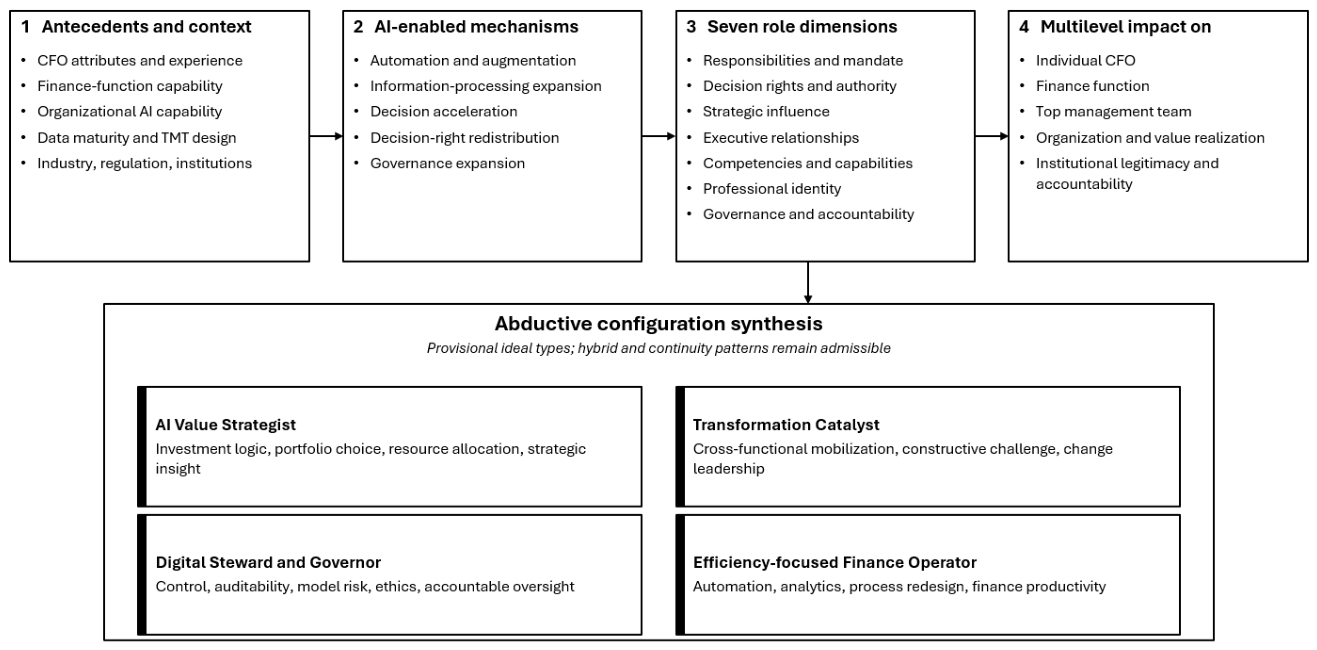
Table 1.
Research question and subquestions.
| Question | Focus |
| Main research question (RQ) | How does selected literature explain CFO executive role transformation in the context of AI-DT, and what is the evidential status of each explanation? |
| SQ1: Role dimensions and configurations | Which responsibilities, decision rights, strategic contributions, relationships, competencies, identities, and accountability expectations are described? |
| SQ2: Transformation scope and maturity | How do the scope and maturity of transformation help to distinguish different forms of change? |
| SQ3: Competencies and capabilities | How do individual CFO competencies and organizational capabilities differ and interact? |
| SQ4: Relationships and decision boundaries | What does the evidence establish about relationships and decision boundaries among finance, technology, and other executive roles? |
| SQ5: Governance responsibilities | Which proposed responsibilities concern investment, value realization, control, oversight, and accountability? |
| SQ6: Contextual variation and gaps | Which contexts and evidence limitations constrain the framework and call for future research? |
Note: The subquestions guide one integrated synthesis; they are not separate reviews.
Table 5.
Role dimensions, directness, and evidence strength.
| Dimension | Direct evidence | Contextual/antecedent evidence | Strength | Interpretation |
| Responsibilities and mandate | Chatpibal et al. (2024); Sandner et al. (2020) | Bedford et al. (2025); Leitner-Hanetseder et al. (2021); Mohanna et al. (2025) | Moderate–strong | Direct evidence supports cumulative expansion; AI-specific value-realization duties remain under-observed. |
| Decision rights and authority | Chatpibal et al. (2024); Denford & Schobel (2021) | Andreassen (2020); Hiebl et al. (2013); Mohanna et al. (2025) | Moderate | Evidence supports negotiated boundaries more than formal transfer of technology ownership. |
| Strategic influence | Chatpibal et al. (2024); Sandner et al. (2020) | Liu & Wu (2026); Szukits (2022); Wu et al. (2025); Yao et al. (2024) | Moderate–strong | Strategic influence is plausible, but Category B studies measure antecedents and outcomes rather than realized role change. |
| Executive relationships | Denford & Schobel (2021) | Abbas et al. (2026); Firk et al. (2024); Mohanna et al. (2025); Rautiainen et al. (2024) | Moderate–strong | Cross-functional dependence is well supported; formal decision-right allocation is less studied. |
| Competencies and capabilities | Chatpibal et al. (2024) | Abbas et al. (2026); Leitner-Hanetseder et al. (2021); Oesterreich et al. (2019); Roozen et al. (2019) | Moderate | Mixed competency profile is well supported contextually; CFO-specific measures are missing. |
| Professional identity | Chatpibal et al. (2024) | Andreassen (2020); Mohanna et al. (2025); Rautiainen et al. (2024); van Slooten et al. (2026) | Moderate | Hybrid and fluid identities are visible, but most evidence concerns management accountants. |
| Governance and accountability | Chatpibal et al. (2024); Denford & Schobel (2021); Sandner et al. (2020) | Leitner-Hanetseder et al. (2021); Losbichler & Lehner (2021); Mohanna et al. (2025); Rieg & Vanini (2026) | Limited–moderate | Shared governance is supported; direct CFO evidence on model risk, cybersecurity, and ethics is limited. |
Table 6.
Provisional configurations and evidential status.
| Configuration | Dominant dimensions | Illustrative evidence | Status | Boundary |
| AI Value Strategist | Strategic influence; responsibilities; competencies | Chatpibal et al. (2024); Sandner et al. (2020); Szukits (2022); Wu et al. (2025) | Moderate; direct AI-value evidence limited | Investment selection, portfolio logic, resource allocation, and value tracking. |
| Transformation Catalyst | Relationships; authority; strategic influence | Abbas et al. (2026); Denford & Schobel (2021); Firk et al. (2024); Mohanna et al. (2025) | Moderate | Cross-functional mobilization, constructive challenge, and change leadership. |
| Digital Steward and Governor | Governance; responsibility; relationships | Leitner-Hanetseder et al. (2021); Losbichler & Lehner (2021); Mohanna et al. (2025); Sandner et al. (2020) | Limited–moderate | Control, auditability, human oversight, model risk, ethics, and shared accountability. |
| Efficiency-focused Finance Operator | Responsibilities; competencies; authority | Bedford et al. (2025); Oesterreich et al. (2019); Rieg & Vanini (2026) | Moderate, mainly contextual | Automation, analytics, process redesign, and finance productivity. |
| Continuity / hybrid condition | Any combination | Evidence of persistent stewardship and mixed role effects across the corpus | Moderate | Traditional duties may remain dominant; configurations may overlap or fail to emerge. |
Table 7.
Suggested research agenda.
| Priority | Focused question | Suitable design |
| Direct role change | How do CFO responsibilities, authority, identity, and accountability change during or after AI adoption? | Longitudinal multiple-case studies with paired executives. |
| Decision rights | Who owns project selection, data, model approval, risk acceptance, benefits tracking, and escalation? | Comparative governance mapping and paired-executive surveys. |
| Capabilities | Which CFO AI-related personal or organizational capabilities are needed to contribute to AI-DT? | Mixed-methods approach, integrating both qualitative and quantitative procedures across industries or countries. |
| Value realization | Which CFO practices are associated with measurable AI value over time? | Longitudinal project portfolios combining investment, governance, and outcome data. |
| Context | How do size, ownership, industry, regulation, and AI maturity condition executive role configurations? | Cross-country, SME, public-sector, and regulated-industry comparisons. |
Disclaimer/Publisher’s Note: The statements, opinions and data contained in all publications are solely those of the individual author(s) and contributor(s) and not of MDPI and/or the editor(s). MDPI and/or the editor(s) disclaim responsibility for any injury to people or property resulting from any ideas, methods, instructions or products referred to in the content. |
© 2026 by the authors. Licensee MDPI, Basel, Switzerland. This article is an open access article distributed under the terms and conditions of the Creative Commons Attribution (CC BY) license (http://creativecommons.org/licenses/by/4.0/).
Copyright: This open access article is published under a Creative Commons CC BY 4.0 license, which permit the free download, distribution, and reuse, provided that the author and preprint are cited in any reuse.