

Submitted:
15 September 2026
Posted:
16 September 2026
You are already at the latest version
Abstract
Distributed digital fabrication training combines computer-aided design, machine operation, electronics, programming, documentation, and access to physical infrastructure. This study develops a documentary evidence framework for examining whether these technological activities remain connected when laboratory access is distributed across locations. The framework was applied retrospectively to 19 assignment pages and one final-project page from an Ecuadorian Fab Academy portfolio; a doctoral thesis in an institutional repository provided cross-source verification of the integrated technological chain. Five dimensions were coded: digital-to-physical translation, troubleshooting and iteration, mentoring or technical assistance, access to equipment and materials, and reuse or integration across tasks. Digital-to-physical translation appeared on 17 of 20 pages (85%), reuse or integration on 13 (65%), troubleshooting on 9 (45%), assistance on 8 (40%), and redistributed material access on 4 (20%). The pattern shows continuity through linked technical representations, physical artifacts, assisted diagnosis, alternative access arrangements, and cumulative reuse. Cross-source comparison traced CAD, rapid prototyping, Arduino programming, sensor verification, PCB design, and CNC fabrication into the later device. The framework distinguishes artifacts, reported processes, task links, and technical corroboration. It offers a reproducible audit structure while remaining a bounded demonstration in one practitioner-authored case; independent coding and additional portfolios are required for validation.
Keywords:
digital fabrication
; distributed training
; Fab Academy
; CAD/CAM
; portfolio analytics
; troubleshooting
; component reuse
; documentary evidence
1. Introduction
Digital fabrication training requires coordination across computational representations, machine processes, electronics, programming, materials, and physical infrastructure. A computer-aided design (CAD) model must be translated into tool paths and machine operations; electronic components must be fabricated, assembled, programmed, and integrated; and the resulting decisions must remain inspectable through documentation. When access to a laboratory is restricted or distributed, continuity becomes a technological coordination problem: digital instruction can continue remotely, but fabrication still depends on machines, materials, local assistance, and verifiable links between representations and artifacts [1].
Research on makerspaces has documented relationships among creativity, pedagogy, collaboration, and fabrication resources, while reviews identify persistent challenges in curriculum integration, educator preparation, and equitable access [2,3]. Collaborative digital fabrication courses also separate teamwork, prototype characteristics, and perceived learning when evaluating project outcomes [4]. These findings show why a completed prototype or a populated portfolio cannot, by itself, demonstrate how technical continuity was achieved or which operations were performed independently.
Distributed fabrication networks are especially relevant where access to machines, materials, and specialist support varies between institutions and locations. In these settings, the technical problem is not merely whether equipment exists, but how design files, machine access, troubleshooting, assistance, and component provenance are coordinated across an extended sequence of tasks. A reproducible method is therefore needed to distinguish evidence of an artifact from evidence of a process, an explicit task dependency, or verified technical performance.
Studies from Ecuador and other Latin American settings describe rapid-prototyping laboratories, heterogeneous FabLab arrangements, and institutional or community relationships supporting fabrication [5,6,7,8,9]. These studies provide regional context but do not supply a common procedure for auditing continuity across a learner’s documented assignments. The absence of such a procedure limits comparison: photographs, source files, reflections, and completion records carry different evidential weight and should not be interpreted as interchangeable measures of competence.
Fab Academy provides a suitable test environment because its distributed model combines shared instruction and online documentation with local mentoring and equipment access [10]. Prior work has examined its academic recognition through course content, workload, and assessment [11]. Distributed fabrication must also be distinguished from virtual laboratories, which simulate operations, and remote laboratories, in which physical equipment is operated through a network interface [1]. Online advice for a locally operated machine does not constitute remote machine operation. These distinctions allow continuity to be analyzed through the actual relationship between digital preparation and physical execution.
This article develops a documentary evidence framework and applies it to the public Fab Academy portfolio of the first author [12], an Ecuadorian industrial designer and university educator with experience coordinating FabLab Yachay. The corpus spans design, subtractive and additive manufacturing, electronics, embedded programming, interface development, and system integration. It includes reported restrictions on laboratory access, borrowed equipment, simulation, technical assistance, unsuccessful fabrication, and reuse of earlier components. These characteristics make the case information-rich for demonstrating how heterogeneous evidence can be classified without treating the portfolio as an independent performance test.
The rehabilitation-oriented device documented as the final project has been examined previously as a technical design and through user evaluation [13,14,15]. The present contribution neither re-evaluates the device nor reproduces those analyses. It introduces an audit framework for a different problem: how a distributed fabrication trajectory can be reconstructed from project records while preserving the boundary between documented activity and verified performance. The study asks: (1) Which connections between digital preparation and physical fabrication are traceable? (2) How are troubleshooting, assistance, access, and adaptation represented? (3) Which dependencies between assignments can be reconstructed? and (4) What can and cannot be inferred from the resulting evidence structure?
2. Materials and Methods
2.1. Research Design and Case Boundary
A retrospective single-case documentary design was used to examine an existing educational portfolio. Case study research is appropriate for investigating a bounded process in its context, while document analysis requires attention to why records were produced, what they contain, and what they omit [16,17]. The unit of analysis was the documented fabrication learning trajectory of one practitioner. Individual assignment pages were sources within that case, not independent participants or separate cases. The study did not implement a teaching intervention, administer learning assessments, or conduct a systematic review of the educational literature.
The case was selected purposively because its publicly accessible portfolio links diverse fabrication tasks and contains accounts of difficulties and adaptations, rather than only final products. This is an information-oriented selection of an accessible practitioner case. It is not a representative sample of Fab Academy learners, Ecuadorian institutions, or Latin American FabLabs. FabLab Yachay forms part of the first author's professional background; the educational records analyzed here are those of his Fab Academy portfolio associated with Zoi. No comparative institutional evaluation of Yachay and Zoi was undertaken.
2.2. Documentary Corpus and Chronology
The primary corpus comprised the 19 assignment pages linked from the portfolio home page and the separate final-project page, giving 20 substantive webpages. The home page supplied contextual information. The pages were captured on 2 September 2026; their addresses, file hashes, source classifications, and analytical summaries are provided in Supplementary Material S1. The capture represents the version available on that date. It does not establish when individual paragraphs, images, or files were originally uploaded. Embedded videos and all downloadable design files were not independently replayed, executed, or validated; their presence was distinguished from verified technical performance.
Two author-supplied records were used to clarify the chronology. A certificate dated 11 July 2023 records enrollment in 2020, identifies the program as Fab Academy 2023, and lists 252 guided hours plus approximately 210 personal-work hours. The diploma is dated 24 July 2023. These records establish enrollment, certification, and stated program workload. They do not document continuous attendance between 2020 and 2023 or provide a measured time series of learning. The approximately 462-hour total is a certification-based workload figure. It is not an independently observed measure of time on task. Table 1 distinguishes these sources and their analytical functions.
A publicly accessible doctoral thesis deposited in the institutional repository of Universitat Politècnica de València was used as a contextual cross-source record [18]. It describes the later integrated ARTH-aid development and explicitly attributes part of the electronic experimentation to Fab Academy. The thesis was used to check whether technologies documented separately in the portfolio reappeared in the integrated system. Because the thesis and portfolio share the same practitioner-author, agreement between them is documentary triangulation across records, not independent confirmation of authorship, learning gain, or technical accuracy.
The portfolio includes a 2020 archive path, a home-page label referring to 2021, and references to pandemic-related restrictions. These features were retained as documentary characteristics. The certification records were used for the enrollment and award dates, while the analysis avoided assigning an exact calendar date to each assignment or reconstructing an uninterrupted sequence. The Fab Academy annual report provides independent program-level context for laboratory access restrictions in 2020 and 2021, without establishing the timing of events in this individual case [19].
2.3. Documentary Evidence Framework and Coding Rules
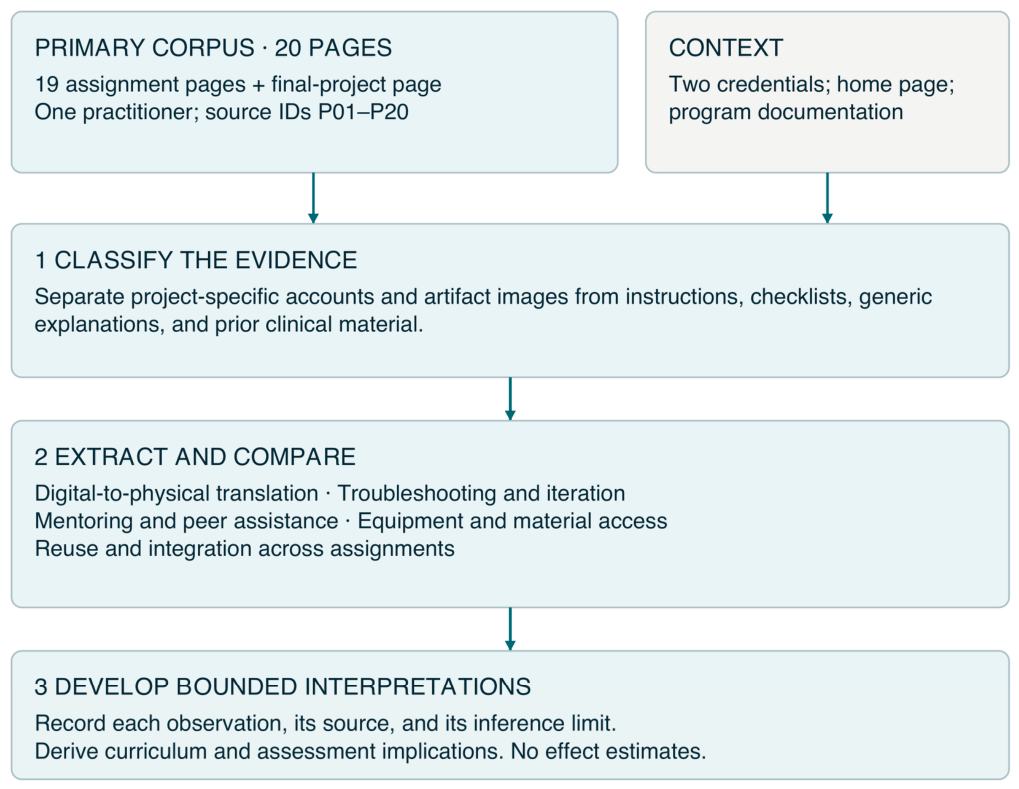
The framework used four reproducible steps. First, every primary page received a stable identifier (P01–P20) and was inventoried by its displayed assignment title, URL, capture date, and SHA-256 hash. Second, project-specific accounts were separated from exercise instructions, completion checklists, generic software explanations, and external tutorial material. An instruction or checked box was not treated as evidence of execution. Third, each page was coded for five dimensions: D1, digital-to-physical translation; D2, troubleshooting and iteration; D3, mentoring or technical assistance; D4, access to equipment and materials; and D5, reuse or integration across tasks. Fourth, every observation was paired with an inference boundary stating what the source did not establish. The complete page-level matrix and codebook are supplied in Supplementary Material S1.
Coding followed explicit evidence rules. A photograph supported artifact presence at the time represented but not accuracy, calibration, authorship, or long-term performance. A screenshot supported the presence of a digital representation but not successful manufacture. A first-person statement supported a reported experience. An explicit statement that an earlier board or configuration was reused supported a dependency between assignments. Certification supported program completion and stated workload but not measured skill gain. Repeated text or images were not counted as independent corroboration, and inconsistent descriptions were retained as limitations. Dimension frequencies report documentary coverage across pages, not independent observations, learning outcomes, or effect estimates.
Initial extraction and organization were assisted by artificial intelligence. The analytical output was constrained by the codebook, page identifiers, source URLs, file hashes, verbatim documentary observations, and explicit inference boundaries provided in Supplementary Material S1. The final manuscript reports only claims traceable to that matrix. No independent second-coder analysis, intercoder agreement statistic, participant interview, machine-log validation, or member checking is claimed. The framework is therefore demonstrated for transparency and reproducibility of documentary classification, not validated as a measurement instrument.
Figure 1.
Documentary analysis pathway. Twenty substantive portfolio pages form the primary corpus; credentials and program documents establish context. Evidence classification precedes comparison across five analytical categories. The final interpretations remain linked to their sources and explicit evidential limits. Diagram prepared for this study.
2.4. Researcher Position and Ethical Scope
The first author is both the practitioner represented in the portfolio and an author of this analysis. His experience coordinating FabLab Yachay provides contextual knowledge of fabrication environments, but also creates a risk of selecting favorable examples or attributing later expertise to the course. His industrial design background further means that competence in CAD cannot be assumed to indicate equivalent prior competence in electronics, programming, or online documentation. The portfolio was therefore read for difficulties, incomplete evidence, and explicit assistance alongside successful outputs.
The analysis concerns educational documentation and engineering artifacts. It excludes patient-level observations, clinical outcome claims, therapeutic recommendations, and identifiable images of third parties from the research findings and figures. No new participants were recruited. The certification files were inspected to establish training facts and are not reproduced as public supplementary material. Prior publications on the device are acknowledged to delineate the relationship between the technical research and this educational analysis [13,14].
2.5. Relationship to Prior Publications and Analytical Independence
The ARTH-aid device has been described in earlier publications addressing technical design and rehabilitation-oriented development [13,15]. A subsequent user-centered evaluation reported a five-week study involving 30 patients and four therapists and analyzed perceived usability, satisfaction, and rehabilitation impact [14]. Those participant data, questionnaires, statistical analyses, tables, and figures are not reproduced or reanalyzed here. They remain results of the cited publications.
The present article addresses a separate research object and dataset: the traceability of digital fabrication activities across 20 public educational portfolio pages. Prior device publications are used only to delimit the later integration context and to establish that the final project continued beyond the educational portfolio. The new contribution consists of the five-dimension documentary framework, page-level coded matrix, evidence-strength rules, explicit task-dependency graph, and cross-record comparison with the institutional thesis. Consequently, no clinical effectiveness or user-validation result is claimed as a finding of this study.
3. Results
3.1. Framework Coverage and Heterogeneous Technical Evidence
Across the 20 primary pages, digital-to-physical translation (D1) was coded on 17 pages (85%), reuse or integration (D5) on 13 (65%), troubleshooting and iteration (D2) on 9 (45%), mentoring or technical assistance (D3) on 8 (40%), and redistributed access to equipment or materials (D4) on 4 (20%). Because several dimensions can occur on the same page, percentages are not mutually exclusive. These counts characterize the coverage of the documentary record; they do not measure proficiency, independence, or learning gain. Table 2 provides the dimension definitions and counts.
The distribution was technically heterogeneous. CAD documentation (P03) reflected prior design experience, whereas Electronics Production (P05) described a first attempt to fabricate a printed circuit board (PCB), programming difficulty, and assistance from the FabLab Zoi team. Project Management (P02) reported initial HTML exercises, template adaptation, upload difficulties, and local guidance. The framework therefore retains prior expertise, difficulty, assistance, and artifact evidence as separate attributes rather than combining them into a single competence judgment.
The public record also mixes learner-authored reflection with assignment requirements and generic descriptions. Applying the evidence rules reduced the analytical record to project-specific observations and their limits. This filtering is a methodological result: the quantity of portfolio content is not equivalent to the quantity or strength of evidence. Claims become auditable only when the source type and inference boundary accompany each coded dimension.
3.2. Digital-to-Physical Translation
Several pages connect representations to decisions about fabrication. In the 3D Scanning and Printing assignment (P06), a protective case for a programmer is described through sketches, component dimensions, modeled parts, assembly checking, slicing, and a photograph of the printed enclosure. This sequence links the geometry of the housing to the dimensions and arrangement of an existing board. The author's account reports a successful fit, but no dimensional inspection record is supplied. The documented result is therefore an account of design-to-assembly reasoning, not a measured accuracy claim.
The Mechanical and Machine Design page (P10) offers a different translation. The author identifies his contribution to a group machine as the design and implementation of cases for electronic components. The page describes choosing laser cutting after initially considering 3D printing and preparing the design in AutoCAD. This supports a documented manufacturing choice and an identified individual role. It does not establish a measured reduction in manufacturing time or an independently assessed improvement in teamwork.
Physical fabrication remained visible in the electronics tasks. The Input Devices record (P11) shows PCB manufacture and a sensor connected to a board; the Output Devices record (P13) documents a separate liquid crystal display (LCD) module and its assembly with the training board. Figure 2 presents these artifacts as evidence of material work and integration. Their presence supports the distinction between simulated preparation and fabricated components, while leaving electrical accuracy, calibration, and long-term reliability untested in this analysis.
3.3. Troubleshooting, Simulation, and Assisted Diagnosis
The electronics and programming pages describe repeated movement between digital preparation and physical troubleshooting. Electronics Production (P05) reports failed programming steps and the value of following a work sequence to locate errors. Embedded Programming (P09) describes using a simulator after programming difficulties. Input Devices (P11) reports soldering mistakes and subsequent rechecking, while Output Devices (P13) describes online group instruction, work with Tinkercad, and later construction of a physical module. Taken together, these records associate simulation with preparation and diagnosis; they do not show that simulation replaced physical work.
The support described is also specific. The portfolio acknowledges instructor help with computer numerical control (CNC) tasks, assistance from the Zoi team with PCB production, and advice from an experienced colleague on interface development. These accounts make the social organization of the work visible. They support the interpretation that progress was assisted and distributed across resources and people. They cannot determine how much of the final performance was independently achieved by the learner or quantify the contribution of each source of support.
A negative example remains in the Wildcard Week page (P17), where the author explicitly labels a PCB fabrication attempt as a failure associated with using a new machine. The page includes images but no diagnostic measurements sufficient to establish the cause. This is evidence that the portfolio did not contain only successful outcomes. It also illustrates an evidential limit: a useful reflection on failure can be present without enough information to reproduce the diagnosis. Table 2 summarizes the distribution and operational criteria of the five documentary dimensions.
3.4. Distributed Access to Fabrication Infrastructure
Restricted access changed where the physical work took place. The Computer-Controlled Machining page (P08) reports a last laboratory visit associated with COVID-related restrictions and describes difficulty understanding machine operation at a distance. Electronics Design (P07) records borrowing a machine to manufacture a PCB when laboratory attendance was not possible. Moulding and Casting (P12) describes work conducted at home with materials supplied by FabLab Zoi. Wildcard Week (P17) also records access to a friend's embroidery equipment and a university sewing machine.
These accounts indicate that access was maintained through several material arrangements: a laboratory, equipment loans, supplied materials, and other institutional or personal facilities. The digital environment linked preparation and communication, but the work still depended on physical tools and materials being available somewhere. The corpus does not document authenticated remote control of a fabrication machine over the Internet. The hybrid character of the case is supported by the combination of online activity and redistributed physical making.
The record does not quantify the time spent in each setting, the number of canceled sessions, equipment uptime, or the costs of these arrangements. It also does not establish that comparable access would have been available to a learner without the same professional contacts. The evidence therefore supports a description of how continuity was achieved in this case, while leaving its equity, scalability, and institutional sustainability unresolved.
3.5. Task Dependencies and Component Reuse
The clearest evidence of continuity is the explicit reuse of components across tasks. The Input Devices page (P11) describes an Arduino-compatible training board used to read a flex sensor. Output Devices (P13) states that this board was reused with an LCD module. Networking and Communications (P14) then identifies the earlier electronics-design board and the input-devices training board as its two nodes. Interface and Application Programming (P15) connects a Processing interface to the board used in the networking exercise. Figure 3 reconstructs these declared relationships without assuming that every pictured board is the same physical specimen.
The final-project page (P20) presents a rehabilitation-oriented glove prototype with mechanical parts, electronics, an interface, and links to design and code files. Its educational role is as an integration context. The page and Applications and Implications (P16) identify tasks such as fitting components to a glove, mapping sensors, calibrating motors, and providing an enclosure. However, the presence of these requirements and artifacts does not show that all requirements were quantitatively verified. The portfolio's clinical claims fall outside the educational findings reported here.
The reconstructed dependency chain is the principal technological result. Earlier work supplied components, representations, or interfaces for later activities, and the portfolio made several of those links explicit. The framework captures this continuity without converting reuse into an unsupported measure of conceptual transfer or independent mastery. It also reveals missing verification: component identity, interface tests, calibration records, and machine logs would be required to move from a documentary dependency to validated technical performance.
3.6. Cross-Source Verification of the Integrated Technological Chain
The institutional thesis provides a second public record of the technological chain represented in the portfolio [18]. It reports computer-aided modeling and rapid prototyping of articulated parts, Arduino-based control, flex-sensor signal verification, electronic-board design in Eagle, CNC machining of a PCB, and preparation of machining trajectories through FabModules. It also states that electronic experimentation conducted through Fab Academy contributed to the rehabilitation-system proposal. These elements correspond to the portfolio dimensions of digital-to-physical translation, troubleshooting, and reuse or integration, and they show that several training technologies were subsequently assembled within a larger engineering system.
This comparison strengthens traceability between assignment-level records and the later integrated device, but its evidential boundary remains important. The thesis was written by the same practitioner and concerns development completed after the portfolio assignments; it cannot serve as an independent assessment of competence or establish that every later component was identical to an assignment artifact. Its contribution is narrower: it corroborates the continuity of the documented technology classes and provides a stable institutional source for the subsequent integration context.
The downstream relevance of this technological chain is also documented in prior peer-reviewed studies. The 2023 Springer chapter describes design and validation of the integrated exoskeleton [15], while the 2025 user-centered evaluation reports feedback from 30 patients and four therapists after supervised use [14]. These publications show that the integration context progressed to technical and user-facing evaluation. They do not validate the educational framework proposed here, and their participant outcomes are not counted among the present results.
4. Discussion
4.1. Technical Continuity Through Connected Artifacts
The framework adds a process-level representation to research on digital fabrication and makerspaces. Its distinctive contribution is the separation of five auditable dimensions and the reconstruction of explicit dependencies between assignments: a board becomes an input to a later exercise, a component dimension constrains an enclosure, and an interface operates a previously developed configuration. This representation shifts attention from the mere presence of a finished artifact to the provenance, adaptation, assistance, and verification needed to interpret it [4,14].
For distributed technical training, each assignment should preserve both the artifact and its dependency record: source representation, fabrication constraint, machine or process used, assistance received, diagnostic evidence, revision, and integration test. A subsequent task can then require adaptation of an earlier component under new interface requirements. The proposed structure is an audit specification derived from the case; its effectiveness as an assessment instrument requires prospective testing and assessor calibration.
The findings also qualify simple narratives of technical empowerment. The practitioner entered with design experience and professional connections but still reported substantial difficulty with programming and electronics. Support was a visible part of progress. This is consistent with treating pedagogy, facilitation, and infrastructure as interdependent rather than assuming that equipment availability produces learning automatically [2,3].
4.2. Infrastructure Conditions for Distributed Fabrication
Hybridization in this case involved more than moving instruction online. Physical access was redistributed through loans, supplied materials, and alternative workspaces. Program-level accounts of Fab Academy during 2020 and 2021 similarly describe varied local responses to laboratory restrictions [19]. The case adds a detailed example of how those responses can appear in a learner's documentation, while the absence of access logs prevents an estimate of their extent or effectiveness.
For Ecuadorian institutions, including programs informed by experience at FabLab Yachay, the practical question is how to make such support dependable. Equipment booking, loan arrangements, technician availability, material provision, and supervision need to be planned alongside online instruction. The role of a coordinator can be framed as connecting these conditions to learning objectives and ensuring that responsibility for each stage is clear. These are implications of the documented dependencies and the first author's professional perspective; they are not findings from an evaluation of Yachay's organizational performance.
Regional studies reinforce the relevance of institutional relationships and local context [5,7,8]. Nevertheless, a network built on personal favors may sustain one participant while leaving others excluded. Future implementation should therefore record who obtains equipment, materials, mentoring, and opportunities to perform hands-on work, including unsuccessful attempts to gain access. A count of enrolled learners or registered machines would not answer those questions.
Digital access also requires attention to usability and accessibility. An evaluation of 50 Android applications available in Ecuador identified accessibility barriers and emphasized the limits of automated evaluation alone [20]. Their findings concern mobile applications, not FabLab learning outcomes. The relevant implication for hybrid fabrication is to examine the accessibility of the interfaces through which learners receive instructions, document work, and request assistance. Providing a digital channel is insufficient evidence that all learners can use it effectively.
4.3. Evidential Strength and Technical Auditability
The portfolio makes processes inspectable, but the evidence it supplies varies in strength. A screenshot can show a design representation; a linked source file can support further inspection; a photograph can show an assembled artifact; and a reflective statement can describe the learner's interpretation. None of these alone establishes an assessed improvement in competence. Research on the academic recognition of Fab Academy similarly directs attention to the relationship between learning content, workload, and assessment [11]. In this case, the certification-based workload should therefore remain separate from evidence of performance.
Table 3 translates the documentary findings into minimum evidence requirements for a technically auditable portfolio. The requirements connect design decisions to tests, assistance to subsequent independent action, and reuse to provenance and interface verification. They are proposed specifications rather than a validated scoring rubric.
The publicly documented failure is particularly valuable for designing such assessment. A learner can explain what failed, what evidence informed the diagnosis, what changed, and whether the revision addressed the problem. Recording those elements would improve the interpretability of a portfolio. It would also avoid equating a polished presentation with a complete record of learning. The existing corpus suggests the value of this approach, while its incomplete diagnostic records show why further data collection is needed.
4.4. Validity, Reproducibility, and Future Validation
This is a framework demonstration using one experienced practitioner’s portfolio, not a representative evaluation of Fab Academy or Latin American FabLabs. The first author’s dual role creates selection and interpretation risk. The pages were produced for educational documentation and may have been edited after the events described. Archive paths are not upload timestamps, certification dates do not establish an uninterrupted chronology, and inconsistent equipment descriptions prevent precise reconstruction of some operations.
The source set lacks an independent baseline, comparison case, calibrated performance instrument, complete assistance log, machine telemetry, and follow-up test. Photographs and narrative descriptions were not treated as substitutes for dimensional inspection, electrical measurement, calibration, or execution of linked files. Multiple pages authored by one person are repeated observations within a case, not independent samples. The dimension frequencies therefore characterize documentary coverage only. The RIUNET thesis adds cross-record traceability for the integrated technological chain, but common authorship prevents treating it as an independent outcome measure [18].
AI assistance creates an additional validity concern. Reproducibility is supported by the public sources, capture date, hashes, codebook, coded matrix, and claim-specific inference limits, but those controls do not establish coding reliability. Validation should proceed in two stages: independent recoding of the existing corpus with agreement analysis, followed by prospective application to additional portfolios with direct inspection of source files, fabrication tests, and structured records of assistance and access.
Generalization beyond this case is not claimed. A multi-case validation should sample learners with different prior expertise and institutional access, apply the same evidence rules, and test whether the five dimensions remain distinguishable. Prospective studies can then examine whether dependency-aware documentation improves fault diagnosis, integration success, or the interpretability of technical assessment. These are testable extensions of the framework rather than effects established by the present demonstration.
5. Conclusions
This study developed and demonstrated a five-dimension documentary evidence framework for distributed digital fabrication training. Applied to 20 Fab Academy project pages, the framework identified extensive digital-to-physical translation, frequent reuse or integration across tasks, documented troubleshooting and assistance, and a smaller set of explicit alternative-access arrangements. These distributions describe what the portfolio makes traceable; they do not measure competence or learning gain.
The framework contributes a reproducible audit structure linking each observation to a source, evidence type, analytical dimension, and inference boundary. It also reconstructs dependencies between assignments and specifies the records needed to distinguish artifact presence from verified technical performance. In distributed fabrication training, this distinction is essential because online documentation, simulation, mentoring, machines, materials, and physical testing remain interdependent.
The single practitioner-authored case provides an initial demonstration rather than instrument validation. Independent recoding, additional portfolios, direct testing of linked technical files, and prospective performance measures are required before the framework can support comparative assessment. Within those limits, the method offers a transparent basis for examining continuity, troubleshooting, access, and cumulative integration in distributed digital fabrication programs.
Supplementary Materials
The following supporting information can be downloaded at the website of this paper posted on Preprints.org, S1: Documentary evidence matrix, analytical codebook, documented task links, contextual source inventory, and source-image provenance. The matrix identifies the 20 portfolio pages, capture date, file hashes, observations, and inference limits. S1 also identifies contextual sources and the boundary between the current documentary dataset and prior device publications.
Author Contributions
Conceptualization, methodology, investigation, formal analysis, data curation, visualization, writing—original draft preparation, supervision, and project administration, R.M.-J.; project administration, funding acquisition, and writing—review and editing, M.R.-V.; validation, resources, and writing—review and editing, C.O.-N.; validation, resources, and writing—review and editing, B.C.-O.; methodology, validation, and writing—review and editing, A.M.-M. All authors have read and agreed to the published version of the manuscript.
Funding
This study received no external research funding. The article processing charge will be covered by Universidad Central del Ecuador (UCE).
Institutional Review Board Statement
The study analyzes a publicly accessible educational portfolio and credentials supplied by the practitioner-author. It involved no recruitment, intervention, or analysis of patient-level records. No formal ethics committee approval or exemption has been documented for this analysis. No participant-level data from the previously published device evaluations were accessed or reanalyzed in the present study.
Informed Consent Statement
The practitioner-author authorized the use of his portfolio, artifact images, and certification facts for this case study. Private credential files are not reproduced, and identifiable images of third parties and patient-level observations are excluded.
Data Availability Statement
The primary documentary sources are publicly accessible through the first author’s Fab Academy portfolio. Supplementary Material S1 provides the source URLs, capture date, HTML hashes, evidence matrix, and analytical definitions. Credential files were inspected to establish training facts and are not publicly distributed. The contextual doctoral thesis is openly available from RIUNET at https://riunet.upv.es/handle/10251/193057 (accessed on 14 September 2026).
Acknowledgments
The authors thank Universidad Central del Ecuador and its Faculty of Engineering and Applied Sciences for institutional support. They also acknowledge the mentoring and technical assistance documented in the Fab Academy Zoi portfolio and the professional context provided by FabLab Yachay. Use of Artificial Intelligence: OpenAI ChatGPT assisted with documentary extraction, evidence organization, manuscript preparation, reference formatting, and analytical diagrams. The authors reviewed the reported claims against the supplied evidence matrix. Photographs were not generated or altered using artificial intelligence. The analytical controls and limitations are described in Sections 2.3 and 4.4.
Conflicts of Interest
The authors declare no conflicts of interest.
Abbreviations
The following abbreviations are used in this manuscript:
| AI | Artificial intelligence |
| CAD | Computer-aided design |
| CNC | computer numerical control |
| HTML | HyperText Markup Language |
| LCD | liquid crystal display |
| PCB | printed circuit board |
| UCE | Universidad Central del Ecuador. |
References
- May, D.; Jahnke, I.; Moore, S. Online Laboratories and Virtual Experimentation in Higher Education from a Sociotechnical-Pedagogical Design Perspective. J. Comput. High. Educ. 2023, 35, 203–222. [Google Scholar] [CrossRef]
- Soomro, S.A.; Casakin, H.; Nanjappan, V.; Georgiev, G.V. Makerspaces Fostering Creativity: A Systematic Literature Review. J. Sci. Educ. Technol. 2023, 32, 530–548. [Google Scholar] [CrossRef]
- Elmoazen, R.; López-Pernas, S.; Saqr, M. Mapping Makerspaces in Education: A Meta-Systematic Review. Int. J. Technol. Des. Educ. 2026. [Google Scholar] [CrossRef]
- Georgiev, G.V.; Nanjappan, V.; Casakin, H.; Soomro, S. Collaborative Teamwork, Prototyping, and Creativity in Digital Fabrication Design Education. Proc. Des. Soc. 2023, 3, 967–976. [Google Scholar] [CrossRef]
- Rivera, M.; Barba, C.; Peñaherrera, K.; Davila, D.; Leon, P. Evolution and Transformation of Rapid Prototyping Laboratories in Ecuador. Minerva 2021, 2, 32–42. [Google Scholar] [CrossRef]
- García-Ruiz, M.-E.; Lena-Acebo, F.-J. FabLabs: The Road to Distributed and Sustainable Technological Training through Digital Manufacturing. Sustainability 2022, 14. [Google Scholar] [CrossRef]
- Valenzuela-Zubiaur, M.; Torres-Bustos, H.; Arroyo-Vázquez, M.; Ferrer-Gisbert, P. Promotion of Social Innovation through Fab Labs. The Case of ProteinLab UTEM in Chile. Sustainability 2021, 13. [Google Scholar] [CrossRef]
- Herrera, P.C.; Dreifuss-Serrano, C.; Valenzuela-Zubiaur, M.; Schreier-Barreto, C. Fabricating Service-Learning: The Convergence of Global Frameworks and Local Realities in Latin America. In Utilizing Service Learning Practices for Creative Design Improvements; IGI Global, 2025; pp. 1–29. ISBN 9798369397060. [Google Scholar]
- Seo-Zindy, R.; Heeks, R. Researching the Emergence of 3D Printing, Makerspaces, Hackerspaces and FabLabs in the Global South: A Scoping Review and Research Agenda on Digital Innovation and Fabrication Networks. Electron. J. Inf. Syst. Dev. Ctries. 2017, 80, 1–24. [Google Scholar] [CrossRef]
- Fab Academy. About Fab Academy. Available online: https://fabacademy.org/about/index.html (accessed on 2 September 2026).
- Ylioja, J.; Georgiev, G.V.; Sánchez, I.; Riekki, J. Academic Recognition of Fab Academy. In Proceedings of the FabLearn Europe 2019 Conference, Oulu, Finland, 28–29 May 2019; ACM: New York, NY, USA, 2019; Article 1, p. 7 pp. [Google Scholar] [CrossRef]
- Moya-Jiménez, R. Roberto Moya: Fab Academy Portfolio. Available online: https://fabacademy.org/2020/labs/zoi/students/roberto-moya/ (accessed on 2 September 2026).
- Moya-Jiménez, R.; Magal-Royo, T.; Ponce, D.; Flores, M.; Caiza, M. Hand Exoskeleton Design for the Rehabilitation of Patients with Rheumatoid Arthritis. In Information and communication technologies; Morales, Rodriguez, Fonseca C., G., Salgado, E.R., Pérez-Gosende P., J.P., Cordero, Orellana, Berrezueta S., M., Eds.; Springer, 2020; Vol. 1307, pp. 12–21. [Google Scholar] [CrossRef]
- Moya-Jiménez, R.; Goyes-Balladares, A.; Rivera-Valenzuela, M.; Magal-Royo, T. User-Centered Evaluation of the ARTH-Aid ExoGlove: Perspectives of Patients and Therapists in Rheumatoid Arthritis Rehabilitation. Designs 2025, 9. [Google Scholar] [CrossRef]
- Crowe, S.; Cresswell, K.; Robertson, A.; Huby, G.; Avery, A.; Sheikh, A. The Case Study Approach. BMC Med. Res. Methodol. 2011, 11. [Google Scholar] [CrossRef] [PubMed]
- Bowen, G.A. Document Analysis as a Qualitative Research Method. Qual. Res. J. 2009, 9, 27–40. [Google Scholar] [CrossRef]
- Fab Academy. Fab Academy: 2020 and 2021 Annual Report. Available online: https://fabacademy.org/resources/report2020&21.html (accessed on 2 September 2026).
- Blikstein, P. Digital Fabrication and “Making” in Education: The Democratization of Invention. In FabLabs: Of Machines, Makers and Inventors; Walter-Herrmann, J., Büching, C., Eds.; transcript Verlag: Bielefeld, Germany, 2013; pp. 203–222. [Google Scholar]
- Acosta-Vargas, P.; Zarate-Estrella, S.; Mantilla-Vaca, F.; Novillo-Villegas, S.; Chimbo, C.; Luján-Mora, S. Towards Accessibility and Inclusion of Native Mobile Applications Available for Ecuador in Google Play Store. Sustainability 2021, 13. [Google Scholar] [CrossRef]
- Moya-Jiménez, R. Estudio sistémico de una estructura exoesquelética para la rehabilitación de la atrofia muscular de la mano en personas con artritis reumatoide. Doctoral Thesis, Universitat Politècnica de València, Valencia, Spain, 2023. Available online: https://riunet.upv.es/handle/10251/193057 (accessed on 14 September 2026).
- Moya-Jiménez, R.; Magal-Royo, T.; Flores, M.; Caiza, M. Design and Validation of an Exoskeleton for Hand Rehabilitation in Adult Patients with Rheumatoid Arthritis. In Intelligent Systems and Applications; Lecture Notes in Networks and Systems; Arai, K., Ed.; Springer: Cham, Switzerland, 2023; Volume 543, pp. 399–412. [Google Scholar] [CrossRef]
Figure 2.
Fabricated artifacts documented in the portfolio: (a) PCB milling; (b) a flex-sensor setup with the training board; (c) the LCD module and training board before connection; and (d) the assembled LCD module. Panels (a,b) are from Input Devices (P11); panels (c,d) are from Output Devices (P13). Source: Roberto Moya’s Fab Academy portfolio, reproduced with his authorization. Images are shown proportionally without content alteration. They document artifact presence, not calibration, reliability, or independent learning gains.
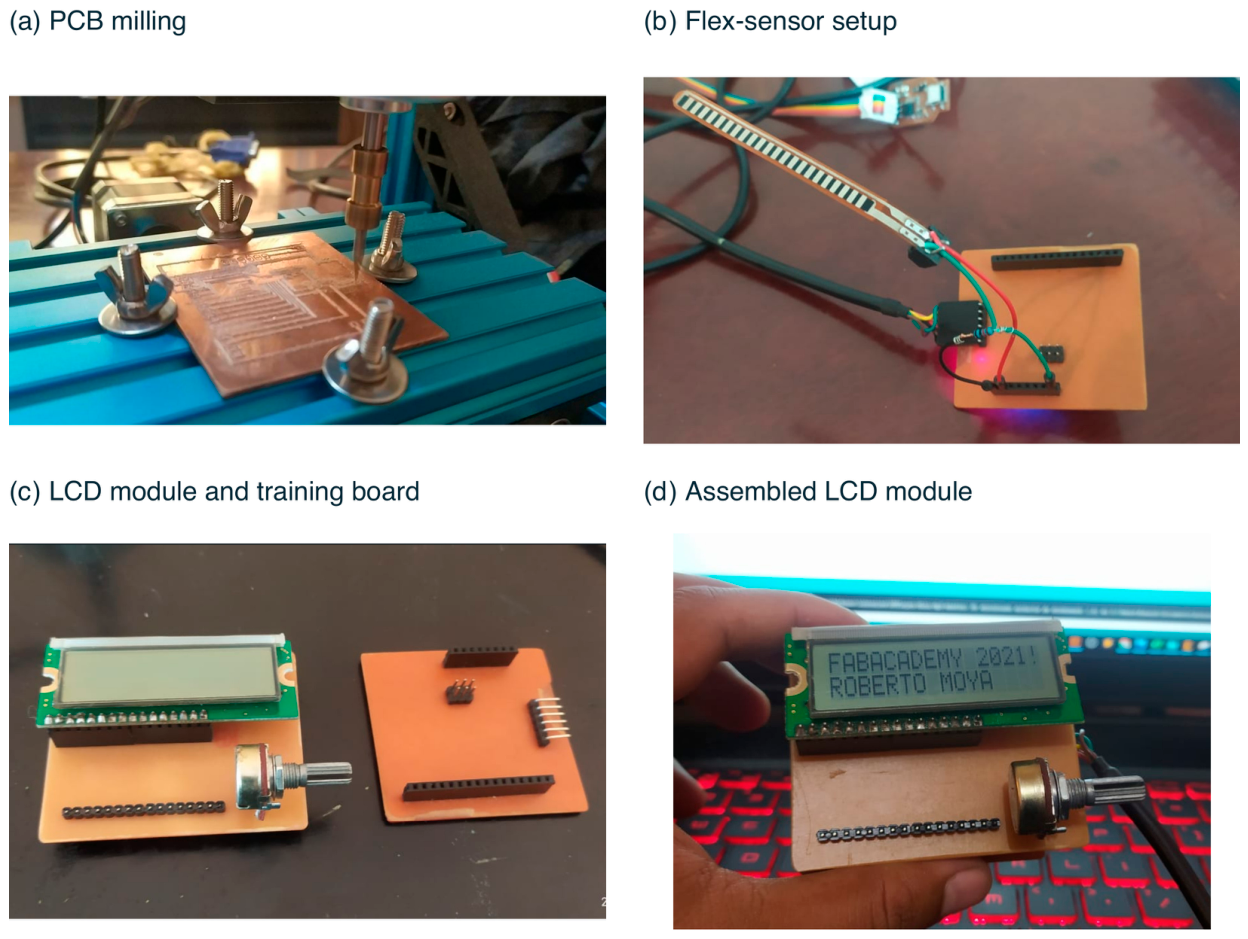
Figure 3.
Explicit reuse relationships documented between assignments. Arrows indicate portfolio statements connecting an earlier board or configuration to subsequent work. P identifiers correspond to Supplementary Material S1. This is a graph of documented task relationships, not an independently validated hardware architecture or a complete chronology. Diagram prepared from P07, P09, P11, and P13–P15.
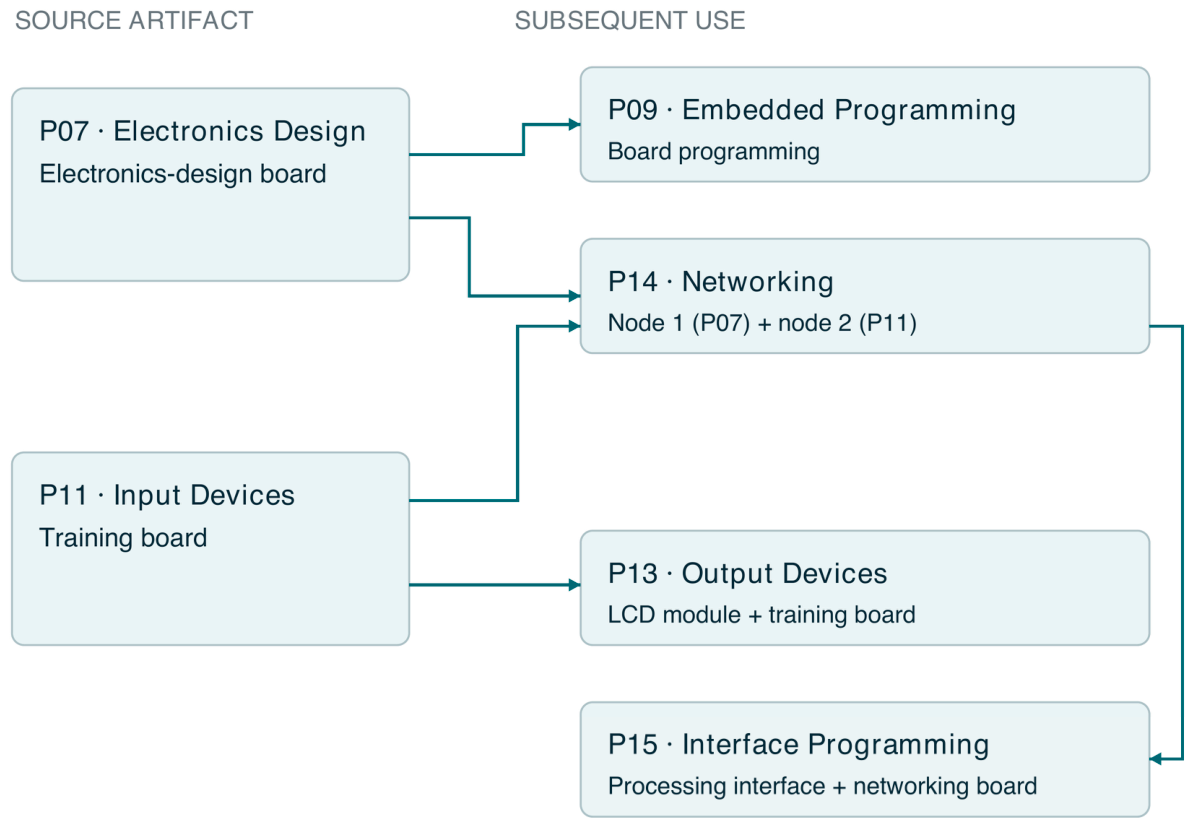

Table 1.
Documentary sources and their analytical functions.
| Source group | n | Analytical function | Inference boundary |
|---|---|---|---|
| Assignment and final-project pages | 20 | Project-specific processes, artifacts, difficulties, and reuse links | One practitioner; webpages are not independent cases |
| Certificate and diploma | 2 | Enrollment, award dates, and stated program workload | No measured skill gain or continuous attendance record |
| Portfolio home page | 1 | Identity, context, and navigation | Archive labels are not verified task dates |
| Program description and annual report | 2 | Distributed delivery model and restriction context | Program-level context does not verify individual events |
The primary analytical corpus is P01–P20. Contextual sources are not included in the 20-page count. Credentials are described but are not redistributed.
Table 2.
Coverage of the five documentary evidence dimensions across the 20 primary pages.
| Dimension | Operational criterion | Pages, n | Coverage |
|---|---|---|---|
| D1: Digital-to-physical translation | Explicit link between a digital representation and fabrication, assembly, or a material constraint. | 17 | 85% |
| D2: Troubleshooting and iteration | Documented difficulty, failure, diagnosis, revision, or retest. | 9 | 45% |
| D3: Mentoring or technical assistance | Explicitly acknowledged instruction, advice, or direct assistance. | 8 | 40% |
| D4: Equipment or material access | Documented loan, supplied material, restricted laboratory, or alternative fabrication location. | 4 | 20% |
| D5: Reuse or integration | Explicit reuse or integration of an earlier component, design, or configuration. | 13 | 65% |
Dimension assignments resolve to page-level observations, URLs, capture records, and inference boundaries in Supplementary Material S1. Multiple codes on one page indicate co-occurring documentary features and are not independent samples.
Table 3.
Proposed evidence requirements for future portfolio assessment.
| Dimension | Evidence to retain | Question made assessable |
|---|---|---|
| Design reasoning | Dimensioned source files; design decision; fabrication constraint; fit test | How does the learner justify a design-to-material decision? |
| Troubleshooting | Failure record; diagnostic evidence; revision; retest under stated conditions | What changed, and what evidence supports the diagnosis? |
| Assistance and agency | Task contribution; assistance received; subsequent independent attempt | Which actions can the learner perform and explain independently? |
| Reuse and integration | Component provenance; interface requirements; adaptation; integration test | How is earlier work adapted to a subsequent task? |
| Access and participation | Requested and obtained equipment time, materials, mentoring, and barriers | Who can complete the physical work under the available arrangements? |
These are implications of the documentary case, not a validated rubric. Implementation would require defined criteria, assessor calibration, and evaluation with additional learners.
Disclaimer/Publisher’s Note: The statements, opinions and data contained in all publications are solely those of the individual author(s) and contributor(s) and not of MDPI and/or the editor(s). MDPI and/or the editor(s) disclaim responsibility for any injury to people or property resulting from any ideas, methods, instructions or products referred to in the content. |
© 2026 by the authors. Licensee MDPI, Basel, Switzerland. This article is an open access article distributed under the terms and conditions of the Creative Commons Attribution (CC BY) license (http://creativecommons.org/licenses/by/4.0/).
Copyright: This open access article is published under a Creative Commons CC BY 4.0 license, which permit the free download, distribution, and reuse, provided that the author and preprint are cited in any reuse.