

Submitted:
14 September 2026
Posted:
16 September 2026
You are already at the latest version
Abstract
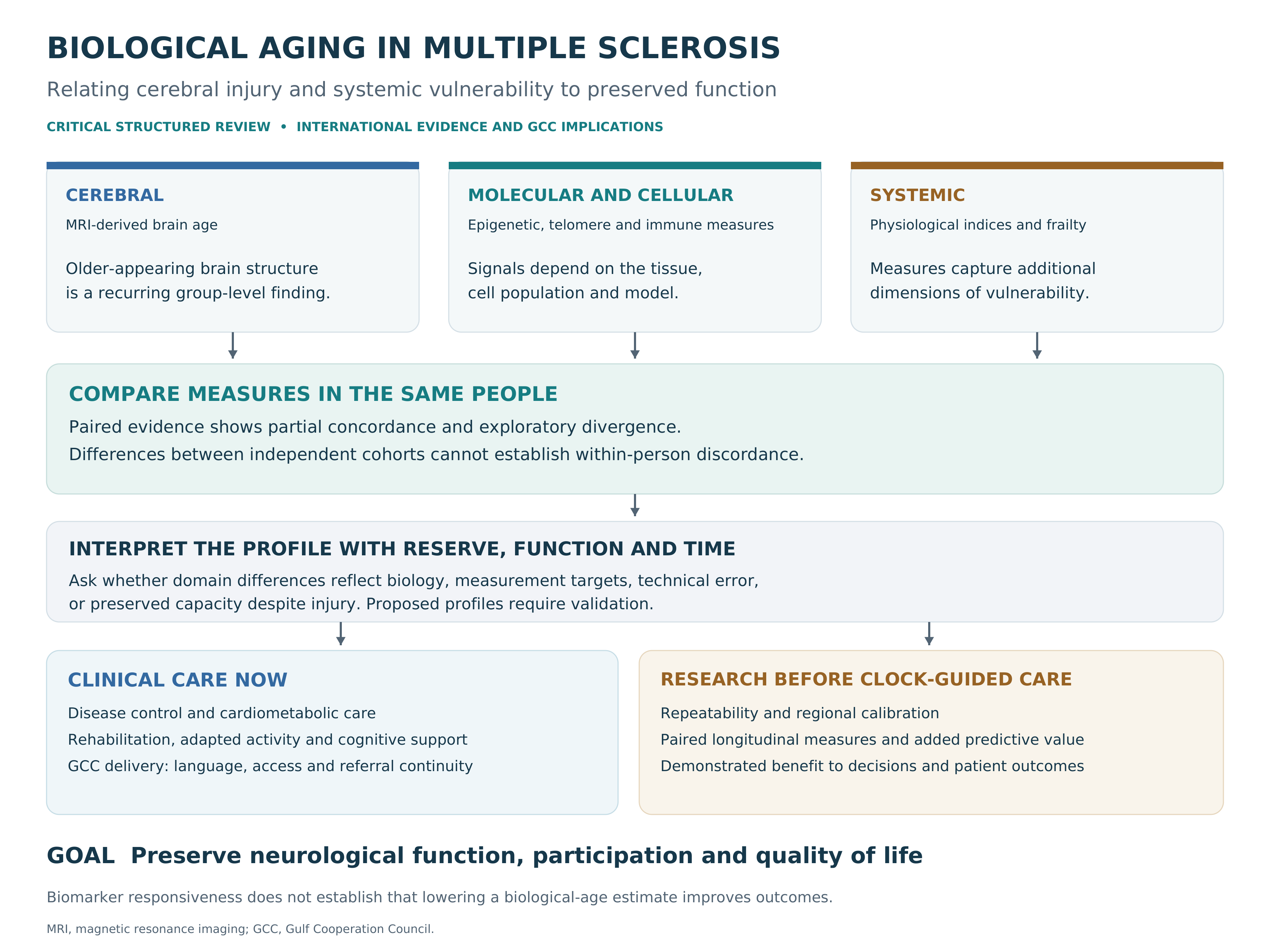
Background: Preserving neurological function in multiple sclerosis (MS) requires understanding why inflammatory injury, systemic vulnerability, and functional capacity evolve differently across patients. Biological-aging measures offer complementary perspectives on this heterogeneity.Objective: To examine how cerebral, molecular, and systemic aging measures relate to one another in MS, distinguish directly demonstrated within-person findings from apparent cross-domain contrasts, and assess their implications for brain-health preservation and Gulf Cooperation Council (GCC) practice.Methods: This critical structured review combined five modular PubMed searches with an evidence cutoff of 5 September 2026 and targeted source verification. Source-directed, AI-assisted selection and charting distinguished adult clinical evidence from mechanistic, pediatric, non-MS, regional, and preprint findings. Independent duplicate screening and formal risk-of-bias assessment were not completed.Results: MRI studies consistently identify older-appearing brain structure at group level, with clinical associations varying by model, cohort, and comparator. Tissue-dependent epigenetic findings and systemic, telomere, and frailty measures suggest partly distinct dimensions of vulnerability. Direct paired evidence includes modest MRI–clinical-blood concordance, opposing exploratory treatment responses, and an MRI–immune comparison without improvement over brain age alone in its disability model. Independent assay cohorts cannot establish within-person discordance. Integrating these distinctions with reserve yields a testable framework for interpreting domain, injury–function, and temporal relationships. GCC cardiometabolic context and research infrastructure support regional evaluation and coordinated prevention, without establishing a distinct regional MS aging phenotype.Conclusions: The contribution of a multidimensional aging framework is to connect measured injury and vulnerability with preserved function and potentially actionable needs. Disease control, cardiometabolic care, rehabilitation, and support for cognition and participation are relevant now. Whether paired aging profiles improve prognosis or treatment decisions requires reproducibility, longitudinal validation, and demonstrated benefit beyond established assessment.
Keywords:
multiple sclerosis
; biological aging
; magnetic resonance imaging
; DNA methylation
; biomarkers
; frailty
; brain health
; Gulf Cooperation Council
Copyright: This open access article is published under a Creative Commons CC BY 4.0 license, which permit the free download, distribution, and reuse, provided that the author and preprint are cited in any reuse.