

Submitted:
15 September 2026
Posted:
16 September 2026
You are already at the latest version
Abstract
The evolution of the pentadactyl limbs in tetrapods is an interdisciplinary field, spanning palaeontology, evolutionary biology, human and animal physiology, biomechanics, and the theory of complex emergent systems. Research in this area has led to the formulation of various scientific hypotheses and theories that require further investigation and testing. This research continues to generate theories and approaches to solve this problem. In this paper, we analyse prevailing theories and the experimental evidence supporting them and propose our model to explain the number of fingers on the human hand. The results of palaeontological studies show that the first limbs of ancient fish that emerged from the water, consisted of eight, seven, or six digits. However, the subsequent evolution of land-dwelling organisms led to the vast majority of tetrapods, from the whole range of possible finger counts, settling on the number five. Geneticists have now studied in considerable detail the mechanism by which five digits are formed, involving the Hoxa11, Hoxa13, Hoxd13 and other genes. However, the question of why evolution chose five digits specifically, rather than six, seven or eight, remains unanswered. Another theory that the selection of five digits and the establishment of this number occurred by chance, and that the number five offers no advantage over any other number. In this paper, we formulate hypothesis that the selection of five digits was not random but purposeful, as evolution would have required, and that the reason for this choice is determined by the physical properties of three-dimensional space and time. We show that the number five is a characteristic number of our physical world, a fundamental biological constant for terrestrial creatures. Evolution’s selection of a limb with five digits is a necessary and sufficient condition for adaptation to three-dimensional terrestrial space, enabling the rapid acquisition, via the five digits, of the necessary and sufficient tactile information about the shapes of three-dimensional objects in the context of the struggle for existence. Tetrapods with any other number of digits lost out to those with five digits in the competitive struggle for survival during the course of evolution.
Keywords:
five fingers on the formulate hand
; evolution of five fingers
; evolution of limbs
1. Introduction. Statement of the Problem and Historical Overview
The question ‘Why do we have five fingers on our hands?’ actually consists of two questions. The first one is: what triggered the mechanism leading to the formation of five fingers, rather than six, seven or eight, during the evolution of ancient fish as they moved onto land? The second one is: what genetic mechanism does nature employ when it causes an embryo to develop paws with five fingers?
The Soviet and Russian palaeontologist O. A. Lebedev discovered an ancient amphibian, named Tulerpeton (Tulerpeton curtum), during excavations at the Andreevka site in the Suvorov District of the Tula Region in 1982; this creature had six toes on each foot [1]. Tulerpeton curtum was a lung-breathing animal that had completely lost its internal gills and inhabited shallow waters in coastal marine lagoons. Its six-toed foot was adapted both for swimming and for pushing its body through soft, damp soil, rather than for crawling on land.
In 1987, during excavations in East Greenland, British palaeontologists J. Clack and M.I. Coats discovered an almost complete skeleton of Acanthostega gunneri and determined that it had eight toes on its limbs. In the same year, they applied more modern methods to clean a specimen of an Ichthyostega hind limb, found at the same site during expeditions by Danish scientists between 1929 and 1955 and housed at the Swedish Museum of Natural History in Stockholm. As a result, they discovered that it had seven toes on its hind limb, four large ones and three small ones fused into a single fin.
In their paper [2], the authors described new preserved fossils from Greenland and cast doubt on the notion that five toes are a primitive characteristic of tetrapods. J. Clack studied the anatomy of Acanthostega in detail. She noted that this creature had limbs with eight digits, yet it retained internal fish-like gills, a weak ribcage that would have been unable to support the body on land, and limb joints that did not bend in a way that would allow the animal to bear its own weight on land.
M.I. Coates carried out a study comparing the structure of the limbs of Acanthostega (eight digits), Ichthyostega (seven digits) and Tulerpeton (six digits), discovered by O. Lebedev [3]. He proposed an evolutionary tree and applied biomechanical models. He demonstrated, both mathematically and anatomically, that during the early stages of the transition to land, the number of toes varied among different animals, and polydactyly was the norm.
They concluded that the limbs had evolved for swimming, not for walking. The structure of the multi-toed limbs of Acanthostega and Ichthyostega (weak wrists, lack of flexible joints) showed that these 7-8-toed fin-like limbs were used primarily for movement in water – as efficient paddles amongst dense aquatic vegetation. The digits on the limbs first evolved in water and only later became useful on land. Amphibians first became quadrupeds, and only then terrestrial creatures. The five-digit configuration is a coincidence. The number 5 is not a fundamental biological constant for terrestrial creatures. Early tetrapods experimented with different numbers of digits (6 in Tulerpeton, 7 in Ichthyostega, 8 in Acanthostega), and it was only later, during the Carboniferous period, that the surviving evolutionary lineages settled on the five-toed pattern.
Based on their findings, J. Clack and M.I. Coates have formulated a new theory of limb evolution: ‘life in water → the emergence of 7–8-toed limbs for swimming → random selection of five-toed forms → the move onto land’.
The development of new technologies and methods for working with DNA from the late 20th and early 21st centuries gave fresh impetus to research into the genetic mechanisms that trigger the development of five digits.
Edward B. Lewis [4], C. Nüssline-Volhard, and E. Wieschaus [5] (Nobel Prize 1995) discovered the Hox genes (homeotic genes). These genes function like an architect’s master plan: they map out the embryo’s body, determining where the head and tail will form, and exactly how many fingers will develop on the limbs.
Researchers at the laboratory of the Swiss geneticist D. Duboule [6,7] discovered that the Hoxd13 and Hoxa13 genes are responsible for the formation of fingers. If these genes are slightly altered, laboratory mice begin to grow six, seven, or more fingers. His experiments showed that the number and length of fingers depend directly on the duration of activity and the dosage of the Hoxd13 and Hoxa13 proteins. If there are too many of these proteins, or if they remain active for longer than intended, the mice begin to develop polydactyly (multiple fingers), similar to that found by Clack and Coates in the fossilised acanthostegs and ichthyostegs.
T. Nakamura – an evolutionary biologist and geneticist, and professor at Rutgers University in the USA – has demonstrated that our fingers evolved from the fins of fish. In 2016, Nakamura, in collaboration with palaeontologist N. Shubin, published a groundbreaking study [8], in which they applied the modern CRISPR/Cas9 gene-editing technology to the commonly used laboratory fish, the zebrafish (Danio rerio). He inactivated the very same Hox genes in the fish (specifically, hoxa13 and hoxd13) that are responsible for the formation of wrists and fingers in humans. As a result, the mutant fish lost their long fin rays. This proved that fingers and fins share common genes, and that the same genetic program operates in both fish and humans; it simply forms fins in fish and fingers in humans.
Researchers from the University of Montreal and the adjacent Montreal Clinical Research Institute (IRCM), led by geneticist and biologist Professor M. Kmita, answered the following question in 2016–2017: which specific genetic switch caused ancient creatures to transition from multi-rayed fins to strictly five-toed limbs? [9]. Marie Kmita’s team conducted experiments on mouse and zebrafish (Danio rerio) embryos. They focused on two key architect genes – Hoxa11 (Homeobox A11) and Hoxa13. The scientists observed that in fish, within the fin primordia, the Hoxa11 and Hoxa13 genes are active simultaneously in the same cells. This resulted in the formation of a fan-shaped fin in fish, with numerous dermal rays (finger-like structures). In mice, these two genes have diverged over the course of evolution. The Hoxa11 gene is active only in the forearm, whilst in the hand itself it is completely switched off, giving way to the Hoxa13 gene. It is precisely this division of the genes’ areas of activity that allows the hand to form exactly five neatly arranged fingers.
To prove this, the scientists carried out a reverse experiment: they forced the Hoxa11 gene to function in the paw of a mouse embryo in the same way as it does in fish. The result confirmed their hypothesis - the mice developed 6-7 fingers on each paw. This discovery solved a long-standing paleontological mystery: why the first land-dwelling creatures, such as Ichthyostega and Acanthostega, had 7–8 fingers. The researchers demonstrated that these creatures had this number of digits not because it was anatomically advantageous for them, but because evolution had not yet fully separated the regions of action of the Hoxa11 and Hoxa13 genes in their DNA. They were at an intermediate stage between the ‘fish-like’ chaotic arrangement and the strict ‘five-toed’ human standard.
M. Kmit’s team also demonstrated [10] how these genetic mechanisms are interlinked with the formation of the wrist, showing that the transition to five fingers required a simultaneous reorganisation of the entire architectural structure of the hand’s joints to provide better support on land.
Professor J. Sharpe from the EMBL (European Molecular Biology Laboratory) in Barcelona has proposed a mathematical and biological answer to the question: ‘Why are our fingers shaped the way they are, and why do we have five of them?’ The key discovery by J. Sharpe and his laboratory relates to the confirmation of A. Turing’s theory [11]. In 1952, the mathematician A. Turing hypothesized that complex patterns in nature (the stripes on a zebra, the spots on a leopard, or the fingers on a hand) form spontaneously due to the interaction of two chemical substances an activator and an inhibitor. Between 2012 and 2014, J. Sharp and his colleagues experimentally demonstrated [12,13] that the fingers on our hands grow precisely according to Turing’s model. They discovered that, within the embryo, the future hand initially takes the form of a solid pad (the precursor to the limb). A mathematical process of ‘self-organisation’ is triggered within it. Three key signalling proteins (BMP, Bone Morphogenetic Protein; the Wnt pathway; Sox9, and SRY-box transcription factor 9) begin to propagate in waves. The peaks of these chemical waves trigger bone growth (these are the future fingers), whilst the troughs of the waves program cell death (these are the spaces between the fingers). The size of the human hand primordia at the embryonic stage and the ‘wavelength’ of these chemical signals coincide perfectly, so that exactly five peaks (five fingers) physically fit within the palm.
J. Sharp’s laboratory genetically modified mice by altering the activity of Hox genes. It turned out that Hox genes act as a ‘volume control’ or a switch for the frequency of the Turing wave. If these genes are slightly inhibited, the distance between the chemical waves increases. Fewer ridges fit on the palm – the mice developed 2–3 thick fingers each. If gene activity was reduced even further, the wave became so frequent that a huge number of thin ridges could fit into the same area – the mouse’s paw turned into something resembling a fish fin with numerous rays. J. Sharp and his colleagues demonstrated that five fingers are the result of the wavelength within our embryonic tissue. Had our palm been slightly wider in the early stages of development, or had the chemical signal been slightly more frequent, the standard number of fingers for humans would have been six or seven.
There are several other explanations and hypotheses - ranging from the laws of pure mechanics to genetic constraints. Here are the main alternative and complementary theories as to why we have ended up with exactly five fingers.
The biomechanical theory (the ideal compromise) [14] views the hand as an engineering structure. From this perspective, five fingers represent an evolutionary compromise between two opposing requirements: flexibility (dexterity) and strength (power). If there were fewer fingers (for example, three, as in some birds or the ancestors of horses), the hand would be perfectly suited to running or providing strong support, but we would lose our fine motor skills - we would be unable to sew, hold small objects securely or play musical instruments. If there were more fingers (six, eight, or ten), the palm would become too wide, bulky and fleshy. The bones inside the palm would be too tightly packed, reducing the overall gripping strength and the hand’s resilience when struck or during a firm grip. Five fingers provide the ideal distribution of load when walking, climbing trees and handling objects.
In developing the ‘Frozen Accident’ theory many evolutionists have tended to view the number 5 not as the ‘perfect crown of creation’, but as a historical accident that simply became established at the right time. When ancient amphibians emerged onto land 360 million years ago, nature was experimenting: Acanthostega had eight toes, whilst Ichthyostega had seven. But due to certain external factors (such as the drying up of water bodies or climate change), it was precisely those species that happened to have five toes (such as Panderpethes). They gave rise to all mammals. Evolution operates on the ‘good enough’ principle, rather than seeking perfection. The five-toed paw performed its tasks perfectly well, and nature simply saw no need to change anything.
Nevertheless, as T. Nakamura notes, science still has no definitive answer to the question: ‘Why did evolution settle on five digits in particular, rather than resulting in a different number?’ [15]. All terrestrial vertebrates - amphibians, reptiles, birds and mammals - are descended from a single fish-like ancestor. Early tetrapods had a large number of digits up to eight on each limb, but during the course of evolution, the superfluous digits disappeared. J. Sharpe noted [16]: ‘The question of why humans have five fingers is the greatest meta-problem of all. If we understood why there are five, we would probably understand everything.’
To summarise, the researchers were able to identify the genetic mechanism underlying the formation of five fingers, confirm the fundamental role of HOX genes, confirm that fingers originated from the transformation of fins, experimentally demonstrated that fingers form as chemical waves according to Turing’s mathematical theory, and described in detail a network of three molecules (Bmp, Sox9 and Wnt), the distribution of which determines the ‘wave’ period, thereby defining the number of fingers.
However, the question of why evolution selected and established at the genetic level the very mechanism of forming five fingers remains unclear to this day, and boils down to several main propositions:
- - the reason for this choice is attributed to chance;
- - the width of the palm does not allow for a greater number, whilst fewer fingers would be impractical; this represents the optimal balance for motor function;
- - it is convenient for grasping and for standing;
- - it’s good enough.
What do these and other similar claims have in common, apart from the fact that the choice of five fingers was a matter of chance?
The main focus in all these statements is on so-called motor and grasping functions, and the biomechanical properties of the limbs: movement, standing, flexibility, dexterity, ease of grasping, fine motor skills, and so on.
In this paper, we hypothesise that the primary reason for the selection of five digits and the consolidation of this selection in the HOX genes lies, first and foremost, in the need for the development of tactile functions in the digits of early tetrapods, and in the properties of our three-dimensional space and time.
2. The Characteristics of Land as a Two-Component Medium. The Transition from Wave-Like Motion to Rectilinear Motion
To understand why evolution settled on five fingers in different species of tetrapods, we should first consider three-dimensional space itself and the properties of time, and to begin with, examine the differences between the terrestrial and aquatic environments. It was precisely thanks to the two-component environment – comprising land and the air above it – and the physical laws of the three-dimensional world that the mechanism for the genetic formation of five-toed limbs was set in motion.
For the first lobe-finned fish to colonise land, the main factor – apart from stronger gravity – was that they found themselves in a two-component environment, where life was primarily concentrated on the earth’s surface and in the air, in contrast to their previous homogeneous aquatic environment.
The presence of a boundary in a two-component medium – between solid ground and air – enabled them and their descendants to radically change their mode of locomotion. Now, instead of undulating movement, they were able, by rising above the land, to move in a straight line forwards.
It was enough simply to stand on their limbs, ensure good grip between the limbs and the ground surface over which they were moving, and, by pushing off from it, impart the momentum required for movement to the body. It can therefore be said that the development of limbs suited to this new type of movement was the key to the successful colonisation of land.
3. The Functioning of the Senses When Fish Move onto Land
It should be noted that the existence of all living organisms follows the same identical pattern. The very existence of living beings, and all their movements, is impossible without feedback, a role fulfilled by the sensory nervous system: the sense organs and parts of the cerebral cortex. The most fundamental feedback signal is the signal indicating the presence of danger. Any search for food sources or any exploration of a new habitat is impossible when the boundaries of dangerous distances are too close and the level of danger is too high. Only when there is an acceptable safe zone ─ the boundaries of which are determined by the reaction speed of living beings, the distance to a safe shelter, or the possibility of simply fleeing – can living organisms continue to exist. Therefore, in addition to adapting their limbs to a new mode of movement, all organisms colonising a new habitat require a new, modified sensory nervous system and new sensory organs – sight, hearing, smell, taste, touch and the vestibular system –adapted to that environment.
It is clear that, upon leaving the water, their sense organs will function quite differently—if they function at all. Which of the fish’s main sensory organs changed when they moved onto land?
Firstly, their lateral line ceased to function; this was the main organ responsible for remote sensing in fish, enabling them to detect sound vibrations, surrounding currents and water pressure. The lateral line of fish could only function in water. On land, they could no longer perceive their surroundings.
Secondly, even their enlarged eyes were not yet adapted to dry, dusty air or to the vastly increased levels of solar radiation. In paper [17], a team of scientists led by Professor M. MacIver of Northwestern University and L. Schmitz of Claremont Colleges carried out calculations demonstrating an evolutionary leap in vision among Tiktaalik’s ancestors. It was shown that Tiktaalik’s eyes, which were situated on top of a flattened, crocodile-like skull, were three times larger than normal so that, by raising them out of the water, the animal could observe its surroundings in the air and hunt ancient insects inhabiting the coastal environment. This enabled the animals to see 70 times further than they could in water and expanded the space they could monitor a million-fold, whilst also prompting them to colonise the land as a safe haven with a ‘buffet’ full of insects. However, simply increasing the size of their eyes was not enough for them to survive on land.
They lacked a fully developed lacrimal system and an outer eyelid, which protect the eyes from drying out and mechanical damage. Their flat cornea was not adapted to refract light in the air, and their spherical lens was unable to allow the eyes to focus at different distances. Furthermore, vision is not just about the eyes. Processing information from such enlarged eyes would have required a significant increase in brain volume. Even their descendants, the amphibians, can see clearly on average up to 2 meters, and mainly only moving objects. Most importantly, they were fundamentally unable to see what lay beneath their bellies and limbs, as their eyes were positioned on top of their heads and could only perceive what lay above the horizon of their heads. The part of the ground over which they crawled – uneven surfaces, stones, holes and anything else that might pose a danger to them – lay within their blind spot and was terra incognita to them.
Thirdly, they lost their sense of hearing. In water, the inner ear, connected to the lateral line, served as their hearing organ, whilst the swim bladder helped to amplify these sounds. As with all amphibious fish, the swim bladder itself began to shrink as the fish moved onto land, until it eventually disappeared altogether. They could still detect certain vibrations in the ground and sounds travelling along the surface, but this was completely insufficient on land.
Fourthly, their keen sense of smell, which allowed them to detect concentrations of substances at a ratio of 1:1,000,000,000, also required an aquatic environment. They could make out the outlines of moving objects around them, sense gusts of wind and smells, and hear loud noises. But it was nothing like what they had experienced in the water. The limits of safe distances had closed in on them a hundred, if not a thousand, times. Almost all their senses, which had evolved over hundreds of millions of years spent in water, were virtually useless on land and needed to adapt.
4. The Tactile Function of the Fingers Was the Primary Functional Mechanism in Adapting to a New Habitat
All except one - tactile perception, which evolved further. The first ancient fish to begin adapting to life on land most likely discovered that, after leaving the water, the only sense that remained and continued to function well was the tactile function of their pelvic and pectoral fins ─ which they had begun to develop whilst still living in an aquatic environment. It was touch that may well have become the very first and most important sense, enabling fish to adapt to life in their new environment. Whilst in water fish relied on their lateral line, receptors on the skin, barbels and the ray bones of their fins for touch, now, when moving on land, the ability to feel the surface of the ground and objects on it was retained only by the barbels and the pectoral and pelvic fins.
In the early stages ─ perhaps spanning tens of millions of years ─ it was precisely the limbs, which had evolved from the pectoral and pelvic fins, that played a decisive role in the colonisation of land, replacing, amongst other things, hearing, as they were able to sense vibrations transmitted through the ground. Furthermore, with a genetic mechanism already in place, the process of transforming fins into paws with an optimal number of toes most likely occurred much more rapidly than the adaptation of the other senses to life on land.
The paws of modern animals can be said to have two main functions. Animals must be able to stand or move, hunt or defend themselves, grasp prey or hold onto branches whilst climbing – that is, dynamic (locomotor and prehensile) functions – as well as tactile functions, i.e., sensing the surface they are running on or what they have finally caught.
Here we have tot once again consider what was more important for the limbs of the first land-dwelling creatures – motor and grasping functions, or tactile senses? Clearly, the ability to move and grasp was essential. But with virtually no sight, poor hearing, and no sense of danger, where on earth could they go, whom could they hunt, and from whom could they flee? Even if there was no particular danger around them – since there were no predators on land apart from themselves, and the very act of coming ashore was an attempt to find a safer and more food-rich habitat. Most likely, the range of movement of the first land-dwellers was limited, and their movements were very cautious – much like walking in complete darkness, unable to hear sounds or detect smells, feeling their way around everything in their vicinity.
Therefore, upon emerging onto the earth’s surface, the very first and most essential function of their paws ─ on which their ability to adapt to life on land depended ─ was tactile: feeling everything around them and sensing the surface of the ground. Neither an increase in size and mass, nor the ability to stand firmly or crawl nimbly, nor any other anatomical features gave them such an advantage as the ability to quickly and accurately determine the properties of the surface beneath their paws.
Moreover, moving onto land would have been impossible without changes to the musculoskeletal system, including modifications and strengthening of the bones and so on, but the tactile function of the paws had to be developed first and foremost, and as quickly as possible─ not just in one specific paw – but preferably in all four, in order to obtain more accurate information about the surrounding environment.
At the same time, the main reason why nature ultimately chose the variant of tactile paws with precisely five digits, rather than six, seven or eight, lies in the properties of the space-time environment surrounding us, namely its three-dimensionality, homogeneity and the properties of time.
5. The Evolutionary Mechanism Behind the Selection of a Five-Fingered Hand and the Properties of Three-Dimensional Space-Time
Let us consider the simplest problem. There is a ball lying on a table. How many fingers are needed to fix its position? The answer is one (Figure 1). Mathematically, this means that the ball’s position in space is determined by the coordinates X, Y, Z relative to a chosen reference frame, for example, that of a person. But this is also the definition of a radius vector, a role successfully played by our finger. But what if there are pencils and balls on the table? How many fingers do you need to determine whether it is either a pencil or a ball (Figure 1).? The answer is two. A mathematician would say that to define a straight line or a directed line segment, you need to specify two points, i.e., use two fingers. It is also clear that to identify, for example, a book or a flat board, we will need just three fingers, since a plane is defined by three points (Figure 1).
However, it is somewhat more complicated with three-dimensional shapes. Let us consider a cylinder of diameter D. To determine whether it is a cylinder or a plane, we will need four fingers positioned so that they form a square with a side length l less than or equal to the cylinder’s diameter D (Figure 2). However, if we rotate the cylinder by 90°, we find that it is impossible to determine the cylinder’s orientation with our eyes closed ─ that is, by touch using four fingers. In both cases, we will feel contact at the same four points on our fingers.
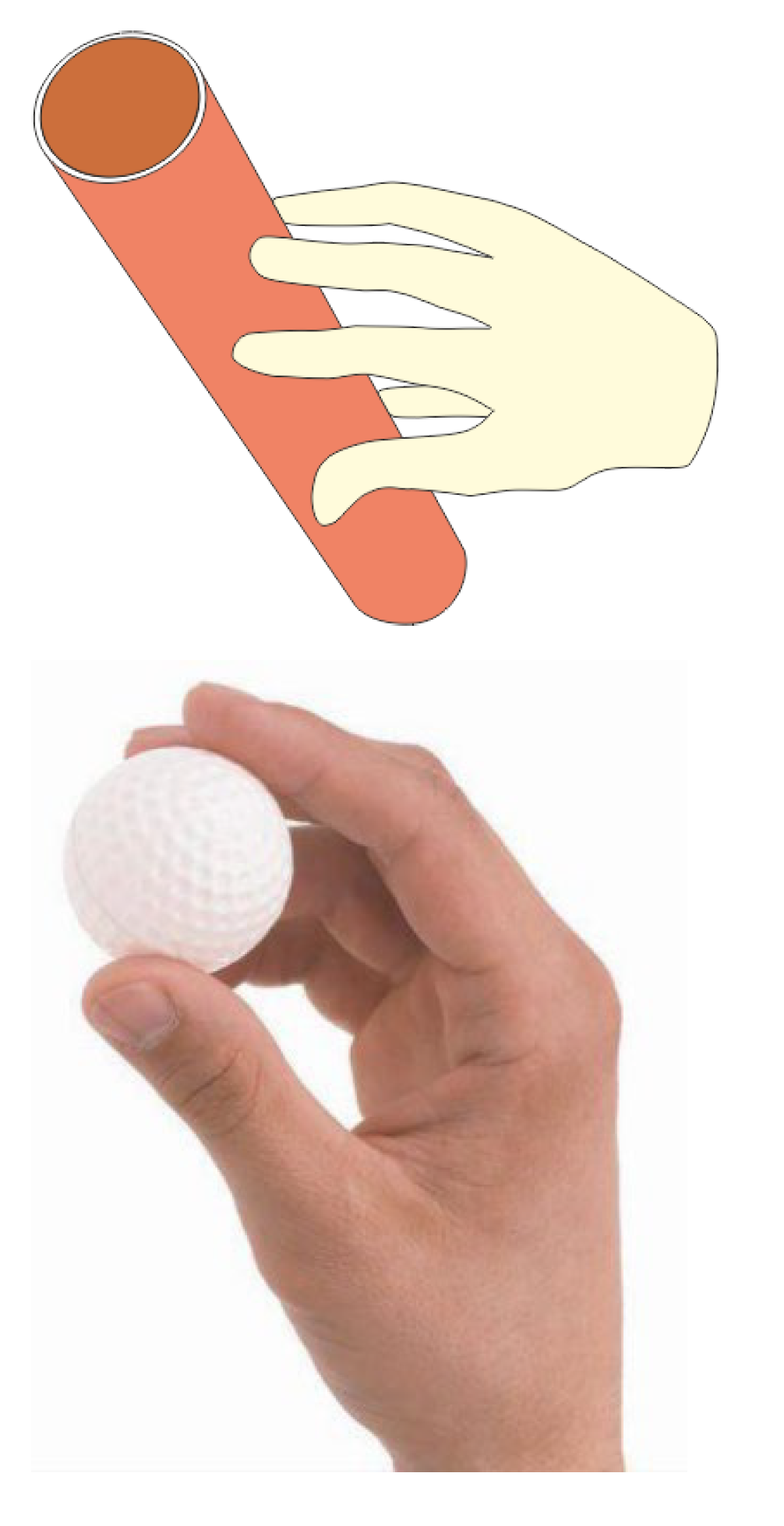
It is possible to determine cylinder’s orientation with the help of the fifth finger that we can determine which way the cylinder is facing, i.e., whether it lies lengthways or crossways along the hand (Figure 3). Moreover, with the help of the fifth finger, we can not only determine the orientation of the cylinder but also distinguish any three-dimensional objects by its geometrical shape: an apple, a pear, or a sphere (Figure 3). From a mathematical point of view, without delving into the intricacies of the topology of complex objects, this means that any simple surface in three-dimensional space is defined by five points.
The second reason why we have five fingers is that we not only live in three-dimensional space, but also live our lives in time. And this life depends on how quickly we can assess the space around us and how quickly we can make the right decisions.
It is possible to determine the shape of a surface using just one finger by feeling the object several times. For example, a probe is used to determine the shape of a mine buried in the ground. By gently probing around the mine, one can determine its boundaries. But to do so, one needs to probe it at least five times, and perhaps even more.
Clearly, by grasping an object with two, three or four fingers, we can also form an accurate impression of it. But each such grasp takes up additional time, and in a struggle for survival, where the faster person wins, this means the right to live. And six fingers are no good either, as the signal from the sixth finger provides no new information, but simply duplicates that from the other fingers. This is also a disadvantage because time is wasted filtering out the redundant signal.
Only five fingers allow the precise shape of an object to be determined in the shortest possible time; consequently, they are a necessary and sufficient condition for the existence of living organisms on land, and the number of fingers most advantageous for life from an evolutionary perspective. To summarise, it can be said that the time taken to make a decision when assessing the surrounding reality is responsible for the fact that nature chose not one, two, three or four fingers, but five. Similarly, thanks to the three-dimensionality and homogeneity of the space around us, nature has ruled out options with six, seven, eight or more fingers.
In general, three-dimensional space is characterised by three spatial coordinates, X, Y and Z, and the angles α, β and γ. And the homogeneity of our space lies in the fact that, when rotating through any angles and moving from one point in space to another, we will not find any distinct direction or distinct locations ─ that is, any direction or locations where the physical properties of space differ from one another. For example, whether it is better to breathe in a southerly direction than in a westerly or easterly one, or whether a person’s height is twice as great at one point as at another. This also means that, having determined the shape of any object in one place, we can be certain that its shape has not changed fundamentally in another place. Mathematically, this means that to construct a closed surface or sphere, it is entirely sufficient to perform a convolution using the three coordinates and the two angles, or indeed the very same five independent variables required to determine the geometric properties (surface area, volume) of objects in our three-dimensional world.
We can therefore assert that the number five is a fundamental biological constant for terrestrial organisms, a characteristic number of our three-dimensional space, and that the very geometry of living organisms is entirely determined by the physical properties of space and time, its properties of symmetry, the properties of gravity and electromagnetic waves, and the properties of the environment in which they live.
As they crawled along the riverbed, pushing their way through dense thickets of aquatic vegetation, ancient fish most likely activated the genetic mechanism for the transformation of their fins not only for swimming, but also as an additional source of tactile information about their surroundings: dense algae, rocks on the riverbed, and so on. Thus, with this genetic mechanism already in place, the process of transforming fins into paws with the optimal number of digits for life on land would most likely have occurred more rapidly than the adaptation of the other sensory organs.
Perhaps, as tool use drove the evolution of primates into humans, the development of the tactile fin function likely accelerated brain development in ancient fish, speeding their adaptation to life on land.
Once the first land-dwelling creatures had restored their other senses ─ sight, hearing and smell – and adapted to life in a two-component environment such as land, whilst the tactile function of their fingers ceased to be the sole and primary means of gathering information about their surroundings, they immediately began to modify their fingers to suit more pressing survival needs. Many ancient animals, upon finding their niche, reduced the number of digits to accommodate more advantageous specialised functions.
Most predatory dinosaurs had three-toed limbs. The Tyrannosaurus had three or four toes on its hind feet and two on its forelimbs. Their descendants, birds, generally have four toes, although some have three or two, as in the case of the African ostrich. Primates, rodents and carnivores chose to retain five toes. Tapirs have four toes on their front feet and three on their hind feet. Rhinoceroses and sloths retained three toes. Even-toed ungulates have two toes. Horses took the most radical approach. To run fast and fend off predators, a single toe proved sufficient for them.
On the other hand, animals that needed a sense of touch out of necessity developed these abilities even further. For example, raccoons have sensitive front paws and can feel their way around objects in water without looking. Cats use the pads of their paws to sense sound waves, temperature and the shape of surfaces. For moles, their paws serve a purpose beyond simply digging burrows. The sensitive touch of their paws allows them to determine the shape of objects and hear sounds from the surface in complete darkness.
Based on the mechanism of evolutionary selection of five digits that we have examined, we can rewrite the theory of limb evolution proposed by J. Clack and M.I. Coates [3] as: ‘life in water → the emergence of 7–8-digit flippers for swimming → random selection of five-digit forms → the move onto land’.
When considering the number of digits on the limbs and the habitats of Acanthostega, Ichthyostega and Tulerpeton, the following can be observed: Acanthostega had eight digits on its limbs. It possessed internal gills, weak limbs lacking wrists, and short ribs, all of which indicate a predominantly aquatic lifestyle. Ichthyostega had seven digits on its limbs. It possessed a caudal fin and sensory organs that functioned only in water. It breathed through its lungs and had reduced gill remnants. At the same time, its forelimb girdle was stronger and better adapted for locomotion on its limbs. It is thought to have inhabited shallow waters, muddy shores and marshes, venturing onto land only briefly. Tulerpeton had six toes on each foot. It was a lung-breathing animal that had completely lost its internal gills and it is thought to have inhabited shallow marine waters. Its foot was adapted both for swimming and for pushing its body through soft, damp soil and coastal silt, rather than for crawling on land.
With a certain degree of probability, it can be concluded that a greater number of toes on the feet indicated an aquatic lifestyle. Animals with fewer toes were already tending towards a semi-aquatic life in shallow waters, as they were unable to breathe in water like fish.
Therefore, the modified theory of limb evolution proposed by J. Clack and M. I. Coates [3], concerning the process by which fish moved onto land, would most likely look as follows:
- - Life in water →
- -The emergence of fins/limbs with 7–8 digits for swimming in shallow waters amidst dense algae→
- - Life in coastal waters and frequently drying-up saltwater bodies of the first lobe-finned fish, swimming and crawling along the bottom in coastal mud, with between 8 and 6 digits on their limbs, and the initiation of the mechanism for the transformation of fins not only for swimming, but also as an additional source of tactile information about the environment: dense algae, bottom rocks, etc., as a preparatory stage before leaving the water and adapting to life on land →
- - Leaving the water and adapting to life on land →
- - Not random, but purposeful ─ the activation of the mechanism for the development of the tactile functions of the toes, as the primary source of information about the environment when adapting to life on land→
- - The evolutionary selection of a number of digits equal to 5 as a necessary and sufficient condition for obtaining tactile information about the environment, and the consolidation of this number by eliminating unnecessary genetic mechanisms responsible for the development of a greater number of digits.
6. Conclusions
The number five is a number characteristic of living organisms in our three-dimensional world, a fundamental biological constant for terrestrial creatures. The choice of five fingers was by no means random, but rather a deliberate adaptation to the three-dimensional shapes of objects on the Earth’s surface and the need to quickly obtain tactile information in the context of the struggle for survival.
The time taken to make a decision when assessing the environment through touch is the reason why nature opted for five fingers rather than one, two, three or four. Similarly, owing to the three-dimensionality and uniformity of the space around us, nature has ruled out variants with six, seven, eight or more fingers. Five fingers are a necessary and sufficient condition for adaptation to three-dimensional space and for the rapid acquisition of tactile information about the shapes of three-dimensional objects in the context of the struggle for existence.
The modified theory of limb evolution ─ that is, the mechanism by which animals developed five fingers is as follows:
- - Life in water →
- - The emergence of fins/paws with 7–8 digits for swimming in shallow water amidst dense algae→
- - Life in coastal waters and frequently drying-up saltwater bodies of the first lobe-finned fish, swimming and crawling along the bottom in coastal mud, with between 8 and 6 digits on their limbs, and the initiation of the mechanism for the transformation of fins not only for swimming, but also as an additional source of tactile information about the environment: dense algae, bottom rocks, etc., as a preparatory stage before leaving the water and colonising land →
- - Leaving the water and adapting to life on land→
- - Not by chance, but purposefully the activation of the mechanism for the development of the tactile functions of the toes, as the primary source of information about the environment when adapting to life on land→
- - The evolutionary selection of 5 as the number of digits ─ as a necessary and sufficient condition for obtaining tactile information about the environment—and the consolidation of this number by eliminating unnecessary genetic mechanisms responsible for the development of a greater number of digits.
Animals with any other number of digits would always have been at a disadvantage in the competitive struggle for survival against five-toed species. And, as a result, they most likely lost out. It was only after the tactile function of the toes on their paws ceased to be the sole source of information about the environment, and tetrapods began to adapt successfully to life on land ─ that is, once they had learnt to see, hear and smell ─ did evolution resume the process of further reducing superfluous digits to meet the specific needs of each animal species occupying its strictly defined ecological niche. This resulted in the modern diversity of terrestrial animals, with a number of digits ranging from five to one.
Acknowledgments
Assistance from AI was used to improve English grammar and style of the manuscript text.
References
- Lebedev, O. A. ‘The first discovery of a Devonian tetrapod in the USSR’. Palaeontol. J. 1984, No. 3, 116–119. [Google Scholar]
- Coates, Michael I.; Clack, Jennifer A. ‘Polydactyly in the earliest known tetrapod limbs’. Nature 1990, vol. 347, 66–69. [Google Scholar] [CrossRef]
- Lebedev, O. A.; Coates, M. I. ‘The postcranial skeleton of the Devonian tetrapod Tulerpeton curtum Lebedev’. Zool. J. Linn. Soc. 1995, Vol. 114(Issue 3), 307–348. [Google Scholar] [CrossRef]
- Lewis, Eduard B. ‘A gene complex controlling segmentation in Drosophila’. Nature 1978, vol. 276, 565–570. [Google Scholar] [CrossRef] [PubMed]
- Nüsslein-Volhard, Christiane; Wieschaus, Eric. “Mutations affecting segment number and polarity in Drosophila”. Nature 1980, vol. 287, 795–801. [Google Scholar] [CrossRef] [PubMed]
- Dollé, P.; Dierich, A.; LeMeur, M.; Schöneich, T.; Duboule, D. ‘Disruption of the Hoxd-13 gene induces alterations in spatial patterning and the loss of features of the pentadactyl limb’. Cell 1993, vol. 75(Issue 3), 431–441. [Google Scholar]
- Sordino, P.; van der Hoeven, F.; Duboule, D. Hox gene expression in teleost fins and the origin of vertebrate digits. Nature 1995, vol. 375(no. 6533), 678–681. [Google Scholar] [CrossRef] [PubMed]
- Nakamura, T.; Gehrke, A. R.; Lemberg, J.; Szymaszek, J.; Shubin, N. H. ‘Digits and fin rays share common developmental histories’. Nature 2016. [Google Scholar] [CrossRef] [PubMed]
- Kherdjemil, Yacine; Lalonde, Robert L.; Sheth, Rushikesh; Dumouchel, Annie; de Martino, Gemma; Pineault, Kyriel M.; Wellik, Deneen M.; Stadler, H. Scott; Akimenko, Marie-Andrée; Kmita, Marie. ‘Evolution of Hoxa11 regulation in vertebrates is linked to the pentadactyl state’. Nature 2016, vol. 539, 89–92. [Google Scholar] [CrossRef] [PubMed]
- Sheth, R.; Marcon, L.; Bastida, M. F.; Junco, M.; Quintana, L.; Dahn, R.; Kmita, M.; Sharpe, J.; Ros, M. A. ‘Hox genes regulate digit patterning by controlling the wavelength of a Turing-type mechanism’. *Science* 2012, 338(6113), 1476–1480. [Google Scholar] [CrossRef] [PubMed]
- Raspopovic, J.; Marcon, L.; Russo, L.; Sharpe, J. ‘Modelling digits. Digit patterning is controlled by a Bmp-Sox9-Wnt Turing network modulated by morphogen gradients’. Science 2014, 345(6196), 566–570. [Google Scholar] [CrossRef] [PubMed]
- Turing, Alan M. ‘The Chemical Basis of Morphogenesis’. Philos. Trans. R. Soc. London. Ser. B Biol. Sci. 1952, vol. 237(No. 641), 37–72. [Google Scholar] [CrossRef]
- Onimaru, K.; Marcon, L.; Musy, M.; Tanaka, M.; Sharpe, J. ‘The fin-to-limb transition as the reorganisation of a Turing pattern’. Nat. Commun. 2016. [Google Scholar] [PubMed]
- Efremov. “Taphonomy and Geological Chronicle”; USSR Academy of Sciences, 1950. [Google Scholar]
- Kiniry, Laura. ‘Why do we have five fingers and toes?’. *Pop. Sci.* 2025. [Google Scholar] [CrossRef]
- Yong, Ed. ‘How Did You Get Five Fingers?’; National Geographic, 1 August 2014. [Google Scholar]
- Schmitz, Lars; Mugan, Ugurcan; Murphey, Todd D; Mobley, Curtis D. ‘Massive increase in visual range preceded the origin of terrestrial vertebrates’. PNAS 2017. [Google Scholar] [CrossRef] [PubMed]
Figure 1.
Illustration demonstrating how geometric objects can be defined through the tactile sensation of using one, two, or three fingers: a ball is represented as a point, a pencil - as a line segment, and a book - as a plane.
Figure 1.
Illustration demonstrating how geometric objects can be defined through the tactile sensation of using one, two, or three fingers: a ball is represented as a point, a pencil - as a line segment, and a book - as a plane.
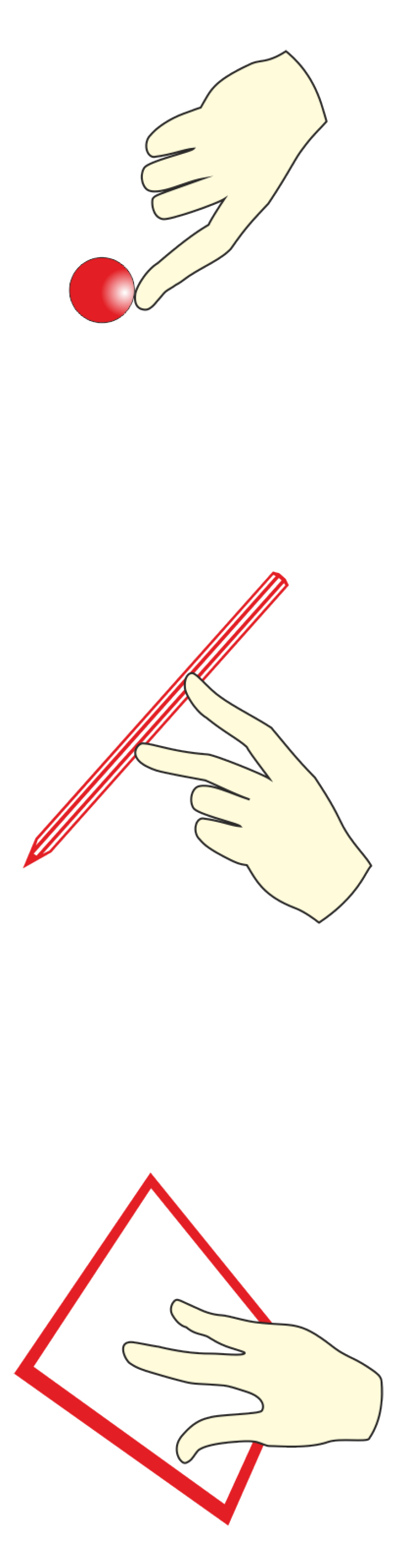
Figure 2.
Illustration demonstrating how a cylinder can be defined through the tactile sensations of using four fingers (left) and the impossibility to determine cylinder’s orientation using tactile sensation by four fingers (right).
Figure 2.
Illustration demonstrating how a cylinder can be defined through the tactile sensations of using four fingers (left) and the impossibility to determine cylinder’s orientation using tactile sensation by four fingers (right).
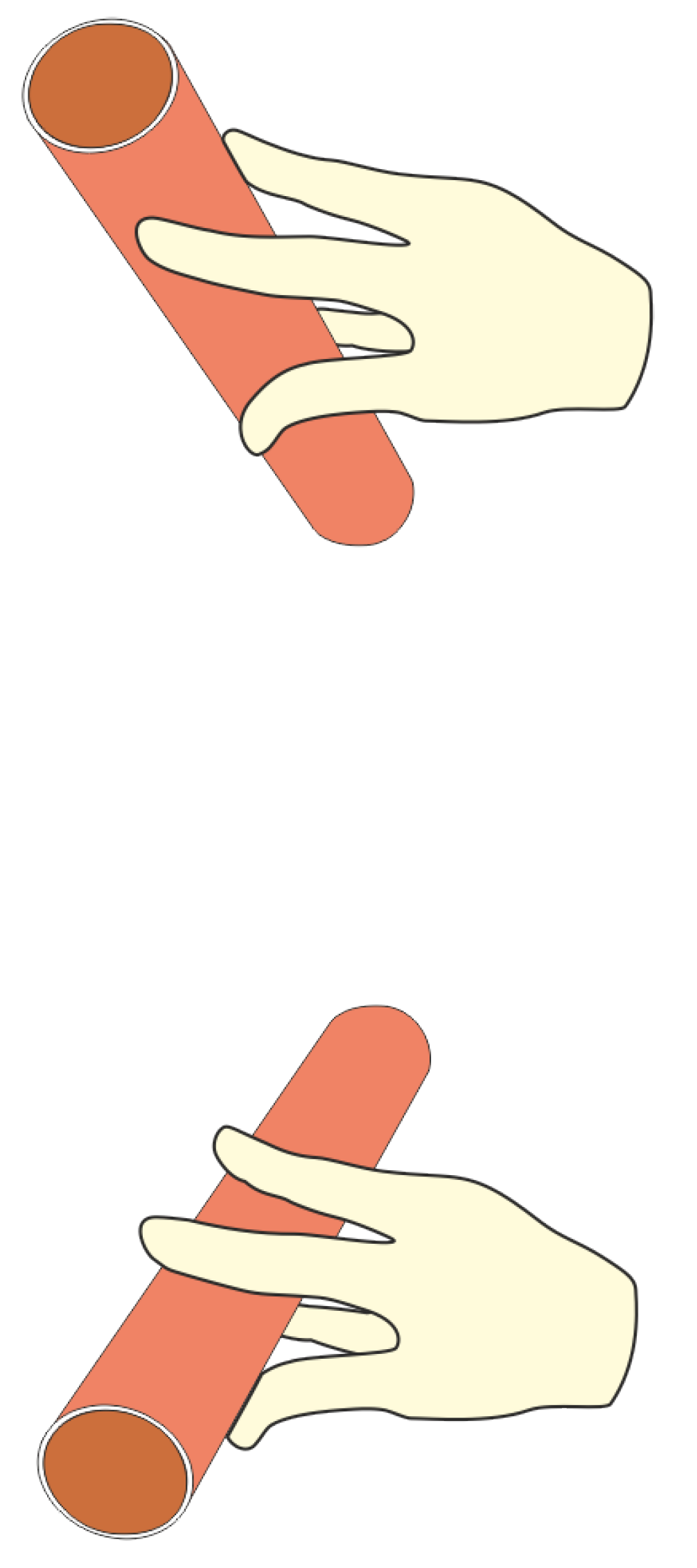
Figure 3.
Illustration demonstrating how a shape of three-dimensional objects can be defined through the tactile sensation of using of the five fingers.
Figure 3.
Illustration demonstrating how a shape of three-dimensional objects can be defined through the tactile sensation of using of the five fingers.
Disclaimer/Publisher’s Note: The statements, opinions and data contained in all publications are solely those of the individual author(s) and contributor(s) and not of MDPI and/or the editor(s). MDPI and/or the editor(s) disclaim responsibility for any injury to people or property resulting from any ideas, methods, instructions or products referred to in the content. |
© 2026 by the authors. Licensee MDPI, Basel, Switzerland. This article is an open access article distributed under the terms and conditions of the Creative Commons Attribution (CC BY) license (http://creativecommons.org/licenses/by/4.0/).
Copyright: This open access article is published under a Creative Commons CC BY 4.0 license, which permit the free download, distribution, and reuse, provided that the author and preprint are cited in any reuse.