
Submitted:
15 September 2026
Posted:
16 September 2026
You are already at the latest version
Abstract
The voluntary carbon market (VCM) certifies and trades greenhouse gas mitigation and removal outcomes generated outside compliance markets, yet concerns about additionality, measurement, reporting and verification (MRV), double counting and credit quality continue to constrain market credibility. Stringent integrity requirements may simultaneously increase the cost and expertise burden borne by new climate-tech firms and carbon mitigation project developers. This study examines how institutional requirements for environmental integrity are connected to the market entry and value creation of these actors. A SciVal-based research landscape analysis is combined with a qualitative analysis of legal, policy and market-operation documents, and the European Union, Singapore and the Republic of Korea are compared functionally as cases with different institutional contexts and stages of development. The comparison shows that integrity requirements simultaneously constitute market-access conditions and entry requirements, that entry burdens are addressed not by relaxing quality standards but by entry-enabling conditions such as standardization, technical and advisory support, burden mitigation, collective participation and early-stage finance, and that market participation is converted into economic value only where revenue realization, price valuation, revenue predictability and commercial scaling operate. On this basis, an Integrity–Entry–Value (IEV) structure is proposed as a conditional rather than linear account of VCM formation, offering conditional policy implications for late-forming markets.
Keywords:
voluntary carbon market
; environmental integrity
; MRV
; market entry
; climate tech
; value creation
; value capture
; comparative policy analysis
1. Introduction
The voluntary carbon market (VCM) has developed as a market-based mechanism that converts greenhouse gas (GHG) mitigation and removal activities outside compliance markets into carbon credits, thereby inducing private climate action and mitigation investment. As the market has grown, however, questions about the actual mitigation effect and the environmental integrity of credits have been raised persistently. A synthesis of existing empirical evidence covering 2346 carbon crediting projects reports that only a limited share of the credits issued by the projects examined is backed by actual emission reductions [1], and it has also been noted that a substantial share of the credits used by major companies originated from projects at high risk of failing to deliver real and additional mitigation [2]. This body of work indicates that the sustainability of the VCM does not follow from growth in traded credit volume alone, but depends on securing the credibility of mitigation outcomes through additionality, appropriate quantification, measurement, reporting and verification (MRV) and transparent tracking.
Institutions designed to strengthen environmental integrity, however, may raise market trust and at the same time generate new entry costs for new firms. Unlike the market entry of ordinary products or services, the recognition of a carbon mitigation project as a source of credits requires compliance with requirements for the measurement, reporting, verification and certification of mitigation outcomes, as well as with trading rules. A meta-analytical review of forest carbon sequestration projects showed that transaction costs arise not only from project establishment and management but also from compliance with trading requirements and MRV, and pointed out that such costs may not be sufficiently accounted for in assessments of project economics [3]. Conversely, a study of 18,110 cleantech startups across 33 countries reports that market-based climate policy and technical support are positively associated with the entry of new cleantech firms, and that complementary institutional environments such as the financial system strengthen this relationship [4]. Taken together, these findings suggest that the institutional arrangements of carbon markets are simultaneously the foundation of market trust and a condition that may enable or constrain firm entry.
After entry, a further question is whether carbon mitigation activities can be translated into value creation for the firm. A review of 143 academic studies and 49 industry and policy sources that typologizes low-carbon business models—the ways in which firms propose, create and capture value through decarbonization—notes that research integrating decarbonization and value creation in a low-carbon setting remains limited [5]. Studies that link the VCM directly to entrepreneurship have also begun to appear [6], but this literature is not yet well developed. In addition, an analysis of actual transactions in Japan's J-Blue Credit scheme found that project characteristics, co-benefits, purchaser characteristics and the fit between them influenced transaction outcomes [7]. This suggests that economic value is not created automatically by generating credible credits; purchase demand and market relationships must be formed alongside them.
Despite this literature, an important disconnect persists across research areas. A recent systematic review of empirical VCM research also highlighted environmental, financial and socio-economic performance and the importance of policy frameworks [8], yet existing work has largely analysed the environmental integrity of credits and projects, climate policy and firm entry, business models and value creation, and project–purchaser transaction relationships separately. In particular, relatively few studies explain, from the perspective of the firm and within a single structure, how the MRV, verification and certification systems that secure environmental integrity enable or constrain the market entry of new climate-tech firms and carbon mitigation project developers, and how entry is in turn connected to value creation. The question is also institutionally timely. Through the Carbon Removals and Carbon Farming Certification Framework (CRCF) established by Regulation (EU) 2024/3012, the European Union is institutionalizing quality criteria and verification and certification procedures for permanent carbon removals, carbon farming and carbon storage in products; although the CRCF is not identical to the EU-wide VCM, it is an important case of the institutionalization of the credibility of carbon outcomes [9]. Singapore presents criteria for identifying high-quality carbon credits, independent third-party verification and the avoidance of double counting in official policy guidance, while also operating actual VCM trading infrastructure, making it a case in which environmental integrity and firm-level market access can be examined together [10]. The Republic of Korea, in turn, published the Direction for the Establishment of a Korean Voluntary Carbon Market in April 2026, which covers registration, assessment and trading, demand development and support for the market entry of small and medium-sized enterprises (SMEs), and identifies MRV support and the easing of entry barriers as key policy tasks [11]. Because market operation has not yet produced accumulated outcomes, Korea is a case in which the joint design of environmental integrity and firm entry can be examined at the stage of institutional formation.
Accordingly, this study aims to clarify how the institutional requirements for securing environmental integrity in the VCM are connected to the market entry and value creation of climate-tech firms and carbon mitigation project developers. To this end, a SciVal-based research landscape analysis and a qualitative analysis of policy and institutional documents are used to compare the relevant institutional functions of the EU, Singapore and Korea, three cases with different institutional contexts and stages of development. On this basis, the study links environmental integrity (Integrity), firm market entry (Entry) and value creation (Value) and identifies the policy and institutional conditions that enable firm participation while maintaining environmental integrity.
The study addresses the following research questions.
RQ1 (Integrity). What conditions and potential burdens do environmental integrity requirements—such as additionality, MRV, and verification and certification—create for the market access of climate-tech firms and carbon mitigation project developers?
RQ2 (Entry). What institutional conditions are required to mitigate these entry requirements and potential burdens without undermining market credibility?
RQ3 (Value). Through which market functions are the mitigation outcomes of participating climate-tech firms and carbon mitigation project developers converted into value creation and value capture?
2. Materials and Methods
2.1. Research Design
This study is designed as comparative policy research that combines a SciVal-based research landscape analysis with a qualitative analysis of policy and institutional documents in order to examine how the institutional requirements for securing environmental integrity in the VCM are connected to the market entry and value creation of climate-tech firms and carbon mitigation project developers. The purpose is not to evaluate market performance or institutional superiority across cases, but to identify the institutional functions that connect environmental integrity with firm participation and value creation in different institutional contexts and at different stages of development. Document analysis, which systematically examines statutes and official policy documents as independent research material, is well suited to analysing how policies and institutions are formed and how they operate [12].
The research proceeded in four stages, as summarized in Figure 1. First, SciVal was used to explore the VCM-related research landscape and its main research themes. Second, relevant statutes, policy documents and official market-operation materials for the EU, Singapore and Korea were collected. Third, the collected materials were coded into the three dimensions of environmental integrity (Integrity), market entry (Entry) and value creation (Value), and a functional comparison across cases was conducted. Finally, the shared functions, differences and institutional gaps identified in the comparison were synthesized into the Integrity–Entry–Value (IEV) structure.
2.2. SciVal-Based Research Landscape Analysis
Prior to the policy and institutional analysis, Elsevier SciVal was used as a supplementary tool to identify the structure of VCM-related scholarly research and its main research areas [13]. On 28 August 2026, “VCM – Voluntary Carbon Market” was specified as an author-defined Research Area and research trends for 2020–2026 were analysed, yielding 792 items of Scholarly Output, 131 Topic Clusters and 274 Topics. Exploratory searches combining this research area with entrepreneurship, market entry, business model and climate tech returned 1, 1, 11 and 0 publications, respectively.
The SciVal analysis was not used to demonstrate a research gap statistically or to select an analytical sample for a systematic review, because results vary with the composition of the research area and the search conditions. SciVal was instead used as an exploratory tool to grasp the overall landscape of VCM research and adjacent research areas and to specify Integrity, Entry and Value as the core categories of the subsequent policy and institutional analysis.
2.3. Case Selection and Data Sources
The EU, Singapore and Korea were selected as comparative cases through purposive case selection. The three cases were not chosen in order to compare VCMs of identical form or to rank institutional maturity, but to compare how the functions of environmental integrity, market access and market formation are institutionalized, operated or planned in different institutional contexts. The same IEV analytical scheme was applied to all cases (Table 1).
For the EU, the analysis focused on the CRCF established by Regulation (EU) 2024/3012 [9]. The scope of analysis reflects the fact that the CRCF does not denote the EU-wide VCM but is a system that institutionalizes the quality and certification of permanent carbon removals, carbon farming and carbon storage in products. Detailed certification methodologies were examined through Commission Delegated Regulation (EU) 2026/285 [14], and the early market-formation function of linking certified supply with purchase demand was analysed using materials of the EU CRCF Buyers Club [15].
For Singapore, the Guidance on Role of Carbon Credits in Corporate Decarbonisation was used to analyse criteria for identifying high-quality credits and policy principles such as additionality, verification and the avoidance of double counting [10]. Market functions were examined through the Project Marketplace and CIX Exchange of Climate Impact X (CIX), focusing on project and purchaser access, trading and price discovery [16,17]. Singapore's VCM-related market functions were analysed separately from compliance arrangements such as the International Carbon Credits framework used for carbon tax obligations.
Korea was treated as a case at the institutional formation stage. The Direction for the Establishment of a Korean Voluntary Carbon Market sets out policy directions including registration, assessment and trading systems, demand development, SME market entry and MRV support [11]; given that legislation relating to the voluntary carbon market was under discussion as of 31 August 2026 [18], planned policy functions were distinguished from arrangements already in force.
2.4. Data Collection and Classification of Implementation Status
The reference date for data collection was set at 31 August 2026. Core analytical materials were, as a priority, statutes, delegated regulations, policy documents, certification and verification criteria and market-operation materials published directly by governments, public institutions or official institutional and market operators. Media reports, web materials of unclear provenance and corporate promotional materials were excluded from the core analytical materials, while peer-reviewed literature and reports of international organizations were used as supplementary materials for interpreting and cross-checking policy and institutional sources.
To avoid interpreting materials from cases at different stages of institutional development as evidence of the same standing, the implementation status of each policy and institutional element was classified alongside its content. Elements institutionalized through statutes or official rules were classified as institutionalized; functions actually in operation, such as trading, registration or support, as operational; and functions presented as official policy directions or legislative plans as planned/proposed. Where a function could not be confirmed in the official materials, it was recorded as not identified rather than inferred.
2.5. Analytical Dimensions and Coding
The collected materials were analysed using the three higher-order dimensions of Integrity, Entry and Value in line with the research questions. The operational definition and main coding elements of each dimension are presented in Table 2.
Within the Integrity dimension, MRV was analysed as the core infrastructure that connects mitigation outcomes with market trust by measuring and reporting environmental performance and converting it into verifiable information. Entry was defined not as a criterion for screening the suitability of firms, but as the institutional and market conditions that enable or constrain the market entry of climate-tech firms and carbon mitigation project developers. Value was confined to the value creation and value capture of mitigation outcomes and related technologies and services, rather than share prices or firm valuation.
Coding was primarily deductive, with the higher-order categories of Integrity, Entry and Value specified in advance; new functions repeatedly identified in official materials were added as subcodes. Reflecting the fact that a single policy instrument may have multiple effects, integrity-enhancing, entry-enabling, entry-constraining and value-enabling effects were recorded in an overlapping manner. This made it possible to analyse the Integrity–Entry tension, whereby strengthening environmental integrity raises market trust while potentially increasing the entry costs faced by firms.
For each policy and institutional element, the objective of the arrangement, the responsible body, the scope of application, the implementation status, the contribution to integrity, the entry condition or burden for firms, the pathway to value creation and the source document were recorded. Core materials were coded independently by at least two researchers, and items on which the coding did not agree were resolved by consensus after re-examining the original text of the relevant statute or policy document.
2.6. Functional Cross-Case Comparison
In the cross-case comparison, the institutions of the EU, Singapore and Korea were not mapped onto one another in their entirety; instead, the institutional functions that address the same market problem were used as the common unit of comparison. The main comparative functions were quality criteria and additionality, MRV and verification, certification and registration and tracking, firm market access, cost, expertise and financial support, purchase demand, trading and price discovery, and value creation.
For RQ1, the ways in which environmental integrity requirements contribute to the credibility of mitigation outcomes were compared alongside the cost, information and expertise burdens they create for firms. For RQ2, the functions capable of easing entry barriers without undermining environmental integrity—standardization, technical and MRV support, finance, information access, aggregation, trading infrastructure and the formation of purchase demand—were compared. For RQ3, the analysis examined how these conditions are connected to firm participation, buyer access, carbon revenue and the commercialization of related products and services. Integrity, Entry and Value were therefore analysed as functionally interacting relationships in the process of VCM formation rather than as three separate domains.
2.7. Structure Development and Assessment of Policy Applicability
The institutional functions, trade-offs and institutional gaps repeatedly identified in the cross-case comparison were synthesized into the Integrity–Entry–Value structure. The IEV does not assume a linear causal model in which Integrity automatically produces Entry and Entry automatically produces Value. The analysis examined whether enabling conditions such as technical support, standardization, finance, aggregation, trading infrastructure, information access and purchase demand moderate the tension created because institutional requirements for environmental integrity raise market trust while potentially increasing the cost and expertise burdens of new entrants.
Policy applicability was examined not as the direct transfer of foreign arrangements to Korea but with reference to the conditions of policy transfer [19]. The institutional functions identified in the EU and Singapore were compared with Korea's institutional formation stage and classified into principles that can be applied directly, functions that require institutional adjustment, functions whose application is limited at the present stage, and functions that need to be newly designed. This classification operationalizes the policy transfer discussion of Dolowitz and Marsh [19] for the purposes of the present study.
Applicability was judged on the basis of the contribution to environmental integrity, the potential to ease firm entry burdens, feasibility within Korea's institutional and market environment, and connectivity with purchase demand and value creation. Rather than presuming a particular foreign arrangement to be best practice, the analysis therefore derived policy implications by asking which institutional functions are required under which conditions.
2.8. Analytical Rigor
To enhance the reliability of the analysis, institutional facts were confirmed primarily from primary sources issued by legislatures, government agencies and official market operators, and identical IEV coding criteria and implementation-status categories were applied to all cases. For each judgement, the underlying document and the location of the relevant text were recorded to ensure traceability. In addition, policy plans and government-stated expected effects were distinguished from actual operational outcomes, so that the planned policy functions of Korea, a case at the institutional formation stage, were not interpreted as market effects already realized.
3. Results
The results of the functional cross-case comparison are presented in the order of the three research questions. Section 3.1 compares how the environmental integrity requirements of the EU, Singapore and Korea are institutionalized and what conditions and potential burdens they create for the market access of climate-tech firms and carbon mitigation project developers (RQ1). Section 3.2 compares the institutional conditions through which each case addresses those entry requirements without relaxing integrity standards (RQ2). Section 3.3 compares the market functions through which mitigation outcomes are converted into value creation and value capture after entry (RQ3). Throughout, the implementation status of each institutional element is retained, so that arrangements institutionalized in statutes, functions already in operation and functions presented only as policy plans are distinguished. Accordingly, “not identified” in Table 3, Table 4 and Table 5 indicates that a function was not confirmed as an independent institutional element in the official materials analysed, and not that the function is absent. Because the analysis is based on policy and institutional documents, the results describe institutional functions and their relationships rather than measured effects on firm behaviour.
3.1. Integrity Requirements and Their Implications for Market Entry
A comparison of the policy and institutional materials of the EU, Singapore and Korea shows that all three cases include institutional functions relating to additionality, quantification and MRV, verification and certification, permanence, and registration and tracking in order to secure the environmental integrity of carbon credits. The ways in which these functions are implemented and their implementation status, however, differ. The EU institutionalizes quality criteria and certification procedures in legal and methodological terms through the CRCF [9,14], whereas Singapore relies on non-binding official guidance together with international carbon standards and independent verification in order to support the voluntary use of carbon credits by firms [10]. Korea presents quality-assessment principles such as additionality and permanence and a registration, assessment and tracking system as policy directions [11], but as of the reference date the relevant arrangements and detailed operating systems were at the stage of formation [18]. The main comparative results are presented in Table 3.
As Table 3 shows, the clearest difference among the three cases lies not in the principles used to secure environmental integrity but in the way these principles are institutionalized and applied to the market. The EU CRCF specifies additionality, quantification, independent verification and certification as legal and methodological requirements [9,14]; in particular, additionality requires that an activity go beyond EU and national legal obligations at the level of the individual operator and that the incentive effect of certification be necessary for the financial viability of the activity. Where activity-specific baselines are applied, a separate additionality test is required [9]. Singapore, by contrast, does not maintain a national statutory certification system applying directly to the VCM; instead it presents criteria such as additional, real, quantified and verified, permanent, no leakage and the avoidance of double counting as non-binding official guidance for identifying high-quality credits [10]. Korea presents additionality beyond BAU and permanence as quality-assessment principles [11], but certain detailed methodologies, such as a common approach to baseline calculation, were not confirmed in the policy documents analysed.
Quantification and MRV, together with verification and certification, emerged as the core functions that convert mitigation outcomes into information the market can trust. In the EU, operators submit an activity plan and a monitoring plan and undergo a certification audit and re-certification by independent certification bodies [9,14]; Singapore recommends conservative quantification of mitigation and removal volumes together with verification by accredited independent third parties and project-level due diligence [10]. Korea presents private-sector MRV as its basic direction and plans a structure that combines the approval, certification and issuance functions of the registry body with the quality-assessment function of a separate assessment body [11]. These differences show that, while the three cases share the same integrity elements, they implement them in different ways: the EU through a statutory certification system, Singapore through guidance and international standards, and Korea through a public management structure at the stage of institutional formation.
A common mechanism of market trust was also identified in the registration and tracking function. The EU provides for the issuance and use of certified units to be tracked through certification registries and, in future, the Union Registry, and for double issuance and double use to be prevented [9]. Singapore advises the use of credits registered in reputable registries and the claiming of a retired credit only once [10]. Korea plans a structure in which the registry body manages the entire process of issuance, transfer and retirement of mitigation outcomes and reflects transaction and retirement information in the registry [11]. Traceability therefore performs a complementary function: by making ownership, transaction and retirement histories verifiable, it extends credibility beyond the generation of a credit to the mitigation outcome as used in the market.
Taken together, these results indicate that environmental integrity requirements have a dual function with respect to the market entry of climate-tech firms and carbon mitigation project developers. Additionality, quantification and MRV, independent verification and certification, and traceability are market-access conditions that allow mitigation outcomes to be recognized in the market and, at the same time, require the technical and procedural capacity to set baselines, collect and manage data, measure and report, undergo external verification and complete registration procedures. However, the analysis of policy and institutional documents alone does not permit the conclusion that these requirements have actually reduced firm entry rates. Rather than treating them as entry barriers in a strict sense, the results were therefore interpreted as a structure in which the trust conditions that enable market access and the entry requirements and potential entry burdens needed to satisfy them are formed simultaneously.
3.2. Institutional Conditions Mitigating Entry Requirements while Preserving Integrity
Comparing the institutional responses of the EU, Singapore and Korea against the entry requirements and potential burdens identified in RQ1 shows an approach that clarifies criteria and procedures, supports technical and professional capacity, and eases the burdens associated with verification and certification and early-stage funding constraints, rather than relaxing environmental integrity standards themselves. The scope and degree of institutionalization of these entry-enabling functions, however, differ across cases. The main comparative results are presented in Table 4.
As Table 4 shows, the EU embeds within its institutional design functions that reduce the administrative and financial burden of meeting integrity requirements rather than relaxing those requirements. Regulation (EU) 2024/3012 provides that certification methodologies should minimize administrative and financial burdens, particularly for small-scale operators, and that certification procedures should be designed to be as simple and easy to use as possible. It also allows multiple operators to participate as a group of operators and requires that the manner in which advisory services are provided be specified, particularly for small-scale carbon-farming operators [9]. This constitutes an approach that adjusts the burden required to meet the standards through standardization, procedural simplification and collective participation rather than by lowering quality criteria.
In Singapore, the clarification of quality criteria and information is comparatively more prominent than direct support for suppliers. The government Guidance sets out principles for identifying high-quality credits, such as additionality, quantification and verification, permanence and the avoidance of double counting, and recommends the use of international meta-standards including PACM, the ICVCM Core Carbon Principles and CORSIA, together with project-level due diligence [10]. By contrast, the VCM Guidance analysed in this study did not include arrangements that directly support the MRV costs or the verification and certification costs of project developers, or the collective participation of suppliers. The RQ2-related functions of the Singapore case were therefore classified as the provision of information and decision criteria that allow market participants to understand the required quality standards, rather than direct subsidies to suppliers.
Korea's policy directions present support instruments for easing the entry burdens of supply-side firms most directly. The Direction for the Establishment of a Korean Voluntary Carbon Market sets out support for SME measurement, reporting and verification of carbon emissions and mitigation consulting, conversion to low-carbon and high-efficiency equipment, and loans and guarantees for facility and operating funds [11]. It also indicates that support measures will be considered so that quality assessment of mitigation outcomes does not become a burden on firms in the early market, and that a legal basis will be established for a support centre responsible for education, outreach and institutional assistance for market participants. Instruments such as EPC and transition finance are likewise included in plans to ease the funding constraints of early-stage mitigation projects [11]. These instruments were interpreted as planned functions presented at the stage of institutional formation rather than as actual operational outcomes.
Across the three cases, the institutional conditions that ease entry requirements and potential burdens while maintaining environmental integrity fall into five groups: (i) standardization and procedural clarity; (ii) technical and professional capacity support; (iii) mitigation of the administrative and financial burden of verification and certification; (iv) collective participation or institutional support for small-scale participants; and (v) early-stage project finance. Not all cases possess these functions to the same degree: the EU shows a relatively explicit focus on standardization, procedural simplification and collective participation by small-scale operators; Singapore on the clarification of quality criteria and information; and Korea on MRV and consulting support, cost support and early-stage finance. The mitigation of entry burdens therefore takes the form of establishing entry-enabling conditions that give new entrants access to the information, capacity and resources needed to meet the standards, rather than of lowering the standards themselves. This study did not test the causal claim that such arrangements increased actual firm entry rates; it compares the functional responses identified in official policy and institutional materials.
3.3. Market Functions Converting Carbon Outcomes into Value Creation and Capture
A comparison of the official materials of the three cases indicates that the pathways through which mitigation outcomes are converted into firm value after market participation fall into four functions: revenue realization, price valuation, revenue predictability and commercial scaling. These functions correspond not to the conditions for entering the market but to the process through which mitigation outcomes that are already registered or tradable are converted into economic and business value (Table 5).
The first value pathway identified in Table 5 is revenue realization. In the EU, purchase agreements are being pursued for CRCF-certified carbon removals [15], and in Singapore spot trading of carbon credits is actually operating through CIX [16,17]. In Korea, the direction of building a voluntary carbon credit trading market centred on the Korea Exchange has been set out [11]. This function forms the pathway through which mitigation outcomes cease to be environmental performance alone and become saleable economic output.
The second is price valuation. On the CIX Exchange in Singapore, market prices and benchmarks are formed through bids, offers and actual transactions [17], and Korea plans a structure in which mitigation outcomes of similar quality are composed into product groups and prices are formed by product group [11]. In the core official materials of the EU CRCF Buyers Club, by contrast, purchase agreements for individual projects are more prominent than a public benchmark price formation function [15]. It follows that economic value is not determined by the existence of tradable mitigation outcomes alone; a separate function is required through which that value becomes visible in the market as price information.
The third is revenue predictability. The EU CRCF Buyers Club sets out the use of multi-year offtake agreements for permanent carbon removals in order to increase the future revenue certainty of projects and support investment decisions [15]. In the core materials analysed for Singapore and Korea, no corresponding long-term purchase structure was confirmed as an independent function. This indicates that one-off credit sales and predictable long-term revenue structures represent different stages of value capture.
Finally, commercial scaling was identified. In the EU, long-term purchase is presented as a route for expanding initial projects into larger-scale carbon removal businesses [15], while in Singapore repeated transactions and an expanded sales scope are possible through a global trading market [16,17]. Korea likewise presents the purchase of domestic mitigation outcomes by overseas buyers and the broadening of the uses of mitigation outcomes as medium- to long-term market development tasks [11]. Because some EU and Korean functions remain at an early or planned stage, they were not interpreted as realized firm-level outcomes.
Across the three cases, the valuation of mitigation outcomes after market participation is not completed by a single act of sale but appears as a staged process running from the realization of sales revenue, through valuation via market prices and the predictability of revenue under long-term contracts, to the formation of repeatable and scalable business opportunities. Market entry in itself therefore does not guarantee value creation for the firm; for mitigation outcomes to be converted into sustained value creation and value capture, these value-conversion functions need to operate.
4. Discussion
The comparative results indicate that environmental integrity, firm market entry and value creation in the VCM are better understood not as three independent problems but as interconnected institutional and market processes that nevertheless perform distinct functions. Figure 2 summarizes this relationship as the Integrity–Entry–Value (IEV) structure derived from the comparison; the interpretation that follows is organized around it.
The IEV structure presented in Figure 2 does not imply a simple linear causal model of Integrity → Entry → Value. Securing integrity does not automatically generate entry, and entry does not automatically create value. Between Integrity and Entry, entry-enabling conditions such as standardization, technical support, mitigation of procedural and cost burdens, collective participation and early-stage finance operate; between Entry and Value, value-conversion functions such as revenue realization, price valuation, revenue predictability and commercial scaling are required. Because a gap in any of these functions can weaken the link to the next stage, the IEV is best understood as an analytical account of the conditional relationships among the securing of integrity, the possibility of participation and the capture of value.
4.1. Interpretation of the IEV Relationship and Implications
Where previous research has treated the three domains largely separately [1,2,3,4,5,6], connecting them within a single analytical relationship makes it possible to explain the process running from the securing of integrity to market participation and value capture in an integrated way.
First, the view that environmental integrity and firm participation stand in a simple trade-off relationship requires reconsideration. Demanding standards of additionality, quantification, verification and traceability may impose additional data, technical and procedural requirements on new entrants. Lowering integrity standards for that reason, however, would weaken the fundamental basis of trust of the VCM. Earlier studies have likewise identified uncertainty about credit quality and actual mitigation effects as a core problem undermining market trust [1,2]. The policy issue is therefore not to choose between integrity and market activation, but to determine how to build the institutional capacity that allows new firms and project developers to meet demanding integrity standards. This interpretation is consistent with research reporting that the stringency of environmental policy can be positively associated with the entry of cleantech firms when combined with appropriate financial and institutional conditions [4]. Because the present study did not test this relationship with firm-level performance data, however, it is more appropriate to understand the relationship as institutional complementarity between integrity and market participation than as direct causation.
Second, the existence of market infrastructure and the capacity of new suppliers to participate in the market are not the same thing. In the comparison, Singapore had relatively clear criteria for identifying high-quality credits and relatively well-developed trading infrastructure, yet the core VCM materials analysed did not clearly identify functions such as direct MRV support for project developers, mitigation of verification and certification costs, or VCM-specific early-stage finance. This means that even where a trading market exists and buyers can access infrastructure, new project developers do not automatically acquire the technical and organizational capacity the market demands. The level of development of a VCM therefore needs to be assessed not only in terms of trading platforms and traded volumes but also in terms of the entry-enabling capacity that allows suppliers to meet the market's quality standards. This perspective supports treating Entry in the IEV as an independent analytical dimension rather than a mere transit stage between Integrity and Value.
Third, market entry and value creation cannot be treated as the same process either. The ability to participate in the market is only the starting point of economic value capture and does not guarantee sustained revenue or business expansion. Research on low-carbon business models has emphasized that converting environmental value into economic value requires value delivery and value capture structures to operate alongside the value proposition [5]. The comparative results show that this logic also applies to the VCM. In Singapore, actual trading and price discovery functions are relatively pronounced [16,17], whereas the EU CRCF Buyers Club emphasizes the predictability of future revenue through long-term purchase and offtake [15]. Value capture therefore cannot be explained by a single market function: price discovery makes the current market value of mitigation outcomes visible, while long-term purchase reduces uncertainty about future revenue. Value creation in the VCM should thus be understood as the combination of distinct value-conversion functions—price formation, revenue realization, revenue predictability and business expansion—rather than as the sale of credits as such.
This interpretation also connects with the findings of Kuwae et al. [7], who analysed transaction data from Japan's J-Blue Credit scheme. That study shows that transaction outcomes may be related not only to mitigation volume itself but also to the characteristics of projects and purchasers and the fit between them, supporting the view that producing environmentally credible credits and capturing economic value from those credits are not the same process. For climate-tech firms and project developers, credit issuance should therefore be understood as one stage in the process of converting mitigation outcomes into market value rather than as the end point of a project.
Fourth, the differences among the EU, Singapore and Korea show that no single institutional model implements the IEV relationship. What matters is not replicating the arrangements of any one jurisdiction but identifying the functions those arrangements perform. In the EU, the combination of a public certification system with long-term purchase is comparatively prominent; in Singapore, international standards and actual trading and price discovery functions appear strongly. Korea is attempting to build integrity management, firm support, and trading and price formation functions within a single institutional framework from the earliest stage of market formation. Given these differences, late-forming markets such as Korea need to select and combine the functions required at the Integrity, Entry and Value stages in line with their own institutional environment and stage of market development, rather than transplanting the arrangements of earlier markets. This is consistent with the argument of Dolowitz and Marsh [19] that policy transfer should be a process of selection and adjustment according to policy objectives and institutional context rather than the simple replication of institutions.
Korea may in particular enjoy a late-mover advantage in market design, in the sense that the relevant arrangements are not yet locked in. This does not mean that its institutions lag behind those of earlier jurisdictions; rather, it can observe both the institutional strengths and the gaps of markets already formed abroad and reflect them selectively at the stage of market formation. Instead of concentrating either on strengthening integrity standards alone or, conversely, on relaxing quality standards to broaden participation, it can design a structure that considers the formation of credible mitigation outcomes, the participation possibilities of new suppliers, and value capture after entry together. Such an approach is significant in that a Korean VCM could develop its own market-design logic rather than simply following earlier markets.
The IEV structure also extends the focus of VCM research beyond credit quality or market size to the whole process through which firms and project developers generate credible mitigation outcomes and convert them into market participation and sustainable business value.
4.2. Limitations and Future Research
This study has several limitations. First, because it is a qualitative comparative policy and institutional analysis based on legal, policy and market-operation materials from the EU, Singapore and Korea, it does not empirically test whether particular institutional functions actually changed firm entry rates, transaction costs, revenues or profitability. The entry-enabling conditions and value-conversion functions presented here are therefore findings about institutional functions and their relationships as confirmed in official materials, and should not be interpreted as direct causal effects on firm performance.
Second, the comparative cases differ in institutional standing and stage of development. The EU CRCF is not an arrangement covering the entire EU voluntary carbon market, and Singapore's official VCM Guidance is not a statutory certification system operated directly by the state. Korea, too, was at the stage of forming its market and its legal and institutional arrangements as of the reference date, so some functions are policy plans rather than actual operational outcomes. These differences are precisely why a functional approach—comparing how the same function is implemented in different institutional environments—is needed instead of a direct comparison of national market performance.
Third, because the proposed IEV structure was derived from policy and institutional materials, it requires validation through subsequent empirical research. Future work should analyse the relationships among Integrity, Entry and Value at the firm and project level using data on the MRV and verification costs of climate-tech firms and project developers, project registration periods, credit issuance volumes, actual transaction prices, long-term purchase agreements, revenues and business expansion. Quantitative tests of which entry-enabling conditions substantively reduce the costs or time faced by new entrants, and which value-conversion functions connect one-off credit sales to sustained business performance, would allow the explanatory power of the IEV structure to be assessed more clearly.
Finally, future research should analyse the connection between the environmental credibility of mitigation outcomes and market value in more technical terms. Approaches that link life cycle assessment (LCA) to MRV can be used to evaluate the life cycle environmental burdens and net mitigation effects of projects systematically [20]; combining these with actual transaction prices, purchase agreements and firm performance would make it possible to analyse the conditions under which environmental integrity and economic value are formed together. This would extend the IEV structure from a comparative analysis at the policy and institutional level to an empirical analytical scheme at the firm and project level.
5. Conclusions
This study set out to clarify how the institutional requirements for securing environmental integrity in the voluntary carbon market are connected to the market participation and value creation of climate-tech firms and carbon mitigation project developers. To this end, it combined a SciVal-based research landscape analysis with a qualitative analysis of policy and institutional documents and compared the EU, Singapore and the Republic of Korea functionally as cases with different institutional contexts and stages of development. On the basis of the results, an Integrity–Entry–Value (IEV) structure was proposed to explain the relationships among environmental integrity, market entry and value creation.
The analysis shows that environmental integrity is not a condition opposed to firm participation but a foundation that allows credible mitigation outcomes to be recognized in the market and, at the same time, a condition that requires additional capacity and procedures. In addressing these requirements, what mattered was not the relaxation of integrity standards but entry-enabling conditions—standardization, technical and professional capacity support, mitigation of procedural and cost burdens, collective participation and early-stage finance—that raise participants' ability to meet the standards. Nor did the ability to participate in the market by itself secure sustained economic value: for mitigation outcomes to be linked to value creation and value capture, value-conversion functions such as revenue realization, price valuation, revenue predictability and commercial scaling needed to operate separately.
These findings indicate that the IEV should be understood not as a linear causal chain of Integrity → Entry → Value but as a conditional structure in which different institutional and market conditions operate between each stage. The academic contribution of this study lies in connecting, within a single functional analytical scheme, the environmental integrity of credits, firm market participation and post-entry value capture, which have been treated relatively separately in existing VCM research. In particular, it points to the need to analyse the entire process of market formation, through which credible mitigation outcomes pass via the participation possibilities of firms into sustainable business value, rather than assessing market development by credit quality or trading volume alone.
In policy terms, the results suggest that countries forming a voluntary carbon market need not treat market credibility and broader firm participation as conflicting objectives. The institutional functions identified in the comparison of the EU and Singapore were not implemented in the same way, which indicates that late-forming markets such as Korea should select and adjust the functions they need according to their stage of market development and institutional environment rather than replicating a particular foreign arrangement. Korea is notable in that, at the stage of institutional formation, it can design a market structure that considers the securing of environmental integrity, the participation possibilities of new suppliers and the sustained value conversion of mitigation outcomes together. This functional approach can serve as a basic analytical scheme for examining institutional design and the strategies of new market entrants, not only in Korea but also in other late-forming markets that are newly building voluntary carbon markets.
Author Contributions
Conceptualization, M.-S.J. and Y.-W.H.; methodology, M.-S.J.; formal analysis, M.-S.J., H.-J.N. and H.-W.L.; investigation, M.-S.J. and H.-J.N.; data curation, H.-J.N. and H.-W.L.; writing—original draft preparation, M.-S.J.; writing—review and editing, Y.-W.H., H.-J.N. and H.-W.L.; visualization, M.-S.J.; supervision, Y.-W.H.; project administration, Y.-W.H. All authors have read and agreed to the published version of the manuscript.
Funding
This research received no external funding.
Institutional Review Board Statement
Not applicable.
Informed Consent Statement
Not applicable.
Data Availability Statement
All materials analysed in this study are publicly available legal, policy and market-operation documents cited in the reference list. No new data were created.
Conflicts of Interest
The authors declare no conflicts of interest.
Abbreviations
The following abbreviations are used in this manuscript:
| BAU | Business as usual |
| CIX | Climate Impact X |
| CRCF | Carbon Removals and Carbon Farming Certification Framework |
| IEV | Integrity–Entry–Value |
| LCA | Life cycle assessment |
| MRV | Measurement, reporting and verification |
| SME | Small and medium-sized enterprise |
| VCM | Voluntary carbon market |
References
- Probst, B.S.; Toetzke, M.; Kontoleon, A.; et al. Systematic Assessment of the Achieved Emission Reductions of Carbon Crediting Projects. Nat. Commun. 2024, 15, 9562. [Google Scholar] [CrossRef]
- Trencher, G.; Nick, S.; Carlson, J.; Johnson, M. Demand for Low-Quality Offsets by Major Companies Undermines Climate Integrity of the Voluntary Carbon Market. Nat. Commun. 2024, 15, 6863. [Google Scholar] [CrossRef]
- Martins Karpavicius, L.; Elofsson, K.; Yan, S. The Determinants of Transaction Costs for Carbon Sequestration Projects: A Meta-Analytical Review. J. For. Econ. advance online publication. 2026. [Google Scholar] [CrossRef]
- Khan, M.Z.; Hameed, A.; Khan, N.U.; Khan, Z.U. Beyond Compliance: The Role of Climate Policy Stringency and Financial Institutions in Cleantech Startup Entry. Bus. Strategy Environ. 2026, 1–30. [Google Scholar] [CrossRef]
- Sairanen, M.; Aarikka-Stenroos, L. Low-Carbon Business Models: Review and Typology. Ind. Mark. Manag. 2024, 123, 222–250. [Google Scholar] [CrossRef]
- Dhanda, K.K.; Malik, M. Voluntary Carbon Markets: Potential for Social Entrepreneurship? New Engl. J. Entrep. 2025, 28, 7–24. [Google Scholar] [CrossRef]
- Kuwae, T.; Suzuki, Y.; Furuya, M. Empirical Analysis of Project–Purchaser Dynamics in Japan’s Blue Carbon Dioxide Removal Credit Scheme. npj Ocean Sustain. 2026. [Google Scholar] [CrossRef]
- Kochar, R.; Kalsie, A.; Deka, N. Voluntary Carbon Markets (VCMs) in a Nutshell: A Systematic Review Based on the Empirical Evidence from across the Globe. J. Clean. Prod. 2025, 522, 146261. [Google Scholar] [CrossRef]
- European Parliament and Council of the European Union. Regulation (EU) 2024/3012 of 27 November 2024 Establishing a Union Certification Framework for Permanent Carbon Removals, Carbon Farming and Carbon Storage in Products. L 2024/3012; Official Journal of the European Union. Brussels, Belgium, 2024. [Google Scholar]
- National Climate Change Secretariat; Ministry of Trade and Industry; Enterprise Singapore. Guidance on Role of Carbon Credits in Corporate Decarbonisation; updated; Government of Singapore: Singapore, 2025. [Google Scholar]
- Ministry of Planning and Budget. Direction for the Establishment of a Korean Voluntary Carbon Market; (In Korean). Ministry of Planning and Budget: Sejong, Republic of Korea, 27 April 2026. [Google Scholar]
- Bowen, G.A. Document Analysis as a Qualitative Research Method. Qual. Res. J. 2009, 9, 27–40. [Google Scholar] [CrossRef]
- Elsevier. SciVal [Database]; Author-Defined Research Area: “VCM – Voluntary Carbon Market”; analysis conducted 28 August 2026; Elsevier: Amsterdam, The Netherlands, 2026. [Google Scholar]
- European Commission. Commission Delegated Regulation (EU) 2026/285 of 3 February 2026 Supplementing Regulation (EU) 2024/3012 by Establishing the Certification Methodologies for Permanent Carbon Removals Activities. In Official Journal of the European Union; Brussels, Belgium, 2026; p. L 2026/285. [Google Scholar]
- European Commission; Directorate-General for Climate Action. EU CRCF Buyers Club; accessed on; European Commission: Brussels, Belgium, 2026; (accessed on 31 August 2026). [Google Scholar]
- Climate Impact X. Climate Impact X Launches Global Carbon Marketplace to Accelerate Climate Action through Quality Carbon Credits. Press Release. 16 March 2022.
- Climate Impact, X. Climate Impact X Launches CIX Exchange to Level Up Carbon Market Transparency, Certainty and Liquidity. Press Release. 8 June 2023. [Google Scholar]
- Ministry of Planning and Budget. National Assembly Debate Held on the Direction for Enacting a Voluntary Carbon Market Act. Press Release;(In Korean) 31 August 2026. [Google Scholar]
- Dolowitz, D.P.; Marsh, D. Learning from Abroad: The Role of Policy Transfer in Contemporary Policy-Making. Governance 2000, 13, 5–23. [Google Scholar] [CrossRef]
- Yao, Y.; Zhang, B. Life Cycle Assessment in the Monitoring, Reporting, and Verification of Land-Based Carbon Dioxide Removal: Gaps and Opportunities. Environ. Sci. Technol. 2025, 59, 11950–11963. [Google Scholar] [CrossRef]
Figure 1.
Four-stage research design of the comparative policy and institutional analysis.
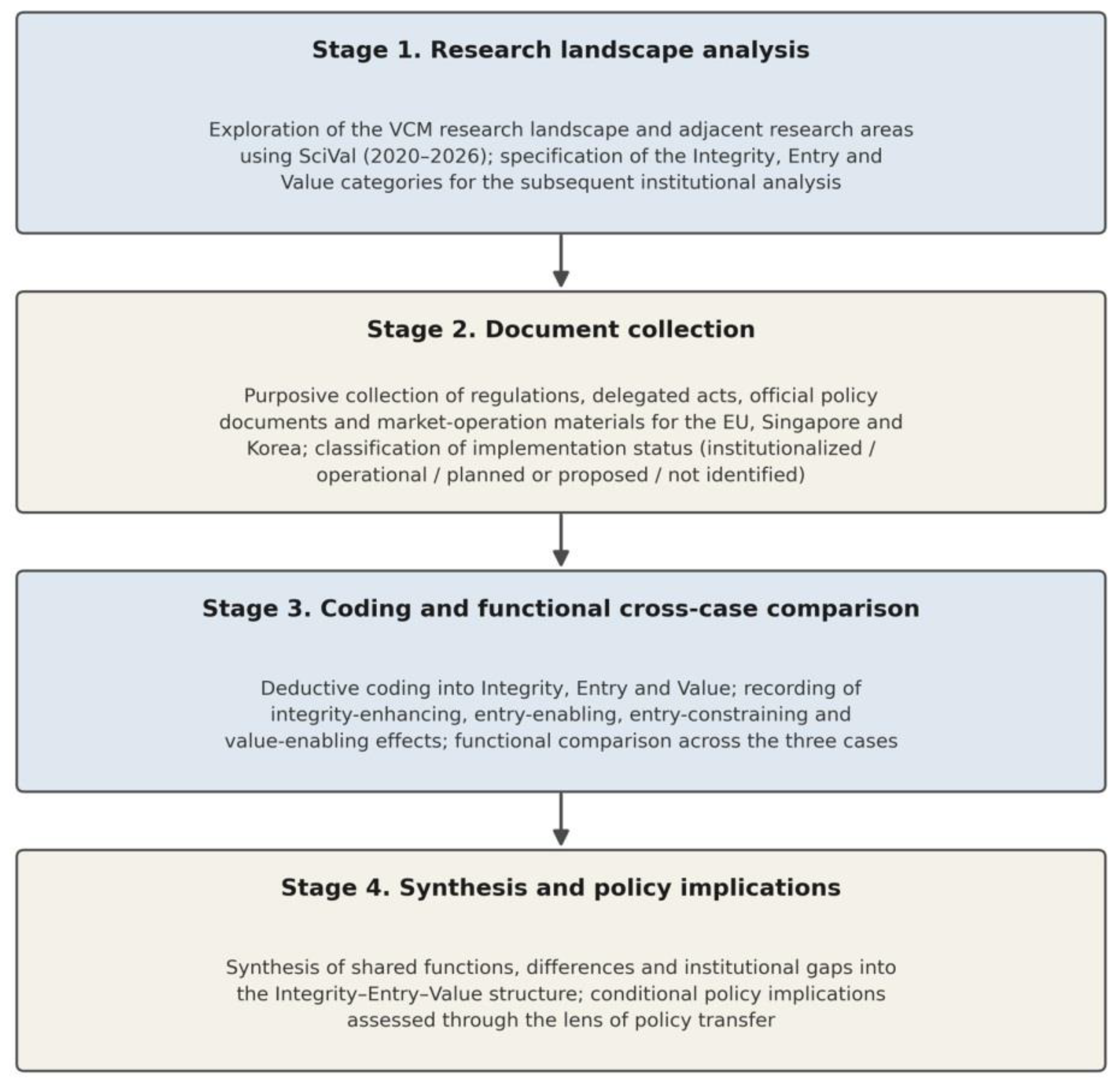
Figure 2.
The Integrity–Entry–Value (IEV) structure derived from the functional cross-case comparison.
Figure 2.
The Integrity–Entry–Value (IEV) structure derived from the functional cross-case comparison.
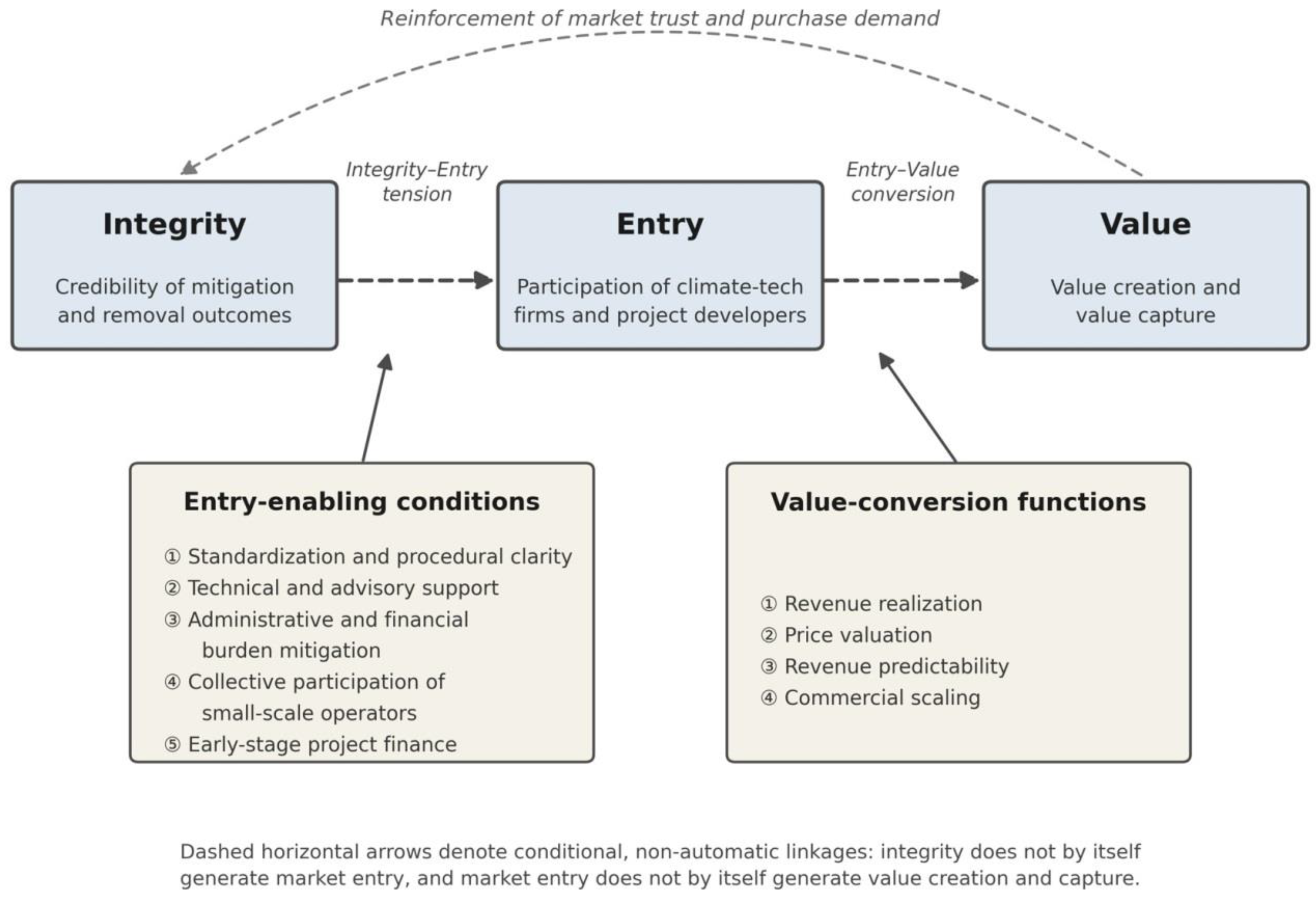

Table 1.
Case selection and institutional context.
| Case | Institutional focus | Primary data sources | Analytical rationale |
|---|---|---|---|
| EU | Institutionalization of carbon removal certification and quality management | Regulation (EU) 2024/3012 [9]; Delegated Regulation (EU) 2026/285 [14]; EU CRCF Buyers Club [15] | Quality criteria for carbon removals and carbon farming, verification and certification, and demand-linking functions can be observed as institutionalized arrangements |
| Singapore | Coexistence of VCM-related policy guidance and operating trading infrastructure | Guidance on Role of Carbon Credits in Corporate Decarbonisation [10]; CIX Project Marketplace [16]; CIX Exchange [17] | Policy guidance on environmental integrity can be analysed together with actual market access, trading and price discovery functions |
| Republic of Korea | Institutional formation and market construction stage of the VCM | Direction for the Establishment of a Korean Voluntary Carbon Market [11]; official materials on the enactment of a voluntary carbon market act [18] | The way in which Integrity, Entry and Value functions are being designed in policy prior to market operation can be analysed |
Table 2.
Operationalization of the Integrity–Entry–Value analytical dimensions.
| Dimension | Operational definition | Main coding elements | Guiding analytical question | Coded functional effect |
|---|---|---|---|---|
| Integrity | Institutional functions that secure the credibility of mitigation and removal outcomes and of carbon credits | Additionality; baseline and quantification; MRV; independent verification; certification; permanence; leakage; registration and tracking; avoidance of double counting | Through which institutional requirements is the credibility of mitigation and removal outcomes secured? | Integrity-enhancing |
| Entry | Institutional and market conditions that enable or constrain the participation of climate-tech firms and project developers in the VCM | Access to methodologies and information; MRV, verification and certification costs; technical expertise; project development and demonstration support; finance; aggregation; trading platforms; buyer access | What opportunities and barriers do integrity requirements create for market entry, and what conditions moderate them? | Entry-enabling / entry-constraining |
| Value | The process through which mitigation outcomes and related technologies and services are created and captured as economic and strategic value after market entry | Credit revenue; price discovery; buyer access; demand formation; long-term purchase and offtake; commercialization; linkage to products and services; market expansion | Through which pathways are entry conditions connected to value creation and value capture? | Value-enabling |
Note: A single policy or institutional element may be coded with multiple functional effects. For example, MRV and independent verification may have an integrity-enhancing function that strengthens the credibility of mitigation outcomes and, at the same time, an entry-constraining function that increases cost and expertise burdens.
Table 3.
Integrity requirements and their implications for market entry.
| Integrity component | EU (CRCF) | Singapore | Republic of Korea | Implications for market entry |
|---|---|---|---|---|
| Additionality and baseline | Legal additionality criteria; application of baselines and an additionality test [9,14] | Additionality beyond business as usual (BAU) as a principle (non-binding official guidance) [10] | Additionality beyond BAU presented as a quality-assessment principle [11] |
Enabling: credibility of mitigation outcomes Requirement: demonstration of baseline and additionality |
| Quantification and MRV | Methodology-specific quantification, monitoring and reporting [9,14] | Conservative baselines and transparent, conservative quantification [10] | Private-sector MRV and MRV support set out as policy directions; detailed common methodologies not identified [11] |
Enabling: conversion of mitigation outcomes into market information Requirement: data, measurement and reporting capacity |
| Verification and certification | Certification audit and re-certification by independent certification bodies [9,14] | Independent third-party verification, international meta-standards and project-level due diligence [10] | Planned approval, certification and issuance by the registry body and quality assessment by a separate assessment body [11] |
Enabling: market and buyer trust Potential burden: response to verification procedures and expertise requirements |
| Permanence and risk control | Long-term storage, monitoring and management of reversals [9,14] | Permanence and no-leakage principles [10] | Permanence principle presented; leakage not identified [11] |
Enabling: durability of mitigation effects Requirement: long-term management and risk response |
| Registry and traceability | Certification registries and the Union Registry; prevention of double issuance and double use [9] | Use of reputable registries, retirement and single-claim principles [10] | Planned registration and tracking system covering issuance, transfer and retirement [11] |
Enabling: traceability of ownership, transaction and retirement Requirement: registration and information management |
Note 1: Singapore's quality criteria are non-binding official guidance rather than legal certification requirements applying directly to VCM participants. Note 2: “Not identified” does not mean that the function does not exist, but that it was not confirmed as an independent institutional requirement in the official documents analysed in this study. Note 3: Where a single body performs multiple functions, coding followed the function rather than the body. Approval, certification and issuance by the Korean registry body were classified under verification and certification, and the management of registration, transfer and retirement records under registry and traceability.
Table 4.
Institutional conditions mitigating entry requirements while preserving integrity.
| Entry requirement or potential burden | Mitigating institutional function | EU (CRCF) | Singapore | Republic of Korea |
|---|---|---|---|---|
| Complexity of methodologies and baseline setting | Standardization and procedural clarity | Standardized baselines and activity-specific certification methodologies; clarification of additionality demonstration and certification procedures [9] | Principles for identifying high-quality credits and directions for the use of international meta-standards set out in official Guidance [10] | Planned disclosure of quality-assessment principles and indicators and construction of an institutional management system [11] |
| Requirements for data and MRV expertise | Technical and advisory support | Advisory services for groups of operators and advisory support for small-scale carbon-farming operators [9] | Direct VCM-MRV support for supply-side project developers not identified [10] | Explicit support for SME measurement, reporting and verification (MRV) and mitigation consulting [11] |
| Administrative and financial burden of verification and certification | Cost and procedural burden mitigation | Certification methodologies required to minimize administrative and financial burdens, particularly for small-scale operators, and to simplify procedures [9] | Arrangements directly easing verification and certification costs for VCM suppliers not identified [10] | Consideration of support measures so that quality assessment does not become a burden on firms in the early market [11] |
| Limited individual capacity of small-scale operators | Collective participation and institutional support | Participation of multiple operators as a group of operators permitted; advisory arrangements for small-scale carbon-farming participants included [9] | VCM arrangements directly supporting collective participation by suppliers not identified [10] | Planned education and outreach for market participants and establishment and operation of a voluntary carbon market support centre [11] |
| Funding burden of early-stage mitigation projects | Early-stage finance | Direct early-stage project finance within the CRCF certification system not identified [9] | Direct early-stage finance for VCM supply projects not identified in the Guidance analysed [10] | Instruments for early-stage funding support, including low-carbon equipment conversion, loans and guarantees, and EPC and transition finance [11] |
Note 1: “Not identified” does not mean that the function or policy does not exist, but that it was not directly confirmed in the official materials within the scope of this analysis. Note 2: Because the Singapore Guidance is primarily a document supporting corporate decisions on the purchase and use of voluntary carbon credits, direct support for supply-side project developers was coded only where explicitly identified. Note 3: Korea's support instruments were coded as planned policy functions set out in 2026 policy documents and were not interpreted as realized reductions in entry costs or increases in firm entry.
Table 5.
Market functions converting carbon outcomes into value creation and capture.
| Value function | EU (CRCF Buyers Club) | Singapore (CIX) | Republic of Korea | Value-conversion pathway |
|---|---|---|---|---|
| Revenue realization | Purchase and sale pathways for certified removals formed through CRCF-based purchase agreements [15] | Actual spot trading of credits operating on CIX [16,17] | Planned trading system for mitigation outcomes through a VCM operated by the Korea Exchange [11] | Mitigation outcome → sale → revenue capture |
| Price valuation | Project-level valuation through agreements; public benchmark price function not identified [15] | Market prices and benchmarks formed through bids, offers and transactions [17] | Planned composition of product groups by quality and price formation by product group [11] | Environmental performance → visibility of economic market value |
| Revenue predictability | Strengthened revenue certainty through multi-year offtake for permanent removals [15] | Long-term purchase function not identified in the core materials [16,17] | Long-term offtake not identified in the core policy materials [11] | Short-term sales revenue → predictability of future revenue |
| Commercial scaling | Commercialization pathway through long-term purchase and the scaling of large removal projects [15] | Repeated sales and expansion of market scope through a global trading market [16,17] | Participation of overseas buyers and expansion of use markets planned over the medium to long term [11] | Individual project revenue → repeatable and scalable business opportunity |
Note: “Not identified” does not mean that the function does not exist, but that it was not confirmed as an independent function in the core official materials analysed in this study. Because the EU Buyers Club and some Korean market functions are at an early or planned stage, they were not interpreted as realized firm-level outcomes.
Disclaimer/Publisher’s Note: The statements, opinions and data contained in all publications are solely those of the individual author(s) and contributor(s) and not of MDPI and/or the editor(s). MDPI and/or the editor(s) disclaim responsibility for any injury to people or property resulting from any ideas, methods, instructions or products referred to in the content. |
© 2026 by the authors. Licensee MDPI, Basel, Switzerland. This article is an open access article distributed under the terms and conditions of the Creative Commons Attribution (CC BY) license (http://creativecommons.org/licenses/by/4.0/).
Copyright: This open access article is published under a Creative Commons CC BY 4.0 license, which permit the free download, distribution, and reuse, provided that the author and preprint are cited in any reuse.