

Submitted:
12 September 2026
Posted:
15 September 2026
You are already at the latest version
Abstract
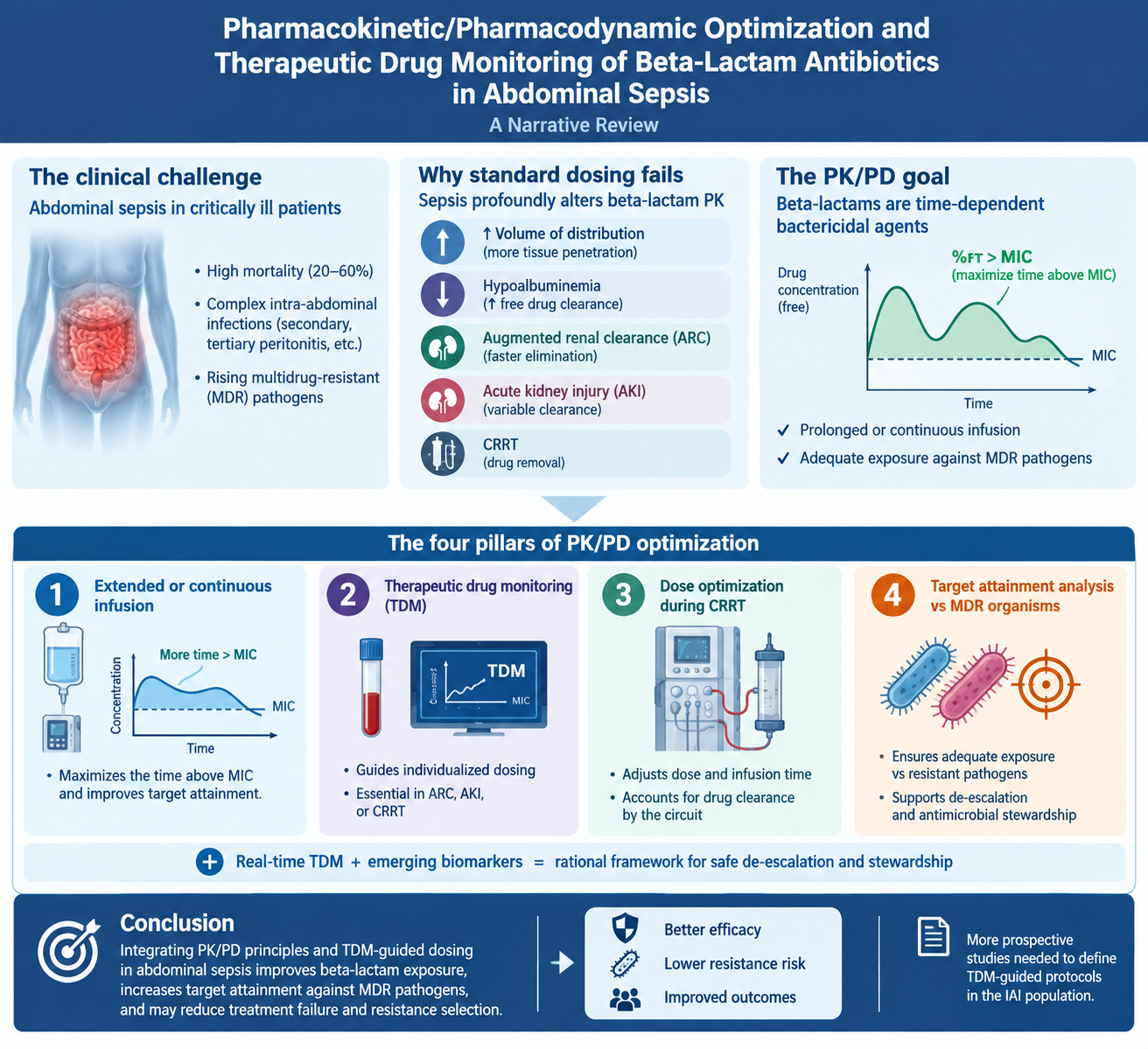
Background: Abdominal sepsis is associated with profound pharmacokinetic (PK) alterations that make standard beta-lactam dosing regimens potentially inadequate in critically ill patients. Increased volume of distribution, hypoalbuminemia, augmented renal clearance (ARC) and acute kidney injury (AKI) collectively impair the ability of conventional dosing to achieve pharmacodynamic (PD) targets. Beta-lactam antibiotics, the cornerstone therapy in intra-abdominal infections (IAIs), are particularly susceptible to these alterations, especially in the context of multidrug-resistant (MDR) pathogens. Methods: We conducted a structured narrative review of the literature published between 2010 and 2026, searching PubMed and Embase using terms related to pharmacokinetics, pharmacodynamics, therapeutic drug monitoring, beta-lactam antibiotics, abdominal sepsis, and intra-abdominal infection in critically ill patients. Additional references were identified through manual bibliography screening, including seminal studies predating the search window. No formal systematic review methodology was applied. Results: PK/PD optimization in abdominal sepsis relies on four pillars: extended or continuous infusion of beta-lactams to maximize the time above the minimum inhibitory concentration; therapeutic drug monitoring (TDM) to guide individualized dose adjustment in the presence of ARC, AKI, or continuous renal replacement therapy (CRRT); dose optimization during CRRT; and target attainment analysis against MDR organisms. Current evidence suggests combining real-time TDM with emerging bi-omarkers provides a rational framework for safe de-escalation and stewardship. Conclusions: In abdominal sepsis, integrating PK/PD principles and TDM-guided dosing represents an evidence-based strategy to optimize beta-lactam exposure, improve target attainment against MDR pathogens, and potentially reduce treatment failure and resistance selection. Prospective studies specifically designed for the IAI population are needed to establish definitive TDM-guided dosing protocols in this high-acuity setting.
Keywords:
abdominal sepsis
; intra-abdominal infection
; pharmacokinetics
; pharmacodynamics
; therapeutic drug monitoring
; beta-lactam
; extended infusion
; augmented renal clearance
; CRRT
; multidrug resistance
; intensive care unit
1. Introduction
Abdominal sepsis – including secondary and tertiary peritonitis, complicated intra-abdominal infections (IAIs), and septic shock of abdominal origin – represents one of the most challenging clinical scenarios in the intensive care unit (ICU), with mortality rates ranging from 20% to over 60% [1,2,3]. Beta-lactam antibiotics remain the cornerstone of empirical and definitive antimicrobial therapy in IAIs, given their broad spectrum of activity, favorable safety profile, and established efficacy against the predominant Gram-negative and anaerobic pathogens involved in IAIs [3,4,5]. Nevertheless, antibiotic selection and dosing optimization are further complicated by the rising prevalence of multidrug resistant (MDR) organisms in IAIs, including extended spectrum beta-lactamases- (ESBL) producing Enterobacteriaceae, Klebsiella pneumoniae carbapenemases- (KPC) and OXA-48-producing K. pneumoniae, and difficult-to-treat P. aeruginosa [6]. Moreover, achieving adequate antibiotic exposure in critically ill patients with abdominal sepsis is substantially more complex than in other clinical populations, as the pathophysiological alterations associated with sepsis profoundly disrupt their pharmacokinetic (PK) behavior [7,8,9]. This narrative review argues that standard beta-lactam dosing in abdominal sepsis is often insufficient, requiring a shift toward an individualized, pharmacokinetic/pharmacodynamic (PK/PD)-guided approach supported by therapeutic drug monitoring (TDM).
Beta-lactam antibiotics exhibit a time-dependent bactericidal activity, and their efficacy is best predicted by the percentage of the dosing interval during which free drug concentrations remain above the minimum inhibitory concentration (%fT>MIC) [10,11,12,13,14]. In healthy individuals, standard dosing regimens are generally sufficient to achieve these targets. In critically ill patients with abdominal sepsis, however, multiple simultaneous PK alterations synergically contribute to impair drug exposure: increased volume of distribution, hypoalbuminemia, augmented renal clearance (ARC) [15,16,17] and acute kidney injury (AKI). Critically, these alterations have a dynamic evolution over the course of illness, making a fixed dosing strategy inadequate for a population whose PK profile may change from hour to hour [18].
Despite strong evidence supporting PK/PD-guided antibiotic optimization in critically ill patients, most available data derive mainly from respiratory or bloodstream infections in ICU, with IAIs often underrepresented as a primary study population [19,20,21]. Abdominal sepsis presents additional unique PK challenges: (1) drug penetration in the peritoneal compartment is poorly characterized and differs substantially from plasma, particularly for hydrophilic beta-lactams [22,23]; (2) the frequent need for continuous renal replacement therapy (CRRT) in this setting introduces an additional variable elimination pathway [24,25,26]; (3) the polymicrobial nature of IAIs, often involving MDR organisms with elevated MICs, further narrows the margin between adequate and subtherapeutic exposure [27]. Although TDM has been increasingly advocated as a tool to optimize and individualize beta-lactam dosing in ICU patients, no structured framework exists for its application specifically in IAIs [28,29].
The convergence of a high-acuity population, a pharmacokinetically hostile environment, and an increasingly resistant bacterial etiology makes abdominal sepsis an ideal and urgent context in which to synthesize current evidence on PK/PD optimization and TDM of beta-lactam antibiotics. A structured, narrative synthesis of this evidence is currently lacking, translating into significant practice variability across ICUs, with potential consequences for both clinical outcomes and antimicrobial stewardship. The primary aim of this narrative review is therefore to provide clinicians with a comprehensive, evidence-based framework for the PK/PD- and TDM-guided optimization and individualization of beta-lactam antibiotic therapy in critically ill patients with abdominal sepsis.
2. Materials and Methods
This narrative review was conducted following a structured search of the PubMed and Embase electronic databases, covering literature published from January 2010 to August 2026. No language restrictions were applied, although only manuscripts available in English were included in the final synthesis. The following search terms were used in various combinations: abdominal sepsis, intra-abdominal infection, secondary peritonitis, tertiary peritonitis, pharmacokinetics, pharmacodynamics, PK/PD, therapeutic drug monitoring, TDM, beta-lactam, meropenem, piperacillin-tazobactam, ceftazidime-avibactam, extended infusion, continuous infusion, augmented renal clearance, acute kidney injury, continuous renal replacement therapy, CRRT, target attainment, and multidrug resistance. Additional relevant references were identified through manual screening of the bibliographies of retrieved articles, allowing the inclusion of fundamental pharmacological and clinical studies published before 2010, when considered essential for context or background. No formal systematic review methodology was applied, and no PRISMA flow diagram or quantitative synthesis was performed. The methodological quality of this narrative review was assessed using the Scale for the Assessment of Narrative Review Articles (SANRA) [30]. The final selection of included studies was based on relevance to the review domains, methodological quality, and clinical applicability, as assessed by the authors. Eligible sources included original research articles, PK/PD modeling and Monte Carlo simulation studies, randomized controlled trials, prospective and retrospective observational studies, and evidence-based clinical guidelines. Case reports and conference abstracts were excluded. The narrative synthesis was organized thematically across four domains: pharmacokinetic alterations in abdominal sepsis; extended and continuous infusion strategies; therapeutic drug monitoring; dosing optimization during CRRT and target attainment against MDR pathogens.
3. Pharmacokinetic Alterations in Abdominal Sepsis: Implications for Beta-Lactam Dosing
Abdominal sepsis profoundly alters beta-lactams PK behavior, making standard dosing regimens potentially inadequate even when the causal pathogen is susceptible to the selected agent. Understanding these PK alterations is an essential prerequisite for any rational approach to antibiotic optimization in this population.
The Vd of hydrophilic beta-lactams is among the most consistently affected PK parameters in abdominal sepsis. Aggressive fluid resuscitation, capillary leak secondary to systemic inflammation, and third-space accumulation in the peritoneal and interstitial compartments collectively expand the extracellular fluid volume, diluting drug concentrations and reducing peak plasma levels after standard bolus dosing [31,32]. This effect is particularly pronounced in the early phase of sepsis management and may result in subtherapeutic concentrations at the site of infection despite apparently adequate systemic dosing.
This effect is further aggravated by hypoalbuminemia, almost universally present in critically ill patients as a consequence of increased vascular permeability, hepatic metabolic shift, and nutritional depletion. Reduced serum albumin further alters PK behavior, by increasing the unbound and pharmacologically active fraction of protein-bound agents which accelerates their clearance, while simultaneously reducing plasma oncotic pressure and worsening fluid shifts [33].
Renal function in abdominal sepsis often follows an unpredictable and biphasic trajectory, with opposite consequences for beta-lactam exposure. In the early hyperdynamic phase, characterized by increased cardiac output and renal hyperperfusion, ARC, defined as a measured creatinine clearance exceeding 130 mL/min/1.73m², can be documented in 30% to 65% of ICU patients [16,17]. ARC accelerates the elimination of renally cleared beta-lactams, including meropenem, piperacillin-tazobactam, and ceftazidime, resulting in shortened half-lives and reduced antibiotic exposure [34,35]. Paradoxically, as sepsis progresses or in patients with pre-existing renal disease, AKI may occur, reducing renal elimination and creating the opposite risk of drug accumulation and concentration-dependent toxicity [36,37]. The rapid and unpredictable transition between ARC and AKI in the same patient underscores the inadequacy of static dosing strategies based on a single punctual assessment of renal function.
Furthermore, the PK behavior of beta-lactams within the peritoneal compartment adds another element of complexity. As hydrophilic molecules, beta-lactams distribute predominantly in extracellular water and achieve delayed and reduced peritoneal fluid concentrations compared to plasma levels, particularly during the early resuscitative phase when third-space accumulation is maximal. Peritoneal diffusion is poorly characterized for most agents and represents a critical evidence gap, as the peritoneal cavity constitutes the primary site of infection in abdominal sepsis and adequate local drug concentrations are crucial for adequate bactericidal activity [22,23,38].
Finally, the frequent need for CRRT in sepsis-associated AKI (s-AKI) introduces profound PK variability. Both convective (continuous venovenous hemofiltration, CVVH) and diffusive (continuous venovenous hemodialysis, CVVHD; continuous venovenous hemodiafiltration, CVVHDF) clearance mechanisms remove hydrophilic beta-lactams from the circulation depending on membrane type, effluent flow rate, filter saturation, and residual diuresis. None of these mechanisms is captured by standard renal dosing adjustment tables. Rather than simply replacing lost renal function, CRRT creates an unpredictable elimination pathway that can rapidly offset AKI-induced drug accumulation, making empirical dosing highly inaccurate in these patients.
Collectively, these dynamically interacting variables (Table 1) make empirical, population-based dosing inherently unreliable in this setting [19]. The obvious clinical consequence is a high prevalence of subtherapeutic drug exposure in ICU patients receiving standard beta-lactam regimens, with direct implications for treatment failure, emergence of resistance, and ultimately worse patient outcomes [39,40,41].
Addressing these alterations requires a shift from fixed, weight-based dosing toward dynamic, individualized strategies, including extended and continuous infusion, TDM, and real-time dose adjustments.
4. Extended and Continuous Infusion of Beta-Lactam Antibiotics: Pharmacological Rationale and Clinical Evidence
The time-dependent bactericidal activity of beta-lactam antibiotics provides the PK basis for extended and continuous infusion strategies. Since efficacy is determined by the proportion of the dosing interval during which free drug concentrations remain above the MIC (%fT>MIC), prolonging the infusion duration – rather than increasing the dose – represents the most rational approach to maximize target attainment without increasing toxicity risk [12,42]. For pathogens with elevated MICs, as MDR pathogens responsible for abdominal sepsis, standard intermittent bolus doses often fail to achieve 100% fT>MIC, whereas extended or continuous infusion can restore adequate drug concentrations throughout the entire dosing interval [40,43,44].
A strong body of evidence supports extended infusion protocols for meropenem, the most widely used carbapenem in severe IAIs. Multiple PK/PD studies have demonstrated that administering the standard 1–2 g dose over three to four hours, rather than with a thirty-minute bolus, significantly improves the probability of target attainment (PTA) against pathogens with MICs up to 4–8 mg/L, effectively extending the spectrum of adequate coverage into the intermediate susceptibility range [45,46]. Clinical data from randomized controlled trials and prospective observational studies corroborate these PD advantages, demonstrating improved microbiological eradication rates and, in some analyses, reduced mortality in critically ill patients receiving prolonged meropenem infusions compared to standard bolus administrations [44,47]. Continuous infusion of meropenem, while logistically more demanding, further optimizes exposure in the most pharmacokinetically unstable patients, including those with ARC or rapidly fluctuating renal function. Nevertheless, since meropenem degrades at room temperature within eight hours [48], adequate infusion protocols and dedicated intravenous access must be ensured.
Piperacillin-tazobactam, a first-line option in community-acquired and low-risk healthcare-associated IAIs, similarly benefits from extended infusion strategies with a superior PTA with three- to four-hour infusions compared to the standard thirty-minute administration, particularly relevant given the concerns raised by the MERINO trial regarding the adequacy of piperacillin-tazobactam against ESBL-producing Enterobacteriaceae at standard dosing [49,50,51]. Continuous infusion of piperacillin-tazobactam at doses of 13.5–18g over 24 hours has been proposed as an optimization strategy in high-risk patients, with available data suggesting improved clinical outcomes in bacteremic and critically ill populations, though IAI-specific evidence remains limited [52,53]. However, a systematic review and meta-analysis from Gonçalves-Pereira et al reported similar 28-day mortality rates in the two groups [54]. Unlike meropenem, piperacillin-tazobactam demonstrates chemical stability for up to 24 hours at room temperature in standard IV bags and elastomeric devices, making it logistically well-suited for continuous 24-hour administration in the ICU setting or in the ward [55].
Ceftazidime-avibactam is a relatively new beta-lactam/beta-lactamase inhibitor combination, increasingly used in MDR abdominal sepsis and needing particular attention from a PK/PD perspective. The efficacy of this combination depends on simultaneously maintaining adequate concentrations of both components above their respective PD thresholds, as subinhibitory avibactam concentrations may permit beta-lactamase-mediated resistance to emerge on therapy. Extended infusion of ceftazidime-avibactam over three to four hours is therefore recommended to ensure sustained avibactam exposure, particularly in patients with ARC where accelerated elimination of both components poses a significant risk of failure of target attainment [56,57,58].
However, data specifically addressing extended infusion in the context of abdominal sepsis and IAIs remain sparse, as most clinical trials have enrolled heterogeneous ICU populations without stratification by infection source. Nevertheless, the unique PK challenges of abdominal sepsis – increased Vd, ARC, AKI, CRRT and uncertain peritoneal penetration – probably make this population among the most likely to benefit from infusion optimization strategies [29,38].
Despite the absence of IAI-specific prospective data, extended or continuous infusions of meropenem, piperacillin-tazobactam, and ceftazidime-avibactam should be considered the standard of care in critically ill patients with abdominal sepsis. To maximize PTA, these regimens must be driven by real-time assessments of renal function and, where available, TDM.
5. Therapeutic Drug Monitoring of Beta-Lactam Antibiotics in Abdominal Sepsis: Rationale, Targets, and Clinical Implementation
Standard dosing and extended infusion regimens rely on population PK models, which often fail in the erratic physiological alterations of abdominal sepsis. In a precision medicine perspective, TDM bridges this gap, offering the only reliable method to confirm adequate exposure in real time, especially for beta-lactam antibiotics, which exhibit a time-dependent bactericidal activity and a narrow margin between subtherapeutic and potentially toxic concentrations [28,29,41,59]. Measurement of free drug concentrations is methodologically preferred, although total drug concentration measurement with estimated free fraction correction remains the more widely available clinical approach [33,60].
While sharing the same %fT>MIC rationale as extended infusions, TDM moves beyond theoretical dosing by directly quantifying actual free drug concentrations in the individual patient. For most beta-lactams used in severe IAIs, current consensus recommendations propose two tiered targets: a minimum efficacy target of 100% fT>MIC to ensure bacteriostatic and bactericidal activity throughout the dosing interval, and an optimized efficacy target of 100% fT>4–5×MIC to maximize the rate and extent of bacterial killing against less susceptible or MDR pathogens [41,61]. Recommended free trough concentrations for the minimum efficacy target (100% fT>MIC) are ≥2 mg/L for meropenem and ≥8 mg/L for piperacillin, based on EUCAST clinical breakpoints for susceptible Enterobacterales; for the optimized target (100% fT>4×MIC), corresponding ranges are 4–8 mg/L and 36–54 mg/L respectively, the latter derived from MIC distributions for wild-type Pseudomonas aeruginosa [41,61,62]. For ceftazidime-avibactam, a dual and concomitant PK/PD target must be achieved for both components: 100% fT>4×MIC for ceftazidime and 100% fT above the critical threshold concentration (CT) of avibactam, defined as 1 mg/L, which is the minimum concentration below which beta-lactamase inhibition in vivo ceases to occur. Target attainment is considered optimal only when both conditions are met simultaneously; achieving only one component or neither is associated with worse microbiological outcomes and risk of on-therapy resistance [57,63]. Recommended targets for each agent are detailed in Table 2.
The consensus recommendations of the International Association for Therapeutic Drug Monitoring and Clinical Toxicology (IATDMCT) formally endorse routine TDM of beta-lactams in critically ill patients, identifying ICU patients with sepsis and organ dysfunction as the population most likely to derive clinical benefit [29], since up to 65% of ICU patients fail to achieve recommended PD targets when treated with standard regimens. TDM-guided dose optimization significantly increase the PTA [19] and is associated with improved microbiological eradication and clinical cure rates, and reduced treatment failure, as demonstrated by a systematic review and meta-analysis by Pai Mangalore et al including over 1,400 critically ill patients, although no difference was observed in mortality or length of hospital stay [64]. An association with reduced 30-day mortality has been suggested in prospective observational analyses, particularly when TDM-guided dose adjustment is performed early and in patients infected with less susceptible pathogens [65], although this benefit has not been confirmed in randomized controlled trials, and larger prospective studies are warranted to establish a definitive mortality signal [66].
Despite clear benefits, several barriers currently limit the widespread implementation of beta-lactam TDM in clinical practice. Access to high-performance liquid chromatography (HPLC) or validated immunoassay platforms, capable of producing results in a clinically reasonable turnaround time, are not universally available, particularly outside large academic centers [67]. The optimal sampling strategy remains a subject of debate: trough sampling at steady state is the most pragmatic approach for beta-lactams administered by intermittent or extended infusion, whereas mid-interval or multiple-point sampling may be required to fully characterize the concentration-time profile in patients receiving continuous infusion [68]. Furthermore, the frequency of TDM measurement in critically ill patients, who may transition from ARC to AKI within hours, has not been established, though available evidence suggests that daily or every-other-day monitoring is more informative than single-point assessment in the acute phase of sepsis [29,69].
Since IAIs are often polymicrobial and involve pathogens with elevated MICs, achieving the optimized 100% fT>4–5×MIC target – rather than the minimum efficacy threshold – may be necessary to ensure adequate killing of the causative organisms. Biomarker-guided strategies may further complement TDM-driven dose: presepsin has recently emerged as a promising diagnostic and prognostic biomarker in this population, with documented accuracy in identifying postoperative intra-abdominal sepsis and potential utility in guiding therapeutic decisions [70]. Integrating presepsin monitoring with TDM-guided dosing adjustments creates a powerful antimicrobial stewardship tool in abdominal sepsis: documenting adequate drug exposure provides the pharmacological basis to safely de-escalate or shorten therapy duration, without compromising clinical outcomes [71,72]. This integration of TDM into biomarker monitoring and emerging treatment options for MDR pathogens [6,70] transforms it from a reactive safety measure into a proactive, precision-medicine optimization strategy in the ICU.
6. Dosing During Continuous Renal Replacement Therapy and Target Attainment Against MDR Pathogens
In critically ill patients with abdominal sepsis and AKI, CRRT introduces an additional and highly variable pathway of beta-lactams elimination, that further complicates their PK. Extracorporeal clearance depends on CRRT modality, effluent flow rate, membrane type and adsorptive properties, filter age, and residual diuresis. None of these variables are captured by standard chronic kidney disease dosing adjustment tables [73]. Consequently, conventional CRRT dosing recommendations, often based on outdated techniques, frequently result in inadequate plasma concentrations. One prospective study found that standard regimens during CRRT often fail to achieve optimal PD targets for Pseudomonas aeruginosa with piperacillin-tazobactam and ceftazidime, although not with meropenem [74]. Furthermore, plasma concentrations show wide interindividual variability even at identical CRRT settings, with residual diuresis emerging as the primary driver of meropenem clearance, more than the delivered CRRT dose itself [75].
Both piperacillin and tazobactam are substantially removed by CRRT, with effluent flow rate and CRRT modality representing a major and highly variable component of total drug elimination [76]. While a prospective PK study found no significant difference in piperacillin clearance during CVVHDF and CVVH at equal effluent dose [77], population PK analyses and Monte Carlo simulations consistently demonstrate that continuous infusion of piperacillin-tazobactam achieves higher PTA than intermittent or extended infusion across all CRRT settings, and that among patients receiving CRRT, even lower continuous infusion doses provide a high probability of maintaining targeted concentrations [78,79]. However, given the large interindividual variability in Vd and elimination rate constants, TDM remains essential to guide individualized dose adjustment even during continuous infusion, to prevent subtherapeutic exposure of unbound piperacillin.
Meropenem kinetics are more stable compared to piperacillin. Population PK meta-analyses and Monte Carlo simulations suggest that either a 1g q8h regimen administered as a 3-hour extended infusion, or 2–4g as a 24-hour continuous infusion, achieves adequate PTA across CRRT effluent flow rates of 25–50 mL/kg/h. Within this range, the impact of CRRT intensity on meropenem PTA is clinically modest [80,81].
Conversely, dosing ceftazidime-avibactam during CRRT presents a critical challenge, since both components are renally eliminated and significantly removed by the filter. This makes its dual PK/PD target particularly vulnerable to suboptimal attainment, especially at standard q8h dosing in patients with high-intensity CRRT or residual renal function [82]. However, a continuous infusion of ceftazidime-avibactam during high-intensity CVVHDF has been shown to achieve optimal joint PK/PD targets (simultaneous 100% fT>4×MIC for ceftazidime and 100% fT>CT for avibactam) in 100% of patients in a small case series, supporting its preferential use over intermittent infusion in this setting [82].
Therefore, TDM is particularly valuable during CRRT, where the unpredictability of drug clearance makes empirical dose selection unreliable and where the consequences of target non-attainment (including treatment failure or on-therapy resistance) are most severe.
Ultimately, target attainment against MDR pathogens highlights the absolute limits of empirical dosing. As pathogen MIC increases (i.e., due to ESBL production, carbapenemase expression, or efflux pump upregulation) the probability of achieving 100% fT>MIC or 100% fT>4×MIC with any fixed dosing regimen decreases steeply, and standard doses rapidly become inadequate even with extended infusions [10,19,83]. Monte Carlo simulations demonstrate that for meropenem against KPC-producing Klebsiella pneumoniae with MIC ≥4 mg/L, or for piperacillin-tazobactam against ESBL-producing Enterobacterales with MIC ≥16 mg/L, PTA falls below acceptable thresholds even with maximum continuous infusion doses, necessitating a switch to novel beta-lactam/beta-lactamase inhibitor combinations [6]. For ceftazidime-avibactam against KPC/OXA-48 or for aztreonam-avibactam against MBL-producing pathogens, TDM-guided target attainment of both components is essential to maximize bacterial killing and suppress on-therapy resistance [82]. Particularly in abdominal sepsis, where source control may be incomplete or delayed and peritoneal bacterial inoculum is high, achieving the optimized 100% fT>4×MIC target, rather than the minimum efficacy threshold, is crucial to ensure bactericidal activity and prevent the selection of resistant subpopulations.
A proposed algorithm integrating renal function assessment, MDR risk stratification, infusion strategy selection, TDM-guided dose individualization, and biomarker-driven de-escalation for critically ill patients with abdominal sepsis is illustrated in Figure 1.
7. Conclusions
Abdominal sepsis creates a challenging pharmacological environment. The combined effects of increased Vd, hypoalbuminemia, ARC, and AKI make standard beta-lactam dosing regimens often inadequate in critically ill patients. The evidence reviewed in this article converges on extended or continuous infusion to maximize time-dependent target attainment, TDM to individualize dosing in real time, and careful dose adjustment during CRRT. When dealing with MDR pathogens with elevated MICs, these strategies are prerequisites for therapeutic success, since the margin between adequate exposure and treatment failure is too narrow to rely on empirical dosing.
A major limitation of the current evidence is the systematic underrepresentation of IAIs in PK/PD trials and TDM studies, most of which have been conducted in respiratory or bloodstream infections. Moreover, the peritoneal drug diffusion remains poorly characterized for most agents, and prospective data on TDM-guided dosing specifically in abdominal sepsis are lacking, leaving a critical knowledge gap regarding target attainment at the actual site of infection.
Future research should prioritize prospective PK studies quantifying beta-lactam penetration into peritoneal fluid, TDM-guided dosing trials specifically designed for the IAI population, as well as the integration of biomarker-driven protocols with PK/PD optimization into a unified, precision-medicine framework for antibiotic management in abdominal sepsis.
Author Contributions
Conceptualization, R.G., G.C.; methodology, R.G., V.P., M.F.; investigation, R.G., G.C.; writing—original draft preparation, R.G.; writing—review and editing, R.G., G.C., M.F., S.N.; visualization, R.G., S.N., F.P.; supervision, M.F., M.C.P., F.C., P.S., V.P. All authors have read and agreed to the published version of the manuscript.
Funding
This research received no external funding.
Institutional Review Board Statement
not applicable.
Informed Consent Statement
not applicable.
Data Availability Statement
Data sharing is not applicable (only appropriate if no new data is generated or the article describes entirely theoretical research).
Conflicts of Interest
The authors declare no conflicts of interest.
References
- Sartelli M, Tascini C, Coccolini F, et al. Management of intra-abdominal infections: recommendations by the Italian council for the optimization of antimicrobial use. World Journal of Emergency Surgery 2024 19:1 2024;19:23-. [CrossRef]
- Sartelli M, Chichom-Mefire A, Labricciosa FM, et al. The management of intra-abdominal infections from a global perspective: 2017 WSES guidelines for management of intra-abdominal infections. World Journal of Emergency Surgery 2017;12:29. [CrossRef]
- Sartelli M, Coccolini F, Kluger Y, et al. WSES/GAIS/SIS-E/WSIS/AAST global clinical pathways for patients with intra-abdominal infections. World Journal of Emergency Surgery 2021 16:1 2021;16:49-. [CrossRef]
- Prescott HC, Antonelli M, Alhazzani W, et al. Surviving Sepsis Campaign: International Guidelines for Management of Sepsis and Septic Shock 2026. Crit Care Med 2026;54:725–812. [CrossRef]
- Solomkin JS, Mazuski JE, Bradley JS, et al. Diagnosis and Management of Complicated Intra-abdominal Infection in Adults and Children: Guidelines by the Surgical Infection Society and the Infectious Diseases Society of America. Clinical Infectious Diseases 2010;50:133–64. [CrossRef]
- Giurazza R, Mazza MC, Andini R, et al. Emerging Treatment Options for Multi-Drug-Resistant Bacterial Infections 2021;11:519. [CrossRef]
- De Paepe P, Belpaire FM, Buylaert WA. Pharmacokinetic and pharmacodynamic considerations when treating patients with sepsis and septic shock. Clin Pharmacokinet 2002;41:1135–51. [CrossRef]
- Wang Y, Li H, Wang D, et al. Changes of PK/PD of Meropenem in patients with abdominal septic shock and exploration of clinical rational administration plan: a prospective exploratory study. Scientific Reports 2024 14:1 2024;14:10173-. [CrossRef]
- Roberts J. Using PK/PD to optimize antibiotic dosing for critically ill patients. Curr Pharm Biotechnol 2011;12:2070–9. [CrossRef]
- Craig WA. Pharmacokinetic/pharmacodynamic parameters: rationale for antibacterial dosing of mice and men. Clin Infect Dis 1998;26:1–12. [CrossRef]
- CA D, SY L, JL K, et al. Optimising dosing strategies of antibacterials utilising pharmacodynamic principles: impact on the development of resistance. Drugs 2006;66:1–8. [CrossRef]
- Drusano GL. Pharmacokinetics and pharmacodynamics of antimicrobials. Clin Infect Dis 2007;45 Suppl 1. [CrossRef]
- Turnidge JD. The Pharmacodynamics of β-Lactams. Clinical Infectious Diseases 1998;27:10–22. [CrossRef]
- Gonçalves-Pereira J, Póvoa P. Antibiotics in critically ill patients: a systematic review of the pharmacokinetics of β-lactams. Critical Care 2011 15:5 2011;15:R206-. [CrossRef]
- Claus BOM, Hoste EA, Colpaert K, et al. Augmented renal clearance is a common finding with worse clinical outcome in critically ill patients receiving antimicrobial therapy. J Crit Care 2013;28:695–700. [CrossRef]
- Udy AA, Baptista JP, Lim NL, et al. Augmented renal clearance in the ICU: results of a multicenter observational study of renal function in critically ill patients with normal plasma creatinine concentrations*. Crit Care Med 2014;42:520–7. [CrossRef]
- Hobbs ALV, Shea KM, Roberts KM, et al. Implications of Augmented Renal Clearance on Drug Dosing in Critically Ill Patients: A Focus on Antibiotics. Pharmacotherapy 2015;35:1063–75. [CrossRef]
- Roberts JA, Taccone FS, Lipman J. Understanding PK/PD. Intensive Care Med 2016;42:1797–800. [CrossRef]
- Roberts JA, De Waele JJ, Dimopoulos G, et al. DALI: Defining Antibiotic Levels in Intensive care unit patients: a multi-centre point of prevalence study to determine whether contemporary antibiotic dosing for critically ill patients is therapeutic. BMC Infect Dis 2012;12:152. [CrossRef]
- Ewoldt TMJ, Abdulla A, Rietdijk WJR, et al. Model-informed precision dosing of beta-lactam antibiotics and ciprofloxacin in critically ill patients: a multicentre randomised clinical trial. Intensive Care Medicine 2022 48:12 2022;48:1760–71. [CrossRef]
- Abdulla A, Dijkstra A, Hunfeld NGM, et al. Failure of target attainment of beta-lactam antibiotics in critically ill patients and associated risk factors: a two-center prospective study (EXPAT). Crit Care 2020;24. [CrossRef]
- Murao N, Ohge H, Ikawa K, et al. Pharmacokinetics of piperacillin-tazobactam in plasma, peritoneal fluid and peritoneum of surgery patients, and dosing considerations based on site-specific pharmacodynamic target attainment. Int J Antimicrob Agents 2017;50:393–8. [CrossRef]
- Buijk SLCE, Gyssens IC, Mouton JW, et al. Pharmacokinetics of ceftazidime in serum and peritoneal exudate during continuous versus intermittent administration to patients with severe intra-abdominal infections. Journal of Antimicrobial Chemotherapy 2002;49:121–8. [CrossRef]
- Trotman RL, Williamson JC, Shoemaker DM, et al. Antibiotic Dosing in Critically Ill Adult Patients Receiving Continuous Renal Replacement Therapy. Clinical Infectious Diseases 2005;41:1159–66. [CrossRef]
- Pea F, Viale P, Pavan F, et al. Pharmacokinetic Considerations for Antimicrobial Therapy in Patients Receiving Renal Replacement Therapy. Clinical Pharmacokinetics 2007 46:12 2012;46:997–1038. [CrossRef]
- Li L, Li X, Xia Y, et al. Recommendation of Antimicrobial Dosing Optimization During Continuous Renal Replacement Therapy. Front Pharmacol 2020;11:522496. [CrossRef]
- Nicoletti G, Nicolosi D, Rossolini GM, et al. Intra-abdominal infections: etiology, epidemiology, microbiological diagnosis and antibiotic resistance. J Chemother 2009;21 Suppl 1:5–11. [CrossRef]
- Roberts JA, Norris R, Paterson DL, et al. Therapeutic drug monitoring of antimicrobials. Br J Clin Pharmacol 2012;73:27–36. [CrossRef]
- Abdul-Aziz MH, Alffenaar JWC, Bassetti M, et al. Antimicrobial therapeutic drug monitoring in critically ill adult patients: a Position Paper. Intensive Care Med 2020;46:1127–53. [CrossRef]
- Baethge C, Goldbeck-Wood S, Mertens S. SANRA—a scale for the quality assessment of narrative review articles. Res Integr Peer Rev 2019;4:5. [CrossRef]
- Morales Castro D, Dresser L, Granton J, et al. Pharmacokinetic Alterations Associated with Critical Illness. Clin Pharmacokinet 2023;62:209. [CrossRef]
- Charlton M, Thompson JP. Pharmacokinetics in sepsis. BJA Educ 2018;19:7. [CrossRef]
- Ulldemolins M, Roberts JA, Rello J, et al. The effects of hypoalbuminaemia on optimizing antibacterial dosing in critically ill patients. Clin Pharmacokinet 2011;50:99–110. [CrossRef]
- Silva CM, Baptista JP, Santos I, et al. Recommended Antibiotic Dosage Regimens in Critically Ill Patients with Augmented Renal Clearance: A Systematic Review. Int J Antimicrob Agents 2022;59. [CrossRef]
- Carlier M, Carrette S, Roberts JA, et al. Meropenem and piperacillin/tazobactam prescribing in critically ill patients: does augmented renal clearance affect pharmacokinetic/pharmacodynamic target attainment when extended infusions are used? Critical Care 2013 17:3 2013;17:R84-. [CrossRef]
- Hughes S, Heard KL, Mughal N, et al. Optimization of antimicrobial dosing in patients with acute kidney injury: a single-centre observational study. JAC Antimicrob Resist 2022;4:dlac080. [CrossRef]
- Veiga RP, Paiva JA. Pharmacokinetics-pharmacodynamics issues relevant for the clinical use of beta-lactam antibiotics in critically ill patients. Crit Care 2018;22. [CrossRef]
- Adnan S, Paterson DL, Lipman J, et al. Pharmacokinetics of beta-lactam antibiotics in patients with intra-abdominal disease: A structured review. Surg Infect (Larchmt) 2012;13:9–17. [CrossRef]
- Udy AA, Varghese JM, Altukroni M, et al. Subtherapeutic initial β-lactam concentrations in select critically ill patients: association between augmented renal clearance and low trough drug concentrations. Chest 2012;142:30–9. [CrossRef]
- Abdul-Aziz MH, Lipman J, Roberts JA. Identifying “at-risk” patients for sub-optimal beta-lactam exposure in critically ill patients with severe infections. Crit Care 2017;21:283. [CrossRef]
- Guilhaumou R, Benaboud S, Bennis Y, et al. Optimization of the treatment with beta-lactam antibiotics in critically ill patients-guidelines from the French Society of Pharmacology and Therapeutics (Société Française de Pharmacologie et Thérapeutique-SFPT) and the French Society of Anaesthesia and…. Crit Care 2019;23. [CrossRef]
- Jacobs MR. Optimisation of antimicrobial therapy using pharmacokinetic and pharmacodynamic parameters. Clinical Microbiology and Infection 2001;7:589–96. [CrossRef]
- Roberts JA, Lipman J, Blot S, et al. Better outcomes through continuous infusion of time-dependent antibiotics to critically ill patients? Curr Opin Crit Care 2008;14:390–6. [CrossRef]
- Dulhunty JM, Roberts JA, Davis JS, et al. Continuous infusion of beta-lactam antibiotics in severe sepsis: a multicenter double-blind, randomized controlled trial. Clin Infect Dis 2013;56:236–44. [CrossRef]
- Crandon JL, Ariano RE, Zelenitsky SA, et al. Optimization of meropenem dosage in the critically ill population based on renal function. Intensive Care Med 2011;37:632–8. [CrossRef]
- Kothekar AT, Divatia JV, Myatra SN, et al. Clinical pharmacokinetics of 3-h extended infusion of meropenem in adult patients with severe sepsis and septic shock: implications for empirical therapy against Gram-negative bacteria. Ann Intensive Care 2020;10. [CrossRef]
- Vardakas KZ, Voulgaris GL, Maliaros A, et al. Prolonged versus short-term intravenous infusion of antipseudomonal β-lactams for patients with sepsis: a systematic review and meta-analysis of randomised trials. Lancet Infect Dis 2018;18:108–20. [CrossRef]
- Fawaz S, Barton S, Whitney L, et al. Stability of Meropenem After Reconstitution for Administration by Prolonged Infusion. Hosp Pharm 2018;54:190. [CrossRef]
- Harris PNA, Tambyah PA, Lye DC, et al. Effect of Piperacillin-Tazobactam vs Meropenem on 30-Day Mortality for Patients With E coli or Klebsiella pneumoniae Bloodstream Infection and Ceftriaxone Resistance: A Randomized Clinical Trial. JAMA 2018;320:984–94. [CrossRef]
- Lodise TP, Lomaestro B, Drusano GL. Piperacillin-tazobactam for Pseudomonas aeruginosa infection: clinical implications of an extended-infusion dosing strategy. Clin Infect Dis 2007;44:357–63. [CrossRef]
- Felton TW, Hope WW, Lomaestro BM, et al. Population pharmacokinetics of extended-infusion piperacillin-tazobactam in hospitalized patients with nosocomial infections. Antimicrob Agents Chemother 2012;56:4087–94. [CrossRef]
- Hyun DG, Seo J, Lee SY, et al. Continuous Piperacillin-Tazobactam Infusion Improves Clinical Outcomes in Critically Ill Patients with Sepsis: A Retrospective, Single-Centre Study. Antibiotics (Basel) 2022;11. [CrossRef]
- Fawaz S, Barton S, Nabhani-Gebara S. Comparing clinical outcomes of piperacillin-tazobactam administration and dosage strategies in critically ill adult patients: a systematic review and meta-analysis. BMC Infect Dis 2020;20. [CrossRef]
- Gonçalves-Pereira J, Oliveira BS, Janeiro S, et al. Continuous infusion of piperacillin/tazobactam in septic critically ill patients--a multicenter propensity matched analysis. PLoS One 2012;7. [CrossRef]
- Négrier L, Mena AM, Dupont C, et al. The Infusion of Piperacillin/Tazobactam with an Elastomeric Device: A Combined 24-H Stability Study and Drug Solution Flow Rate Analysis. Pharmaceuticals 2024;17:1085. [CrossRef]
- Gatti M, Rinaldi M, Cojutti PG, et al. A pre-post quasi-experimental study of antimicrobial stewardship exploring the impact of a multidisciplinary approach aimed at attaining an aggressive joint pharmacokinetic/pharmacodynamic target with ceftazidime/avibactam on treatment outcome of KPC-pro…. Antimicrob Agents Chemother 2025;69. [CrossRef]
- Fresan D, Luque S, Benítez-Cano A, et al. Pharmacokinetics/pharmacodynamics and therapeutic drug monitoring of ceftazidime/avibactam administered by continuous infusion in patients with MDR Gram-negative bacterial infections. J Antimicrob Chemother 2023;78:678–83. [CrossRef]
- Han Y, Zhu J, Liu J, et al. Adequacy of the Dosing and Infusion Time of Ceftazidime/Avibactam for the Treatment of Gram-Negative Bacterial Infections: A PK/PD Simulation Study. Infect Drug Resist 2024;17:2823–32. [CrossRef]
- Pea F, Viale P, Cojutti P, et al. Therapeutic drug monitoring may improve safety outcomes of long-term treatment with linezolid in adult patients. J Antimicrob Chemother 2012;67:2034–42. [CrossRef]
- Musteata FM. Monitoring free drug concentrations: challenges. Bioanalysis 2011;3:1753–68. [CrossRef]
- Abdul-Aziz MH, Brady K, Cotta MO, et al. Therapeutic Drug Monitoring of Antibiotics: Defining the Therapeutic Range. Ther Drug Monit 2022;44:19–31. [CrossRef]
- EUCAST: Clinical Breakpoint Tables n.d. https://www.eucast.org/bacteria/clinical-breakpoints-and-interpretation/clinical-breakpoint-tables/ (accessed August 19, 2026).
- O’Jeanson A, Nielsen EI, Friberg LE. A model-based evaluation of the pharmacokinetics-pharmacodynamics (PKPD) of avibactam in combination with ceftazidime. JAC Antimicrob Resist 2025;7. [CrossRef]
- Pai Mangalore R, Ashok A, Lee SJ, et al. Beta-Lactam Antibiotic Therapeutic Drug Monitoring in Critically Ill Patients: A Systematic Review and Meta-Analysis. Clin Infect Dis 2022;75:1848–60. [CrossRef]
- Alshaer MH, Maranchick NF, Maguigan KL, et al. Impact of Timing of Beta-Lactam Therapeutic Drug Monitoring and Therapy Adjustment in Critically Ill Patients. Antibiotics 2025;14:463. [CrossRef]
- Hagel S, Bach F, Brenner T, et al. Effect of therapeutic drug monitoring-based dose optimization of piperacillin/tazobactam on sepsis-related organ dysfunction in patients with sepsis: a randomized controlled trial. Intensive Care Med 2022;48:311. [CrossRef]
- Kim HY, Byashalira KC, Heysell SK, et al. TDM of Anti-infective Drugs: Implementation Strategies for Three Different Scenarios. Ther Drug Monit 2022;44:3. [CrossRef]
- Carlier M, Stove V, Wallis SC, et al. Assays for therapeutic drug monitoring of β-lactam antibiotics: A structured review. Int J Antimicrob Agents 2015;46:367–75. [CrossRef]
- Tanaka R. Pharmacokinetic variability and significance of therapeutic drug monitoring for broad-spectrum antimicrobials in critically ill patients. J Pharm Health Care Sci 2025;11:21. [CrossRef]
- Fiore M, Cosenza G, Romano FM, et al. Presepsin as a Novel Biomarker in Abdominal Sepsis: Diagnostic Accuracy and Prognostic Implications. Biomedicines 2026, Vol 14, Page 822 2026;14:822. [CrossRef]
- Koch BCP, Muller AE, Hunfeld NGM, et al. Therapeutic Drug Monitoring of Antibiotics in Critically Ill Patients: Current Practice and Future Perspectives With a Focus on Clinical Outcome. Ther Drug Monit 2022;44:11–8. [CrossRef]
- Dhaese S, Van Vooren S, Boelens J, et al. Therapeutic drug monitoring of β-lactam antibiotics in the ICU. Expert Rev Anti Infect Ther 2020;18:1155–64. [CrossRef]
- De Waele JJ, Carlier M. Beta-lactam antibiotic dosing during continuous renal replacement therapy: how can we optimize therapy? Crit Care 2014;18. [CrossRef]
- Seyler L, Cotton F, Taccone FS, et al. Recommended β-lactam regimens are inadequate in septic patients treated with continuous renal replacement therapy. Crit Care 2011;15:R137. [CrossRef]
- Petersson J, Giske CG, Eliasson E. Poor Correlation between Meropenem and Piperacillin Plasma Concentrations and Delivered Dose of Continuous Renal Replacement Therapy. Antimicrob Agents Chemother 2021;65:e02029-20. [CrossRef]
- Selig DJ, DeLuca JP, Chung KK, et al. Pharmacokinetics of piperacillin and tazobactam in critically Ill patients treated with continuous kidney replacement therapy: A mini-review and population pharmacokinetic analysis. J Clin Pharm Ther 2022;47:1091–102. [CrossRef]
- Roger C, Cotta MO, Muller L, et al. Impact of renal replacement modalities on the clearance of piperacillin-tazobactam administered via continuous infusion in critically ill patients. Int J Antimicrob Agents 2017;50:227–31. [CrossRef]
- Hahn J, Min KL, Kang S, et al. Population Pharmacokinetics and Dosing Optimization of Piperacillin-Tazobactam in Critically Ill Patients on Extracorporeal Membrane Oxygenation and the Influence of Concomitant Renal Replacement Therapy. Microbiol Spectr 2021;9. [CrossRef]
- Shotwell MS, Nesbitt R, Madonia PN, et al. Pharmacokinetics and pharmacodynamics of extended infusion versus short infusion piperacillin-tazobactam in critically Ill patients undergoing CRRT. Clinical Journal of the American Society of Nephrology 2016;11:1377–83. [CrossRef]
- Charoensareerat T, Chaijamorn W, Kerdnimith P, et al. Optimal Meropenem Dosing Regimens in Patients Undergoing Continuous Renal Replacement Therapy: Systematic Review and Monte Carlo Simulations. Blood Purif 2023;52:503–15. [CrossRef]
- Peng Y, Cheng Z, Xie F. Population Pharmacokinetic Meta-Analysis and Dosing Recommendation for Meropenem in Critically Ill Patients Receiving Continuous Renal Replacement Therapy. Antimicrob Agents Chemother 2022;66. [CrossRef]
- Gatti M, Rinaldi M, Gaibani P, et al. A descriptive pharmacokinetic/pharmacodynamic analysis of continuous infusion ceftazidime-avibactam for treating DTR gram-negative infections in a case series of critically ill patients undergoing continuous veno-venous haemodiafiltration (CVVHDF). J Crit Care 2023;76. [CrossRef]
- Drusano GL. Antimicrobial pharmacodynamics: critical interactions of “bug and drug.” Nat Rev Microbiol 2004;2:289–300. [CrossRef]
Figure 1.
Proposed algorithm for pharmacokinetic/pharmacodynamic-guided beta-lactam optimization in critically ill patients with abdominal sepsis. ARC: augmented renal clearance; CrCl: creatinine clearance; AKI: acute kidney injury; CRRT: continuous renal replacement therapy; MDR: multidrug-resistant; KPC: Klebsiella pneumoniae carbapenemases; TDM: therapeutic drug monitoring; PCT: procalcitonin.
Figure 1.
Proposed algorithm for pharmacokinetic/pharmacodynamic-guided beta-lactam optimization in critically ill patients with abdominal sepsis. ARC: augmented renal clearance; CrCl: creatinine clearance; AKI: acute kidney injury; CRRT: continuous renal replacement therapy; MDR: multidrug-resistant; KPC: Klebsiella pneumoniae carbapenemases; TDM: therapeutic drug monitoring; PCT: procalcitonin.
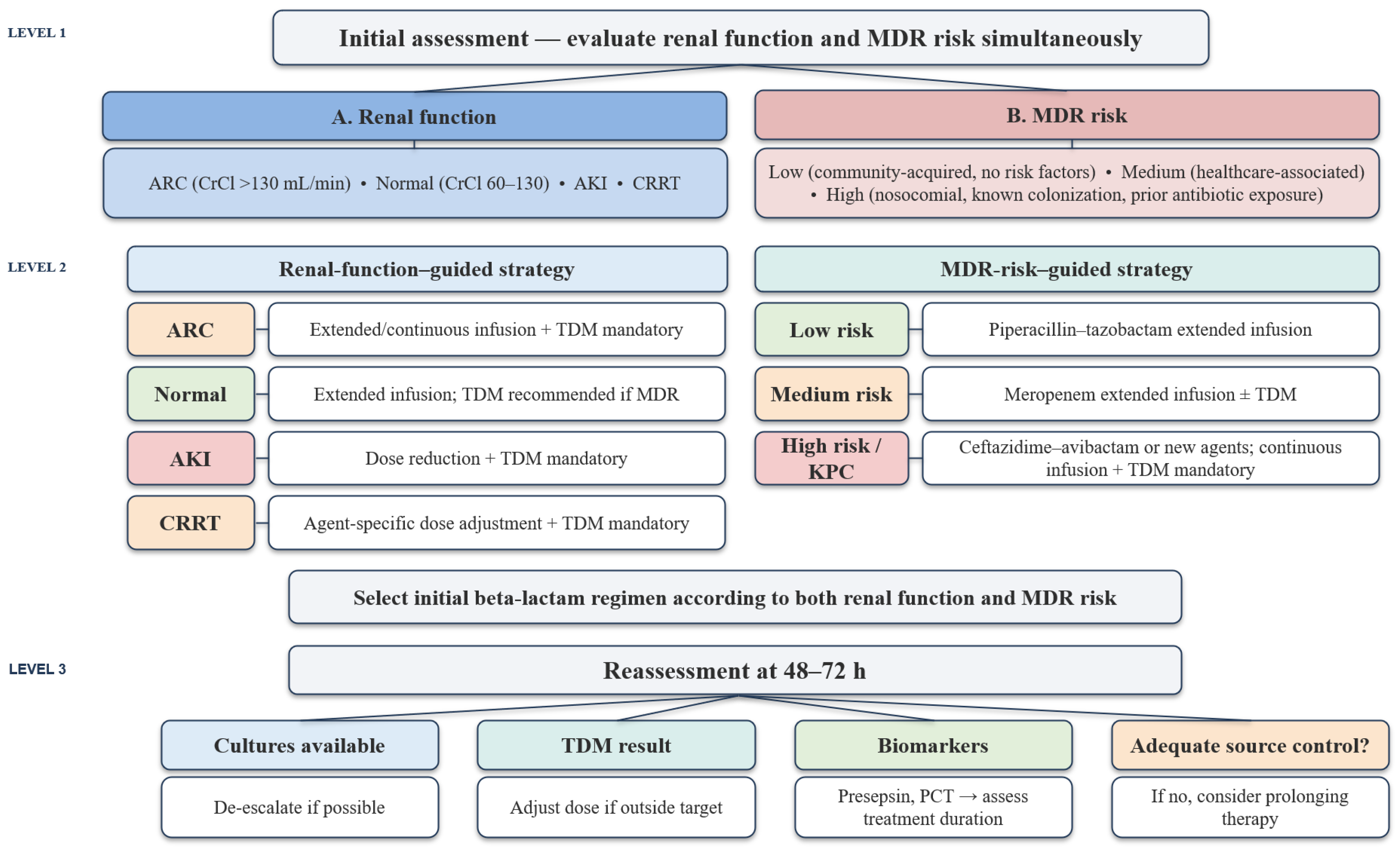

Table 1.
Pharmacokinetic alterations in critically ill patients with abdominal sepsis and their clinical implications for beta-lactam antibiotic dosing.
Table 1.
Pharmacokinetic alterations in critically ill patients with abdominal sepsis and their clinical implications for beta-lactam antibiotic dosing.
| PK alteration | Mechanism | Predominant phase | Impact on beta-lactams | Most affected agents |
|---|---|---|---|---|
| ↑ volume of distribution (Vd) | Fluid resuscitation, capillary leak, third-space accumulation | Early resuscitative | ↓ Peak plasma concentrations after bolus dosing; Subtherapeutic levels despite standard dosing |
All hydrophilic beta-lactams (meropenem, piperacillin-tazobactam, ceftazidime) |
| Hypoalbuminemia | Increased vascular permeability, hepatic metabolic shift, nutritional depletion | Persistent throughout ICU stay | ↑ Unbound (active) drug fraction; Unpredictable free drug concentrations |
Protein-bound agents (ceftriaxone, ertapenem) |
| Augmented Renal Clearance (ARC) | Renal hyperperfusion, hyperdynamic state (eGFR >130 mL/min/1.73m²) | Early hyperdynamic phase | ↑ Drug elimination; Shortened half-life; ↓ Drug exposure despite standard dosing |
All renally cleared beta-lactams; particularly meropenem, piperacillin-tazobactam, ceftazidime-avibactam |
| Acute Kidney Injury (AKI) | Renal hypoperfusion, nephrotoxicity, disease progression | Late/severe phase | ↓ Drug elimination; ↑ Risk of accumulation and toxicity |
All renally cleared beta-lactams; particularly meropenem, piperacillin-tazobactam, ceftazidime-avibactam |
| CRRT-mediated clearance | Convective and diffusive extracorporeal drug removal; dependent on membrane type, effluent flow rate, filter age, and residual diuresis | Variable; concurrent with AKI | Additional unpredictable elimination pathway; Highly variable by modality and effluent dose; May offset AKI-related accumulation or cause subtherapeutic exposure depending on CRRT intensity |
All renally cleared beta-lactams; particularly meropenem, piperacillin-tazobactam, ceftazidime-avibactam |
| ↓ Peritoneal penetration | Hydrophilic distribution, delayed equilibration, third-space effect | Early phase | Subtherapeutic concentrations at primary infection site despite adequate plasma levels | All hydrophilic beta-lactams |
ARC: augmented renal clearance; AKI: acute kidney injury; CRRT: continuous renal replacement therapy; eGFR: estimated glomerular filtration rate; ICU: intensive care unit.
Table 2.
This is a table. Tables should be placed in the main text near to the first time they are cited.
Table 2.
This is a table. Tables should be placed in the main text near to the first time they are cited.
| Agent | PD strategy | Infusion strategy | Free trough target (minimum efficacy) | Free trough target (optimized) | Dose in CRRT* | Key notes |
|---|---|---|---|---|---|---|
| Meropenem | 100% fT>MIC | EI 3–4h or CI 24h | ≥2 mg/L (MIC ≤2 mg/L) | 4–8 mg/L (100% fT>4×MIC) | 1–2g q8h as EI 3h; 3–6g/24h CI |
Degrades within 8h at room temperature; Dedicated IV line required for CI |
| Piperacillin-tazobactam | 100% fT>4×MIC |
EI 3–4h or CI 24h | ≥8 mg/L (piperacillin free) | 36–54 mg/L (piperacillin free) | 13.5g/24h CI or higher; TDM mandatory |
Stable 24h at room temperature; Logistically suited for CI; Caution with ESBL |
| Ceftazidime-avibactam | 100% fT>4×MIC (CAZ) + 100% fT>CT (AVI) |
EI 2–3h or CI 24h | CAZ ≥4 mg/L; AVI ≥1 mg/L |
CAZ: 100% fT>4×MIC; AVI: Css/CT >1 (i.e., AVI free concentration >1 mg/L throughout dosing interval) |
CI preferred in CVVHDF; TDM mandatory |
Dual concomitant target required: both components must be maintained simultaneously; Subtherapeutic AVI → risk of on-therapy resistance |
*effluent flow rate 24-30 ml/kg/h. CAZ: ceftazidime; AVI: avibactam; MIC: minimum inhibitory concentration; fT>MIC: free time above MIC; Css: concentration at steady state; CT: critical threshold concentration; EI: extended infusion; CI: continuous infusion; CRRT: continuous renal replacement therapy; CVVHDF: continuous venovenous hemodiafiltration; MDR: multidrug-resistant; IAI: intra-abdominal infection; TDM: therapeutic drug monitoring; AKI: acute kidney injury; PK: pharmacokinetic; PD: pharmacodynamic.
Disclaimer/Publisher’s Note: The statements, opinions and data contained in all publications are solely those of the individual author(s) and contributor(s) and not of MDPI and/or the editor(s). MDPI and/or the editor(s) disclaim responsibility for any injury to people or property resulting from any ideas, methods, instructions or products referred to in the content. |
© 2026 by the authors. Licensee MDPI, Basel, Switzerland. This article is an open access article distributed under the terms and conditions of the Creative Commons Attribution (CC BY) license (http://creativecommons.org/licenses/by/4.0/).
Copyright: This open access article is published under a Creative Commons CC BY 4.0 license, which permit the free download, distribution, and reuse, provided that the author and preprint are cited in any reuse.