

Submitted:
14 September 2026
Posted:
15 September 2026
You are already at the latest version
Abstract
Urban observatories support evidence-based planning yet less attention has been paid to whose values their indicators reflect and who decides what should be measured. This paper examines how decision-making authority is distributed within observatories and how plural values can be incorporated without sacrificing comparability. A six-dimensional coding matrix is applied to public documentation from 24 urban observatories while 8 community-led monitoring initiatives are examined as institutional precedents. The analysis reveals a consistent gap between stated commitments to inclusion and the forms of participation built into observatory governance. Decisions about indicator ownership, knowledge selection and review remain controlled by host institutions. However, community-led initiatives show that values can be elicited, translated into indicators and used accountably. These findings inform a Plural-Values Framework organized around three stages: eliciting diverse and potentially conflicting values, co-producing candidate indicators through transdisciplinary deliberation, and integrating them through multi-criteria and mixed-method evaluation. Governance and periodic review operate across all three stages. The framework retains the comparable indicators required by the Urban Monitoring Framework and SDG 11 while allowing communities to develop locally governed measures. It offers observatories an institutional design for combining comparability with community authority and locally grounded knowledge.
Keywords:
urban observatories
; plural values
; indicator governance
; co-design
; data justice
; participatory urban monitoring
1. Introduction
Cities have become the principal arena through which the twenty-first century's most pressing sustainability challenges are negotiated. More than half of the world's population now resides in urban areas, and this proportion is projected to approach 70 per cent by 2050 (United Nations, 2025). Urbanization has become inseparable from questions of climate adaptation, biodiversity conservation, housing affordability, environmental degradation, public health, infrastructure provision, economic productivity, and social inclusion. As urban systems become increasingly complex, so are governments investing heavily in data infrastructures intended to support evidence-based planning and policy evaluation. Urban observatories have emerged at the centre of this transformation. Once conceived primarily as repositories for urban statistics, observatories have evolved into sophisticated knowledge infrastructures that integrate official statistics, geospatial information, Earth observation, administrative records, citizen-generated data, and increasingly, big data and artificial intelligence to monitor urban dynamics in near real time (UN-Habitat, 2022; Batty, 2013). The growing prominence of urban observatories indicates a broader shift towards data-driven governance. Across international development, national planning systems, and municipal management, measurement has become synonymous with accountability, transparency, and effective policy. The Sustainable Development Goals (SDGs), the New Urban Agenda, the Global Goal on Adaptation, and numerous national urban policies have reinforced the expectation that governments should monitor urban change using standardized indicators capable of supporting evidence-based decision-making and international comparison (United Nations, 2015; UN-Habitat, 2022; UNFCCC, 2025). In this context, observatories have assumed a strategic role as institutional platforms through which urban conditions are rendered visible, measurable, and governable.
The question of whose values are encoded in an indicator is inseparable from the question of who holds authority across the data lifecycle. Participation in a consultation or data collection exercise does not necessarily confer influence over indicator selection, methodological design, validation, interpretation, dissemination or subsequent reuse. In practice, citizens or communities may supply the observations through which previously invisible urban conditions become measurable while technical agencies retain authority over how those observations are categorized and translated into policy evidence. A plural-values observatory must therefore be assessed not only by the diversity of its contributors, but by the distribution of decision-making authority across the production and governance of data.
This dimension is easy to miss because indicators are often presented as objective representations of reality. Contemporary urban monitoring frameworks typically emphasize methodological robustness, statistical comparability, spatial consistency, and temporal continuity. Considerable effort has therefore been devoted to harmonizing definitions, standardizing methodologies, and improving data quality across countries and cities. The implicit assumption underlying much of this work is that once methodological consistency has been achieved, indicators can provide neutral descriptions of urban conditions that objectively inform policy decisions.
However, a growing body of scholarship challenges precisely this assumption. Across planning theory, science and technology studies, critical data studies, and environmental governance, scholars increasingly argue that indicators do not simply measure reality, they actively construct it (Merry, 2016; Porter, 1995; Espeland and Stevens, 2008). Decisions regarding what should be measured, which variables deserve inclusion, how concepts are operationalized, and whose experiences are represented inevitably privilege certain understandings of development while marginalizing others. Measurement therefore constitutes an inherently normative practice rather than a purely technical exercise.
Urban observatories provide an especially important setting within which these dynamics unfold. Every observatory embodies a particular conception of what constitutes a successful city. Whether indicators prioritize economic competitiveness, environmental sustainability, infrastructure provision, housing adequacy, quality of life, resilience, or social inclusion fundamentally shapes the policy priorities that emerge from subsequent analyses. In this sense, observatories do not merely monitor cities; they participate in governing them by defining which urban realities become visible, legitimate, and actionable.
This insight resonates with a long tradition within planning theory that rejects the notion of planning as a purely rational or technocratic activity. Since the communicative turn in planning scholarship, researchers have demonstrated that planning decisions inevitably reflect competing social values, political interests, and contested visions of the public good (Healey, 1997; Forester, 1999; Innes and Booher, 2010). Evidence never speaks for itself. Rather, evidence acquires meaning through deliberative processes in which diverse actors negotiate priorities, interpret knowledge, and construct collective understandings of desirable futures.
Ironically, while planning theory has increasingly embraced pluralism, participation, and collaborative governance, many urban monitoring systems continue to be designed according to predominantly technocratic assumptions. Indicator selection is often treated as an expert-driven exercise focused on statistical validity and international comparability, with relatively limited attention given to whose priorities those indicators represent. The resulting observatories may therefore reproduce dominant institutional perspectives while overlooking locally valued dimensions of urban life that are more difficult to quantify or standardize.
The tension between global standardization and local relevance has become particularly pronounced since the adoption of the Sustainable Development Goals. SDG 11 introduced an unprecedented global framework for monitoring sustainable urban development through internationally agreed indicators covering housing, transport, land use, disaster risk reduction, environmental quality, public space, cultural heritage, urban policy, and resilience (United Nations, 2015). These indicators have substantially improved the global evidence base for urban policy and created new opportunities for international benchmarking. They have also stimulated significant investment in urban observatories, national statistical systems, geospatial data infrastructures, and city-level monitoring platforms.
Yet the very strengths of standardized global indicators also expose their limitations. International comparability necessarily requires simplification. Concepts that are deeply embedded within local social, cultural, ecological, and political contexts must be translated into standardized variables capable of consistent measurement across diverse settings. In doing so, important dimensions of urban experience may be excluded, not because they lack significance, but because they resist universal operationalization. Issues such as social cohesion, cultural identity, perceived safety, place attachment, Indigenous knowledge, community resilience, or procedural justice frequently remain peripheral within standardized monitoring systems despite their central importance to many urban communities.
This challenge is particularly evident in rapidly urbanizing regions of the Global South, where formal statistical systems often coexist with extensive informal institutions, diverse tenure arrangements, community-based governance structures, and locally generated knowledge. Conventional observatories, grounded primarily in official administrative and statistical data, may therefore capture only a partial representation of urban realities. Communities experiencing informality, displacement, marginalization, or environmental injustice frequently possess rich experiential knowledge regarding housing, mobility, risk, and service provision that remains largely absent from formal indicator systems. As a consequence, observatories designed to support inclusive urban governance may inadvertently reinforce existing inequalities by privileging the perspectives of institutions already possessing the greatest capacity to produce data.
Statistical invisibility is often institutional as much as technical. Individuals and communities whose residence, tenure arrangements, territorial boundaries or collective rights are weakly documented or formally unrecognized may also be poorly represented in administrative registers, cadastral systems, service databases and statistical sampling frames. Informal tenants, mobile populations, customary and collective rights-holders, displaced communities and residents of unplanned settlements can therefore remain poorly represented or invisible across several mutually reinforcing information systems. This explains why some values are systematically absent from urban monitoring. Exclusion can occur before indicator selection even begins, because the people, places, institutions and relationships through which those values are expressed may themselves be weakly represented in the data infrastructures on which observatories depend. Where observatories rely predominantly on formally recognized administrative and spatial datasets, they may consequently reproduce existing patterns of exclusion unless deliberate pathways exist for community-generated, experiential and other locally grounded forms of evidence to enter and influence monitoring systems (Taylor, 2017; UN-Habitat, 2025).
These concerns have become increasingly visible within wider debates surrounding data justice, algorithmic governance, and digital urbanism. Kitchin (2014), Jasanoff (2004) and Taylor (2017) argue that contemporary data infrastructures are never politically neutral but instead reflect underlying relations of power that shape whose experiences are rendered visible, whose knowledge counts as evidence, and whose priorities influence public decision-making. As these urban data systems have multiplied from smart cities and digital twins to Earth observation and AI, the questions of legitimacy have grown harder since greater volumes of data do not necessarily produce more inclusive governance. On the contrary, without explicit attention to representation, participation, and value diversity, increasingly sophisticated monitoring systems may amplify existing asymmetries of power and non-inclusion through the appearance of technical objectivity.
Against this backdrop, the design of urban observatories can no longer be understood solely as a technical challenge concerned with improving data quality or expanding indicator coverage. Rather, it must also be recognised as an institutional and normative challenge concerned with how societies negotiate competing understandings of sustainable urban development. The central issue is therefore beyond whether observatories produce accurate indicators, but whether those indicators adequately represent the diversity of values and systems that characterize contemporary urban societies.
Therefore, urban observatories should be understood and conceptualized as data infrastructures and institutional technologies of governance through which competing visions of urbanization are constructed, legitimized and even contested. Consequently, indicator selection and construction should be understood as both technical and political processes through which particular urban futures are privileged while others are marginalized.
2. The Scale of the Observatory Enterprise and Its Under-Represented Publics
The stakes of the question are proportional to the scale of the enterprise. As part of the mandate that it draws from the United Nations General Assembly, the United Nations Human Settlements Programme (UN-Habitat) through its Data and Analytics Unit coordinates 374 urban observatories worldwide (101 in Africa, 143 in Asia, and 130 in Latin America and the Caribbean), connected through the Global Urban Observatory Network, GUO-Net (UN-Habitat, 2026a; UN-Habitat, 2026b). In UN-Habitat's articulation, each observatory comprises five components: a stakeholder network that operationalizes it, the data, a dissemination platform, a support system, and a decision-support interface (UN-Habitat, 2026b). Since 2022, the Urban Monitoring Framework (UMF), endorsed by the UN Statistical Commission, has served as the harmonized standard through which these observatories report on SDG 11, the New Urban Agenda, and related urban dimensions of the 2030 Agenda (UN-Habitat, 2022). Across nearly four hundred jurisdictions, then, observatories now decide which aspects of urban life become visible to planning, budgeting, and global reporting. Figure 1 situates this infrastructure against the demographic transition it monitors.
However, the GUO-Net observatories under-represent particular urban groups of their own. As the mapping in Section 4 shows, host institutions usually decide what gets measured and not the communities being measured. Groups recorded through externally set categories among them informal-settlement residents, migrants, and urban Indigenous populations, therefore appear only faintly in what observatories track.
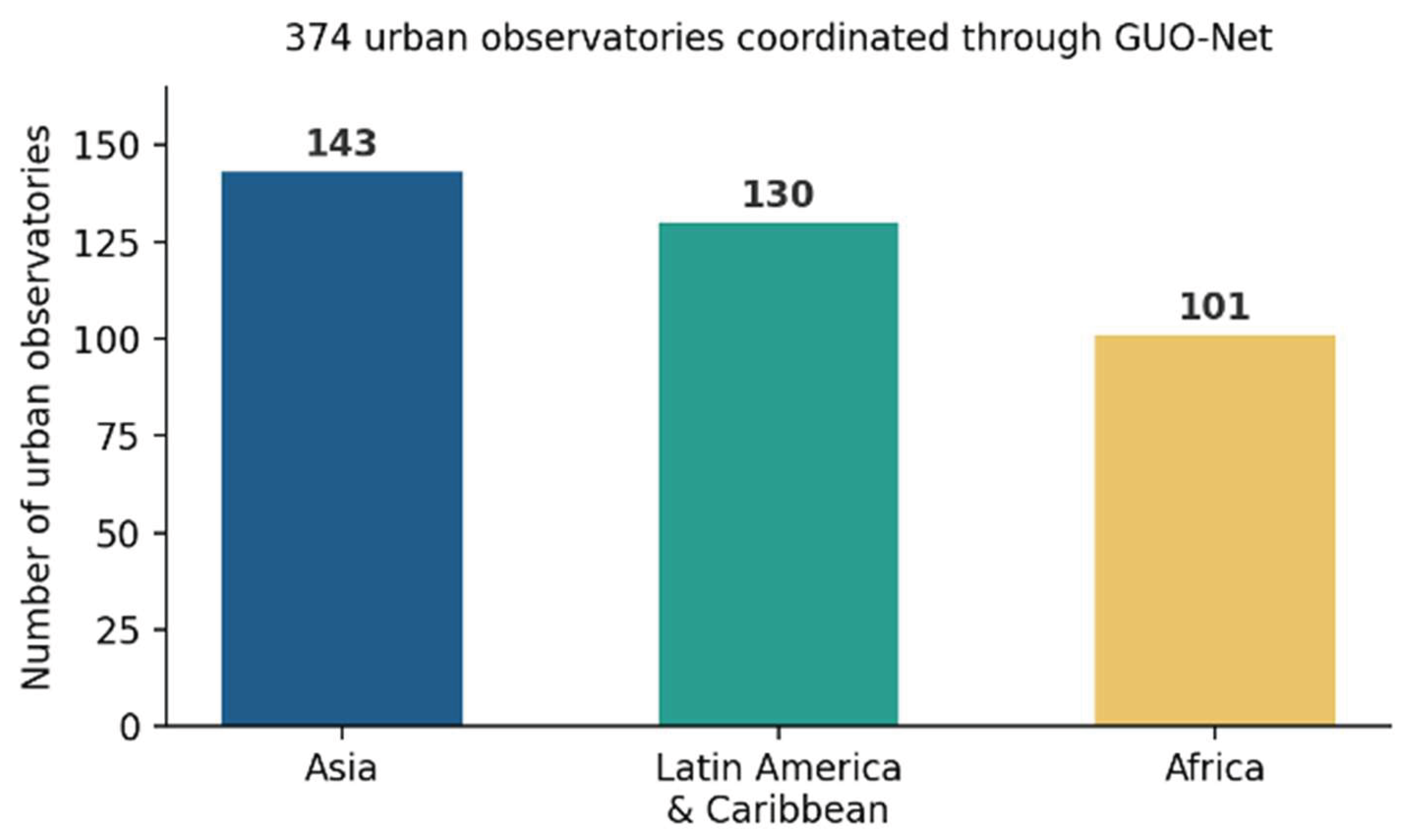
Figure 2.
Urban Observatories Coordinated through the Global Urban Observatory Network (GUO-Net), by region. Source: UN-Habitat Data and Analytics Unit (UN-Habitat, 2026a; UN-Habitat, 2026b).
Figure 2.
Urban Observatories Coordinated through the Global Urban Observatory Network (GUO-Net), by region. Source: UN-Habitat Data and Analytics Unit (UN-Habitat, 2026a; UN-Habitat, 2026b).
Among these publics the systems under-represent, urban Indigenous populations illustrate both the problem and the most developed governance response to date. Most of the world's Indigenous population remains rural, but over a quarter globally lives in urban areas, with wide regional variation: roughly 69% in North America, 52% in Latin America and the Caribbean, 34% in Europe and Central Asia, 27% in Asia and the Pacific, and 18% in Africa (ILO, 2019; Figure 3). In Canada and Brazil the Indigenous population is now majority-urban, and Brazil's urban share rose from 36% to 54% between the 2010 and 2022 censuses (Statistics Canada, 2022; IBGE, 2023). Urban Indigenous populations are nonetheless often invisible in city statistics and statistics-generating processes: undercounted, folded into general categories, not involved, or measured through frameworks indifferent to relational and place-based values (Carroll et al., 2020; ILO, 2019). The Indigenous data sovereignty movement has answered with the CARE Principles for Indigenous Data Governance (Collective benefit, Authority to control, Responsibility, Ethics), formulated as a people-and-purpose-oriented complement to the technically oriented FAIR principles of open data (Carroll et al., 2020; Wilkinson et al., 2016). The CARE principles' insistence on authority, benefit, and accountability supplies a governance vocabulary that can be adapted, without appropriating the specific legal standing of Indigenous peoples, to the broader range of communities whose values urban data systems under-represent. The framework developed in this paper draws on that vocabulary.
3. Methods
3.1. Research Design
This study uses a comparative documentary and institutional analysis with a theory-building component to develop a Plural-Values Framework for the Co-Design of Urban Observatories. The empirical component examines how documented governance arrangements shape indicator selection, while the theory-building component synthesizes those findings with scholarship on value pluralism, participatory governance and transdisciplinary knowledge production. The study therefore addresses a governance question: whose values, and through what institutional processes, are represented in the indicators that urban observatories produce? Indicators are treated as socially constructed representations of development priorities shaped by institutional arrangements, stakeholder participation and knowledge systems.
The methodology extends the comparative institutional approach developed in Urban Observatories: A Comparative Review (Dickey et al., 2021) from observatory governance to indicator governance. Three analytical phases were completed: (i) comparative mapping and institutional analysis of 24 urban observatories and observatory-like monitoring institutions; (ii) stakeholder-values analysis and cross-case synthesis; and (iii) development of the Plural-Values Framework using the observatory findings and eight community-led monitoring precedents. Expert validation is specified as a subsequent phase of the research rather than as part of the analysis reported in this paper.
3.2. Comparative Mapping and Institutional Analysis
The first phase examined 24 urban observatories and observatory-like monitoring institutions representing different geographical regions, governance arrangements and institutional models. Consistent with Dickey et al. (2021), the sample includes organizations formally identified as urban observatories and institutions performing comparable functions in urban monitoring, knowledge production and policy support. A separate precedent set of eight community-led monitoring initiatives was used to assess whether the practices required by the proposed framework have been demonstrated at institutional scale. The complete coded corpus therefore comprises 32 institutions: 24 observatories or observatory-like monitoring institutions and eight community-led precedents.
Each observatory was analysed using a structured coding framework based on publicly available documentation, including governance documents, strategic plans, annual reports, indicator frameworks and methodological guidance. A Plural Values Coding Matrix was developed to assess indicator ownership, stakeholder participation, decision-making processes, knowledge sources, value systems represented, and mechanisms for transparency, accountability and review. The unit of analysis was the governance process through which indicators are selected, maintained and revised, rather than the indicators themselves.
3.3. Stakeholder Values Analysis and Cross-Case Synthesis
The second phase examined how stakeholder values shape indicator selection. Rather than asking which indicators cities should measure, the study investigates whose priorities become indicators and how different knowledge systems influence urban monitoring. Stakeholder groups considered include governments, national statistical offices, civil society organizations, academia, local communities, informal settlement residents, women, youth, indigenous peoples, the private sector and international organizations.
Publicly available documentary evidence was analysed using qualitative content analysis and thematic coding to identify stakeholder priorities, preferred evidence sources and gaps in existing indicator systems. The findings were synthesized in a Plural Values Matrix showing how different actors privilege different forms of evidence and development outcomes. Cross-case synthesis was then used to identify recurring governance models, institutional innovations and barriers to inclusive indicator development. The eight community-led initiatives were analysed separately as precedents rather than as direct comparators to the 24 observatories.
3.4. Development and Validation of the Plural-Values Framework
The final analytical phase developed the Plural-Values Framework for the Co-Design of Urban Observatories. Rather than proposing a new indicator set, the framework establishes a transparent and participatory process through which indicators can be collectively designed. It is based on the premise that urban indicators should emerge through dialogue among multiple stakeholders and integrate diverse knowledge systems rather than reflecting the priorities of a single institution or technical community.
The framework comprises eight iterative stages: stakeholder mapping, values elicitation, knowledge systems mapping, indicator co-design workshops, consensus building, pilot implementation, governance endorsement, and adaptive learning through periodic review. These stages provide a practical process for integrating official statistics, Earth observation, administrative records, citizen-generated data and local knowledge into urban monitoring systems while ensuring that indicators remain responsive to changing urban priorities.
A structured expert-review process is proposed to validate the framework adapting the approach used by Dickey et al. (2021). This process combines document review, expert consultation and iterative refinement. This validation would engage experts from urban observatories, national statistical offices, United Nations agencies, local governments and academia, assessing the framework against six criteria namely; institutional feasibility, inclusiveness, transparency, scalability, practical usability, and adaptability across governance contexts. The aim would be not statistical validation but the establishment of analytical credibility, conceptual coherence and policy relevance. This expert review forms the next phase of the research and is outlined as future work.
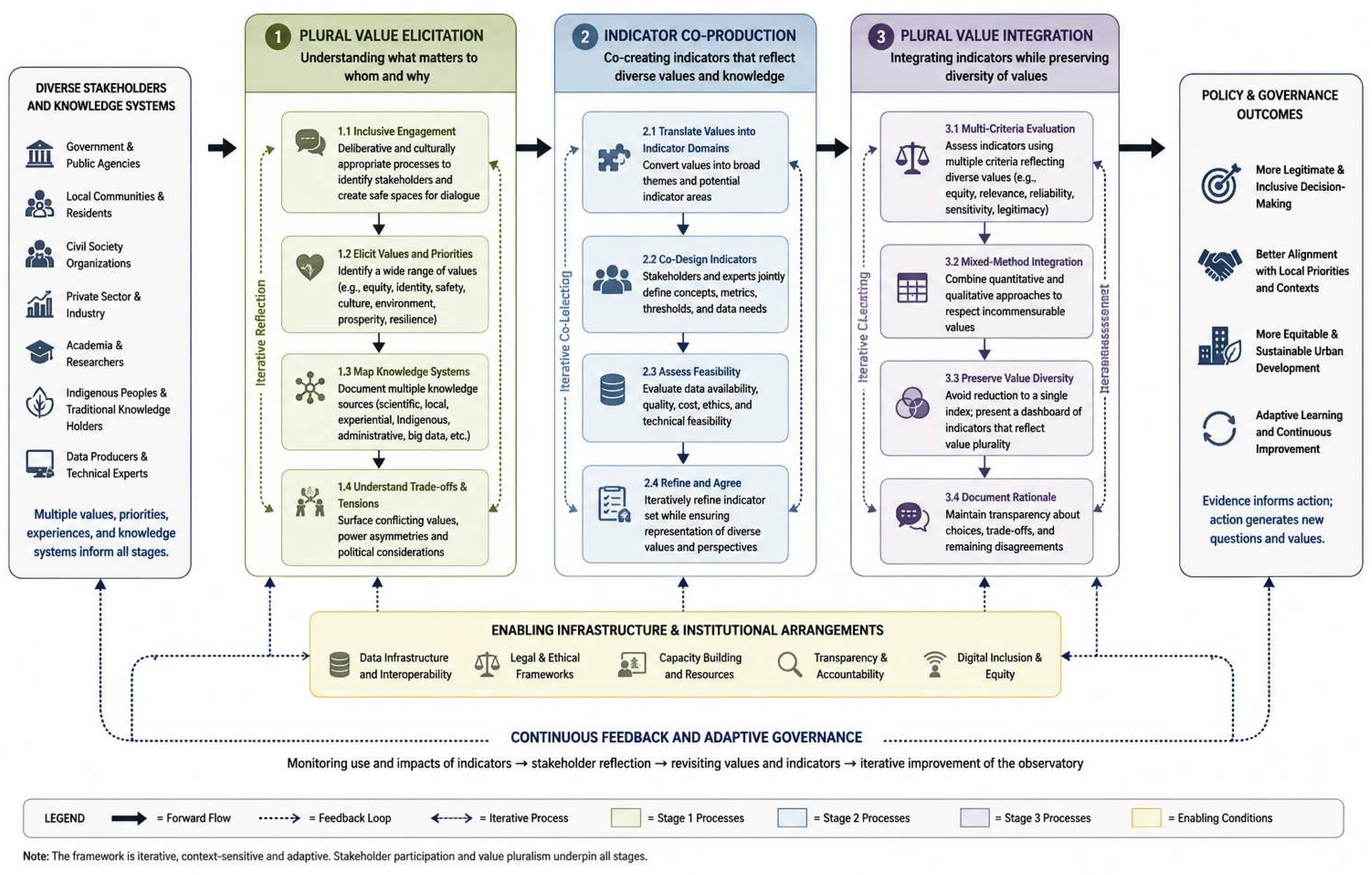
Figure 4.
A Plural-Values Framework for the Co-Design of Urban Observatories .
3.5. Data Sources and Analytical Approach
The analysis draws on publicly available urban-observatory websites, governance documents, strategic plans, annual reports, indicator frameworks, SDG monitoring methodologies, Urban Monitoring Framework documentation and peer-reviewed literature. These sources support the institutional coding, stakeholder-values analysis and cross-case synthesis reported in the paper. Interviews and expert validation are not part of the completed evidence base and remain future phases of the research.
Analysis combines comparative institutional analysis, qualitative content analysis, thematic coding and cross-case synthesis. Rather than evaluating indicators solely on technical performance, the study adopts institutional legitimacy as its primary analytical lens, treating indicators as products of governance processes through which multiple actors negotiate priorities, knowledge and evidence.
4. Results
The comparative mapping produced a coded corpus of 32 documented institutions, drawn from the documentable subset of the 374 urban observatories coordinated through the Global Urban Observatory Network together with observatory-like monitoring institutions for which indicator-governance documentation exists. Each institution was scored 0–3 on the six dimensions of the Plural Values Coding Matrix, with every score supported by a documented source. The corpus divides into two groups that play distinct roles in the analysis. The first, comprising 24 urban observatories and observatory-like monitoring institutions under state-hosted, university-hosted and hybrid university–government arrangements (n = 24), is the object of study: these operate under current urban monitoring frameworks and their coding tests the paper's claim about how observatories handle plural values. The second, comprising 8 community-led monitoring initiatives (n = 8), is not a set of observatories and is not treated as a comparator; it is reserved as a precedent set, examined in Section 4.3 to establish whether the practices the proposed framework requires have been demonstrated anywhere at instituitional scale.
The results proceed in three movements. Section 4.1 establishes the problem by examining how the 24 observatories perform across the six dimensions. Section 4.2 shows that the deficit is structural rather than simply a failure of intent by comparing declared and governed participation. Section 4.3 assesses feasibility through variation within the observatory population and evidence from the eight community-led precedents.
4.1. Plural Values under Current Observatory Frameworks
Only a minority of the 374 observatories in the network publish the governance and indicator-selection documentation needed to assess how they decide what to measure; the remainder report data without making their indicator-governance processes publicly legible. This distribution is itself a first result. When most observatories cannot be evaluated on how they select indicators, because they document only outputs and not process, that opacity is evidence about the state of indicator governance: transparency about whose values shape measurement is the exception rather than the norm. Within the 24 observatories that can be assessed, performance is weak across every dimension. Mean scores range from 1.54 (indicator ownership; review and revisability) to 1.79 (stakeholder participation), with an overall median of 2 on a 0–3 scale. No observatory scored 3 on indicator ownership: in every case, authority over the indicator set rests with the host institution or its partners rather than with the constituencies the indicators represent. The two weakest dimensions are the most consequential. Indicator ownership (mean 1.54) shows that the question of whose values are encoded is settled institutionally and upstream. Review and revisability (mean 1.54) shows that what has been settled rarely changes: only one institution in the sample, the German municipal SDG indicator system, provided documented evidence of an indicator set being materially revised through review, expanding from 47 core indicators in 2018 to 120 following consecutive evaluations.
Stakeholder participation, the dimension operationalizing Arnstein's distinction between tokenistic and substantive involvement, is instructive in its distribution. Of the 24 observatories, nine score 1 (informing only), eleven score 2 (consultation on expert-prepared drafts), and only four score 3 (generative co-production). Participation is therefore not absent — it is present, ubiquitous, and confined to a stage at which the substantive decisions have already been taken. This is the specific weakness the paper addresses: not that observatories exclude stakeholders, but that they include them downstream of the choice that matters.
The pattern is consistent with independent evidence on indicator content. A systematic analysis of sixty-seven urban sustainability measurement initiatives comprising 2,847 indicators found that such sets 'generally pay marginal attention to political questions (e.g., participation, policies, institutional settings), gender issues and distributional concerns' (Merino-Saum et al., 2020). The deficit identified here in the governance of indicator selection is mirrored in what the resulting indicators measure.
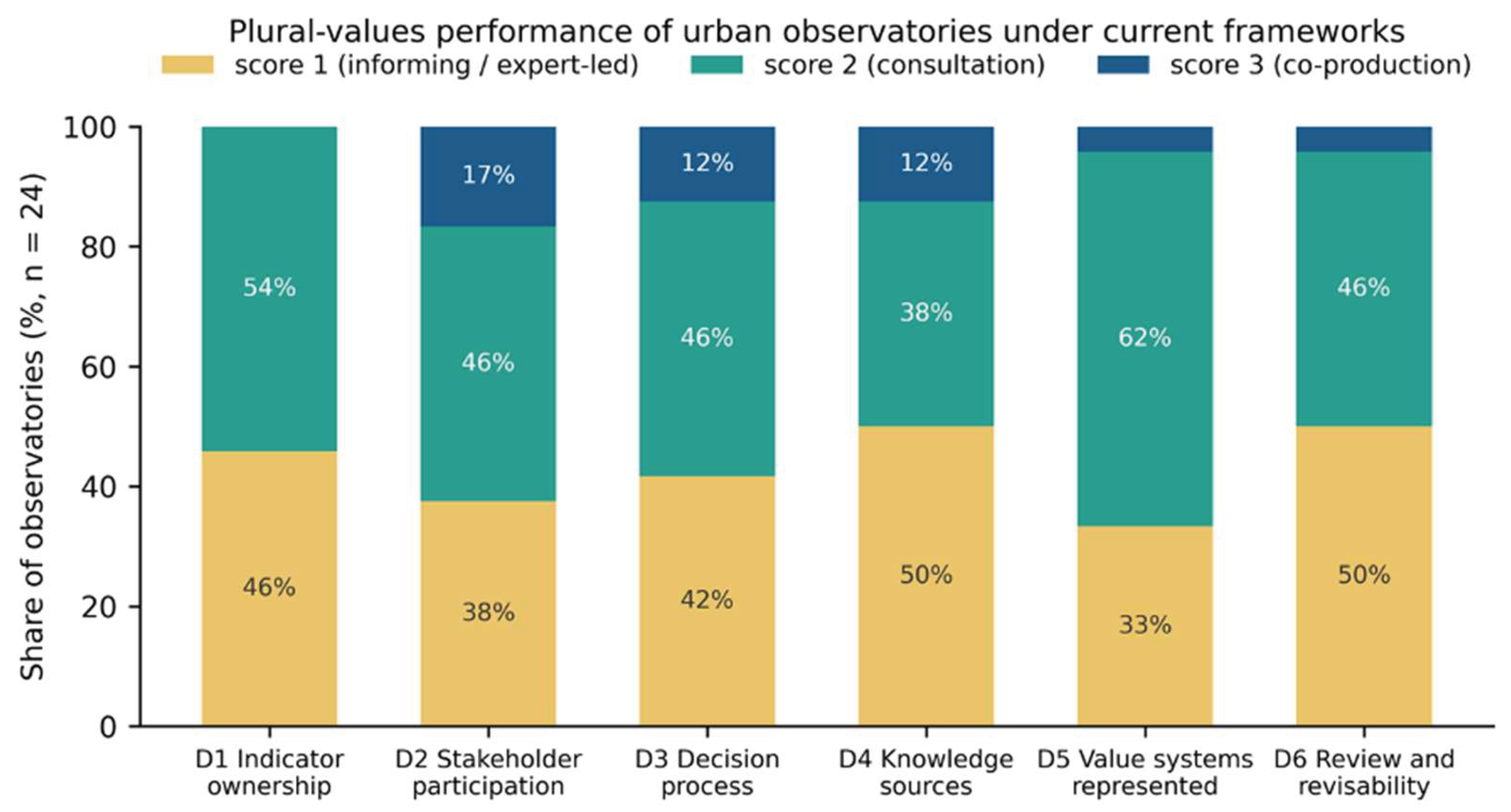
Figure 5.
Share of observatories at each coded score across the six dimensions under current framework.
Figure 5.
Share of observatories at each coded score across the six dimensions under current framework.
4.2. The Declared-Governed Gap: A Structural Rather Than Attitudinal Deficit
If the deficit reflected indifference to inclusion, advocacy would remedy it. The coding shows otherwise. Alongside each observatory's governed participation score, we coded the strength of its declared commitment to inclusion as expressed in its own mission, strategy and programme documents, on the same 0–3 anchors. Declared commitment exceeds governed participation in fourteen of twenty-four observatories and is lower in none. Mean declared commitment is 2.38 against mean governed participation of 1.79, a difference significant on a Wilcoxon signed-rank test (W = 0.0, p = 0.00018).
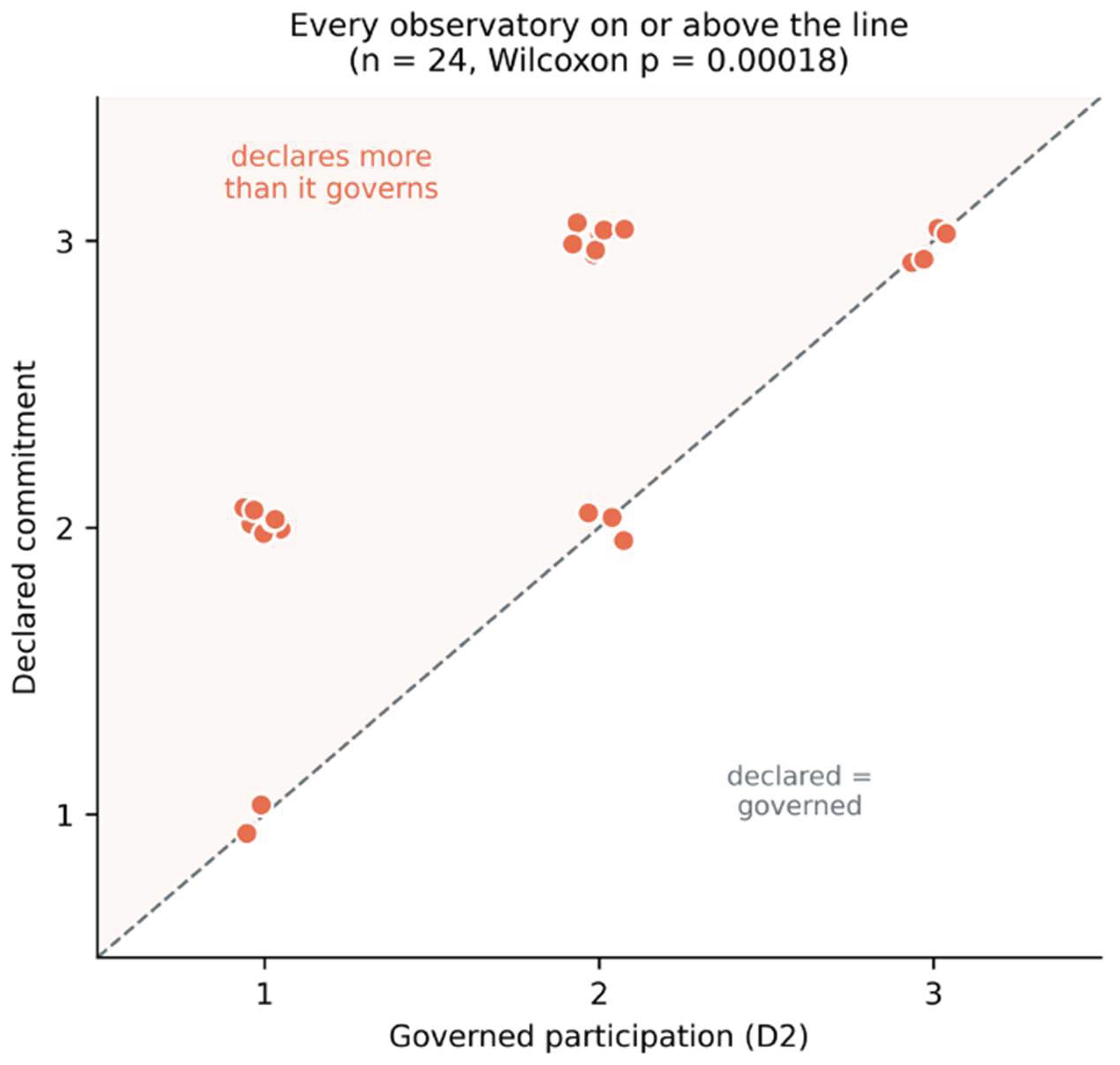
Figure 6.
Declared commitment plotted against governed participation for each observatory).
Individual cases show the mechanism. A study of Nairobi City County's monitoring and evaluation system found citizen participation and knowledge management structures to be 'good but not systematically institutionalized', while dashboards and geospatial tools accounted for 65.9% of variance in service delivery outcomes (Awere et al., 2025): the technical layer is institutionalised and functioning, the participatory layer is aspirational. Research on SDG localisation in Bristol found the Goals 'instrumentalized by cities to signal global ambitions and progressive identities' (Fox and Macleod, 2021). Barcelona's data programme, among the most advanced statements of citizen data sovereignty in Europe, is assessed by its own analysts as an approach that 'has yet to be entirely established as a paradigm' (Calzada, 2018). In each case the commitment is genuine and the governance unchanged.
A parallel pattern is documented in the recognition of Indigenous and community land rights more broadly. Most national governments have endorsed the UN Declaration on the Rights of Indigenous Peoples and comparable commitments to free, prior and informed consent and customary tenure (United Nations, 2007; FAO, 2012), yet implementation research finds that legal recognition consistently outpaces governed practice: across 73 countries covering 85 per cent of the Earth's land area, existing laws already entitle Indigenous Peoples and local communities to some 260 million hectares of additional land that has not yet been formally recognised or brought under their control (Rights and Resources Initiative, 2023). As with the observatories examined here, the shortfall is not one of declared intent but of institutionalised authority, precisely the distinction this paper's coding scheme applies to indicator governance.
Two further findings indicate a structural constraint. First, the values excluded are not unknown but unaccommodated: when index construction for the Gauteng City-Region Observatory was allowed to follow local context rather than models derived from the Global North, a distinct dimension of 'bottom-up political voice' emerged that predefined frameworks had not captured (Katumba et al., 2022). The value existed in the population and was rendered invisible by the measurement frame. Second, the same dynamic appears in platform failure: a comparative study of the Smart Columbus Operating System found that despite 'a well-designed organization, methodology, and processes, the platform did not sufficiently capture city users, and was no longer used soon after demonstration funding ended', the authors' central recommendations being continuous stakeholder engagement and clarified data ownership (Wolf et al., 2025). Absent governance of participation and ownership is diagnosed as a cause of institutional failure, not merely of inequity. Together these results locate the deficit in the architecture of indicator governance rather than in the intentions of those who operate it — which is what motivates a framework rather than an exhortation.
4.3. Feasibility: Variation within the Observatory Population and Documented Precedents
A framework is worth proposing only if what it asks for is achievable. Two lines of evidence indicate that it is. The first is variation within the observatory population. Hybrid university–government partnerships outperform state-hosted and university-hosted observatories on every one of the six dimensions, and the difference in participation across observatory types is significant (Kruskal-Wallis H = 8.65, p = 0.013). Hybrid observatories average 2.33 on participation against 1.42 for state-hosted institutions, and lead on indicator ownership (2.00 against 1.25), decision process (2.22 against 1.33) and knowledge sources (2.22 against 1.25). These remain observatories in the full institutional sense: the Gauteng City-Region Observatory has institutionalized resident perception across seven survey rounds since 2009, the Sierra Leone Urban Research Centre curates collective spaces for community action planning, and the Loughborough town observatory was co-created with stakeholders following a review of participatory practice in twenty existing observatories. Movement toward plural-values governance does not require an institution to stop being an observatory.
The second line of evidence comes from the precedent set (n = 8): community-led monitoring initiatives including Slum Dwellers International's Know Your City programme, the Mukuru Special Planning Area process in Nairobi, the Colombian Cómo Vamos network and the Urban Resource Centre in Karachi. These are not full-fledged observatories and they are included to establish whether the practices each framework stage requires have been demonstrated at institutional scale. Figure 7 places their mean governance profile against the three observatory types, and the contrast is stark: the precedent set reaches the outer range on every dimension where observatories remain near the centre.
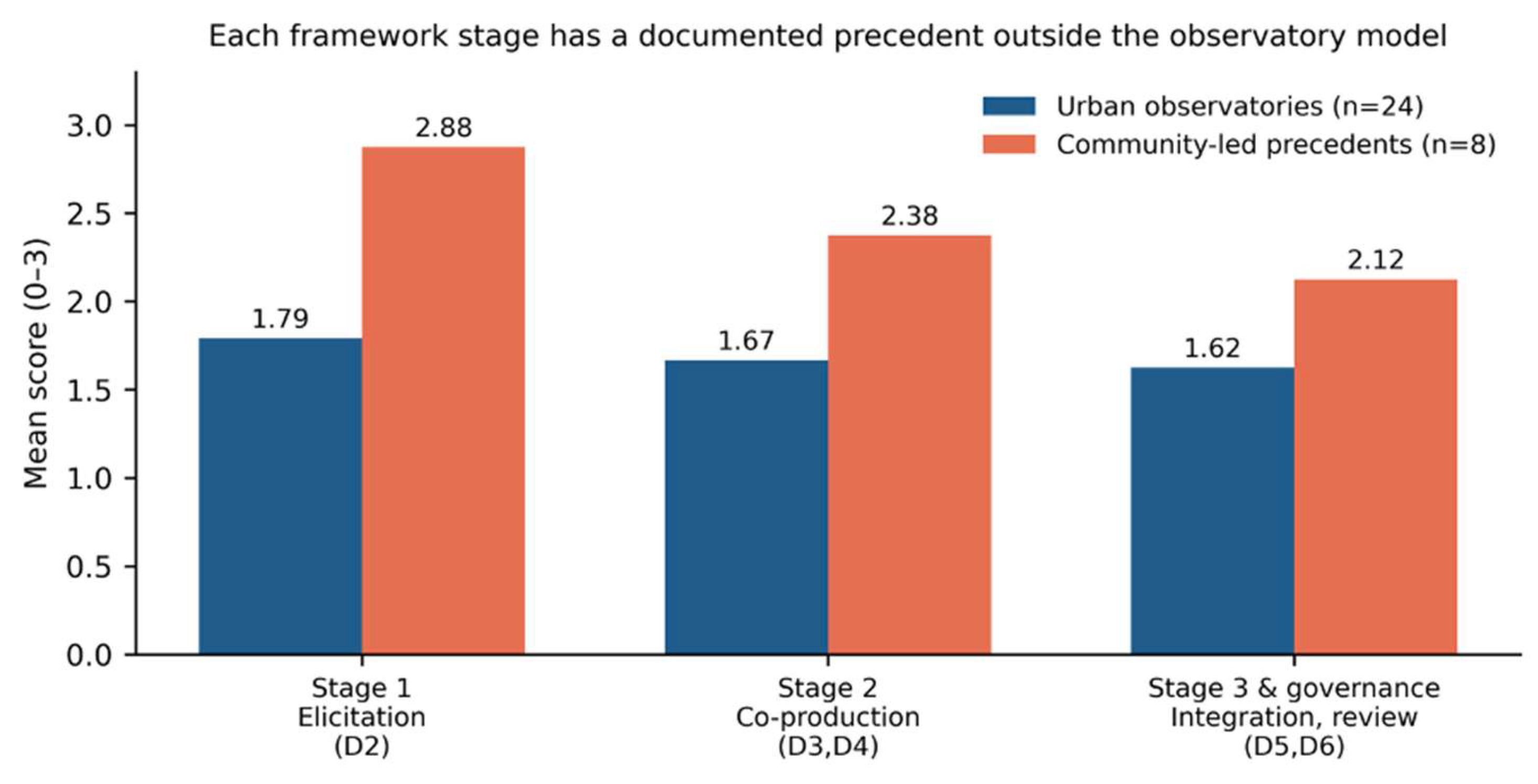
The precedents demonstrate each stage of the framework in operation. For elicitation, the Mukuru process convened residents who 'co-define research objectives with professionals, collect and analyze data, and help translate findings into ameliorative actions', generating evidence used by thousands of residents to co-design an integrated development plan (Corburn et al., 2022), since scaled into city-wide practice (Horn, 2021). For co-production, community-led enumeration has produced settlement data to a common standard across 1,238 settlements in 103 cities by 2017, with cumulative profiling since exceeding ten thousand settlements; Namibia's Community Land Information Programme profiled every informal settlement nationally, covering more than 500,000 people (Muller et al., 2012; Patel et al., 2012). For integration and use, enumerations in Old Fadama, Accra were conducted in 2004, 2006–07 and 2009, each round entering negotiation with a successive city government and shifting policy 'away from forced evictions towards participatory relocations or rehabilitation' (Farouk and Owusu, 2012). Community-generated data meeting official standards of use is an established fact, not a proposal (Figure 8).
The contribution of the framework follows from these two findings taken together. The practices are proven and institutional movement is possible, yet no observatory in the sample assembles the practices into a single governed indicator cycle with community authority defined at each stage. That assembly, rather than any individual technique, is what the framework provides.
4.4. The Plural-Values Framework: Three Macro-Stages
The eight operational stages identified in the Methods organize into three macro-stages, each answering a distinct design question together with a cross-cutting governance layer (Figure 9; Table 2). The macro-stages give the operational process its theoretical architecture. Each corresponds to a body of scholarship and each carries design rules that distinguish co-design from conventional consultation. Table 1 summarizes how the resulting observatory differs from conventional design.
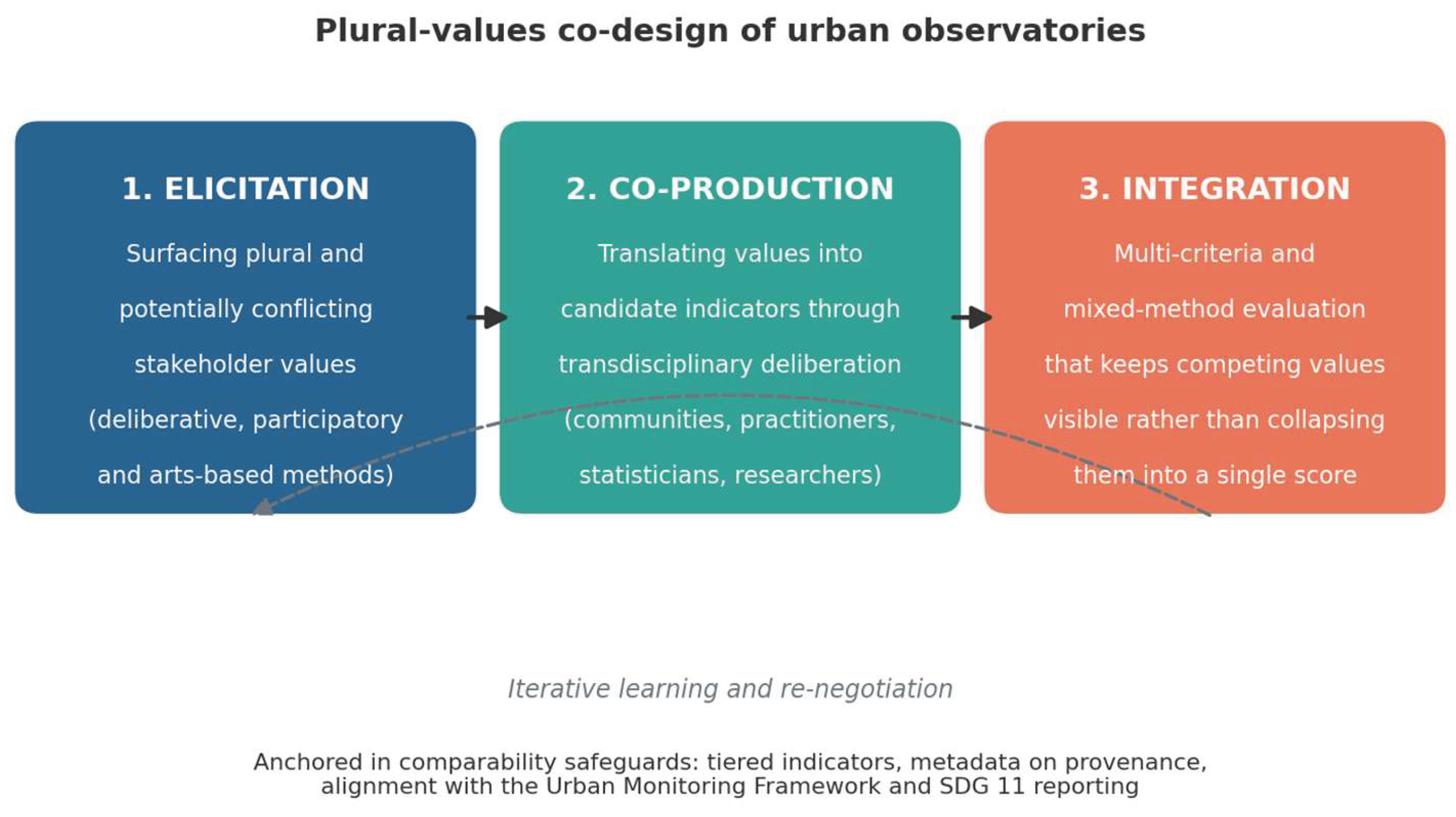
Figure 9.
The three-stage plural-values framework for the co-design of urban observatories. Source: authors
Figure 9.
The three-stage plural-values framework for the co-design of urban observatories. Source: authors
Stage 1: Eliciting plural and potentially conflicting values. The first macro-stage (operationally: stakeholder mapping, values elicitation, and knowledge systems mapping) surfaces, before any indicator is specified, the different conceptions of urban well-being held across the observatory's constituency. Elicitation has to be structured to reach beyond the usual participants: informal workers and traders, residents of informal settlements, women's and youth groups, persons with disabilities, migrants, customary and faith authorities, and urban Indigenous communities, alongside planners, statisticians, and business actors. For Indigenous Peoples and Local Communities specifically, elicitation should follow the principle of Free, Prior and Informed Consent (FPIC): engagement is initiated before decisions are taken, based on adequate information, and structured so that communities may withhold or withdraw consent. FPIC is affirmed in the UN Declaration on the Rights of Indigenous Peoples and ILO Convention No. 169 (United Nations, 2007; ILO, 2019), and is operationalized for land and resource governance in the FAO Voluntary Guidelines on the Responsible Governance of Tenure (FAO, 2012). These instruments offer observatories a tested procedural standard for what plural and potentially conflicting values means in practice whenever a constituency's land, resource, or data rights are engaged, not only its opinions. The methods are plural too: deliberative workshops, narrative and life-history interviews, participatory mapping, photovoice and arts-based methods, structured valuation exercises. Different value languages need different media of expression (IPBES, 2022; Watson, 2014; Funtowicz and Ravetz, 1993). Two design rules separate this stage from conventional stakeholder consultation. Elicitation is open-ended with respect to values, not confined to reactions to a pre-existing indicator menu. And conflict is treated as information: divergent and opposing values are documented as such rather than averaged away, because the map of value conflict is what the later stages have to work with (Munda, 2004; Turnhout et al., 2020).
Stage 2: Co-producing candidate indicators through transdisciplinary deliberation. The second macro-stage (operationally: indicator co-design workshops and consensus building) translates elicited values into measurable candidate indicators through structured deliberation among mixed panels of community representatives, subject-matter experts, official statisticians, and observatory staff. Translation is where the epistemic risk concentrates. A lived value ('our market must remain ours') is either rendered faithfully into measurement ('security of tenure of market traders; continuity of trader associations in market governance') or quietly assimilated to what is already measured ('number of market stalls'). The safeguards follow from the co-production literature (Ostrom, 1996; Jasanoff, 2004; Watson, 2014; Turnhout et al., 2020). Community panelists hold authority over whether a candidate indicator adequately expresses the value it operationalizes. Statisticians hold authority over feasibility and method. Neither can unilaterally overrule the other, and unresolved translations are recorded as measurement gaps instead of being silently dropped. The stage's output is a documented, contestable register of candidate indicators, each traceable to the values and constituencies it expresses: a provenance record in the same spirit as metadata standards in official statistics, extended to normative provenance.
Stage 3: Integration through multi-criteria and mixed-method evaluation. The third macro-stage (operationally: pilot implementation) governs how plural indicators are brought together for learning and decision support without being collapsed into a single score. Social multi-criteria evaluation supplies the methodological core (Munda, 2004). Decision options or urban conditions are assessed against multiple criteria simultaneously. Weights are elicited transparently from stakeholders rather than imposed. Incommensurability is accepted as a mathematical and ethical property of the problem, and sensitivity analysis exposes how conclusions shift under different value weightings. Deliberative variants of multi-criteria analysis embed these techniques in structured dialogue, so the analysis organizes negotiation instead of replacing it (Munda, 2004; Cerreta and Panaro, 2017). Where phenomena resist quantification, mixed-method synthesis presents qualitative and narrative evidence alongside quantitative indicators as first-class evaluative material (IPBES, 2022). The observatory's decision-support interface is reconceived accordingly: from a dashboard that announces scores to an evaluation environment that displays trade-offs, records dissent, and supports argument. One rule governs throughout. Aggregation is permitted for communication, but every aggregate must be decomposable back to its plural constituents, and no composite may become the sole basis of reporting or reward.
Governance and iteration. The remaining operational stages (governance endorsement and adaptive learning through periodic review) form a cross-cutting layer adapted from the CARE principles (Carroll et al., 2020): defined community authority over the indicators that represent them, documented responsibility for data stewardship, explicit statements of collective benefit, and ethical review of uses. This governance layer converges with parallel developments in international rights frameworks, where Indigenous Peoples and local communities are increasingly recognized as rights-holders rather than as stakeholders to be consulted after decisions are made. The UN Declaration on the Rights of Indigenous Peoples affirms the right to self-determination and to free, prior and informed consent over matters affecting communities' lands, territories and resources (United Nations, 2007), while the FAO Voluntary Guidelines on the Responsible Governance of Tenure set out corresponding standards for recognizing customary and collective tenure rights in decision-making (FAO, 2012). Observatories seeking a governance analogue for community authority over indicators, rather than mere participation in producing them, can draw directly on these rights-based standards: a defined, binding role in decisions, not only a role in data collection. Values evolve and constituencies change, so the cycle is iterative. Elicitation is periodically renewed, the indicator register is revisable, and the observatory's legitimacy rests on the demonstrated possibility of changing what is measured. That possibility is the institutional test that separates co-design from consultation (Arnstein, 1969; Turnhout et al., 2020).

Table 1.
Correspondence between the three macro-stages and the eight operational stages of the framework.
Table 1.
Correspondence between the three macro-stages and the eight operational stages of the framework.
| Macro-stage | Operational stages (Methods, eight-stage process) | Function |
|---|---|---|
| 1. Elicitation | Stakeholder mapping; values elicitation; knowledge systems mapping | Surfacing plural and potentially conflicting values and the knowledge systems that carry them |
| 2. Co-production | Indicator co-design workshops; consensus building | Translating values into candidate indicators through transdisciplinary deliberation |
| 3. Integration | Pilot implementation | Multi-criteria and mixed-method evaluation that keeps competing values visible |
| Governance and iteration | Governance endorsement; adaptive learning through periodic review | Community authority, accountability and revisability over time (CARE-adapted) |
Source: authors.
Table 2.
Conventional versus plural-values observatory design.
| Dimension | Conventional observatory design | Plural-values co-design |
|---|---|---|
| Primary purpose | Compliance with global and national reporting; benchmarking and ranking | Shared learning, negotiation and decision support alongside reporting |
| Indicator origin | Imported from global templates and expert selection | Co-produced from elicited stakeholder values, then mapped to global frameworks |
| Knowledge base | Official statistics, administrative and geospatial data | Official statistics plus local, experiential, Indigenous and community-generated knowledge |
| Treatment of values | Implicit; assumed to be settled by the framework | Explicit; plural and potentially conflicting values are surfaced and documented |
| Aggregation | Composite indices and single scores | Multi-criteria and mixed-method syntheses that preserve trade-offs |
| Governance | Expert-led, centralized stewardship | Multi-stakeholder stewardship with defined community authority over data (e.g., CARE principles) |
| Accountability | Upward, to national and global reporting systems | Both upward and downward, to the communities represented in the data |
Source: authors.
4.5. Reconciling Plural Values with the Demands of Comparability
The strongest practitioner objection to the framework is architectural. Observatories exist, in large part, to feed comparable data upward into national and global reporting, and locally co-produced indicators are by construction not comparable across cities. The objection is serious. It is also resolvable, because it presumes a single-tier indicator architecture that nothing in the monitoring frameworks actually requires.
We propose a tiered architecture. A core tier retains the harmonized indicators of the Urban Monitoring Framework and the SDG 11 framework, reported exactly as global standards specify. The framework neither modifies nor competes with this tier, and a city's comparability obligations are met within it (United Nations, 2015; UN-Habitat, 2022). A plural tier carries the co-produced indicators described above, governed and published by the observatory with full normative provenance, serving local learning, deliberation, and accountability. A crosswalk layer connects the two. Co-produced indicators are mapped, where meaningful, to Urban Monitoring Framework domains, so plural measurement enriches the global picture rather than fragmenting it. The crosswalk also makes systematic gaps visible: values that recur across many cities' plural tiers but appear nowhere in global menus become structured feedback to the custodians of global frameworks. Two features of this architecture matter most. It converts the localization pipeline from one-way to two-way, giving local value systems a formal channel through which to inform the evolution of global frameworks. And it protects the plural tier from the gravitational pull of reporting: because comparability obligations are fully discharged in the core tier, plural indicators need not be distorted into comparable form, and the temptation to collapse them into league tables is structurally reduced (Merry, 2016; Munda, 2004).
4.6. Expert Validation and Next Steps
The framework remains conceptual and requires empirical validation. It draws on documentary analysis, established urban monitoring practice and precedents from participatory and community-led monitoring, but the complete architecture proposed here has not yet been implemented within an urban observatory. The immediate next step should therefore be a structured expert validation process consistent with the approach described in the Methods. Practitioners from established urban observatories, national statistical systems, local governments, community organizations and relevant technical institutions could assess the framework against criteria including conceptual clarity, operational feasibility, governance requirements, resource implications, compatibility with existing monitoring systems and potential risks. Expert validation should be followed by implementation in one or two pilot observatories. Pilot sites should ideally differ in institutional capacity and urban context, allowing assessment of which elements are transferable and which require adaptation. Testing should examine not merely whether the eight operational steps can be completed but whether the process changes indicator selection, stakeholder participation, perceived legitimacy, use of evidence and relationships between locally generated and standardized indicators. Particular attention should be given to the crosswalk mechanism. Empirical testing is needed to determine whether plural-tier indicators can be connected meaningfully to global frameworks without losing their normative specificity and whether recurrent local indicators can be synthesized in ways that provide useful feedback to framework custodians. The pilot phase should also document transaction costs, skills requirements and governance challenges so that lighter-weight versions can be developed for observatories operating with limited resources.
5. Discussion and Conclusions
For practitioners, the framework offers a design vocabulary and sequence that applies to new observatories and to the reform of existing ones. The five canonical components of the observatory model map onto it directly: the stakeholder network becomes the site of elicitation and co-production; the data component acquires normative provenance metadata; the decision-support interface becomes the venue of value-preserving integration (UN-Habitat, 2026b). For the custodians of global frameworks, the crosswalk layer offers something currently missing: systematic, comparable evidence about what the world's cities value but global menus do not measure. For scholars, the framework specifies testable propositions, among them that plural-tier observatories show higher perceived legitimacy and data use among marginalized constituencies, and that value-conflict maps predict where technocratic indicators will meet implementation resistance.
Several limitations bound the argument. The framework awaits validation beyond the expert review described in the Methods, and its costs are real: elicitation and deliberation take time and skill, and may strain the observatories, often in low-resource settings, that would benefit most, so lighter-weight variants need development. Co-production processes are vulnerable to elite capture and to the simulation of participation without any transfer of authority; the governance safeguards reduce this risk but cannot eliminate it (Arnstein, 1969; Turnhout et al., 2020). The framework's borrowing from Indigenous data sovereignty must remain adaptation rather than appropriation. The CARE principles arise from specific rights claims, and extending their vocabulary to other communities must not dilute the standing of Indigenous Peoples where the term has precise legal meaning (Carroll et al., 2020). The same caution applies to the term IPLC itself: as used in environmental governance, it bundles Indigenous Peoples, who hold distinct legal and collective rights, together with local communities, and the framework should flag that conflation rather than reproduce it silently. Multi-criteria methods, finally, carry their own politics, in the selection of criteria, the elicitation of weights, and the framing of alternatives, and must be applied reflexively rather than as a neutral solvent (Munda, 2004).
The research agenda follows. Comparative case studies of observatories that have experimented with participatory indicator development. Methodological work on low-cost value-elicitation instruments suitable for routine observatory practice. Empirical testing of the tiered architecture, including how crosswalk feedback behaves in real reporting chains. Evaluation designs capable of attributing changes in legitimacy, data use, and planning outcomes to plural-values co-design. Cross-border and multi-jurisdictional city-regions, where two or more polities with distinct institutional value systems must share a single evidence base, are a particularly demanding class of validation context, and for that reason a particularly informative one.
Urban observatories concentrate the authority to decide what, in a city, is worth knowing. This paper has argued that this authority is normative and power-laden, that its conventional exercise excludes local, experiential, and Indigenous value systems, and that the exclusion is a design choice, not a technical necessity. The framework developed here, three macro-stages realized through eight operational steps, embedded in governance adapted from Indigenous data sovereignty and reconciled with global reporting through a tiered indicator architecture, offers a transferable model for exercising that authority inclusively. By returning the question of whose values are measured to the centre of observatory design, the framework reframes urban indicators as negotiated socio-political constructs, and the observatory itself as a collaborative evaluation institution capable of advancing more equitable, legitimate, and just urban governance.
References
- Arnstein, S.R. A ladder of citizen participation. J. Am. Inst. Plan. 1969, 35(4), 216–224. [Google Scholar] [CrossRef]
- Awere, E.; et al. Monitoring and evaluation systems in Nairobi City County. Int. J. Res. Sci. Innov. 2025. [Google Scholar] [CrossRef]
- Batty, M. The new science of cities; MIT Press, 2013. [Google Scholar]
- Calzada, I. (Smart) citizens from data providers to decision-makers? The case study of Barcelona. Sustainability 2018, 10(9), 3252. [Google Scholar] [CrossRef]
- Carroll, S. R.; Garba, I.; Figueroa-Rodríguez, O. L.; et al. The CARE Principles for Indigenous Data Governance. Data Sci. J. 2020, 19(1), 43. [Google Scholar] [CrossRef]
- Cerreta, M.; Panaro, S. From perceived values to shared values: A multi-stakeholder spatial decision analysis (M-SSDA) for resilient landscapes. Sustainability 2017, 9(7), 1113. [Google Scholar] [CrossRef]
- Corburn, J.; Njoroge, P.; Weru, J.; Musya, M. Urban climate justice, human health, and citizen science in Nairobi’s informal settlements. Urban Sci. 2022, 6(2), 36. [Google Scholar] [CrossRef]
- Dickey, A.; Acuto, M.; Washbourne, C.-L. Urban observatories: A comparative review; Connected Cities Lab, Faculty of Architecture, Building and Planning, The University of Melbourne, 2021. [Google Scholar]
- Espeland, W. N.; Stevens, M. L. A sociology of quantification. Eur. J. Sociol. 2008, 49(3), 401–436. [Google Scholar] [CrossRef]
- FAO. Voluntary Guidelines on the Responsible Governance of Tenure of Land, Fisheries and Forests in the Context of National Food Security; FAO; Food and Agriculture Organization of the United Nations, 2012. [Google Scholar]
- Farouk, B. R.; Owusu, M. “If in doubt, count”: The role of community-led enumerations in blocking eviction in Old Fadama, Accra. Environ. Urban. 2012, 24(1), 47–57. [Google Scholar] [CrossRef]
- Forester, J. The deliberative practitioner: Encouraging participatory planning processes; MIT Press, 1999. [Google Scholar]
- Fox, S.; Macleod, A. Localizing the Sustainable Development Goals in cities: Reflections from Bristol, UK. Urban Geography 2021. [Google Scholar]
- Funtowicz, S. O.; Ravetz, J. R. Science for the post-normal age. Futures 1993, 25(7), 739–755. [Google Scholar] [CrossRef]
- Healey, P. Collaborative planning: Shaping places in fragmented societies; Macmillan, 1997. [Google Scholar]
- Horn, P. Enabling participatory planning to be scaled in exclusionary urban political environments: Lessons from the Mukuru Special Planning Area in Nairobi. Environ. Urban. 2021, 33(2), 519–538. [Google Scholar] [CrossRef]
- IBGE. Censo Demográfico 2022: Indígenas; IBGE; Instituto Brasileiro de Geografia e Estatística, 2023. [Google Scholar]
- ILO (International Labour Organization). Implementing the ILO Indigenous and Tribal Peoples Convention No. 169: Towards an inclusive, sustainable and just future; ILO, 2019. [Google Scholar]
- Innes, J. E.; Booher, D. E. Planning with complexity: An introduction to collaborative rationality for public policy; Routledge, 2010. [Google Scholar]
- IPBES. Methodological assessment report on the diverse values and valuation of nature. IPBES Secretariat 2022. [Google Scholar]
- Jasanoff, S. (Ed.) States of knowledge: The co-production of science and social order; Routledge, 2004. [Google Scholar]
- Katumba, S.; et al. Construction of a composite quality of life index for the Gauteng city-region. Social Indicators Research 2022. [Google Scholar] [CrossRef]
- Kitchin, R. The data revolution: Big data, open data, data infrastructures and their consequences; Sage, 2014. [Google Scholar]
- Merino-Saum, A.; Halla, P.; Superti, V.; Boesch, A.; Binder, C.R. Indicators for urban sustainability: Key lessons from a systematic analysis of 67 measurement initiatives. Ecol. Indic. 119 2020, 106879. [Google Scholar] [CrossRef]
- Merry, S.E. The seductions of quantification: Measuring human rights, gender violence, and sex trafficking; University of Chicago Press, 2016. [Google Scholar]
- Muller, A.; Mbanga, E. Participatory enumerations at the national level in Namibia: The Community Land Information Programme (CLIP). Environ. Urban. 2012, 24(1), 67–75. [Google Scholar] [CrossRef]
- Munda, G. Social multi-criteria evaluation: Methodological foundations and operational consequences. Eur. J. Oper. Res. 2004, 158(3), 662–677. [Google Scholar] [CrossRef]
- Ostrom, E. Crossing the great divide: Coproduction, synergy, and development. World Dev. 1996, 24(6), 1073–1087. [Google Scholar] [CrossRef]
- Patel, S.; Baptist, C.; d’Cruz, C. Knowledge is power – informal communities assert their right to the city through SDI and community-led enumerations. Environ. Urban. 2012, 24(1), 13–26. [Google Scholar] [CrossRef]
- Porter, T.M. Trust in numbers: The pursuit of objectivity in science and public life; Princeton University Press, 1995. [Google Scholar]
- Rights and Resources Initiative. Who Owns the World's Land? The Second Edition; Rights and Resources Initiative, 2023. [Google Scholar]
- Statistics Canada. Indigenous population profile, 2021 Census of Population; Statistics Canada, 2022. [Google Scholar]
- Taylor, L. What is data justice? The case for connecting digital rights and freedoms globally. Big Data Soc. 2017, 4(2). [Google Scholar] [CrossRef]
- Turnhout, E.; Metze, T.; Wyborn, C.; Klenk, N.; Louder, E. The politics of co-production: Participation, power, and transformation. Curr. Opin. Environ. Sustain. 2020, 42, 15–21. [Google Scholar] [CrossRef]
- UN-Habitat. Urban Monitoring Framework: A guide for monitoring sustainable urban development; UN-Habitat, 2022. [Google Scholar]
- UN-Habitat. Global urban observatories. 2026a. Available online: https://unhabitat.org/initiative/global-urban-observatories (accessed on 5 July 2026).
- UN-Habitat. Urban observatories - urban indicators database. 2026b. Available online: https://data.unhabitat.org/pages/urban-observatories (accessed on 5 July 2026).
- United Nations. United Nations Declaration on the Rights of Indigenous Peoples; United Nations, 2007. [Google Scholar]
- United Nations. Transforming our world: The 2030 Agenda for Sustainable Development; United Nations, 2015. [Google Scholar]
- United Nations. World urbanization prospects: The 2018 revision; United Nations Department of Economic and Social Affairs, 2019. [Google Scholar]
- United Nations. World urbanization prospects 2025; United Nations Department of Economic and Social Affairs, 2025. [Google Scholar]
- Watson, V. Co-production and collaboration in planning the difference. Plan. Theory Pract. 2014, 15(1), 62–76. [Google Scholar] [CrossRef]
- Wilkinson, M. D.; Dumontier, M.; Aalbersberg, I. J.; et al. The FAIR guiding principles for scientific data management and stewardship. Sci. Data 2016, 3, 160018. [Google Scholar] [CrossRef] [PubMed]
- Wolf, K.; Stiles, J.; Miller, H. J.; Dawson, R. J.; Mills, J. P.; Blythe, P.; Morley, J. Building enduring smart city data platforms to provide urban management support: Lessons learnt from UK Urban Observatories and the US Smart Columbus Operating System. Front. Sustain. Cities 7 2025, 1512847. [Google Scholar] [CrossRef]
Figure 1.
Share of the world's population living in urban areas, 1950-2050 (estimates and projections). Source: authors' elaboration of United Nations World Urbanization Prospects data (United Nations, 2019; United Nations, 2025).
Figure 1.
Share of the world's population living in urban areas, 1950-2050 (estimates and projections). Source: authors' elaboration of United Nations World Urbanization Prospects data (United Nations, 2019; United Nations, 2025).
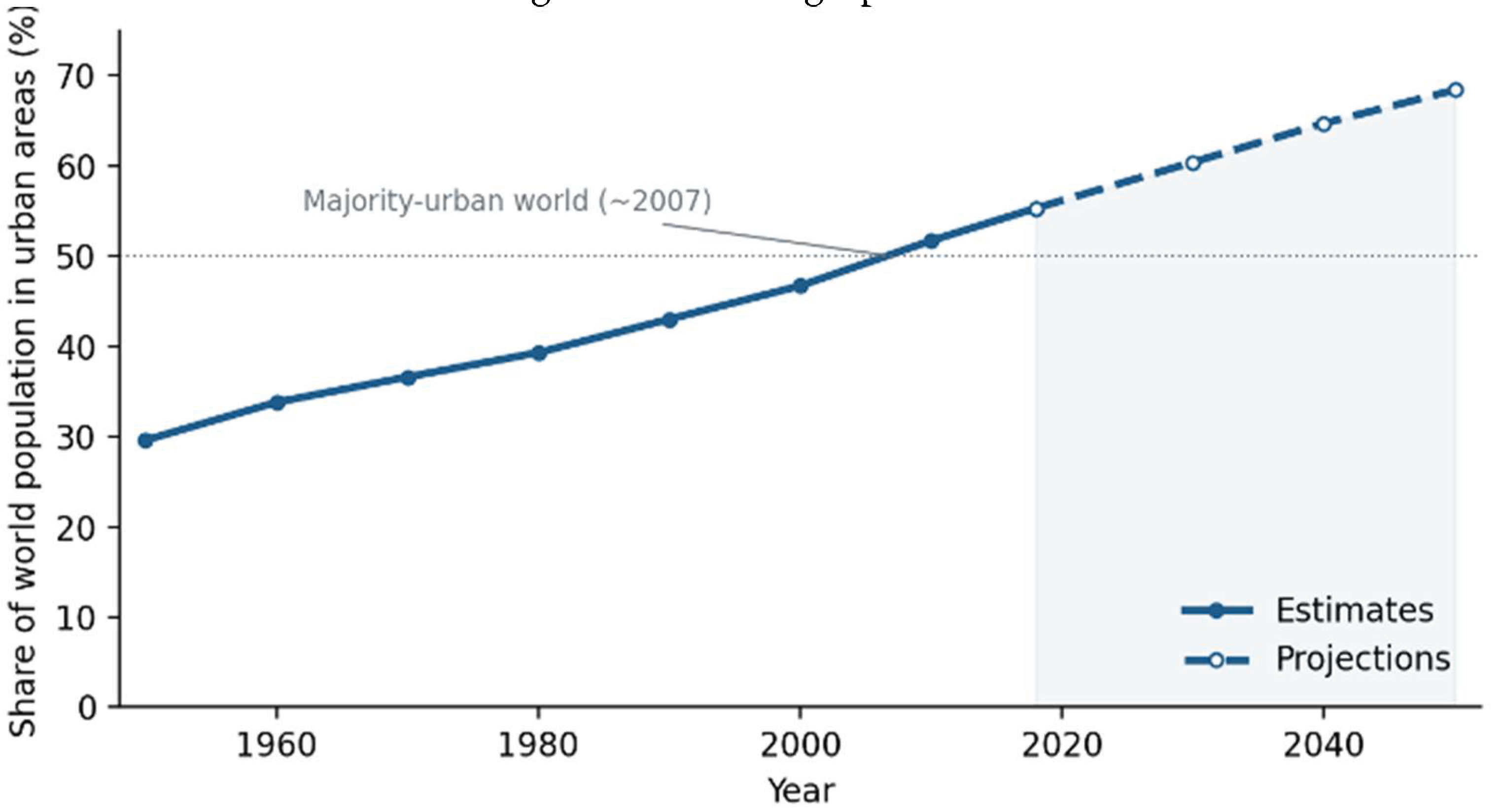
Figure 3.
Share of the Indigenous population living in urban areas, by region and world. Source: authors' elaboration of ILO estimates (ILO, 2019).
Figure 3.
Share of the Indigenous population living in urban areas, by region and world. Source: authors' elaboration of ILO estimates (ILO, 2019).
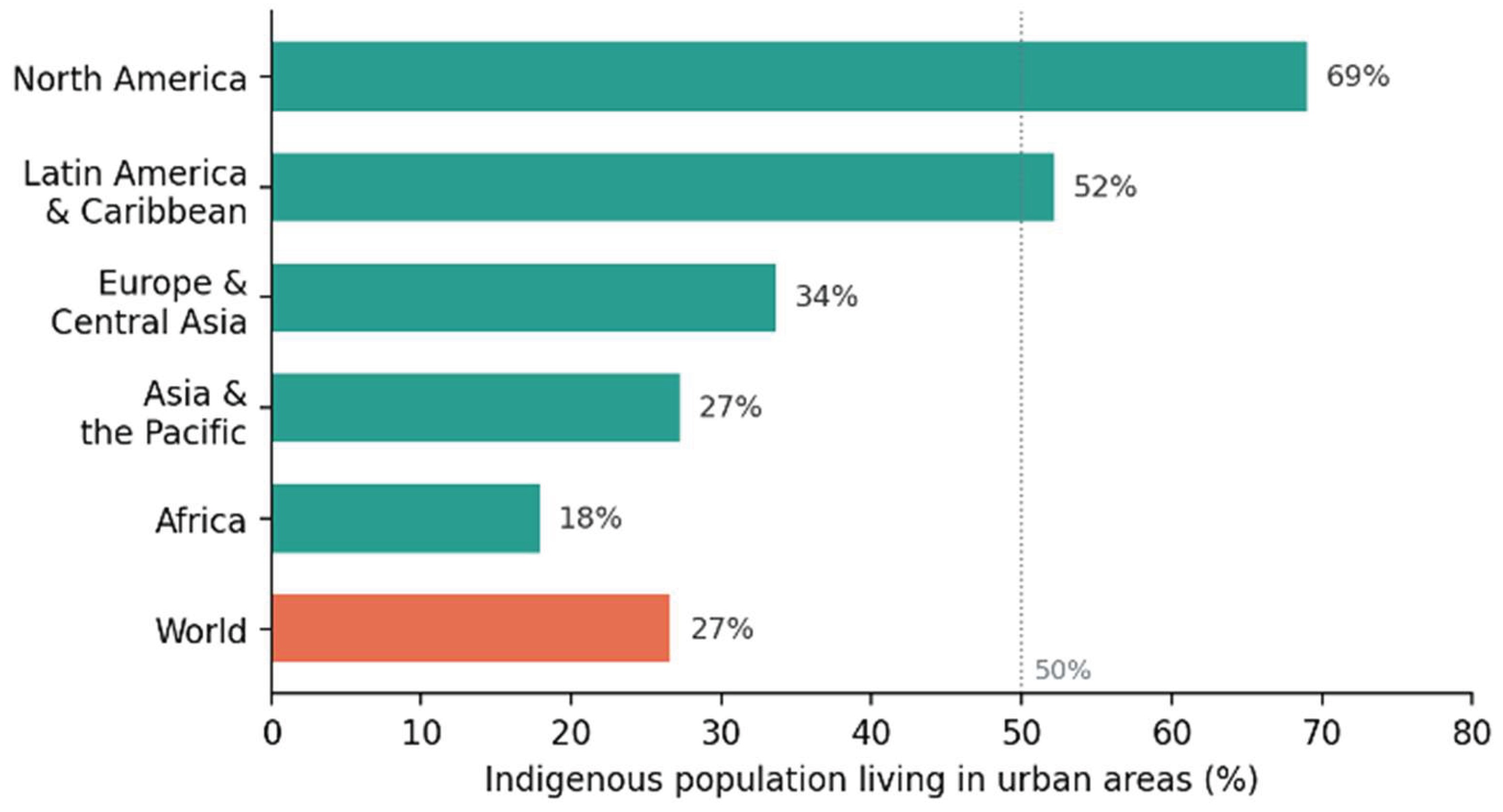
Figure 7.
Governance profile by institutional type across the six dimensions: three observatory types against the community.
Figure 7.
Governance profile by institutional type across the six dimensions: three observatory types against the community.
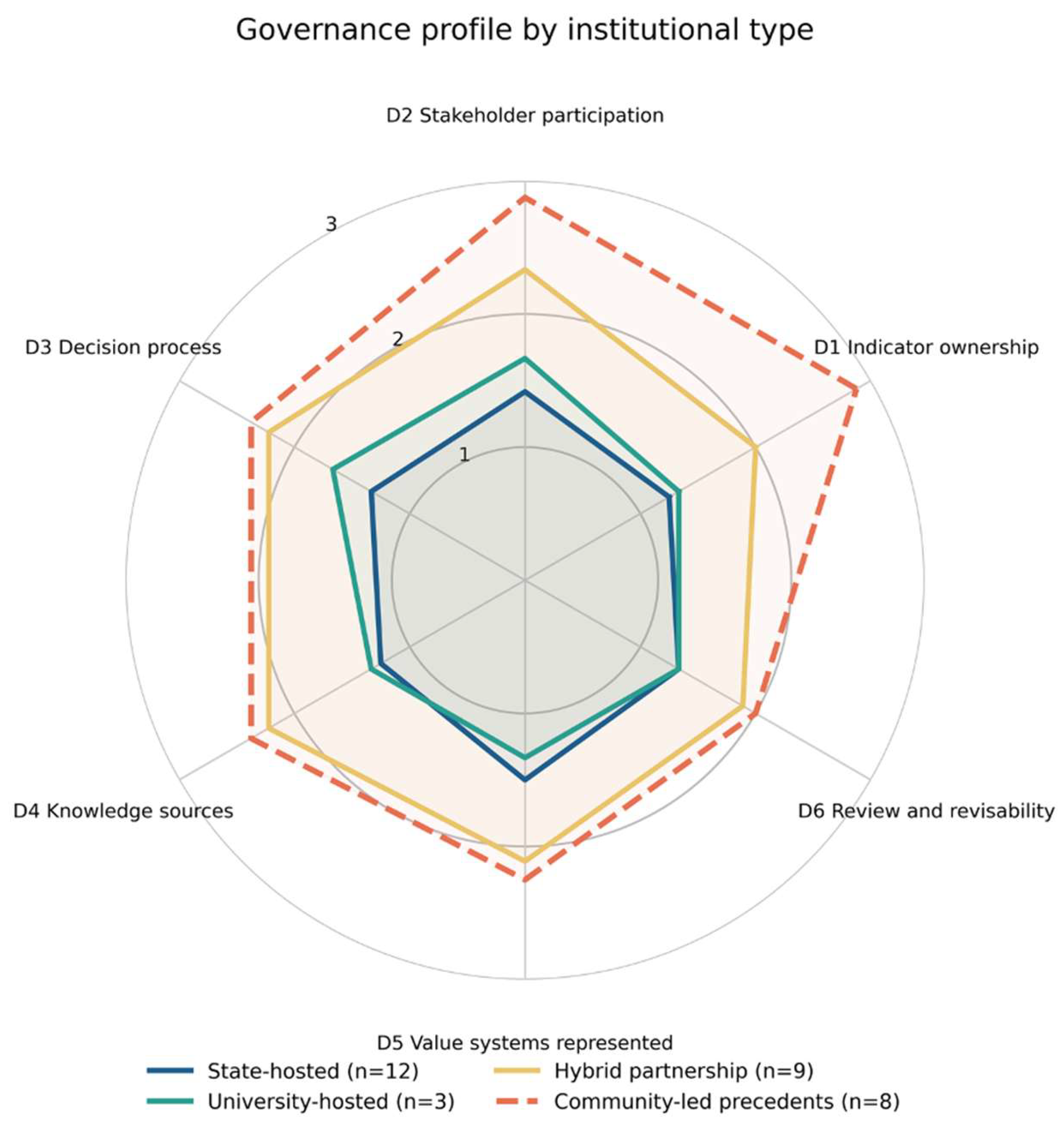
Figure 8.
Mean performance by framework stage: urban observatories (n = 24) against community-led precedents (n = 8).
Figure 8.
Mean performance by framework stage: urban observatories (n = 24) against community-led precedents (n = 8).
Disclaimer/Publisher’s Note: The statements, opinions and data contained in all publications are solely those of the individual author(s) and contributor(s) and not of MDPI and/or the editor(s). MDPI and/or the editor(s) disclaim responsibility for any injury to people or property resulting from any ideas, methods, instructions or products referred to in the content. |
© 2026 by the authors. Licensee MDPI, Basel, Switzerland. This article is an open access article distributed under the terms and conditions of the Creative Commons Attribution (CC BY) license (http://creativecommons.org/licenses/by/4.0/).
Copyright: This open access article is published under a Creative Commons CC BY 4.0 license, which permit the free download, distribution, and reuse, provided that the author and preprint are cited in any reuse.