
Submitted:
15 September 2026
Posted:
15 September 2026
You are already at the latest version
Abstract
Sickle cell disease (encompassing genotypes of HbSS, HbSC, and HbSβ-thalassemia) is a debilitating hematologic disease affecting nearly 7.7 million people worldwide. Most commonly caused by a single base pair mutation in the hemoglobin beta globin (HBB) gene, red blood cells (RBCs) are distorted into a sickle shape during physiologic stress, causing microscopic vascular occlusions in every organ in the body. The hallmark of this disease is the “pain crisis” caused by these occlusions and resulting tissue infarction. For the patient, frequent pain leads to reduced functional capacity, depression/anxiety, and difficulty maintaining employment, pursuing education, or stable relationships. This negatively affects healthcare systems as well through provider burnout, negative perceptions of the patients, and increased utilization of healthcare resources. Repeated bouts of acute pain can lead to the development of chronic pain over time.
The pain associated with sickle cell disease is the most common reason for hospitalization. It presents a formidable challenge to healthcare providers due to its complexity. It is multi-faceted, mediated by physical, emotional, and sociologic factors. The aim of this review is to help the clinician gain a better understanding and appreciation for the pain experienced by these patients and manage it effectively.
Keywords:
sickle cell disease
; sickle cell anemia
; acute pain
; chronic pain
; hematology
Introduction
Sickle cell disease (SCD) is a debilitating heritable hematologic disease affecting nearly 7.7 million people worldwide [1]. SCD mainly encompasses the genotypes of HbSS, HbSC, HbSβ+-thalassemia and HbSβ0-thalassemia, while the term sickle cell anemia (SCA) is reserved for the severe subtypes HbSS and HbSβ0-thalassemia. It is inherited in an autosomal recessive manner [2]. HbSS is the most common subtype, while compound heterozygote presentations (HbSC, HbSβ-thalassemia, etc.) account for about one third of all affected individuals [3]. Sickle cell disease is most commonly caused by a single base pair mutation in the hemoglobin beta-globin gene (HBB) which substitutes a hydrophilic amino acid for a hydrophobic one (known as HbS) [4,5]. This seemingly minute change alters hemoglobin’s structure during physiologic stress, causing hemoglobin polymerization. Red blood cells (RBCs) are then contorted from their usual biconcave disc into a sickle shape which cannot easily traverse capillaries, causing microscopic vascular occlusions in every organ in the body. These occlusions and a chronic hemolytic anemia are typical characteristics of the disease [6]. The hallmark is the “pain crisis” caused by these occlusions and resulting tissue infarction. Pain is the most common cause of hospitalization in this patient population [7]. Pain crises often last hours to days and can involve severe, debilitating pain episodes. Over time, repeated bouts of pain can lead to restructuring of the nervous system which upregulates pain in a manner that is independent of tissue damage, a phenomenon known as nociplastic pain. Pain is heterogenous, even within the same genotype, with some able to manage pain with minimal intervention while others are disabled by the symptoms despite many treatments.
Treatment of pain in SCD is challenging, owing to the poorly understood mechanisms, inaccurate perceptions of pain drivers, and the inherent subjectivity of pain. This results in a burden for patients and treating providers. Frequent pain leads to reduced functional capacity, depression/anxiety, and difficulty maintaining employment, pursuing education, or stable relationships [8]. This negatively affects healthcare systems as well through provider burnout, negative perceptions of the patients, and increased utilization of healthcare resources. This review aims to discuss the pathophysiology of pain in SCD, differences between acute and chronic pain, evaluation, and current treatment approaches.
Understanding Pain in SCD
Pain as a Central Symptom
Pain is a central feature of SCD, and the mechanisms of it are poorly understood. In 2020, The International Association for the Study of Pain (IASP) revised their definition of pain, defining it as “an unpleasant sensory and emotional experience associated with, or resembling that associated with, actual or potential tissue damage” [9]. This was an important evolution in our understanding of pain in that it highlighted that pain can occur with or without actual tissue damage. This helps to frame the challenges associated with pain in SCD, as many patients will manifest pain independent of direct tissue injury.
Pain is divided into several subtypes: nociceptive, neuropathic, and nociplastic. Nociceptive pain is typically associated with direct injury. When peripheral tissue damage occurs, a nerve transmits a pain signal which is felt by the patient [10]. Neuropathic pain also occurs via direct central/peripheral nerve injury or dysfunction and results in numbness, paresthesia, allodynia, and hyperalgesia. Nociplastic pain is a relatively new term, adopted formally by the IASP in 2017 to describe a type of pain which can manifest in a nonspecific, generalized manner, but importantly, occurs independent of specific disease or tissue damage [11]. The nuances of these pain types will be explored in the following sections.
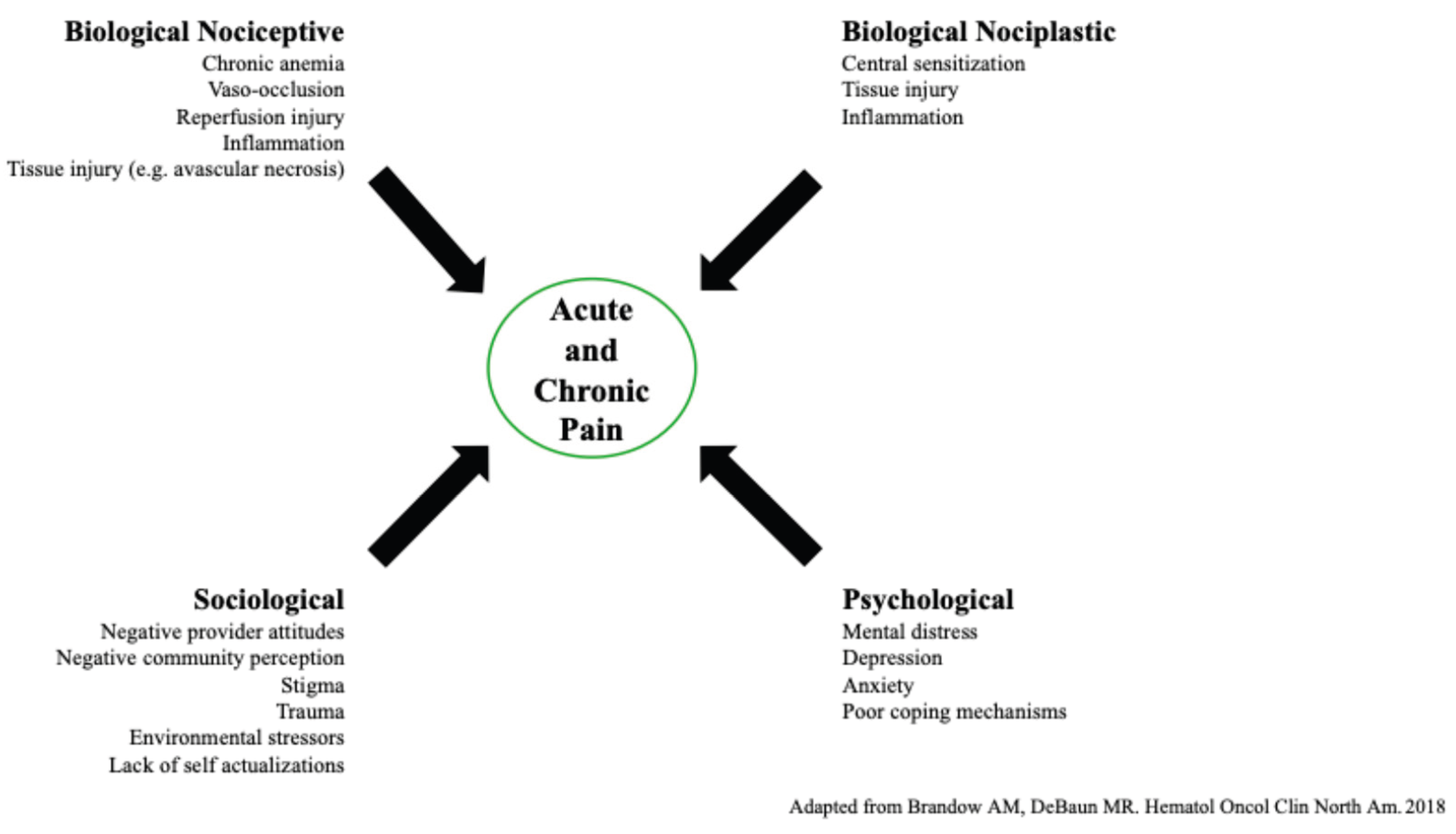
Pain has cognitive, sensory, and affective inputs which all play a role in the subjective sensation. Biological, sociological, and psychological factors all contribute to the patient’s sensation of pain. Biological factors include inflammation, vaso-occlusion, nervous system sensitization, and chronic organ damage. Sociological factors include the negative perceptions by the healthcare system, healthcare providers, the community at large (e.g., seeing patients as “drug seeking”), stigma, environmental factors, and traumatic life events. Psychological factors include depression, anxiety, learned helplessness, and insomnia (Figure 1) [12].
Acute Pain
Acute pain in SCD is defined as greater than 2 hours but less than 10 days in duration [13]. Acute pain in SCD is classically associated with the vaso-occlusive crisis (VOC), although not all acute pain is due to VOC. In the sickle cell community, there is increasing momentum shifting away from the term “vaso-occlusive crisis” and towards “acute pain crisis” to highlight that this pain is not exclusively due to vaso-occlusion, but multiple complex mechanisms. (“Crisis” remains in the term to validate the feelings of patients undergoing the event.) The acute pain crisis is characterized by sharp pain, usually in the back, arms, legs, and/or chest. It is often triggered by dehydration, infections, temperature changes, fatigue, stress, or pregnancy. Pain frequency tends to increase with age. Many other sickle cell complications occur with the VOC, including acute chest syndrome, hepatic and splenic sequestration crises, stroke, and multiorgan dysfunction syndrome (MODS) [14]. Acute pain is most often due to nociceptive pain. In 1995, Samir Ballas proposed four phases for the acute pain crisis: prodromal, initial, established, and resolving phase [15]. The prodromal phase may last 1-2 days before the crisis and can manifest with paresthesia and a sense that crisis will soon occur. In the initial phase, pain ramps up rapidly over the course of 1-2 days. In the established phase, often lasting 4-5 days, pain is continuous and severe. In the resolving phase, acute pain begins to wane over 2-3 days. Although not always the case, this model allows for planning of pain medications and when to expect acute pain improvement. Continued pain after these phases suggests possible acute-on-chronic components.
Mechanisms of Acute Pain
The combination of molecular events in the blood vessel and affected organs, including polymerization, vasoconstriction, cell adhesion, inflammation, and reperfusion injury create the milieu that makes sickle cell pain complex. Polymerization of hemoglobin during oxidative stress causes the characteristic sickled shape of the RBC [2]. This makes the cell less deformable. It is unable to traverse small capillaries which results in micro-occlusion. It is important to note, however, that vaso-occlusion from sickled RBCs is not the only mechanism by which pain and ischemia occur during an acute pain episode. In the blood vessel, there is also RBC lysis which causes a chronic, normocytic anemia. This in turn releases free arginase which binds available nitric oxide and causes vasoconstriction [16].
Adhesion molecules also play an important role in the acute pain crisis. P-selectin is one of the better studied. This molecule is expressed on both platelets and the vascular endothelium and allows neutrophils to bind to platelets and the endothelium [17]. This leads to aggregate formation. P-selectin is also important in the rolling and adhesion of RBCs on the endothelium. Other adhesion molecules reported to be involved in acute vascular occlusion include α4β1 integrin, CD36, basal cell adhesion molecule/lutheran protein, and endothelial vascular cell adhesion molecule-1 (VCAM-1) [18,19].
Lysis also releases prothrombotic cytokines and activates the clotting cascade, which contribute to microthrombi. After the microthrombi have been dislodged, there is reperfusion injury in which free radicals are formed, adding to the tissue damage [20]. These events are occurring simultaneously and constantly, not only during a pain crisis, which helps to explain the chronic vascular and organ damage which occurs over time.
Chronic Pain
Chronic pain is one of the most poorly understood aspects of SCD. It is defined as pain on most days with a duration minimum of 3-6 months in at least one area [21]. It is a common feature of patients with SCD and tends to become more prevalent with age. Patients often begin experiencing chronic pain at adolescence. One of the biggest advancements in understanding sickle cell pain came from the PiSCES study by Smith et al. in 2008 which asked 232 patients with SCD to complete a daily pain diary over the course of 6 months. The results were striking: 29.3% of patients reported pain in greater than 95% of diary days and 55% reported pain in over 50% of days [22]. This demonstrated that patients were suffering from pain between the acute pain crises in hospital and that chronic pain was a significant burden. Many patients were managing their pain at home, outside of the healthcare system. This changed the understanding of the pain landscape in sickle cell care; prior to this, it was not widely known that SCD patients suffered from chronic pain between acute pain episodes.
Mechanisms of Chronic Pain
Some chronic pain can be tied directly to tissue injury. Examples of this include avascular necrosis, bone infarction, and leg ulceration. Most chronic pain, however, occurs due to nociplastic pain. Nociplastic pain often involves generalized pain which may migrate. It also features components of allodynia, hyperalgesia, and sensitivity to hot and cold temperatures [23]. Nociplastic pain is thought to arise from a rewiring of nerve pathways known as “neuroplasticity” or “central sensitization” [24]. This occurs when repeat pain stimuli signals from the peripheral nerve system cause the nervous system to continuously fire, increasing the pain response. Downregulation of the pain response no longer occurs. The signal for pain is disproportionate to standard sensory inputs and begins to trigger without corresponding tissue damage. Risk factors for nociplastic pain include psychological trauma, female sex, and a personal or family history of a chronic pain or mood disorder [21]. Patients are trained to seek relief with opioids, since they are used for acute pain, but opioids are not always effective in nociplastic pain. There are no known pharmacologic treatments for nociplastic pain. There is also some data hypothesizing the role of inflammation in creating chronic pain pathways. For example, substance P, which promotes IL-8 and simulates tumor necrosis factor alpha (TNF-α), has been demonstrated to be elevated in SCD [25].
Approach to Pain Management
History and Physical
The first step in pain management is thorough history and physical. It is imperative to get an understanding of the frequency of pain, quality, and location. Careful attention should be paid to understanding the types involved: nociceptive, neuropathic, nociplastic, or a combination of these. Pain diaries can be a useful tool to understand patient’s day-to-day pain. Evaluation of pain can be achieved through several pain scoring systems. Unidimensional measures of pain intensity include the numeric pain rating scale (NPRS) which measures pain from 0-10, 0 being no pain and 10 being the worst pain imaginable [26]. There is the FACES pain scale, which measures pain according to a series of faces ranging from happy to sad—often used for pediatric populations. These unidimensional measures are useful in assessing pain in the moment. They are not useful in capturing the overall picture of pain over a period. Multidimensional tools can be used to assess pain over a longer period of time. Quality of life measures such as the ASCQ-ME and NIH PROMIS scores help to assess chronic pain, the functional impact of pain, how pain changes over time, and help guide treatment decisions [27]. Examination should focus on assessing for avascular necrosis (joint exam), leg ulcerations, abdominal pain (from hepatic/splenic sequestration), edema, priapism, and treatable infections [2].
It can be difficult to care for patients with pain, especially when they may not comply with suggested treatments. This can be due to many reasons. One reason may be neurocognitive deficits, making it difficult to remember instructions, take medications on a consistent basis, and report their pain accurately [28]. Neurocognitive damage is high in the sickle cell population, owing to pain and silent strokes. All patients should be screened with a Montreal Cognitive Assessment (MoCA) to assess their neurocognition. The assessment has a maximum score of 30, with scores <26 indicative of at least mild cognitive impairment [29]. Patients with neurocognitive impairment should be referred for formal neuropsychiatric testing. MRI brain, if not already completed, should be done to rule out silent strokes, which can affect up to 24% of patients by the age of 40 [30].
Laboratory Evaluation
It is important to confirm the patient’s genotype with hemoglobin electrophoresis if not previously done. Patients with sickle cell trait (HbAS) are not expected to have SCD-related pain crises (unless they have the rare “super-sickling” HbS-Oman variant) [31]. Ultimately, the gold standard of pain measurement is the patient’s report of pain [2]. There are no biomarkers which can tell whether a patient is in pain or not. Improvement in hemoglobin, reduction in LDH or bilirubin, or normalization of reticulocyte counts should not be considered a resolution of a pain crisis. Correspondingly, worsening of hemolytic parameters alone should not be seen as signs of a worsening crisis.
Individualized Pain Plan
It is crucial to understand that pain management should be individualized to each patient because there are acute and chronic components which differ based on age, crisis frequency, and numerous other factors. Standardized protocols for pain management can be a useful starting point, but ultimately an individualized approach will result in the best care. A multidisciplinary team should be involved in creating an individualized pain plan, including members of hematology, pain medicine, psychiatry/psychology, emergency medicine, nursing, and physical therapy [32]. Individualized pain plans can only be effective if the clinician understands the sources and temporal frequency of pain through H&P and applies this knowledge to the action plan.
The use of individualized pain plans is a standard according to the National Association of Sickle Cell Centers (NASCC). Individual pain plans ideally include guidance for inpatient admissions (e.g., PCA doses, lockout period, durations), IV fluid guidance, if non-opioid analgesia or adjuncts are to be used, and any psychosocial barriers to be aware of. They should also have a section identifying the ED or outpatient infusion center plans. Finally, they should include reasons to escalate care to a hematology or sickle cell specific service [33].
ASH SCD 2020 Guidelines
One of the broadest and most comprehensive set of guidelines for SCD pain was published in 2020 by the American Society of Hematology (ASH). The “ASH 2020 guidelines for sickle cell disease: management of acute and chronic pain” were established by a multidisciplinary team who reviewed the available data and came to consensus on 18 recommendations for acute and chronic pain. Some recommendations were expressed as “strong” while others were “conditional” based on the level of supportive evidence available. Many of the recommendations within the guidelines are based on weak evidence because of a paucity of data in the field. To help bridge this gap, the panel sometimes extrapolated from chronic pain conditions felt to resemble SCD most closely (e.g., fibromyalgia) [32]. Select recommendations will be mentioned throughout the following sections.
Management of Acute Pain
Outpatient
Early intervention is key to managing pain in SCD. Counseling patients on trigger avoidance is helpful: avoid dehydration, communicable illness, manage stress, ensure adequate sleep, and avoid temperature extremes. Despite the seemingly high burden of sickle cell pain in the hospital setting, the majority of patients manage their pain at home. The PiSCES study previously mentioned reported that only 3.5% of pain days were managed in a healthcare setting [22]. Management may include use of non-steroidal anti-inflammatory drugs (NSAIDs) or oral opiates. Additional measures which may be helpful include oral hydration, warm blankets/heating pads, distraction techniques, sleep, or meditation.
Hospital Management
The first place patients often end up when they cannot manage an acute pain crisis at home is the emergency department (ED). Unfortunately, ED wait times are often prohibitively long, with many patients not receiving pain medications for hours. In one study of over 44,000 encounters in 225 sites, median times to first pain medication in the ED ranged from 30 to 250 minutes, and 86% of sites had a median time of >60 minutes [34]. ASH proposed a door-to-analgesia time of 60 minutes as a quality measure to improve outcomes in pain crisis in the ED and in acute care facilities such as day hospitals, but many EDs have difficulty maintaining this standard [32]. During triage, the National Heart, Lung, and Blood Institute (NHLBI) 2014 guidelines recommend an emergency severity index (ESI) of 2 for any patient with an acute pain crisis, but this is not always done [35]. Data from Haimed et al. showed that ESI correlated with time to first analgesic (HR 5.731; p < 0.001) and that median time to first analgesic was 65 minutes for those assigned ESI 2, and 178 minutes for those assigned ESI 3 (p < 0.001) [36].
Acute pain is generally managed with a combination of IV fluids, IV opiates, and adjuncts. IV opiates include morphine, hydromorphone, and fentanyl. Non-opioid analgesics include NSAIDs (e.g., ketorolac), acetaminophen, and gabapentinoids. Adjuncts are medications such as antiemetics and antihistamines (to combat the side effects of opiates such as vomiting and pruritis, respectively). Subcutaneous (SQ) routes of opiate administration are preferred for rapid analgesia for patients in whom IV access cannot be attained. Patient controlled analgesia (PCA) is often preferred over IV administration because the patient can administer pain relief precisely at the time it is needed, they can get pain medications as quickly as every 10-15 minutes, and the PCA can be titrated based on the number of demand doses and administered doses [32]. The ASH SCD guidelines chose not to offer a recommendation for or against a continuous basal infusion with PCA, but in practice a basal infusion is avoided in many cases due to risk of oversedation [32]. If the patient is on extended-release opiates (e.g., Oxycodone extended release (ER) or morphine ER), this is often continued while on PCA. NASCC advises reassessment of pain and analgesia every 2 hours for the first 24 hours or once an effective regimen has been established [33].
The risks of these medications must be weighed against potential benefits. Opiates carry risk of respiratory depression, pruritis, nausea, and opioid-induced hyperalgesia, among others. It is important to know that patients with SCD have similar rates of addiction to the general population despite the seemingly high doses of morphine milliequivalents (MME) they may have. Opioid misuse does occur, but it is rare. In a population study of over 4,000 patients with SCD, SCD was not associated with higher rates of opioid-use disorder compared to adults with other chronic conditions (OR = 1.12; p = 0.804) or without chronic conditions (OR 2.09, p = 0.102) [37]. Another study found that deaths from opioids were ≤ 10 per year in individuals with SCD from 1999-2013 (representing only 0.77% of deaths in this population), significantly lower than other non-cancer conditions including low back pain, fibromyalgia and migraine [38]. NSAIDs should be used cautiously in those with decompensated heart failure, cirrhosis, renal disease, and pregnancy. IV diphenhydramine should be avoided because it will cause additive CNS and respiratory depression with opioids. This can lead to increased rates of acute chest syndrome. Oral antihistamines are preferred when needed. The ASH SCD guidelines recommend against corticosteroids for acute pain management due to the risk of rebound pain when discontinued [32]. Corticosteroids should, however, be used to treat other medical conditions (e.g., asthma).
Following a patient’s individualized pain plan is best. When this is not available, it is wise to look through prior hospitalizations and see what medications and doses worked for the patient. Discuss the plan with the patient and seek their opinion on what has worked and not worked for them in the past. The patient knows their pain the best, and their input is extremely valuable.
Day Hospital /Acute Care Model
An alternative to the ED has emerged as a way for sickle cell patients to receive prompt and effective treatment. First described in 2000, the “day hospital” model proposed an alternative to the ED which allows patients to receive IV fluids, IV opiates, and adjuncts in an infusion facility. The infusions can be administered in a shared space (e.g., oncology infusion space) or a dedicated space for SCD. This model presents several benefits over the ED. First, patients are more likely to achieve door-to-analgesia time of <60 minutes, consistent with ASH guidelines. Second, patients are more likely to have their pain adequately controlled. Third, their likelihood of hospital admission is lower. Fourth, patients are able to live more normal, uninterrupted lives because they can leave the center after treatment and return multiple days in a row if needed. Finally, the cost of running the day hospital is substantially lower than an ED visit.
The data supports the use of day hospitals. In 2000, the Montefiore Medical Center reported the results of their infusion center over a 5-year period: there was a 40% decline in the number of ED visits, and the center admitted five times less often than in the ED (8.3% vs. 42.7%). 90% of patients treated had pain relief within 2-4 hours. Savings to the hospital came to more than $1.7 million when accounting for decreased admissions, reduced length-of-stay, and outlier costs [39]. The day hospital at Johns Hopkins reported that 85% of their patients were discharged home and there was a lower average charge per visit compared to the ED ($739 vs $1975) [40]. Adeboye et al. reported that, over a three-year period, 94% of patients reported pain relief after 4 hours. 95% of the patients in the infusion center were discharged home, as opposed to 43% in the ED. Their hospital cost was significantly less in the infusion center per encounter ($1,609.52 vs. $2,689.07) [41]. The ASH SCD guidelines for acute pain offer a conditional recommendation for the use of SCD-specific hospital-based acute care facilities over typical ED-based care [32].
Optimizing Disease-Modifying Therapy
Hydroxyurea has been a mainstay of sickle cell treatment for decades. It works through multiple mechanisms, including fetal hemoglobin (HbF) induction and inhibition of ribonucleotide reductase. The latter impairs DNA synthesis which causes myelosuppression and reduced opportunity for white blood cells and platelets to form and “stick” in a vaso-occlusive event [42]. Hydroxyurea has been shown to improve overall lifespan, reduce acute chest syndrome, and reduce acute pain episodes up to 50%. In the Multicenter Study of Hydroxyurea (MSH), adult patients with ≥3 crises per year who remained on hydroxyurea had an annual VOC rate ~44% lower than placebo. Hydroxyurea reduced the mean annual rate of all painful crises (mean difference −2.80, 95% CI −4.74 to −0.86; p = 0.005) and crises requiring hospitalization (MD −1.50, 95% CI −2.58 to −0.42; p = 0.007). It also lengthened the median time to first, second, and third pain crisis [43]. Patients should start at 15 mg/kg and increase to target absolute neutrophil count 2,000-4000/uL while maintaining platelet count ≥80,000/μL, not to exceed 35 mg/kg. Patients typically need 3-6 months of maximum tolerated dose before any meaningful benefit will be seen [35].
Crizanlizumab is a monoclonal antibody which binds to P-selectin. It was first approved for use in SCD in 2017 after the results of the SUSTAIN study which showed the median rate of crises per year was 1.63 with high dose crizanlizumab versus 2.98 with placebo, a 45.3% lower rate (p = 0.01). The median time to first (4.07 vs. 1.38 months, p = 0.001) and second crisis (10.32 vs. 5.09 months, p = 0.02) was delayed as well [44]. L-glutamine, an amino acid which increases reduced nicotinamide adenine dinucleotides (NAD) in sickle cell and reduces oxidative stress, was shown in 2018 to reduce the median number of pain crises from 4.0 in the placebo group to 3.0 in the l-glutamine group [45]. Although these therapies are useful in reducing acute pain episodes, no research to date has demonstrated efficacy in the chronic pain setting.
Ketamine
Ketamine has proven to be a possible new treatment for opioid-refractory pain in acute crisis. Ketamine is an NMDA antagonist which works as a continuous infusion. There are RCTs supporting its use, including one in the pediatric population and another in adults. Alshahrani et al. performed a double-blind trial that took 278 adults with acute pain in Saudi Arabia and randomized them to an infusion of ketamine 0.3 mg/kg or morphine 0.1 mg/kg. Although the numeric pain rating scale (NPRS) was not significantly different between the two groups (5.7 or 5.6, respectively; p = 0.63), the cumulative dose of morphine was lower in patients treated with the ketamine (0.07 vs 0.13 mg/kg; p < 0.001) [46]. Another RCT, a noninferiority trial for pediatric population by Lubega et al., determined ketamine was noninferior to morphine in changing the NPRS (66.4% vs. 61.3%; 95% CI, -2.2 to -13.2), but pain relief was achieved faster with ketamine (19.8 vs 34.1 minutes) [47]. Case reports also highlight the use of ketamine in opioid refractory patients. Side effects reported include dysphoria, nausea, dizziness, hypertension, and hypersalivation. The ASH SCD guidelines have recommended subanesthetic ketamine infusion for opioid refractory pain, although it admits that there is no definition of “opioid-refractory” [32]. Doses should start at 0.1-0.3 mg/kg and increase to max of 1 mg/kg infusion. This should be administered by a practitioner familiar with its use (often anesthesia pain) [32]. In practice, some clinicians will treat with opioids for 5-7 days and then seek ketamine infusion if pain is not well controlled on maximum PCA settings.
Management of Chronic Pain
Chronic Opioid Therapy (COT)
Chronic pain management in sickle cell disease relies on a biopsychosocial approach. This means that the biological, psychological, and social drivers of pain must be addressed to achieve the best outcomes. This requires a multimodal approach to management, including both pharmacologic and non-pharmacologic interventions.
Many patients will develop chronic pain during adolescence or early adulthood. As a result of the chronic pain, patients are often placed on chronic opioid therapy (COT). This involves the use of long-acting opiates like morphine ER, oxycodone ER, or fentanyl patches. These are designed to reduce basal pain level while short acting opiates treat breakthrough pain.
Although frequently employed, COT is not always the best choice for management. Patients on chronic opiate therapy will often develop tolerance to opiates and require progressively higher doses over time. These higher doses increase risk of side effects and opioid-induced hyperalgesia, leading to a paradoxical worsening of the very pain it was supposed to treat. The ASH SCD guidelines give recommendations for the management of COT. In patients who are on COT and derive benefit, providers should engage in shared decision-making regarding continuation. In those already on COT who are not functioning well, or are not deriving any benefit, discussion should focus on discontinuing COT. In patients who have recently developed chronic pain not already on COT, the panel suggests against starting COT unless pain is refractory to multiple other treatment modalities [32]. In those who end up on COT, it is prudent to ensure best practice: use the lowest effective dose, co-prescription of naloxone, use of pain contracts, and consideration of a time-limited trial. Goals should be clearly laid out on what “success” means—and if not meeting these goals, discontinuation should be considered. When available, collaboration with pain specialists can be valuable to understand best practices.
Non-Opioid Analgesia
As part of a multimodal approach, attention should be focused on non-opioid analgesia for both acute and chronic pain management. Pharmacologic interventions include NSAIDs, gabapentinoids, tricyclic antidepressants, and serotonin-norepinephrine reuptake inhibitors (SNRIs). The last three are recommended in the ASH SCD guidelines based on weak evidence [32]. These can target some of the inflammatory, neuropathic, and depressive causes of chronic pain.
Non-Pharmacologic Interventions
Non-pharmacologic techniques are also highlighted in the ASH SCD guidelines. The panel suggests adding massage, yoga, transcutaneous electrical nerve stimulation (TENS), virtual reality (VR), and guided audiovisual (AV) relaxation to standard pharmacological therapy. Acupuncture is also considered beneficial. Although based on weak evidence, they are low-risk interventions. Cognitive behavioral therapy (CBT) is a psychosocial intervention that is designed to create an awareness for the patient of their disease and develop coping strategies to deal with pain, depression, and anxiety [48]. Although limited evidence exists for its efficacy in SCD, this appears to be an important intervention that continues to be underutilized. Additional research is needed to demonstrate its utility.
Buprenorphine
Although in its nascency, there is emerging data that buprenorphine may be an effective way to manage chronic sickle cell pain. With partial μ-opioid receptor agonism and weak κ-opioid receptor antagonism, buprenorphine has been used traditionally for management of severe pain and opioid use disorder for decades. Studies are largely retrospective or case reports, but they have shown promise in several domains. One is reduced MME requirements. Jacobs-McFarlane et al. reported a decrease from 189.3 to 35.6 MME/day (p < 0.001) in their 13-patient cohort [49] and Patel et al. reported a reduction from 24.4 to 0.7 MME/day (p = 0.002) in their 14-patient group [50]. Another domain is in reducing healthcare utilization. In one of the larger studies on this subject, David et al. reported that acute care visits decreased from 10.5 to 2.89 (SD = 3.4) after a 6-month induction of buprenorphine (n = 36) [51]. Jacobs-McFarlane et al. found a reduction in emergency department visits (7.2 to 5.9 per year, p < 0.001), hospital admissions (8.5 to 5.6 per year, p < 0.01), and treatment center visits (3.0 to 2.2 per year, p < 0.001) [49]. Quality of life is the third domain positively impacted by buprenorphine. With the reduced need for opiates (and associated side effects), patients report better pain control, autonomy, reduced mental fogginess, and improved daily functioning [51].
Side effects reported with buprenorphine include potential opioid withdrawal side effects (due to the partial opioid antagonism) and includes diarrhea, headaches, nausea, and agitation. Other side effects reported include constipation and pruritis [52]. Patient compliance can vary because of the discomfort of precipitating a mild opiate withdrawal during induction, so micro inductions have been introduced to mitigate this risk.
Transfusion Therapy
Simple and exchange transfusions are useful tools in the management of some sickle cell complications. RBC exchange transfusion (RCE) involves removal of patient blood and replacing with multiple units of donor blood. This differs from simple transfusion in that with exchange, there is removal of blood and multiple units of non-sickle donor blood can be given in a short amount of time. Exchange transfusion can be manual (phlebotomy followed by several transfusions) or automated with an apheresis machine. Simple transfusion is indicated in patients for events such as acute chest syndrome, splenic/hepatic sequestration crises, aplastic crisis, or symptomatic anemia. Exchange transfusion is first-line therapy for emergency situations like severe acute chest syndrome or stroke because it rapidly reduces the HbS fraction to levels <30%. Chronic exchange transfusion refers to the repeated use of exchange transfusions to maintain lower HbS levels.
The use of simple transfusions in the management of pain is clear: is not indicated for uncomplicated pain crisis because it has not been shown to reduce pain duration, intensity, or frequency [35]. Chronic exchange transfusions, on the other hand, are controversial. There is data to support its use in acute pain, although no RCTs currently exist in this space. In one retrospective pediatric study, 14 patients who were given monthly exchange transfusion therapy for 1 year demonstrated a reduced number of total ED visits (6 vs 2.5 visits/year, p = 0.005) and a reduced mean total number of hospitalizations (3.5 vs 1 admissions/year, p = 0.0002). It also noted a significant increase in clinic visits (4 to 13 clinic visits/year, p = 0.0001) [53]. A single-center study noted that, in the 59% (n=68) treated with RCE for pain, 77% demonstrated a clinically significant result, which they defined as a ≥ 25% reduction in ED attendance for pain management [54]. Other data highlight potentially no benefit: a retrospective analysis of 164 patients referred for chronic RCE (44.5% of patients were referred for refractory pain) showed no significant difference in acute care encounters following 3 years of RCE for the 30 patients remaining [55]. SCD-CARRE is an RCT in progress which randomizes patients to standard-of-care (SOC) vs. SOC plus automated RCE. Pain is a secondary outcome. Hopefully this trial will bring some much-needed answers for this treatment modality. The ASH SCD guidelines suggest against chronic monthly transfusions as a first-line treatment for acute pain. It chooses not to offer a recommendation for or against transfusion therapy in chronic pain management [32]. There are risks to transfusions, including transfusion reactions, development of alloantibodies (making future transfusions more challenging), iron overload, and hyperviscosity if the hemoglobin is maintained > 10 g/dL. Patients should be aware of these risks before proceeding with chronic transfusion therapy.
Conclusions
SCD is an incredibly complicated affliction, and management is limited by a limited evidence base. Pain is complex, and management of acute and chronic pain differs because of the various etiologies. Understanding these mechanisms allows for greater understanding and a step towards holistic analgesia. A multimodal approach, including pharmacologic and non-pharmacologic methods, provides the best chance for success. It is important to spend time with the patient understanding the drivers of pain, including physical, psychological, and emotional injury. From this understanding, a multidisciplinary team should create an individualized pain plan. These plans should evolve as the patient’s pain evolves, and input from the patient is a necessity. With this understanding, healthcare systems will come closer to achieving relief for this vulnerable population.

Table 1.
Definitions of pain types seen in SCD.
| Term | Definition |
|---|---|
| Acute Pain | Pain lasting >2 hours but <10 days that is typically caused by vaso-occlusion and tissue ischemia/infarction. |
| Chronic Pain | Pain in at least one area which presents most days for at least 3-6 months. Typically caused by central sensitization but can occur via direct tissue injury. |
| Nociceptive Pain | Pain occurring when peripheral tissue is damaged and a nerve transmits pain signal from peripheral to central nervous system. Typically associated with direct injury. |
| Neuropathic Pain | Pain caused by a lesion in the somatosensory nervous system which is often described as paresthesia, allodynia, or hyperalgesia. Typically associated with direct injury but can also occur via central sensitization. |
| Neuroplastic Pain | Pain which arises from a rewiring of nerve pathways known as central sensitization. A central feature of most chronic pain. Often described as generalized, migratory pain. Typically associated with indirect injury. |
References
- Collaborators. Global, regional, and national prevalence and mortality burden of sickle cell disease, 2000-2021: a systematic analysis from the Global Burden of Disease Study 2021. Lancet Haematol. 2023, 10, e585–e599. [Google Scholar] [CrossRef] [PubMed]
- Kavanagh, P.L.; Fasipe, T.A.; Wun, T. Sickle Cell Disease: A Review. JAMA 2022, 328, 57–68. [Google Scholar] [CrossRef] [PubMed]
- Pecker, L.H.; Lanzkron, S. Sickle Cell Disease. Ann. Intern Med. 2021, 174, ITC1–ITC16. [Google Scholar] [CrossRef] [PubMed]
- Elendu, C.; Amaechi, D.C.; Alakwe-Ojimba, C.E.; Elendu, T.C.; Elendu, R.C.; Ayabazu, C.P.; Aina, T.O.; Aborisade, O.; Adenikinju, J.S. Understanding Sickle cell disease: Causes, symptoms, and treatment options. Medicine 2023, 102, e35237. [Google Scholar] [CrossRef] [PubMed]
- Bunn, H.F. Pathogenesis and treatment of sickle cell disease. N Engl. J. Med. 1997, 337, 762–769. [Google Scholar] [CrossRef] [PubMed]
- Brandow, A.M.; Liem, R.I. Advances in the diagnosis and treatment of sickle cell disease. J. Hematol. Oncol. 2022, 15, 20. [Google Scholar] [CrossRef] [PubMed]
- Ballas, S.K.; Darbari, D.S. Review/overview of pain in sickle cell disease. Complement Ther. Med. 2020, 49, 102327. [Google Scholar] [CrossRef] [PubMed]
- Osunkwo, I.; Andemariam, B.; Minniti, C.P.; Inusa, B.P.D.; El Rassi, F.; Francis-Gibson, B.; Nero, A.; Trimnell, C.; Abboud, M.R.; Arlet, J.B.; et al. Impact of sickle cell disease on patients’ daily lives, symptoms reported, and disease management strategies: Results from the international Sickle Cell World Assessment Survey (SWAY). Am. J. Hematol. 2021, 96, 404–417. [Google Scholar] [CrossRef] [PubMed]
- Raja, S.N.; Carr, D.B.; Cohen, M.; Finnerup, N.B.; Flor, H.; Gibson, S.; Keefe, F.J.; Mogil, J.S.; Ringkamp, M.; Sluka, K.A.; et al. The revised International Association for the Study of Pain definition of pain: concepts, challenges, and compromises. Pain 2020, 161, 1976–1982. [Google Scholar] [CrossRef] [PubMed]
- Field, J.J.; Ballas, S.K.; Campbell, C.M.; Crosby, L.E.; Dampier, C.; Darbari, D.S.; McClish, D.K.; Smith, W.R.; Zempsky, W.T. AAAPT Diagnostic Criteria for Acute Sickle Cell Disease Pain. J. Pain 2019, 20, 746–759. [Google Scholar] [CrossRef] [PubMed]
- Brandow, A.M.; Farley, R.A.; Panepinto, J.A. Neuropathic pain in patients with sickle cell disease. Pediatr. Blood Cancer 2014, 61, 512–517. [Google Scholar] [CrossRef] [PubMed]
- Brandow, A.M.; DeBaun, M.R. Key Components of Pain Management for Children and Adults with Sickle Cell Disease. Hematol. Oncol. Clin. North Am. 2018, 32, 535–550. [Google Scholar] [CrossRef] [PubMed]
- Kenney, M.O.; Smith, W.R. Moving Toward a Multimodal Analgesic Regimen for Acute Sickle Cell Pain with Non-Opioid Analgesic Adjuncts: A Narrative Review. J. Pain Res. 2022, 15, 879–894. [Google Scholar] [CrossRef] [PubMed]
- Darbari, D.S.; Sheehan, V.A.; Ballas, S.K. The vaso-occlusive pain crisis in sickle cell disease: Definition, pathophysiology, and management. Eur. J. Haematol. 2020, 105, 237–246. [Google Scholar] [CrossRef] [PubMed]
- Ballas, S.K. The sickle cell painful crisis in adults: phases and objective signs. Hemoglobin 1995, 19, 323–333. [Google Scholar] [CrossRef] [PubMed]
- Morris, C.R.; Kato, G.J.; Poljakovic, M.; Wang, X.; Blackwelder, W.C.; Sachdev, V.; Hazen, S.L.; Vichinsky, E.P.; Morris, S.M., Jr.; Gladwin, M.T. Dysregulated arginine metabolism, hemolysis-associated pulmonary hypertension, and mortality in sickle cell disease. JAMA 2005, 294, 81–90. [Google Scholar] [CrossRef] [PubMed]
- Matsui, N.M.; Borsig, L.; Rosen, S.D.; Yaghmai, M.; Varki, A.; Embury, S.H. P-selectin mediates the adhesion of sickle erythrocytes to the endothelium. Blood 2001, 98, 1955–1962. [Google Scholar] [CrossRef] [PubMed]
- Hebbel, R.P. Perspectives series: cell adhesion in vascular biology. Adhesive interactions of sickle erythrocytes with endothelium. J. Clin. Invest 1997, 99, 2561–2564. [Google Scholar] [CrossRef] [PubMed]
- Wick, T.M.; Eckman, J.R. Molecular basis of sickle cell-endothelial cell interactions. Curr. Opin. Hematol. 1996, 3, 118–124. [Google Scholar] [CrossRef] [PubMed]
- Madigan, C.; Malik, P. Pathophysiology and therapy for haemoglobinopathies. Part I: sickle cell disease. Expert Rev. Mol. Med. 2006, 8, 1–23. [Google Scholar] [CrossRef] [PubMed]
- Smith, W.R.; Lipato, T. Management of sickle cell pain; Oxford University Press: New York, NY, 2025. [Google Scholar]
- Smith, W.R.; Penberthy, L.T.; Bovbjerg, V.E.; McClish, D.K.; Roberts, J.D.; Dahman, B.; Aisiku, I.P.; Levenson, J.L.; Roseff, S.D. Daily assessment of pain in adults with sickle cell disease. Ann. Intern Med. 2008, 148, 94–101. [Google Scholar] [CrossRef] [PubMed]
- Nijs, J.; Malfliet, A.; Nishigami, T. Nociplastic pain and central sensitization in patients with chronic pain conditions: a terminology update for clinicians. Braz. J. Phys. Ther. 2023, 27, 100518. [Google Scholar] [CrossRef] [PubMed]
- Volcheck, M.M.; Graham, S.M.; Fleming, K.C.; Mohabbat, A.B.; Luedtke, C.A. Central sensitization, chronic pain, and other symptoms: Better understanding, better management. Cleve Clin. J. Med. 2023, 90, 245–254. [Google Scholar] [CrossRef] [PubMed]
- Michaels, L.A.; Ohene-Frempong, K.; Zhao, H.; Douglas, S.D. Serum levels of substance P are elevated in patients with sickle cell disease and increase further during vaso-occlusive crisis. Blood 1998, 92, 3148–3151. [Google Scholar] [CrossRef]
- Esham, K.S.; Rodday, A.M.; Smith, H.P.; Noubary, F.; Weidner, R.A.; Buchsbaum, R.J.; Parsons, S.K. Assessment of health-related quality of life among adults hospitalized with sickle cell disease vaso-occlusive crisis. Blood Adv. 2020, 4, 19–27. [Google Scholar] [CrossRef] [PubMed]
- Darbari, D.S.; Brandow, A.M. Pain-measurement tools in sickle cell disease: where are we now? Hematol. Am. Soc. Hematol. Educ. Program 2017, 2017, 534–541. [Google Scholar] [CrossRef] [PubMed]
- Lanzkron, S.; Haywood, C., Jr. The five key things you need to know to manage adult patients with sickle cell disease. Hematol. Am. Soc. Hematol. Educ. Program 2015, 2015, 420–425. [Google Scholar] [CrossRef] [PubMed]
- Nasreddine, Z.S.; Phillips, N.A.; Bedirian, V.; Charbonneau, S.; Whitehead, V.; Collin, I.; Cummings, J.L.; Chertkow, H. The Montreal Cognitive Assessment, MoCA: a brief screening tool for mild cognitive impairment. J. Am. Geriatr. Soc. 2005, 53, 695–699. [Google Scholar] [CrossRef] [PubMed]
- Switzer, J.A.; Hess, D.C.; Nichols, F.T.; Adams, R.J. Pathophysiology and treatment of stroke in sickle-cell disease: present and future. Lancet Neurol. 2006, 5, 501–512. [Google Scholar] [CrossRef] [PubMed]
- Al Balushi, H.W.M.; Wali, Y.; Al Awadi, M.; Al-Subhi, T.; Rees, D.C.; Brewin, J.N.; Hannemann, A.; Gibson, J.S. The super sickling haemoglobin HbS-Oman: a study of red cell sickling, K(+) permeability and associations with disease severity in patients heterozygous for HbA and HbS-Oman (HbA/S-Oman genotype). Br. J. Haematol. 2017, 179, 256–265. [Google Scholar] [CrossRef] [PubMed]
- Brandow, A.M.; Carroll, C.P.; Creary, S.; Edwards-Elliott, R.; Glassberg, J.; Hurley, R.W.; Kutlar, A.; Seisa, M.; Stinson, J.; Strouse, J.J.; et al. American Society of Hematology 2020 guidelines for sickle cell disease: management of acute and chronic pain. Blood Adv. 2020, 4, 2656–2701. [Google Scholar] [CrossRef] [PubMed]
- Centers, N.A.o.S.C. Recommendations for the Management of Uncomplicated Acute Pain Crisis in SCD. 2025. [Google Scholar] [PubMed]
- Gwarzo, I.; Dega, H.C.; Tanabe, P.; Miller, R.; Brousseau, D.C. Evaluating the American Society of Hematology quality measure on timeliness of analgesics for sickle cell disease pain crisis. Blood Adv. 2026, 10, 1336–1343. [Google Scholar] [CrossRef] [PubMed]
- Yawn, B.P.; Buchanan, G.R.; Afenyi-Annan, A.N.; Ballas, S.K.; Hassell, K.L.; James, A.H.; Jordan, L.; Lanzkron, S.M.; Lottenberg, R.; Savage, W.J.; et al. Management of sickle cell disease: summary of the 2014 evidence-based report by expert panel members. Jama 2014, 312, 1033–1048. [Google Scholar] [CrossRef] [PubMed]
- Abu Haimed, A.; Patel, D.; Clopton, O.; Baer, M.R.; Stryckman, B.; Wilkerson, R.G.; Law, J.Y. Use of Emergency Severity Index 2 reduces time to first analgesia in sickle cell disease vaso-occlusive crisis. Blood Adv. 2025, 9, 6199–6204. [Google Scholar] [CrossRef] [PubMed]
- Jonassaint, C.R.; O’Brien, J.; Nardo, E.; Feldman, R.; Stanton, M.; DeCastro, L.; Abebe, K.Z. Prevalence of Substance Use Disorders in Sickle Cell Disease Compared to Other Chronic Conditions: a Population-Based Study of Black American Adults. J. Gen. Intern Med. 2023, 38, 1214–1223. [Google Scholar] [CrossRef] [PubMed]
- Bode, A.L.; Borja-Montes, O.F.; Quazi, M.A.; Mumtaz, A.; Sohail, A.H.; Smith, C.R.; Khawaja, M.R.; Sheikh, A.B. Sickle cell disease and opioid overdose outcomes in the United States: a nationwide analysis. Ann. Hematol. 2025, 104, 1551–1561. [Google Scholar] [CrossRef] [PubMed]
- Benjamin, L.J.; Swinson, G.I.; Nagel, R.L. Sickle cell anemia day hospital: an approach for the management of uncomplicated painful crises. Blood 2000, 95, 1130–1136. [Google Scholar] [CrossRef]
- Lanzkron, S.; Carroll, C.P.; Hill, P.; David, M.; Paul, N.; Haywood, C., Jr. Impact of a dedicated infusion clinic for acute management of adults with sickle cell pain crisis. Am. J. Hematol. 2015, 90, 376–380. [Google Scholar] [CrossRef] [PubMed]
- Adewoye, A.H.; Nolan, V.; McMahon, L.; Ma, Q.; Steinberg, M.H. Effectiveness of a dedicated day hospital for management of acute sickle cell pain. Haematologica 2007, 92, 854–855. [Google Scholar] [CrossRef] [PubMed]
- Agrawal, R.K.; Patel, R.K.; Shah, V.; Nainiwal, L.; Trivedi, B. Hydroxyurea in sickle cell disease: drug review. Indian J. Hematol. Blood Transfus. 2014, 30, 91–96. [Google Scholar] [CrossRef] [PubMed]
- Charache, S.; Terrin, M.L.; Moore, R.D.; Dover, G.J.; Barton, F.B.; Eckert, S.V.; McMahon, R.P.; Bonds, D.R. Effect of hydroxyurea on the frequency of painful crises in sickle cell anemia. Investigators of the Multicenter Study of Hydroxyurea in Sickle Cell Anemia. N Engl. J. Med. 1995, 332, 1317–1322. [Google Scholar] [CrossRef] [PubMed]
- Ataga, K.I.; Kutlar, A.; Kanter, J.; Liles, D.; Cancado, R.; Friedrisch, J.; Guthrie, T.H.; Knight-Madden, J.; Alvarez, O.A.; Gordeuk, V.R.; et al. Crizanlizumab for the Prevention of Pain Crises in Sickle Cell Disease. N Engl. J. Med. 2017, 376, 429–439. [Google Scholar] [CrossRef] [PubMed]
- Niihara, Y.; Smith, W.R.; Stark, C.W. A Phase 3 Trial of l-Glutamine in Sickle Cell Disease. N Engl. J. Med. 2018, 379, 1880. [Google Scholar] [CrossRef] [PubMed]
- Alshahrani, M.S.; AlSulaibikh, A.H.; ElTahan, M.R.; AlFaraj, S.Z.; Asonto, L.P.; AlMulhim, A.A.; AlAbbad, M.F.; Almaghraby, N.; AlJumaan, M.A.; AlJunaid, T.O.; et al. Ketamine administration for acute painful sickle cell crisis: A randomized controlled trial. Acad. Emerg. Med. 2022, 29, 150–158. [Google Scholar] [CrossRef] [PubMed]
- Lubega, F.A.; DeSilva, M.S.; Munube, D.; Nkwine, R.; Tumukunde, J.; Agaba, P.K.; Nabukenya, M.T.; Bulamba, F.; Luggya, T.S. Low dose ketamine versus morphine for acute severe vaso occlusive pain in children: a randomized controlled trial. Scand. J. Pain 2018, 18, 19–27. [Google Scholar] [CrossRef] [PubMed]
- Edwards, L.Y.; Edwards, C.L. Psychosocial treatments in pain management of sickle cell disease. J. Natl. Med. Assoc. 2010, 102, 1084–1094. [Google Scholar] [CrossRef] [PubMed]
- Jacobs-McFarlane, C.; Liu, A.; McCrary, B.; McCuskee, S.; Wexler, M.G.; Stidham, E.; Zhang, B.; Glassberg, J.; Curtis, S. Buprenorphine Is Associated With Lower Home Opioid Use and Acute Care Utilization in Sickle Cell Disease. Pain Manag Nurs. 2025, 26, 585–591. [Google Scholar] [CrossRef] [PubMed]
- Irwin, M.; Gunther, W.; Keefer, P.; Saul, D.; Singh, S.A.; Wright, J.; Smith, M.A. Buprenorphine for Chronic Pain in a Pediatric Patient With Sickle-Cell Disease. J. Pain Symptom Manag. 2021, 62, 1086–1091. [Google Scholar] [CrossRef] [PubMed]
- David, M.S.; Jones, J.; Lauriello, A.; Nnake, I.; Plazas Montana, M.; Lasko, K.; Buri-Nagua, C.; Olagbaju, Y.; Williams, E.; Sears, M.; et al. Converting adults with sickle cell disease from full agonist opioids to buprenorphine: A reliable method with safety and early evidence of reduced acute care utilization. Am. J. Hematol. 2022, 97, 1435–1442. [Google Scholar] [CrossRef] [PubMed]
- Singh, S.; Akbari, A.R.; Marín-López, C.; Perchellet, M.; Sethi, R. Buprenorphine for Chronic Pain Management in Sickle Cell Disease: A Scoping Review of Current Evidence. Prim. Care Companion CNS Disord. 2026, 28. [Google Scholar] [CrossRef] [PubMed]
- Hilliard, L.M.; Kulkarni, V.; Sen, B.; Caldwell, C.; Bemrich-Stolz, C.; Howard, T.H.; Brandow, A.; Waite, E.; Lebensburger, J.D. Red blood cell transfusion therapy for sickle cell patients with frequent painful events. Pediatr. Blood Cancer 2018, 65, e27423. [Google Scholar] [CrossRef] [PubMed]
- Tsitsikas, D.A.; Badle, S.; Hall, R.; Meenan, J.; Bello-Sanyaolu, O.; Orebayo, F.; Abukar, J.; Elmi, M.; Mulla, A.; Dave, S.; et al. Automated Red Cell Exchange in the Management of Sickle Cell Disease. J. Clin. Med. 2021, 10. [Google Scholar] [CrossRef] [PubMed]
- Zakieh, A.; Mercure-Corriveau, N.; Lanzkron, S.; Feng, X.; Vozniak, S.; Crowe, E.P.; Rai, H.; Lawrence, C.; Bekkouri, D.; Goel, R.; et al. Chronic automated red cell exchange therapy for sickle cell disease. Transfusion 2024, 64, 1509–1519. [Google Scholar] [CrossRef] [PubMed]
Disclaimer/Publisher’s Note: The statements, opinions and data contained in all publications are solely those of the individual author(s) and contributor(s) and not of MDPI and/or the editor(s). MDPI and/or the editor(s) disclaim responsibility for any injury to people or property resulting from any ideas, methods, instructions or products referred to in the content. |
© 2026 by the authors. Licensee MDPI, Basel, Switzerland. This article is an open access article distributed under the terms and conditions of the Creative Commons Attribution (CC BY) license (http://creativecommons.org/licenses/by/4.0/).
Copyright: This open access article is published under a Creative Commons CC BY 4.0 license, which permit the free download, distribution, and reuse, provided that the author and preprint are cited in any reuse.