

Submitted:
14 September 2026
Posted:
15 September 2026
You are already at the latest version
Abstract
Introduction: Endovascular treatment (EV) of aortoiliac TASC II D lesions is increasingly common, yet evidence directly comparing long-term outcomes with open surgical repair (OSR) remains limited, particularly for complete iliac axis occlusions (CIAO). This study compares outcomes between CIAO patients treated with OSR and EV approach using covered stents. Method: Thirty-nine consecutive CIAO cases received EV treatment (2014-2017) using standalone or combined balloon-expandable and self-expandable covered stents. A historic control of 29 aorto-femoral bypasses (OSR, 2007-2014) was included for comparison. Clinical and ultrasound-based imaging follow-up extended for a median of 109 months, with half of the uncensored cases followed beyond ten years. In-hospital stay, primary, assisted, and secondary patencies, reintervention rates, and overall survival were the main outcomes, defined per Society for Vascular Surgery (SVS) reporting standards. Results: The EV group was older and had a higher (though not statistically significant) prevalence of smoking, chronic obstructive pulmonary disease, and renal failure. Ten-year survival was comparable between groups (59% EV vs. 52% OSR, p=0.725). OSR was predominantly performed through a retroperitoneal approach (93.1%) using Dacron grafts; in the EV group, 66.7% of cases required a kissing stent reconstruction of the aortic bifurcation and 74.3% required femoral patch plasty. Hospital stay was significantly shorter after EV (median 5 vs. 10 days, p<0.001). No significant differences emerged in the ten-year reintervention rate (35.9% EV vs. 31.0% OSR, p=0.675), amputation-free survival (94.9% vs. 86.2%, p=0.390), or primary (62% vs. 74%, p=0.722), assisted (78% vs. 75%, p=0.679), and secondary (94% vs. 84%, p=0.323) patency. Conclusion: EV treatment of CIAO using covered stents may offer a shorter hospital stay than OSR, without significant differences in long-term primary, assisted, and secondary patency, supporting its role as a durable alternative even in this complex anatomical subset.
Keywords:
complete iliac axis occlusion
; covered stents
; aortofemoral bypass
; patency
; TASC II D lesions
Introduction
Aortoiliac occlusive disease (AIOD) is among the most disabling presentations of peripheral artery disease, ranging from claudication to chronic limb-threatening ischemia (CLTI). Over the past two decades, the treatment paradigm has moved steadily toward an endovascular-first strategy, and current guidelines endorse endovascular treatment (EV) as the preferred initial approach for aortoiliac lesions that do not simultaneously involve the common and external iliac arteries or significant common femoral disease.1-4 This position remains broadly consistent with the 2007 Trans-Atlantic Inter-Society Consensus (TASC II), which reserved open surgical repair (OSR) for the more extensive and calcified class C and D lesions on the basis of the durability historically attributed to aorto-femoral bypass.5 More recent guideline updates—the 2024 European Society for Vascular Surgery (ESVS) guidelines on lower limb peripheral artery disease,6 the 2024 European Society of Cardiology (ESC) guidelines on peripheral arterial and aortic diseases,7 and the 2024 American College of Cardiology/American Heart Association (ACC/AHA) guideline on lower extremity peripheral artery disease8—have refined this framework further, favouring a “best endovascular first” strategy across an increasingly broad anatomical spectrum whenever it is technically feasible and durable, while still acknowledging that complex, calcified, and occlusive TASC C/D (or GLASS high-complexity) disease may benefit from OSR in good-risk patients.
Advances in endovascular technique, growing operator expertise, and the development of purpose-built covered stent-grafts have nonetheless produced a growing body of literature reporting favourable outcomes with complete endovascular9-11 or hybrid12-15 approaches even in these complex anatomical scenarios, generally with lower wound complication rates and shorter hospital stays than OSR.11,15 The introduction and refinement of the covered endovascular reconstruction of the aortic bifurcation (CERAB) technique and its variants has been particularly influential,16 with recent meta-analyses of covered versus bare-metal stents17 and of the CERAB technique specifically18 reporting five-year primary patency rates in the 70-85% range for complex aortoiliac disease, and long-term single-centre series showing comparably encouraging results.19,20 A recent network meta-analysis of treatment options for TASC II C and D disease further supports covered stents as a leading strategy in terms of patency and morbidity among endovascular alternatives.21
Despite this expanding evidence base, high-quality data directly comparing total endovascular treatment with OSR specifically for iliac axis occlusions remain scarce. Most available series are single-arm case series, with few comparative analyses.22-24 Besides, existing comparative research more often focuses on covered versus bare-metal stents25-27 or on occlusions versus stenoses28 than on a direct, anatomically homogeneous comparison of treatment strategy. The inherent heterogeneity of TASC II class D lesions—which encompass complete iliac axis occlusions (CIAO) alongside other complex but non-occlusive anatomies—further complicates the interpretation of pooled results, and emerging risk-stratification tools such as CT-based iliac calcium scoring underscore how anatomically and clinically heterogeneous this population truly is.29
This study aims to compare short and long-term outcomes between a cohort of patients treated endovascularly for CIAO and a historical cohort treated with OSR for the same, precisely defined condition, extending our group’s previously reported midterm results30 to a median follow-up beyond nine years.
Materials and Methods
All consecutive patients undergoing elective treatment for CIAO—defined as concurrent occlusion of the common and external iliac arteries—at a single tertiary-care teaching institution were prospectively enrolled in an institutional database. Enrolment for the endovascular cohort spanned January 2014 to December 2017 (four years); patients with a concomitant aortic occlusion were excluded. A historic control group treated with OSR for CIAO at the same institution between January 2007 and December 2013 was included for comparison.
Demographics, comorbidities, cardiovascular risk factors, prior revascularization procedures, iliac occlusion length, the presence of terminal aortic or common femoral disease, and associated symptoms were recorded, along with operative time and hospital stay. Given the retrospective design and the anonymized processing of data, the Institutional Review Board waived the requirement for specific patient consent.
All procedures were planned on pre-operative contrast-enhanced CT angiography, assessing occlusion length, thrombus and calcification burden, pre- and post-occlusion arterial diameters, contralateral iliac involvement, and common femoral artery (CFA) disease.
Endovascular treatment
A retrograde recanalization attempt from the ipsilateral CFA was always performed first; if intraluminal re-entry failed, an antegrade approach was performed via the contralateral CFA or a brachial access, with re-entry devices reserved for cases in which these strategies were unsuccessful. Technical details have been reported previously.30 CFA endarterectomy was performed for stenoses exceeding 50% to secure an adequate landing zone for the distal end of the external iliac stent and to optimize outflow; femoral patch plasty was indicated for CFA diameters below 7 mm (6 mm in women) or stenosis greater than 50%. A kissing covered-stent reconstruction of the aortic bifurcation was used when significant aortic stenosis, contralateral common iliac ostial stenosis, or complete ipsilateral occlusion without a healthy proximal stump was present. Balloon-expandable covered Advanta V12 stents (Atrium-Maquet Getting Group, Hudson, NH, USA) were deployed in the common iliac artery, followed by a self-expandable Viabahn stent-graft (WL Gore & Associates, Flagstaff, AZ, USA) in the external iliac artery, with at least 1 cm of overlap and coverage beyond the proximal margin of any femoral endarterectomy. In selected cases with favourable length and limited calcification, a single 15 cm Viabahn device covered the entire axis. Non-compliant balloon post-dilation (8-10 mm) followed stent deployment. Patients were discharged on dual antiplatelet therapy (aspirin 100 mg and clopidogrel 75 mg daily), with clopidogrel discontinued after a minimum of three months.
Open Surgical Repair
The OSR group comprised aorto-femoral and ilio-femoral bypasses; for the latter, only cases with a proximal anastomosis to an endarterectomized common iliac stump were included. All procedures used an 8 mm Dacron graft, and patients were discharged on single antiplatelet therapy (aspirin 100 mg or triflusal 600 mg daily).
Follow-up and Outcomes
Follow-up included clinical evaluation, ankle-brachial index measurement, and Duplex ultrasonography (CFDU) at three months and annually thereafter. Patency loss was suspected on the basis of symptom recurrence or an absent femoral pulse and confirmed by CFDU in every case; a stenosis exceeding 70% (peak systolic velocity ratio >3.5) prompted CT angiography for further evaluation and treatment planning. The primary outcome was primary (unassisted) patency, defined as uninterrupted patency without any intervention on or at the margins of the treated segment. Secondary outcomes were hospital stay, assisted and secondary patency, reintervention rate, and mortality, all defined according to Society for Vascular Surgery reporting standards.1
Statistical Analysis
Quantitative variables were expressed as mean ± standard deviation or median (interquartile range) according to distribution, assessed with the Shapiro-Wilk test. Bivariate comparisons used Pearson’s chi-square, Fisher’s exact, Student’s t, or Mann-Whitney U tests as appropriate. Survival and patency estimates were derived using the Kaplan-Meier method. Analyses were performed in SPSS v25.0 (IBM Corp., Armonk, NY, USA), with a p-value under 0.05 considered as significant.
Results
68 patients were included, 29 treated with OSR and 39 with EV. Baseline characteristics and comorbidities are summarized in Table 1. Hypertension (69.0% vs. 41.0%, p=0.022), diabetes mellitus (51.7% vs. 17.9%, p=0.003), and prior revascularization attempts on the same iliac axis (37.9% vs. 5.1%, p=0.001) were significantly more common in the OSR group. Although the EV group trended toward older age and higher prevalence of smoking, chronic obstructive pulmonary disease, and renal failure, none of these differences reached statistical significance. Most patients presented with CLTI (56.4% EV, 51.7% OSR).
Open Surgery Group
Of the 29 OSR patients (2007-2014), 11 (37.9%) had prior revascularization attempts (8 angioplasty/stenting, 2 thrombectomies, 1 external iliac–common femoral bypass). Most procedures (27/29, 93.1%) used a retroperitoneal approach, with the proximal anastomosis placed on the distal aorta in 10 cases (34.5%) or on an endarterectomized common iliac stump in 19 (65.5%). The distal anastomosis was fashioned on the common femoral artery in 23 cases (79.3%, three requiring endarterectomy) and on the profunda femoris artery in six. Eight patients (27.6%) required a concomitant femoro-popliteal bypass (six above-knee Dacron, two below-knee autologous vein), and two underwent minor amputation during the index procedure.
No 30-day mortality occurred in the OSR group. Nine patients required reintervention: two bypass thromboses were treated with fibrinolysis and thrombectomy, one of which also required a complementary femoro-popliteal bypass, as did another patient with an otherwise patent iliofemoral bypass; one patient deemed unsuitable for thrombectomy underwent an extra-anatomical femoro-femoral bypass instead; one graft required removal and replacement with a venous conduit for infection eight years after the index procedure; another patient required stenting for a pre-occlusive iliofemoral bypass stenosis; and three groin revisions were performed for anastomotic pseudoaneurysms (at 3 months, 25 months, and 13 years). Three patients required more than one reintervention during follow-up.
Endovascular Group
Among the 39 EV patients (2014-2017), recanalization was achieved via brachial access in 7 cases (17.9%) and with a re-entry device in one (Outback, Cordis, Bridgewater, NJ, USA). A combination of balloon-expandable Advanta V12 stents in the common iliac artery and self-expandable Viabahn stent-grafts in the external iliac artery was used in 51.3% of cases, while 48.7% received a standalone Viabahn device. Kissing aortic stents were deployed in 66.7% (26/39), and femoral endarterectomy with patch plasty was performed in 74.3% (29/39); mean common femoral diameter was 6.5±2 mm. Seven patients (17.9%) required a concomitant femoro-popliteal procedure (four femoral angioplasties, one superficial femoral stent, two below-the-knee bypasses), and four underwent minor amputation during the index procedure. Technical success was 100%.
One patient died on postoperative day 25 from respiratory insufficiency (2.5% 30-day mortality). Fourteen reinterventions were required: three groin revisions (one for infection requiring debridement within the first postoperative month, one for a femoral pseudoaneurysm at five months, and one re-do femoral endarterectomy at one year); one morbidly obese patient required proximal (kissing-stent) and distal stent extension with superficial femoral angioplasty at 13 months, was reoperated two months later with a further kissing-stent procedure, and ultimately required conversion to a bifurcated bypass graft three years after the index procedure. Three additional patients required conversion to a bifurcated bypass following iliac axis thrombosis, all five years after the endovascular procedure; one patient required plain angioplasty of the external iliac artery at seven months; three patients required a distal stent extension into the proximal CFA for asymptomatic stenosis detected on ultrasound surveillance (at 15 and 39 months); one patient required a re-do distal bypass for thrombosis at 36 months; another required iliac relining with a short bypass to the profunda femoris artery (with superficial femoral reimplantation) at 18 months; and one patient underwent iliac thrombectomy with superficial femoral stenting for acute ischemia at four months.
Outcomes
Median follow-up was 109 months (9.1 years) overall, longer in the OSR group by study design (Table 2). Primary patency at 1, 2, 5, and 10 years was 86%, 82%, 79%, and 74% for OSR and 94%, 86%, 70%, and 62% for EV, without significant differences (log-rank p=0.722) (Table 3, Figure 1A); assisted and secondary patency likewise showed no significant differences (Table 3, Figure 1B–C).
In-hospital stay was significantly shorter after EV (median 5 vs. 10 days, Mann-Whitney U p<0.001). Ten-year survival did not differ significantly between groups (59% EV vs. 52% OSR, p=0.725), nor did the rate of Clavien-Dindo ≥3 complications (p=0.513). The ten-year reintervention rate was numerically higher after EV than OSR (35.9% vs. 31.0%), though this difference did not reach significance, with a five-year reintervention-free survival estimate of 65% for EV and 79% for OSR (p=0.303). Amputation-free survival was also comparable between groups (94.9% EV vs. 86.2% OSR, p=0.390), although the crude amputation rate was more than double after OSR (13.8%) compared with EV (5.1%).
Discussion
Endovascular treatment is increasingly established as the first-line therapeutic option for aortoiliac occlusive disease, offering lower perioperative risk and shorter hospital stays than OSR.12,22,28 Its safety, efficacy, and high technical success rates are well documented, with mid-term patency outcomes generally comparable to aorto-femoral bypass. Nonetheless, guideline bodies—including the original TASC consensus and successive CLTI and PAD recommendations (2015 SVS,1 2016 AHA/ACC,2 2017 ESC/ESVS,3 2019 Global Vascular Guidelines,4 and, more recently, the 2024 ESVS,6 2024 ESC,7 and 2024 ACC/AHA8 guidelines)—have consistently continued to favour OSR for the most complex TASC C and D lesions (classified as GLASS high-complexity inflow disease in the current staging framework)4 in patients fit enough to tolerate it, reserving an endovascular-first strategy for higher-risk patients treated in experienced centres. The 2024 updates have nonetheless progressively widened the anatomical envelope in which endovascular therapy is considered a reasonable initial strategy, reflecting the accumulating evidence base described below.
The historic scarcity of robust data directly comparing EV and OSR outcomes has long hindered a full paradigm shift, but recent studies have begun to close this gap. Piazza et al.13 reported comparable three-year patency (95% EV vs. 98% OSR, p=.54) for iliac stenting combined with femoral endarterectomy, although their cohort was predominantly TASC II C/D (79%) treated with bare-metal stents, and most patients (65%) presented with claudication rather than CLTI. Psacharopulo et al.23 similarly found no significant differences in two-year patency (91% EV vs. 95% OSR), although only half of their cohort had a true CIAO. Antonello et al.24 reported no significant difference in five-year primary patency (81.4% EV vs. 84.3% OSR, p=0.317) in one of the longest available comparative series, though fewer than half of the lesions were occlusive and the proportion of CIAO cases was unspecified. Given the technical challenges unique to occlusive (rather than stenotic) lesions, the heterogeneity across these studies has continued to limit their direct applicability to a CIAO-specific population.
In our series, which focuses exclusively on CIAO, primary patency was essentially comparable between groups at four (79% EV vs. 79% OSR, p=.855) and seven years (70% vs. 74%), and remained without significant differences at ten years. These results match, and in some respects outperform, the main OSR-controlled studies and case series available,9,14,15,23 even though most of these also include a substantial TASC II C/D lesion mix and variable proportions of claudicants. The largest meta-analysis available to date (n=9319), comparing EV and OSR for extensive aortoiliac disease, reported higher five-year primary patency for OSR (88% vs. 71%).31 Against this backdrop, our long-term results reinforce the role of covered-stent EV treatment as a durable alternative to OSR in an increasing proportion of cases, including the most anatomically demanding occlusive lesions.
The past four years have also brought a substantial expansion of the covered-stent evidence base, largely focused on refinements of the aortic bifurcation reconstruction technique. Individual participant data meta-analyses have shown covered stents to outperform bare-metal stents in TASC II D disease in terms of both patency and freedom from reintervention,17 and dedicated systematic reviews and meta-analyses of the CERAB technique report primary patency in the range of 80-85% at one to two years, with favourable secondary patency achieved predominantly through endovascular reintervention—a pattern that closely parallels our own observation that assisted and secondary patency after EV compensate for a numerically lower primary patency.18 Long-term single-centre series extending CERAB follow-up beyond two19 and, most recently, beyond five years20 have reported comparably durable results, and a network meta-analysis of treatment strategies for TASC II C/D disease ranked covered-stent techniques favourably against both bare-metal stenting and OSR for the combined endpoints of patency and morbidity.21 Together with our own decade-long follow-up—among the longest reported specifically for CIAO—this body of evidence increasingly supports covered stents as a durable, not merely a lower-morbidity, alternative to open bypass.
At ten years, reintervention estimates were 27% for OSR and 42% for EV, without a statistically significant difference. The fact of this difference not reaching significance can be attributed to our limited sample size. Most patency-related events over time reflected disease progression at the proximal and distal landing or anastomotic zones. To mitigate this, we performed femoral patch plasty in 74.3% of EV cases to secure adequate outflow and limit intimal hyperplasia at the common femoral artery—a hybrid strategy also emphasized in the multicenter ILIACS registry, which reported hybrid procedures in 32% of cases despite a lower proportion of fully occlusive lesions,32 and in other series highlighting femoral patch plasty as both effective and a recurring source of reintervention.14,15,33 Covered stents provide a mechanical barrier against intimal hyperplasia and tolerate the aggressive dilation often required in heavily calcified, occlusive vessels where intraluminal guidewire passage is technically demanding—an advantage supported by the ILIACS registry,32 the COBEST trial,27 and the more recent meta-analyses summarized above.11,17
Taken together, the patency and reintervention trend findings suggest a distinct pattern of reintervention between strategies: although primary patency was numerically—but not significantly—lower after EV, assisted and secondary patency were numerically higher, and limb salvage trended in favour of EV. This pattern is consistent with reinterventions after EV being largely oriented toward, and successful at, maintaining or restoring axis patency, while reinterventions after OSR were more frequently prompted by graft-related complications such as infection or anastomotic pseudoaneurysm that did not translate into a comparable patency benefit.
Patient comorbidity and risk-factor burden also meaningfully influence outcomes in CIAO treatment. Although the EV group trended toward older age, higher ASA scores, and a greater prevalence of smoking, dyslipidaemia, chronic obstructive pulmonary disease, and renal failure, none of these differences reached statistical significance, and ten-year survival was ultimately comparable between groups. Notably, over half of our cohort (54.4%) presented with CLTI, and 37.9% of OSR patients had prior ipsilateral revascularization attempts, underscoring the complexity of this population. Emerging risk-stratification tools, such as CT-based iliac calcium scoring, have recently been shown to independently predict adverse limb and cardiovascular outcomes specifically in TASC II D disease,29 and may offer a complementary framework for future patient selection between EV and OSR beyond anatomical classification alone. In this challenging context, EV treatment demonstrated its value by achieving primary, assisted, and secondary patency comparable to OSR while significantly reducing hospital stay—without a significant excess of reinterventions and with a numerically lower amputation rate.
Limitations
This study has several limitations. Its retrospective design, lack of randomization, and limited sample size carry an inherent risk of bias, and the small cohort precludes a meaningful multivariate analysis. The shift toward endovascular management after 2014 necessitated the use of a historical OSR control group, since no unilateral aorto-femoral or ilio-femoral bypass was performed at our institution beyond that date; this introduces an element of temporal confounding common to most single-centre comparative series in this field. Despit—e these limitations, the study reflects real-world practice at a single institution over nearly two decades and provides one of the longest available follow-up periods for a precisely defined, anatomically homogeneous lesion subset (CIAO). While efforts were made to ensure comparability between groups, technical variability across endovascular centres, devices, and operator experience may still limit the generalizability of these findings.
Conclusions
At ten years, patency rates for endovascular treatment of complete iliac axis occlusions using covered stents were comparable to those of unilateral open surgical revascularization, achieved with a significantly shorter hospital stay and without a significant excess of reinterventions. In the continued absence of large prospective, protocol-driven trials, long-term observational cohort studies such as this one offer valuable real-world insight, supporting the growing role of covered-stent endovascular repair—including in its most anatomically demanding, fully occlusive form — as a durable option for patients with complex aortoiliac disease.
References
- Conte, M.S.; Pomposelli, F.B.; Clair, D.G.; Geraghty, P.J.; McKinsey, J.F.; Mills, J.L.; et al. Society for Vascular Surgery practice guidelines for atherosclerotic occlusive disease of the lower extremities: Management of asymptomatic disease and claudication. J. Vasc. Surg. 2015, 61, 2S–41S.e1. [Google Scholar] [CrossRef] [PubMed]
- Gerhard-Herman, M.D.; Gornik, H.L.; Barrett, C.; Barshes, N.R.; Corriere, M.A.; Drachman, D.E.; et al. 2016 AHA/ACC Guideline on the Management of Patients With Lower Extremity Peripheral Artery Disease. Circulation 2017, 135, e686–e725. [Google Scholar] [CrossRef] [PubMed]
- Aboyans, V.; Ricco, J.-B.; Bartelink, M.-L.E.L.; Björck, M.; Brodmann, M.; Cohnert, T.; et al. 2017 ESC Guidelines on the Diagnosis and Treatment of Peripheral Arterial Diseases, in collaboration with the ESVS. Eur. J. Vasc. Endovasc. Surg. 2018, 55, 305–68. [Google Scholar] [CrossRef] [PubMed]
- Conte, M.S.; Bradbury, A.W.; Kolh, P.; White, J.; Dick, F.; Fitridge, R.; et al. Global vascular guidelines on the management of chronic limb-threatening ischemia. J. Vasc. Surg. 2019, 69, 3S–125S.e40. [Google Scholar] [CrossRef] [PubMed]
- Norgren, L.; Hiatt, W.R.; Dormandy, J.A.; Nehler, M.R.; Harris, K.A.; Fowkes, F.G.R.; et al. Inter-Society Consensus for the Management of Peripheral Arterial Disease (TASC II). Eur. J. Vasc. Endovasc. Surg. 2007, 33 Suppl 1, S1–75. [Google Scholar] [CrossRef] [PubMed]
- Nordanstig, J.; Behrendt, C.-A.; Baumgartner, I.; Belch, J.; Bäck, M.; Fitridge, R.; et al. European Society for Vascular Surgery (ESVS) 2024 Clinical Practice Guidelines on the Management of Asymptomatic Lower Limb Peripheral Arterial Disease and Intermittent Claudication. Eur. J. Vasc. Endovasc. Surg. 2024, 67, 9–96. [Google Scholar] [CrossRef] [PubMed]
- Mazzolai, L.; Teixido-Tura, G.; Lanzi, S.; Boc, V.; Bossone, E.; Brodmann, M.; et al. 2024 ESC Guidelines for the management of peripheral arterial and aortic diseases. Eur. Heart J. 2024, 45, 3538–700. [Google Scholar] [CrossRef] [PubMed]
- Gornik, H.L.; Aronow, H.D.; Goodney, P.P.; Arya, S.; Brewster, L.P.; Byrd, L.; et al. 2024 ACC/AHA/AACVPR/APMA/ABC/SCAI/SVM/SVN/SVS/SIR/VESS Guideline for the Management of Lower Extremity Peripheral Artery Disease. Circulation 2024, 149, e1313–410. [Google Scholar] [CrossRef] [PubMed]
- Ahn, S.; Park, K.-M.; Kim, Y.K.; Kim, J.I.; Moon, I.S.; Hong, K.C.; et al. Outcomes of endovascular treatment for TASC C and D aorto-iliac lesions. Asian J. Surg. 2017, 40, 215–20. [Google Scholar] [CrossRef] [PubMed]
- Piazza, M.; Squizzato, F.; Lepidi, S.; Menegolo, M.; Grego, F.; Antonello, M. Iliac Artery Stenting Combined with Ipsilateral Open Femoro-Popliteal Revascularization and Its Effect on Bypass Patency. Ann. Vasc. Surg. 2017, 44, 282–8. [Google Scholar] [CrossRef] [PubMed]
- Bontinis, V.; Bontinis, A.; Giannopoulos, A.; Manaki, V.; Kontes, I.; Rafailidis, V.; et al. Covered Stents Versus Bare Metal Stents in the Treatment of Aorto-iliac Disease: A Systematic Review and Individual Participant Data Meta-analysis. Eur. J. Vasc. Endovasc. Surg. 2024, 68, 348–58. [Google Scholar] [CrossRef] [PubMed]
- Indes, J.E.; Mandawat, A.; Tuggle, C.T.; Muhs, B.; Sosa, J.A. Endovascular procedures for aorto-iliac occlusive disease are associated with superior short-term clinical and economic outcomes compared with open surgery in the inpatient population. J. Vasc. Surg. 2010, 52, 1173–9. [Google Scholar] [CrossRef] [PubMed]
- Piazza, M.; Ricotta, J.J.; Bower, T.C.; Kalra, M.; Duncan, A.A.; Cha, S.; et al. Iliac artery stenting combined with open femoral endarterectomy is as effective as open surgical reconstruction for severe iliac and common femoral occlusive disease. J. Vasc. Surg. 2011, 54, 402–11. [Google Scholar] [CrossRef] [PubMed]
- Maitrias, P.; Deltombe, G.; Molin, V.; Reix, T. Iliofemoral endarterectomy associated with systematic iliac stent grafting for the treatment of severe iliofemoral occlusive disease. J. Vasc. Surg. 2017, 65, 406–13. [Google Scholar] [CrossRef] [PubMed]
- Ray, J.J.; Eidelson, S.A.; Karcutskie, C.A.; Meizoso, J.P.; DeAmorim, H.; Goldstein, L.J.; et al. Hybrid Revascularization Combining Iliofemoral Endarterectomy and Iliac Stent Grafting for TASC C and D Aortoiliac Occlusive Disease. Ann. Vasc. Surg. 2018, 50, 73–9. [Google Scholar] [CrossRef] [PubMed]
- Reijnen, M.M. Update on covered endovascular reconstruction of the aortic bifurcation. Vascular 2020, 28, 225–32. [Google Scholar] [CrossRef] [PubMed]
- Bontinis, V.; Bontinis, A.; Giannopoulos, A.; Manaki, V.; Kontes, I.; Rafailidis, V.; et al. Covered endovascular reconstruction of the aortic bifurcation: A systematic review, aggregated data and individual participant data meta-analysis. J. Vasc. Surg. 2024, 79, 1525–35.e9. [Google Scholar] [CrossRef] [PubMed]
- Rouwenhorst, K.B.; Abdelbaqy, O.M.A.; van der Veen, D.; van Rijswijk, R.E.; Holewijn, S.; Reijnen, M.M.P.J. Long-Term Outcomes of the Covered Endovascular Reconstruction of the Aortic Bifurcation (CERAB) Technique in Patients With Aorto-Iliac Occlusive Disease. J. Endovasc. Ther. 2025, 32, 110–20. [Google Scholar] [CrossRef] [PubMed]
- Dikmen, N.; Ozcinar, E.; Akça, F.; Sen, E.; Karacuha, A.F.; Kayan, A.; et al. The Long-Term Results of Covered Endovascular Aortic Bifurcation Repair in Complex Aortoiliac Disease: A Two-Year Follow-Up. J. Clin. Med. 2024, 13, 5684. [Google Scholar] [CrossRef] [PubMed]
- Wang, K.; Cui, Y.; Zhang, W.; Jiang, P.; He, J.; Mei, F. Treatment Options for TASC II C and D Aorto-iliac Occlusive Disease: A Systematic Review and Network Meta-analysis. Vasc. Endovasc. Surg. Epub ahead of print. 2025. [Google Scholar] [CrossRef] [PubMed]
- Clair, D.G.; Beach, J.M. Strategies for managing aortoiliac occlusions: access, treatment and outcomes. Expert Rev. Cardiovasc Ther. 2015, 13, 551–63. [Google Scholar] [CrossRef] [PubMed]
- Psacharopulo, D.; Ferrero, E.; Ferri, M.; Viazzo, A.; Singh Bahia, S.; Trucco, A.; et al. Increasing efficacy of endovascular recanalization with covered stent graft for TASC II D aortoiliac complex occlusion. J. Vasc. Surg. 2015, 62, 1219–26. [Google Scholar] [CrossRef] [PubMed]
- Antonello, M.; Squizzato, F.; Bassini, S.; Porcellato, L.; Grego, F.; Piazza, M. Open repair versus endovascular treatment of complex aortoiliac lesions in low risk patients. J. Vasc. Surg. 2019, 70, 1155–65.e1. [Google Scholar] [CrossRef] [PubMed]
- Squizzato, F.; D’Oria, M.; Bozza, R.; Bertoglio, L.; Fiorucci, B.; Baderkhan, H.; et al. Propensity-matched comparison of endovascular versus open reconstruction for TASC-II C/D aortoiliac occlusive disease. A ten-year single-center experience with self-expanding covered stents. Ann. Vasc. Surg. 2021, 71, 84–95. [Google Scholar] [CrossRef] [PubMed]
- Fang, S.; Zhou, M.; Li, X.; Ding, Y.; Xie, T.; Zhou, Z.; et al. Comparison of Covered Stent versus Bare-Metal Stent Implantation in Aortoiliac Occlusive Disease: A Systematic Review and Meta-Analysis. J. Vasc. Interv. Radiol. Epub ahead of print. 2025, 36. [Google Scholar] [CrossRef] [PubMed]
- Piazza, M.; Squizzato, F.; Dall’Antonia, A.; Lepidi, S.; Menegolo, M.; Grego, F.; et al. Outcomes of Self Expanding PTFE Covered Stent Versus Bare Metal Stent for Chronic Iliac Artery Occlusion in Matched Cohorts Using Propensity Score Modelling. Eur. J. Vasc. Endovasc. Surg. 2017, 54, 177–85. [Google Scholar] [CrossRef] [PubMed]
- Mwipatayi, B.P.; Sharma, S.; Daneshmand, A.; Thomas, S.D.; Vijayan, V.; Altaf, N.; et al. Durability of the balloon-expandable covered versus bare-metal stents in the Covered versus Balloon Expandable Stent Trial (COBEST) for the treatment of aortoiliac occlusive disease. J. Vasc. Surg. 2016, 64, 83–94.e1. [Google Scholar] [CrossRef] [PubMed]
- Pulli, R.; Dorigo, W.; Fargion, A.; Innocenti, A.A.; Pratesi, G.; Marek, J.; et al. Early and long-term comparison of endovascular treatment of iliac artery occlusions and stenosis. J. Vasc. Surg. 2011, 53, 92–8. [Google Scholar] [CrossRef] [PubMed]
- Pereira-Neves, A.; Rocha-Neves, J.; Costa-Pereira, T.; Ribeiro, H.; Dias, L.R.; Duarte-Gamas, L.; et al. Iliac Calcium Score thresholds predict cardiovascular and limb-related outcomes in TASC D aortoiliac disease. Front Med. 2025, 12, 1655229. [Google Scholar] [CrossRef] [PubMed]
- Zanabili Al Sibbai, A.-A.; Camblor Santervás, L.-A.; Alvarez Marcos, F.; Rivas Domínguez, M.; Del Castro Madrazo, J.A.; Llaneza Coto, J.-M.; et al. Midterm results of endovascular treatment for complete iliac axis occlusions using covered stents. Ann. Vasc. Surg. 2020, 63, 241–9. [Google Scholar] [CrossRef] [PubMed]
- Salem, M.; Sayed Hosny, M.; Francia, F.; Sallam, M.; Saratzis, A.; Saha, P.; et al. Management of Extensive Aorto-Iliac Disease: A Systematic Review and Meta-Analysis of 9319 Patients. Cardiovasc Interv. Radiol. 2021, 44, 1518–35. [Google Scholar] [CrossRef] [PubMed]
- Piffaretti, G.; Fargion, A.T.; Dorigo, W.; Pulli, R.; Gattuso, A.; Bush, R.L.; et al. Outcomes From the Multicenter Italian Registry on Primary Endovascular Treatment of Aortoiliac Occlusive Disease. J. Endovasc. Ther. 2019, 26, 623–32. [Google Scholar] [CrossRef] [PubMed]
- Ilano, A.G.; Garvin, R.P.; Ryer, E.J.; Dove, J.T.; Elmore, J.R. Patency and limb salvage after femoral endarterectomy and iliac stenting are not affected by severity of iliac disease. J. Vasc. Surg. 2017, 65, 1336–43. [Google Scholar] [CrossRef] [PubMed]
Figure 1.
Primary (A), assisted (B), and secondary (C) patency survival estimates for the open surgical (OSR, blue) and endovascular (EV, red) treatment groups.
Figure 1.
Primary (A), assisted (B), and secondary (C) patency survival estimates for the open surgical (OSR, blue) and endovascular (EV, red) treatment groups.
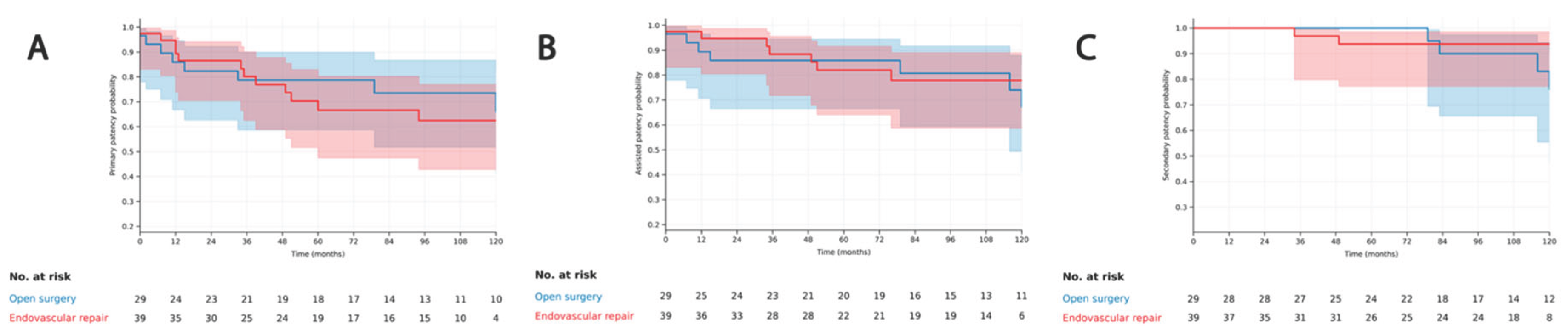

Table 1.
Baseline characteristics and comorbidities for the open surgical (OSR) and endovascular (EV) treatment groups.
Table 1.
Baseline characteristics and comorbidities for the open surgical (OSR) and endovascular (EV) treatment groups.
| Variable | OSR treatment (n=29) | EV treatment (n=39) | p-value |
| Age (years) | 61.4 ± 10 (range 43-83) |
64.3 ± 9 (range 50-93) |
0.236 |
| Male sex | 26 (89.7%) | 34 (87.2%) | 1.000* |
| BMI (kg/m2) | 26.6 ± 5 | 27.4 ± 5 | 0.630 |
| ASA risk 3 or more | 19 (65.5%) | 26 (66.7%) | 1.000* |
| Active tabaquism (current smokers) |
10 (34.5%) | 16 (41.0%) | 0.583 |
| Hypertension | 20 (69.0%) | 16 (41.0%) | 0.022 |
| Diabetes mellitus | 15 (51.7%) | 7 (17.9%) | 0.003 |
| Dyslipidemia | 13 (44.8%) | 16 (41.0%) | 0.754 |
| Coronary disease history | 8 (27.6%) | 9 (23.1%) | 0.671 |
| Coronary revascularization | 4 (13.8%) | 4 (10.2%) | 0.715* |
| Congestive heart failure | 1 (3.5%) | 0 | 0.426* |
| COPD | 4 (13.8%) | 7 (17.9%) | 0.747* |
| Cerebrovascular disease | 1 (3.4%) | 6 (15.4%) | 0.225* |
| Chronic renal impairment | 2 (6.8%) | 4 (10.2%) | 1.000* |
| Preoperative Cr (mg/dL) | 0.95 ± 0.7 | 0.88 ± 0.2 | 0.659 |
| Preoperative ABI | 0.35 ± 0.5 | 0.39 ± 0.1 | 0.904 |
| Rutherford ischemia class - 3 - 4 - 5 - 6 |
14 (48.2%) 11 (37.9%) 3 (10.3%) 1 (3.4%) |
17 (43.6%) 17 (43.6%) 4 (10.2%) 1 (2.6%) |
0.807 0.804 1.000* 1.000* |
| Prior revascularization | 11 (37.9%) | 2 (5.1%) | 0.001 |
| Occlusion length (cm) | 13.3 ± 2 | 14.1 ± 2 | 0.084 |
BMI, body mass index; ASA, American Society of Anesthesiology risk score; COPD, chronic pulmonary obstructive disease; ABI, ankle-brachial index. * Fischer’s exact test.
Table 2.
Postoperative outcomes during follow-up for the open surgical (OSR) and endovascular (EV) treatment groups.
Table 2.
Postoperative outcomes during follow-up for the open surgical (OSR) and endovascular (EV) treatment groups.
| Variable | OSR treatment (n=29) | EV treatment (n=39) | p-value |
| Associated minor amputation | 2 (6.9%) | 2 (5.1%) | 0.547* |
| Associated infrainguinal revascularization | 10 (25.6%) | 7 (17.9%) | 0.119 |
| Postoperative ABI | 0.70 ± 0.3 | 0.89 ± 0.2 | 0.050 |
| In-hospital stay (days) |
Median 10 (5-50) 75% under 14 days |
Median 5 (2-25) 75% under 7 days |
<0.001** |
| Follow-up (months) |
Median 125 (4-212) = 10.4 years 75% over 14 years |
Median 107 (1-202) = 8.9 years 75% over 9.7 years |
0.045** |
| 30-day mortality | 0 | 1 | 0.574* |
| Overall mortality | 20 (69.0%) | 16 (41.0%) | 0.022 |
| Survival estimates (mortality free) | |||
| 1-year | 97% | 95% | 0.725*** |
| 2-year | 97% | 90% | |
| 5-year | 83% | 77% | |
| 10-year | 52% | 59% | |
| Reintervention (global) | 9 (31.0%) | 14 (35.9%) | 0.675 |
| Major amputation | 4 (13.8%) | 2 (5.1%) | 0.390 |
| Survival estimates (reintervention free) | |||
| 1-year | 89% | 87% | 0.303*** |
| 2-year | 82% | 78% | |
| 5-year | 79% | 65% | |
| 10-year | 73% | 58% | |
ABI, ankle-brachial index. * Fischer’s exact test. ** Mann-Whitney U test. *** Mantel-Cox log-rank test.
Table 3.
Primary, assisted and secondary patency rates during follow-up for the open surgical (OSR) and endovascular (EV) treatment groups.
Table 3.
Primary, assisted and secondary patency rates during follow-up for the open surgical (OSR) and endovascular (EV) treatment groups.
| Variable | OSR treatment (n=29) | EV treatment (n=39) | p-value |
| Primary patency | |||
| 1-year | 86 | 94 | 0.722 |
| 2-year | 82 | 86 | |
| 5-year | 79 | 70 | |
| 10-year | 74 | 62 | |
| Assisted patency | |||
| 1-year | 90 | 98 | 0.679 |
| 2-year | 86 | 95 | |
| 5-year | 86 | 82 | |
| 10-year | 75 | 78 | |
| Secondary patency | |||
| 1-year | 100 | 100 | 0.323 |
| 2-year | 100 | 100 | |
| 5-year | 100 | 94 | |
| 10-year | 84 | 94 | |
Disclaimer/Publisher’s Note: The statements, opinions and data contained in all publications are solely those of the individual author(s) and contributor(s) and not of MDPI and/or the editor(s). MDPI and/or the editor(s) disclaim responsibility for any injury to people or property resulting from any ideas, methods, instructions or products referred to in the content. |
© 2026 by the authors. Licensee MDPI, Basel, Switzerland. This article is an open access article distributed under the terms and conditions of the Creative Commons Attribution (CC BY) license (http://creativecommons.org/licenses/by/4.0/).
Copyright: This open access article is published under a Creative Commons CC BY 4.0 license, which permit the free download, distribution, and reuse, provided that the author and preprint are cited in any reuse.