

Submitted:
15 September 2026
Posted:
15 September 2026
You are already at the latest version
Abstract
Teaching is a critical component of medicine. Many institutions offer faculty programs to develop their teaching skills and some offer education electives to medical students. This exploratory study describes the implementation and outcomes of a concentration that was co-created by faculty and medical students using personalized educational approaches. The integration of precision education principles into such a concentration is an unexplored area of study, offering a novel approach for tailoring educator development pathways for medical students. The concentration consists of interactive skill development workshops, educator development sessions, a teaching practicum, one medical education scholarship or research project, and observed structured teaching examinations. The first graduating cohort (n=6) participated in interviews which were iteratively open-coded by 3 coders. The interviews revealed 4 themes: 1) personalization and flexibility supported individualized educator development; 2) professional identity formation and career validation as medical educators; 3) development of teaching skills and approaches; and 4) potential for improvement of the concentration. This pathway combined a core curriculum, individualized learning, authentic teaching experiences, feedback, mentorship, and an educational scholarship or research project. These findings provide insights for institutions internationally seeking to develop student-centered education programming to tackle the educator development gap present in medical training.
Keywords:
medical education concentration
; elective
; precision education
1. Introduction
Due to the nature of medicine, physicians are responsible for the education of their patients and colleagues [1]. The importance of early exposure to teaching principles also extends beyond mere professional obligation. It has been argued that by teaching, students learn more effectively and gain greater mastery of material [2]. Furthermore, teaching skills directly correlate with improved communication abilities, which are essential for effective physician-patient interactions and collaborative healthcare delivery. Despite this universal expectation, accreditation bodies do not mandate the promotion of teaching skills [3]. This has resulted in a critical gap in physician preparation—the development of educational competencies [4].
Students who identify this gap, as well as other gaps in their desired skillsets, often turn to elective courses or concentrations. Within the landscape of undergraduate medical education, elective courses have become essential to provide students with opportunities for individualized learning experiences [5]. Available electives reported in the literature span a range of disciplines, from specialized clinical areas to interdisciplinary fields including medical humanities and bioethics [5]. Medical education electives address and help medical students to systematically develop the teaching skills necessary for their careers [6].
Although the expectation that physicians will serve as educators is internationally recognized [11], opportunities for medical students to develop these skills remain heterogeneous. Existing undergraduate initiatives include student-as-teacher electives and longitudinal curricula, dedicated scholarly concentrations, joint MD/M.Ed programs, and postgraduate master’s programs with reported benefits including increased teaching confidence, development of feedback and mentoring skills, and increased interest in academic medicine [12,13,14]. Longitudinal undergraduate educator pathways that integrate didactic instruction, supervised teaching practice, individualized mentorship, and educational scholarship within medical degrees remain predominantly implemented and studied in the United States [15]. In contrast, the global landscape of health professions education primarily focuses on investment in formal postgraduate education programs [16]. This demonstrates an opportunity to extend structured preparation for medical educators earlier in the continuum of medical training.
In addition to providing a structured foundation in educational theory and practice, medical education electives may benefit from approaches that account for individual learners’ goals, prior experiences, and areas of interest. Precision education applies individualized learning principles to optimize educational outcomes for diverse student populations and needs [7]. Within the context of preparing medical students to become effective educators, precision education offers a framework for designing medical education electives that systematically develop teaching competencies while accommodating students’ diverse backgrounds, learning preferences, and career aspirations. Rather than adopting a one-size-fits-all approach, the precision education framework delivers targeted content and experiences within the time constraints of medical school, leading to more relevant and meaningful skill development [7].
To address this gap, we developed and implemented the Medical Education Concentration (MEC) rooted in precision education principles [8]. This was driven by students who identified this preparation gap and wanted to develop a structured pathway for themselves, their peers, and future students to pursue medical education opportunities, practice educating throughout their medical school careers, and strengthen their skills as educators and scholars. Student and faculty co-creators sought to establish a longitudinal pathway that combined opportunities to teach in varied settings, receive structured feedback, engage in medical education scholarship, and develop relationships with experienced medical educators. At the same time, students brought diverse goals and interests to their educator development, motivating a program structure that paired standardized educational experiences with individualized components.
The resulting MEC incorporated educational skills training, supervised teaching practice, mentorship, individualized learning plans, and a medical education scholarly project. The impact of the MEC extends beyond individual student development to the broader goals of improving medical education, advancing educational scholarship, and enhancing student confidence in providing quality patient care. This paper, co-authored by student co-creators of the concentration and a faculty director, delves into the components and outcomes of the MEC, examining its role in shaping the educational experiences of medical students and its implications on preparing future physicians as medical educators.
Although medical education concentrations have been described as opportunities for focused educator development, less is known about how students experience these longitudinal programs and which aspects they perceive as contributing to their development as educators. Understanding these experiences may help institutions design programs that are both structured enough to provide foundational preparation and flexible enough to accommodate diverse learner goals. By exploring the challenges and opportunities associated with the implementation of our concentration, this study aims to offer insights into best practices for fostering meaningful and impactful educational experiences within medical curricula, at Yale School of Medicine and beyond. The goal of this study is to utilize the voices of the student leaders and co-creators of the MEC to evaluate its impact on the graduating participants of its first cohort and to identify improvements that can be implemented going forward for this concentration and others like it.
2. Materials and Methods
Components of the MEC at Yale School of Medicine
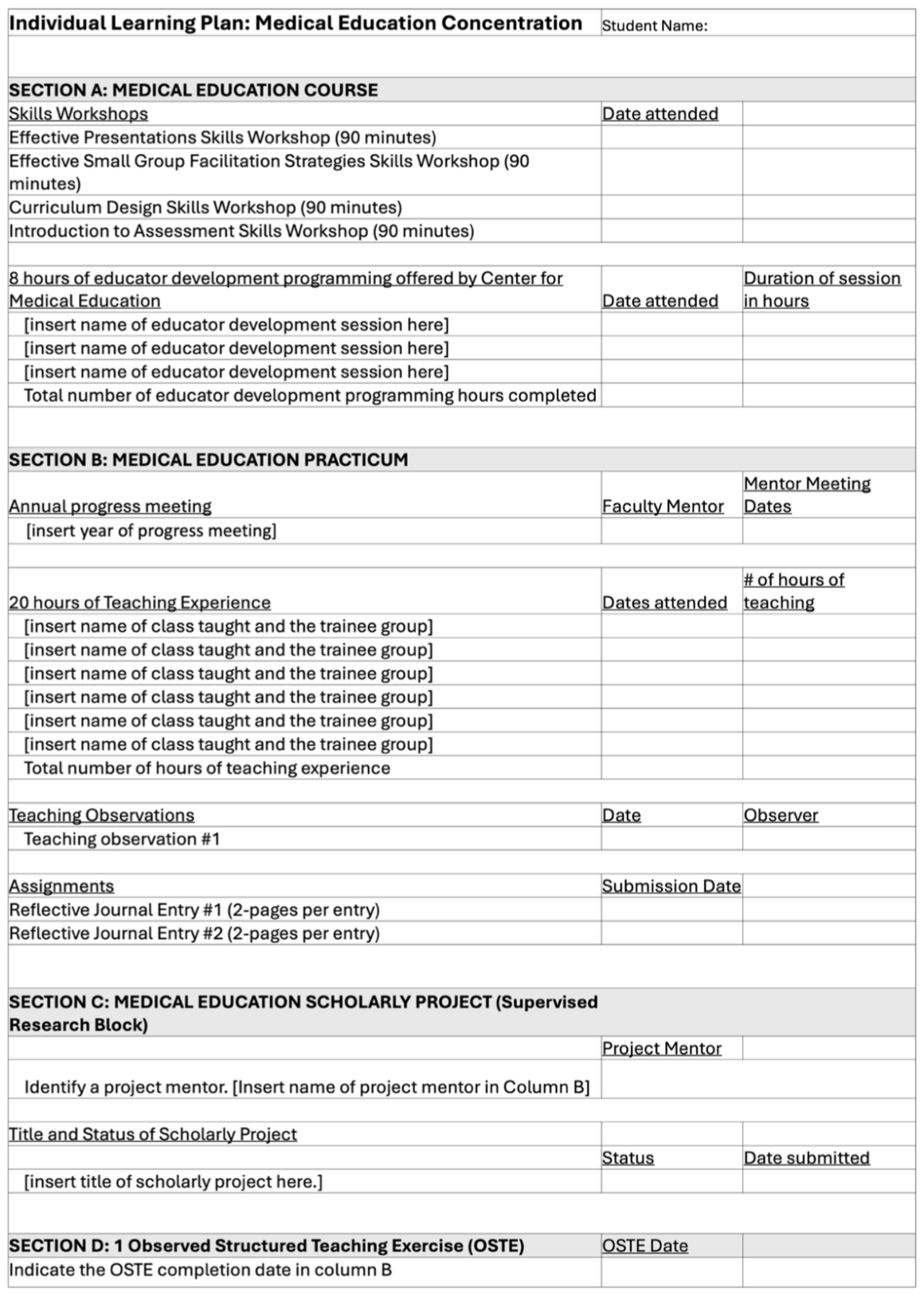
The curriculum of the MEC features 7 standardized educational sessions, including 6 teaching skills workshops and completion of an Observed Standardized Teaching Experience (OSTE), a high-fidelity training and assessment method for evaluating the teaching skills of participants [9]. In the OSTE, students rotate through 3 scenarios entitled: 1) the one-minute preceptor, 2) orienting a learner, and 3) giving constructive feedback. In the simulated experience, students practice and apply concepts learned in the concentration and receive real-time, actionable feedback. The remaining requirements of the concentration are student-tailored, including 8 hours of elective sessions, 20 hours of a teaching practicum that can be performed in a variety of customized settings, direct observation and feedback of their teaching skills during this practicum by a trained clinician educator, and a scholarly medical education project in a specific area of focus chosen by the student. Additionally, each student is assigned an mentor from among a pool of 26 clinician educators recruited from across the medical school with experience in medical education and educational scholarship or educational research. These mentors role model the knowledge, skills, and attitudes of clinician educators, promoting enculturation of learners into the world of medical education. They also meet with the students as needed to guide them through the concentration and to tailor the MEC experience to the student’s specific interests and goals. This advising is structured using an independent learning plan (ILP) designed at Yale School of Medicine to track each student’s progress through the MEC’s flexible requirements (Appendix A.1.).
Sample
As of submission, 78 students have voluntarily enrolled in the MEC. We analyzed data collected from a diverse group of 6 students of the inaugural cohort of the MEC who completed all of the program’s requirements before their graduation in May 2025 (Table 1). During enrollment into the program, all students consented to participation in research studies pertaining to the evaluation of the program.
Data Collection and Analysis
After completing their OSTE, students participated in 20-minute semi-structured interviews over Zoom, conducted by an administrator from the school’s Center for Medical Education who had no part in their evaluation to minimize potential power dynamics and evaluation-related response bias. The interviewer was not involved in students’ instruction or assessment within the MEC and was independent of the student research team. This separation between interviewers and the research team was intended to reduce social desirability and evaluation-related response bias. Interviews explored students’ experiences with the MEC, including their perceptions of the curriculum, teaching experiences, advising, and development as medical educators. Zoom’s transcription software was used to create transcripts of the interviews that were then anonymized.
Three members of the research team independently reviewed and open-coded all six transcripts using an inductive content analysis approach [10]. All three coders were involved in the development and implementation of the MEC and have either completed or are completing the concentration themselves. None of the coders was a member of the inaugural cohort whose interviews were analyzed. To promote reflexivity, coders independently reviewed transcripts before meeting to compare preliminary codes and discuss discrepancies.
Coders met to compare preliminary codes, resolve discrepancies through discussion, and develop a consensus codebook. The consensus codebook was then applied to the transcripts, with iterative refinement of codes as needed during the analysis process. Final codes were organized into broader categories representing recurring patterns across participants’ experiences. To characterize the prevalence of identified themes, we calculated the number of interviews in which each code was present.
3. Results
From our 6 interviews, 4 overarching themes were identified. Participants commented on 1) the benefits of having a personal and flexible education, 2) the deepening and development of a professional identity as a clinician educator, 3) large growth in teaching and educational skills, and 4) effective components and opportunities for improvement. Representative quotes of these themes can be seen in Table 2.
3.1. Flexibility and Personalized Approach: Personalization Enabled Students to Pursue Individualized Educator Development
Throughout the interviews, students frequently highlighted the flexibility of the MEC as a key benefit. Students could choose when to complete the various components of the MEC, including the didactics, teaching practicum, and scholarly project. One student noted that the flexibility allowed students to “work on [their] teaching skills in whatever component works best for [them]” during the times of medical school that work best for them (Interview 4). In addition to being able to pursue teaching opportunities that students enjoyed and thought would be useful for their future careers, students also appreciated the opportunity to pursue a scholarly project in an area of their interest. 4/6 interviewees commented that, through its personalization, the concentration provided more exposure to different specialties and interests within medical education and thus a better understanding of how interested students could incorporate medical education into their future careers.
In addition to the adaptable requirements of the program, students appreciated receiving tailored feedback on their teaching skills from their assigned mentors (3/6). In addition to these teaching observations, 5/6 referenced their mentors as uniquely positioned to support their pursuit of medical education through answering career-related questions and modeling how to incorporate medical education into their careers. They found this individualized guidance to be deeply meaningful to their future careers as medical educators. This is best illustrated in the following quote:
I just appreciated that we were getting advice [from my mentor] that was deeply relevant to the things that we were going to be doing. I’m not saying that the previous that the courses didn’t have value. It’s just that it’s… I don’t know... It’s like when your parents give you advice when you’re a kid like you don’t get it. If that makes sense. From my mentor, it seems deeply grounded.
– Interview 5
3.2. Formalization of Medical Education and Professional Identity Formation: Formalization transformed medical education from an informal interest into a professional pathway
Beyond flexibility, all of the participants stated that the MEC made Medical Education a very tangible pathway for its participants. One major outcome of establishing a formal concentration to pursue medical education was the reinforcement of students’ existing interest in medical education. This was reported in 3/6 of the interviews. One student mentioned that they enjoyed teaching before they joined the MEC and through the concentration, they were able to utilize that interest to teach something that they are passionate about: medicine (Interview 5).
Beyond simply confirming preexisting interests, the MEC also showed students what medical education is in practice. 5/6 interviewees commented on the formalization of the medical education curriculum, stating that it encouraged students to incorporate pursuing medical education into their career goals. Students who had not had exposure to medical education especially commented that the rigor and structure of the concentration “brought a whole world open” to pursuing medical education professionally (Interview 4). Additionally, it was noted by all participants (6/6) that this concentration helped them to become more assured of their interests in medical education as a valid career path, which is best demonstrated in the following quote:
I was like, there are formal ways that people like go about like trying to be good educators. It’s not just that... I feel like sometimes, you know, people begrudgingly accept a lecture because they have to do it and it’s like, no, there are people who really love this and enjoy it and research it.
– Interview 1
In addition to showing them what their future careers will look like, students felt their current academic pursuits benefited tangibly from the concentration. 4/6 interviewees mentioned that they directly discussed the MEC in their residency applications and interviews and viewed it as a benefit to their CV. One student remarked how this concentration rewards interested students for accomplishing many of the things they were already pursuing, giving them a sense of validation and a tangible accomplishment to show for it (Interview 2).
One specific way that the concentration served to develop specific skills was through its scholarly project requirement. Students valued the opportunity to do scholarly work in medical education, as mentioned in 4/6 of our interviews. Specifically, one mentioned that until they joined the concentration, they had been trying to tackle educational projects without a scholarly framework in mind and that they found learning the formal ways in which educational programs are developed and evaluated helpful for these sorts of projects in the future (Interview 1).
The MEC also created an avenue for mentorship, networking, and professional development. Half of the interviewees (3/6) cited the required didactics as a value added for learning more about medical education while engaging with faculty and students in the concentration. Many students also enjoyed the opportunities to network with faculty members (3/6), as well as like-minded peers (2/6), invested in medical education as a career and research interest. This ability to connect with educators, established and budding alike, is well illustrated in the quote below:
Having a medical education concentration that allows us to interact with some of these really outstanding teachers, I think, is really useful.
– Interview 6
3.3. Formalization of Medical Education and Professional Identity Formation: Formalization transformed medical education from an informal interest into a professional pathway
Participants emphasized that the MEC will affect their future practice as educators. Every (6/6) interviewee mentioned that they feel that the MEC made them a better teacher. Many students mentioned how formalized training in educational practices, including the didactic sessions mentioned above, combined with the observed teaching sessions, allowed them to become more comfortable with a variety of teaching techniques – assessing learners’ baseline level of understanding, utilizing silence, etc. – and formats (Interview 4).
In particular, 3/6 argued for the benefits of developing skills in small group teaching, while 4/6 students pointed out the importance and utility of near-peer teaching. The utility of developing skills to teach near-peers, alone and in small groups, as they will as future residents teaching medical students and more junior residents, was pointed out by Interviewee 5 in the following quote:
I think [near-peer teaching] is a component of teaching in medicine that is different from teaching in a lot of other contexts. Often medical students teach one another. Residents teach one another. Residents teach medical students. As much as we talk about a hierarchy in medicine, there’s fairly little separation between people who are providing the teaching and receiving the information. And so, the emphasis on near peer teaching environments is something that I find to be the most helpful… component of the concentration…
– Interview 5
Meanwhile, the small-group teaching skills allowed students to develop the skills they will use in “[their] future career[s]... on the wards,” (Interview 2). Through learning about and developing the skills necessary for such impromptu, team-based chalk talks and educational discussions that many use while working on teaching services, students reflected on how they will likely be employing their educational skills after they finish their training.
Half (3/6) of interviewees mentioned the OSTE experience as a particular strength of the MEC, as it allowed them to actually practice the teaching skills they learned throughout the concentration. Further, it allowed them to understand and practice the kinds of teaching they will be participating in during their own residency training. One interviewee even noted that they enjoyed getting to “role play” and teach and interact with learners as they will as future attendings (Interview 6).
3.4. Potential Future Directions and Broad Utility: Opportunities to increase rigor and broaden accessibility
While we sought to understand how the MEC might be useful for its students, we also wanted to learn how we can improve the concentration for its current and future participants. 5/6 of interviews featured the idea that the concentration’s requirements could be more rigorous to help develop more effective clinician educators. Participant 5, who helped develop the concentration, pointed out that while at first there was a “[worry] that people wouldn’t be interested” in the concentration, but now that there is sufficient “buy-in,” folks will likely be willing to “earn” their educational and professional development.
Likely owing to all the benefits laid out above, 4/6 interviewees felt that this concentration, and others like it, are likely beneficial for all students, not just those who believe they may be interested in medical education, as they noted that all physicians teach. This is perhaps best illustrated in the following quote:
I think that medical education is important because every medical professional is an educator. Everybody who works in the healthcare system has patients to teach, has colleagues and students to teach. .... and so, having any baseline in it is going to improve the system and having a strong foundation like the one this concentration aims to provide is, I think, something that is very undervalued, but needs to be recognized.
– Interview 5
4. Discussion
This qualitative study examined the perspectives of the inaugural cohort of the MEC, revealing how students and faculty were able to co-design a structured, yet personalized, training in medical education can meaningfully impact medical students’ development as educators and their professional identity formation. Our findings demonstrate that a thoughtfully designed elective concentration can successfully bridge the educator development preparation gap identified in medical education literature using the precision education model [2,7]. This concentration as-is, could be useful for any student or faculty member interested in co-designing a similar concentration at their respective institution, across the globe.
Participation in the MEC not only enhanced students’ self-reported teaching abilities but also fostered the development of professional identities as medical educators. The MEC solidified interest among students already drawn to teaching while also sparking new interest in educational roles among others. As has long been argued, every physician is a teacher. Our interviewees astutely noticed this and argued that, since all graduates from medical school will teach at some point, it is worth their time, both for themselves and society at large, to gain skills in teaching during medical school. A concentration like the MEC provides this opportunity. Additionally, through structured exposure to educational theory, medical education scholarship, practical teaching experiences, mentorship from education-focused faculty, and an individualized approach, students increasingly recognized medical education as a legitimate and valuable career path. This underscores the importance of exposure and structured opportunities in shaping medical student aspirations — a finding echoed in studies of similar electives [4,6].
A key strength of this study is its in-depth, qualitative approach, which allows for nuanced exploration of student experiences and perceptions. The use of open coding and consensus-based analysis enhances the credibility of our findings. This study provides valuable insight into how programs like these can best be developed and modified to utilize precision education to help fill the gap in educational preparation of medical professionals. These data can help guide program improvement and inform other institutions considering similar initiatives, while contributing to the broader literature on medical education concentrations—an area with limited empirical research.
Several limitations should be noted. Interviews were conducted after completion of the concentration and student reflections may have been influenced by recall bias, positive retrospective framing, or subsequent experiences not directly related to the MEC. Our sample size of six students at one medical school limits the generalizability of our findings. Additionally, this study captured student perspectives at a single time point.
Overall, the development of the MEC contributes to a growing international recognition that preparation for the educator role can and should begin during medical school. Our findings suggest that a longitudinal medical education concentration can provide a scalable framework for integrating foundational teaching skills, supervised practice, mentorship, and educational scholarship within the medical school curriculum. As additional students advance through the MEC, we will gather longitudinal data to assess how perspectives evolve throughout the concentration and to determine whether the reported benefits persist in residency and beyond. Although the MEC was developed within the context of Yale School of Medicine, its flexible structure may be adaptable to institutions across diverse educational systems and resource settings. Future research can examine similar undergraduate educator pathways across institutions and countries to provide evidence as to whether longitudinal participation in a concentration translates into sustained teaching engagement, educational scholarship, and development of the next generation of medical educators globally.
5. Conclusions
We evaluated the MEC at Yale School of Medicine using a qualitative approach to determine the impact of the concentration on the first cohort of graduates. One of the strongest lessons learned was that the formalization of medical education training provided the opportunity for the students to develop professional identity formation as educators. Integrating student-mentor dyads, personalized ILPs, a flexible curriculum, and diverse teaching experiences within a precision education framework were key elements in the model for bridging the gap in formal educator training for new physicians that we believe can be applied worldwide to medical schools.
Author Contributions
Conceptualization, F.C., K.S., T.L, Y.L., E.W., S.C., S.G., J.H.; methodology, F.C., K.S., T.L., S.G., J.H..; formal analysis, F.C., K.S., T.L..; investigation, F.C., K.S., S.G., J.H.; writing—original draft preparation, F.C., K.S., T.L, Y.L., E.W., S.C., S.G., J.H.; writing—review and editing, F.C. K.S.; supervision, S.G., J.H.; project administration, S.G. All authors have read and agreed to the published version of the manuscript.” Please turn to the CRediT taxonomy for the term explanation. Authorship must be limited to those who have contributed substantially to the work reported.
Funding
This research received no external funding.
Institutional Review Board Statement
The study was conducted in accordance with the Declaration of Helsinki. Ethical review and approval were waived for this study by the Institutional Review Board of Yale School of Medicine.
Informed Consent Statement
Informed consent was obtained from all subjects involved in the study.”
Data Availability Statement
We encourage all authors of articles published in MDPI journals to share their research data. In this section, please provide details regarding where data supporting reported results can be found, including links to publicly archived datasets analyzed or generated during the study. Where no new data were created, or where data are unavailable due to privacy or ethical restrictions, a statement is still required. Suggested Data Availability Statements are available in the section “MDPI Research Data Policies” at https://www.mdpi.com/ethics.
Acknowledgments
During the preparation of this manuscript/study, the author(s) used Zoom Transcription AI for the purposes of transcribing interviews. The authors have reviewed and edited the output and take full responsibility for the content of this publication.
Conflicts of Interest
The authors declare no conflicts of interest.
Abbreviations
The following abbreviations are used in this manuscript:
| MEC | Medical Education Concentration |
| ILP | independent learning plan |
Appendix A
Appendix A.1. Representative Example of an Independent Learning Plan (ILP) Template that all MEC Students must Complete. ILPs are Submitted to MEC Director to Demonstrate Completion of the MEC
References
- Peluso MJ, Hafler JP. Medical Students as Medical Educators: Opportunities for Skill Development in the Absence of Formal Training Programs.
- Dandavino M, Snell L, Wiseman J. Why medical students should learn how to teach. Medical Teacher. 2007;29:558–65. [CrossRef]
- Functions and Structure of a Medical School for 2027-2028 from the LCME, 2026.
- Cohen A, Steinert Y, Ruano Cea E. Teaching Medical Students to Teach: A Narrative Review and Literature-Informed Recommendations for Student-as-Teacher Curricula. Acad Med. 2022;97:909–22. [CrossRef]
- Ramalho AR, Vieira-Marques PM, Magalhães-Alves C, Severo M, Ferreira MA, Falcão-Pires I. Electives in the medical curriculum – an opportunity to achieve students’ satisfaction? 2020.
- Shumylo MY. The role of elective courses in higher medical education during pre-clinical years. SEND. 2019;VII(209):45–8. [CrossRef]
- Desai SV, Burk-Rafel J, Lomis KD, Caverzagie K, Richardson J, O’Brien CL, et al. Precision Education: The Future of Lifelong Learning in Medicine. Acad Med. 2024;99:S14–20. [CrossRef]
- Medical Education Concentration (MEC) for MD and MD-PhD Students n.d. https://medicine.yale.edu/center-for-medical-education/student-concentration/ (accessed October 31, 2025).
- Mahoney MR, Gayoso ME, Belsky NA, Crook TW, Parekh KP. Observed Structured Teaching Experiences (OSTEs) in a Students as Teachers Course. Med Sci Educ. 2023;34:13–8. [CrossRef]
- Miles MB, Huberman AM, Saldana J. Qualitative Data Analysis: A Methods Sourcebook. Third Edition. SAGE Publications Ltd (CA). SAGE Publications; 2014.
- Al-Eraky MM, Taylor DCM. Faculty development through higher degrees: AMEE Guide No. 180. Med Teach. 2025;47(10):1578-1588. [CrossRef]
- Darwin A, Mason A, Clare AF, Nestler S, Spoto-Cannons A. Teaching to Teach: A Scoping Review of Teaching Skill-Development Programs across Medical Education. South Med J. 2025;118(5):260-266. [CrossRef]
- Fuchs MA, Schwartz AW, Caton JB, Gooding H, Richards JB. Defining Student-as-Teacher Curricula in the Absence of National Guidelines: An Innovative Model. Acad Med. 2022;97(6):832-838. [CrossRef]
- Carr F, Hafler JP. Mastering the Masters: The Impact of Yale School of Medicine’s Master of Health Science Medical Education Program on Alumni’s Career Advancement and Academic Productivity. Med Sci Educ. 2025;35(4):1927-1937. Published 2025 Apr 4. [CrossRef]
- Arja SB, Arja SB, Ponnusamy K, Kottath Veetil P, Paramban S, Laungani YC. Medical Education Electives Can Promote Teaching and Research Interests Among Medical Students. Adv Med Educ Pract. 2024;15:173–80. [CrossRef]
- Tekian A, Harris I. Preparing health professions education leaders worldwide: A description of masters-level programs. Med Teach. 2012;34(1):52-58. [CrossRef]

Table 1.
Participant Demographics.
| Incidence | ||
| Gender | Female | 4 |
| Male | 2 | |
| Specialty | Dermatology | 1 |
| Internal Medicine | 1 | |
| Medicine-Pediatrics | 1 | |
| Pediatrics | 1 | |
| Psychiatry | 1 | |
| Other (non-clinical) | 1 | |
| Degree Program | MD | 4 |
| MD, MHS | 2 |
Table 2.
Representative Quotes from Interviews with MEC Graduates.
| Theme | Incidence | Representative Quote |
| Flexibility | 3 | It was nice to have the flexibility to complete the requirements on my own time, and there was more than enough time within these 2 years to do so. So that was that was nice in terms of fulfilling the requirements. – Interview 3 |
| Tailored Feedback | 3 | Even so, it was super nice to have like structured teaching experiences that I had observations about things that like... I always ask for feedback, but to have, like an actual structured way of getting feedback, or to have actual reflections on these experiences has been really nice. – Interview 2 |
| Encouraged Exploration | 4 | That experience for me has definitely helped to define my interest in medical education as a whole. Outside of even my specialty specific interests. I think it helped me identify various different projects again, even further, beyond just my specialty, specific interests. – Interview 2 |
| Mentorship opportunities | 5 | I just appreciated that we were getting advice [from my mentor] that was deeply relevant to the things that we were going to be doing. I’m not saying that the previous that the courses didn’t have value. It’s just that it’s… I don’t know... It’s like when your parents give you advice when you’re a kid like you don’t get it. If that makes sense. From my mentor, it seems deeply grounded. – Interview 5 |
| Interest Reinforcement | 3 | So, I was interested in medical education like, before the concentration came about. And so, I was kind of trying to do some work already in this area. So, I think, like, I kind of had a project idea that I had started working on and had identified like some areas where I was curious. – Interview 1 |
| Formalization of Medical Education Curriculum | 5 | Well, certainly I did not really know much about medical education before starting the concentration…So I think the concentration just really brought a whole world open to me of like that. I could actually pursue this in a rigorous way to like actually learn some tangible skills if I want to be like you know, Professor, or, you know, stay in academic medicine, like all those skills, will be really helpful.– Interview 4 |
| Professional Identity Formation | 6 | I think, committing to a concentration and doing the requirements gives you a professional identity which was helpful. Because it’s something I wanted to do. And I’ve taken steps to try to improve my teaching specifically, but medical education is another... It’s related, but not. It’s another thing altogether; to think in that that sphere was helpful. – Interview 3 |
| Career Validation | 6 | I was like, oh, there are like formal ways... I love teaching... And I was like, there are formal ways that people like go about like trying to be good educators. It’s not just that... like I feel like sometimes, you know, people begrudgingly accept a lecture because they have to do it and it’s like, no, there are people who really love this and enjoy it and like research it. – Interview 1 |
| Evidence of Tangible Commitment | 4 | I think after going through the Residency interview process, you know, having tangible things, and I’m sure in my career in Academia, moving forward, having, like real tangible things that show that I dedicated an XYZ amount of time to this, and really cared about this is so much more important, and I think was something I really took away from that experience was like finding opportunities where I can really have you know something on my CV and resume. – Interview 2 |
| Scholarly Project | 4 | So I was interested in medical education like, before the concentration came about. And so, I was kind of trying to do some work already in this area. So, I think, like, I kind of had a project idea that I had started working on and had identified like some areas where I was curious. So, I think for me, it was kind of nice, like as I’m wrapping up my [School Name] journey to be like oh, there are formal ways to assess the quality of questions, or there are formal ways to like, do X, Y, and Z. And because until then I’ve just been trying to figure it out like on my own in terms of like working towards these projects. – Interview 1 |
| Didactic Sessions | 3 | I really do like the like sessions, the required like longer evening sessions, because it’s a great time to see everybody else who’s like doing the concentration and kind of like engaging with instructors or people involved with it. So, I like those. – Interview 1 |
| Networking with Faculty | 3 | And I’ve been talking to a lot of people applying to medical school, like deciding between schools and [School Name] has a reputation for being a place with like really unique people who are good at teaching. And I almost feel like we do things so differently here that… having a medical education concentration that allows us to interact with some of these really outstanding teachers, I think, is really useful. – Interview 6 |
| Networking with Peers | 2 | And I’ve also really liked the community component, too. So, attending some of the events that have been centered around students who are also completing the concentration and talking to them about what they’ve been doing. That’s really nice, like the almost older... But I guess the further along in your medical experience, I feel like the less overall group experiences I’ve had, and so I don’t really know a ton of like the like M2s, M1s, or M3s, even. And so, it’s been really nice to have kind of an opportunity to meet other students who are interested in the same path that I’m sure our careers will cross over many times, that will most likely collaborate with in the future. So that’s also been a really nice aspect of the program, too. – Interview 2 |
| Teaching Skill Development | 6 | I think, as I’ve gotten more like progress in education, I’ve learned that before you even start teaching something. It can be really helpful to assess like learners, baseline level and what they actually want to learn, and then also getting feedback at the end of, like what they took out of the conversation, and so that beginning and end part. I didn’t really have like concrete, a concrete understanding of that going into the concentration. And then I sort of gained those skills toward the end, which was very helpful. And I think this: the concentration’s also been very helpful in teaching me, like other ways, to be more ways to be interactive in my teaching rather than just formal lecture based, and I think, based on what we learned like our Pre-Clerkship experience. Most of it was based on lecture and that sort of, and also like chalk talks and things like that. So that’s sort of what my basis was, and it’s been interesting to learn that there’s so many other ways to enhance your, you know, teaching style. – Interview 4 |
| Small Group Teaching | 4 | I think I’ve gained a lot of skills in small group, and in the moment teaching. I think a lot of my teaching in my future career will be on the wards and in clinical settings where you’re not in front of a classroom teaching 100 students at once but, you know, more on the fly in the moment smaller group teaching. And so those are really skills that I definitely think I honed during medical school and through this concentration. – Interview 2 |
| Near Peer Teaching | 4 | I think there were 20 hours required for this component of the concentration, and I really took advantage of, you know, trying to help with [medical student] simulations and ultrasound workshops and being part of [medical student] clinical skills session, and I think I wanted to do those things anyway. But the concentration sort of pushed me to be even more involved. – Interview 4 |
| OSTE Importance | 3 | I think that the OSTE really does stand out as one of the strengths of it. And of course, the teaching requirement and making sure that everybody gets experience actually teaching and not just learning about teaching. I think that’s very important. – Interview 5 |
| Desire for More Rigor | 5 | I think that when we started this, we were worried that people wouldn’t be interested, and that would be a really small pool. But then we got so many people signed up that I think we can move away from that fear and work more with people to like. We have the buy-in. Now, what are we selling? People are willing to do something, so let’s ask them to do it. Not be afraid to ask them to do stuff to earn this, because I think this is something to be earned. It’s not something that we want to welcome people into Med Ed. It’s so important, but we don’t want to, just... I don’t think we want to cheapen it. – Interview 5 |
| Potential Value for All Students | 4 | I think even if you don’t plan to go into medical education in a formal capacity in the future, I think it’s a great way to practice your teaching skills to practice. You know, a skill that will inevitably be relevant to anyone in academic medicine. – Interview 4 |
Disclaimer/Publisher’s Note: The statements, opinions and data contained in all publications are solely those of the individual author(s) and contributor(s) and not of MDPI and/or the editor(s). MDPI and/or the editor(s) disclaim responsibility for any injury to people or property resulting from any ideas, methods, instructions or products referred to in the content. |
© 2026 by the authors. Licensee MDPI, Basel, Switzerland. This article is an open access article distributed under the terms and conditions of the Creative Commons Attribution (CC BY) license (http://creativecommons.org/licenses/by/4.0/).
Copyright: This open access article is published under a Creative Commons CC BY 4.0 license, which permit the free download, distribution, and reuse, provided that the author and preprint are cited in any reuse.