

Submitted:
14 September 2026
Posted:
15 September 2026
You are already at the latest version
Abstract
Oxidative stress and mitochondrial dysfunction are hallmarks of aging and major contributors to age-related disease. Yet the structural and functional determinants within respiratory Complex I that maycontribute to species-specific differences in longevity remain poorly understood. Using comparativegenomic, evolutionary, and structural analyses, I identified a conserved primate ubiquinonegatekeeper signature (Met17/Met21/Met225) within mitochondrially encoded NADH dehydrogenasesubunit 1 (MT-ND1), positioned at the entrance to the respiratory Complex I ubiquinone accesschannel. Remarkably, multiple exceptionally long-lived vertebrate lineages, including bats,cetaceans, birds, marsupials, monotremes, and coelacanth, independently evolved a sharedVal17/Thr21/Leu225 gatekeeper signature at this site. Cartilaginous fishes exhibit a closely relatedThr17/Thr21/Leu225 gatekeeper signature. Structural mapping places these residues within the MT-ND1 ubiquinone access pathway, where oxidative modification could influence ubiquinone access,electron transfer, and reactive oxygen species (ROS) generation. This region overlaps with thepharmacologically important ubiquinone-binding site targeted by numerous Complex I inhibitors.Their recurrent replacement in evolutionarily distant, exceptionally long-lived vertebrates isconsistent with reduced oxidative vulnerability of Complex I. Together, these observations support amodel in which oxidation-prone MT-ND1 methionines contribute to mitochondrial oxidativevulnerability, whereas their recurrent evolutionary replacement may promote mitochondrial redoxhomeostasis. These findings identify the MT-ND1 ubiquinone gatekeeper signature as a previouslyunrecognized molecular nexus linking respiratory chain architecture, therapeutic response, andvertebrate longevity.
Keywords:
MT-ND1
; complex I
; convergent evolution
; reactive oxygen species
; vertebrate longevity
Introduction
Chronic psychological and physical stress are major contributors to biological aging and chronic disease [1,2,3]. Persistent stress exposure disrupts redox homeostasis, mitochondrial function, protein homeostasis and inflammatory signaling, thereby contributing to cardiovascular disease, cancer, metabolic disorders, neurodegeneration, and mood disorders [4,5]. Although the upstream triggers of stress are highly heterogeneous, a common downstream mechanism involves the disruption of cellular redox homeostasis and the excessive production of reactive oxygen species (ROS). At physiological concentrations, ROS function as essential signaling molecules regulating cellular adaptation, metabolism, immunity, and tissue homeostasis. However, chronic oxidative stress may convert ROS signaling from a physiological mediator of redox homeostasis into a driver of macromolecular damage, consistent with the framework proposed by Harman’s free radical theory of aging [6,7]. The resulting damage to DNA, proteins, and lipids ultimately promotes cellular dysfunction, disease progression, and aging [8,9,10].
Mitochondria are central regulators of cellular adaptation to chronic stress through their roles in energy metabolism, redox homeostasis, and inflammatory signaling. Sustained stress can promote mitochondrial dysfunction, leading to chronic inflammation, impaired cellular resilience, and progressive functional decline [4,5]. These observations suggest that oxidative stress may act as a causal mediator linking chronic stress to aging and disease, rather than simply serving as a biomarker of stress exposure [7,8,10]. Identifying the molecular mechanisms that drive stress-induced mitochondrial dysfunction and remodeling is therefore crucial for understanding how chronic stress promotes age-related pathology [11]. Among mitochondrial ROS-generating systems, respiratory chain Complex I occupy a central position because of its dual role in oxidative phosphorylation and redox signaling [12].
Mitochondrial Complex I (NADH:ubiquinone oxidoreductase) is the largest enzyme complex of the respiratory chain [13]. As the primary entry point for electrons into the respiratory chain, Complex I is responsible for maintaining efficient oxidative phosphorylation while simultaneously representing one of the principal sites of mitochondrial ROS generation [12,14,15,16]. Under physiological conditions, electron transfer proceeds with remarkable efficiency. However, even subtle disturbances in electron flux, cofactor integrity, or protein conformation can increase electron leakage to molecular oxygen, resulting in superoxide production and amplification of oxidative stress [12,14,16]. The central role of Complex I in mitochondrial metabolism has also made it an attractive therapeutic target. Cryo-EM studies have revealed that Complex I inhibitors occupy the ubiquinone-binding tunnel as an extended chain of aromatic rings, forming a “cork-in-the-bottle” configuration that blocks ubiquinone access to the catalytic site and thereby inhibits electron transfer [17]. Several pharmacological inhibitors of mitochondrial Complex I, including IACS-10759, BAY87-2243, mubritinib, metformin, and phenformin, have advanced to clinical evaluation or therapeutic use, highlighting the sustained interest in Complex I–directed therapies [18,19,20,21,22,23].
Increasing evidence suggests that Complex I is not merely a catalytic component of the respiratory chain but a dynamic redox-responsive signaling platform. Multiple reversible post-translational modifications, such as cysteine oxidation, S-nitrosylation, S-glutathionylation, methionine oxidation, acetylation, phosphorylation, and succinylation, have emerged as important regulators of respiratory chain function and mitochondrial adaptation to stress [24,25,26,27,28,29]. While many of these modifications participate in normal redox signaling, chronic oxidative stress may progressively remodel the respiratory machinery through the accumulation of interacting molecular alterations, ultimately impairing bioenergetic efficiency and enhancing ROS production.
Compared with the extensively studied cysteine-centered redox modifications [24,29,30,31], the biological significance of methionine oxidation remains incompletely understood. Once considered merely a consequence of oxidative damage, methionine oxidation is now recognized as a potentially reversible regulatory mechanism that can influence protein conformation and function [32,33]. Oxidation of methionine residues generates methionine sulfoxide, which can be repaired by the stereospecific methionine sulfoxide reductases A and B (MSRA and MSRB), thereby restoring protein integrity. Mitochondrial MSRA is particularly important for safeguarding enzyme activity by reversing methionine oxidation within the mitochondrial matrix [34]. In contrast, prolonged oxidative stress can drive the formation of methionine sulfone, an irreversible oxidation product associated with impaired protein function [35].
Methionine residues are uniquely positioned to function as redox-sensitive structural elements. Yet it remains unclear whether their conservation within the human Complex I ubiquinone access pathway reflects an adaptive regulatory mechanism or an evolutionary vulnerability to oxidative damage remains unknown. This question is particularly relevant because several methionine residues occupy strategic positions within the ubiquinone tunnel, where oxidative modification could influence ubiquinone trafficking, electron transfer dynamics, and ROS generation. Despite major advances in our understanding of Complex I structure and function, the evolutionary and functional significance of these conserved residues has remained largely unexplored. To address this gap, I combined structural analyses, comparative genomics, and evolutionary approaches to investigate the conservation of methionine residues within the Complex I ubiquinone pathway and to explore their potential relevance to species-specific differences in longevity and cancer resistance.
Materials and Methods
Retrieval of Homologous ND1 Sequences and Dataset Construction
The human mitochondrial NADH dehydrogenase subunit 1 (ND1) protein sequence was retrieved from the UniProtKB/Swiss-Prot database (accession P03886) and used as the reference sequence. Homologous protein sequences were identified using BLAST searches against the reviewed UniProtKB/Swiss-Prot and National Center for Biotechnology Information (NCBI) protein databases. Sequences exhibiting high amino acid sequence identity and coverage relative to the human ND1 reference were retained for further analysis. Selection thresholds were chosen to ensure reliable multiple sequence alignment while preserving sufficient evolutionary diversity for comparative analyses. To reduce redundancy, duplicate entries and multiple sequences originating from the same species were excluded whenever possible, retaining a single representative sequence per species. The final Swiss-Prot dataset consisted of 100 homologous protein sequences showing >65% amino acid sequence identity and >94% sequence coverage relative to the human ND1 reference sequence.
Multiple Sequence Alignment
Multiple sequence alignments were generated using Clustal Omega and MAFFT with default parameters to ensure the robustness of alignment results. The alignments were examined to identify conserved and variable amino acid positions across the dataset. Particular attention was given to residues corresponding to positions Met17, Met21, and Met225 in the human ND1 reference sequence (UniProtKB accession P03886). Conservation patterns at these positions were evaluated across the aligned sequences and compared among major vertebrate lineages to assess evolutionary variation and potential lineage-specific substitutions.
Structural Analysis of Methionine Residues in the Complex I Ubiquinone Access Pathway
Structural models of mammalian mitochondrial Complex I were obtained from the Protein Data Bank (PDB) and illustrated using BioRender (Science Suite Inc.) and BIOVIA Discovery Studio Visualizer (Dassault Systèmes). To characterize the architecture of the ubiquinone access pathway, the bovine Complex I structure containing a phenformin derivative at the entrance of the channel (PDB: 7R45) and the cryo-EM structure with endogenous ubiquinone bound within the Q-binding site (PDB: 7QSK) were used as structural references. Human MT-ND1 was analyzed using both the experimentally determined Complex I structure (PDB: 5XTD) and the AlphaFold2-predicted model (AF-P03886-F1), while the AlphaFold2 model of blue whale MT-ND1 (AF-A0A343VMH3-F1) served as a comparative reference [36]. Residue positions, side-chain orientations, intermolecular distances, and solvent accessibility were evaluated to identify amino acid residues lining the entrance of the ubiquinone access pathway. Methionine residues whose side chains extended into the cavity lumen were classified as candidate gatekeeper residues due to their potential role in regulating access of ubiquinone and other small molecules to the channel.
Results
Conserved Methionine Residues Are Positioned at the Entrance of the Ubiquinone Channel
Among mitochondrial ROS-generating systems, Complex I occupy a central position because of its dual role in oxidative phosphorylation and redox signaling (Figure 1a). Structural analysis of human mitochondrial Complex I revealed a conserved methionine cluster within the NADH dehydrogenase subunit 1 (MT-ND1) at the membrane-proximal entrance of the ubiquinone access pathway leading to the catalytic Q-site. Analysis of a phenformin-derivative bound structure demonstrated that incoming molecules enter Complex I through a narrow cavity connecting the lipid bilayer to the internal ubiquinone-binding tunnel (Figure 2a), while comparison with a structure containing endogenous ubiquinone confirmed continuity between this entry route and the catalytic Q-site (Figure 2b). Examination of human Complex I structures revealed a previously unrecognized cluster of three methionine residues (Met17, Met21 and Met225) within the MT-ND1 subunit at the membrane-facing entrance of the ubiquinone access pathway (Figure 2c). Structures containing either a phenformin-derivative inhibitor or endogenous ubiquinone demonstrated that this cavity constitutes the principal route connecting the lipid bilayer to the deeply buried catalytic Q-site (Figure 2a,b). At this critical junction, the three methionine side chains converge toward the center of the channel, positioning their sulfur atoms within 4.6–7.5 Å of one another. This arrangement creates a compact sulfur-rich microenvironment that constricts the entrance of the approximately 40 Å long ubiquinone tunnel (Figure 1b). Situated at the interface between the hydrophobic membrane phase and the internal catalytic cavity, the methionine cluster occupies a uniquely strategic position along the substrate entry pathway. Importantly, the same architecture was independently reproduced by AlphaFold2 prediction of human MT-ND1 (Figure 2d), supporting the structural validation of this feature. Together, these observations identify a conserved methionine-defined constriction that forms the major architectural bottleneck encountered by ubiquinone on its path from the membrane bilayer to the catalytic Q-site.
Long-Lived and Cancer-Resistant Species Exhibit Evolutionary Loss of Methionine Gatekeepers
Comparative analysis of MT-ND1 sequences from 100 vertebrate species revealed that the human methionine residues Met17, Met21, and Met225 are not universally conserved (Supplementary Table S1). Although these residues occupy structurally important positions at the entrance of the Complex I ubiquinone tunnel, multiple vertebrate lineages have independently acquired substitutions at these sites. Notably, amino acid replacement was highly non-random, with the same alternative residues recurring across distantly related taxa.
Among species lacking all three methionines, the predominant amino acid configuration was Val17/Thr21/Leu225 (residue numbering relative to the human MT-ND1 reference sequence) (Table 1). This signature was identified across evolutionarily diverse vertebrate clades, including Chiroptera (bats), Cetacea (whales), Monotremata, Marsupialia, Xenarthra, Perissodactyla, Carnivora, Pholidota, Aves (birds), Reptilia, Coelacanthiformes, Chondrichthyes, and Actinopterygii (teleost fishes). In contrast, the canonical Met17/Met21/Met225 configuration was retained throughout primate evolution. Only two species, the spiny dogfish (Squalus acanthias) and the small-spotted catshark (Scyliorhinus canicula), deviated from the predominant pattern by exhibiting a Thr17/Thr21/Leu225 configuration. The recurrence of nearly identical amino acid combinations across highly divergent vertebrate taxa suggests strong structural and functional constraints acting on these MT-ND1 positions.
Evidence for convergent evolution was particularly apparent in bats, where 14 species representing distinct evolutionary lineages shared the Val17/Thr21/Leu225 signature. The same residue combination was also observed in the platypus, echidnas, blue whale, and fin whale, further supporting recurrent and constrained evolutionary replacement at these MT-ND1 positions.
Importantly, the recurrent Val17/Thr21/Leu225 signature was enriched among species characterized by exceptional longevity, reduced cancer susceptibility, or both (Table 2). Representatives included bats, cetaceans, monotremes, coelacanth, marsupials, birds, and cartilaginous fishes, many of which exhibit exceptional lifespan relative to body size. The same amino acid configuration was also observed in diverse vertebrate groups, including ray-finned fishes (Actinopterygii), and several carnivorous mammals. To further evaluate the association with longevity, additional vertebrate species were examined using MT-ND1 sequences available in the NCBI database. The Greenland shark (Somniosus microcephalus; YP_009905837.1) displayed a closely related Thr17/Thr21/Leu225 configuration characteristic of sharks, whereas the bowhead whale (Balaena mysticetus; NP_944607.1), Galápagos giant tortoise (Chelonoidis niger; AEX66115.1), rougheye rockfish (Sebastes aleutianus; YP_009533184.1), and kakapo (Strigops habroptilus; YP_025949.1) carried the Val17/Thr21/Leu225 signature. Notably, several of these species’ rank among the longest-lived vertebrates currently known. Collectively, these observations indicate that the Val17/Thr21/Leu225 signature recurs across evolutionarily distant vertebrate lineages and is repeatedly observed in species notable for exceptional longevity and, in some cases, reduced cancer susceptibility.
Structural and Evolutionary Observations Support a Model of Methionine Oxidation–Dependent Remodeling of Complex I
Structural and evolutionary observations collectively support a model in which methionine Met17, Met21, and Met225 residues positioned at the entrance of the Complex I ubiquinone access pathway may function as redox-sensitive gatekeepers. This positioning places all three residues at a critical interface between the membrane environment and the ubiquinone channel, where alterations in side-chain chemistry are expected to influence substrate access and local electron-transfer dynamics.
The evolutionary signal associated with these residues was striking. Across multiple vertebrate lineages, Met17, Met21, and Met225 were repeatedly replaced through independent evolutionary events. Moreover, whenever all three methionines were simultaneously substituted, evolution converged overwhelmingly on the same amino acid combination, Val17/Thr21/Leu225. The repeated emergence of an identical solution across phylogenetically distant taxa suggests that this region is subject to strong functional constraints and that only a limited number of residue combinations are compatible with efficient operation of the ubiquinone pathway.
The chemical properties of methionine provide a plausible mechanistic framework linking these structural and evolutionary observations. Unlike valine, threonine, and leucine, methionine is susceptible to oxidation, generating methionine sulfoxide and methionine sulfone derivatives with markedly different physicochemical characteristics. Because all three residues occupy the entrance region of the ubiquinone channel, oxidative modification could alter channel architecture, perturb ubiquinone trafficking, and increase the probability of electron leakage. The resulting increase in reactive oxygen species would in turn promote additional methionine oxidation, creating a potential feed-forward mechanism of progressive oxidative remodeling
Viewed together, the structural localization of the methionine triad and the repeated convergent emergence of the Val17/Thr21/Leu225 signature support a model in which selection acts against oxidation-sensitive channel architectures while preserving ubiquinone-pathway function. Under this model, the MT-ND1 gatekeeper region represents a previously unrecognized evolutionary target linking redox chemistry, Complex I architecture, and respiratory-chain performance. Because this region overlaps with the pharmacologically important ubiquinone-binding site, its structural state may also influence local interactions with Complex I-targeted therapeutics, including IACS-10759, BAY 87-2243, and mubritinib, as well as, biguanides metformin and phenformin (Figure 3).
Discussion
The present study identifies a cluster of conserved methionine residues at the entrance of the Complex I ubiquinone channel and proposes that these residues function as redox-sensitive gatekeepers. Although methionine oxidation has received less attention than cysteine-centered redox regulation, the strategic positioning of Met17, Met21, and Met225 within MT-ND1 suggests a potential role in controlling ubiquinone access to the catalytic Q-site. Their strong evolutionary conservation further supports functional importance beyond a purely structural role [52].
Methionine oxidation to methionine sulfoxide or sulfone can alter local polarity, steric properties, and electrostatic interactions. Because these residues are located at the entry of the ubiquinone pathway, such modifications could influence ubiquinone trafficking and disrupt efficient electron transfer within Complex I. Consequently, impaired ubiquinone reduction may increase electron leakage to molecular oxygen, promoting ROS generation and establishing a positive feedback cycle in which oxidative stress drives further methionine oxidation and progressive mitochondrial dysfunction.
A notable finding is the recurrent evolutionary replacement of Met17, Met21, and Met225 in phylogenetically distant vertebrates. Remarkably, complete loss of all three methionines converges predominantly on a single amino acid configuration, Val17/Thr21/Leu225, suggesting strong structural or functional constraints rather than neutral sequence drift. While the canonical Met17/Met21/Met225 configuration remains highly conserved in primates, the Val17/Thr21/Leu225 signature has emerged repeatedly in multiple non-primate lineages, consistent with convergent evolution acting on a functionally important region of Complex I.
Strikingly, several species carrying the Val17/Thr21/Leu225 (sharks; Thr17/Thr21/Leu225) signature display exceptional longevity, reduced cancer incidence, or both, including bats, cetaceans, birds, marsupials, monotremes, coelacanth, and cartilaginous fishes [49]. Although these observations do not establish causality, they are compatible with the hypothesis that replacement of oxidation-prone methionine residues may reduce susceptibility of Complex I to oxidative remodeling over the lifespan. In this framework, adaptive remodeling of the MT-ND1 gatekeeper region could contribute to long-term preservation of mitochondrial function by limiting cumulative oxidative damage rather than by directly regulating lifespan.
Not all observations are readily explained by a simple longevity or cancer-resistance model. The presence of the Val17/Thr21/Leu225 signature in several carnivorous mammals, including dogs, cats, and wolves, indicates that remodeling of the MT-ND1 gatekeeper region is unlikely to be sufficient on its own to confer exceptional longevity or reduced cancer susceptibility. Rather, its biological effects are likely shaped by interactions with additional genetic, physiological, and environmental factors. One plausible modifier is dietary heme iron, which can promote reactive oxygen species generation and lipid peroxidation [53,54]. High consumption of iron-rich animal tissues may therefore increase oxidative stress and partially counteract the benefits of a low-oxidation MT-ND1 configuration. A similar pattern may be evident among marsupials, which generally display relatively low cancer prevalence, whereas carnivorous dasyurid species appear to experience comparatively higher cancer incidence [46,47]. Although speculative, this observation is consistent with the possibility that ecological and dietary factors can modulate cancer susceptibility despite the presence of potentially protective molecular adaptations.
In contrast, several cetacean species carrying the same Val17/Thr21/Leu225 signature achieve exceptional longevity despite substantial dietary iron exposure and multiple physiological sources of oxidative stress associated with large body size, prolonged lifespan, and diving-related hypoxia–reoxygenation cycles. This apparent paradox suggests that the MT-ND1 configuration may function as one component of a broader protective network that includes enhanced DNA repair, antioxidant capacity, tumor-suppressive mechanisms, and cellular stress-response pathways [8,10,55]. Taken together, these observations support a model in which the phenotypic consequences of MT-ND1 remodeling depend on the broader genetic and ecological context in which the variant occurs.
Beyond the endogenous ligands ubiquinone and ubiquinol, several chemically distinct Complex I inhibitors, including IACS-010759, BAY87-2243, mubritinib, metformin, and phenformin, target the ubiquinone-binding region of the enzyme. Notably, metformin, a widely used antidiabetic drug and a leading candidate geroprotective compound, exerts many of its effects through Complex I inhibition, underscoring the potential relevance of this region to aging biology [18,19,56]. The methionine gatekeeper model suggests that oxidative remodeling of the ubiquinone tunnel may dynamically regulate ligand access and inhibitor binding, thereby generating distinct functional states of Complex I. Consequently, responses to Complex I-targeting drugs may depend not only on genotype and drug exposure, but also on the mitochondrial redox environment. In addition, the gatekeeper region itself may represent a previously unrecognized pharmacological target for the development of state-selective Complex I modulators. If confirmed, this mechanism could provide a direct link between mitochondrial genetics, aging, and therapeutic response.
However, the present study is limited by the absence of direct experimental validation and therefore does not establish causality between MT-ND1 gatekeeper composition and biological outcomes such as ROS production, longevity, or cancer resistance. Rather, it identifies a previously overlooked, evolutionarily conserved feature of the Complex I ubiquinone pathway that merits direct experimental investigation. Future studies combining molecular dynamics simulations, site-directed mutagenesis, cryo-EM, respiratory measurements, and ROS quantification will be required to determine whether oxidation of Met17, Met21, and Met225 alters ubiquinone dynamics and promotes ROS-generating states of Complex I. Nevertheless, the structural and evolutionary observations, together with established principles of methionine oxidation chemistry and Complex I function, supports the MT-ND1 methionine gatekeeper model as a plausible mechanism linking Complex I architecture to mitochondrial redox homeostasis and provides a foundation for future mechanistic and therapeutic studies.
Supplementary Materials
The following supporting information can be downloaded at the website of this paper posted on Preprints.org.
Acknowledgments
The author gratefully acknowledges the support provided by Tampere University and the University of Eastern Finland during his period as a visiting researcher.
Sources of Funding
This work was supported by the Jane and Aatos Erkko Foundation and by the author.
Competing Interests
M. J. V. is a named inventor on patent WO2018055235 and patent application FI20253138, both owned by the University of Helsinki. No other competing interests are declared.
References
- Powers SK, Jackson MJ. Exercise-Induced Oxidative Stress: Cellular Mechanisms and Impact on Muscle Force Production. Physiol Rev 2008;88:1243. [CrossRef]
- Epel ES, Blackburn EH, Lin J, Dhabhar FS, Adler NE, Morrow JD, et al. Accelerated telomere shortening in response to life stress. Proc Natl Acad Sci U S A 2004;101:17312–5. [CrossRef]
- Tippairote T, Hoonkaew P, Suksawang A, Tippairote P. Chronic stress and the mitochondria–telomere axis: human evidence for a bioenergetic-debt model of early aging. Biogerontology 2026;27:33-. [CrossRef]
- Jomova K, Raptova R, Alomar SY, Alwasel SH, Nepovimova E, Kuca K, et al. Reactive oxygen species, toxicity, oxidative stress, and antioxidants: chronic diseases and aging. Arch Toxicol 2023;97:2499–574. [CrossRef]
- Xu X, Pang Y, Fan X. Mitochondria in oxidative stress, inflammation and aging: from mechanisms to therapeutic advances. Signal Transduct Target Ther 2025;10:190-. [CrossRef]
- Harman D. Aging: A Theory Based on Free Radical and Radiation Chemistry. J Gerontol 1956;11:298–300. [CrossRef]
- Harman D. The Biologic Clock: The Mitochondria? J Am Geriatr Soc 1972;20:145–7. [CrossRef]
- López-Otín C, Blasco MA, Partridge L, Serrano M, Kroemer G. Hallmarks of aging: An expanding universe. Cell 2023;186:243–78. [CrossRef]
- Sies H, Belousov V V., Chandel NS, Davies MJ, Jones DP, Mann GE, et al. Defining roles of specific reactive oxygen species (ROS) in cell biology and physiology. Nat Rev Mol Cell Biol 2022;23:499–515. [CrossRef]
- López-Otín C, Blasco MA, Partridge L, Serrano M, Kroemer G. The hallmarks of aging. Cell 2013;153:1194. [CrossRef]
- Forman HJ, Zhang H. Targeting oxidative stress in disease: promise and limitations of antioxidant therapy. Nat Rev Drug Discov 2021;20:689–709. [CrossRef]
- Murphy MP. How mitochondria produce reactive oxygen species. Biochem J 2009;417:1–13. [CrossRef]
- Fiedorczuk K, Letts JA, Degliesposti G, Kaszuba K, Skehel M, Sazanov LA. Atomic structure of the entire mammalian mitochondrial complex I. Nature 2016;538:406–10. [CrossRef]
- Hirst J. Mitochondrial complex I. Annu Rev Biochem 2013;82:551–75. [CrossRef]
- Fedor JG, Jones AJY, Di Luca A, Kaila VRI, Hirst J. Correlating kinetic and structural data on ubiquinone binding and reduction by respiratory complex I. Proc Natl Acad Sci U S A 2017;114:12737–42. [CrossRef]
- Donati G, Nicoli P, Verrecchia A, Vallelonga V, Croci O, Rodighiero S, et al. Oxidative stress enhances the therapeutic action of a respiratory inhibitor in MYC-driven lymphoma. EMBO Mol Med 2023;15. [CrossRef]
- Chung I, Serreli R, Cross JB, Di Francesco ME, Marszalek JR, Hirst J. Cork-in-bottle mechanism of inhibitor binding to mammalian complex I. Sci Adv 2021;7:4000–14. [CrossRef]
- Bridges HR, Blaza JN, Yin Z, Chung I, Pollak MN, Hirst J. Structural basis of mammalian respiratory complex I inhibition by medicinal biguanides. Science (1979) 2023;379:351–7. [CrossRef]
- Reczek CR, Chakrabarty RP, D’Alessandro KB, Sebo ZL, Grant RA, Gao P, et al. Metformin targets mitochondrial complex I to lower blood glucose levels. Sci Adv 2024;10:5466. [CrossRef]
- Baccelli I, Gareau Y, Lehnertz B, Stephane G, Spinella J-F, Beautrait A, et al. Mubritinib Targets the Electron Transport Chain Complex I and Reveals the Landscape of Mitochondrial Vulnerability in Acute Myeloid Leukemia. Blood 2018;132:910–910. [CrossRef]
- Anttila JM, Savelius M, Id L, Nicorici D, Somani J, Hiltunen AO, et al. Complex I drives glutamine-dependent TCA cycle to support viability of MYChigh breast cancer cells. Cell Rep 2026;45:117629. [CrossRef]
- Yap TA, Daver N, Mahendra M, Zhang J, Kamiya-Matsuoka C, Meric-Bernstam F, et al. Complex I inhibitor of oxidative phosphorylation in advanced solid tumors and acute myeloid leukemia: phase I trials. Nat Med 2023;29:115–26. [CrossRef]
- Ellinghaus P, Heisler I, Unterschemmann K, Haerter M, Beck H, Greschat S, et al. BAY 87-2243, a highly potent and selective inhibitor of hypoxia-induced gene activation has antitumor activities by inhibition of mitochondrial complex I. Cancer Med 2013;2:611–24. [CrossRef]
- Chouchani ET, Methner C, Nadtochiy SM, Logan A, Pell VR, Ding S, et al. Cardioprotection by S-nitrosation of a cysteine switch on mitochondrial complex I. Nat Med 2013;19:753–9. [CrossRef]
- Park S, Trujillo-Hernandez JA, Levine RL. Ndufaf2, a protein in mitochondrial complex I, interacts in vivo with methionine sulfoxide reductases. Redox Report 2023;28. [CrossRef]
- Anderson KA, Hirschey MD. Mitochondrial protein acetylation regulates metabolism. Essays Biochem 2012;52:10. [CrossRef]
- Morais VA, Haddad D, Craessaerts K, De Bock PJ, Swerts J, Vilain S, et al. PINK1 loss-of-function mutations affect mitochondrial complex I activity via NdufA10 ubiquinone uncoupling. Science (1979) 2014;344:203–7. [CrossRef]
- Yang Y, Tapias V, Acosta D, Xu H, Chen H, Bhawal R, et al. Altered succinylation of mitochondrial proteins, APP and tau in Alzheimer’s disease. Nat Commun 2022;13:159-. [CrossRef]
- Hurd TR, Requejo R, Filipovska A, Brown S, Prime TA, Robinson AJ, et al. Complex I within Oxidatively Stressed Bovine Heart Mitochondria Is Glutathionylated on Cys-531 and Cys-704 of the 75-kDa Subunit. Journal of Biological Chemistry 2008;283:24801–15. [CrossRef]
- Chen R, Tabatabaei Dakhili SA, Gerulskis R, Zhao YY, Lockhart S, Tonoyan L, et al. Cysteine oxidation of a redox hub within complex I can facilitate electron transport chain supercomplex formation. Journal of Biological Chemistry 2025;301:110555. [CrossRef]
- Galkin A, Meyer B, Wittig I, Karas M, Schägger H, Vinogradov A, et al. Identification of the Mitochondrial ND3 Subunit as a Structural Component Involved in the Active/Deactive Enzyme Transition of Respiratory Complex I. J Biol Chem 2008;283:20907. [CrossRef]
- Drazic A, Winter J. The physiological role of reversible methionine oxidation. Biochim Biophys Acta 2014;1844:1367–82. [CrossRef]
- Moskovitz J, Smith A. Methionine sulfoxide and the methionine sulfoxide reductase system as modulators of signal transduction pathways: a review. Amino Acids 2021;53:1011–20. [CrossRef]
- Hansel A, Kuschel L, Hehl S, Lemke C, Agricola HJ, Hoshi T, et al. Mitochondrial targeting of the human peptide methionine sulfoxide reductase (MSRA), an enzyme involved in the repair of oxidized proteins. FASEB Journal 2002;16:911–3. [CrossRef]
- Dung T Le, Liang X, Fomenko DE, Raza AS, Chong CK, Carlson BA, et al. Analysis of methionine/selenomethionine oxidation and methionine sulfoxide reductase function using methionine-rich proteins and antibodies against their oxidized forms. Biochemistry 2008;47:6685–94. [CrossRef]
- Jumper J, Evans R, Pritzel A, Green T, Figurnov M, Ronneberger O, et al. Highly accurate protein structure prediction with AlphaFold. Nature 2021;596:583–9. [CrossRef]
- Chung I, Wright JJ, Bridges HR, Ivanov BS, Biner O, Pereira CS, et al. Cryo-EM structures define ubiquinone-10 binding to mitochondrial complex I and conformational transitions accompanying Q-site occupancy. Nat Commun 2022;13:1–13. [CrossRef]
- Guo R, Zong S, Wu M, Gu J, Yang M. Architecture of Human Mitochondrial Respiratory Megacomplex I2III2IV2. Cell 2017;170:1247–57. [CrossRef]
- Hua R, Ma YS, Yang L, Hao JJ, Hua QY, Shi LY, et al. Experimental evidence for cancer resistance in a bat species. Nat Commun 2024;15:1401-. [CrossRef]
- Wilkinson GS, Adams DM. Recurrent evolution of extreme longevity in bats. Biol Lett 2019;15. [CrossRef]
- Keane M, Semeiks J, Webb AE, Li YI, Quesada V, Craig T, et al. Insights into the evolution of longevity from the bowhead whale genome. Cell Rep 2015;10:112–22. [CrossRef]
- Warren WC, Hillier LDW, Marshall Graves JA, Birney E, Ponting CP, Grützner F, et al. Genome analysis of the platypus reveals unique signatures of evolution. Nature 2008;453:175–83. [CrossRef]
- Amemiya CT, Alfoldi J, Lee AP, Fan S, Philippe H, MacCallum I, et al. The African coelacanth genome provides insights into tetrapod evolution. Nature 2013;496:311–6. [CrossRef]
- Sendell-Price AT, Tulenko FJ, Pettersson M, Kang D, Montandon M, Winkler S, et al. Low mutation rate in epaulette sharks is consistent with a slow rate of evolution in sharks. Nat Commun 2023;14:6628-. [CrossRef]
- Holmes DJ, Austad SN. The Evolution of Avian Senescence Patterns: Implications for Understanding Primary Aging Processes. Integr Comp Biol 1995;35:307–17. [CrossRef]
- Epstein B, Jones M, Hamede R, Hendricks S, McCallum H, Murchison EP, et al. Rapid evolutionary response to a transmissible cancer in Tasmanian devils. Nat Commun 2016;7:12684-. [CrossRef]
- Petrohilos C, Peel E, Silver LW, O’Neill RJ, Grady PGS, Hogg CJ, et al. When cells rebel: a comparative genomics investigation into marsupial cancer susceptibility. Mol Biol Evol 2026;43:10. [CrossRef]
- Uliano-Silva M, da Conceição HB, Mercuri RLV, Winkler S, Guardia GDA, Myers E, et al. Elevated retrocopy burden and sloth-specific expansions illuminate mammalian genome evolution. BMC Biol 2026;24:137-. [CrossRef]
- Seluanov A, Gladyshev VN, Vijg J, Gorbunova V. Mechanisms of cancer resistance in long-lived mammals. Nat Rev Cancer 2018;18:433–41. [CrossRef]
- Howe K, Clark MD, Torroja CF, Torrance J, Berthelot C, Muffato M, et al. The zebrafish reference genome sequence and its relationship to the human genome. Nature 2013;496:498–503. [CrossRef]
- Schiffman JD, Breen M. Comparative oncology: what dogs and other species can teach us about humans with cancer. Philosophical Transactions of the Royal Society B 2015;370:20140231. [CrossRef]
- Rechsteiner C, Morandini F, Kim SJ, Seluanov A, Gorbunova V. Unlocking longevity through the comparative biology of aging. Nat Aging 2025;5:1686–703. [CrossRef]
- Seiwert N, Wecklein S, Demuth P, Hasselwander S, Kemper TA, Schwerdtle T, et al. Heme oxygenase 1 protects human colonocytes against ROS formation, oxidative DNA damage and cytotoxicity induced by heme iron, but not inorganic iron. Cell Death Dis 2020;11. [CrossRef]
- Dutt S, Hamza I, Bartnikas TB. Molecular Mechanisms of Iron and Heme Metabolism. Annu Rev Nutr 2022;42:311. [CrossRef]
- Schumacher B, Pothof J, Vijg J, Hoeijmakers JHJ. The central role of DNA damage in the ageing process. Nature 2021;592:695. [CrossRef]
- Kulkarni AS, Gubbi S, Barzilai N. Benefits of Metformin in Attenuating the Hallmarks of Aging. Cell Metab 2020;32:15–30. [CrossRef]
Figure 1.
Structural localization of mitochondrially encoded NADH dehydrogenase subunit 1 (MT-ND1) within mitochondrial Complex I and the ubiquinone-binding site. (a) Overall structure of mitochondrial Complex I (NADH:ubiquinone oxidoreductase), highlighting the region containing the ubiquinone-binding pocket (PDB: 7QSK) [37]. (b) Enlarged view of the ubiquinone-binding site formed by MT-ND1 (yellow). Ubiquinone is shown in green. MT-ND1 contributes directly to the architecture of the quinone-binding cavity, providing structural context for the evolutionary analysis of MT-ND1 amino acid residues presented in this study.
Figure 1.
Structural localization of mitochondrially encoded NADH dehydrogenase subunit 1 (MT-ND1) within mitochondrial Complex I and the ubiquinone-binding site. (a) Overall structure of mitochondrial Complex I (NADH:ubiquinone oxidoreductase), highlighting the region containing the ubiquinone-binding pocket (PDB: 7QSK) [37]. (b) Enlarged view of the ubiquinone-binding site formed by MT-ND1 (yellow). Ubiquinone is shown in green. MT-ND1 contributes directly to the architecture of the quinone-binding cavity, providing structural context for the evolutionary analysis of MT-ND1 amino acid residues presented in this study.
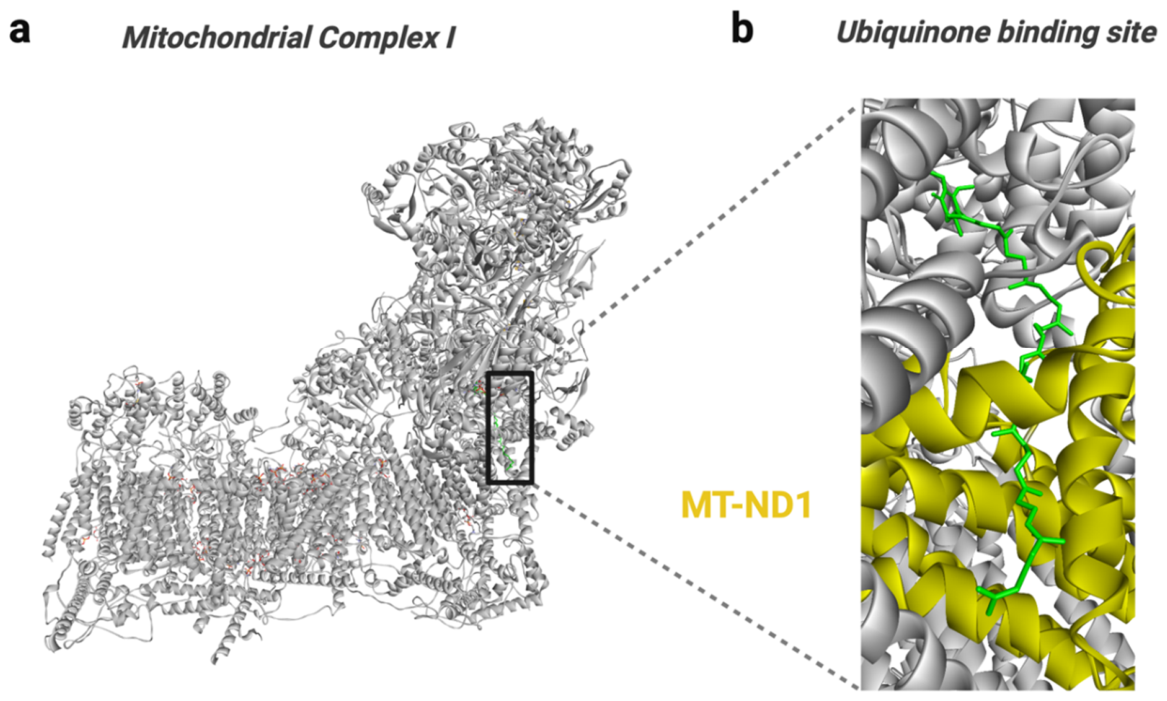
Figure 2.
A conserved cluster of methionine residues forms a redox-sensitive gatekeeping barrier at the entrance of the ubiquinone tunnel in mitochondrial Complex I. (a) Crystal structure of the entrance to the bovine Complex I ubiquinone tunnel occupied by a phenformin derivative (PDB: 7R45) [18]. (b) Cryo-EM structure of endogenous ubiquinone bound within the bovine Complex I ubiquinone-binding site (PDB: 7QSK) [37]. (c) Human MT-ND1 subunit within Complex I illustrates three methionine—Met17, Met21, and Met225—acting as gatekeepers for incoming molecules (PDB: 5XTD) [38]. (d) AlphaFold2 model of human MT-ND1 confirms the positioning of three methionine side chains at the cavity entrance (AF-P03886-F1).
Figure 2.
A conserved cluster of methionine residues forms a redox-sensitive gatekeeping barrier at the entrance of the ubiquinone tunnel in mitochondrial Complex I. (a) Crystal structure of the entrance to the bovine Complex I ubiquinone tunnel occupied by a phenformin derivative (PDB: 7R45) [18]. (b) Cryo-EM structure of endogenous ubiquinone bound within the bovine Complex I ubiquinone-binding site (PDB: 7QSK) [37]. (c) Human MT-ND1 subunit within Complex I illustrates three methionine—Met17, Met21, and Met225—acting as gatekeepers for incoming molecules (PDB: 5XTD) [38]. (d) AlphaFold2 model of human MT-ND1 confirms the positioning of three methionine side chains at the cavity entrance (AF-P03886-F1).
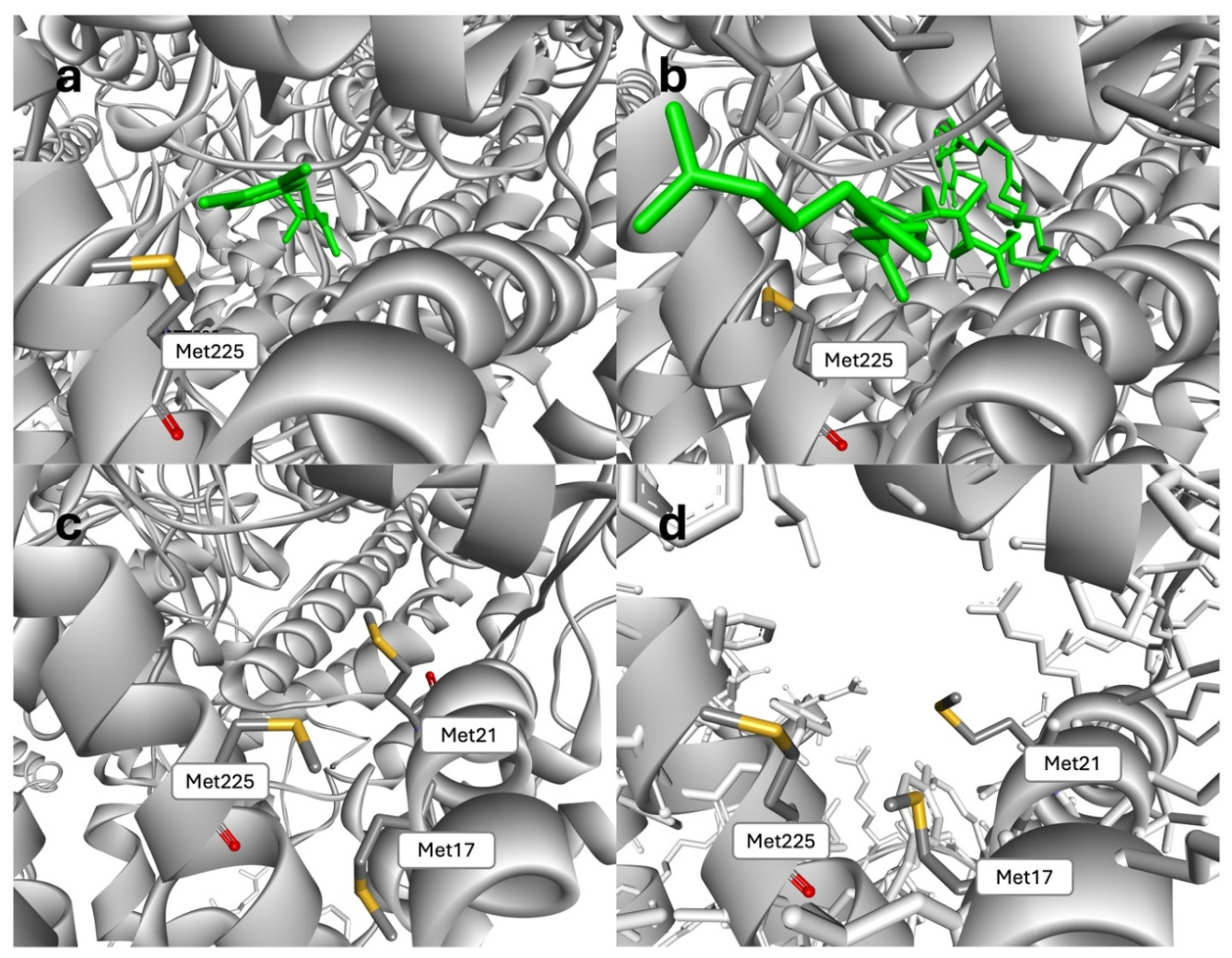
Figure 3.
Conceptual MT-ND1-centered redox-longevity model linking four clinical-stage candidates and metformin through putative mitochondrial interactions.
Conserved methionine residues in MT-ND1 may act as oxidation-sensitive gatekeepers of the Complex I ubiquinone access pathway. Oxidative conversion of methionine residues could disrupt ubiquinone access, promote electron leak and ROS production, and alter inhibitor binding. The proposed model provides a conceptual framework for understanding how structurally and pharmacologically diverse compounds may engage MT-ND1-associated mitochondrial pathways, with implications for drug development in ageing and chronic disease. In contrast, evolutionary convergence of long-lived vertebrate lineages on the MT-ND1 Val17/Thr21/Leu225 signature suggests positive selection for structural features that preserve efficient electron transfer, minimize oxidative stress, and support exceptional longevity. Representative AlphaFold2-predicted structures of MT-ND1 from human (AF-P03886-F1) and blue whale (AF-A0A343VMH3-F1). Abbreviations: MT-ND1, mitochondrially encoded NADH dehydrogenase 1; OXPHOS, oxidative phosphorylation; ROS, reactive oxygen species.
Figure 3.
Conceptual MT-ND1-centered redox-longevity model linking four clinical-stage candidates and metformin through putative mitochondrial interactions.
Conserved methionine residues in MT-ND1 may act as oxidation-sensitive gatekeepers of the Complex I ubiquinone access pathway. Oxidative conversion of methionine residues could disrupt ubiquinone access, promote electron leak and ROS production, and alter inhibitor binding. The proposed model provides a conceptual framework for understanding how structurally and pharmacologically diverse compounds may engage MT-ND1-associated mitochondrial pathways, with implications for drug development in ageing and chronic disease. In contrast, evolutionary convergence of long-lived vertebrate lineages on the MT-ND1 Val17/Thr21/Leu225 signature suggests positive selection for structural features that preserve efficient electron transfer, minimize oxidative stress, and support exceptional longevity. Representative AlphaFold2-predicted structures of MT-ND1 from human (AF-P03886-F1) and blue whale (AF-A0A343VMH3-F1). Abbreviations: MT-ND1, mitochondrially encoded NADH dehydrogenase 1; OXPHOS, oxidative phosphorylation; ROS, reactive oxygen species.
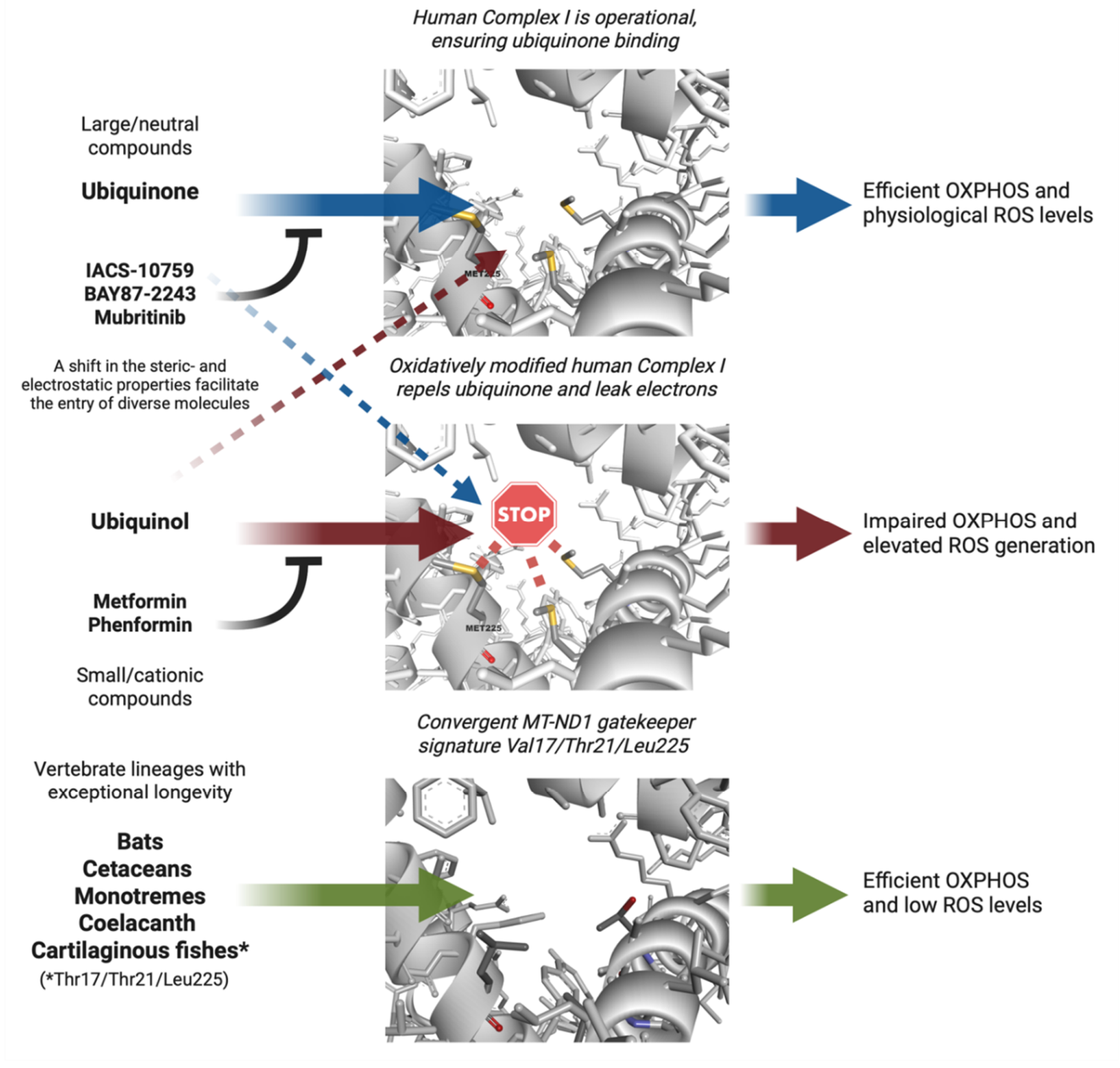

Table 1.
Evolutionary variation at MT-ND1 positions 17, 21, and 225.
The table summarizes the 60 species (out of 100 analyzed) that carry amino acid substitutions relative to the human MT-ND1 sequence at positions Met17/Met21/Met225. The recurrent Val17/Thr21/Leu225 signature was identified in multiple evolutionarily distinct vertebrate lineages. Sequence data were retrieved from UniProtKB/Swiss-Prot, and residue numbering follows the human MT-ND1 reference sequence (P03886).
Table 1.
Evolutionary variation at MT-ND1 positions 17, 21, and 225.
The table summarizes the 60 species (out of 100 analyzed) that carry amino acid substitutions relative to the human MT-ND1 sequence at positions Met17/Met21/Met225. The recurrent Val17/Thr21/Leu225 signature was identified in multiple evolutionarily distinct vertebrate lineages. Sequence data were retrieved from UniProtKB/Swiss-Prot, and residue numbering follows the human MT-ND1 reference sequence (P03886).
| UniProt | Species | Common Name | Met17/Met21/Met225 |
|---|---|---|---|
| HUMAN | Homo sapiens | Human | Met/Met/Met |
| EQUAS | Equus asinus | Donkey | Val/Thr/Leu |
| HORSE | Equus caballus | Horse | Val/Thr/Leu |
| PHOVI | Phoca vitulina | Harbor seal | Val/Thr/Leu |
| HALGR | Halichoerus grypus | Grey seal | Val/Thr/Leu |
| CANLU | Canis lupus | Gray wolf | Val/Thr/Leu |
| CANLF | Canis lupus familiaris | Domestic dog | Val/Thr/Leu |
| FELCA | Felis catus | Domestic cat | Val/Thr/Leu |
| TADIN | Tadarida insignis | Greater wrinkled bat | Val/Thr/Leu |
| HIPAE | Hipposideros armiger terasensis | Taiwanese great roundleaf bat | Val/Thr/Leu |
| HIPDI | Hipposideros diadema | Diadem roundleaf bat | Val/Thr/Leu |
| COEFR | Coelops frithii | East Asian tailless leaf-nosed bat | Val/Thr/Leu |
| TAPME | Taphozous melanopogon | Black-bearded tomb bat | Val/Thr/Leu |
| PHYEO | Phyllostomus elongatus | Lesser spear-nosed bat | Val/Thr/Leu |
| HSUTH | Hsunycteris thomasi | Thomas’s nectar bat | Val/Thr/Leu |
| BALPH | Balaenoptera physalus | Fin whale | Val/Thr/Leu |
| BALMU | Balaenoptera musculus | Blue whale | Val/Thr/Leu |
| DIAYO | Diaemus youngi | White-winged vampire bat | Val/Thr/Leu |
| EMBAL | Emballonura alecto | Small sheath-tailed bat | Val/Thr/Leu |
| NYCPV | Nyctalus plancyi velutinus | Velvety noctule | Val/Thr/Leu |
| NYCNO | Nyctalus noctula | Common noctule | Val/Thr/Leu |
| CNENI | Cnephaeus nilssonii | Northern bat | Val/Thr/Leu |
| MURFL | Murina florium | Flores tube-nosed bat | Val/Thr/Leu |
| MURSU | Murina suilla | Lesser tube-nosed bat | Val/Thr/Leu |
| PHATE | Phataginus tetradactyla | Long-tailed pangolin | Val/Thr/Leu |
| DASKA | Dasypus kappleri | Greater long-nosed armadillo | Val/Thr/Leu |
| DASNO | Dasypus novemcinctus | Nine-banded armadillo | Val/Thr/Leu |
| MYRTR | Myrmecophaga tridactyla | Giant anteater | Val/Thr/Leu |
| CYCDI | Cyclopes didactylus | Silky anteater | Val/Thr/Leu |
| PERGU | Perameles gunnii | Eastern barred bandicoot | Val/Thr/Leu |
| OSPRO | Osphranter robustus | Wallaroo | Val/Thr/Leu |
| OSPRU | Osphranter rufus | Red kangaroo | Val/Thr/Leu |
| NOTEU | Notamacropus eugenii | Tammar wallaby | Val/Thr/Leu |
| VOMUR | Vombatus ursinus | Common wombat | Val/Thr/Leu |
| TRIVU | Trichosurus vulpecula | Common brushtail possum | Val/Thr/Leu |
| SMIMA | Sminthopsis macroura | Stripe-faced dunnart | Val/Thr/Leu |
| SMICR | Sminthopsis crassicaudata | Fat-tailed dunnart | Val/Thr/Leu |
| SARHA | Sarcophilus harrisii | Tasmanian devil | Val/Thr/Leu |
| MONDO | Monodelphis domestica | Gray short-tailed opossum | Val/Thr/Leu |
| PHACI | Phascolarctos cinereus | Koala | Val/Thr/Leu |
| NOTTY | Notoryctes typhlops | Southern marsupial mole | Val/Thr/Leu |
| DIDVI | Didelphis virginiana | Virginia opossum | Val/Thr/Leu |
| ORNAN | Ornithorhynchus anatinus | Platypus | Val/Thr/Leu |
| TACAC | Tachyglossus aculeatus aculeatus | Short-beaked echidna | Val/Thr/Leu |
| ZAGBR | Zaglossus bruijni | Western long-beaked echidna | Val/Thr/Leu |
| SQUAC | Squalus acanthias | Spiny dogfish | Thr/Thr/Leu |
| SCYCA | Scyliorhinus canicula | Small-spotted catshark | Thr/Thr/Leu |
| CARAU | Carassius auratus | Goldfish | Val/Thr/Leu |
| CYPCA | Cyprinus carpio | Common carp | Val/Thr/Leu |
| SALSA | Salmo salar | Atlantic salmon | Val/Thr/Leu |
| ONCMY | Oncorhynchus mykiss | Rainbow trout | Val/Thr/Leu |
| FORLA | Formosania lacustris | Lake sucker loach | Val/Thr/Leu |
| TETNG | Tetraodon nigroviridis | Green spotted puffer | Val/Thr/Leu |
| DANRE | Danio rerio | Zebrafish | Val/Thr/Leu |
| LATCH | Latimeria chalumnae | West Indian Ocean coelacanth | Val/Thr/Leu |
| CHICK | Gallus gallus | Red junglefowl | Val/Thr/Leu |
| EXCCH | Excalfactoria chinensis | King quail | Val/Thr/Leu |
| COTJA | Coturnix japonica | Japanese quail | Val/Thr/Leu |
| STRCA | Struthio camelus | Common ostrich | Val/Thr/Leu |
| VARRU | Varanus rudicollis | Black rough-necked monitor | Val/Thr/Leu |
| THYAR | Thymallus arcticus | Arctic grayling | Val/Thr/Leu |
| VARDU | Varanus dumerilii | Dumeril’s monitor | Val/Thr/Leu |
Table 2.
Longevity and cancer-resistance characteristics of species carrying the Val17/Thr21/Leu225 signature.
Species carrying the Val17/Thr21/Leu225 amino acid signature were identified from UniProtKB/Swiss-Prot and evaluated for reported lifespan and evidence of cancer resistance. Several phylogenetically distant taxa, including bats, cetaceans, monotremes, coelacanth, and cartilaginous fishes, exhibit exceptional longevity and reduced cancer susceptibility.
Table 2.
Longevity and cancer-resistance characteristics of species carrying the Val17/Thr21/Leu225 signature.
Species carrying the Val17/Thr21/Leu225 amino acid signature were identified from UniProtKB/Swiss-Prot and evaluated for reported lifespan and evidence of cancer resistance. Several phylogenetically distant taxa, including bats, cetaceans, monotremes, coelacanth, and cartilaginous fishes, exhibit exceptional longevity and reduced cancer susceptibility.
| Clade | Species (n) | Repr. taxa | Evolutionary position | Longevity signal | Cancer-resistance signal | Relevance for comparative genomics | |
|---|---|---|---|---|---|---|---|
| Chiroptera (Bats) | 14 | Nyctalus, Murina, Diaemus, Tadarida | Eutherian mammals | ★★★★★ | ★★★★★ | Strongest longevity outliers among mammals; prime candidates for DNA repair, immune regulation, mitochondrial resilience, and cancer-resistance studies [39,40] | |
| Cetacea (Whales) | 2 | Blue whale, Fin whale | Eutherian mammals | ★★★★★ | ★★★★★ | Classical example of Peto’s paradox; large body size and long lifespan with unexpectedly low cancer burden [41] | |
| Monotremata | 3 | Platypus, Echidnas | Basal mammals | ★★★★☆ | ★★★☆☆ | Ancient mammalian lineage with extended lifespan and slow life-history traits [42] | |
| Coelacanthiformes | 1 | Latimeria chalumnae | Ancient vertebrate | ★★★★☆ | ★★☆☆☆ | Evolutionary outgroup; useful for identifying deeply conserved vertebrate longevity pathways [43] | |
|
Chondrichthyes Thr17/Thr21/Leu225 |
2 | Spiny dogfish, Catshark | Cartilaginous fishes | ★★★★☆ | ★★★☆☆ | Long-lived vertebrates with distinctive genome biology and low documented cancer incidence [44] | |
| Aves (Birds) | 4 | Ostrich, Chicken, Quails | Avian lineage | ★★★☆☆ | ★★★☆☆ | Birds often exceed mammalian lifespan predictions based on body size [45] | |
| Marsupialia | 13 | Koala, Kangaroo, Tasmanian devil | Pouched mammals | ★★☆☆☆ | ★★★☆☆ | Generally low cancer prevalence; carnivorous Dasyuridae, including Tasmanian devil, exhibit elevated cancer incidence [46,47] | |
| Xenarthra | 4 | Armadillos, Anteaters | Placental mammals | ★★☆☆☆ | ★★☆☆☆ | Understudied lineage with unusual physiology and potentially informative aging biology [48] | |
| Perissodactyla | 2 | Horse, Donkey | Eutherian mammals | ★★☆☆☆ | ★★☆☆☆ | Useful comparison group with typical large-mammal lifespan characteristics [49] | |
| Actinopterygii (Teleost fishes) | 8 | Zebrafish, Carp, Salmon | Ray-finned fishes | ★★☆☆☆ | ★★☆☆☆ | Widely used experimental and genomic models, but generally not characterized by exceptional longevity [50] | |
| Carnivora | 4 | Dog, Cat, Seals | Eutherian mammals | ★★☆☆☆ | ★☆☆☆☆ | Useful reference group; domestic dogs exhibit relatively high cancer incidence [51] | |
| Pholidota | 1 | Long-tailed pangolin | Eutherian mammals | ? | ? | Understudied lineage with limited longevity and cancer data | |
| Reptilia | 2 | Monitor lizards | Amniote vertebrates | ? | ? | Phylogenetically informative reptilian comparison group with limited data on longevity and cancer susceptibility |
Disclaimer/Publisher’s Note: The statements, opinions and data contained in all publications are solely those of the individual author(s) and contributor(s) and not of MDPI and/or the editor(s). MDPI and/or the editor(s) disclaim responsibility for any injury to people or property resulting from any ideas, methods, instructions or products referred to in the content. |
© 2026 by the authors. Licensee MDPI, Basel, Switzerland. This article is an open access article distributed under the terms and conditions of the Creative Commons Attribution (CC BY) license (http://creativecommons.org/licenses/by/4.0/).
Copyright: This open access article is published under a Creative Commons CC BY 4.0 license, which permit the free download, distribution, and reuse, provided that the author and preprint are cited in any reuse.