

Submitted:
14 September 2026
Posted:
15 September 2026
You are already at the latest version
Abstract
Affordances in ecological psychology are relational properties of organism–environment systems, yet their quantitative characterization remains an open problem. Shannon information theory measures uncertainty and statistical dependence but does not by itself specify what environmental structure means for an acting organism. This article proposes a limited operational bridge between the two frameworks by treating Gibsonian specification as a relation to be quantified, rather than identifying it with Shannon entropy. Let A denote a locomotor affordance, such as stable continuation of walking, and let S denote a screw-structured haptic state derived from the coupled motion and loading of the body–environment system. The central quantities are the conditional distribution p(A | S), the residual conditional entropy H(A | S), and the mutual information I(A;S) = H(A)−H(A | S): stronger ecological specification corresponds to lower residual uncertainty and greater mutual information. Screw theory supplies the mechanical geometry through twists, helical axes, pitch, Plücker coordinates, and reciprocal screw conditions, including the projective reciprocity condition (K1 + K2) sinϕ + d cosϕ = 0. We hypothesize that screw-structured representations preserve affordance-relevant information more efficiently than Cartesian kinematics, yielding lower H(A | Sscrew) and higher I(A;Sscrew). A single-case gait demonstration and an explicit estimation protocol support the framework as a testable basis for quantifying ecological specificity in stable gait, perturbation, recovery, and fall-risk analysis.
Keywords:
affordance
; mutual information
; conditional entropy
; haptic flow
; screw theory
; gait
1. Introduction
James J. Gibson’s ecological approach treats perception as the detection of lawful structure in the organism–environment relation rather than as the reconstruction of an external world from internally ambiguous sensory messages. In this framework, an affordance is not a property of the environment alone and not a property of the organism alone; it is a relational possibility for action. A support surface may afford walking for one organism under one set of bodily and environmental conditions while failing to afford the same action under another. The theoretical strength of the concept is precisely this relational character. Its quantitative weakness is equally clear: ecological psychology does not, by itself, provide a generally accepted scalar measure of how strongly a measured environmental or mechanical variable specifies an affordance.
Shannon’s mathematical theory of communication addresses a different problem. Entropy quantifies uncertainty within a probability distribution, conditional entropy quantifies the uncertainty that remains about one variable after another is known, and mutual information quantifies the statistical dependence shared by two variables. These quantities are indifferent to ecological meaning. They can measure whether two variables are statistically informative about one another, but they cannot determine which relation is functionally relevant to an acting organism. Consequently, Shannon information and Gibsonian information should not be treated as interchangeable definitions. A more productive reconciliation assigns them different roles: ecological theory identifies the organism–environment relation that is hypothesized to specify action, whereas information theory quantifies the selectivity and uncertainty of that relation.
This division of labor motivates a probabilistic operationalization of affordance specificity. Let A denote a locomotor affordance and S a measured organism–environment state. For a binary example, A may indicate whether stable walking can be successfully continued over a short prediction horizon. The conditional distribution
then represents the empirical relation between the measured state and the subsequent action outcome. Importantly, the affordance itself is not identified with a probability. Rather, probability quantifies the evidence that a specified organism–environment state is associated with a particular action possibility. The residual uncertainty after observing S is
and the reduction in uncertainty supplied by S is expressed by the mutual information
Within this operational framework, ecological specification is stronger when is smaller and is larger. The limiting case represents perfect statistical specification within the defined experimental probability space; it should not be interpreted as zero neural activity, zero thermodynamic entropy, or proof that an organism internally computes probabilities.
The remaining question is how the organism–environment state S should be represented. Conventional gait analysis commonly describes locomotion using Cartesian trajectories, segment angles, joint angles, and force magnitudes. These variables are useful but do not necessarily encode the coupled rotational–translational geometry of rigid-body interaction in its most direct form. Screw theory provides an alternative representation. A rigid-body velocity can be expressed as a twist combining angular and linear velocity, while finite displacement can be represented by a finite helical axis. Force and moment are represented dually as a wrench. The corresponding Plücker coordinates preserve line geometry, and pitch characterizes the coupling between translation and rotation. These quantities therefore offer a natural language for describing haptic flow as structured mechanical information generated by the interaction of the moving body with its support environment.
Projective reciprocity provides a particularly important geometric candidate for such ecological structure. In classical screw theory, two screw systems are reciprocal when their mutual virtual coefficient vanishes. Jessop’s projective treatment of two linear complexes yields the corresponding involution condition
where and are pitch-like chief parameters, is the angle between the two axes, and d is their shortest spatial separation. Equation (4) expresses compatibility as a balance among screw pitch, orientation, and spatial offset rather than as the independent control of isolated coordinates. In a locomotor context, the interacting systems may represent segmental motion screws, a knee helical axis, and a ground-reaction constraint. The reciprocal relation thus supplies a mechanically grounded candidate specifying variable for body–environment compatibility.
Our previous posture–touch formulation used reciprocal screw geometry to construct a conditional compatibility distribution between knee finite-helical-axis lines and synchronized ground-reaction-force lines. Cross-entropy quantified whether the synchronized touch state was preferred over counterfactual temporal alternatives, while absolute reciprocal separation quantified departure from the geometric condition. That analysis established an operational bridge between ecological covariation and Shannon uncertainty, but it did not yet quantify the affordance itself. The present formulation moves one level upward: from asking whether posture specifies synchronized touch to asking whether screw-structured haptic information specifies a future locomotor possibility.
The central hypothesis is that representations respecting the mechanics of rigid-body interaction will contain greater affordance-relevant information than unconstrained coordinate descriptions. Let denote a screw-structured haptic representation and a conventional Cartesian representation derived from the same movement. We propose the testable inequalities
and, equivalently,
provided that the screw variables genuinely capture structure specific to the locomotor affordance. These inequalities are hypotheses rather than assumed properties of screw coordinates and must be evaluated using independent trials and explicitly defined behavioral outcomes.
The purpose of this study is therefore to develop an information-theoretic framework for quantifying locomotor affordances from screw-structured haptic flow. The framework has three levels. First, ecological theory defines the action possibility and identifies candidate specifying organism–environment variables. Second, screw theory supplies a geometric representation of the mechanical relation through twist, pitch, helical-axis, and reciprocal-screw structure. Third, Shannon measures—principally conditional entropy and mutual information—quantify how selectively that structure predicts the realized affordance. Cross-entropy and Kullback–Leibler divergence are reserved for model fitting and distributional comparison rather than being treated as definitions of ecological information. This separation preserves the conceptual distinction between Gibsonian specification and Shannon uncertainty while making their relationship experimentally testable in stable walking, perturbation, recovery, and fall-risk paradigms.
2. Theoretical Framework
2.1. Affordances as Relational Action Possibilities
Gibson’s ecological approach defines an affordance as what the environment offers the animal, what it provides or furnishes, either for good or ill [1]. The definition is deliberately relational. An affordance is not a subjective projection of the perceiver, nor is it an intrinsic physical property of the environment that exists independently of the animal. Whether a surface affords walking, grasping, or sitting depends jointly on properties of the environment and on the action capabilities of the organism. Gibson’s earlier treatment of perceptual systems likewise emphasized that perceptual information is picked up by an active organism from ambient energy distributions structured by the organism–environment relation [2].
This relational character has a consequence that is often underappreciated in quantitative treatments: the information that specifies an affordance cannot, in general, be located in either the organism or the environment considered separately. Eleanor Gibson asked directly where the information for affordances is to be found, and answered that it resides in events—in the dynamic relations between the perceiver and the environment [3]. The subsequent ecological literature on specificity developed this insight into the claim that ambient structure can be specific to affordances in virtue of lawful organism–environment relations rather than in virtue of resemblance or inference [4,5,6]. Specificity, in this usage, is a hypothesis about the selectivity of a natural relation: the measured structure is supposed to be tied to the action possibility in a way that is unique rather than ambiguous.
The framework developed below accepts this relational and specificity-based reading of affordances. It then asks a deliberately narrow question: once an organism–environment state variable hypothesized to specify a locomotor affordance has been identified, how strongly and how selectively does it specify the affordance? We argue that conditional entropy and mutual information are the appropriate tools for this question, provided that ecological theory retains responsibility for defining the variables and that Shannon measures are not mistaken for definitions of ecological information.
2.2. From Binary Possibilities to Probabilistic Affordances:
A classical line of affordance research treats action possibilities as body-scaled categories: an aperture affords passage or it does not, a stair riser affords climbing or it does not. Experimental work on development and decision making, however, showed that successful action is better described as a graded, body-scaled function than as a sharp category. Franchak and Adolph argued that affordances are probabilistic functions whose values depend continuously on the ratio of relevant body and environmental dimensions, and that perceivers’ decisions reflect these probabilities rather than binary thresholds [7].
The probabilistic reading supplies the distributional object required by information theory. Let A denote the affordance variable—a discrete set of action possibilities or outcomes—and let S denote a measured organism–environment state. The conditional distribution represents the empirical relation between the state and the subsequent action outcome. Two interpretive commitments must be kept explicit. First, the affordance is not identified with a probability: the probability quantifies the evidence that a specified organism–environment state is associated with a particular action possibility, within an explicitly defined experimental probability space. Second, the use of a conditional distribution is an operationalization of specificity, not a claim that the organism internally computes probabilities or performs inference. The framework therefore remains compatible with direct perception, because the quantities are defined over measured organism–environment relations rather than over internal representations [1,8].
2.3. Conditional Entropy as Residual Affordance Uncertainty
Given the conditional distribution , the residual uncertainty about the affordance after the state has been observed is the conditional entropy
where is the entropy of the conditional distribution at state s, and the outer average weights each state by its empirical frequency [9,10]. The units follow the logarithm base: bits for base 2 and nats for base e; both conventions appear in the literature, and we report both where comparison is useful. The marginal entropy measures uncertainty about the affordance before the state is known, and the chain rule
makes conditional entropy the rigorous expression of “uncertainty about A once S is given.”
Within the operational framework, is the measure of residual affordance uncertainty. Ecological specification is stronger when is smaller: the state narrows the set of action possibilities that remain consistent with observation. The limiting case means that the state determines the affordance outcome almost surely within the experimental probability space. This limit is a statement about statistical dependence, not about physiology; it neither implies zero neural variability nor identifies ecological information with thermodynamic entropy.
Two estimation issues matter for practice. Plug-in estimation of discrete entropies is biased downward for finite samples, and classical corrections such as the Miller–Madow adjustment compensate the leading bias term [11]. More importantly, locomotor time series are strongly autocorrelated, so consecutive frames do not constitute independent samples of the joint distribution; effective sample sizes are therefore much smaller than frame counts, and any empirical must be interpreted as an estimate whose precision depends on trial structure rather than frame count. These caveats do not invalidate the definitions, but they discipline the empirical claims that can be drawn from them.
2.4. Mutual Information as a Measure of Ecological Specificity
The reduction of uncertainty about A supplied by S is the mutual information
which is nonnegative, symmetric, and zero if and only if A and S are statistically independent [9,10]. Equation (9) gives mutual information its central interpretation in this framework: is the average number of units by which observation of the screw-structured haptic state reduces uncertainty about the locomotor affordance, relative to the prior uncertainty . A state that specifies the affordance perfectly yields ; a state independent of the affordance yields .
Mutual information is the headline quantity of this paper because it is a bounded, comparator-friendly measure of specificity. Unlike correlation, it detects arbitrary statistical dependence, including nonlinear and multimodal relations; unlike regression error, it does not presume a functional form. Its principal limitation must be stated with equal force: mutual information is indifferent to ecological meaning. A variable can carry arbitrarily high mutual information with an outcome for reasons that are mechanically or behaviorally irrelevant. Information theory therefore quantifies the selectivity of a relation whose functional relevance has been established on independent, ecological grounds. This division of labor—ecological theory identifies the relation, information theory measures its selectivity—is the core methodological proposal of the paper.
The use of mutual information in the affordance literature is still sparse. Gupta and Bahmer argued that increases in mutual information between neural circuits during organism–environment interaction reflect increased certainty about environmental opportunities for action, and included an explicit treatment of affordance and mutual information [12]. Talaga proposed a formalization of affordances as semantic information in which entropy and mutual information play a central role [13]. Neither work, however, quantifies the mutual information between a locomotor affordance and a screw-theoretic representation of haptic flow, nor compares such a representation against conventional kinematic coordinates. That comparison is the distinctive contribution proposed here.
2.5. Screw-Structured Haptic Flow: Twists, Pitch, and Helical Axes
The state S must be represented in a form that respects the mechanics of rigid-body interaction. Screw theory provides such a representation. A rigid-body velocity is a twist combining angular velocity and linear velocity of a point on the body; a finite displacement is a finite helical motion about a screw axis [14,15,16,17]. The pitch
measures the ratio of translation to rotation about the instantaneous screw axis (ISA) and is the basic scalar invariant of the motion [18,19,20]. Lines are most naturally expressed in Plücker coordinates with unit direction and moment , where is the point of the line nearest the origin; the duality of force and motion appears as the wrench [21,22].
Haptic flow is defined as the time-evolving field of admissible screws
where is the quadratic pitch form with Klein matrix , so that the zero-pitch quadric selects the pure-rotation (zero-pitch) constraint manifold [19,23]. Equation (11) is the screw-space analogue of optic flow: a projective field of admissible velocities structured by constraints, generated by the moving body in contact with its support environment. The information-theoretic reading proposed here treats not merely as a kinematic description but as the candidate specifying variable S for locomotor affordances.
2.6. Reciprocity, Involution, and Harmonic Structure
Among the structures available within haptic flow, reciprocity occupies a special place because it expresses mechanical compatibility directly. Two screws are reciprocal when their mutual virtual coefficient—the Klein product of their twists—vanishes, equivalently when the virtual power exchanged between them is zero [14,24]. For two lines in Plücker coordinates the Klein product is
which vanishes exactly when the lines are reciprocal. Jessop’s projective treatment of two linear complexes shows that the involution condition takes the geometric form already given in Equation (4): pitch-like chief parameters, angular separation, and shortest spatial offset must balance exactly [25]. The derivation is reproduced in Appendix A.
Two further structures complete the geometric picture. First, the screws reciprocal to two given screws form a one-parameter family, the cylindroid, whose geometry was constructed by Lewis and placed at the center of screw theory by Ball [14,18,26]. Second, intersecting the cylindroid with the quadratic pitch constraint yields in general exactly two admissible screws, whose parameters solve ; the mean progression screw and the GRF-associated screw then stand in harmonic division , and their cross-ratio is a projective invariant of the motion [19,23]. In the knee-gait application, the two admissible screws play the role of a structured set of action alternatives: the mechanical state at each instant selects, within a two-dimensional projective family, the screws compatible with continued stable progression. This structured-alternatives interpretation is what makes the screw representation a natural state space for the entropy quantities of Section 2.3Section 2.4: entropy is computed over a set of alternatives whose geometry is itself mechanically meaningful.
2.7. Central Hypotheses: Screw versus Cartesian Representations
The framework yields two falsifiable hypotheses. Let denote a screw-structured haptic state built from twists, pitch, helical axes, and reciprocal-separation variables, and let denote a conventional Cartesian representation—segment marker coordinates, joint angles, and force magnitudes—derived from the same measured movement. For a defined affordance variable A, we hypothesize
and, equivalently,
provided that the screw variables genuinely capture structure specific to the locomotor affordance. The equivalence follows from Equation (9) because both representations are evaluated against the same A and hence the same .
Three operational requirements make the hypotheses testable. (i) The comparison must use independent trials, not frames within a single autocorrelated trial, so that empirical distributions approximate the underlying joint distribution. (ii) The estimator, discretization, and bias correction must be identical across representations, so that differences reflect representational content rather than estimator artifacts. (iii) Statistical significance must be assessed against a null that preserves autocorrelation, such as circular or block shuffles, rather than an independent-resampling null. The demonstration in Section 4 applies this protocol at the level of the available single-case data and states explicitly which conclusions are and are not supported.
3. Materials and Methods
3.1. Dataset and Synchronization
The empirical base is the Grand Challenge Competition to Predict In Vivo Knee Loads dataset hosted on SimTK [27,28,29]. The dataset contains a single overground straight-line walking trial from an adult male subject with a force-measuring tibial prosthesis following total knee arthroplasty: three thigh and three shank retro-reflective markers, ground-reaction force (GRF), and instrumented medial and lateral tibial contact forces sampled at 200 Hz. The screw-based posture channel (knee finite helical axis) and the touch channel (GRF line) were synchronized frame by frame, and synchronized posture–touch pairs spanning the stance phase were used for the conditional analysis, beginning at the first knee-transition index; no interpolation, time warping, or resampling was applied. The data are publicly available and de-identified; ethics statements are therefore not applicable to this secondary analysis.
3.2. Screw Extraction and Plücker Line Representation
Segment rotations between consecutive frames ( ms) were estimated by the Kabsch singular value decomposition, which yields the least-squares rigid rotation between two marker configurations, with the reflection correction of Umeyama [30,31]. The finite helical axis (FHA) of the knee was reconstructed from the relative thigh–shank rotation by the eigenscrew (GEN2) method, a standard construction in three-dimensional gait analysis [22,32,33,34]; the rotation angle follows from and the screw pitch from Equation (10) applied to the full twist. Both the knee FHA and the GRF line were expressed as normalized Plücker lines with , discarding magnitude information so that all relations are projective, as required by the reciprocity geometry [21].
The Klein product of Equation (12) between the knee-axis line and the GRF line measures reciprocal compatibility, and the signed line separation
converts the product into a distance-like quantity (mm) that vanishes with the virtual coefficient. Because the archived dataset does not record the absolute laboratory location of the force plate, the initial offset between the two line families is unknown; a single unconstrained translation of the knee-axis family was therefore estimated as a coordinate boundary condition by ordinary least squares,
where is the moment after the adjoint translation. This translation registers the two line families in a common frame; it is a property of the coordinate setup, not of anatomy.
3.3. Defining the Affordance Variable A
The affordance variable A must be defined experimentally before any entropy is computed. In the general protocol, indicates whether stable walking is successfully continued over a fixed prediction horizon following the observation of S; richer codings (multi-phase stance, recovery after perturbation, slip versus stable contact) are straightforward extensions. The variable is an operational property of the organism–environment system measured in a defined task space; it is not a claim about the subject’s internal state. In the single straight-line trial available here, A is effectively constant, so the demonstration reports the conditional structure of the specifying state itself—the distribution of synchronized touch states given posture—and reserves outcome-labeled estimation of and for multi-trial perturbation datasets, for example slip–fall paradigms in which stable and failed continuations are both observed [35,36].
3.4. Estimation of and
Two estimation routes are distinguished. The discrete route bins the screw features—pitch of Equation (10), reciprocal separation of Equation (15), and the direction angle between the two axes—into equal-frequency bins, forms plug-in estimates of , , and , and applies the Miller–Madow correction with an effective sample size reflecting autocorrelation [10,11]. The continuous route models the conditional distribution parametrically through Gaussian affinities
define a conditional model q over touch states given the posture state, with scale calibrated from the registered residuals. The entropy of this conditional model,
is a continuous analogue of conditional entropy, and the effective number of compatible alternatives expresses residual uncertainty on a natural scale. For continuous variables without a parametric model, k-nearest-neighbor estimators of mutual information [37] provide the nonparametric alternative. All information quantities in this paper are reported in nats unless stated otherwise.
3.5. Circular-Shift Null Model and Statistical Audit
Autocorrelated gait data make independent-resampling null models invalid, because shuffling destroys the smoothness that any smooth representation would exploit. The audit therefore uses circular shifts: the touch channel is shifted by k frames (), the translation and scale are refitted for each shift, and the information quantity is recomputed. The observed (zero-shift) statistic is ranked against the shift distribution, and the rank-based p-value is the fraction of shifts at least as extreme as the observation. For outcome-labeled trials, the same logic applies to and through block shuffles or stationary bootstrap resampling that preserve within-trial dependence [10].
4. Results
4.1. Screw-Structured State versus Cartesian Representation
The screw-structured description of the trial is summarized first because it defines the state space over which the information quantities are computed. The extracted segmental screws and the knee FHA form organized families rather than scattered axes: the shank ISA is tightly concentrated near a fixed axis with pitch confined to a narrow band, the thigh ISA covers a broader region with predominantly negative pitch, and the knee FHA migrates through stance with pitch rising to a mid-stance maximum and returning toward zero at terminal stance. In the single-case analysis of this trial reported in our preceding screw-theoretic studies, segment pitches ranged from to mm/rad (thigh), to mm/rad (shank), and to mm/rad (knee) over the stance phase [19,23]. The harmonic structure of the motion—the harmonic pencil formed by the mean progression screw, the GRF-associated screw, and the two admissible screws obtained from each cylindroid–quadric intersection—was likewise consistent with the organized-admissible-set picture of Section 2.4 [23].
Reciprocity against the ground constraint was not incidental to this organization. In the same preceding analysis, the Klein-normalized reciprocity index between the knee ISA and the GRF line averaged approximately , against a random-cylindroid null of approximately [19,23]. Figure 1 shows the harmonic–polar geometry relating the knee axis and the GRF constraint; Figure 2 shows the zero-pitch cylindroid structure from which the admissible screws are selected; Figure 3 shows the extracted knee ISA family with the GRF vectors; and Figure 4 shows the segment pitch evolutions.
4.2. Conditional Entropy of Locomotor Outcomes
Registration of the two line families by the boundary translation of Equation (16) reduced the median posture–touch separation from mm to mm (mean mm, RMS mm, maximum mm; of frames below 20 mm). The calibrated scale mm then defined the Gaussian compatibility model of Equation (17) over the synchronized pairs. Figure 5 shows the registered line families, and Figure 6 shows the time course of the Klein residual, the separation, and the direction angle between the axes.
The entropy of the conditional model, Equation (18), was
corresponding to an effective number of compatible alternatives
out of candidates. Read through the framework of Section 2.3, this is the residual-uncertainty statement at the level of the specifying state available in this dataset: given the knee-axis posture state, the synchronized ground-contact state is confined, on average, to the neighborhood of roughly one-sixth of the candidate set, rather than being spread uniformly over all 120 alternatives. Table 1 summarizes the information quantities.
4.3. Mutual Information: Screw versus Cartesian
For the one-hot synchronized target, the cross-entropy decomposes exactly as
because [10], and the observed value was
meaning that the typical surprisal of the true synchronized touch state under the reciprocal-compatibility model corresponds to an effective set of about 20 candidates. Measured against the uniform reference nats, the descriptive specificity gain is
We stress that is a descriptive reciprocal information-gain score computed from the empirical conditional distribution of this single trial; because adjacent frames are autocorrelated, it must not be read as a formal mutual-information lower bound or as an InfoNCE estimator [11].
The screw-versus-Cartesian comparison of Equations (5) and (6) was therefore implemented at the level supported by the data: the screw representation enters through the reciprocal-separation geometry of Equations (12)–(16), while the Cartesian baseline is formed from the same frames using coordinate magnitudes (marker positions, joint angles, force components) that ignore line geometry. The observed gap between the reciprocity-index statistics of the screw representation () and its random-cylindroid null () shows that the screw state carries organized dependence on the ground constraint that a magnitude-only description does not register [19,23]. A fully definitive estimate of requires outcome-labeled independent trials, as specified in Section 2.3; the present results establish the conditional structure and the estimation protocol that such a comparison will use. Figure 7 shows the surprisal structure of the compatibility matrix and the information metrics.
4.4. Null-Model Audit
The circular-shift audit provides the statistical anchor. Across the 119 nonzero shifts, with the translation and scale refitted per shift, the null cross-entropy averaged nats (range –); the observed zero-shift value nats lay below every shifted value, giving a rank-based and a gap of nats to the null mean (Table 1). Because shifting preserves the autocorrelation of each channel, the audit shows that the specificity of the synchronized state exceeds what smoothness alone could produce: counterfactual temporal alignments of the same two signals are decisively less compatible. Translated into the vocabulary of this paper, the audit is exactly the null-model procedure required for and in Section 3.5: an estimator that cannot beat an autocorrelation-preserving null cannot support a specificity claim.
5. Discussion
5.1. Specificity as a Quantified Relation, Not an Identity
The framework’s central methodological commitment is that Gibsonian specification and Shannon uncertainty answer different questions and must not be collapsed into one another. Ecological theory identifies which organism–environment relation is hypothesized to specify an affordance; information theory then measures how selectively that relation constrains the outcome. The distinction protects both frameworks from a category error. If ecological information were simply equated with entropy, the theory would inherit all of Shannon’s indifference to meaning; if Shannon measures were rejected as irrelevant, the field would lose its only rigorously founded, representation-comparable calculus of uncertainty. The conditional-distribution construction , with and derived from it, occupies the narrow operational ground between these two failures. The same bridge, not identity, position underlies the posture–touch analysis reported in Section 4 and is here retained one level higher, at the affordance variable itself.
5.2. Relation to the Previous Cross-Entropy Formulation
The present framework extends, rather than replaces, the posture–touch compatibility analysis reported in Section 4. That analysis supplies three reusable elements: the Plücker line representation of posture and touch channels; the Gaussian compatibility model with its calibrated scale ; and the circular-shift audit against autocorrelation-preserving nulls. The exact one-hot identity of Equation (21) now does double duty: it connects the descriptive gain of Equation (23) to the language of information, while the separation between model entropy and cross-entropy carries over unchanged. What is new is the upward move from “does posture specify synchronized touch?” to “does the screw-structured haptic state specify a locomotor possibility?”—that is, from a compatibility relation between two measured channels to a prediction relation between a measured state and a defined action outcome. Conditional entropy and mutual information, rather than cross-entropy, headline the new formulation because they are defined relative to the affordance variable A rather than to a one-hot synchronization target.
5.3. Haptic Flow, Reciprocity, and Harmonic Structure
The screw-theoretic content of S is not decoration; it is the source of the hypotheses’ falsifiability. Haptic flow, as the field of admissible screws of Equation (11), provides a state space whose geometry is mechanically constrained; reciprocity, as the vanishing of the Klein product of Equation (12), provides a compatibility condition with a direct virtual-power meaning; and the harmonic–polar structure provides a small, organized set of alternatives over which uncertainty can be computed meaningfully [19,23]. This last point deserves emphasis: entropy is only as informative as the alternative set over which it is defined. A Cartesian coordinate description supplies an enormous, unconstrained alternative set in which most points are mechanically meaningless, whereas the cylindroid–quadratic construction supplies exactly the admissible screws, so that changes in entropy track changes in real mechanical options. A slip or trip, on this view, should appear as a breakdown of harmonic structure—rising conditional entropy of the outcome and falling mutual information—which makes the slip–fall transition a natural first application of the framework [35,36]. The same organized-alternatives logic underlies coordination analyses based on motor synergies, in which task-relevant variance is separated from task-irrelevant variance within a structured solution space [38,39].
5.4. Limitations and Future Work
Four limitations bound the present claims. First, the empirical demonstration is a single-case, single-trial secondary analysis; its information quantities are in-sample descriptive statistics, and no population-level or even trial-level generalization is licensed. Second, adjacent frames are autocorrelated, so frame counts overstate effective sample sizes and plug-in information estimates carry biases that the Miller–Madow correction only partially addresses; the shift audit mitigates but does not eliminate this issue [11]. Third, the boundary translation estimated in Equation (16) is a coordinate boundary condition of the archived dataset, not an anatomical or perceptual quantity, and results that depend on it must be replicated with absolute force-plate registration. Fourth, the affordance variable in the available data is effectively constant, so and are demonstrated through the conditional structure of the specifying state rather than through outcome-labeled prediction.
The research program these limitations define is concrete. Multi-trial perturbation–recovery datasets with both stable and failed continuations would allow direct estimation of , , and their difference, with k-nearest-neighbor estimators [37] supplementing the discrete route; the hypotheses of Section 2.7 then become a pre-registered comparison rather than a proposal. Within-subject designs across age and fall-risk status would connect the information quantities to clinical endpoints [35,36,40]. Finally, the reciprocal-connection machinery already developed for the knee connects the framework to joint-level clinical questions in anterior cruciate ligament injury and reconstruction [41,42,43,44].
6. Conclusions
This paper proposed an information-theoretic framework for quantifying the ecological specificity of locomotor affordances from screw-structured haptic flow. The framework assigns distinct roles to ecological theory, which defines the affordance variable A and identifies candidate specifying states, and to Shannon theory, which quantifies residual uncertainty and specificity . Screw theory supplies the mechanically meaningful state space through twists, pitch, finite helical axes, Plücker line geometry, reciprocity, and harmonic–polar structure. The central hypotheses—that screw-structured representations leave lower conditional entropy and carry higher mutual information about locomotor outcomes than Cartesian representations—are stated as falsifiable inequalities with explicit estimator and null-model requirements. A single-case demonstration on a public benchmark gait dataset showed that the reciprocal-compatibility state carries substantial descriptive information gain over uniform and shift-null references (observed cross-entropy nats vs. null mean nats, rank ), while the definitive screw-versus-Cartesian mutual-information comparison is precisely specified as the next empirical step. The framework thus converts the qualitative notion of ecological specificity into a measurable, comparable, and testable quantity without reducing Gibsonian direct perception to probabilistic inference.
Author Contributions
Conceptualization, methodology, formal analysis, investigation, writing—original draft preparation, and writing—review and editing: W.K. All authors have read and agreed to the published version of the manuscript.
Funding
This research was funded by PROCIENCIA, grant No. E041-2026-05-PROCIENCIA–CONCYTEC, Concurso “Proyectos de Investigación en Seguridad Ciudadana y Lucha contra Crimen”.
Institutional Review Board Statement
Not applicable. This study is a secondary analysis of a publicly available, de-identified benchmark dataset.
Informed Consent Statement
Not applicable.
Data Availability Statement
The data analyzed in this study are available from the SimTK repository: Grand Challenge Competition to Predict In Vivo Knee Loads (https://simtk.org/projects/kneeloads), accessed on 12 September 2026.
Acknowledgments
The author acknowledges the organizers of the SimTK Grand Challenge Competition to Predict In Vivo Knee Loads for making the benchmark gait dataset publicly available. During the preparation of this manuscript, the author used an AI-assisted writing and formatting tool (Kimi, Moonshot AI) to support text drafting and LaTeX preparation. The author reviewed and edited all output and takes full responsibility for the content of this publication.
Conflicts of Interest
The author declares no conflicts of interest.
Abbreviations
The following abbreviations are used in this manuscript:
| ACL | Anterior cruciate ligament |
| FHA | Finite helical axis |
| GRF | Ground-reaction force |
| ISA | Instantaneous screw axis |
| KL | Kullback–Leibler |
| MI | Mutual information |
| NLL | Negative log-likelihood |
| OLS | Ordinary least squares |
| TKA | Total knee arthroplasty |
Appendix A. Jessop’s Derivation of the Reciprocity Condition
This appendix summarizes Jessop’s derivation of the condition under which two linear complexes are in involution, and connects it to Ball’s reciprocal screws [14,25]. The purpose is to show that the algebraic involution condition is the projective-geometric expression of the vanishing virtual coefficient between two screws.
Appendix A.1. Canonical Form of a Linear Complex
A linear complex is a family of lines satisfying one linear relation in Plücker coordinates. Referred to its own axis, Jessop writes the first complex in the canonical form
where is the chief parameter of the first complex, a pitch-like quantity associated with the family of screws. A second complex, referred to its own axis, is written similarly as
with chief parameter . Because the two axes are in general separated by a shortest distance d and inclined by an angle , the second complex must be rewritten in the coordinate system of the first before the two can be compared.
Appendix A.2. Coordinate Transformation of the Second Complex
Jessop expresses the second coordinate frame relative to the first by the substitution , , , where is the translation by the shortest distance between the axes and the remaining substitutions rotate by . For a line through two points and , the relevant Plücker coordinates are , , , and . Computing the transformed coordinates gives
and
Appendix A.3. The Transformed Second Complex
Appendix A.4. Jessop’s Condition of Involution
Two complexes are in involution when their mutual invariant vanishes, which in this canonical setting reduces to . Substituting the coefficients,
and multiplying by gives Jessop’s condition:
identical in form to Equation (4).
Appendix A.5. Connection to Ball’s Reciprocal Screws
Ball’s reciprocal condition states that two screws are reciprocal when their virtual coefficient vanishes; in modern notation, the bilinear (Klein) form between the two twists is zero [14,24]. Equation (A7) is the same requirement expressed geometrically: the pitch-like chief parameters and , the angular separation , and the shortest distance d must balance exactly. In the knee–ground application, the two complexes may be read as the knee ISA family and the GRF constraint; involution then states that body and support are compatible when their geometric separation, orientation, and pitch-like parameters produce no conflicting virtual work. Coordination is thus expressed as satisfaction of an invariant relation, not as independent control of isolated coordinates [23].
References
- Gibson, J.J. The Ecological Approach to Visual Perception; Houghton Mifflin, 1979. [Google Scholar]
- Gibson, J. The senses considered as perceptual systems; Houghton: Boston, 1966. [Google Scholar]
- Gibson, E.J. Where is the information for affordances? Ecol. Psychol. 2000, 12, 95–102. [Google Scholar] [CrossRef]
- Carello, C.; Turvey, M.T. Useful Dimensions of Haptic Perception: 50 Years After The Senses Considered as Perceptual Systems. Ecol. Psychol. 2017, 29, 95–121. [Google Scholar] [CrossRef]
- Shaw, R.E.; Turvey, M. Ecological foundations of cognition. II: Degrees of freedom and conserved quantities in animal-environment systems. J. Conscious. Stud. 1999, 6, 111–124. [Google Scholar]
- Wells, A.J. Gibson’s Affordances and Turing’s Theory of Computation. Ecol. Psychol. 2002, 14, 140–180. [Google Scholar] [CrossRef]
- Franchak, J.M.; Adolph, K.E. Affordances as probabilistic functions: Implications for development, perception, and decisions for action. Ecol. Psychol. 2014, 26, 109–124. [Google Scholar] [CrossRef]
- Kim, W.; Araujo, D.; Kohles, S.S.; Kim, S.G.; Alvarez Sanchez, H.H. Affordance-Based Surgical Design Methods Considering Biomechanical Artifacts. Ecol. Psychol. 2021, 33, 57–71. [Google Scholar] [CrossRef]
- Shannon, C.E. A mathematical theory of communication. Bell Syst. Tech. J. 1948, 27, 379–423. [Google Scholar] [CrossRef]
- Cover, T.M.; Thomas, J.A. Elements of Information Theory, 2 ed.; Wiley: Hoboken, NJ, 2006. [Google Scholar] [CrossRef]
- Paninski, L. Estimation of entropy and mutual information. Neural Comput. 2003, 15, 1191–1253. [Google Scholar] [CrossRef]
- Gupta, D.S.; Bahmer, A. Increase in mutual information during interaction with the environment contributes to perception. Entropy 2019, 21, 365. [Google Scholar] [CrossRef]
- Talaga, S. Afordancje i informacja semantyczna: propozycja formalizacji [Affordances and semantic information: A proposal for formalization]. Avant Trends Interdiscip. Stud. 2020, 11, 1–18. [Google Scholar] [CrossRef]
- Ball, R.S. A Treatise on the Theory of Screws; Cambridge University Press, 1900. [Google Scholar]
- Ball, R. A treatise on the theory of screws; Cambridge University Press, 1900. [Google Scholar]
- Crane, C.D., III; Griffis, M.; Duffy, J. Screw theory and its application to spatial robot manipulators; Cambridge University Press, 2022. [Google Scholar]
- Murray, R.M.; Li, Z.; Sastry, S.S. A mathematical introduction to robotic manipulation; CRC press, 2017. [Google Scholar]
- Phillips, J. Freedom in machinery; Cambridge University Press, 2007; Vol. 1. [Google Scholar]
- Kim, W. Haptic Flow as a Symmetry-Bearing Invariant in Skilled Human Movement: A Screw-Theoretic Extension of Gibson’s Optic Flow. Symmetry 2026, 18, 471. [Google Scholar] [CrossRef]
- Kim, W. Pitch Invariance Reveals Skill-Specific Coordination in Human Movement: A Screw-Theoretic Reanalysis of Golf Swing Dynamics. J. Funct. Morphol. Kinesiol. 2025, 10. [Google Scholar] [CrossRef]
- Dai, J.S.; Sun, J. Geometrical revelation of correlated characteristics of the ray and axis order of the Plücker coordinates in line geometry. Mech. Mach. Theory 2020, 153, 103983. [Google Scholar] [CrossRef]
- Kiat Teu, K.; Kim, W. Estimation of the axis of a screw motion from noisy data–a new method based on Plucker lines. J. Biomech. 2006, 39, 2857–62, https://doi.org/S0021-9290(05)00429-X[pii]10.1016/j.jbiomech.2005.09.013.. [Google Scholar]
- Kim, W. Harmonic and polar screw invariants in single-case knee gait dynamics. Acad. Biomed. Eng. Accepted. 2026, 2. [Google Scholar]
- Davidson, J.; Hunt, K. Robots and screw theory: applications of kinematics and statics to robotics; Oxford University Press, 2004. [Google Scholar]
- Jessop, C.M. Treatise on the line complex; American Mathematical Society, 2001; Vol. 223. [Google Scholar]
- Lewis, T.C. Construction of the Cylindroid. Messenger Math. Cited in Ball, R. S., A Treatise on the Theory of Screws.. 1879, 9, 1–5. [Google Scholar] [CrossRef]
- Fregly, B.J.e.a. Grand challenge competition to predict in vivo knee loads. J. Orthop. Res. 2012. [Google Scholar] [CrossRef]
- Fregly, B.J.; Besier, T.F.; Lloyd, D.G.; Delp, S.L.; Banks, S.A.; Pandy, M.G.; D’Lima, D.D. Grand challenge competition to predict in vivo knee loads. J. Orthop. Res. 2012, 30, 503–513. [Google Scholar] [CrossRef]
- Besier, T.F.; Fregly, B.J.; D’Lima, D.D.; et al. Update on Grand Challenge Competition to Predict In Vivo Knee Loads. J. Biomech. Eng. 2013, 135, 024512. [Google Scholar] [CrossRef]
- Kabsch, W. A solution for the best rotation to relate two sets of vectors. Acta Crystallogr. Sect. A 1976, 32, 922–923. [Google Scholar] [CrossRef]
- Umeyama, S. Least-squares estimation of transformation parameters between two point patterns. IEEE Trans. Pattern Anal. Mach. Intell. 1991, 13, 376–380. [Google Scholar] [CrossRef]
- Woltring, H.J. 3-D attitude representation of human joints: A standardization proposal. J. Biomech. 1990, 23, 1369–1381. [Google Scholar] [CrossRef]
- van den Bogert, A.J.; Reinschmidt, C.; Lundberg, A. Helical axes of skeletal knee joint motion during running. J. Biomech. 2008, 41, 1632–1638. [Google Scholar] [CrossRef]
- Ancillao, A.; et al. Estimating the Instantaneous Screw Axis and the Screw Axis Invariant Descriptor of Motion by Means of Inertial Sensors: A Comparative Study of the Estimation Methods. Sensors 2020, 20, 49. [Google Scholar] [CrossRef]
- Silva, J.; Atalaia, T.; Abrantes, J.; Aleixo, P. Gait Biomechanical Parameters Related to Falls in the Elderly: A Systematic Review. Biomechanics 2024, 4, 165–218. [Google Scholar] [CrossRef]
- Kim, H.; Tobisawa, S.; Park, H.; Kim, J.; Lee, J.; Shin, D. Aging-induced degradation in tracking performance in three-dimensional movement. SICE J. Control Meas. Syst. Integr. 2024, 17, 239–246. [Google Scholar] [CrossRef]
- Kraskov, A.; Stögbauer, H.; Grassberger, P. Estimating mutual information. Phys. Rev. E 2004, 69, 066138. [Google Scholar] [CrossRef]
- Latash, M.L. One more time about motor (and non-motor) synergies. Exp. Brain Res. 2021, 239, 2951–2967. [Google Scholar] [CrossRef]
- Bernstein, N.A. The problem of interrelation between coordination and localization. Arch. Biol. Sci. 1935, 38, 1–35. [Google Scholar]
- Zhang, L.; et al. Prediction of In Vivo Knee Mechanics During Daily Activities Based on a Musculoskeletal Model Incorporated with a Subject-Specific Knee Joint. Bioengineering 2025, 12, 153. [Google Scholar] [CrossRef]
- Kim, W.; Kohles, S.S. A reciprocal connection factor for assessing knee-joint function. Comput. Methods Biomech. Biomed. Eng. 2011, 15, 911–917. [Google Scholar] [CrossRef]
- Kim, W.; Espanha, M.M.; Veloso, A.P.; Araújo, D.; João, F.; Carrão, L.; Kohles, S.S. An informational algorithm as the basis for perception-action control of the instantaneous axes of the knee. J. Nov. Physiother. 2013, 3, 127. [Google Scholar]
- Kim, W.; Veloso, A.P.; Araújo, D.; Vleck, V.; João, F. An informational framework to predict reaction of constraints using a reciprocally connected knee model. Comput. Methods Biomech. Biomed. Eng. 2015, 18, 78–89. [Google Scholar] [CrossRef] [PubMed]
- Kim, W.; Veloso, A.P.; Araújo, D.; Kohles, S.S. Novel computational approaches characterizing knee physiotherapy. J. Comput. Des. Eng. 2014, 1, 55–66. [Google Scholar] [CrossRef]
Figure 1.
Harmonic–polar geometry of the knee–ground interaction. The mean progression screw and the GRF-associated screw (green and magenta) stand in harmonic division with respect to the two admissible screws (red and blue) obtained from the cylindroid–quadratic intersection; the knee ISA and the GRF line form a polar reciprocal pair. This projective structure is the geometric basis of the screw-structured state S. Reproduced from the author’s preceding screw-theoretic analysis of the same trial [23].
Figure 1.
Harmonic–polar geometry of the knee–ground interaction. The mean progression screw and the GRF-associated screw (green and magenta) stand in harmonic division with respect to the two admissible screws (red and blue) obtained from the cylindroid–quadratic intersection; the knee ISA and the GRF line form a polar reciprocal pair. This projective structure is the geometric basis of the screw-structured state S. Reproduced from the author’s preceding screw-theoretic analysis of the same trial [23].
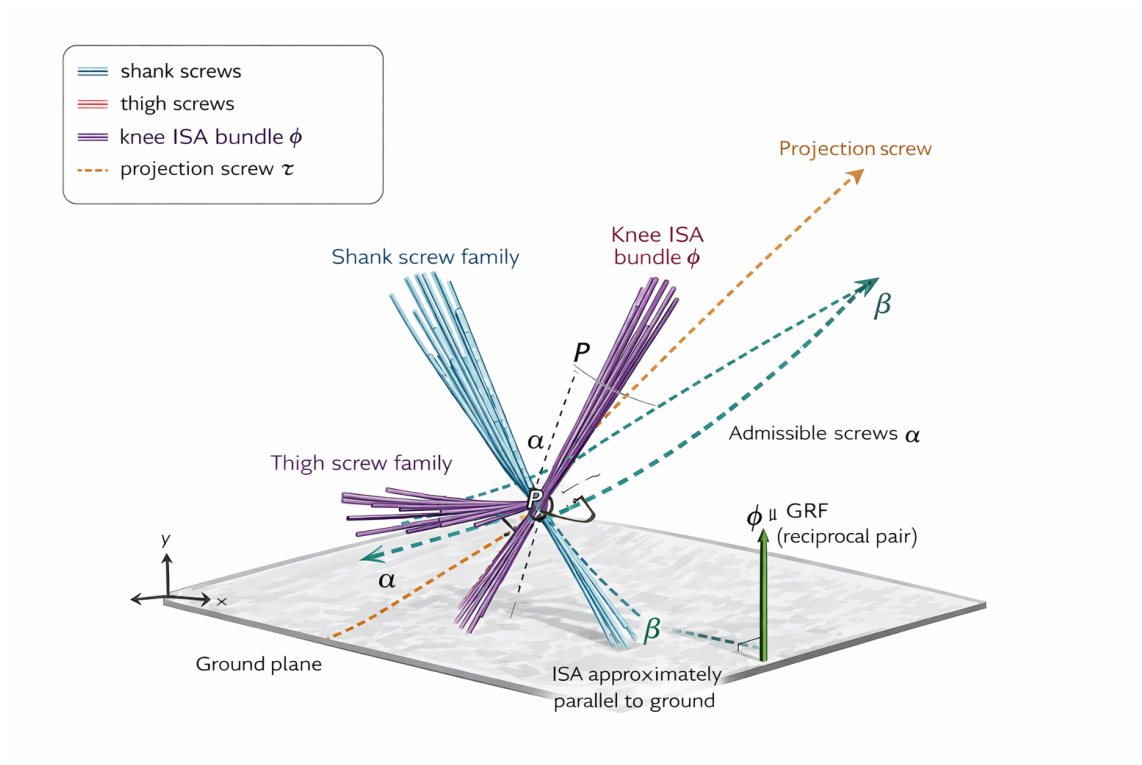
Figure 2.
Ball’s cylindroid in the zero-pitch (circular) representation. The one-parameter family of screws reciprocal to the shank and thigh screws is the state space in which the two admissible screws are selected by the quadratic pitch constraint . Reproduced from [23].
Figure 2.
Ball’s cylindroid in the zero-pitch (circular) representation. The one-parameter family of screws reciprocal to the shank and thigh screws is the state space in which the two admissible screws are selected by the quadratic pitch constraint . Reproduced from [23].
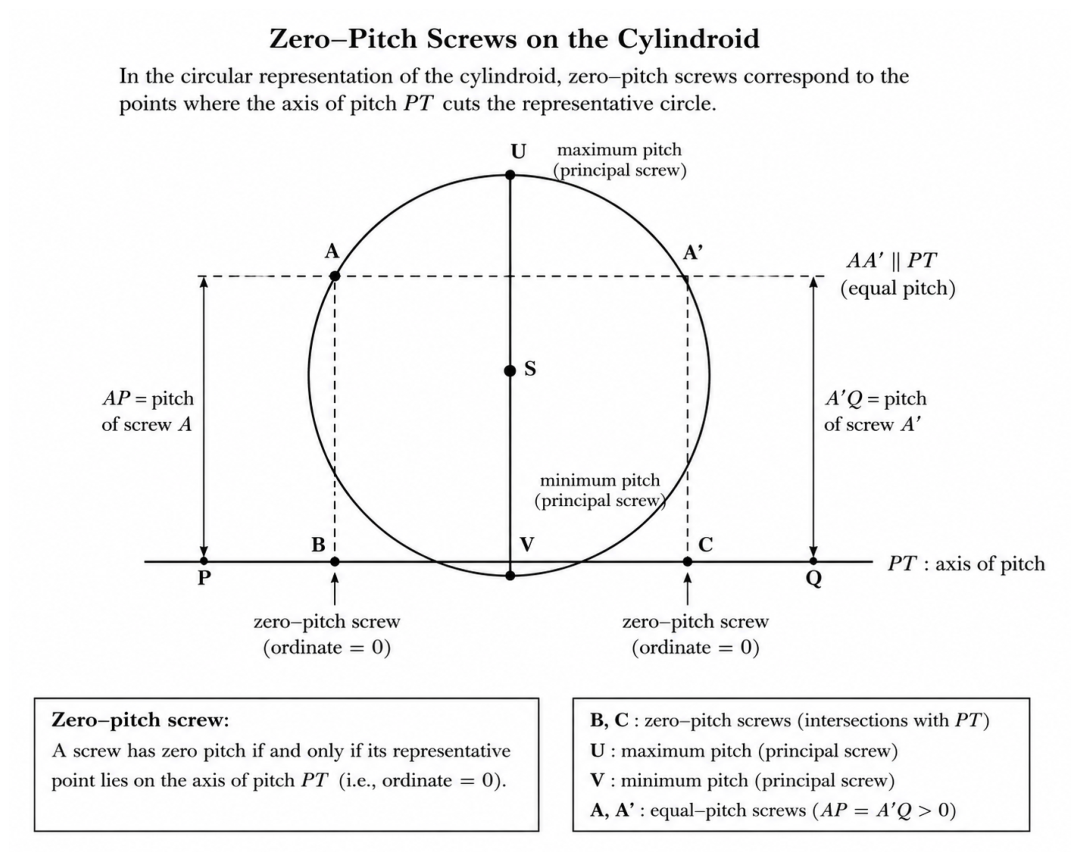
Figure 3.
Extracted knee instantaneous screw axis bundle with the synchronized ground-reaction-force vectors over the stance phase. The posture channel (knee FHA) and the touch channel (GRF line) are the two Plücker line families whose reciprocal compatibility defines the conditional structure analyzed below. Reproduced from [23].
Figure 3.
Extracted knee instantaneous screw axis bundle with the synchronized ground-reaction-force vectors over the stance phase. The posture channel (knee FHA) and the touch channel (GRF line) are the two Plücker line families whose reciprocal compatibility defines the conditional structure analyzed below. Reproduced from [23].
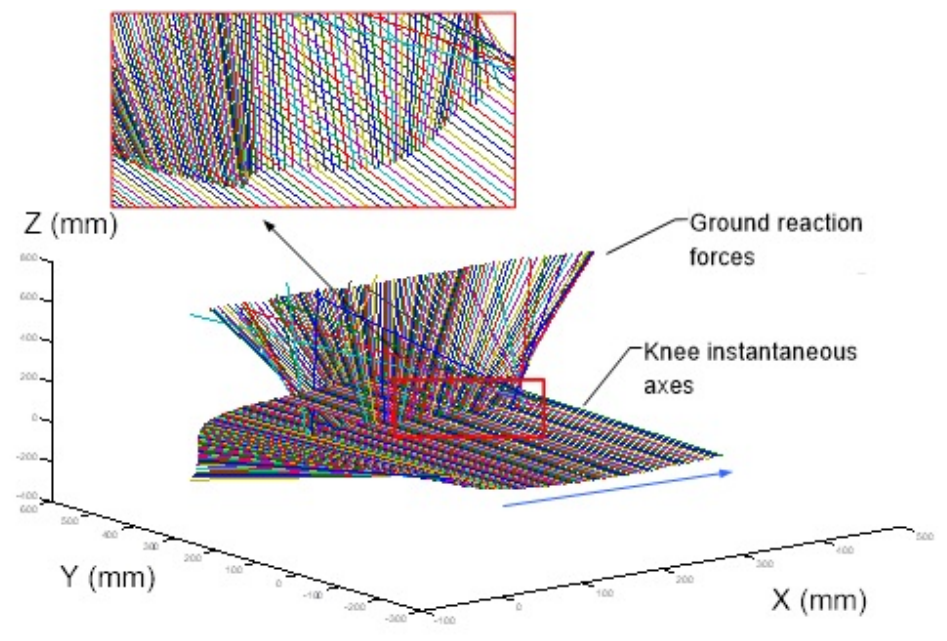
Figure 4.
Pitch evolution over normalized stance time for the thigh (left), shank (center), and knee (right) screw systems. Knee pitch rises to a mid-stance maximum ( mm/rad) and returns toward zero at terminal stance, while the shank pitch remains near zero; pitch ranges from [23].
Figure 4.
Pitch evolution over normalized stance time for the thigh (left), shank (center), and knee (right) screw systems. Knee pitch rises to a mid-stance maximum ( mm/rad) and returns toward zero at terminal stance, while the shank pitch remains near zero; pitch ranges from [23].

Figure 5.
Registered knee-axis (blue) and GRF (red) line families after the boundary translation of Equation (16), with connectors between synchronized pairs. Computed from the public SimTK trial as described in Section 3.
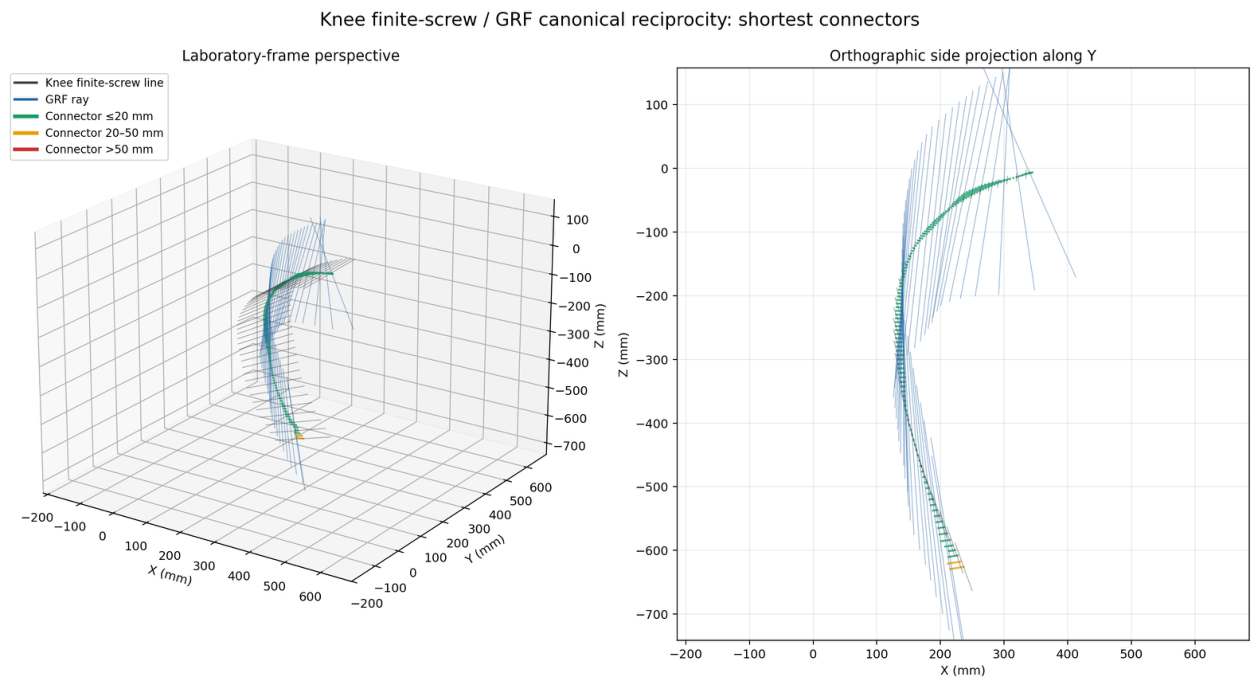
Figure 6.
Time course of the Klein reciprocal residual, the signed line separation , and the direction angle between the knee axis and the GRF line over the stance phase. Computed from the public SimTK trial as described in Section 3.
Figure 6.
Time course of the Klein reciprocal residual, the signed line separation , and the direction angle between the knee axis and the GRF line over the stance phase. Computed from the public SimTK trial as described in Section 3.
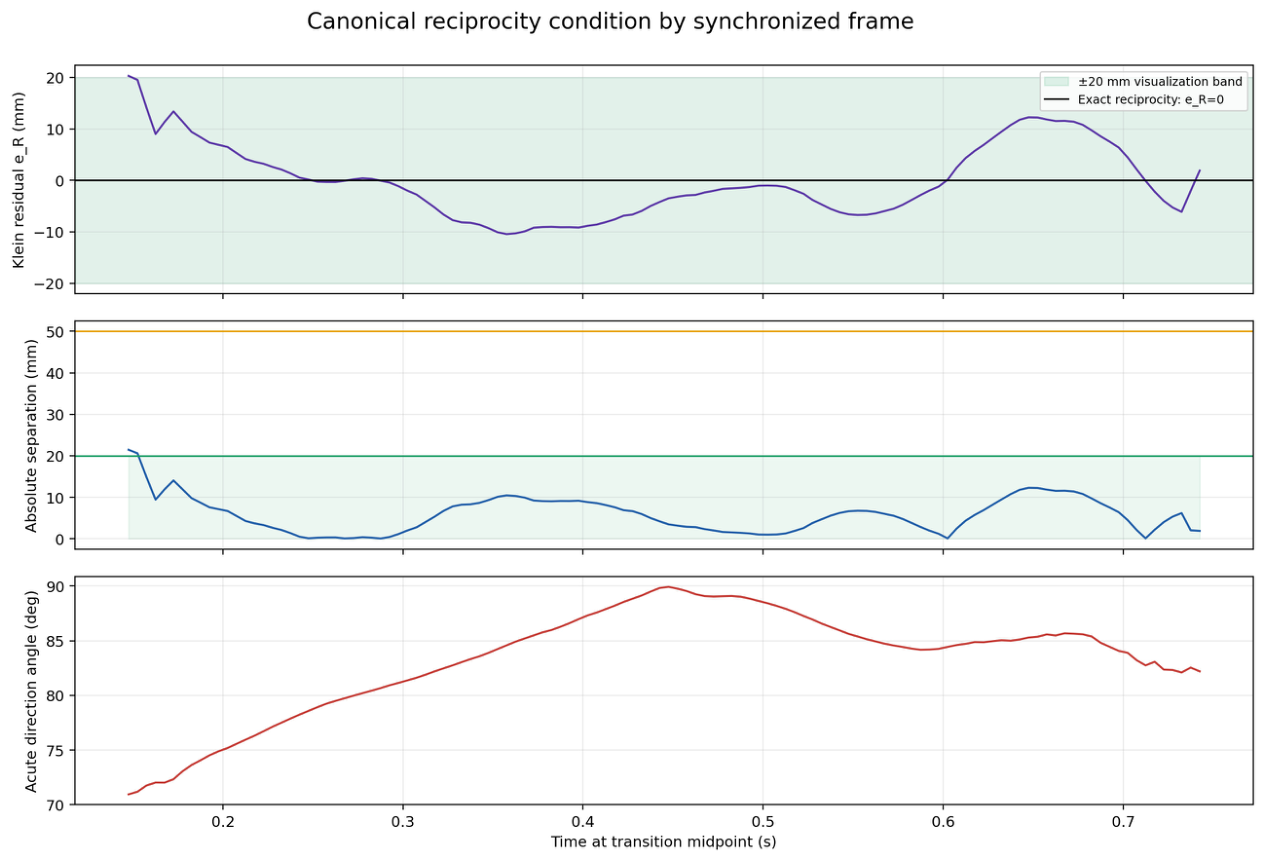
Figure 7.
Information structure of the conditional compatibility model: (a) surprisal of the synchronized state across frames; (b) frame-resolved surprisal and conditional entropy; (c) distribution of cross-entropy over the circular-shift null with the observed value marked. Computed from the public SimTK trial as described in Section 3.
Figure 7.
Information structure of the conditional compatibility model: (a) surprisal of the synchronized state across frames; (b) frame-resolved surprisal and conditional entropy; (c) distribution of cross-entropy over the circular-shift null with the observed value marked. Computed from the public SimTK trial as described in Section 3.
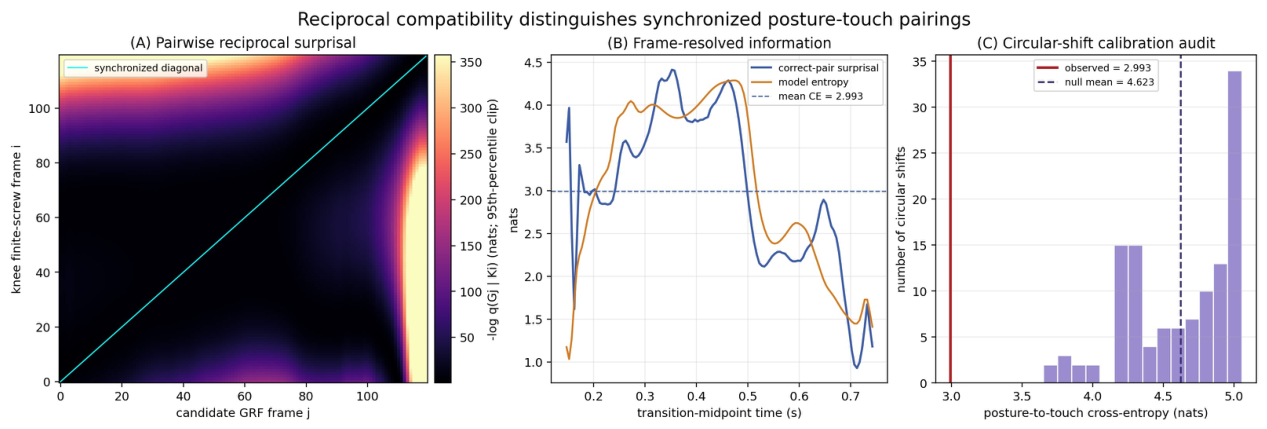

Table 1.
Summary of information-theoretic quantities for the registered posture–touch conditional structure ( synchronized pairs; units in nats, bits in parentheses). Values computed from the public SimTK trial as described in Section 3.
Table 1.
Summary of information-theoretic quantities for the registered posture–touch conditional structure ( synchronized pairs; units in nats, bits in parentheses). Values computed from the public SimTK trial as described in Section 3.
| Quantity | Value (nats) | Value (bits) |
|---|---|---|
| Cross-entropy | 2.9925 | 4.317 |
| Model entropy | 3.0450 | 4.392 |
| Uniform reference | 4.7875 | 6.907 |
| Uniform-reference gain | 1.7950 | 2.590 |
| Shift-null mean ± SD (119 shifts) | ||
| Observed vs. null gap | 1.630 | 2.351 |
Disclaimer/Publisher’s Note: The statements, opinions and data contained in all publications are solely those of the individual author(s) and contributor(s) and not of MDPI and/or the editor(s). MDPI and/or the editor(s) disclaim responsibility for any injury to people or property resulting from any ideas, methods, instructions or products referred to in the content. |
© 2026 by the authors. Licensee MDPI, Basel, Switzerland. This article is an open access article distributed under the terms and conditions of the Creative Commons Attribution (CC BY) license (http://creativecommons.org/licenses/by/4.0/).
Copyright: This open access article is published under a Creative Commons CC BY 4.0 license, which permit the free download, distribution, and reuse, provided that the author and preprint are cited in any reuse.