
Submitted:
14 September 2026
Posted:
15 September 2026
You are already at the latest version
Abstract
Most LLM-based agent systems operate reactively, taking action only after receiving explicit user instructions. Yet many real-world settings demand that agents anticipate user needs, detect environmental changes, and correct their own reasoning before problems surface---capabilities we collectively term proactive execution. These capabilities are particularly relevant to consumer technologies and electronics, where proactive LLM-based agents can support smartphones, smart homes, wearables, personal robots, and IoT devices. However, related research remains scattered across proactive dialogue, embodied perception, feedback-driven adaptation, and self-reflection, with no unified framework connecting them. This survey bridges that gap. We propose a trigger-source taxonomy that organizes proactive execution into three paradigms: (i) user behavior-driven, encompassing need inference from interaction history, task-driven clarification, and assistance under intent shifts; (ii) external event-driven, covering environmental, behavioral, and informational event perception as well as feedback-driven closed-loop adaptation; and (iii) internal uncertainty-driven, addressing confidence-aware verification and self-reflection-based correction. For each paradigm, we analyze representative methods, compare their mechanisms and limitations, and identify the conditions under which they are most effective. We further extend the discussion to the Internet of Agents (IoA) setting, examining how proactive coordination scales across heterogeneous, networked agent infrastructures. Finally, we outline open challenges, including the trade-off between proactive intervention and user disruption, security and privacy risks, and the lack of evaluation standards for proactive behavior, and propose concrete directions for future research.
Keywords:
proactive execution
; LLM
; Agent
; IoA
1. Introduction
Large language models (LLMs) have reshaped the landscape of artificial intelligence by demonstrating remarkable capabilities in natural language understanding, reasoning, planning, and generation [1,2]. LLM-based agents have been widely applied in a variety of scenarios, including game agents [3], medical agents [4], and web agents [5]. In the field of consumer electronics, LLM-based agents are increasingly being embedded in various user-facing devices and services, including smartphones, smart-home systems, wearable devices, personal robots, and in-vehicle assistants. However, consumer electronic systems often need to sense contextual changes, infer user preferences, coordinate multiple devices, and provide timely intelligent assistance in daily-life scenarios. Despite the significant progress that existing agent systems have made in reasoning, planning, and tool use, most current approaches still operate under a reactive execution paradigm, in which agents begin making decisions and taking actions only after receiving explicit user instructions or external requests [6,7,8]. However, this reactive mode of execution exhibits clear limitations in open, dynamic, and multi-agent collaborative settings:
- Agents rely heavily on immediate inputs and often struggle to effectively integrate long-term interaction history, environmental context, and latent task cues, thereby lacking the ability to proactively anticipate subsequent user needs and task evolution.
- Tasks are often continuous, coupled, and temporally dependent. A purely reactive strategy that responds only after external events occur can easily lead to execution delays, inefficient collaboration, and resource waste.
- Existing agents typically lack the ability to continuously monitor planning reliability and internal uncertainty, making it difficult to perform timely self-reflection and strategy adjustment when information is insufficient, task planning is incomplete, or execution fails.
To overcome the limitations of conventional reactive execution, prior studies have begun to investigate proactive execution from several perspectives, including proactivity in user dialogue settings [9,10,11,12,13], proactivity in open environments, human–computer interaction, and feedback-based adaptation [14,15,16,17,18], as well as proactive correction and reflection driven by internal state awareness [19,20,21,22]. However, to the best of our knowledge, there is still no systematic survey specifically dedicated to the mechanisms of proactive execution in LLM-based agent systems.
This survey addresses this research gap and, drawing on the definition of proactivity in organizational behavior [105], conceptualizes proactive execution as taking initiative based on contextual cues before explicit requirements emerge, with the aim of influencing future outcomes. This survey transfers the above behavioral structure to the context of LLM agents, defines proactive execution as the capability of an agentic system to anticipate potential user needs, task risks, or execution deviations in the absence of an explicit execution instruction from the user in the current interaction turn, based on weakly explicit or implicit triggering signals from user behavior, external events, and internal states, and to proactively initiate interaction, adjust plans, invoke tools, or perform verification before the problem becomes fully apparent. Accordingly, proactive execution can be understood as a continuum: at one end are strongly proactive behaviors driven by the inference of latent user needs, the perception of external events, or the anticipation of internal uncertainty; at the other end are reactive forms of proactive adaptation triggered by weakly explicit feedback or internal risk signals. The main contributions of this paper are summarized as follows:
- From the perspective of trigger sources, this survey systematically reviews research on proactive execution and provides a detailed analysis of three representative paradigms. In this way, the survey presents a relatively comprehensive picture of proactive execution under three major trigger sources, namely, user behavior, external events, and internal uncertainty, while revealing the intrinsic connections and distinctions among different proactive execution mechanisms.
- This survey discusses proactive execution in the IoA environment, with a focus on how IoA supports proactive behaviors in open, heterogeneous, and cross-platform scenarios. It further illustrates its operating mechanisms through three scenarios: user behavior-driven, external event-driven, and internal uncertainty-driven proactive execution. In addition, this survey summarizes typical industrial cases of proactive execution in IoA.
- This survey summarizes open challenges, including the trade-off between proactive intervention and user disruption, security and privacy risks, and the lack of evaluation standards for proactive behavior, and proposes concrete directions for future research.
To the best of our knowledge, this is the first survey that systematically organizes proactive execution in LLM-based agent systems from a trigger-source perspective, and it aims to provide guidance for the design of future proactive agent systems. Table 1 presents a comparison of related surveys in terms of research scope and empirical coverage. As shown in Figure 1, this survey constructs a literature review framework for proactive execution in LLM-agent systems from the perspective of triggering sources.
2. User Behavior-Driven Proactive Execution
This section discusses user behavior-driven proactive execution from three perspectives: interaction history-based user need inference, task-driven proactive clarification, and proactive assistance under user intent shifts. Table 2, Table 3 and Table 4 summarize representative studies on interaction-history-based user-need inference and understanding, task-driven proactive clarification, and proactive assistance based on changes in user intent, covering their triggering conditions, technical approaches, empirical evidence, proactive behaviors, evaluation benchmarks, application scenarios, and limitations.
2.1. Interaction History-Based User Need Inference and Understanding
Proactive execution is not merely about responding more quickly to the user’s current input. More importantly, it requires the ability to capture the user’s underlying needs from continuously accumulated interactions. In many task scenarios, users do not provide complete goals in a single turn; instead, they gradually reveal preferences, constraints, and latent intentions over multiple rounds of dialogue. Therefore, interaction history itself constitutes an important source of information for proactive execution [100].
Interaction history-based user need inference is essentially a modeling process that progresses from surface-level expressions to deeper intentions. Compared with traditional dialogue systems, a major advantage of LLM-based agents lies in their ability to leverage long-context understanding, semantic association, and instruction abstraction to connect fragmented information provided by users at different times and identify relatively stable goal tendencies and task preferences embedded in these interactions [106]. For example, long-term requirements previously expressed by the user, repeatedly revised constraints, and habitual expression patterns that are implicitly followed may not be explicitly restated in the current turn, yet they can continue to shape subsequent task execution. Therefore, interaction history should not be regarded merely as a simple context buffer, but rather as a core basis for constructing dynamic user models. This capability is fundamental for LLM-based agents to move beyond simple question-answering and to capture users’ deeper intentions.
In multi-agent systems, the value of interaction history lies not only in enabling individual agents to continuously track user intentions, but also in supporting finer-grained collaborative division of labor within the system based on historical information. Moreover, interaction history is no longer limited to recording users’ past utterances; instead, it serves as an important medium for sharing user states across agents, coordinating execution strategies, and reducing decision bias. In complex tasks, user needs often involve both explicit goals and implicit preferences. Only when historical information is transformed into shareable, updatable, and callable representations of user needs can the system’s proactive behavior maintain continuity and consistency.
Discussion. The core issue in this direction lies in determining the validity of historical information for the current task. Long-term user preferences, short-term intentions, and temporary constraints exhibit different levels of stability. If an agent treats outdated preferences or incidental expressions as long-term patterns, it may lead to erroneous proactive inferences. Future research should therefore establish temporal modeling and conflict-detection mechanisms for historical information, such as distinguishing stable preferences, stage-specific goals, and one-time constraints, and proactively triggering confirmation when historical information conflicts with the current input, rather than directly executing based on memory.
2.2. Task-Driven Proactive Clarification
In real-world conversational search and question-answering scenarios, when the user’s goal is incomplete or ambiguous, the agent needs to proactively raise clarification questions to supplement critical information, reduce understanding bias, and establish a more reliable basis for subsequent planning and execution [107].
Proactive questioning in LLM-based agents differs fundamentally from the rule-based information completion strategies used in traditional question-answering systems. It can jointly consider task objectives, contextual states, and linguistic-semantic features to support integrated decision-making, including identifying information gaps in the current task and selecting high-priority questions. In essence, proactive questioning places greater emphasis on task decomposition and plan refinement. In this process, the questions raised should be explicitly task-oriented: some are used to confirm the user’s actual goal and avoid premature planning; some are intended to supplement execution parameters, constraints, or preference information; and others are used to distinguish among multiple candidate options at minimal cost, thereby reducing the risk of subsequent execution errors [108].
Proactive clarification can be organized as a collaborative decision-making process among multiple agents rather than as an immediate reaction of a single agent [109]. In collaborative tasks, proactive interaction requires coordinated decision-making based on task progress, memory of other agents’ states, and prior dialogue context. Since communication incurs both time and resource costs, the system must balance the benefits of communication against execution efficiency, and explicitly determine which agent should proactively seek clarification from the user. For example, Wang et al. [110] proposed SynPT, which enables proactive mining of implicit user intent in travel scenarios through dual-agent data synthesis, a memory stack, and emotion reasoning mechanisms.
Discussion. Proactive clarification focuses on determining whether an ambiguity is sufficient to affect subsequent execution outcomes. If the ambiguity only concerns expressive details, excessive follow-up questioning may increase interaction costs; however, if the ambiguity involves task goals, constraints, or tool parameters, the absence of clarification may lead to task failure. Future work could model proactive clarification as a cost-sensitive decision-making problem, estimating information gain, task risk, and user interruption cost before asking a question, thereby deciding whether to execute directly, proactively seek clarification, or provide candidate solutions with explicit assumptions.
2.3. Proactive Assistance Under User Intent Shifts
In real-world interactions, user intent is rarely static. As a task progresses, users may continuously introduce new constraints, adjust their preferences, or even directly change their original goals. Therefore, proactive execution must possess the ability to continuously perceive changes in user intent and satisfaction [111]. Effective proactive assistance should promptly detect dynamic shifts in user intent during interaction and adjust subsequent assistance strategies accordingly.
Proactive assistance under user intent shifts is essentially a continuous modeling process oriented toward dynamic goals. A key advantage of LLM-based agents is that they can not only understand the explicit expressions in the current turn, but also integrate long-term preferences, repeatedly revised constraints, and default behavioral patterns reflected in historical dialogues to determine whether the current need represents a local modification of the original goal or a directional shift toward a new one. In most scenarios, users do not explicitly announce such intent changes; instead, updates to their needs are often conveyed indirectly through changes in tone, shifts in focus, transitions in the core issue, or the introduction of new constraints.
Discussion. The challenge of proactive assistance under changing user intent lies not merely in detecting whether the user’s intent has changed, but in distinguishing genuine goal shifts, local constraint adjustments, and expression noise. Future research should establish more fine-grained mechanisms for intent-change discrimination, jointly considering historical goals, current constraints, and task progress to determine the type of change, and accordingly decide whether to maintain the original plan, locally revise the plan, or switch the workflow.
3. External Event-Driven Proactive Execution
This section discusses external event-driven proactive execution from two perspectives: external event perception and feedback-driven closed-loop adaptation.
3.1. External Event Perception
External event perception focuses on continuously capturing multi-source changes in open environments in the absence of explicit user instructions and on determining whether these changes may affect user needs, task states, or subsequent execution paths. The key to proactivity lies in whether these dynamic environmental cues can be further transformed into evidence for judging the necessity of proactive service, thereby triggering subsequent reasoning, tool use, and action decisions to enable timely and minimally intrusive proactive assistance. According to differences in event sources and affected targets, this survey categorizes external events into four types: environmental state events, user behavior events, task perturbation events, and information update events.
3.1.1. Environmental State Events
refer to changes in the external environment involving objects, spaces, resources, and devices. For example, object displacement, the appearance of obstacles, changes in spatial layout, low robot battery levels, sensor anomalies, or device unavailability may all affect the executability of the original task plan. To address such events, agents need to continuously maintain awareness of their own position, spatial structure, object semantics, and geometric relationships by integrating environmental perception methods such as visual simultaneous localization and mapping (vSLAM) and 3D scene understanding, thereby determining whether the current environment still supports execution of the original plan [101]. For example, Wu et al. [39] proposed TaPA, which leverages multi-view perception and open-vocabulary detection to obtain a list of scene objects and subsequently constrains LLMs to generate executable embodied task plans. Song et al. [40] proposed a novel high-level planner based on large language models that dynamically replans from environmental perception to generate more embodied plans. Mu et al. [41] introduced an end-to-end multimodal embodied foundation model that enables more natural and intuitive interaction with the physical world and supports stepwise planning and execution of low-level instructions.
3.1.2. User Behavior Events
refer to changes in human actions, gaze, speech, posture, and contextual conditions. Even when users do not explicitly issue new instructions, signals such as occluded gaze, posture shifts, interrupted operations, or changes in attention often imply emerging assistance needs. For example, Lee et al. [42] leveraged multimodal context awareness and large-scale model reasoning to dynamically adjust assistance content and interaction strategies, thereby enabling situated proactive assistance in AR scenarios. Veerabadran et al. [43] systematically investigated how assistive wearable agents can combine visual, auditory, digital contextual, and long-term historical information to infer goals, thereby reducing interaction costs. Tanneberg et al. [44] proposed Attentive Support, which identifies human-constrained states based on scene perception and dialogue understanding and provides unobtrusive proactive support. Yang et al. [45] proposed ContextAgent, which combines multimodal perception and user profiling to support proactive prediction and tool use.
3.1.3. Task Perturbation Events
refer to situations in which task execution is obstructed, plans become invalid, or feedback signals are abnormal. Kim et al. [46] proposed FLARE, which combines a multimodal planner with environment-adaptive replanning and leverages visual cues to correct ungrounded subgoals, thereby enabling few-shot embodied task planning. Seo et al. [47] proposed REVECA, which reduces redundant information and erroneous plans through relevance estimation, adaptive planning, and trajectory validation.
3.1.4. Information Update Events
include updates to notifications, messages, results, external knowledge bases, and the status of tools or APIs. Only by continuously perceiving such information changes can agents maintain the timeliness and accuracy of proactive execution in dynamic knowledge environments. For example, Shi et al. [48] proposed a long-horizon task-oriented agent for dynamic environments, which transforms external environment updates into triggers for proactive execution through intent-conditioned monitoring and event-triggered follow-up. Schick et al. [49] proposed Toolformer, which uses self-supervised filtering of useful API calls to enable language models to autonomously learn when to invoke external tools such as calculators, retrieval systems, and translation services. Patil et al. [50] proposed Gorilla, which improves the accuracy of API invocation through retrieval-aware training while reducing tool hallucinations.
Discussion. State changes, notification updates, and user-behavior signals in open environments are often highly noisy. If an agent responds to every change, it may cause false triggering and resource waste. Future research should develop perception mechanisms tailored to proactive agents, enabling them to dynamically associate changes in the external environment with users’ long-term goals, current task progress, and available tool capabilities. In addition, future proactive agents should further possess capabilities for continuous monitoring, intent maintenance, anticipation of task blockage, and low-disruption execution, thereby facilitating their transition from local event response to long-term proactive service.
3.2. Feedback-Driven Closed-Loop Adaptation
During proactive execution, feedback serves as a critical basis for agents to revise plans, update state judgments, and optimize subsequent behavior. Agents should proactively interact with the environment, and even construct or manipulate it when necessary, in order to obtain feedback and transform such feedback into learning signals that drive task adjustment and self-improvement. This form of environmental closed-loop adaptation provides the complexity and diversity required for scalable agent adaptation. According to the source of feedback, it can be broadly categorized into three types: environmental feedback, human feedback, and multi-agent feedback.
3.2.1. Environmental Feedback
consists of signals directly provided by environmental states, external tools, or task outcomes, and is used to determine whether current behaviors are effective and whether subsequent execution paths need to be adjusted. Recent studies have explored environmental feedback from multiple perspectives. Carta et al. [51] treated the LLM as the agent policy and continuously updated it using environmental feedback via online reinforcement learning, thereby improving goal-solving performance. Sun et al. [52] enabled LLM-based agents to adaptively optimize self-generated plans according to environmental feedback through both within-plan and out-of-plan optimization strategies. Zhang et al. [53] performed policy-level reflection and optimization over historical interaction trajectories and beliefs, elevating environmental feedback from action-level correction to continual updates of behavioral strategies. Farag et al. [54] progressively replanned embodied tasks based on environmental feedback through conditional multi-stage recovery. Chen et al. [55] continuously updated rules and task manuals through interactive environmental learning. Wu et al. [56] corrected operation paths based on interface feedback using error detection and backtracking mechanisms. Wang et al. [57] proposed VOYAGER, which combines environmental feedback to support continual exploration and skill accumulation in open-world environments.
Discussion. Existing methods largely remain limited to feedback utilization in specific environments or task settings. In future research, environmental feedback should be used not only to detect errors or correct current actions, but also to continuously update the agent’s task model, behavioral policy, rule knowledge, and reusable skills. Agents need to evolve into continuously self-improving systems that can anticipate potential execution risks and proactively select replanning, backtracking, rule updating, or skill invocation, thereby enabling adaptive adjustment across scenarios.
3.2.2. Human Feedback
mainly comes from direct responses by users or human evaluators to agent behavior, including explicit corrections, preference expressions, rating or ranking signals, supplementary explanations, and interactive guidance. Recent studies have explored human feedback from multiple perspectives. Wang et al. [58] proposed the PrefCLM framework, which uses crowdsourced large language models to generate synthetic preferences and continuously refines both the evaluation mechanism and the reward learning process through human-in-the-loop interactive feedback. Feng et al. [59] proposed the ReHAC framework, which learns to select the most appropriate timing for human intervention during complex task solving, thereby enabling more efficient human–agent collaboration and task completion under limited human involvement. Liang et al. [60] proposed PAHF, which combines explicit memory with pre-action clarification and post-action feedback to support continual learning and dynamic adaptation of user preferences.
Discussion. Human feedback is characterized by high cost, noticeable latency, and substantial subjectivity. Therefore, how to efficiently leverage human feedback while reducing user burden remains a key issue in the design of proactive execution systems.
3.2.3. Multi-Agent Feedback
is more suitably designed as a collaborative cyclic process among multiple agents. Feedback no longer serves merely as a post hoc signal for error correction by an individual agent; rather, it can be transformed into a shared medium for inter-agent decision interaction, thereby improving the overall stability and execution efficiency of the system. Recent studies have explored multi-agent feedback from several perspectives. For example, Zhang et al. [61] used advantage functions to evaluate the contribution of individual or joint actions to team task completion, thereby guiding plan self-correction in multi-agent collaboration. Du et al. [62] proposed a multi-agent debate framework in which multiple agents conduct multi-round cross-examination and iterative updates over candidate answers and reasoning processes, effectively improving reasoning correctness and factual reliability. Wang et al. [63] proposed MARS, which employs collaboration among author, reviewer, and meta-reviewer agents to significantly reduce the overhead of multi-agent systems while maintaining reasoning performance.
Discussion. Beyond collaborative feedback, adversarial feedback also constitutes an important form of closed-loop adaptation in multi-agent systems. Specifically, multiple agents may engage in iterative questioning, debate, and cross-validation around the same problem or candidate solution until a relatively consistent judgment is reached, thereby improving the reliability of decisions and the quality of outputs. Meanwhile, the coordination mechanism among multiple agents itself is an important issue worthy of investigation [112]. When several agents discuss the same problem, information redundancy and opinion dispersion can easily arise. Therefore, a coordinating agent is often needed to integrate and optimize responses from different agents to improve the quality of the final result.
4. Internal Uncertainty-Driven Proactive Execution
This section discusses internal uncertainty-driven proactive execution from two perspectives: proactive verification driven by internal uncertainty and proactive correction driven by self-reflection.
4.1. Uncertainty-Driven Proactive Verification
Agents have demonstrated remarkable capabilities across a wide range of tasks. However, they may still produce hallucinations and biases in knowledge acquisition, semantic interpretation, tool use, reasoning outcomes, and content generation. Such defective responses are often highly fluent and seemingly plausible, making them difficult to detect. Therefore, systems should proactively assess, verify, and review their outputs. Figure 2 illustrates the workflow of uncertainty estimation.
Uncertainty estimation typically assigns a confidence score to model outputs. In many cases, although an agent may appear to generate fluent answers, the output may still admit multiple plausible interpretations, or its intermediate reasoning may be locally reasonable while failing to guarantee the reliability of overall task execution. In such cases, if the system relies solely on explicit confidence expressions to decide whether to proceed, it may mistakenly treat the model’s linguistic fluency as evidence of the objective accuracy of its output [113]. Therefore, proactive verification should not be based merely on having the model provide a self-reported confidence score; instead, it should make a more fine-grained assessment of the internal state by jointly considering semantic stability, consistency across candidate answers, and the alignment between expressed confidence and actual output quality.
According to whether model internals are accessible, uncertainty estimation can be categorized into three types: black-box uncertainty estimation methods, white-box uncertainty estimation methods, and hybrid methods. White-box uncertainty estimation methods estimate uncertainty by exploiting internal model information, whereas black-box uncertainty estimation methods estimate uncertainty solely from the model’s input–output behavior when internal parameters and intermediate states are inaccessible. Hybrid methods are compatible with both white-box and black-box uncertainty estimation paradigms. Table 5 summarizes studies related to internal uncertainty estimation, covering uncertainty sources, method types, technical approaches, evaluation benchmarks, application scenarios, and limitations.
Discussion. Agents should explicitly determine which verification behaviors should be triggered by different types of uncertainty. White-box methods mainly rely on internal probabilities, trajectory features, or intermediate-layer representations for calibration, whereas black-box methods depend on verbalized confidence, repeated sampling, prompt perturbation, or cost priors to assess output reliability. Therefore, future research should shift from uncertainty estimation to uncertainty-informed decision-making, further establishing mappings among uncertainty types, verification costs, and forms of proactive intervention.
4.2. Self-Reflection-Driven Proactive Correction
Self-reflection is not only a means of reducing error risk, but also reflects a key capability through which agents evolve from static execution toward autonomous self-improvement. Current core techniques include in-context learning (ICL), supervised fine-tuning (SFT), and reinforcement learning (RL), which enable agents to continuously identify the boundaries of their capabilities based on their own trajectories, interaction experience, and environmental feedback, and to transform verification outcomes into stable improvements in subsequent behavior. Table 6 summarizes related studies on self-reflection, including the methods employed and the timing of agent updates during the reflection process.
LLM-based agents can explicitly express the causes of failure in natural language, summarize corrective experience, and convert such experience into semantic memory that can be invoked in subsequent decision-making [114]. Unlike traditional adaptation approaches that rely solely on parameter updates or reward feedback, reflection mechanisms enable agents to directly extract more abstract behavioral rules from past trajectories, such as which steps are likely to induce deviations, which strategies are more robust in similar tasks, and which local successes do not necessarily imply that the overall goal remains valid. In addition, some methods [115] further construct internal reward signals using model probability estimates, internal confidence, and self-evaluation results, thereby reducing dependence on manual annotation and external evaluators and supporting a more autonomous and scalable process of continual correction.
4.2.1. From the Single-Agent Perspective
correction driven by reflection mechanisms does not necessarily need to occur only after a task has completely failed. In more mature, proactive execution systems, reflection can be integrated into the execution process or even used to anticipate potential deviations before actions are taken [116,117]. Recent studies have explored self-reflection in single-agent settings from multiple perspectives. Zhang et al. [75] injected uncertainty into both step-level and trajectory-level rewards, transforming failed trajectories into effective learning signals for subsequent policy correction and thereby enhancing agents’ capabilities for self-evolution and proactive error correction. Zhao et al. [76] enabled agents to extract natural language experience and behavioral rules from successful and failed trajectories across tasks, and to achieve continual correction in subsequent tasks through experience recall and reflection guidance. Li et al. [77] employed a small language model together with Bayesian optimization to dynamically generate task-adaptive reflection prompts, effectively mitigating the problem of prematurely terminated reflection. Zhang et al. [78] proposed RETROAGENT, which achieves continual self-optimization through retrospective reflection and experience memory. Qiao et al. [79] proposed KnowSelf, which enables agents to reflect on demand and selectively invoke knowledge through a situational self-awareness mechanism. Chen et al. [80] proposed STeP, which improves the reflective error-correction capability of LLM-based agents through self-reflective trajectories and partial-mask training.
Discussion. Future research should further develop prospective self-reflection mechanisms oriented toward internal uncertainty, enabling agents to proactively identify internal states such as knowledge insufficiency, reasoning bias, planning risk, and declining action confidence before and during task execution. Based on these signals, agents can dynamically select corrective strategies such as anticipation, rethinking, experience retrieval, policy adjustment, or knowledge invocation.
4.2.2. From the Multi-Agent Perspective
proactive correction driven by reflection mechanisms is not limited to the local review of existing trajectories by an individual agent, but instead emphasizes a team-level process of collaborative evolution. Recent studies have explored self-reflection in multi-agent systems from multiple perspectives. For example, FELA [81], a multi-agent evolutionary system, collaboratively generates, verifies, and refines feature schemes based on evaluative feedback and achieves continual self-evolution through a hierarchical knowledge base together with short-term and long-term memory. The Puppeteer-style multi-agent collaboration framework [82] employs a reinforcement learning-driven centralized orchestrator to dynamically adjust agent activation order and collaboration structure according to task feedback, thereby enabling more efficient collaborative correction during continual evolution. Mu et al. [83] proposed SRGen, which performs real-time self-reflective correction during generation through dynamic entropy detection and hidden-state calibration. Ozer et al. [84] proposed MAR, which produces consensus reflection through multi-agent debate. Bo et al. [85] proposed COPPER, which improves reflective collaboration in multi-agent systems through counterfactual rewards and a shared reflector. Yuan et al. [86] proposed DPSDP, which trains an actor–critic system through multi-agent reflection and preference optimization to achieve iterative answer refinement. Wu et al. [87] proposed STAR, which internalizes tool-use and self-reflection capabilities into a single-agent recommendation model through multi-agent trajectory distillation and collaborative signal translation.
Discussion. On the one hand, the system can adopt a hierarchical division of labor by assigning deviation detection, cause analysis, alternative solution generation, and re-execution to different functional agents, thereby mitigating the limitations of self-assessment by any single agent. On the other hand, proactive correction can also be reflected in the continual optimization of team composition, collaboration workflows, and knowledge accumulation strategies. Specifically, the system can build an experience repository to store successful experiences from different agents, promote mutual learning among agents, and further improve the overall collaboration structure, task orchestration, and case-based memory.
5. Proactive Execution in IoA
This section further discusses proactive execution in the IoA environment, with a focus on how IoA supports proactive behaviors in open, heterogeneous, and cross-platform scenarios. It also illustrates its operating mechanisms through three scenarios: user behavior-driven, external event-driven, and internal uncertainty-driven proactive execution. In addition, this section summarizes typical industrial cases of proactive execution in IoA.
The preceding sections have discussed proactive execution in LLM-based agentic systems primarily from three triggering sources: user behavior, external events, and internal uncertainty. However, in open environments, proactive execution is often no longer completed independently by a single agent, but instead requires the collaboration of multiple heterogeneous agents across different platforms, tools, devices, and organizational boundaries. IoA can be understood as a new type of networked infrastructure designed for large-scale interconnection and interoperability among heterogeneous agents. Its core objective is not merely to enable multiple agents to accomplish tasks together, but to allow agents distributed across different platforms, organizations, and even physical environments to be discovered, understood, scheduled, and coordinated for collaborative execution.
For IoA, earlier studies mainly discussed its organizational forms and implementation pathways from perspectives such as open linked data, ecosystem construction methods, and agent model design [88,89]. In recent years, with the rapid development of LLM-based agents, the research focus has shifted markedly toward Internet-style interconnection frameworks for heterogeneous agents, as well as mechanisms for dynamic discovery and collaborative orchestration [90,91,92]. Wang et al. proposed a unified IoA framework oriented toward the deep integration of the Internet of Things and intelligent agents, systematically restructuring AI agent systems from four dimensions—perception, communication, decision-making, and execution—and promoting their evolution from traditional terminal interconnection to a collaborative agent network with semantic planning and proactive execution capabilities [93]. In addition, some studies have further investigated key issues such as collaborative communication protocols, capability discovery, identity authentication, and trustworthy cross-organizational access, gradually moving IoA from a conceptual vision toward a more concrete and systematic infrastructure [94,95,96,97,98]. Collectively, these studies indicate that IoA is not merely a scaled-up version of traditional multi-agent systems, but rather a new stage that reconstructs agent collaboration at the level of networked interconnection.
Compared with the commonly studied LLM-based multi-agent systems, IoA emphasizes collaboration but operates at a different level of concern. LLM-based multi-agent systems are typically oriented toward a single application or task scenario, focusing on improving task-solving capability through mechanisms such as multi-agent dialogue, role specialization, team optimization, and collaboration strategies, for example, in directions including multi-agent conversational frameworks, expert group orchestration, dynamic team selection, and summaries of collaboration mechanisms [118,119]. By contrast, IoA is not limited to collaboration within a task. Instead, it places greater emphasis on how heterogeneous agents can establish unified mechanisms for discovery, addressing, registration, interaction, and governance, so that agents originally isolated within their own ecosystems can be invoked, composed, and migrated in a service-like manner across the network.
From the perspective of proactive execution, IoA adopts a four-layer hierarchical architecture, consisting of the resource layer, agent management layer, agent collaboration layer, and agent service layer. These layers respectively undertake functions such as triggering-signal acquisition, agent governance, collaborative decision-making, and user-service delivery:
- The resource layer provides multimodal data, models, tools, and computational resources for proactive execution, enabling agents to perceive user behaviors, environmental events, and internal states.
- The agent management layer is responsible for agent registration, identity authentication, access control, and state monitoring, determining which agents are eligible to participate in proactive execution.
- The agent collaboration layer supports task decomposition, capability matching, protocol negotiation, and cross-agent feedback aggregation, serving as the core mechanism through which proactive behaviors are extended from single-point triggering to networked collaboration.
- The agent service layer further transforms collaborative outcomes into user-facing or external-system-oriented proactive interactions, plan adjustments, and tool invocations.
Table 7 summarizes the key technologies of IoA and the networked extension mechanisms of the three types of proactive-execution triggers within IoA. To further illustrate how the IoA infrastructure supports proactive execution under these three triggering sources, three mechanistic examples are provided below:
- User behavior-driven proactive execution: The user has long-term preferences for low-cost travel, avoiding overnight layovers, and hotels within short walking distances. In IoA, the calendar agent, travel agent, hotel agent, and payment agent each possess different contextual information. When the user plans a new trip, the system proactively generates an initial plan that aligns with the user’s long-term preferences through shared memory and capability discovery before receiving a complete instruction, and actively seeks clarification when key constraints remain uncertain.
- External event-driven proactive execution: Flight delays, sudden weather changes at the destination, or changes in hotel availability are first perceived by external monitoring agents. Through an event-coordination mechanism, IoA notifies the travel-planning agent, discovers agents with capabilities for flight rescheduling, accommodation adjustment, and transportation coordination, completes cross-service replanning, and determines whether to proactively remind the user for confirmation.
- Internal uncertainty-driven proactive execution: In high-risk question-answering or medical-assistance scenarios, when the primary agent detects insufficient confidence in its own output, it can proactively discover external agents with capabilities for domain-specific knowledge retrieval, fact checking, or compliance review through IoA, and initiate cross-verification after trust validation.
Beyond the aforementioned mechanistic examples, recent industrial practices, such as agent factories, industrial copilots, and predictive maintenance assistants, have also provided practical references for proactive execution in IoA scenarios. Table 8 summarizes typical industrial cases of proactive execution in IoA.
These cases indicate that proactive execution in IoA-enabled industrial scenarios is mainly reflected in three types of capabilities:
- Proactive perception and early warning based on production data, equipment states, and external events.
- Cross-system collaborative execution for tasks such as production scheduling, quality inspection, maintenance, and engineering development.
- Through industrial copilot, factory brains, or operational assistants, human experts, industrial software, physical devices, and agent capabilities are connected into a closed-loop execution network.
It should be noted that research on proactive execution in IoA scenarios is still at an early stage. Existing studies mainly focus on system architectures, protocol design, and capability discovery mechanisms, while empirical investigations into proactive triggering, cross-agent delegation, and long-term feedback loops in real open environments remain limited. Therefore, this paper regards IoA as an important extension direction through which proactive execution can evolve from closed multi-agent systems toward open, networked agent infrastructures.
6. Challenges and Outlook
This section reviews the core challenges currently faced by proactive execution in large language model agent systems and further discusses potential directions for future research.
6.1. The Trade-Off Between Proactive Intervention and User Disruption
LLM-based agent systems must be able to anticipate user needs and intervene at appropriate moments, while avoiding excessive interruption caused by inappropriate triggering timing, inaccurate intent judgment, or unclear execution boundaries.
Studies have shown that automated systems may induce overreliance and automation bias, reducing users’ willingness to monitor and verify system outputs, and even leading them to accept erroneous recommendations when the system does not indicate anomalies or when its outputs conflict with other reliable evidence [120]. This indicates that the challenge of proactive execution lies not only in reducing unnecessary interruptions, but also in preventing proactive suggestions and proactive tool invocation from altering users’ decision-making trajectories, undermining user autonomy, and causing further harm when interventions are erroneous. For example, Adamczyk et al. [121] found that interrupting users at different points in a task sequence can have distinct effects on task performance, affective state, and users’ social attribution toward the system.
Research on interruption management and notification timing in the field of human–computer interaction provides an important theoretical foundation for proactive execution. For example, Kuang et al. [122] investigated how proactive UX analysis suggestions generated by ChatGPT affect user experience when presented at different temporal points. They compared three timing conditions: before a problem occurs, synchronously with the problem, and after the problem occurs. The results show that post-problem suggestions are more preferred by users and can improve trust and efficiency. Pu et al. [123] noted that LLM-based proactive programming agents can reduce the cost of intent expression and improve efficiency, but may also interrupt users’ workflows. Therefore, intervention timing should be designed by jointly considering subtask boundaries, user context, and system visibility.
The above studies indicate that trigger signals only suggest the potential necessity of proactive intervention, whereas whether to intervene immediately requires a comprehensive consideration of the user’s current task stage, cognitive load, intervention benefits, and interruption recovery costs. Recent studies have also begun to explicitly model this trade-off. For example, ProMemAssist [124] models users’ working memory through multimodal wearable devices and employs a timing predictor to balance the value of proactive assistance against the cost of interruption.
Therefore, proactive intervention should account for both intervention timing and intervention modality. Under different triggering sources, the mechanisms by which erroneous proactive interventions arise and the resulting harms may differ substantially. Table 9 summarizes representative cases in which proactive behaviors lead to negative consequences from three perspectives: triggering source, risk formation, and potential harm.
6.2. Security and Privacy Risks
Continuous access to model context, historical memory, tool interfaces, and environmental signals for proactive execution significantly expands the security, privacy, and trustworthiness risks of LLM-based agent systems. The attack surfaces differ across proactive-execution paradigms. Table 10 summarizes the potential risks and prevention priorities from three perspectives: user behavior-driven, external event-driven, and internal uncertainty-driven proactive execution.
User behavior-driven proactive execution: The primary risks arise from long-term memory and user modeling. The agent is required to continuously leverage historical interactions, user preferences, and cues related to implicit intent, which may lead to sensitive information leakage, unauthorized privacy inference, misuse of user profiles, and amplification of bias.
External event-driven proactive execution: The agent needs to access environmental sensors, external knowledge bases, notification streams, and API-based tools. Adversaries may induce unintended triggering, erroneous replanning, or unsafe actions by fabricating events, poisoning external information [125], tampering with tool outputs, or injecting malicious API responses. Therefore, this paradigm typically exhibits the broadest external attack surface.
Internal uncertainty-driven proactive execution: If confidence estimation is manipulated, or if the self-reflection process is affected by erroneous feedback, malicious trajectories, or untrusted external agents, the agentic system may produce incorrect revisions, reflection contamination, or shifts in multi-agent consensus.
6.3. The Lack of Evaluation Standards for Proactive Behavior
The evaluation of proactive execution still lacks unified, credible, and application-oriented standards. Existing benchmarks for LLM agents have examined agent capabilities from multiple dynamic perspectives. For example, AgentBench [126] evaluates the decision-making capabilities of LLMs as agents across diverse interactive environments, while OSWorld [127] and WorkArena [128] further extend evaluation to realistic desktop, Web, and enterprise software environments. These studies provide an important foundation for agent evaluation. However, their core metrics remain primarily centered on task success rate, action correctness, and environmental state changes, which are insufficient for assessing the more critical aspects of proactive execution, including trigger timing, intervention necessity, user acceptance, and interruption cost.
Recent studies have begun to address this issue. For example, Lu et al. [129] constructed ProactiveBench, which trains an automatic evaluator using real human activity events and human-annotated acceptance/rejection labels to assess whether an agent can proactively provide assistance in the absence of explicit instructions. ProactiveBench for Video LLMs [130] further points out that model responses in proactive interaction occur at different temporal points; therefore, evaluation metrics should consider not only response content but also temporal dynamics, and proposes PAUC to measure how response quality evolves over time. These studies indicate that the evaluation of proactive execution should shift from single-outcome assessment toward a process-oriented, timing-aware, and user-centered multidimensional evaluation framework.
Therefore, this work argues that an evaluation framework for proactive execution in LLM agents should include at least the following six dimensions. Table 11 summarizes the key elements of proactive-execution evaluation from three perspectives: evaluation dimension, core question, and potential metrics.
6.4. Outlook
Several concrete directions deserve priority in future research. On the modeling side, proactive execution would benefit from decision-theoretic frameworks that weigh the expected value of intervention against its cost before acting, moving beyond heuristic trigger thresholds toward principled action selection. On the evaluation side, the community needs benchmarks that explicitly measure when not to act—rewarding restraint when proactive intervention would be counterproductive and penalizing unnecessary disruption. On the systems side, the extension to IoA settings raises practical questions around latency, trust delegation, and cross-organizational governance that remain almost entirely unexplored empirically.
This survey has several limitations that should inform how its conclusions are interpreted. Our coverage is limited to English-language publications and does not address domain-specific deployments (e.g., clinical or financial agents) where the stakes and constraints of proactive behavior differ substantially. We have focused on mechanisms and architectures rather than computational cost, which remains an important practical consideration for real-world deployment. Finally, the IoA discussion is necessarily forward-looking given the limited empirical work available in this area.
7. Conclusions
This survey has provided a systematic examination of proactive execution in LLM-based agent systems, organized around a trigger-source taxonomy that distinguishes three paradigms. User behavior-driven proactive execution enables agents to infer latent needs from interaction history, raise clarification questions at task bottlenecks, and adapt assistance when user intent shifts, yet current methods struggle to determine when historical evidence is sufficient for autonomous action and when clarification is genuinely necessary. External event-driven proactive execution equips agents to perceive environmental, behavioral, and informational changes and to close the loop through environmental, human, and multi-agent feedback, yet the field still lacks principled criteria for deciding which perceived changes warrant proactive intervention versus continued observation. Internal uncertainty-driven proactive execution allows agents to assess their own confidence and correct their reasoning through self-reflection, yet the gap between verbalized confidence and actual reliability remains largely unresolved, and reflection mechanisms risk amplifying rather than correcting errors when the agent’s self-assessment is poorly calibrated. In addition, this survey further extends proactive execution to IoA scenarios, enabling proactive execution to evolve from local decision-making by a single agent into continuous collaboration within networked agent infrastructures. Finally, this survey reviews the core challenges currently faced by proactive execution in LLM-agent systems and discusses future research directions.
References
- Ouyang, L.; Wu, J.; Jiang, X.; Almeida, D.; Wainwright, C.; Mishkin, P.; Zhang, C.; Agarwal, S.; Slama, K.; Ray, A.; et al. Training language models to follow instructions with human feedback. Adv. Neural Inf. Process. Syst. 2022, 35, 27730–27744. [Google Scholar] [CrossRef]
- Achiam, J.; Adler, S.; Agarwal, S.; Ahmad, L.; Akkaya, I.; Aleman, F.L.; Almeida, D.; Altenschmidt, J.; Altman, S.; Anadkat, S.; et al. Gpt-4 technical report. arXiv 2023, arXiv:2303.08774. [Google Scholar]
- Zhu, X.; Chen, Y.; Tian, H.; Tao, C.; Su, W.; Yang, C.; Huang, G.; Li, B.; Lu, L.; Wang, X.; et al. Ghost in the minecraft: Generally capable agents for open-world environments via large language models with text-based knowledge and memory. arXiv 2023, arXiv:2305.17144. [Google Scholar]
- Li, J.; Lai, Y.; Li, W.; Ren, J.; Zhang, M.; Kang, X.; Wang, S.; Li, P.; Zhang, Y.Q.; Ma, W.; et al. Agent hospital: A simulacrum of hospital with evolvable medical agents. arXiv 2024, arXiv:2405.02957. [Google Scholar]
- Deng, Y.; Zhang, A.; Lin, Y.; Chen, X.; Wen, J.R.; Chua, T.S. Large language model powered agents in the web. In Proceedings of the Companion Proceedings of the ACM Web Conference 2024; 2024; pp. 1242–1245. [Google Scholar]
- Singh, I.; Blukis, V.; Mousavian, A.; Goyal, A.; Xu, D.; Tremblay, J.; Fox, D.; Thomason, J.; Garg, A. Progprompt: Generating situated robot task plans using large language models. arXiv 2022, arXiv:2209.11302. [Google Scholar]
- Ding, Y.; Zhang, X.; Amiri, S.; Cao, N.; Yang, H.; Kaminski, A.; Esselink, C.; Zhang, S. Integrating action knowledge and LLMs for task planning and situation handling in open worlds. Auton. Robot. 2023, 47, 981–997. [Google Scholar] [CrossRef]
- Ahn, M.; Brohan, A.; Brown, N.; Chebotar, Y.; Cortes, O.; David, B.; Finn, C.; Fu, C.; Gopalakrishnan, K.; Hausman, K.; et al. Do as i can, not as i say: Grounding language in robotic affordances. arXiv 2022, arXiv:2204.01691. [Google Scholar]
- Qian, C.; He, B.; Zhuang, Z.; Deng, J.; Qin, Y.; Cong, X.; Zhang, Z.; Zhou, J.; Lin, Y.; Liu, Z.; et al. Tell me more! towards implicit user intention understanding of language model driven agents. In Proceedings of the 62nd Annual Meeting of the Association for Computational Linguistics (Volume 1: Long Papers); 2024; pp. 1088–1113. [Google Scholar]
- Li, Z.; Liao, L.; Chua, T.S. Learning to ask critical questions for assisting product search. arXiv 2024, arXiv:2403.02754. [Google Scholar]
- Lu, Y.; Yang, S.; Qian, C.; Chen, G.; Luo, Q.; Wu, Y.; Wang, H.; Cong, X.; Zhang, Z.; Lin, Y.; et al. Proactive agent: Shifting llm agents from reactive responses to active assistance. arXiv 2024, arXiv:2410.12361. [Google Scholar]
- Liao, L.; Yang, G.H.; Shah, C. Proactive conversational agents in the post-chatgpt world. In Proceedings of the Proceedings of the 46th international ACM SIGIR conference on research and development in information retrieval, 2023; pp. 3452–3455. [Google Scholar]
- Zhang, X.; Deng, Y.; Ren, Z.; Ng, S.K.; Chua, T.S. Ask-before-plan: Proactive language agents for real-world planning. In Proceedings of the Findings of the Association for Computational Linguistics: EMNLP 2024; 2024; pp. 10836–10863. [Google Scholar]
- Park, J.S.; O’Brien, J.; Cai, C.J.; Morris, M.R.; Liang, P.; Bernstein, M.S. Generative agents: Interactive simulacra of human behavior. In Proceedings of the Proceedings of the 36th annual acm symposium on user interface software and technology, 2023; pp. 1–22. [Google Scholar]
- Huang, W.; Xia, F.; Xiao, T.; Chan, H.; Liang, J.; Florence, P.; Zeng, A.; Tompson, J.; Mordatch, I.; Chebotar, Y.; et al. Inner monologue: Embodied reasoning through planning with language models. arXiv 2022, arXiv:2207.05608. [Google Scholar]
- Liang, J.; Huang, W.; Xia, F.; Xu, P.; Hausman, K.; Ichter, B.; Florence, P.; Zeng, A. Code as policies: Language model programs for embodied control. In Proceedings of the 2023 IEEE International conference on robotics and automation (ICRA); IEEE, 2023; pp. 9493–9500. [Google Scholar]
- Wang, Z.; Cai, S.; Chen, G.; Liu, A.; Ma, X.S.; Liang, Y. Describe, explain, plan and select: interactive planning with llms enables open-world multi-task agents. Adv. Neural Inf. Process. Syst. 2023, 36, 34153–34189. [Google Scholar] [CrossRef]
- Sun, N.; Mao, B.; Li, Y.; Guo, D.; Liu, H. AssistantX: An LLM-Powered Proactive Assistant in Collaborative Human-Populated Environments. In Proceedings of the 2025 IEEE/RSJ International Conference on Intelligent Robots and Systems (IROS); IEEE, 2025; pp. 3352–3359. [Google Scholar]
- Zhou, A.; Yan, K.; Shlapentokh-Rothman, M.; Wang, H.; Wang, Y.X. Language agent tree search unifies reasoning acting and planning in language models. arXiv 2023, arXiv:2310.04406. [Google Scholar]
- Renze, M.; Guven, E. Self-reflection in llm agents: Effects on problem-solving performance. arXiv 2024, arXiv:2405.06682. [Google Scholar]
- Madaan, A.; Tandon, N.; Gupta, P.; Hallinan, S.; Gao, L.; Wiegreffe, S.; Alon, U.; Dziri, N.; Prabhumoye, S.; Yang, Y.; et al. Self-refine: Iterative refinement with self-feedback. Adv. Neural Inf. Process. Syst. 2023, 36, 46534–46594. [Google Scholar] [CrossRef]
- Yuan, S.; Chen, Z.; Xi, Z.; Ye, J.; Du, Z.; Chen, J. Agent-r: Training language model agents to reflect via iterative self-training. arXiv 2025, arXiv:2501.11425. [Google Scholar]
- Wang, J.; Ning, H.; Ding, J.; Zhu, T.; Chen, L.; Nugent, C. LLM-Driven Preference Data Synthesis for Proactive Prediction of the Next User Utterance in Human-Machine Dialogue. arXiv 2025, arXiv:2601.09713. [Google Scholar]
- Li, C.; Deng, Y.; Hu, H.; Kan, M.Y.; Li, H. Chatcrs: Incorporating external knowledge and goal guidance for llm-based conversational recommender systems. In Proceedings of the Findings of the Association for Computational Linguistics: NAACL 2025; 2025; pp. 295–312. [Google Scholar]
- Kaur, K.; Gupta, V.; Gupta, A.; Shah, C. The proper approach to proactivity: Benchmarking and advancing knowledge gap navigation. arXiv 2026, arXiv:2601.09926. [Google Scholar]
- Dao, H.Q.; Deng, Y.; Bui, K.H.; Le, D.D.; Liao, L. Experience as source for anticipation and planning: Experiential policy learning for target-driven recommendation dialogues. In Proceedings of the Findings of the Association for Computational Linguistics: EMNLP 2024; 2024; pp. 14179–14198. [Google Scholar]
- Tang, J.; Shen, S.; ZhipengWang, Z.; Zhi, G.; Feng, X.; Sun, Z.; Tan, H.; Chen, X. KAPA: A Deliberative Agent Framework with Tree-Structured Knowledge Base for Multi-Domain User Intent Understanding. In Proceedings of the Findings of the Association for Computational Linguistics: ACL 2025; 2025; pp. 6150–6166. [Google Scholar]
- Deng, Y.; Liao, L.; Chen, L.; Wang, H.; Lei, W.; Chua, T.S. Prompting and evaluating large language models for proactive dialogues: Clarification, target-guided, and non-collaboration. In Proceedings of the Findings of the Association for Computational Linguistics: EMNLP 2023, 2023; pp. 10602–10621. [Google Scholar]
- Butala, Y.; Garg, S.; Banerjee, P.; Misra, A. ProMISe: A proactive multi-turn dialogue dataset for information-seeking intent resolution. In Proceedings of the Findings of the Association for Computational Linguistics: EACL 2024; 2024; pp. 1774–1789. [Google Scholar]
- Sato, S.; Baba, J.; Hentona, A.; Iwata, S.; Yoshimoto, A.; Yoshino, K. Proactive User Information Acquisition via Chats on User-Favored Topics. In Proceedings of the Findings of the Association for Computational Linguistics: EMNLP 2025; 2025; pp. 2418–2443. [Google Scholar]
- Lee, D.; Kim, S.; Lee, M.; Lee, H.; Park, J.; Lee, S.W.; Jung, K. Asking clarification questions to handle ambiguity in open-domain QA. In Proceedings of the Findings of the Association for Computational Linguistics: EMNLP 2023, 2023; pp. 11526–11544. [Google Scholar]
- Ye, J.; Jiang, Y.; Wang, X.; Li, Y.; Li, Y.; Xie, P.; Huang, F. Productagent: Benchmarking conversational product search agent with asking clarification questions. In Proceedings of the Proceedings of the 2025 Conference on Empirical Methods in Natural Language Processing: Industry Track, 2025; pp. 383–398. [Google Scholar]
- Zhang, X.; Shen, Y.; Zheng, Z.; Wu, L.; Zhang, W.; Yan, Y.; Peng, Q.; Wang, J.; Lu, W. Asktoact: Enhancing llms tool use via self-correcting clarification. In Proceedings of the Proceedings of the 2025 Conference on Empirical Methods in Natural Language Processing, 2025; pp. 13495–13522. [Google Scholar]
- Li, X.; Li, X.; Gao, L.; Liu, Y.; Wang, X.; Wang, S.; Wang, J.; Yin, D. Proactive Guidance of Multi-Turn Conversation in Industrial Search. In Proceedings of the 63rd Annual Meeting of the Association for Computational Linguistics (Volume 6: Industry Track); 2025; pp. 706–717. [Google Scholar]
- Yoon, Y.; Son, Y.; So, N.; Kim, M.; Cho, M.; Park, C.; Lee, S.; Kim, T. Beyond Task-Oriented and Chitchat Dialogues: Proactive and Transition-Aware Conversational Agents. In Proceedings of the Proceedings of the 2025 Conference on Empirical Methods in Natural Language Processing, 2025; pp. 13291–13317. [Google Scholar]
- Su, J.; Fang, R.; Li, Y.; Wang, X.; Cai, S.; Xie, P.; Zhang, N.; Yuan, F. U-Fold: Dynamic Intent-Aware Context Folding for User-Centric Agents. arXiv 2026, arXiv:2601.18285. [Google Scholar]
- Mitra, K.; Zhang, D.; Kim, H.; Hruschka, E. RECAP: REwriting Conversations for Intent Understanding in Agentic Planning. In Proceedings of the Findings of the Association for Computational Linguistics: EACL 2026; 2026; pp. 2015–2033. [Google Scholar]
- Chang, W.Y.; Qiu, L.; Liu, Y.H.; Chen, Y.N. FLOWSWITCH: A State-Aware Framework for Workflow Transitions in Adaptive Dialogue Agents. In Proceedings of the Proceedings of the 16th International Workshop on Spoken Dialogue System Technology, 2026; pp. 18–33. [Google Scholar]
- Wu, Z.; Wang, Z.; Xu, X.; Lu, J.; Yan, H. Embodied task planning with large language models. arXiv 2023, arXiv:2307.01848. [Google Scholar]
- Song, C.H.; Wu, J.; Washington, C.; Sadler, B.M.; Chao, W.L.; Su, Y. Llm-planner: Few-shot grounded planning for embodied agents with large language models. In Proceedings of the Proceedings of the IEEE/CVF international conference on computer vision, 2023; pp. 2998–3009. [Google Scholar]
- Mu, Y.; Zhang, Q.; Hu, M.; Wang, W.; Ding, M.; Jin, J.; Wang, B.; Dai, J.; Qiao, Y.; Luo, P. Embodiedgpt: Vision-language pre-training via embodied chain of thought. Adv. Neural Inf. Process. Syst. 2023, 36, 25081–25094. [Google Scholar] [CrossRef]
- Lee, G.; Xia, M.; Numan, N.; Qian, X.; Li, D.; Chen, Y.; Kulshrestha, A.; Chatterjee, I.; Zhang, Y.; Manocha, D.; et al. Sensible agent: A framework for unobtrusive interaction with proactive ar agents. In Proceedings of the Proceedings of the 38th Annual ACM Symposium on User Interface Software and Technology, 2025; pp. 1–22. [Google Scholar]
- Veerabadran, V.; Xiao, F.; Kamra, N.; Matias, P.; Chen, J.; Drooff, C.; Roads, B.D.; Williams, R.; Henderson, E.; Zhao, X.; et al. Benchmarking Egocentric Multimodal Goal Inference for Assistive Wearable Agents. arXiv 2025, arXiv:2510.22443. [Google Scholar]
- Tanneberg, D.; Ocker, F.; Hasler, S.; Deigmoeller, J.; Belardinelli, A.; Wang, C.; Wersing, H.; Sendhoff, B.; Gienger, M. To help or not to help: Llm-based attentive support for human-robot group interactions. In Proceedings of the 2024 IEEE/RSJ International Conference on Intelligent Robots and Systems (IROS); IEEE, 2024; pp. 9130–9137. [Google Scholar]
- Yang, B.; Xu, L.; Zeng, L.; Liu, K.; Jiang, S.; Lu, W.; Chen, H.; Jiang, X.; Xing, G.; Yan, Z. Contextagent: Context-aware proactive llm agents with open-world sensory perceptions. arXiv 2025, arXiv:2505.14668. [Google Scholar]
- Kim, T.; Kim, B.; Choi, J. Multi-modal grounded planning and efficient replanning for learning embodied agents with a few examples. In Proceedings of the AAAI Conference on Artificial Intelligence, 2025; 2025; Vol. 39, pp. 4329–4337. [Google Scholar]
- Seo, S.; Noh, S.; Lee, J.; Lim, S.; Lee, W.H.; Kang, H. Reveca: Adaptive planning and trajectory-based validation in cooperative language agents using information relevance and relative proximity. In Proceedings of the AAAI Conference on Artificial Intelligence, 2025; Vol. 39, pp. 23295–23303. [Google Scholar]
- Shi, Q.; Wang, D.; Zhou, H.; Li, J.; Xu, J.; Gao, J.; Hao, J.; He, R. Long-term Task-oriented Agent: Proactive Long-term Intent Maintenance in Dynamic Environments. arXiv 2026, arXiv:2601.09382. [Google Scholar]
- Schick, T.; Dwivedi-Yu, J.; Dessì, R.; Raileanu, R.; Lomeli, M.; Hambro, E.; Zettlemoyer, L.; Cancedda, N.; Scialom, T. Toolformer: Language models can teach themselves to use tools. Adv. Neural Inf. Process. Syst. 2023, 36, 68539–68551. [Google Scholar] [CrossRef]
- Patil, S.G.; Zhang, T.; Wang, X.; Gonzalez, J.E. Gorilla: Large language model connected with massive apis. Adv. Neural Inf. Process. Syst. 2024, 37, 126544–126565. [Google Scholar] [CrossRef]
- Carta, T.; Romac, C.; Wolf, T.; Lamprier, S.; Sigaud, O.; Oudeyer, P.Y. Grounding large language models in interactive environments with online reinforcement learning. In Proceedings of the International conference on machine learning; 2023, PMLR; pp. 3676–3713.
- Sun, H.; Zhuang, Y.; Kong, L.; Dai, B.; Zhang, C. Adaplanner: Adaptive planning from feedback with language models. Adv. Neural Inf. Process. Syst. 2023, 36, 58202–58245. [Google Scholar] [CrossRef]
- Zhang, W.; Tang, K.; Wu, H.; Wang, M.; Shen, Y.; Hou, G.; Tan, Z.; Li, P.; Zhuang, Y.; Lu, W. Agent-pro: Learning to evolve via policy-level reflection and optimization. In Proceedings of the 62nd Annual Meeting of the Association for Computational Linguistics (Volume 1: Long Papers); 2024; pp. 5348–5375. [Google Scholar]
- Farag, Y.; Stoyanchev, S.; Li, M.; Keizer, S.; Doddipatla, R. Conditional Multi-Stage Failure Recovery for Embodied Agents. In Proceedings of the Proceedings of the 1st Workshop for Research on Agent Language Models (REALM 2025), 2025; pp. 200–227. [Google Scholar]
- Chen, M.; Li, Y.; Yang, Y.; Yu, S.; Lin, B.; He, X. Automanual: Constructing instruction manuals by llm agents via interactive environmental learning. Adv. Neural Inf. Process. Syst. 2024, 37, 589–631. [Google Scholar] [CrossRef]
- Wu, Q.; Gao, P.; Liu, W.; Luan, J. Backtrackagent: Enhancing gui agent with error detection and backtracking mechanism. In Proceedings of the Proceedings of the 2025 Conference on Empirical Methods in Natural Language Processing, 2025; pp. 4250–4272. [Google Scholar]
- Wang, G.; Xie, Y.; Jiang, Y.; Mandlekar, A.; Xiao, C.; Zhu, Y.; Fan, L.; Anandkumar, A. Voyager: An open-ended embodied agent with large language models. arXiv 2023, arXiv:2305.16291. [Google Scholar]
- Wang, R.; Zhao, D.; Yuan, Z.; Obi, I.; Min, B.C. Prefclm: Enhancing preference-based reinforcement learning with crowdsourced large language models. IEEE Robot. Autom. Lett. 2025, 10, 2486–2493. [Google Scholar] [CrossRef]
- Feng, X.; Chen, Z.Y.; Qin, Y.; Lin, Y.; Chen, X.; Liu, Z.; Wen, J.R. Large language model-based human-agent collaboration for complex task solving. In Proceedings of the Findings of the Association for Computational Linguistics: EMNLP 2024; 2024; pp. 1336–1357. [Google Scholar]
- Liang, K.; Kruk, J.; Qian, S.; Yang, X.; Bi, S.; Yao, Y.; Nie, S.; Zhang, M.; Liu, L.; Fisac, J.F.; et al. Learning Personalized Agents from Human Feedback. arXiv 2026, arXiv:2602.16173. [Google Scholar]
- Zhang, Y.; Yang, S.; Bai, C.; Wu, F.; Li, X.; Wang, Z.; Li, X. Towards efficient llm grounding for embodied multi-agent collaboration. In Proceedings of the Findings of the Association for Computational Linguistics: ACL 2025; 2025; pp. 1663–1699. [Google Scholar]
- Du, Y.; Li, S.; Torralba, A.; Tenenbaum, J.B.; Mordatch, I. Improving factuality and reasoning in language models through multiagent debate. In Proceedings of the Forty-first international conference on machine learning, 2024. [Google Scholar]
- Wang, X.; Wang, J.; Wang, Y.; Dang, P.; Cao, S.; Zhang, C. MARS: toward more efficient multi-agent collaboration for LLM reasoning. arXiv 2025, arXiv:2509.20502. [Google Scholar]
- Liu, H.; Dou, Z.Y.; Wang, Y.; Peng, N.; Yue, Y. Uncertainty calibration for tool-using language agents. In Proceedings of the Findings of the Association for Computational Linguistics: EMNLP 2024; 2024; pp. 16781–16805. [Google Scholar]
- Zhang, J.; Xiong, C.; Wu, C.S. Agentic confidence calibration. arXiv 2026, arXiv:2601.15778. [Google Scholar]
- Subramani, N.; Eisner, J.; Svegliato, J.; Van Durme, B.; Su, Y.; Thomson, S. MICE for CATs: Model-internal confidence estimation for calibrating agents with tools. In Proceedings of the 2025 Conference of the Nations of the Americas Chapter of the Association for Computational Linguistics: Human Language Technologies (Volume 1: Long Papers); 2025; pp. 12362–12375. [Google Scholar]
- Fadeeva, E.; Rubashevskii, A.; Shelmanov, A.; Petrakov, S.; Li, H.; Mubarak, H.; Tsymbalov, E.; Kuzmin, G.; Panchenko, A.; Baldwin, T.; et al. Fact-checking the output of large language models via token-level uncertainty quantification. In Proceedings of the Findings of the Association for Computational Linguistics: ACL 2024; 2024; pp. 9367–9385. [Google Scholar]
- Zhang, J.; Choubey, P.K.; Huang, K.H.; Xiong, C.; Wu, C.S. Agentic Uncertainty Quantification. arXiv 2026, arXiv:2601.15703. [Google Scholar]
- Tsai, Y.H.H.; Talbott, W.; Zhang, J. Efficient non-parametric uncertainty quantification for black-box large language models and decision planning. arXiv 2024, arXiv:2402.00251. [Google Scholar]
- Lin, Z.; Trivedi, S.; Sun, J. Generating with confidence: Uncertainty quantification for black-box large language models. arXiv 2023, arXiv:2305.19187. [Google Scholar]
- Ding, W.; Tomlin, N.; Durrett, G. Calibrate-Then-Act: Cost-Aware Exploration in LLM Agents. arXiv 2026, arXiv:2602.16699. [Google Scholar]
- Pedapati, T.; Dhurandhar, A.; Ghosh, S.; Dan, S.; Sattigeri, P. Large language model confidence estimation via black-box access. arXiv 2024, arXiv:2406.04370. [Google Scholar]
- Han, J.; Buntine, W.; Shareghi, E. Towards uncertainty-aware language agent. In Proceedings of the Findings of the Association for Computational Linguistics: ACL 2024; 2024; pp. 6662–6685. [Google Scholar]
- Zhao, Q.; Li, D.; Liu, Y.; Cheng, W.; Sun, Y.; Oishi, M.; Osaki, T.; Matsuda, K.; Yao, H.; Zhao, C.; et al. Uncertainty propagation on llm agent. In Proceedings of the 63rd Annual Meeting of the Association for Computational Linguistics (Volume 1: Long Papers); 2025; pp. 6064–6073. [Google Scholar]
- Zhang, D.; Liu, X.; Cheng, L.; Wang, Y.; Murray, K.; Wei, H. SELAUR: Self Evolving LLM Agent via Uncertainty-aware Rewards. arXiv 2026, arXiv:2602.21158. [Google Scholar]
- Zhao, A.; Huang, D.; Xu, Q.; Lin, M.; Liu, Y.J.; Huang, G. Expel: Llm agents are experiential learners. In Proceedings of the AAAI Conference on Artificial Intelligence; 2024; Vol. 38, pp. 19632–19642. [Google Scholar]
- Li, K.; Zhao, T.; Zhou, W.; Hu, S. DORA: Dynamic optimization prompt for continuous reflection of LLM-based agent. In Proceedings of the Proceedings of the 31st International Conference on Computational Linguistics, 2025; pp. 7546–7557. [Google Scholar]
- Zhang, X.; Liu, Z.; Zhang, Y.; Hu, X.; Shao, W. Retroagent: From solving to evolving via retrospective dual intrinsic feedback. arXiv 2026, arXiv:2603.08561. [Google Scholar]
- Qiao, S.; Qiu, Z.; Ren, B.; Wang, X.; Ru, X.; Zhang, N.; Chen, X.; Jiang, Y.; Xie, P.; Huang, F.; et al. Agentic knowledgeable self-awareness. In Proceedings of the 63rd Annual Meeting of the Association for Computational Linguistics (Volume 1: Long Papers); 2025; pp. 12601–12625. [Google Scholar]
- Chen, Y.; Xu, B.; Wang, X.; Zhang, Y.; Mao, Z. Training LLM-Based Agents with Synthetic Self-Reflected Trajectories and Partial Masking. arXiv 2025, arXiv:2505.20023. [Google Scholar]
- Ouyang, K.; Wang, H.; Fang, D. FELA: A Multi-Agent Evolutionary System for Feature Engineering of Industrial Event Log Data. arXiv 2025, arXiv:2510.25223. [Google Scholar]
- Dang, Y.; Qian, C.; Luo, X.; Fan, J.; Xie, Z.; Shi, R.; Chen, W.; Yang, C.; Che, X.; Tian, Y.; et al. Multi-agent collaboration via evolving orchestration. arXiv 2025, arXiv:2505.19591. [Google Scholar]
- Mu, J.; Zhang, Q.; Wang, Z.; Yang, M.; Qiu, S.; Qin, C.; Dai, Z.; Shu, Y. Self-reflective generation at test time. arXiv 2025, arXiv:2510.02919. [Google Scholar]
- Ozer, O.; Wu, G.; Wang, Y.; Dosti, D.; Zhang, H.; De La Rue, V. MAR: Multi-Agent Reflexion Improves Reasoning Abilities in LLMs. arXiv 2025, arXiv:2512.20845. [Google Scholar]
- Bo, X.; Zhang, Z.; Dai, Q.; Feng, X.; Wang, L.; Li, R.; Chen, X.; Wen, J.R. Reflective multi-agent collaboration based on large language models. Adv. Neural Inf. Process. Syst. 2024, 37, 138595–138631. [Google Scholar] [CrossRef]
- Yuan, Y.; Xie, T. Reinforce llm reasoning through multi-agent reflection. arXiv 2025, arXiv:2506.08379. [Google Scholar]
- Wu, Y.; Wang, H.; Li, Q.; Zhang, J.; Yu, H.; Jiang, J. Internalizing Multi-Agent Reasoning for Accurate and Efficient LLM-based Recommendation. arXiv 2026, arXiv:2602.09829. [Google Scholar]
- Pico-Valencia, P.; Holgado-Terriza, J.A.; Paderewski, P. A systematic method for building internet of agents applications based on the linked open data approach. Future Gener. Comput. Syst. 2019, 94, 250–271. [Google Scholar] [CrossRef]
- Pico-Valencia, P.; Holgado-Terriza, J.A.; Senso, J. An agent model based on open linked data for building internet of agents ecosystems. In Proceedings of the Proceedings of the 18th international conference on autonomous agents and multiagent systems, 2019; pp. 1536–1538. [Google Scholar]
- Chen, W.; You, Z.; Li, R.; Guan, Y.; Qian, C.; Zhao, C.; Yang, C.; Xie, R.; Liu, Z.; Sun, M. Internet of agents: Weaving a web of heterogeneous agents for collaborative intelligence. arXiv 2024, arXiv:2407.07061. [Google Scholar]
- Wang, Y.; Guo, S.; Pan, Y.; Su, Z.; Chen, F.; Luan, T.H.; Li, P.; Kang, J.; Niyato, D. Internet of agents: Fundamentals, applications, and challenges. IEEE Transactions on Cognitive Communications and Networking, 2025. [Google Scholar]
- Georgio, R.J.; Forder, C.; Deb, S.; Rahimov, A.; Carroll, P.; Gürcan, Ö. Coral protocol: Open infrastructure connecting the internet of agents. arXiv 2025, arXiv:2505.00749. [Google Scholar]
- Wang, J.; Ning, H.; Ding, J.; Zhu, T.; Daneshmand, M. Internet of Agents (IoAT): Sensing, Communication, Decision-Making and Execution. Authorea Preprints 2026. [Google Scholar]
- Li, C.; Wu, J.; Du, Q.; Yu, S.; Zou, R.; Yu, K.; Chen, K.; Li, K.; Qian, Y.; Guo, X.; et al. Acps: Agent collaboration protocols for the internet of agents. In Proceedings of the 2025 9th IEEE International Conference on Network Intelligence and Digital Content (IC-NIDC); IEEE, 2025; pp. 342–346. [Google Scholar]
- Yang, Y.; Chai, H.; Song, Y.; Qi, S.; Wen, M.; Li, N.; Liao, J.; Hu, H.; Lin, J.; Chang, G.; et al. A survey of ai agent protocols. arXiv 2025, arXiv:2504.16736. [Google Scholar]
- Raskar, R.; Chari, P.; Zinky, J.; Lambe, M.; Grogan, J.J.; Wang, S.; Ranjan, R.; Singhal, R.; Gupta, S.; Lincourt, R.; et al. Beyond dns: Unlocking the internet of ai agents via the nanda index and verified agentfacts. arXiv 2025, arXiv:2507.14263. [Google Scholar]
- Fleming, C.; Muscariello, L.; Pandey, V.; Kompella, R. A Layered Protocol Architecture for the Internet of Agents. arXiv 2025, arXiv:2511.19699. [Google Scholar]
- Xu, W.; Wang, T.; Xia, Y.; Zhang, S.; Liew, S.C. Agent-OSI: A Layered Protocol Stack Toward a Decentralized Internet of Agents. arXiv 2026, arXiv:2602.13795. [Google Scholar]
- Deng, Y.; Lei, W.; Lam, W.; Chua, T.S. A survey on proactive dialogue systems: Problems, methods, and prospects. arXiv 2023, arXiv:2305.02750. [Google Scholar]
- Deng, Y.; Liao, L.; Lei, W.; Yang, G.H.; Lam, W.; Chua, T.S. Proactive conversational ai: A comprehensive survey of advancements and opportunities. ACM Trans. Inf. Syst. 2025, 43, 1–45. [Google Scholar] [CrossRef]
- Liu, Y.; Chen, W.; Bai, Y.; Liang, X.; Li, G.; Gao, W.; Lin, L. Aligning cyber space with physical world: A comprehensive survey on embodied ai. IEEE/ASME Transactions on Mechatronics, 2025. [Google Scholar]
- Liu, Z.; Bai, X.; Chen, K.; Chen, X.; Li, X.; Xiang, Y.; Liu, J.; Li, H.D.; Wang, Y.; Nie, L.; et al. A survey on the feedback mechanism of LLM-based AI agents. In Proceedings of the Proceedings of the Thirty-Fourth International Joint Conference on Artificial Intelligence. International Joint Conferences on Artificial Intelligence, 2025; pp. 10582–10592. [Google Scholar]
- Xia, Z.; Xu, J.; Zhang, Y.; Liu, H. A survey of uncertainty estimation methods on large language models. In Proceedings of the Findings of the Association for Computational Linguistics: ACL 2025; 2025; pp. 21381–21396. [Google Scholar]
- Du, S.; Zhao, J.; Shi, J.; Xie, Z.; Jiang, X.; Bai, Y.; He, L. A survey on the optimization of large language model-based agents. ACM Comput. Surv. 2026, 58, 1–37. [Google Scholar] [CrossRef]
- Grant, A.M.; Ashford, S.J. The dynamics of proactivity at work. Res. Organ. Behav. 2008, 28, 3–34. [Google Scholar] [CrossRef]
- Moghe, N.; Xia, P.; Andreas, J.; Eisner, J.; Van Durme, B.; Jhamtani, H. Interpreting user requests in the context of natural language standing instructions. In Proceedings of the Findings of the Association for Computational Linguistics: NAACL 2024; 2024; pp. 4043–4060. [Google Scholar]
- Zamani, H.; Mitra, B.; Chen, E.; Lueck, G.; Diaz, F.; Bennett, P.N.; Craswell, N.; Dumais, S.T. Analyzing and learning from user interactions for search clarification. In Proceedings of the Proceedings of the 43rd international acm sigir conference on research and development in information retrieval, 2020; pp. 1181–1190. [Google Scholar]
- Wang, W.; Juluan, S.; Ling, Z.; Chan, Y.K.; Wang, C.; Lee, C.; Yuan, Y.; Huang, J.t.; Jiao, W.; Lyu, M.R. Learning to ask: When llm agents meet unclear instruction. In Proceedings of the Proceedings of the 2025 Conference on Empirical Methods in Natural Language Processing, 2025; pp. 21784–21795. [Google Scholar]
- Acikgoz, E.C.; Oh, J.; Jeon, J.H.; Hao, J.; Ji, H.; Hakkani-Tur, D.; Tur, G.; Li, X.; Ma, C.; Fan, X. MAC: A Multi-Agent Framework for Interactive User Clarification in Multi-turn Conversations. In Proceedings of the Proceedings of the 16th International Workshop on Spoken Dialogue System Technology, 2026; pp. 1–17. [Google Scholar]
- Wang, J.; Ning, H.; Zhu, T.; Ding, J. A Data Synthesis Method Driven by Large Language Models for Proactive Mining of Implicit User Intentions in Tourism. arXiv 2025, arXiv:2505.11533. [Google Scholar]
- Feng, X.; Zhang, J.; Tang, J.; Li, W.; Cai, G.; Chen, X.; Dai, Q.; Zhu, Y.; Dong, Z. Expectation Confirmation Preference Optimization for Multi-Turn Conversational Recommendation Agent. In Proceedings of the Findings of the Association for Computational Linguistics: ACL 2025; 2025; pp. 5896–5914. [Google Scholar]
- Hao, R.; Hu, L.; Qi, W.; Wu, Q.; Zhang, Y.; Nie, L. Chatllm network: More brains, more intelligence. AI Open 2025, 6, 45–52. [Google Scholar] [CrossRef]
- Xiong, M.; Hu, Z.; Lu, X.; Li, Y.; Fu, J.; He, J.; Hooi, B. Can llms express their uncertainty? an empirical evaluation of confidence elicitation in llms. arXiv 2023, arXiv:2306.13063. [Google Scholar]
- Gupta, P.; Kirtania, S.; Singha, A.; Gulwani, S.; Radhakrishna, A.; Soares, G.; Shi, S. Metareflection: Learning instructions for language agents using past reflections. In Proceedings of the Proceedings of the 2024 Conference on Empirical Methods in Natural Language Processing, 2024; pp. 8369–8385. [Google Scholar]
- Taubenfeld, A.; Sheffer, T.; Ofek, E.; Feder, A.; Goldstein, A.; Gekhman, Z.; Yona, G. Confidence improves self-consistency in llms. In Proceedings of the Findings of the Association for Computational Linguistics: ACL 2025; 2025; pp. 20090–20111. [Google Scholar]
- Wang, H.; Li, T.; Deng, Z.; Roth, D.; Li, Y. Devil’s advocate: Anticipatory reflection for llm agents. In Proceedings of the Findings of the Association for Computational Linguistics: EMNLP 2024; 2024; pp. 966–978. [Google Scholar]
- Ge, Y.; Romeo, S.; Cai, J.; Sunkara, M.; Zhang, Y. Samule: Self-learning agents enhanced by multi-level reflection. In Proceedings of the Proceedings of the 2025 Conference on Empirical Methods in Natural Language Processing, 2025; pp. 16602–16621. [Google Scholar]
- Liu, Z.; Zhang, Y.; Li, P.; Liu, Y.; Yang, D. Dynamic llm-agent network: An llm-agent collaboration framework with agent team optimization. arXiv 2023, arXiv:2310.02170. [Google Scholar]
- Chen, W.; Su, Y.; Zuo, J.; Yang, C.; Yuan, C.; Chan, C.M.; Yu, H.; Lu, Y.; Hung, Y.H.; Qian, C.; et al. Agentverse: Facilitating multi-agent collaboration and exploring emergent behaviors. In Proceedings of the The Twelfth International Conference on Learning Representations, 2023. [Google Scholar]
- Parasuraman, R.; Riley, V. Humans and automation: Use, misuse, disuse, abuse. Hum. Factors 1997, 39, 230–253. [Google Scholar] [CrossRef]
- Adamczyk, P.D.; Bailey, B.P. If not now, when? The effects of interruption at different moments within task execution. In Proceedings of the Proceedings of the SIGCHI conference on Human factors in computing systems, 2004; pp. 271–278. [Google Scholar]
- Kuang, E.; Li, M.; Fan, M.; Shinohara, K. Enhancing UX evaluation through collaboration with conversational AI assistants: Effects of proactive dialogue and timing. In Proceedings of the Proceedings of the 2024 CHI Conference on Human Factors in Computing Systems, 2024; pp. 1–16. [Google Scholar]
- Pu, K.; Lazaro, D.; Arawjo, I.; Xia, H.; Xiao, Z.; Grossman, T.; Chen, Y. Assistance or disruption? exploring and evaluating the design and trade-offs of proactive ai programming support. In Proceedings of the Proceedings of the 2025 CHI conference on human factors in computing systems, 2025; pp. 1–21. [Google Scholar]
- Pu, K.; Zhang, T.; Sendhilnathan, N.; Freitag, S.; Sodhi, R.; Jonker, T.R. Promemassist: Exploring timely proactive assistance through working memory modeling in multi-modal wearable devices. In Proceedings of the Proceedings of the 38th Annual ACM Symposium on User Interface Software and Technology, 2025; pp. 1–19. [Google Scholar]
- He, F.; Zhu, T.; Ye, D.; Liu, B.; Zhou, W.; Yu, P.S. The emerged security and privacy of llm agent: A survey with case studies. ACM Comput. Surv. 2025, 58, 1–36. [Google Scholar] [CrossRef]
- Liu, X.; Yu, H.; Zhang, H.; Xu, Y.; Lei, X.; Lai, H.; Gu, Y.; Ding, H.; Men, K.; Yang, K.; et al. Agentbench: Evaluating llms as agents. In Proceedings of the International Conference on Learning Representations; 2024; Vol. 2024, pp. 52989–53046. [Google Scholar]
- Xie, T.; Zhang, D.; Chen, J.; Li, X.; Zhao, S.; Cao, R.; Hua, T.J.; Cheng, Z.; Shin, D.; Lei, F.; et al. Osworld: Benchmarking multimodal agents for open-ended tasks in real computer environments. Adv. Neural Inf. Process. Syst. 2024, 37, 52040–52094. [Google Scholar] [CrossRef]
- Drouin, A.; Gasse, M.; Caccia, M.; Laradji, I.H.; Del Verme, M.; Marty, T.; Boisvert, L.; Thakkar, M.; Cappart, Q.; Vazquez, D.; et al. Workarena: How capable are web agents at solving common knowledge work tasks? arXiv 2024, arXiv:2403.07718. [Google Scholar]
- Lu, Y.; Yang, S.; Qian, C.; Chen, G.; Luo, Q.; Wu, Y.; Wang, H.; Cong, X.; Zhang, Z.; Lin, Y.; et al. Proactive agent: Shifting llm agents from reactive responses to active assistance. In Proceedings of the International Conference on Learning Representations; 2025; Vol. 2025, pp. 47431–47457. [Google Scholar]
- Wang, Y.; Meng, X.; Wang, Y.; Zhang, H.; Zhao, D. Proactivevideoqa: A comprehensive benchmark evaluating proactive interactions in video large language models. arXiv 2025, arXiv:2507.09313. [Google Scholar]
Figure 1.
A trigger-source-based framework of proactive execution in LLM-based agent systems.
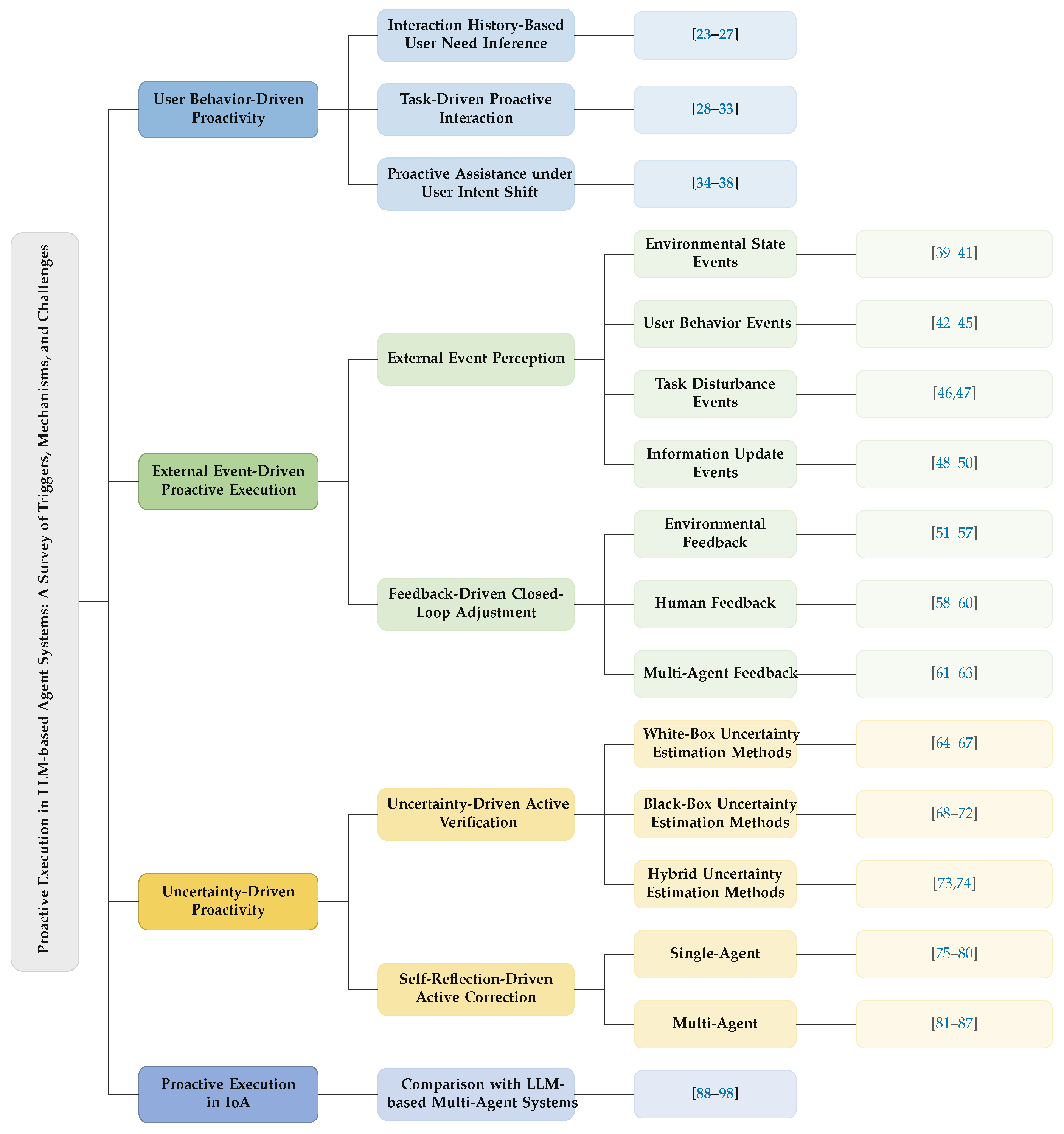
Figure 2.
Workflow of uncertainty estimation.
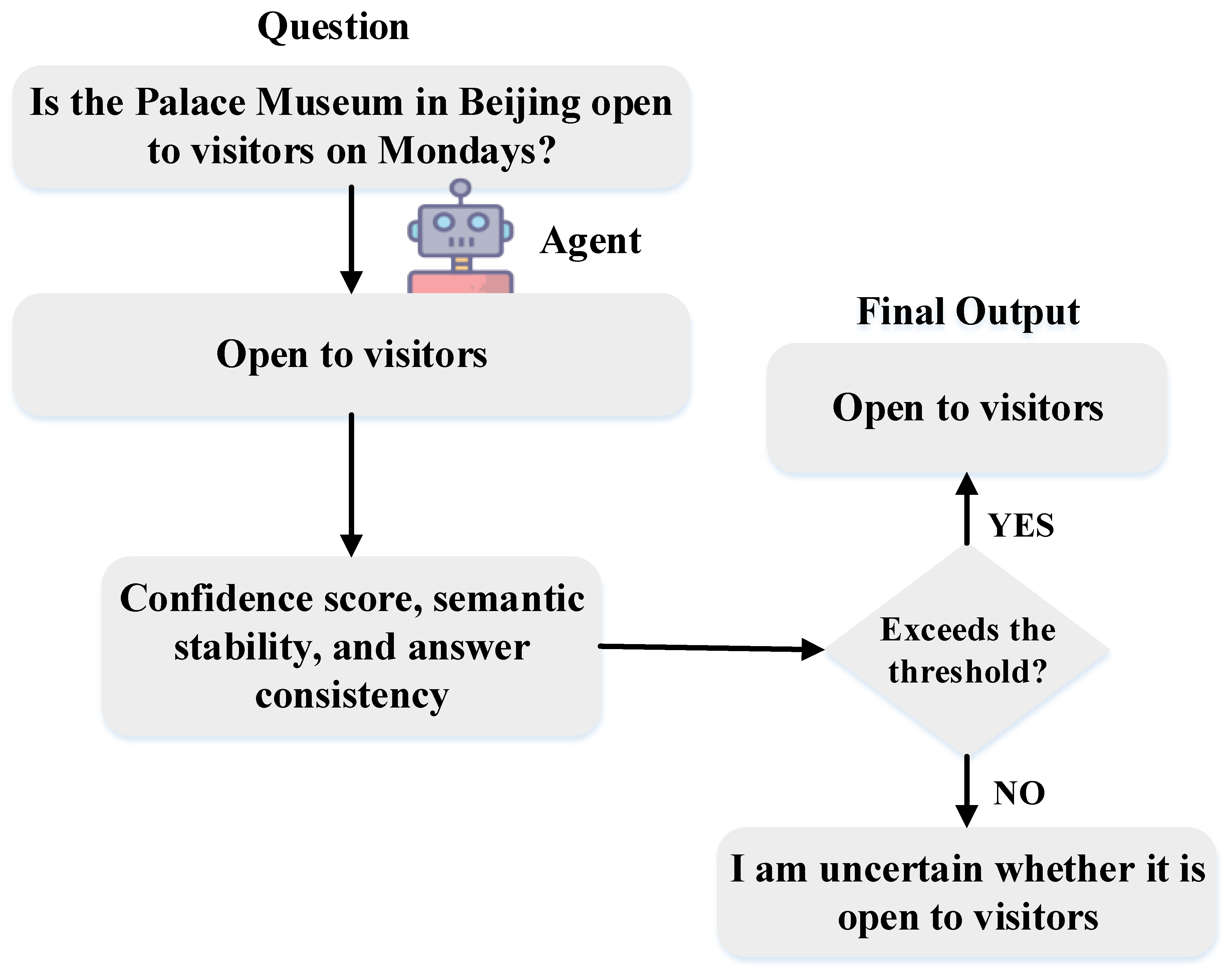

Table 1.
Comparison of related surveys in terms of research scope and empirical coverage.
| Representative Study | Year | Focus on LLM Agents | Proactive-oriented | Main Research Object | Covered Proactive Execution Triggers | Tasks Involved | Discussion of IoA |
|---|---|---|---|---|---|---|---|
| Deng et al. [99] | 2023 | ✓ | ✓ | Proactive dialogue systems | User behavior | Open-domain dialogue, task-oriented dialogue, and information-seeking dialogue | × |
| Deng et al. [100] | 2025 | ✓ | ✓ | Proactive conversational AI | User behavior | Open-domain dialogue, task-oriented dialogue, information-seeking dialogue, and LLM/hybrid dialogue | × |
| Liu et al. [101] | 2025 | ✓ | × | Embodied intelligence/embodied agents based on multimodal large models and world models | User behavior and external events | Embodied robots, simulation environments, embodied perception, embodied interaction, and embodied agents | × |
| Liu et al. [102] | 2025 | ✓ | × | Feedback mechanisms for LLM agents | Feedback and self-reflection | Reasoning-based question answering, code generation, Web/tool use, embodied action, and multi-agent collaboration | × |
| Xia et al. [103] | 2025 | × | × | Uncertainty/confidence estimation methods for LLM outputs | Internal uncertainty | LLM uncertainty estimation in question answering, factuality judgment, and mathematical reasoning | × |
| Du et al. [104] | 2026 | ✓ | × | Optimization methods for LLM agents, including parameter-driven and parameter-free optimization | Feedback and self-reflection | Programming, question answering, embodied intelligence, multimodal tasks, etc. | × |
| This survey | 2026 | ✓ | ✓ | Proactive execution in LLM-agent systems | User behavior, external events, feedback, internal uncertainty, and self-reflection | Dialogue interaction, recommendation, information-seeking dialogue, embodied-environment tasks, multi-agent collaboration, and IoA | ✓ |
Table 2.
Representative studies on interaction-history-based user-need inference.
| Representative Study | Triggering Condition | Technical Approach | Empirical Evidence | Proactive Behavior | Evaluation Benchmark | Application Scenario | Impact rating and Limitations |
|---|---|---|---|---|---|---|---|
| ProUtt [23] | Historical conversations imply subsequent user needs | Intent tree and preference-data synthesis | Benchmark experiments and human evaluation | Proactively predicts the user’s next-turn utterance | LMSYS, ShareGPT, WildChat, CrossWOZ | Human–agent dialogue | Medium: insufficient cross-domain generalization and limited expressiveness of the intent tree |
| ChatCRS [24] | Recommendation dialogues require proactive goal advancement | External knowledge and goal guidance | Benchmark experiments, ablation studies, and human evaluation | Proactively guides recommendation dialogues | DuRecDial, TG-ReDial | Conversational recommendation | Medium: dependence on knowledge retrieval and turn-by-turn goal annotation |
| PROPER [25] | Users have implicit knowledge gaps | DGA/RGA dual-agent framework and dimensional modeling | Benchmark experiments and ablation studies | Proactively supplements unexpressed user needs | MD, CodeContests, PWAB | Personalized assistants | High: primarily relying on LLM-as-a-Judge evaluation, with limited validation using real users and downstream tasks |
| EPL and T-EPL [26] | Recommendation dialogues require anticipation of subsequent paths | Long-term memory and experience scoring | Benchmark experiments, ablation studies, and human evaluation | Plans dialogue strategies based on historical experience | DuRecDial 2.0, INSPIRED | Goal-driven recommendation dialogues | Medium: reliance on similar historical experiences and relatively high computational overhead |
| KAPA [27] | Multi-turn intent is ambiguous or changes over time | Deliberative agent and tree-structured knowledge base | Benchmark experiments, ablation studies, and evaluation experiments | Infers and clarifies the user’s true intent | UIU | Multi-domain intent understanding | Medium: primarily validated on the upstream stage of intent understanding, without demonstrating improvements in real-world downstream task execution |
Table 3.
Representative studies on task-driven proactive clarification.
| Representative Study | Triggering Condition | Technical Approach | Empirical Evidence | Proactive Behavior | Evaluation Benchmark | Application Scenario | Impact rating and Limitations |
|---|---|---|---|---|---|---|---|
| Deng et al. [28] | The dialogue requires clarification, guidance, or refusal | ProCoT | Comparative experiments with prompting methods and human evaluation | Clarifies user intent, guides goals, and refuses inappropriate requests | Abg-CoQA, PACIFIC, OTTers, TGConv, CraigslistBargain | Proactive dialogue evaluation | Medium: prompt-sensitive, with insufficient generalization to real-world dynamic interactions |
| ProMISe [29] | The user’s information need is incomplete | Multi-turn SQA candidate generation | Comparative experiments, benchmark experiments, and ablation studies | Asks questions turn by turn to narrow the intent space | ProMISe | Information-seeking dialogue | Medium: reliance on Bing retrieval, with limited question diversity |
| PIA [30] | Specific user information needs to be obtained without being intrusive | User-preference-oriented topic chatting and information acquisition | Benchmark experiments, analytical experiments, and automatic evaluation | Proactively asks for information during casual conversation | PIA | Personalized chatting | Medium: low task success rate and continued reliance on human evaluation |
| Lee et al. [31] | Open-domain questions contain ambiguity | Ambiguity detection, clarification generation, and clarification-based question answering | Benchmark experiments and user preference studies | Proactively asks clarification questions | CAMBIGNQ | Open-domain question answering | Medium: limited to ambiguity resolution in open-domain question answering |
| ProductAgent [32] | The initial product query is overly broad | Dialogue memory, product-attribute statistics, question generation, and a vector-retrieval feedback loop | Benchmark experiments, ablation studies, and case studies | Proactively asks about product-attribute preferences | PROCLARE | E-commerce product search | High: reliance on simulated users, with real-world shopping scenarios remaining to be validated |
| ASKTOACT [33] | Tool-calling parameters are missing or the user intent is unclear | Parameter-deletion data construction and self-corrective clarification | Benchmark experiments, ablation studies, and human interaction experiments | Proactively asks follow-up questions before tool invocation | xlam-IC | LLM tool use | Medium: focused on tool invocation, with limited generalization to general-purpose dialogue |
Table 4.
Representative studies on proactive assistance under user intent shifts.
| Representative Study | Triggering Condition | Technical Approach | Empirical Evidence | Proactive Behavior | Evaluation Benchmark | Application Scenario | Impact rating and Limitations |
|---|---|---|---|---|---|---|---|
| Li et al. [34] | User goals change during multi-turn search | G-SFT and C-RL | Ablation studies and human evaluation | Proactively generates guiding questions for the next turn | Question–answer pairs collected from Baidu Search AI Assistant | Industrial search dialogue | Medium: strong reliance on industrial click feedback, with cross-platform generalization remaining to be validated |
| TACT [35] | Switching between task-oriented and chit-chat dialogues | Transition-aware dataset and direct preference optimization | Comparative experiments and evaluation studies | Proactively switches or restores the dialogue mode | TACT | Mixed task-oriented and chit-chat dialogue | Medium: reliance on synthetically transformed data, with limited coverage of real-world dialogues |
| U-Fold [36] | Intent drift or information omission in long dialogues | Dynamic context folding and intent-aware summarization | Benchmark experiments, ablation studies, and capability-transfer experiments | Proactively preserves key constraints and tool-use history | -bench, -bench, VitaBench | User-centered and tool-augmented scenarios | Medium: dependence on the quality of summarization and extraction, where errors may affect subsequent decision-making |
| RECAP [37] | Dialogues contain ambiguity, drift, or multiple intents | Intent rewriting and plan-utility evaluation | Comparative experiments on rewriters and evaluation studies | Rewrites historical dialogue into the current user goal | RECAP | Agent planning | High: data are largely synthetic, and evaluation relies on LLM-based judgment |
| FLOWSWITCH [38] | User intent exceeds the scope of the current workflow | State-aware detection and hierarchical retrieval | Retrieval comparison experiments | Determines whether to continue the current flow or switch workflows | FlowBench | Task-oriented dialogue | Medium: reliance on a predefined workflow library, with limited scalability to open-domain settings |
Table 5.
Related studies on internal uncertainty estimation.
| Representative Study | Uncertainty Source | Method Type | Technical Approach | Evaluation Benchmark | Application Scenario | Impact rating and Limitations |
|---|---|---|---|---|---|---|
| PROBECAL [64] | Uncertainty in tool prompts and execution trajectories | White-box | Trains an MLP using LLM embeddings to predict the success rate of prompts or trajectories | MATH, TabMWP | Tool use and mathematical reasoning | Medium: reliance on a trained calibrator, with generalization to real-world complex toolchains remaining to be validated |
| HTC [65] | Error accumulation and tool noise in multi-step trajectories | White-box | Extracts trajectory-level confidence features and trains an interpretable calibrator | SimpleQA, MATH500, GAIA, and five other datasets | High-risk scenarios | Medium: reliance on complete trajectory features, with the cost of online real-time deployment remaining to be validated |
| MICE [66] | Miscalibrated confidence in tool-call outputs | White-box | Performs intermediate-layer decoding, computes similarity scores between layer-wise generations and the final output, and trains a probabilistic classifier | STE | High-risk tool use | High: reliance on internal layers of white-box models, making it difficult to apply to closed-source LLMs |
| Fadeeva et al. [67] | Uncertainty in local factual claims within generated text | White-box | Extracts atomic claims, aggregates token probabilities, and performs claim-conditioned probability-based semantic calibration and aggregation | Seven LLMs and four languages | Hallucination detection and fact checking | High: requires access to token probabilities |
| AUQ [68] | Propagation of early errors in long-horizon reasoning | Black-box | Uses verbalized confidence, uncertainty-aware memory, and reflection triggering | ALFWorld, WebShop, DeepResearch | Long-horizon agents and open-ended tasks | Medium: reliance on self-assessed confidence, with real-world reliability remaining to be demonstrated |
| Tsai et al. [69] | Uncertainty in matching decisions with user intent | Black-box | Uses point-wise dependency neural estimation and conformal prediction | Smart-home decision data | Decision planning and smart homes | Medium: primarily validated in smart-home settings, with limited scenario generalization |
| Lin et al. [70] | Semantic dispersion across multiple generated answers | Black-box | Performs multi-response sampling and groups outputs by semantic similarity or semantic sets | CoQA, TriviaQA, Natural Questions | Selective generation and question answering | Medium: requires multiple sampling rounds, with insufficient validation for open-ended generation |
| CTA [71] | Trade-off between exploration cost and answer confidence | Black-box | Uses explicit priors and a Calibrate-Then-Act strategy | Information-seeking question answering and simplified coding tasks | Retrieval and coding agents | Medium: dependence on the quality of prior estimation, with a lack of validation in real-world complex environments |
| Pedapati et al. [72] | Changes in answer consistency after perturbation | Black-box | Uses prompt perturbation, semantic and lexical features, and logistic regression | CoQA, SQuAD, TriviaQA, Natural Questions | Confidence estimation and hallucination detection | Medium: requires multiple perturbation-based generations, with constrained cost efficiency and stability |
| UALA [73] | Insufficient confidence in single-step answers | Hybrid | Uses uncertainty-threshold judgment and selective tool invocation or human assistance | HotpotQA, StrategyQA, MMLU | Question-answering agents and tool use | Medium: reliance on threshold calibration, with limited task generalization |
| SAUP [74] | Uncertainty accumulation in multi-step reasoning | Hybrid | Combines single-step uncertainty estimation, contextual weight modeling, distance/HMM hidden-state modeling, and weighted uncertainty propagation | HotpotQA, MMLU, StrategyQA | Multi-step reasoning agents | Medium: contextual weighting relies on proxy indicators |
Table 6.
Related studies on self-reflection.
| Representative Study | Year | Method | Update Timing |
|---|---|---|---|
| SELAUR [75] | 2026 | RL | Training time |
| ExpeL [76] | 2024 | ICL | Inference time |
| DORA [77] | 2025 | Other | Reflection iteration time |
| RetroAgent [78] | 2026 | RL | Online interaction time |
| KnowSelf [79] | 2025 | SFT + Other | Training time |
| STeP [80] | 2025 | SFT | Training time |
| FELA [81] | 2025 | RL + Other | Evolution iteration time |
| Dang et al. [82] | 2025 | RL | Training time and execution time |
| SRGen [83] | 2025 | Other | Generation time |
| MAR [84] | 2025 | Other | Inference time |
| COPPER [85] | 2024 | RL | Training time |
| DPSDP [86] | 2025 | RL | Training time |
| STAR [87] | 2026 | SFT + Other | Training time |
Table 7.
Key IoA technologies and the networked extension mechanisms of the three types of proactive-execution triggers in IoA.
Table 7.
Key IoA technologies and the networked extension mechanisms of the three types of proactive-execution triggers in IoA.
| Proactive-Execution Trigger Source | Form of Triggering Signals in IoA | Key IoA Technologies | Networked Proactive Behaviors | Major Risks |
|---|---|---|---|---|
| User behavior-driven | Long-term preferences, historical interactions, cross-application contexts, and implicit needs | Memory and context sharing, capability description, governance and access control, task delegation, and agent discovery | Cross-service need inference, proactive clarification, personalized assistance, and task pre-configuration | Over-profiling, privacy leakage, and misinterpretation of user intent |
| External event-driven | Environmental changes, device states, task disturbances, information updates, and tool/API status changes | Event-driven coordination, agent discovery, protocol negotiation, task delegation, and cross-agent feedback loops | Proactive reminders, cross-platform replanning, exception recovery, and resource substitution | Event noise, repeated triggering, collaboration latency, and error propagation |
| Internal uncertainty-driven | Low confidence, high-risk reasoning, tool-call failures, answer conflicts, and failed self-checks | Trust verification, agent discovery, protocol negotiation, cross-agent feedback loops, and governance and access control | External expert invocation, fact checking, compliance review, and multi-agent cross-verification | High verification costs, untrustworthy external agents, and conflicting feedback |
Table 8.
Typical industrial cases of proactive execution in IoA.
| Industrial Case | System/Platform | Typical Applications | Implications for Proactive Execution in IoA |
|---|---|---|---|
| Midea Agent Factory | Factory Brain, multi-agent collaboration, and embodied robots | Production scenarios such as scheduling, quality inspection, equipment operation and maintenance, and energy management | Demonstrates closed-loop collaborative perception, decision-making, execution, and feedback among multiple agents in real factory environments |
| Siemens Industrial Copilot | Siemens Industrial Copilot and Microsoft Azure OpenAI Service | Automated code generation, debugging, fault diagnosis, and proactive maintenance planning | Demonstrates proactive assistance enabled by the integration of industrial knowledge, engineering toolchains, and natural-language interaction |
| Schaeffler Industrial Copilot | Siemens Industrial Copilot and TIA Portal | PLC code generation and automation-engineering assistance | Shows how agents can access industrial engineering software and assist task execution |
| Schneider Electric agentic manufacturing | Industrial Copilot and Azure AI | Engineering changes, manufacturing-process optimization, and industrial-automation assistance | Reflects agentic industrial capabilities across the full manufacturing lifecycle |
Table 9.
Typical cases in which proactive behaviors lead to negative consequences under the three proactive execution paradigms.
Table 9.
Typical cases in which proactive behaviors lead to negative consequences under the three proactive execution paradigms.
| Proactive Execution Trigger Source | Risk Formation | Potential Harm |
|---|---|---|
| User behavior-driven | Inferring user needs based on incomplete or outdated historical information | Produces inappropriate recommendations, induces users to accept erroneous preference judgments, weakens user autonomy in decision-making, and may exacerbate overreliance |
| External event-driven | Misjudging environmental changes, task disturbances, or information updates | Triggers false warnings or unnecessary tool invocations, resulting in resource waste and task deviation |
| Internal uncertainty-driven | Miscalibrated confidence estimation or erroneous self-reflection | Packages erroneous judgments as verified conclusions, thereby increasing users’ trust in incorrect results |
Table 10.
Security risk comparison across the three proactive execution paradigms.
| Proactive-Execution Trigger Source | Major Attack Surface | Typical Risk | Risk Cause | Protection Priority |
|---|---|---|---|---|
| User behavior-driven | Historical memory, user profiling, and context modeling | Privacy leakage, unauthorized inference, and bias amplification | Reliance on long-term interaction history and implicit preference inference | Memory access control, sensitive-information filtering, and user-controllable preference management |
| External event-driven | Environmental perception, external knowledge bases, and tool invocation | Event forgery, toolchain attacks, and malicious triggering | Access to open environments, external data streams, and tool interfaces | Event verification, tool sandboxing, API response validation, and anomaly detection |
| Internal uncertainty-driven | Confidence estimation, self-reflection, and multi-agent feedback | Confidence manipulation, reflection contamination, and malicious consensus | Reliance on self-assessment, verification chains, and cross-agent feedback | Confidence calibration, reflection auditing, and trusted-agent verification |
Table 11.
A multidimensional evaluation framework for proactive execution in LLM agents.
| Evaluation Dimension | Core Question | Potential Metrics |
|---|---|---|
| Triggering accuracy | Whether the system triggers proactive intervention when it is genuinely needed | Trigger precision, trigger recall, F1 score, false-trigger rate, and missed-trigger rate |
| Intervention timing | Whether the system intervenes at an appropriate time | Temporal deviation and penalties for premature or delayed intervention |
| Quality of intervention content | Whether the proactive behavior is effective | Task success rate, action accuracy, tool-invocation success rate, and factual consistency |
| User acceptance | Whether users endorse the proactive behavior | Acceptance rate, rejection rate, user satisfaction, and trust |
| Interruption and recovery cost | Whether the proactive behavior interferes with the user’s current task | Number of interruptions, task recovery time, user cognitive load, number of interaction turns, and subjective user-rated interruption score |
| System overhead and risk | Whether proactive execution introduces additional costs or security risks | Token cost, number of tool invocations, latency, multi-agent communication overhead, privacy exposure rate, and error rate |
Disclaimer/Publisher’s Note: The statements, opinions and data contained in all publications are solely those of the individual author(s) and contributor(s) and not of MDPI and/or the editor(s). MDPI and/or the editor(s) disclaim responsibility for any injury to people or property resulting from any ideas, methods, instructions or products referred to in the content. |
© 2026 by the authors. Licensee MDPI, Basel, Switzerland. This article is an open access article distributed under the terms and conditions of the Creative Commons Attribution (CC BY) license (http://creativecommons.org/licenses/by/4.0/).
Copyright: This open access article is published under a Creative Commons CC BY 4.0 license, which permit the free download, distribution, and reuse, provided that the author and preprint are cited in any reuse.