

Submitted:
10 September 2026
Posted:
15 September 2026
You are already at the latest version
Abstract
This study aims to assess the current state of Artificial Intelligence (AI) education in design schools, identify gaps and challenges, and propose recommendations for enhancing AI preparedness. After a comprehensive literature review on the implications of AI in creative disciplines and education, a mixed-methods approach will use content analysis of top-ranked Design schools and expert interviews. The study assesses how Design Higher Education Institutions (HEIs) integrate AI into their curricula to equip students with the skills needed to prepare for professional careers in the AI paradigm. The findings further inform recommendations for improving AI education in design, ensuring graduates are well-equipped for the AI-driven design landscape. This research is significant as it provides valuable insights for design schools to improve their AI education offerings. The main objective is to evaluate the current state of AI design education, identify gaps and challenges in AI integration from faculty, staff, and HEI stakeholders, and develop recommendations to enhance AI readiness in design schools. By addressing these issues, this study proposes a framework to help design schools better equip graduates with the skills and knowledge needed to thrive in the AI-driven design landscape.
Keywords:
design education
; artificial intelligence
; opportunities
; challenges
; recommendations
1. Introduction
In recent years, there has been growing attention to the potential and risks associated with AI, particularly in academia, where issues such as plagiarism and copyright infringement have emerged (Chan, 2023). A third of US college students report using AI tools like ChatGPT for projects (Intelligent.com, 2023), prompting educators to either integrate AI into their curriculum or ban it altogether. This dichotomy overlooks the complexities of AI’s impact on education. The influence of such tools on creative industries is significant, and many organisations are already adopting them (Larsen & Narayan, 2023). Given the importance of AI in shaping professional environments, this study aims to explore best practices for creating secure learning environments that encourage students to harness AI for creative purposes. Building on Chan’s work (2023), we will assess AI-related curricula in top Arts and Design schools, gather insights from professionals, and review existing policies to propose a framework for integrating AI in Design education.
2. Literature Review
The promise of AI as a vehicle for creative expression is not recognised by this dichotomy of fear versus acceptance (Anantrasirichai & Bull, 2022; Farrelly & Baker, 2023). Although the discussion about AI and education has accelerated, its primary focus remains academic integrity and plagiarism (Piskopani et al., 2023; Fathoni, 2023). However, the effects of AI go beyond these worries. Businesses in the creative sector have already begun incorporating AI technologies into their processes, underscoring the potential repercussions of disregarding or fearing AI in creative education (Larsen & Narayan, 2023).
A critical question arises in light of AI’s increasing prominence: How can design educators prepare themselves and their students for a future in which generative AI increasingly influences the workplace?
Although research on AI in education is booming, little is known about its direct impact on explicitly creative education. According to some research, AI can provide adaptable learning environments and personalised learning (Tapalova & Zhiyenbayeva, 2022). Others examine the moral implications of automated grading and assessment utilising AI (Khan, 2023).
Some argue that AI can hinder creativity by limiting exploration or providing predetermined solutions (Habib et al., 2024). Others have a more positive outlook, arguing that AI may enhance the creative process by automating repetitive tasks, generating new ideas, and inspiring creativity (Marrone et al., 2022; Wieland et al., 2022). The pedagogical strategies for incorporating AI tools into creative education have yet to be thoroughly studied (Habib et al., 2024). According to some research, AI can generate prompts, facilitate brainstorming sessions, and provide feedback on artistic creations (Marrone et al., 2022; Wieland et al., 2022). Yet, there needs to be a thorough framework for maximising AI’s promise while addressing its drawbacks. By examining the effects of generative AI on creative education from multiple perspectives, this study aims to bridge the existing gap in the literature.
This study also proposes a framework for successfully integrating AI into creative education, emphasising educational strategies, appropriate technologies, and logistical considerations. This framework may help educators better prepare their students for the innovative jobs of the future in an AI-driven world. The fact that AI has been a part of many recent discussions in the arts and design community is familiar.
With AI-generated images winning photography competitions and AI-generated models earning magazine covers (Piskopani et al. 2023), the question is no longer whether people should adopt the technology or not, but rather whether artists and designers are prepared to handle its rapidly expanding advancements, opportunities, and risks.
Educators need to train the next generation of professionals for a world increasingly influenced by AI, as many creatives express concerns about the risks associated with unchecked AI use (Piskopani et al., 2023) and its impact on their future. While Wingström et al. (2024) argue that societal contexts often influence creativity, AI can reduce repetitive tasks by offering varied solutions, sparking discussion about its role in creativity. However, overreliance on AI might stifle originality, leading to predictable outcomes and diminishing the uniqueness of art by eliminating minor errors (Przegalinska & Triantoro, 2024). Additionally, concerns have been raised about the potential devaluation of art and copyright issues (Piskopani et al., 2023).
AI can replicate existing artistic styles to create content in real-time, like songs or photographs (Wingström et al., 2024). This has led some in the creative community to view artists using AI as hypocritical, as creativity is rooted in human emotion and interaction. Despite this, many artists have embraced AI in their work. Creators of AI tools, like Midjourney, argue that their technology can enhance creativity, despite differing opinions among artists (Piskopani et al., 2023, p. 1).
According to Przegalinska and Triantoro (2024), “Historically, creativity was seen as the exclusive domain of humans, an indication of our unique ability to imagine, innovate, and inspire. However, with the advent of advanced, generative AI systems, we are witnessing an interesting paradigm shift”. The authors highlight that “AI systems, equipped with vast datasets and sophisticated algorithms, can now produce content that rivals, and in some cases surpass, human-generated works in terms of complexity and aesthetic appeal”. But they also believe, “rivalry, however, is not the direction. As we have underlined before, the intersection of human creativity and AI is the exciting frontier, teeming with potential and full of possibilities” (Przegalinska and Triantoro 2024, 19).
Although the optimistic view on AI and creativity reflects the current state of the creative industry, it is crucial to address the need for fair rules and regulations to ensure their coexistence. A key question arises: should these regulations grant authorship to AI tools, recognising them as co-creators, or should they be examined as research topics if the Creative Industries become too dependent on them (Przegalinska & Triantoro, 2024)? Furthermore, Wingström et al. (2024) highlight the differing perceptions of AI between scientists and artists; scientists often define creativity in terms of valuable and novel outcomes, whereas artists focus on the creative process and view intrinsic value in all outcomes. The authors note that “AI is approached differently in these two domains. For scientists, AI was a capable but limited tool, whereas the artists more often recognised a co-creative, playful relationship with it” (178).
The authors also note that participants believe AI to be creative in and of itself, and that creatives are more likely to openly acknowledge AI’s importance in their approach (Wingström et al., 2024, p. 188). Furthermore, Przegalinska and Triantoro (2024) recognise the significance of co-creativity and assert that “society must contend with the changing sands of ownership and value attribution” in a world where “a work of art or an innovative solution can be co-created with AI” (18).
The discussion is also significant because it raises numerous issues regarding originality, copyright infringement, and where to draw the thin line between inspiration and replication. AI businesses have been the target of numerous lawsuits alleging copyright violations and improper usage of online imagery. Regarding Amankwah-Amoah and associates (2024): “ethical dilemmas loom large, with questions about plagiarism, copyright, and authenticity challenging conventional norms”. Authors also believe that “as consumer behaviour shifts, particularly with growing interest in generative AI, societal expectations transform, prompting introspection on whether people will discern or even care if a work of art is AI-generated. The burgeoning investment in generative AI technology adds another layer to the narrative” (6).
Recent cases in the creative industries include Getty Images vs. Stability AI, McKernan and Ortiz vs. DevianArt, and Andersen (Piskopani et al. 2023). According to Amankwah-Amoah et al. (2024), AI (AI) is not a threat to creativity and should be viewed as a “transformative force—not as a replacement for creativity but as a catalyst for collaboration” (4). However, the authors also caution about the potential impact on employment within the creative community and the need to strike a balance between businesses using AI-generated content without consulting practitioners.
However, Vinchon et al. (2023) compare the current paradigm to Josef Schumpeter’s idea of “creative destruction.” While numerous media outlets have reported that AI is displacing workers in various industries, the authors argue that this is not expected to be true for “higher-level jobs, including those that utilise creative thinking” (Vinchon et al. 2023, 473).
The emergence of AI tools has created a divide among creators, with established artists conflicted about AI’s role in creativity and smaller artists fearing obsolescence. Meanwhile, companies developing these tools profit from a lack of regulations (Piskopani et al., 2023). Educators are concerned about fostering a positive relationship with AI, but the impact of AI on learning outcomes remains unverified (Zailuddin et al. 2024). There is also a need to effectively integrate AI’s potential into creative education. As the new generation of creators navigates issues of justice, equity, and moral behaviour, educators must adapt to these changes and understand AI to properly support students facing future challenges (Amankwah-Amoah et al. 2024).
However, education is also essential for identifying sources of inspiration, creativity, and creative research in general. For designers, this involves conducting in-depth studies on complex issues, utilising empathy and critical thinking (Zailuddin et al., 2024). The authors also highlight the initial challenges of developing these intricate thoughts and the necessary knowledge, highlighting the value of AI (AI) in education. AI offers a wide range of tools to gather data and convert preliminary concepts into more profound ones (Zailuddin et al., 2024, p. 2). The boundaries of ethical AI use must be explicitly defined in education to demonstrate to students how to fairly and openly integrate these tools into their work without sacrificing their research methodology or breadth of understanding of the creative and design domains. According to Piskopani et al. (2023), “’prompting’ could become a new artistic skill” (2023, 2), but it is also important to teach how these prompts are employed and conveyed.
According to many, this implies that AI-generated tools ought to be developed “ethically”, with safeguards to guarantee their equity, openness and avoid legal problems with other developers (Piskopani et al., 2023). Not all businesses appear concerned about the biases created by using other artists’ and designers’ works and styles to feed their algorithms; many more efforts and policies must be implemented. To some extent, a few platforms have demonstrated efforts to make this happen and have already addressed some of these issues through best practices sections and revised terms of use (Piskopani et al., 2023).
AI-powered work should be fully disclosed, explained, and communicated, rather than merely dissimulated, to enable a better understanding by all stakeholders and a safer use of the technology through higher literacy on the subject (Fathoni, 2024).
Educators must ensure that students comprehend the technology and its complexities to prepare the next generation properly. From understanding what the AI umbrella encompasses (such as robotics, deep learning, cognitive computing, etc.) and the various fields that are impacted by it both directly and indirectly to understanding the foundations of ethics in creativity and AI’s emerging impact, curricula must include concepts of AI literacy and use (Zailuddin et al. 2024). These ideas, combined with AI-powered group creativity and co-creation (Zailuddin et al., 2024), should be taught, critically examined, and integrated into the educational system’s curricula, exercises, and evaluations.
Machines are still assistance to people and cannot take their place in more significant jobs and places, even if AI is acknowledged as a potent tool for creators during their process (Vinchon et al. 2023). Therefore, finding ways to engage with AI transparently and responsibly is essential for all fields, whether they are more creative or scientific, and this effort must begin in education as soon as possible. Teachers need to prepare students and future professionals for the development of AI, enabling them to embrace and understand it, rather than being afraid of it and missing out on the potential it presents. Esposito (2024) proposes that traditional approaches to future-making often rely on probability, which can be a limiting factor. However, producing possibilities and intervening in the course of things seems like a more approachable way of proceeding. This research engages with Higher Education Institutions (HEIs) organisations to assess how AI has disrupted these institutions in recent developments and access to technology. Esposito (2024) also questions the limitations of such organisations in the face of uncertainty. While one may be aware of the potential threats, one can also often need help to predict their exact nature or the best way to respond to them, as uncertainty is self-generated and results from the lack of knowledge and understanding (Esposito 20244, 216). In this sense, studying innovation can provide insights into how organisations can better prepare for future and potential crises (Esposito 2024).
For Whyte et al., people in charge of organising the future may become over-focused on their ideas and assumptions without considering other perspectives or challenging the status quo (2022). This can be seen as potentially dangerous in the case of higher education institutions and their addressing of AI. As Design plays an essential role in shaping the world, it also involves the interaction of various systems. While many designers strive to create sustainable products and solutions, the vast majority of products designed and manufactured are not sustainable, nor do they consider future implications, underscoring the need for a more future-oriented approach to design and production within design education itself (Faludi et al., 2023). According to Davis & Dubberly (2023), the Fourth Industrial Revolution blurs the lines between the physical, digital, and biological spheres.
The authors also emphasise the importance of understanding both people and technology to create the most relevant and valuable solutions, as well as the growing need for designers to comprehend data structures, machine learning, and the social and ethical implications of technology (Davis & Dubberly, 2023). These skills must be engaged with at the earliest levels of design education to prepare students for the changing design landscape. However, implementing such changes in Design education can be challenging. In this context, this study examines a changing landscape of Design education and the evidence of revolutionary concepts and ethical pitfalls brought on by the democratisation of generative AI to the masses.
This research seeks to evaluate the current state of design education regarding AI, arguing whether it still fails to equip students with the necessary knowledge and skills to develop and manage technological systems (e.g., coding, platform building, and data analytics skills), essential skills for designing and developing products, services, and social initiatives (Davis & Dubberly 2023, 113). By equipping students with the technical skills and sensitivities to AI and the capacity to navigate the abundance of data, future designers will be prepared for challenges and systems that define all impactful design work (Cain & Pino 2023).
Design education can create more value for society by connecting students with experts to open new horizons. To achieve these goals, higher education programmes need to critically examine the current paradigm of design education and develop new theories and models that better address the emerging future (Davis & Dubberly 2023, 113). Future designers must equip themselves with the latest tools and techniques to leverage these technological developments and navigate the data age proficiently (Cain & Pino 2023).
3. Methods
Our research aims to investigate the impact of generative AI on creative education and explore how educators can prepare students for this evolving landscape. We employ a mixed-methods approach to assess the literature and our study’s objectives, which include evaluating the current state of AI in Design education, identifying integration gaps and challenges, and providing recommendations for enhancing AI preparedness in design schools.
We collected quantitative data through a content analysis of curricula from the top 10 HEIs in the QS World University Rankings 2024, focusing on AI integration and addressing issues of plagiarism, originality, and ethical considerations, whilst qualitative data involved interviews with design educators who have integrated AI into their teaching. We then analysed these results using Nvivo 15 to identify key themes and develop a proposed framework for implementing best AI practices in arts and design education.
4. Results and Discussion
Our results section begins with a quantitative analysis of AI-related curricula from top higher education institutions in the Arts and Design fields, followed by a qualitative approach using data from interviews with experts in Arts and Design education who have experience with AI.
4.1. Assessment of the 10 Highest Ranking Arts and Design Higher Education Institutions: Content Analysis on AI-Preparedness
We conducted a quantitative assessment of AI content in Design Higher Education by analysing curricula in Design programmes. Focusing on the 2024 QSWU and Times Higher Education (THE) rankings in Art & Design, we found significant differences, with only one school appearing in both top 10 lists. Since THE ranked only US-based schools in the top 10, we prioritised the QSWU ranking. We created various charts listing the top 10 institutions from QSWU, including their rank and score, the number of programmes assessed (undergraduate, graduate, doctoral), the number of programmes that mention AI, and additional notes on our findings (Figure 1 and Figure 2).
Whilst Figure 1 merely states which Schools are part of the top 10 Universities in Arts and Design according to the QSWU 2024 assessment, by offering their rank and average score, Figure 2 details the number of programmes assessed (in blue) versus the number of programmes that mention AI-related content in their curricula (green). The bars which present no green figures are equivalent to zero (e.g., RISD, DAE, Pratt Institute, and School of the Art Institute of Chicago). The numbers sided with an asterisk (*) represent programmes that are outside the Arts and Design curriculum but proposed by the schools.
The schools’ websites provided information about their curricula, leading us to evaluate 10 schools. Our findings are based solely on accessible data, and we cannot generalise to all courses. Of the 1306 programs we assessed, 58 mentioned AI (AI). Notably, Pratt Institute lacks a dedicated AI curriculum, but three course units reference it. RISD accepts AI-generated portfolios if indicated by candidates and offers explicit guidelines, unlike other institutions. While some schools showcase student projects related to AI, the coverage of AI in curricula remains limited. As AI is viewed as both a threat and an opportunity, educational institutions must prepare teachers to help students integrate AI into their work. There is a pressing need for HEIs to improve the clarity of their AI guidelines and enhance curricula to better equip future graduates for the evolving job market. We will now explore the perspectives of higher education professionals through qualitative interviews.
4.2. Interviews with Arts and Design Education Professionals
Two interviews were conducted with arts and design professionals who utilise AI in their work. Hanny Wijaya is a Professor at the Hubei Institute of Fine Arts in China and a Doctoral Researcher at the University of Arts & Design of Linz in Austria. Andrew Shea is an associate professor at Parsons School of Design in New York and the creator of the “Creative AI Magnifier” project with his design studio, MANY. Both have incorporated AI into their teaching and research. The topics discussed and the perspectives of both interviewees are compiled in Table 1.
Additionally, the interview transcripts were uploaded and analysed using NVivo 15 to examine details and identify trends and patterns, such as repetitions and connections made by the interviewees. These nodes (encoded references in NVivo) are represented in the following table (see Table 2), which summarises the critical considerations made by each interviewee and will contribute to the final part of this research.
4.3. Existing AI Guidelines in Creative Education
A resonant discussion among UK higher education institutions regarding AI for Arts and Design fields is highlighted in a recent Design Week piece titled “How are university design courses adapting to incorporate AI?” (Bamford, 2023). The Russell Group’s “Principles on the use of generative AI tools in education,” released in July 2023, is also mentioned in the article. There are five main points in this collection of guidelines and recommendations (Russell Group, 2024). The guidelines address the current state of AI, its opportunities, and challenges in the education sector. Russell Group universities commit to responsible AI use, ensuring equal access for faculty, staff, and students to utilise AI tools while maintaining academic integrity. As this results section concludes, it is time to reflect on the components of this study and offer key recommendations based on the content analysis, professional interviews, and literature review, summarised in the proposed framework (see Figure 3).
The framework presented in Figure 3 outlines six different targets to enhance preparedness for AI in Arts and Design education.
1. Understand AI in Design: Educate faculty and staff on key AI concepts (such as machine learning and Generative AI), existing applications, implications for Design, and ethical considerations.
2. Innovation Culture: Foster a culture of innovation by encouraging research and development initiatives related to AI in Design, supporting faculty projects, and embracing a prototyping and iteration process.
3. AI for Design Literacy: Develop foundational AI skills among all stakeholders and promote ongoing learning through workshops and events, ensuring faculty stay informed of industry developments.
4. Ethics and Guidelines: Establish clear, unified guidelines that address bias, privacy, and intellectual property, involving students in the conversation to promote ethically sound AI-aided design practices.
5. Development Support: Provide resources for staff development and learning opportunities related to AI in Design, alongside recognition for those showcasing best practices.
6. Co-creation and Partnerships: Establish collaborative networks between universities and industry partners for real-world projects, fostering multidisciplinary research in design, technology, and innovation.
This framework can initiate a much-needed conversation about AI in Arts and Design education and its related implications by presenting it.
5. Conclusions
To better understand the potential effects of generative AI tools on arts and design education, this study gathered qualitative and quantitative data on the preparedness of these institutions. This study also addressed how HEIs can effectively prepare students for this changing environment. According to the findings section, AI presents both potential and challenges for creative education. AI tools can prevent monotonous work, encourage creativity, and even increase it, providing new opportunities for creative expression. By encouraging creative problem-solving, teamwork, and ethical collaboration, educators can use these tools to improve the learning process. Based on the findings, the authors suggest conducting further research into developing pedagogical frameworks and training programs for faculty members to effectively utilise their skills and knowledge to incorporate AI safely into their creative classrooms. Furthermore, integrating responsible AI practices in creative education requires cooperation from educators, tech experts, students, and industry professionals. Institutions of higher learning must also invest in the resources, technologies, and infrastructure needed to facilitate AI integration. These practices, investments and resources can be obtained through the creation of research laboratories within the institutions, in partnership with industry stakeholders and other Higher Education Institutions. In the case of The New School, the Lab for AI, Ethics and Creative Labour, co-directed by Andrew Shea and Sareeta Amrute, is an essential solution that should be closely examined as a model and potentially replicated by other institutions. However, the Laboratory model was not part of this study’s focus; instead, it was a recommendation. Therefore, the authors recommend that further research on such emerging laboratories be conducted by other studies. The results section includes key recommendations based on the investigation. To prepare students for the intersection of creativity and technology, the authors suggest addressing challenges and leveraging opportunities in AI, and encourage other researchers to test these guidelines in various settings to refine them and advance AI and Design education.
Acknowledgments
The study was conducted in accordance with and approved by the LASALLE Ethics Board. Informed consent was obtained from the two interviewed parties involved in the study. Written informed consent has been obtained from the participants to publish this paper. During the preparation of this work, the authors used Grammarly to refine sentences and improve the language throughout. After using these tools, the authors reviewed and edited the content as needed and take full responsibility for the publication’s content. The authors would like to thank Andrew Shea and Hanny Wijaya for their participation and contributions to the study.
References
- Amankwah-Amoah, J.; Abdalla, S.; Mogaji, E.; Elbanna, A.; Dwivedi, Y. K. The impending disruption of creative industries by generative AI: Opportunities, challenges, and research agenda. Int. J. Inf. Manag. 2024, 79, 102759. [Google Scholar] [CrossRef]
- Anantrasirichai, N.; Bull, D. Artificial intelligence in the creative industries: a review. Artif. Intell. Rev. 2021, 55(1), 589–656. [Google Scholar] [CrossRef]
- Chan, C. K. Y. A comprehensive AI policy education framework for university teaching and learning. Int. J. Educ. Technol. High. Educ. 2023, 20(1). [Google Scholar] [CrossRef]
- Davis, M.; Dubberly, H. Rethinking design education. She Ji 2023, 9(2), 97–116. [Google Scholar] [CrossRef]
- Esposito, E. Can we use the open future? Preparedness and innovation in times of self-generated uncertainty. Eur. J. Soc. Theory 2024, 27(2), 209–224. [Google Scholar] [CrossRef]
- Faludi, J.; Acaroglu, L.; Gardien, P.; Rapela, A.; Sumter, D.; Cooper, C. Sustainability in the future of design education. She Ji 2023, 9(2), 157–178. [Google Scholar] [CrossRef]
- Farrelly, T.; Baker, N. Generative Artificial Intelligence: Implications and considerations for higher education practice. Educ. Sci. 2023, 13(11), 1109. [Google Scholar] [CrossRef]
- Fathoni, A. F. C. A. Leveraging generative AI solutions in art and design education: bridging sustainable creativity and fostering academic integrity for innovative society. E3S Web Conf. 2023, 426, 01102. [Google Scholar] [CrossRef]
- Habib, Sabrina; Vogel, Thomas; Anli, Xiao; Thorne, Evelyn. How Does Generative AI Impact Student Creativity? J. Creat. 2024, 34(1), 100072. [Google Scholar] [CrossRef]
- Intelligent.com. Nearly 1 in 3 College Students Have Used ChatGPT on Written Assignments. 23 January 2023. Available online: https://www.intelligent.com/nearly-1-in-3-college-students-have-used- (accessed on 11 July 2024).
- Khan, Muskan. Ethics of Assessment in Higher Education – an Analysis of AI and Contemporary Teaching (No. 11445). EasyChair. 2023. Available online: https://easychair.org/publications/preprint/N8tV (accessed on 11 July 2024).
- Larsen, B.; Narayan, J. Generative AI: a game-changer that society and industry need to be ready for. 2023. Available online: https://www.weforum.org/agenda/2023/01/davos23-generative-ai-a-game-changer-industries-and-society-code-developers/ (accessed on 11 July 2023).
- Marrone, R.; Taddeo, V.; Hill, G. Creativity and Artificial Intelligence—A student perspective. J. Intell. 2022, 10(3), 65. [Google Scholar] [CrossRef]
- Piskopani, A. M.; Chamberlain, A.; Holter, C. T. Responsible AI and the Arts: The Ethical and Legal Implications of AI in the Arts and Creative Industries. TAS ’23 Proc. First Int. Symp. Trust. Auton. Syst. 2023, 1–5. [Google Scholar] [CrossRef]
- Ringling College of Art and Design - Office of Marketing and Communications. Ringling College Launches First-of-its-Kind AI Undergraduate Certificate Program for art and design Students. - Ringling College. Ringling College. 22 May 2024. Available online: https://www.ringling.edu/news/052324-ai_certificate-2/ (accessed on 28 July 2024).
- Tapalova, Olga; Zhiyenbayeva, Nadezhda. AI in education: AIEd for personalised learning pathways. Electron. J. E-Learn. 2022, 20(5), 639–653. Available online: https://files.eric.ed.gov/fulltext/EJ1373006.pdf (accessed on 11 July 2024). [CrossRef]
- The Russell Group. New principles on use of AI in education. 26 July 2024. Available online: https://russellgroup.ac.uk/news/new-principles-on-use-of-ai-in-education/ (accessed on 26 July 2024).
- Vinchon, F.; Lubart, T.; Bartolotta, S.; Gironnay, V.; Botella, M.; Bourgeois-Bougrine, S.; Burkhardt, J.; Bonnardel, N.; Corazza, G. E.; Glăveanu, V.; Hanson, M. H.; Ivcevic, Z.; Karwowski, M.; Kaufman, J. C.; Okada, T.; Reiter-Palmon, R.; Gaggioli, A. Artificial Intelligence & Creativity: A Manifesto for Collaboration. J. Creat. Behav. 2023, 57(4), 472–484. [Google Scholar] [CrossRef]
- Whyte, J.; Comi, A.; Mosca, L. Making futures that matter: Future making, online working and organizing remotely. Organ. Theory 2022, 3(1). [Google Scholar] [CrossRef]
- Wieland, B.; De Wit, J.; De Rooij, A. Electronic brainstorming with a chatbot partner: a good idea due to increased productivity and idea diversity. Front. Artif. Intell. 2022, 5. [Google Scholar] [CrossRef] [PubMed]
- Wingström, R.; Hautala, J.; Lundman, R. Redefining creativity in the era of AI? Perspectives of computer scientists and new media artists. Creat. Res. J. 2022, 36(2), 177–193. [Google Scholar] [CrossRef]
- Zailuddin, M. F. N. O.; Harun, N. a. N.; Rahim, H. a. A.; Kamaruzaman, A. F.; Berahim, M. H.; Harun, M. H.; Ibrahim, Y. Redefining creative education: a case study analysis of AI in design courses. J. Res. Innov. Teach. Learn. 2024b, 17(2), 282–296. [Google Scholar] [CrossRef]
Figure 1.
Top 10 Global Universities in Art and Design (QSWU 2024) with Ranks and Average Scores (by the authors).
Figure 1.
Top 10 Global Universities in Art and Design (QSWU 2024) with Ranks and Average Scores (by the authors).
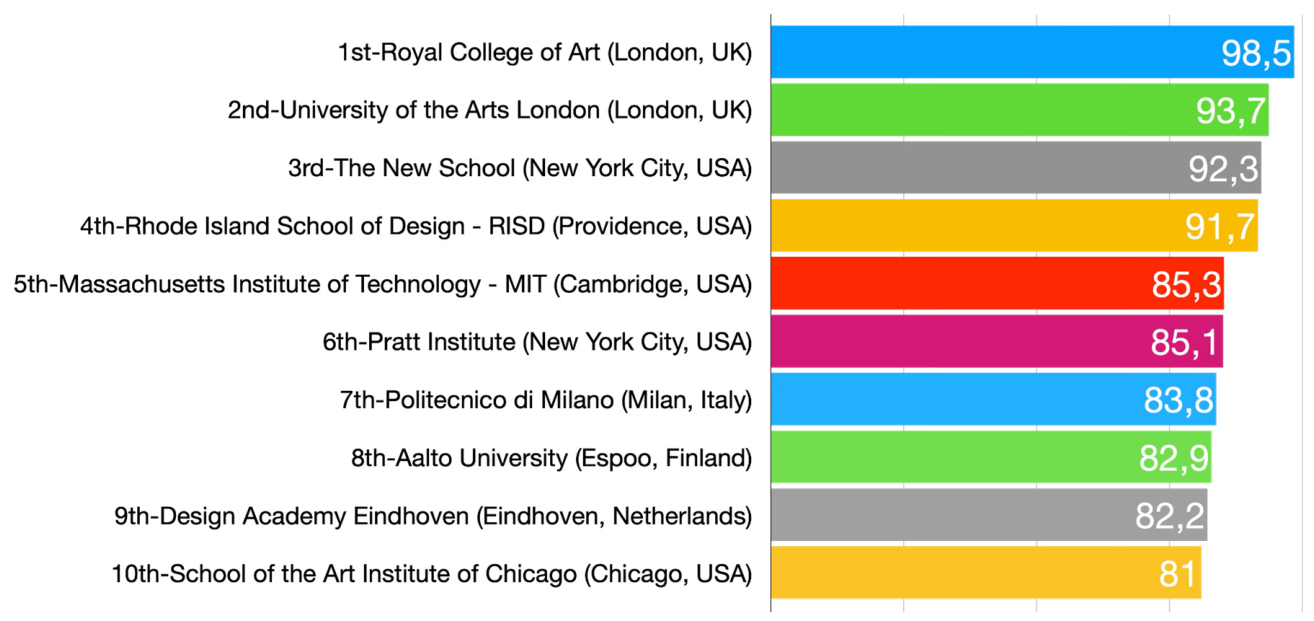
Figure 2.
Quantitative Analysis of AI Content: Total Programmes Assessed vs. AI-Related Curricula in Top 10 Institutions (by the authors).
Figure 2.
Quantitative Analysis of AI Content: Total Programmes Assessed vs. AI-Related Curricula in Top 10 Institutions (by the authors).
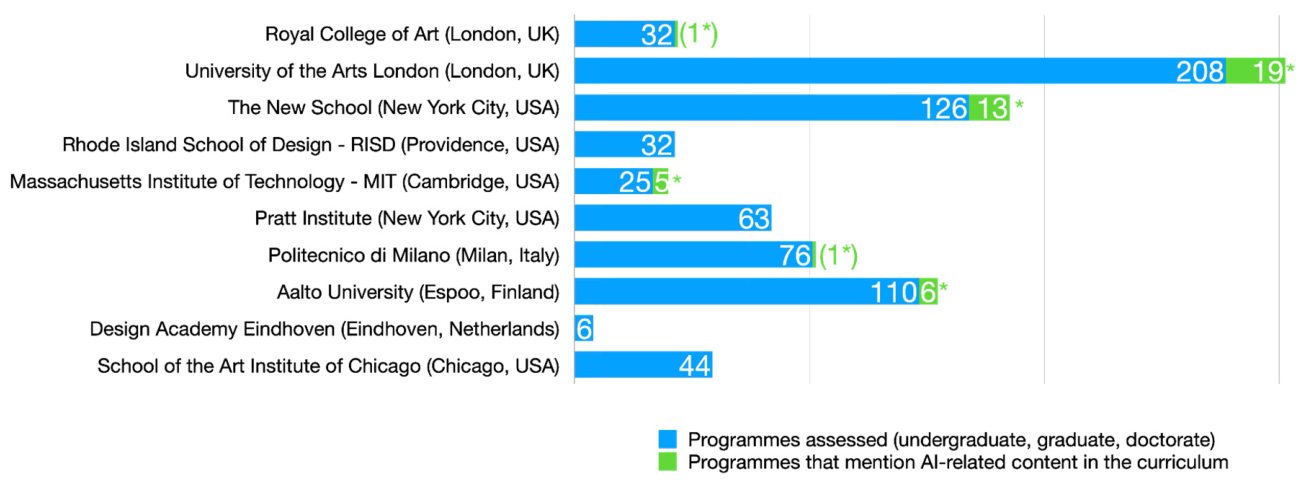
Figure 3.
Framework for AI-preparedness in Arts & Design Education (by the authors).
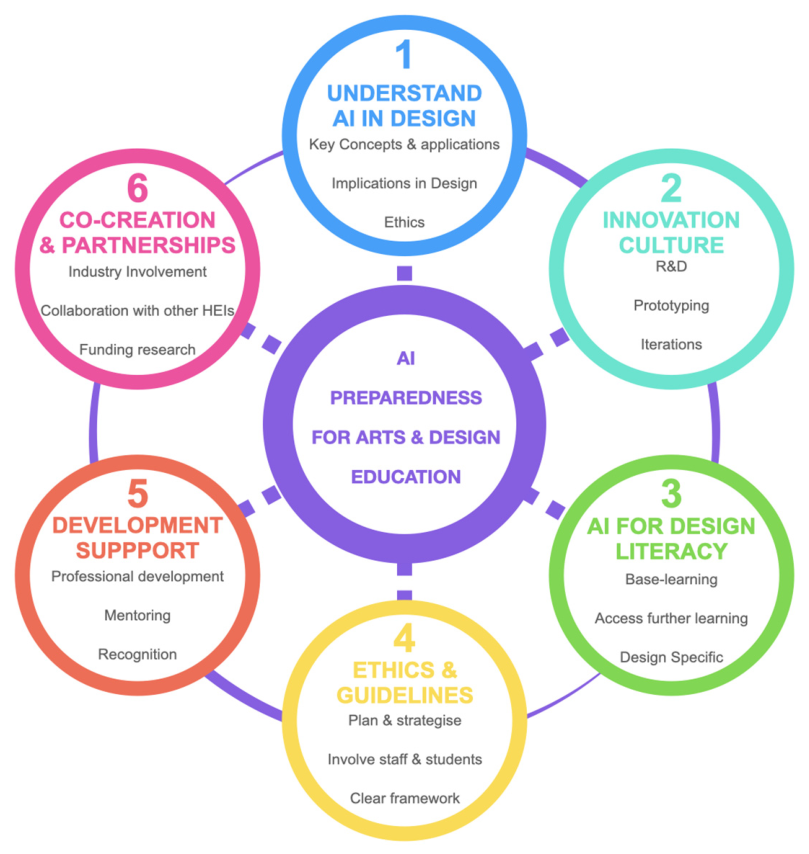

Table 1.
Interview Excerpts Summary.
| Topic | Andrew Shea’s Perspective | Hanny Wijaya’s Perspective |
|---|---|---|
| Overall View of AI | Hopeful yet cautious about power concentration; concerned about the track record of Big Tech. Excited about AI for sustainability and health | (Not specifically addressed) |
| Faculty Preparedness | Need for more training and conversations about collective priorities. Faculty must determine the most valuable tools and stay ahead of students to guide the discussion. | Faculty are the most significant challenge; many seem afraid of being replaced. Needs to be reframed as similar to the initial fear of the internet. |
| Institutional Readiness | (Addressed in the context of faculty training) | Sees varying levels of acceptance and readiness depending on the university (public/private). Each institution needs to find the right pace for its introduction. |
| Necessary Student Skills | Primary goal: students must identify and frame their relationship with AI. Key skills: prompt writing, understanding tool limitations and differences, and considering privacy implications. | Key skills: prompt use and integrating emotional intelligence to grasp ethical limitations and improve collaboration. |
| Core Ethical Concerns | Intellectual Property (IP) ownership, data privacy, bias and representation, and cultural appropriation | Emotional intelligence is necessary for students to grasp the ethical limitations of AI. |
Table 2.
Other relevant elements mentioned by experts during interviews.
| Nodes/references | Andrew Shea | Hanny Wijaya |
|---|---|---|
| Organise research networks between universities and partners | X | X |
| Need for Partnerships with Industry | X | X |
| Financing through Tech Companies (or other interested companies) | X | X |
| Need for more research from faculty members | X | |
| The ethics of AI necessitate a thorough review, and policies must be established | X | X |
| Organise invited presentations/workshops around AI | X | X |
| Need for a unified strategy for each university | X | X |
| Create recognition and incentives for staff to incorporate more AI | X | |
| Encourage professional AI development of staff | X | |
| Use Design research strategies to plan AI integration | X | |
| Create several levels of learning for staff to complete | X | X |
| Prioritise Research & Development | X | |
| Create a culture of AI learning and usage | X | |
| Involve all stakeholders, as well as students, in the AI planning process | X | X |
| Need for co-creation in AI between universities and third parties | X | X |
Disclaimer/Publisher’s Note: The statements, opinions and data contained in all publications are solely those of the individual author(s) and contributor(s) and not of MDPI and/or the editor(s). MDPI and/or the editor(s) disclaim responsibility for any injury to people or property resulting from any ideas, methods, instructions or products referred to in the content. |
© 2026 by the authors. Licensee MDPI, Basel, Switzerland. This article is an open access article distributed under the terms and conditions of the Creative Commons Attribution (CC BY) license.
Copyright: This open access article is published under a Creative Commons CC BY 4.0 license, which permit the free download, distribution, and reuse, provided that the author and preprint are cited in any reuse.