

Submitted:
21 September 2026
Posted:
22 September 2026
You are already at the latest version
Abstract
Underwater acoustic target recognition (UATR) models trained on one body of water can fail to generalize to another, and unsupervised domain adaptation (UDA) is a widely used remedy when the target water has no labels. We benchmark four UDA paradigms—source-only training, correlation alignment (CORAL), multi-kernel MMD, and domain-adversarial training (DANN, CDAN)—against a target-only supervised reference on a frozen two-class protocol spanning four corpora: the Strait-of-Georgia marine corpus Oceanship, freshwater-lake QiandaoEar22, an AIS-auto-labeled VTUAD reconstruction, and nearshore ShipsEar (40 method–direction combinations; ten seeds on the two-domain matrix and eight on the seven extension directions, 344 runs in total; strict source-validation model selection, exploratory paired significance tests; DANN/CDAN on the two-domain matrix only). We use “target oracle” solely as shorthand for this target-only supervised reference under the present architecture and protocol; it is not a theoretical upper bound. Under this protocol, adaptation can work but is strongly direction-asymmetric. In the lake→ocean (QiandaoEar22→Oceanship) direction, MMD lifts macro-F1 from 0.359 (near-total source-only collapse onto the majority class) to 0.524 ± 0.090, recovering 74% of the target-only supervised reference, and restoring passenger-ship recall from at most 9/1,214 on any source-only seed to 662/1,214 on the best-macro-F1 seed; all four UDA methods improve over source-only significantly, while pairwise differences among the UDA methods remain unresolved. In the ocean→lake (Oceanship→QiandaoEar22) direction the target-only oracle itself is low (0.551 macro-F1 with an 89-segment minority test class), indicating limited supervised headroom under the present architecture, labels, and split; there UDA’s measurable value is accuracy-variance compression (variance ratios 0.044–0.376 vs. source-only) and class-bias correction. On the two-domain matrix the most stable method in each direction is a moment-matching method (CORAL lake→ocean, MMD ocean→lake) and the least stable an adversarial one; the conditional variant CDAN exhibits a direction-dependent early-stopping collapse, with three of ten seeds frozen at epoch 1. The VTUAD third domain reverses the moment-matching ranking—CORAL shows fewer severe observed degradations than MMD across the evaluated directions and leads the only VTUAD direction with significant adaptation gains (QiandaoEar22→VTUAD, +0.129, p = 0.0008)—and MMD produces a significant negative adaptation (VTUAD→QiandaoEar22, −0.147 macro-F1, p = 0.005). On the hardest ShipsEar direction, none of the evaluated source-only/CORAL/MMD methods achieved a useful macro-F1 under this protocol (≤ 0.194 vs. a 0.8356 majority-class baseline). No method dominated across all directions, indicating that transfer direction and target-domain constraints are stronger determinants of performance than a universal choice of UDA objective. Recording/clip-level re-aggregation is reported as a three-seed robustness analysis because per-segment predictions were archived for the initial batch only; the primary multi-seed comparisons remain segment-level under recording/clip-disjoint splits. We release the MMSI-retaining VTUAD pipeline, code, frozen splits, and per-seed results.
Keywords:
underwater acoustic target recognition
; ship-radiated noise
; unsupervised domain adaptation
; domain shift
; benchmark
1. Introduction
Passive recognition of vessels from their radiated noise is a central capability of underwater acoustic surveillance. Deep classifiers trained on public corpora such as ShipsEar [1], DeepShip [2], Oceanship [3], and QiandaoEar22 [4] now reach usable accuracy. This accuracy holds only when training and test data come from the same body of water, the same hydrophone, and the same vessel population. In a companion benchmark study [5], we showed that this within-dataset evaluation conceals a complete cross-water failure. A ResNet-18 trained on marine recordings from the Strait of Georgia (Oceanship) scores 0.0% accuracy on lake recordings (QiandaoEar22), and the reverse direction scores 4.1%. Both scores lie far below the respective majority-class baselines. A recognition system deployed in waters without labeled data must close this gap without target labels. This is precisely the setting of unsupervised domain adaptation (UDA) [6].
The UDA literature offers two dominant families of methods. Statistical moment matching aligns feature distributions explicitly: CORAL aligns second-order covariances [7], while maximum mean discrepancy (MMD), as used in deep adaptation networks [8], matches kernel mean embeddings. Domain-adversarial training instead learns features that fool a domain discriminator. DANN [6] uses a gradient-reversal layer, and CDAN [9] conditions the discriminator on classifier predictions. Both families descend from the same theoretical root, the domain-adaptation generalization bound of Ben-David et al. [10,11]. This bound decomposes target error into a source-error term, a distribution-divergence term (the HΔH divergence), and a shared-optimal-error term. Each of the four methods we study can be read as a different strategy for controlling the divergence term. CORAL applies explicit second-order alignment, MMD applies kernel-metric alignment, and DANN and CDAN learn approximations to the divergence itself. The third term is a shared-optimal-error component of the domain pair that representation learning alone cannot reduce. Both families are mature in computer vision, but their behavior under acoustic cross-water shift is unknown. Underwater domains differ in channel and noise floor and in the vessel population itself. The two-class-per-direction shared label space is tiny, and evaluation is dominated by a fragile minority class. Whether the mechanisms that make adversarial methods competitive on Office-31 [8] survive these conditions is an open empirical question with direct operational consequences.
This paper answers that question with a controlled comparison, and contributes:
(1) A systematic 344-run UDA benchmark for cross-water UATR. On the shared two-class label space between Oceanship and QiandaoEar22 established in [5], we evaluate source-only (lower bound), CORAL, MMD, DANN, CDAN, and a target-only supervised reference (the “target oracle”) in both transfer directions, with ten seeds each (120 runs). We extend the matrix to a third domain (our VTUAD reconstruction, Section 3.2) with four additional directions × four methods (source-only, CORAL, MMD, target oracle) × eight seeds (128 runs). We further extend it to a fourth corpus (ShipsEar, Section 4.7) with three additional directions × the same four methods × eight seeds (96 runs). Everything runs under a strict no-label-leak protocol: all UDA methods perform model selection on the source validation split and never touch target labels before the final test. Method-level claims are supported by paired t-tests over seeds, bootstrap confidence intervals, and variance-ratio F-tests recomputed from the released per-seed results.
(2) A unified theoretical treatment with implementation-faithful derivations. We present the Ben-David bound (Section 3.3) as the common frame. We then derive each method’s objective in one notation that maps term by term onto the released training code: CORAL’s Frobenius covariance penalty and its closed-form whitening–recoloring analogue, the multi-kernel MMD estimator with median-heuristic bandwidths, DANN’s gradient-reversal minimax, and CDAN’s multilinear conditioning.
(3) Evidence of transfer-direction asymmetry and a supervised-ceiling-limited direction. Adaptation gains are significant for all four UDA methods in the lake→ocean direction, with MMD at the highest mean (macro-F1 0.359 → 0.524, +46% relative, 74% of the target-only supervised reference). They are structurally capped in the ocean→lake direction, where even the supervised oracle only reaches 0.854 accuracy / 0.551 macro-F1 owing to an 89-segment minority test class. There, UDA’s measurable value is stabilizing training and correcting class bias. We treat this ceiling as an empirical reference under the present architecture, split, and sample size; it may be consistent with a large shared-optimal-error term of the Ben-David bound, but it is not a direct estimate of that term.
(4) A stability ranking of UDA paradigms. The tightest per-direction seed spread comes from a moment-matching method in both directions of the two-domain matrix (CORAL lake→ocean, MMD ocean→lake), and the widest from an adversarial method (CDAN and DANN, respectively; at segment level; one aggregation-level exception, Section 4.8). CDAN in particular suffers a direction-dependent early-stopping collapse, with three of ten seeds frozen at epoch 1. Its training-curve pattern is consistent with an interaction between the gradient-reversal warm-up schedule and source-validation model selection on a two-class label space, though this attribution is not verified by controlled intervention (Section 4.3).
(5) An AIS-auto-labeled reconstruction of the VTUAD dataset. The VTUAD corpus [12], hydrophone audio labeled by co-recorded AIS traffic, is gated behind an IEEE DataPort subscription. We rebuild it from its public upstream source (Ocean Networks Canada hydrophones in the Strait of Georgia, jointly archived AIS messages, and CTD casts) with a fully automatic pipeline: AIS message parsing, MMSI-level static-table propagation, hydrophone-distance filtering, single-vessel scenario identification, and interval matching between audio and AIS tracks (Section 3.2 details all rules and parameters). Because the rebuild retains MMSI identifiers and exact timestamps, vessel-identity-disjoint split isolation is possible from its metadata, a leakage guard the original release does not support. The released frozen split itself, however, is clip-level and does not enforce vessel-identity disjointness. The rebuilt corpus contains 525 AIS-labeled clips over 12 classes (509 single-vessel scenario clips and 16 background clips), with 132,273 unique segments and frozen clip-level splits of 369/80/76. We benchmark it under the identical protocol, adding 128 configurations whose results qualify the two-domain method ranking and expose the first negative-adaptation result observed within the present four-corpus protocol and, to our knowledge, among the cross-water UATR studies reviewed here (Section 4.6).
Relationship to companion preprints. This preprint is the source-data UDA benchmark of a coordinated series built on shared frozen assets: the companion zero-transfer benchmark [5] documents the direct-transfer failure and supplies the shared two-class label space and frozen splits; the data descriptor [16] documents the VTUAD third domain; the source-free counterpart [19] adapts without access to source data; the open-set pilot [20] studies rejection of unknown vessel classes; the OSFUDA preprint [21] studies open-set source-free adaptation on unknown-contaminated target pools; and the foundation-model preprint [23] studies frozen general-purpose audio foundation models. Each preprint addresses a separate research question on the same frozen protocol, and no headline result table is shared between them.
2. Related Work
2.1. Cross-Water Shift in Underwater Acoustic Recognition
Public UATR corpora differ systematically in acquisition conditions. ShipsEar [1] was recorded off the Spanish Atlantic coast. DeepShip [2] and Oceanship [3] both draw on Ocean Networks Canada (ONC) hydrophones in the Strait of Georgia but use different taxonomies (4 coarse classes vs. 15 AIS vessel types). QiandaoEar22 [4] was recorded with a DigitalHyd SR-1 hydrophone in the freshwater Qiandao Lake and is organized as target-presence tasks for three specific vessels. Published evaluations on these corpora are, to our knowledge, all within-dataset. The only cross-domain settings in this literature that we are aware of are the few-shot works [13,14], which still require a small amount of labeled target data. Our companion study [5] provided, to our knowledge among the cross-water UATR studies reviewed here, the first cross-dataset measurement between public ship-noise corpora. It found complete zero-transfer in both directions (0.0% and 4.1% accuracy), with asymmetric failure modes: the ocean model maps lake inputs to high-energy workboat types, and the lake model maps ocean vessels to background noise. It further showed that part of the collapse stems from label-taxonomy mismatch, beyond acoustic shift alone. That work established the shared two-class label space and frozen splits on which the present UDA study is built, but it did not attempt any adaptation. The closest prior adaptation work in UATR is few-shot and supervision-intensive. He et al. [13] improve few-shot underwater acoustic recognition by exploiting unlabeled target-domain samples alongside a labeled few-shot support set. Cui et al. [14] instead drive few-shot recognition with cross-domain contrastive learning. Both require a small amount of labeled target data, and neither measures label-free cross-water adaptation. The present study, by contrast, benchmarks fully target-label-free UDA on a frozen two-class protocol spanning four corpora.
2.2. Unsupervised Domain Adaptation: Theory and Methods
UDA assumes labeled source data and unlabeled target data from related but shifted distributions. The theoretical foundation is the generalization bound of Ben-David et al. [10,11]. The bound upper-bounds the target error of any hypothesis by its source error, plus the HΔH divergence between the two marginal feature distributions, plus an irreducible shared-optimal-error term. The divergence term can be estimated from finite samples by training a domain classifier [10], which is exactly what adversarial UDA methods operationalize. Moment-matching methods instead minimize an explicit distributional discrepancy. CORAL [7] aligns the second-order feature covariances of source and target with a Frobenius-norm penalty. The Deep Adaptation Network [8] minimizes a multi-kernel MMD between domain mean embeddings in a reproducing kernel Hilbert space, a metric on distributions when the kernel is characteristic [15]. Adversarial methods learn domain-invariant features through a minimax game. DANN [6] inserts a gradient-reversal layer between the feature extractor and a domain discriminator, with the adversarial weight ramped up over training. CDAN [9] conditions the discriminator on the outer product of features and classifier predictions to capture multimodal class-conditional structure. These methods are extensively benchmarked on image corpora, where adversarial methods typically match or exceed moment matching. Whether this ordering transfers to cross-water acoustics has not been tested; there the domain gap includes physical channel differences, and the label space may be as small as two classes. Our results indicate it does not. Under our protocol, moment matching achieved the highest mean macro-F1 in the lake→ocean direction and provided the most stable method of each direction at segment level (Section 4.8), among the evaluated methods. The third-domain extension further splits the moment-matching family itself: CORAL proves the more reliable default across the four VTUAD directions, while MMD turns significantly harmful in one of them (Section 4.6).
2.3. AIS-Based Automatic Labeling of Hydrophone Audio
Manual annotation of passive acoustic recordings is prohibitive at scale. Co-recorded AIS traffic offers an automatic alternative: each vessel’s broadcast position, identity (MMSI), and static type-and-cargo code can be matched in time and space against hydrophone recordings to yield automatically derived labels with potential uncertainty. This strategy underlies Oceanship [3] and the ONC-based dataset construction pipeline of Domingos et al. [12], whose VTUAD dataset (released via IEEE DataPort under subscription) pairs Strait of Georgia hydrophone audio with AIS-derived vessel-type labels. Our reconstruction follows the same pipeline architecture [12] against the public ONC archive, with two practical differences. First, the pipeline runs against current ONC APIs (pyais-compatible parsing). Second, every output segment carries its MMSI and UTC timestamps, which makes vessel-identity-disjoint split isolation possible from metadata; the original release does not support this.
3. Materials and Methods
3.1. Domains, Shared Label Space, and Splits
The four adaptation domains span four corpora. The first is the marine corpus Oceanship [3] (81,446 log-mel segments over 15 AIS vessel types; ONC hydrophones, Strait of Georgia). The second is the freshwater-lake corpus QiandaoEar22 [4] (35,641 content-deduplicated segments over 8 target-presence view labels; DigitalHyd SR-1, Qiandao Lake, 2022). The third is our AIS-auto-labeled VTUAD reconstruction [16] (525 clips: 509 single-vessel scenario + 16 background; 132,273 unique log-mel segments over 12 classes; ONC hydrophone ICLISTENAF2523, Strait of Georgia, 2016–2017; Section 3.2). The fourth is the nearshore harbor corpus ShipsEar [1] (90 recordings, mostly at <50 m range, off the Spanish Atlantic coast; 7,425 log-mel segments over 12 registry classes; Section 4.7). Following [5], cross-water evaluation is restricted to the two semantically mappable class pairs (Table 1). These are passenger_ship (Oceanship Passenger ↔ QiandaoEar22 kaiyuan_target; the KaiYuan is a passenger sightseeing ship) and small_fast_craft (Oceanship Pleasure Craft ↔ speedboat_target; an approximate mapping, as AIS has no speedboat type code).
All audio is preprocessed identically (16 kHz, 3 s segments with 1.5 s hop, single-channel 128-bin log-mel spectrograms, n_fft = 1024, hop = 320). Splits are frozen at the recording level (*_v1.json, seed 42, stratified by class at the recording level, with test ratio 0.15 and validation ratio 0.15, both measured against the total, giving a 70/15/15 partition), so that segments from one source recording never cross partitions [5]. ‘Recording level’ denotes a dataset-specific group-disjoint rule whose key is released with each split manifest: scenario clip IDs for VTUAD, source-WAV recording IDs for ShipsEar, recording-session timestamp prefixes for Oceanship, and recording-session timestamps or DATA IDs for QiandaoEar22. Restricting each corpus to its two shared classes gives the protocol populations in Table 2. One asymmetry drives much of what follows. The QiandaoEar22 two-class test set contains only 89 minority-class (kaiyuan_target) segments out of 802 (11.1%). Its majority-class baseline is therefore 0.8890, and macro-F1 is extremely sensitive to minority recall. A single minority false negative moves minority recall by 1/89 ≈ 1.1 percentage points. The binomial standard error of a minority-recall estimate at true recall r = 0.5 is . The VTUAD two-class test set is comparatively balanced (916 minority segments of 2,426, majority-class baseline 0.6224). This makes it the first direction in this benchmark with both a large minority test class and a high empirical reference ceiling (Section 4.6). The ShipsEar two-class test subset is the most imbalanced of the four domains (84 minority segments of 511, majority-class baseline 0.8356). Because it spans only 7 test recordings, its estimates are reported with per-seed values throughout (Section 4.7).
3.2. VTUAD Reconstruction via AIS Automatic Labeling
As a third domain we reconstruct VTUAD [12] from public ONC archives (Figure 1), adapting the open-source ONC dataset-construction code of [12] to the current ONC API. The pipeline runs in six scripted stages: deployment query and verification; AIS acquisition and parsing; static-table propagation and cleaning; single-vessel scenario identification (per-minute determination: exactly one tracked vessel within the 6,000 m exclusion zone, sustained for at least 2 consecutive minutes and released at the 4,000 m inclusion-radius tier; background intervals instead require no tracked vessel within 6,000 m for at least 30 consecutive minutes); audio download and interval matching (±5-minute tolerance); and metadata generation with per-period CTD environmental covariates. All stage parameters, self-checks, and released artifacts are documented in the companion data descriptor [16] and are not repeated here. One protocol difference from the original VTUAD construction must be stated explicitly, because the two descriptions could otherwise read as contradictory. The original pipeline split the matched audio into normalized one-second pieces. Our reconstruction instead retains each single-vessel scenario as one complete WAV clip (median duration 300 s, range 119–2,220 s [16]). The full-length scenario clip is therefore the release and split unit of the rebuilt corpus. The one-second normalization step belongs to the original pipeline only. Every log-mel segment used below is derived from these complete clips by the unified front-end.
3.2.1. Frozen Split and Vessel-Identity-Level Isolation
The frozen split itself is recording/clip-level isolation. Because every segment additionally carries its MMSI and UTC interval, vessel-identity-level isolation (all segments of a given MMSI confined to a single partition) is possible from the metadata. This is a stronger leakage guard than segment-level random splits, and one the original VTUAD metadata does not support. The released frozen split, however, does not itself enforce vessel-identity disjointness. The rebuilt corpus contains 525 labeled clips over 12 classes—509 single-vessel scenario clips and 16 background clips (passengership, tug, tanker, cargo, background, pleasurecraft, fishing, sailing, pilotvessel, rescue, dredger, other). The unified front-end segments them into 132,273 unique log-mel segments (93,592 / 20,479 / 18,202 train/val/test) under a frozen clip-level split of 369/80/76 clips (vtuad_v1.json, seed 42, stratified). The extraction manifest lists 133,784 rows, of which 1,511 are duplicate rows from eight background/vessel filename collisions whose feature files were overwritten on disk; all counts in this paper use the deduplicated count. The companion descriptor’s v1.2.0 release [16] resolves these collisions with globally unique identifiers, giving a 133,784-segment store; all VTUAD experiments in this manuscript use the frozen deduplicated experimental snapshot, not the public v1.2.0 release. The class distribution is long-tailed (training imbalance 81.6:1, tug vs. pilotvessel, computed as 29,230 vs. 358 segments in the frozen twelve-class training store; the public v1.2.0 release differs here (30,502 vs. 358, i.e., 85.2:1) because the collision repair restored training segments). Section 4.6 reports the completed third-domain experiments.
3.2.2. Relationship to the Original VTUAD Release
We reuse the public upstream archives identified by Domingos et al. [12]—ONC hydrophone audio, jointly archived AIS messages, and CTD casts—and follow their pipeline architecture for AIS parsing, static-table propagation, distance filtering, and single-vessel scenario identification. The reconstruction nonetheless differs from the original release in several processing choices: we retain complete WAV scenario clips rather than normalized one-second pieces, run against the current ONC API, and apply our own filtering, time-matching, file-naming, and deduplication rules, each of which may alter the sample distribution. We have not performed a file-by-file consistency check against the subscription release, which is not publicly accessible. The corpus is therefore used here as an independently reconstructed AIS-labeled corpus derived from public ONC archives, not as a strict mirror of the original VTUAD release, and cross-study numerical comparisons with results obtained on the original release should be made with caution.
Reproducibility note. All VTUAD experiments in this manuscript use the frozen deduplicated 132,273-segment experimental snapshot (Zenodo version DOI: https://doi.org/10.5281/zenodo.22274550), not the public v1.2.0 release described in the companion data descriptor [16], which resolves the filename collisions with globally unique identifiers and contains 133,784 stored segments. Results should not be numerically compared across versions. A v1.2.0 replication, together with MMSI-disjoint split results, is pre-registered and underway for a subsequent manuscript version. All UDA loaders use one shared nominal batch size for source and target; the per-batch truncation to n = min(nS, nT) noted in Section 3.5 is retained only as a defensive implementation detail for unequal final batches.
Changes from v1. Relative to v1 (preprints202609.1124.v1), this version (i) retitles the study from “Unsupervised Domain Adaptation for Cross-Water Underwater Acoustic Target Recognition: A Four-Corpus Benchmark on Oceanship, QiandaoEar22, an AIS-Auto-Labeled VTUAD Reconstruction, and ShipsEar” to the present title; (ii) expands the seed set from three to ten on the two-domain matrix and from three to eight on the seven extension directions under the identical frozen protocol (224 additional runs; the v1 runs form a strict nested subset of the v2 run set, and the v1 numbers remain unchanged on the v1 record); and (iii) expands the theory treatment of Section 2.2 (generalization bound, divergence estimation, and method-by-method objective derivations). All tables, figures, and statistics in this version were recomputed on the expanded run set.
3.3. Problem Formulation and Theoretical Framework
Setup. Let be the log-mel input space and the shared two-class label space. The source domain is a distribution over with labeled samples; the target domain is observed only through unlabeled samples drawn from its marginal. A model factorizes as , where is the feature extractor () and the classifier. We write and for the expected 0-1 errors of on the two domains.
The Ben-David bound. The foundational result of domain-adaptation theory [10,11] states that for any hypothesis in a class ,
where the divergence measures how well two hypotheses in can disagree on one domain but not the other,
and the shared-optimal-error term
is the combined error of the best joint hypothesis, a property of the domain pair rather than of any algorithm.
This decomposition organizes the entire comparison of this paper:
- Term 1 (source error) is minimized by the supervised classification loss shared by all methods.
- Term 2 (divergence) is the explicit target of every UDA method, and the methods differ in which proxy they minimize. CORAL minimizes a second-order surrogate, the Frobenius gap between feature covariances (Section 3.5.2). MMD minimizes a kernel-metric surrogate that bounds the discrepancy visible to any unit-norm RKHS function (Section 3.5.3). DANN and CDAN minimize a learned approximation to itself: a domain discriminator that cannot distinguish source from target features indicates, in the idealized limit of a sufficiently expressive and well-optimized discriminator, that the feature distributions are hard to separate; with our finite-capacity MLP discriminator we interpret the discriminator loss as an optimization signal rather than as a direct estimate of the HΔH divergence. The empirical estimate of the divergence via a domain classifier is due to [10], and the minimax objective that gradient descent makes practical is DANN’s contribution [6].
- Term 3 () cannot be reduced by representation learning. Its practical signature is a low empirical reference ceiling—the performance attainable by supervised training on the target domain itself under the present architecture, split, and protocol. A low target-only oracle, however, should not be interpreted as a direct estimate of : the oracle measures the single-domain target risk of one fixed ResNet-18, one training recipe, one class weighting, and one target train/validation split, so a low oracle can equally reflect finite-sample effects, label ambiguity, class-definition mismatch, or limited model capacity. It is better read as an operational diagnostic that the target task, under the present architecture, labels, split, and sample size, has limited supervised headroom. Such a ceiling is consistent with a large shared-optimal-error component, but does not by itself establish one. This is the situation we identify in the ocean→lake direction (Section 4.2), where the supervised oracle itself reaches only 0.551 macro-F1; we therefore describe that direction as supervised-ceiling-limited rather than -dominated.
Unified objective. All four UDA methods share one training template,
where is class-weighted cross-entropy (Section 3.6). The first term controls the source error, and the second term is a method-specific divergence proxy. For CORAL and MMD, is a differentiable discrepancy evaluated on paired source/target batches (, no schedule). For DANN and CDAN, is realized through a domain discriminator and a gradient-reversal layer with scheduled weight (Section 3.5.4 and Section 3.5.5). The remainder of this section derives each in this common notation; every equation maps directly onto the released implementation (train_uda.py).
3.4. Network Architecture
All methods share one backbone: ResNet-18 [17] with ImageNet-pretrained weights, its first convolution adapted to the single-channel log-mel input (128 mel bins × 151 frames for 3 s at hop 320). The penultimate global-average-pooled feature feeds a linear two-class head . Adversarial methods attach a domain discriminator; its input dimension differs between DANN and CDAN (Table 3).
3.5. UDA Methods: Objectives and Derivations
3.5.1. Source-Only and Target Oracle (Reference Bounds)
Source-only training sets and evaluates the source-trained model directly on the target test set: the UDA lower bound. The target oracle trains the same architecture on labeled target training data with target-domain normalization and target-validation model selection; it provides an empirical reference ceiling under the present architecture, split, and protocol and cannot be deployed in practice (hereafter also the supervised oracle).
3.5.2. CORAL: Second-Order Covariance Alignment
Objective. Let and be batches of source and target features (implementation detail: both batches are truncated to rows). With column means and centered matrices (and analogously for ), the unbiased batch covariances are
and Deep CORAL [7] minimizes the squared Frobenius distance between them,
where the factor normalizes the penalty so that its magnitude is independent of feature dimension (with the raw matrix discrepancy can reach entries of unit scale). In the Ben-David reading of Section 3.3, is a second-order surrogate of the divergence term. Any linear detector has equal second moments on the two domains only if . Driving the covariance gap to zero therefore removes every discrepancy that a quadratic measurement of the feature distribution can detect.
Closed-form analogue (whitening–recoloring). In its original linear form [7], CORAL admits an exact zero-loss transformation without any gradient steps. Given full-data covariances and a small regularizer , whiten the source features and recolor them with the target covariance:
The transformed covariance satisfies
with equality when and is invertible: second-order alignment has a one-shot closed form in the linear case. Deep CORAL replaces this transformation by the differentiable penalty above, because the “transformation” must instead be absorbed into the weights of . The gradient of the Frobenius penalty w.r.t. the features is . Differentiating the loss contributes a factor , and the Jacobian of contributes a factor per transpose term, with the two transpose terms coinciding by symmetry into the overall factor 2/(n−1). The implementation obtains this gradient by automatic differentiation.
Why second order, and its blind spot. Covariance alignment is cheap (), parameter-free, and deterministic given the batch, which foreshadows its empirical stability (Section 4.3). Its structural blind spot follows directly from the definition. Because each batch is centered before the covariance is computed, is invariant to any constant shift of the feature mean. It cannot see first-order displacement at all. Cross-water acoustic shift, however, includes precisely such a global translation: channel noise floor and spectral tilt move the log-mel feature cloud bodily. This observation makes a mechanism-level prediction: a discrepancy sensitive to means should dominate CORAL on the direction where the shift has a large first-order component. Section 4.2 confirms this prediction for MMD.
3.5.3. MMD: Multi-Kernel Mean-Embedding Matching
MMD is designed to close the full distributional gap, not only a second-order slice of it. Embedding both domains in a reproducing kernel Hilbert space makes the objective sensitive to first-order (mean) displacement that covariance alignment cannot see. This mechanism later proves decisive both positively (Section 4.1) and negatively (Section 4.6).
Kernel mean embedding. Let be a positive-definite kernel with reproducing kernel Hilbert space (RKHS) and feature map , . The kernel mean embedding of a distribution is , and the squared maximum mean discrepancy between source and target feature distributions is the RKHS distance between their embeddings [15]:
where the second equality is the kernel trick expansion of the RKHS norm: all expectations reduce to kernel evaluations, so is computable without ever constructing .
Properties relevant here. (i) is an integral probability metric: . It therefore upper-bounds the discrepancy seen by any unit-norm RKHS function, a strictly richer witness class than CORAL’s quadratic measurements. (ii) For a characteristic kernel such as the Gaussian RBF, : matching the embedding matches the full distribution, all orders of moments included [15]. In particular, unlike , MMD does see first-order mean displacement, the property Section 3.5.2 argues is decisive for cross-water shift.
Biased empirical estimator. On feature batches , (again truncated to in implementation), the DAN-style [8] biased V-statistic estimator is
The biased estimator is preferred in deep adaptation for two practical reasons. It is non-negative by construction, hence numerically stable as a loss. Its diagonal terms supply a constant offset that does not change gradients while keeping the objective well-behaved under mixed-precision training.
Multi-kernel RBF with median heuristic. A single Gaussian bandwidth is brittle at 512-d scales, so we follow [8] and use a sum of five Gaussian kernels, itself a valid (characteristic) kernel:
where is the median of all pairwise squared Euclidean distances in the pooled source-plus-target batch (clamped below by ). The median heuristic places the base kernel at the scale where half of all sample pairs are inside the kernel’s sensitive region. The spread covers an octave band around it. This makes the loss robust to the large scale differences between the two domains’ feature clouds. Pairwise distances are computed through the expansion with clamping at 0, and the bandwidths are frozen per batch under no_grad, exactly as in the released implementation.
3.5.4. DANN: Adversarial Divergence Minimization via Gradient Reversal
The domain discriminator as divergence estimator. Ben-David et al. [10] show that the divergence can be estimated from finite samples by the error of the best domain classifier: a discriminator that cannot separate source from target features indicates a small divergence in the idealized limit of a sufficiently expressive and well-optimized discriminator. DANN [6] turns this into a trainable objective. A discriminator with parameters receives features and is trained with domain cross-entropy ( source, target):
while the feature extractor is trained to maximize the same quantity, giving the minimax
At the optimum of the inner maximization, equals (up to a constant) the Jensen–Shannon divergence between the two feature distributions in the idealized limit of an optimal discriminator. With a finite-capacity, SGD-trained discriminator we treat this identity as motivation only: the outer minimization shrinks a divergence-term proxy in the Ben-David bound rather than a measured divergence.
Gradient reversal layer (GRL). The minimax is implemented without alternating optimization by the GRL, an identity in forward and a scaled sign-flip in backward:
so that ordinary SGD on ascends the feature-extractor gradient while descending the discriminator gradient: one optimizer, one pass. This gradient-reversal implementation provides a practical joint optimization procedure for the adversarial objective; it does not guarantee convergence to a global minimax equilibrium.
Warm-up schedule. The adversarial weight follows the standard DANN schedule over training progress ,
which satisfies and sigmoidally. The purpose is curriculum: early epochs let establish a discriminative source representation before the (initially noisy) adversarial pressure is applied. Section 4.3 discusses one plausible mechanism by which this schedule, benign on vision benchmarks, may contribute to one of our failure modes. The near-zero adversarial gradient at small can leave the classifier frozen at a degenerate checkpoint when model selection is source-based.
The discriminator is an MLP with structure Linear(512 → 256) + ReLU + Dropout(0.5) + Linear(256 → 2) (Table 3), receiving both source and target batch features through the same GRL.
3.5.5. CDAN: Conditioning the Discriminator on Classifier Predictions
Motivation. DANN aligns the marginal feature distributions and . On multimodal data, however, marginal alignment can be achieved while the class-conditional distributions remain misaligned: two modes of one class may be matched against modes of the other. On a ship-noise two-class problem the failure is concrete. Nothing in the DANN objective prevents the “passenger ship” mode of the lake domain from being fused with the “small craft” mode of the ocean domain, since the discriminator sees no label information. CDAN [9] conditions the discriminator on the classifier’s own prediction distribution so that the adversarial game is played on the joint distribution of features and predictions.
Multilinear conditioning map. Let be the predicted class posterior () and the feature. CDAN feeds the discriminator the flattened multilinear (outer-product) map
whose coordinates are exactly all feature–posterior cross-products , i.e., a rich sufficient statistic of the cross-covariance between the representation and the prediction. Matching across domains encourages—but does not by itself guarantee—alignment of features within each predicted class, at only linear cost in . The full joint would be intractable for large ; for the conditioning doubles the discriminator input width from 512 to 1024. This widening is modest but, as Section 4.3 shows, apparently still too weak a signal on a two-class problem when combined with early source-based selection. The discriminator becomes Linear(1024 → 256) + ReLU + Dropout(0.5) + Linear(256 → 2), and the GRL schedule is identical to DANN. We do not use the entropy-conditioning variant (no per-sample weighting by prediction uncertainty), keeping the comparison to the conditioning mechanism alone.
Expected gain, and where it can fail. Relative to DANN, CDAN should (i) reduce negative transfer from class-confused alignment and (ii) tighten the bound’s divergence term on the class-conditional instead of the marginal distributions, at the cost of a noisier discriminator input early in training, when the classifier posterior itself is unreliable. Section 4.3 shows both faces of this trade: CDAN halves DANN’s variance ocean→lake, yet exhibits a direction-dependent collapse lake→ocean.
3.6. Training and Evaluation Protocol
Training is identical across methods (Table 4): 30 epochs maximum, early stopping with patience 8, batch 64, AdamW (lr 3×10⁻⁴, weight decay 1×10⁻⁴, cosine annealing over the full epoch budget), SpecAugment [18] time/frequency masking, and square-root-smoothed class weights,
i.e., inverse class frequency raised to power 0.5 and normalized to unit mean, the scheme shown in [5] to be the viable weighting under skew. For UDA methods, each training step pairs one labeled source batch with one unlabeled target batch (target loader cycled), so source and target see the same number of steps per epoch. Features are normalized with the source training-set mean/std for all UDA methods (the realistic deployment condition); the oracle uses target statistics. Crucially for UDA validity, model selection for source-only, CORAL, MMD, DANN, and CDAN uses source-validation accuracy only. Target labels participate nowhere in training, checkpointing, or early stopping. Only the oracle (a supervised reference) selects on target validation. Early stopping fires after 8 consecutive epochs without improvement of the selection accuracy. The best checkpoint (highest selection accuracy over training) is restored for the single final target-test evaluation.
Each of the 2 directions × 6 methods is run with ten seeds (42–51; 120 runs). The third-domain extension (Section 4.6) applies the identical protocol to the four VTUAD-related directions (Oceanship→VTUAD, QiandaoEar22→VTUAD, VTUAD→Oceanship, VTUAD→QiandaoEar22) with the four architecture-free methods (source-only, CORAL, MMD, target oracle; the adversarial methods DANN/CDAN are confined to the original two-domain matrix) and eight seeds (42–49; 128 runs). The fourth-corpus extension (Section 4.7) applies the same protocol and the same four methods to three ShipsEar-related directions (Oceanship→ShipsEar, QiandaoEar22→ShipsEar, ShipsEar→Oceanship; 96 runs). We report target-test accuracy and macro-F1 as mean ± std over the direction’s seeds (ten on the two-domain matrix, eight on the extensions). Unless noted otherwise, std is the population standard deviation (ddof = 0, denominator ), matching the released aggregate.json. The paired tests of Section 4.5 use the sample standard deviation of the per-seed differences (ddof = 1, denominator ; df = 9 on the two-domain matrix, df = 7 on the extension directions). Because the adaptation gains concentrate in minority-class recall, macro-F1 is the primary metric,
giving equal weight to the 89-segment minority class; accuracy is reported alongside and interpreted against each test set’s majority-class baseline. Statistical comparisons are paired across the shared seed set. We use two-sided paired t-tests on per-seed differences with 95% confidence intervals and Cohen’s , percentile bootstrap confidence intervals (200,000 resamples) for each per-direction method mean, and variance-ratio F-tests for stability claims (Section 4.5). Per-class confusion matrices are used for failure-mode diagnosis.
4. Results
4.1. Main Comparison: The Two-Domain Matrix (120 Configurations, Both Directions)
- Lake→ocean, adaptation works and MMD has the highest mean. Source-only training collapses onto the majority class (accuracy 0.5564 ≈ the majority-class baseline 0.5563; passenger_ship recall is 0/1,214 on six of ten seeds and at most 9/1,214 on the rest). All four UDA methods recover minority-class detection. Multi-kernel MMD achieves the highest mean result of the entire study, with macro-F1 0.5240 ± 0.0896, i.e., +0.166 over source-only (+46% relative; paired t(9) = 5.49, p < 0.001, Cohen’s d = 1.74, 95% CI of the gain [+0.097, +0.234]). This reaches 74% of the target-only supervised reference’s 0.7109 (CORAL reaches 69%). MMD also has the highest mean accuracy (0.5904, 3.4 points above the majority-class baseline). The highest single-seed result (seed 43) reaches macro-F1 0.6350 with passenger_ship recall 0.545 (662/1,214).
- Ocean→lake, the ceiling is the story. Source-only accuracy (0.5696) already sits far below the 0.8890 majority-class baseline, and no UDA method closes that gap. All UDA accuracies remain ≤ 0.686. Macro-F1 differences among methods are small (0.433–0.490; CDAN nominally best at 0.4897 ± 0.0339), and every method stays below the oracle’s macro-F1 0.5514. As Section 4.2 shows, this direction’s empirical reference ceiling is itself low, leaving little room for adaptation to show mean gains.
- Accuracy is the wrong lens here. In both directions the dominant effect of UDA is the recovery of minority-class recall. Macro-F1 registers this effect but accuracy obscures it. CORAL’s ocean→lake accuracy (0.5491), for example, is below source-only (0.5696), while its class-balanced predictions are far more useful. We therefore rank methods by macro-F1 throughout.
4.2. Direction Asymmetry and the Oracle Ceiling
The two directions differ not in degree but in kind. In the lake→ocean direction the supervised oracle is strong (0.714 acc / 0.711 macro-F1), the source-only model collapses to the majority class, and UDA has genuine headroom, which MMD largely exploits. In the ocean→lake direction the supervised oracle itself reaches only 0.854 accuracy / 0.551 macro-F1, below the 0.8890 majority-class baseline on accuracy. With only 89 kaiyuan_target segments (11.1%) in the test set, even a supervised model must trade accuracy for minority recall, because class weighting lifts the 89-segment class at the cost of majority-class errors. Under the present data, architecture, and training protocol, UDA should not be expected to exceed this empirical reference substantially. The observed gap between UDA methods and the oracle (macro-F1 ≈ 0.49 vs. 0.55) is correspondingly narrow. We call this direction supervised-ceiling-limited. Its bottleneck lies in the target test population itself, with the adaptation algorithm only secondary, and further method development on this direction has diminishing returns until the minority test class is enlarged. In the theoretical frame of Section 3.3, this pattern is consistent with a substantial λ* component: the supervised oracle provides an empirical reference ceiling (0.551 macro-F1), and even perfect control of the divergence term leaves little headroom under the present protocol. As Section 3.3 cautions, the low oracle may equally reflect finite-sample effects, label ambiguity, or model mismatch, so we do not read it as a direct measurement of the shared-optimal-error term.
Three data-level properties of the ocean→lake test set quantify why the ceiling is a property of the data and not of the algorithm. (i) Sample size. With minority segments, the binomial standard error of minority recall at a true recall of 0.5 is . Macro-F1, which averages the two per-class F1 scores, inherits a comparable floor of intrinsic noise. A large fraction of the observed oracle minus UDA gap (0.551 − 0.490 = 0.062 for CDAN) is within one such noise unit. (ii) Class-prior skew. The 0.8890 majority-class baseline means any minority-seeking model pays for recall with visible accuracy loss. The oracle’s own accuracy (0.854) sits below the majority-class baseline not because the oracle is a worse model, but because its class-weighted training buys minority recall at the expense of majority-class errors. (iii) Recording-level freezing. Because splits are frozen at the recording level [5], the 89 test segments come from held-out recordings of a single vessel class (the KaiYuan sightseeing ship). Within-class acoustic diversity in the test minority is therefore limited, and estimate variance across seeds is further amplified.
What UDA does deliver in this supervised-ceiling-limited direction is reliability. Source-only accuracy swings widely across the ten seeds (0.23–0.85; std 0.228). Every UDA method compresses the accuracy std to ≤ 0.140 and the macro-F1 std to ≤ 0.060 (DANN). The variance ratios against source-only are 0.044–0.376 on accuracy and 0.081–0.302 on macro-F1 (F-tests in Section 4.5). UDA also corrects class bias. Source-only (seed 42) over-fires the minority class (passenger_ship 80/89 detected but small_fast_craft only 161/713), whereas DANN (seed 42) rebalances to 45/89 and 507/713, a more usable operating point even at similar mean metrics.
The lake→ocean direction poses the opposite regime, with a small λ* (oracle macro-F1 0.711) and a large divergence term. Here the choice of divergence proxy decides the outcome. The results are consistent with the mechanism-level reading of Section 3.5. MMD, whose characteristic-kernel embedding is sensitive to first-order (mean) displacement of the feature cloud, recovers passenger-ship recall to 0.545 on the best seed (662/1,214). CORAL, whose centered covariance penalty is structurally blind to mean shifts and sees only second-order ellipsoid mismatch, recovers only 438/1,214 on its best seed. The observed advantage of MMD in this direction is consistent with a substantial first-order feature-displacement component, potentially related to differences in channel response, noise floor, or spectral tilt—precisely the component CORAL cannot see—although the present benchmark does not causally isolate first-order shift from higher-order, class-prior, or optimization effects. The multi-scale median-heuristic kernel set further lets MMD track this displacement at the correct 512-d scale without bandwidth tuning. First-order-sensitive matching is therefore the better-matched inductive bias for this direction under this reading. This is consistent with MMD’s 3-point macro-F1 lead over CORAL (0.5240 vs. 0.4907)—a descriptive lead whose paired interval contains zero (Section 4.5)—even though CORAL is the more stable estimator in this direction.
4.3. Stability: Moment Matching versus Adversarial Training
Figure 3 and the per-seed spreads in Table 5 and Table 6 rank the paradigms by stability. In the lake→ocean direction, macro-F1 std is CORAL 0.059 < DANN 0.068 < MMD 0.090 < CDAN 0.104; in the ocean→lake direction, MMD 0.031 < CDAN 0.034 < CORAL 0.045 < DANN 0.059. The tightest spread in each direction therefore belongs to a moment-matching method (CORAL lake→ocean, MMD ocean→lake) and the widest to an adversarial method (CDAN and DANN, respectively) at segment level. The recording-level re-aggregation (Section 4.8) keeps this ordering in the lake→ocean direction (CORAL 0.050 < DANN 0.055 < MMD 0.066 ≪ CDAN 0.147) but not in the ocean→lake direction, where CDAN’s macro-F1 spread is the tightest (CDAN 0.014 < MMD 0.046 < CORAL 0.053 < DANN 0.093); the most-stable-method designation is therefore direction- and aggregation-level-dependent rather than a single overall property. This ordering has a structural explanation. CORAL and MMD add a deterministic, parameter-free alignment term whose value is a direct function of the paired batches, so the optimization landscape stays close to that of plain supervised training. Adversarial methods instead inject a second, trainable player whose gradient signal depends on the discriminator’s own convergence state. This adds a stochastic degree of freedom that seed variation can amplify.
CDAN displays a direction-dependent failure mode with direct consequences for method choice. In the lake→ocean direction, three of ten seeds (42, 44, 47) early-stop with their best checkpoint at epoch 1 (near-majority collapse; passenger_ship only 25–41/1,214), while seeds 43, 46, and 48 train to epochs 17/26/23 and reach the highest single-seed CDAN macro-F1 values of that direction (0.6287–0.6374). The training curves are consistent with one plausible mechanism, which we now describe concretely. On seed 42, the epoch-1 model reaches source-validation accuracy 0.6669 with the adversarial weight still at . From epoch 2 onward the classifier is disrupted before conditioning can engage. Source validation drops to 0.449–0.636 and never re-exceeds the epoch-1 value within the patience of 8 epochs. Early stopping therefore fires at epoch 9 with the epoch-1 checkpoint frozen. The domain loss, meanwhile, saturates at ≈ 0.693 = ln 2. The discriminator sits at chance, consistent with a degenerate equilibrium in which features are domain-confused but no longer class-discriminative on the source—although a chance-level discriminator can equally reflect underfitting or failed optimization (Section 3.5.4). Seed 43 escapes only because its epoch-2 source accuracy (0.6421) happens to exceed its epoch-1 value (0.6381), restarting the patience counter until the warmed-up adversarial term () becomes useful. We read the collapse as the coincidence of three ingredients, a hypothesis consistent with the curves above but not verified by controlled intervention: (i) the warm-up makes epoch-1 training almost purely supervised, so a source-majority-pleasing checkpoint looks good under source-validation selection; (ii) on the two-class space the conditional signal (512 × 2) is apparently too weak to prevent the discriminator from reaching its ln-2 equilibrium through class-erasing instead of class-preserving confusion; and (iii) source-validation selection cannot see the developing target-side recovery (target validation macro behavior improves much later). We did not run the controlled variants that would verify this attribution directly (adversarial weight fixed at 1 from epoch 1, or target-validation selection); that check is left to future work. In the ocean→lake direction, by contrast, the same conditioning helps: CDAN compresses DANN’s seed variance (macro-F1 std 0.0594 → 0.0339; accuracy std 0.1397 → 0.0477) and attains that direction’s highest mean UDA macro-F1. Conditional adversarial alignment is therefore neither uniformly superior nor uniformly inferior to DANN here. Its behavior depends on the direction, which is itself a finding for practitioners choosing a default method.
4.4. Failure-Mode Diagnostics
Per-class confusion evidence ties the metric movements to acoustic behavior:
- Lake→ocean, source-only: the collapse onto small_fast_craft is near-total: passenger_ship detection is 0/1,214 on six of ten seeds and at most 9/1,214 on the remaining four. The lake-trained classifier does not respond to marine passenger-vessel noise. This is the same “ocean vessels become noise” insensitivity observed in the zero-transfer study [5], now manifest inside a retrained two-class model.
- Lake→ocean, CORAL (seed 42): passenger_ship 438/1,214 detected and small_fast_craft 1,169/1,522. This is genuine minority recovery, purchased with majority-class recall: accuracy sits only slightly above the majority-class baseline while macro-F1 rises sharply, so metric choice is again decisive.
- Lake→ocean, MMD (seed 43): passenger_ship 662/1,214 (recall 0.545) and small_fast_craft 1,101/1,522. First-order-sensitive kernel mean matching restores substantially more minority detection than second-order covariance alignment on this direction. This provides one plausible explanation for MMD’s higher mean performance in this direction (Section 4.2).
- Ocean→lake, source-only (seed 42): the reverse bias: minority over-detection (passenger 80/89) with majority collapse (small_fast_craft 161/713); DANN (seed 42) corrects it to 45/89 and 507/713.
4.5. Statistical Significance
Mean ± std over a handful of seeds is standard but weak evidence by itself, so we recompute all claims from the released per-seed results (per_seed_results.csv) with paired tests over the shared seed set ({42–51} on the two-domain matrix, {42–49} on the extension directions), bootstrap confidence intervals (200,000 resamples), and variance-ratio F-tests. The two-domain tests have 9 degrees of freedom and the extension tests 7. We report effect sizes (Cohen’s d) alongside p-values and interpret the tests as corroboration of the per-seed pattern, not as standalone proof. We do not apply multiplicity correction across the small, pre-specified comparison set; all comparisons below were chosen before inspection of the test statistics, following the study’s headline claims.
Lake→ocean (the headroom direction). All four UDA methods beat source-only on macro-F1 with significant paired gains under the exploratory paired tests (Table 7): MMD +0.166 (t(9) = 5.49, p < 0.001, d = 1.74), CORAL +0.132 (t(9) = 6.67, p < 0.001, d = 2.11), DANN +0.139 (t(9) = 6.17, p < 0.001, d = 1.95), and CDAN +0.149 (t(9) = 4.33, p = 0.002, d = 1.37)—CDAN included, despite its three collapsed seeds. Method-vs-method differences remain unresolved at n = 10: MMD − CORAL +0.033 (p = 0.293), MMD − DANN +0.026 (p = 0.429), MMD − CDAN +0.016 (p = 0.731). The correct statistical statement of our headline is therefore two-layered. Adaptation vs. no adaptation is significant with large effects. The ranking among UDA methods is a descriptive ordering whose every pairwise CI contains zero, and we present it as such. The oracle − MMD gap (+0.187 macro-F1) is itself significant at n = 10 (p < 0.001): MMD’s mean recovers 74% of the empirical reference ceiling, and the remaining gap is real.
Ocean→lake (the supervised-ceiling-limited direction). No UDA method’s mean macro-F1 differs significantly from source-only (paired t(9) vs. source-only: CORAL p = 0.31, MMD p = 0.16, DANN p = 0.59, CDAN p = 0.08), consistent with Section 4.2’s reading that this direction offers no exploitable mean headroom. The significant effects under these exploratory tests concern variance (Table 8), while the means stay put. Against source-only’s wide seed spread, every UDA method compresses the accuracy variance by a factor of 2.7–23 (variance ratios 0.044–0.376) and the macro-F1 variance by a factor of 3.3–12 (ratios 0.081–0.302). CORAL, MMD, and CDAN are significant at the 5% level on both metrics, and DANN on macro-F1 only (accuracy p = 0.081), within these exploratory tests. Under recording-level aggregation (Section 4.8) the compression persists (accuracy-variance ratios 0.010–0.120, macro-F1 ratios 0.009–0.363) but the significant set changes: CDAN is significant on both metrics, and CORAL and MMD on accuracy only (macro-F1 p = 0.104 and 0.081, respectively). The oracle’s remaining macro-F1 advantage over the highest-mean UDA method is now itself significant at n = 10 (oracle − CDAN +0.062, p = 0.024; oracle − MMD +0.095, p = 0.003), so this direction’s conclusions should rest on the ceiling analysis, not on inter-method ranking.
Bootstrap percentile intervals of the per-direction method means (Table 9) make the same picture visible without distributional assumptions. In the lake→ocean direction the UDA methods’ macro-F1 intervals all sit strictly above source-only’s degenerate [0.358, 0.360]. In the ocean→lake direction no UDA interval reaches the oracle’s [0.511, 0.593]; only CDAN’s upper edge (0.511) touches the oracle’s lower edge.
4.6. Extension to a Third Domain (VTUAD)
The VTUAD reconstruction (Section 3.2) extends the benchmark to a third domain that shares the Strait of Georgia observatory environment with Oceanship but is labeled by an independent AIS pipeline with vessel-level (MMSI) identifiers. This adds four directions to the matrix: two with VTUAD as target (Oceanship→VTUAD, QiandaoEar22→VTUAD) and two with VTUAD as source (VTUAD→Oceanship, VTUAD→QiandaoEar22). The Oceanship→VTUAD pair is a same-water transfer (same water body, but different hydrophone, different labeling pipeline, and different scenario definition), which isolates labeling-provenance and population shift from channel shift in a way the original two domains cannot. The protocol, hyperparameters (Table 4), and evaluation are identical to the two-domain study. Each direction runs source-only, CORAL, MMD, and the target oracle with seeds 42–49 (128 configurations; the adversarial methods DANN/CDAN were not extended to these directions). All 128 configurations completed without failures, so every aggregate below is mean ± std over eight seeds. The VTUAD two-class view contains 13,927 / 3,263 / 2,426 train/val/test segments (passengership 1,510 / pleasurecraft 916 in test; majority-class baseline 0.6224). VTUAD’s minority test class is therefore an order of magnitude larger than QiandaoEar22’s 89-segment class.
- CORAL shows the fewest severe degradations on the VTUAD directions. In the direction where adaptation has genuine headroom (QiandaoEar22→VTUAD), source-only training collapses deterministically onto the minority class. All eight seeds predict pleasurecraft everywhere (accuracy 0.3776 = 916/2,426, macro-F1 0.2741, std 0.0000). The training logs show normal runs with different stopping epochs and a target-validation accuracy frozen at the minority prior, so the zero variance is a real degenerate equilibrium; no run failure occurred. CORAL leads the recovery (macro-F1 0.4029 ± 0.0608; +0.129 over source-only, t(7) = 5.61, p < 0.001, d = 1.98), with MMD behind but also significantly positive (+0.078, p = 0.013). The CORAL–MMD difference itself is unresolved at n = 8 (p = 0.205), as in the two-domain matrix. In VTUAD→Oceanship both moment-matching methods give small, consistent gains (MMD highest mean, +0.040, p = 0.071; CORAL +0.019, p = 0.235), the same directional tendency as lake→ocean but an order of magnitude weaker.
- Same-water transfer shows no adaptation gain and one of the largest oracle gaps of the study. Oceanship→VTUAD holds the water body and recording region constant and changes only the hydrophone, the labeling pipeline, and the scenario population. Source-only is already the highest-mean non-oracle method on accuracy (0.5817), CORAL’s macro-F1 gain is negligible (+0.012, p = 0.375), and MMD is harmful (macro-F1 −0.029, p = 0.138; accuracy −0.077, p = 0.002). CORAL also illustrates the metric split on this direction. Its accuracy (0.5352) falls below source-only (0.5817) while its macro-F1 (0.4147) stays above it (0.4024), the pattern that makes macro-F1 the primary metric of this study. Yet the supervised oracle reaches 0.8343 / 0.8305, the highest ceiling of all six directions (tied with QiandaoEar22→VTUAD by construction). The oracle-to-best-UDA gap is +0.416 macro-F1 (p < 0.001), second only to QiandaoEar22→VTUAD’s +0.428 (Table 11). Where the two-domain study recovered 74% of the oracle in its headroom direction, UDA on the VTUAD-target directions recovers only about half (0.415/0.831). The residual gap in this direction is consistent with substantial labeling-provenance and scenario-population differences rather than the low-order channel displacement that moment matching removes, although their contribution cannot be separated from other forms of shift in the present design.
- VTUAD→QiandaoEar22 is again supervised-ceiling-limited, and hosts the first negative-adaptation result observed within the present four-corpus protocol and, to our knowledge, among the cross-water UATR studies reviewed here. The empirical reference ceiling is comparable to the two-domain case (0.8566 accuracy / 0.5717 macro-F1 over seeds 42–49, below the 0.8890 majority-class baseline on accuracy). This is the same 89-segment minority-limited reference ceiling as in Section 4.2, since the target is identical. MMD significantly degrades macro-F1 by −0.147 (exploratory paired t(7) = −4.09, p = 0.005, d = −1.44, CI [−0.232, −0.062]) and CORAL also trends negative (−0.058, p = 0.066): aligning a balanced-prior two-class source (13,927 train segments, majority prior 0.68) to a target whose minority class has 89 test segments (majority prior 0.89) actively damages the decision boundary. This is a method-level effect of MMD; the adaptation paradigm as such does not fail on this direction. The significant negative adaptation is MMD’s (−0.147, p = 0.005), while CORAL moves in the same direction (−0.058) without reaching significance (p = 0.066). The mechanism matches the class-prior reading of Section 5. With source and target priors this far apart, the marginal embeddings matched by the biased V-statistic MMD objective are dominated by different class mixtures. Minimizing the objective then fits that prior mismatch instead of the first-order channel displacement MMD handles best, turning alignment directly into feature distortion. In Table 10 the MMD row of this direction reads 0.2249 ± 0.0564 against source-only’s 0.3718 ± 0.0632. This is the first significant negative adaptation observed in this study: running the method here is strictly worse than not adapting at all. And because both UDA means sit below the source-only lower bound, no cell of this direction is bolded in Table 10: there is no successful adaptation to mark. Source-only, despite its high seed variance (accuracy std 0.190), remains the highest-mean non-oracle choice. This is the practical analogue of Section 4.2’s supervised-ceiling conclusion, now with a statistically significant (exploratory paired test, n = 8) warning against applying MMD blindly.
- The stability ranking survives; the peak-method ranking does not. Pooling all six directions, CORAL is never significantly negative and is best or tied-best in three of the four VTUAD directions at segment level (Oceanship→VTUAD, QiandaoEar22→VTUAD, VTUAD→QiandaoEar22); at recording (clip) level the count is two of four, because QiandaoEar22→VTUAD flips to MMD (recording-level macro-F1 0.3434 vs. CORAL 0.2855 on the three-seed robustness batch, versus eight-seed segment-level CORAL 0.4029 vs. MMD 0.3521), although the recording-level MMD − CORAL difference is unresolved at n = 3 seeds (mean +0.058, per-seed differences −0.028/0.000/+0.201; Section 4.8). MMD keeps the highest-mean result of the entire study (lake→ocean macro-F1 0.524) but is significantly harmful in VTUAD→QiandaoEar22 and harmful on accuracy in Oceanship→VTUAD. The two-domain headline (moment matching beats adversarial training, MMD peaks where headroom exists) therefore survives in kind but shifts in method identity. Across the evaluated moment-matching methods and directions, CORAL showed fewer severe observed degradations than MMD, making it a pragmatic low-complexity baseline candidate rather than a universally preferred default; MMD remains worth testing where a source-only collapse coexists with a high target-only supervised reference, always verified per seed.
All 128 VTUAD-direction per-seed results are released in per_seed_results.csv alongside the 120 two-domain runs. The two-domain conclusions of Section 4.1, Section 4.2, Section 4.3, Section 4.4 and Section 4.5 are unchanged, and the third-domain matrix adds to them. The fourth-corpus extension below adds 96 further per-seed results under the identical protocol.
4.7. Extension to a Fourth Corpus (ShipsEar)
ShipsEar [1] adds a fourth, acoustically distinct domain: nearshore harbor recordings made off the Spanish Atlantic coast with moored hydrophones, mostly at <50 m source range. The corpus holds 90 recordings over 12 registry classes, segmented by the frozen front-end into 7,425 log-mel segments (4,962/1,557/906 train/val/test, recording-level splits). Its two-class view maps passengers and ocean_liner to passenger_ship and motorboat to small_fast_craft (Table 1). This leaves 511 of 906 test segments (427/84 per class) with a majority-class baseline of 0.8356, the most imbalanced target in this study. Accuracy is therefore actively misleading on this corpus. The in-library tuned ResNet-18 baseline reaches 0.589 ± 0.013 accuracy but only 0.277 ± 0.012 macro-F1 over seeds 42/43/44, and we report both metrics throughout. We run three directions (Oceanship→ShipsEar, QiandaoEar22→ShipsEar, ShipsEar→Oceanship) with the four architecture-free methods and seeds 42–49 (96 configurations; DANN/CDAN were not run on the ShipsEar directions). Because the two-class test side spans only 7 recordings, these directions carry segment-level evidence only: directional trends are reported descriptively, and no recording-level statistical inference is drawn from them (the recording-cluster analysis of Section 4.8 corroborates the qualitative pattern).
Three findings extend the two-domain picture, and none flips it (Table 12):
- QiandaoEar22→ShipsEar: none of the evaluated methods yields a usable improvement under this protocol. All three methods sit at macro-F1 ≤ 0.194 and accuracy 0.17–0.21 against a 0.8356 majority-class baseline, more than 60 accuracy points below that baseline. The supervised oracle reaches 0.927/0.877, so the headroom is real and entirely unclaimed. MMD’s +0.038 macro-F1 over source-only is the direction’s largest mean gain (exploratory paired p = 0.036) and still leaves the system unusable. One scale caveat applies: the evaluable test subset behind these numbers is 511 segments drawn from only 7 test recordings. The per-direction estimates therefore carry large variance, and the 0.877-oracle-versus-≤0.194 gap is directional evidence and should not be read as a precise measurement.
- Oceanship→ShipsEar: the mean gains are positive but weak and unstable. CORAL’s +0.053 mean macro-F1 gain is the largest of the direction (p = 0.132), with MMD also positive on macro-F1 (+0.029, p = 0.522) though not on accuracy (−0.024). Source-only is the least stable configuration on this direction (per-seed accuracy 0.321–0.777; macro-F1 0.321–0.648), so no seed-level superiority claim survives.
- ShipsEar→Oceanship: adaptation is flat. All three methods leave accuracy at ≈ 0.44, far below both the 0.5563 majority-class baseline and the 0.7084 oracle. Macro-F1 moves by at most +0.021 (CORAL), the size of the per-seed noise documented inSection 4.5.
Read together with Section 4.1, Section 4.2, Section 4.3, Section 4.4, Section 4.5 and Section 4.6, the fourth corpus confirms the study’s organizing observation from the opposite end. The severity of cross-water shift and the benefit of any UDA method are both strongly direction-dependent. A corpus that differs from the other three in range geometry and recording platform (nearshore, short-range, moored hydrophones) reproduces the pattern instead of averaging it away. All 96 per-seed results are released alongside the two-domain and VTUAD runs.
The ShipsEar directions add one structural observation. Their supervised oracle (0.927 accuracy / 0.877 macro-F1) is the highest of the study, yet no UDA method toward ShipsEar exceeds macro-F1 0.194. This gap is only partly acoustic. ShipsEar’s official-registry taxonomy shares just two mappable classes with the AIS code families, and its evaluated subset is 83.6% majority-class drawn from seven test recordings. The taxonomy difference therefore caps what representation-level alignment can recover before acoustics even enter. The headroom the oracle indicates is real but lies behind a label-structure bottleneck that moment matching does not address. High oracle and failed adaptation are therefore consistent here: the two numbers measure the label-taxonomy distance and the acoustic distance separately.
4.8. Recording-Level Re-Aggregation (Robustness Check)
All headline metrics above treat each 3 s segment as an independent observation. Segments cut from the same recording (1.5 s hop) are not independent, so we re-aggregated every run at the recording/clip level as a robustness check. From the frozen best checkpoints of the initial three-seed batch (seeds 42–44; 120 runs, the batch for which per-segment predictions were exported) we re-computed the target-test forward pass, grouped segments by the frozen split’s recording group (1,411 groups in the Oceanship two-class test, 13 recording sessions in QiandaoEar22, 14 clips in VTUAD, 7 recordings in ShipsEar), and formed one prediction per recording by mean-softmax vote (majority vote reported alongside in the released tables). The re-derived segment-level metrics reproduce the released values for all 120 runs exactly, so every difference reported below is attributable to the aggregation level, not to re-implementation. This recording-level analysis is a three-seed robustness check; the segment-level headline numbers elsewhere in the paper use the full ten-/eight-seed run set.
The headline conclusions hold at recording level. In the lake→ocean direction MMD attains recording-level macro-F1 0.5920 ± 0.0659, i.e., +0.2438 over source-only (paired t(2) = 6.49, p = 0.023; paired cluster bootstrap over recording clusters, 2,000 resamples, clusters drawn uniformly over recording groups, 95% CI [+0.220, +0.268]) and 82.5% of the oracle’s 0.7178. MMD’s VTUAD→QiandaoEar22 negative adaptation remains significant at recording level (−0.1814 vs. source-only, t(2) = −5.29, p = 0.034; bootstrap CI [−0.337, −0.015]). The ShipsEar failure is stronger at recording level: in QiandaoEar22→ShipsEar every method, source-only included, assigns all seven test recordings to a single class (macro-F1 0.222, bootstrap CI [0.000, 0.364] against the oracle’s [0.500, 1.000]), and no method on any ShipsEar direction exceeds its target-side majority-class accuracy baseline (0.8356 on the two directions toward ShipsEar, 0.5563 on ShipsEar→Oceanship).
Two segment-level statements do change at recording level, and Section 4.3, Section 4.5 and Section 4.6 carry the level-specific wording: the ocean→lake variance-significance set becomes CDAN on both metrics with CORAL and MMD significant on accuracy only; the ocean→lake stability ordering places CDAN’s macro-F1 spread tightest at recording level; and CORAL’s best-mean count on the VTUAD directions is two of four at clip level versus three of four at segment level (QiandaoEar22→VTUAD flips to MMD, unresolved). Per-segment predictions, per-recording metrics, and the paired bootstrap tables for all nine directions are released in the project repository (results/paper2_recording_agg/). Consequently, the recording-level results should be interpreted as a consistency check rather than a full-seed replacement for the primary analysis. Full recording-level predictions for the expanded seed set are registered as future work for a subsequent version.
5. Discussion
Among the evaluated methods and under our protocol, moment matching is the safer default for cross-water UATR. The vision literature’s rough parity between adversarial and moment-matching UDA does not reproduce here. MMD is the highest-mean method on the direction where adaptation has headroom, the tightest per-direction spread at segment level belongs to a moment-matching method in both directions (CORAL lake→ocean, MMD ocean→lake; recording-level exception in Section 4.3), and the adversarial family contributes the two extreme behaviors of the study: CDAN’s highest single-seed result (0.6374 lake→ocean, seed 46) and its three collapsed seeds in the same direction. The theoretical frame of Section 3.3 plus the derivation-level details of Section 3.5 suggest that this pattern has a structural basis; a dedicated sensitivity analysis over the adaptation weights would be needed to fully exclude hyperparameter-driven explanations (see Limitations). The observed pattern is consistent with a substantial low-order distributional-displacement component in cross-water log-mel shift (channel response, noise floor, spectral tilt), although the present benchmark does not causally isolate it from higher-order, class-prior, or optimization effects. Explicit moment matching addresses exactly this structure. MMD’s characteristic-kernel embedding additionally sees the first-order component that CORAL’s centered covariance is structurally blind to (Section 3.5.2), a mechanism consistent with MMD’s lake→ocean lead. Adversarial methods, by contrast, estimate the divergence term through a learned discriminator. On a two-class label space with an 11%-minority target test set, the discriminator’s signal may be too weak to avoid degenerate equilibria (the ln-2 domain-loss saturation observed in the CDAN collapse)—again one plausible mechanism, not verified by controlled intervention (Section 4.3). The minimax dynamics can also inject variance that moment matching does not carry. Practically, we recommend starting with CORAL or MMD and treating adversarial methods as higher-variance alternatives that require per-seed verification. One scope note applies: this moment-matching-over-adversarial ordering is measured on the two-domain matrix, where all six methods ran. The VTUAD and ShipsEar extensions (Section 4.6 and Section 4.7) ran only the four architecture-free methods, so the paradigm conclusion does not extrapolate to adversarial methods on those directions.
The third domain revises “which moment-matching method first”. The VTUAD extension (Section 4.6) keeps the moment-matching-over-adversarial conclusion intact but reverses the within-family recommendation. Across the four VTUAD directions CORAL is never significantly negative and leads the one direction with genuine headroom (QiandaoEar22→VTUAD). MMD, the two-domain peak performer, turns significantly harmful on VTUAD→QiandaoEar22 (−0.147 macro-F1, p = 0.005) and reduces accuracy on the same-water Oceanship→VTUAD pair (p = 0.002). One property of the new directions plausibly drives the difference. VTUAD-target directions have a balanced-ish target prior (0.62 majority vs. 0.89) with a high oracle, so the shift is no longer dominated by the first-order channel displacement that is MMD’s specialty. The same prior-mismatch mechanism accounts for the VTUAD→QiandaoEar22 failure through the source side (Section 4.6). The same-water Oceanship→VTUAD result is a finding in its own right. With the channel essentially held constant, neither moment-matching method gains anything. The +0.416 macro-F1 oracle gap, one of the largest of the six directions and second only to QiandaoEar22→VTUAD’s +0.428, is most plausibly attributed to labeling-provenance and scenario-population shift—a component of “domain shift” that representation-level alignment does not address—although the present design cannot separate their contribution from other forms of shift. Practically, we recommend evaluating CORAL and MMD jointly as complementary baselines: CORAL for its comparatively conservative behavior under the present protocol, and MMD when a source-only collapse and substantial target-only supervised headroom justify testing stronger distribution matching, always with per-seed verification.
Direction asymmetry should be reported, not averaged. Averaging the two directions would report a middling “UDA works somewhat” conclusion. It would miss both the MMD success (lake→ocean) and the structural explanation of the ocean→lake failure (an 89-segment minority test class capping even supervised learning at 0.551 macro-F1; in our framework this is consistent with a substantial component—a direction where divergence reduction alone has little headroom). We recommend that cross-water UDA studies always report per-direction results together with the supervised oracle and the majority-class baseline; without the oracle, the ocean→lake results would read as a method failure when they are in fact a data ceiling. The ShipsEar extension (Section 4.7) adds three more directions to the same pattern: near-total failure on QiandaoEar22→ShipsEar, weak and unstable moment-matching gains on Oceanship→ShipsEar, and no significant gain over source-only on ShipsEar→Oceanship (≤ +0.021 macro-F1, within seed noise). The direction therefore remains the dominant covariate across nine measured directions, ahead of the method. The same caution applies to the value of source data. That comparison was made on the two-domain matrix, where MMD is best in the lake→ocean direction. The third-domain extension reverses the MMD ranking (Section 4.6). The value of source data, like every method-level conclusion, must be verified per direction; it cannot be assumed portable.
What this says about the earlier zero-transfer result. The companion benchmark [5] measured 0.0%/4.1% direct transfer with frozen 15-class/8-class models. Retraining on the shared two-class space without adaptation already recovers target accuracy to 0.56–0.57, though the lake→ocean model degenerates to majority-class prediction and the ocean→lake model stays below the majority-class baseline. A substantial part of the zero-transfer collapse was therefore label-taxonomy mismatch, with acoustic shift only part of the cause. The present results then isolate the acoustic component. It is real (source-only collapse) and partly correctable (MMD recovers 74% of oracle macro-F1 in the headroom direction), and its correctability is direction-dependent.
Model selection without target labels is a binding constraint. All UDA numbers here use source-validation selection, the only strictly valid protocol when the target is truly unlabeled. The CDAN collapse shows this constraint is not cosmetic. A method that would eventually recover can be frozen at a degenerate checkpoint by early source-validation selection (epoch-1 source accuracy 0.667 never re-exceeded within patience 8, while the domain loss sat at its ln-2 equilibrium). Variance across seeds should therefore be reported as a first-class result (we report all 344 per-seed numbers together with paired tests), and early-stopping criteria that inspect alignment diagnostics alongside source accuracy are a worthwhile direction.
Limitations. (i) Two classes per direction, imposed by the taxonomies themselves; whether the stability ranking holds on wider label spaces (e.g., Oceanship↔DeepShip cargo/tanker/tug overlap) is open. (ii) One backbone (ResNet-18 on log-mel) and one hyperparameter budget; absolute numbers will move with capacity, but the 344-run seed matrix bounds the method-level conclusions. (iii) The speedboat ↔ Pleasure Craft mapping is approximate [5], so the benchmark mixes conditional (label-semantic) shift with covariate shift, and its results reflect real cross-corpus transfer difficulty rather than acoustic channel shift alone. (iv) The VTUAD third domain is benchmarked with four of the six methods (DANN/CDAN were not extended to the VTUAD directions), so adversarial behavior on the third domain is unmeasured. The VTUAD reconstruction also covers a single deployment (2016–2017), leaving multi-deployment extension to future work. (v) The ocean→lake direction’s small minority test class (n = 89) makes its macro-F1 estimates intrinsically noisy; conclusions for that direction rest on the oracle comparison and not on inter-method differences. (vi) The paired tests of Section 4.5 and Section 4.6, now at n = 10 seeds on the two-domain matrix and n = 8 on the extension directions, remain exploratory and uncorrected for multiplicity. The claimed significant effects are adaptation-vs-source-only (lake→ocean, all four methods), variance compression (ocean→lake), the QiandaoEar22→VTUAD recovery, and negative adaptation (MMD, VTUAD→QiandaoEar22), all of which are visible per-seed without any test; method-vs-method rankings remain descriptive, since every pairwise UDA comparison’s interval contains zero. (vii) The ShipsEar fourth corpus is benchmarked with the four architecture-free methods only (DANN/CDAN were not run on the ShipsEar directions). Its mappable two-class test subset (511 of 906 segments, majority-class baseline 0.8356) spans only 7 test recordings, so its per-direction estimates (including the 0.927/0.877 oracle) rest on few independent recordings and are reported with per-seed values. (viii) The 3 s segments overlap by 50% within each recording, so segment-level counts are not statistically independent samples even though splits are frozen at the recording level; the recording-level re-aggregation robustness check is reported in Section 4.8 for the initial three-seed batch (120 runs); extending that check to the full ten-/eight-seed run set, an MMSI-disjoint split stress test for the VTUAD reconstruction, and cluster-aware uncertainty estimates for the segment-level metrics, remain future work. (ix) The adaptation weights (μ = 1 for CORAL/MMD, λmax = 1 with the standard ramp for DANN/CDAN) were fixed by budget; a sensitivity analysis over adaptation weights—particularly for the adversarial methods, whose behavior depends on initialization and early stopping—would strengthen the method-level comparisons. (x) The class-prior reading of Section 4.6 suggests that the shifts studied here mix covariate and label shift; class-prior correction, calibration, and stronger or more recent baselines (e.g., AdaBN, JAN, entropy minimization, SHOT) were not evaluated here and are natural next steps. A companion source-free UDA benchmark [19] evaluates batch-normalization statistics re-estimation (the AdaBN mechanism) on the same two-direction Oceanship↔QiandaoEar22 matrix. A companion self-supervised pretraining pilot [22] likewise bounds the representation route on the same frozen assets: three-corpus SimCLR pretraining did not outperform ImageNet features under linear probing and did not improve fine-tuning outcomes, which is why all runs here start from ImageNet-pretrained weights (Section 3.4).
6. Conclusions
We benchmarked four UDA paradigms for cross-water underwater acoustic target recognition on a frozen two-class protocol spanning four corpora: marine (Oceanship, Strait of Georgia), freshwater-lake (QiandaoEar22), an AIS-auto-labeled VTUAD reconstruction from the same observatory region as Oceanship, and the nearshore harbor corpus ShipsEar. The benchmark covers 344 runs with strict source-only model selection, analyzed through the Ben-David generalization bound and corroborated by exploratory paired significance tests. Adaptation works, but asymmetrically. Multi-kernel MMD lifts lake→ocean macro-F1 from 0.359 (near-total majority-class collapse) to 0.524 ± 0.090 (+46% relative, paired t(9) = 5.49, p < 0.001; 74% of the target-only supervised reference), restoring passenger-ship recall from at most 9/1,214 on any source-only seed to 662/1,214 on the best-macro-F1 seed, with all four UDA methods significantly above source-only. The ocean→lake direction is supervised-ceiling-limited by an 89-segment minority test class—an empirical reference ceiling under the present architecture, split, and protocol (Section 3.3)—in which UDA’s measurable value is variance compression (accuracy variance ratios 0.044–0.376 vs. source-only) and class-bias correction. The third-domain extension (128 runs) qualifies the method ranking. CORAL shows the fewest severe degradations of the evaluated paradigms across the four VTUAD directions: it is never significantly negative and has the highest mean in three of four at segment level (two of four at clip level, Section 4.8), including the lake→VTUAD headroom direction where source-only collapses deterministically onto the minority class and where both moment-matching methods now show significant gains. MMD, the two-domain peak performer, produces the first negative-adaptation result observed within the present four-corpus protocol and, to our knowledge, among the cross-water UATR studies reviewed here (VTUAD→QiandaoEar22, −0.147 macro-F1, p = 0.005). On VTUAD-target directions UDA recovers only about half of the 0.831 oracle macro-F1, and the same-water Oceanship→VTUAD pair shows no adaptation gain at all. This is consistent with labeling-provenance and scenario-population shift as the dominant residual difference once the channel is held constant, although the present design cannot separate their contribution from other forms of shift. The fourth-corpus extension to ShipsEar (96 runs) sharpens the asymmetry further. On QiandaoEar22→ShipsEar none of the evaluated methods achieved a useful macro-F1 under this protocol (≤ 0.194 against a 0.8356 majority-class baseline, with a 0.877 macro-F1 oracle indicating the headroom is real). On Oceanship→ShipsEar the mean gains are small and unstable atop the direction’s highly variable source-only baseline (per-seed accuracy 0.321–0.777). On ShipsEar→Oceanship no method significantly improves over source-only (largest mean gain +0.021 macro-F1, within seed noise). UDA benefit is therefore direction-dependent even at fixed methods and protocol. One scope limit bears repeating: DANN and CDAN ran only on the Oceanship↔QiandaoEar22 matrix, and the VTUAD and ShipsEar extensions ran source-only, CORAL, MMD, and the oracle. The moment-matching-over-adversarial comparison is therefore measured on the two-domain matrix alone. Method derivations that match the released implementation line by line identify the mechanism behind the paradigm behavior. Moment matching directly controls low-order distributional displacement, the component most consistent with the observed cross-water log-mel shift, with MMD additionally sensitive to the first-order component CORAL cannot see. The adversarial family must instead estimate the divergence through a learned discriminator that, on a two-class label space, admits degenerate equilibria. CDAN’s direction-dependent early-stopping collapse (3/10 seeds frozen at epoch 1, domain loss saturated at ln 2) is the observed outcome; the warm-up/selection interaction hypothesized in Section 4.3 remains unverified by controlled intervention, which makes per-seed reporting mandatory. As a data contribution we rebuild the AIS-labeled VTUAD dataset from public ONC archives with MMSI-retaining metadata that makes vessel-identity-disjoint split isolation possible (the released frozen split itself is clip-level), and benchmark it as the third domain of this study. Code, frozen splits, per-seed results, and figure-generation scripts are available in the project repository.
Author Contributions
Conceptualization, H.Y. and W.W.; methodology, H.Y. and G.C.; software, H.Y. and X.L.; validation, X.L. and B.L.; formal analysis, H.Y., F.H. and G.C.; investigation, H.Y.; data curation, H.Y. and F.H.; writing—original draft preparation, H.Y.; writing—review and editing, W.W. and G.C.; visualization, H.Y.; supervision, W.W.; project administration, W.W.; funding acquisition, W.W. All authors have read and agreed to the published version of the manuscript.
Funding
This work was supported by the National Natural Science Foundation of China under Grant 12501435.
Data Availability Statement
Oceanship [3] and QiandaoEar22 [4] are publicly available from their respective releases; VTUAD [12] is available via IEEE DataPort (subscription), and our reconstruction pipeline operates on the public Ocean Networks Canada archive; ShipsEar [1] was obtained from its authors under an educational-use agreement and cannot be redistributed. The VTUAD reconstruction itself—packaged WAV audio, metadata registry, frozen split, precomputed log-mel features, and the full rebuild pipeline code—is released on Zenodo under the concept DOI https://doi.org/10.5281/zenodo.22274549 [16] (the v1.0.0 experimental snapshot used in this study: https://doi.org/10.5281/zenodo.22274550). The benchmark artifacts specific to this study (frozen two-class splits and class-mapping tables for the four-corpus protocol, training/evaluation code, all 344 per-seed results, per-segment predictions with recording-level aggregation tables, and figure scripts) will be deposited in a public archival repository upon preprint posting and are available from the corresponding author upon request in the interim. All VTUAD numbers reported here, including the extension-direction results, use the frozen deduplicated 132,273-segment experimental snapshot derived from that reconstruction (not the companion descriptor’s public v1.2.0 release [16]) for checkpoint continuity; they are version-specific.
Conflicts of Interest
Hao Yuan, Xiwu Li, Fan Huang, and Bei Li are also affiliated with CSSC-LINCOM Electronics (Wuhan) Co., Ltd. (affiliation 2). The authors declare no other competing interests.
References
- Santos-Domínguez, D.; Torres-Guijarro, S.; Cardenal-López, A.; Pena-Gimenez, A. ShipsEar: An Underwater Vessel Noise Database. Applied Acoustics 2016, 113, 64–69. [CrossRef]
- Irfan, M.; Jiangbin, Z.; Ali, S.; Iqbal, M.; Masood, Z.; Hamid, U. DeepShip: An Underwater Acoustic Benchmark Dataset and a Separable Convolution Based Autoencoder for Classification. Expert Systems with Applications 2021, 183, 115270. [CrossRef]
- Li, Z.; Xiang, S.; Yu, T.; Gao, J.; Ruan, J.; Hu, Y.; Liu, T.; Fu, Y. Oceanship: A Large-Scale Dataset for Underwater Audio Target Recognition. In Proceedings of the International Conference on Intelligent Computing (ICIC); Springer: Singapore, 2024; pp. 475–486.
- Du, X.; Hong, F. QiandaoEar22: A High-Quality Noise Dataset for Identifying Specific Ship from Multiple Underwater Acoustic Targets Using Ship-Radiated Noise. EURASIP Journal on Advances in Signal Processing 2024, 2024, 96. [CrossRef]
- Yuan, H.; Wang, W.; Zeng, L.; Chen, G.; Li, T.; Hou, X. When Underwater Acoustic Recognition Fails Across Datasets: A Cross-Dataset Benchmark Revealing Zero-Transfer and Label Shift. Preprints 2026, 202609.0919.v1. (companion paper). [CrossRef]
- Ganin, Y.; Ustinova, E.; Ajakan, H.; Germain, P.; Larochelle, H.; Laviolette, F.; Marchand, M.; Lempitsky, V. Domain-Adversarial Training of Neural Networks. Journal of Machine Learning Research 2016, 17, 1–35.
- Sun, B.; Saenko, K. Deep CORAL: Correlation Alignment for Deep Domain Adaptation. In Computer Vision – ECCV 2016 Workshops; Lecture Notes in Computer Science, Vol. 9915; Springer: Cham, 2016; pp. 443–450.
- Long, M.; Cao, Y.; Wang, J.; Jordan, M.I. Learning Transferable Features with Deep Adaptation Networks. In Proceedings of the 32nd International Conference on Machine Learning (ICML); PMLR: Lille, France, 2015; pp. 97–105.
- Long, M.; Cao, Z.; Wang, J.; Jordan, M.I. Conditional Adversarial Domain Adaptation. In Advances in Neural Information Processing Systems 31 (NeurIPS); Curran Associates: Montréal, Canada, 2018.
- Ben-David, S.; Blitzer, J.; Crammer, K.; Pereira, F. Analysis of Representations for Domain Adaptation. In Advances in Neural Information Processing Systems 19 (NIPS); MIT Press: Cambridge, MA, USA, 2007; pp. 137–144.
- Ben-David, S.; Blitzer, J.; Crammer, K.; Kulesza, A.; Pereira, F.; Vaughan, J.W. A Theory of Learning from Different Domains. Machine Learning 2010, 79, 151–175. [CrossRef]
- Domingos, L.C.F.; Santos, P.E.; Skelton, P.S.M.; Brinkworth, R.S.A.; Sammut, K. An Investigation of Preprocessing Filters and Deep Learning Methods for Vessel Type Classification With Underwater Acoustic Data. IEEE Access 2022, 10, 117582–117596. [CrossRef]
- He, Z.; Han, J.; Zhang, Q.; Xue, Y.; Shen, L.; Cui, X. Unlabeled Samples Improve Few-Shot Underwater Acoustic Target Recognition. IEEE Transactions on Geoscience and Remote Sensing 2025, 63, 1–16. [CrossRef]
- Cui, X.; He, Z.; Xue, Y.; Tang, K.; Zhu, P.; Han, J. Cross-Domain Contrastive Learning-Based Few-Shot Underwater Acoustic Target Recognition. Journal of Marine Science and Engineering 2024, 12, 264. [CrossRef]
- Gretton, A.; Borgwardt, K.M.; Rasch, M.J.; Schölkopf, B.; Smola, A.J. A Kernel Two-Sample Test. Journal of Machine Learning Research 2012, 13, 723–773.
- Yuan, H.; Wang, W.; Li, T.; Chen, G.; Zeng, L.; Liu, S. VTUAD: An AIS-Auto-Labeled Vessel-Type Underwater Acoustic Dataset Reconstructed from Ocean Networks Canada Archives. Preprints 2026, 202609.0617.v2. 10.20944/preprints202609.0617.v2 (companion paper). Dataset. [CrossRef]
- He, K.; Zhang, X.; Ren, S.; Sun, J. Deep Residual Learning for Image Recognition. In Proceedings of the IEEE Conference on Computer Vision and Pattern Recognition (CVPR), 2016; pp. 770–778.
- Park, D.S.; Chan, W.; Zhang, Y.; Chiu, C.-C.; Zoph, B.; Cubuk, E.D.; Le, Q.V. SpecAugment: A Simple Data Augmentation Method for Automatic Speech Recognition. In Proceedings of Interspeech 2019; pp. 2613–2617.
- Yuan, H.; Wang, W.; Huang, F.; Chen, G.; Li, X.; Wang, F. Source-Free Domain Adaptation for Underwater Acoustic Target Recognition: A Strong Batch-Normalization Statistics Baseline under Cross-Water-Area Shift. Preprints 2026, 202609.1126.v2. (companion paper). [CrossRef]
- Yuan, H.; Wang, W.; Zeng, L.; Chen, G.; Chen, Y.; Pang, Z. Confidence Inversion in Open-Set Underwater Acoustic Target Recognition: A Leakage-Safe Multi-Corpus Pilot. Preprints 2026, 202609.1125.v2. (companion paper). [CrossRef]
- Yuan, H.; Wang, W.; He, C.; Chen, G.; Hua, M.; Li, B. Open-World Source-Free Adaptation for Underwater Acoustic Target Recognition under Naturally Contaminated Target Streams: Adaptation Survives, Post-hoc Rejection Does Not. Preprints 2026, 202609.1683.v1. (companion paper). [CrossRef]
- Yuan, H.; Wang, W.; Chen, Y.; Chen, G.; Li, T.; Wu, X. Self-Supervised Pretraining for Underwater Acoustic Target Recognition: A Three-Corpus SimCLR Pilot with a Sobering Verdict. Preprints 2026, 202609.0999.v1. (companion paper). [CrossRef]
- Yuan, H.; Wang, W.; Hua, M.; Chen, G.; He, C.; Hou, X. General-Purpose Audio Foundation Models Improve Zero-Adaptation Cross-Water Transfer in Underwater Acoustic Target Recognition. Preprints 2026, 202609.1744.v1. (companion paper). [CrossRef]
Figure 1.
VTUAD reconstruction pipeline: AIS-based automatic labeling of ONC hydrophone audio. AIS messages are parsed, cleaned, propagated to a per-MMSI static table, and distance-filtered; single-vessel intervals (scenarios) are matched in time against downloaded WAV archives to produce labeled segments that retain MMSI identifiers and timestamps, enabling vessel-level split isolation. CTD casts (not shown) are optionally averaged per interval as environmental metadata.
Figure 1.
VTUAD reconstruction pipeline: AIS-based automatic labeling of ONC hydrophone audio. AIS messages are parsed, cleaned, propagated to a per-MMSI static table, and distance-filtered; single-vessel intervals (scenarios) are matched in time against downloaded WAV archives to produce labeled segments that retain MMSI identifiers and timestamps, enabling vessel-level split isolation. CTD casts (not shown) are optionally averaged per interval as environmental metadata.
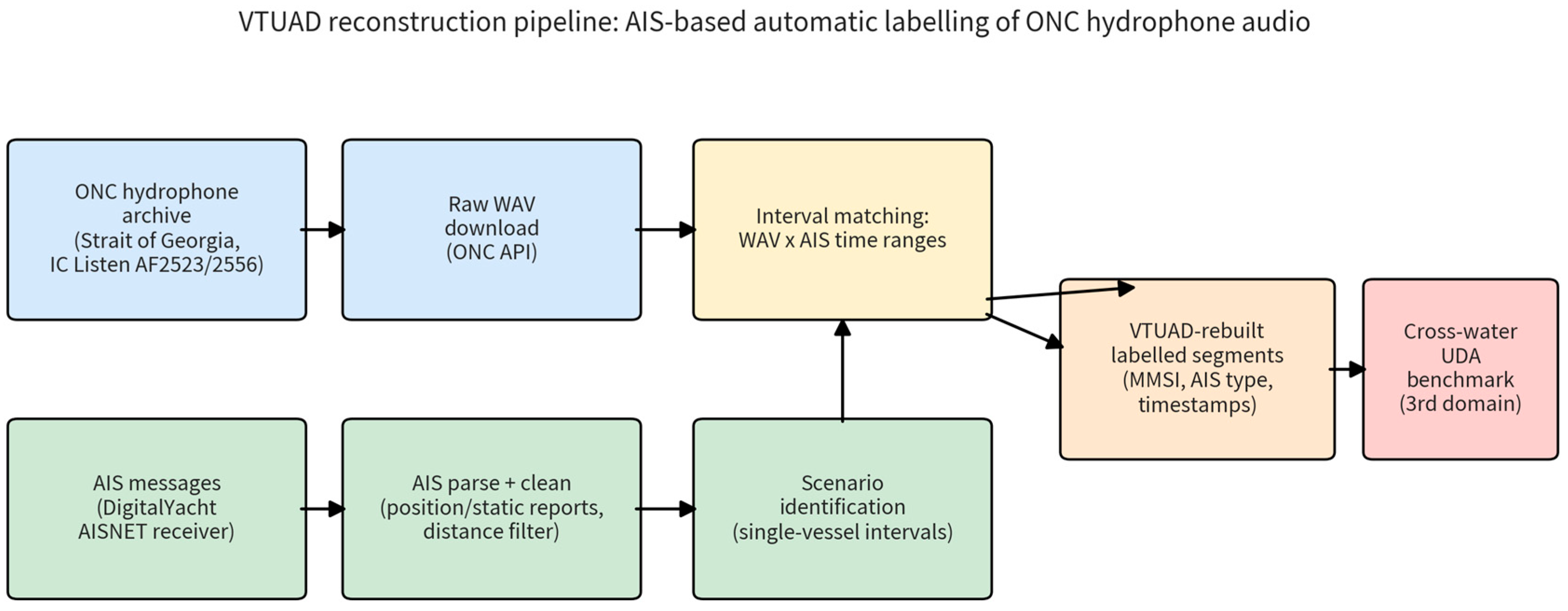
Figure 2.
Target-test macro-F1 (mean ± std, 10 seeds) for all methods in both transfer directions; the dashed line marks the supervised target-oracle macro-F1 of each direction. (a) Lake→ocean: source-only collapses to the majority class; MMD recovers 74% of the oracle macro-F1. (b) Ocean→lake: all UDA methods cluster in a narrow band below the oracle; the direction is limited by the low empirical reference ceiling associated with the target test set’s 89-segment minority class.
Figure 2.
Target-test macro-F1 (mean ± std, 10 seeds) for all methods in both transfer directions; the dashed line marks the supervised target-oracle macro-F1 of each direction. (a) Lake→ocean: source-only collapses to the majority class; MMD recovers 74% of the oracle macro-F1. (b) Ocean→lake: all UDA methods cluster in a narrow band below the oracle; the direction is limited by the low empirical reference ceiling associated with the target test set’s 89-segment minority class.
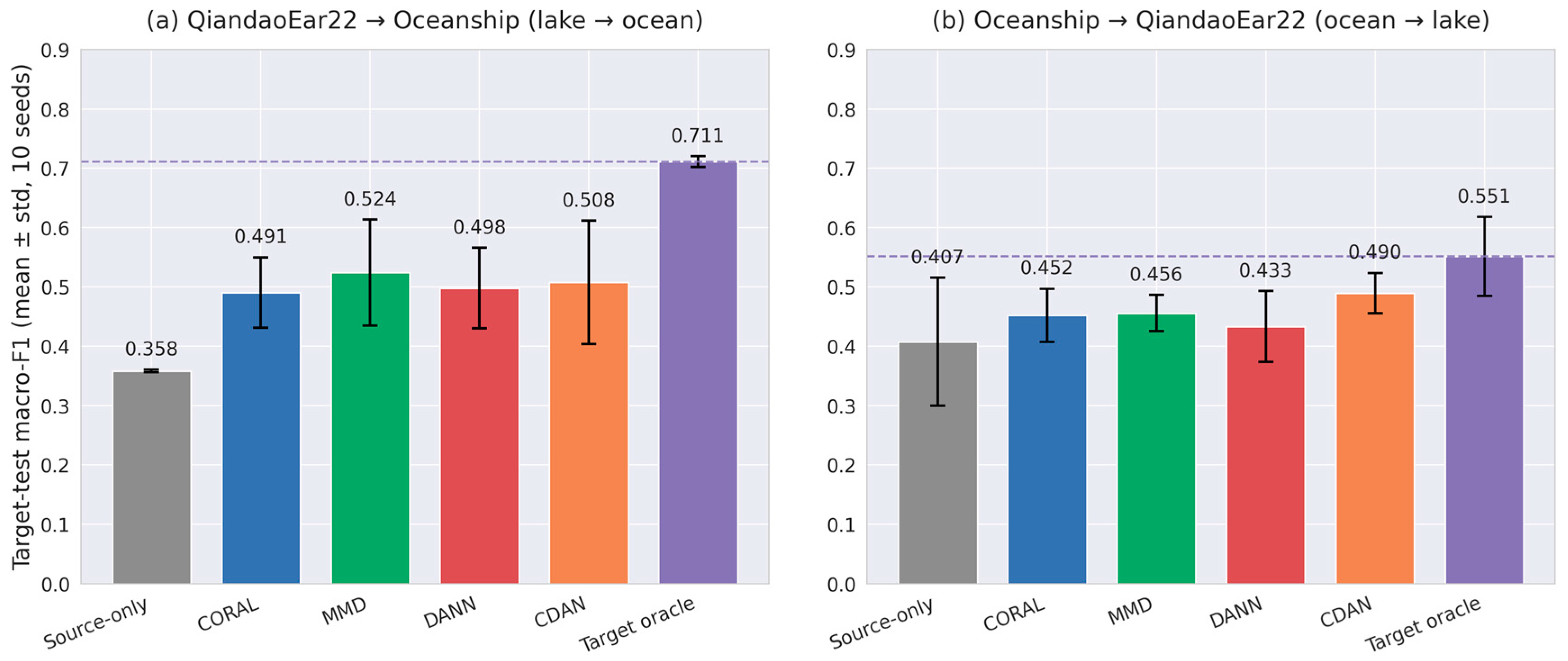
Figure 3.
Per-seed target-test macro-F1 distributions (box + individual seeds, oracle excluded). (a) Lake→ocean: MMD is simultaneously the highest-mean and a mid-stability method; CDAN’s wide spread (three of ten seeds collapsed at epoch 1) is visible. (b) Ocean→lake: source-only’s extreme seed variance is compressed by all UDA methods; MMD and CDAN are the tightest.
Figure 3.
Per-seed target-test macro-F1 distributions (box + individual seeds, oracle excluded). (a) Lake→ocean: MMD is simultaneously the highest-mean and a mid-stability method; CDAN’s wide spread (three of ten seeds collapsed at epoch 1) is visible. (b) Ocean→lake: source-only’s extreme seed variance is compressed by all UDA methods; MMD and CDAN are the tightest.
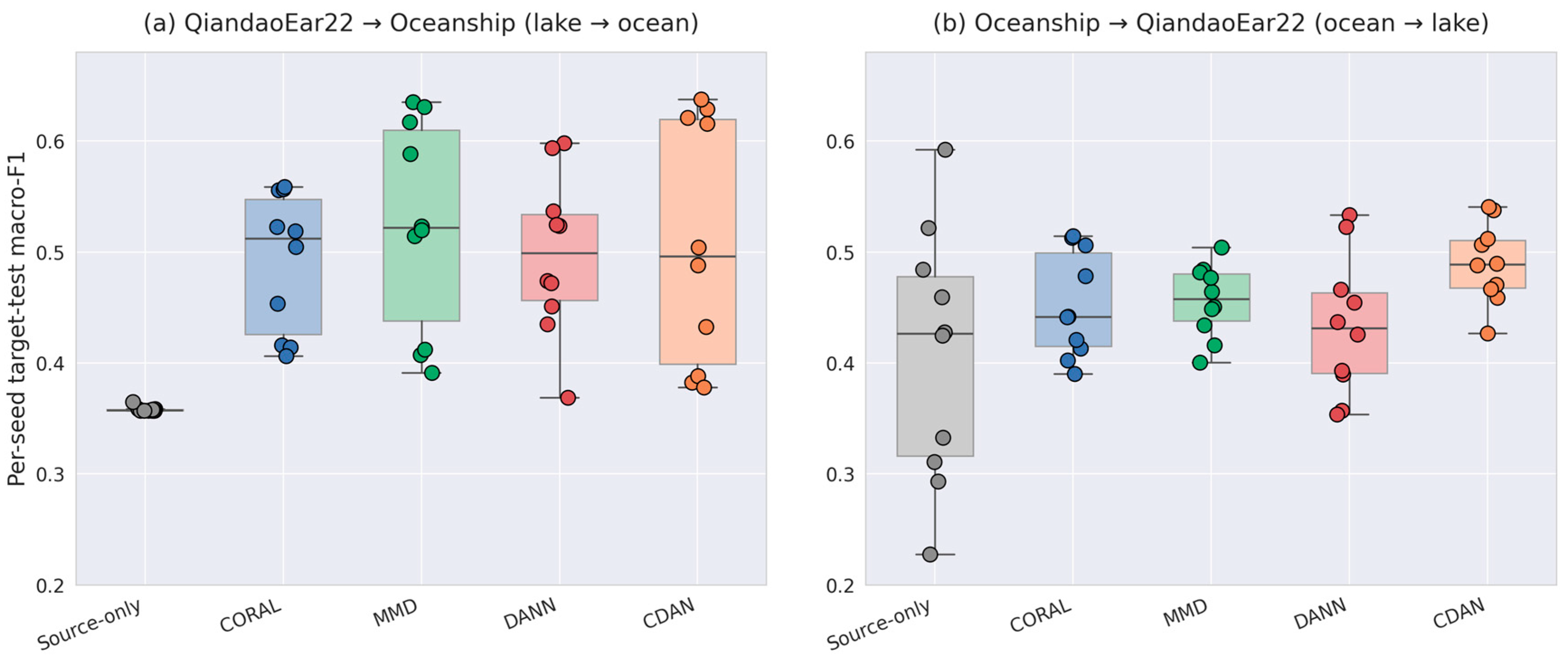

Table 1.
Shared two-class label space for cross-water UDA (Oceanship ↔ QiandaoEar22 mapping established in [5]; VTUAD and ShipsEar columns added in this work).
Table 1.
Shared two-class label space for cross-water UDA (Oceanship ↔ QiandaoEar22 mapping established in [5]; VTUAD and ShipsEar columns added in this work).
| Shared label | Oceanship class | QiandaoEar22 class | VTUAD class | ShipsEar class | Mapping basis |
| passenger_ship | Passenger | kaiyuan_target | passengership (AIS 60–69) | passengers, ocean_liner | KaiYuan is a passenger sightseeing ship [4]; VTUAD uses the same AIS code family as Oceanship; ShipsEar passenger vessels and ocean liners belong to the AIS 60–69 family |
| small_fast_craft | Pleasure Craft | speedboat_target | pleasurecraft (AIS 37) | motorboat | Sightseeing speedboat ≈ small pleasure craft (approximate); AIS 37 is identical in Oceanship and VTUAD; ShipsEar motorboats are small fast craft by construction |
Table 2.
Two-class UDA protocol populations (per direction, source → target).
| Domain (2-class view) | Train | Val | Test | Majority-class baseline (test) |
| Oceanship (passenger_ship 5,627 / small_fast_craft 7,160 train) | 12,787 | 2,729 | 2,736 | 0.5563 |
| QiandaoEar22 (kaiyuan 1,512 / speedboat 5,068 train) | 6,580 | 1,492 | 802 | 0.8890 |
| VTUAD (passengership 9,430 / pleasurecraft 4,497 train) | 13,927 | 3,263 | 2,426 | 0.6224 |
| ShipsEar (passenger_ship 2,435 / small_fast_craft 447 train) | 2,882 | 695 | 511 | 0.8356 |
Table 3.
Network components. All methods share the backbone and classifier; only adversarial methods carry a domain discriminator.
Table 3.
Network components. All methods share the backbone and classifier; only adversarial methods carry a domain discriminator.
| Component | Specification | Output dim |
| Feature extractor | ResNet-18 [17], ImageNet-pretrained, conv1 adapted to 1 channel | 512 |
| Classifier | Linear(512 → 2) | 2 |
| Domain discriminator (DANN) | Linear(512 → 256) + ReLU + Dropout(0.5) + Linear(256 → 2) | 2 |
| Domain discriminator (CDAN) | Linear(1024 → 256) + ReLU + Dropout(0.5) + Linear(256 → 2) | 2 |
Table 4.
Training hyperparameters (shared by all 344 runs).
| Hyperparameter | Value |
| Optimizer | AdamW (lr 3×10⁻⁴, weight decay 1×10⁻⁴) |
| LR schedule | Cosine annealing, T_max = 30 |
| Epochs / early-stop patience | 30 / 8 (selection metric: source val acc; oracle: target val acc) |
| Batch size | 64 (source; target batch cycled, truncated to min) |
| Augmentation | SpecAugment time/frequency masking [18] |
| Class weights | unit-mean normalized |
| CORAL weight | 1.0 (fixed) |
| MMD weight / kernels | 1.0 (fixed) / 5 Gaussian kernels, |
| DANN / CDAN | 1.0, schedule |
| Mixed precision / workers | autocast + GradScaler / 2 DataLoader workers |
| Seeds | 42–51 (two-domain matrix); 42–49 (VTUAD/ShipsEar extensions) |
Table 5.
Target-test results, QiandaoEar22 → Oceanship (lake → ocean); mean ± std over seeds 42–51 (n = 10). Highest-mean UDA result per column in bold (a descriptive ordering; pairwise method differences are not resolved at n = 10). Baseline = majority-class accuracy 0.5563.
Table 5.
Target-test results, QiandaoEar22 → Oceanship (lake → ocean); mean ± std over seeds 42–51 (n = 10). Highest-mean UDA result per column in bold (a descriptive ordering; pairwise method differences are not resolved at n = 10). Baseline = majority-class accuracy 0.5563.
| Method | Paradigm | Macro-F1 | Acc |
| Source-only (lower bound) | — | 0.3585 ± 0.0022 | 0.5564 ± 0.0005 |
| CORAL [7] | Moment matching (2nd order) | 0.4907 ± 0.0593 | 0.5822 ± 0.0146 |
| MMD [8] | Moment matching (kernel mean) | 0.5240 ± 0.0896 | 0.5904 ± 0.0362 |
| DANN [6] | Adversarial | 0.4978 ± 0.0679 | 0.5789 ± 0.0183 |
| CDAN [9] | Conditional adversarial | 0.5076 ± 0.1042 | 0.5878 ± 0.0371 |
| Target-only supervised reference | Supervised reference | 0.7109 ± 0.0091 | 0.7136 ± 0.0091 |
Table 6.
Target-test results, Oceanship → QiandaoEar22 (ocean → lake); mean ± std over seeds 42–51 (n = 10). Highest-mean UDA result per column in bold (a descriptive ordering; pairwise method differences are not resolved at n = 10). Baseline = majority-class accuracy 0.8890.
Table 6.
Target-test results, Oceanship → QiandaoEar22 (ocean → lake); mean ± std over seeds 42–51 (n = 10). Highest-mean UDA result per column in bold (a descriptive ordering; pairwise method differences are not resolved at n = 10). Baseline = majority-class accuracy 0.8890.
| Method | Paradigm | Macro-F1 | Acc |
| Source-only (lower bound) | — | 0.4074 ± 0.1081 | 0.5696 ± 0.2278 |
| CORAL [7] | Moment matching (2nd order) | 0.4522 ± 0.0449 | 0.5491 ± 0.0729 |
| MMD [8] | Moment matching (kernel mean) | 0.4561 ± 0.0308 | 0.6742 ± 0.0505 |
| DANN [6] | Adversarial | 0.4333 ± 0.0594 | 0.5900 ± 0.1397 |
| CDAN [9] | Conditional adversarial | 0.4897 ± 0.0339 | 0.6859 ± 0.0477 |
| Target-only supervised reference | Supervised reference | 0.5514 ± 0.0665 | 0.8536 ± 0.0212 |
Table 7.
Paired t-tests on lake→ocean target-test macro-F1 (n = 10 seeds, df = 9). Diff = mean paired difference; CI95 = 95% CI of the difference; d = Cohen’s d. The comparison set was pre-specified and small, so no multiplicity correction was applied; all p-values are exploratory evidence rather than confirmatory conclusions.
Table 7.
Paired t-tests on lake→ocean target-test macro-F1 (n = 10 seeds, df = 9). Diff = mean paired difference; CI95 = 95% CI of the difference; d = Cohen’s d. The comparison set was pre-specified and small, so no multiplicity correction was applied; all p-values are exploratory evidence rather than confirmatory conclusions.
| Comparison | Diff | CI95 | t(9) | p (two-sided) | |
| MMD − source-only | +0.166 | [+0.097, +0.234] | 5.49 | < 0.001 | 1.74 |
| CORAL − source-only | +0.132 | [+0.087, +0.177] | 6.67 | < 0.001 | 2.11 |
| DANN − source-only | +0.139 | [+0.088, +0.190] | 6.17 | < 0.001 | 1.95 |
| CDAN − source-only | +0.149 | [+0.071, +0.227] | 4.33 | 0.002 | 1.37 |
| MMD − CORAL | +0.033 | [−0.034, +0.101] | 1.12 | 0.293 | 0.35 |
| MMD − DANN | +0.026 | [−0.045, +0.098] | 0.83 | 0.429 | 0.26 |
| MMD − CDAN | +0.016 | [−0.088, +0.121] | 0.35 | 0.731 | 0.11 |
| Oracle − MMD | +0.187 | [+0.118, +0.256] | 6.12 | < 0.001 | 1.94 |
Table 8.
Ocean→lake variance-ratio F-tests against source-only (per-seed variances, df = (9, 9)); ratio < 1 means more stable than source-only.
Table 8.
Ocean→lake variance-ratio F-tests against source-only (per-seed variances, df = (9, 9)); ratio < 1 means more stable than source-only.
| Method | Metric | Var ratio | F(9,9) | p (one-sided, smaller var) |
| CORAL | Accuracy | 0.103 | 0.103 | 0.001 |
| MMD | Accuracy | 0.049 | 0.049 | < 0.001 |
| DANN | Accuracy | 0.376 | 0.376 | 0.081 |
| CDAN | Accuracy | 0.044 | 0.044 | < 0.001 |
| CORAL | Macro-F1 | 0.173 | 0.173 | 0.008 |
| MMD | Macro-F1 | 0.081 | 0.081 | < 0.001 |
| DANN | Macro-F1 | 0.302 | 0.302 | 0.045 |
| CDAN | Macro-F1 | 0.099 | 0.099 | 0.001 |
Table 9.
Bootstrap 95% CIs (percentile, 200,000 resamples) of the 10-seed mean target-test macro-F1.
Table 9.
Bootstrap 95% CIs (percentile, 200,000 resamples) of the 10-seed mean target-test macro-F1.
| Method | Lake→ocean | Ocean→lake |
| Source-only | [0.358, 0.360] | [0.340, 0.474] |
| CORAL | [0.454, 0.526] | [0.425, 0.480] |
| MMD | [0.468, 0.578] | [0.437, 0.475] |
| DANN | [0.455, 0.539] | [0.398, 0.471] |
| CDAN | [0.444, 0.572] | [0.469, 0.511] |
| Target oracle | [0.705, 0.717] | [0.511, 0.593] |
Table 10.
Target-test results on the four VTUAD-related directions; mean ± std over seeds 42–49 (n = 8 per cell, no missing seeds). Bold marks a UDA result only when it has the highest mean macro-F1 in its direction and its mean exceeds the source-only lower bound; no cell qualifies on VTUAD→QiandaoEar22, where both UDA methods fall below source-only, so there is no successful adaptation to mark. The target oracle is a target-only supervised reference, not a UDA method; oracle rows of directions sharing a target are computed from the same trained runs but are aggregated over seeds 42–49 here versus 42–51 in Table 5 and Table 6, so shared-target oracle values differ slightly between tables. Baseline = majority-class accuracy of the target test set. VTUAD extension results use the frozen deduplicated 132,273-segment experimental snapshot (not the public v1.2.0 release) for checkpoint continuity; they are version-specific.
Table 10.
Target-test results on the four VTUAD-related directions; mean ± std over seeds 42–49 (n = 8 per cell, no missing seeds). Bold marks a UDA result only when it has the highest mean macro-F1 in its direction and its mean exceeds the source-only lower bound; no cell qualifies on VTUAD→QiandaoEar22, where both UDA methods fall below source-only, so there is no successful adaptation to mark. The target oracle is a target-only supervised reference, not a UDA method; oracle rows of directions sharing a target are computed from the same trained runs but are aggregated over seeds 42–49 here versus 42–51 in Table 5 and Table 6, so shared-target oracle values differ slightly between tables. Baseline = majority-class accuracy of the target test set. VTUAD extension results use the frozen deduplicated 132,273-segment experimental snapshot (not the public v1.2.0 release) for checkpoint continuity; they are version-specific.
| Direction | Method | Macro-F1 | Acc |
| Oceanship → VTUAD (baseline 0.6224) | Source-only (lower bound) | 0.4024 ± 0.0268 | 0.5817 ± 0.0462 |
| CORAL [7] | 0.4147 ± 0.0383 | 0.5352 ± 0.0435 | |
| MMD [8] | 0.3734 ± 0.0371 | 0.5052 ± 0.0338 | |
| Target-only supervised reference | 0.8305 ± 0.0106 | 0.8343 ± 0.0102 | |
| QiandaoEar22 → VTUAD (baseline 0.6224) | Source-only (lower bound) | 0.2741 ± 0.0000 | 0.3776 ± 0.0000 |
| CORAL [7] | 0.4029 ± 0.0608 | 0.4369 ± 0.0455 | |
| MMD [8] | 0.3521 ± 0.0629 | 0.4346 ± 0.0830 | |
| Target-only supervised reference | 0.8305 ± 0.0106 | 0.8343 ± 0.0102 | |
| VTUAD → Oceanship (baseline 0.5563) | Source-only (lower bound) | 0.4294 ± 0.0331 | 0.4518 ± 0.0228 |
| CORAL [7] | 0.4484 ± 0.0166 | 0.4629 ± 0.0113 | |
| MMD [8] | 0.4689 ± 0.0275 | 0.4743 ± 0.0255 | |
| Target-only supervised reference | 0.7084 ± 0.0083 | 0.7108 ± 0.0079 | |
| VTUAD → QiandaoEar22 (baseline 0.8890) | Source-only (lower bound) | 0.3718 ± 0.0632 | 0.5289 ± 0.1904 |
| CORAL [7] | 0.3138 ± 0.0382 | 0.3653 ± 0.0886 | |
| MMD [8] | 0.2249 ± 0.0564 | 0.2274 ± 0.0582 | |
| Target-only supervised reference | 0.5717 ± 0.0588 | 0.8566 ± 0.0207 |
Table 11.
Paired t-tests on VTUAD-direction target-test macro-F1 (n = 8 seeds, df = 7), computed exactly as in Section 4.5. Negative diffs are negative adaptation (method worse than no adaptation). In the oracle rows, “best UDA” names the UDA method with the highest mean macro-F1 in that direction — a per-direction designation, not the best UDA result of the whole table.
Table 11.
Paired t-tests on VTUAD-direction target-test macro-F1 (n = 8 seeds, df = 7), computed exactly as in Section 4.5. Negative diffs are negative adaptation (method worse than no adaptation). In the oracle rows, “best UDA” names the UDA method with the highest mean macro-F1 in that direction — a per-direction designation, not the best UDA result of the whole table.
| Direction | Comparison | Diff | CI95 | t(7) | p (two-sided) | |
| Oceanship → VTUAD | CORAL − source-only | +0.012 | [−0.018, +0.043] | 0.95 | 0.375 | 0.33 |
| Oceanship → VTUAD | MMD − source-only | −0.029 | [−0.070, +0.012] | −1.67 | 0.138 | −0.59 |
| QiandaoEar22 → VTUAD | CORAL − source-only | +0.129 | [+0.074, +0.183] | 5.61 | < 0.001 | 1.98 |
| QiandaoEar22 → VTUAD | MMD − source-only | +0.078 | [+0.022, +0.134] | 3.28 | 0.013 | 1.16 |
| VTUAD → Oceanship | CORAL − source-only | +0.019 | [−0.016, +0.054] | 1.30 | 0.235 | 0.46 |
| VTUAD → Oceanship | MMD − source-only | +0.040 | [−0.004, +0.083] | 2.13 | 0.071 | 0.75 |
| VTUAD → QiandaoEar22 | CORAL − source-only | −0.058 | [−0.121, +0.005] | −2.18 | 0.066 | −0.77 |
| VTUAD → QiandaoEar22 | MMD − source-only | −0.147 | [−0.232, −0.062] | −4.09 | 0.005 | −1.44 |
| Oceanship → VTUAD | Oracle − CORAL (direction-best UDA) | +0.416 | [+0.378, +0.453] | 26.33 | < 0.001 | 9.31 |
| QiandaoEar22 → VTUAD | Oracle − CORAL (direction-best UDA) | +0.428 | [+0.368, +0.487] | 16.89 | < 0.001 | 5.97 |
| VTUAD → Oceanship | Oracle − MMD (direction-best UDA) | +0.239 | [+0.214, +0.265] | 22.21 | < 0.001 | 7.85 |
| VTUAD → QiandaoEar22 | Oracle − CORAL (direction-best UDA; below source-only) | +0.258 | [+0.186, +0.330] | 8.43 | < 0.001 | 2.98 |
Table 12.
Target-test results on the three ShipsEar-related directions; mean ± std over seeds 42–49 (n = 8; population std, ddof = 0, matching Table 5, Table 6 and Table 10). Baseline = majority-class accuracy on the evaluated target test subset. Bold marks the highest-mean UDA method per direction where it exceeds source-only; bold indicates the highest mean only and does not guarantee statistical superiority over source-only.
Table 12.
Target-test results on the three ShipsEar-related directions; mean ± std over seeds 42–49 (n = 8; population std, ddof = 0, matching Table 5, Table 6 and Table 10). Baseline = majority-class accuracy on the evaluated target test subset. Bold marks the highest-mean UDA method per direction where it exceeds source-only; bold indicates the highest mean only and does not guarantee statistical superiority over source-only.
| Direction | Method | Macro-F1 | Acc |
| Oceanship → ShipsEar (baseline 0.8356) | Source-only (lower bound) | 0.4473 ± 0.0962 | 0.5303 ± 0.1553 |
| CORAL [7] | 0.5005 ± 0.0702 | 0.5565 ± 0.1060 | |
| MMD [8] | 0.4767 ± 0.0480 | 0.5066 ± 0.0523 | |
| Target-only supervised reference | 0.8770 ± 0.0417 | 0.9269 ± 0.0306 | |
| QiandaoEar22 → ShipsEar (baseline 0.8356) | Source-only (lower bound) | 0.1556 ± 0.0101 | 0.1749 ± 0.0083 |
| CORAL [7] | 0.1818 ± 0.0379 | 0.1952 ± 0.0318 | |
| MMD [8] | 0.1940 ± 0.0393 | 0.2062 ± 0.0315 | |
| Target-only supervised reference | 0.8770 ± 0.0417 | 0.9269 ± 0.0306 | |
| ShipsEar → Oceanship (baseline 0.5563) | Source-only (lower bound) | 0.3257 ± 0.0145 | 0.4462 ± 0.0051 |
| CORAL [7] | 0.3464 ± 0.0293 | 0.4394 ± 0.0132 | |
| MMD [8] | 0.3454 ± 0.0324 | 0.4490 ± 0.0075 | |
| Target-only supervised reference | 0.7084 ± 0.0083 | 0.7108 ± 0.0079 |
Disclaimer/Publisher’s Note: The statements, opinions and data contained in all publications are solely those of the individual author(s) and contributor(s) and not of MDPI and/or the editor(s). MDPI and/or the editor(s) disclaim responsibility for any injury to people or property resulting from any ideas, methods, instructions or products referred to in the content. |
© 2026 by the authors. Licensee MDPI, Basel, Switzerland. This article is an open access article distributed under the terms and conditions of the Creative Commons Attribution (CC BY) license (http://creativecommons.org/licenses/by/4.0/).
Copyright: This open access article is published under a Creative Commons CC BY 4.0 license, which permit the free download, distribution, and reuse, provided that the author and preprint are cited in any reuse.