

Submitted:
13 August 2026
Posted:
15 September 2026
You are already at the latest version
Abstract
Whale shark watching has become an important nature-based tourism activity in La Paz, where small-scale tour operators have played a key role in conservation through long-term collaboration with several stakeholders and in acting in several activities since 2003. However, these operators are vulnerable due to stricter conservation regulations, intensified competition from larger and foreign firms, and external shocks such as the COVID-19 pandemic, underscoring persistent trade-offs between biodiversity protection and local livelihoods. To inform strategies that reconcile conservation and competitiveness, this study employs a Discrete Choice Experiment (DCE), Citizen Jury, and widely accessible digital platforms, presenting six scenarios to elicit individual willingness to pay (WTP). Results indicate that tourists' maximum WTP ranges from 147 to 195% more for better-trained guides, from 62 to 68% for maritime signaling, from 168 to 171% for monitoring, and from 23 to 37% for vessel improvement, suggesting that conservation-oriented investments can generate economic benefits rather than impose additional costs. The potential collection under these scenarios ranges from USD 1.044 million to USD 8.448 million if the strategies were implemented. The findings imply that investment in human capital, conservation practices, and branding strategies may enhance the resilience and competitiveness of small-scale operators while supporting conservation objectives.
Keywords:
wildlife tourism trade-offs
; stakeholder engagement
; deliberative methods
; willingness to pay
; gulf of California
1. Introduction
1.1. Nature-Based and Wildlife Tourism
Nature-based tourism refers to tourism activities that depend directly on natural environments, whereas wildlife tourism is a more specific category centered on encounters with free-ranging species. Whale shark watching in Bahía de La Paz is therefore treated here as a form of marine wildlife tourism within the broader nature-based tourism sector. This distinction is analytically important because the conservation status of the species, the quality of the encounter, and the management of visitor behavior directly shape both ecological outcomes and the economic viability of local operators.
Nature-based tourism has become a dynamic and economically significant segment of the global tourism industry, encompassing activities that depend directly on natural environments and biodiversity as central components of the visitor experience. Within this broader category, wildlife tourism is a rapidly expanding niche driven by rising demand for authentic, immersive encounters with free-ranging species [1,2]. In marine contexts, interactions with charismatic megafauna such as whale sharks (Rhincodon typus) have emerged as key tourism products, generating substantial economic benefits for coastal destinations while simultaneously creating incentives for conservation [3,4].
Despite these benefits, the relationship between wildlife tourism and conservation remains complex and context-dependent. While tourism revenues can support species protection and habitat conservation, poorly managed activities may cause ecological disturbance, behavioral changes in wildlife, and the degradation of critical habitats. As a result, the sustainability of wildlife tourism depends on effective management strategies that balance ecological integrity with visitor satisfaction and economic viability [5,6]. Within this system, tourism service providers—particularly small-scale local operators—play a central role, as they directly shape visitor experiences, influence compliance with conservation rules, and act as intermediaries between tourists and ecosystems. Despite their central role, relatively little empirical evidence exists on how tourism services can be designed to simultaneously improve conservation outcomes and strengthen the economic resilience of small-scale operators in marine wildlife tourism. This challenge is particularly relevant in destinations where conservation regulations, increasing market competition, and external shocks threaten the long-term viability of locally based tourism enterprises.
1.2. Pandemic and Sectoral Vulnerability
The vulnerability of these operators became especially evident during the COVID-19 pandemic, which caused an unprecedented disruption to global tourism. Following the declaration of COVID-19 as a global pandemic by the World Health Organization (WHO) in March 2020, governments worldwide implemented restrictions on mobility and non-essential activities, severely affecting tourism-dependent economies [7]. In Mexico, national measures led to the suspension of tourism operations, directly affecting seasonal activities, such as whale shark tourism, in Bahía de La Paz. Prior to the pandemic, this activity generated an estimated USD 3.92 million in revenue and attracted approximately 39,213 visitors annually, according to data compiled by the Local Committee for Whale Sharks. However, during the 2020 season, visitor numbers declined to approximately 22,153, and revenues fell to between USD 1.5 and 1.8 million, reflecting the loss of nearly half of the expected annual income [19].
These impacts intensified pre-existing structural pressures within the sector. The number of registered operators increased substantially over time—from approximately 30 in the mid-2000s to 118 by 2019—according to records from the National Commission of Natural Protected Areas (CONANP) and the local management committee [19]. This expansion contributed to increased competition, price dispersion, and market saturation, disproportionately affecting small-scale local operators with limited access to capital, marketing infrastructure, and digital platforms. Under these conditions, the pandemic acted as a stress test, exposing the fragility of business models dependent on seasonal demand and highlighting the need for strategies to increase the value of tourism services without increasing ecological pressure.
La Paz Bay provides an appropriate case study because whale shark tourism is one of the region's most important nature-based tourism activities and shares characteristics common to many marine wildlife destinations worldwide, including dependence on charismatic species, strong conservation regulation, seasonality, and the predominance of small-scale local operators. Consequently, lessons derived from this case may apply to similar marine wildlife tourism systems facing comparable conservation and economic challenges.
1.3. Marine Wildlife Tourism Management Strategies
The literature on marine wildlife tourism emphasizes the importance of management strategies that integrate conservation and service design. Effective approaches typically include regulatory measures such as limits on visitor numbers, spatial zoning, and codes of conduct, as well as operational strategies such as guide training, monitoring systems, and enforcement mechanisms [5,8]. Increasingly, research suggests that visible conservation actions—such as monitoring technologies and spatial demarcation—can enhance visitor perceptions and willingness to support conservation-oriented tourism models [9,10]. Likewise, trained guides play a critical role in mediating interactions between tourists and wildlife, improving both visitor satisfaction and compliance with environmental regulations [4,11].
These strategies are embedded within market dynamics that shape competitiveness. Small-scale operators often face structural disadvantages relative to larger or externally funded companies, particularly in branding, commercialization, and digital presence, despite their closer connection to local ecosystems and conservation practices [3,12]. Thus, the interest in identifying tourism attributes that can enhance competitiveness through value creation, rather than expansion, aligns economic incentives with conservation outcomes.
However, a key gap remains in understanding how tourists value combinations of service and conservation attributes in small-scale marine wildlife tourism contexts, particularly when preferences are shaped by informed, deliberative processes. While discrete choice experiments (DCEs) have been widely applied to estimate willingness to pay (WTP) for environmental and tourism attributes [13,14,15], relatively few studies integrate deliberative approaches that allow participants to engage with the ecological, economic, and governance dimensions of tourism systems prior to valuation.
To address this gap, the objective of this study is to estimate tourists' willingness to pay for service and conservation attributes associated with whale shark tourism in Bahía de La Paz, such as guide training, conservation measures and management, vessel characteristics, business image, and price. The study combines a Discrete Choice Experiment (DCE) with a Citizen Jury (CJ) to capture informed and reflective preferences under economic and logistical constraints.
The study is motivated by the need to identify management strategies that simultaneously strengthen conservation outcomes and improve the competitiveness of small-scale local operators. Its contribution is to connect deliberative valuation, discrete choice modeling, and marine wildlife tourism governance in a context where conservation regulation, market competition, and external shocks interact.
2. Materials and Methods
2.1. Study Area and Management Context
This study was conducted in the Whale Shark Refuge located in Bahía de La Paz, Baja California Sur, Mexico (Figure 1). Whale sharks (Rhincodon typus) have been legally protected in Mexico under NOM-059-SEMARNAT-2010, which classifies the species as threatened and establishes regulatory responsibilities for its conservation [16]. The refuge is managed by the National Commission of Natural Protected Areas (CONANP) and constitutes one of the most important whale shark aggregation sites in the Eastern Pacific.
The first Management Plan for the Whale Shark Swimming Activity in the Bay of La Paz was published in 2005 and represented the first structured, science-based effort to regulate whale shark tourism. The plan introduced limits on vessel numbers, interaction times, swimmer behavior, guiding protocols, and safety measures, while assigning responsibilities for monitoring, reporting, and adaptive management. Its stated objective was to balance tourism development with species conservation and minimize disturbance to whale sharks [17,18].
Subsequent revisions to the management framework progressively reduced the number of vessels allowed in the refuge at any given time and the passenger capacity per boat. These measures, while conservation-oriented, also constrained operators' revenue potential and limited local community access to whale shark encounters to regulated paid tours. Together with intensified enforcement and sanctions, these regulatory changes generated tension among operators and local stakeholders, particularly small-scale permit holders [19].
2.2. Situational Context: SARS-CoV-2 (COVID-19) Pandemic
Whale shark tourism in Bahía de La Paz was significantly disrupted during the COVID-19 pandemic. In 2019, the activity generated an estimated USD 3.92 million in direct revenue and registered 39,213 visitors according to Local Committee for Whale Shark (LCWS) records [19]. This figure was already below the 45,000-50,000 visitors reported in earlier seasons. The official whale shark watching and swimming season extends from October to April each year.
The 2019-2020 season commenced on 1 October 2019 and proceeded under standard regulatory conditions until March 2020. No extraordinary suspensions occurred before that date, although operators reported fewer whale shark sightings toward the end of 2019, effectively shortening the usable season. In late March 2020, tourism activities ceased abruptly as national and global public health measures were implemented.
During the portion of 2020 in which operations were possible, estimated revenue ranged between USD 1.5 and 1.8 million, and 22,153 visitors were registered by the LCWS. The complete halt of activity after March resulted in the loss of roughly half of the expected annual income. The pandemic therefore magnified the vulnerability of small-scale operators already affected by stricter regulations and growing competition.
This vulnerability was further intensified by the rapid increase in the number of registered whale shark tour operators, which rose from approximately 30 in the mid-2000s to 118 by 2019 [19]. The entry of foreign investors with greater capital, branding capacity, and larger vessels increased competitive pressures. Together, regulation, market saturation, and external shocks exposed the fragility of business models dependent on seasonal demand and price competition.
2.3. Expert Panel and Attribute Validation
To define and validate the attributes used in the Discrete Choice Experiment (DCE), an expert panel was convened and interviewed using a qualitative, in-depth interview approach [20]. This panel functioned independently from the Citizen Jury and served as the foundational stage for attribute generation and validation.
The expert panel consisted of 11 individuals representing disciplinary and stakeholder perspectives on whale shark tourism in La Paz. Participants included marine biologists specializing in Rhincodon typus, environmental economists, certified whale shark guides, permit holders and boat captains, officials from CONANP, members of the Whale Shark Citizen Committee, and representatives from non-governmental conservation organizations.
Semi-structured interviews were organized around seven thematic axes: (1) ecosystem service valuation; (2) biological and economic importance of whale sharks; (3) regional economic relevance of whale shark tourism; (4) price effects on stakeholders; (5) allocation of resources for conservation; (6) branding and business image; and (7) perceived user benefits associated with improvements in tour attributes. Interviews were recorded, synthesized, and transformed into explanatory audiovisual materials that were later presented to the Citizen Jury.
Based on expert consensus and consultations with service providers, five attributes were validated for inclusion in the DCE: boat characteristics, guide training, conservation measures, business image, and price. Attribute levels were defined to reflect realistic improvements over the status quo and operational feasibility within the existing regulatory framework (Table 1). This number of attributes is consistent with best practices in DCE design, which recommend between three and six attributes to maintain cognitive clarity without compromising experimental efficiency [21,22].
2.4. Sampling, Citizen Jury Design, and Data Collection
Citizen Juries are a well-established deliberative method designed to elicit informed public preferences in complex environmental and policy contexts [23,24]. By providing participants with expert information and opportunities for discussion prior to preference elicitation, CJs enhance the consistency and legitimacy of valuation outcomes [25,26]. Methodological guidelines recommend group sizes of approximately 15 to 24 participants to balance diversity with effective deliberation [27,28]. In this study, 24 participants were initially invited to participate, of whom 19 completed the full process, consistent with these recommendations. The use of a CJ was further justified by the constraints imposed by the COVID-19 pandemic, which limited access to representative samples and restricted in-person data collection.
Due to COVID-19 health restrictions, the Citizen Jury was employed instead of a fully randomized representative sample. Participants were recruited voluntarily through participating licensed whale shark tour operators, in accordance with public health guidelines that limited in-person contact [7]. The CJ was designed according to established protocols developed by the Jefferson Center, emphasizing demographic and cognitive diversity while maintaining a size suitable for deliberation [27,28]. The sample size for the Citizen Jury was estimated using the choice-based conjoint planning approach proposed by Tang [29] and later discussed by Assele et al. [30].
where 100 ≤ I ≤ 500. In this calculation, c is the expected percentage of choice sets in which respondents choose the status quo option, K is the number of parameters to be estimated, J is the number of alternatives per choice set, S is the number of choice sets, and I is the number of individuals. In the current manuscript, the parameters are reported as c = 0.40, K = 4, J = 3, S = 18, and I = 195, resulting in approximately 24 individuals forming the CJ. Then we invited the 24 people to participate in the CJ; 23 of them started. At the end, only 19 people finished the experiment.
Eligibility criteria required CJ; 23 of them started. At the end, only 19 people who were English-speaking, had completed the whale shark activity in La Paz within the previous seven years, and were available for the scheduled online deliberation and choice tasks. Registration was conducted through Google Forms. Expert presentations based on the panel interviews were delivered via YouTube and covered biological, economic, legal, and social dimensions of whale shark tourism. A closed WhatsApp group moderated by the researcher and members of the expert panel facilitated questions and discussion. After the deliberation period, participants completed the DCE online using Google Forms, ensuring both informed reflection and methodological consistency.
2.5. Discrete Choice Experiment Design and Econometric Modeling
The Discrete Choice Experiment used in this study follows a stated-preference approach rooted in environmental valuation theory. DCEs model utility as a function of multiple attributes, allowing estimation of marginal willingness to pay (WTP) for individual improvements [31,32].
The analytical foundation of the experiment is Random Utility Theory (RUT), operationalized through the Random Utility Maximization (RUM) framework [33]. Under this framework, individual utility comprises a deterministic component linked to observable attributes and a stochastic component that captures unobserved heterogeneity. Respondents are assumed to choose the alternative that maximizes their utility among a set of discrete options. Formally, the Random Utility Model for alternative j and individual i is expressed as:
where Uij is the utility of individual i when choosing alternative j; ti represents the additional payment associated with the chosen alternative relative to individual income yi; Vij is the deterministic component of utility; xj represents the attributes of the alternative; zi represents observed individual-level covariates; and εij is the stochastic term [34]. Under this framework, the individual is assumed to select the alternative that provides the highest utility. The simplified utility expression is presented as:
Uij=Vij(yi-ti,xi,zi)+εij
∀Uij =Vij +εij Uij =Vij + εij
The experiment included five attributes and a price variable, each varying across defined levels relative to a status quo alternative. Participants completed repeated choice tasks, enabling estimation of marginal WTP as the ratio of attribute coefficients to the price coefficient.
Various probabilistic models can be applied to this type of data, depending on assumptions about the distribution of the error terms. The logit family of models is commonly used for discrete choice data, with coefficients estimated by maximum likelihood. In this specification, β denotes the utility parameter vector associated with the attribute vector S, and γ denotes the coefficient associated with price (P), as shown below:
The average marginal value for an individual associated with a variation in attribute Si can then be derived from the ratio between the attribute coefficient and the price coefficient, following standard stated-preference valuation practice [35].
The standard logit model relies on the Independence from Irrelevant Alternatives (IIA) property, which requires that the presence or absence of one alternative does not affect the odds ratios associated with the remaining alternatives in the choice set [36].
Data were analyzed using both Conditional Logit (CL) and Mixed Logit (ML) models. The CL model assumes homogeneous preferences across respondents. In contrast, the ML model allows parameters to vary randomly, capturing preference heterogeneity--particularly relevant given the small, deliberative sample of a Citizen Jury. These complementary specifications enhance the robustness and interpretability of the results.
3. Results
3.1. Expert Panel Results
Interviews with the expert panel revealed a high degree of convergence across disciplinary and professional backgrounds, despite the diversity of institutional roles and stakeholder perspectives represented. Six recurring themes emerged from the interviews.
First, experts emphasized that effective whale shark conservation requires intersectoral collaboration among small-scale permit-holding operators, scientific institutions, and regulatory authorities. Conservation outcomes were viewed as unattainable without the active involvement of operators who interact daily with the resource. Second, experts agreed that tourists place high value on conservation outcomes. Visitors were perceived as particularly sensitive to visible conservation measures and responsive to evidence that their participation contributes positively to species protection. This perception informed the inclusion of explicit conservation-related attributes in the DCE.
Third, tour guides were identified as central mediators between science, regulation, and visitor behavior. Experts described guides as key communicators of biological knowledge, conservation rules, and ethical norms, underscoring their influence on both visitor satisfaction and compliance with management protocols. Fourth, there was strong consensus that unauthorized vessels and excessive navigation speed constitute the most immediate threats to whale sharks in the refuge area. Experts reported recurring injuries caused by unauthorized boats operating at high speeds, reinforcing calls for stricter enforcement.
Fifth, experts highlighted growing economic pressures and market distortions, including price competition and the informal renting of permits and vessels to third parties. These dynamics were seen as undermining both conservation objectives and regulatory control. Finally, experts recommended specific conservation enhancements, notably installing a buoy system to clearly demarcate the refuge area and incorporating technological monitoring tools such as drones, electronic telescopes, and radio communication systems. These recommendations directly informed the conservation attribute levels used in the DCE.
The synthesis of these interviews was incorporated into a documentary-style video presented to the Citizen Jury through YouTube, ensuring that jurors received consistent, expert-validated information prior to deliberation.
3.2. Citizen Jury Characteristics and Participation
A total of 24 individuals were initially invited to participate in the Citizen Jury (CJ), and 19 participants completed the full deliberative process (79%). The jury consisted of 13 women (68%) and 6 men (32%). Participants reported between one and five previous whale shark tours, with an average of 2.26 experiences per participant. The group was relatively well educated: two participants had completed secondary education, eleven held undergraduate degrees, and six held postgraduate degrees. The average age was 41.8 years, ranging from 20 to 77 years, and mean monthly household income was MXN 20,282. This profile reflects a relatively well-educated and experienced group of participants, providing a robust foundation for informed deliberation and reflective judgment regarding whale shark tourism management in La Paz.
3.3. Discrete Choice Experiment Estimation
This study uses Conditional Logit (CL) and Mixed Logit (ML) models [37,38] to estimate preferences and marginal WTP for whale shark tourism attributes. In the CL model, the preference structure is assumed to be homogeneous across respondents, which may be restrictive and can be affected by the Independence from Irrelevant Alternatives assumption. The ML model relaxes this limitation by estimating distributions for random coefficients, thereby capturing respondents' preference heterogeneity [34]. Following standard practice in stated-preference valuation, all non-monetary attribute coefficients were specified as normally distributed. Conversely, the price coefficient was fixed to preserve utility monotonicity and avoid convergence or implausibility issues commonly observed when using random price terms [39,40,41].
The CL model achieved a McFadden pseudo-R2 of 0.298, indicating satisfactory explanatory power for stated-preference data. The log-likelihood at convergence was -80.99, with an Akaike Information Criterion (AIC) of 180.0 and a Bayesian Information Criterion (BIC) of 213.8. While equivalent fit statistics are not directly comparable for the ML model, its specification allows for random taste variation and is therefore better suited to capturing heterogeneity within a deliberative Citizen Jury sample. Both models showed a strong, statistically significant negative coefficient for the status quo alternative (CL = -4.402, p < 0.001; ML = -47.54, p < 0.10), indicating a clear preference for change relative to the existing tour conditions.
The price attribute was negative and statistically significant in both models (CL = -0.804, p < 0.001; ML = -9.224, p < 0.05), validating the economic consistency of responses and enabling estimation of marginal WTP. A positive and statistically significant preference for trained tour guides emerged in both models (CL = 0.616, p < 0.05; ML = 7.691, p < 0.05), highlighting the importance of human capital improvements in shaping tourist choices. Monitoring was positive in both models (CL = 0.524; ML = 8.101), suggesting favorable valuation of conservation-oriented monitoring, although the coefficient table does not mark this attribute as statistically significant at conventional levels, and any decision derived from it should be treated carefully.
In contrast, several infrastructure- and commercialization-related attributes were associated with negative utility. Boats with new engines, online booking platforms, and physical dive shops all yielded negative coefficients, with statistical significance for most specifications in the coefficient table. These results suggest resistance to features perceived as increasing mechanization, commercialization, or environmental risk. The attribute 'boat with more space' was not statistically significant in either model, indicating that comfort-related improvements were not prioritized relative to interpretive or conservation attributes.

Table 2.
Conditional Logit and Mixed Logit estimates for DCE on whale shark tourism.
| Variable | CL | ML | |
|---|---|---|---|
| n=315 | n=315 | ||
| sq | -4.4021*** | -47.5435* | |
| (0.876) | (26.99) | ||
| Boat with a new engine | -1.2683** | -16.5618* | |
| (0.4713) | (9.1784) | ||
| Boat with more space | -0.5464 | -0.5912 | |
| (0.3723) | (1.3816) | ||
| Trained tour guide | 0.6164** | 7.6910** | |
| (0.2834) | (3.8233) | ||
| Maritime signaling with buoys | -0.2477 | 1.0096 | |
| (0.3983) | (1.5424) | ||
| Monitoring for conservation | 0.5241 | 8.1014 | |
| (0.3902) | (5.4476) | ||
| Webpage and online booking | -1.0863** | -15.503* | |
| (0.4177) | (8.9209) | ||
| Physical dive shop | -1.0891** | -12.6609** | |
| (0.4870) | (7.2021) | ||
| Tour price (USD) | -0.80466*** | -9.2249*** | |
| (0.2270) | (4.6160) | ||
| McFadden R2 | 0.2980 | ||
| Log-likelihood | -80.99 | -66.29 | |
| AIC | 180 | 166.6 | |
| BIC | 213.8 | 230.4 | |
| Standard errors in parentheses * p<0.10, ** p<0.05, *** p<0.001 sq: Status quo Source: Author’s self-elaboration | |||
3.4. Willingness-to-Pay Estimates
Willingness-to-pay (WTP) estimates were calculated as the negative ratio of each attribute coefficient to the price coefficient. Table 3 presents WTP ratios and 95% confidence intervals for both CL and ML models. These values should be interpreted as marginal attribute-based valuations rather than final recommended prices.
The estimated WTP to move away from the status quo was substantial and consistent across models (CL: 5.48; ML: 5.15, interpreted in absolute terms), reinforcing the preference for alternative management scenarios. The trained-guide attribute elicited positive WTP estimates of 0.77 (CL) and 0.83 (ML). Conservation through monitoring technologies also yielded positive WTP estimates (CL: 0.65; ML: 0.88), although the confidence intervals include zero, indicating heterogeneity and the need for cautious interpretation. Negative WTP values were observed for online booking systems (CL: -1.35; ML: -1.68) and physical dive shops (CL: -1.35; ML: -1.37), suggesting that respondents would require compensation to accept these features. Overall, the WTP results indicate that participants prioritize investments in guide training and conservation-oriented monitoring over infrastructure expansion or digital commercialization.
To estimate individual monetary WTP (Table 4), Equation (4) was applied to the lower-limit, mean, and upper-limit attribute ratios for each model (CL and ML), using the whale shark tour price in La Paz Bay in 2020 as the baseline, based on information provided by the Local Committee for Whale Shark records [19]. Attributes with negative WTP values status quo, new engine, webpage and online booking, and physical dive shop--were not included in the positive WTP scenarios. The resulting estimates represent plausible hypothetical scenarios under which one or more positively valued attributes are implemented and credibly enforced.
For the CL model, implementing a tour-guide training program yields a lower-bound individual WTP scenario of USD 47.17 and a mean scenario of USD 78.77. When conservation monitoring is added, the mean total individual WTP scenario reaches USD 152.19. Under the upper-bound CL scenario, including larger boats and maritime signaling with buoys in addition to guide training and monitoring produces a total estimate of USD 381.37. In the ML model, the corresponding lower-bound guide-training scenario is USD 58.74, the mean combined scenario including guide training, maritime signaling, and monitoring is USD 214.49, and the upper-bound scenario reaches USD 362.23. These values should be interpreted as scenario-based valuation estimates rather than automatic tariff recommendations.
These individual monetary estimates are contingent on the actual implementation and enforcement of the attributes identified in the analysis. Therefore, any additional charge would require transparent rules for collection, administration, and reinvestment in whale shark and habitat conservation. If applied to registered visitors during the 2020-2021 season, the potential collection for such a sustainable finance mechanism could range from USD 1.045 million to USD 8.448 million, depending on the scenario considered.
Finally, participants were asked to evaluate the deliberative process and the digital tools employed through four embedded survey questions. These items assessed overall satisfaction, the quality of deliberation, the clarity of expert information, and the adequacy of time allocation. Results were strongly positive. Approximately 95% of participants rated both the communication process and expert video content as 'good' or 'very good,' while approximately 90% rated the digital data collection method and deliberation time as adequate. These results support the feasibility of the digital CJ format under pandemic restrictions, although they should not be interpreted as proof that online deliberation is fully equivalent to face-to-face deliberation. These findings suggest that digitally facilitated Citizen Juries can effectively serve as substitutes for in-person deliberation under conditions that restrict physical gatherings, while maintaining high levels of participant engagement and satisfaction.
4. Discussion
4.1. Environmental Valuation and Willingness to Pay
This study provides empirical and methodological insights into the governance of whale shark tourism in La Paz by examining how informed participants value alternative service and conservation attributes under conditions of regulatory pressure and external shocks. Integrating a Discrete Choice Experiment (DCE) with a Citizen Jury (CJ) allows the discussion to move beyond conventional preference elicitation toward a deliberative interpretation of how conservation, service quality, and market mechanisms interact in small-scale marine ecotourism.
The willingness-to-pay (WTP) estimates should be interpreted as scenario-based indicators rather than fixed prices or definitive tariff recommendations. Because the attributes were presented as hypothetical improvements relative to the status quo, the estimated values represent the additional welfare that participants associated with specific, clearly defined management changes. In this sense, the upper-bound scenarios provide a useful baseline for discussing sustainable finance, but they should not be treated as values that can be automatically added to the current market price of whale shark tours.
If these attributes were implemented, their economic relevance would depend on credible enforcement and institutional design. Training programs, monitoring technologies, buoy systems, or any other conservation-oriented improvement would need to be verifiable, maintained over time, and clearly communicated to visitors. Similarly, any additional charge or conservation fund would require transparent rules regarding collection, administration, and reinvestment in whale shark conservation and habitat management. This is particularly important because operators may be reluctant to charge additional fees unless the mechanism is legitimate, equitable, and visibly connected to improved management outcomes.
Finally, the valuation results are bounded by the environmental, social, and economic context in which the study was conducted. They capture preferences during a specific period marked by COVID-19 restrictions, regulatory change, and market vulnerability among small-scale operators. Future longitudinal studies should examine whether visitor preferences remain stable over time and whether implementing guide training, monitoring, or other conservation strategies produces measurable improvements in both visitor welfare and whale shark conservation outcomes.
4.2. Attributes for Conservation Management and Competitiveness
A key finding is the strong and consistent negative utility associated with the status quo across both the Cl and ML models. The substantial WTP to move away from current conditions suggests that, when participants are exposed to expert knowledge and deliberative processes, they express dissatisfaction with existing tour configurations and governance arrangements. This result aligns with broader critiques of nature-based tourism systems in which regulatory tightening and market expansion coexist without sufficient mechanisms to translate conservation effort into economic resilience for local operators. Rather than signaling resistance to regulation per se, the negative valuation of the status quo appears to reflect a demand for more coherent, transparent, and conservation-aligned service models.
The strongest positive preference observed in both models was for better-trained tour guides. This finding reinforces the central role of guides as interpreters, educators, and informal regulators within marine megafauna tourism. Consistent with previous studies in whale shark and marine wildlife tourism, guide expertise enhances visitor satisfaction while simultaneously promoting compliance with conservation rules and ethical interaction protocols. Importantly, the positive WTP for guide training suggests that investments in human capital can generate both conservation and economic returns, positioning training programs as low-impact, high-value policy instruments. This result is particularly relevant for small-scale operators with limited capacity for large capital investments, as it highlights a pathway to competitiveness that does not rely on vessel expansion or technological intensification. This means that human capital is a core value in whale shark tourism.
Preferences for conservation measures, particularly monitoring-based interventions, were positive but heterogeneous. While the Mixed Logit model showed a stronger positive preference for monitoring technologies, the Conditional Logit estimates were weaker and less consistent, and the coefficient table does not mark monitoring as statistically significant at conventional levels. This divergence suggests that the valuation of conservation actions varies across individuals, even within an informed and deliberative group. Such heterogeneity may reflect differences in ecological knowledge, trust in technology, or perceptions of effectiveness. The finding underscores the importance of communication and transparency in conservation policy: when conservation measures are clearly explained and visibly linked to outcomes, their perceived value is likely to increase. From a governance perspective, this implies that conservation investments should be accompanied by interpretive and educational strategies to enhance public understanding and support.
A counterintuitive result is the consistent negative valuation of infrastructure-related attributes, including new boat engines, online booking systems, and physical dive shops. Rather than indicating opposition to service improvement, these preferences may reflect concerns about environmental impact, over-commercialization, and loss of authenticity. New engines may be associated with increased noise, speed, and collision risk. At the same time, digital platforms and physical storefronts may signal a shift toward mass-tourism models that are perceived as incompatible with conservation-oriented experiences. These findings challenge the assumption that modernization and digitalization are universally valued in ecotourism contexts and suggest that, for whale shark tourism, perceived intimacy, trust, and low-impact operation remain central to visitor preferences.
4.3. Methodological Contributions and Limitations
Beyond substantive findings, this study contributes methodologically by demonstrating the feasibility of combining deliberative Citizen Juries with DCEs under severe constraints, such as those imposed by the COVID-19 pandemic. The high levels of participant satisfaction and engagement reported in the evaluation of the digital CJ indicate that deliberative processes can be meaningfully adapted to online environments without undermining data quality. This is particularly relevant for small-scale tourism systems and data-scarce contexts, where traditional sampling is costly, logistically complex, or impossible. The CJ format also enhances the normative legitimacy of valuation outcomes by ensuring that preferences are informed, reflective, and socially grounded rather than purely individualistic.
Several limitations should be acknowledged when interpreting the results. First, the sampling strategy, while appropriate under COVID-19 restrictions, limits the external validity of the findings. Participants were recruited from recent whale shark tour users through licensed operators, following best-practice guidelines for Citizen Juries. This ensured that jurors were informed and experienced but excluded potential visitors with different profiles, such as first-time tourists or those with lower environmental awareness, who may have distinct preferences and willingness-to-pay (WTP) patterns.
Second, the exclusive reliance on digital platforms for information delivery, deliberation, and data collection introduced potential biases related to digital literacy, access, and online engagement. Although participant evaluations indicate high satisfaction with the digital format, previous research suggests that online deliberation may reduce the richness of interaction compared to face-to-face processes. This limitation is particularly relevant for complex or abstract attributes, such as conservation measures, where nuanced discussion can influence preference formation.
Third, the DCE design itself involved trade-offs between realism and cognitive burden. To maintain clarity and minimize fatigue during online participation, the number of attributes was restricted. While all attributes were validated through expert consultation, potentially relevant dimensions—such as certification schemes, trip duration, or explicit biodiversity outcomes—were excluded. Additionally, although both Conditional Logit and Mixed Logit models produced coherent results, WTP estimates exhibit variability and wide confidence intervals, reflecting preference heterogeneity and the relatively small deliberative sample.
Finally, the Citizen Jury format, while enhancing the normative legitimacy and social robustness of the valuation exercise, presents challenges of scalability and replication. The intensive design—combining expert input, deliberation, and repeated choice tasks—requires institutional support and coordination that may not be available in all destinations.
4.4. Implications for Policy Management and Small-Scale Operators
Despite the limitations, the findings offer several actionable insights for sustainable tourism governance. First, the strong preference for trained guides suggests that human capital investment represents a low-impact, high-return strategy for aligning conservation objectives with operator competitiveness. Training programs, certification schemes, and continuing education for guides could be prioritized by regulatory authorities and supported through targeted subsidies or differentiated permits.
The positive—though heterogeneous—valuation of conservation monitoring highlights the importance of visible and well-communicated conservation actions. Monitoring technologies and spatial management tools should be accompanied by interpretive strategies that clearly link conservation efforts to outcomes, thereby strengthening visitor support and willingness to contribute financially.
The negative valuation of infrastructure expansion and digital commercialization challenges dominant narratives of modernization in tourism policy. For whale shark tourism, authenticity, trust, and low-impact operation appear to be central to perceived value. Policymakers and destination managers should therefore avoid one-size-fits-all development models and instead tailor interventions to the ecological and social context of marine megafauna tourism.
At a broader level, integrating Citizen Juries into tourism planning provides a mechanism for legitimizing trade-offs, improving transparency, and incorporating informed public values into decision-making. Such participatory approaches are particularly relevant in highly regulated environments where compliance and stakeholder buy-in are critical for long-term sustainability.
Taken together, the results suggest that policy frameworks for whale shark tourism should prioritize investments in human capital and visible conservation actions over infrastructure expansion. Regulatory authorities and management agencies could leverage these findings to design incentive structures—such as certification schemes, training subsidies, or differentiated permits—that reward conservation-aligned practices without increasing ecological pressure. For small-scale operators, the findings highlight strategic opportunities to enhance competitiveness through guide training, conservation branding, and communication rather than capital-intensive upgrades. More broadly, the study illustrates how deliberative valuation can inform adaptive governance strategies that reconcile conservation objectives with sustainable livelihoods in marine ecotourism.
4.5. Comparative Evidence on WTP for Conservation-Oriented Wildlife Tourism
The results of this study are consistent with a growing body of environmental valuation research showing that visitors to wildlife and nature-based tourism destinations are often willing to pay not only for recreational experiences, but also for improvements that strengthen conservation, interpretation, and site management. Although the studies reviewed here differ in geographic setting, target species, valuation method, governance context, and payment mechanism, they indicate a recurrent pattern: visitors assign positive economic value to conservation when proposed measures are transparent, credible, and directly linked to the tourism experience.
This pattern is particularly evident in marine wildlife tourism. Studies of whale shark tourism in Ningaloo Marine Park [42] and St. Helena [43] show that visitors may accept additional charges when revenues are explicitly allocated to research, conservation, or environmental management. Differences in income levels, institutional arrangements, tourism markets, and baseline prices prevent direct comparison with La Paz; however, all three cases point to a similar behavioral response: conservation finance is more acceptable when its environmental purpose is visible and clearly communicated.
Our findings also suggest that tourists place value on guide training and conservation monitoring, emphasizing that the quality of wildlife tourism depends not only on the opportunity to observe charismatic species but also on how the experience is managed. This interpretation is consistent with Lee et al. [44], who found that visitors valued interpretative services alongside wildlife encounters. It is also supported, with methodological caution, by Francis [45] (published online in 2022), which uses contingent valuation rather than a choice experiment, and by Berrios [46], which should be treated as a master's thesis and supporting grey literature rather than as peer-reviewed evidence.
Evidence from protected areas and ecosystem-service contexts reinforces this interpretation. Cerda et al. [47], using a choice experiment, found that visitor preferences can converge with conservation objectives, including the protection of animals, plants, soil, and water-related ecosystem services. Pedroso and Biu Kung'u [48], using contingent valuation within a payment for ecosystem services framework, similarly found that wildlife tourists were willing to cofinance upstream restoration and conservation measures. These studies are not directly comparable to whale shark tourism in La Paz, but they show that visitors may value ecological improvements that sustain tourism systems even when those improvements extend beyond the immediate site of consumption.
Taken together, the comparative literature indicates that the La Paz results are not an isolated case but part of a broader trend across conservation-oriented tourism. Visitors frequently express greater willingness to pay for improvements that increase environmental quality, strengthen conservation, and enhance educational value. At the same time, WTP estimates should not be transferred mechanically across destinations. Valuation outcomes remain context-dependent, reflecting differences in visitor characteristics, species charisma, governance credibility, market maturity, and valuation methodology. Consequently, the principal contribution of the comparative evidence is not to establish a universal conservation fee, but to support the interpretation that conservation-oriented management can generate economic value across diverse ecotourism settings.
Table 5.
Environmental economic valuation studies for wildlife tourism.
| Source | Context | Method | Main WTP finding | Relevance to La Paz |
|---|---|---|---|---|
| Davis and Tisdell [42] | Whale shark tourism, Ningaloo Marine Park, Australia | Tourist survey / levy valuation | Visitors were willing to pay a higher transparent levy for research, management, and education. | Strong direct comparison: whale shark tourism, access fee, and management finance. |
| Drew et al. [43] | Whale shark tourism, St. Helena | Stakeholder survey with WTP question | 32% of respondents were willing to pay at least £10 more, a 20% increase over existing charges. | Direct whale shark comparison; useful for conservation pricing and equity considerations. |
| Lee et al. [44] | Whale tourism | Choice experiment | Visitors valued interpretative services, sighting probability, and educational/cultural facilities. | Supports the economic relevance of trained guides and interpretation in La Paz. |
| Francis [45] (published online 2022) | Rainforest Discovery Centre, Sabah, Malaysia | Contingent valuation method | Visitors expressed WTP for the conservation value and sustainable development of an ecotourism site. | Useful supporting evidence, but not directly comparable to the La Paz choice experiment because it is CVM, not CE. |
| Berrios [46] | Shark ecotourism, Costa Rica | Master’s thesis; stated-preference methods | Tourists showed positive WTP for the conservation of threatened hammerhead shark species. | Supporting grey literature for marine megafauna conservation valuation. |
| Cerda et al. [47] | Protected area, central Chile | Choice experiment | Visitors valued protection of animals, plants, soil, and water-related ecosystem services. | Supports the broader claim that visitor preferences can converge with conservation objectives. |
| Pedroso and Biu Kung’u [48] | Maasai Mara / Mara River Basin, Kenya | Contingent valuation within a PES framework | Wildlife tourists were willing to cofinance upstream restoration and conservation measures. | Shows that tourists may support conservation measures that sustain ecological conditions beyond the immediate tourism site. |
| Moreno-Gutiérrez et al. [49] | Whale shark tourism, La Paz Bay, Mexico | Individual travel cost method | Individual WTP ranged from USD 8 to 27 per trip; seasonal recreational value ranged from USD 304,600 to 1,028,025. | Provides local revealed-preference baseline for whale shark recreational value in La Paz. |
| Note: Values are not directly transferable across sites because methods, payment vehicles, species, visitor profiles, and governance contexts differ. The table is used to support qualitative comparison only. Source: Author’s self-elaboration | ||||
Future research should seek to extend and test the robustness of these findings using larger, more diverse samples, potentially combining deliberative methods with representative surveys. Comparative studies across different whale shark destinations or other marine megafauna tourism systems would help assess the generalizability of preferences for human capital and conservation over infrastructure expansion.
Methodologically, hybrid designs that blend online and in-person deliberation could address some of the limitations observed in fully digital Citizen Juries, while longitudinal studies could examine how preferences evolve over time and in response to policy changes. Finally, integrating ecological indicators with economic valuation would enable future studies to link visitor preferences more directly to measurable conservation outcomes, strengthening the evidence base for adaptive and resilient tourism governance.
5. Conclusions
This study examined visitor preferences for whale shark tourism attributes in La Paz by combining a Discrete Choice Experiment (DCE) with a Citizen Jury (CJ) under conditions of regulatory pressure and pandemic-related constraints. The results demonstrate that when tourists are exposed to expert knowledge and deliberative processes, they express a clear preference for conservation-oriented and knowledge-based improvements—particularly guide training and monitoring—over infrastructure expansion or increased commercialization. These findings contribute to ongoing debates on how nature-based tourism can reconcile biodiversity protection with the economic viability of small-scale operators.
From a policy perspective, the findings suggest that conservation finance mechanisms in whale shark tourism should be linked to clearly defined and verifiable improvements rather than framed as general price increases. The positive valuation of guide training and conservation-oriented monitoring indicates that visitors may support additional payments when these are associated with visible actions that improve the quality and sustainability of the experience. However, such mechanisms would require transparent rules for collection, administration, and reinvestment, as well as credible communication to visitors and operators. Under these conditions, conservation-linked pricing could complement existing regulation by helping finance guide certification, monitoring technologies, visitor education, and habitat or species protection, without necessarily increasing ecological pressure.
The results also have implications for the competitiveness of small-scale local operators. In this case, visitors did not assign higher value to attributes associated with infrastructure expansion or increased commercialization, such as newer engines, online booking platforms, or physical dive shops. Instead, they prioritized human capital and conservation-oriented service quality. This suggests that small-scale operators may be able to strengthen their market position through training, interpretation, trust, and conservation credibility rather than through capital-intensive modernization. Such a strategy is particularly relevant in La Paz, where operators face stricter regulation, market saturation, and competition from firms with greater financial and commercial capacity.
Finally, the study contributes methodologically by showing that a Citizen Jury can be combined with a Discrete Choice Experiment to elicit informed preferences in a context where conventional fieldwork was constrained by the COVID-19 pandemic. The deliberative design helped participants evaluate trade-offs between tourism quality, conservation needs, and operator viability, but the results should still be interpreted with caution because the sample was small, experienced, and not statistically representative of all potential visitors. Future research should test the robustness of these findings using larger and more diverse samples, compare preferences across whale shark destinations, and examine whether stated willingness to pay translates into actual payment behavior. Linking economic valuation with ecological indicators would also help determine whether conservation-finance mechanisms generate measurable benefits for whale sharks, local operators, and destination governance.
Overall, the La Paz case suggests that marine wildlife tourism policy can be more effective when visitor preferences, conservation requirements, and local operator capacities are considered together, but the design of any pricing or management instrument must remain locally grounded, transparent, and adaptive.
Author Contributions
Conceptualization, E.G.A. and V.H.-T.; methodology, E.G.A., V.H.-T. and E.M.-G.; software, V.H.-T. and E.M.-G.; validation, V.H.-T. and E.M.-G.; formal analysis, E.G.A., V.H.-T., and E.M.-G., investigation, E.G.A., P.R.C.-C.; resources, E.G.A., U.J.-C., and V.H.-T..; data curation, V.H.-T.; writing—original draft preparation, E.G.A.; writing—review and editing, U.J.-C..; visualization, E.G.A. and V.H.-T.; supervision, P.R.C.-C. project administration. All authors have read and agreed to the published version of the manuscript.
Funding
This research was supported by a postgraduate scholarship awarded to the first author by the Consejo Nacional de Ciencia y Tecnología (CONACYT), currently Secretaría de Ciencia, Humanidades, Tecnología e Innovación (SECIHTI), during the development of the master's research from which this study originated.
Institutional Review Board Statement
Formal ethical approval was not obtained at the time of the original data collection because the study was conducted as non-interventional academic research during the COVID-19 pandemic, under the methodological framework of a master's thesis, and involved adult participants who voluntarily took part in expert interviews, a deliberative Citizen Jury process, and an online stated-preference survey. The research did not involve medical, clinical, or biological intervention, and the information collected was limited to socioeconomic characteristics, tourism experience, perceptions, and stated preferences. All results were analyzed and reported in anonymized and aggregated form, without publishing personally identifiable information. This statement should be reviewed and validated by the authors' institution before submission.
Informed Consent Statement
Specific written informed consent forms were not preserved. However, participation was voluntary, and participants registered and took part in the study after being informed about its academic purpose, the deliberative process, and the use of their responses for research. Expert participants, Citizen Jury members, and survey respondents participated voluntarily, and all results were analyzed and reported in anonymized and aggregated form.
Data Availability Statement
The data supporting the findings of this study are not publicly available due to privacy considerations related to human participants. The study includes socioeconomic information, deliberative participation records, and stated-preference responses collected from a small group of participants. Anonymized data may be made available from the corresponding author upon reasonable request, subject to privacy, ethical, and institutional considerations.
Acknowledgments
The authors thank the members of the Citizen Jury for their time, participation, and deliberative contributions. The authors also acknowledge the members of the expert panel, the participating whale shark tour operators, and the representatives and staff of the National Commission of Natural Protected Areas (CONANP) who contributed contextual information, expert knowledge, and support during the development of the research. During the preparation of this manuscript, the authors used ChatGPT, developed by OpenAI, for language editing, manuscript organization/design, and review support. The authors reviewed, edited, and validated all AI-assisted outputs and take full responsibility for the content of this publication.
Conflicts of Interest
The authors declare no conflicts of interest. The views expressed in this manuscript are solely those of the authors and do not necessarily represent the official position of any institution, committee, operator, or organization involved in whale shark tourism management in Bahia de La Paz.
References
- World Tourism Organization (UNWTO). International Tourism Highlights, 2019 Edition; UNWTO: Madrid, Spain, 2019. [Google Scholar] [CrossRef]
- Balmford, A.; Green, J.M.H.; Anderson, M.; Beresford, J.; Huang, C.; Naidoo, R.; Walpole, M.; Manica, A. Walk on the wild side: Estimating the global magnitude of visits to protected areas. PLoS Biol. 2015, 13, e1002074. [Google Scholar] [CrossRef]
- Cisneros-Montemayor, A.M.; Barnes-Mauthe, M.; Al-Abdulrazzak, D.; Navarro-Holm, E.; Sumaila, U.R. Global economic value of shark ecotourism: Implications for conservation. Oryx 2013, 47, 381–388. [Google Scholar] [CrossRef]
- Gallagher, A.J.; Hammerschlag, N. Global shark currency: The distribution, frequency, and economic value of shark ecotourism. Curr. Issues Tour. 2011, 14, 797–812. [Google Scholar] [CrossRef]
- Higham, J.E.S.; Lück, M. Marine Wildlife and Tourism Management: Insights from the Natural and Social Sciences; CABI Publishing: Wallingford, UK, 2007. [Google Scholar]
- Trave, C.; Brunnschweiler, J.; Sheaves, M.; Diedrich, A.; Barnett, A. Are we killing them with kindness? Evaluation of sustainable marine wildlife tourism. Biol. Conserv. 2017, 209, 211–222. [Google Scholar] [CrossRef]
- World Health Organization. Coronavirus disease (COVID-19): How is it transmitted? 2020. Available online: https://www.who.int/news-room/questions-and-answers/item/coronavirus-disease-covid-19-how-is-it-transmitted (accessed on 30 July 2026).
- Catlin, J.R.; Jones, R.; Jones, T. Marine wildlife tourism: Developing a quality management framework for tour operations. Environ. Manag. 2010, 45, 1231–1242. [Google Scholar] [CrossRef]
- Jobstvogt, N.; Hanley, N.; Hynes, S.; Kenter, J.O.; Witte, U. Twenty thousand sterling under the sea: Estimating the value of protecting deep-sea biodiversity. Ecol. Econ. 2014, 97, 10–19. [Google Scholar] [CrossRef]
- Oyanedel, R.; Cifuentes, M.; Torres, C.; Vásquez, L. Heterogeneous preferences for cleaner maritime transportation in the tourism sector: A choice experiment from the Galápagos Islands. Res. Transp. Bus. Manag. 2025, 101387. [Google Scholar] [CrossRef]
- Powell, R.B.; Brownlee, M.T.J.; Kellert, S.R.; Ham, S.H. From awe to satisfaction: Immediate affective responses to the Antarctic tourism experience. Polar Rec. 2012, 48, 145–156. [Google Scholar] [CrossRef]
- Porter, M.E. The five competitive forces that shape strategy. Harv. Bus. Rev. 2008, 86, 78–93. [Google Scholar]
- Hanley, N.; Wright, R.E.; Adamowicz, V. Using choice experiments to value the environment. Environ. Resour. Econ. 1998, 11, 413–428. [Google Scholar] [CrossRef]
- Hoyos, D. The state of the art of environmental valuation with discrete choice experiments. Ecol. Econ. 2010, 69, 1595–1603. [Google Scholar] [CrossRef]
- Johnston, R.J.; Boyle, K.J.; Adamowicz, W.; Bennett, J.; Brouwer, R.; Cameron, T.A.; Hanemann, W.M.; Hanley, N.; Ryan, M.; Scarpa, R.; Tourangeau, R. Contemporary guidance for stated preference studies. J. Assoc. Environ. Resour. Econ. 2017, 4, 319–405. [Google Scholar] [CrossRef]
- Secretaría de Medio Ambiente y Recursos Naturales (SEMARNAT). Norma Oficial Mexicana NOM-059-SEMARNAT-2010, Protección ambiental-Especies nativas de México de flora y fauna silvestres-Categorías de riesgo y especificaciones para su inclusión, exclusión o cambio-Lista de especies en riesgo; Diario Oficial de la Federación: Mexico City, Mexico, 2010. [Google Scholar]
- Comisión Nacional de Áreas Naturales Protegidas (CONANP). Plan de Manejo para la Conservación y Aprovechamiento No Extractivo del Tiburón Ballena (Rhincodon typus) en Bahía de La Paz, Baja California Sur; CONANP/SEMARNAT: Mexico City, Mexico, 2005. [Google Scholar]
- Ramírez-Macías, D.; Vázquez-Haikin, A.; Vázquez-Juárez, R. Whale shark Rhincodon typus populations along the west coast of the Gulf of California and implications for management. Endanger. Species Res. 2012, 18, 115–128. [Google Scholar] [CrossRef]
- Local Committee for Whale Shark (LCWS). Visitor, revenue, and operator records for whale shark tourism in Bahía de La Paz, 2019-2021. unpublished internal records. 2021. [Google Scholar]
- Hernández-Sampieri, R.; Fernández-Collado, C.; Baptista-Lucio, P. Metodología de la Investigación; McGraw-Hill: Mexico City, Mexico, 2012. [Google Scholar]
- Caussade, S.; de Dios Ortúzar, J.; Rizzi, L.I.; Hensher, D.A. Assessing the influence of design dimensions on stated choice experiment estimates. Transp. Res. Part B Methodol. 2005, 39, 621–640. [Google Scholar] [CrossRef]
- Meyerhoff, J.; Glenk, K. Learning how to choose-effects of instructional choice sets in discrete choice experiments. Resour. Energy Econ. 2015, 41, 122–142. [Google Scholar] [CrossRef]
- Smith, G.; Wales, C. Citizens' juries and deliberative democracy. Polit. Stud. 2000, 48, 51–65. [Google Scholar] [CrossRef]
- Kenyon, W.; Hanley, N.; Nevin, C. Citizens' juries: An aid to environmental valuation? Environ. Plan. C Gov. Policy 2001, 19, 557–566. [Google Scholar] [CrossRef]
- Abelson, J.; Forest, P.G.; Eyles, J.; Smith, P.; Martin, E.; Gauvin, F.P. Deliberations about deliberative methods: Issues in the design and evaluation of public participation processes. Soc. Sci. Med. 2003, 57, 239–251. [Google Scholar] [CrossRef]
- Drury, S.; Elstub, S.; Escobar, O.; Roberts, J. Deliberative quality and expertise: Uses of evidence in citizens' juries on wind farms. J. Delib. Democr. 2021, 17. [Google Scholar] [CrossRef]
- Veasey, J. A Practical Guide to Citizen Juries; Jefferson Center for New Democratic Processes: Minneapolis, MN, USA, 2004. [Google Scholar]
- Center for New Democratic Processes. Handbook for New Democratic Processes; Center for New Democratic Processes: Minneapolis, MN, USA, 2021; Available online: https://www.newdemocraticprocess.org/ (accessed on 30 July 2026).
- Tang, J.; Vandale, W.; Weiner, J.; Insight, I. Sample planning for choice-based conjoint models: Our experience. In Proceedings of the 2006 Sawtooth Software Conference, Sequim, WA, USA, 2006; pp. 111–116. [Google Scholar]
- Assele, S.Y.; Meulders, M.; Vandebroek, M. Sample size selection for discrete choice experiments using design features. J. Choice Model. 2023, 49, 100436. [Google Scholar] [CrossRef]
- Hanemann, W.M. Welfare evaluations in contingent valuation experiments with discrete responses. Am. J. Agric. Econ. 1984, 66, 332–341. [Google Scholar] [CrossRef]
- Melo-Guerrero, E. Diagnóstico y planeación de políticas a través de experimentos de elección y valoración contingente en el Parque Nacional Los Mármoles, Estado de Hidalgo. Doctoral Thesis, Universidad Autónoma Chapingo, Texcoco, Mexico, 2017. [Google Scholar]
- McFadden, D. Conditional logit analysis of qualitative choice behavior. In Frontiers in Econometrics; Zarembka, P., Ed.; Academic Press: New York, NY, USA, 1974; pp. 105–142. [Google Scholar]
- Train, K.E. Discrete Choice Methods with Simulation, 2nd ed.; Cambridge University Press: Cambridge, UK, 2009. [Google Scholar] [CrossRef]
- Louviere, J.J.; Hensher, D.A.; Swait, J.D. Stated Choice Methods: Analysis and Applications; Cambridge University Press: Cambridge, UK, 2000. [Google Scholar]
- Hausman, J.; McFadden, D. Specification tests for the multinomial logit model. Econometrica 1984, 52, 1219–1240. [Google Scholar] [CrossRef]
- McFadden, D.; Train, K. Mixed MNL models for discrete response. J. Appl. Econom. 2000, 15, 447–470. [Google Scholar] [CrossRef]
- Crespo-Cebada, E.; Díaz-Caro, C.; Robina-Ramírez, R.; Sánchez-Hernández, M.I. Is biodiversity a relevant attribute for assessing natural parks? Evidence from Cornalvo Natural Park in Spain. Forests 2020, 11, 410. [Google Scholar] [CrossRef]
- Scarpa, R.; Thiene, M. Destination choice models for rock climbing in the Northeastern Alps: A latent-class approach based on intensity of preferences. Land Econ. 2005, 81, 426–444. [Google Scholar] [CrossRef]
- Train, K.; Weeks, M. Discrete choice models in preference space and willingness-to-pay space. In Applications of Simulation Methods in Environmental and Resource Economics; Scarpa, R., Alberini, A., Eds.; Springer: Dordrecht, The Netherlands, 2005; pp. 1–16. [Google Scholar]
- Daly, A.; Hess, S.; Train, K. Assuring finite moments for willingness to pay in random coefficient models. Transportation 2012, 39, 19–31. [Google Scholar] [CrossRef]
- Davis, D.; Tisdell, C.A. Tourist levies and willingness to pay for a whale shark experience. Tour. Econ. 1999, 5, 161–174. [Google Scholar] [CrossRef]
- Drew, J.A.; Andrews, K.; Smith, N. The potential for expansion of whale shark (Rhincodon typus) tourism in St. Helena: Stakeholder engagement and willingness to pay. J. Ecotourism 2022, 21, 354–365. [Google Scholar] [CrossRef]
- Lee, C.-K.; Mjelde, J.W.; Kim, T.-K.; Lee, E.-J.; Choi, Y.-J. Willingness-to-pay for whale tour attributes using a choice experiment. Asia Pac. J. Tour. Res. 2019, 24, 606–617. [Google Scholar] [CrossRef]
- Francis, F.J. Using a contingent valuation method to evaluate an ecotourism site in Borneo, Malaysia: A case of the Rainforest Discovery Centre, Malaysia. J. Policy Res. Tour. Leis. Events 2025, 17, 36–50. [Google Scholar] [CrossRef]
- Berrios, A.M. Are Sharks Worth More Alive Than Dead? A Stated Preference Study on Shark Ecotourism in Costa Rica. Master's Thesis, Charles University, Prague, Czech Republic, 2017. [Google Scholar]
- Cerda, C.; Fuentes, J.P.; Escobar, G. Can conservation in protected areas and visitor preferences converge? An empirical study in Central Chile. Biodivers. Conserv. 2018, 27, 1431–1451. [Google Scholar] [CrossRef]
- Pedroso, R.; Biu Kung'u, J. Tourists' willingness to pay for upstream restoration and conservation measures. J. Sustain. Tour. 2019, 27, 1107–1124. [Google Scholar] [CrossRef]
- Moreno-Gutiérrez, M.; Hernández-Trejo, V.; Avilés-Polanco, G.; Jakes-Cota, U.; Ojeda-Ruiz de la Peña, M.A.; Marín-Monroy, E.A.; Almendarez-Hernández, L.C. Economic valuation and community-based management: The whale shark wildlife tourism in La Paz Bay, Mexico. Tour. Hosp. 2026, 7, 53. [Google Scholar] [CrossRef]
Figure 1.
Location of the Whale Shark Refuge in Bahía de La Paz (green) in Baja California Sur, Mexico. Source: Author’s self-elaboration.
Figure 1.
Location of the Whale Shark Refuge in Bahía de La Paz (green) in Baja California Sur, Mexico. Source: Author’s self-elaboration.
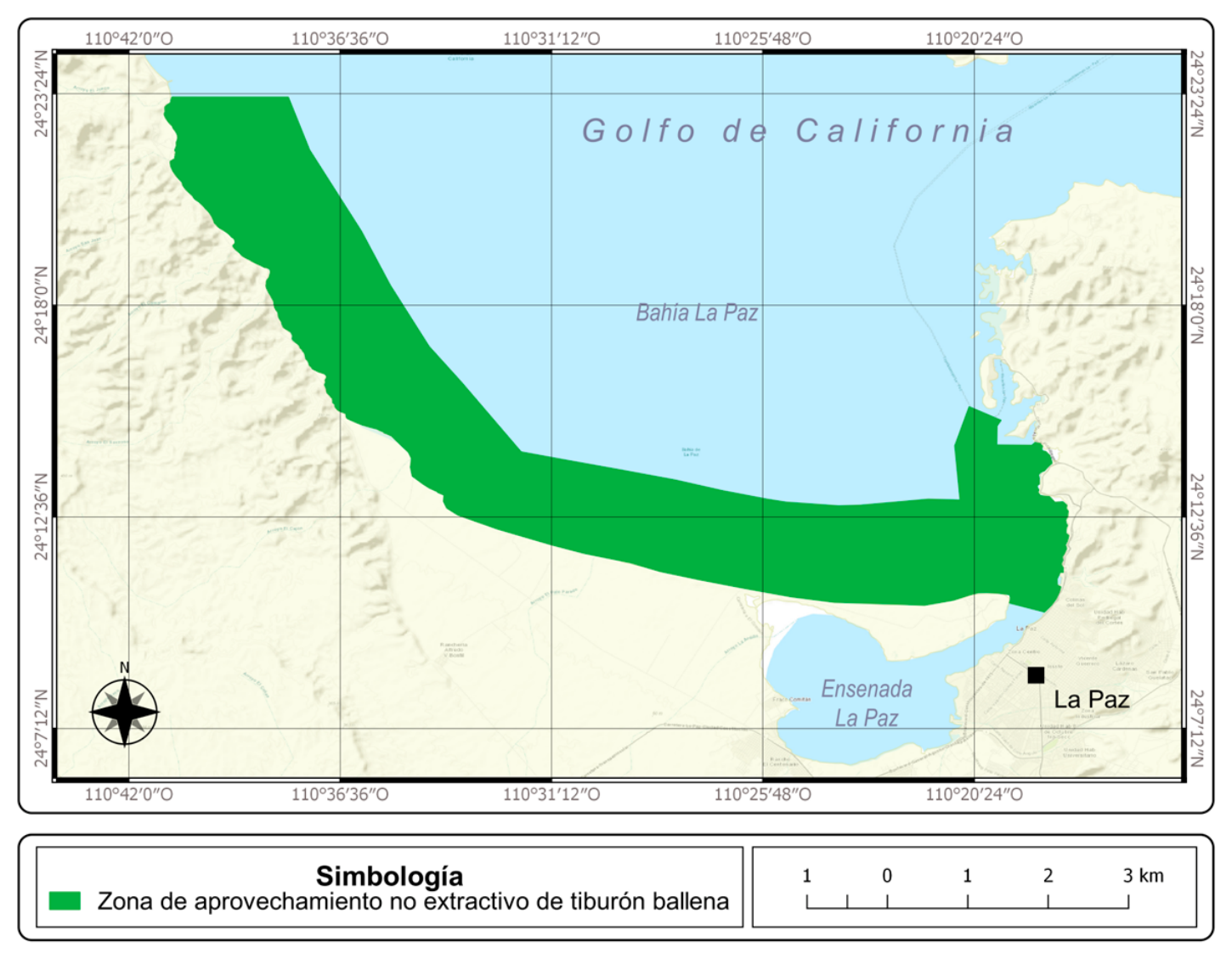
Table 1.
Attributes and levels used in the discrete choice experiment (DCE).
| Attribute | Status quo / current level | Level 1 | Level 2 |
|---|---|---|---|
| Boat characteristics | Current vessel conditions | Boat with a newer engine | Boat with more space |
| Guide training | Guide complies with current management-plan requirements | Trained guide with regional knowledge and customer-service skills | Not applicable |
| Conservation measures | Monitoring of entry and exit to the refuge area | Maritime signaling with buoys | Technological monitoring for conservation |
| Business image | Beach or street-based sales only | Webpage and online booking | Physical dive shop |
| Tour price | USD 65 | USD 90 | USD 115 |
Source: Author’s self-elaboration based on expert-panel validation and the experimental design.
Table 3.
Estimated willingness-to-pay ratios by attribute and model specification.
| Model Concept | sq | Boat with a new engine |
Boat with more space | Trained tour guide | Maritime signaling with buoys |
Monitoring for conservation | Webpage and online booking |
Physical dive shop | |
|---|---|---|---|---|---|---|---|---|---|
| CL | WTP | -5.48 | -1.58 | -0.68 | 0.77 | -0.31 | 0.65 | -1.35 | -1.35 |
| ll | -9.50 | -2.94 | -1.64 | 0.06 | -1.57 | -0.30 | -2.59 | -2.94 | |
| ul | -3.87 | -0.54 | 0.23 | 1.95 | 0.68 | 1.71 | -0.43 | -0.28 | |
| ML | WTP | -5.15 | -1.80 | -0.06 | 0.83 | 0.11 | 0.88 | -1.68 | -1.37 |
| ll | -6.80 | -2.51 | -0.80 | 0.32 | -0.59 | -0.26 | -2.26 | -2.18 | |
| ul | -2.00 | -0.68 | 0.37 | 1.47 | 0.62 | 1.68 | -0.52 | -0.38 | |
| ll: Lower limit, ul: Upper limit, sq: Status quo Source: Author’s self-elaboration | |||||||||
Table 4.
Scenario-based individual WTP estimates for positively valued attributes (USD).
| Model | Concept | Boat with more space |
Trained tour guide | Maritime signaling with buoys | Monitoring for conservation | Total individual WTP |
|---|---|---|---|---|---|---|
| CL | ll | ---- | 47.17 | ---- | ---- | 47.17 |
| Mean WTP | ---- | 78.77 | ---- | 73.43 | 152.19 | |
| ul | 54.74 | 131.28 | 74.76 | 120.60 | 381.37 | |
| ML | ll | ---- | 58.74 | ---- | ---- | 58.74 |
| Mean WTP | ---- | 81.44 | 49.40 | 83.66 | 214.49 | |
| ul | 60.97 | 109.92 | 72.09 | 119.26 | 362.23 | |
| ll: lower limit, ul: upper limit. Source: Author’s self-elaboration | ||||||
Disclaimer/Publisher’s Note: The statements, opinions and data contained in all publications are solely those of the individual author(s) and contributor(s) and not of MDPI and/or the editor(s). MDPI and/or the editor(s) disclaim responsibility for any injury to people or property resulting from any ideas, methods, instructions or products referred to in the content. |
© 2026 by the authors. Licensee MDPI, Basel, Switzerland. This article is an open access article distributed under the terms and conditions of the Creative Commons Attribution (CC BY) license.
Copyright: This open access article is published under a Creative Commons CC BY 4.0 license, which permit the free download, distribution, and reuse, provided that the author and preprint are cited in any reuse.