

Submitted:
11 September 2026
Posted:
15 September 2026
You are already at the latest version
Abstract
Marketing communication has undergone a structural transformation comparable in magnitude to the television revolution of the mid-twentieth century. This paper develops an integrative, qualitative analysis of marketing communication in the age of digital media across the 26-year period from 2000 to 2026, pursuing four questions: how digitalization has reconfigured the conceptual and operational architecture of the field; what role advertising now performs within that architecture; how the discipline relates, intellectually and institutionally, to the older tradition of advertising research and practice; and which research gaps most urgently demand scholarly attention. Methodologically, the study combines an integrative literature review with reflexive thematic analysis, triangulated against harmonized statistical series (ITU/World Bank, IAB/PwC, WPP Media) and industry audits. A structured review of 36 studies 20 foundational studies published between 2015 and 2023, and 16 studies published between 2024 and 2026—anchors the analysis at the research frontier, spanning integration and journey theory, causal effectiveness measurement, privacy regulation, influencer marketing, and generative artificial intelligence. The analysis traces the field's development through six historical stages, compares three research traditions whose convergence now defines the study of communication effectiveness, and documents an accountability crisis evidenced by programmatic supply-chain leakage, deflationary causal estimates of advertising effects, and signal loss under privacy regulation. Four overarching themes emerge: the migration from linear message delivery to dialogic orchestration; the datafication and algorithmic mediation of persuasion; the rising centrality of trust, privacy, and ethics; and the convergence-within-fragmentation of advertising. The paper contributes a stage model of the field's development, a comparative framework of research traditions and measurement approaches, two synthesis matrices of recent evidence, a consolidated taxonomy of research gaps, a concise analytical discussion, and a prioritized program of ten recommended research streams with implications for managers, regulators, and scholars.
Keywords:
marketing communication
; integrated marketing communications
; advertising research
; digital media
; advertising effectiveness
; generative artificial intelligence
; privacy
; influencer marketing
; and research agenda
1. Introduction
Few domains of marketing thought have been transformed thoroughly by digital media as marketing communication. The discipline that matured around the mass advertisement—built on one-to-many transmission, television dominance, and the reach–frequency calculus—now operates in an environment in which roughly six billion people, close to three-quarters of humanity, use the internet (International Telecommunication Union [ITU], 2025; World Bank, 2026), and approximately 5.8 billion social media user identities are active worldwide (Kemp, 2026). In 2000, at the peak of the dot-com boom, internet advertising in the United States generated US$8.1 billion (Interactive Advertising Bureau [IAB], 2011); in 2025 it generated US$294.6 billion (IAB, 2026). Global advertising revenue reached an estimated US$1.14 trillion in 2025, with pure-play digital channels accounting for roughly 73 percent of the total and commerce media overtaking television for the first time (WPP Media, 2025a, 2025b). The infrastructure of persuasion has shifted decisively from the broadcast tower to the distributed network of platforms, algorithms, creators, and databases.
Yet the transformation is not merely quantitative. Digital media have altered the ontology of marketing communication: who speaks (professional communicators, consumers, influencers, and now generative machines), what constitutes a message (from fixed copy to dynamic, personalized, co-produced, and increasingly machine-generated content), how audiences are reached (from purchased reach to algorithmically mediated attention), and how effects are conceptualized (from linear hierarchies of response to recursive journeys across paid, owned, earned, and shared touchpoints; Kannan & Li, 2017; Lemon & Verhoef, 2016; Schweidel et al., 2022). Foundational constructs—integration, consistency, message control, even the sender–receiver dyad itself—require re-examination under these conditions (Finne & Grönroos, 2009; Vargo & Lusch, 2004), and the diffusion of generative artificial intelligence (AI) since late 2022 has added a further layer, in which the author of a persuasive message may be neither a person nor an organization but a model (Hermann & Puntoni, 2024; Kshetri et al., 2024).
This paper responds to the need for a systematic, analytically rigorous account of marketing communication in this new environment, with particular attention to the field's intellectual relationship with advertising research and practice. Advertising is not only the field's largest tool (Section 7); it is also the domain that supplied marketing communication's oldest research institutions, its measurement conventions, and most of its accumulated empirical generalizations—while simultaneously undergoing its own crisis of accountability in the digital era (Gordon et al., 2019, 2021; Lewis & Rao, 2015). Three features distinguish the present analysis from earlier agenda-setting reviews (Dwivedi et al., 2021; Kannan & Li, 2017; Lamberton & Stephen, 2016). First, it treats the 26-year period from 2000 to 2026 as a single analytic window and anchors its conceptual claims in harmonized statistical series rather than in isolated headline figures. Second, it reads the field through its relationship with advertising research, arguing that the discipline's measurement crisis and its theoretical fragmentation are two faces of the same problem. Third, it integrates the most recent evidence, published between 2024 and 2026, on generative AI, AI disclosure, influencer economics, retail media, attention measurement, and privacy regulation—evidence that did not exist when earlier agendas were written.
The paper is framed by four research questions. RQ1: How has digitalization transformed the conceptual foundations and operational architecture of marketing communication? RQ2: What is the evolving role of advertising within the expanded ecosystem of marketing communication tools? RQ3: How do advertising research and advertising practice relate to marketing communication research and practice, and what does that relationship reveal about the field's condition? RQ4: Which theoretical, measurement, methodological, contextual, technological, ethical, and translational gaps most urgently require scholarly investigation? Section 2 outlines the research design; Section 3 establishes conceptual foundations; Section 4 traces the historical emergence of the discipline; and Section 5 reviews the research frontier through 36 recent studies. Section 6 to 8 present the results: the digital transformation of the field between 2000 and 2026, the repositioning of advertising, and the relationship between advertising research and practice and the marketing communication ecosystem. Section 9 addresses privacy, ethics, and sustainability; Section 10 consolidates the gap analysis; and a concise Discussion (Section 11) and Recommendations (Section 12) precede the Conclusion (Section 13).
2. Research Design and Method
This study is a qualitative, interpretive research paper based on an integrative literature review combined with thematic synthesis design appropriate for generating new conceptual perspectives on a mature but rapidly evolving domain, because it permits simultaneous engagement with empirical studies, theoretical contributions, and practitioner evidence (Snyder, 2019). The analytic window spans the 26 years from 2000 to 2026—from the commercial internet's first advertising cycle to the diffusion of generative AI—while the corpus extends historically to canonical works that established the field's theoretical and measurement foundations (e.g., Borden, 1964; Ehrenberg, 1974/2000; Keller, 1993; Schultz et al., 1993).
The review followed a structured protocol. First, the leading marketing, advertising, and communication journals were designated as anchor outlets, supplemented by searches in Scopus, Web of Science, and Crossref using combinations of the terms "marketing communication," "integrated marketing communications," "advertising effectiveness," "digital marketing," "influencer," "programmatic," "retail media," "attention," "privacy," and "generative artificial intelligence." Second, from the assembled corpus, 20 studies published between 2015 and 2023 were purposively selected as foundation studies using three criteria: direct relevance to the research questions; methodological weight (large-scale field data, experimentation, meta-analysis, or agenda-setting synthesis); and balanced coverage of the four thematic domains that emerged from coding. Third, the same criteria, with the added requirement of publication in a dated issue between January 2024 and mid-2026, identified 16 studies representing the most recent frontier; the bibliographic details of every study were verified against publisher records. Fourth, in keeping with the interpretive tradition, which treats context and triangulation as essential to trustworthiness (Denzin & Lincoln, 2018), harmonized statistical and industry sources were integrated to anchor conceptual claims in current empirical facts: the ITU series on internet use as published by the World Bank; the IAB/PwC series on U.S. internet advertising revenue, which runs continuously from 1996; the WPP Media global advertising forecasts; Data Reporter’s global digital reports; the Association of National Advertisers (ANA) and Incorporated Society of British Advertisers (ISBA) programmatic supply-chain audits; the CMS GDPR Enforcement Tracker; The CMO Survey; and the Gartner CMO Spend Survey, together with official regulatory texts from the European Union and the U.S. Federal Trade Commission (FTC). Where industry figures are estimates, the text identifies their vintage.
The analysis followed the six phases of reflexive thematic analysis articulated by Braun and Clarke (2006): familiarization; initial coding; theme generation; theme review; theme definition; and analytic narrative. Coding was abductive, moving iteratively between the data and sensitizing concepts drawn from IMC theory, relationship communication, service-dominant logic, digital marketing frameworks, and the empirical-generalizations tradition of advertising research (Assmus et al., 1984; Hanssens, 2018; Sethuraman et al., 2011), with triangulation across academic, statistical, and industry sources as the principal validity strategy (Denzin & Lincoln, 2018; Snyder, 2019). Three limitations should be acknowledged: the design is interpretive rather than meta-analytic, so no pooled effect sizes are estimated; the evidence base, like the field itself, is concentrated in North American, European, and Chinese contexts; and industry statistics are periodically revised, as the ITU's 2025 upward revision of its own internet-use estimates illustrates (ITU, 2025). The resulting thematic structure, presented in Section 10 (Figure 5), organizes the paper's findings.
3. Conceptual Foundations: Defining Marketing Communication
Marketing communication may be defined as the strategically orchestrated set of messages, media, tools, and relational activities through which an organization conveys brand-relevant meaning to target audiences and stakeholders in order to inform, persuade, remind, and engage them in ways that advance explicit commercial and relational objectives. Three properties distinguish it from adjacent concepts. Unlike general communication, marketing communication is purposeful: every message is designed to contribute to measurable marketing outcomes. Unlike marketing in its entirety, which concerns the holistic creation, delivery, and exchange of value, it constitutes the voice of the brand: the managed interface between organizational strategy and audience perception. And, most distinctively, it is integrative: its value lies not in any single instrument but in the deliberate coordination of heterogeneous tools—advertising, sales promotion, public relations, direct marketing, personal selling, digital and interactive media, events, and sponsorships—so that they speak with a consistent voice and generate synergistic rather than redundant effects (Pickton & Broderick, 2005; Schultz et al., 1993).
The field's conceptual vocabulary has evolved under digital conditions. McCarthy's (1960) four Ps positioned promotion as one manageable variable within the marketing mix; Lauterborn's (1990) reformulation from the consumer's perspective recast promotion as communication, foregrounding dialogue and meaning negotiation; and Schultz, Tannenbaum, and Lauterborn's (1993) Integrated Marketing Communications named the emergent managerial paradigm. Cornelissen (2001, 2003) later subjected the construct to sustained critique, noting that integration functioned more as normative aspiration than as precisely specified theory. Subsequent work has partly answered that critique by operationalizing integration as a firm-wide organizational capability (Porcu et al., 2017) and by showing that consumers' perceived consistency of communications predicts relationship outcomes (Šerić et al., 2020), yet the under specification Cornelissen diagnosed retains its relevance in an omnichannel era in which touchpoints multiply faster than planning frameworks (Cui et al., 2021; Verhoef et al., 2015).
Three interlocking strategic functions anchor the field's conceptual core. Marketing communication constructs brand equity: Keller's (1993) customer-based brand equity framework demonstrates how communication builds awareness, shapes associations, and anchors perceived quality and loyalty. It fosters relationships: Grönroos (1994) and Gummesson (2002) reframed communication as ongoing dialogue with multiple publics, elaborated in Duncan and Moriarty's (1998) communication-based model of relationship management. And it shapes perception and behavior, drawing on persuasion theory from Lavidge and Steiner's (1961) hierarchy-of-effects model to Petty and Cacioppo's (1986) elaboration likelihood model. Under service-dominant logic (Vargo & Lusch, 2004), these functions are increasingly understood relationally: communication is not message delivery to passive receivers but value co-creation among brands, stakeholders, and—crucially in the digital era—platforms and algorithms (Finne & Grönroos, 2009; Kannan & Li, 2017). The generative turn extends the point: when models can produce messages, the co-creating "stakeholder" may itself be a machine whose outputs consumers evaluate through their own persuasion knowledge (Campbell et al., 2022; Wu, 2026).
4. The Historical Emergence of Marketing Communication as an Independent Discipline
Marketing communication's institutionalization as a distinct discipline resulted from the convergence of commercial practice, academic marketing, and communication science across six identifiable stages, summarized in Table 1. Significantly for the argument developed in Section 8, the measurement institutions of the field were built first by advertising research—recognition and recall testing, media syndication, and panel-based sales linkage—decades before marketing communication acquired a distinct academic identity.
The craft era's commercial antecedents lay in the nineteenth century, when industrial overcapacity and the mass-circulation press created an apparatus for paid persuasion; the early twentieth century professionalized it through figures such as Albert Lasker and Claude Hopkins, whose Scientific Advertising (1923) introduced testing and accountability. Starch's (1914) psychological treatment of advertising and the rise of readership research gave the young practice its first measurement instruments, and academic respectability arrived with the first university marketing courses, the Journal of Marketing (1936), and the American Marketing Association (1937).
The mid-century consolidation was decisive. Television inaugurated mass-mediated brand building, and the marketing mix codified by Borden (1964) and McCarthy (1960), popularized by Kotler (1967), positioned promotion as one manageable variable among four. Communication science supplied the theoretical apparatus—transmission models, the two-step flow, diffusion theory, the Yale persuasion program, and later the elaboration likelihood model (Petty & Cacioppo, 1986)—and dedicated outlets, the Journal of Advertising Research (1960) and the Journal of Advertising (1972), signaled maturing scholarship, though promotional activity remained a sub-function of marketing.
The decisive transition to disciplinary autonomy occurred in the 1980s and 1990s, propelled by structural upheaval: media de-massification fragmented audiences; database technology enabled addressable communication; sales promotion spending overtook media advertising in the United States by the mid-1980s; and agency commission structures yielded to accountability regimes. Conceptually, Ries and Trout (1981) relocated strategy to the mind of the consumer, while the brand equity movement (Aaker, 1991; Keller, 1993) justified managing all communication instruments as investments in a single asset. Schultz et al. (1993) named the emergent paradigm; the Journal of Marketing Communications (1995) and landmark textbooks consolidated curricular identity (Belch & Belch, 2021; Pickton & Broderick, 2005; Shimp, 1990); and Grönroos's (1994) manifesto for relationship marketing, Duncan and Moriarty's (1998) communication-based model, and Vargo and Lusch's (2004) service-dominant logic completed the migration from message delivery to dialogic value co-creation—preparing the field, at least in principle, for the networked conditions of the digital century.
The two most recent stages are the subject of Section 5 and Section 6. Their boundary is marked less by a technology than by a change in the locus of authorship: the algorithmic era (2015–2022) automated the delivery of persuasion through programmatic and recommendation systems, whereas the generative–agentic era that opened with the public release of ChatGPT in November 2022 automates its production (Hermann & Puntoni, 2024; Peres et al., 2023) and, prospectively, its negotiation through AI agents and answer engines (Kim, 2025; Wu, 2026).
5. The Research Frontier, 2015–2026
The conceptual foundations established in Section 3 acquire empirical substance only through engagement with the contemporary research record. This section reviews 36 studies in two cohorts. Table 2 synthesizes 20 foundation studies published between 2015 and 2023, selected according to the criteria described in Section 2; Table 3 synthesizes 16 studies published between 2024 and 2026 that extend, and in places overturn, the earlier record. The narrative develops the review thematically, because the studies' collective significance lies in the pattern they form rather than in any single result.
5.1. Foundation Studies, 2015–2023
The foundation cohort comprises 20 studies published between 2015 and 2023, the period in which programmatic delivery, social platforms, and data-driven attribution became the operating infrastructure of marketing communication. The studies were drawn from the review corpus described in Section 2 and selected for their theoretical reach, methodological rigor, and direct bearing on the four research questions. They span the field's leading outlets in marketing, economics, and advertising, and they combine conceptual syntheses and systematic reviews with large-scale field experiments, panel models, and multi-brand generalizations. Table 2 summarizes each study's domain, method and data, and core finding, keyed to the research question it addresses; Section 5.2 then organizes the cohort into four thematic clusters that structure the analysis in Section 6 to 9.
5.2. Four Clusters in the Foundation Cohort
The foundation studies form four clusters that Section 6 to 9 develop in context. The integration and journey cluster (studies 1–4) supplies what three decades of IMC scholarship, by Cornelissen's (2003) diagnosis, had failed to deliver—a specified mid-range theory of integration (Batra & Keller, 2016)—and effects a quiet paradigm displacement in which the unit of planning is no longer the campaign but the journey (Lemon & Verhoef, 2016), a displacement that Kuehnl et al. (2019) ground in consumers' own perceptions of journey design, Cui et al. (2021) complicate with the informational challenges of omnichannel integration, and Colicev et al. (2018) show to be financially material. The causal cluster (studies 5–10) constitutes the evidentiary core of the accountability crisis analyzed in Section 8: adequately powered advertising experiments often require tens of millions of observations (Lewis & Rao, 2015); observational attribution overstates effects relative to experimental ground truth (Blake et al., 2015; de Haan et al., 2016; Gordon et al., 2019, 2023); and the median television elasticity across 288 brands is approximately 0.01, an order of magnitude below the meta-analytic means of Assmus et al. (1984) and Sethuraman et al. (2011), with publication selection implicated in the earlier record (Shapiro et al., 2021). The infrastructure cluster (studies 11–14) shows that ad blocking and privacy regulation reshape markets, not merely messages—advantaging incumbents (Todri, 2022) and concentrating ad-tech (Johnson et al., 2023)—while trust and disclosure condition persuasion at the micro level (Bleier & Eisenbeiss, 2015; Boerman et al., 2017; Bleier et al., 2020). The new voices cluster (studies 15–20) establishes the influencer's triple identity as channel, endorser, and peer (Hudders et al., 2021; Leung, Gu, & Palmatier, 2022), the inverted-U contingencies that govern influencer effectiveness (De Veirman et al., 2017; Leung, Gu, Li, et al., 2022; Wies et al., 2023), the strategic trajectory and source perception of machine communicators (Campbell et al., 2022; Huang & Rust, 2021; Longoni & Cian, 2022), and the authenticity-alignment typology that distinguishes brand activism from "woke washing" (Vredenburg et al., 2020).
5.3. The Most Recent Record, 2024–2026
The 16 studies synthesized in Table 3 were published after the foundation cohort and address questions that the earlier record could only pose.
The studies fall into five streams. The first, generative creative, converts the speculative promise of Huang and Rust (2021) into measured effects: AI-generated images can exceed professionally made marketing images on quality, realism, and aesthetics (Hartmann et al., 2025); generative, purchase-history-personalized video advertisements lift engagement (Kapoor & Kumar, 2025); a human-in-the-loop large language model writes search advertisements that outperform both human copywriters and unassisted models (Reisenbichler et al., 2026); and evaluators rate AI-generated persuasive content favorably, the residual preference for human work reflecting human favoritism rather than AI aversion (Zhang & Gosline, 2023). The second, AI disclosure, complicates that optimism: Koning and Voorveld (2025), Baek et al. (2026), Gu et al. (2026), and Sands et al. (2026) converge on the finding that telling consumers an advertisement was generated by AI activates persuasion knowledge, reduces credibility and trust, and increases avoidance—particularly for emotional appeals and sincere brands—although perceived human-likeness of the AI, a brand's commitment to the greater good, and the novelty and awe that generative formats evoke (Hou et al., 2026) buffer the penalty. Because the EU AI Act makes marking and labeling of synthetic content mandatory from August 2026 (European Commission, 2026; European Parliament & Council of the European Union, 2024), this stream carries immediate regulatory weight.
The third stream, influencer economics and governance, reverses a decade of intuition: engagement rather than reach drives purchases (Beichert et al., 2024; Yang et al., 2025), stakeholders hold misaligned conceptions of authenticity (Duffek et al., 2025), virtual influencers persuade less on attitudes but not on behavior (Chu et al., 2026), and 96 percent of sponsored posts on Twitter were undisclosed (Ershov et al., 2025). The fourth, privacy and signal loss, quantifies the infrastructure turn through the cost of losing offsite tracking data (Wernerfelt et al., 2025), the revenue losses that Apple's App Tracking Transparency (ATT) imposed on Meta-dependent firms (Aridor et al., 2026), the publisher revenue endangered by cookie restrictions (Miller & Skiera, 2024), and the recorded traffic lost after the GDPR (Goldberg et al., 2024), while Zhu et al. (2025) and Ju et al. (2026) add theory and psychology: privacy restrictions can raise consumer welfare when platforms reset ad rates, and dark patterns in consent interfaces provoke reactance that spills over into behavioral advertising. The fifth, platforms, attention, and retail media, sharpens measurement: most conversions attributable to short-form video advertising occur off-platform (Liang et al., 2025); displayed social endorsements raise clicks mainly for lesser-known brands (Huang & Lin, 2025); viewport logging is validated against eye-tracking (Bruns et al., 2025); retail media networks receive their first systematic conceptualizations (Pauwels & Fagbola, 2025; Thomas et al., 2025); and Kim (2025) and Wu (2026) open the agentic frontier, arguing that persistent, adaptive AI agents challenge exposure-centered advertising theory itself.
5.4. Synthesis: What the Recent Record Shows
Read as a whole, the 36 studies exhibit four patterns that structure the remainder of this paper. First, a causal turn: the field's most influential recent work replaces attitudinal mediation and correlational attribution with experimental and quasi-experimental identification, and the results are systematically deflationary—advertising effects are smaller, rarer, and more conditional than either practitioner dashboards or the earlier academic record implied (Blake et al., 2015; Gordon et al., 2019, 2023; Shapiro et al., 2021). Second, a contingency turn: the strongest new findings take the form of inverted-U relationships and boundary conditions (Bleier & Eisenbeiss, 2015; Huang & Lin, 2025; Leung, Gu, Li, et al., 2022; Longoni & Cian, 2022; Wies et al., 2023) rather than main effects, suggesting the discipline is ready for the mid-range contingent theorizing that Section 12 identifies as its central task. Third, an infrastructure turn: the most consequential variables increasingly reside not in messages or audiences but in the regulatory and technical architecture—ad blockers, consent regimes, tracking identifiers, platform market structure—within which communication occurs (Aridor et al., 2026; Johnson et al., 2023; Todri, 2022; Wernerfelt et al., 2025). Fourth, and newest, a generative turn: machine-produced messages now measurably outperform human-produced ones on several creative and performance criteria, while disclosure of their provenance measurably erodes trust (Hartmann et al., 2025; Koning & Voorveld, 2025). Each pattern is taken up in the results, gap analysis, and recommendations that follow.
6. Results I: The Digital Transformation of Marketing Communication, 2000–2026
This section presents the first set of results, addressing RQ1: how digitalization has transformed the conceptual foundations and operational architecture of marketing communication. It reads the 26-year window from 2000 to 2026 as a cumulative structural transformation rather than a sequence of new channels, drawing on the historical account in Section 4 and the evidence base assembled in Section 5. The argument moves from macro to micro. Section 6.1 documents the quantitative shift in connectivity, datafication, and audience fragmentation that conditions everything else; Section 6.2 and Section 6.3 trace the resulting change in the field's communication model, from linear transmission to networked, data-feedback exchange and from paid media logic to the PESO ecosystem; Section 6.4 and Section 6.5 examine the delegation of brand voice to consumers and influencers; Section 6.6 analyzes the personalization and programmatic infrastructure, the rise of retail media, and the privacy reset that now constrains them; and Section 6.7 turns to generative artificial intelligence and the automation of persuasion itself. Together these subsections establish the transformed ecosystem within which Section 7 and Section 8 reposition advertising and advertising research.
6.1. The Macro-Structural Shift: Connectivity, Datafication, and Fragmentation
The quantitative scale of digital connectivity establishes the context for every subsequent development, and the 26-year window makes the magnitude of the shift legible. Figure 1 plots two harmonized series. In 2005, the first year of the ITU's harmonized global estimate, roughly one billion people—15.6 percent of the world's population—used the internet; by 2025 the figure had reached six billion, or 73.6 percent (ITU, 2025; Our World in Data, 2026; World Bank, 2026). Over the same period, U.S. internet advertising revenue, which had contracted from US$8.1 billion in 2000 to US$6.0 billion in 2002 after the dot-com collapse, grew to US$26.0 billion in 2010, US$139.8 billion in 2020, and US$294.6 billion in 2025 (IAB, 2011, 2026). Advertising revenue grew far faster than the user base after 2010, reflecting the intensification of monetization per user through targeting, video, and commerce media, and the pandemic year 2020 marked an inflection after which social, video, and retail media formats accelerated rather than plateaued.
Table 4 consolidates the key indicators at four points in the window and records the reallocation of advertising money toward platform-mediated formats: social media (US$117.7 billion) overtook search (US$114.2 billion) as the largest U.S. format in 2025, and the top ten companies captured 84.1 percent of U.S. internet advertising revenue (IAB, 2026), while globally pure-play digital media accounted for 73.2 percent of advertising revenue and commerce media (US$178.2 billion) surpassed television (US$167.5 billion) for the first time (WPP Media, 2025a, 2025b).
Three qualitative properties of this environment matter more than any single statistic. First, interactivity collapses the sender–receiver boundary: consumers search, comment, review, create, and share, producing electronic word of mouth whose persuasive dynamics differ fundamentally from paid messaging (Babić Rosario et al., 2020; Hennig-Thurau et al., 2004; Kietzmann et al., 2011). Second, datafication renders communication addressable and measurable at the individual level; budgets have followed, with paid media absorbing 30.6 percent of marketing budgets even as total budgets have flattened at 7.7 percent of company revenue (Gartner, 2025), and 57.6 percent of companies are adding channels, digital channels and retail media foremost among them (Moorman, 2026). Third, fragmentation and avoidance coexist with abundance: attention is scarce, ad blocking is a mass behavior whose welfare consequences are now quantified (Gordon et al., 2021; Todri, 2022), and trust concentrates in earned sources—88 percent of more than 40,000 consumers surveyed across five regions trust recommendations from people they know more than any paid form (Nielsen, 2021). Because ad-blocker adoption depresses spending chiefly on brands the consumer has not previously bought (Todri, 2022), attention scarcity systematically favors incumbents and suppresses discovery.
6.2. From Linear Transmission to Networked, Data-Feedback Communication
These properties amount to a paradigm shift in the architecture of communication, depicted in Figure 2. The classical model of the mass era ran in one direction—from brand, through agency and mass media, to audience—with high message control and slow, aggregate feedback. The digital–algorithmic model is recursive: brands, platforms and their algorithms, creators, owned media, and consumer communities exchange messages in every direction, and a continuous data loop of attribution and optimization re-programs subsequent communication on the basis of observed behavior (Finne & Grönroos, 2009; Kannan & Li, 2017; Kietzmann et al., 2011). Two features of the lower panel are absent from the classical model—algorithmic intermediaries that determine message visibility, and a feedback loop in which the audience's behavior becomes an input to the next message—and the generative era adds a third: the message itself may be produced by a model operating inside the loop (Hartmann et al., 2025; Reisenbichler et al., 2026).
6.3. From Paid Media Logic to the PESO Ecosystem
The classical discipline organized its tools by function (advertising, promotion, public relations, direct marketing). Digital conditions have rendered a media-type taxonomy—the paid, earned, shared, and owned (PESO) framework—analytically indispensable (Dietrich, 2014). Table 5 compares the four media types across control, cost, credibility, and measurement.
The PESO lens clarifies a central empirical finding: owned and earned assets do not merely substitute for paid reach but interact with it. Owned and earned social media exert distinct, sequential effects on consumer mindsets and shareholder value (Colicev et al., 2018), a substantial share of consumers requires exposure to multiple channels before responding (Danaher & Dagger, 2013; Naik & Peters, 2009), and users exposed to short-form video advertising on ByteDance were eight times more likely to convert off-platform than on it (Liang et al., 2025)—so integration across media types is a value-relevant strategic variable, and platform-bounded measurement understates the value of paid media as a trigger for owned and earned conversion.
6.4. Social Media and Electronic Word of Mouth: The Delegation of Voice
Social media restructured marketing communication's power geometry. Kietzmann et al.'s (2011) honeycomb framework—identity, conversations, sharing, presence, relationships, reputation, groups—remains the canonical map of what platforms functionally do; TikTok alone reached one billion monthly users by September 2021 (TikTok, 2021), and more than 30 percent of adult internet users now report discovering new brands through advertisements on social platforms (Kemp, 2025). For brands, the decisive novelty was the delegation of voice: meaning increasingly forms in consumer-to-consumer spaces the brand does not control. Electronic word of mouth—consumer statements made available to multitudes via the internet (Hennig-Thurau et al., 2004)—has become a primary persuasion mechanism with well-documented dynamics: brand-related user-generated content differs systematically across platforms (Smith et al., 2012); sharing follows predictable creative and emotional drivers rather than random virality (Nelson-Field, 2013); eWOM creation, exposure, and evaluation form an integrated process (Babić Rosario et al., 2020); and social endorsement signals persuade conditionally, helping lesser-known brands most (Huang & Lin, 2025).
The strategic consequences are visible in hallmark cases. The ALS Ice Bucket Challenge raised US$115 million in the summer of 2014—communication whose reach and credibility derived entirely from peer participation (ALS Association, 2019)—and Dove's long-running Real Beauty program illustrates the hybrid logic of the era: a paid creative platform architected to generate earned coverage, user-generated conversation, and cultural debate. Social commerce, estimated at US$492 billion in 2021 and projected to reach US$1.2 trillion by 2025 (Accenture, 2022), shows that the commercial infrastructure of shared media has matured accordingly; such cases substantiate, in practice, the claim that digital-era communication is co-produced (Vargo & Lusch, 2004).
6.5. Influencer Marketing: The Professionalization of the Hybrid Voice
Influencer marketing formalizes the delegation of voice into a commercial institution: creator advertising spending in the United States alone reached US$37 billion in 2025 and is projected at US$44 billion for 2026 (IAB, 2026). Influencers occupy a unique structural position, simultaneously media channel, content producer, and peer (Hudders et al., 2021; Leung, Gu, & Palmatier, 2022). Their persuasive advantage rests on perceived authenticity and parasocial relationships, yet their effectiveness is contingent: large followings can signal popularity or commercial co-optation (De Veirman et al., 2017); originality, follower size, and sponsor salience help while activity, fit, and positivity show inverted-U effects (Leung, Gu, Li, et al., 2022); midsize "Goldilocks" influencers are the engagement-optimal tier (Wies et al., 2023); and low-followership targeting outperforms high-followership targeting by an order of magnitude on return on investment, because engagement rather than reach drives purchases (Beichert et al., 2024; Yang et al., 2025). Authenticity, the currency of the channel, is itself contested (Duffek et al., 2025), and virtual influencers—customizable, automatable personas (Mouritzen et al., 2024)—test its limits, persuading less than humans on attitudes but comparably on behavior (Chu et al., 2026).
This hybridity produces a distinctive governance problem: disclosure. The FTC updated its Endorsement Guides in 2023 to address influencers and deceptive reviews explicitly and in 2024 issued a rule banning fake reviews and testimonials, including AI-generated ones (Federal Trade Commission, 2023, 2024). Disclosure activates advertising recognition and can reduce persuasion (Boerman et al., 2017), yet well-designed disclosure language can preserve or even enhance credibility (Evans et al., 2017); compliance, however, lags rules, with 96 percent of sponsored influencer content on Twitter carrying no disclosure (Ershov et al., 2025). Fenty Beauty's 2017 launch—leveraging Rihanna's celebrity and a distributed creator network to generate a reported US$100 million in sales within its first weeks (Robehmed, 2019)—exemplifies the influencer-mediated model at scale.
6.6. Personalization, Programmatic Infrastructure, Retail Media, and the Privacy Reset
Beneath the visible channels lies the algorithmic infrastructure of contemporary practice. Programmatic buying mediates roughly 90 percent of U.S. digital display transactions (eMarketer, 2023) and reached US$162.4 billion in 2025 (IAB, 2026); search and social platforms auction attention in real time; dynamic creative optimization assembles individualized messages; and retail media networks monetize retailer first-party data through closed-loop reporting (Thomas et al., 2025), reaching US$178.2 billion globally in 2025 and projected at US$252.1 billion, or 18 percent of all advertising revenue, by 2030 (WPP Media, 2025a, 2025b). Retail media inverts the buyer–seller relationship between retailers and brands and raises unresolved questions of incrementality, competition, and data transparency (Pauwels & Fagbola, 2025), even as marketplaces can use advertising signals to improve product discovery (Long et al., 2022).
Personalization, in turn, is double-edged: its effectiveness depends critically on trust, and under low trust tailoring amplifies resistance (Bleier & Eisenbeiss, 2015); granting consumers control over their data increases ad effectiveness (Tucker, 2014); and there are boundaries beyond which targeting is experienced as overstepping (John et al., 2018). The institutional environment has responded accordingly. The EU's General Data Protection Regulation established the global template for consent-based data processing (European Parliament & Council of the European Union, 2016). Apple's ATT framework (2021) degraded mobile identifiers—Meta's chief financial officer put the 2022 revenue impact "on the order of $10 billion" (CNBC, 2022), and conversion-optimized Meta advertisements lost 37 percent of their click-through rates while Meta-dependent e-commerce firms suffered revenue declines of 8 to 40 percent (Aridor et al., 2026). Google's decade-long attempt to deprecate third-party cookies in Chrome ended in retreat: a "new path" preserving cookies in July 2024, the abandonment of a standalone user-choice prompt in April 2025, and the retirement of the Topics, Protected Audience, and Attribution Reporting APIs in October 2025 (Chavez, 2024, 2025a, 2025b). The economics of identifiers are now quantified (Miller & Skiera, 2024; Wernerfelt et al., 2025), and the GDPR's combination of reduced vendor use, higher ad-tech concentration, and lost recorded revenue (Goldberg et al., 2024; Johnson et al., 2023) shows that privacy architecture and market structure are jointly determined. Contextual targeting, first-party data strategies, clean rooms, and a renaissance of media mix modeling constitute the industry's adaptive response, with deep implications for how communication effects can be studied (Johnson et al., 2022; Martin & Murphy, 2017).
6.7. Generative Artificial Intelligence and the Automation of Persuasion
Generative AI constitutes the newest and potentially most disruptive layer. The diffusion speed is unprecedented: ChatGPT reached an estimated 100 million monthly users within two months of its November 2022 launch (Hu, 2023) and 900 million weekly users by February 2026 (Malik, 2026). Nearly nine in ten organizations now report regular use of AI in at least one business function, 40 percent of large organizations report scaling AI agents, and marketing and sales is the function in which revenue gains are most commonly reported (McKinsey & Company, 2026); generative AI's potential value has been estimated at US$2.6–4.4 trillion annually, with marketing productivity gains equivalent to 5–15 percent of marketing spending (McKinsey & Company, 2023); and among marketers, AI use has more than tripled since 2022, with AI projected to account for more than half of all marketing activities within three years (Moorman, 2026). Davenport et al. (2020) provide the canonical account of AI's marketing functions; Huang and Rust (2021, 2024) offer a strategic framework in which AI progressively absorbs mechanical, thinking, and feeling tasks—implying that creative strategy itself, long advertising's distinctive human preserve, is increasingly automatable; and Hermann and Puntoni (2024) distinguish the predictive AI of the algorithmic era from generative AI, a distinction that maps onto the shift from optimizing delivery to producing content.
The evidence reviewed in Section 5.3 shows that production has already crossed a quality threshold (Hartmann et al., 2025; Kapoor & Kumar, 2025; Reisenbichler et al., 2026), while consumer-side evidence is more ambivalent: AI-sourced recommendations are trusted more for utilitarian than hedonic judgments (Longoni & Cian, 2022), people rate AI-generated persuasive content highly (Zhang & Gosline, 2023), but disclosure of machine authorship activates persuasion knowledge, reduces trust, and increases avoidance (Baek et al., 2026; Gu et al., 2026; Koning & Voorveld, 2025; Sands et al., 2026). Early brand deployments illustrate the trajectory: Coca-Cola's "Create Real Magic" platform invited consumers to co-create brand imagery using generative tools (Coca-Cola Company, 2023), while Heinz's "A.I. Ketchup" campaign used image-generation outputs as brand-equity evidence (Rethink, 2022).
Conversely, generative AI industrializes deception at scale. Advertisers lost approximately US$84 billion to fraud in 2023—22 percent of digital advertising spending—with losses projected to reach US$172 billion by 2028 (Juniper Research, 2023), and the FTC's 2024 rule explicitly targets AI-generated fake reviews (Federal Trade Commission, 2024). Regulation of provenance is now concrete: Article 50 of the EU AI Act, applicable from 2 August 2026, requires providers to mark synthetic audio, image, video, and text outputs in machine-readable form and deployers to label deepfakes and AI-generated public-interest text (European Commission, 2026; European Parliament & Council of the European Union, 2024). Scholarly frameworks for the ethics of AI-mediated persuasion are emerging (Hermann, 2022; Kshetri et al., 2024), and the agentic frontier—advertising conducted through persistent AI agents and answer engines rather than exposures—has been opened conceptually (Kim, 2025; Wu, 2026), but, as Section 10 argues, theory substantially lags practice.
7. Results II: The Evolving Relationship Between Marketing Communication and Advertising
Advertising—paid, non-personal communication from an identified sponsor—remains the largest single instrument within marketing communication, but its role has been fundamentally repositioned. Historically, advertising was the field's public identity: its message control, scale, repetition, and long-run equity accumulation made it the default strategic instrument throughout the mix era (Borden, 1964; Kotler, 1967). That hegemony eroded under exactly the conditions that created the autonomous discipline of marketing communication: audience fragmentation inflated the cost of mass reach; promotion, direct, and public relations spending grew; databases enabled addressable persuasion; and clients demanded measurable returns that exposure metrics could not supply. IMC (Schultz et al., 1993) formalized the reallocation of authority—the advertiser's "big idea" became one voice in a coordinated portfolio planned outside-in from customer data rather than from creative intuition. Table 6 summarizes the comparative position of advertising relative to the instruments with which it must now be choreographed.
Two empirical regularities now discipline the advertising-versus-other-tools debate. First, synergy is real and quantifiable: hierarchical modeling demonstrates online–offline interactions that exceed the sum of isolated effects (Naik & Peters, 2009), multichannel studies show response concentrated among consumers reached across several channels (Danaher & Dagger, 2013), television advertising causally shifts online search and purchase within minutes of airing (Liaukonyte et al., 2015), and its retail effects vary spatially in ways location-based planning can exploit (Luo & Ranjan, 2025)—mass media functioning empirically as the anchor that digital channels harvest, with Batra and Keller (2016) supplying the corresponding planning theory. Second, time horizon matters: analysis of the IPA databank shows that communication weighted toward long-term brand building (the canonical "60/40" brand-to-activation split) outperforms short-term-only strategies on both revenue and profit over multiyear horizons (Binet & Field, 2013), and the marketing–finance literature documents that brand investments influence firm value through channels that short-window metrics do not capture (Edeling et al., 2021). The dominant contemporary tension—brand building versus performance harvesting—is therefore an allocation problem with measurable stakes, intensified by attribution systems that favor last-click measurability over equity accumulation (Kannan & Li, 2017).
Convergence and divergence coexist. Convergence appears where advertising dissolves into other forms: native advertising, branded content, sponsorship, and influencer collaborations are simultaneously advertising, public relations, and word of mouth—generating synergistic hybridity but also regulatory anxiety over disclosure and deception (Boerman et al., 2017; Evans et al., 2017; Federal Trade Commission, 2023; Sahni & Nair, 2020). Divergence appears where communication separates from brand meaning entirely: programmatic performance campaigns optimized solely for conversion represent advertising reduced to distribution mechanics, and retail media, now larger than television, embeds advertising inside the transaction itself (WPP Media, 2025b). The strategic synthesis emerging in practice (Lemon & Verhoef, 2016; Verhoef et al., 2015) assigns advertising the role not of hegemon but of anchor: supplier of the durable narrative that faster, smaller, more personalized instruments extend across the journey.
8. Results III: Advertising Research and Practice in the Marketing Communication Ecosystem
Because advertising historically dominated both the practice and the study of promotional activity, an adequate analysis of marketing communication's current condition requires examining advertising not only as a tool (Section 7) but as a research tradition and a professional practice system. Advertising research built the measurement conventions and accumulated the empirical generalizations upon which communication effectiveness claims still rest, while advertising practice built the institutional machinery—agencies, media auditors, testing laboratories—through which marketing communication is executed. Digital media have simultaneously fused and strained this relationship.
8.1. The Intellectual Lineage of Advertising Research
Advertising research predates marketing communication's academic identity by decades and supplied the field's earliest measurement infrastructure: Starch's recognition testing from the 1930s, Gallup's day-after recall in the 1940s, the Advertising Research Foundation's (founded 1936) measurement conventions, and A. C. Nielsen's retail audits linking advertising weight to sales; by the 1980s, split-cable experiments and single-source panels had established the gold standard for causal claims. Two enduring theoretical positions structured this tradition. Strong theory—implicit in hierarchy-of-effects models—held that advertising persuades by moving consumers through cognitive, affective, and conative stages (Lavidge & Steiner, 1961; Rossiter & Percy, 1997). Weak theory, articulated most influentially by Ehrenberg (1974/2000) and extended into the view of brand advertising as "creative publicity" (Ehrenberg et al., 2002), held that advertising's role is predominantly reinforcement and salience maintenance among existing buyers rather than persuasion of new ones.
The empirical record assembled under this tradition is remarkably sober. Meta-analysis yields mean short-term advertising elasticities of approximately 0.22 (Assmus et al., 1984), revised downward to roughly 0.12 in later generalizations that double with carryover (Sethuraman et al., 2011), and Shapiro et al. (2021) now report a median television elasticity near 0.01 for 288 brands while implicating publication selection in the earlier record—so the field's proudest cumulative achievement is itself implicated in the accountability crisis, and any restored program of empirical generalization (Hanssens, 2018) must build in publication-bias defenses. Roughly half of 389 split-cable-tested commercials produced no measurable short-term sales effect (Lodish et al., 1995); one-week purchase lifts appeared for only a minority of campaigns, though with genuine carryover (Jones, 1995) consistent with Broadbent's (1979) adstock logic; and Vakratsas and Ambler's (1999) landmark review found little support for intermediate hierarchy constructs. Meanwhile, the Ehrenberg-Bass program systematized weak-theory implications into the modern doctrine of mass reach, mental availability, and distinctive assets (Romaniuk, 2018; Romaniuk & Sharp, 2004; Sharp, 2010)—extended to social platforms by Nelson-Field et al. (2013)—which stands in direct theoretical tension with digital targeting orthodoxy.
8.2. Three Research Traditions and Their Convergence
The digital era has produced not one but three partially overlapping research traditions bearing on marketing communication effectiveness, compared in Table 7 and depicted in Figure 3. The classical message–response tradition examines individual advertisements and campaigns through psychology-rooted experiments and survey measures. The integrative marketing communication tradition examines brand-level communication programs through managerial, strategic, and relational constructs. The digital–econometric tradition—largely developed inside platforms and marketing science departments—examines impressions, interactions, and conversion paths through large-scale field experimentation and causal inference. Each possesses characteristic strengths and blind spots; each has claimed authority over the "effectiveness" question; and none alone is adequate to the orchestration problems the field now faces (Hanssens & Pauwels, 2016; Stewart, 2009).
The three traditions are converging, as Figure 3 depicts, not because any one has prevailed but because two catalytic developments require all three at once. Attention measurement—eye-tracking in the laboratory (Pieters & Wedel, 2004; Segijn, 2025) and viewport logging and passive panels at scale (Bruns et al., 2025; Nelson-Field, 2020)—supplies a construct that the message–response tradition theorized, the integrative tradition needs for planning, and the econometric tradition can now measure at the impression level; machine-generated content, likewise, is at once a creative variable, a governance problem, and an experimentally manipulable treatment (Hartmann et al., 2025; Kapoor & Kumar, 2025). Convergence, however, remains incomplete: the traditions are still published in separate journals, train separate doctoral cohorts, and speak to separate practitioner constituencies.
8.3. The Accountability Crisis: Evidence from Advertising Practice
If advertising research-built marketing communication's measurement foundations, contemporary advertising practice is exposing their limits: spending stands at record levels (WPP Media, 2025b), yet confidence in measurement has deteriorated on four fronts.
The first front is supply-chain transparency. The ISBA and PwC (2020) programmatic audit found that only 51 percent of advertiser spend reached publishers as working media, with a 15 percent "unknown delta" that could not be traced at all; a second audit in 2022 reduced the unknown delta to 3 percent through log-level data sharing, but the share of spend reaching publishers remained at roughly half (51 percent; ISBA & PwC, 2023). The larger ANA (2023) study, covering 21 advertisers, US$123 million of spend, and 35.5 billion impressions, concluded that of every dollar entering a demand-side platform, 29 cents is absorbed by transaction costs, a further 35 cents is lost to non-viewable, invalid, non-measurable, and made-for-advertising (MFA) inventory—MFA sites alone captured 21 percent of impressions and 15 percent of spend—and only 36 cents reaches the consumer effectively, as Figure 4 depicts. Layered atop this, estimated global ad fraud losses reached US$84 billion in 2023 (Juniper Research, 2023), and advertisers directed an estimated US$336 million between 2021 and 2024 to eleven news websites that publish health misinformation—US$35.7 million of it from government and health organizations (Patel et al., 2026). These findings transform waste from a rumor into a documented structural property of the digital advertising system (Gordon et al., 2021).
The second front is micro-effectiveness. Because individual-level advertising elasticities are tiny, randomized controlled trials capable of detecting typical returns require samples in the millions (Lewis & Rao, 2015). Gordon et al. (2019) found negligible short-term sales effects for most of 15 large Facebook campaigns and systematic overstatement of effects by observational attribution models; Gordon et al. (2023) confirmed at far larger scale that non-experimental methods are seldom "close enough"; Blake et al. (2015) demonstrated with eBay that brand-keyword search advertisements generated no measurable incremental sales; and Liang et al. (2025) showed that platform-bounded measurement can err in the opposite direction by missing off-platform conversions. Such findings do not show that digital advertising is ineffective; they show that its effectiveness is rare, conditional, and far harder to detect than attribution dashboards suggest—and signal loss compounds the problem by making attribution data sparser (Aridor et al., 2026; Wernerfelt et al., 2025).
The third front is attention. Exposure-based metrics presuppose that exposure implies processing, yet fewer than half of internet users actually fixate on banner advertisements even when measurably exposed (Drèze & Hussherr, 2003), and attention capture and attention transfer to the brand are analytically distinct (Pieters & Wedel, 2004). Television advertisements are far more likely than online video advertisements to be viewed beyond the 75 percent threshold at which exposure approaches full effectiveness, because online ad avoidance truncates viewing time (Bellman et al., 2020), and attention pays off in recall chiefly among light and non-users of a brand (Simmonds et al., 2020). The institutional response—attention metric standardization and the validation of scalable proxies such as viewport logging against eye-tracking (Bruns et al., 2025)—represents the first genuinely new effectiveness construct of the digital era, but its linkage to sales outcomes remains empirically immature.
The fourth front is managerial observability. Marketing budgets have flattened at 7.7 percent of company revenue and training budgets have fallen to 3.8 percent of marketing spending (Gartner, 2025; Moorman, 2026); fewer than half of companies report that marketing and finance work together on growth (Moorman, 2026), despite two decades of accountability rhetoric (Rust et al., 2004; Stewart, 2009). Part of this is construct inflation: "engagement," the era's signature metric, is not a single construct, and its dimensions relate differently to advertising outcomes (Calder et al., 2009). Table 8 compares the principal measurement approaches available to practice, their origins, strengths, and digital-era status.
8.4. Frictions and Synergies Between the Traditions
The reach-versus-targeting controversy crystallizes the friction between traditions. Targeting orthodoxy holds that addressability raises efficiency by concentrating spend on likely buyers; the weak-theory counterargument holds that because most buyers are out of market at any given time (Sharp, 2010), excessive targeting sacrifices the reach on which long-run growth depends (Romaniuk & Sharp, 2004). The evidence is usefully conditional—retargeting works best for new customers exposed to generic content (Lambrecht & Tucker, 2013), obtrusiveness moderates the payoff to targeting (Goldfarb & Tucker, 2011), and the value of targeting data is real but unevenly distributed (Wernerfelt et al., 2025)—suggesting that both traditions capture part of the truth within boundary conditions the field has yet to formalize. A parallel friction runs between creative and data: Binet and Field's (2013) long-run evidence privileges emotional brand building that resists short-cycle optimization, while algorithmic systems optimize toward whatever proxies are measurable—a textbook Goodhart dynamic in which the metric colonizes the objective—and generative AI sharpens the friction by making creative variation cheap enough to be optimized like a media variable (Reisenbichler et al., 2026). There is also a long-standing academic–practitioner gap: advertising practitioners rely principally on trade press and personal experience rather than academic research (Nyilasy & Reid, 2007), and platform-authored white papers and proprietary dashboards now compete with—and often displace—peer-reviewed evidence as the practice's epistemic authority. This translational problem, together with the accountability crisis, motivates the consolidated gap analysis that follows.
9. Critical Issues: Privacy, Ethics, and Sustainability
The analytical themes developed above converge on normative challenges the field can no longer treat as peripheral. Privacy is the central case. The personalization–privacy paradox is documented descriptively but poorly explained theoretically (Martin & Murphy, 2017), and experimental evidence complicates simple trade-off narratives: privacy controls can increase advertising effectiveness (Tucker, 2014), consumers exhibit boundaries beyond which targeting becomes counterproductive (John et al., 2018), and dark patterns in consent interfaces provoke reactance that attaches to subsequent behavioral advertising (Ju et al., 2026). Regulation has hardened: European data protection authorities had imposed 2,685 fines totaling €6.11 billion by March 2026, including the record €1.2 billion penalty against Meta in 2023 and €530 million against TikTok in 2025 (CMS, 2026), while the ATT episode shows that platform-level privacy changes can redistribute billions in communication budgets and measurably reduce the revenue of dependent firms (Aridor et al., 2026; CNBC, 2022). The regulatory response itself carries unintended structural consequences: the GDPR increased ad-tech market concentration (Johnson et al., 2023), so privacy governance and competition policy cannot be treated as separate domains, and whether consumers gain from privacy restrictions depends on how platforms reset advertising prices (Zhu et al., 2025).
Ethics of persuasion technology raises supply-side concerns. Dark patterns, targeting of vulnerable populations, undisclosed sponsorship, and undisclosed machine-generated persuasion have attracted more public debate than rigorous evidence on actual consumer harm—yet the evidence is accumulating: the overwhelming majority of sponsored influencer posts go undisclosed (Ershov et al., 2025), consumers are not deceived by clearly labeled native advertising (Sahni & Nair, 2020), and transparency about machine authorship carries a measurable persuasion cost (Baek et al., 2026; Koning & Voorveld, 2025). Hermann (2022) argues that AI in marketing should be evaluated within an explicit social-good frame of transparency, accountability, and human oversight, and the disclosure research stream (Boerman et al., 2017; Evans et al., 2017) offers a template for quantifying institutional interventions such as the FTC's 2023 Endorsement Guides and 2024 fake-reviews rule and the EU AI Act's 2026 labeling obligations (European Commission, 2026; Federal Trade Commission, 2023, 2024). The documented programmatic leakage to MFA sites, invalid traffic, and misinformation publishers (ANA, 2023; ISBA & PwC, 2020; Patel et al., 2026) is itself an ethical problem of the communication system, not merely an operational one: brands routinely fund misinformation-adjacent inventory without intent or knowledge.
Sustainability communication completes the triad. As firms escalate environmental claims, greenwashing has become a focal construct (de Freitas Netto et al., 2020; Lyon & Montgomery, 2015), and digital channels amplify both green claims and their detection. Brand activism raises adjacent questions: taking a sociopolitical stand can raise or lower firm value depending on its fit with stakeholder values (Bhagwat et al., 2020; Mukherjee & Althuizen, 2020), and consumers distinguish authentic value advocacy from "woke washing" (Vredenburg et al., 2020), whose alignment typology—purpose, values, messaging, and practice must cohere—supplies the field's clearest current instrument for evaluating this boundary. For a discipline whose core function is shaping perception, the boundary between legitimate advocacy and manipulative polarization remains an unresolved theoretical and empirical problem.
10. Current Gaps in Marketing Communication Research
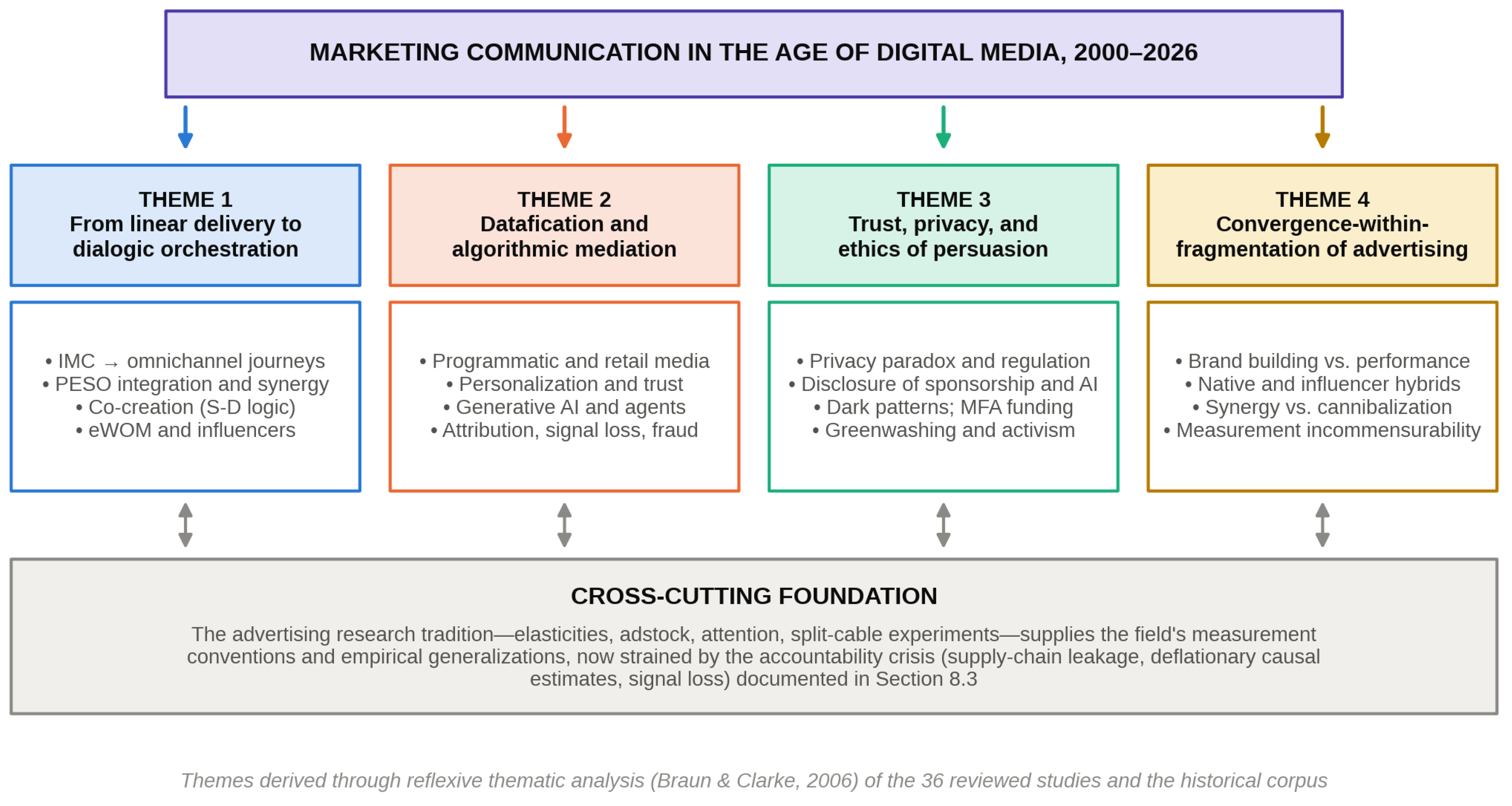
The thematic analysis yields four overarching themes characterizing marketing communication in the digital age—dialogic orchestration, algorithmic mediation, trust and ethics, and convergence-within-fragmentation—each shadowed by research deficiencies that flow from five root causes: fragmentation of the three research traditions documented in Section 8; proprietary enclosure of evidence within platforms; the speed of technological change, now measured in months rather than years; concentration of the evidence base in WEIRD and B2C contexts; and misaligned incentives in both academia (publication over cumulation) and industry (optimization over verification). Table 9 consolidates the resulting taxonomy, extending the framework with two previously under-recognized domains: the measurement gap exposed by the accountability crisis and the translational gap between academic research and practice.
Figure 5 maps the four themes and the cross-cutting foundation on which they rest. Three gaps deserve elaboration because they bind the rest together. First, the theoretical gap has a distinctive historical character: advertising research accumulated genuine empirical generalizations—elasticity ranges, adstock decay, weak-theory regularities—that gave the mass era a cumulative science, whereas digital-era research has produced abundant findings but few stabilized generalizations, and even the mass-era record is now understood to have been inflated by publication selection (Sethuraman et al., 2011; Shapiro et al., 2021). Rebuilding such generalizations under conditions of algorithmic mediation and machine authorship is arguably the discipline's core theoretical task. Second, the measurement gap is not a technical nuisance but a substantive phenomenon: as Section 11 argues, measurement regimes allocate budgets and therefore shape market reality; studying them is studying the field itself. Third, the translational gap completes the circuit: the academic–practitioner divide documented long before digitalization (Nyilasy & Reid, 2007) has been aggravated by platform enclosure of data, meaning that even rigorous findings often cannot be tested, replicated, or applied outside proprietary walls.
Figure 5.
Thematic Map of Marketing Communication in the Age of Digital Media. Note. Themes and sub-themes derived through reflexive thematic analysis of the reviewed corpus (Braun & Clarke, 2006); the cross-cutting foundation is the advertising research tradition now strained by the accountability crisis documented in Section 8.3. Figure prepared by the author.
11. Discussion
Five theses synthesize the analysis. First, the relationship between advertising and marketing communication is best understood as epistemic symbiosis. Advertising research supplies the field's most developed causal methods and its only substantial stock of empirical generalizations—elasticity magnitudes, carryover dynamics, attention mechanics—while marketing communication research supplies the integrative, relational, and strategic frame that single-medium advertising research structurally lacks. The three traditions documented in Section 8 are complementary rather than competing (Figure 3): the orchestration problems that define contemporary practice—when to reach, when to target, when to build, when to harvest—cannot be answered by any single tradition (Hanssens & Pauwels, 2016), and the four turns identified in Section 5.4 each originate in one tradition yet acquire meaning only within the frame the others supply.
Second, the field confronts a measurement trilemma: micro-internal validity (randomized experiments), macro-ecological validity (media mix modeling), and construct validity (attention and tracking research) each capture part of the effectiveness picture, and none captures all (Table 8). Experiments are costly, context-bound, and blind to what happens off-platform (Gordon et al., 2019; Lewis & Rao, 2015; Liang et al., 2025); models rest on stationarity assumptions the digital era violates; and attention metrics remain immaturely linked to outcomes (Bruns et al., 2025; Pieters & Wedel, 2004). Practice over-indexes on micro methods because they are fast and platform-supplied, mechanically shifting budgets toward short-term, measurable, bottom-funnel channels—an observational analogue of Goodhart's law at the level of the entire discipline, visible in the 70.6 percent of marketers reporting a tilt toward short-term impact (Moorman, 2026).
Third, the field exhibits a productivity paradox: communication spending at record levels (WPP Media, 2025b) coexists with documented supply-chain leakage (ANA, 2023; ISBA & PwC, 2020, 2023), truncated attention (Bellman et al., 2020), pervasive fraud (Juniper Research, 2023), signal loss (Aridor et al., 2026; Wernerfelt et al., 2025), and managerial inability to demonstrate long-term impact (Moorman, 2026). Effectiveness estimation has thus become as consequential as effectiveness creation. Measurement regimes are not neutral instruments; they allocate budgets, and budgets shape market structure—privacy rules concentrate ad-tech markets (Johnson et al., 2023), retail media relocates advertising inside the point of sale (WPP Media, 2025b), and identifier loss penalizes small advertisers (Wernerfelt et al., 2025). Marketing communication research should therefore treat measurement itself as a substantive object of study—reflexively, since the field's own metrics participate in the phenomena they purport to describe.
Fourth, ethics has become constitutive rather than peripheral. Privacy architecture (Tucker, 2014; Zhu et al., 2025), disclosure regimes (Boerman et al., 2017; Ershov et al., 2025), AI provenance (Hermann, 2022; Koning & Voorveld, 2025), and the ethics of funding MFA and misinformation inventory (ANA, 2023; Patel et al., 2026) jointly define the terms on which persuasion occurs. The AI-disclosure findings are the sharpest illustration: transparency mandated by the EU AI Act from August 2026 carries a measurable persuasion cost (Baek et al., 2026; European Commission, 2026), so the normative and the positive questions—what brands should disclose and what disclosure does—can no longer be studied apart.
Fifth, the analysis supports a continuity thesis: each prior media rupture in the field's history was resolved not by incremental repair but by construct reconstruction—promotion became communication, communication became integration, integration is becoming orchestration (Table 1). The current rupture—machine-generated, algorithmically mediated, co-produced, and prospectively agent-negotiated communication—demands an analogous reconstruction around attention, authorship, and trust. That machine-made messages can outperform human-made ones (Hartmann et al., 2025) while disclosure of their origin erodes trust (Gu et al., 2026) captures the tension precisely: the founding sender–receiver dyad no longer specifies who is speaking, and the gaps cataloged in Section 10 are the shape of that reconstruction still pending. The contextual gap in Table 9 has a constructive corollary: markets such as Saudi Arabia and the wider Gulf region, in which digital advertising, influencer, and retail media formats are expanding rapidly, are conspicuously absent from the evidence base reviewed here (Dwivedi et al., 2021), and they therefore offer an opportunity to build and test theory outside the WEIRD frame rather than merely to replicate it.
12. Recommendations
The recommendations that follow convert the gap analysis of Section 10 and the interpretation offered in Section 11 into an actionable agenda for the three constituencies of the paper addresses. They rest on a single premise: the causal, contingency, infrastructure, and generative turns identified in Section 5 have outrun the theory, measurement standards, and institutional arrangements that the field inherited from the integrated marketing communication era, so that progress now depends as much on how research is organized as on which questions are asked. Section 12.1 sets research priorities, using a prioritization matrix (Figure 6) to sort the agenda by theoretical urgency and near-term feasibility, specifying ten research programs (Table 10), and naming the institutional reforms on which the most ambitious of them depend. Section 12.2 draws out the implications for managers, who must now treat measurement strategy as inseparable from communication strategy, and for policymakers and regulators, who face the task of designing disclosure, privacy, and competition rules as a single coherent problem.
12.1. Priorities for Future Research
Research investment should follow the dual logic of theoretical urgency and near-term feasibility, mapped in Figure 6: "quick wins" (AI-disclosure and authorship-perception experiments; natural experiments around ATT and the AI Act), "targeted programs" (retail media incrementality, attention–outcome linkage, B2B digital journeys, cross-cultural disclosure protocols), and "grand challenges" (contingent orchestration theory, machine-era persuasion theory, cumulative digital generalizations), alongside long-horizon societal work on sustainability, misinformation, and the macro effects of advertising.
The matrix makes two points that the tabular agenda cannot. First, the studies with the highest theoretical stakes—orchestration theory, machine-era persuasion theory, and cumulative digital generalizations—are also those that depend most on data the field does not yet control, which is why the institutional reforms discussed below are preconditions rather than afterthoughts. Second, the quick wins are quick because regulation is creating natural experiments faster than scholars are exploiting them: the AI Act's labeling obligations, the FTC's fake-reviews rule, and the retention of third-party cookies in Chrome each date a treatment that the disclosure and privacy literatures are already equipped to evaluate. Table 10 translates the framework into ten research programs grounded in the findings of Section 5 to 10.
Beyond individual studies, institutional reforms are prerequisites: preregistered and registered-report formats to combat selective reporting; industry–academic data trusts operating through privacy-preserving clean rooms; standardized, publicly documented attention and cross-channel metrics developed jointly with industry measurement bodies; practitioner-facing synthesis vehicles in the manner of medical Cochrane collaborations to close the translational gap (Nyilasy & Reid, 2007); and doctoral training that combines causal inference, computational methods, and normative theory, since the field's next generation must work across the three traditions rather than within one.
12.2. Implications for Practice and Policy
For managers, integration has become harder, not easier, and measurement strategy is now inseparable from communication strategy. The evidence supports rebalancing toward long-term brand investment (Binet & Field, 2013; Edeling et al., 2021); architecting paid media as anchors for owned and earned systems (Colicev et al., 2018; Liang et al., 2025); selecting influencers on engagement rather than reach (Beichert et al., 2024; Wies et al., 2023); auditing programmatic supply chains against documented leakage benchmarks (ANA, 2023; ISBA & PwC, 2023); triangulating attribution with experiments and mix models (Gordon et al., 2019); adopting validated attention metrics as leading indicators (Bruns et al., 2025); and governing generative AI with disclosure strategies calibrated to the documented trust penalty (Koning & Voorveld, 2025; Sands et al., 2026) and to fraud externalities (Juniper Research, 2023).
For policymakers and regulators, the disclosure literature demonstrates that transparency interventions measurably shape persuasion processes (Boerman et al., 2017; Evans et al., 2017), supporting evidence-based rule-making for influencer and AI-generated content (European Commission, 2026; Federal Trade Commission, 2023, 2024)—but the 96 percent non-disclosure rate documented by Ershov et al. (2025) shows that rules without computational enforcement are largely symbolic. The programmatic transparency findings justify supply-chain disclosure obligations analogous to financial auditing, and the attention research agenda suggests that "exposure" itself may require redefinition in future media standards. Regulators should also weigh the competitive side effects documented by Johnson et al. (2023), Goldberg et al. (2024), and Aridor et al. (2026): privacy rules can concentrate ad-tech market power and burden small firms even as they protect consumer data. For regulators in rapidly digitalizing markets such as Saudi Arabia and other Gulf states, which are building data-protection and advertising-governance regimes concurrently, these findings argue for treating disclosure, privacy, and competition rules as a single design problem rather than as three separate ones.
13. Conclusions
Marketing communication's trajectory—from the orphaned techniques of the promotion mix to a self-conscious integrative discipline, and now into an algorithmically mediated, generative, co-creative condition—reflects the dialectic of economic necessity, technological disruption, and theoretical ambition that has shaped marketing thought. Across the 26 years from 2000 to 2026, the internet moved from a minority medium to the infrastructure of three-quarters of humanity, U.S. internet advertising grew from US$8 billion to nearly US$300 billion, commerce media overtook television, and the author of a persuasive message became, for the first time, potentially a machine. This analysis has argued that the field's condition cannot be fully understood without its relationship to advertising research and practice: advertising supplied the measurement institutions, the empirical generalizations, and the professional infrastructure upon which marketing communication stands, even as digitalization has demoted advertising from hegemon to anchor within the tool ecosystem and thrown its accountability arrangements into crisis. The 36 studies reviewed in Section 5 confirm that this crisis is empirically documented across the causal, contingency, infrastructure, and generative dimensions of contemporary research.
The discipline's founding problem has inverted. Where communicators once struggled to reach mass audiences with consistent messages, they now struggle to orchestrate hyper-abundant, personalized, machine-generated touchpoints into coherent and trustworthy brand meaning—under measurement regimes that systematically distort what is known about what works, and under disclosure regimes that make the origin of a message part of its meaning. Closing the gaps identified here—through integrative orchestration theory, a restored program of empirical generalization, triangulated measurement architectures, cross-cultural evidence, and normative seriousness about persuasion's societal consequences, supported by the institutional reforms recommended in Section 12—will determine whether marketing communication consolidates its status as a rigorous academic discipline for the algorithmic age, or remains, in part, a practice outrunning its own explanation.
Funding
This work was supported and funded by the Deanship of Scientific Research at Imam Mohammad ibn Saud Islamic University (IMSIU) (grant number IMSIU-DDRSP2602).
Transparency
The author confirms that the manuscript is an honest, accurate and transparent account of the study that no vital features of the study have been omitted and that any discrepancies from the study as planned have been explained. This study followed all ethical practices during writing.
Declaration of generative AI and AI-assisted technologies in manuscript preparation
The author used (Paperpal) for language editing and (Perplexity) to verify the accuracy of citations and references. The author reviewed and edited all content and assumed full responsibility for the published article.
Consent to Publish declaration
applicable.
Consent to Participate declaration
not applicable.
Ethics declaration
not applicable.
Conflicts of Interest
The authors declare no conflicts of interest.
References
- Aaker, D. A. Managing brand equity: Capitalizing on the value of a brand name; Free Press, 1991; ISBN 978-0-02-900101-1. [Google Scholar]
- Accenture. Shopping on social media platforms expected to reach $1.2 trillion globally by 2025, new Accenture study finds. [Press release. 4 January 2022. Available online: https://newsroom.accenture.com/news/2022/shopping-on-social-media-platforms-expected-to-reach-1-2-trillion-globally-by-2025-new-accenture-study-finds.
- ALS Association. Ice Bucket Challenge dramatically accelerated the fight against ALS. 4 June 2019. Available online: https://www.als.org/stories-news/ice-bucket-challenge-dramatically-accelerated-fight-against-als.
- Aridor, G.; Che, Y.-K.; Hollenbeck, B.; Kaiser, M.; McCarthy, D. Evaluating the impact of privacy regulation on e-commerce firms: Evidence from Apple's App Tracking Transparency. Management Science 2026, 72(8), 7009–7027. [Google Scholar] [CrossRef]
- Assmus, G.; Farley, J. U.; Lehmann, D. R. How advertising affects sales: Meta-analysis of econometric results. Journal of Marketing Research 1984, 21(1), 65–74. [Google Scholar] [CrossRef]
- Association of National Advertisers. ANA programmatic media supply chain transparency study: Complete report. 2023. Available online: https://www.ana.net/miccontent/show/id/rr-2023-12-ana-programmatic-media-supply-chain-transparency-study.
- Babić Rosario, A.; de Valck, K.; Sotgiu, F. Conceptualizing the electronic word-of-mouth process: What we know and need to know about eWOM creation, exposure, and evaluation. Journal of the Academy of Marketing Science 2020, 48(3), 422–448. [Google Scholar] [CrossRef]
- Baek, T. H.; Kim, J.; Kim, J. H. Effect of disclosing AI-generated content on prosocial advertising evaluation. International Journal of Advertising 2026, 45(1), 171–192. [Google Scholar] [CrossRef]
- Batra, R.; Keller, K. L. Integrating marketing communications: New findings, new lessons, and new ideas. Journal of Marketing 2016, 80(6), 122–145. [Google Scholar] [CrossRef]
- Beichert, M.; Bayerl, A.; Goldenberg, J.; Lanz, A. Revenue generation through influencer marketing. Journal of Marketing 2024, 88(4), 40–63. [Google Scholar] [CrossRef]
- Belch, G. E.; Belch, M. A. Advertising and promotion: An integrated marketing communications perspective, 12th ed.; McGraw-Hill Education, 2021; ISBN 978-1-260-25931-5. [Google Scholar]
- Bellman, S.; Beal, V.; Wooley, B.; Varan, D. Viewing time as a cross-media metric: Comparing viewing time for video advertising on television and online. Journal of Business Research 120 2020, 103–113. [Google Scholar] [CrossRef]
- Bhagwat, Y.; Warren, N. L.; Beck, J. T.; Watson, G. F., IV. Corporate sociopolitical activism and firm value. Journal of Marketing 2020, 84(5), 1–21. [Google Scholar] [CrossRef]
- Binet, L.; Field, P. The long and the short of it: Balancing short and long-term marketing strategies. In Institute of Practitioners in Advertising; 2013; ISBN 978-0-85294-134-8. [Google Scholar]
- Blake, T.; Nosko, C.; Tadelis, S. Consumer heterogeneity and paid search effectiveness: A large-scale field experiment. Econometrica 2015, 83(1), 155–174. [Google Scholar] [CrossRef]
- Bleier, A.; Eisenbeiss, M. The importance of trust for personalized online advertising. Journal of Retailing 2015, 91(3), 390–409. [Google Scholar] [CrossRef]
- Bleier, A.; Goldfarb, A.; Tucker, C. Consumer privacy and the future of data-based innovation and marketing. International Journal of Research in Marketing 2020, 37(3), 466–480. [Google Scholar] [CrossRef]
- Boerman, S. C.; Willemsen, L. M.; Van der Aa, E. P. This post is sponsored": Effects of sponsorship disclosure on persuasion knowledge and electronic word of mouth in the context of Facebook. Journal of Interactive Marketing 38 2017, 82–92. [Google Scholar] [CrossRef]
- Borden, N. H. The concept of the marketing mix. Journal of Advertising Research 1964, 4(2), 2–7. [Google Scholar] [CrossRef]
- Braun, V.; Clarke, V. Using thematic analysis in psychology. Qualitative Research in Psychology 2006, 3(2), 77–101. [Google Scholar] [CrossRef]
- Broadbent, S. One way of looking at advertising response. Admap 1979, 15(9), 336–340. [Google Scholar]
- Bruns, D.; Kopka, J. F.; Borgmann, L.; Prior, S.; Langner, T. Measuring gaining and holding attention to social media ads with viewport logging: A validation study using mobile eye-tracking. Journal of Advertising 2025, 54(5), 655–672. [Google Scholar] [CrossRef]
- Calder, B. J.; Malthouse, E. C.; Schaedel, U. An experimental study of the relationship between online engagement and advertising effectiveness. Journal of Interactive Marketing 2009, 23(4), 321–331. [Google Scholar] [CrossRef]
- Campbell, C.; Plangger, K.; Sands, S.; Kietzmann, J. Preparing for an era of deepfakes and AI-generated ads: A framework for understanding responses to manipulated advertising. Journal of Advertising 2022, 51(1), 22–38. [Google Scholar] [CrossRef]
- Chavez, A. A new path for Privacy Sandbox on the web. Google Privacy Sandbox. 22 July 2024. Available online: https://privacysandbox.google.com/blog/privacy-sandbox-update.
- Chavez, A. Next steps for Privacy Sandbox and tracking protections in Chrome. Google Privacy Sandbox. 22 April 2025a. Available online: https://privacysandbox.google.com/blog/privacy-sandbox-next-steps.
- Chavez, A. Update on plans for Privacy Sandbox technologies. Google Privacy Sandbox. 17 October 2025b. Available online: https://privacysandbox.google.com/blog/update-on-plans-for-privacy-sandbox-technologies.
- Chu, T. H.; Looi, J.; Liu, D. A meta-analytic comparison of human influencers and virtual influencers across different levels of human-likeness: Is humanness more persuasive? Journal of Advertising Research Advance online publication. 2026. [Google Scholar] [CrossRef]
- CMS. GDPR Enforcement Tracker report 2026, 7th ed.; CMS Legal Services, 2026; Available online: https://cms.law/en/int/publication/gdpr-enforcement-tracker-report.
- CNBC. Facebook says Apple iOS privacy change will result in $10 billion revenue hit this year. 2 February 2022. Available online: https://www.cnbc.com/2022/02/02/facebook-says-apple-ios-privacy-change-will-cost-10-billion-this-year.html.
- Coca-Cola Company. Coca-Cola invites digital artists to "Create Real Magic" using new AI platform. [Press release. 20 March 2023. Available online: https://www.coca-colacompany.com/media-center/coca-cola-invites-digital-artists-to-create-real-magic-using-new-ai-platform.
- Colicev, A.; Malshe, A.; Pauwels, K.; O'Connor, P. Improving consumer mindset metrics and shareholder value through social media: The different roles of owned and earned media. Journal of Marketing 2018, 82(1), 37–56. [Google Scholar] [CrossRef]
- Cornelissen, J. P. Integrated marketing communications and the language of marketing development. International Journal of Advertising 2001, 20(4), 483–498. [Google Scholar] [CrossRef]
- Cornelissen, J. P. Change, continuity and progress: The concept of integrated marketing communications and marketing communications practice. Journal of Strategic Marketing 2003, 11(4), 217–234. [Google Scholar] [CrossRef]
- Cui, T. H.; Ghose, A.; Halaburda, H.; Iyengar, R.; Pauwels, K.; Sriram, S.; Tucker, C.; Venkataraman, S. Informational challenges in omnichannel marketing: Remedies and future research. Journal of Marketing 2021, 85(1), 103–120. [Google Scholar] [CrossRef]
- Danaher, P. J.; Dagger, T. S. Comparing the relative effectiveness of advertising channels: A case study of a multimedia blitz campaign. Journal of Marketing Research 2013, 50(4), 517–534. [Google Scholar] [CrossRef]
- Davenport, T.; Guha, A.; Grewal, D.; Bressgott, T. How artificial intelligence will change the future of marketing. Journal of the Academy of Marketing Science 2020, 48(1), 24–42. [Google Scholar] [CrossRef]
- de Freitas Netto, S. V.; Sobral, M. F. F.; Ribeiro, A. R. B.; Soares, G. R. da L. Concepts and forms of greenwashing: A systematic review. Environmental Sciences Europe 2020, 32(1), 19. [Google Scholar] [CrossRef]
- de Haan, E.; Wiesel, T.; Pauwels, K. The effectiveness of different forms of online advertising for purchase conversion in a multiple-channel attribution framework. International Journal of Research in Marketing 2016, 33(3), 491–507. [Google Scholar] [CrossRef]
- De Veirman, M.; Cauberghe, V.; Hudders, L. Marketing through Instagram influencers: The impact of number of followers and product divergence on brand attitude. International Journal of Advertising 2017, 36(5), 798–828. [Google Scholar] [CrossRef]
- Denzin, N. K.; Lincoln, Y. S. (Eds.) The SAGE handbook of qualitative research, 5th ed.; SAGE, 2018; ISBN 978-1-4833-4980-0. [Google Scholar]
- Dietrich, G. Spin sucks: Communication and reputation management in the digital age; Que Publishing, 2014; ISBN 978-0-7897-4886-7. [Google Scholar]
- Drèze, X.; Hussherr, F.-X. Internet advertising: Is anybody watching? Journal of Interactive Marketing 2003, 17(4), 8–23. [Google Scholar] [CrossRef]
- Duffek, B.; Eisingerich, A. B.; Merlo, O.; Lee, G. Authenticity in influencer marketing: How can influencers and brands work together to build and maintain influencer authenticity? Journal of Marketing 2025, 89(5), 21–46. [Google Scholar] [CrossRef]
- Duncan, T.; Moriarty, S. E. A communication-based marketing model for managing relationships. Journal of Marketing 1998, 62(2), 1–13. [Google Scholar] [CrossRef]
- Dwivedi, Y. K.; Ismagilova, E.; Hughes, D. L.; Carlson, J.; Filieri, R.; Jacobson, J.; Jain, V.; Karjaluoto, H.; Kefi, H.; Krishen, A. S.; Kumar, V.; Rahman, M. M.; Raman, R.; Rauschnabel, P. A.; Rowley, J.; Salo, J.; Tran, G. A.; Wang, Y. Setting the future of digital and social media marketing research: Perspectives and research propositions. International Journal of Information Management 59 2021, 102168. [Google Scholar] [CrossRef]
- Edeling, A.; Srinivasan, S.; Hanssens, D. M. The marketing–finance interface: A new integrative review of metrics, methods, findings and an agenda for future research. International Journal of Research in Marketing 2021, 38(4), 857–876. [Google Scholar] [CrossRef]
- Ehrenberg, A. S. C. Repetitive advertising and the consumer. Journal of Advertising Research (Original work published 1974). 2000, 40(6), 39–48. [Google Scholar] [CrossRef]
- Ehrenberg, A.; Barnard, N.; Kennedy, R.; Bloom, H. Brand advertising as creative publicity. Journal of Advertising Research 2002, 42(4), 7–18. [Google Scholar] [CrossRef]
- eMarketer. The state of programmatic advertising in 5 charts. 17 August 2023. Available online: https://www.emarketer.com/content/state-of-programmatic-advertising-5-charts.
- Ershov, D.; He, Y.; Seiler, S. Frontiers: How much influencer marketing is undisclosed? Evidence from Twitter. Marketing Science 2025, 44(3), 505–515. [Google Scholar] [CrossRef]
- European Commission. Transparency obligations under Article 50 of the AI Act. Questions and answers. 2026. Available online: https://digital-strategy.ec.europa.eu/en/faqs/transparency-obligations-under-article-50-ai-act.
- European Parliament; Council of the European Union. Regulation (EU) 2016/679 on the protection of natural persons with regard to the processing of personal data and on the free movement of such data (General Data Protection Regulation). Official Journal of the European Union L 119 2016, 1–88. Available online: https://eur-lex.europa.eu/eli/reg/2016/679/oj.
- European Parliament; Council of the European Union. Regulation (EU) 2024/1689 laying down harmonised rules on artificial intelligence (Artificial Intelligence Act). Official Journal of the European Union L 2024, 2024/1689. Available online: https://eur-lex.europa.eu/eli/reg/2024/1689/oj.
- Evans, N. J.; Phua, J.; Lim, J.; Jun, H. Disclosing Instagram influencer advertising: The effects of disclosure language on advertising recognition, attitudes, and behavioral intent. Journal of Interactive Advertising 2017, 17(2), 138–149. [Google Scholar] [CrossRef]
- Federal Trade Commission. Federal Trade Commission announces updated advertising guides to combat deceptive reviews and endorsements [Press release]. 29 June 2023. Available online: https://www.ftc.gov/news-events/news/press-releases/2023/06/federal-trade-commission-announces-updated-advertising-guides-combat-deceptive-reviews-endorsements.
- Federal Trade Commission. Federal Trade Commission announces final rule banning fake reviews and testimonials [Press release]. 14 August 2024. Available online: https://www.ftc.gov/news-events/news/press-releases/2024/08/federal-trade-commission-announces-final-rule-banning-fake-reviews-testimonials.
- Finne, Å.; Grönroos, C. Rethinking marketing communication: From integrated marketing communication to relationship communication. Journal of Marketing Communications 2009, 15(2–3), 179–195. [Google Scholar] [CrossRef]
- Gartner. Gartner 2025 CMO Spend Survey reveals marketing budgets have flatlined at 7.7% of overall company revenue. [Press release. 12 May 2025. Available online: https://www.gartner.com/en/newsroom/press-releases/2025-05-12-gartner-2025-cmo-spend-survey-reveals-marketing-budgets-have-flatlined-at-seven-percent-of-overall-company-revenue.
- Goldberg, S. G.; Johnson, G. A.; Shriver, S. K. Regulating privacy online: An economic evaluation of the GDPR. American Economic Journal: Economic Policy 2024, 16(1), 325–358. [Google Scholar] [CrossRef]
- Goldfarb, A.; Tucker, C. Online display advertising: Targeting and obtrusiveness. Marketing Science 2011, 30(3), 389–404. [Google Scholar] [CrossRef]
- Gordon, B. R.; Jerath, K.; Katona, Z.; Narayanan, S.; Shin, J.; Wilbur, K. C. Inefficiencies in digital advertising markets. Journal of Marketing 2021, 85(1), 7–25. [Google Scholar] [CrossRef]
- Gordon, B. R.; Moakler, R.; Zettelmeyer, F. Close enough? A large-scale exploration of non-experimental approaches to advertising measurement. Marketing Science 2023, 42(4), 768–793. [Google Scholar] [CrossRef]
- Gordon, B. R.; Zettelmeyer, F.; Bhargava, N.; Chapsky, D. A comparison of approaches to advertising measurement: Evidence from big field experiments at Facebook. Marketing Science 2019, 38(2), 193–225. [Google Scholar] [CrossRef]
- Grönroos, C. From marketing mix to relationship marketing: Towards a paradigm shift in marketing. Management Decision 1994, 32(2), 4–20. [Google Scholar] [CrossRef]
- Gu, C.; Li, X.; Xiang, Q. The infinite monkey theorem in AIGC advertising: Matching effects between AI disclosure and advertising appeals on consumer advertising avoidance intention. Journal of Research in Interactive Marketing 2026, 20(6), 886–905. [Google Scholar] [CrossRef]
- Gummesson, E. Total relationship marketing, 2nd ed.; Butterworth-Heinemann, 2002; ISBN 978-0-7506-5407-4. [Google Scholar]
- Hanssens, D. M. The value of empirical generalizations in marketing. Journal of the Academy of Marketing Science 2018, 46(1), 6–8. [Google Scholar] [CrossRef]
- Hanssens, D. M.; Pauwels, K. H. Demonstrating the value of marketing. Journal of Marketing 2016, 80(6), 173–190. [Google Scholar] [CrossRef]
- Hartmann, J.; Exner, Y.; Domdey, S. The power of generative marketing: Can generative AI create superhuman visual marketing content? International Journal of Research in Marketing 2025, 42(1), 13–31. [Google Scholar] [CrossRef]
- Hennig-Thurau, T.; Gwinner, K. P.; Walsh, G.; Gremler, D. D. Electronic word-of-mouth via consumer-opinion platforms: What motivates consumers to articulate themselves on the Internet? Journal of Interactive Marketing 2004, 18(1), 38–52. [Google Scholar] [CrossRef]
- Hermann, E. Leveraging artificial intelligence in marketing for social good—An ethical perspective. Journal of Business Ethics 2022, 179(1), 43–61. [Google Scholar] [CrossRef]
- Hermann, E.; Puntoni, S. Artificial intelligence and consumer behavior: From predictive to generative AI. Journal of Business Research 180 2024, 114720. [Google Scholar] [CrossRef]
- Hopkins, C. C. Scientific advertising; Lord & Thomas, 1923. [Google Scholar]
- Hou, W.; Xu, J.; Ren, J. Exploring the advertising effectiveness of generative artificial intelligence: An empirical study using the hierarchy-of-effects model. International Journal of Advertising 2026, 45(1), 6–26. [Google Scholar] [CrossRef]
- Hu, K. ChatGPT sets record for fastest-growing user base – analyst note. In Reuters; 2 February 2023; Available online: https://www.reuters.com/technology/chatgpt-sets-record-fastest-growing-user-base-analyst-note-2023-02-01/.
- Huang, M.-H.; Rust, R. T. A strategic framework for artificial intelligence in marketing. Journal of the Academy of Marketing Science 2021, 49(1), 30–50. [Google Scholar] [CrossRef]
- Huang, M.-H.; Rust, R. T. The caring machine: Feeling AI for customer care. Journal of Marketing 2024, 88(5), 1–23. [Google Scholar] [CrossRef]
- Huang, S.; Lin, S. Do more likes lead to more clicks? Evidence from a field experiment on social advertising. Journal of Marketing 2025, 89(5), 88–110. [Google Scholar] [CrossRef]
- Hudders, L.; De Jans, S.; De Veirman, M. The commercialization of social media stars: A literature review and conceptual framework on the strategic use of social media influencers. International Journal of Advertising 2021, 40(3), 327–375. [Google Scholar] [CrossRef]
- Interactive Advertising Bureau. IAB internet advertising revenue report: 2010 full year results. IAB & PwC. 2011. Available online: https://www.iab.com/wp-content/uploads/2015/05/IAB_Full_year_2010_0413_Final.pdf.
- Interactive Advertising Bureau. IAB/PwC internet advertising revenue report: Full year 2025. IAB & PwC. 16 April 2026. Available online: https://www.iab.com/insights/internet-advertising-revenue-report-full-year-2025/.
- International Telecommunication Union. Measuring digital development: Facts and figures 2025. 2025. Available online: https://www.itu.int/itu-d/reports/statistics/facts-figures-2025/.
- ISBA; PwC. Programmatic supply chain transparency study: Executive summary. Incorporated Society of British Advertisers. 2020. Available online: https://www.isba.org.uk/system/files/media/documents/2020-12/executive-summary-programmatic-supply-chain-transparency-study.pdf.
- ISBA; PwC. Programmatic supply chain transparency study II: Summary; Incorporated Society of British Advertisers., 18 January 2023; Available online: https://www.isba.org.uk/knowledge/second-programmatic-supply-chain-transparency-study.
- John, L. K.; Kim, T.; Barasz, K. Ads that don't overstep. Harvard Business Review 2018, 96(1), 62–69. Available online: https://hbr.org/2018/01/ads-that-dont-overstep. [CrossRef]
- Johnson, G. A.; Runge, J.; Seufert, E. Privacy-centric digital advertising: Implications for research. Customer Needs and Solutions 2022, 9(1–2), 49–54. [Google Scholar] [CrossRef]
- Johnson, G. A.; Shriver, S. K.; Goldberg, S. G. Privacy and market concentration: Intended and unintended consequences of the GDPR. Management Science 2023, 69(10), 5695–5721. [Google Scholar] [CrossRef]
- Jones, J. P. When ads work: New proof that advertising triggers sales; Lexington Books, 1995; ISBN 978-0-02-916662-8. [Google Scholar]
- Ju, I.; Ham, C.-D.; Yel, E. Dark patterns in data-consent disclosures and consumer reactance to online behavioral advertising. Journal of Advertising 2026, 55(3), 307–325. [Google Scholar] [CrossRef]
- Juniper Research. Quantifying the cost of ad fraud: 2023–2028. White paper. 2023. Available online: https://fraudblocker.com/wp-content/uploads/2023/09/Ad-Fraud-Whitepaper_Juniper-Research.pdf.
- Kannan, P. K.; Li, H. A. Digital marketing: A framework, review and research agenda. International Journal of Research in Marketing 2017, 34(1), 22–45. [Google Scholar] [CrossRef]
- Kapoor, A.; Kumar, M. Frontiers: Generative AI and personalized video advertisements. Marketing Science 2025, 44(4), 733–747. [Google Scholar] [CrossRef]
- Keller, K. L. Conceptualizing, measuring, and managing customer-based brand equity. Journal of Marketing 1993, 57(1), 1–22. [Google Scholar] [CrossRef]
- Kemp, S. Digital 2024: Global overview report; DataReportal, 31 January 2024; Available online: https://datareportal.com/reports/digital-2024-global-overview-report.
- Kemp, S. Digital 2026: Global overview report. DataReportal. October 2025. Available online: https://datareportal.com/reports/digital-2026-global-overview-report.
- Kemp, S. Digital 2026: Mid-year global update report; DataReportal, April 2026; Available online: https://datareportal.com/reports/digital-2026-mid-year-global-update-report.
- Kietzmann, J. H.; Hermkens, K.; McCarthy, I. P.; Silvestre, B. S. Social media? Get serious! Understanding the functional building blocks of social media. Business Horizons 2011, 54(3), 241–251. [Google Scholar] [CrossRef]
- Kim, J. Advertising in the age of agentic AI: Call for research. Journal of Interactive Advertising 2025, 25(3), 215–221. [Google Scholar] [CrossRef]
- Koning, B.; Voorveld, H. A. M. Disclaimer! This content is AI-generated: How AI-disclosures influence trust in advertisements and organizations. Journal of Interactive Advertising 2025, 25(3), 240–253. [Google Scholar] [CrossRef]
- Kotler, P. Marketing management: Analysis, planning, and control; Prentice-Hall, 1967. [Google Scholar]
- Kshetri, N.; Dwivedi, Y. K.; Davenport, T. H.; Panteli, N. Generative artificial intelligence in marketing: Applications, opportunities, challenges, and research agenda. International Journal of Information Management 75 2024, 102716. [Google Scholar] [CrossRef]
- Kuehnl, C.; Jozic, D.; Homburg, C. Effective customer journey design: Consumers' conception, measurement, and consequences. Journal of the Academy of Marketing Science 2019, 47(3), 551–568. [Google Scholar] [CrossRef]
- Lamberton, C.; Stephen, A. T. A thematic exploration of digital, social media, and mobile marketing: Research evolution from 2000 to 2015 and an agenda for future inquiry. Journal of Marketing 2016, 80(6), 146–172. [Google Scholar] [CrossRef]
- Lambrecht, A.; Tucker, C. When does retargeting work? Information specificity in online advertising. Journal of Marketing Research 2013, 50(5), 561–576. [Google Scholar] [CrossRef]
- Lauterborn, B. New marketing litany: Four Ps passé; C-words take over. Advertising Age 1990, 61(41), 26. [Google Scholar]
- Lavidge, R. J.; Steiner, G. A. A model for predictive measurements of advertising effectiveness. Journal of Marketing 1961, 25(6), 59–62. [Google Scholar] [CrossRef]
- Lemon, K. N.; Verhoef, P. C. Understanding customer experience throughout the customer journey. Journal of Marketing 2016, 80(6), 69–96. [Google Scholar] [CrossRef]
- Leung, F. F.; Gu, F. F.; Li, Y.; Zhang, J. Z.; Palmatier, R. W. Influencer marketing effectiveness. Journal of Marketing 2022, 86(6), 93–115. [Google Scholar] [CrossRef]
- Leung, F. F.; Gu, F. F.; Palmatier, R. W. Online influencer marketing. Journal of the Academy of Marketing Science 2022, 50(2), 226–251. [Google Scholar] [CrossRef]
- Lewis, R. A.; Rao, J. M. The unfavorable economics of measuring the returns to advertising. Quarterly Journal of Economics 2015, 130(4), 1941–1973. [Google Scholar] [CrossRef]
- Li, H. A.; Kannan, P. K. Attributing conversions in a multichannel online marketing environment: An empirical model and a field experiment. Journal of Marketing Research 2014, 51(1), 40–56. [Google Scholar] [CrossRef]
- Liang, Y.; Chen, X.; Han, S.; Zhang, J.; Chen, Y. Is the money spent on short-form video social platforms worth it? The role of advertising spillover in a large-scale randomized field experiment on ByteDance. Marketing Science 2025, 44(5), 1125–1144. [Google Scholar] [CrossRef]
- Liaukonyte, J.; Teixeira, T.; Wilbur, K. C. Television advertising and online shopping. Marketing Science 2015, 34(3), 311–330. [Google Scholar] [CrossRef]
- Lodish, L. M.; Abraham, M.; Kalmenson, S.; Livelsberger, J.; Lubetkin, B.; Richardson, B.; Stevens, M. E. How T.V. advertising works: A meta-analysis of 389 real world split cable T.V. advertising experiments. Journal of Marketing Research 1995, 32(2), 125–139. [Google Scholar] [CrossRef]
- Long, F.; Jerath, K.; Sarvary, M. Designing an online retail marketplace: Leveraging information from sponsored advertising. Marketing Science 2022, 41(1), 115–138. [Google Scholar] [CrossRef]
- Longoni, C.; Cian, L. Artificial intelligence in utilitarian vs. hedonic contexts: The "word-of-machine" effect. Journal of Marketing 2022, 86(1), 91–108. [Google Scholar] [CrossRef]
- Luo, B.; Ranjan, B. Mapping spatial heterogeneity in retail advertising effectiveness. Journal of Marketing Research 2025, 62(6), 1063–1080. [Google Scholar] [CrossRef]
- Lyon, T. P.; Montgomery, A. W. The means and end of greenwash. Organization & Environment 2015, 28(2), 223–249. [Google Scholar] [CrossRef]
- Malik, A. ChatGPT reaches 900M weekly active users. TechCrunch. 27 February 2026. Available online: https://techcrunch.com/2026/02/27/chatgpt-reaches-900m-weekly-active-users.
- Martin, K. D.; Murphy, P. E. The role of data privacy in marketing. Journal of the Academy of Marketing Science 2017, 45(2), 135–155. [Google Scholar] [CrossRef]
- McCarthy, E. J. Basic marketing: A managerial approach; Richard D. Irwin, 1960. [Google Scholar]
- The economic potential of generative AI: The next productivity frontier; McKinsey, Ed.; McKinsey Global Institute, 14 June 2023; Available online: https://www.mckinsey.com/capabilities/mckinsey-digital/our-insights/the-economic-potential-of-generative-ai-the-next-productivity-frontier.
- McKinsey, Ed.; The state of AI in 2026: On the road to ROI. QuantumBlack, AI by McKinsey. 25 August 2026. Available online: https://www.mckinsey.com/capabilities/quantumblack/our-insights/the-state-of-ai.
- Miller, K. M.; Skiera, B. Economic consequences of online tracking restrictions: Evidence from cookies. International Journal of Research in Marketing 2024, 41(2), 241–264. [Google Scholar] [CrossRef]
- Moorman, C. Marketing contracts under economic pressure despite growing value and AI gains (The CMO Survey, 35th ed.; Duke University, Fuqua School of Business, 31 March 2026; Available online: https://cmosurvey.org/marketing-contracts-under-economic-pressure-despite-growing-value-and-ai-gains/.
- Mouritzen, S. L. T.; Penttinen, V.; Pedersen, S. Virtual influencer marketing: The good, the bad and the unreal. European Journal of Marketing 2024, 58(2), 410–440. [Google Scholar] [CrossRef]
- Mukherjee, S.; Althuizen, N. Brand activism: Does courting controversy help or hurt a brand? International Journal of Research in Marketing 2020, 37(4), 772–788. [Google Scholar] [CrossRef]
- Naik, P. A.; Peters, K. A hierarchical marketing communications model of online and offline media synergies. Journal of Interactive Marketing 2009, 23(4), 288–299. [Google Scholar] [CrossRef]
- Nelson-Field, K. Viral marketing: The science of sharing; Oxford University Press, 2013; ISBN 978-0-19-552798-8. [Google Scholar]
- Nelson-Field, K. The attention economy and how media works: Simple truths for marketers; Palgrave Macmillan, 2020. [Google Scholar] [CrossRef]
- Nelson-Field, K.; Riebe, E.; Sharp, B. More mutter about clutter: Extending empirical generalizations to Facebook. Journal of Advertising Research 2013, 53(2), 186–191. [Google Scholar] [CrossRef]
- Nielsen. Beyond martech: Building trust with consumers and engaging where sentiment is high. 2021. Available online: https://www.nielsen.com/insights/2021/beyond-martech-building-trust-with-consumers-and-engaging-where-sentiment-is-high/.
- Nyilasy, G.; Reid, L. N. The academician–practitioner gap in advertising. International Journal of Advertising 2007, 26(4), 425–445. [Google Scholar] [CrossRef]
- Our World in Data. Number of internet users. Data set; ITU estimates via World Bank. 2026. Available online: https://ourworldindata.org/grapher/number-of-internet-users.
- Patel, N. G.; Ramachandran, R.; Ross, J. S. Advertising payments to news websites that publish health misinformation. JAMA Network Open 2026, 9(4), e265068. [Google Scholar] [CrossRef]
- Pauwels, K.; Fagbola, L. Understanding retail media: Perspectives and implications for stakeholders. Journal of Retailing 2025, 101(3), 315–330. [Google Scholar] [CrossRef]
- Peres, R.; Schreier, M.; Schweidel, D.; Sorescu, A. On ChatGPT and beyond: How generative artificial intelligence may affect research, teaching, and practice. International Journal of Research in Marketing 2023, 40(2), 269–275. [Google Scholar] [CrossRef]
- Petty, R. E.; Cacioppo, J. T. The elaboration likelihood model of persuasion. Advances in Experimental Social Psychology 19 1986, 123–205. [Google Scholar] [CrossRef]
- Pickton, D.; Broderick, A. Integrated marketing communications, 2nd ed.; Financial Times Prentice Hall, 2005; ISBN 978-0-273-67645-4. [Google Scholar]
- Pieters, R.; Wedel, M. Attention capture and transfer in advertising: Brand, pictorial, and text-size effects. Journal of Marketing 2004, 68(2), 36–50. [Google Scholar] [CrossRef]
- Porcu, L.; del Barrio-García, S.; Kitchen, P. J. Measuring integrated marketing communication by taking a broad organisational approach: The firm-wide IMC scale. European Journal of Marketing 2017, 51(3), 692–718. [Google Scholar] [CrossRef]
- Reisenbichler, M.; Reutterer, T.; Schweidel, D. A. Applying large language models to sponsored search advertising. Marketing Science 2026, 45(1), 123–141. [Google Scholar] [CrossRef]
- Rethink. Heinz A.I. Ketchup. Campaign case. 2022. Available online: https://rethinkideas.com/work/heinz-ketchup/2022/digital-social/heinz-a-i-ketchup/.
- Ries, A.; Trout, J. Positioning: The battle for your mind; McGraw-Hill, 1981; ISBN 978-0-07-065263-7. [Google Scholar]
- Robehmed, N. How Rihanna created a $600 million fortune—and became the world's richest female musician. Forbes. 4 June 2019. Available online: https://www.forbes.com/sites/natalierobehmed/2019/06/04/rihanna-worth-fenty-beauty/.
- Romaniuk, J. Building distinctive brand assets; Oxford University Press, 2018; ISBN 978-0-19-031150-6. [Google Scholar]
- Romaniuk, J.; Sharp, B. Conceptualizing and measuring brand salience. Marketing Theory 2004, 4(4), 327–342. [Google Scholar] [CrossRef]
- Rossiter, J. R.; Percy, L. Advertising communications and promotion management, 2nd ed.; McGraw-Hill, 1997; ISBN 978-0-07-053943-3. [Google Scholar]
- Rust, R. T.; Ambler, T.; Carpenter, G. S.; Kumar, V.; Srivastava, R. K. Measuring marketing productivity: Current knowledge and future directions. Journal of Marketing 2004, 68(4), 76–89. [Google Scholar] [CrossRef]
- Sahni, N. S.; Nair, H. S. Sponsorship disclosure and consumer deception: Experimental evidence from native advertising in mobile search. Marketing Science 2020, 39(1), 5–32. [Google Scholar] [CrossRef]
- Sands, S.; Demsar, V.; Ferraro, C.; Wilson, S.; Wheeler, M.; Campbell, C. Easing AI-advertising aversion: How leadership for the greater good buffers negative response to AI-generated ads. International Journal of Advertising 2026, 45(1), 27–47. [Google Scholar] [CrossRef]
- Schultz, D. E.; Tannenbaum, S. I.; Lauterborn, R. F. Integrated marketing communications: Putting it together & making it work; NTC Business Books, 1993; ISBN 978-0-8442-3363-5. [Google Scholar]
- Schweidel, D. A.; Bart, Y.; Inman, J. J.; Stephen, A. T.; Libai, B.; Andrews, M.; Babić Rosario, A.; Chae, I.; Chen, Z.; Kupor, D.; Longoni, C.; Thomaz, F. How consumer digital signals are reshaping the customer journey. Journal of the Academy of Marketing Science 2022, 50(6), 1257–1276. [Google Scholar] [CrossRef]
- Segijn, C. M. Eye-tracking research in advertising scholarship: A review and practical guide. Journal of Advertising 2025, 54(5), 637–654. [Google Scholar] [CrossRef]
- Šerić, M.; Ozretić-Došen, Đ.; Škare, V. How can perceived consistency in marketing communications influence customer–brand relationship outcomes? European Management Journal 2020, 38(2), 335–343. [Google Scholar] [CrossRef]
- Sethuraman, R.; Tellis, G. J.; Briesch, R. A. How well does advertising work? Generalizations from meta-analysis of brand advertising elasticities. Journal of Marketing Research 2011, 48(3), 457–471. [Google Scholar] [CrossRef]
- Shapiro, B. T.; Hitsch, G. J.; Tuchman, A. E. TV advertising effectiveness and profitability: Generalizable results from 288 brands. Econometrica 2021, 89(4), 1855–1879. [Google Scholar] [CrossRef]
- Sharp, B. How brands grow: What marketers don't know; Oxford University Press, 2010; ISBN 978-0-19-557356-5. [Google Scholar]
- Shimp, T. A. Promotion management and marketing communications, 2nd ed.; Dryden Press, 1990; ISBN 978-0-03-026643-0. [Google Scholar]
- Simmonds, L.; Bellman, S.; Kennedy, R.; Nenycz-Thiel, M.; Bogomolova, S. Moderating effects of prior brand usage on visual attention to video advertising and recall: An eye-tracking investigation. Journal of Business Research 111 2020, 241–248. [Google Scholar] [CrossRef]
- Smith, A. N.; Fischer, E.; Yongjian, C. How does brand-related user-generated content differ across YouTube, Facebook, and Twitter? Journal of Interactive Marketing 2012, 26(2), 102–113. [Google Scholar] [CrossRef]
- Snyder, H. Literature review as a research methodology: An overview and guidelines. Journal of Business Research 104 2019, 333–339. [Google Scholar] [CrossRef]
- Starch, D. Advertising: Its principles, practice, and technique; Scott, Foresman, Eds.; 1914. [Google Scholar]
- Stewart, D. W. Marketing accountability: Linking marketing actions to financial results. Journal of Business Research 2009, 62(6), 636–643. [Google Scholar] [CrossRef]
- Thomas, R.; Thomas, S.; Rapert, M.; Williams, B.; Murray, A. Retail media networks: Definition, development, and differentiation. Journal of Business Research 200 2025, 115656. [Google Scholar] [CrossRef]
- TikTok. Thanks a billion! [Blog post. 27 September 2021. Available online: https://newsroom.tiktok.com/en-us/1-billion-people-on-tiktok.
- Todri, V. Frontiers: The impact of ad-blockers on online consumer behavior. Marketing Science 2022, 41(1), 7–18. [Google Scholar] [CrossRef]
- Tucker, C. E. Social networks, personalized advertising, and privacy controls. Journal of Marketing Research 2014, 51(5), 546–562. [Google Scholar] [CrossRef]
- Vakratsas, D.; Ambler, T. How advertising works: What do we really know? Journal of Marketing 1999, 63(1), 26–43. [Google Scholar] [CrossRef]
- Vargo, S. L.; Lusch, R. F. Evolving to a new dominant logic for marketing. Journal of Marketing 2004, 68(1), 1–17. [Google Scholar] [CrossRef]
- Verhoef, P. C.; Kannan, P. K.; Inman, J. J. From multi-channel retailing to omni-channel retailing: Introduction to the special issue on multi-channel retailing. Journal of Retailing 2015, 91(2), 174–181. [Google Scholar] [CrossRef]
- Vredenburg, J.; Kapitan, S.; Spry, A.; Kemper, J. A. Brands taking a stand: Authentic brand activism or woke washing? Journal of Public Policy & Marketing 2020, 39(4), 444–460. [Google Scholar] [CrossRef]
- Wernerfelt, N.; Tuchman, A.; Shapiro, B. T.; Moakler, R. Estimating the value of offsite tracking data to advertisers: Evidence from Meta. Marketing Science 2025, 44(2), 268–286. [Google Scholar] [CrossRef]
- Wies, S.; Bleier, A.; Edeling, A. Finding Goldilocks influencers: How follower count drives social media engagement. Journal of Marketing 2023, 87(3), 383–405. [Google Scholar] [CrossRef]
- World Bank. Individuals using the Internet (% of population): World [Data set; indicator IT.NET.USER.ZS, ITU estimates]. 2026. Available online: https://data.worldbank.org/indicator/IT.NET.USER.ZS?locations=1W.
- WPP Media. This Year Next Year: 2025 mid-year global advertising forecast. 10 June 2025a. Available online: https://www.wppmedia.com/thought-leadership/this-year-next-year/tyny-midyear-2025-research.
- WPP Media. This Year Next Year: December 2025 global advertising forecast. 10 December 2025b. Available online: https://www.wppmedia.com/thought-leadership/this-year-next-year/December-2025.
- WPP Media. This Year Next Year: 2026 mid-year global advertising forecast. 16 June 2026. Available online: https://www.wppmedia.com/thought-leadership/this-year-next-year/midyear-2026.
- Wu, G. From advertisements to ad agents: A relational inference framework for agentic advertising. Journal of Advertising Advance online publication. 2026. [Google Scholar] [CrossRef]
- Yang, J.; Zhang, J.; Zhang, Y. Engagement that sells: Influencer video advertising on TikTok. Marketing Science 2025, 44(2), 247–267. [Google Scholar] [CrossRef]
- Zhang, Y.; Gosline, R. Human favoritism, not AI aversion: People's perceptions (and bias) toward generative AI, human experts, and human–GAI collaboration in persuasive content generation. Judgment and Decision Making 18 2023, e41. [Google Scholar] [CrossRef]
- Zhu, R.; Moorthy, S.; Shi, X. Advertising platforms and privacy. Marketing Science 2025, 44(6), 1381–1406. [Google Scholar] [CrossRef]
Author Bio:
Dr. Safran Safar Almakaty is a Professor at Imam Mohammad ibn Saud Islamic University (IMSIU) in Riyadh and is widely recognized for his contributions to communication, media studies, and higher education in Saudi Arabia and the broader Middle East. He has helped shape scholarly discussion on media transformation and international communication. With a Master of Arts from Michigan State University and a PhD from the University of Kentucky, Dr. Almakaty brings an interdisciplinary perspective to his research and teaching. His work examines media evolution in the region, with particular attention to how new technologies, global trends, and sociopolitical forces reshape public discourse and information exchange.
Beyond academia, Dr. Almakaty is a consultant in communication strategy, corporate communications, and international relations, advising government agencies, businesses, and nonprofit organizations. His expertise also extends to higher education policy, especially where media literacy, digital transformation, and educational reform intersect.
Dr. Almakaty’s research covers topics ranging from hybrid conference formats and diplomatic effectiveness to the role of strategic conferences in advancing Saudi Arabia’s Vision 2030. He has published extensively in peer-reviewed journals, participated in international forums, and collaborated on cross-cultural research projects, positioning his work at the intersection of regional scholarship and global thought leadership.
As an educator, Dr. Almakaty is committed to mentoring emerging scholars and practitioners while fostering inquiry, innovation, and academic excellence. He continues to shape media and communication studies by supporting initiatives that advance international engagement, effective public diplomacy, and the modernization of knowledge institutions across the Middle East.
Figure 1.
Global Internet Adoption (2005–2025) and U.S. Internet Advertising Revenue (2000–2025). Note. Panel (a) plots internet users (bars, billions), with the share of the world's population online labeled at five-year intervals; data from World Bank (2026) and Our World in Data (2026), both based on ITU estimates (ITU, 2025). Panel (b) plots annual U.S. internet advertising revenue in nominal dollars; data from IAB (2011) for 2000–2010 and IAB (2026) for 2011–2025. Figure prepared by the author.
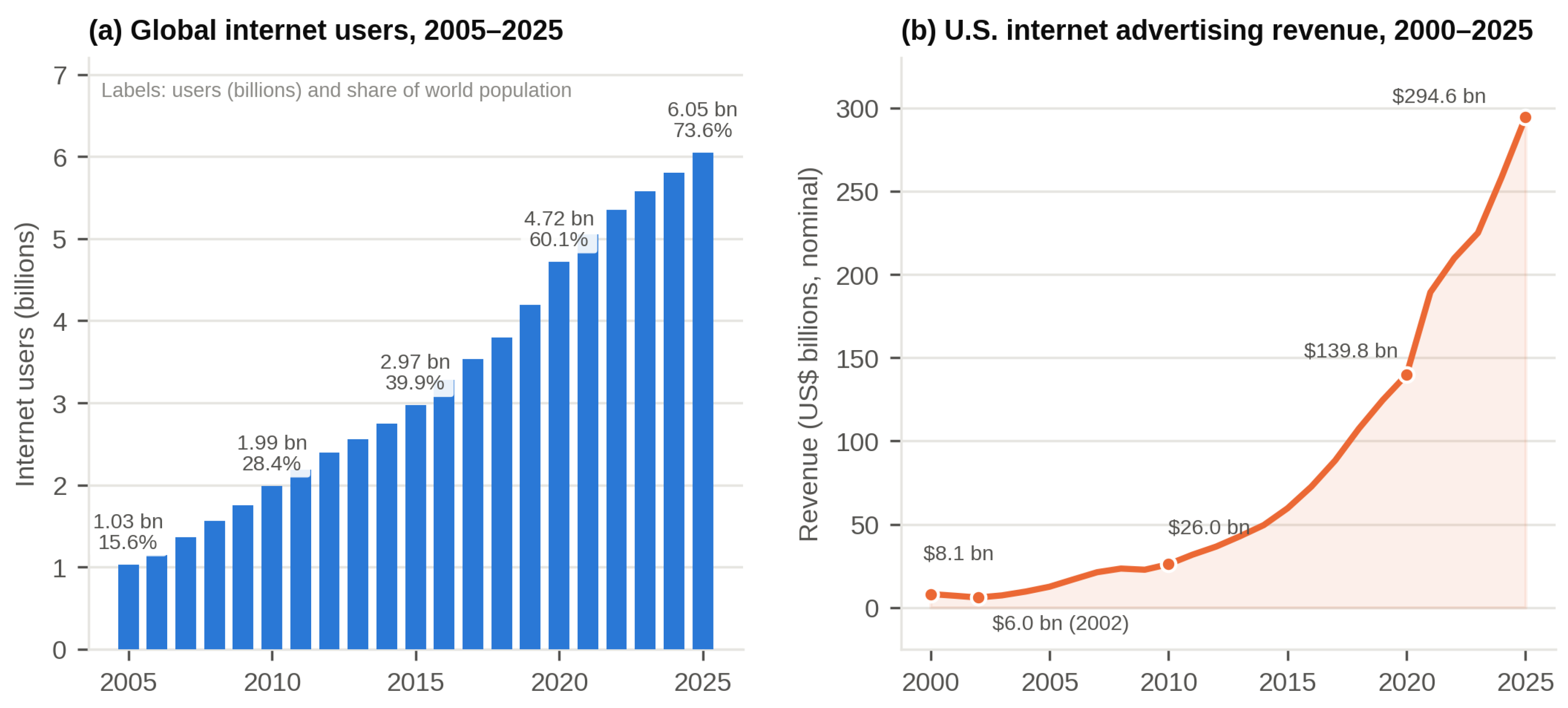
Figure 2.
From Linear Transmission to Networked, Data-Feedback Communication. Note. The upper panel depicts the one-to-many, linear model of the mass era; the lower panel the many-to-many, recursive model of the digital era, in which platforms mediate visibility and a continuous data loop re-programs subsequent communication. Diagram constructed by the author, drawing on Finne and Grönroos (2009), Kietzmann et al. (2011), and Kannan and Li (2017).
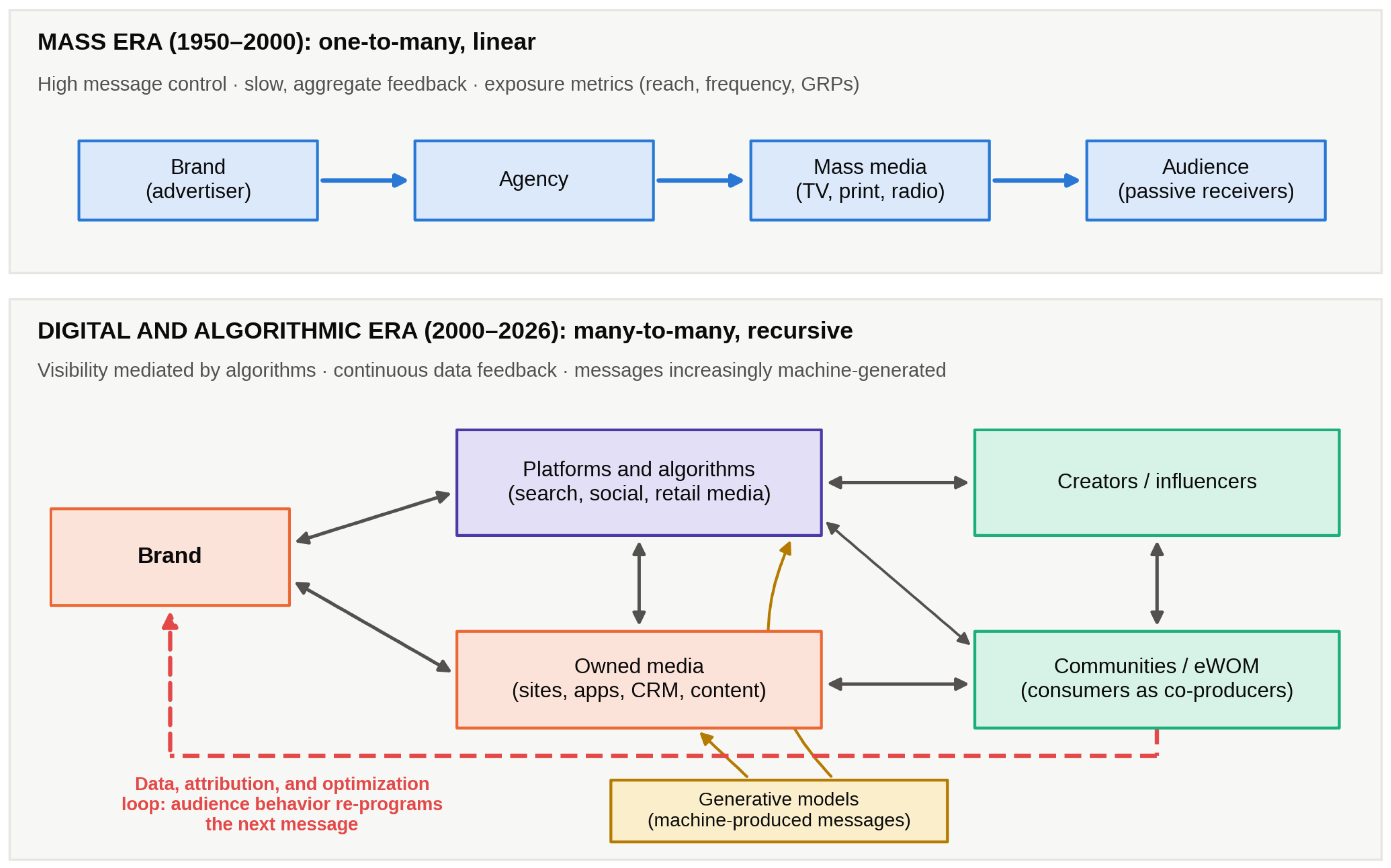
Figure 3.
Convergence of Research Traditions in the Study of Marketing Communication Effectiveness. Note. The three traditions differ in unit of analysis, theoretical roots, and methods but converge on the effectiveness question; attention measurement and AI-generated content act as catalytic layers requiring all three. Conceptual model developed by the author; convergence dynamics evidenced by Colicev et al. (2018), Hanssens and Pauwels (2016), Kannan and Li (2017), and Bruns et al. (2025).
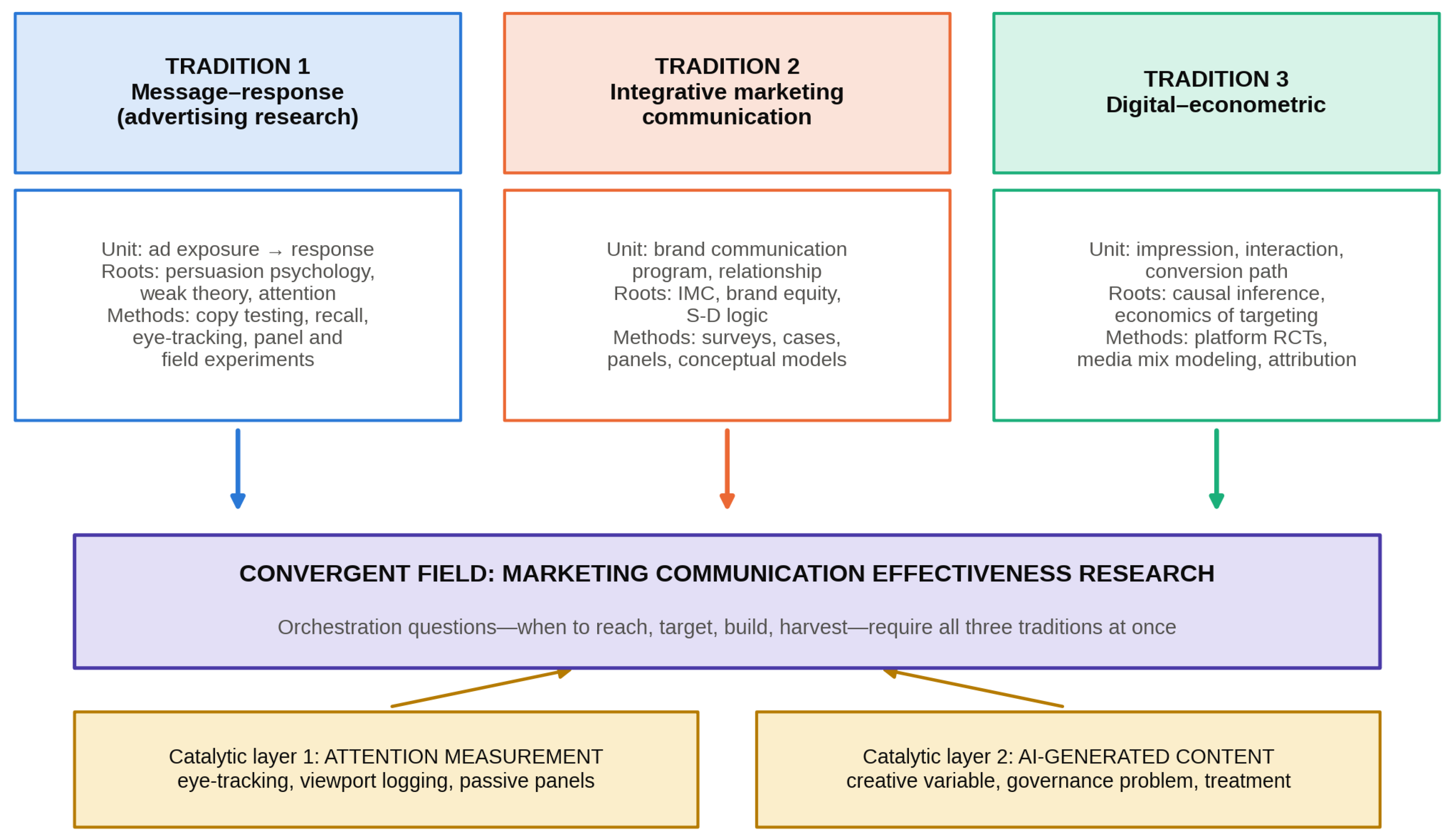
Figure 4.
Where the Programmatic Advertising Dollar Goes: Evidence from Industry Audits, 2020–2023. Note. Panel (a) decomposes each dollar entering a demand-side platform according to the ANA (2023) study of 21 advertisers and 35.5 billion impressions; "media productivity loss" comprises non-viewable, invalid, non-measurable, and made-for-advertising impressions. Panel (b) reports the share of spend reaching publishers and the untraceable "unknown delta" in the two ISBA and PwC (2020, 2023) audits of the U.K. programmatic supply chain. Figure prepared by the author.
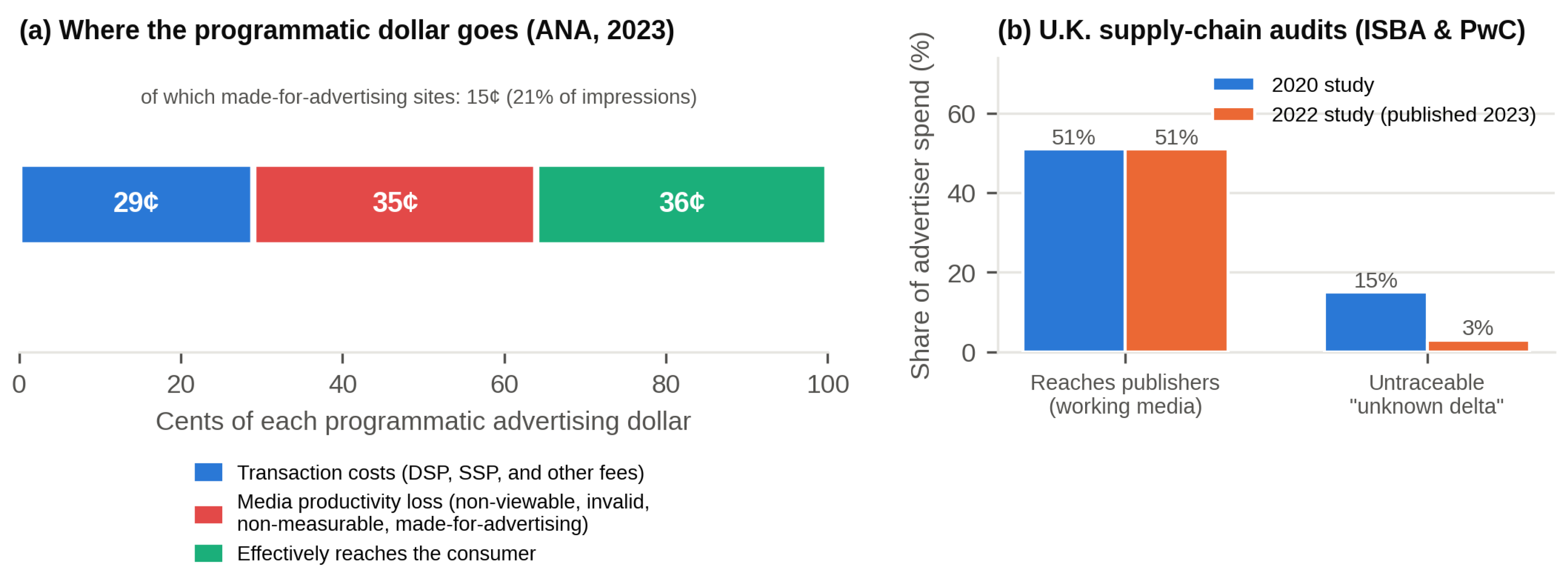
Figure 6.
Research Gap Prioritization Matrix. Note. Programs are positioned by near-term feasibility (vertical axis) and theoretical or societal urgency (horizontal axis), as assessed in Section 10 and Section 11. Framework developed by the author.
Figure 6.
Research Gap Prioritization Matrix. Note. Programs are positioned by near-term feasibility (vertical axis) and theoretical or societal urgency (horizontal axis), as assessed in Section 10 and Section 11. Framework developed by the author.
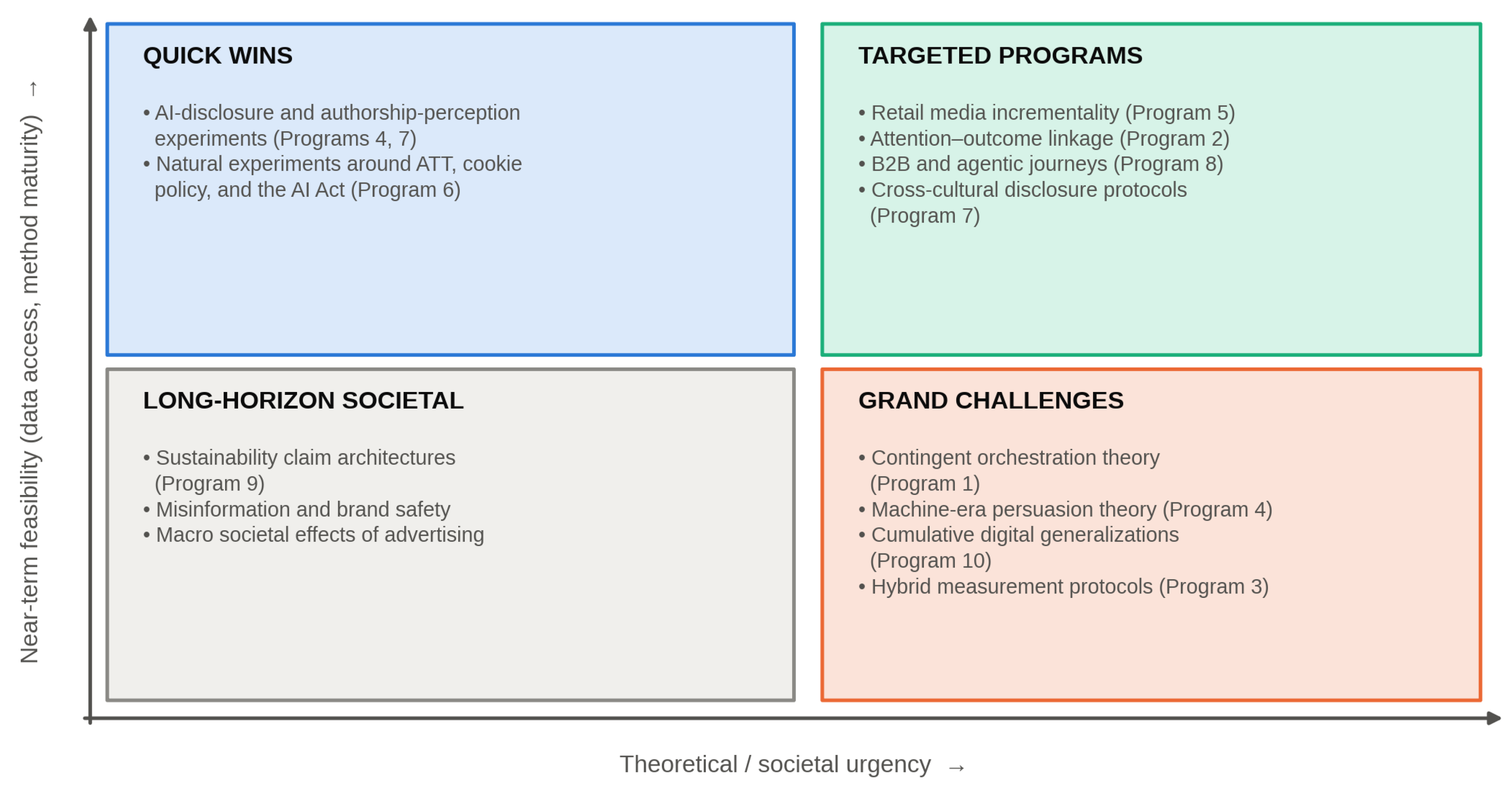

Table 1.
Evolutionary Stages of Marketing Communication as a Discipline, 1900–2026.
| Stage (approx. period) | Dominant paradigm | Principal tools and media | Theoretical anchors | Representative works |
| Craft and professionalization (1900–1950) | "Salesmanship in print"; testing and accountability | Print, radio, early agencies | Response psychology; hard/soft sell | Hopkins (1923); Starch (1914); founding of the AMA (1937) and the Journal of Marketing (1936) |
| Mass media and mix era (1950–1980) | Promotion as one P of the four Ps; brand image | Television, national print | Hierarchy of effects; positioning; diffusion; elaboration likelihood | Borden (1964); McCarthy (1960); Kotler (1967); Lavidge & Steiner (1961); Ries & Trout (1981); Petty & Cacioppo (1986) |
| Fragmentation and IMC era (1980–2000) | Integration across tools; outside-in planning; brand equity | Database/direct marketing, sales promotion, PR, cable TV | IMC; customer-based brand equity; relationship marketing | Schultz et al. (1993); Aaker (1991); Keller (1993); Grönroos (1994); Duncan & Moriarty (1998) |
| Digital–network era (2000–2015) | Interactive, dialogic, social; paid–owned–earned media | Search, social media, mobile, e-commerce, eWOM | Service-dominant logic; social media frameworks; customer journey | Vargo & Lusch (2004); Hennig-Thurau et al. (2004); Kietzmann et al. (2011); Lamberton & Stephen (2016); Lemon & Verhoef (2016) |
| Algorithmic era (2015–2022) | Data-driven orchestration; personalization at scale; creator content | Programmatic, retail media, CTV, influencers | Algorithmic marketing; trust and privacy theory; AI capability frameworks | Kannan & Li (2017); Davenport et al. (2020); Huang & Rust (2021); Hudders et al. (2021); Dwivedi et al. (2021) |
| Generative–agentic era (2022–2026) | Machine-generated and machine-mediated persuasion; signal loss; disclosure regulation | Generative creative, LLM-based search and ad copy, AI agents, answer engines | Generative AI frameworks; algorithmic source perception; persuasion knowledge for AI | Peres et al. (2023); Kshetri et al. (2024); Hermann & Puntoni (2024); Hartmann et al. (2025); Kim (2025); Wu (2026) |
Note. Stage boundaries are analytical rather than sharp; tools and theories overlap across stages. Compiled by the author from the sources cited in the final column and from Borden (1964), Schultz et al. (1993), and Kannan and Li (2017). AMA = American Marketing Association; LLM = large language model.
Table 2.
Synthesis of 20 Foundation Studies (2015–2023) Informing the Analysis.
| # | Study (journal) | Domain | Method and data | Core finding (research question addressed) |
| 1 | Batra & Keller (2016), J. of Marketing | Integration | Conceptual synthesis | Media differ in communication abilities; sequencing should follow the consumer journey bottom-up (RQ1) |
| 2 | Lemon & Verhoef (2016), J. of Marketing | Integration/journey | Integrative review | Experience accrues across touchpoints, many outside firm control; the journey replaces the campaign as planning unit (RQ1) |
| 3 | Kannan & Li (2017), IJRM | Digital framework | Framework and agenda | Digital technologies transform every marketing-mix interface; attribution and search are pivotal fronts (RQ1, RQ4) |
| 4 | Colicev et al. (2018), J. of Marketing | Media synergy | Panel VAR; 45 brands | Owned and earned social media affect distinct mindset stages and shareholder value differently (RQ1, RQ2) |
| 5 | Gordon et al. (2019), Marketing Science | Effectiveness measurement | 15 Facebook RCTs vs. observational models | Attribution methods systematically overstate causal ad effects (RQ3) |
| 6 | Lewis & Rao (2015), QJE | Effectiveness measurement | Power analysis of 25 ad experiments | Ad effects are so small relative to outcome variance that reliable measurement is often economically infeasible (RQ3) |
| 7 | Blake et al. (2015), Econometrica | Effectiveness measurement | Field experiments at eBay | Brand-keyword paid search showed near-zero incrementality (RQ3) |
| 8 | Shapiro et al. (2021), Econometrica | Empirical generalization | 288 brands; common identification | Median TV advertising elasticity ~0.01; publication bias inflated earlier means (RQ3, RQ4) |
| 9 | de Haan et al. (2016), IJRM | Attribution | Multichannel conversion modeling | Channel types differ sharply in true conversion contribution; naive attribution misallocates (RQ3) |
| 10 | Liaukonyte et al. (2015), Marketing Science | Cross-channel synergy | Minute-level TV and online data | TV advertising causally shifts online search and purchase within minutes (RQ2) |
| 11 | Todri (2022), Marketing Science | Avoidance | Consumer panel; ad-blocker adoption | Ad blockers cut online spending ~1.45% per adopter, harming unfamiliar brands most (RQ1, RQ3) |
| 12 | Johnson et al. (2023), Management Science | Privacy regulation | 27,000+ websites pre/post GDPR | GDPR cut vendor use ~15% but raised ad-tech concentration ~17% (RQ4) |
| 13 | Bleier & Eisenbeiss (2015), J. of Retailing | Personalization | Field and lab experiments | Personalization works only under trust; under low trust it backfires (RQ1) |
| 14 | Boerman et al. (2017), J. of Interactive Marketing | Disclosure | Experiments on sponsored Facebook content | Disclosure activates persuasion knowledge and reduces eWOM intentions (RQ4) |
| 15 | Hudders et al. (2021), Int. J. of Advertising | Influencers | Systematic review | Influencers are simultaneously channel, endorser, and peer (RQ2) |
| 16 | Leung, Gu, Li, et al. (2022), J. of Marketing | Influencers | Engagement-elasticity model; field campaigns | Originality, follower size, and sponsor salience help; activity, fit, and positivity show inverted-U effects (RQ2) |
| 17 | Wies et al. (2023), J. of Marketing | Influencers | 802 Instagram campaigns; eye-tracking; experiments | Inverted-U between follower count and engagement; midsize influencers optimize response (RQ2) |
| 18 | Huang & Rust (2021), JAMS | AI | Strategic framework | AI absorbs mechanical, thinking, then feeling tasks (RQ1, RQ4) |
| 19 | Longoni & Cian (2022), J. of Marketing | AI | Ten experiments | "Word-of-machine" effect: AI trusted for utilitarian, not hedonic, judgments (RQ4) |
| 20 | Vredenburg et al. (2020), JPP&M | Ethics/activism | Conceptual typology | Authentic activism requires alignment of purpose, values, messaging, and practice (RQ4) |
Note. Studies selected by the author from the review corpus described in Section 2; domains map onto the thematic structure of Figure 5. IJRM = International Journal of Research in Marketing; QJE = Quarterly Journal of Economics; JAMS = Journal of the Academy of Marketing Science; JPP&M = Journal of Public Policy & Marketing; RCT = randomized controlled trial.
Table 3.
Synthesis of 16 Recent Studies (2024–2026) Extending the Research Frontier.
| # | Study (journal) | Stream | Method and data | Core finding (research question addressed) |
| 21 | Beichert et al. (2024), J. of Marketing | Influencer economics | 1.88 million purchases; three field studies | Low-followership influencer targeting outperforms high-followership targeting by an order of magnitude on ROI (RQ2) |
| 22 | Miller & Skiera (2024), IJRM | Privacy/signal loss | 54,127 users; 128 million impressions | A one-year cookie-lifetime cap endangers ~€904 million of European display revenue annually (RQ4) |
| 23 | Goldberg et al. (2024), AEJ: Economic Policy | Privacy regulation | 1,084 online firms around GDPR | 12% reduction in recorded EU page views and revenue after enforcement (RQ4) |
| 24 | Hartmann et al. (2025), IJRM | Generative creative | 10,320 synthetic images; 254,400 evaluations; field test | AI images can surpass human-made marketing images; AI banner ads achieved up to 50% higher click-through (RQ1, RQ4) |
| 25 | Kapoor & Kumar (2025), Marketing Science | Generative creative | WhatsApp field experiment | Generative personalized video ads raised engagement by six to nine percentage points (RQ1) |
| 26 | Wernerfelt et al. (2025), Marketing Science | Privacy/signal loss | Randomized experiment; 70,000+ Meta advertisers | Losing offsite tracking data raises median cost per incremental customer by 31%, hurting small advertisers most (RQ3, RQ4) |
| 27 | Ershov et al. (2025), Marketing Science | Influencer disclosure | 100+ million Twitter posts; ML classifier | 96% of sponsored influencer posts are undisclosed (lower bound 82%) (RQ4) |
| 28 | Liang et al. (2025), Marketing Science | Platform measurement | Large-scale RCT on ByteDance | Exposed users were eight times more likely to convert off-platform than on it; spillover shrinks cost per conversion 5–25 times (RQ3) |
| 29 | Yang et al. (2025), Marketing Science | Influencer video | Deep-learning saliency model; TikTok ads; Taobao sales | A pixel-level product-engagement score predicts video-specific sales lift (RQ2, RQ3) |
| 30 | Bruns et al. (2025), J. of Advertising | Attention measurement | Viewport logging vs. mobile eye-tracking | Viewport metrics show high concurrent validity and predict brand recall (RQ3) |
| 31 | Pauwels & Fagbola (2025), J. of Retailing | Retail media | Multi-stakeholder conceptual framework | Retail media pits personalization and reach against privacy, incrementality, and competition concerns (RQ2, RQ4) |
| 32 | Koning & Voorveld (2025), J. of Interactive Advertising | AI disclosure | Between-subjects experiment, N = 304 | AI disclosure raises persuasion knowledge, which lowers trust in the ad and the organization (RQ4) |
| 33 | Aridor et al. (2026), Management Science | Privacy/signal loss | Advertiser spending, performance, and revenue data around ATT | Conversion-optimized Meta ads lost 37% of click-through; Meta-dependent firms lost 8–40% of revenue (RQ3, RQ4) |
| 34 | Baek et al. (2026), Int. J. of Advertising | AI disclosure | Three experiments; prosocial advertising | Disclosing AI-generated content lowers ad attitudes and donation intentions via credibility (RQ4) |
| 35 | Chu et al. (2026), J. of Advertising Research | Virtual influencers | Meta-analysis of 46 experiments | Virtual influencers are less persuasive than humans on attitudes but comparable on intentions and behavior (RQ2) |
| 36 | Reisenbichler et al. (2026), Marketing Science | Generative search | Human-in-the-loop LLM ad generation; two settings | LLM-generated search ads outperform human- and standard-LLM-written ads on clicks, at higher cost per click (RQ1, RQ3) |
Note. Studies selected by the author using the criteria in Section 2; year reflects the dated issue. AEJ = American Economic Journal; IJRM = International Journal of Research in Marketing; ATT = App Tracking Transparency; ML = machine learning; LLM = large language model; RCT = randomized controlled trial.
Table 4.
Key Indicators of the Digital Transformation of Marketing Communication, 2000–2026.
| Indicator | 2000–2005 | 2010 | 2020–2021 | Latest (2025–2026) | Source |
| Global internet users (billions; % of population) | 1.03 (15.6%) in 2005 | 1.99 (28.4%) | 4.72 (60.1%) in 2020 | 6.05 (73.6%) in 2025 | World Bank (2026); Our World in Data (2026) |
| Social media user identities (billions; % of population) | — | — | 5.04 (62.3%) in Jan. 2024 | 5.79 (69.9%) in Apr. 2026 | Kemp (2024, 2026) |
| U.S. internet advertising revenue (US$ billions) | 8.1 in 2000 | 26.0 | 139.8 in 2020 | 294.6 in 2025 (+13.9%) | IAB (2011, 2026) |
| Global advertising revenue (US$ trillions) | — | — | — | 1.14 in 2025; ~1.3 forecast for 2026 | WPP Media (2025b, 2026) |
| Pure-play digital share of global ad revenue | — | — | — | 73.2% in 2025 | WPP Media (2025a) |
| Commerce (retail) media vs. television, global (US$ billions) | — | — | — | 178.2 vs. 167.5 in 2025 | WPP Media (2025b) |
| U.S. programmatic transactions (US$ billions; share of display) | — | — | 90% of display in 2023 | 162.4 in 2025 (+20.5%) | eMarketer (2023); IAB (2026) |
| U.S. creator advertising spend (US$ billions) | — | — | — | 37 in 2025; 44 forecast for 2026 | IAB (2026) |
| Advertiser losses to ad fraud (US$ billions) | — | — | — | 84 in 2023; 172 projected for 2028 | Juniper Research (2023) |
| Share of programmatic dollar reaching consumers | — | — | — | 36 cents (2022–2023 audit) | ANA (2023) |
| Cumulative GDPR fines (number; € billions) | — | — | — | 2,685 fines; €6.11 billion to Mar. 2026 | CMS (2026) |
| Organizations regularly using AI in at least one function | — | — | — | Nearly nine in ten (2026) | McKinsey & Company (2026) |
| ChatGPT users (millions) | — | — | 100 monthly within two months of launch (Jan. 2023) | 900 weekly (Feb. 2026) | Hu (2023); Malik (2026) |
Note. Compiled by the author from the cited sources; figures are the latest published estimates and are subject to revision. Dashes indicate that no harmonized figure is available for that period. Social media identities may not correspond to unique individuals (Kemp, 2024). ANA = Association of National Advertisers.
Table 5.
The PESO Media Framework in Marketing Communication.
| Dimension | Paid media | Owned media | Earned media | Shared media |
| Definition | Reach purchased from third parties | Brand-controlled channels | Third-party coverage and endorsement, unpaid | Brand presence in consumer-shared social spaces |
| Examples | TV, display, search ads, retail media, sponsorships | Websites, apps, email/CRM, brand content | Press coverage, reviews, eWOM, organic user-generated content | Brand profiles and interactions on social platforms |
| Message control | High | High | Low | Low to moderate |
| Cost profile | High, continuous | Moderate, capitalized | Low direct cost, high coordination cost | Low direct cost, high labor cost |
| Credibility/trust | Lower (commercial intent) | Moderate | High (Nielsen, 2021) | Variable, community-dependent |
| Primary metrics | Reach, GRPs, CPM, ROAS | Traffic, engagement, CRM outcomes | Sentiment, share of voice, eWOM valence | Followers, engagement rate, community growth |
Note. PESO taxonomy attributed to Dietrich (2014); comparative dimensions compiled by the author from Dietrich (2014), Colicev et al. (2018), and Kannan and Li (2017). GRPs = gross rating points; CPM = cost per thousand impressions; ROAS = return on advertising spend; CRM = customer relationship management.
Table 6.
Advertising Relative to Other Marketing Communication Instruments in the Digital Era.
| Dimension | Advertising (incl. digital display/CTV) | Public relations/earned | Sales promotion | Direct/CRM | Influencer/shared | Performance and retail media |
| Message control | High | Low (editorial dependence) | High | High (permissive consent) | Low to moderate | High |
| Credibility source | Brand, repetition, creativity | Third-party endorsement (Nielsen, 2021) | Tangible offer | Relevance, permission | Parasocial authenticity (Hudders et al., 2021) | Intent relevance; closed-loop data |
| Time horizon of effect | Long-term brand building | Medium to long | Short-term activation | Short to medium, cumulative | Short to medium, hybrid | Immediate |
| Typical metrics | Reach, GRPs, brand tracking | Share of voice, sentiment | Redemption, uplift | CLV, retention, conversion | Engagement, revenue per endorsement (Beichert et al., 2024) | ROAS, CAC, incrementality |
| Strategic function | Equity anchoring; narrative | Legitimacy; credibility transfer | Behavioral nudging; trial | Relationship management | Cultural relevance; peer persuasion | Conversion harvesting; retailer gatekeeping (Pauwels & Fagbola, 2025) |
Note. Comparative synthesis by the author, drawing on Belch and Belch (2021), Pickton and Broderick (2005), Binet and Field (2013), Hudders et al. (2021), and the sources cited in the cells. CTV = connected television; CLV = customer lifetime value; CAC = customer acquisition cost.
Table 7.
Comparative Overview of Three Research Traditions Bearing on Marketing Communication.
| Dimension | Message–response tradition (advertising research) | Integrative marketing communication tradition | Digital–econometric tradition |
| Primary unit of analysis | Advertisement, exposure, campaign | Brand communication program; brand–stakeholder relationship | Impression, interaction, session, conversion path |
| Dominant theoretical roots | Persuasion psychology (ELM); weak theory; attention (Ehrenberg, 1974/2000; Petty & Cacioppo, 1986; Pieters & Wedel, 2004) | IMC; customer-based brand equity; relationship marketing; S-D logic (Keller, 1993; Schultz et al., 1993; Vargo & Lusch, 2004) | Causal inference; industrial organization; economics of targeting (Goldfarb & Tucker, 2011; Kannan & Li, 2017) |
| Canonical methods | Copy testing; recognition/recall; eye-tracking; panel and field experiments; econometrics (Assmus et al., 1984; Lodish et al., 1995; Segijn, 2025) | Manager surveys; consumer panels; case research; conceptual modeling (Cornelissen, 2003; Porcu et al., 2017) | Platform RCTs; media mix modeling; multi-touch attribution (Gordon et al., 2019; Li & Kannan, 2014) |
| Characteristic metrics | Recall, recognition, attitude toward the ad, attention, elasticities | Integration, brand equity, relationship quality | CTR, ROAS, incrementality, CAC |
| Institutional homes | JAR, Journal of Advertising, IJA, ARF | JMC, EJM, JIM, marketing communication textbooks | Marketing Science, IJRM, Management Science, platform research units |
| Principal blind spots | Other communication tools; integration; relationships | Causal identification; attention; exposure mechanics | Long-term brand effects; creative content; societal effects; off-platform spillover (Liang et al., 2025) |
Note. Typology was constructed by the author through thematic synthesis of the reviewed literature (Braun & Clarke, 2006). ELM = elaboration likelihood model; S-D = service-dominant; RCT = randomized controlled trial; CTR = click-through rate; ARF = Advertising Research Foundation.
Table 8.
Effectiveness Measurement Approaches in Marketing Communication Practice.
| Approach | Principal era of origin | Unit of analysis | Key strength | Key limitation | Digital-era status (2026) |
| Copy testing (recognition/recall) | 1930s–1940s (Starch; Gallup lineage) | Individual advertisement | Pre-launch diagnostics; construct validity for attention and recall | Weak sales linkage; recall artifacts | Automated, AI-scored pre-testing; generative variants tested at scale (Hartmann et al., 2025) |
| Brand tracking | 1950s–present | Brand | Longitudinal equity monitoring | Slow, aggregate; attribution ambiguity | Hybridized with digital signals |
| Split-cable/single-source panels | 1960s–1990s | Household | Causal purchase linkage (Lodish et al., 1995) | Cost; panel decline | Revival via addressable-TV and location panels (Luo & Ranjan, 2025) |
| Media mix modeling | 1980s–present (Broadbent, 1979) | Brand/category time series | Captures carryover and offline effects; privacy-proof | Stationarity assumptions; granularity limits | Renaissance after ATT and cookie retention (Chavez, 2025a; Johnson et al., 2022) |
| Multi-touch attribution | 2000s–present | User-level conversion path | Granular, near-real-time optimization | Selection bias and endogeneity (de Haan et al., 2016; Li & Kannan, 2014); signal loss | Degrading; giving way to incrementality |
| Platform field experiments/incrementality | 2010s–present | Impression/user | Causal gold standard at scale (Gordon et al., 2019) | Cost (Lewis & Rao, 2015); platform dependence; off-platform spillover (Liang et al., 2025) | Growing standard among sophisticated advertisers |
| Attention measurement | Academic 2000s; industry 2020s | Exposure moment | Bridges exposure and processing; pre-behavioral signal (Pieters & Wedel, 2004) | Outcome linkage immature; standards nascent | Institutionalizing; viewport logging validated (Bruns et al., 2025) |
Note. Compiled by the author from the sources indicated. ATT = App Tracking Transparency.
Table 9.
Consolidated Taxonomy of Gaps in Marketing Communication Research.
| Gap domain | Representative symptoms | Root cause | Illustrative under-researched questions | Priority |
| Theoretical | No cumulative digital-era generalizations comparable to mass-era elasticity and adstock findings (Assmus et al., 1984; Sethuraman et al., 2011); IMC underspecified (Cornelissen, 2003); sender–receiver models assume controllable delivery and human authorship | Fragmentation of traditions; construct inflation | When does consistency build versus erode effectiveness? How should persuasion models be re-specified when the sender is an algorithm or agent (Wu, 2026)? How does attention allocation (Pieters & Wedel, 2004) integrate with journey models? | High |
| Measurement/effectiveness | Attribution overstates effects (Gordon et al., 2019, 2023); platform-bounded measurement misses off-platform spillover (Liang et al., 2025); "engagement" lacks construct validity (Calder et al., 2009); attention–sales linkage immature; historical elasticities inflated by publication selection (Shapiro et al., 2021) | Proprietary data enclosure; method silos; signal loss | Which hybrid designs (RCT + MMM + attention) yield decision-grade estimates? How do attention metrics map onto brand and sales outcomes? | High |
| Methodological | Dominance of cross-sectional surveys and single-message experiments; endogeneity in attribution (de Haan et al., 2016; Li & Kannan, 2014); scarce replications; AI-disclosure evidence rests on single-country online samples | Incentive structures; data access | How do multi-touchpoint effects accumulate over customer lifetimes? Can preregistered field-experiment consortia become routine? | High |
| Technological | Generative persuasion lacks validated theory despite strong effect evidence (Hartmann et al., 2025; Kapoor & Kumar, 2025); retail media barely theorized (Pauwels & Fagbola, 2025); agentic advertising and generative search unstudied empirically (Kim, 2025) | Speed of change; platform dependence | How do consumers calibrate credibility under uncertain authorship? What are the welfare effects of retail media gatekeeping? How is advertising conducted when the audience is an AI agent? | High |
| Contextual | WEIRD and B2C concentration; B2B, SME, nonprofit, and emerging-market communication under-theorized (Dwivedi et al., 2021); most platform evidence from the United States and China | Sample convenience; theoretical importation from Anglo-American agency structures | Do integration, influencer, and AI-disclosure paradigms transfer to B2B and emerging-market social commerce? | Medium–high |
| Ethical/societal | Privacy paradox unexplained (Martin & Murphy, 2017); disclosure rules widely violated (Ershov et al., 2025); dark patterns and MFA funding under-evidenced; greenwashing detection nascent (Lyon & Montgomery, 2015); privacy regulation concentrates markets (Johnson et al., 2023) | Normative–positive separation; regulatory flux | Do AI-content markers change persuasion, and for whom? What disclosure architectures minimize deception at acceptable cost? How should privacy and competition rules be designed jointly? | High |
| Translational | Practitioners rely on trade and platform sources over peer-reviewed research (Nyilasy & Reid, 2007); findings fail to diffuse; training budgets shrinking (Moorman, 2026) | Epistemic asymmetry; format mismatch | What boundary-spanning vehicles (data trusts, registered reports, synthesis journals) close the practice gap? | Medium–high |
Note. Taxonomy developed by the author through thematic synthesis (Braun & Clarke, 2006). RCT = randomized controlled trial; MMM = media mix modeling; MFA = made-for-advertising.
Table 10.
Prioritized Recommendations for Future Studies in Marketing Communication.
| Priority | Research program | Core research questions | Suggested design and data | Expected contribution |
| 1 | Contingent theory of orchestration | Under what category, channel, and cultural conditions does message consistency outperform adaptive heterogeneity? | Multilevel modeling of campaign archives; IPA-style databank extension (Batra & Keller, 2016; Binet & Field, 2013) | Mid-range theory replacing IMC's uniformity assumption (Cornelissen, 2003) |
| 2 | Attention–outcome linkage | How do measured attention quantities map to recall, salience, and sales across media? | Single-source panels combining viewport logging and eye-tracking with purchase data (Bruns et al., 2025; Pieters & Wedel, 2004) | New empirical generalizations; attention-based planning |
| 3 | Hybrid measurement protocols | Which triangulation architectures (RCT + MMM + tracking + attention) yield decision-grade estimates, including off-platform spillover? | Industry–academic consortia running parallel designs on common campaigns (Gordon et al., 2019, 2023; Liang et al., 2025) | Standards for the measurement trilemma; correction of attribution bias |
| 4 | Machine-era persuasion theory | How do consumers infer authorship, credibility, and intent when content is machine-generated, and how do mandated AI labels change persuasion? | Factorial and field experiments varying AI authorship, disclosure, appeal type, and brand personality across cultures (Baek et al., 2026; Gu et al., 2026; Koning & Voorveld, 2025; Longoni & Cian, 2022) | Positive theory of algorithmic source perception; ethics-by-design inputs for AI Act compliance |
| 5 | Retail media economics | What are the incremental sales, competition, and welfare effects of retail media advertising? | Field experiments with retailers; econometric models of gatekeeping power (Long et al., 2022; Pauwels & Fagbola, 2025; Thomas et al., 2025) | First-order theory of the channel now larger than television |
| 6 | Personalization under privacy attenuation | How do targeting effectiveness and consumer trust evolve as identifiers degrade, and what are the competitive side effects of privacy regulation? | Natural experiments around ATT, GDPR, and cookie policy; longitudinal trust experiments (Aridor et al., 2026; Johnson et al., 2023; Miller & Skiera, 2024; Wernerfelt et al., 2025) | Boundary conditions for the personalization–privacy paradox; joint privacy–competition policy design |
| 7 | Cross-cultural disclosure effects | Do influencer and AI disclosure effects replicate across cultures and regulatory regimes, and why is compliance so low? | Cross-country preregistered replication network; computational audits of disclosure (Boerman et al., 2017; Ershov et al., 2025; Evans et al., 2017) | Robust evidence beyond WEIRD samples, including Gulf and emerging markets |
| 8 | B2B and agentic digital communication | How do integration and journey constructs operate in multi-stakeholder B2B processes, and how is communication conducted when buyers delegate search to AI agents? | Comparative case research and multilevel surveys in B2B settings; experiments with answer engines (Dwivedi et al., 2021; Kim, 2025; Wu, 2026) | Contextual correction of B2C-centric theory; first evidence on agentic advertising |
| 9 | Sustainability claim architectures | Which claim formats resist greenwashing attribution while retaining persuasiveness? | Computational text analysis of claims plus field tests of consumer response (de Freitas Netto et al., 2020; Lyon & Montgomery, 2015; Vredenburg et al., 2020) | Design principles for credible sustainability communication |
| 10 | Cumulative digital generalizations | What stable effect-size ranges and carryover dynamics characterize digital and generative channels? | Meta-analysis of published and consortium-held digital experiments, extending Assmus et al. (1984) and Sethuraman et al. (2011), with preregistration and publication-bias defenses following Shapiro et al. (2021) | Restored cumulation; a Cochrane-style evidence repository |
Note. Agenda compiled by the author; priority reflects the joint assessment in Figure 6. RCT = randomized controlled trial; MMM = media mix modeling; ATT = App Tracking Transparency.
Disclaimer/Publisher’s Note: The statements, opinions and data contained in all publications are solely those of the individual author(s) and contributor(s) and not of MDPI and/or the editor(s). MDPI and/or the editor(s) disclaim responsibility for any injury to people or property resulting from any ideas, methods, instructions or products referred to in the content. |
© 2026 by the authors. Licensee MDPI, Basel, Switzerland. This article is an open access article distributed under the terms and conditions of the Creative Commons Attribution (CC BY) license (http://creativecommons.org/licenses/by/4.0/).
Copyright: This open access article is published under a Creative Commons CC BY 4.0 license, which permit the free download, distribution, and reuse, provided that the author and preprint are cited in any reuse.