
Submitted:
12 September 2026
Posted:
14 September 2026
You are already at the latest version
Abstract
Background: Women constitute a growing yet underrecognized segment of the informal automobile repair sector in sub-Saharan Africa (SSA), entering male-dominated technical trades amid economic necessity and limited formal employment opportunities. These female artisans face compounded occupational health risks from chemical exposures, physical hazards, and gender-based discrimination, yet remain largely invisible in occupational health research and policy frameworks. This synthesis examines the epidemiology, hazard profile, reproductive health implications, and structural determinants of health among female automobile artisans in SSA. Methods: We conducted a narrative synthesis of peer-reviewed literature retrieved from Scopus, PubMed and Google Scholar databases. Search terms combined concepts of informal sector employment, automobile repair trades, occupational health hazards, gender, reproductive health, and SSA contexts. Inclusion criteria prioritized empirical studies, systematic reviews, and policy analyses addressing female participation in automobile trades, occupational exposures in informal automotive workshops, and gender dimensions of informal sector work. Quality appraisal emphasized methodological rigor, sample representativeness, and relevance to the synthesis objectives. Thematic synthesis organized findings across nine domains: epidemiology, hazard characterization, personal protective equipment access, reproductive health, psychosocial stressors, economic precarity, empowerment pathways, regulatory frameworks, and Sustainable Development Goal (SDG) alignment. Results: Female participation in automobile trades remains marginal across SSA, with women concentrated in lower-skill, lower-income activities and systematically excluded from technical apprenticeships and trade leadership. Occupational hazard profiles include lead exposure exceeding biological exposure indices, organic solvents with documented reproductive toxicity, polycyclic aromatic hydrocarbons, particulate matter, ergonomic stressors, thermal extremes, and traumatic injuries. Personal protective equipment remains scarce, gender-inappropriate in sizing and design, and underutilized due to cost barriers and workplace norms. Reproductive health implications are severe: lead crosses the placenta, solvents disrupt endocrine function, and absence of maternity protection forces women to work through pregnancy without accommodation. Psychosocial stressors include pervasive sexual harassment, workplace hostility, gender-based stigma, and the double burden of domestic and professional labor. Economic precarity traps women in poverty, with lower earnings than male counterparts, limited credit access, and intersecting vulnerabilities related to education, marital status, and geographic location. Regulatory frameworks systematically exclude informal workers from occupational health and safety legislation, labor protections, and social security. Despite explicit commitments under SDGs 3, 5, 8, and 10, evidence-policy gaps remain vast. Conclusions: Female automobile artisans in SSA face a syndemic of occupational health hazards, reproductive risks, gender-based violence, and structural exclusion. Addressing this crisis requires gender-responsive occupational health interventions, enforcement of labor protections in the informal economy, maternity safeguards, skills training pathways, and deliberate efforts to dismantle gender-based barriers in technical trades. Research priorities include prospective cohort studies of reproductive outcomes, biomonitoring of chemical exposures, intervention trials of gender-appropriate personal protective equipment, and participatory action research centering women's voices and agency.
Keywords:
informal sector
; automobile artisans
; occupational health
; gender equity
; reproductive health
; sub-Saharan Africa
; lead exposure
; Sustainable Development Goals
1. Introduction
The informal economy employs more than 85 percent of the workforce in SSA, serving as the primary source of livelihood for millions who lack access to formal sector opportunities[1,2]. Within this vast and heterogeneous sector, automobile repair and maintenance trades represent a significant economic activity, concentrated in urban and peri-urban mechanic villages, roadside workshops, and informal industrial clusters [3,4]. These workshops service the region's aging vehicle fleet, provide affordable repair services to low-income populations, and generate employment for artisans who acquire skills through informal apprenticeships rather than formal technical and vocational education and training institutions [5,6].
Women's participation in automobile trades has historically been minimal, constrained by deeply entrenched gender norms that construct mechanical work as inherently masculine [7,8]. Across SSA, technical trades remain sites of occupational gender segregation, where women are systematically channeled into traditionally feminine occupations such as hairdressing, tailoring, and food vending, while men dominate carpentry, welding, electrical work, and automobile repair [5,9,10]. This segregation is not merely a reflection of individual preferences but is actively produced and reproduced through discriminatory apprenticeship systems, exclusionary trade associations, workplace harassment, and societal stigma that questions women's technical competence and physical capacity [7,8,11].
Yet economic necessity, household poverty, and the erosion of traditional livelihoods have driven a small but growing number of women into male-dominated trades, including automobile repair [1,10,12]. These women enter the sector as apprentices, assistants, or independent operators, often after exhausting other income-generating options or following family connections to the trade [10]. Their presence challenges gender stereotypes and opens new economic pathways, but it also exposes them to a compounded burden of occupational health hazards and gender-based vulnerabilities that remain poorly documented and inadequately addressed in occupational health research and policy [13,14].
The occupational health risks in informal automobile workshops are well established for male workers. Artisans face chronic exposure to lead from battery repair, brake lining dust, and leaded paint [15,16,17]. They inhale organic solvents from degreasers, paints, and adhesives [18,19]. They are exposed to polycyclic aromatic hydrocarbons from engine exhaust and used oils, particulate matter from welding and grinding, and physical hazards including noise, heat, vibration, and traumatic injuries [20,21,22]. Blood lead levels among informal automobile artisans in Kenya, for example, have been documented at mean concentrations of 25.36 micrograms per deciliter, significantly exceeding the World Health Organization biological exposure index of 20 micrograms per deciliter and associated with impaired renal and hepatic function [15].
For women, these occupational exposures carry additional reproductive and maternal health implications. Lead crosses the placenta and is associated with spontaneous abortion, preterm birth, low birth weight, and neurodevelopmental impairment in offspring [23,24]. Organic solvents disrupt endocrine function, impair fertility, and increase risks of congenital malformations [1,16,25,26]. Yet women in informal automobile trades work without maternity protection, prenatal occupational health surveillance, or workplace accommodations during pregnancy [2,5,27]. They face the double burden of occupational exposure and domestic reproductive labor, often continuing hazardous work through pregnancy due to economic necessity and absence of social protection [2,27,28].
Beyond chemical and physical hazards, female automobile artisans confront pervasive gender-based discrimination, sexual harassment, and workplace hostility [10,12,29,30]. They are paid less than male counterparts for equivalent work, excluded from trade leadership and decision-making, and subjected to stigma that questions their femininity and moral character [7,10,12]. These psychosocial stressors compound occupational health risks, contributing to mental health burdens that remain unmeasured in existing research [31,32].
The SDGs adopted by United Nations member states in 2015 include explicit commitments to gender equality, decent work, and health for all. SDG 5 calls for ending all forms of discrimination against women and ensuring women's full and effective participation in economic life [33,34]. SDG 8, Target 8.8, commits to protecting labor rights and promoting safe and secure working environments for all workers, including those in informal employment [1]. SDG 3 aims to ensure healthy lives and promote well-being for all at all ages, with specific attention to reproductive, maternal, and child health [5]. Yet the evidence-policy gap remains vast. Informal sector workers, and particularly women in male-dominated informal trades, remain systematically excluded from occupational health and safety legislation, labor protections, and social security systems [2,35,36].
This narrative synthesis addresses this gap by systematically examining the occupational health, reproductive risks, and structural determinants of health among female automobile artisans in SSA. Our objectives are threefold: first, to characterize the epidemiology of female participation in automobile trades and the occupational hazard profile to which these women are exposed; second, to synthesize evidence on reproductive health implications, psychosocial stressors, and economic precarity; and third, to assess the alignment between international commitments under the SDGs and the lived realities of female automobile artisans, identifying evidence-policy gaps and pathways for intervention.
2. Materials and Methods
2.1. Narrative Synthesis Methodology
We employed narrative synthesis as our methodological approach, appropriate for integrating heterogeneous evidence from diverse study designs, geographic contexts, and disciplinary perspectives [37]. Narrative synthesis allows thematic organization of findings, identification of patterns and contradictions across studies, and generation of policy-relevant insights from a complex and fragmented evidence base [37].
2.2. Search Strategy and Databases
We conducted systematic searches across three major databases: Scopus, Web of Science, PubMed, and Google Scholar. Search terms combined concepts related to informal sector employment, automobile repair trades, occupational health hazards, gender, reproductive health, and SSA contexts. Specific search strings included combinations of the following terms:
Population and setting: "informal sector," "informal economy," "automobile artisans," "auto mechanics," "vehicle repair," "garage workers," "jua kali," "mechanic village," "sub-Saharan Africa," "Nigeria," "Ghana," "Kenya," "South Africa," "Tanzania," "Zimbabwe," "Ethiopia"
Gender and women: "women," "female," "gender," "women's empowerment," "gender discrimination," "male-dominated trades," "occupational segregation"
Occupational health: "occupational health," "occupational hazards," "occupational exposure," "lead exposure," "solvents," "chemical exposure," "personal protective equipment," "PPE," "workplace safety," "injuries," "ergonomic hazards"
Reproductive health: "reproductive health," "maternal health," "pregnancy outcomes," "fertility," "birth outcomes," "maternity protection," "prenatal exposure"
Policy and development: "Sustainable Development Goals," "SDG," "decent work," "labor rights," "occupational health and safety legislation," "ILO," "gender equality"
Searches were conducted iteratively, with initial broad searches followed by targeted searches to fill identified gaps. Reference lists of key papers were hand-searched to identify additional relevant studies.
2.3. Inclusion and Exclusion Criteria
Inclusion criteria:
- Empirical studies (quantitative, qualitative, or mixed methods) addressing occupational health, working conditions, or gender dimensions of informal sector work in SSA
- Studies specifically examining automobile repair trades, vehicle maintenance, or related technical occupations
- Systematic reviews, meta-analyses, and policy analyses relevant to informal sector occupational health or gender equity in technical trades
- Studies addressing reproductive health outcomes associated with occupational exposures relevant to automobile trades
- Grey literature including reports from international organizations, government agencies, and non-governmental organizations when providing unique empirical data or policy analysis
Exclusion criteria:
- Studies conducted exclusively outside SSA or low- and middle-income country contexts, unless providing methodological insights or comparative frameworks applicable to the region
- Studies addressing formal sector employment without relevance to informal economy dynamics
- Opinion pieces, editorials, or commentaries without empirical data or systematic evidence synthesis
- Studies published in languages other than English, French, or Portuguese due to resource constraints
2.4. Quality Appraisal
Quality appraisal emphasized methodological rigor, sample representativeness, transparency in data collection and analysis, and relevance to synthesis objectives. For quantitative studies, we assessed sampling strategies, sample size adequacy, measurement validity, and statistical analysis appropriateness. For qualitative studies, we evaluated sampling logic, data collection methods, reflexivity, and analytical depth. For systematic reviews, we assessed search comprehensiveness, inclusion criteria clarity, and synthesis methods. Studies were not excluded based on quality scores alone, but quality considerations informed the weight given to findings in synthesis and interpretation.
2.5. Data Extraction and Synthesis Framework
Data extraction captured study characteristics including country, study design, population, sample size, gender composition, occupational exposures measured or reported, health outcomes, and key findings. Thematic synthesis organized findings across nine pre-specified domains aligned with synthesis objectives:
- Epidemiology of female participation in automobile trades
- Occupational hazard profile (chemical, physical, ergonomic, biological)
- Personal protective equipment access, suitability, and compliance
- Reproductive and maternal health implications
- Psychosocial stressors, gender-based discrimination, and mental health
- Economic precarity, poverty, and intersectionality
- Leadership, agency, and pathways to women's empowerment
- Regulatory and institutional frameworks
- SDG alignment and evidence-policy gaps
Within each domain, we identified converging evidence, contradictions, geographic patterns, and research gaps. Synthesis prioritized studies with explicit gender analysis, direct measurement of occupational exposures, and documentation of health outcomes.
AI tools were used to refine outlines, graphics (schematic diagrams and figures), and English language.
3. Results
The characteristics and key findings of the included studies are summarized in Table 1.
3.1. Epidemiology of Female Participation
Female participation in automobile repair trades across SSA remains marginal, with women constituting a small minority of the workforce in this male-dominated sector. Precise prevalence estimates are scarce due to the informal and unregistered nature of the work, but available evidence suggests women represent less than 5 percent of automobile artisans in most contexts [5,7,10].
In Ghana, a study of gender-role stereotyping among auto-artisans documented near-total male dominance, with women's presence in workshops limited to administrative roles, food vending, or cleaning rather than technical repair work [7]. Similarly, in Nigeria, women's participation in vehicle maintenance artisanship is described as minimal, with women concentrated in peripheral activities rather than core mechanical tasks [1,38]. In Kenya, studies of informal automobile repair artisans in Nakuru Town included no female participants, reflecting the gender composition of the sector [15,16].
Where women do enter automobile trades, they face systematic channeling into lower-skill, lower-income activities. A study of women in car washes in Abidjan, Côte d'Ivoire, documented 229 women employed in this subsector of the automobile industry, performing physically demanding labor under hazardous conditions but excluded from higher-skill mechanical repair work [30]. In South Africa, women in the informal automotive sector are concentrated in parts sales, administrative support, or cleaning, with minimal representation in technical trades [39,40].
The apprenticeship system, which serves as the primary pathway into automobile trades, actively reproduces gender exclusion. A comparative analysis of informal apprenticeship systems across Egypt, Ghana, Malawi, Senegal, Sudan, Tanzania, Tunisia, Zambia, Zimbabwe, and Bangladesh documented pervasive gender bias, with women systematically limited to traditionally feminine trades such as hairdressing, tailoring, and food preparation [5]. Master craftspersons in automobile trades rarely accept female apprentices, citing concerns about physical capacity, workplace propriety, and customer acceptance [5,6,10]. Where women do gain apprenticeship opportunities, they face longer training periods, lower stipends, and greater risk of sexual harassment compared to male apprentices [5,10].
Educational attainment intersects with gender to shape occupational trajectories. In Kenya, analysis of the 1997 Welfare Monitoring Survey documented that women with equivalent education to men were significantly less likely to enter technical trades and more likely to be concentrated in low-skill informal services [41]. In Senegal, 83 percent of working women were found in the informal sector, compared to 50 percent of men, with women disproportionately concentrated in activities requiring lower skills and generating lower incomes [25,42].
Geographic patterns reveal urban concentration of female automobile artisans, with women's participation higher in major cities such as Accra, Lagos, Nairobi, and Johannesburg compared to rural areas [1,12,39]. This urban concentration reflects both greater economic opportunities and somewhat more permissive gender norms in urban settings, though discrimination and exclusion remain pervasive [10,12]. The geographic distribution of the available evidence is shown in Figure 1 (schematic).
Demographic characteristics of female automobile artisans, where documented, reveal women who are predominantly young adults (ages 20–40), have completed primary or secondary education, are often single heads of household or primary breadwinners, and entered the trade due to economic necessity rather than vocational preference [10,12]. Many report prior attempts at other income-generating activities, including petty trading, domestic work, or agriculture, before transitioning to automobile trades [10,12].
Workforce composition data from broader informal sector studies provide context. In Ghana's informal sector, women constituted 32.2 percent of workers across beauticians, garage mechanics, taxi drivers, and head porters, but were concentrated in beautician and head porter roles rather than garage mechanics [20]. In Nigeria, women represent 41 percent of entrepreneurs in the informal sector overall, but their representation in technical trades remains minimal [38].
Trends over time are difficult to assess due to limited longitudinal data, but qualitative evidence suggests slow growth in female participation driven by economic crisis, household poverty, and women's increasing recognition of the income potential in technical trades [10,12]. However, this growth occurs against persistent structural barriers, and women's representation remains far below parity [8,10].
3.2. Occupational Hazard Profile
Female automobile artisans face a complex occupational hazard profile encompassing chemical, physical, ergonomic, and biological exposures. While much of the evidence on hazard characterization comes from studies of predominantly male artisan populations, the exposures documented are equally or more relevant to women due to sex-based differences in toxicokinetics, reproductive vulnerabilities, and typically smaller body size affecting dose-response relationships [43,44,45]. The full range of chemical, physical, ergonomic, biological, psychosocial, and organizational hazards is summarized in Table 2.
3.2.1. Lead Exposure
Lead exposure represents the most extensively documented chemical hazard in informal automobile workshops. Artisans encounter lead through multiple pathways: battery repair and recycling, brake lining dust containing lead compounds, sanding and removal of leaded paint, and welding of lead-containing materials [15,16,17].
Biomonitoring studies in Kenya documented mean blood lead concentrations of 25.36 micrograms per deciliter among informal automobile repair artisans in Nakuru Town, significantly exceeding the World Health Organization biological exposure index of 20 micrograms per deciliter and more than 75 percent higher than control subjects [15]. Artisans had four times the odds of elevated blood lead levels compared to non-exposed controls [16]. These elevated blood lead levels were associated with impaired renal function, evidenced by decreased estimated glomerular filtration rate, and suggested hepatic effects [15].
Environmental monitoring in Kenya revealed airborne lead concentrations ranging from 1.4 to 126.9 micrograms per cubic meter in 56 percent of informal workshop sheds [17]. Welding operations generated airborne lead concentrations of 126.9 and 117.4 micrograms per cubic meter, exceeding the United States Occupational Safety and Health Administration permissible exposure limit time-weighted average of 50 micrograms per cubic meter [17]. Painting activities produced airborne lead concentrations of 56.4 and 53.6 micrograms per cubic meter, also exceeding regulatory limits [17].
Task-based exposure assessment demonstrated that specific activities generate acute high-level exposures. Battery repair, brake servicing, and paint removal were identified as highest-risk tasks [15,17]. Artisans performing these tasks without respiratory protection or adequate ventilation experience direct inhalation of lead-containing dust and fumes [17].
Knowledge gaps regarding lead toxicity are pervasive. The Kenyan study documented limited awareness among informal sector workers about lead exposure sources, health effects, and protective measures [17]. This knowledge deficit, combined with absence of occupational health surveillance, means that lead poisoning often goes unrecognized until symptomatic disease develops [15,16].
3.2.2. Organic Solvents
Organic solvents constitute a major chemical hazard class in automobile workshops, used in degreasers, paint thinners, adhesives, and cleaning agents [18,19]. Common solvents include toluene, xylene, benzene, methyl ethyl ketone, and petroleum distillates [18].
Exposure occurs through inhalation of solvent vapors in poorly ventilated workshops and through dermal contact during parts cleaning, painting, and degreasing operations [18]. Artisans frequently work with bare hands, lacking chemical-resistant gloves, resulting in prolonged skin contact with solvent-containing products [18,22].
Health effects documented among automobile artisans include respiratory irritation, dermatitis, eczema, and neurological symptoms [18]. Chronic solvent exposure is associated with peripheral neuropathy, cognitive impairment, and mood disturbances [18]. For women, solvents pose particular reproductive health risks, discussed in detail in Section 3.4 [1,16,26].
3.2.3. Polycyclic Aromatic Hydrocarbons and Particulate Matter
Polycyclic aromatic hydrocarbons are generated from incomplete combustion of petroleum products, present in engine exhaust, used motor oil, and welding fumes [19]. Artisans experience chronic low-level exposure through inhalation and dermal contact with contaminated oils and surfaces [19].
Particulate matter exposure is pervasive, generated from welding, grinding, sanding, and brake dust [20c,21]. Studies in Ghana documented that 66 percent of informal sector workers, including garage mechanics, reported exposure to dust, and 40 percent reported fume inhalation [20]. Welding operations generate metal fumes containing iron, manganese, chromium, and nickel, in addition to lead [17,21].
Respiratory health effects are common. Studies of automobile artisans in Ghana and Nigeria documented high prevalence of respiratory symptoms, including chronic cough, dyspnea, and chest tightness [18,22,46]. Lung function testing revealed obstructive and restrictive patterns consistent with chronic occupational lung disease [46].
3.2.4. Physical Hazards
Physical hazards in automobile workshops include noise, heat, vibration, and traumatic injury risks [20,21,22].
Noise exposure is pervasive, generated from power tools, hammering, engine testing, and workshop machinery. A study in Ghana documented that 66 percent of informal sector workers reported noise exposure [20]. Prolonged exposure without hearing protection contributes to noise-induced hearing loss, though audiometric data from female artisans are lacking [21].
Heat stress is common, particularly in tropical climates where workshops lack ventilation and artisans work in direct sunlight or near heat-generating equipment [27,47]. Women market traders in Ghana reported heat-related health effects including dehydration and heat rash [27,47]. Similar exposures affect female automobile artisans, compounded by physically demanding work and inadequate hydration access [30].
Vibration exposure occurs through use of power tools, grinders, and impact wrenches. Hand-arm vibration syndrome, characterized by vascular and neurological impairment in the hands and fingers, is a recognized occupational disease among mechanics, though prevalence data from SSA are limited [48].
Traumatic injuries are common. Studies in Ghana documented that 64 percent of vehicle repair artisans sustained work-related injuries, predominantly cuts and burns [22]. In Nigeria, automobile artisans reported injuries ranging from minor cuts to serious trauma requiring medical attention [49,50]. Injury rates are elevated by absence of machine guarding, inadequate tool maintenance, poor housekeeping, and lack of first aid capacity [21,22]. Among artisans who sustained injuries, 74 percent received no compensation, and 55 percent self-medicated rather than seeking formal medical care [22].
3.2.5. Ergonomic Hazards
Ergonomic hazards include awkward postures, repetitive motions, heavy lifting, and prolonged standing or kneeling [20,22,48]. A study in Ghana found that 75 percent of informal sector workers, including garage mechanics, reported poor posture as an occupational hazard [20]. Musculoskeletal disorders are common, with artisans reporting back pain, neck pain, shoulder pain, and knee pain [22,48].
For women, ergonomic hazards are compounded by tools and workstations designed for male body dimensions, requiring women to adopt more awkward postures and exert greater relative force [30,51]. A study of women in car washes in Abidjan documented that equipment weight and design contributed to physical risks [30].
Assessment of ergonomic principles in the informal sector in Zimbabwe revealed poor application of ergonomic design, with workstations lacking adjustability, inadequate seating, and absence of mechanical aids for heavy lifting [48]. These deficits affect all artisans but disproportionately burden women, who face additional expectations to prove physical capability in male-dominated environments [8,10].
3.2.6. Biological Hazards
Biological hazards, while less prominent than chemical and physical hazards, include exposure to rodents, insects, and infectious agents in unsanitary workshop environments [27,32]. Women market traders in Ghana reported exposure to rodents and flies, and concerns about infectious disease transmission from crowded, unsanitary conditions [27]. Similar conditions characterize many informal automobile workshops, particularly in densely populated urban mechanic villages [3].
3.3. PPE Access, Suitability, and Safety Compliance
Personal protective equipment represents a primary control measure for occupational hazards, yet access, suitability, and utilization remain profoundly inadequate among informal automobile artisans, with gender-specific barriers compounding these deficits [18,22,52,53].
3.3.1. Availability and Access
Studies across Ghana, Nigeria, and Kenya document extremely low availability of personal protective equipment in informal automobile workshops [18,22,52,53]. In Ghana, only 27 percent of vehicle repair artisans reported using personal protective equipment [22]. In Nigeria, a study of informal automobile artisans in Osun State found that personal protective equipment use was minimal, with artisans citing cost, unavailability, and lack of employer provision as primary barriers [53].
The informal nature of employment means that artisans are typically responsible for purchasing their own protective equipment, yet low and irregular incomes make this prohibitively expensive [22,53]. Employers, often themselves operating on narrow margins, rarely provide personal protective equipment to workers [18,53]. Regulatory enforcement is absent, removing any compliance incentive [53].
3.3.2. Gender-Specific Fit and Design Barriers
Personal protective equipment is overwhelmingly designed for male body dimensions, creating fit and comfort problems for women that reduce both protection effectiveness and willingness to use equipment [51,54,55]. Gloves designed for male hands are too large for most women, reducing dexterity and increasing risk of hand injuries [51,55]. Coveralls and protective clothing are sized for male bodies, resulting in excess fabric that poses entanglement hazards or inadequate coverage [51,55].
Respiratory protective equipment, including dust masks and respirators, is designed and fit-tested on male facial dimensions. Women's smaller facial dimensions and different facial contours result in poor seal and reduced protection [55]. This problem is compounded for women who wear headscarves for religious or cultural reasons, as standard respirators are incompatible with head coverings [55].
Safety footwear is typically available only in male sizes, forcing women to wear ill-fitting boots that cause blisters, reduce stability, and increase fall risk [55]. Eye protection, including safety glasses and goggles, is similarly designed for male facial dimensions and may not provide adequate coverage or fit for women [55].
These design failures are not merely matters of comfort but represent serious protection deficits. Ill-fitting personal protective equipment provides inadequate protection, and discomfort reduces compliance [54,55]. Yet gender-appropriate personal protective equipment is rarely available in SSA markets, and even where available, cost barriers remain prohibitive [53].
3.3.3. Behavioral and Cultural Barriers to Compliance
Beyond availability and fit, behavioral and cultural factors shape personal protective equipment utilization. Risk perception plays a significant role: a study in Ghana found that perceived occupational risk significantly predicted personal protective equipment utilization among informal auto-artisans [52]. Artisans who perceived their work as hazardous were more likely to use available protective equipment, while those who minimized risks or attributed injuries to fate or divine will were less likely to use protection [52,53].
Workplace norms and peer behavior influence individual compliance. In male-dominated workshops, use of personal protective equipment may be stigmatized as weakness or lack of skill, with experienced artisans demonstrating masculinity through working without protection [53]. Women entering these environments face pressure to conform to prevailing norms, even when those norms are unsafe [8,10].
Knowledge deficits regarding hazard recognition and protective equipment use are pervasive. Studies in Ghana and Kenya documented that artisans lacked training in occupational health and safety, did not recognize many chemical and physical hazards, and did not understand the purpose or proper use of personal protective equipment [17,18,22]. In Ghana, 78 percent of artisans lacked training in fire safety, and 92 percent were ignorant of first aid administration [22].
Heat and discomfort in tropical climates reduce willingness to wear protective equipment, particularly respirators, gloves, and coveralls [18,53]. Artisans report that protective equipment is too hot, restricts movement, and reduces productivity [53]. These concerns are legitimate but reflect the absence of climate-appropriate protective equipment designed for tropical working conditions [53].
3.3.4. Floor Effects in Statistical Analyses
The extremely low baseline utilization of personal protective equipment creates floor effects in statistical analyses, limiting ability to detect associations between personal protective equipment use and health outcomes [53]. When fewer than 30 percent of workers use any protective equipment, and use is sporadic rather than consistent, dose-response relationships are difficult to establish [53]. This methodological challenge has implications for intervention research, as baseline utilization is so low that even modest improvements may appear statistically significant while remaining inadequate for health protection [53].
3.4. Reproductive and Maternal Health Implications
The reproductive and maternal health implications of occupational exposures in automobile trades represent a critical yet profoundly underresearched dimension of women's occupational health in SSA. Chemical exposures documented in automobile workshops, particularly lead and organic solvents, carry well-established reproductive toxicity, yet women work without prenatal surveillance, maternity protection, or workplace accommodations [2,5,27].
3.4.1. Lead Reproductive Toxicity
Lead is a potent reproductive toxicant affecting both female and male reproductive systems. In women, lead disrupts the hypothalamic-pituitary-ovarian axis, impairs folliculogenesis, and is associated with reduced fertility [23,31]. Elevated blood lead levels are associated with longer time to pregnancy, increased risk of spontaneous abortion, and earlier menopause [23].
During pregnancy, lead crosses the placenta freely, with fetal blood lead concentrations approximating maternal levels [23,24]. Prenatal lead exposure is associated with increased risk of preterm birth, low birth weight, and intrauterine growth restriction [23,24]. A systematic review of maternal occupational exposures and adverse pregnancy outcomes identified lead as a consistent risk factor for preterm birth and low birth weight across multiple studies [56].
Neurodevelopmental effects of prenatal lead exposure are well documented. Even low-level prenatal exposure, below current reference levels, is associated with reduced cognitive function, attention deficits, and behavioral problems in children [23]. Lead exposure during pregnancy in Lubumbashi, Democratic Republic of Congo, was associated with preeclampsia, suggesting vascular effects [24].
For female automobile artisans with blood lead levels exceeding 25 micrograms per deciliter, as documented in Kenya [15], reproductive health risks are substantial. Yet these women work without blood lead monitoring, prenatal counseling, or workplace modifications during pregnancy [2,5]. The absence of maternity protection in the informal sector means women continue hazardous work through pregnancy, driven by economic necessity and lack of alternative income sources [2,5,27].
3.4.2. Solvent Reproductive Toxicity
Organic solvents used in automobile workshops, including toluene, xylene, and petroleum distillates, are reproductive toxicants affecting fertility, pregnancy outcomes, and fetal development [1,16,26].
A systematic review of occupational exposure to chemical substances and time to pregnancy found that solvent exposure was associated with reduced fertility and longer time to conception [1]. Mechanisms include disruption of endocrine function, impaired oocyte quality, and effects on the uterine environment [26,57].
Maternal occupational exposure to organic solvents during pregnancy is associated with increased risk of spontaneous abortion, preterm birth, low birth weight, and small-for-gestational-age infants [20,41]. A study of maternal occupational exposure to selected organic and chlorinated solvents found dose-response relationships between solvent exposure intensity and risk of preterm birth and small-for-gestational-age infants [20].
Congenital malformations, particularly neural tube defects and orofacial clefts, are associated with maternal solvent exposure during early pregnancy [16,25]. A case-control study found that maternal occupational exposure to organic solvent mixtures during the first trimester was associated with increased risk of non-syndromic oral clefts [16]. Another study documented associations between maternal occupational exposure to organic solvents and neural tube defects and orofacial clefts [25].
Solvents cross the placenta and are detected in amniotic fluid and fetal tissues [26]. Prenatal solvent exposure affects fetal neurodevelopment, with potential long-term cognitive and behavioral effects [26].
For women working in automobile workshops, solvent exposure is chronic and often unrecognized. Women perform degreasing, painting, and cleaning tasks involving direct solvent contact without chemical-resistant gloves or respiratory protection [18]. They work in poorly ventilated spaces where solvent vapor concentrations may exceed occupational exposure limits [18]. Yet they receive no reproductive health counseling, no exposure monitoring, and no workplace accommodations during pregnancy [2,5].
3.4.3. Polycyclic Aromatic Hydrocarbons and Other Chemical Exposures
Polycyclic aromatic hydrocarbons, present in engine exhaust, used motor oil, and combustion products, are reproductive toxicants and carcinogens [19]. Prenatal exposure to polycyclic aromatic hydrocarbons is associated with reduced birth weight, preterm birth, and neurodevelopmental effects [19].
Other chemical exposures in automobile workshops, including heavy metals (cadmium, chromium, nickel), particulate matter, and diesel exhaust, carry reproductive health risks [21,58]. A systematic review of environmental and occupational exposure of metals and female reproductive health documented associations between metal exposures and adverse pregnancy outcomes, menstrual disorders, and impaired fertility [58].
3.4.4. Absence of Maternity Protection
The informal economy in SSA is characterized by near-total absence of maternity protection [2,5]. Women lack access to paid maternity leave, prenatal care accommodations, workplace modifications during pregnancy, or protection from dismissal due to pregnancy [2,5].
A study of maternity protection in the informal economy in SSA documented structural barriers including lack of legal coverage, absence of social insurance, economic precarity forcing women to work through pregnancy, and workplace cultures that stigmatize pregnancy as incompatible with productivity [2,5]. Women reported working until the day of delivery, returning to work within days or weeks postpartum, and bringing infants to work due to lack of childcare [2,5,27].
For women in automobile trades, pregnancy poses particular challenges. The physical demands of the work, combined with chemical exposures and lack of workplace accommodations, create risks for both maternal and fetal health [2,27]. Yet women cannot afford to stop working, and informal employment offers no maternity benefits [2,5].
A qualitative study of maternal market traders in Accra, Ghana, documented that pregnant and nursing mothers continued working in hazardous conditions, carrying heavy loads, standing for long hours, and working in extreme heat without access to rest breaks, hydration, or sanitation facilities [27]. These women reported pregnancy complications, preterm labor, and postpartum health problems but had no alternative income sources [27]. Similar conditions affect female automobile artisans, compounded by chemical exposures [30].
3.4.5. Documented Birth Outcomes and Reproductive Health Effects
Direct evidence of reproductive health outcomes among female automobile artisans in SSA is extremely limited, reflecting both the small population of women in this occupation and the absence of occupational health surveillance. However, a study of female informal street traders in Durban, South Africa, who face similar occupational exposures to pollutants, documented reproductive health effects including menstrual disorders, pregnancy complications, and adverse birth outcomes [2,59]. This study provides a model for research needed among female automobile artisans [2].
The absence of direct evidence does not indicate absence of risk. The documented exposure levels to lead, solvents, and other reproductive toxicants in automobile workshops, combined with the well-established reproductive toxicity of these agents, create a strong biological plausibility for reproductive health effects among female automobile artisans [23,56,58]. The research gap represents a failure of occupational health surveillance and research prioritization rather than evidence of safety [2,14].
3.5. Psychosocial Stressors, Gender-Based Discrimination, and Mental Health
Female automobile artisans face pervasive psychosocial stressors rooted in gender-based discrimination, workplace hostility, sexual harassment, and the double burden of productive and reproductive labor. These stressors compound physical and chemical occupational hazards, contributing to mental health burdens that remain largely unmeasured and unaddressed [10,12,31,32].
3.5.1. Sexual Harassment and Gender-Based Violence
Sexual harassment is pervasive in male-dominated workplaces, including automobile trades. Studies of women in informal sector work across SSA document high prevalence of sexual harassment, ranging from verbal comments and unwanted sexual attention to sexual assault [12,29,32,35].
In Ghana, a study of informal sector workers documented that 14 respondents reported sexual abuse as an occupational hazard [20]. Female informal entrepreneurs in Richards Bay and Empangeni, South Africa, reported severe risk of sexual assault and sexual harassment from government and customs officials [12]. Women in artisanal and small-scale mining in SSA documented sexual violence and physical abuse as occupational hazards [29].
For women in automobile trades, sexual harassment comes from multiple sources: male coworkers, supervisors, customers, and community members [10,12]. Women report being propositioned, touched without consent, subjected to sexually explicit comments, and facing expectations of sexual availability as a condition of employment or apprenticeship [10,12]. Refusal of sexual advances may result in job loss, denial of training opportunities, or escalated harassment [10,12].
The informal nature of employment leaves women without recourse. There are no human resources departments, no harassment policies, and no legal protections [12,35]. Women who report harassment face retaliation, disbelief, or blame [12,35]. Many women endure harassment silently, viewing it as an unavoidable cost of working in male-dominated trades [10,12].
3.5.2. Workplace Hostility and Stigma
Beyond overt sexual harassment, women in automobile trades face workplace hostility and stigma that question their technical competence, physical capability, and moral character [7,8,10]. Gender-role stereotyping among auto-artisans in Ghana documented beliefs that automobile repair is inherently masculine work, unsuitable for women [7]. Women who enter the trade are viewed as transgressing gender norms, facing accusations of being unfeminine, sexually promiscuous, or morally suspect [7,10].
Male coworkers may refuse to train women, withhold information, assign women to menial tasks rather than technical work, or actively sabotage women's work [8,10]. Customers may refuse service from female artisans, doubting their competence and requesting male mechanics [10]. These experiences of discrimination are daily stressors that undermine women's professional development and mental health [8,10].
A study of women in male-dominated trades documented that women face constant pressure to prove their competence, working harder than male counterparts to gain equivalent recognition [8,55]. This performance pressure, combined with exclusion from informal networks and mentorship, creates chronic stress [8].
Stigma extends beyond the workplace to families and communities. Women report that family members disapprove of their work in automobile trades, viewing it as inappropriate for women [10]. Community members may gossip about women who work in mechanic villages, questioning their morality and femininity [10]. This social stigma isolates women and compounds workplace stressors [10].
3.5.3. Double Burden of Domestic and Professional Labor
Women in SSA bear primary responsibility for domestic labor, including childcare, cooking, cleaning, and care for sick or elderly family members [18,28,33]. This domestic labor burden does not diminish when women enter paid employment; instead, women work a double shift, performing full-time paid work and full-time unpaid domestic work [28,33].
For female automobile artisans, the double burden is particularly severe. Automobile repair work is physically demanding and often requires long hours, including early mornings and late evenings to accommodate customer schedules [10]. Women must balance these work demands with domestic responsibilities, often waking before dawn to prepare meals and care for children before going to the workshop, then returning home to perform domestic labor after work [10,28].
The COVID-19 pandemic exacerbated this double burden, with school closures and increased care demands falling disproportionately on women [18,59]. Women in the informal sector in Nigeria reported increased unpaid care work during lockdowns, compounding economic stress from reduced income [18].
The double burden contributes to chronic fatigue, sleep deprivation, and stress-related health problems [28]. Women report having no time for rest, recreation, or self-care [28]. This chronic stress affects both physical and mental health, increasing risk of hypertension, diabetes, depression, and anxiety [28].
3.5.4. Mental Health Sequelae
The cumulative effect of occupational hazards, sexual harassment, workplace discrimination, economic precarity, and the double burden is substantial mental health burden. Studies of women in informal sector work document high prevalence of depression, anxiety, and psychological distress [31,32,60].
A study of gender and health among informally employed workers found that women experienced worse mental health outcomes than men, mediated by lower social support and greater work-family conflict [60]. Women in informal employment reported higher levels of psychological distress, depression, and anxiety compared to women in formal employment or men in informal employment [60].
Psychosocial stressors in the workplace, including harassment, discrimination, and job insecurity, are established risk factors for mental health disorders [32,60]. For women in male-dominated trades, these stressors are chronic and pervasive, creating sustained mental health burden [8].
Yet mental health services are scarce and stigmatized in many SSA contexts, and women in the informal sector lack access to occupational health services that might address work-related mental health problems [31,32]. Women cope through social support networks, religious faith, and resilience, but these individual coping strategies cannot address structural determinants of mental health [32,60].
3.5.5. Intersecting Vulnerabilities
Psychosocial stressors intersect with other vulnerabilities, including poverty, low education, single motherhood, and migrant status, creating compounded disadvantage [12,32,61]. Women who are single heads of household face particular stress, bearing sole economic responsibility for children while navigating hostile work environments [12]. Migrant women face additional vulnerabilities related to language barriers, lack of social networks, and precarious legal status [16,62].
The concept of intersectionality, which recognizes that multiple forms of disadvantage interact to create unique experiences of oppression, is essential for understanding the lived realities of female automobile artisans [61,63]. These women face discrimination not only as women but also as informal workers, as members of low-income communities, and often as members of marginalized ethnic or religious groups [61,63]. These intersecting identities shape their occupational health risks and their access to resources and support [61,63].
3.6. Economic Precarity, Poverty, and Intersectionality
Economic precarity is both a driver of women's entry into automobile trades and a consequence of the structural disadvantages they face within the sector. Women enter automobile trades primarily due to economic necessity, seeking income to support themselves and their dependents in contexts where formal employment opportunities are scarce and other informal sector activities generate insufficient income [10,12,38]. Yet within automobile trades, women earn less than male counterparts, face barriers to business growth, and remain trapped in poverty [25,42,61,64].
3.6.1. Income Levels and Gender Wage Gaps
Women in the informal sector earn significantly less than men, even when performing equivalent work [25,61,65,66]. In Senegal, analysis of household survey data found that informal employment was characterized by lower earnings and higher gender gaps, with women concentrated in activities requiring lower skills and generating lower incomes [25,42]. In Kenya, gender differences in occupational outcomes revealed that women in the informal sector earned substantially less than men with equivalent education and experience [41].
For female automobile artisans, wage disparities reflect multiple mechanisms. Women are concentrated in lower-skill, lower-paid activities within the sector, such as parts cleaning, washing, and basic maintenance, while men dominate higher-skill, higher-paid mechanical repair and diagnostic work [7,10,30]. Even when women perform equivalent technical work, they are paid less than male counterparts, reflecting gender-based wage discrimination [61,65].
Women also face barriers to establishing independent businesses. Access to credit is limited, with financial institutions viewing women as higher-risk borrowers and requiring collateral that women often lack [23,38,57]. Women have less access to business training, market information, and trade association membership, limiting their ability to grow businesses and increase earnings [24,38,57].
A study of determinants of income in the informal sector in Ghana found that gender was a significant predictor of income, with women earning less than men even after controlling for education, experience, and sector [67]. This wage gap reflects both occupational segregation and within-occupation discrimination [67].
3.6.2. Poverty Rates and Household Economic Stress
Women in the informal sector experience high rates of poverty, with many living below national and international poverty lines [63,64,65]. In Eritrea, a study of women in the informal sector found that while informal sector participation generated income, it was insufficient to lift most women out of poverty [64]. Women reported chronic food insecurity, inability to afford healthcare, and inability to send children to school [64].
For female automobile artisans, irregular income compounds poverty. Automobile repair work is characterized by income volatility, with earnings dependent on customer demand, which fluctuates seasonally and with economic conditions [10,68]. Women report periods of no income, forcing them to borrow money, skip meals, or withdraw children from school [10,12].
Many female automobile artisans are single heads of household, bearing sole economic responsibility for children and other dependents [12,64]. This responsibility creates intense economic pressure and limits women's ability to refuse unsafe work, negotiate for higher wages, or leave exploitative employment [12,64].
The COVID-19 pandemic exacerbated economic precarity for women in the informal sector. Lockdowns and movement restrictions eliminated income for many women, while care demands increased [18,59,69]. Women in informal trade in Cameroon reported severe economic stress, food insecurity, and inability to pay rent during the pandemic [69]. Recovery has been slow and uneven, with women disproportionately affected by economic contraction [18,59].
3.6.3. Credit Access and Financial Exclusion
Access to credit is essential for business establishment and growth, yet women in the informal sector face systematic financial exclusion [23,38,57,70]. Formal financial institutions require collateral, credit history, and documentation that informal sector women typically lack [38,57]. Women are less likely than men to own land or property that can serve as collateral, and cultural norms in many contexts restrict women's property ownership [33,38,57].
Informal credit sources, including moneylenders and rotating savings and credit associations, are more accessible but often charge high interest rates and offer limited loan amounts [1,57]. Women report that informal credit is insufficient for business investment and that high interest rates trap them in debt cycles [38,57].
Microfinance has been promoted as a solution to women's financial exclusion, but evidence of impact is mixed [38,57,70]. While microfinance provides access to small loans, interest rates remain high, loan amounts are often insufficient for business growth, and repayment pressure creates stress [38,57]. Some studies suggest that microfinance may increase women's economic burden without generating sustainable income increases [63].
For female automobile artisans, lack of credit access limits ability to purchase tools, rent workshop space, or invest in skills training [10,38]. Women report that they cannot afford to purchase the tools necessary for independent practice, forcing them to remain as low-paid assistants or apprentices [10].
3.6.4. Informal Economy Entrapment
The informal economy is often characterized as a temporary stepping stone to formal employment, but for most women, informal sector work is a long-term or permanent condition [2,63,65]. Structural barriers, including limited formal sector job creation, educational deficits, and gender discrimination, trap women in informal employment [2,63,65].
A study of informality and gender gaps in Senegal found that women's probability of informal employment was significantly higher than men's, even after controlling for education, age, and urban-rural residence [25]. Women with secondary education were more likely to be informally employed than men with primary education, suggesting that education alone is insufficient to overcome gender-based barriers to formal employment [25].
For women in automobile trades, pathways to formalization are limited. The sector itself is predominantly informal, with few formal automotive repair businesses [3,4]. Even where formal businesses exist, gender discrimination limits women's hiring and advancement [8,10]. Women report that they are not considered for formal sector positions, with employers citing customer preferences for male mechanics or concerns about workplace dynamics [10].
The informal economy entrapment has implications for social protection. Informal sector workers lack access to health insurance, pension schemes, unemployment benefits, and other social protections available to formal sector workers [2,25,36]. This exclusion leaves women vulnerable to health shocks, income loss, and poverty in old age [2,36].
3.6.5. Intersecting Vulnerabilities
Economic precarity intersects with other vulnerabilities to create compounded disadvantage [61,63,65]. Women with low education face greater barriers to income generation and business growth [41,64]. Single mothers face particular economic stress, balancing income generation with childcare responsibilities [12,64]. Migrant women face additional barriers related to legal status, language, and lack of social networks [16,62].
Age intersects with gender to shape economic outcomes. Younger women may face discrimination based on perceptions of inexperience, while older women face age-based discrimination and declining physical capacity for demanding work [10,64]. Women with disabilities face compounded barriers to employment and income generation [13].
Ethnicity and religion intersect with gender in complex ways. In some contexts, women from minority ethnic or religious groups face additional discrimination and exclusion [61,63]. In others, ethnic or religious networks provide social capital and business opportunities [56,70]. The concept of intersectionality is essential for understanding economic precarity among female automobile artisans: interventions must be tailored to address these intersecting vulnerabilities rather than treating gender as a singular axis of disadvantage [61,63].
3.7. Leadership, Agency, and Pathways to Women's Empowerment
Despite pervasive barriers, women in automobile trades demonstrate agency, resilience, and strategies for navigating hostile environments. Understanding pathways to women's empowerment requires examining both structural constraints and women's individual and collective actions to expand their opportunities and challenge gender-based exclusion [10,57,63,71].
3.7.1. Kabeer's Three-Pillar Framework
Naila Kabeer's framework for women's empowerment provides a useful lens for analyzing pathways to empowerment among female automobile artisans [63,71]. Kabeer conceptualizes empowerment as comprising three interrelated dimensions: resources (material, human, and social assets), agency (decision-making, negotiation, and resistance), and achievements (well-being outcomes) [63,71]. The three dimensions of Kabeer’s framework and their relevance to female automobile artisans are illustrated in Figure 2 (schematic).
Resources include access to education, skills training, credit, tools, workshop space, and social networks [63,71]. For female automobile artisans, resource deficits are pervasive. Women have less access than men to technical training, credit, and trade association membership [5,10,38,57]. Addressing resource deficits requires targeted interventions including gender-responsive skills training, microfinance tailored to women's needs, and support for women's trade associations [24,38,57].
Agency refers to women's ability to make strategic life choices, negotiate within relationships and institutions, and resist oppression [63,71]. For female automobile artisans, agency is constrained by gender norms, economic dependence, and workplace power dynamics [10,12]. Yet women demonstrate agency through strategies including forming support networks, negotiating with employers and customers, and challenging discriminatory treatment [10,12]. Enhancing agency requires addressing structural constraints while supporting women's individual and collective action [63,71].
Achievements include improved income, health, education, and well-being [63,71]. For female automobile artisans, achievements remain limited by structural barriers, but women report that employment in automobile trades provides higher income than alternative informal sector activities, greater economic independence, and expanded social networks [10,12]. Measuring achievements requires attention to both objective indicators (income, health outcomes) and subjective well-being [63,71].
3.7.2. Women's Exclusion from Trade Leadership
Trade associations and informal business networks play important roles in the informal sector, providing information sharing, collective bargaining, and mutual support [24,68,72]. Yet women are systematically excluded from trade leadership positions and decision-making [24,57,70].
In Ghana, studies of informal sector trade associations documented male dominance of leadership positions, with women relegated to auxiliary roles [56,57]. Women reported that they were not taken seriously in association meetings, that their concerns were dismissed, and that male leaders prioritized men's interests [57]. This exclusion from leadership limits women's ability to shape trade policies, access association resources, and benefit from collective action [24,57].
For female automobile artisans, exclusion from trade associations has practical consequences. Trade associations often control access to workshop space, negotiate with government authorities, and provide training opportunities [68,72]. Women's exclusion limits their access to these resources and reinforces their marginal status in the sector [10,68].
3.7.3. Successful Empowerment Interventions
Despite limited research on interventions specifically targeting female automobile artisans, studies of women's empowerment interventions in other informal sector contexts provide insights into promising approaches [12,24,57,73].
Skills training programs that provide technical training tailored to women's needs and schedules have shown positive effects on women's employment and income [12,73]. A program in Kenya providing technical and vocational education and training to women in male-dominated trades, including automotive trades, documented increased employment and income among participants [12]. Key success factors included gender-responsive curriculum, female instructors serving as role models, provision of childcare to enable women's participation, and linkages to employment opportunities [12].
Microfinance and business development support tailored to women's needs can enhance women's economic empowerment, though effects depend on program design and context [24,38,57]. Successful programs combine credit access with business training, mentorship, and support for women's collective organization [24,57]. A study in Nigeria found that informal entrepreneurial network education enhanced women's enterprise sustainability through knowledge sharing, peer support, and collective problem-solving [24].
Women's collective organization enhances bargaining power and provides mutual support [32,57,72]. Studies of waste pickers in SSA and Latin America found that women's organization into cooperatives and associations enhanced their ability to negotiate with authorities, access resources, and resist exploitation [32]. Collective organization also provided social support, reducing isolation and enhancing mental health [32].
Legal and policy reforms that extend labor protections and social security to informal sector workers are essential structural interventions [2,35,36]. While implementation remains weak, countries including South Africa and Tanzania have enacted policies extending occupational health and safety protections and maternity benefits to informal sector workers [2,74]. Enforcement and awareness-raising are needed to translate policy into practice [2,35].
3.7.4. Women's Strategies for Navigating Male-Dominated Trades
Qualitative research with women in male-dominated trades documents diverse strategies women employ to navigate hostile environments and establish legitimacy [8,10,75].
Proving competence through exceptional performance is a common strategy. Women report working harder than male counterparts, accepting more difficult tasks, and demonstrating technical skill to overcome assumptions of incompetence [8,10]. While this strategy can establish individual legitimacy, it places unsustainable burden on women and does not challenge underlying gender stereotypes [8].
Building alliances with supportive male coworkers, mentors, or customers provides protection and access to opportunities [10]. Women report that having a male mentor or ally who vouches for their competence helps overcome customer skepticism and coworker hostility [10]. However, reliance on male allies can reinforce women's subordinate status and leave women vulnerable if alliances dissolve [10].
Forming women's networks provides mutual support, information sharing, and collective problem-solving [24,32,56]. Women in informal sector work report that connections with other women in similar situations provide emotional support, practical advice, and solidarity [24,32]. These networks can evolve into formal associations that enhance women's collective bargaining power [32,72].
Challenging discrimination directly, through confronting harassers, filing complaints, or publicly calling out discriminatory treatment, is a high-risk strategy that some women employ [10,12]. While direct challenge can establish boundaries and deter future harassment, it also risks retaliation, job loss, or escalated violence [10,12]. Women report that they must carefully assess risks before deciding whether to challenge discrimination directly [10,12].
Reframing femininity to encompass technical competence is a strategy some women employ to reconcile their work identity with gender norms [10,75]. Women report that they emphasize that technical skill and femininity are not mutually exclusive, and that diversity strengthens the trade [10]. This reframing challenges gender stereotypes while allowing women to maintain valued aspects of feminine identity [10].
3.8. Regulatory and Institutional Frameworks
The regulatory and institutional frameworks governing occupational health and safety, labor rights, and social protection in SSA systematically exclude informal sector workers, leaving female automobile artisans without legal protections or recourse [2,35,36,76].
3.8.1. Occupational Health and Safety Legislation Gaps
Occupational health and safety legislation in most SSA applies only to formal sector employment, explicitly or implicitly excluding informal sector workers [2,35,76]. In Nigeria, the Factories Act and other occupational health and safety legislation cover registered workplaces with minimum employee thresholds, excluding the vast majority of informal workshops [31,58]. In Ghana, occupational health and safety legislation similarly applies to formal sector workplaces, leaving informal sector artisans unprotected [18,20].
Even where legislation theoretically covers informal sector workers, enforcement is absent [2,35]. Informal workshops are not registered, not inspected, and not subject to regulatory oversight [2,35]. Artisans and employers are unaware of legal requirements, and government agencies lack capacity and political will to extend enforcement to the informal sector [2,35].
This regulatory exclusion has profound consequences. Informal sector workers have no legal right to safe working conditions, no recourse for workplace injuries, and no access to workers' compensation [2,35,76]. Employers face no penalties for failing to provide personal protective equipment, maintain safe equipment, or address hazardous exposures [2,35].
3.8.2. Informal Sector Exclusion from Labor Law
Labor law in SSA, including minimum wage legislation, working hours regulations, and protections against unfair dismissal, typically applies only to formal employment relationships [2,36,76]. Informal sector workers, who lack written contracts and formal employer-employee relationships, are excluded from these protections [2,76].
For female automobile artisans, this exclusion means no minimum wage protection, no limits on working hours, no protection against sexual harassment or discrimination, and no recourse for unfair treatment [2,12,35]. Women work long hours for low pay, face dismissal without notice or compensation, and have no legal mechanism to challenge discriminatory treatment [2,12].
Apprenticeship relationships in the informal sector are governed by customary norms rather than legal frameworks [5,6]. Apprentices, who are predominantly young and include a small number of women, work for minimal or no pay, face exploitation and abuse, and have no legal protections [5,6]. While some countries have enacted apprenticeship legislation, enforcement in the informal sector is absent [5,6].
3.8.3. International Labour Organization Standards
The International Labour Organization has adopted numerous conventions and recommendations addressing occupational health and safety, gender equality, and decent work [2,5,36]. Relevant standards include ILO Convention 155 on Occupational Safety and Health (1981), which establishes the right to a safe and healthy working environment; ILO Convention 183 on Maternity Protection (2000), which requires maternity leave and health protection for pregnant workers; ILO Recommendation 204 on the Transition from the Informal to the Formal Economy (2015), which calls for extending legal and social protection to informal economy workers; and ILO Convention 190 on Violence and Harassment (2019), which addresses gender-based violence in the world of work [2,5,12,35,36].
3.8.4. Country-Level Responses
Country-level responses vary across SSA. Nigeria has extensive informal sector employment but limited policy attention to informal sector occupational health; the National Policy on Occupational Safety and Health (2006) acknowledges the informal sector but provides limited implementation guidance [31,38,58]. Ghana has been more proactive, with the Ghana Health Service piloting occupational health programs targeting informal sector workers, though coverage remains limited [18,20,22]. Kenya has enacted occupational health and safety legislation theoretically covering all workplaces, but studies of informal automobile artisans documented no government inspection, no occupational health surveillance, and no enforcement of safety standards [15,16,17].
South Africa has more developed labor law with some extensions to informal sector workers under the Occupational Health and Safety Act and the Compensation for Occupational Injuries and Diseases Act, but informal sector workers report limited awareness of rights and minimal enforcement [2,39,61]. Zimbabwe faces economic and political challenges constraining government capacity, with systematic exclusion of women in artisanal and small-scale mining from health services and protective equipment documented as a model of challenges affecting other informal sector trades [13,48]. Tanzania has enacted policies acknowledging the importance of the informal sector but implementation remains limited [2,5,74].
3.8.5. Barriers to Regulatory Extension
Extending occupational health and safety regulation to the informal sector faces multiple barriers: definitional challenges given the heterogeneity of the informal sector; difficulty identifying and monitoring unregistered and mobile informal enterprises; government capacity constraints; political economy dynamics that may deprioritize informal sector regulation; limited awareness and compliance capacity among informal sector workers and employers; and the limited applicability of traditional enforcement mechanisms [2,35,36,76].
Alternative approaches, including participatory occupational health and safety programs, peer education, and support for informal sector workers' organizations, may be more effective than traditional command-and-control regulation [2,35,36]. However, these approaches require sustained investment and political commitment [2,36].
3.9. SDG Alignment — Between Commitment and Practice
The SDGs, adopted by United Nations member states in 2015, include explicit commitments to gender equality, decent work, health for all, and reduced inequalities [1,5,33,34]. Yet for female automobile artisans in SSA, the gap between international commitments and lived realities remains vast [1,2,35]. The commitments, evidence-policy gaps, and recommended actions across these Sustainable Development Goals are summarized in Table 3.
3.9.1. SDG 3: Good Health and Well-Being
Target 3.8 commits to achieving universal health coverage, including access to quality essential health services for all [5]. For female automobile artisans, this commitment remains unfulfilled: women lack access to occupational health services, reproductive health care, and treatment for work-related injuries and illnesses [2,15,27,31]. Target 3.9 commits to substantially reducing deaths and illnesses from hazardous chemicals and pollution [15,17,19]. Female automobile artisans face chronic exposure to lead, solvents, polycyclic aromatic hydrocarbons, and particulate matter, with documented health effects including blood lead levels exceeding biological exposure indices, respiratory disease, and reproductive health risks [15,16,17,18].
No country in SSA has implemented occupational health surveillance or intervention programs specifically targeting informal sector automobile artisans [2,15]. Recommended actions include establishing mobile occupational health clinics providing biomonitoring, reproductive health counseling, and treatment for work-related illnesses; providing subsidized personal protective equipment; and implementing exposure reduction interventions including improved ventilation, chemical substitution, and training in safe work practices [2,15,17,18].
3.9.2. SDG 5: Gender Equality
Target 5.1 commits to ending all forms of discrimination against women and girls [33,34]. Female automobile artisans face pervasive gender-based discrimination: exclusion from apprenticeships, lower wages than male counterparts, sexual harassment, and workplace hostility [7,8,10,12]. Target 5.2 commits to eliminating violence against women and girls; Target 5.4 commits to recognizing unpaid care work; Target 5.5 commits to women's participation in leadership; and Target 5.a commits to equal access to economic resources [12,24,29,33,35,57].
No sub-Saharan African country has implemented comprehensive policies addressing gender-based discrimination in informal sector trades [2,35]. Recommended actions include enacting and enforcing legislation prohibiting gender-based discrimination and harassment, establishing accessible complaint mechanisms and legal aid, and implementing affirmative action policies promoting women's participation in technical trades [2,10,12,35].
3.9.3. SDG 8: Decent Work and Economic Growth
Targets 8.3, 8.5, and 8.8 commit to promoting formalization, achieving equal pay for equal work, and protecting labor rights and safe working environments for all workers, including those in precarious employment [1,2,25,35,36,61,65]. Female automobile artisans earn less than men for equivalent work, work in hazardous conditions without labor protections, and face barriers to business formalization and credit access [2,25,38,57,61].
Target 8.8 explicitly includes informal sector workers, yet no sub-Saharan African country has implemented comprehensive occupational health and safety protections for informal sector workers [2,35,36]. Recommended actions include extending occupational health and safety legislation to informal sector workers, establishing appropriate enforcement mechanisms, providing workers' compensation, and implementing programs supporting formalization with attention to gender-specific barriers [2,35,36].
3.9.4. SDG 10: Reduced Inequalities
Targets 10.2 and 10.3 commit to promoting the inclusion of all, irrespective of sex, race, ethnicity, or economic status, and to ensuring equal opportunity through elimination of discriminatory laws and practices [2,33,35,61,63]. Female automobile artisans face intersecting inequalities based on gender, class, and often ethnicity or religion, yet policies addressing inequality in SSA rarely address informal sector workers or gender-specific vulnerabilities in male-dominated trades [2,35,61,63]. Recommended actions include adopting intersectional approaches, extending legal protections and social security to informal sector workers, and implementing targeted programs addressing barriers faced by women in male-dominated trades [2,35,61,63].
3.9.5. SDG 17: Partnerships for the Goals
Targets 17.14 and 17.17 commit to enhancing policy coherence for sustainable development and to promoting effective public, public-private, and civil society partnerships [5,24,32,36]. Achieving SDGs for female automobile artisans requires coherence across occupational health, labor rights, gender equality, education, and economic development — but current policies are fragmented and partnerships addressing informal sector occupational health are rare [2,35,36]. Recommended actions include establishing multi-sectoral partnerships bringing together government agencies, trade associations, women's organizations, occupational health professionals, and international agencies, and supporting participatory approaches that center women's voices and agency [2,5,24,36].
4. Discussion
This narrative synthesis reveals a syndemic of occupational health hazards, reproductive risks, gender-based violence, and structural exclusion facing female automobile artisans in SSA. Women enter automobile trades driven by economic necessity, seeking income in contexts where formal employment is scarce and other informal sector activities generate insufficient earnings. Yet within automobile trades, women face compounded vulnerabilities: chronic exposure to lead, solvents, and other reproductive toxicants; pervasive sexual harassment and workplace hostility; systematic exclusion from apprenticeships, trade leadership, and higher-skill, higher-income work; and absence of legal protections, maternity safeguards, or occupational health services.
The evidence base, while growing, remains fragmented and characterized by significant gaps. Most occupational health research in informal automobile workshops has focused on male workers, with women's experiences and gender-specific vulnerabilities underexamined. Direct evidence of reproductive health outcomes among female automobile artisans is extremely limited, despite strong biological plausibility for adverse effects based on documented exposure levels and established reproductive toxicity of lead and solvents. Mental health burdens, while qualitatively documented, lack quantitative assessment. Economic analyses rarely disaggregate by gender within specific informal sector trades, limiting understanding of wage gaps and economic precarity specific to female automobile artisans.
4.1. Patterns Across Geographies
Geographic patterns reveal both commonalities and variations across SSA. Commonalities include near-universal marginalization of women in automobile trades, pervasive occupational hazards, absence of personal protective equipment, and exclusion from regulatory protections. These commonalities reflect shared structural features of informal economies, patriarchal gender norms, and weak governance capacity across the region.
Variations exist in the extent of women's participation, with some countries (Ghana, South Africa, Kenya) showing slightly higher female representation than others (Nigeria, Ethiopia). These variations may reflect differences in urbanization, economic development, educational attainment, and cultural norms regarding women's work. However, even in contexts with relatively higher female participation, women remain a small minority and face pervasive discrimination.
Policy responses also vary. South Africa has more developed labor law and social protection systems, with some extensions to informal sector workers, though implementation remains weak. Ghana has made policy commitments to informal sector occupational health, though enforcement is limited. Nigeria, despite having the largest informal sector in the region, has minimal policy attention to informal sector occupational health and safety. These variations suggest that political will and governance capacity shape policy responses, but that implementation gaps are universal.
4.2. Contradictions and Tensions
Several contradictions and tensions emerge from the evidence. First, women's entry into automobile trades is simultaneously an expression of agency and a consequence of constrained choices. Women demonstrate resilience and determination in entering male-dominated trades, challenging gender stereotypes and expanding economic opportunities. Yet their entry is driven primarily by economic desperation rather than vocational preference, and they face such severe barriers that their participation remains marginal.
Second, skills training is promoted as a pathway to women's economic empowerment, yet training alone is insufficient without addressing structural barriers including discrimination, credit access, and market opportunities. Women who complete technical training in automobile trades report that they cannot find employment or establish businesses due to gender-based discrimination and lack of capital.
Third, international commitments under the SDGs are explicit and ambitious, yet implementation is absent. All sub-Saharan African countries have endorsed the SDGs, and most have ratified relevant International Labour Organization conventions, yet informal sector workers remain systematically excluded from legal protections and social security. This gap between commitment and practice reflects both governance capacity constraints and political economy dynamics that prioritize formal sector workers and elite interests.
Fourth, women's collective organization is recognized as essential for empowerment, yet women face barriers to organizing including time poverty, geographic dispersion, fear of retaliation, and exclusion from existing trade associations. Supporting women's organization requires addressing these barriers through provision of meeting space, childcare, protection from retaliation, and resources for organizing.
4.3. Research Gaps
Multiple research gaps constrain evidence-based policy and practice. Priority gaps include:
- Prospective cohort studies of reproductive outcomes among female automobile artisans, with biomonitoring of lead, solvents, and other reproductive toxicants, and assessment of pregnancy outcomes, birth outcomes, and child neurodevelopment.
- Intervention trials of gender-appropriate personal protective equipment, assessing both protection effectiveness and user acceptance.
- Economic analyses disaggregated by gender within automobile trades, documenting wage gaps, income trajectories, and barriers to business growth.
- Mental health research assessing prevalence of depression, anxiety, and post-traumatic stress disorder among female automobile artisans, and examining associations with workplace harassment, discrimination, and occupational stressors.
- Participatory action research centering women's voices, experiences, and priorities, and co-developing interventions with female automobile artisans.
- Policy implementation research examining barriers to extending occupational health and safety protections to informal sector workers and evaluating alternative regulatory approaches.
- Intersectional analyses examining how gender intersects with class, ethnicity, religion, age, and other identities to shape occupational health risks and opportunities.
4.4. Policy Implications
Addressing the occupational health and gender equity crisis facing female automobile artisans requires multi-level interventions spanning individual, workplace, community, and policy levels. Figure 3 presents a schematic multilevel framework linking individual, workplace, community, and policy determinants to occupational health outcomes.
Individual-level interventions include provision of personal protective equipment tailored to women's body dimensions, training in hazard recognition and safe work practices, reproductive health counseling, and mental health support. Such interventions must be accessible, affordable, and culturally appropriate.
Workplace-level interventions include engineering controls to reduce exposures (ventilation, substitution of less hazardous chemicals), administrative controls (work rotation, rest breaks), and organizational policies prohibiting harassment and discrimination. Engaging employers and master craftspersons is essential, though challenging given the informal nature of employment.
Community-level interventions include support for women's trade associations, peer education and mentorship programs, and community awareness campaigns challenging gender stereotypes and promoting women's participation in technical trades. Engaging men as allies is important for changing workplace cultures.
Policy-level interventions include extending occupational health and safety legislation to cover informal sector workers, enforcing prohibitions on gender-based discrimination and harassment, providing maternity protection and childcare support, expanding access to technical and vocational education and training for women, and ensuring credit access and business development support. Policy implementation requires sustained political commitment, adequate resources, and participatory approaches that center workers' voices.
4.5. Call to Action
The evidence synthesized in this review demands urgent action. Female automobile artisans in SSA face a preventable crisis of occupational disease, reproductive harm, and gender-based violence. The SDGs provide a framework for action, but political will and resources are needed to translate commitments into practice.
Governments must extend occupational health and safety protections to informal sector workers, enforce prohibitions on gender-based discrimination and harassment, and provide maternity protection and social security. International agencies must prioritize informal sector occupational health in development assistance and technical cooperation. Trade associations must open leadership positions to women and address discrimination within their ranks. Occupational health professionals must extend services to informal sector workers and advocate for policy change. Researchers must prioritize gender-responsive occupational health research and center women's voices and experiences.
Women themselves are not passive victims but active agents demanding change. Supporting women's collective organization, amplifying women's voices, and resourcing women-led initiatives are essential components of any effective response. The time for action is now. Every day of delay perpetuates preventable suffering and denies women their fundamental rights to health, safety, and dignity at work.
5. Conclusions
Female automobile artisans in SSA face a syndemic of occupational health hazards, reproductive risks, gender-based violence, and structural exclusion. Women enter automobile trades driven by economic necessity, seeking income in contexts where formal employment is scarce. Yet within automobile trades, women face chronic exposure to lead, solvents, polycyclic aromatic hydrocarbons, and particulate matter, with documented health effects including elevated blood lead levels, respiratory disease, and reproductive health risks. Personal protective equipment is scarce, gender-inappropriate, and underutilized. Women work without maternity protection, prenatal occupational health surveillance, or workplace accommodations during pregnancy, facing substantial reproductive health risks.
Beyond chemical and physical hazards, women face pervasive sexual harassment, workplace hostility, gender-based stigma, and the double burden of domestic and professional labor. These psychosocial stressors compound occupational health risks and contribute to mental health burdens. Women earn less than male counterparts, face barriers to credit access and business growth, and remain trapped in poverty. They are systematically excluded from apprenticeships, trade leadership, and decision-making.
Regulatory frameworks systematically exclude informal sector workers from occupational health and safety legislation, labor protections, and social security. Despite explicit commitments under SDGs 3, 5, 8, and 10, evidence-policy gaps remain vast. No sub-Saharan African country has implemented comprehensive occupational health and safety protections for informal sector workers, and women have no legal recourse for discrimination, harassment, or workplace injuries.
Addressing this crisis requires gender-responsive occupational health interventions, enforcement of labor protections in the informal economy, maternity safeguards, skills training pathways, and deliberate efforts to dismantle gender-based barriers in technical trades. Priority interventions include:
- Establish occupational health programs targeting informal sector workers, including mobile clinics providing biomonitoring, reproductive health counseling, and treatment for work-related illnesses.
- Provide subsidized or free personal protective equipment tailored to women's body dimensions and tropical working conditions.
- Extend occupational health and safety legislation to cover all workers, including those in informal employment, with enforcement mechanisms appropriate for the informal sector.
- Enact and enforce legislation prohibiting gender-based discrimination and harassment in all workplaces, with accessible complaint mechanisms and legal aid.
- Provide maternity protection including paid maternity leave, prenatal care accommodations, and workplace modifications during pregnancy, extended to informal sector workers.
- Expand access to technical and vocational education and training for women, with gender-responsive curriculum, female instructors, childcare provision, and linkages to employment.
- Support women's collective organization through provision of meeting space, resources, and protection from retaliation.
- Ensure credit access and business development support tailored to women's needs, with attention to barriers including lack of collateral and discriminatory lending practices.
- Implement multi-sectoral partnerships bringing together government, trade associations, women's organizations, occupational health professionals, and international agencies.
- Build evidence through prospective cohort studies of reproductive outcomes, intervention trials of gender-appropriate personal protective equipment, participatory action research centering women's voices, and policy implementation research.
The SDGs provide a framework for action, but political will and resources are needed to translate commitments into practice. Governments, international agencies, trade associations, occupational health professionals, and researchers all have roles to play. Women themselves are not passive victims but active agents demanding change. Supporting women's collective organization, amplifying women's voices, and resourcing women-led initiatives are essential components of any effective response.
The evidence is clear: female automobile artisans in SSA face a preventable crisis of occupational disease, reproductive harm, and gender-based violence. The time for action is now.
Funding
This research received no external funding.
Institutional Review Board Statement
The study did not require ethical approval.
Informed Consent Statement
Not applicable.
Data Availability Statement
Data supporting the reported results can be found by following the references.
Acknowledgments
The author wishes to thank the authors whose work has been cited in the review. I stand with women automobile artisans in SSA and all over the world. AI tools were used to refine outlines, graphics (schematic diagrams and figures), and to improve the English language. The author has reviewed and edited the output and take full responsibility for the content of this publication.
Conflicts of Interest
The author declares no conflicts of interest.
Abbreviations
The following abbreviations are used in this manuscript:
| SSA | sub-Saharan Africa |
| SDG | Sustainable Development Goal |
References
- Omobowale, A.O. The African informal economy: structure, dynamics, and resilience [Internet]. In Studies in political economy of global labor and work; Brill: Leiden, Netherlands, 2024; vol. 5, p. 296 p. [Google Scholar] [CrossRef]
- Africa, S.S. Informality and inclusive growth in sub-Saharan Africa. In Development Policy Research Unit, University of Cape Town South Africa; Available online: https://ideas.repec.org/p/ctw/wpaper/201602.html.
- Appiah, S.O. Ghana's informal automobile repairs and retail sector. Int. Ser. Public Policy 2023, 115–127. [Google Scholar] [CrossRef]
- Madiba, S.L. Assimilating bush mechanics into the small-scale motor industry in Africa: A personal and academic exploration. E-J. Humanit Art. Soc. Sci. 2025, 2529–2543. [Google Scholar] [CrossRef]
- Hofmann, C.; Zelenka, M.; Savadogo, B. How to strengthen informal apprenticeship systems for a better future of work? Lessons learned from comparative analysis of country cases. In ILO Working Paper; 2022. [Google Scholar] [CrossRef]
- Ngure, S.W. Stakeholders' perceptions of technical, vocational education and training: The case of Kenyan micro and small enterprises in the motor vehicle service and repair industry. Doctoral dissertation, Edith Cowan Univesity, 2013. Available online: https://ro.ecu.edu.au/theses/597/.
- Edjah, K.; Edjah, J.O. Gender-role stereotyping among auto-artisans in Ghana. Gend. Behav. 2009, 7(2), 2367–2381. [Google Scholar] [CrossRef]
- Adisa, T.A.; Gbadamosi, G.; Adekoya, O.D. Gender apartheid: The challenges of breaking into man's world. Gend. Work Organ. 2021, 28(6), 2216–2234. [Google Scholar] [CrossRef]
- Eriksson, K. Konssegregering som ett hinder for kvinnors mojlighet till utveckling soder om Sahara ("Gender segregation as an obstacle to women's opportunity for development south of the Sahara."). 2007. Available online: https://lup.lub.lu.se/student-papers/search/publication/1336526.
- Forkuor, J.B.; Buari, M.A.; Aheto, C.K.A. Breaking barriers: The experiences of women in male dominated informal sector occupations in urban Ghana. Gend. Issues 2020, 37(1), 25–43. [Google Scholar] [CrossRef]
- Gebremeskel, M.M. The Interplay between Gender-Based Workplace Prejudice and Girls’ Occupational Choice at Bahir Dar Polytechnic College. Bahir Dar J. Educ. 2018, 18(1). [Google Scholar] [CrossRef]
- Genders, S. Exploring challenges that affect female informal entrepreneurs in the central business district of Richards Bay and Empangeni. Doctoral dissertation, 2022. [Google Scholar] [CrossRef]
- Moyo, F. O-392 occupational health access challenges for women in artisanal and small scale mining: Lessons learnt from Zimbabwe. Occup. Med. 2024, 74 (Suppl 1). [Google Scholar] [CrossRef]
- Rawat, V. Women workers in the informal sector, challenges and opportunities: A systematic review and suggested ways forward. Int. J. Multidiscip. Res. 2025, 7(5). [Google Scholar] [CrossRef]
- Owino, O.A.; Moturi, W.N.; Obonyo, M. Health effects of occupational lead exposures among informal automobile repair artisans: a case study of Nakuru town, Kenya. Int. J. Toxicol. Environ. Health 2019, 4(2), 79–88. Available online: https://www.academia.edu/download/82705193/300820196240.pdf.
- Odongo, A.O.; Moturi, W.N.; Meshack, A.O. Risk of high blood lead levels among informal sector automobile artisans: a case study of Nakuru town, Kenya. Int. J. Environ. Health 2019, 9(3), 258–70. [Google Scholar] [CrossRef]
- Namungu, L.; Mburu, C.; Were, C.F. Evaluation of occupational lead exposure in informal work environment in Kenya. Chem. Sci. Int. J. 2021, 30(11), 43–54. [Google Scholar] [CrossRef]
- Apreko, A.A.; Danku, L.S.; Akple, M.S.; Apeletey, A.F. Occupational health and safety management: The use of personal protective equipment by artisans in the local automotive industry in Volta Region, Ghana. Int. J. Eng. Trends Technol. 2015, 19(4), 201–206. [Google Scholar] [CrossRef]
- Basu, N.; Ayelo, P.; Djogbenou, L.; Kedote, M.; Lawin, H.; Tohon, H.; et al. Occupational and environmental health risks associated with informal sector activities: Selected case studies from West Africa. New Solut. 2016, 26(2), 253–270. [Google Scholar] [CrossRef] [PubMed]
- Ametepeh, R.S.; Adei, D.; Arhin, A.A. Occupational health hazards and safety of the informal sector in the Sekondi-Takoradi Metropolitan Area of Ghana. Res. Humanit Soc. Sci. 2013, 3(20), 87–99. [Google Scholar] [CrossRef]
- Amfo-Otu, R.; Agyemang, J.K. Occupational health hazards and safety practices among the informal sector auto mechanics. Appl. Res. J. 2017, 2(1). Available online: https://www.academia.edu/download/80991710/43_137_1_PB_1_.pdf.
- Monney, I.; Dwumfour-Asare, B.; Owusu-Mensah, I.; Kuffour, R.A. Occupational health and safety practices among vehicle repair artisans in an urban area in Ghana. J. Environ. Occup. Sci. 2014, 3(3), 147–153. [Google Scholar] [CrossRef]
- McGrath, S. Education and training for the informal sector. 1995, volume 1. [Google Scholar]
- Essien, A.A. Informal entrepreneurial network education as a catalyst for women's enterprises sustainability: Evidence from Nigeria. Bus. Manag. Stud. 2021, 7(2), 31–46. [Google Scholar] [CrossRef]
- Malta, V.; Kolovich, L.; Martinez, A.; Tavares, M.M. Informality and gender gaps going hand in hand. Int. Monet. Fund. 2019, (112), 1–34. [Google Scholar] [CrossRef]
- Sesay, B.P.; Conteh, A.R.; Kobbay, M.S.; Gebru, G.N. Occupational safety and health in the formal and informal sectors: A workplace-based survey in Freetown, Sierra Leone. 2023. [Google Scholar] [PubMed]
- Amoako, J. Women's occupational health and safety in the informal economy: Maternal market traders in Accra, Ghana. 2019. [Google Scholar] [PubMed]
- Amoo, E.O.; Ola-David, O.; Olurinola, I.O.; Fadayomi, T.O. Street trading activities and maternal health in urban areas of Nigeria. 2012. [Google Scholar] [PubMed]
- Hilson, G.; Hilson, A.; Siwale, A.; Maconachie, R. Female faces in informal spaces: Women and artisanal and small-scale mining in sub-Saharan Africa. Afr. J. Manag. 2018, 4(3), 306–346. [Google Scholar] [CrossRef]
- Kone, S.T.; Bottasso, C.L.; Edwige, N.A. L'emploi des femmes dans les PME du secteur automobile: L'analyse des risques dans les lavages-autos du district d'Abidjan. 2023. [Google Scholar] [CrossRef]
- Wrigley-Asante, C. Unraveling the health-related challenges of women in the informal economy: Accounts of women in cross-border trading in Accra, Ghana. GeoJournal 2013, 78(3), 525–537. [Google Scholar] [CrossRef]
- Ogando, A.C.; Roever, S.; Rogan, M. Gender and informal livelihoods: Coping strategies and perceptions of waste pickers in sub-Saharan Africa and Latin America. Int. J. Sociol. Soc. Policy 2017, 37, 435–451. [Google Scholar] [CrossRef]
- Africa Partnership Forum. Supporting technical document. 2007. [Google Scholar] [CrossRef]
- Trade policy and gender equality; 2023. [CrossRef]
- Pallangyo, W.A. The informal sector and the safety of female traders in Tanzania: A reflection of practices, policies, and legislation. Res. Pap. Econ. 2021. [Google Scholar] [CrossRef]
- Otobe, N. Gender and the informal economy: Key challenges and policy response. In Res Pap Econ; ILO Working Papers; 2017. [Google Scholar]
- Coulibaly, M. A systematic review of occupational health hazards and mitigation strategies for informal sector workers in Kampala's markets and transport hubs: An African perspective (2021-2026). 2025. [Google Scholar] [CrossRef]
- Ebisi, N. Prospects and challenges of entrepreneurial woman in Nigeria's informal sector. Niger. J. Sociol. Anthropol. 2022, 20(1). [Google Scholar] [CrossRef]
- Grant, R. Gendered spaces of informal entrepreneurship in Soweto, South Africa. Urban Geogr. 2013, 34(1), 86–108. [Google Scholar] [CrossRef]
- Rogerson, C.M. The absorptive capacity of the informal sector in the South African city. In InThe apartheid city and beyond; Routledge, 2 Sep 2003; p. 161-172 173-184. [Google Scholar] [CrossRef]
- Atieno, R.; Teal, F. Gender, education and occupational outcomes: Kenya's informal sector in the 1990s. Res. Pap. Econ. 2007. [Google Scholar]
- Granstrom, O. Aid, drugs, and informality: Essays in empirical economics; 2008. [Google Scholar]
- Caronna, C.A. Gendered occupational hazards. 2014, 650–654. [Google Scholar] [CrossRef]
- Messing, K.; de Grosbois, S. Women workers confront one-eyed science: Building alliances to improve women's occupational health. Women Health 2001, 33(1), 125–141. [Google Scholar] [CrossRef] [PubMed]
- Koh, D.; Wong, M.L. Women's occupational health. Occup. Med. 2005, 55(7), 513–514. [Google Scholar] [CrossRef] [PubMed]
- Omokhodion, F.O.; Osungbade, O.O. Health problems of automobile mechanics in Nigeria. Trop. Dr. 1996, 26(3), 102–104. [Google Scholar] [CrossRef] [PubMed]
- Agyemang, L. Women's work: Labor market outcomes and female entrepreneurship in Ghana. J. Undergrad. Res. 2017, 3(1), 2. Available online: https://digitalcommons.butler.edu/bjur/vol3/iss1/2/.
- Jerie, S. An assessment of the application of occupational ergonomics principles in the informal sector of Harare and Mutare in Zimbabwe. 2017, 2(7), 01–06. [Google Scholar] [CrossRef]
- Afolabi, F. Alcohol consumption and work-related health problems: Exploring the perceptions of Nigerian informal automobile artisans. Int. J. Alcohol Drug Res. 2024, 12(1), 33–41. [Google Scholar] [CrossRef]
- Afolabi, F.J. O-206 occupational health problems prevention: Evidence from a Nigerian study. Occup. Med. 2024, 74 (Suppl 1). [Google Scholar] [CrossRef]
- Vezina, N.; Courville, J. Integration of women into traditionally masculine jobs. Women Health 1992, 18(3), 97–118. [Google Scholar] [CrossRef] [PubMed]
- Adu-Gyamfi, A.B. Occupational risk perception and utilization of personal protective equipment among informal auto-artisans in Ghana: A cross-sectional study. Health Sci. Rep. 2025, 8. [Google Scholar] [CrossRef] [PubMed]
- Afolabi, F.J.; de Beer, P.; Haafkens, J.A. Occupational risk perception and the use of personal protective equipment: A study among informal automobile artisans in Osun State, Nigeria. SAGE Open 2021, 11(1). [Google Scholar] [CrossRef]
- Gervais, R.L. Gender-sensitive interventions in the workplace: examples from practice. In InAligning Perspectives in Gender Mainstreaming: Gender, Health, Safety, and Wellbeing; Springer International Publishing: Cham, 16 Dec 2020; pp. 117–132. [Google Scholar] [CrossRef]
- Curtis, H.M.; Meischke, H.; Stover, B.; Simcox, N.J.; Seixas, N.S. Gendered safety and health risks in the construction trades. Ann. Work Expo. Health 2018, 62(4), 404–415. [Google Scholar] [CrossRef] [PubMed]
- Kwami, J.D. Gender, entrepreneurship, and informal markets in Africa: Understanding how Ghanaian women traders self-organize with digital tools. In InEconomics: Concepts, Methodologies, Tools, and Applications; IGI Global Scientific Publishing; Volume 2015, pp. 776–805. [CrossRef]
- Ganu, J.; Boateng, P.A. Harnessing the potentials of informal sector women for development in Ghana. J. Strateg. Innov. Sustain. 2012, 8(2), 46–61. Available online: https://www.academia.edu/download/53397010/GanuJ_Web8_2_.pdf.
- Onyenechere, E.C. The informal sector and the environment in Nigerian towns: what we know and what we still need to know. Res. J. Environ. Earth Sci. 2011, 3(1), 61–9. Available online: https://www.airitilibrary.com/Article/Detail/20410492-201101-201507240029-201507240029-61-69.
- Oyadiran, K.O.; Gbadeyan, O.J.; Odedokun, E.A. Exploring the impact of post-COVID-19 on women's livelihood: Socio-economic challenges and well-being in Nigeria. Gend. Behav. 2026, 24(1), 25035–43. [Google Scholar] [CrossRef]
- Zhan, Y.; Zhan, X.; Wu, X. Gender and health among informally employed workers: The impact of social support. Health Soc. Care Community 2025, 2025(1). [Google Scholar] [CrossRef]
- Rogan, M.; Alfers, L. Gendered inequalities in the South African informal economy. Agenda 2019, 33(4), 91–102. [Google Scholar] [CrossRef]
- Wahab, A.A. Rethinking refugees as economically isolated: The Rohingyas participation in informal economy in Klang Valley, Malaysia. J. ASEAN Stud. 2018, 5(2), 102–118. [Google Scholar] [CrossRef]
- Meagher, K. The empowerment trap: Gender, poverty and the informal economy in sub-Saharan Africa; 2010. [Google Scholar] [CrossRef]
- Ghebregiorgis, F.; Mehreteab, H.T.; Hailemariam, S. Employment creation, income generation, poverty and women in the informal sector: Evidences from urban Eritrea. 2016, 7(5), 40–49. [Google Scholar] [CrossRef]
- Joseph, T.E.; Nevo, C.M.; Nwolisa, C.U. Informal economy and gender inequality in Africa. 2022, 2(1), 1–12. [Google Scholar] [CrossRef]
- Tingum, E.N. Estimating the likelihood of women working in the service sector in formal enterprises: Evidence from sub-Saharan African countries. J. Econ. Sustain Dev. 2016, 7(2), 51–64. Available online: https://www.academia.edu/download/106939788/28439-31186-1-PB.pdf.
- Zogli, L.; Dlamini. Determinants of income in the informal sector: A case of selected slums in Ghana. Int. J. Entrep. 2019, 23(4). [Google Scholar]
- Oyelade, O.K. Business networking among auto-artisans in Ibadan mechanic villages, Nigeria. Afr. Informal Econ. Struct. Dyn. Resil. 2024, 64–84. [Google Scholar] [CrossRef] [PubMed]
- Mojakisane, T.; Siamabele, B.; Kaliba, M.; Mumba, R.P. Women in informal trade amidst COVID-19: SOA Market Cameroon. Sahoe Gwahag Nonchong 2023. [Google Scholar] [CrossRef]
- Iodice, J.; Yourougou, P. Female entrepreneurs in Africa: Negotiating power and production in the informal markets. Transnatl. Corp. Rev. 2016, 8(4), 289–295. [Google Scholar] [CrossRef]
- Mukhopadhyay, M.; Singh, N. Gender justice, citizenship and development. 2007. Available online: https://idrc-crdi.ca/sites/default/files/openebooks/339-3/.
- Entrepreneurial political action in the informal economy: The case of the Kumasi petty traders. Entrep. Theory Pract. 2023. [CrossRef]
- Safford, K.; Cooper, D.; Wolfenden, F.; Chitsulo, J. Give courage to the ladies: Expansive apprenticeship for women in rural Malawi. J. Vocat. Educ. Train. 2013, 65(2), 193–207. [Google Scholar] [CrossRef]
- Exploring social policy trajectories in mainland Tanzania: Driving for gender-inclusive development? Work Pap. Ser. 2022. [CrossRef]
- Sasunkevich, O. Revealing agentive aspects of women's engagement in informal economy on the EU external borders. Eur. J. Womens Stud. 2019, 26(2), 117–131. [Google Scholar] [CrossRef]
- Marshall, S.; Fenwick, C. Labour law and development: Characteristics and challenges. 2016, 1–32. [Google Scholar] [CrossRef]
Figure 1.
Geographic distribution of evidence on female automobile artisans and informal sector occupational health across sub-Saharan Africa.
Figure 1.
Geographic distribution of evidence on female automobile artisans and informal sector occupational health across sub-Saharan Africa.
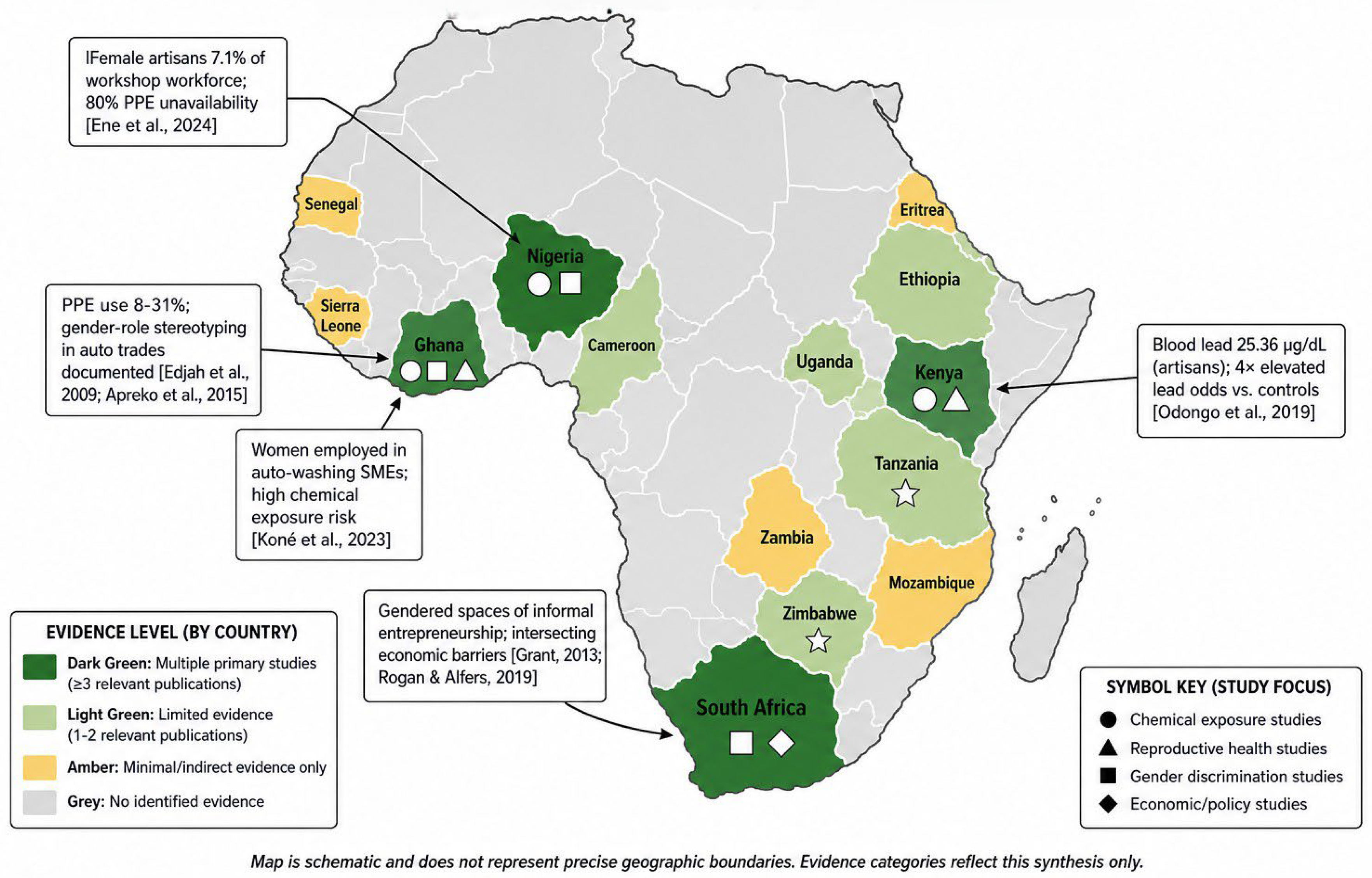
Figure 2.
Kabeer's three-pillar empowerment framework operationalised for female automobile artisans: resources, agency, and achievements.
Figure 2.
Kabeer's three-pillar empowerment framework operationalised for female automobile artisans: resources, agency, and achievements.
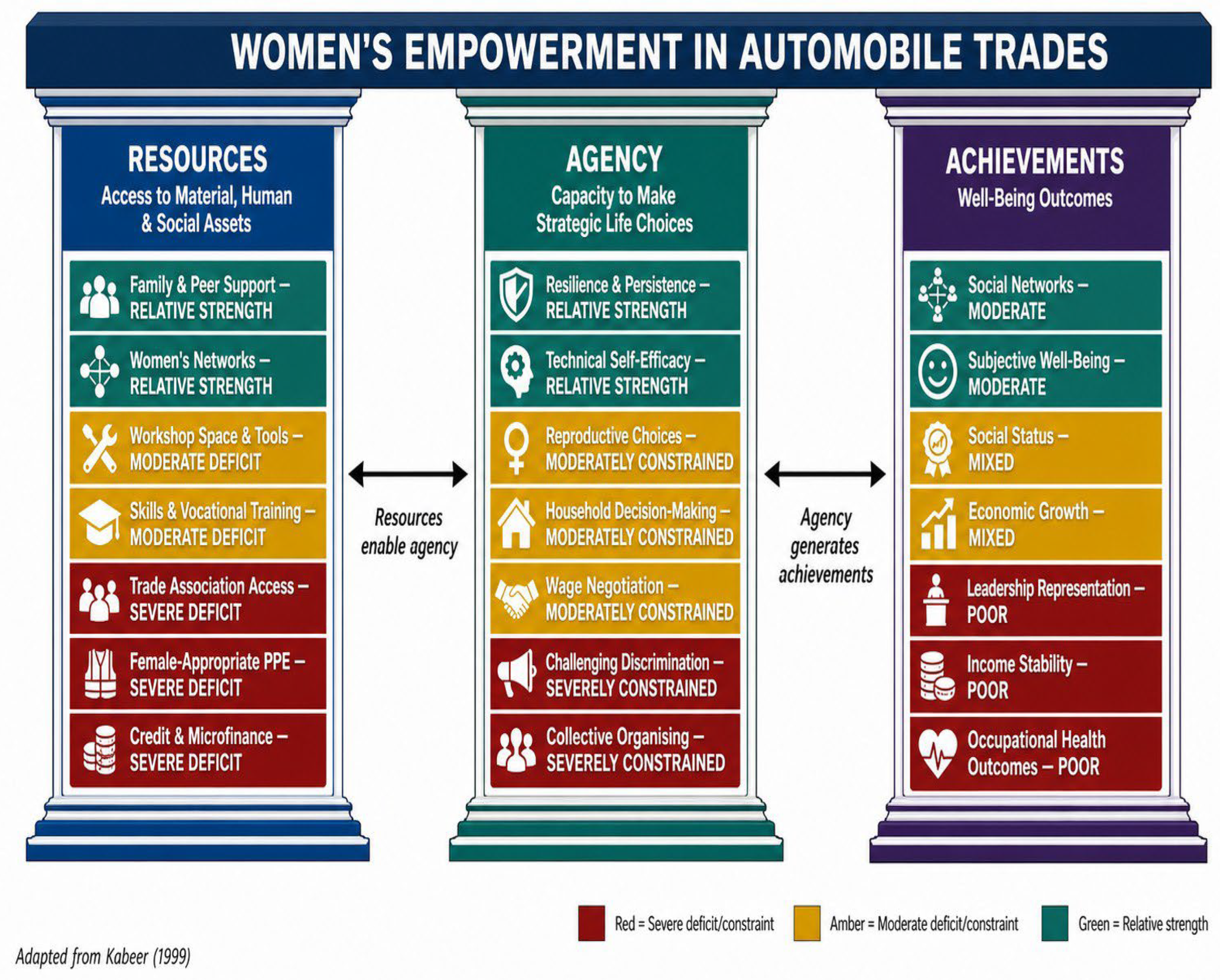
Figure 3.
Ecological multilevel conceptual framework for occupational health outcomes among female automobile artisans in sub-Saharan Africa.
Figure 3.
Ecological multilevel conceptual framework for occupational health outcomes among female automobile artisans in sub-Saharan Africa.
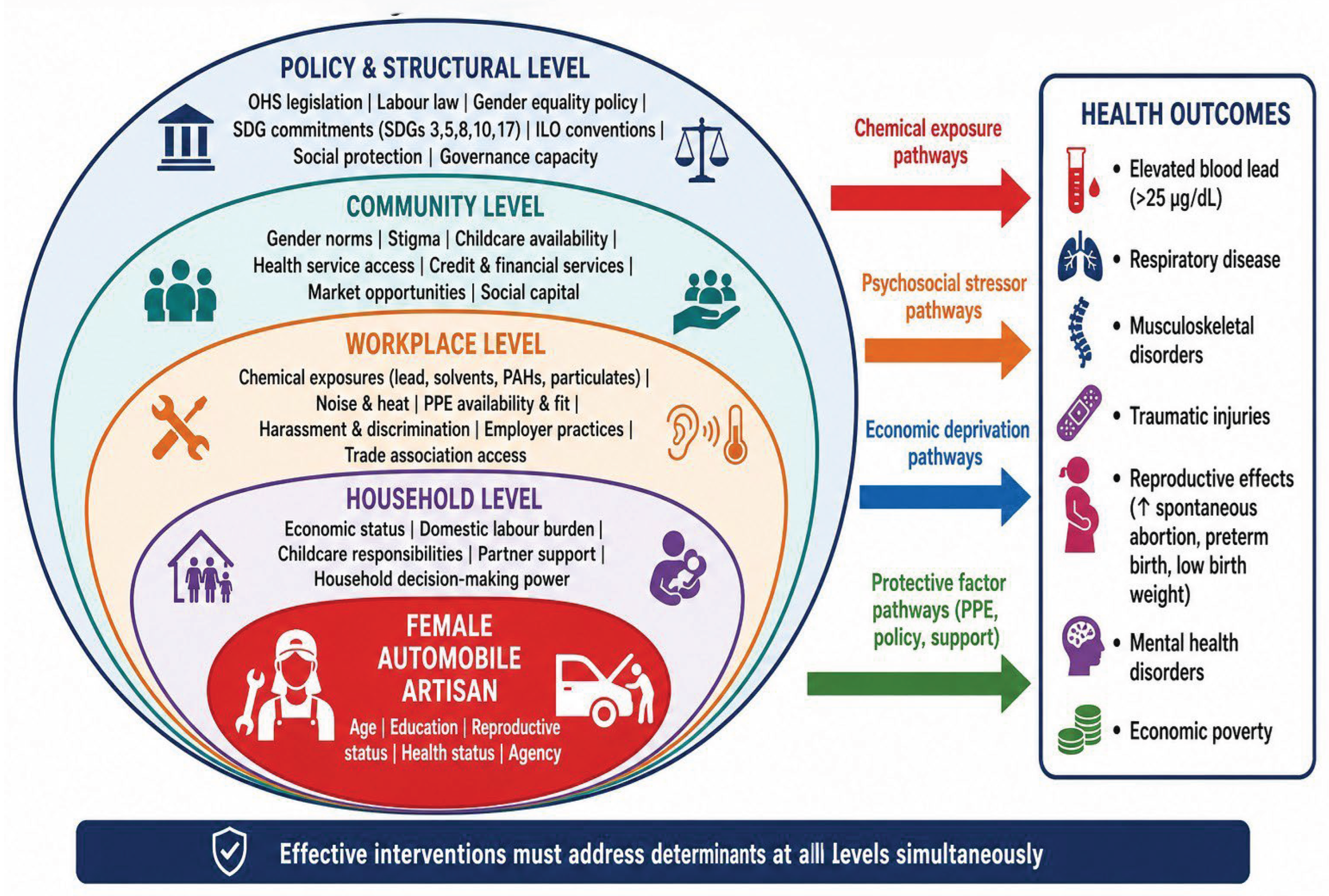

Table 1.
Summary of Key Included Studies.
| Author/Year | Country | Study Design | Sample (N) | Population | Key Findings | Quality |
|---|---|---|---|---|---|---|
| Odongo et al. 2019 [15] | Kenya | Descriptive comparative study | 60 (30 exposed, 30 controls) | Informal automobile repair artisans, Nakuru Town | Mean blood lead 25.36 µg/dL among artisans vs 14.17 µg/dL controls; exceeded WHO BEI; impaired renal function | High |
| Ametepeh et al. 2013 [20] | Ghana | Mixed-methods field survey | 440 | Informal sector workers (beauticians, mechanics, taxi drivers, head porters); 32.2% female | 66% noise exposure, 40% fume inhalation, 75% poor posture, 14 sexual abuse reports; 32.2% female | Moderate |
| Amoako 2019 [27] | Ghana | Qualitative interviews and observation | 24 | Maternal market traders (pregnant/nursing), Accra; 100% female, ages 18-35 | Poor sanitation, fire outbreaks, overcrowding, harassment, extreme heat, excessive workloads, lack of maternity protection | Moderate |
| Namungu et al. [17] | Kenya | Environmental monitoring and survey | 34 production areas | Informal sector workers, Kenya | Airborne Pb 1.4-126.9 µg/m³ in 56% of sheds; welding 126.9 µg/m³, painting 56.4 µg/m³; exceeded OSHA PEL; limited PPE | Moderate |
| Wrigley-Asante 2013 [31] | Ghana | In-depth interviews and observation | Not specified | Women in cross-border trading, Accra; 100% female | Musculoskeletal problems, psychosocial stress from safety concerns, limited STI information | Moderate |
| Genders 2022 [12] | South Africa | Mixed-methods | 120 | Female informal entrepreneurs (street vendors), Richards Bay/Empangeni; 100% female, 91% African, 50% ages 31-50 | Theft, sexual assault risk, police brutality, sexual harassment, lack of infrastructure | Moderate |
| Hilson et al. 2018 [29] | Sierra Leone, Zambia, Ghana | Synthesis and qualitative | 588 (106 female miners in Ghana survey) | Women in artisanal and small-scale mining, SSA | Sexual violence, physical abuse, discrimination, frequent injuries; women in dangerous conditions | Moderate |
| Ogando et al. 2017 [32] | South Africa, Kenya, Brazil, Colombia | Mixed-methods | 614 waste pickers (Durban, Nakuru, Belo Horizonte, Bogota) | Waste pickers; both genders | Health risks from waste handling, lack of sanitary toilets, fear of sexual violence; women's concerns about physical security | High |
| Malta et al. 2019 [25] | Senegal | Probit models, household survey | 47,169 (19,367 female, 27,802 male) | Senegalese workers ages 15-64 | 83% working women in informal sector vs 50% men; informal employment = less stability, lower earnings, higher gender gaps | High |
| Apreko et al. 2015 [18] | Ghana | Survey | 200 | Local automotive artisans, Volta Region; 100% male, 56% ages 26-35 | Exposure to petrol, diesel, exhaust, welding fumes, oils, solvents; lung diseases, dermatitis, eczema; hand injuries, burns | Moderate |
| KONE et al. 2023 [30] | Cote d'Ivoire | Quantitative | 229 | Women in car washes, Abidjan district; 100% female | High physical risks from equipment weight, men's perception of women as housewives, workplace harassment | Moderate |
| Amfo-Otu et al. 2017 [21] | Ghana | Accidental sampling survey | 70 | Informal sector auto mechanics, Sekyere East District; male-dominated, 84.3% ages 17-35 | Heat, burns, asbestos, fumes, insect bites, working under pressure; 74% injured received no compensation | Moderate |
| Hofmann et al. 2022 [5] | Egypt, Ghana, Malawi, Senegal, Sudan, Tanzania, Tunisia, Zambia, Zimbabwe, Bangladesh | Meta-analysis, qualitative | Multiple countries | MCs, skilled workers, apprentices in informal apprenticeships | Gender bias: women limited to traditionally feminine trades; hazardous conditions, child labor, occupational injury | High |
| Atieno & Teal 2007 [41] | Kenya | Labour force survey analysis | 50,713 (ages 15-65) | Kenyan workers, 1997 Welfare Monitoring Survey III | Gender differences in occupational outcomes; women less likely to enter technical trades despite equivalent education | High |
| Ganu & Boateng 2012 [57] | Ghana | Mixed-methods | 50 | Illiterate informal sector women, rural Akyemansa district; 100% female | Barriers to development; need for support | Low |
| Essien 2021 [24] | Nigeria | Quantitative, Google Survey | 100 | NECA Women entrepreneurs association members, six regions; 100% female | Informal entrepreneurial network education enhances enterprise sustainability | Moderate |
| Agyemang 2017 [47] | Ghana | Mixed-methods, OLS regression | 119 (43 men, 76 women) + 30 female traders | Microenterprise owners, Accra/Tema; female textile traders, Makola Market | Women face health issues from physically demanding work; noise, congestion, heat, dust in markets | Moderate |
| Granstrom 2008 [42] | Senegal | Cross-sectional household survey | 11,772 (ages 15-65) | Dakar, Senegal | 83% working women in informal sector vs 50% men | Moderate |
| Odongo et al. [16] | Kenya | Comparative cross-sectional | 60 (30 artisans, 30 controls) | Informal automobile artisans, Nakuru Town | 4x odds of high blood lead levels (OR=4.0; 95% CI 1.37-11.70) | High |
| Mokomane et al. 2025 [5] | Sub-Saharan Africa | Systematic review | Multiple countries | Informal economy workers, SSA | Structural barriers to maternity protection: lack of legal coverage, absence of social insurance, economic precarity | High |
| Afolabi 2024 [49] | Nigeria | Qualitative, in-depth interviews | 43 | Automobile artisans, Osun State | Work-related health problems (minor to very serious); alcohol consumption as major cause of accidents | Moderate |
| Forkuor et al. 2020 [10] | Ghana | Qualitative | Not specified | Women in male-dominated informal sector occupations, urban Ghana | Gender discrimination, harassment, exclusion from apprenticeships, proving competence, building alliances | Moderate |
| Pallangyo 2021 [35] | Tanzania | Policy analysis | N/A | Female traders, Tanzania | Informal sector exclusion from safety legislation; lack of legal protections | Moderate |
| Hariparsad et al. 2019 [2] | South Africa | Cross-sectional | Not specified | Female informal street traders, Warwick Junction, Durban | Reproductive health effects from occupational pollutants; menstrual disorders, pregnancy complications | Moderate |
| Moyo 2024 [13] | Zimbabwe | Conference abstract | Not specified | Women in artisanal and small-scale mining, Zimbabwe | Occupational health access challenges; systematic exclusion from health services, lack of PPE | Low |
| Adisa et al. 2021 [8] | Multiple | Qualitative synthesis | Not specified | Women in male-dominated workplaces | Gender apartheid; challenges of breaking into a man's world; constant pressure to prove competence | Moderate |
| Meagher 2010 [63] | Sub-Saharan Africa | Theoretical analysis | N/A | Women in informal economy, SSA | Empowerment trap; informal sector participation insufficient for empowerment without structural change | High |
| Chen et al. 2020 [42] | Global | Edited volume synthesis | N/A | Informal economy workers globally | Informal economy revisited; need for extending protections and social security | High |
| Otobe 2017 [36] | Global | ILO policy brief | N/A | Women in informal economy globally | Gender and informal economy; key challenges and policy responses; need for extending labor protections | High |
Note: Quality ratings based on methodological rigour, sample representativeness, and relevance to synthesis objectives. High = rigorous design, adequate sample, direct relevance; Moderate = acceptable design with some limitations; Low = limited methodological detail or indirect relevance.
Table 2.
Comprehensive Occupational Hazard Matrix.
| Hazard Category | Specific Agents/Mechanisms | Health Outcomes Documented | Evidence Source(s) | Level of Evidence |
|---|---|---|---|---|
| Chemical: Lead | Battery repair/recycling, brake lining dust, leaded paint, welding of lead-containing materials | Blood lead levels 25.36 µg/dL (exceeding WHO BEI 20 µg/dL); impaired renal function (decreased eGFR); hepatic effects; reproductive toxicity (spontaneous abortion, preterm birth, low birth weight, neurodevelopmental impairment in offspring) | [15,16,17,23,24,56] | High |
| Chemical: Organic Solvents | Degreasers, paint thinners, adhesives (toluene, xylene, benzene, methyl ethyl ketone, petroleum distillates) | Respiratory irritation, dermatitis, eczema, neurological symptoms (peripheral neuropathy, cognitive impairment, mood disturbances); reproductive toxicity (reduced fertility, spontaneous abortion, preterm birth, low birth weight, congenital malformations including neural tube defects and orofacial clefts) | [1,16,18,20,25,26,41] | High |
| Chemical: Polycyclic Aromatic Hydrocarbons (PAHs) | Engine exhaust, used motor oil, combustion products, welding fumes | Reduced birth weight, preterm birth, neurodevelopmental effects; carcinogenic potential | [19] | Moderate |
| Chemical: Particulate Matter | Welding, grinding, sanding, brake dust | Respiratory symptoms (chronic cough, dyspnoea, chest tightness); lung function impairment (obstructive and restrictive patterns); chronic occupational lung disease | [18,20,21,22,46] | High |
| Chemical: Heavy Metals (other) | Cadmium, chromium, nickel, manganese (from welding fumes, metal work) | Respiratory effects, reproductive health risks, metal toxicity | [17,21,58] | Moderate |
| Chemical: Asbestos | Brake linings, gaskets, insulation materials | Respiratory disease, asbestosis, mesothelioma risk (long latency) | [21] | Moderate |
| Physical: Noise | Power tools, hammering, engine testing, workshop machinery | Noise-induced hearing loss; 66% of workers reported noise exposure | [20,21] | Moderate |
| Physical: Heat | Tropical climate, direct sunlight, heat-generating equipment, poor ventilation | Heat stress, dehydration, heat rash, reduced work capacity | [27,30,47] | Moderate |
| Physical: Vibration | Power tools, grinders, impact wrenches | Hand-arm vibration syndrome (vascular and neurological impairment in hands/fingers) | [20,48] | Low |
| Physical: Traumatic Injuries | Cuts, burns, crush injuries, falls; lack of machine guarding, poor tool maintenance | 64% of artisans sustained work-related injuries (cuts, burns); 74% received no compensation; 55% self-medicated | [21,22,49,50] | High |
| Ergonomic: Awkward Postures | Kneeling, bending, overhead work, prolonged standing; tools/workstations designed for male body dimensions | Musculoskeletal disorders (back pain, neck pain, shoulder pain, knee pain); 75% reported poor posture | [20,22,30,31,48,51] | High |
| Ergonomic: Heavy Lifting | Lifting engines, tyres, batteries, parts; lack of mechanical aids | Back injuries, musculoskeletal strain; compounded for women by equipment designed for male strength | [27,30,48] | Moderate |
| Ergonomic: Repetitive Motions | Repetitive tool use, assembly/disassembly tasks | Repetitive strain injuries, tendinitis | [22,48] | Moderate |
| Biological: Infectious Agents | Rodents, insects, unsanitary conditions, lack of toilets/handwashing | Faecal-oral disease transmission, urinary tract infections, infectious disease risk | [27,32] | Low |
| Biological: Zoonotic Exposures | Rodent bites, insect bites | Insect bites documented; potential for vector-borne disease | [21,27] | Low |
| Psychosocial: Sexual Harassment | Verbal harassment, unwanted sexual attention, sexual assault from coworkers, supervisors, customers, officials | Depression, anxiety, PTSD, reduced self-esteem; forced exit from employment | [12,20,29,32,35] | High |
| Psychosocial: Gender-Based Discrimination | Exclusion from apprenticeships, lower wages, denial of training, questioning of competence, stigma | Chronic stress, mental health burden, limited professional development | [7,8,10,12] | High |
| Psychosocial: Workplace Hostility | Refusal to train, withholding information, sabotage, customer refusal of service | Chronic stress, isolation, undermined professional development | [8,10] | Moderate |
| Psychosocial: Double Burden | Domestic labour (childcare, cooking, cleaning, elder care) + full-time paid work | Chronic fatigue, sleep deprivation, stress-related health problems (hypertension, diabetes, depression, anxiety) | [18,28,33] | High |
| Psychosocial: Economic Precarity | Irregular income, poverty, debt, food insecurity | Chronic stress, inability to refuse unsafe work, mental health burden | [10,12,63,64] | High |
| Organizational: Lack of PPE | Unavailability, unaffordability, gender-inappropriate sizing/design | Inadequate protection from chemical, physical, and biological hazards; 27% PPE use in Ghana study | [17,18,22,51,52,53,54,55] | High |
| Organizational: Absence of Training | No occupational health and safety training, no hazard recognition training, no first aid training | 78% lacked fire safety training, 92% ignorant of first aid; limited knowledge of lead exposure risks | [17,18,22] | High |
| Organizational: Lack of Compensation | No workers' compensation, no health insurance, no sick leave | 74% of injured workers received no compensation; financial burden of work-related injuries | [21,22] | High |
| Organizational: Absence of Maternity Protection | No paid maternity leave, no prenatal accommodations, no workplace modifications during pregnancy | Women work until delivery, return within days/weeks postpartum; pregnancy complications, preterm labour | [2,5,27] | High |
Note: Level of evidence based on number of studies, methodological quality, consistency of findings, and directness of evidence. High = multiple high-quality studies with consistent findings; Moderate = fewer studies or some methodological limitations; Low = limited evidence or indirect inference.
Table 3.
SDG Alignment Matrix.
| SDG & Target | Specific Commitment | Evidence from This Synthesis | Implementation Gap | Recommended Action |
|---|---|---|---|---|
| SDG 3: Good Health and Well-Being | ||||
| Target 3.8 | Universal health coverage, including access to quality essential health services | Female automobile artisans lack access to occupational health services, reproductive health care, and treatment for work-related injuries [2,15,27,31] | No occupational health surveillance or services for informal sector workers [2,15] | Establish mobile occupational health clinics; provide biomonitoring, reproductive health counselling, and treatment for work-related illnesses [2,15] |
| Target 3.9 | Reduce deaths and illnesses from hazardous chemicals and pollution | Blood lead levels exceeding BEI [15,16]; airborne lead exceeding OELs [17]; respiratory disease [18,46]; reproductive health risks [2,23,56] | No exposure monitoring, no interventions to reduce chemical exposures [2,15,17] | Implement exposure reduction interventions: improved ventilation, chemical substitution, training in safe work practices; provide subsidised PPE [2,15,17,18] |
| SDG 5: Gender Equality | ||||
| Target 5.1 | End all forms of discrimination against women and girls | Pervasive gender-based discrimination: exclusion from apprenticeships, lower wages, sexual harassment, workplace hostility [7,8,10,12] | No enforcement of anti-discrimination laws in informal sector [2,35] | Enact and enforce legislation prohibiting gender-based discrimination in all workplaces; establish accessible complaint mechanisms; provide legal aid [2,12,35] |
| Target 5.2 | Eliminate all forms of violence against women and girls | Sexual harassment, sexual assault, gender-based violence as occupational hazards [12,29,32] | No legal recourse; violence goes unpunished [12,35] | Enforce prohibitions on sexual harassment and violence; establish safe reporting mechanisms; provide support services for survivors [12,35] |
| Target 5.4 | Recognise and value unpaid care and domestic work | Women bear double burden of paid work and unpaid domestic labour with no public support [27,28,33] | No childcare support, no recognition of care work burden [28,33] | Provide public childcare services; implement policies recognising and supporting care work [28,33] |
| Target 5.5 | Ensure women's full participation and equal opportunities for leadership | Women systematically excluded from trade association leadership and decision-making [24,57,68] | No affirmative action policies; male dominance of trade leadership [57,68] | Implement quotas for women in trade association leadership; support women's trade associations [24,57] |
| Target 5.a | Equal rights to economic resources, property, financial services | Women face barriers to credit access, property ownership, business establishment [38,57,70] | Discriminatory lending practices; lack of collateral; financial exclusion [38,57] | Reform financial services to ensure women's access to credit; provide business development support tailored to women's needs [38,57] |
| SDG 8: Decent Work and Economic Growth | ||||
| Target 8.3 | Promote formalization and growth of micro-, small-, and medium-sized enterprises, including through access to financial services | Women face barriers to business formalization, credit access, and business growth [2,38,57] | Limited support for informal sector formalization; financial exclusion [2,38,57] | Implement programmes supporting formalization with attention to gender-specific barriers; ensure credit access [2,38,57] |
| Target 8.5 | Full and productive employment and decent work for all; equal pay for work of equal value | Women earn less than men for equivalent work; barriers to productive employment [25,61,65] | Gender-based wage gaps persist; no enforcement of equal pay [25,61,65] | Enforce equal pay legislation; address occupational segregation; promote women's access to higher-skill, higher-income work [25,61,65] |
| Target 8.8 | Protect labour rights and promote safe and secure working environments for all workers, including those in precarious employment | Hazardous working conditions without labour protections or safe working environments [2,15,18,20,22] | Informal sector workers excluded from occupational health and safety legislation; no enforcement [2,35,76] | Extend occupational health and safety legislation to cover all workers; establish enforcement mechanisms appropriate for informal sector; provide workers' compensation [2,35,36] |
| SDG 10: Reduced Inequalities | ||||
| Target 10.2 | Empower and promote social, economic, and political inclusion of all, irrespective of sex, disability, race, ethnicity, religion, or economic status | Female automobile artisans face intersecting inequalities based on gender, class, ethnicity, religion [61,63,65] | Policies rarely address informal sector workers or intersectional vulnerabilities [2,61,63] | Adopt intersectional approaches to inequality reduction; extend legal protections and social security to informal sector workers [2,61,63] |
| Target 10.3 | Ensure equal opportunity and reduce inequalities of outcome; eliminate discriminatory laws, policies, and practices | Discriminatory laws and policies exclude informal sector workers from labour protections and social security [2,35,76] | Systematic exclusion of informal sector workers from legal protections [2,35,76] | Reform laws and policies to extend protections to informal sector workers; eliminate discriminatory provisions [2,35,76] |
| SDG 17: Partnerships for the Goals | ||||
| Target 17.14 | Enhance policy coherence for sustainable development | Current policies are fragmented; occupational health, labour, and gender equality policies operate in silos [2,35] | Lack of policy coherence across sectors [2,35] | Establish multi-sectoral coordination mechanisms; ensure policy coherence across occupational health, labour, gender equality, education, and economic development [2,35,36] |
| Target 17.17 | Encourage and promote effective public, public-private, and civil society partnerships | Partnerships addressing informal sector occupational health and gender equity are limited [2,36] | Few partnerships; limited civil society engagement [2,36] | Establish multi-sectoral partnerships bringing together government, trade associations, women's organisations, occupational health professionals, and international agencies [2,5,24,36] |
Note: Evidence citations refer to studies documenting the specific issue. Implementation gaps reflect synthesis of evidence on policy and practice. Recommended actions synthesise evidence-based interventions from the literature.
Disclaimer/Publisher’s Note: The statements, opinions and data contained in all publications are solely those of the individual author(s) and contributor(s) and not of MDPI and/or the editor(s). MDPI and/or the editor(s) disclaim responsibility for any injury to people or property resulting from any ideas, methods, instructions or products referred to in the content. |
© 2026 by the authors. Licensee MDPI, Basel, Switzerland. This article is an open access article distributed under the terms and conditions of the Creative Commons Attribution (CC BY) license (http://creativecommons.org/licenses/by/4.0/).
Copyright: This open access article is published under a Creative Commons CC BY 4.0 license, which permit the free download, distribution, and reuse, provided that the author and preprint are cited in any reuse.