
Submitted:
11 September 2026
Posted:
14 September 2026
You are already at the latest version
Abstract
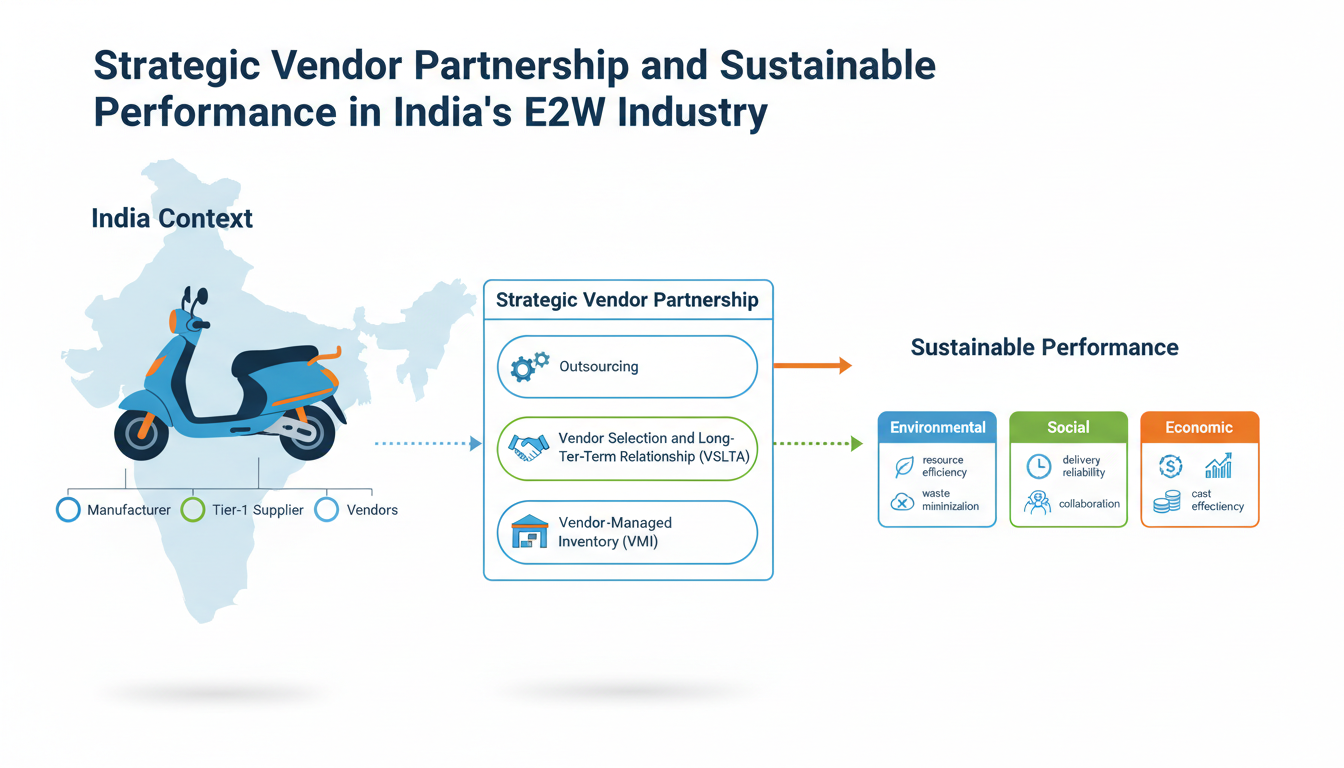
As the electric two-wheeler (E2W) sector rapidly proliferates in India, achieving genuine sustainability is strongly dependent upon upstream supply chain dynamics. Drawing on sustainable supply chain and partnership theories, this research investigates how strategic vendor partnerships (SVP) drive economic, environmental, and social sustainability within this emerging market. We deconstruct the SVP framework into three fundamental practices: outsourcing, vendor-managed inventory (VMI), and vendor selection tied to long-term alliances (VSLTA). For an evaluation of how these practices impact critical sustainability metrics like emission control, waste reduction, resource optimization, cost efficiency, and delivery reliability, we surveyed procurement and supply chain experts from major Indian E2W manufacturers and their tier-1 suppliers. The gathered data was empirically evaluated utilizing exploratory factor analysis and multiple regression. The analysis reveals that sustainable performance is significantly and positively enhanced by all three facets of SVP. Notably, establishing enduring relationships through VSLTA, proved to be the most impactful catalyst for sustainability, followed closely by VMI integration and outsourcing strategies. Finally, this research advances the academic discourse on sustainable e-mobility operations in developing economies and equips industry managers with evidence-based strategies to build supply chains that are both highly competitive and ecologically responsible.
Keywords:
strategic vendor partnership (SVP)
; sustainability
; Indian electric two-wheeler (IE2W) industry
; outsourcing
; vendor selection
; long-term vendor relationships
; vendor-managed inventory (VMI)
; sustainable supply chain management (SSCM)
; green procurement
; environmental performance
; social performance
; economic performance
Copyright: This open access article is published under a Creative Commons CC BY 4.0 license, which permit the free download, distribution, and reuse, provided that the author and preprint are cited in any reuse.