

Submitted:
12 September 2026
Posted:
14 September 2026
You are already at the latest version
Abstract
Empirical evidence integrating multiple biological levels on freshwater biodiversity persistence in regulated river basins remains scarce for Neotropical systems. We evaluated fish assemblage structure, reproductive strategies, and life-cycle support for migratory species across lotic and lentic habitats in three tributaries of the Porto Primavera Reservoir, Upper Paraná basin, Brazil, over an 11-year monitoring period (2007–2018), encompassing 104 species and a Life-cycle Support Index (LSI) based on occurrence of eggs, larvae, juveniles, and adults. Marginal lagoons functioned as biodiversity hotspots, with higher richness and diversity than river channels; reproductive guilds were habitat-partitioned, with opportunistic and parental-care strategists in lentic environments and periodic/migratory strategists in lotic habitats. Tributary identity was the strongest predictor of assemblage composition: the Aguapeí River, partially protected, showed the highest LSI values, whereas the Verde River provided the strongest evidence of reproduction for conservation-priority taxa, including the critically endangered Brycon orbignyanus, whose adults occurred exclusively there, and the vulnerable Pseudoplatystoma corruscans, for which adults, eggs, and larvae co-occurred. Three proposed hydropower developments on the Verde River would fragment a 200-km free-flowing stretch, threatening these conditions. Undammed tributaries are irreplaceable for freshwater biodiversity and should be recognized as conservation priorities in hydro-power licensing and basin governance.
Keywords:
fish assemblages
; freshwater biodiversity
; hydropower impacts
; migratory fish
; river connectivity
; life-cycle support
; Brycon orbignyanus
; Upper Paraná River
; habitat heterogeneity
; conservation
; restoration
1. Introduction
The Neotropical region harbors the highest freshwater fish diversity in the world, with more than 6,345 valid species described across South America, Central America, and the Greater Antilles [1,2,3], representing approximately 18% of all valid fish species and roughly 9% of all vertebrate species on Earth. Within this context, the Upper Paraná River basin supports a highly diverse ichthyofauna characterized by a broad range of reproductive strategies associated with heterogeneous aquatic environments, including rivers, lakes, and floodplain lagoons. These strategies include early maturation with multiple spawning events, parental care with non-seasonal reproduction, and long-distance migratory behaviors linked to seasonal reproductive cycles [4,5].
Fish reproductive dynamics in tropical rivers are strongly regulated by seasonal and spatial hydrological variability, particularly by the flood pulse, which synchronizes spawning migrations, gonadal maturation, spawning, larval drift, and juvenile recruitment across interconnected habitats [6,7]. Riverine fish recruitment is therefore increasingly recognized as the outcome of interactions among multiple environmental drivers—including flow, temperature, habitat structure, and species-specific traits—rather than hydrology alone, highlighting the need for integrative, riverscape-scale approaches to understand fish population dynamics [8]. To meet changing ecological requirements throughout their lives, many fish species shift among tributaries, large rivers, floodplain lakes, and freshwater–marine interfaces. For numerous riverine species, successful completion of the life cycle depends on movements and long-distance migrations linking spatially separated spawning grounds, nursery habitats, feeding areas, and refuges [9,10]. The maintenance of these ecological connections has been increasingly compromised by anthropogenic pressures, particularly dam construction, which alters natural flow regimes, disrupts longitudinal connectivity, and fragments riverine habitats at large spatial scales [11,12,13]. Beyond blocking migratory routes, dams reduce the magnitude, duration, and predictability of flood events, decoupling biological cycles from the environmental cues that trigger reproduction and recruitment [14]. As a result, species that depend on seasonal migrations and specific hydrological conditions are especially vulnerable to river regulation, although even non-migratory species may experience reduced habitat availability and altered population dynamics [7,15].
In addition to river regulation, freshwater ecosystems are increasingly affected by multiple stressors, including urbanization, habitat degradation, pollution, agricultural expansion, overfishing, extreme drought events, and deforestation [16,17,18]. Freshwater fish biodiversity is currently undergoing one of the most severe decline trajectories among vertebrate groups, with marked changes documented in more than 50% of the world's rivers [19], and recovery efforts in regulated systems showing signs of deceleration despite decades of restoration investment [20]. In the Paraná River basin, large reservoirs have caused profound ecological changes, particularly affecting long-distance migratory species whose life cycles depend on access to spawning and nursery habitats [21,22]. Hydrological regulation disrupts the synchronization between reproductive cycles and flood pulses, impairing environmental cues required for gonadal maturation and spawning, ultimately leading to recruitment failures and population declines [7,23,24]. In addition, river regulation may facilitate the establishment and spread of non-native species, further altering native fish assemblages [25,26].
To mitigate biodiversity loss, several conservation strategies have been implemented worldwide, including integrated water-resource management, ecosystem restoration, overfishing control, and the establishment of protected areas [17,27,28]. Nevertheless, conservation coverage remains insufficient in many tropical river systems. In Brazil, approximately 84% of riverine environments remain outside protected areas, and large river systems are particularly underrepresented [29]. In the Upper Paraná River basin, South America's second-largest watershed, the remaining floodplain constitutes the last non-impounded stretch (230 km) of the Paraná River in Brazilian territory and plays a crucial role in maintaining biodiversity and ecological processes. Existing protected areas in the basin have been shown to offer insufficient coverage for migratory fish species, underscoring the need for the redesign and expansion of conservation networks to encompass critical spawning and nursery reaches [30].
Tributaries associated with large reservoirs have become increasingly important for sustaining fish reproduction of characteristic species and maintaining ecological connectivity in fragmented river systems. In highly regulated basins, remaining dam-free tributaries [31,32] may play a critical role in sustaining biodiversity and life-history processes that have been severely impaired in dammed mainstems. Recent studies demonstrate that tributaries can act as demographic sources in fragmented systems, supporting higher survival and population growth rates relative to impounded rivers, even when representing a relatively small proportion of total habitat availability [33,34]. Tributaries associated with the Engenheiro Sérgio Motta reservoir, for example, support spawning and recruitment of eight migratory and five threatened species [35,36], highlighting the disproportionate conservation value of these systems within highly regulated networks. In addition, tributaries provide essential ecological functions, including habitat heterogeneity, maintenance of connectivity, ecological asynchrony, and nursery habitats for early life stages [37,38,39,40]. Marginal lagoons associated with these tributaries are particularly important because they provide shelter, feeding areas, and nursery habitats for resident floodplain species and juveniles of migratory fishes during early developmental stages [38,41].
Despite their recognized ecological importance, undammed tributaries are increasingly threatened by new hydropower developments. In the Upper Paraná River basin alone, an almost 500% increase in medium-sized hydropower plants is projected relative to those currently in operation [42], with cumulative fragmentation effects that could irreversibly reduce the extent of free-flowing lotic environments available to migratory and threatened species [12,13]. Where opportunities to maintain longitudinal connectivity are becoming progressively limited, the conservation of remaining lotic tributary environments has emerged as a defining challenge for sustainable river-basin management [18].
One such example is the Verde River, a tributary of the Upper Paraná basin investigated in this study, which retains a continuous free-flowing stretch of approximately 200 km in its lower reaches. This stretch currently faces direct pressure from three hydropower developments under environmental licensing, all of which have already received Preliminary Environmental Licenses from the relevant state environmental authority. If constructed, these projects would fragment one of the longest remaining continuous lotic stretches in the basin and, combined with three hydropower plants already operating in the uppermost reaches of the Verde River, would effectively transform the entire river into a cascade of reservoirs.
Such cascading fragmentation would eliminate the connectivity-dependent ecological conditions critical for the reproduction, recruitment, and population persistence of migratory and threatened fish species. Given the fundamental role of tributaries as spawning grounds, nursery habitats, refuge, and ecological corridors, further fragmentation could lead to irreversible losses of ecological biodiversity and functionality. Empirical, basin-scale assessments integrating biodiversity patterns, reproductive strategies, and life-cycle support for migratory species are therefore urgently needed to inform evidence-based decision-making and sustainable hydropower planning.
The reconciliation of freshwater biodiversity conservation with energy production has become a central challenge for sustainable development globally. Hydropower expansion is directly implicated in trade-offs involving multiple Sustainable Development Goals - SDG. In river basins where hydropower infrastructure is already extensive, the persistence of free-flowing tributaries represents one of the few remaining opportunities to simultaneously advance biodiversity conservation, maintain ecosystem services, and uphold the water-related SDG targets that depend on ecologically functional freshwater systems. Despite this relevance, environmental licensing frameworks in many tropical countries including Brazil continue to evaluate hydropower projects on an individual basis, with limited integration of cumulative ecological impacts at the basin scale [42,43]. This fragmented approach undermines the capacity of licensing processes to safeguard the ecological connectivity and life-history processes that sustain freshwater biodiversity in highly regulated systems.
In this context, the present study aims to characterize and compare fish assemblages between lentic and lotic environments in three tributaries of the Upper Paraná River basin — the Aguapeí, Pardo, and Verde rivers — and to evaluate differences in reproductive strategies, species origin, conservation status, and support for migratory fish life cycles across habitats and tributary systems. Uniquely, the assessment integrates occurrence data spanning all developmental stages, from eggs and larvae to juveniles and adults, providing a comprehensive view of species-specific life-cycle support that is rarely achievable in long-term fish monitoring studies. Specifically, we investigate how habitat heterogeneity, hydrological connectivity, and tributary identity influence fish diversity, assemblage structure, reproductive strategies, and the occurrence of conservation-priority species in order to identify key environments for biodiversity conservation in a highly regulated river basin.
We hypothesize that undammed stretches of tributaries function as ecological refugia within fragmented river networks, sustaining biodiversity and ecological processes that have been largely lost from impounded mainstems. Specifically, we predict that: (i) fish assemblage structure is jointly shaped by habitat type, hydrological connectivity, and tributary identity, with marginal lagoons expected to support higher species diversity and ecological heterogeneity than river channels; and with abiotic conditions expected to covary with these habitat-scale factors, reflecting environmental filtering as an underlying mechanism; (ii) reproductive strategies are non-randomly distributed across habitats due to environmental filtering, with lentic environments favoring opportunistic and equilibrium/parental-care strategists, whereas lotic environments support a greater abundance of periodic and migratory species; (iii) threatened and migratory species are disproportionately associated with lotic habitats and tributaries that maintain higher levels of ecological integrity and connectivity; and (iv) tributaries differ in their capacity to support migratory fish life cycles, with some systems functioning as refugial habitats that sustain multiple life-history stages, maintain population persistence, and preserve the genetic diversity of migratory species, while others provide stronger evidence of active reproduction and early recruitment. By quantifying the ecological roles of dam-free tributary reaches across contrasting habitat types, protection regimes, and levels of hydropower pressure, this study provides empirical evidence to support basin-scale conservation planning, the design of restoration measures in regulated tributaries, and environmental licensing decisions. Long-term empirical datasets remain scarce in one of the most regulated river systems in the Neotropics.
2. Materials and Methods
2.1. Study Area
The study was conducted in three tributaries of the Porto Primavera Reservoir (Engenheiro Sérgio Motta Hydroelectric Plant), the Aguapeí, Verde, and Pardo rivers, located in the Upper Paraná River basin, Brazil, one of the most extensively regulated river systems in South America, characterized by profound hydrological alteration and habitat fragmentation (Figure 1).
The Porto Primavera Reservoir is situated 28 km upstream of the Paraná–Paranapanema river confluence and is the largest on the Paraná River, with a length of 240 km. Its dam (11.4 km long, 22 m high) features 16 surface spillways with a discharge capacity of up to 53,600 m³/s. A pool-and-orifice-type fish ladder was built on the left side of the dam to allow passage of migratory fish and maintain longitudinal connectivity, measuring 472.5 m in length with a 4% slope [44]. The Aguapeí River lies on the left bank of the Paraná River, while the Verde and Pardo rivers lie on the right bank (Figure 1). The three tributaries differ in environmental characteristics, connectivity, and protection status, allowing evaluation of ecological processes across contrasting conditions.
The tributaries also differ in upstream regulation. The Verde River has three hydroelectric facilities in its uppermost reaches (Verde 4A, Verde 4, São Domingos), approximately 185 km upstream of the sampled stretch, and the Pardo River has the Assis Chateaubriand plant approximately 214 km upstream. Despite these upstream structures, the sampled reaches of both rivers remain predominantly unimpounded, retaining the hydrological and ecological characteristics of free-flowing systems locally. The Aguapeí River, in contrast, remains entirely free of dams throughout its drainage basin, the only fully unregulated system of the three.
The Aguapeí River, in the state of São Paulo, drains into the Paraná River between the municipalities of Nova Independência and São João do Pau d'Alho. It has a markedly meandering channel (average width 73.3 m, length exceeding 339 km) with well-preserved riparian forest (Figure 2a). Marginal lagoons commonly contain Eichhornia (Pontederiaceae) macrophytes, from which the river derives its Tupi name, meaning "river of water hyacinths." Fish sampling was conducted in the "Pau da Onça" lagoon (21°05'16''S, 51°42'42''W) and the adjacent channel (21°04'47.4''S, 51°42'46.3''W; Datum SIRGAS 2000), an approximately 2.0-ha lagoon with well-preserved riparian vegetation (Figure 2b) whose depth ranges from below 0.6 m in dry periods to over 4.0 m during floods. Notably, these sites lie within the Aguapeí River State Park, a Conservation Unit established by the São Paulo State Power Company (CESP) as environmental compensation for the Engenheiro Sérgio Motta Plant, offering a unique opportunity to evaluate fish assemblages under comparatively high environmental integrity within an otherwise highly regulated basin.
The Pardo River extends approximately 405 km within the state of Mato Grosso do Sul. In the sampled stretch (average width 103.06 m), margins have shrubby and arboreal riparian vegetation and extensive macrophyte banks (Figure 2c). Sampling was conducted in the permanent "Lagoa dos Coqueiros" lagoon (21°42'48.6''S, 52°32'37.0''W) and the adjacent channel (21°42'46.2''S, 52°32'25.3''W; Datum SIRGAS 2000). The lagoon supports dense floating macrophytes that may reduce lateral connectivity during low water (Figure 2d), with depth ranging from approximately 1.0 m (dry) to over 2.0 m (flood).
The Verde River, also entirely within Mato Grosso do Sul, extends approximately 398 km with an average width of 85.16 m in the study area and well-preserved riparian margins. It is associated with temporary marginal lagoons and seasonally flooded areas. Sampling was conducted in a temporary lagoon (21°02'02.0''S, 52°07'31.3''W) near agricultural and pasture land, surrounded by shrubby, arboreal, and herbaceous vegetation (Figure 2f), and the adjacent channel (21°02'12.8''S, 52°07'13.2''W; Datum SIRGAS 2000). As a seasonal environment, the lagoon shows marked fluctuations in water level, with depth below 0.3 m during droughts and exceeding 1.5 m during floods, driving dynamic connectivity with the main channel.
2.2. Fish Sampling and Environmental Variables
2.2.1. Sampling Design and Temporal Coverage
To evaluate the composition and structure of fish assemblages, sampling was conducted over an eight-year period, from 2011 to 2018. Sampling was performed at least three times and up to ten times per year, at approximately monthly intervals during the wet season (October–March) and at longer, irregular intervals during the dry season (April–September), totaling 44 sampling events distributed as follows: 3 in 2011 (October–December), 8 in 2012 (January–May and October–December), 10 in 2013 (January–May and August–December), 6 in 2014 (January–May and December), 4 in 2015 (January, May, July, and December), 4 in 2016 (January, April, June, and December), 5 in 2017 (January, March, May, November, and December), and 4 in 2018 (January–April). All twelve calendar months were represented across the full study period, providing coverage of both wet and dry season conditions.
Sampling sites encompassed both lotic (river channels) and lentic environments (marginal lagoons) within each tributary, allowing comparisons among habitats with distinct hydrological and ecological characteristics.
Due to prolonged drought conditions and severe reductions in water level, some lagoons became temporarily disconnected from the main channel or experienced substantial habitat contraction, preventing fish sampling during specific periods. Consequently, no lagoon sampling was conducted in the Aguapeí River during April, May, and December 2014, and January, May, and July 2015. Similarly, sampling in the marginal lagoon of the Verde River was not possible in January 2013 and February 2014. These hydrological fluctuations reflect the strong environmental variability characteristic of marginal lagoon systems associated with tributaries in the Upper Paraná River basin.
2.2.2. Fish Assemblage Sampling
To minimize gear selectivity and reduce potential sampling bias, multiple fishing methods were employed during each sampling campaign, following recommendations for fish assemblage studies in Neotropical environments [45]. Fish sampling was conducted using gillnets, surface longlines, limb lines, and sieve nets, allowing the capture of species with different ecological characteristics, habitat use patterns, and body sizes.
Gillnet sampling was performed using two sets of nets, each measuring 10 m in length, with mesh sizes ranging from 25 to 60 mm between non-adjacent knots. This mesh configuration was selected to prioritize the capture of juvenile individuals, particularly migratory species. Nets were deployed near the shoreline in low-flow areas at approximately 17:00 h and retrieved at 21:00 h.
Surface longlines were installed at each sampling site and consisted of a 40 m main line equipped with twenty 3/0 hooks attached to 1.30 m branch lines made of 0.70 mm nylon, spaced at 1 m intervals. In addition, five limb lines were installed per sampling site, consisting of 3 m long nylon lines (2.0 mm diameter) equipped with 9/0 hooks and weights, attached to tree branches along riverbanks or to emergent vegetation in lagoons and marked with reflective tape to facilitate retrieval. Both surface long lines and limb lines were set at approximately 17:00 h and baited at dusk (~18:30 h) using natural bait (fishes from Gymnotiformes and Synbranchiformes), to reduce bait loss and minimize predation by diurnal predators, particularly Serrasalmus spp.
Additional sampling was conducted in the littoral region of marginal lagoons using a sieve net (1.20 × 0.80 m), with six standardized throws performed near marginal vegetation per lagoon [46], to improve capture of small-bodied species and juveniles associated with shallow littoral habitats.
Upon capture, specimens were immediately placed on ice and transported to the laboratory for identification and analysis. Voucher specimens were deposited in the Zoology Museum of the State University of Londrina (MZUEL).
2.2.3. Ichthyoplankton Sampling
Ichthyoplankton surveys were conducted by our research group across consecutive sampling periods in the same tributary systems. From 2007 to 2010, monthly ichthyoplankton collections were performed from October to March at five sampling sites per tributary, using a conical-cylindrical plankton net (0.5 mm mesh) rigged for surface collection and equipped with a flow meter; tows were horizontal (20 cm deep), each lasting 10 min, and were conducted after dark (19:00–23:00 h) to maximize larval catches. Samples were standardized to a volume of 10 m³ of filtered water. Full methodological details for this period are described in [35] and [36]. From 2010 to 2012, the same protocol was maintained but sampling was restricted to December and February at two sites per tributary. From 2012 to 2018, monthly collections from October to March were resumed at two sites per tributary following the same standardized protocol.
2.2.4. Environmental Variables
At each fish sampling event, physicochemical variables — turbidity, water temperature, dissolved oxygen (DO), pH, and electrical conductivity — were recorded at each sampling site using a turbidimeter AP2000 IR (Policontrol, Diadema, Brazil) and a Professional Plus multiparameter probe (YSI, Ohio, USA). Measurements were taken at two time points during each sampling event: at gear deployment and at gear retrieval. Discharge, water level, and precipitation data were obtained from fluviometric and meteorological stations operated by Companhia Energética de São Paulo (CESP) in each tributary.
2.3. Data Analysis
Fish were identified at the lowest possible taxonomic level according to [47] and [48]. To avoid possible sampling effort biases among sampling sites, we determined the abundance of fish species through catch per unit effort (CPUE). CPUE was calculated for each equipment and species per sample. Gear-specific CPUE was expressed in its native units: gillnets, individuals per 1000 m² of net; surface longlines and limb lines, individuals per 100 hooks; and sieve nets, individuals per m². The CPUE data from different equipment were then combined using multigear mean standardization (MGMS, [49]), in which the CPUE of each species in each sampling unit is divided by the mean CPUE of that gear across all sampling units. This mean-centering step cancels the unit of effort associated with each gear, yielding a dimensionless, standardized index (MGMS-CPUE) that can be summed across gears without being dominated by whichever gear produces numerically larger raw values.
To verify possible variations in the composition and abundance of reproductive strategies between lotic and lentic environments, fish species were categorized into different reproductive strategies determined following [24,50,51]: (1) Opportunistic — species with indirect development, small to medium-sized adult fish, short spawning period, no parental care, and local/short migrations; (2) Equilibrium/Parental Care — species with indirect development, small to medium-sized adult fish, extended spawning period, parental care, and local migrations; (3) Periodic/Seasonal Migratory — species with indirect development, medium to large-sized adult fish, short spawning period, no parental care, and seasonal long-distance migrations; and (4) Internal Fertilization and Direct Development — species with internal fertilization and direct development. Long-distance migratory species were classified by life stage, into juvenile and adult, based on the species' size at first maturation, following [23] and [48].
To investigate the fish fauna regarding the level of threat, we categorized the fish species according to their threat level based on the "Official National List of Endangered Fauna Species - Fish and Aquatic Invertebrates", Annex I of Ordinance No. 1667 of the Ministry of the Environment and Climate Change – MMA, of April 26, 2026 [52], and Red Book of Paraná State Endangered Fauna [53]. These were categorized as critically endangered (CR), vulnerable (VU), near threatened (NT) and least concern (LC). Species with no information in the literature were classified as NC (no information known). Species were categorized by their origin according to [48,54] and consultations with FishBase (www.fishbase.org). Species identified only to genus level (e.g., spp.) were retained in taxonomic analyses but excluded from trait-based analyses due to the absence of reliable ecological and reproductive information at the species level.
2.3.1. Fish Assemblage Structure and Environmental Drivers
To evaluate spatial patterns of fish assemblage structure across tributaries and habitat types, species abundance data were organized into a species-by-sample matrix and analyzed using both univariate and multivariate approaches in R version 4.2.3 [55], adopting a significance level of α = 0.05. Multivariate analyses were performed using the vegan package version 2.6-4 [56].
For each sampling unit, total abundance, species richness (S), Shannon diversity index (H′), and Pielou's evenness index (J′) were calculated using untransformed abundance data. Prior to statistical analyses, exploratory procedures were conducted to assess data distribution and homogeneity of variances. Because assumptions of normality and homoscedasticity were not met, differences in diversity metrics among groups were evaluated using non-parametric approaches. Differences between habitat types (lentic vs. lotic) and among tributaries (Aguapeí, Pardo, and Verde) were tested separately using Kruskal–Wallis tests. When significant differences among tributaries were detected, pairwise post-hoc comparisons were performed using Dunn's test with Bonferroni correction to control multiple comparisons and identify which tributary pairs differed significantly. Kruskal–Wallis analyses were implemented using the kruskal.test() function, whereas post-hoc comparisons were conducted using the dunnTest() function from the FSA package with Bonferroni-adjusted p-values. Descriptive statistics are presented as mean ± standard deviation, and statistical significance was assessed at α = 0.05.
To investigate patterns of fish assemblage composition among habitat types, tributaries, protection status, and connectivity regimes, multivariate analyses were performed using abundance data. Prior to ordination and permutational analyses, abundance data were Hellinger-transformed using the decostand function in the vegan package to reduce the influence of highly abundant species and to down-weight the contribution of rare species, thereby stabilizing community composition estimates prior to distance computation [57]. Bray–Curtis dissimilarities were subsequently calculated from the Hellinger-transformed matrix and used as the basis for all permutational and ordination analyses. The resulting dissimilarity matrix was used directly as the response in all permutational analyses. Three complementary PERMANOVA models were fitted to disentangle the effects of ecologically and structurally related predictors. A primary model tested the sequential effects of habitat type and tributary identity (entered in this order, Type I sums of squares), reflecting an a priori ecological hierarchy from local habitat conditions to tributary-scale attributes. Because protection status and connectivity regime are structurally confounded with tributary identity — each tributary being uniquely associated with a single protection status and a single connectivity type — these variables were evaluated in two additional independent PERMANOVA models, each including only the variable of interest as a single predictor. Both predictors were treated as categorical factors: habitat type with two levels (lentic and lotic) and tributary identity with three levels (Aguapeí, Pardo, and Verde), entered as nominal variables without numerical transformation or coding. Sampling units with zero total abundance were excluded from all multivariate analyses (n = 10), as Bray–Curtis dissimilarities are undefined for empty samples. Sampling units containing a single recorded species (n = 8) were additionally excluded prior to NMDS and PERMANOVA, as such profiles behave as mathematical poles under the Bray–Curtis measure and consistently produced degenerate, near-zero-stress NMDS solutions across repeated random starts; these units were retained in the univariate diversity analyses reported above. Multivariate analyses were therefore based on a final set of 246 sampling units.
Fish assemblage patterns were visualized through non-metric multidimensional scaling (NMDS) using the metaMDS function in the vegan package, with two-dimensional ordination, random starts, and stress minimization procedures. The adequacy of the ordination was assessed based on stress values and graphical interpretation of sample distribution in reduced ordination space.
To identify which combination of environmental variables best explained fish assemblage composition, a BIO-ENV analysis [58] was performed using the bioenv function in the vegan package in R [56], comparing the Spearman rank correlation between Bray–Curtis dissimilarities computed from Hellinger-transformed species abundance data and normalized Euclidean distances computed from all subsets of standardized environmental variables. To quantify the proportion of variation in assemblage composition explained by environmental predictors, a distance-based redundancy analysis (db-RDA, [59]) was performed using the dbrda function in vegan. Environmental variables were selected by a forward stepwise procedure using ordiR2step, which adds variables sequentially based on maximization of adjusted R² [60], with significance assessed by 999 permutation tests. The environmental variables evaluated were water temperature, dissolved oxygen, pH, electrical conductivity, turbidity, water level, discharge, and precipitation.
2.3.2. Reproductive Strategies
To investigate habitat-filtering effects on reproductive strategies and the distribution of species of conservation concern, additional analyses were conducted using aggregated functional datasets derived from the species-by-sample matrix. All analyses were performed in R version 4.2.3 [55], adopting a significance level of α = 0.05.
Species were grouped according to reproductive strategy and conservation status. For reproductive-strategy analyses, species abundances were aggregated by sampling unit into four functional reproductive categories: opportunistic, equilibrium/parental care, periodic/migratory, and internal fertilization/direct development. Prior to model fitting, the distribution of response variables was examined to characterize zero-inflation and asymmetry. The proportion of zero-valued sampling units differed markedly among response variables: opportunistic strategists presented 6.8% zeros, equilibrium/parental-care strategists 13.3%, periodic/migratory strategists 36.7%, and internal fertilization/direct development strategists 76.5%.
Generalized linear mixed-model approaches were initially evaluated to account for the repeated-measures structure of the data. However, exploratory fitting consistently indicated negligible variance associated with temporal random effects, resulting in singular fits. Consequently, final analyses were conducted using generalized linear models (GLMs) with year included as a fixed factor to account for interannual variation. For reproductive-strategy abundances, which consisted of non-negative continuous data with varying degrees of zero-inflation, GLMs were fitted to log-transformed data [log(x + 1)] assuming a Gaussian error structure. Although this approach does not fully account for zero-inflation, it provided stable model fits and ecologically interpretable parameter estimates for response variables with moderate zero proportions (opportunistic and equilibrium/parental care). For response variables with severe zero-inflation (periodic/migratory ≥ 36.7%; internal fertilization/direct development = 76.5%), results should be interpreted with caution, as the log-Gaussian framework may underestimate uncertainty associated with excess zeros. For each response variable, candidate models were constructed to evaluate the effects of habitat type (lentic vs. lotic) and tributary identity (Aguapeí, Pardo, and Verde). Hydrological connectivity regime (seasonal vs. permanent) and protection status were evaluated through independent candidate models, as these variables are structurally confounded with tributary identity and cannot be included simultaneously without inducing perfect multicollinearity. Model selection followed an information-theoretic approach based on Akaike's Information Criterion (AIC), and competing models were ranked according to ΔAIC values. Models with the lowest AIC values were considered the most parsimonious. Prior to model interpretation, multicollinearity among explanatory variables was assessed using the Variance Inflation Factor (VIF), implemented through the vif() function from the car package [61]. GLMs were fitted using the glm() function in base R, and post-hoc pairwise comparisons among habitat types and tributaries were conducted using estimated marginal means and adjusted contrasts implemented through the emmeans package [62].
2.3.3. Conservation-Priority and Threatened Species
For conservation analyses, species classified as Critically Endangered (CR), Vulnerable (VU), or Near Threatened (NT) were grouped as species of conservation concern, and two response variables were calculated for each sampling unit: total abundance and occurrence (presence or absence of at least one conservation-concern species). Zero values were recorded in 82.6% of sampling units for the abundance of conservation-concern species. The occurrence of conservation-concern species was strictly binary across all 264 sampling units (0 = absent, 1 = present), with conservation-concern species recorded in 46 of 264 sampling units. For conservation-concern abundance, a GLM was fitted to log-transformed data [log(x + 1)] assuming a Gaussian error structure. For the binary occurrence of conservation-concern species, a GLM with binomial error distribution (logit link) was used, as this response variable does not meet the assumptions of continuous Gaussian models. Predictors, model selection, VIF assessment, and post-hoc procedures followed the same approach described in section 2.3.2.
2.3.4. Life-Cycle Support for Migratory Species
To evaluate the role of tributaries in supporting life-history processes of migratory fish species, an integrative analysis based on occurrence records of different developmental stages was conducted. Species classified as migratory according to [63] were evaluated using data from fish assemblage surveys (adults and juveniles) collected between 2011 and 2018, combined with ichthyoplankton records (eggs and larvae) from 2007 to 2018 in the Aguapeí, Pardo, and Verde tributaries (see Section 2.2.4 for full sampling details). Eggs and larvae collected during 2017 and 2018 were subjected to species-level identification through DNA barcoding [64], which substantially improved taxonomic resolution for early life stages and strengthened evidence of reproductive activity and recruitment processes within tributaries. Together, the ichthyoplankton records (2007–2018) and the fish assemblage data (2011–2018) constitute an 11-year monitoring dataset for the three studied tributaries, representing one of the longest continuous multi-stage records available for tributaries of the Upper Paraná River basin.
Although all data were collected by the same research group using the same standardized protocol in the same tributary systems, the number of sampling sites and collection frequency varied across ichthyoplankton periods, precluding reliable standardization of abundance or density estimates across the full temporal extent of the dataset. Therefore, species occurrence for all life stages — adults, juveniles, larvae, and eggs — was treated as presence–absence data (0 = absent; 1 = present), regardless of the number of individuals or propagules recorded. This approach maximizes temporal comparability within a long-term monitoring framework while retaining ecologically meaningful information on the occurrence of key life-history stages within each tributary.
To integrate evidence across developmental stages into a single interpretable metric, a Life-cycle Support Index (LSI) was developed to quantify the degree of support provided by each tributary for migratory fish populations. The index assigned differential weights to each life stage according to its ecological significance as evidence of reproductive and recruitment processes: adult = 1; juvenile = 1; larvae = 2; eggs = 3. Greater weight was assigned to eggs because their occurrence constitutes direct evidence of local spawning activity and requires completion of upstream migration and gonadal maturation within the tributary system. Larval occurrence indicates successful fertilization, hatching, and early development, representing the next strongest line of evidence. Adult and juvenile occurrences were weighed equally as indicators of habitat use, population persistence, and recruitment to the adult population, but do not in themselves confirm local reproduction. The index was calculated as:
Possible values ranged from 0 to 7. Based on LSI values, species were classified into five evidence categories: 0 = no evidence; 1 = occurrence only; 2 = weak evidence; 3–4 = moderate evidence; and 5–7 = strong evidence of life-cycle support. Species classified within the highest category exhibited simultaneous evidence of multiple life-history stages, indicating that tributaries likely support reproduction, recruitment, and population persistence processes. It should be noted that the LSI weights assigned to each life stage, while ecologically grounded, involve a degree of subjectivity inherent to any index-based framework. The weighting scheme was defined a priori based on the hierarchical ecological significance of each stage as evidence of local reproductive processes and was applied consistently across all species and tributaries. To assess robustness of LSI-based tributary rankings to the weighting scheme adopted, a sensitivity analysis was performed comparing the original weights against three alternative schemes (equal weights; inverted larva/egg weights; adult-weighted), with species-level LSI rankings evaluated using Spearman rank correlation.
3. Results
The fish assemblage recorded in the tributaries associated with the Porto Primavera Reservoir comprised 8 orders, 32 families, 74 genera, and 104 species. A complete list of sampled species including reproductive strategies, origin, conservation status, and mean abundance (MGMS-standardized CPUE) per tributary is provided in Table S1 (Supplementary Materials). The community matrix used for multivariate analyses contained 115 taxonomic units, including 11 records identified only to genus level.
3.1. Fish Assemblage Structure and Environmental Drivers
A total of 264 sampling units were analyzed on diversity metrics, equally distributed between lentic and lotic environments (n = 132 each) (Figure 3).
Species richness was significantly higher in lentic environments than in lotic habitats (Kruskal–Wallis: H = 57.58, p < 0.001), with marginal lagoons presenting, on average, almost twice the number of species recorded in river channels (lentic: 15.16 ± 7.70 species; lotic: 8.55 ± 4.53 species). Similarly, Shannon diversity was significantly greater in lentic habitats (H = 52.70, p < 0.001), with mean values of 1.80 ± 0.72 in lentic environments and 1.24 ± 0.59 in lotic habitats.
Pielou’s evenness index also differed significantly between habitat types (H = 8.79, p = 0.003), with higher values recorded in lentic environments (0.67 ± 0.24) than in lotic habitats (0.61 ± 0.24). In contrast, total abundance did not differ significantly between habitat types (H = 0.62, p = 0.432).
Fish diversity metrics differed significantly among tributaries. Significant differences were detected for species richness (H = 6.50, p = 0.039), Shannon diversity (H = 14.03, p < 0.001), Pielou’s evenness index (H = 13.57, p = 0.001) and total abundance (Kruskal–Wallis: H = 7.47, p = 0.024).
Post-hoc Dunn tests with Bonferroni correction revealed significant pairwise differences primarily involving the Aguapeí River (Table S2). Mean total abundance was highest in the Aguapeí River (4.12 ± 3.42), followed by the Pardo (2.93 ± 2.93) and Verde rivers (2.77 ± 2.28). Total abundance differed significantly between Aguapeí and Pardo (p = 0.046), whereas differences between Aguapeí and Verde (p = 0.064) and between Pardo and Verde (p = 1.000) did not reach significance after Bonferroni correction.
For species richness, mean values were broadly similar among tributaries (Aguapeí: 10.07 ± 5.78; Pardo: 13.08 ± 8.81; Verde: 12.42 ± 6.09), and no pairwise comparisons remained significant after Bonferroni correction despite the significant overall Kruskal–Wallis result.
Shannon diversity was lowest in the Aguapeí River (1.29 ± 0.68), followed by the Pardo (1.60 ± 0.79) and Verde (1.67 ± 0.62) rivers; it was significantly lower in Aguapeí than in both Pardo (p = 0.013) and Verde (p = 0.001), whereas no significant difference was detected between Pardo and Verde. Similarly, Pielou’s evenness was likewise lowest in the Aguapeí River (0.56 ± 0.27), followed by the Pardo (0.66 ± 0.25) and Verde (0.69 ± 0.18) rivers; it differed between Aguapeí and Pardo (p = 0.007) and between Aguapeí and Verde (p = 0.003), while Pardo and Verde did not differ significantly.
Significant differences in fish assemblage composition among habitat types and tributaries were detected by PERMANOVA based on Bray–Curtis dissimilarities (N = 246 sampling units; see Methods). In the primary model, habitat type explained 7.5% of the variation in assemblage composition (R² = 0.075, F = 21.87, p = 0.001) and tributary identity explained an additional 9.2% (R² = 0.092, F = 13.38, p = 0.001), together accounting for 16.7% of the total variation. The connectivity regime also significantly explained assemblage variation in an independent model (R² = 0.016, F = 3.84, p = 0.001). However, because each tributary is uniquely associated with a single connectivity type — the Pardo River with permanent connectivity and the Aguapeí and Verde rivers with seasonal connectivity — connectivity and tributary identity are perfectly collinear and cannot be modelled simultaneously. This result is therefore reported separately and should not be interpreted as an independent or additive effect.
Non-metric multidimensional scaling (NMDS) ordination revealed partial separation between lentic and lotic assemblages (Figure 4), with notable overlap that is consistent with the moderate R² values obtained by PERMANOVA. The relatively low proportion of variance explained by PERMANOVA, despite the apparent visual separation in the NMDS, reflects the significant difference in multivariate dispersion between habitat types (betadisper: F = 42.37, p < 0.001): lentic assemblages showed greater within-group variability than lotic habitats, meaning that part of the visual pattern reflects differences in compositional spread rather than differences in mean composition alone [65]. The extensive overlap between habitat types likely reflects the dynamic nature of habitat use by fish, including ontogenetic habitat shifts — with early life stages often associated with lentic environments and adults with lotic habitats — as well as seasonal movements, behavioural responses to food availability, and connectivity-mediated exchange between lagoons and river channels. One sampling unit from the Aguapeí River lentic habitat (January 2016) appeared as an extreme value in ordination space (Figure 4), characterized by unusually low species richness (n = 2) and a composition dominated by Poecillia hollandi and Piabina argentea — a near-depauperate, compositionally atypical assemblage relative to the rest of the dataset. Exclusion of this sample did not substantially alter the PERMANOVA results (R² = 0.076 vs. 0.075 in the full dataset), confirming that the statistical outcomes are robust to its inclusion.
Tributaries showed only partial differentiation in ordination space (Figure 5), with substantial overlap among all three systems — considerably greater than the separation observed between habitat types (Figure 4). The Aguapeí River occupied predominantly negative-to-central NMDS1 values, but only a subset of its assemblages was clearly separated from the other tributaries, with most scores overlapping broadly with the Pardo River. The Pardo River showed the widest dispersion among the three systems, overlapping extensively with both the Aguapeí and Verde rivers. The Verde River formed a comparatively more compact cluster at central to slightly positive NMDS1 values, overlapping substantially with Pardo. The same extreme sampling unit identified in Figure 4 — Aguapeí River, lentic habitat, January 2016 (n = 2 species; dominated by Poecillia hollandi and Piabina argentea) — also appears as an outlier along NMDS1 in the tributary-based ordination (Figure 5). Exclusion of this sample did not substantially alter the PERMANOVA results for tributary identity (R² = 0.094 vs. 0.093 in the full dataset), confirming that the statistical outcomes are robust to its inclusion. The final NMDS solution presented a stress value of 0.249, slightly exceeding the 0.20 threshold recommended by [66]; the two-dimensional representation should therefore be interpreted as a qualitative complement to the PERMANOVA results rather than as a primary basis for inference.
Homogeneity of multivariate dispersion analyses indicated significant differences in assemblage dispersion between lentic and lotic environments (F = 42.37, p < 0.001) and among tributaries (F = 7.56, p < 0.001). Because dispersion differed significantly among groups, the PERMANOVA results should be interpreted reflecting differences in both composition and spread of assemblages rather than location alone [65]. In contrast, protection status alone did not significantly affect multivariate dispersion (F = 0.97, p = 0.326).
BIO-ENV analysis identified turbidity and discharge as the combination of environmental variables which correlated best with fish assemblage composition (Spearman rho = 0.271, p < 0.001). db-RDA with forward stepwise selection retained seven variables (conductivity, turbidity, water temperature, dissolved oxygen, water level, discharge, and precipitation) collectively explaining 8.1% of the total variation in assemblage composition (R²adj = 8.1%, p = 0.001). Conductivity entered first (R²adj = 3.1%), followed by turbidity (cumulative R²adj = 4.9%), with the remaining variables each contributing less than 1% additionally. pH was not selected.
3.2. Reproductive Strategies
Significant effects of habitat type and tributary identity on the abundance of reproductive strategies were observed (Table S3; Figure 6).
Species exhibiting equilibrium/parental-care strategies were significantly more abundant in lentic environments than in lotic habitats (β = −0.320, p < 0.001). Estimated marginal means were 0.58 ± 0.04 in lentic environments and 0.26 ± 0.04 in lotic habitats (p < 0.001). Tributary effects were weaker (Aguapeí: 0.35 ± 0.05; Pardo: 0.48 ± 0.05; Verde: 0.41 ± 0.05), although the Pardo River showed slightly higher abundance than the Aguapeí River (p = 0.092).
Opportunistic strategists were also more abundant in lentic environments (β = −0.159, p = 0.016), with estimated marginal means of 0.86 ± 0.05 in lentic environments and 0.70 ± 0.05 in lotic habitats. Among tributaries, the Verde River exhibited greater abundance of opportunistic species (0.86 ± 0.06) than the Pardo River (0.67 ± 0.06) (p = 0.040), whereas the Aguapeí River showed intermediate values (0.80 ± 0.06).
In contrast, periodic/migratory strategists were more abundant in lotic environments (β = 0.308, p < 0.001), with estimated marginal means of 0.52 ± 0.04 in river channels and 0.21 ± 0.04 in lentic habitats. Tributary identity significantly influenced migratory assemblages, with the Aguapeí River presenting the highest estimated abundance (0.67 ± 0.06), followed by the Pardo River (0.30 ± 0.06) and the Verde River (0.12 ± 0.06). Pairwise comparisons indicated significantly higher abundance in the Aguapeí River relative to both the Pardo and Verde rivers (p < 0.001), whereas the Pardo River also differed significantly from the Verde River (p = 0.046).
Species exhibiting internal fertilization/direct development did not differ significantly between habitat types (p = 0.566).
3.3. Conservation-Priority and Threatened Species
Analyses of species classified as Critically Endangered (CR), Vulnerable (VU), or Near Threatened (NT) revealed pronounced habitat and tributary effects on both abundance and richness patterns.
Model selection based on AIC strongly supported the combined model including habitat type, tributary identity, and year for both abundance (AIC = 216.27) and richness (AIC = 25.84) of conservation-concern species. Alternative models including only habitat type, tributary identity, connectivity, or protection status presented substantially higher AIC values, indicating lower explanatory power.
The abundance of conservation-concern species was significantly greater in lotic habitats than in lentic environments (β = 0.212, p < 0.001; estimated marginal means: 0.25 ± 0.03 in lotic vs. 0.03 ± 0.03 in lentic environments). Tributary identity also significantly influenced abundance patterns, with both the Pardo River (β = −0.202, p < 0.001; EMM = 0.09 ± 0.04) and the Verde River (β = −0.245, p < 0.001; EMM = 0.04 ± 0.04) presenting lower abundance relative to the Aguapeí River (EMM = 0.29 ± 0.04).
Similarly, richness of conservation-concern species was significantly higher in lotic environments (β = 0.147, p < 0.001; estimated marginal means: 0.20 ± 0.02 in lotic vs. 0.05 ± 0.02 in lentic environments). Tributary effects were also significant, with reduced richness observed in both Pardo (β = −0.079, p = 0.036; EMM = 0.11 ± 0.03) and Verde rivers (β = −0.126, p < 0.001; EMM = 0.07 ± 0.03) compared to Aguapeí (EMM = 0.19 ± 0.03).
3.4. Life-Cycle Support for Migratory Species
Analyses integrating occurrence records of adults, juveniles, eggs, and larvae revealed differences among tributaries in their capacity to support life-history processes of migratory fish species.
A total of 17 migratory species were recorded across the evaluated tributaries. The Aguapeí River exhibited the highest mean Life-cycle Support Index (LSI) value (2.76 ± 2.46), followed by the Pardo and Verde rivers, both with a mean LSI of 2.35 (± 1.73 and ± 1.80, respectively) (Table S4 and Table S5, Figure 7). Likewise, the Aguapeí River presented the highest number of species classified as exhibiting strong evidence of life-cycle support (LSI = 5–7; n = 4), whereas the Verde and Pardo rivers supported two and one species, respectively, within this category.
The number of migratory species exhibiting adult occurrence was similar between the Verde and Pardo rivers (n = 13) and slightly lower in the Aguapeí River (n = 11). Juvenile occurrence showed limited variation among tributaries, ranging from five species in the Pardo River to seven species in the Verde River, with six species recorded in the Aguapeí River. Early life-stage records revealed greater differences among systems. Larval occurrence was highest in the Aguapeí River (n = 9 species), followed by the Pardo River (n = 8) and the Verde River (n = 7). In contrast, egg occurrence was highest in the Aguapeí River (n = 4 species), compared with two species in both the Verde and Pardo rivers.
Heatmap visualization revealed marked species-specific differences among tributaries, indicating heterogeneous patterns of life-stage occurrence and life-cycle support among migratory species (Figure 7). Several species exhibited simultaneous records of adults, juveniles, eggs, and larvae within individual tributaries, providing strong evidence that all these systems support multiple life-history stages.
Among conservation-priority migratory species, the vulnerable catfish Pseudoplatystoma corruscans exhibited moderate evidence of life-cycle support in the Aguapeí and Pardo rivers (LSI = 4) and strong evidence in the Verde River (LSI = 6), where simultaneous records of adults, eggs, and larvae were obtained. The near-threatened armored catfish Rhinelepis aspera showed occurrence records of adults in the Aguapeí and Pardo rivers (LSI = 1) and no evidence recorded in the Verde River (LSI = 0).
3.4.1. Occurrence of Critically Endangered Species
The critically endangered piracanjuba, Brycon orbignyanus, was recorded in all three evaluated tributaries, although occurrence patterns differed markedly among systems. Larval records were detected in the Aguapeí, Pardo, and Verde rivers, whereas adult individuals were recorded exclusively in the Verde River. No juvenile individuals or eggs of B. orbignyanus were detected in any tributary during the study period.
The Life-cycle Support Index (LSI) reflected these differences among tributaries in the degree of support for the species' life-history processes. The Verde River presented the highest LSI value for B. orbignyanus (LSI = 3), corresponding to moderate evidence of life-cycle support, based on the simultaneous occurrence of adults and larvae. In contrast, the Aguapeí and Pardo rivers exhibited lower LSI values (LSI = 2), corresponding to weaker evidence of life-cycle support based exclusively on larval records.
The exclusive occurrence of adults in the Verde River indicates a stronger ecological association of this tributary with critical life-history processes of the species. Although the LSI value for the Verde River corresponds to moderate rather than strong evidence — reflecting the absence of egg records — the combination of adult and larval occurrence within the same system provides meaningful support for the hypothesis that the Verde River sustains reproductive activity and early recruitment of B. orbignyanus. Given its Critically Endangered status and strong dependence on longitudinally connected lotic habitats, these findings substantially elevate the conservation relevance of the Verde River within the Upper Paraná basin. However, the protection of individual tributary sections, while ecologically significant, is unlikely to guarantee the long-term preservation of this species at the population level. The persistence of B. orbignyanus and other long-distance migratory species ultimately depends on the restoration and maintenance of migration routes at a larger basin scale including upstream and downstream connectivity across the multiple hydropower barriers that currently fragment the Upper Paraná system. Tributary-scale conservation measures, such as those evidenced here for the Verde River, should therefore be understood as necessary but insufficient conditions for population viability, and must be embedded within a broader framework of basin-scale connectivity management and habitat restoration.
4. Discussion
The ecological patterns identified in these watercourses reveal that dam-free tributary reaches with a barrier-free connection to heavily regulated reservoirs retain far greater ecological functionality than the impounded mainstems they drain. These functions encompass the maintenance of biodiversity, reproductive processes, and critical life-history stages of migratory and threatened fish that have been largely lost from heavily dammed river networks [12,32,35]. Across the 11-year monitoring period, habitat heterogeneity, longitudinal connectivity, and tributary identity emerged as the dominant structuring forces of fish assemblage composition, reproductive organization, and the distribution of conservation-priority species. Irrespective of tributary identity, marginal lagoons and lotic channels supported fundamentally different ecological communities, with distinct reproductive guilds partitioned between these two habitat types — a pattern consistent with selective habitat use driven by hydrodynamic conditions, contrasting degrees of hydrological variability, and differences in structural complexity between lagoons and river channels. At the tributary scale, the Aguapeí and Verde rivers performed complementary, non-redundant functions: the former providing the highest diversity and life-cycle support for migratory species, the latter harboring critical life-history stages of the critically endangered Brycon orbignyanus and providing strong evidence of reproduction for the vulnerable Pseudoplatystoma corruscans. These patterns underscore the irreplaceable role of unimpounded tributary systems in maintaining freshwater biodiversity within one of the most regulated river basins of the Neotropics. Given the already limited number of remaining dam-free reaches in this basin, further fragmentation will very probably involve additional losses of biodiversity as documented in similarly regulated systems elsewhere [13,15] and encompass high conservation costs that may prove irreversible at ecological and evolutionary timescales.
4.1. Habitat Heterogeneity and Fish Diversity Patterns
The fish assemblage recorded across the three tributaries represented 56% of the total ichthyofauna documented for the Upper Paraná River stretch between the Porto Primavera and Itaipu reservoirs [48]. This underscores the remarkable contribution of these systems to regional fish diversity. It carries particular conservation significance given that human activities have already caused marked changes in fish biodiversity in more than 50% of the world's rivers, making species-rich unimpounded reaches increasingly rare [19]. Moreover, species richness was likely underestimated by standard fishing methods: DNA barcoding of eggs and larvae revealed additional spawning species undetected by conventional gear, including Piaractus mesopotamicus, Hoplias mbigua, Amaralia sp., Corydoras aeneus, Phenacorhamdia tenebrosa, and Pseudopimelodus mangurus [64], expanding the documented taxonomic diversity of these tributaries beyond what assemblage surveys alone can capture.
Marginal lagoons consistently exhibited higher species richness, Shannon diversity, and evenness than river channels, confirming their role as biodiversity hotspots within regulated tributary systems. Similar patterns have been reported in the nearby Itaipu Reservoir, where lacustrine zones of reservoir arms concentrated the highest larval densities of commercially important fishes, highlighting the importance of lentic environments as spawning and nursery habitats across Neotropical impounded systems [41]. These observations are consistent with the flood pulse concept [6], which identifies lateral connectivity between river channels and floodplain habitats as a primary driver of productivity and biodiversity in tropical rivers. Accordingly, the permanently connected Pardo lagoon, characterized by extensive Eichhornia spp. beds and stable water levels, was associated with the numerically highest species richness among the three tributaries, alongside significantly higher Shannon diversity and evenness relative to the Aguapeí River. The seasonally disconnecting Aguapeí and Verde lagoons — the latter subject to more severe water-level fluctuations, including localized drying — instead favored assemblages dominated by species with greater habitat plasticity [7,67,68]. Similar relationships between lateral connectivity and fish diversity have also been documented in restored European floodplains, where permanent connectivity enhanced fish abundance and nursery function [40,69], and in South African river systems, where tributaries maintained greater fish diversity than degraded mainstem reaches despite different anthropogenic pressures [70]. These studies indicate that tributary habitats play a fundamental role in maintaining fish diversity across contrasting environmental and biogeographic contexts. Consistent with this broader pattern, our results showed that tributary identity explained slightly more variation in fish assemblage composition than local habitat type, emphasizing that fish communities are structured not only by local environmental conditions but also by broader basin-scale processes, including floodplain dynamics and landscape context [71].
Several abiotic variables closely associated with the assemblage structure were identified, providing a mechanistic context for these compositional patterns. Conductivity emerged as the strongest individual predictor, reflecting the markedly distinct hydrochemical identity of the Aguapeí River — whose mean conductivity was approximately three times higher than those of the Pardo and Verde rivers. This suggests that basin-wide differences in geology and land use also contribute independently to assemblage differentiation among tributaries. The fact that conductivity explained more variation than any single habitat-scale variable is consistent with the PERMANOVA result showing tributary identity as a stronger predictor of assemblage composition than local habitat type and supports the interpretation that fish assemblages in this system are primarily structured by tributary-scale environmental characteristics rather than by within-tributary habitat conditions alone. The relatively low but statistically significant proportion of explained variation is ecologically expected for complex tropical fish assemblages, where unmeasured biotic interactions, historical colonization processes, and temporal variability typically account for most of the compositional variation [72].
4.2. Habitat Filtering and Reproductive Strategies
Strong environmental filtering structured the distribution of reproductive strategies across habitat types and tributaries. Opportunistic strategists such as Acestrorhynchus lacustris, Schizodon borellii, and Hemiodus orthonops were more abundant in lentic environments, consistent with their capacity for multiple reproductive events and rapid responses to environmental variability, a pattern documented also in other floodplain systems [63,73]. The greater abundance of parental-care strategists in lagoons is likely associated with calmer hydrodynamic conditions that favor nest construction and offspring survival [74]; piranhas (Serrasalmus marginatus and S. maculatus) and the armored catfish Loricariichthys platymetopon were predominantly recorded in lagoon environments, consistent with their dependence on structurally complex, low-velocity habitats for nesting and offspring guarding. These habitat preferences are consistent with the physicochemical differences documented between lentic and lotic environments. Lagoons exhibited significantly lower dissolved oxygen concentrations and higher water temperatures than river channels, creating conditions that favor species capable of tolerating reduced oxygen levels and that provide active parental care to compensate for the physiological challenges imposed on early developmental stages. Conversely, the higher dissolved oxygen and lower turbidity of lotic habitats — the Verde River presented the lowest mean turbidity among the three tributaries (20.09 NTU) — are consistent with the preference of periodic and migratory strategists for flowing, well-oxygenated environments where buoyant eggs and drifting larvae can develop under adequate gas exchange conditions [7,23].
Periodic and migratory strategists exhibited stronger associations with lotic habitats, reflecting their dependence on longitudinal connectivity and flowing-water environments for reproduction and recruitment. A similar pattern has been described for other pelagophilic migratory fishes, including the golden perch (Macquaria ambigua) in Australia's Darling River, whose eggs and larvae drift downstream from lotic spawning sites to floodplain nursery habitats [75]. The convergence of these patterns across geographically distinct river basins suggests that the ecological requirements of migratory fishes are largely independent of regional setting and are fundamentally linked to the maintenance of natural flow regimes and hydrological connectivity across nested spatial scales — from long-distance movements along the main stem and main stem–tributary confluences, to upstream migration within tributaries and the finer-scale linkage between spawning sites and nurseries.
Evidence of multi-stage life-cycle support within the studied tributaries was substantial. Eggs of Prochilodus lineatus, Megaleporinus obtusidens, and Rhaphiodon vulpinus were identified through DNA barcoding [64]; larvae of multiple migratory species were recorded across all three tributaries [35,36,64]; and juveniles of P. lineatus, Pseudoplatystoma corruscans, Megaleporinus obtusidens, Megaleporinus piavussu, Pimelodus maculatus, and Salminus brasiliensis were consistently detected over multiple years. Together, these observations provide strong evidence that the evaluated tributaries sustain reproduction, early development, and recruitment of long-distance migratory fishes. Similar spatial segregation of reproductive stages has been reported in other regulated river systems. In a tributary of Dongting Lake (China), egg densities peaked in lotic reaches whereas larval densities were concentrated in downstream transitional habitats, demonstrating that spawning and nursery functions may be spatially decoupled within the same river network [76]. Likewise, studies in the Uruguay River basin showed that juveniles of migratory species were concentrated at tributary mouths and seasonally flooded wetlands [39], while spawning and recruitment areas of Megaleporinus obtusidens, Salminus brasiliensis, and Prochilodus lineatus overlapped with sites proposed for future hydropower development [77], highlighting a conservation challenge similar to that identified for the Verde River. The Life-cycle Support Index further demonstrated that these ecological functions were not uniformly distributed among tributaries. The Aguapeí River exhibited the highest mean LSI and the greatest number of species showing strong evidence of life-cycle support, indicating its role as a major reproductive and recruitment area for migratory fishes. In contrast, although the Verde River supported fewer species with high LSI values, it contributed disproportionately to connectivity-dependent processes and the persistence of threatened taxa, emphasizing the distinct conservation roles of these tributary systems. This indicates that the combined effects of the specific environmental conditions within each tributary form an essential basis for the high species richness and overall species pool of the region. The loss of these essential contributions from any single system would likely lead to a decline in biodiversity and to the extinction of individual species.
The observed tributary-level differences in egg and larval occurrence likely represent conservative minimum estimates of reproductive activity, since sampling intervals may not have consistently captured the window during which these stages are present, though relative comparisons among tributaries remain informative given the equal sampling effort applied across systems.
The prominence of the Aguapeí River as a hub for migratory fishes likely reflects the interaction of processes operating at multiple, non-exclusive ecological scales. Its meandering channel, seasonally connected floodplain lagoons with extensive Eichhornia macrophyte beds, and location within a Conservation Unit provide favorable structural and hydrological conditions for large rheophilic species [7,14,78]. Although protection status did not emerge as a significant predictor in the statistical analyses, reduced anthropogenic disturbance may further contribute to maintaining habitat quality. In addition, its distinctive hydrochemical signature (see Section 4.1) may provide chemosensory cues that facilitate homing during reproductive migrations.
Beyond habitat characteristics, homing behavior combined with different movement strategies—from obligate long-distance migrants to facultative partial migrants or resident individuals—may promote repeated use of the same tributary across successive reproductive seasons [9,79]. Such variation in migratory behavior among species may partly explain the contrasting Life-cycle Support Index (LSI) patterns observed among tributaries. This interpretation is further supported by population genetic evidence: Ref. [80] reported that Prochilodus lineatus exhibits its highest mitochondrial haplotype diversity in the Aguapeí River, suggesting that this tributary functions as a long-term genetic reservoir within the Upper Paraná basin. The bidirectional connectivity maintained by the Porto Primavera fish ladder may contribute to preserving this genetic diversity by facilitating gene flow among populations [44].
The functional roles of tributaries of the Porto Primavera Reservoir documented here are consistent with patterns reported in regulated river systems worldwide. Ref. [33] and [34] demonstrated that tributaries can function as demographic sources in fragmented networks, supporting higher population growth rates than impounded mainstems even when representing a small fraction of total habitat. Ref. [37] showed that tributaries provide temporal asynchrony at the basin scale with different systems supporting distinct life-history stages at different times, a mechanism directly reflected in the heterogeneous LSI patterns among the three tributaries evaluated in the present study. The magnitude of this tributary contribution, however, is not universal: in the Mississippi and Ohio river systems, catfish and black bass recruitment derives predominantly from main-channel habitats, with tributaries contributing only a minor, supplemental fraction of recruits [81,82], indicating that the relative importance of tributaries as recruitment sources is contingent on taxon-specific life histories and basin configuration. In highly regulated basins of the Northern Hemisphere, loss of tributary access has been identified as a primary driver of migratory fish population decline [21,83,84]. Beyond restricting access, physical alterations to tributaries themselves — including damming, channelization, and pollution — also compromise fundamental hydraulic, hydrological, and biological processes such as sediment and nutrient transport, productivity, and food availability, further undermining the functions that sustain migratory fish populations. Protecting free-flowing tributaries therefore represents a globally relevant strategy for maintaining connectivity-dependent biodiversity. The Upper Paraná basin, one of the most intensively regulated Neotropical systems [42], where a near-500% increase in medium-sized hydropower plants is projected, exemplifies this challenge at a scale and pace that leaves little margin for adaptive management [12,43].
4.3. Threatened Species and Conservation Significance
The distribution of conservation-priority species across tributaries and habitat types reinforces the broader pattern of environmental filtering identified for fish assemblages as a whole, while revealing additional species-specific processes that operate at the population and landscape scale. The critically endangered piracanjuba Brycon orbignyanus exhibited the most ecologically revealing occurrence pattern: larval records were detected across all three tributaries, whereas adult individuals were recorded exclusively in the Verde River — the system with the longest continuous lotic reach in the lower Porto Primavera reservoir area — resulting in the highest LSI value for the species (LSI = 3, moderate evidence). The Verde River's higher average discharge (mean ≈ 222 m³ s⁻¹; [36]) relative to the Aguapeí (mean ≈ 98 m³ s⁻¹) may generate stronger hydraulic cues for migratory orientation. Population genetic data identified the Verde–Sucuriú system as a distinct management unit for B. orbignyanus [85]. The Sucuriú River is a right-bank tributary of the Paraná River that drains into the reservoir formed by the Jupiá Dam, located upstream of Porto Primavera, and is thus hydrologically separated from the Verde River by this barrier.
The genetic cohesion of these two geographically separated tributaries as a single management unit suggests the existence of historical gene flow prior to dam construction. It implies that the Verde River may currently harbor a partially resident adult component that does not undertake long-distance migrations annually, a pattern documented in other Neotropical migratory species [35,79]. Ref. [86] reported that more than half of dam-regulated sites in the Upper Paraná basin lacked records of the species, further highlighting the rarity and conservation significance of its occurrence in the Verde River. The convergence of ecological, hydrological, and genetic evidence positions the Verde River as an irreplaceable component of the B. orbignyanus conservation landscape. The native populations of this species are nowadays severely restricted to relatively preserved river stretches where environmental conditions remain suitable [87,88]. These findings support its recognition as both an indicator of ecological integrity and a flagship taxon for freshwater conservation in the Upper Paraná basin.
Pseudoplatystoma corruscans showed moderate life-cycle support in the Aguapeí and Pardo rivers (LSI = 4) and strong support in the Verde River (LSI = 6). Here, simultaneous records of adults, eggs, and larvae were obtained, making it the most comprehensively documented threatened migratory species observed in this study. Beyond its role for B. orbignyanus, this finding further reinforces the Verde River's high conservation significance. The limited support of Rhinelepis aspera, with adult records only in the Aguapeí and Pardo rivers (LSI = 1) and no evidence in the Verde River, suggests that spawning grounds of this species are located outside of the sampled stretches, or insufficient detectability of early life stages with the protocols employed. Across all threatened species, conservation-priority taxa were significantly more abundant and species-rich in lotic habitats, with pronounced tributary-specific patterns: the Aguapeí River supported the highest levels of both abundance and richness. This pattern did not track the connectivity regime in a simple way — the Verde River, also seasonally connected, presented the lowest values among the three systems — suggesting that factors specific to the Aguapeí River, such as its distinct hydrochemical signature and protected status, are more directly implicated than connectivity regime per se. Habitat loss through dam construction, combined with overfishing [89] and suppression of riparian vegetation, has progressively reduced stocks of Salminus brasiliensis, P. lineatus, Megaleporinus piavussu, and P. corruscans across the basin. The construction of new hydropower projects on the Verde River, as the Água Clara, Baixo Verde I and Baixo Verde III dams (Figure 1), would fragment a currently continuous lotic stretch of approximately 200 km, directly dismantling the ecological conditions documented here as vital for reproduction and long-term population persistence of these species.
4.4. Non-Native Species and Ecological Implications
The concurrent expansion of non-native species represents an additional threat to the native fish fauna these systems support and compound their ecological vulnerability. A total of 49 non-native species were recorded across the three tributaries, with the Aguapeí River alone accounting for approximately 31% non-native fauna — a striking proportion for a system that simultaneously harbors the greatest diversity of native migratory species. This pattern reflects a broader regional trend: the Upper Paraná River currently harbors the highest richness of non-native fish species among Neotropical basins, driven by aquaculture escapes, stocking programs, sport fishing introductions, and the progressive elimination of natural dispersal barriers following dam construction [25,54,90]. The resulting habitat homogenization further facilitates the establishment of opportunistic invaders while reducing suitability for connectivity-dependent native species [91]. The presence of Leporinus tigrinus — native to the Tocantins–Araguaia basin and with local reproduction confirmed by DNA barcoding [92] — and of Clarias gariepinus in the Aguapeí River exemplify how non-native species can successfully exploit even partially protected tributary environments. The co-occurrence of high native biodiversity and expanding non-native assemblages in the same systems underscores the need for long-term monitoring and proactive management, particularly in tributaries whose functional integrity is essential for native biodiversity conservation [26].
4.5. Implications for Sustainable River Basin Management
The relationships between river identity, environmental conditions, connectivity and fish assemblage diversity and characteristics observed in this study demonstrate that individual project-scale hydropower assessments are structurally inadequate to capture the cumulative ecological consequences of fragmentation in already highly regulated basins. The Verde River faces imminent pressure from three hydropower developments under environmental licensing, and these projects would fragment the lotic stretch, eliminate suitable and essential habitat conditions documented here as vital for the reproduction, recruitment, and population persistence of the occurring migratory and threatened species. This risk is consistent with global meta-analytical evidence that clusters of sequential barriers, and barriers separating habitats of markedly different size, produce disproportionately severe fragmentation of fish populations relative to isolated structures [93], reinforcing that the cumulative, cascade-like effect of the three proposed dams poses a substantially greater threat than would be inferred from evaluating each project individually.
Crucially, the fragmentation of the Verde River would also negate the conservation value of the existing Porto Primavera fish ladder: Ref. [44] demonstrated that bidirectional connectivity through this structure enables adult migratory fish to access the reservoir's free-flowing tributaries, but this pathway is only ecologically meaningful if those tributaries retain the spawning and nursery conditions required for population renewal. Ref. [94] further showed that passage performance at this dam involves compounding inefficiencies at both entry and ascent stages, meaning that only a fraction of the migratory fish attempting to use the ladder successfully complete the upstream circuit. The fragmentation of the Verde River by the three proposed hydroelectric dams represents an additional reduction in the access to reproductive habitats and amplifies existing passage bottlenecks. This would further lead to a reduction of the effective reproduction of migratory populations to levels insufficient for long-term population maintenance.
Environmental Impact Assessments for new hydropower developments in the Upper Paraná basin should therefore incorporate basin-scale connectivity analyses, life-cycle support assessments, and cumulative impact evaluations in line with the Hydropower Sustainability Standard [95] and Brazil's National Water Resources Policy (Law No. 9.433/1997). In parallel, the establishment of new protected areas and the expansion of existing ones encompassing key tributary reaches and river systems that sustain migratory fish populations should be pursued as complementary governance measures. Additionally, river restoration measures that mitigate hydropower impacts and improve habitat conditions for endangered species should be incorporated as standard requirements in future licensing processes. With a near-500% increase in medium-sized hydropower plants projected for the basin [42], the window for implementing such preventive governance frameworks is rapidly narrowing.
From the perspective of the 2030 Agenda for Sustainable Development, maintaining free-flowing tributaries in highly regulated basins directly advances SDG 6 (target 6.6: protect and restore water-related ecosystems), SDG 15 (target 15.1: ensure conservation of freshwater ecosystems), SDG 2 (food security through maintenance of inland fisheries), and SDG 1 (livelihoods of riparian communities), while responsible hydropower planning advances SDG 7 without irreversibly compromising the biodiversity and ecosystem services on which human well-being depends. Reconciling these goals requires that hydropower planning be framed within multi-objective sustainability frameworks rather than treated as an energy-sector decision with biodiversity conservation as a secondary constraint.
This pattern, supported by independent genetic evidence of the Verde River's priority conservation status [85], demonstrates that project-scale Environmental Impact Assessments are structurally incapable of capturing the basin-scale significance of individual tributary systems. Our results suggest three operational priorities. First, the Verde River should be formally recognized as a high-conservation-value tributary within basin environmental management plans, given its demonstrated importance for B. orbignyanus, P. corruscans, and connectivity-dependent migratory fishes. Second, the Aguapeí River State Park should be maintained and strengthened as a model for tributary-scale conservation, demonstrating that formal protection of riparian corridors can sustain both ecological functionality and the genetic diversity of migratory populations. This is particularly urgent given that existing protected areas in the Paraná–Paraguay basin fail to adequately cover the current ranges of migratory fish species and will offer increasingly insufficient protection under projected climate change scenarios [30]. This highlights the need for complementary protected areas in high-conservation-value tributaries such as the Verde River. Third, environmental licensing authorities, including state (Mato Grosso do Sul State Environmental Institute – IMASUL) and federal agencies, should adopt Life-cycle Support Indices or equivalent integrative tools as standard components of cumulative impact assessments. Because metapopulation rescue effects are critical drivers of long-term fish persistence in floodplain habitats of the Upper Paraná River [96], protecting a network of complementary habitats rather than isolated sites is biologically necessary, not merely desirable, and must be reflected in licensing frameworks. Embedding these recommendations within the Brazilian National Biodiversity Strategy and Action Plan (NBSAP) and the Kunming-Montreal Global Biodiversity Framework [97] would strengthen their institutional legitimacy and long-term effectiveness. Given that current conservation efforts may be insufficient to prevent substantial freshwater biodiversity losses in the face of climate change and persistent anthropogenic stressors [18], the time to implement these measures in systems such as the Upper Paraná basin is running short.
5. Conclusions
This study provides compelling evidence that dam-free tributary reaches and their associated marginal lagoons are irreplaceable refugia within one of the most regulated river basins of South America, preserving fish biodiversity, reproductive processes, and life-history connectivity that have been largely eliminated from impounded mainstems. All four priori predictions were supported. Assemblage structure was jointly shaped by habitat type, tributary identity, and abiotic conditions — particularly conductivity and turbidity — reflecting environmental filtering as the mechanism through which tributary-scale hydrochemical identity and local habitat conditions selectively structure fish communities (prediction i). Reproductive strategies were non-randomly distributed across habitat types, with parental-care and opportunistic strategists predominating in lentic and migratory strategists more abundant in lotic habitats, consistent with habitat-specific filtering by hydrodynamic conditions and structural complexity (prediction ii). Conservation-priority species were disproportionately associated with lotic habitats and the tributary with higher protection status; the Verde River — formally unprotected — nonetheless emerged as the most critical system for threatened taxa, qualifying prediction (iii). Tributaries differed markedly in their life-cycle support functions: the Aguapeí River functioned as a multi-species reproductive reservoir with the highest mean LSI and greatest number of species with strong life-cycle support, while the Verde River provided the strongest evidence of reproduction for the critically endangered Brycon orbignyanus and the vulnerable Pseudoplatystoma corruscans, revealing complementary, non-redundant ecological roles that occurrence-based approaches alone would have obscured (prediction iv).
The Aguapeí River, partially protected within a Conservation Unit and characterized by a seasonally dynamic floodplain lagoon system, sustained the highest diversity and life-cycle support for migratory species and harbored the greatest genetic diversity of Prochilodus lineatus, demonstrating that formal protection simultaneously preserves ecological function and evolutionary dimensions of freshwater biodiversity. The Verde River, despite the absence of formal protection, emerged as a high-priority conservation system by supporting critical life-history stages of B. orbignyanus — the only tributary in which adults were recorded — and providing strong evidence of reproduction for P. corruscans. As previously noted, the three proposed hydropower developments on the Verde River would jeopardize these irreplaceable functions before adequate mitigation can be implemented. This risk is made starker by their combined output of only 77 MW (Água Clara: 25 MW; Baixo Verde I: 27 MW; Baixo Verde III: 25 MW), highlighting a marked imbalance between ecological costs and energy gains — and raising the question of whether the conservation value of these last free-flowing reaches justifies redirecting equivalent energy investments toward alternative renewable sources such as wind and solar photovoltaic power, which do not impose barriers to longitudinal river connectivity.
The Life-cycle Support Index, introduced here as a practical framework integrating occurrence data across all developmental stages — eggs, larvae, juveniles, and adults — proved effective in revealing complementary and non-redundant functional roles among tributaries, providing a reproducible tool for cumulative impact assessments and environmental licensing. Beyond identifying high-value biodiversity systems, the results reveal that lotic tributary environments sustain processes increasingly lost from impounded river networks — reproduction, recruitment, dispersal, and population persistence of migratory fishes. Because these processes cannot be fully replaced once longitudinal connectivity is disrupted, the value of remaining connected tributaries becomes acute in highly fragmented river basins, and their protection must be embedded in basin-scale governance frameworks that explicitly incorporate ecological connectivity and life-cycle support for migratory species.
The evidence presented here, spanning 11 years, three tributaries, and multiple biological levels from physicochemical characterization and assemblage composition to population genetics, provides a reproducible and sound empirical foundation for such frameworks. Despite inherent limitations in spatial coverage and dataset integration, this monitoring record represents one of the most comprehensive assessments of tributary ecological functionality available for the Upper Paraná basin. Future research combining telemetry, population genetics, and long-term hydrological monitoring would substantially advance mechanistic understanding of the processes documented here. Protecting the remaining un-impounded tributary reaches of the Upper Paraná basin is not merely a conservation imperative — it is a prerequisite for the sustained delivery of freshwater ecosystem services, functional fisheries, and the ecological resilience that riparian communities depend on. In basins where energy demand can increasingly be met through non-river-based renewables, safeguarding these connectivity-dependent systems represents one of the most ecologically sound and economically defensible strategies available for reconciling energy development with the long-term persistence of freshwater biodiversity.
Supplementary Materials
The following supporting information can be downloaded at the website of this paper posted on Preprints.org., Table S1: Complete list of fish species recorded in the tributaries of the Porto Primavera Reservoir, with reproductive strategies, origin, conservation status, and mean standardized abundance per tributary; Table S2: Pairwise comparisons of fish diversity metrics among tributaries; Table S3: Generalized linear model results and estimated marginal means for the abundance of fish reproductive strategies; Table S4: Summary of Life-cycle Support Index (LSI) metrics for migratory fish species; Table S5: Life-cycle Support Index (LSI) per species for migratory fish species recorded in the tributaries.
Author Contributions
Conceptualization, P.S.S., J.H.P.D., M.C.M. and S.M.; methodology, P.S.S., J.H.P.D., M.C.M. and S.M.; software, M.C.M. and P.S.S.; validation, M.C.M. and H.K.; formal analysis, M.C.M. and P.S.S.; investigation, P.S.S., M.C.M., S.M. and R.C.C.; resources, M.C.M. and S.M.; data curation, P.S.S.; writing—original draft preparation, P.S.S., M.C.M., M.P.N., H.K. and L.d.A.; writing—review and editing, P.S.S., M.C.M., H.K., J.H.P.D., M.P.N.; R.C.C., L.d.A. and S.M.; visualization, P.S.S. and M.C.M.; supervision, M.C.M. and S.M.; project administration, M.C.M.; funding acquisition, S.M. All authors have read and agreed to the published version of the manuscript.
Funding
This research was funding by Companhia Energética de São Paulo (CESP).
Institutional Review Board Statement
All procedures involving animal handling and sampling were approved by the Animal Use Ethics Committee of the Western Paraná State University (Unioeste) under Protocol No. 52/09, and fish collection was authorized by the Brazilian Biodiversity Authorization and Information System (SISBIO; permit numbers 31137-2, 31137-3, and 31137-5).
Informed Consent Statement
Not applicable.
Data Availability Statement
The data that support the findings of this study are available from the corresponding author upon reasonable request.
Acknowledgments
The authors thank Tiago Vitor Chlusewicz, Fabio Luiz Paetztholdt, Régis Piana, Valmir Evangelhista, Hugo Marques and Sergio Bovolenta who provided assistance with data collection. Additionally, we thank Instituto Água Viva (Douglas Jardelino de Camargo) for help with the logistics and the technical team of the Grupo de Pesquisa em Tecnologia em Ecohidráulica e Conservação de Recursos Pesqueiros e Hídricos (GETECH), for assisting in the field samplings. During the preparation of this manuscript, the authors used ChatGPT (OpenAI) and Claude Sonnet 5 (Anthropic) to assist with language editing, reference verification, and data consistency checks. The authors have reviewed and edited the output and take full responsibility for the content of this publication.
Conflicts of Interest
The authors declare no conflict of interest.
References
- Reis, R.E.; Albert, J.S.; Di Dario, F.; Mincarone, M.M.; Petry, P.; Rocha, L.A. Fish biodiversity and conservation in South America. J. Fish. Biol. 2016, 89, 12–47. [Google Scholar] [CrossRef] [PubMed]
- Albert, J.S.; Tagliacollo, V.A.; Dagosta, F. Diversification of Neotropical freshwater fishes. Annu. Rev. Ecol. Evol. Syst. 2020, 51, 27–53. [Google Scholar] [CrossRef]
- Albert, J.S.; Abrahão, V.; Akin, D.R.; et al. An ecological trait matrix of Neotropical freshwater fishes. Sci. Data 2025, 12, 1127. [Google Scholar] [CrossRef] [PubMed]
- Winemiller, K.O. Patterns of variation in life history among South American fishes in seasonal environments. Oecologia 1989, 81, 225–241. [Google Scholar] [CrossRef] [PubMed]
- Winemiller, K.O. Life-history strategies and the effectiveness of sexual selection. Oikos 1992, 63, 318–327. [Google Scholar] [CrossRef]
- Junk, W.J.; Bayley, P.B.; Sparks, R.E. The flood pulse concept in river-floodplain systems. Can. Spec. Publ. Fish. Aquat. Sci. 1989, 106, 110–127. [Google Scholar]
- Agostinho, A.A.; Gomes, L.C.; Pelicice, F.M. Ecologia e Manejo de Recursos Pesqueiros em Reservatórios do Brasil; Eduem: Maringá, Brazil, 2007. [Google Scholar]
- Humphries, P.; King, A.; McCasker, N.; Kopf, R.K.; Stoffels, R.; Zampatti, B.; Price, A. Riverscape recruitment: a conceptual synthesis of drivers of fish recruitment in rivers. Can. J. Fish. Aquat. Sci. 2020, 77, 213–225. [Google Scholar] [CrossRef]
- Herrera-R, G.A.; Heilpern, S.A.; Couto, T.B.A.; Victoria-Lacy, L.; Duponchelle, F.; Correa, S.B.; Farah-Pérez, A.; López-Casas, S.; Cañas-Alva, C.M.; Doria, C.R.C.; Anderson, E.P. A synthesis of the diversity of freshwater fish migrations in the Amazon basin. Fish. Fish. 2024, 25, 114–133. [Google Scholar] [CrossRef]
- Baigún, C.R.M.; Minotti, P.G. Conserving the Paraguay-Paraná Fluvial Corridor in the XXI Century: Conflicts, Threats, and Challenges. Sustainability 2021, 13, 5198. [Google Scholar] [CrossRef]
- Grill, G.; Lehner, B.; Lumsdon, A.; MacDonald, G.; Zarfl, C.; Liermann, C. An index-based framework for assessing patterns and trends in river fragmentation and flow regulation by global dams at multiple scales. Environ. Res. Lett. 2015, 10, 015001. [Google Scholar] [CrossRef]
- Grill, G.; Lehner, B.; Thieme, M.; Geenen, B.; Tickner, D.; Antonelli, F.; Babu, S.; Borrelli, P.; Cheng, L.; Crochetiere, H.; et al. Mapping the world's free-flowing rivers. Nature 2019, 569, 215–221. [Google Scholar] [CrossRef] [PubMed]
- Keijzer, T.; Barbarossa, V.; Marques, A.; Carvajal-Quintero, J. D.; Huijbregts, M. A. J.; Schipper, A. M. Threats of dams to the persistence of the world's freshwater fishes. Glob. Change Biol. 2024, 30, e17166. [Google Scholar] [CrossRef]
- Poff, N.L.; Allan, J.D.; Bain, M.B.; Karr, J.R.; Prestegaard, K.L.; Richter, B.D.; Sparks, R.E.; Stromberg, J.C. The natural flow regime. BioScience 1997, 47, 769–784. [Google Scholar] [CrossRef]
- Sor, R.; Ngor, P.B.; Lek, S.; Chann, K.; Khoeun, R.; Chandra, S.; Hogan, Z.S.; Null, S.E. Fish biodiversity declines with dam development in the Lower Mekong Basin. Sci. Rep. 2023, 13, 8571. [Google Scholar] [CrossRef] [PubMed]
- Dudgeon, D.; Arthington, A.H.; Gessner, M.O.; Kawabata, Z.-I.; Knowler, D.J.; Lévêque, C.; Naiman, R.J.; Prieur-Richard, A.-H.; Soto, D.; Stiassny, M.L.J.; Sullivan, C.A. Freshwater biodiversity: Importance, threats, status and conservation challenges. Biol. Rev. 2007, 81, 163–182. [Google Scholar] [CrossRef] [PubMed]
- Li, J.; Chen, X.; Zhang, X.; Huang, Z.; Xiao, L.; Huang, L.; Kano, Y.; Sato, T.; Shimatani, Y.; Zhang, C. Fish biodiversity conservation and restoration, Yangtze River Basin, China, urgently needs 'scientific' and 'ecological' action. Water 2020, 12, 3043. [Google Scholar] [CrossRef]
- Dudgeon, D.; Strayer, D.L. Bending the curve of global freshwater biodiversity loss: What are the prospects? Biol. Rev. 2025, 100, 205–226. [Google Scholar] [CrossRef] [PubMed]
- Su, G.; Logez, M.; Xu, J.; Tao, S.; Villéger, S.; Brosse, S. Human impacts on global freshwater fish biodiversity. Science 2021, 371, 835–838. [Google Scholar] [CrossRef] [PubMed]
- Haase, P.; Bowler, D.E.; Baker, N.J.; et al. The recovery of European freshwater biodiversity has come to a halt. Nature 2023, 620, 582–588. [Google Scholar] [CrossRef] [PubMed]
- Lucas, M.; Baras, E. Migration of Freshwater Fishes; Blackwell Science: Oxford, UK, 2001. [Google Scholar]
- Pelicice, F.M.; Vitule, J.R.S.; Lima-Junior, D.P.; Orsi, M.L.; Agostinho, A.A. A serious new threat to Brazilian freshwater ecosystems: the naturalization of non-native fish by decree. Conserv. Lett. 2014, 7, 55–60. [Google Scholar] [CrossRef]
- Vazzoler, A.E.A.M. Biologia da Reprodução de Peixes Teleósteos: Teoria e Prática; Eduem: Maringá, Brazil, 1996. [Google Scholar]
- Suzuki, H.I.; Agostinho, A.A.; Bailly, D.; Gimenes, M.F.; Júlio-Junior, H.F.; Gomes, L.C. Inter-annual variations in the abundance of young-of-the-year of migratory fishes in the Upper Paraná River floodplain: Relations with hydrographic attributes. Braz. J. Biol. 2009, 69, 649–660. [Google Scholar] [CrossRef] [PubMed]
- Garcia, D.A.Z.; Britton, J.R.; Vidotto-Magnoni, A.P.; Orsi, M.L. Introductions of non-native fishes into a heavily modified river: rates, patterns and management issues in the Paranapanema River (Upper Paraná ecoregion, Brazil). Biol. Invasions 2018, 20, 1229–1241. [Google Scholar] [CrossRef]
- Pelicice, F.M.; Azevedo-Santos, V.M.; Vitule, J.R.S.; Orsi, M.L.; Lima-Junior, D.P.; Magalhães, A.L.B.; Pompeu, P.S.; Petrere-Júnior, M.; Agostinho, A.A. Neotropical freshwater fishes imperilled by unsustainable policies. Fish. Fish. 2017, 18, 1119–1133. [Google Scholar] [CrossRef]
- Rodrigues, A.S.L.; Akçakaya, H.R.; Andelman, S.J.; Bakarr, M.I.; Boitani, L.; Brooks, T.M.; Chanson, J.S.; Fishpool, L.D.C.; Da Fonseca, G.A.B.; Gaston, K.J.; Hoffmann, M.; Marquet, P.A.; Pilgrim, J.D.; Pressey, R.L.; Schipper, J.; Sechrest, W.; Stuart, S.N.; Underhill, L.G.; Waller, R.W.; Watts, M.E.J.; Yan, X. Global gap analysis: priority regions for expanding the global protected-area network. BioScience 2004, 54, 1092–1100. [Google Scholar] [CrossRef]
- Piczak, M.L.; Perry, D.; Cooke, S.J.; Harrison, I.; Benitez, S.; Koning, A.; Peng, L.; Limbu, P.; Smokorowski, K.E.; Salinas-Rodriguez, S.; Koehn, J.D.; Creed, I.F. Protecting and restoring habitats to benefit freshwater biodiversity. Environ. Rev. 2023, 32, 438–456. [Google Scholar] [CrossRef]
- Carrizo, S.F.; Jähnig, S.C.; Bremerich, V.; Freyhof, J.; Harrison, I.; He, F.; Langhans, S.D.; Tockner, K.; Zarfl, C.; Darwall, W. Freshwater megafauna: Flagships for freshwater biodiversity under threat. BioScience 2017, 67, 919–927. [Google Scholar] [CrossRef] [PubMed]
- Bailly, D.; Batista-Silva, V.F.; Cassemiro, F.A.S.; Lemes, P.; Graça, W.J.; Oliveira, A.G.; Couto, E.V.; Ferreira, J.H.D.; Ré, R.; Rangel, T.F.; Agostinho, A.A. The conservation of migratory fishes in the second largest river basin of South America depends on the creation of new protected areas. Aquat. Conserv. Mar. Freshw. Ecosyst. 2021, 31, 2515–2532. [Google Scholar] [CrossRef]
- Silva, J.C.; Rosa, R.R.; Galdioli, E.M.; Soares, C.M.; Domingues, W.M.; Veríssimo, S.; Bialetzki, A. Importance of dam-free stretches for fish reproduction: the last remnant in the Upper Paraná River. Acta Limnol. Bras. 2017, 29, e119. [Google Scholar] [CrossRef]
- Marques, H.; Dias, J.H.P.; Perbiche-Neves, G.; Luiz, E.A.; Kashiwaqui, E.A.L.; Ramos, I.P. Importance of dam-free tributaries for conserving fish biodiversity in Neotropical reservoirs. Biol. Conserv. 2018, 224, 347–354. [Google Scholar] [CrossRef]
- Tsuboi, J.; Morita, K.; Koseki, Y.; Endo, S.; Sahashi, G.; Kishi, D.; Kikko, T.; Ishizaki, D.; Nunokawa, M.; Kanno, Y. Small giants: tributaries rescue spatially structured populations from extirpation in a highly fragmented stream. J. Appl. Ecol. 2022, 59, 1997–2009. [Google Scholar] [CrossRef]
- Healy, B.D.; Smith, E.O. Quantifying the contributions of tributaries to large-river fish populations through mark-recapture modeling. N. Am. J. Fish. Manag. 2024, 44, 299–316. [Google Scholar] [CrossRef]
- Da Silva, P.S.; Makrakis, M.C.; Miranda, L.E.; Makrakis, S.; Assumpção, L.; Paula, S.; Dias, J.H.P.; Marques, H. Importance of reservoir tributaries to spawning of migratory fish in the Upper Paraná River. River Res. Appl. 2015, 31, 313–322. [Google Scholar] [CrossRef]
- Da Silva, P.S.; Miranda, L.E.; Makrakis, S.; Assumpção, L.; Dias, J.H.P.; Makrakis, M.C. Tributaries as biodiversity preserves: An ichthyoplankton perspective from the severely impounded Upper Paraná River. Aquat. Conserv. Mar. Freshw. Ecosyst. 2019, 29, 258–269. [Google Scholar] [CrossRef]
- Bouska, K.L.; Healy, B.D.; Moore, M.J.; Dunn, C.G.; Spurgeon, J.J.; Paukert, C.P. Diverse portfolios: Investing in tributaries for restoration of large river fishes in the Anthropocene. Front. Environ. Sci. 2023, 11, 1151315. [Google Scholar] [CrossRef]
- Naus, C.J.; Adams, S.R. Fish nursery habitat function of the main channel, floodplain tributaries and oxbow lakes of a medium-sized river. Ecol. Freshw. Fish. 2018, 27, 4–18. [Google Scholar] [CrossRef]
- Pachla, L.; Hartmann, P.B.; Massaro, M.V.; Pelicice, F.M.; Reynalte-Tataje, D.A. Recruitment of migratory fish in free-flowing rivers with limited floodplain development. Aquat. Conserv. Mar. Freshw. Ecosyst. 2022, 32, 1888–1900. [Google Scholar] [CrossRef]
- Stoffers, T.; Buijse, A.D.; Geerling, G.W.; Jans, L.H.; Schoor, M.M.; Vriese, T.; Leuven, R.S.E.W. Freshwater fish biodiversity restoration in floodplain rivers requires connectivity and habitat heterogeneity at multiple spatial scales. Sci. Total Environ. 2022, 838, 156509. [Google Scholar] [CrossRef] [PubMed]
- Silva, R.O.; Gogola, T.M.; Piana, P.A.; Baumgartner, D.; Sanches, P.V. Spatiotemporal dynamics of larvae and juveniles of two species of interest for fisheries in Itaipu: A big neotropical reservoir. Bol. Inst. Pesca 2024, 51, e923. [Google Scholar] [CrossRef]
- Makrakis, S.; Bertão, A.P.S.; Silva, J.F.M.; Makrakis, M.C.; Sanz-Ronda, F.J.; Celestino, L.F. Hydropower development and fishways: A need for connectivity in rivers of the Upper Paraná Basin. Sustainability 2019, 11, 3749. [Google Scholar] [CrossRef]
- Winemiller, K.O.; McIntyre, P.B.; Castello, L.; Fluet-Chouinard, E.; Giarrizzo, T.; Nam, S.; Baird, I.G.; Darwall, W.; Lujan, N.K.; Harrison, I.; et al. Balancing hydropower and biodiversity in the Amazon, Congo, and Mekong. Science 2016, 351, 128–129. [Google Scholar] [CrossRef] [PubMed]
- Celestino, L.F.; Sanz-Ronda, F.J.; Miranda, L.E.; Makrakis, M.C.; Dias, J.H.P.; Makrakis, S. Bidirectional connectivity via fish ladders in a large Neotropical river. River Res. Appl. 2019, 35, 236–246. [Google Scholar] [CrossRef]
- Affonso, I.P.A.; Gomes, L.C.; Agostinho, A.A.; Message, H.J.; Latini, J.D.; García-Berthou, E. Interacting effects of spatial gradients and fishing gears on characterization of fish assemblages in large reservoirs. Rev. Fish. Biol. Fish. 2016, 26, 71–81. [Google Scholar] [CrossRef]
- Nakatani, K.; Agostinho, A.A.; Bialetzki, A.; Baumgartner, G.; Sanches, P.V.; Makrakis, M.C.; Pavanelli, C.S. Manual de Identificação de Ovos e Larvas de Peixes Brasileiros de Água Doce; Eduem: Maringá, Brazil, 2001. [Google Scholar]
- Britski, H.A.; Silimon, K.Z.S.; Lopes, B.S. Peixes do Pantanal: Manual de Identificação, 2nd ed.; Embrapa: Brasília, Brazil, 2007. [Google Scholar]
- Ota, R.R.; Deprá, G.C.; Graça, W.J.; Pavanelli, C.S. Peixes da planície de inundação do alto rio Paraná e áreas adjacentes: Revised, annotated and updated. Neotrop. Ichthyol. 2018, 16, e170094. [Google Scholar] [CrossRef]
- Gibson-Reinemer, D.K.; Ickes, B.S.; Chick, J.H. Development and assessment of a new method for combining catch per unit effort data from different fish sampling gears: Multi-gear mean standardization (MGMS). Can. J. Fish. Aquat. Sci. 2017, 74, 8–14. [Google Scholar] [CrossRef]
- Humphries, P.; Serafini, L.; King, A.J. River regulation and fish larvae: variation through space and time. Freshw. Biol. 2002, 47, 1307–1331. [Google Scholar] [CrossRef]
- Winemiller, K.O.; Rose, K.A. Patterns of life-history diversification in North American fishes: Implications for population regulation. Can. J. Fish. Aquat. Sci. 1992, 49, 2196–2218. [Google Scholar] [CrossRef]
- Brasil — Ministério do Meio Ambiente e Mudança do Clima (MMA). Portaria GM/MMA No. 1.667, de 27 de Abril de 2026: Lista Nacional Oficial de Espécies da Fauna Ameaçadas de Extinção — Peixes e Invertebrados AquáticosPortaria GM/MMA No. 1.667, de 27 de Abril de 2026: Lista Nacional Oficial de Espécies da Fauna Ameaçadas de Extinção — Peixes e Invertebrados Aquáticos; Diário Oficial da União: Brasília, Brazil, 28 April 2026. [Google Scholar]
- Abilhoa, V. Pisces (Peixes). In Livro Vermelho da Fauna Ameaçada de Extinção do Estado do Paraná; Leivas, P.T., Ed.; Instituto Água e Terra (IAT): Curitiba, Brazil, 2025; pp. 403–489. [Google Scholar]
- Dagosta, F.C.P.; Monção, M.S.; Nagamatsu, B.A.; Pavanelli, C.S.; Carvalho, F.R.; Lima, F.C.T.; Langeani, F.; Dutra, G.M.; Ota, R.R.; Seren, T.J.; Tagliacollo, V.; Menezes, N.A.; Britski, H.A.; de Pinna, M.C.C. Fishes of the upper rio Paraná basin: Diversity, biogeography and conservation. Neotrop. Ichthyol. 2024, 22, e230066. [Google Scholar] [CrossRef]
- R Core Team. R: A Language and Environment for Statistical Computing; R Foundation for Statistical Computing: Vienna, Austria, 2023. [Google Scholar]
- Oksanen, J.; Simpson, G.L.; Blanchet, F.G.; Kindt, R.; Legendre, P.; Minchin, P.R.; O'Hara, R.B.; Solymos, P.; Stevens, M.H.H.; Szoecs, E.; et al. vegan: Community Ecology Package. vegan: Community Ecology Package. 2022. Available online: https://CRAN.R-project.org/package=vegan (accessed on 10 June 2026).
- Legendre, P.; Gallagher, E.D. Ecologically meaningful transformations for ordination of species data. Oecologia 2001, 129, 271–280. [Google Scholar] [CrossRef] [PubMed]
- Clarke, K.R.; Ainsworth, M. A method of linking multivariate community structure to environmental variables. Mar. Ecol. Prog. Ser. 1993, 92, 205–219. [Google Scholar] [CrossRef]
- Legendre, P.; Anderson, M.J. Distance-based redundancy analysis: Testing multispecies responses in multifactorial ecological experiments. Ecol. Monogr. 1999, 69, 1–24. [Google Scholar] [CrossRef]
- Peres-Neto, P.R.; Legendre, P.; Dray, S.; Borcard, D. Variation partitioning of species data matrices: Estimation and comparison of fractions. Ecology 2006, 87, 2614–2625. [Google Scholar] [CrossRef]
- Fox, J.; Weisberg, S. An R Companion to Applied Regression, 3rd ed.; Sage: Thousand Oaks, CA, USA, 2019. [Google Scholar]
- Lenth, R.V. emmeans: Estimated Marginal Means, aka Least-Squares Means. R package version 1.6.0. 2021. Available online: https://CRAN.R-project.org/package=emmeans (accessed on 10 June 2026).
- Suzuki, H.I.; Pelicice, F.M.; Luiz, E.A.; Latini, J.D.; Agostinho, A.A. Reproductive strategies of the fish community of the Upper Paraná river floodplain. In Structure and Functioning of the Paraná River and its Floodplain; Agostinho, A.A., Rodrigues, L., Gomes, L.C., Thomaz, S.M., Miranda, L.E., Eds.; Eduem: Maringá, Brazil, 2004; pp. 125–130. [Google Scholar]
- Cavaretto, R. Utilização do DNA Barcoding como Ferramenta no Estudo do Ictioplâncton e na Avaliação do Estabelecimento de Espécies Não Nativas. Master's Thesis, Universidade Estadual do Oeste do Paraná, Toledo, Brazil, 2019. [Google Scholar]
- Anderson, M.J.; Walsh, D.C.I. PERMANOVA, ANOSIM, and the Mantel test in the face of heterogeneous dispersions: What null hypothesis are you testing? Ecol. Monogr. 2013, 83, 557–574. [Google Scholar] [CrossRef]
- Clarke, K.R. Non-parametric multivariate analyses of changes in community structure. Aust. J. Ecol. 1993, 18, 117–143. [Google Scholar] [CrossRef]
- Delariva, R.L.; Agostinho, A.A.; Nakatani, K.; Baumgartner, G. Ichthyofauna associated to aquatic macrophytes in the upper Paraná River floodplain. Rev. UNIMAR 1994, 16, 41–60. [Google Scholar]
- Cunico, M.A.; Graça, W.J.; Veríssimo, S.; Bini, L.M. Influência do nível hidrológico sobre a assembléia de peixes em lagoa sazonalmente isolada da planície de inundação do alto rio Paraná. Acta Sci. Biol. Sci. 2002, 24, 383–389. [Google Scholar]
- Bouloy, A.; Olivier, J.-M.; Riquier, J.; Castella, E.; Marle, P.; Lamouroux, N. Spatio-temporal dynamics of habitat use by fish in a restored alluvial floodplain over two decades. Sci. Total Environ. 2024, 906, 167540. [Google Scholar] [CrossRef] [PubMed]
- Ngcobo, N.B.; Burnett, M.J.; Downs, C.T. Influence of habitat structures on fish abundances and diversity: comparing mainstream and tributary communities in the urban uMsunduze Catchment, KwaZulu-Natal, South Africa. Urban Ecosyst. 2025, 28, 86. [Google Scholar] [CrossRef] [PubMed]
- Poiani, K.A.; Richter, B.D.; Anderson, M.G.; Richter, H.E. Biodiversity conservation at multiple scales: functional sites, landscapes, and networks. BioScience 2000, 50, 133–146. [Google Scholar] [CrossRef]
- Legendre, P.; Legendre, L. Numerical Ecology, 3rd ed.; Elsevier: Amsterdam, The Netherlands, 2012. [Google Scholar]
- Mims, M.C.; Olden, J.D.; Shattuck, Z.R.; Poff, N.L. Life history trait diversity of native freshwater fishes in North America. Ecol. Freshw. Fish. 2010, 19, 390–400. [Google Scholar] [CrossRef]
- Winemiller, K.O.; Agostinho, A.A.; Caramaschi, E.P. Fish ecology in tropical streams. In Tropical Stream Ecology; Dudgeon, D., Ed.; Academic Press: London, UK, 2008; pp. 107–140. [Google Scholar]
- Stuart, I.G.; Sharpe, C.P. Riverine spawning, long distance larval drift, and floodplain recruitment of a pelagophilic fish: a case study of golden perch (Macquaria ambigua) in the arid Darling River, Australia. Aquat. Conserv. Mar. Freshw. Ecosyst. 2020, 30, 675–690. [Google Scholar] [CrossRef]
- Huang, Y.; Yang, Y.; Luo, Y.; Luo, C.; Liu, L.; Li, D. Evaluating fish spawning and nursery function along environmental gradients of a main tributary of Dongting Lake. Hydrobiologia 2025, 852, 4387–4406. [Google Scholar] [CrossRef]
- Mounic-Silva, C.E.; Lopes, C.A.; Porto-Ferreira, L.B.; Nunes, M.E.; Reynalte-Tataje, D.A.; Zaniboni-Filho, E. Spawning and recruitment areas of migratory fish in the Uruguay River: applying for rivers connectivity conservation in South America. Bol. Inst. Pesca 2019, 45, e510. [Google Scholar] [CrossRef]
- Pracheil, B.M.; Pegg, M.A.; Mestl, G.E. Tributaries influence recruitment of fish in large rivers. Ecol. Freshw. Fish. 2009, 18, 603–609. [Google Scholar] [CrossRef]
- Makrakis, M.C.; Miranda, L.E.; Makrakis, S.; Fontes, H.M.; Morlis, W.G.; Dias, J.H.P.; Garcia, J.O. Diversity in migratory patterns among Neotropical fishes. J. Fish. Biol. 2012, 81, 866–881. [Google Scholar] [CrossRef] [PubMed]
- Ferreira, D.G.; Souza-Shibatta, L.; Shibatta, O.A.; Sofia, S.H.; Carlsson, J.; Dias, J.H.P.; Makrakis, S.; Makrakis, M.C. Genetic structure and diversity of migratory freshwater fish in a fragmented Neotropical river system. Rev. Fish. Biol. Fish. 2017, 27, 209–231. [Google Scholar] [CrossRef]
- Laughlin, T.W.; Whitledge, G.W.; Oliver, D.C.; Rude, N.P. Recruitment sources of channel and blue catfishes inhabiting the middle Mississippi River. River Res. Appl. 2016, 32, 1808–1818. [Google Scholar] [CrossRef]
- Abell, N.J.; Oliver, D.C.; Whitledge, G.W. Recruitment sources and spatial patterns of population demographics of spotted bass in a large river–tributary network. Fish. Manag. Ecol. 2018, 25, 339–349. [Google Scholar] [CrossRef]
- Keckeis, H.; Schiemer, F. Understanding conservation issues of the Danube River. In Fishery Science: The Unique Contributions of Early Life Stages; Fuiman, L.A., Werner, R.G., Eds.; Blackwell Publishing: Oxford, UK, 2002; pp. 272–288. [Google Scholar]
- Limburg, K.E.; Waldman, J.R. Dramatic declines in North Atlantic diadromous fishes. BioScience 2009, 59, 955–965. [Google Scholar] [CrossRef]
- Ashikaga, F.Y.; Orsi, M.; Oliveira, C.; Senhorini, J.A.; Foresti, F. The endangered species Brycon orbignyanus: genetic analysis and definition of priority areas for conservation. Environ. Biol. Fishes 2015, 98, 1845–1855. [Google Scholar] [CrossRef]
- Tonella, L.H.; Dias, R.M.; Vitorino-Júnior, O.B.; Fugi, R.; Agostinho, A.A. Conservation status and bio-ecology of Brycon orbignyanus (Characiformes: Bryconidae), an endemic fish species from the Paraná River basin (Brazil) threatened with extinction. Neotrop. Ichthyol. 2019, 17, e190030. [Google Scholar] [CrossRef]
- Reynalte-Tataje, D.A. First evidence of a spawning site of the endangered fish Brycon orbignyanus (Valenciennes, 1850) (Characiformes, Bryconidae) in the Middle Uruguay River, Brazil. Acta Limnol. Bras. 2020, 32, e23. [Google Scholar] [CrossRef]
- Oliveira, A.G.; Baumgartner, M.T.; Gomes, L.C.; Dias, R.M.; Agostinho, A.A. Long-term effects of flow regulation by dams simplify fish functional diversity. Freshw. Biol. 2018, 63, 293–305. [Google Scholar] [CrossRef]
- Costa, R.S.; Okada, E.K.; Agostinho, A.A.; Gomes, L.C. Variação temporal no rendimento e composição específica da pesca artesanal do Alto rio Paraná, PR-Brasil: os efeitos crônicos dos barramentos. Bol. Inst. Pesca 2012, 38, 199–213. [Google Scholar]
- Orlandi Neto, A.; Ribas, L.G.d.S.; Franceschini, L.; Dias, J.H.P.; Marques, H.; Ramos, I.P.; Casatti, L.; Gubiani, É.A.; Vitule, J.R.S. Spread of Amazonian freshwater fishes beyond their native ranges. Fish. Fish. 2026, 27, 56–67. [Google Scholar] [CrossRef]
- Wang, J.; Chen, L.; Tang, W.; Heino, J.; Jiang, X. Effects of dam construction and fish invasion on the species, functional and phylogenetic diversity of fish assemblages in the Yellow River Basin. J. Environ. Manag. 2021, 293, 112863. [Google Scholar] [CrossRef] [PubMed]
- Cavaretto, R.C.; Souza-Shibatta, L.; Celestino, L.F.; Da Silva, P.S.; Shibatta, O.A.; Sofia, S.H.; Makrakis, S.; Makrakis, M.C. Evidence for the unexpected dispersal of Leporinus tigrinus Borodin, 1929 through hydroelectric dams in the most regulated Neotropical river basin. Aquat. Invasions 2020, 15, 497–513. [Google Scholar] [CrossRef]
- Adams, L.M.D.; Suthers, I.M.; Crook, D.A.; Thiem, J.D.; Kingsford, R.T.; Ryan, D.; Cheshire, K.J.M.; Schilling, H.T. Barrier features, fish traits, and river flows drive fragmentation of freshwater fish. Ecol. Monogr. 2025, 95, e70014. [Google Scholar] [CrossRef]
- Wagner, R.L.; Makrakis, S.; Castro-Santos, T.; Makrakis, M.C.; Dias, J.H.P.; Belmont, R.F. Passage performance of long-distance upstream migrants at a large dam on the Paraná River and the compounding effects of entry and ascent. Neotrop. Ichthyol. 2012, 10, 785–795. [Google Scholar] [CrossRef]
- IHA — International Hydropower Association. Hydropower Sustainability Standard; IHA: London, UK, 2021; Available online: https://www.hydropower.org/hydropower-sustainability-standard (accessed on 10 June 2026).
- Granzotti, R.V.; Cassemiro, F.A.S.; Agostinho, A.A.; Bini, L.M. Rescue effect drives local persistence of fish species in the Upper Paraná River floodplain. Freshw. Biol. 2021, 66, 914–925. [Google Scholar] [CrossRef]
- CBD — Convention on Biological Diversity. Kunming-Montreal Global Biodiversity Framework; CBD: Montreal, Canada, 2022; Available online: https://www.cbd.int/gbf (accessed on 10 June 2026).
Figure 1.
Sampling sites in the tributaries of the Porto Primavera Reservoir, Upper Paraná River, Brazil. L1 (Aguapeí River lagoon); R1 (Aguapeí River); L2 (Pardo River lagoon); R2 (Pardo River); L3 (Verde River lagoon); R3 (Verde River). Black squares indicate operating hydropower plants; white squares indicate planned hydropower plants.
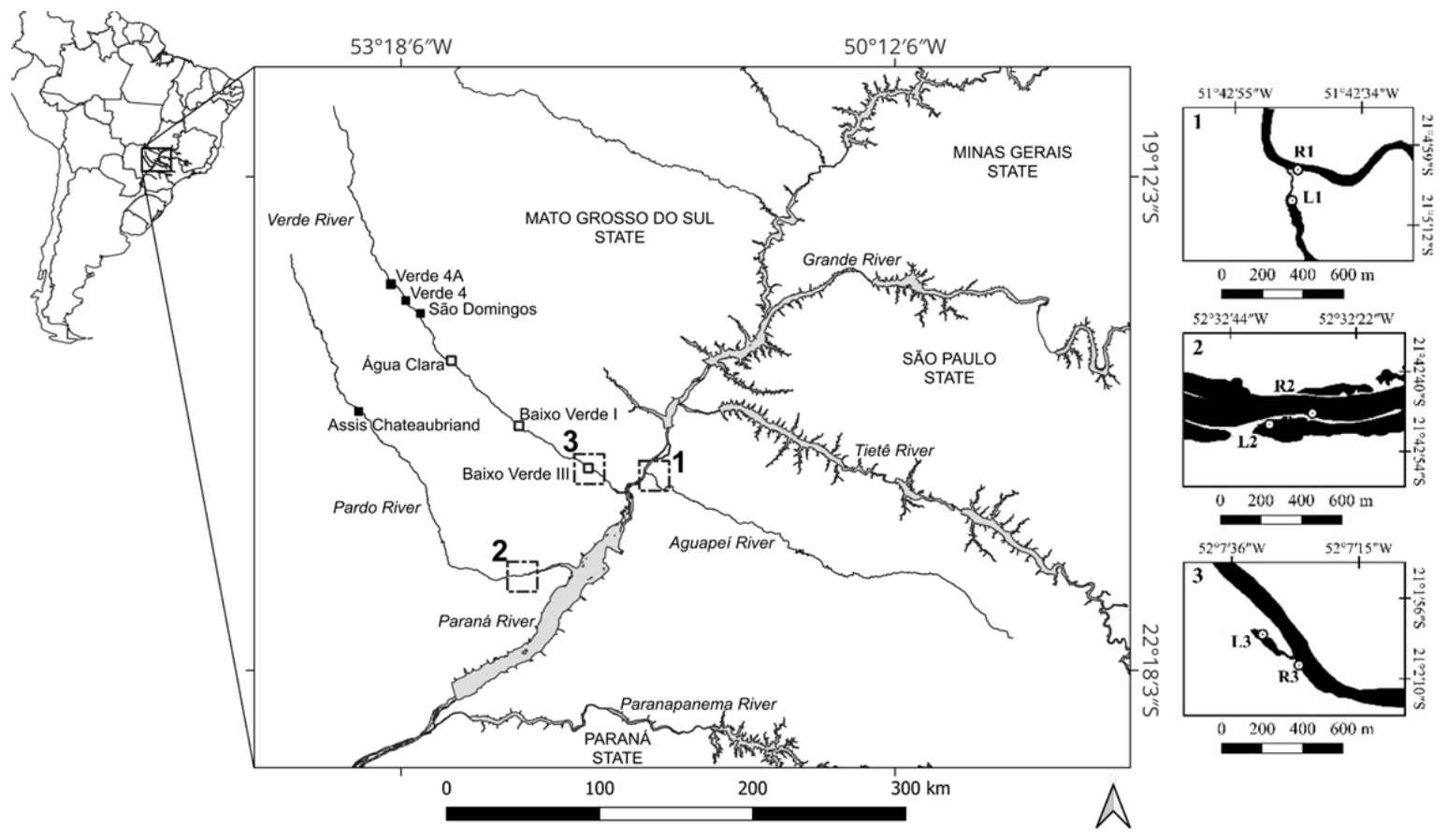
Figure 2.
Sampling sites: (a) Aguapeí River - R1; (b) Aguapeí River lagoon (L1); (c) Pardo River - R2; (d) Pardo River lagoon - L2; (e) Verde River - R3; and (f) Verde River lagoon - L3.
Figure 2.
Sampling sites: (a) Aguapeí River - R1; (b) Aguapeí River lagoon (L1); (c) Pardo River - R2; (d) Pardo River lagoon - L2; (e) Verde River - R3; and (f) Verde River lagoon - L3.
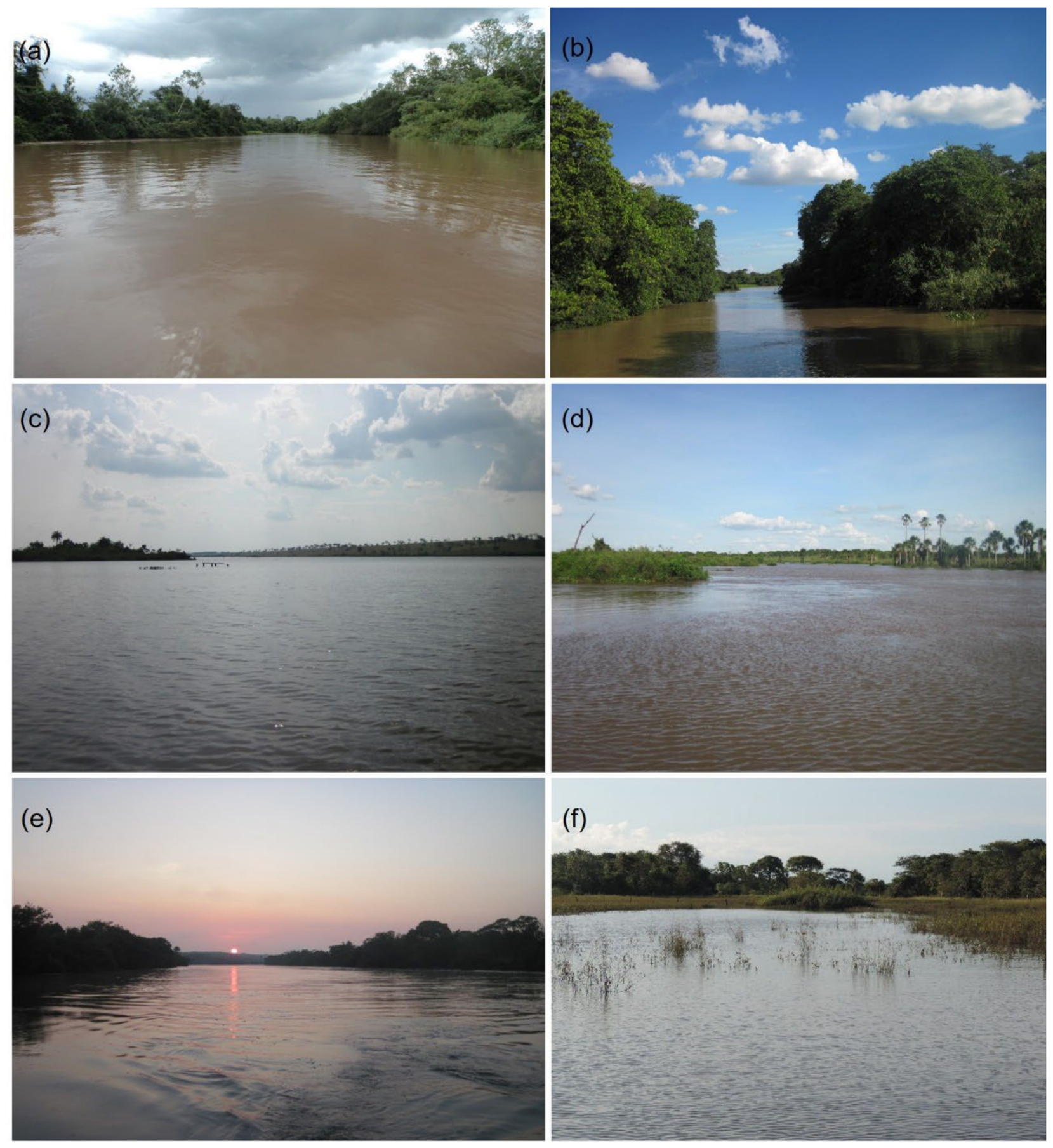
Figure 3.
Distribution of diversity metrics between lentic and lotic habitats across 264 sampling units in tributaries of the Upper Paraná River basin. Violin plots represent density distributions, whereas embedded boxplots indicate medians, interquartile ranges, and dispersion. Different letters indicate significant differences between habitat types based on Kruskal–Wallis tests (p < 0.05). ns = non-significant.
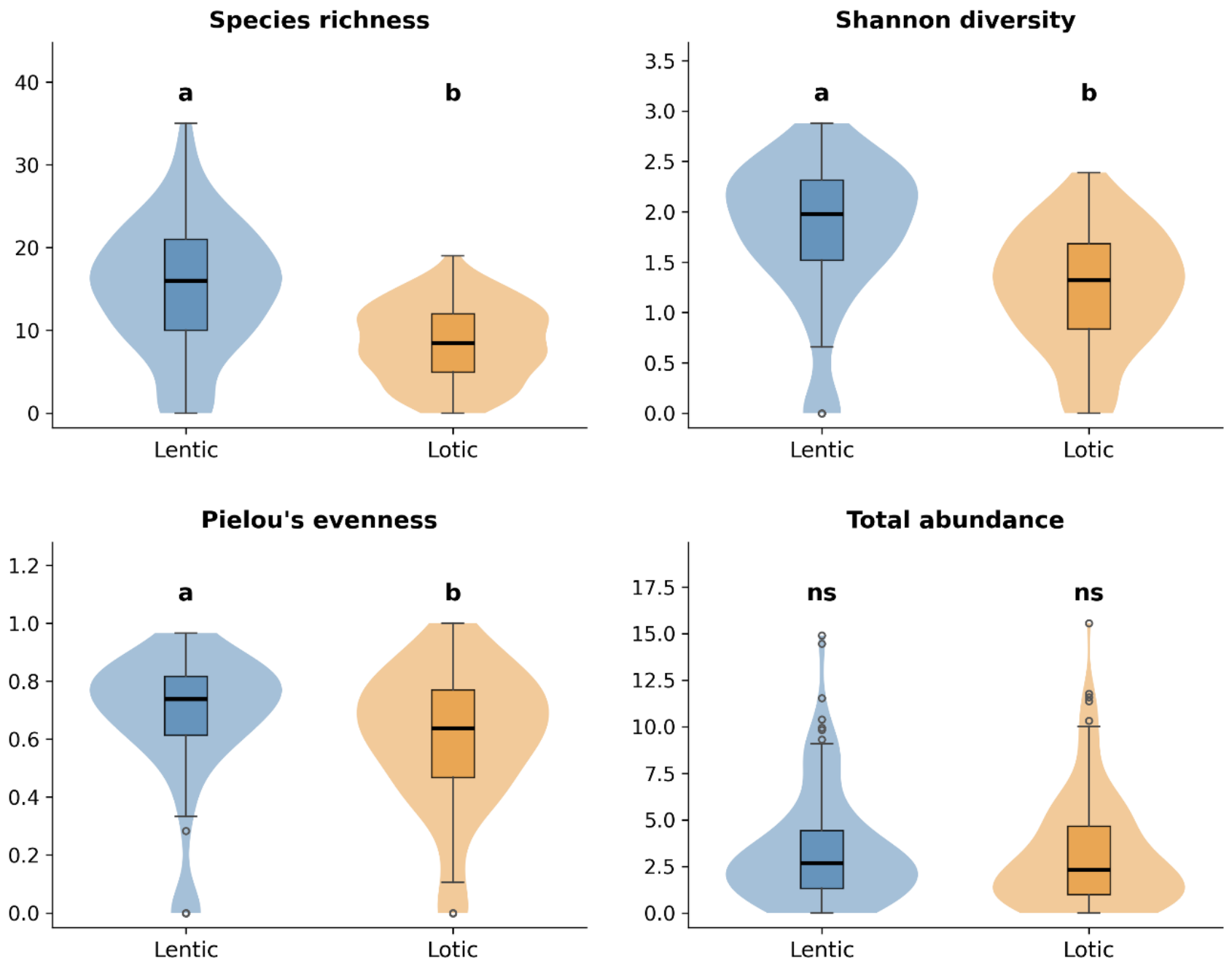
Figure 4.
Ordination of fish assemblages (NMDS) showing the distribution of sampling units according to habitat type (lentic and lotic environments). Stress = 0.249.
Figure 4.
Ordination of fish assemblages (NMDS) showing the distribution of sampling units according to habitat type (lentic and lotic environments). Stress = 0.249.
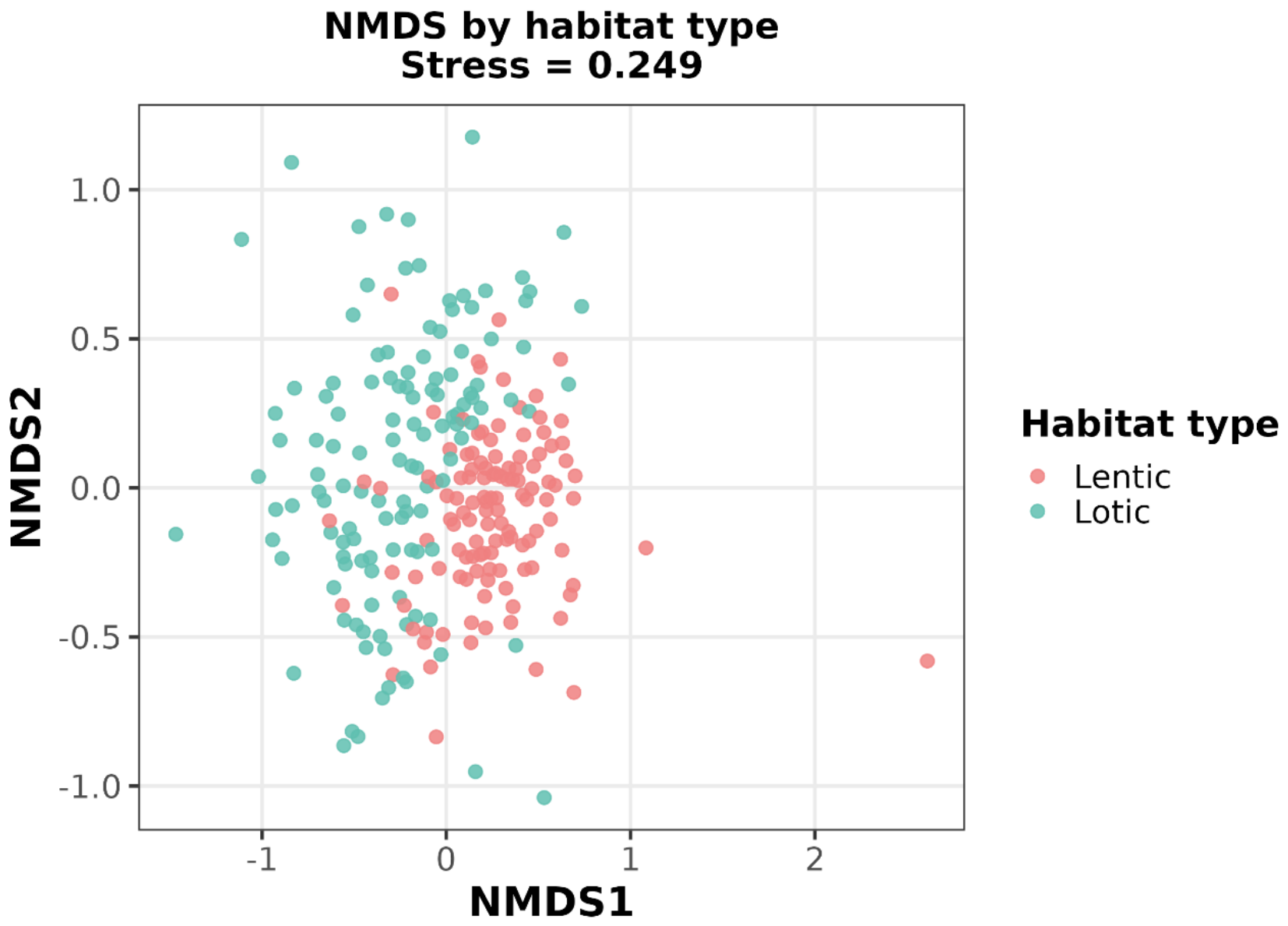
Figure 5.
Ordination of fish assemblages (NMDS) showing the distribution of sampling units among tributaries (Aguapeí, Pardo, and Verde rivers). Stress = 0.249.
Figure 5.
Ordination of fish assemblages (NMDS) showing the distribution of sampling units among tributaries (Aguapeí, Pardo, and Verde rivers). Stress = 0.249.
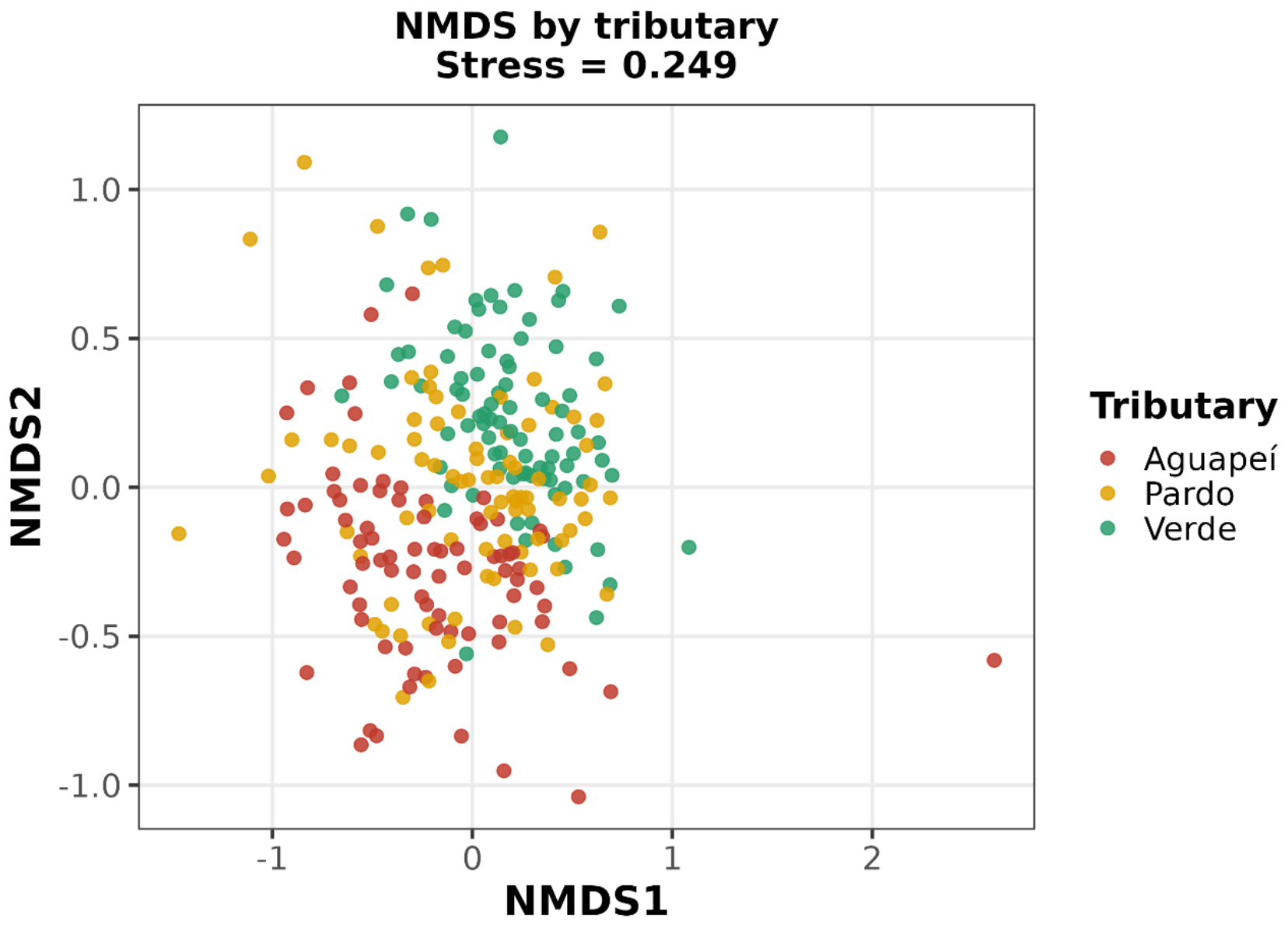
Figure 6.
Distribution of reproductive strategies between lentic and lotic habitats across 264 sampling units in tributaries of the Upper Paraná River basin. Violin plots represent the density distribution of standardized abundance values (MGMS-CPUE) in the original scale, whereas embedded boxplots indicate medians, interquartile ranges, and dispersion. Statistical comparisons were based on generalized linear models fitted to log(x+1)-transformed data; different letters indicate significant differences between habitat types (estimated marginal means with Tukey adjustment, emmeans package; p < 0.05). ns = non-significant.
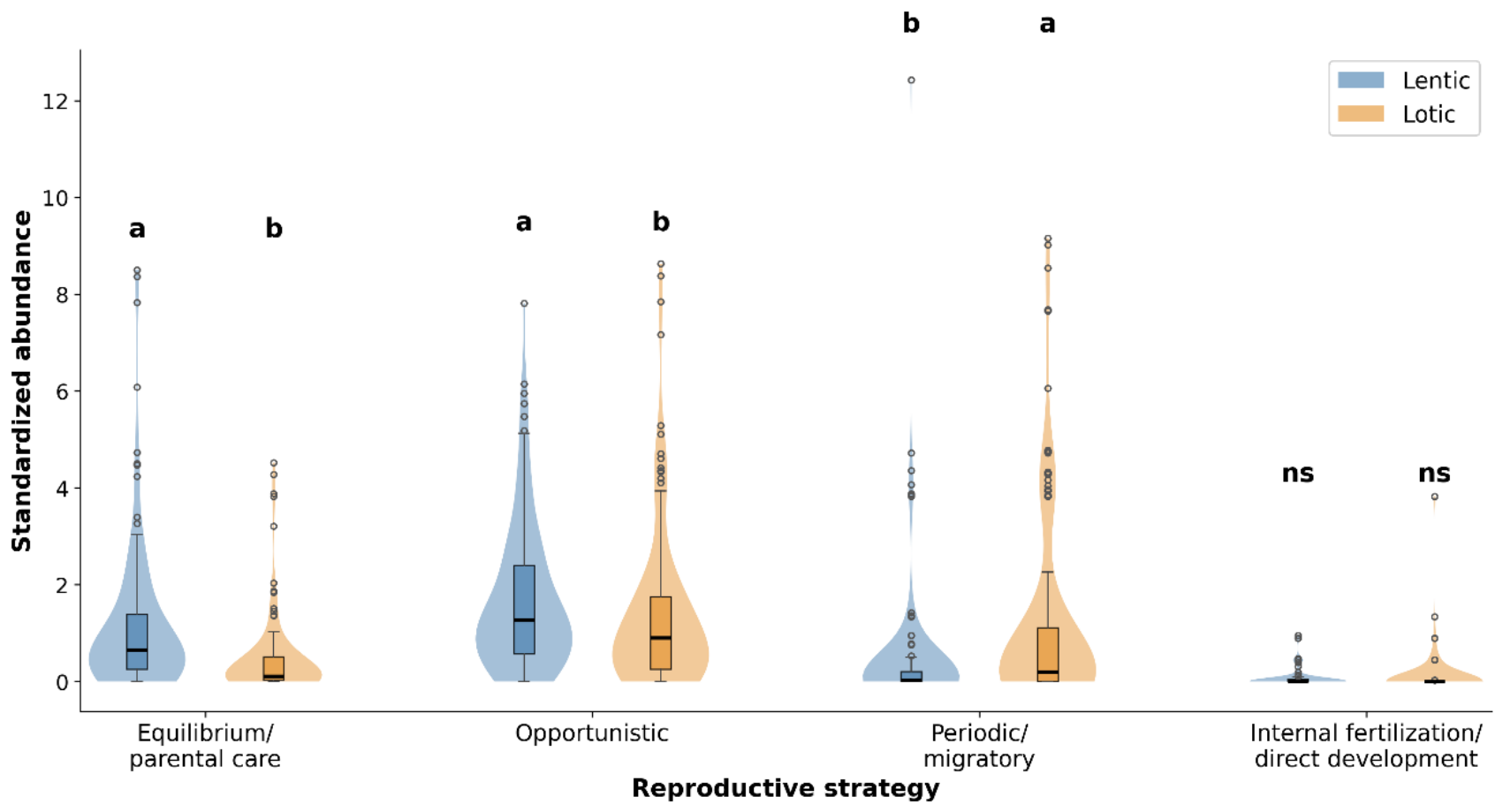
Figure 7.
Heatmap showing the Life-cycle Support Index (LSI) for migratory fish species recorded in the Aguapeí, Pardo, and Verde tributaries of the Upper Paraná River basin. The LSI integrates evidence from adult, juvenile, larval, and egg occurrences (Adult = 1, Juvenile = 1, Larvae = 2, Eggs = 3), providing a measure of the degree to which tributaries support multiple life-history stages of migratory fishes. Higher values indicate stronger evidence of local reproduction, recruitment, and population persistence. Threatened species (Brycon orbignyanus, Pseudoplatystoma corruscans, and Rhinelepis aspera) are highlighted in bold.
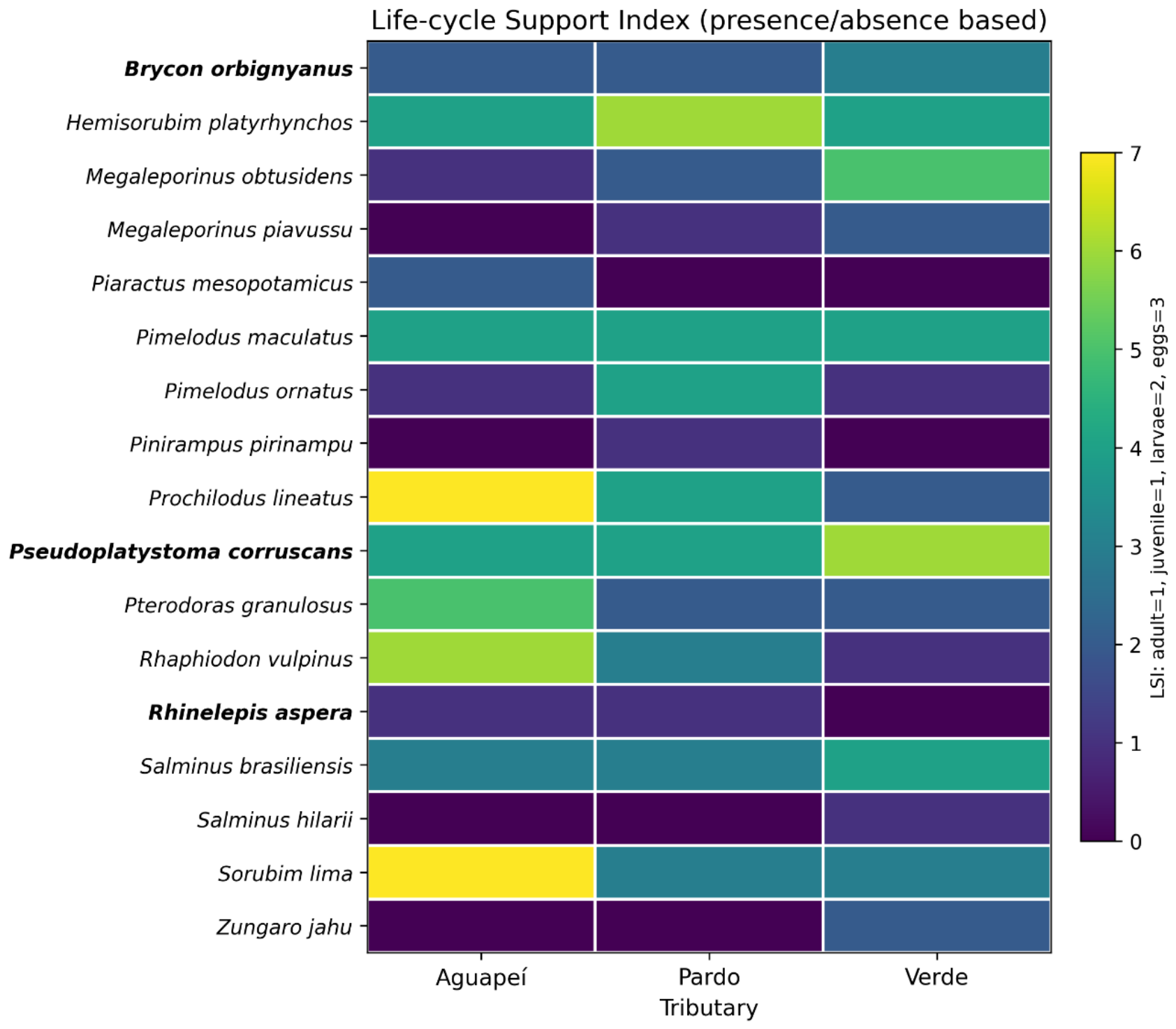
Disclaimer/Publisher’s Note: The statements, opinions and data contained in all publications are solely those of the individual author(s) and contributor(s) and not of MDPI and/or the editor(s). MDPI and/or the editor(s) disclaim responsibility for any injury to people or property resulting from any ideas, methods, instructions or products referred to in the content. |
© 2026 by the authors. Licensee MDPI, Basel, Switzerland. This article is an open access article distributed under the terms and conditions of the Creative Commons Attribution (CC BY) license (http://creativecommons.org/licenses/by/4.0/).
Copyright: This open access article is published under a Creative Commons CC BY 4.0 license, which permit the free download, distribution, and reuse, provided that the author and preprint are cited in any reuse.