

Submitted:
13 September 2026
Posted:
14 September 2026
You are already at the latest version
Abstract
This article explores the strategic pathways to achieve information technology sovereignty that Bangladesh can pursue. Digital sovereignty requires coordinated national capacity across data governance, secure infrastructure, software ecosystems, artificial intelligence policy, cybersecurity, supply-chain resilience, and human capital development. The article proposes a balanced model based on open standards, trusted international partnerships, selective self-reliance, and phased institutional investment. Bangladesh can leverage its youthful workforce, growing digital economy, fintech innovation, and emerging policy frameworks to progressively reduce structural dependency while strengthening national autonomy, resilience, and competitiveness within the global digital order.
Keywords:
IT sovereignty
; Bangladesh
; IT roadmap
Introduction
IT sovereignty of a midsize nation like Bangladesh ideally mean to control its own digital data, infrastructure, AI policy, communication, hardware and software vendors [1]. For IT sovereignty, Bangladesh should have trusted international partnerships and reliable supply chains [2]. Bangladesh is drafting a National AI Policy, digital economy studies and AI readiness assessments [3,4,5]. Building on these prospective policies, this article further proposes a phased ten-year roadmap for Bangladesh and suggest that she should avoid over-reliance on any single entity, technology or nation for cloud, OS, or platform. In public offices ang government-controlled institutions, early adopting of open standards in IT systems will contribute to achieving long-term sovereignty. Moreover, digital and cybersecurity literacy in wider population will strengthen national security. Trusted global partnerships is essential, as it offers knowledge transfer, market access, and advanced technology. Bangladesh is fortunate to have an added advantage of a young, tech-literate population and fintech success through bKash and Nagad. Additionally, Bangladesh has a growing freelance workforce, hi-tech parks, and US, Europe and ASEAN ties, however, need to work to improve overall key capabilities.
Key Capabilities for IT Sovereignty
There are multiple capabilities influence to achieve reasonable sovereignty within Information technology domain for a nation. Regardless of socio, economic and cultural maturity, most of the capability’s domain area are presented in Figure 1. It can be easily argued capable and skilled population can be a huge advantage of Bangladesh. Therefore, invest and improve “Talent and Education” sector is vital for ongoing skills development and supply to job market. On the other hand, Bangladesh has limited land, mining and mineral resources per capita, therefore, strategic alliance with other nations is very important to ensure secure supply chain for hardware components and critical software services and training and co-operation for improving local capabilities.
- Hardware Independence – Bangladesh can focus on partnering with ASEAN countries to establish semiconductor fabrication as well as for indigenous computing hardware. Low human labour cost can provide competitive advantage in chip design, Research and Development.
- OS and Software – Priority can be made on Open-source OS such as Linux and its Bangla supported distributions to adopt in Govt sector. National and collaborative research centres with the partnership of Govt and private universities can spin some of these high ambition research projects for long-term.
- Secure Digital Infrastructure – Bangladesh can enhance its national internet backbone, fixed broadband connection, including boosting 5G/6G networks. Trusted partnership with international vendors, decentralized, resilient local data centres will enhance safety of the digital infrastructure.
- AI, Data & Privacy Governance – The government can focus on data localization laws, create localised ethical AI, and blockchain-based digital identity systems. Sovereign local data will contribute to AI sovereignty; therefore, focus should be given to data privacy. The youth should have open education pathway to become skilled with AI tools. Regular review is need for AI frameworks, AI ethics, and locally relevant use cases [4,5,6].
- Cybersecurity & Cyber Defense – Due to the advancement of AI it is important for a country to form a national cyber army. Private and public institutes needs to adopt zero-trust architectures, and post-quantum encryption (PQC) to counter hacking and espionage [3]. Public and private institutions in Bangladesh should also host and govern its own Public Key Infrastructure and root domains. National sensitive data should remain and govern within the geographics of the country, ensuring adequate decentralised data centres that will reduce dependency on overseas cloud infrastructure. Cybersecurity awareness program starting from school systems to higher education and, to public and private institutions are important to strengthen national cyber defence capabilities.
- Talent & Education –Bangladesh has large youth population and produces many capable engineers each year. Government and private education and business sector should work collaboratively to train the youth, paying attention to emerging AI-driven economy, which can be also facilitated with the new AI tools. Govt should support strong STEM programs such as government-funded research and development (R&D) collaboration with public and private universities. Moreover, Bangladesh can adopt policies to retain tech talent by offering them pathway to succeed within the nation.
- Supply Chain Resilience – In the long-term policy Bangladesh should reduce her reliance on foreign tech and overseas resources. She should look for opportunities to mine and process rare earth material and stockpiling critical components needed for indigenous hardware production [7]. Strategic partnership with other nations can enhance durability in difficult circumstances.
- Financial & Digital Currency Sovereignty – Bangladesh needs to be part of open payment systems to pave the way to integrate digital wallet. Bangladesh can also explore the feasibility study of a central bank digital currency (CBDC).
- Legal Frameworks – Regular reviews and updated legal framework can assist for export controls, Intellectual Property (IP) protection [8]. Bangladesh should also ensure there is updated anti-monopoly laws to safeguard domestic innovation and preventing dominance of foreign tech giants [8] . The country should regularly review the cybercrime laws to ensure adequate penalties for data breaches/espionage for local and international entities [9] .
- Internet, Space & Satellite Autonomy – Bangladesh needs to ensure it has adequate submarine cable support to avoid monopoly of single entities. Bangladesh can extend its cooperation with other space and satellite agencies for sovereign navigation (e.g., EU’s Galileo, China’s BeiDou) and secure satellite internet to avoid single entity dependence like Starlink.
The 10-year roadmap of IT sovereignty is shown in Table 1.
Conclusions
Bangladesh has limited capacity of semiconductor manufacturing and rely on foreign hardware, OS and cloud. Moreover, there is brain drain of skilled engineers as well as low R&D funding. However, Bangladesh can achieve meaningful IT sovereignty within a decade, if she focuses on its capability, developing skillset of the young. For Bangladesh, early sovereignty in IT can come from or in software platforms, cloud and cybersecurity and AI applications. However, chip-design capability, data governance, followed by semiconductor manufacturing industry requires a longer-term partnership with others.
References
- Jiang, M. Models of State Digital Sovereignty From the Global South: Diverging Experiences From China, India and South Africa. Policy Internet 2024, vol. 16(no. 4), 727–738. [Google Scholar] [CrossRef]
- Liu, Y.; Song, W. Navigating digital colonialism: Sovereignty models and development paths in the Global South. Soc. Sci. Humanit. Open 2026, vol. 13, 102546. [Google Scholar] [CrossRef]
- Bangladesh Government. National Artificial Intelligence Policy 2026-2030. Available online: https://aipolicy.gov.bd/ (accessed on 31st July 2026).
- UNDP Bangladesh. Bangladesh Artificial Intelligence Readiness Assessment Report. Available online: https://www.undp.org/bangladesh/publications/bangladesh-artificial-intelligence-readiness-assessment-report (accessed on 31st July 2026).
- Rabbi, M. Z. Bangladesh’s digital transformation roadmap draft: Key takeaways. Available online: https://www.thedailystar.net/tech-startup/news/bangladeshs-digital-transformation-roadmap-draft-key-takeaways-3827356 (accessed on 31st July 2026).
- Weymouth, S. Inside Bangladesh's new data protection laws. Available online: https://www.atlanticcouncil.org/in-depth-research-reports/issue-brief/inside-bangladeshs-new-data-protection-laws/ (accessed on 31st July 2026).
- Uddin, M. R.; Mostafa, M. G.; Pownceby, M. I.; Hossen, M. N.; Rahman, M. A. Rare earth elements in the Ganges-Brahmaputra-Meghna Delta in Bangladesh: A review of their distribution, extraction and pathways for green processing. Hydrometallurgy 2026/06/01/ 2026, vol. 242, 106665. [Google Scholar] [CrossRef]
- International Trade Administration. Bangladesh - Digital Economy. Available online: https://www.trade.gov/country-commercial-guides/bangladesh-digital-economy (accessed on 31st July 2026).
- LightCastle Partners. Balancing innovation and regulation: Insights on digital policies. Available online: https://lightcastlepartners.com/insights/2025/03/balancing-innovation-regulation-insights-on-digital-policies/ (accessed on 31st July 2026).
Figure 1.
Key capabilities for information technology sovereignty.
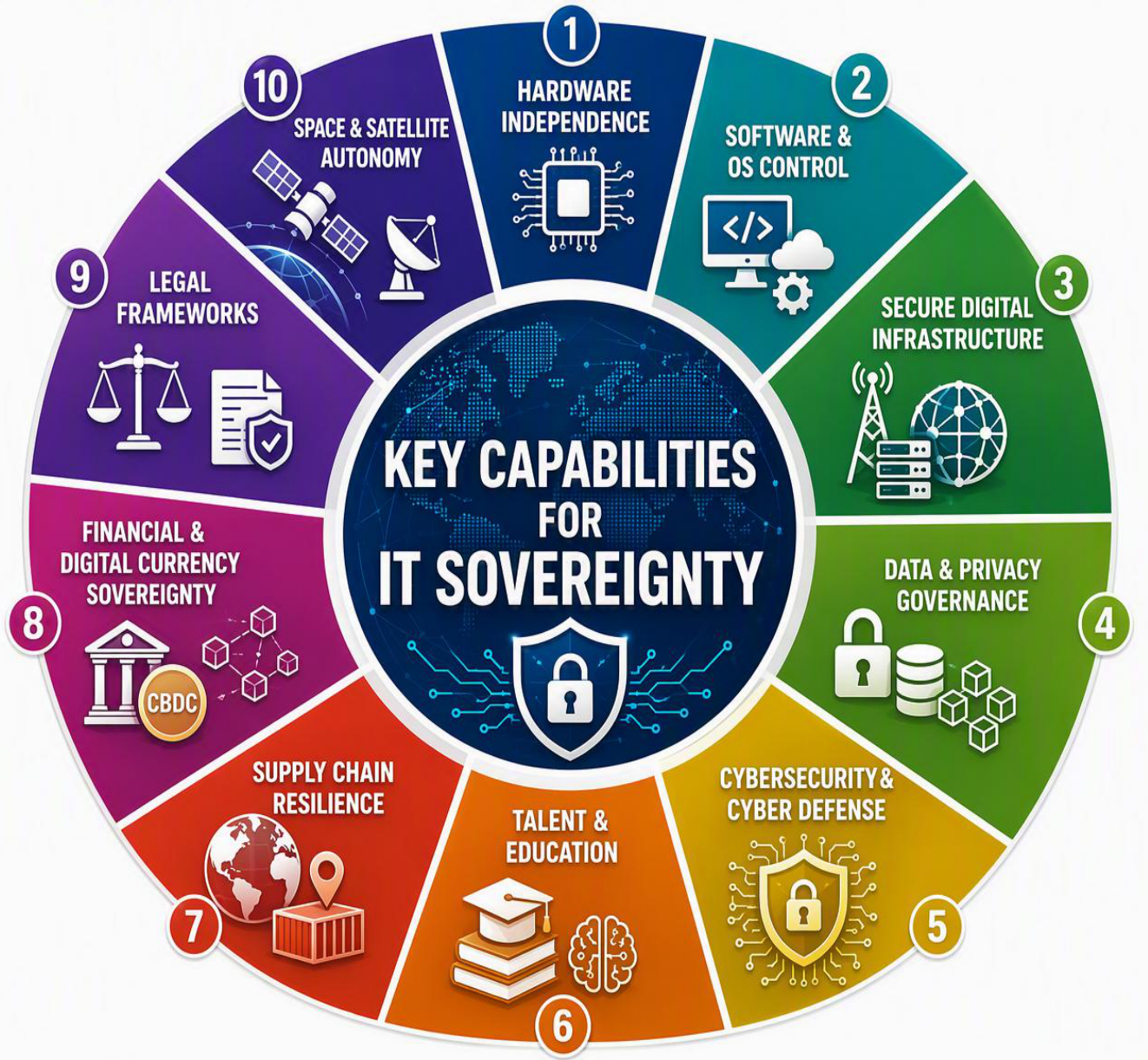

Table 1.
Ten-year roadmap for IT sovereignty for Bangladesh.
| Phase | Years | Focus | Key Actions |
| 1 | 1–2 | Develop foundations | Pass data/cyber/AI laws, strengthen national Cybersecurity, 5G/6G/Submarine cable, enhance chip-assembly, sign GCC, ASEAN partnerships, start R&D in localised ethical AI |
| 2 | 3–5 | Start key systems | Launch sovereign cloud, start CBDC, chip assembly, blockchain digital ID, enhance national cyber defence, diversify localised AI in public and private sectors |
| 3 | 6–8 | Nationwide scaling | Expand chip production, mandatory security audits, adopt PQC, satellite cooperation agreements, localised AI in defence |
| 4 | 9–10 | Gain consolidation | Mature sovereign cloud and AI, diversified connectivity trusted supply chains, strong legal enforcement, |
Disclaimer/Publisher’s Note: The statements, opinions and data contained in all publications are solely those of the individual author(s) and contributor(s) and not of MDPI and/or the editor(s). MDPI and/or the editor(s) disclaim responsibility for any injury to people or property resulting from any ideas, methods, instructions or products referred to in the content. |
© 2026 by the author. Licensee MDPI, Basel, Switzerland. This article is an open access article distributed under the terms and conditions of the Creative Commons Attribution (CC BY) license.
Copyright: This open access article is published under a Creative Commons CC BY 4.0 license, which permit the free download, distribution, and reuse, provided that the author and preprint are cited in any reuse.