
Submitted:
13 September 2026
Posted:
14 September 2026
You are already at the latest version
Abstract
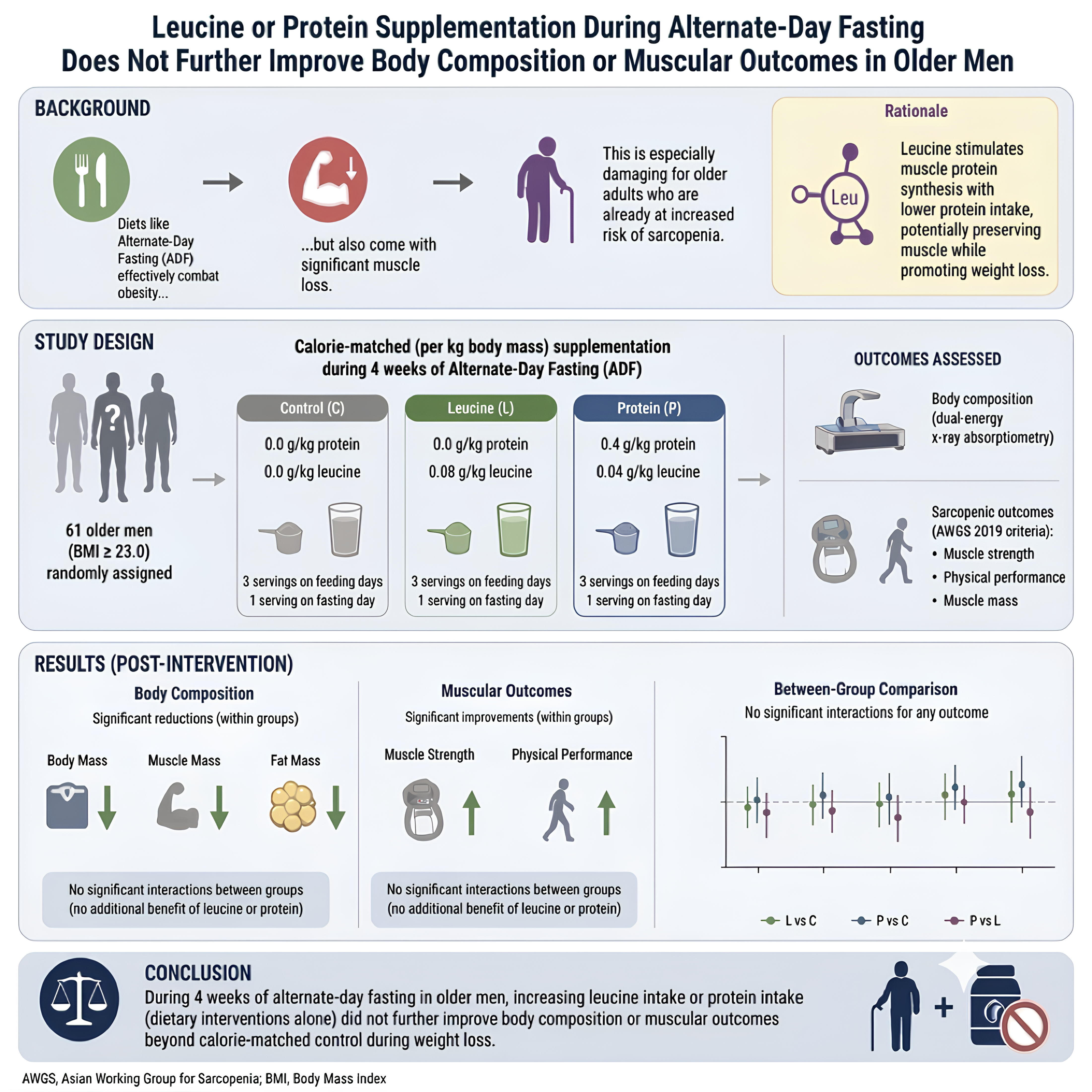
Background: Overweight and obesity are burgeoning health epidemics. Diets including alternate-day fasting (ADF) promote weight loss but risk significant muscle loss, posing health implications to seniors at risk of sarcopenia. Leucine, the key muscle protein synthesis (MPS) driver, effectively stimulates MPS with lower calorie intake than protein. However, the effects of body-mass-scaled protein and leucine intakes are unclear. Objectives: To evaluate body-mass-scaled leucine or protein supplementation on body composition, sarcopenic and cardiometabolic markers in older men during ADF. Methods: Sixty-one older men (BMI ≥ 23.0 kg/m2) underwent 28 days of ADF, randomized across three calorie-matched supplement groups: Control (C: 0.0 g/kg protein, 0.0 g/kg leucine), Leucine (L: 0.0 g/kg protein, 0.08 g/kg leucine), or Protein (P: 0.4 g/kg protein, 0.04 g/kg leucine), consuming three doses on feeding days and one on fasting days. Dual-energy X-ray absorptiometry, sarcopenic metrics, and blood markers (blood pressure, lipid panels, diabetic profiles) were measured. Results: There were no significant interactions (p > 0.05) in body composition, sarcopenic or health outcomes, except diastolic blood pressure (p = 0.016) and HDL cholesterol (p = 0.013). There were significant main effects of time (p £ 0.05) with reductions in all body composition measures (excluding bone mineral density, p = 0.274), systolic blood pressure and lipid profiles (total and LDL cholesterol, total/HDL cholesterol ratio, triglycerides), and improvements in all muscle strength and functional sarcopenic outcomes. Conclusions: Dietary interventions alone that increase leucine and/or protein intake do not further improve body composition, sarcopenic and cardiometabolic outcomes during weight loss.
Keywords:
leucine
; protein
; alternate-day fasting
; intermittent fasting
; weight loss
; muscle preservation
; sarcopenia skeletal muscle
; fat mass
; HOMA-IR
; insulin
Copyright: This open access article is published under a Creative Commons CC BY 4.0 license, which permit the free download, distribution, and reuse, provided that the author and preprint are cited in any reuse.