
Submitted:
12 September 2026
Posted:
14 September 2026
You are already at the latest version
Abstract
Against the backdrop of the platform economy, transforming delivery riders and other new employment groups from objects of governance into forces of governance has become a critical issue in the modernization of grassroots governance. Existing studies focus either on structural domination or on one-dimensional empowerment, and thus struggle to explain the mechanism through which individual agency and macro-level institutions mutually constitute one another. This paper draws on structuration theory to construct an analytical framework of structural opportunity—agentic practice—institutional reproduction, based on qualitative data collected through participant observation and in-depth interviews. Find that riders face a fourfold structural dilemma of algorithmic domination, absent institutional channels, marginalized social identity, and scarce individual resources. The grassroots governance system creates actionable structural opportunities by providing rule-based channels, authoritative resources, symbolic resources, and platform resources. Riders proactively identify these opportunities through practical consciousness, convert their experiential capital into governance capital, accomplish the transition from practical consciousness to discursive consciousness and reflexive monitoring, and systematically construct self-identity, group identity, and social identity. The unintended consequences of their agentic practices, in turn, drive the institutionalization of governance positions, ultimately achieving institutional reproduction and a paradigm shift toward multi-stakeholder co-construction. These findings provide a theoretical foundation and practical insights for moving the governance of new employment groups from the empowerment of individual exemplars toward sustainable, collective ecosystem building.
Keywords:
structural opportunity
; agentic practice
; new employment groups
; grassroots governance
; ecosystem co-construction
1. Introduction
As a typical new employment group spawned by the platform economy, food delivery riders are deeply embedded in the everyday functioning of cities through the occupational characteristics of high mobility, high-frequency reach, and full territorial coverage, and have become a key force sustaining community life and keeping urban micro-circulation flowing. Incorporating delivery riders into the grassroots governance system and shifting them from objects of governance to subjects of governance is both an inevitable requirement for grassroots governance modernization in the face of changing population structures and employment forms, and an important pathway for activating social forces and improving the pattern of co-construction, co-governance, and shared benefits (Li and Xia 2024).
In local governance practice targeting new employment groups, party-led initiatives have established service outposts such as “Rider Stations” and “Riders’ Homes”, and created participation positions such as “mobile grid workers” and “Alley Housekeepers”, rapidly absorbing this group into the governance framework. However, problems such as the group’s insufficient endogenous motivation to participate, the absence of a self-identity as governing subjects, and a weak sense of self-worth remain fundamentally unresolved. Administrative resources continue to sink into communities and service provision keeps expanding, yet why have these investments failed to translate into new employment groups' self-motivated participation in governance (Wang 2025)? The crux is that the prevailing governance model emphasizes one-way empowerment through institutional supply while neglecting the subjectivity claims of new employment groups (Zhe and Ai 2014). New employment groups generally face structural dilemmas of algorithmic control, limited career development, and low social recognition. Delivery riders, in particular, often exist in a vacuum of organizational belonging. Guided by cost-control logic, platform enterprises rarely provide career ladders or carriers of identity, making it difficult for riders to develop a sense of ownership in urban governance. The core question, therefore, is this: how can institutional arrangements break through algorithmic domination and the normalization of mobility—not only opening channels for new employment groups to participate in governance, but also stimulating their endogenous motivation for sustained, in-depth participation, so that riders can verify their self-worth and construct subject identity in governance practice? Only when participation in governance ceases to be passive cooperation under external mobilization and becomes a source of meaning through which individuals achieve occupational dignity, gain social recognition, and build group belonging can institutional arrangements truly retain people, and grassroots governance truly shift from one-way absorption to two-way interaction.
Taking the service practice for new employment groups in S District, Beijing, and the role transition of a rider as its case, this paper introduces the analytical perspective of structuration theory and focuses on three interrelated questions. First, what spaces and resources for governance participation has the grassroots governance system opened up to riders, and how have these external conditions been activated and converted into actual governance action? Second, how do riders transform their own experience into governance resources, achieve the role transition from ordinary laborers to governance participants, and rebuild self-identity in the process? Third, once riders have gained meaning confirmation and value realization through governance practice, how does their participation expand from individual behavior into sustained collective practice, thereby pushing grassroots governance from one-way absorption toward pluralistic co-governance?
2. Literature Review and Theoretical Framework
2.1. Algorithmic Control and Digital Alienation: The Limits of Structural Determinism
Delivery riders and other platform workers confront a distinctive configuration of structural constraints: algorithmic management, thin or absent social protection, and blurred occupational identity. The most influential framework for interpreting this condition is the critical labour-process tradition rooted in Marxian political economy, which treats the platform as a new apparatus of capital that deepens rather than dissolves the alienation of labour (Gandini, 2019; Veen et al., 2020). Within this paradigm, two positions dominate. The first, the algorithmic-control thesis, argues that the labour–capital confrontation has migrated into a new “technology–labour” structure of domination: algorithms, as digital agents of capital, render control invisible and automated, replacing the visible supervisor with a scoring and dispatching system that monitors and disciplines workers in real time (Kellogg et al., 2020; Lee et al., 2015; Rosenblat & Stark, 2016). The second, the alienation-deepening thesis, emphasises the erosion of worker subjectivity: the flexibility ostensibly conferred by platform arrangements in fact serves the efficiency of capital accumulation and does not genuinely strengthen workers’ subject position (Vallas & Schor, 2020; Wood et al., 2019). Under the collusion of capital and technology, workers fall into voluntary overwork under permanent availability as the boundary between work and life blurs.
In China, this line of analysis has shown how algorithmic dispatch and gamified incentives discipline food-delivery riders, while the platform’s multi-layered sub-contracting architecture strips away stable employment ties and enforceable social protection (Chen, 2018; Sun, 2019). Riders thus inherit the predicaments of traditional labour alienation while confronting new alienation mechanisms catalysed by digital technology. Powerful as this paradigm is in revealing the logic of control, its structural-determinist undertone leaves one question unanswered: facing identical institutional predicaments, why do only some riders recognise and seize openings, and accomplish the leap from the governed to governance participants?
2.2. The Subjectivity Turn: Recovering the Actor but Missing the Mechanism of Mutual Constitution
To transcend these limits, a second strand of research has moved beyond the structure–repression framework to reaffirm workers' agency. Labour-process and social-movement scholarship has long insisted that consent and resistance—not mere domination—characterise the workplace, and that workers retain the capacity to bargain, improvise, and organise even within constraining structures (Burawoy, 1979; Silver, 2003). In the gig economy this sensibility has been revived: studies of food-delivery couriers in Europe and beyond show that algorithmic control does not foreclose worker agency, and that riders forge solidarity and collective action in the interstices of platform management (Tassinari & Maccarrone, 2020). In China, where overt collective mobilisation is politically constrained, scholars have foregrounded subtler forms of agency: migrant workers’ collective action despite weak formal organisation (Chan & Pun, 2009); riders’ strategies of “temporal arbitrage” within algorithmic rhythms (Sun, 2019); and—most directly relevant here—the emergence of “contingent agency,” through which platform labourers navigate the gap between the platform's promises and its actual working conditions, improvising identities and practices that are neither fully autonomous nor wholly subordinated (Sun & Chen, 2021). Sun and colleagues' account of platform labour as sticky rather than flexible further shows how riders are held fast in platform employment even as they actively manage its demands (Sun et al., 2023).
Empirically, the Chinese case adds a further layer. Younger and better-educated riders often treat delivery work as a career transition, accumulating resources and seeking upward mobility—whether promotion within the platform hierarchy, intra-industry job change, or a complete change of track through skills training or entrepreneurship (Gao, 2022). Riders also build self-organised mutual-aid networks in physical and digital space, adapting the connective functions of traditional locality and kinship ties to the new spatiotemporal separation of the digital era (Li & Su, 2022). Yet this turn, for all its empirical richness, has recovered the actor at the cost of re-erecting the structure–agency dichotomy. Studies in this vein either celebrate individual resistance to structure or describe survival in its crevices; they pay far less attention to the mechanism of mutual constitution between the two, and to the specific institutional route through which platform workers are converted into governance actors.
2.3. State–Society Relations and Party-Led Incorporation: Top-Down Integration, Neglected Endogenous Motivation
A third, largely Chinese-language literature examines the party-state’s incorporation of new employment groups into grassroots governance. Its relevance must be read against the broader scholarship on Chinese state–society relations, which has documented the state’s reach into everyday social life (Shue, 1988), the negotiated and boundary-testing character of popular contention (O’Brien & Li, 2006), and the party’s adaptive strategies for managing an increasingly differentiated society (Dickson, 2016; Teets, 2013). Within this framework, the Communist Party’s “party-building” (dangjian) initiative extends party organisation into new social strata, non-state workplaces, and digital platforms, aiming to convert emerging groups from latent sources of instability into resources for social management (Hasmath & Hsu, 2014).
The Chinese scholarship on new employment groups unfolds along four lines: the formation, characteristics, and labour conditions of these groups; the practical forms of incorporation, such as “party-building alliances” in the express-delivery industry (Wang & Xia, 2025) and “drivers’ homes”; policy and institutional recommendations that stress strengthening party organisations’ political and organisational functions (Wang, 2024); and, from united-front and social-stratification perspectives, paths of political integration and social inclusion that treat new employment groups as a new social stratum. Recent studies have further argued that party-building leadership, a “warm organisational ecology,” and digital empowerment can convert a potential “governance difficulty” into an active “governance resource” (Zhang, 2025), and have mapped the internal logic and advancing paths of party-building-led integration into community governance (Wang, 2025); at the practical level, cities such as Shenzhen have piloted multi-actor linkages of “elevated management + industry management + territorial management” (Che & Fu, 2024). A closely related concept in the English literature is Sun’s (2022) “platformed governance,” which describes how digital platforms and the state co-produce new regimes for integrating migrant platform workers. Nevertheless, this literature largely sustains a state-centred perspective, emphasising top-down institutional design and organisational coverage while considerably neglecting the core motivation of new employment groups’ governance participation: the realisation of self-worth and the construction of self-identity.
2.4. Theoretical Framework of This Study
The practice of party-building-led grassroots governance is primarily not the one-way implementation of classical theory or state ideology, but a process in which diverse actors respond to it in everyday life. To understand the governance relationship between the state and new employment groups, one must attend simultaneously to the top-down structuring process—the institutional construction at the state level—and the bottom-up structuring process—the agentic construction by social organizations, groups, and individuals in everyday practice; one must attend not only to “institutionalized events” but also to “everyday life practices”, and carefully dissect the interactive mechanisms between the two (Zhe and Ai 2014).
Against this background, how do institutionalized events and everyday life practices actually meet? How is a connection established between macro institutional logic and micro behavioral meaning? This study argues that the key lies in two conditions: whether institutions provide participants with actionable opportunity structures and spaces for participation, and which actors actually respond to and join the process (Zhou and Ai 2010; Zhe and Ai 2014). Only by placing actors and their practices at the center of observation and analysis can we return to real social situations and understand the actual forms and operating logics of governance structures and mechanisms in the empirical world (Zhe and Ai 2014).
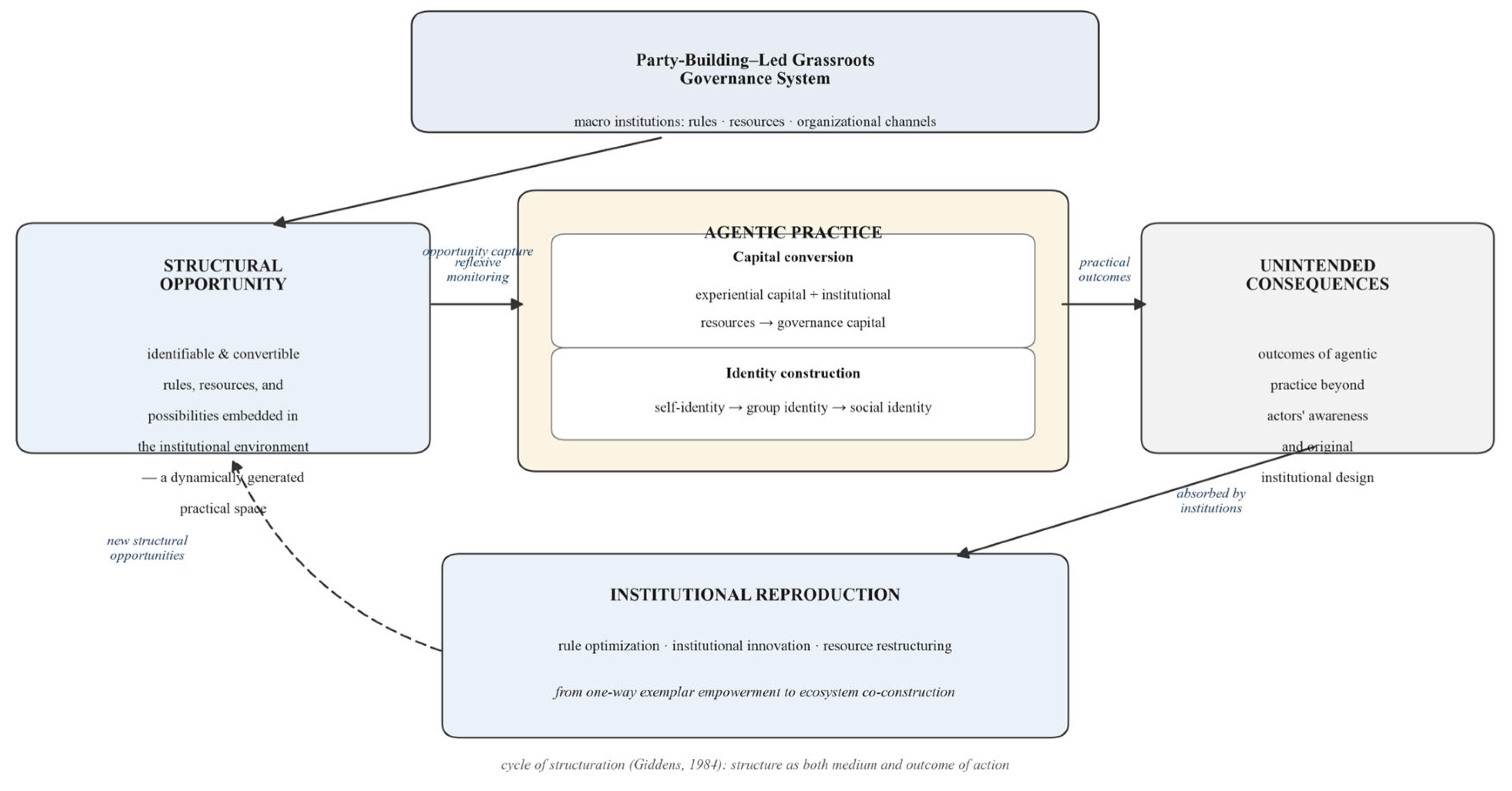
Structuration theory holds that social structure is both the medium and the outcome of human action; constrained by rules and resources, actors exercise agency through reflexive monitoring, and the unintended consequences of their actions further drive institutional reproduction (Giddens 1984; Sewell 1992; Stones 2005). On this basis, this study proposes the core concept of structural opportunity as a bridge connecting macro institutions and micro action. Structural opportunity refers to the rules, resources, and possibilities embedded in the institutional environment that can be identified by actors and converted into resources for actual action. It is not a static institutional arrangement but a dynamic practical space jointly constructed by institutions and actors in continuous interaction. This space keeps evolving and expanding with actors’ agentic practice, displaying the character of dynamic generation. It is not a passively existing window of opportunity but the product of the continuous mutual constitution of structure and action: it encompasses the objective possibilities institutions provide, yet also depends on actors’ subjective capacity for discernment and deployment, and is a practical space continuously generated in the dynamic interaction of the two. Actors capture opportunities through reflexive monitoring and convert existing capital into new action resources; the unintended consequences of their practice are in turn absorbed by institutions, creating new structural opportunities for other actors—thus forming a continuously evolving cycle of structuration.
We construct the analytical framework of structural opportunity—agentic practice—institutional reproduction to explore how new employment groups capture the structural opportunities provided by the grassroots governance system (Figure 1), convert their experiential capital and external institutional resources into governance capital, and thereby accomplish the systematic construction of self-identity, group identity, and social identity. The unintended consequences of their agentic practice in turn drive the optimization of governance rules, institutional innovation, and resource restructuring, ultimately achieving institutional reproduction and pushing the governance of new employment groups from one-way empowerment dependent on individual exemplars toward an ecosystem-co-construction paradigm of plural actors working in synergy—completing the dynamic mutual constitution of individual agency and macro structure.
3. Case Description and Methods
3.1. Case Description
The Rider Station (xiaoge jiayouzhan) is a service site upgraded by the Communist Youth League Committee of S District, Beijing, on the foundation of the Community Youth Hubs, with physical operation and management entrusted to the S District Youth Social Work Association. Targeting new employment groups as its principal service population, the station adopts a trinity operating model of service station/ parlor/growth camp. In terms of life services, the station provides everyday support such as battery swapping, resting spots, drinking water and meal heating, first-aid supplies, and information on rental housing and part-time jobs, and holds birthday parties and holiday gatherings at intervals to strengthen the group’s sense of social belonging. In terms of capacity building, the station draws on Community Youth Hub resources to run training programs such as low-voltage electrician courses and continuing-education classes, supporting riders’ further education and career development. The station runs on a riders serving riders mechanism, selecting outstanding riders as rider social workers (xiaoge shegong) who, as station heads, take concrete charge of service delivery and group cohesion. All three stations are located in residential areas and around large commercial districts where new employment groups are highly concentrated, so as to achieve precise coverage and efficient reach.
This study takes Afeng, who successfully transitioned into a rider social worker, as its typical case. Afeng came to Beijing from a small town in Northeast China in 2018 to do food delivery. That December, he met the head of the S District Youth Social Work Association at an association event and began participating regularly in its activities. During the COVID-19 pandemic in 2020, he volunteered to join the team delivering groceries to locked-down residential compounds and was named a “Most Beautiful Hero in Harm's Way”. Thereafter, he began proactively spotting and reporting urban governance problems along his delivery routes, becoming the rider who reported the most issues in the snap-and-report campaign and an exemplar of governance contribution. On the association’s recommendation and in recognition of his sustained performance, Afeng was honored as a “Beijing Youth Role Model” in 2019 and received the “Beijing May Fourth Youth Medal” in 2020. In 2021, he submitted his application to join the Communist Party of China and enrolled in a continuing-education program, successfully obtaining an associate degree through adult education. After the rider stations were established at the end of 2022, he passed the selection in January of the following year to become a full-time social worker, responsible for station operation and rider liaison. In 2024, Afeng completed his one-year probationary period and became a full Party member; in 2025, he passed the junior social worker examination and was successively named a “Beijing Municipal Model Worker” and a “Young Pioneer of the New Era”.
3.2. Research Methods
This study adopts qualitative methods, collecting empirical materials through participant observation and in-depth interviews, with a focus on the role-conversion mechanism of new employment groups participating in grassroots governance and the practical logic behind it.
From November 2024 to April 2026, we conducted multiple rounds of fieldwork in S District, Beijing, at the rider stations and the Youth Social Work Association, as well as in relevant government departments including the Municipal and District Party Committees’ Departments of Social Work and the District Committee of the Communist Youth League. Through participant observation, we recorded behavioral patterns, discourse features, and interactions among multiple actors in station activities, rider interactions, and rider social workers’ working practice. In addition, the team conducted multiple rounds of one-on-one semi-structured interviews with four categories of subjects: 10 staff members of relevant government departments, 2 administrators of the Youth Social Work Association, 4 rider social workers, and 20 delivery riders active around the stations. Each interview lasted approximately 60 to 120 minutes, was audio-recorded in full, and was supplemented by field notes. All recordings were transcribed verbatim for subsequent analysis.
4. Structural Dilemmas and Structural Opportunities in New Employment Groups’ Participation in Grassroots Governance
Delivery riders and other new employment groups are deeply embedded in the chain of urban operations, yet at the starting point of grassroots governance participation they are broadly trapped in a systemic structural dilemma woven from algorithmic domination, absent institutional supply, marginal social identity, and scarce individual resources.
4.1. The Structural Dilemmas of New Employment Groups’ Participation in Grassroots Governance
Algorithmic domination: the comprehensive disciplining of time and space. Platforms have built, through digital technology, a whole-process, fine-grained, automated model of labor control that decomposes riders’ work behavior into quantifiable, monitorable, and assessable data indicators, replacing human management with algorithmic commands and forming a hidden yet rigid structure of domination. Under algorithmic rules, delivery routes, order-taking frequency, delivery timeliness, and service ratings are all preset by the system; riders must strictly follow algorithmic instructions and remain in a tense state of permanent availability. To maintain income, riders have to extend working hours and compress rest time, long remaining in a labor state of high intensity, high pressure, and high risk, with almost no freely disposable leisure time for community deliberation, volunteering, hazard reporting, or other grassroots governance activities. “I've been in Beijing three years. Every day is just running orders, I don't think about anything else. What else can I do? If there's an order I take it, if not I rest—basically every day is like that""(interview material, delivery rider Xiao Wang). Meanwhile, the algorithm has fragmented and fixed riders’ labor space. Riders' range of activity is carved into discrete delivery grids, and their work paths unfold strictly around orders: although they shuttle daily through community lanes and commercial buildings, they can hardly form stable spatial belonging or community ties. Riders cannot integrate deeply into community life like settled residents, and it is difficult for them to build sustained perception of community environments, residents’ needs, and governance pain points; even those willing to participate find it hard to do so under the dual constraints of space and time.
Absent institutional supply: the double exclusion of identity and channels.
The traditional grassroots governance system rests on the presuppositions of household-registration locality, work-unit membership, and fixed residence, taking permanent residents, work-unit employees, and community residents as its core objects of governance and service; its institutional design, organizational structure, and participation mechanisms all match a fixed and stabilized social structure. Delivery riders, however, are characterized by high mobility, weak labor relations, cross-district activity, and a high proportion of non-local household registration—an evident mismatch with the institutional logic of the traditional governance system that plunges them into a structural dilemma of absent institutional supply. In terms of governance status, riders have long been regarded as mobile outsiders and objects of management and service rather than governance subjects with rights and responsibilities; institutions have made no clear arrangements concerning their qualifications, pathways, or safeguards for participating in grassroots governance. In terms of participation channels, conventional mechanisms—community deliberation councils, residents' congresses, volunteer service teams, the grid management system—have opened no institutionalized entry to the rider group, leaving riders without legitimate, stable, and predictable avenues of participation. In terms of rights protection, the traditional governance system has failed to provide adaptive support for riders' occupational characteristics; the supply of labor protections, safety guarantees, and channels for expressing demands is markedly insufficient.
Marginal social identity: the dissolution of worth and inner motivation.
Social identity is an important psychological foundation for participation in public affairs, yet delivery riders commonly face the marginal-identity dilemma of low occupational prestige, one-dimensional social evaluation, and weak self-worth. In public perception, food delivery is often seen as a low-skill, high-intensity, easily replaceable occupation; media narratives and public impressions focus on negative information such as late deliveries, traffic violations, and service disputes, granting insufficient recognition and respect to riders’ labor value, social contribution, and personal dignity. Such one-sided, labeling evaluation traps riders in an encompassing occupational inferiority and devaluation of worth, making positive self-perception and group identity difficult to form. Meanwhile, although riders traverse urban communities daily and have high-frequency contact with residents, merchants, and community workers, they can hardly establish stable emotional bonds or belonging, presenting the state of “the most familiar strangers” in the city. High mobility makes it hard for them to put down roots in any one community, and weak organization deprives them of channels for collective voice and image building; the public knows little about their real living conditions, labor effort, and practical demands, breeding alienation and estrangement. For individual riders, the absence of social identity directly dissolves the inner motivation to participate in grassroots governance: participation in public affairs and service to community residents is in essence a value-laden behavior requiring the realization of self-worth and the gaining of social recognition as intrinsic incentives. When riders remain in a social situation of being ignored, disparaged, and distanced, they can hardly develop a sense of ownership or responsibility, still less the motivation and passion to actively participate in governance and contribute their strength.
Scarce individual resources: the multiple restriction of capacity and conditions. Participation in grassroots governance requires individuals to possess corresponding human capital, economic capital, social capital, and organizational capacity as supports, yet delivery riders commonly face the constraints of multiple resource scarcity, further aggravating their participation dilemma. That delivery riders have become the base labor force of the digital economy is closely related to the multiple structural resource constraints they encountered while growing up. The regional imbalance of educational resources is the primary factor: a considerable share of riders come from county-level and below areas (Employment Blue Book 2023), facing high teacher turnover and backward teaching facilities in basic education, and many even dropped out after junior high school; the low-education-threshold food delivery industry thus became the main way out among their limited options. The inter-generational poverty of family economic capital forms a second shackle: many riders’ parents work in agriculture or odd jobs, and families have weak risk resistance; delivering food in the city quickly relieves economic pressure but hardly accumulates capital. Youth who grew up in county economies often understand career development narrowly as “more work, more pay”, fail to recognize the inherent fragility of gig work, and generally lack necessary knowledge of the social security system. Educational deprivation restricts them to low-skill jobs, economic pressure drives them to pursue immediate income, limited social networks narrow their information sources, and cognitive gaps weaken their capacity for long-term planning.
4.2. Grassroots Governance as Structural Opportunity
Facing the systemic predicament of the delivery rider group, the grassroots governance system—with party building as the core leadership, coordinating youth league organizations, sub-districts and communities, social organizations, and platform enterprises—has systematically constructed structural opportunities for riders through institutional innovation, the sinking of resources, identity empowerment, and spatial reconstruction. With rule-based channels as the pathway, authoritative resources as the fulcrum, symbolic resources as the incentive, and platform resources as the support, the four work in synergy to provide riders with the legitimate foundation, institutionalized channels, value-based support, and practical guarantees for breaking through structural dilemmas and joining grassroots governance, granting riders who were once at the margins of governance the real possibility of entering the governance field, achieving identity transformation, and realizing their subject value.
Rule-based channel opportunities are the core support of structural opportunity. Through institutional design, the grassroots governance system opens legitimate, standardized, stable, and predictable pathways for riders to participate, converting scattered, spontaneous, ad hoc individual behavior into institutionalized, organized, sustainable governance action. S District explored the establishment of the rider social worker system, selecting riders with outstanding performance, public recognition, and notable ability to transition into full-time or part-time social workers who participate comprehensively in services for new employment groups, community governance coordination, and dispute mediation, forming a replicable and scalable model of institutionalized participation.
Authoritative resource opportunities refer to the organizational anchoring, political identity, and legitimate authority riders obtain in governance participation—the key support for their transformation from scattered individuals into governance subjects. Party organizations proactively bring outstanding riders into the Party member development sequence, providing channels for political growth; youth league organizations, trade unions, and social work associations reach out to the rider group, establishing dedicated liaison mechanisms and organizational belonging, ending their state of having neither organization nor anchorage.
Symbolic resource opportunities are those through which the grassroots governance system, by conferring honors, publicizing commendations, and shaping values, provides riders with social recognition, elevated prestige, and spiritual incentive—an important opportunity for resolving their dilemma of marginal social identity. Participation in grassroots governance is no longer meaningless extra effort but a value-laden behavior capable of earning honor, respect, and a sense of achievement, thereby activating group members' inner motivation to participate.
Platform resource opportunities are the physical space, hardware facilities, funding guarantees, skills training, and organizational support that the grassroots governance system provides for riders’ governance participation—the material foundation on which structural opportunities take effect. From the dimensions of physical space, capacity building, and resource guarantees, they remove the practical obstacles to riders’ participation, giving them a place to participate, conditions to act, and support to rely on, and converting latent willingness into tangible governance action.
Given relatively complete structural opportunities, then, which actors can keenly identify and deeply engage with them?
5. Agentic Practice and Institutional Reproduction in New Employment Groups’ Participation in Grassroots Governance
Facing the rules, authority, symbols, and platform resources offered by the grassroots governance system, delivery riders are not passive recipients: on the basis of their own experience, lived habits, and practical reason, they actively identify opportunities, capture resources, convert capital, and enhance identity, completing the subjective leap from passively receiving empowerment to actively participating in governance.
5.1. Agentic Practice: Opportunity Capture, Consciousness Upgrading, and Subjectivity Construction
5.1.1. Opportunity Capture: Opportunity Recognition and Action Response Based on Practical Consciousness
Riders’ capture of structural opportunities is not a deliberate choice based on rational calculation but arises from the practical consciousness formed in everyday life practice—a kind of tacit knowledge and behavioral habitus that need not be explicitly articulated yet guide action. Many riders come from grassroots society, deeply influenced by mutual-aid ethics, responsibility consciousness, and rural-native values, and in long-term labor have formed the behavioral traits of warm-heartedness in helping, quick response, and familiarity with the community. When the grassroots governance system launches participation opportunities such as Alley Housekeepers, volunteer support, and hazard reporting, riders can, by virtue of practical consciousness, quickly identify and proactively respond, naturally linking institutional opportunity with their own action.
For example, when Afeng first participated in grassroots governance, his action did not originate in rational cognition of discourse systems such as “social governance” or “public participation”. Growing up in the acquaintance society of a small Northeast county town and steeped in the collectivist ethos of a worker’s family, he internalized an almost instinctive behavioral propensity to help one another in adversity—if it ought to be done, do it. This consciousness was not triggered by discursive reflection but was directly activated and guided behavior in specific situations. During the pandemic, Afeng took it as his unshirkable duty to deliver food to residents of locked-down compounds: “I knew that once I went in I couldn’t get out, but so what? —The goods had to be delivered to everyone. Honestly I didn’t think too much at the time.” (interview material, Afeng). Practical consciousness is neither the purely subjective and contingent of interpretive sociology nor the wholly externally determined of functionalism; it is always influenced by social structure and becomes structured through continuous practice across time and space. Afeng’s helping behavior, though manifest as individual action, rests on a habitus system jointly shaped by local ethics, family upbringing, and labor experience—a mode of cognition socially and culturally constructed yet presented in embodied form.
This capture of opportunities is not elite-style rational planning but intuitive action rooted in the life-world—the fit point riders find between their own situation and institutional supply. Opportunity capture driven by practical consciousness allows riders to blend naturally into grassroots governance scenarios without leaving their main occupation or taking on excessive burdens, opening their identity transformation from ordinary laborer to governance participant.
5.1.2. Consciousness Upgrading: From Practical Consciousness to Discursive Consciousness and Reflexive Monitoring
In structuration theory, the internal driving force of human action can be parsed through the stratification of consciousness, especially the distinction and interaction between practical consciousness and discursive consciousness. Practical consciousness refers to knowledge actors can tacitly grasp and skillfully deploy in action—knowing how without necessarily being able to say; discursive consciousness refers to cognition and reasons actors can explicitly articulate in language (Zhao 2017; Jin 2008). The core difference lies in whether it can be clearly articulated and whether it depends on explicit formulation (Dong and Wang 2008). This distinction is of key theoretical significance for understanding how new employment groups capture structural opportunities and achieve governance participation and identity transformation.
Practical consciousness can drive action, but to develop into sustained, self-conscious governance participation it must be converted into discursive consciousness. This does not occur naturally but depends on the external institutional environment providing meaning frames and symbolic resources that name, interpret, and endow action with value. The district youth league committee’s “Alley Housekeeper” program, the “Most Beautiful Hero in Harm’s Way” commendations, and the subsequent Party membership education together constituted institutional mediators that enabled this conversion of consciousness levels. At first, although Afeng constantly shuttled through communities reporting governance problems such as residents’ piling up of materials, he could not articulate his own behavior as “grassroots governance”—until his everyday observations were incorporated into the framework of public affairs, and his volunteer action received dual moral and political recognition. “Only after joining the Party did I understand that what I was doing was ‘social governance’. Before that, what did I know about governance? I just felt it was right, so I did it.” “The organization trusts us, so we must do it well, serve the riders well, and truly solve their urgent difficulties and worries”(interview material, Afeng). The generation of discursive consciousness is thus belated and dependent on external interpretation, but it provides action with a rational foundation and value coordinates, moving action from intuition to self-consciousness and from isolated behavior to institutional participation.
5.1.3. Subjectivity Construction: Completing Identity Transformation Through Triple Identity
Under sustained governance participation, upgrading levels of consciousness, and empowerment by institutional resources, riders accomplish the systematic, progressive construction of self-identity, group identity, and social identity, realizing the identity transformation from objects of governance to subjects of governance. In the process of participating, riders gain a sense of achievement through contributing strength, a sense of belonging through organizational empowerment, and a sense of dignity through social recognition; their sense of self-worth rises markedly, shaking off occupational inferiority and marginal mentality. Within the group, positive incentives take shape: outstanding riders bring more peers into participation, forming an atmosphere of emulation, and group identity keeps strengthening.
First, from occupational inferiority to value verification: the establishment of individual subjectivity. Within structural dilemmas, riders are long locked into a single instrumentalized identity, their labor value disparaged and occupational dignity weakened, generally sinking into a self-negating state of low self-worth, low sense of achievement, and low expectations of the future. After joining grassroots governance, empowered jointly by rule-based channels, symbolic resources, and authoritative resources, riders can step beyond the purely laboring scene and enter the field of public participation. They report community hazards, join emergency services, liaise over peers’ needs, and help implement governance, solving real governance problems with their mobility advantages and community experience; their action is no longer completing orders but creating public value.
Second, from atomized dispersion to communal bonding: the group-identity dimension of collective subjectivity. After joining grassroots governance, relying on platform resources such as the rider stations, rule-based channels such as rider social workers, and symbolic resources such as honors and exemplars, outstanding riders become liaisons and organizers within the group, beginning to proactively care about peers’ demands, coordinate the group’s difficulties, relay policy information, and bring more peers into governance. In mutual-aid practice and collective action, the rider group gradually forms a communal consciousness of “riders understanding riders, riders helping riders, riders co-governing and sharing”. They are no longer mutually unrelated scattered laborers but a new employment group with shared situation, shared interests, and shared identity; no longer passively awaiting external relief but actively self-serving, self-managing, and self-empowering. This group identity greatly raises the degree of organization, elevating individual participation into group participation and scattered action into collective action, providing the group foundation for the orderly integration of new employment groups into governance.
Third, from urban sojourner to community stakeholder: the social-identity dimension of social subjectivity. In traditional governance and public perception, riders are seen as mobile people, outsiders, objects of management—shuttling daily through communities yet regarded as the most familiar strangers, lacking social respect, community belonging, and urban identification. After joining grassroots governance, riders, through normalized and visible governance contributions, break labeling prejudice: they are the advance force of emergency response, and their labor value and governance contribution are officially commended, recognized by communities, and seen by the public.
5.2. Institutional Reproduction: The Unintended Consequences of Agentic Practice and the Reshaping of Structure
The effects of riders’ agentic practice in the governance field extend far beyond individual identity transformation. A series of unintended consequences, unplanned in advance, keep breaching the boundaries of individual action, spreading toward position setting, the governance system, and even the overall paradigm, reversely driving the optimization of grassroots governance rules and mechanism innovation, and ultimately facilitating institutional reproduction. Institutional reproduction is not simple replication or amplification of the original governance model, but the governance system's dynamic evolution—continuously adjusting itself in responding to individual agentic practice—to adapt to new employment forms, absorb group strength, and improve participation mechanisms.
This evolutionary process displays an internal logic of three progressive stages. First, contact-point generation. The origin of institutional reproduction often lies in the unintended breakthroughs of individual actors. Driven by structural opportunity, Afeng pioneered the role transition from ordinary laborer to governance participant. This transition bore a distinctly contingent and individual character: neither the institutional supply of grassroots governance nor the riders’ own behavioral expectations had ever planned for riders’ deep participation. Yet precisely this unpreset individual practice exposed the blank zones of the existing governance system in absorbing new employment groups, while proving the real possibility and unique advantages of riders’ participation in governance. Afeng’s reporting of community hazards, participation in emergency services, and other governance behavior produced social effects beyond the individual level, providing experiential material for subsequent institutional adjustment and conferring a foundation of legitimacy.
Second, institutional encoding: the conversion from individual experience to rule systems. Once individual riders’ governance participation produced notable social effects, multiple actors in the governance system began to intervene proactively, summarizing, refining, and institutionalizing scattered individual practice. The district youth league committee distilled the experience of Afeng and other outstanding riders into the “rider social worke” model, converting originally contingent individual action into predictable, group-level participation channels through a series of formal institutional arrangements—position creation, selection criteria, and training systems. This conversion depends on the coordinated operation of symbolic resources and rule-based channels: the honor system endows riders’ governance behavior with public value, while the position system solidifies this value-laden behavior into a sustainable career path. Thereby riders’ governance participation moves from individual exemplar to group replication, from temporary volunteering to regular position. The key task of the institutional encoding stage is to convert volatile individual experience into stable rule systems, giving contingent success institutionalized guarantees.
Finally, dynamic adjustment: the exposure of tensions and path correction in institutional operation. The completion of institutional encoding does not signify the end of institutional reproduction. On the contrary, formal institutions in operation often expose new structural tensions, which in turn force deeper institutional adjustment. After Afeng fully transitioned from rider to rider social worker, although he gained a stable organizational identity, the association’s resource supply and room for career advancement could not continuously sustain the reproduction of his identity. On the one hand, he lacked the skill reserves to compete with professional social workers, and no further promotion was possible in his current position; on the other, having left the rider job, he could hardly return fully to his former laboring state. This dilemma of advancing or retreating is not Afeng’s personal misfortune but the bottleneck the “rider social worker” model must inevitably encounter in the course of systematization: once the individual transition path is institutionalized, if the institution itself cannot provide continuous room for growth, the empowering arrangement originally intended may degenerate into a new glass ceiling.
It is precisely the emergence of this structural tension that pushed the governance system into the deeper stage of institutional adjustment. Recognizing these problems, the association’s leadership launched the “Companion Program”: rather than having riders transform completely into social workers, conscientious and responsible young riders (order champions) are identified within the delivery platform to take part in group mobilization and policy publicity with their extra energy while keeping their platform jobs, with corresponding honors and resource support. Keeping one foot in each camp—platform labor and governance participation—preserves riders’ economic base in platform labor while expanding the social capital of governance participation, thus avoiding the promotion dilemma caused by complete identity decoupling. Meanwhile, the association’s management and the district youth league committee further proposed the vision of building “youth-friendly communities,” joining with rider-staffing companies to advance a youth apartment plan and opening youth night schools at the staffing companies, integrating multiple resources to unite and serve new employment groups. The information on battery-swapping needs that Afeng grasped through his daily work deep among riders also directly prompted the district youth league committee to join with JD.com and other enterprises to build container-type rider stations centered on battery swapping, expanding the stations’ service scale and extending the scope of rider social workers’ business—while requiring rider social workers to keep learning to meet constantly updated job requirements. “For the newly built battery-swapping station we transferred Afei (another rider social worker) to take full charge. He has to keep adapting to new work content; it depends on his ability. We will continuously give them resources—it depends on whether they can handle it. So in this position, they too must keep learning” (interview material, head of the association).
These measures were not top-down plans made in advance but the outcome of governance actors being forced to respond to real problems in practice, constantly trial-and-error adjusting. For instance, the initial youth-friendly community plan had not yet taken shape; only after the rider social worker position was established did the association begin to concretely consider riders’ housing needs, gradually cooperate with the staffing company, and finally bring the youth apartment plan to fruition. This practice logic of “adjusting while doing” precisely embodies the core mechanism of institutional reproduction: the motive force of institutional adjustment lies not in the simple replication of successful models but in the continuous response to the structural tensions those models expose.
6. Discussion and Conclusion: A Governance Paradigm Shift from Exemplar Empowerment to Ecosystem Co-Construction
The study finds, first, that the grassroots governance system anchored by the rider stations proactively creates structural opportunities under party-building leadership, providing institutionalized organizational channels for the exercise of individual agency; second, that riders, driven by collective ethics, achieve subjectivity construction from self-conscious action to self-conscious participation through opportunity capture and the conversion of practical consciousness into discursive consciousness; and third, that the unintended consequences of individual agentic practice drive the adjustment of governance rules and institutional reproduction, forming a virtuous cycle of individual–organization–institution.
Theoretically, this study mainly reflects on Western theory and attempts localized innovation. First, it tests and revises the applicability of structuration theory in the Chinese context. Classical structuration theory has limits in explaining China's “party and government-led” governance practice: its individualist inclination may underestimate organizational mobilization capacity, and its definition of authoritative resources does not fully cover resources specific to China such as political identity and honor symbols. By expanding symbolic resources as a key conversion capital and emphasizing the shaping of practical consciousness by collective ethics, this study supplements structuration theory. Second, this study combines the Marxist account of human subjectivity, the party-state institutional channels of Chinese grassroots governance, and the mutual-aid ethics of traditional culture. Afeng’s agentic practice is not an isolated individual act; it exemplifies how Marxist practical subjectivity operates in China’s institutional and cultural soil. Party organizational channels provide the stage and resources for action, while the traditional ethics of mutual watch and aid provide cultural motivation and legitimacy. This triple interaction offers a micro case for the modernization of Chinese-style grassroots governance. Third, combining macro theory with micro practice, this study proposes a transferable analytical framework. The framework of structural opportunity—agentic practice—institutional reproduction bridges the rupture between macro structure and micro action, and, incorporating local elements, becomes an effective tool for analyzing the mechanism of state–society mutual constitution in China.
Practically, for government, successful governance lies neither in control nor in service alone but in effective empowerment. Government needs to create and provide structural opportunities through institutional design, thereby activating the inner agency of new employment groups. For new employment groups, this study points to a feasible path of subjectivity construction: changing one’s fate need not mean exiting the existing system; one can use the rules and resources within the system to convert one’s unique experience into governance capital, realizing personal identity while coordinating with social development.
However, this interactive mechanism is not an automatically stable, permanently effective closed loop. Its continued operation depends highly on whether riders continuously gain genuine value recognition in the course of participation. Once identity fractures, the whole mechanism risks collapse. Its sustainability cannot rest only on the initial creation of opportunities and riders' individual enthusiasm; a reproduction mechanism of value recognition must be established. This requires satisfying three progressive conditions: visible feedback—hazards reported and suggestions made by riders should be substantively adopted and responded to in governance practice, not vanish without echo; tangible growth—riders should have clear career development paths, skill-upgrading opportunities, and economic returns in the process, not enthusiasm maintained by honors alone; and accessible negotiation—riders should be incorporated into decision-making links concerning their interests, genuinely holding voice and influence, rather than playing only the roles of executor or collaborator.
Profound changes are underway in Chinese grassroots governance. Governance modernization is not merely a top-down process of implementation, but a bidirectional structuring process full of bottom-up feedback and mutual constitution. The sustainability dilemmas facing the Afengs—including deputy building managers and the elite riders of the Companion Program—are in essence the concrete manifestation, within the modernization of socialist governance with Chinese characteristics, of the tension between pilot innovation and system building. The way out lies not in ceaselessly searching for moral-exemplar individuals, but in building a governance ecosystem capable of systematically cultivating, attracting, and supporting more quasi-Afengs. Future governance innovation should move beyond dependence on typical figures and, through ingenious institutional design, organically integrate the Party’s political leadership, enterprises' platform resources, social organizations’ professional capacity, the cultural nourishment of traditional mutual-aid ethics, and workers' endogenous motivation, thereby systematically upgrading the whole group’s governance capital and pushing the governance model toward a new stage supported by institutionalized, systematized capacity. This not only offers new ideas for the governance of Chinese mega-cities but also contributes practical experience embodying Chinese wisdom and Chinese solutions to the global governance of the platform economy.
Author Contributions
Xiaolei Guo: Conceptualization, methodology, data collection, data curation, formal analysis, investigation, and writing—original draft. Li Nan: Data collection (partial), writing—review and editing, and supervision. All authors have read and agreed to the published version of the manuscript.
Funding
The authors received no specific funding for this work.
Ethics approval and consent to participate
This study was approved by the Ethics Review Committee of the School of Labor Economics, Capital University of Economics and Business. All participants provided informed consent prior to their involvement in the study. They were informed of the study purpose, procedures, anonymity protections, and their right to withdraw at any time without adverse consequences.
Consent for publication
All authors have read and approved the final manuscript and agree to its submission for publication.
Availability of data and material
Due to privacy and ethical concerns, the raw qualitative data (interview transcripts and field notes) are not publicly available in order to protect participant confidentiality. De-identified data excerpts supporting the findings of this study may be available from the corresponding author upon reasonable request.
Conflicts of Interest
The authors declare that they have no competing interests.
References
- Burawoy, M. Manufacturing consent: Changes in the labor process under monopoly capitalism; University of Chicago Press, 1979. [Google Scholar]
- Chan, C. K.-C.; Pun, N. The making of a new working class? A study of collective actions of migrant workers in South China. China Q. 2009, 198, 287–303. [Google Scholar] [CrossRef]
- Chen, J. Y. Thrown under the bus and outrunning it! The logic of Didi and taxi drivers’ labour and activism in the on-demand economy. New Media Soc. 2018, 20(8), 2691–2711. [Google Scholar] [CrossRef]
- Dickson, B. J. The dictator’s dilemma: The Chinese Communist Party's strategy for survival; Oxford University Press, 2016. [Google Scholar]
- Blue Book, Employment. Report on China's employment development (2023). Social Sciences Academic Press. In 就业蓝皮书,2023,《中国就业发展报告(2023)》; 社会科学文献出版社., 2023. [Google Scholar]
- Gandini, A. Labour process theory and the gig economy. Hum. Relat. 2019, 72(6), 1039–1056. [Google Scholar] [CrossRef]
- Gao, W. Social mobility and common prosperity: The case of young food delivery riders. Journal of the University of Chinese Academy of Social Sciences, (7). [高文珺,2022,《社会流动与共同富裕——以青年外卖骑手为例》,《中国社会科学院大学学报》第7期.]. 2022. [Google Scholar] [PubMed]
- Giddens, A. The constitution of society: Outline of the theory of structuration; Polity Press, 1984. [Google Scholar]
- Hasmath, R.; Hsu, J. Y. J. Isomorphic pressures, epistemic communities and state–NGO collaboration in China. China Q. 2014, 220, 936–954. [Google Scholar] [CrossRef]
- Jin, Xiaohong. (2008). The Logic of Giddens' Structuration Theory. Wuhan: Central China Normal University Press. [金小红,2008,《吉登斯结构化理论的逻辑》,武汉:华中师范大学出版社.].
- Kellogg, K. C.; Valentine, M. A.; Christin, A. Algorithms at work: The new contested terrain of control. Acad. Manag. Ann. 2020, 14(1), 366–410. [Google Scholar] [CrossRef]
- Lee, M. K.; Kusbit, D.; Metsky, E.; Dabbish, L. Working with machines: The impact of algorithmic and data-driven management on human workers. In Proceedings of the 33rd Annual ACM Conference on Human Factors in Computing Systems (CHI 15); 2015; pp. 1603–1612. [Google Scholar] [CrossRef]
- Li, P., and Xia, T. (2024). The Generative Logic, Trend Assessment, and Collaborative Governance of New Employment Forms, Population and Society, no. 4.[李鹏、夏彤,2024,《新就业形态生成逻辑、趋势研判与协同治理研究》,《人口与社会》第4期.]. [PubMed]
- Li, Y.; Su, J. Emerging self-organizing forms in the context of intelligent technology: An analytical framework of “formation–adaptation–feedback.” Journal of Public Administration, (5). [李延昊、苏竣,2022,《智能技术背景下的新兴自组织形态研究——基于“形成—适应—反馈”的自组织过程分析框架》. 2022, 公共行政评论》第5期. [Google Scholar] [PubMed]
- O’Brien, K. J.; Li, L. Rightful resistance in rural China; Cambridge University Press, 2006. [Google Scholar]
- Rosenblat, A.; Stark, L. Algorithmic labor and information asymmetries: A case study of Uber’s drivers. Int. J. Commun. 2016, 10, 3758–3784. [Google Scholar]
- Sewell, W. H., Jr. A theory of structure: Duality, agency, and transformation. Am. J. Sociol. 1992, 98(1), 1–29. [Google Scholar] [CrossRef] [PubMed]
- Shue, V. The reach of the state: Sketches of the Chinese body politic; Stanford University Press, 1988. [Google Scholar]
- Silver, B. J. Forces of labor: Workers’ movements and globalization since 1870; Cambridge University Press, 2003. [Google Scholar]
- Stones, R. Structuration theory; Palgrave Macmillan, 2005. [Google Scholar]
- Sun, P. Your order, their labor: An exploration of algorithms and laboring on food delivery platforms in China. Chin. J. Commun. 2019, 12(3), 308–323. [Google Scholar] [CrossRef]
- Sun, P. The rise of platformed governance in China: Migration, technology, and integration. Int. J. Commun. 2022, 16, 5480–5498. [Google Scholar]
- Sun, P.; Chen, Y. J. Platform labour and contingent agency in China. China Perspect. 2021, 2021(1), 19–27. [Google Scholar] [CrossRef]
- Sun, P.; Chen, J. Y.; Rani, U. From flexible labour to “sticky labour”: A tracking study of workers in the food-delivery platform economy of China. Work Employ. Soc. 2023, 37(2), 412–431. [Google Scholar] [CrossRef]
- Tassinari, A.; Maccarrone, V. Riders on the storm: Workplace solidarity among gig economy couriers in Italy and the UK. Work Employ. Soc. 2020, 34(1), 35–54. [Google Scholar] [CrossRef]
- Teets, J. C. Let many civil societies bloom: The rise of consultative authoritarianism in China. China Q. 2013, 213, 19–38. [Google Scholar] [CrossRef]
- Vallas, S.; Schor, J. B. What do platforms do? Understanding the gig economy. Annu. Rev. Sociol. 2020, 46, 273–294. [Google Scholar] [CrossRef]
- Veen, A.; Barratt, T.; Goods, C. Platform-capital's “app-etite” for control: A labour process analysis of food-delivery work in Australia. Work Employ. Soc. 2020, 34(3), 388–406. [Google Scholar] [CrossRef]
- Wang, W.J.; Xia, K.X. Embedded mobilization: The mechanism by which party building leads new employment groups into grassroots governance—The case of the “express industry party-building alliance” in Q District, N City. Administration and Law, (3). [王江伟、夏可欣,2025,《嵌入式动员:党建引领新就业群体参与基层治理的实现机制——以N市Q区“快递行业党建联盟”为例》. 《行政与法》 2025, 第3期. [Google Scholar] [PubMed]
- Wang, K. Practical challenges and optimization paths of party building among new employment groups: An analysis based on party organizations’ political and organizational functions. Journal of the Party School of the CPC Chengdu Municipal Committee, (4). [王凯,2024,《新就业群体党建工作的现实挑战与优化路径——基于党组织政治功能和组织功能的分析》. 中共成都市委党校学报》第4期 2024. [Google Scholar]
- Wang, K.Y. The internal logic and advancing paths of party-building-led integration of new employment groups into community governance. Academic Journal of Zhongzhou, (6). [王可园,2025,《党建引领新就业群体融入社区治理的内在逻辑与推进路径》,《中州学刊》第6期.]. 2025. [Google Scholar] [PubMed]
- Wood, A. J.; Graham, M.; Lehdonvirta, V.; Hjorth, I. Good gig, bad gig: Autonomy and algorithmic control in the global gig economy. Work Employ. Soc. 2019, 33(1), 56–75. [Google Scholar] [CrossRef] [PubMed]
- Zhang, R.D., (2025). Party building leading new employment groups from “management variable” to “governance increment”: The practice and exploration of Ele.me rider party building. China Market Supervision Research, (4). [张瑞东,2025,《党建引领新就业群体从“管理变量”到“治理增量”——饿了么骑手党建工作的实践与探索》,《中国市场监管研究》第4期.].
- Zhao, X.D., (2017). Structure and Reproduction: Giddens’ Social Theory. Beijing: China Renmin University Press.[赵旭东,2017,《结构与再生产——吉登斯的社会理论》,北京:中国人民大学出版社.].
- Zhe, X.Y.; Ai, Y. Research Paths for the Evolution of Urban–Rural Relations: A Sociological Approach and Analytical Framework, Social Development Research, no. 2. [折晓叶、艾云,2014,《城乡关系演变的研究路径——一种社会学研究思路和分析框架》. 2014, 《社会发展研究》第2期. [Google Scholar]
- Zhou, X.G., and Ai, Y., (2010). Institutional Change under Multiple Logics: An Analytical Framework, Social Sciences in China, no. 4.[周雪光、艾云,2010,《多重逻辑下的制度变迁:一个分析框架》,《中国社会科学》第4期.].
Figure 1.
The mutual constitution framework of structural opportunity and agentic practice.
Disclaimer/Publisher’s Note: The statements, opinions and data contained in all publications are solely those of the individual author(s) and contributor(s) and not of MDPI and/or the editor(s). MDPI and/or the editor(s) disclaim responsibility for any injury to people or property resulting from any ideas, methods, instructions or products referred to in the content. |
© 2026 by the authors. Licensee MDPI, Basel, Switzerland. This article is an open access article distributed under the terms and conditions of the Creative Commons Attribution (CC BY) license (http://creativecommons.org/licenses/by/4.0/).
Copyright: This open access article is published under a Creative Commons CC BY 4.0 license, which permit the free download, distribution, and reuse, provided that the author and preprint are cited in any reuse.