

Submitted:
11 September 2026
Posted:
14 September 2026
You are already at the latest version
Abstract
Human motricity operates within a continuous balance between biological organization and disorder. This focused scientific review synthesizes evidence linking movement entropy, lifespan neuromuscular decline, motor-unit remodeling, rapid force production, denervation, mitochondrial dysfunction, and high-velocity training. Longitudinal cohorts show that physical capacity and muscle power peak in early adulthood and decline progressively thereafter. Motor-unit number estimates indicate substantial loss with aging, while surviving units enlarge through collateral reinnervation. Meta-analytic evidence also shows lower motor-unit discharge rates and modestly reduced voluntary activation in older adults. Mechanistic human data identify the first 50 ms of explosive force production as especially dependent on neural excitation; in active octogenarians, normalized 0-50 ms RFD is selectively impaired. Disuse can alter motor-unit properties and neuromuscular-junction transmission within 21 days, while persistent sporadic denervation in very old muscle is linked mechanistically to mitochondrial dysfunction. Histological muscle entropy is independently associated with lower power, mobility, and mitochondrial energetics. Together, these findings support an integrative neuromuscular-aging framework in which neural, motor-unit, tissue, and bioenergetic changes interact across the lifespan. High-velocity power training is presented as a targeted countermeasure for preserving rapid force and function, while several causal links remain to be tested longitudinally.
Keywords:
neuromuscular aging
; motor units
; rate of force development
; neural activation
; denervation
; skeletal muscle
; mitochondrial dysfunction
; muscle power
1. Introduction & Theoretical Framework: Thermodynamic & InformationalEntropy in Human Motricity
Human motricity encompasses all effector actions and behaviors executed via the coordinated contraction of skeletal muscle groups. From a thermodynamic perspective, the human body is an open biological system operating in constant interaction with its environment and consuming free energy to maintain structural and functional organization (Iconaru et al., 2023). In kinesiology and neurophysiology, entropy is also used as an informational measure of signal complexity, predictability, and variability across time-series signals such as electromyography (EMG), force dynamics, postural sway, and gait kinematics (Iconaru et al., 2023).
The Anti-Entropic Nature of Elite Sports Performance: High-level athletic execution can be interpreted as anti-entropic in the operational sense that successful performance constrains unwanted variability and organizes movement toward a precise mechanical goal (Iconaru et al., 2023). In biathlon shooting, climbing, and high-intensity cycling, task-specific expertise is associated with more stable and predictable movement or EMG patterns. This framing does not imply that biological organisms violate thermodynamics; rather, metabolic energy is continuously expended to maintain functional order in an open system.
Review Scope: This article is a focused narrative synthesis rather than a systematic review. It integrates selected longitudinal cohorts, human motor-unit studies, meta-analyses, disuse experiments, mechanistic physiology, muscle-biopsy work, and training interventions to examine how neural activation, motor-unit integrity, rapid force capacity, tissue organization, and mitochondrial energetics may interact during aging.
2. Lifespan Trajectories of Physical Capacity, Maximal Power, and Torque-Velocity Dynamics
Physical capacity follows a constitutive lifespan trajectory characterized by rapid adolescent development, an early-adult peak, and a progressive, non-linear decline (Alcazar et al., 2023; Westerståhl et al., 2025). Two landmark longitudinal cohorts provide rigorous empirical tracking of these lifespan dynamics across decades.
As detailed in Table 1, the 47-year Swedish SPAF study (Westerståhl et al., 2025) shows that aerobic capacity, muscular endurance, and jump power peak in young adulthood and then decline, with rates accelerating later in life. In parallel, the 10-year Flemish cohort (Alcazar et al., 2023) shows that knee-extensor maximum muscle power (Pmax) declines by approximately 0.6% per year in young men, 1.1%-1.4% per year in middle age, and 2.2%-2.4% per year in older adults. Early power loss is predominantly force-related, whereas later decline reflects combined deficits in force and contraction velocity, expressed as a progressive flattening of the normalized torque-velocity relationship.
3. Neuromechanical Determinants of Rapid Force Capacity (RFD/RTD) vs.Maximal Strength (Fmax)
In daily movement and sport, maximal voluntary force is often reached too slowly to determine the outcome. Full isometric force typically requires more than 250 ms, whereas balance recovery, sprinting, rising rapidly from a chair, and other time-constrained tasks depend on force generated within approximately 0-200 ms (Ruggiero & Gruber, 2026; Strey et al., 2026). This makes RFD/RTD a distinct and functionally important property rather than a simple restatement of maximal strength.
The First 50 ms - A Neural-Dominant Window: D’Emanuele et al. (2023) directly separated neural and contractile determinants during brief burst-like knee extensions. In 24 healthy adults, force at 50 ms was explained by muscle excitation (HDsEMG RMS; R2 = .361), whereas electrically evoked contractile capacity became the dominant determinant by 100 ms and maximal voluntary force contributed strongly by 150 ms. The authors concluded that muscle excitation was the sole measured determinant of the earliest 50-ms force output, while contractile characteristics became progressively more important later in the contraction.
Aging-Specific Evidence in the 0-50 ms Window: Varesco et al. (2019) compared active men aged 80-83 years with young men aged 20-33 years. Normalized RFD was 34% lower in the very-old group during 0-50 ms, while no significant normalized group difference was observed at 50-100 or 100–200 ms. The rate of EMG rise was also markedly lower in the very-old group. These results support the interpretation that the earliest phase of force production is particularly sensitive to age-related neural impairment.
Recruitment Interval Mechanics: Dideriksen, Del Vecchio, and Farina (2020) used computational motor-pool modeling to vary recruitment interval, initial discharge rate, doublet probability, and twitch contraction time. Within the model, compressing the recruitment interval from 234 ms to 22 ms increased RFD by an absolute 1,050 +/- 281%MVC/s, corresponding to a 252% relative increase. This modeled effect was more than four-fold larger than the change produced by increasing initial firing rate, more than five-fold larger than increasing doublet probability, and more than six-fold larger than shortening twitch contraction time. The finding identifies recruitment timing as a major determinant of explosive force within the modeled physiological range.
Motor-Unit Loss and Remodeling Across Aging: Piasecki et al. (2016) summarized evidence indicating that by approximately 71 years of age healthy older adults have around 40% fewer functioning motor units, while surviving low- and moderate-threshold units are enlarged by approximately 50%, consistent with collateral reinnervation of denervated fibers. Broader human literature reviewed by Power, Dalton, and Rice (2013) reports age-related motor-unit reductions of roughly 40%-60% in many limb muscles. Importantly, direct human evidence that fast motor units are selectively lost before slow motor units remains incomplete; animal data and functional observations support this possibility, but the human literature should not be described as definitive on motor-unit type selectivity.
Discharge Rate and Voluntary Neural Activation: A meta-analysis by Orssatto et al. (2022), pooling estimates from 29 studies, found lower motor-unit discharge rates in older than younger adults (pooled SMD = 0.66, 95% CI 0.29-1.04), with larger age differences at higher contraction intensities. Rozand et al. (2020), in a 54-study meta-analysis, found a modest but significant reduction in voluntary activation in older adults (d = -0.45). Longitudinally, Clark et al. (2013) observed a 28% decline in the rate of quadriceps EMG rise and a 16.5% decline in leg-press power over approximately three years, while 1RM strength did not significantly change; loss of power was strongly associated with the reduction in EMG rise (R2 = .61). Together, these findings strengthen the case that age-related power decline is partly neural and not explained by muscle size alone.
Disuse Dynamics, Motor Units, and the Neuromuscular Junction: Shorter unloading studies show RFD falling faster than maximal force (Ruggiero & Gruber, 2026). Extending this evidence, Sarto et al. (2025) studied nine healthy young men after 21 days of horizontal bed rest. They found reduced motor-unit discharge rates, altered motor-unit potential properties, impaired neuromuscular-junction transmission at 25% MVC, increased circulating C-terminal agrin fragment, and some denervated neuromuscular junctions present only after bed rest. These data show that motor-unit and NMJ-level deterioration can emerge rapidly during sustained disuse even in young adults.
Rapid Force Deficits in Extreme Old Age (Ages 90-102): Strey et al. (2026) reported that, within a cohort of adults aged 90-102 years, late-phase RTD in the 100–200 ms window declined at approximately 9% per year, while maximal strength, endurance, and muscle thickness/echointensity showed no significant age relationship within the cohort. This reinforces the distinction between rapid force capacity and conventional measures of muscle quantity or maximal strength.
4. Histological Muscle Fiber Disorganization, HDIM, Denervation, and Mitochondrial Energetics
Beyond neural and mechanical changes, aging muscle shows increasing structural disorganization at the tissue level. In the Study of Muscle, Mobility, and Aging (SOMMA), Hong et al. (2026) analyzed 148,120 vastus lateralis fibers from 299 adults aged 70 years or older and developed the Homeostatic Dysregulation Index of Muscle (HDIM) from fiber-size diversity, fiber-type heterogeneity, and spatial-network organization. HDIM was strongly correlated with Shannon entropy (r = .98), supporting its use as a quantitative index of histological disorder.
Higher participant-level HDIM was independently associated with slower 400-m walking, lower SPPB scores, lower peak leg power, weaker grip strength, lower peak VO2, lower ex vivo maximal oxidative phosphorylation, and lower in vivo ATPmax after adjustment for age, sex, thigh muscle volume, and adiposity (Hong et al., 2026). Because these data are observational, they establish association rather than proving that tissue entropy itself causes the mitochondrial or functional deficits.
Denervation as a Mechanistic Bridge to Mitochondrial Dysfunction: Spendiff et al. (2016) examined human muscle across young, old, and very-old groups and paired the human observations with a mouse model of sporadic denervation. The study found that mitochondrial sensitivity to permeability transition increased with aging and that, at advanced age, several mitochondrial changes were markedly influenced by persistent sporadic denervation. Pharmacological inhibition of the denervation-induced ROS response in the mouse model reduced ROS emission by 60%, a pattern resembling the reduction observed in humans older than 75 years. These results support a mechanistic bridge in which late-life mitochondrial dysfunction can be partly secondary to persistent denervation rather than being exclusively a primary mitochondrial lesion.
5. Mechanistic Synthesis & Targeted Anti-Entropic Countermeasures
Synthesizing the longitudinal, neural, motor-unit, histological, and bioenergetic literature suggests five interacting pathways that can contribute to age-related loss of power and rapid movement:
1. Motor-Unit Loss, Denervation-Reinnervation, and Fiber Remodeling: Functioning motor units decline substantially with aging. Surviving units expand through collateral reinnervation, producing larger and more complex units. Type II fiber atrophy and fast-to-slow remodeling are well documented, although selective loss of fast motor units in humans remains incompletely resolved.
2. Neural Drive Blunting and Recruitment Slowing: Older adults show lower motor-unit discharge rates, modestly reduced voluntary activation, and slower rates of EMG rise. Computational modeling further indicates that recruitment interval is a dominant determinant of explosive force.
3. Disproportionate Loss of Early Rapid Force: The first 50 ms is especially dependent on neural excitation, and aging-specific data show a selective deficit in normalized 0-50 ms RFD in active octogenarians.
4. NMJ Instability, Disuse, and Denervation: Prolonged inactivity can alter motor-unit properties and NMJ transmission within weeks. With advanced age, persistent sporadic denervation may also contribute to mitochondrial dysfunction.
5. Tissue Disorganization and Bioenergetic Dysfunction: Muscle histological entropy is associated with lower power, mobility, oxidative phosphorylation, and ATP production independently of muscle volume, providing a tissue-level correlate of declining neuromuscular organization. This proposed integrative sequence is summarized in Figure 1.
Targeted High-Velocity Countermeasures: The intervention literature supports training rapid force and movement velocity directly. In a randomized trial of 112 healthy older adults, Orr et al. (2006) found that 8-12 weeks of power training improved balance compared with non-training controls, with the largest balance improvement in the low-load, high-velocity group. This supports high-velocity training as a functional intervention, although it does not establish that such training prevents motor-unit loss or histological entropy.
Lifelong Athletic Activity and Motor-Unit Preservation: Power et al. (2016) compared world-class octogenarian masters athletes with healthy age-matched controls and reported 28% more functioning motor units, greater excitable muscle mass, and better neuromuscular transmission stability in the athletes. Because the design was cross-sectional, the findings cannot separate training effects from genetics or lifelong selection, but they show that severe age-related motor-unit loss is not uniform and may be modifiable.
6. Limitations and Scope of the Evidence
The evidence synthesized here spans different muscles, age ranges, contraction modes, measurement techniques, and study designs. Motor-unit number in living humans is estimated electrophysiologically rather than counted directly, and estimates are method-dependent. Several key aging studies are cross-sectional, so age differences cannot automatically be interpreted as within-person rates of decline. Human evidence for selective loss of fast versus slow motor units remains incomplete. The SOMMA entropy findings are associative, and the denervation-mitochondrial link combines human observations with mechanistic animal experiments. Finally, the proposed integrated sequence from neural-drive deterioration to motor-unit remodeling, tissue entropy, mitochondrial dysfunction, and functional decline has not been tested end-to-end in a single longitudinal cohort. These limitations define testable predictions rather than invalidating the individual findings.
7. Conclusions
The literature reviewed here converges on a consistent theme: aging-related neuromuscular decline cannot be understood solely through muscle mass. Functioning motor units are lost and remodeled, motor-unit discharge and voluntary activation decline, and the ability to generate force rapidly - particularly within the earliest tens of milliseconds - deteriorates disproportionately. Disuse can accelerate motor-unit and neuromuscular-junction dysfunction, while persistent denervation in advanced age can influence mitochondrial function. At the tissue level, greater histological entropy is independently associated with poorer power, mobility, and mitochondrial energetics.
These observations support a systems-level model in which neural control, motor-unit integrity, rapid force capacity, muscle-tissue organization, and bioenergetics interact across the lifespan. The evidence does not yet prove a single one-way causal chain, but it provides a coherent framework for longitudinal testing. High-velocity and explosive training directly targets one of the most age-sensitive functional outputs - rapid force and power - and is therefore a rational component of neuromuscular preservation strategies, while its ability to prevent motor-unit loss or tissue entropy remains an open experimental question.
Author Contributions
Tony Ruggia conceived the review, developed the conceptual framework, conducted the literature synthesis, and wrote the manuscript.
Funding
The author received no external funding for this work.
Data Availability
No new datasets were generated or analyzed in this review. All information discussed in this manuscript was derived from the published literature cited herein.
Conflicts of Interest
The author declares no conflicts of interest.
Use of Artificial Intelligence
Artificial intelligence (AI) tools were used to assist with the preparation of this manuscript, including support with writing, language refinement, organization, formatting, and the development and presentation of charts and visual materials. The original concepts, hypotheses, theoretical framework, scientific interpretations, and central arguments presented in this review were developed entirely by the author, Tony Ruggia. AI was used as a research and writing assistance tool and did not originate the ideas or conceptual framework of this work. The author takes full responsibility for the final content of the manuscript.
References
- Alcazar, J.; Rodriguez-Lopez, C.; Delecluse, C.; Thomis, M.; Van Roie, E. Ten-year longitudinal changes in muscle power, force, and velocity in young, middle-aged, and older adults. Journal of Cachexia, Sarcopenia and Muscle 2023, 14(2), 1019–1032. [Google Scholar] [CrossRef] [PubMed]
- Clark, D. J.; Pojednic, R. M.; Reid, K. F.; Patten, C.; Pasha, E. P.; Phillips, E. M.; Fielding, R. A. Longitudinal decline of neuromuscular activation and power in healthy older adults. The Journals of Gerontology: Series A 2013, 68(11), 1419–1425. [Google Scholar] [CrossRef] [PubMed]
- D’Emanuele, S.; Tarperi, C.; Rainoldi, A.; Schena, F.; Boccia, G. Neural and contractile determinants of burst-like explosive isometric contractions of the knee extensors. Scandinavian Journal of Medicine & Science in Sports 2023, 33, 127–135. [Google Scholar] [CrossRef] [PubMed]
- Dideriksen, J. L.; Del Vecchio, A.; Farina, D. Neural and muscular determinants of maximal rate of force development. Journal of Neurophysiology 2020, 123(1), 149–157. [Google Scholar] [CrossRef] [PubMed]
- Hong, N.; Cho, S. W.; Cohen, A. A.; Hepple, R. T.; Coen, P. M.; Ahn, B.; Newman, A. B.; Kritchevsky, S. B.; Laurenti, P. J.; Browner, W. S.; Cummings, S. R. Entropy of muscle fiber histology predicts mobility in older adults: The Study of Muscle, Mobility, and Aging. Aging Cell 2026, 25(3), e70421. [Google Scholar] [CrossRef] [PubMed]
- Ioana Iconaru, E.; Mihaela Ciucurel, M.; Tudor, M.; Marilena Tantu, M.; Ciucurel, C. Towards an entropic approach of the movement. In Education Facing Contemporary World Issues - EDU WORLD 2022 (European Proceedings of Educational Sciences; Soare, E., Langa, C., Eds.; European Publisher, 2023; Vol. 5, pp. 741–751. [Google Scholar] [CrossRef]
- Orr, R.; de Vos, N. J.; Singh, N. A.; Ross, D. A.; Stavrinos, T. M.; Fiatarone-Singh, M. A. Power training improves balance in healthy older adults. The Journals of Gerontology: Series A 2006, 61(1), 78–85. [Google Scholar] [CrossRef] [PubMed]
- Orssatto, L. B. R.; Borg, D. N.; Pendrith, L.; Blazevich, A. J.; Shield, A. J.; Trajano, G. S. Do motoneuron discharge rates slow with aging? A systematic review and meta-analysis. Mechanisms of Ageing and Development 2022, 203, 111647. [Google Scholar] [CrossRef] [PubMed]
- Piasecki, M.; Ireland, A.; Jones, D. A.; McPhee, J. S. Age-dependent motor unit remodelling in human limb muscles. Biogerontology 2016, 17, 485–496. [Google Scholar] [CrossRef] [PubMed]
- Power, G. A.; Allen, M. D.; Gilmore, K. J.; Stashuk, D. W.; Doherty, T. J.; Hepple, R. T.; Taivassalo, T.; Rice, C. L. Motor unit number and transmission stability in octogenarian world class athletes: Can age-related deficits be outrun? Journal of Applied Physiology 2016, 121, 1013–1020. [Google Scholar] [CrossRef] [PubMed]
- Power, G. A.; Dalton, B. H.; Rice, C. L. Human neuromuscular structure and function in old age: A brief review. Journal of Sport and Health Science 2013, 2(4), 215–226. [Google Scholar] [CrossRef] [PubMed]
- Rozand, V.; Sundberg, C. W.; Hunter, S. K.; Smith, A. E. Age-related deficits in voluntary activation: A systematic review and meta-analysis. Medicine & Science in Sports & Exercise 2020, 52(3), 549–560. [Google Scholar] [CrossRef] [PubMed]
- Ruggiero, L.; Gruber, M. Neuromuscular mechanisms for the fast decline in rate of force development with muscle disuse - a narrative review. The Journal of Physiology 2026, 604(3), 735–760. [Google Scholar] [CrossRef] [PubMed]
- Sarto, F.; Kalc, M.; Motanova, E. S.; Franchi, M. V.; Stashuk, D.; Murks, N.; Valli, G.; Negro, S.; Prašnikar, T.; Gasparini, M.; Martino, G.; De Vito, G.; Holobar, A.; Simunič, B.; Pišot, R.; Narici, M. V. Twenty-one days of bed rest alter motor unit properties and neuromuscular junction transmission in young adults. Journal of Applied Physiology 2025, 138, 1411–1424. [Google Scholar] [CrossRef] [PubMed]
- Spendiff, S.; Vuda, M.; Gouspillou, G.; Aare, S.; Perez, A.; Morais, J. A.; Jagoe, R. T.; Filion, M.-E.; Glicksman, R.; Kapchinsky, S.; MacMillan, N. J.; Pion, C. H.; Aubertin-Leheudre, M.; Hettwer, S.; Correa, J. A.; Taivassalo, T.; Hepple, R. T. Denervation drives mitochondrial dysfunction in skeletal muscle of octogenarians. The Journal of Physiology 2016, 594(24), 7361–7379. [Google Scholar] [CrossRef] [PubMed]
- Strey, B.; Molinari, T.; Steffens, T.; Neske, R.; Freitas, S. R.; Cruz-Montecinos, C.; Pinto, R. S.; Pietta-Dias, C. Rapid strength in adults over 90 years declines more than maximal strength and skeletal muscle mass. Journal of Aging and Physical Activity 2026, 1–8. [Google Scholar] [CrossRef] [PubMed]
- Varesco, G.; Espeit, L.; Feasson, L.; Lapole, T.; Rozand, V. Rate of force development and rapid muscle activation characteristics of knee extensors in very old men. Experimental Gerontology 2019, 124, 110640. [Google Scholar] [CrossRef] [PubMed]
- Westerståhl, M.; Jörnåker, G.; Jansson, E.; Aasa, U.; Ingre, M.; Pourhamidi, K.; Ulfhake, B.; Gustafsson, T. Rise and fall of physical capacity in a general population: A 47-year longitudinal study. Journal of Cachexia, Sarcopenia and Muscle 2025, 16(6), e70134. [Google Scholar] [CrossRef] [PubMed]
Figure 1.
Proposed integrative neuromuscular entropy model of aging.
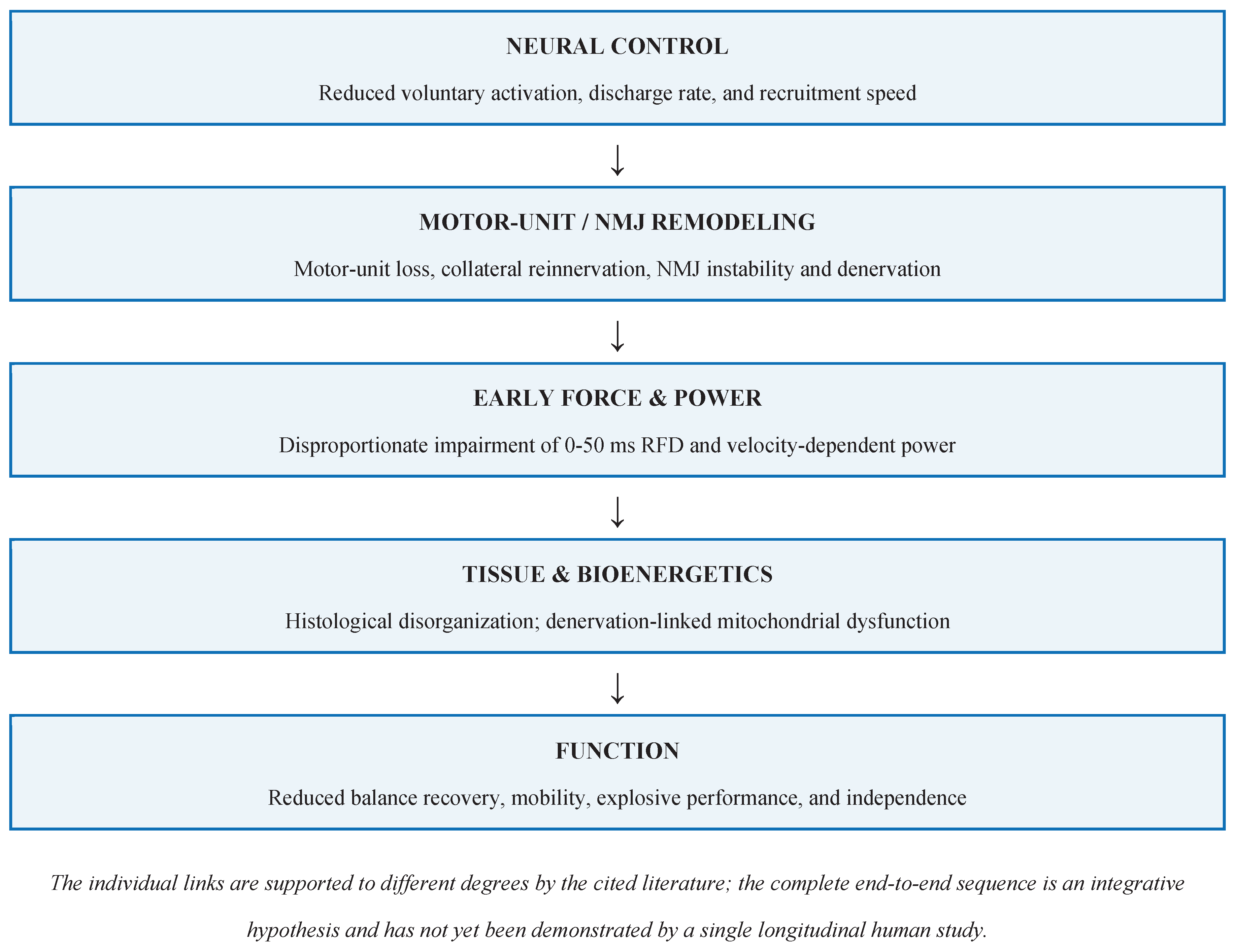

Table 1.
Summary of landmark longitudinal and histological cohorts evaluating human physical capacity and muscle entropy.
Table 1.
Summary of landmark longitudinal and histological cohorts evaluating human physical capacity and muscle entropy.
| Cohort / Study |
Sample & Follow-up |
Peak Age | Key Physiological & Entropic Findings |
|---|---|---|---|
|
Swedish SPAF Cohort (Westerståhl et al., 2025) |
n = 427 Swedish adults (born 1958, 48% women) Ages 16 to 63 yrs (47-yr follow-up) |
Ages 26–36 yrs (Aerobic & Bench Press); Jump Peak: 27 yrs (M), 19 yrs (W) |
Peak to age 63 overall decline of 30%–48%. Decline rate accelerates to 2.0%–2.5%/yr. Group variance increases 25-fold in relative aerobic capacity, 5-fold in jump height, and 3-fold in bench press. |
|
Flemish Cohort (Alcazar et al., 2023) |
n = 489 Belgian adults (311 M, 178 W) Ages 19 to 68 yrs (10-yr follow-up) |
Plateau in 20s; decline starts post-27–28 yrs |
Pmax drops 0.6%/yr (young men), 1.1%–1.4%/yr (mid-life), and 2.2%–2.4%/yr (older adults). Torque-velocity slope S/T0 flattens (-0.10%T0/rad/s/yr). Driven by force loss early, and both force and velocity loss at older age. |
|
SOMMA Study (Hong et al., 2026) |
n = 299 older adults (age ≥70 yrs, mean 76.4 yrs) Vastus lateralis biopsy (148k fibers) |
N/A (Older Adult Cohort, age ≥70) |
Muscle histological entropy (HDIM) correlates r = 0.98 with Shannon entropy. Predicts slower 400m walk speed, lower leg power, lower grip strength, and decreased mitochondrial Max OXPHOS and ATPmax independent of muscle volume. |
|
Nonagenarian Cohort (Strey et al., 2026) |
n = 42 adults over 90 yrs (mean 94.9 ± 3.1 yrs, range: 90–102 yrs) |
N/A (Extreme Old Age Cohort, 90–102 yrs) |
Knee extension RTD in the critical 100–200 ms window drops at ~9%/yr (β = -0.456, p = .014). Rapid strength (RTD) loss severely outpaces losses in maximal isometric strength, muscular endurance, or muscle thickness/quality. |
Disclaimer/Publisher’s Note: The statements, opinions and data contained in all publications are solely those of the individual author(s) and contributor(s) and not of MDPI and/or the editor(s). MDPI and/or the editor(s) disclaim responsibility for any injury to people or property resulting from any ideas, methods, instructions or products referred to in the content. |
© 2026 by the author. Licensee MDPI, Basel, Switzerland. This article is an open access article distributed under the terms and conditions of the Creative Commons Attribution (CC BY) license.
Copyright: This open access article is published under a Creative Commons CC BY 4.0 license, which permit the free download, distribution, and reuse, provided that the author and preprint are cited in any reuse.