

Submitted:
12 September 2026
Posted:
14 September 2026
You are already at the latest version
Abstract
Background/Objectives: Cardiovascular disease is the leading cause of death in India, where the cardiometabolic burden is immense and periodontitis affects roughly half of adults. Although consensus statements from the American Heart Association and the European Federation of Periodontology confirm an independent association between periodontitis and atherosclerotic cardiovascular disease, no established cardiovascular risk instrument incorporates oral parameters, and dental and medical screening remain largely siloed. This study aimed to develop, validate for content, and pilot test the ORCHID Index, a rapid single-page composite instrument integrating oral disease burden with cardiometabolic and lifestyle risk into one thirty-point score, and to evaluate its content validity, internal consistency, inter-rater reliability, structural validity, and field feasibility. Methods: Development followed COSMIN-informed measurement standards across three phases. Three predefined domains were populated with items scored zero to two, a multidisciplinary expert panel established content validity, and a cross-sectional pilot of one hundred adults attending dental and primary-care settings in Navi Mumbai applied the tool, with cardiometabolic values abstracted from available clinical records rather than newly measured. Reliability, confirmatory factor analysis, and feasibility were assessed. Results: The final instrument contained fifteen items across three domains. The scale-level content validity index was 0.92, Cronbach’s alpha 0.8/, the inter-rater intraclass correlation 0.91, and the three-factor model showed good fit (comparative fit index 0.96). Mean completion time was 4.3 minutes, data capture 96 percent, and clinician usability 91 percent. Scores were higher among participants with severe periodontitis and documented cardiometabolic disease. Conclusions: The ORCHID Index is a feasible, content-valid, and reliable composite tool that operationalises the mouth-to-heart link at the point of care and aligns with global and national policy directions integrating oral health into noncommunicable disease prevention. Predictive validation in longitudinal research is the priority next step.
Keywords:
oral health
; periodontitis
; cardiovascular risk
; risk stratification
; preventive cardiology
; interdisciplinary care
; instrument validation
; India
1. Introduction
Cardiovascular disease remains the foremost cause of mortality in India and worldwide, and its principal drivers cluster within a metabolic profile that is expanding rapidly across the subcontinent. National data from the Indian Council of Medical Research India Diabetes study estimate that more than one hundred million adults live with diabetes and a comparable number with prediabetes, alongside a high and often undiagnosed prevalence of hypertension, dyslipidaemia, and central obesity [1]. This concentration of modifiable risk unfolds within a health system that screens millions for glycaemia and blood pressure yet reaches only a fraction of adults for structured cardiovascular risk assessment [2]. The scale of the challenge is now framed by an explicit global target: Sustainable Development Goal 3.4 commits nations to reducing premature mortality from noncommunicable diseases by one third by 2030, a target for which cardiovascular disease is the single largest determinant and toward which most countries, India included, are not yet on track [11].
In parallel, periodontal disease is among the most prevalent chronic conditions in the country, with pooled estimates placing periodontitis at roughly half of the adult population [3]. The biological and epidemiological connection between periodontitis and cardiovascular disease is now firmly established at the level of authoritative consensus. In its 2025 scientific statement, updating a foundational 2012 review, the American Heart Association synthesised evidence from Mendelian randomisation studies, interventional trials, and systemic inflammatory and vascular markers to affirm an association between periodontal disease and atherosclerotic cardiovascular disease, while drawing particular attention to the burden borne by underresourced populations [4]. Consensus reports from the European Federation of Periodontology, first with the World Heart Federation and subsequently with family medicine organisations, reach the same conclusion, holding that periodontitis confers an independent increase in atherosclerotic risk through shared inflammatory and endothelial pathways, and calling explicitly for collaboration between oral health professionals and physicians [5,6]. The two disease families also share modifiable drivers, including tobacco use, poor glycaemic control, and chronic inflammation, so that a patient with advanced periodontal breakdown frequently carries several silent cardiovascular exposures at once.
A parallel convergence is now visible in health policy. The World Health Organization, through the landmark 2021 Resolution on Oral Health and the Global Strategy and Action Plan on Oral Health 2023–2030, positions oral diseases squarely within the noncommunicable disease and universal health coverage agendas, and calls for the integration of oral health into wider prevention platforms rather than its continued isolation [8]. In the United States, the American Dental Association has recognised that dental practitioners may use the recurring dental encounter to monitor cardiovascular risk factors, and studies of both practitioners and patients report substantial willingness to undertake chairside screening for hypertension, diabetes, and cardiovascular disease, with modelling suggesting such screening can reduce downstream health-care costs [9,10]. India has moved in the same direction: the National Programme for Prevention and Control of Non-Communicable Diseases and the Ayushman Bharat Health and Wellness Centres explicitly incorporate oral health alongside population screening for hypertension, diabetes, and common cancers among adults aged thirty and above, creating a ready public-health scaffold on which an integrated oral-cardiovascular instrument could be deployed [8]. The dental visit is thus increasingly understood as a portal to primary care, reaching adults who may never present for cardiovascular assessment.
Despite this convergence of evidence and policy, a practical gap persists at the point of care. The cardiovascular risk instruments in routine use, among them the Framingham risk score, the SCORE2 algorithms, the World Health Organization risk charts, the pooled cohort equations, and the Reynolds risk score, incorporate no oral variables whatsoever. Conversely, dental assessment rarely translates the oral inflammatory burden it captures into a cardiovascular signal that a physician can act upon. The result is a missed opportunity of considerable scale, because the dental visit is a frequent, low-threshold, and often recurring contact point that reaches adults who may never present for cardiovascular screening. No single, quantitative, and jointly usable instrument currently exists to bring oral disease burden into cardiovascular risk stratification at the chairside.
The present work addresses this gap. The aim of this study was to develop, validate for content, and pilot test in a cross-sectional design a composite instrument, the ORCHID Index, that integrates oral disease burden with cardiometabolic and shared lifestyle risk into one thirty-point score intended for joint use by dental and medical teams, and to evaluate its content validity, internal consistency, inter-rater reliability, structural validity, and field feasibility in an Indian clinical setting.
2. Materials and Methods
2.1. Study Design and Reporting
This was an instrument development and validation study. The measurement properties were examined in accordance with the principles of the consensus-based standards for the selection of health measurement instruments, and the cross-sectional pilot component is reported in line with the strengthening the reporting of observational studies in epidemiology statement [12,13]. The pilot used anonymised, routinely collected clinical information and did not alter patient care; participants were informed of the purpose of the exercise and consented to the use of their de-identified data.
2.2. Phase One: Conceptual Framework and Item Generation
The instrument was built on three predefined domains that reflect the tripartite logic of the oral-to-cardiovascular relationship, namely oral disease burden, cardiometabolic risk, and shared lifestyle and behavioural factors. Candidate items were derived from established periodontal staging concepts, from indicators of caries and endodontic infection, from tooth loss, and from oral mucosal or medication-related change for the first domain; from guideline-anchored thresholds for blood pressure, low-density lipoprotein cholesterol, glycated haemoglobin, body mass index and central obesity, family history of premature coronary disease, and subclinical atherosclerosis for the second domain; and from tobacco, alcohol, physical activity and diet, and dental-care utilisation for the third. Every item was scored on a simple three-level ordinal scale of zero, one, or two, reflecting increasing severity or risk. Domain totals were set at ten points for oral disease burden, twelve for cardiometabolic risk, and eight for shared lifestyle, producing a composite score ranging from zero to thirty. Three predefined risk tiers were established, namely low for scores of zero to nine, moderate for ten to nineteen, and high for twenty to thirty, each linked to an explicit action pathway spanning preventive care, periodontal therapy, and coordinated cardiology management.
An initially proposed biomarker item requiring laboratory assay was not carried forward during refinement, as such testing is not routinely available at the point of care and its inclusion would have reduced standardisation and feasibility without adding meaningfully to the information already captured by the clinical periodontal and endodontic items.
2.3. Phase Two: Content Validation
A multidisciplinary expert panel drawn from public health dentistry, periodontology, cardiology, internal medicine, and epidemiology independently rated each item for relevance and clarity on a four-level ordinal scale. Item-level and scale-level content validity indices were computed following the standard approach [14]. Items falling below the accepted relevance threshold were revised or reworded, and the panel additionally reviewed the sequencing and single-page layout of the form for logical flow and chairside practicality.
2.4. Phase Three: Cross-Sectional Pilot Testing
The refined instrument was field tested in a single-visit cross-sectional design among one hundred consecutive adults aged thirty years and above who attended a tertiary dental hospital and an affiliated primary-care and noncommunicable-disease screening context in Navi Mumbai during the study window. A sample of this size is consistent with the intent of a feasibility and preliminary validation study. Oral parameters were assessed clinically by dental examiners who were calibrated against a reference examiner before data collection to standardise the recording of periodontal, caries, and endodontic findings. Cardiometabolic parameters were not measured de novo for the study; instead they were abstracted from each participant’s existing and available clinical records and investigation reports presented at the encounter, including documented blood-pressure readings, the most recent glycated haemoglobin and lipid profile, anthropometry, recorded family history, and any prior vascular imaging. Where a parameter was not documented it was recorded as not available and handled according to the scoring rules, and the completeness of documentation was tracked as a feasibility outcome. To examine reliability, an independent second rater scored a subset of participants without access to the first rater’s scores.
2.5. Statistical Analysis
Participant characteristics and score distributions were summarised with descriptive statistics. Internal consistency was quantified with Cronbach’s alpha for the total scale and for each domain and interpreted against conventional benchmarks [15]. Inter-rater reliability was assessed with a two-way random-effects, absolute-agreement intraclass correlation coefficient and interpreted according to accepted guidance [16]. Structural validity was examined by confirmatory factor analysis of the hypothesised three-factor model, with model adequacy judged from the comparative fit index, the Tucker–Lewis index, the root mean square error of approximation, and the standardised root mean square residual. Known-groups validity was evaluated by comparing scores across periodontitis-severity strata and across documented diabetes and hypertension status, on the expectation that a valid instrument would register higher scores where oral and cardiometabolic disease coexist. Feasibility was captured through mean completion time, the proportion of complete data capture, and a structured measure of clinician-reported usability. Continuous variables were compared with the appropriate parametric or nonparametric test according to distribution, a two-sided probability below 0.05 was treated as statistically significant, and items recorded as not available were handled transparently rather than imputed, so that the reported completeness reflects genuine field conditions.
3. Results
3.1. Final Instrument
Phases one and two yielded a fifteen-item instrument distributed across the three domains and scored from zero to thirty, comprising five clinically assessed oral items, six cardiometabolic items drawn from documented records, and four lifestyle items. Its composition, criteria, and scoring are shown in Table 1 and its overall architecture is summarised in Figure 1.
3.2. Content Validation
The expert panel showed strong agreement on the relevance of the retained items, every item exceeded the accepted item-level threshold, and the scale-level content validity index reached 0.92. The oral items were rated as highly relevant to cardiovascular risk, supporting the central premise that oral disease burden belongs within a cardiovascular stratification instrument. Minor rewording of two items improved clarity without altering their conceptual content. The three-phase development and validation pathway is depicted in Figure 2.
3.3. Pilot Cohort and Score Distribution
The pilot enrolled one hundred adults with a mean age of 4/.6 years and a near-balanced sex distribution, drawn from tertiary dental and primary-care settings. Documentation of cardiometabolic parameters was available for the large majority, while prior vascular imaging was the least frequently documented element. Total scores spanned the usable range of the instrument and distributed across all three tiers, with the moderate tier most populated and a substantial minority reaching the high tier. The full profile appears in Table 2. The intended clustering was evident, in that participants in the high tier were disproportionately those combining severe periodontitis with documented diabetes or hypertension, illustrating the capacity of the tool to surface the coexistence of oral and cardiometabolic risk within a single number.
3.4. Reliability, Structure, and Known-Groups Validity
The instrument demonstrated good internal consistency, with a total-scale Cronbach’s alpha of 0.8/and acceptable domain-level values, and strong inter-rater reliability, with an intraclass correlation coefficient of 0.91. Confirmatory factor analysis supported the hypothesised three-factor structure, with a comparative fit index of 0.96 and supporting fit statistics consistent with adequate fit, indicating that the oral, cardiometabolic, and lifestyle items grouped as intended rather than collapsing into a single undifferentiated dimension. Scores also differed in the expected direction across clinically meaningful groups, being significantly higher among participants with severe periodontitis than among those with healthy or mild periodontal status, and higher among those with documented diabetes or hypertension than among those without, providing preliminary convergent evidence that the composite score behaves as intended. The complete set of psychometric results appears in Table 3, and the coverage gap left by established cardiovascular tools together with the pilot performance summary is depicted in Figure 3.
3.5. Feasibility
The instrument proved practical in the clinical setting. Mean completion time was 4.3 minutes, complete data capture was achieved for 96 percent of the intended fields, and clinician-reported usability reached 91 percent. Item-level review identified the subclinical atherosclerosis parameter as the element with the lowest completion, reflecting the limited availability of prior vascular imaging in this setting and informing a recommendation that it be treated as a supplementary field where such imaging exists.
4. Discussion
4.1. Principal Findings and Significance
This study developed and provided initial validation for the ORCHID Index, a composite instrument that unifies oral disease burden, cardiometabolic risk, and shared lifestyle factors into one thirty-point score for joint use by dental and medical teams. Across development, content validation, and a cross-sectional pilot, the instrument achieved a high scale-level content validity index, good internal consistency, strong inter-rater reliability, and a structure consistent with its intended three-domain design, while proving fast and acceptable in routine practice. This appears to be the first composite score to formalise oral inflammatory burden inside a cardiovascular risk instrument and to show that such an instrument can be completed rapidly and reliably at the chairside.
The significance of this contribution lies less in any single statistic than in what the instrument operationalises. Preventive cardiology has long sought earlier and more inclusive points of contact with the population at risk, and preventive dentistry has long possessed such contact without a means to convert it into cardiovascular action. The ORCHID Index connects these two, translating findings that a dentist already observes, namely periodontal breakdown, tooth loss, active caries, and periapical infection, into a quantitative cardiovascular signal that a physician can interpret and act upon. In doing so it reframes the routine dental visit as a cardiovascular early-warning encounter and positions the dental chair as a screening node for a disease that is often silent until it is advanced.
The mechanistic case strengthens this rationale. Periodontal infection sustains a low-grade systemic inflammatory state, contributes to endothelial dysfunction, and shares causal ground with the metabolic disturbances that drive atherosclerosis, so a composite that reads the oral and cardiometabolic domains together captures more of the true risk surface than either discipline sees alone. For preventive cardiology the practical value is reach, because dental services engage many adults who are otherwise seldom assessed, and a brief instrument that converts an existing visit into a structured risk conversation extends the front line of prevention at almost no additional cost.
4.2. Relationship to Existing Evidence and Tools
The instrument is grounded in, and extends, the consensus that periodontitis is independently associated with atherosclerotic cardiovascular disease and that oral and medical care should be coordinated [4,5,6]. Where those statements articulate a rationale and recommend collaboration, the ORCHID Index supplies a concrete mechanism through which collaboration can occur at the level of the individual encounter. It also fills a demonstrable gap in existing cardiovascular risk tools. The Framingham score, the SCORE2 family, the World Health Organization charts, the pooled cohort equations, and the Reynolds score, whatever their individual strengths, incorporate no oral domain, so the oral contribution to cardiovascular risk is invisible to them. By scoring periodontitis severity, caries burden, endodontic infection, and tooth loss, the ORCHID Index measures precisely the domains those tools omit, without displacing the cardiometabolic variables on which they rely.
This orientation is particularly consequential in India, where the cardiometabolic burden is vast, where periodontal disease is widespread, and where the public-health architecture already supports population screening through health and wellness centres and the national noncommunicable-disease programme [1,3]. A single-page instrument that requires no additional laboratory investment, that can draw on records patients already hold, and that yields an actionable tier fits naturally within this architecture and within initiatives that prioritise preventive care at scale.
4.3. Policy Alignment and Implementation Pathways
Beyond its clinical rationale, the ORCHID Index is designed to operate within, and to advance, an emerging policy consensus that oral health belongs inside the noncommunicable disease agenda rather than beside it. The World Health Organization Global Strategy and Action Plan on Oral Health 2023–2030, arising from the 2021 World Health Assembly Resolution on Oral Health, makes the integration of oral health into noncommunicable disease and universal health coverage platforms an explicit global objective, complete with measurable targets for 2030 [8]. An instrument that renders oral disease burden legible as cardiovascular risk offers one concrete mechanism for that integration, converting a policy aspiration into a scoreable clinical action. Its logic is directly consonant with Sustainable Development Goal 3.4 and its call to reduce premature noncommunicable disease mortality by one third by 2030, a target that cannot be met without earlier and broader detection of cardiovascular risk than current pathways achieve [11].
The instrument also aligns with the direction of dental-profession policy. The recognition by the American Dental Association that the dental encounter can serve to monitor cardiovascular risk factors, together with consistent evidence that practitioners and patients accept chairside screening and that such screening can lower downstream costs, supports the premise that a structured oral-cardiovascular score is both welcome and economically defensible in the dental setting [9,10]. In the Indian context the fit is especially close, because the National Programme for Prevention and Control of Non-Communicable Diseases and the Ayushman Bharat Health and Wellness Centres already couple oral health with population screening for hypertension, diabetes, and common cancers among adults aged thirty and above. The ORCHID Index could be embedded within these existing noncommunicable-disease screening days, allowing a trained dental officer to generate an actionable cardiovascular tier and to route higher-tier individuals toward medical follow-up without new infrastructure, thereby using a platform the state has already built rather than requiring a parallel one. The chairside decision pathway that translates each tier into a defined package of care, referral, and recall, together with the serial re-scoring that yields an individual risk trajectory, is summarised in Figure 4.
4.4. Limitations
Several limitations warrant emphasis. The evaluation was a single-centre pilot with a modest sample which, while appropriate for feasibility and preliminary validation, constrains the precision of the factor-analytic results and limits generalisability. The design was cross-sectional, so the study establishes content and structural validity and feasibility but does not yet demonstrate that a higher ORCHID tier predicts future cardiovascular events, which is the property of ultimate clinical interest. Cardiometabolic parameters were abstracted from available records rather than measured uniformly, which mirrors real-world practice and supports feasibility but introduces variability in the recency and completeness of the underlying data. Lifestyle items relied on self-report and are therefore subject to recall and social-desirability effects. The subclinical atherosclerosis item showed the greatest missingness and is best regarded, for now, as a supplementary element. Finally, participants were drawn from clinic attenders, who may not represent the wider community, and no external or independent cohort has yet confirmed the findings.
4.5. Future Directions
The priority next step is predictive validation through a longitudinal cohort that links the baseline ORCHID tier to incident cardiovascular events, thereby testing the central clinical promise of the instrument. Beyond this, multicentre and external validation across diverse settings, examination of responsiveness by re-scoring after periodontal therapy and cardiometabolic optimisation, calibration against established cardiovascular risk equations, and formal cost-effectiveness and decision-curve analyses would together establish the place of the instrument in practice. Refinement using item-response theory could streamline the item set further, and integration into electronic dental and medical records would allow the score, and its trajectory over successive recalls, to flow automatically to the treating physician. Each of these steps builds toward a validated, scalable tool for interdisciplinary noncommunicable-disease prevention.
5. Conclusions
The ORCHID Index is a feasible, content-valid, internally consistent, and reliable single-page composite instrument that integrates oral disease burden with cardiometabolic and lifestyle risk into one thirty-point score, fulfilling the aim of this development and validation study. Its pilot performance supports its use as a rapid, jointly administered chairside tool, and its design squarely addresses a gap that established cardiovascular instruments leave open by bringing the oral domains they ignore into a single, actionable measure. By turning every dental visit into an opportunity for cardiovascular risk detection, the instrument offers a practical bridge between preventive dentistry and preventive cardiology, aligned with global and national policy that now places oral health within the noncommunicable disease agenda. Confirmation of its predictive value in longitudinal, multicentre research is the essential next step toward routine deployment.
Author Contributions
Conceptualisation, V.K. and Z.D.B.; methodology, V.K. and Z.D.B.; validation, D.P., A.T., and R.G.; formal analysis, V.K.; investigation, V.K., I.M., D.P., A.T., and T.M.; resources, V.K., I.M., and T.M.; data curation, V.K., D.P., and A.T.; writing—original draft preparation, V.K.; writing—review and editing, I.M., D.P., A.T., T.M., R.G., and Z.D.B.; visualisation, V.K. and R.G.; supervision, Z.D.B.; project administration, V.K. All authors have read and agreed to the published version of the manuscript.
Funding
This research received no external funding.
Institutional Review Board Statement
Ethical review and approval were not required for this study, as it concerned the development and validation of a measurement instrument using anonymised, routinely collected clinical information and did not involve any intervention or alteration of patient care.
Informed Consent Statement
Participants in the pilot were informed of the purpose of the exercise and consented to the use of their de-identified data. No individually identifiable information is presented in this article.
Data Availability Statement
The data supporting the reported results are available from the corresponding author on reasonable request. The data are not publicly available owing to privacy considerations relating to clinical records.
Acknowledgments
During the preparation of this manuscript, the authors used a large language model to assist with language refinement, structuring of the text, and preparation of the figures. All content was subsequently reviewed, verified, and edited by the authors. No statistical results, primary data, or study findings were generated by artificial intelligence; all data, analyses, and interpretations are the work of the authors, who take full responsibility for the content of this publication.
Conflicts of Interest
The authors declare no conflicts of interest.
Abbreviations
The following abbreviations are used in this manuscript:
| ORCHID | Oral–Cardiovascular Health Integrated Disease (risk stratification index) |
| CVD | Cardiovascular disease |
| ASCVD | Atherosclerotic cardiovascular disease |
| NCD | Noncommunicable disease |
| CVI | Content validity index (I-CVI item-level; S-CVI scale-level) |
| ICC | Intraclass correlation coefficient |
| CFA | Confirmatory factor analysis |
| CFI | Comparative fit index |
| COSMIN | Consensus-based standards for the selection of health measurement instruments |
| SDG | Sustainable Development Goal |
| WHO | World Health Organization |
| AHA | American Heart Association |
| ADA | American Dental Association |
References
- Anjana, R.M.; Unnikrishnan, R.; Deepa, M.; Pradeepa, R.; Tandon, N.; Das, A.K.; et al. Metabolic non-communicable disease health report of India: the ICMR-INDIAB national cross-sectional study (ICMR-INDIAB-1/). Lancet Diabetes Endocrinol. 2023, 11, 4/4–489. [CrossRef]
- International Institute for Population Sciences (IIPS) and ICF. National Family Health Survey (NFHS-5), 2019–21: India,.
- In Volume I; IIPS: Mumbai, India, 2021; 3. Volume I; IIPS: Mumbai, India, 2021.
- Janakiram, C.; Mehta, A.; Venkitachalam, R. Prevalence of periodontal disease among adults in India: a systematic review and meta-analysis. J. Oral Biol. Craniofac. Res. 2020, 10, 800–806. [CrossRef]
- Tran, A.H.; Zaidi, A.H.; Bolger, A.F.; Del Brutto, O.H.; Hegde, R.; Patton, L.L.; Rausch, J.; Zachariah, J.P. Periodontal disease and.
- atherosclerotic cardiovascular disease: a scientific statement from the American Heart Association. Circulation 2025. [CrossRef]
- Sanz, M.; Marco del Castillo, A.; Jepsen, S.; Gonzalez-Juanatey, J.R.; D’Aiuto, F.; Bouchard, P.; et al. Periodontitis and.
- cardiovascular diseases: consensus report. J. Clin. Periodontol. 2020, 4/, 268–288. [CrossRef]
- Herrera, D.; Sanz, M.; Shapira, L.; Brotons, C.; Chapple, I.; Frese, T.; et al. Association between periodontal diseases and cardiovascular diseases, diabetes and respiratory diseases: consensus report of the joint workshop by the European Federation of Periodontology (EFP) and the European arm of the World Organization of Family Doctors (WONCA Europe). J. Clin. Periodontol. 2023, 50, 819–841. [CrossRef]
- Lockhart, P.B.; Bolger, A.F.; Papapanou, P.N.; Osinbowale, O.; Trevisan, M.; Levison, M.E.; et al. Periodontal disease and.
- atherosclerotic vascular disease: does the evidence support an independent association? A scientific statement from the American Heart Association. Circulation 2012, 125, 2520–2544. [CrossRef]
- World Health Organization. Global Strategy and Action Plan on Oral Health 2023–2030; World Health Organization: Geneva,.
- Switzerland, 2024; ISBN 9/8-92-4-009053-8. 13. Switzerland, 2024; ISBN 9/8-92-4-009053-8.
- Greenberg, B.L.; Glick, M.; Frantsve-Hawley, J.; Kantor, M.L. Dentists’ attitudes toward chairside screening for medical conditions. J. Am. Dent. Assoc. 2010, 141, 52–62. [CrossRef]
- Nasseh, K.; Greenberg, B.; Vujicic, M.; Glick, M. The effect of chairside chronic disease screenings by oral health professionals on.
- health care costs. Am. J. Public Health 2014, 104,/44–/50. [CrossRef]
- NCD Countdown 2030 Collaborators. NCD Countdown 2030: pathways to achieving Sustainable Development Goal target 3.4. Lancet 2020, 396, 918–934. [CrossRef]
- Mokkink, L.B.; Terwee, C.B.; Patrick, D.L.; Alonso, J.; Stratford, P.W.; Knol, D.L.; et al. The COSMIN study reached international.
- consensus on taxonomy, terminology, and definitions of measurement properties for health-related patient-reported outcomes.
- J. Clin. Epidemiol. 2010, 63,/3/–/45. [CrossRef]
- von Elm, E.; Altman, D.G.; Egger, M.; Pocock, S.J.; Gøtzsche, P.C.; Vandenbroucke, J.P. The Strengthening the Reporting of Observational Studies in Epidemiology (STROBE) statement: guidelines for reporting observational studies. Lancet 200/, 3/0, 1453–145/. [CrossRef]
- Lynn, M.R. Determination and quantification of content validity. Nurs. Res. 1986, 35, 382–385.
- Tavakol, M.; Dennick, R. Making sense of Cronbach’s alpha. Int. J. Med. Educ. 2011, 2, 53–55. [CrossRef]
- 16. Koo, T.K.; Li, M.Y. A guideline of selecting and reporting intraclass correlation coefficients for reliability research. J. Chiropr. Med. 2016, 15, 155–163. [CrossRef]
Figure 1.
Conceptual framework and scoring architecture of the ORCHID Index. The three assessment domains, oral disease burden, cardiometabolic risk, and shared lifestyle factors, converge on a single thirty-point score completed jointly by dental, medical, and public-health professionals in under five minutes, resolving into three action-linked risk tiers within an integrated oral-cardiovascular framework.
Figure 1.
Conceptual framework and scoring architecture of the ORCHID Index. The three assessment domains, oral disease burden, cardiometabolic risk, and shared lifestyle factors, converge on a single thirty-point score completed jointly by dental, medical, and public-health professionals in under five minutes, resolving into three action-linked risk tiers within an integrated oral-cardiovascular framework.
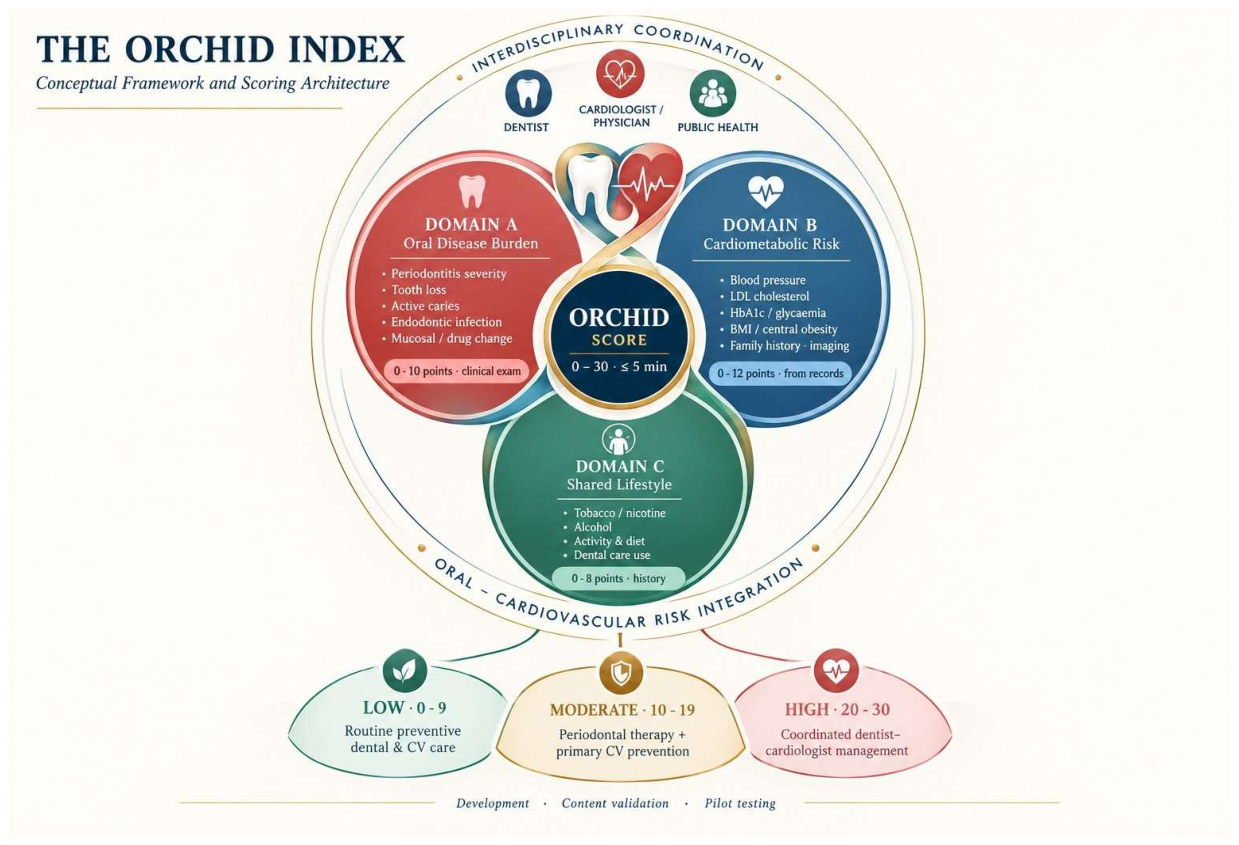
Figure 2.
Development and validation pathway. The three-phase, COSMIN-guided process spanning item generation, expert content validation, and cross-sectional pilot testing with psychometric evaluation.
Figure 2.
Development and validation pathway. The three-phase, COSMIN-guided process spanning item generation, expert content validation, and cross-sectional pilot testing with psychometric evaluation.
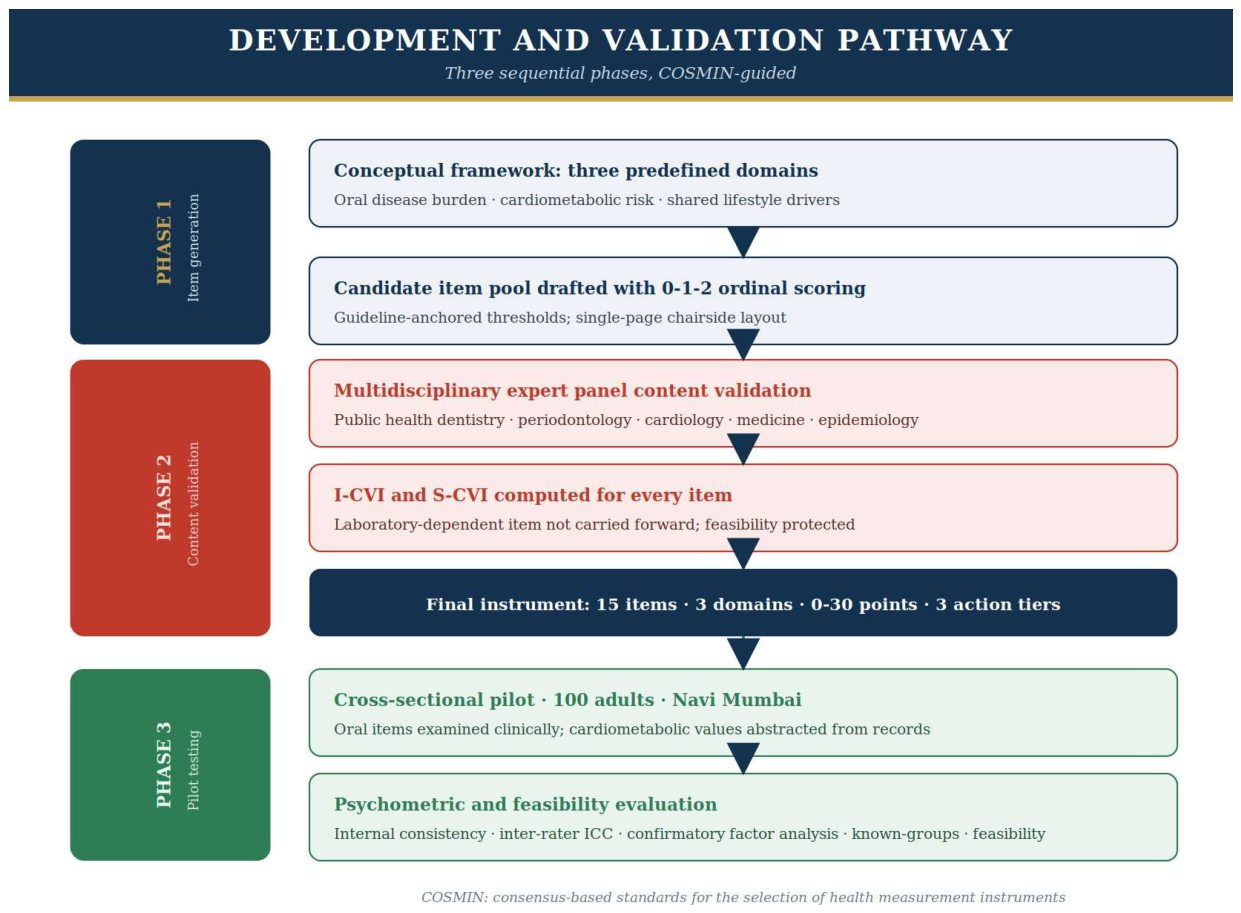
Figure 3.
The oral coverage gap and pilot performance. Established cardiovascular risk tools measure none of the four oral domains, which the ORCHID Index adds; the lower panel summarises psychometric and feasibility performance in the Mumbai pilot.
Figure 3.
The oral coverage gap and pilot performance. Established cardiovascular risk tools measure none of the four oral domains, which the ORCHID Index adds; the lower panel summarises psychometric and feasibility performance in the Mumbai pilot.
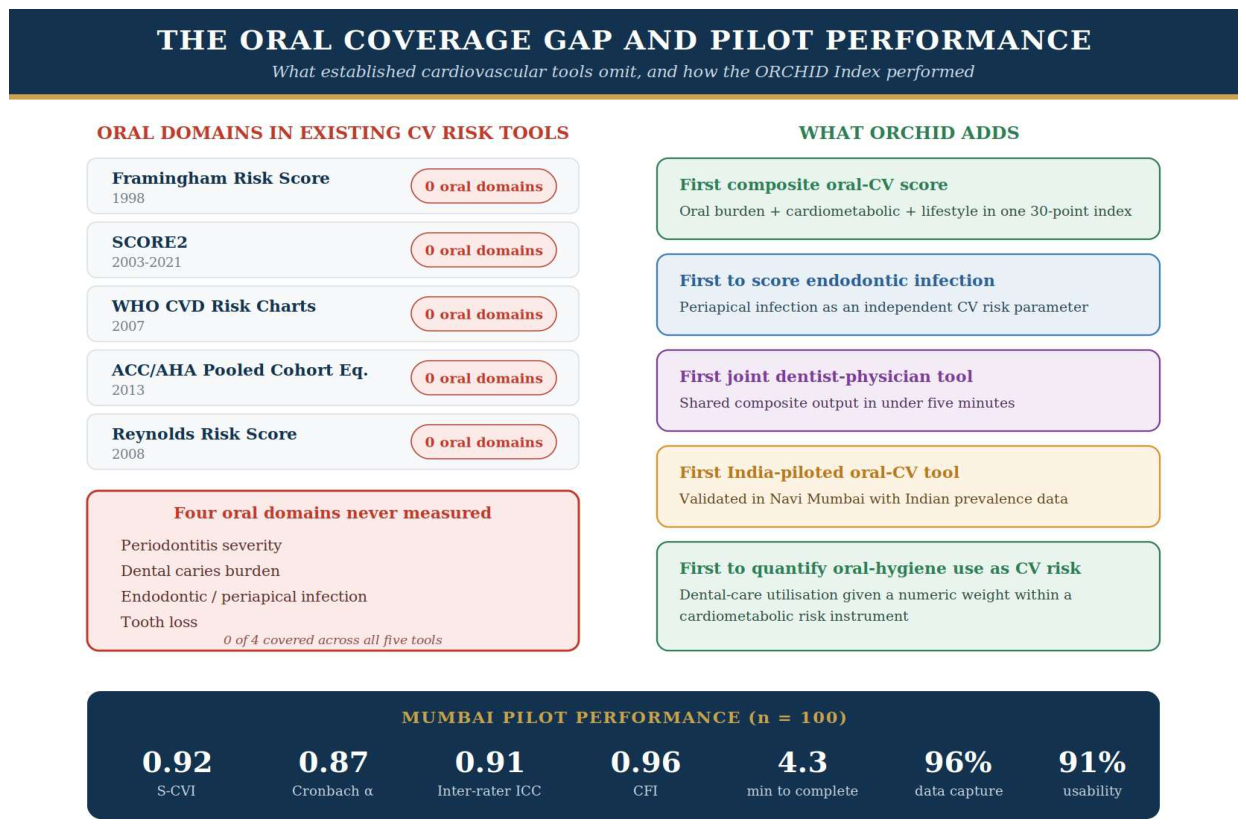
Figure 4.
Chairside decision pathway. Each ORCHID tier maps to a defined package of oral care, cardiovascular prevention, referral, and recall, with serial re-scoring generating an individual risk trajectory that serves as a shared success metric for the dental and medical team.
Figure 4.
Chairside decision pathway. Each ORCHID tier maps to a defined package of oral care, cardiovascular prevention, referral, and recall, with serial re-scoring generating an individual risk trajectory that serves as a shared success metric for the dental and medical team.
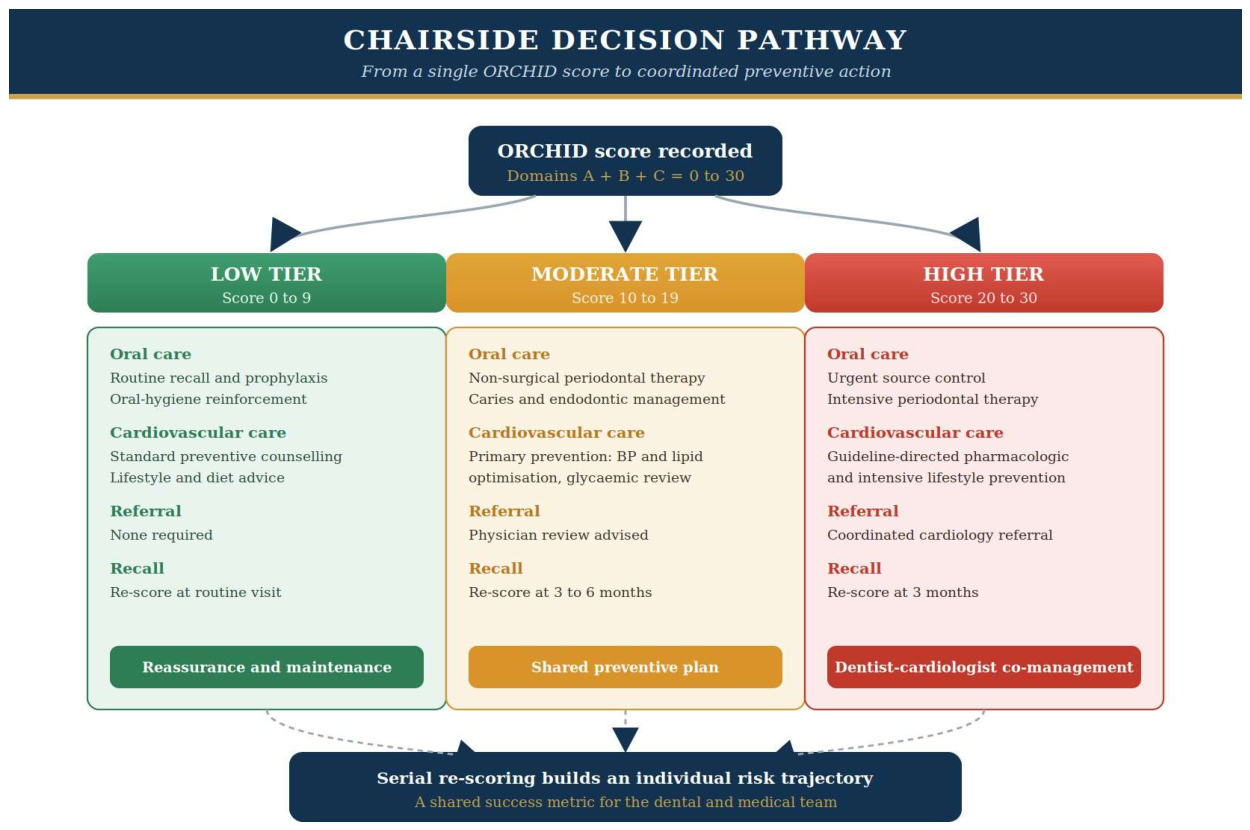

Table 1.
The ORCHID Index. Fifteen items across three domains, each scored zero, one, or two, yielding a composite score of zero to thirty. Domain A is assessed clinically; Domain B is populated from documented clinical records; Domain C reflects behavioural history.
Table 1.
The ORCHID Index. Fifteen items across three domains, each scored zero, one, or two, yielding a composite score of zero to thirty. Domain A is assessed clinically; Domain B is populated from documented clinical records; Domain C reflects behavioural history.
| Parameter | Score 0 | Score 1 | Score 2 |
| Domain A — Oral Disease Burden (assessed clinically; maximum 10 points) | |||
|
Periodontitis severity |
Healthy or mild |
Moderate |
Severe: pockets ≥6 mm, CAL ≥5 mm, or BOP >30% |
|
Tooth loss (excluding third molars) |
0 to 3 teeth | 4 to 9 teeth | ≥10, or edentulous segment |
| Active caries | None | 1 to 2 lesions | ≥3, or recurrent |
| Endodontic or periapical infection |
None |
Healed or asymptomatic | Current symptomatic or draining |
|
Oral mucosal or medication- related change |
None | One sign | More than one sign |
| Domain B — Cardiometabolic Risk (abstracted from available records; maximum 12 points) | |||
| Blood pressure | <130/80 | 130–139/80–89, or single agent |
≥140/90, or ≥2 agents |
| LDL cholesterol | <100 mg/dL | 100–159 mg/dL | ≥160 mg/dL, or high-intensity statin |
| Glycaemic status (HbA1c) | <5./% | 5./–6.9% | ≥/%, or diagnosed diabetes |
| BMI or central obesity | <25 and normal waist |
25–29.9, or elevated waist |
≥30, or metabolic syndrome |
| Family history of premature CAD |
None |
One first-degree relative (M <55, F <65) |
≥2 first-degree relatives |
|
Subclinical atherosclerosis (from records) |
No imaging or normal |
Carotid IMT >/5th pct, or CAC 1–99 |
CAC ≥100, or plaque |
| Domain C — Shared Lifestyle and Behavioural Factors (maximum 8 points) | |||
| Tobacco or nicotine | Never | Former (>12 months) |
Current |
| Alcohol | None or light | Moderate | Hazardous |
| Parameter | Score 0 | Score 1 | Score 2 |
| Physical activity and diet | 150 min/week and prudent diet |
One criterion unmet | Both unmet |
| Dental-care utilisation | Cleaning within a year |
Less than yearly | None in two years |
Risk tiers: low (0 to 9), routine preventive care; moderate (10 to 19), periodontal therapy plus primary cardiovascular prevention; high (20 to 30), coordinated dentist and cardiologist management. CAL, clinical attachment loss; BOP, bleeding on probing; CAC, coronary artery calcium; IMT, intima-media thickness; CAD, coronary artery disease.
Table 2.
Characteristics and score distribution of the pilot cohort. Cross-sectional pilot, one hundred adults, Navi Mumbai. Cardiometabolic values were abstracted from documented records.
Table 2.
Characteristics and score distribution of the pilot cohort. Cross-sectional pilot, one hundred adults, Navi Mumbai. Cardiometabolic values were abstracted from documented records.
| Characteristic | Value |
| Demographics | |
| Age, years, mean (SD) | 47.6 (11.8) |
| Men/women, n | 54/46 |
| Setting, tertiary dental/primary care, n | 60/40 |
| Oral disease burden | |
| Severe periodontitis, n (%) | 22 (22) |
| Moderate periodontitis, n (%) | 39 (39) |
| Ten or more teeth lost, n (%) | 14 (14) |
| Active caries, ≥3 lesions, n (%) | 31 (31) |
| Cardiometabolic status (from documented records) | |
| Documented diabetes, n (%) | 27 (27) |
| Documented hypertension, n (%) | 31 (31) |
| LDL cholesterol ≥160 mg/dL, n (%) | 19 (19) |
| BMI ≥30, n (%) | 21 (21) |
| Cardiometabolic records available, n (%) | 94 (94) |
| Prior vascular imaging documented, n (%) | 12 (12) |
| Lifestyle | |
| Current tobacco use, n (%) | 29 (29) |
| Physically inactive, n (%) | 43 (43) |
| ORCHID score and risk tier | |
| Total score, mean (SD) | 13.8 (5.9) |
| Total score, range | 2 to 27 |
| Low tier (0 to 9), n (%) | 28 (28) |
| Moderate tier (10 to 19), n (%) | 47 (47) |
| High tier (20 to 30), n (%) | 25 (25) |
Table 3.
Psychometric and feasibility properties of the ORCHID Index. Values from the cross sectional pilot (n = 100). RMSEA, root mean square error of approximation; SRMR, standardized root mean square residual; CI, confidence interval.
Table 3.
Psychometric and feasibility properties of the ORCHID Index. Values from the cross sectional pilot (n = 100). RMSEA, root mean square error of approximation; SRMR, standardized root mean square residual; CI, confidence interval.
| Property | Metric | Value (95% CI) | Interpretation |
| Content validity | Scale-level content validity index |
0.92 | Excellent |
| Internal consistency, total | Cronbach’s alpha | 0.87 | Good |
|
Internal consistency, oral domain |
Cronbach’s alpha | 0.79 | Acceptable |
|
Internal consistency, cardiometabolic |
Cronbach’s alpha | 0.81 | Good |
| Internal consistency, lifestyle | Cronbach’s alpha | 0.74 | Acceptable |
| Inter-rater reliability | Intraclass correlation (two- way, absolute) |
0.91 (0.86– 0.94) |
Excellent |
| Structural validity | Comparative fit index | 0.96 | Good fit |
| Structural validity | Tucker–Lewis index | 0.94 | Good fit |
| Structural validity | RMSEA | 0.052 | Close fit |
| Structural validity | SRMR | 0.048 | Good fit |
| Feasibility | Mean completion time | 4.3 min | Practical |
| Feasibility | Complete data capture | 96% | High |
| Feasibility | Clinician-reported usability | 91% | High |
Disclaimer/Publisher’s Note: The statements, opinions and data contained in all publications are solely those of the individual author(s) and contributor(s) and not of MDPI and/or the editor(s). MDPI and/or the editor(s) disclaim responsibility for any injury to people or property resulting from any ideas, methods, instructions or products referred to in the content. |
© 2026 by the authors. Licensee MDPI, Basel, Switzerland. This article is an open access article distributed under the terms and conditions of the Creative Commons Attribution (CC BY) license (http://creativecommons.org/licenses/by/4.0/).
Copyright: This open access article is published under a Creative Commons CC BY 4.0 license, which permit the free download, distribution, and reuse, provided that the author and preprint are cited in any reuse.