

Submitted:
10 September 2026
Posted:
14 September 2026
You are already at the latest version
Abstract
Hallucination detectors commonly read their evidence from natural-language inference (NLI) heads softmax-normalized over {entailment, neutral, contradiction}. When a detector’s only evidence features are the entailment probability T and the contradiction probability F of one such call, T + F ≤ 1 holds identically, so the state in which evidence both supports and refutes a claim has no coordinate of its own (Theorem 1). The bound concerns coordinates: it implies no detection ceiling and no error rate. We test a dual-NLI protocol that reads T and F from separate calls on 20 conflicting-evidence items and 90 controls in six families, with two public NLI models on CPU. Holistic scoring flags 4/20 conflicting items, 3/20 under a margin rule; with oracle span roles, evidence-decomposed scoring reaches 15/20 at 2/80 false positives under a model-free lexical gate. Controls delimit the result: the escape from the simplex follows from scoring two spans in separate calls, not from using two models; requiring the support channel active, not the diagonal T + F > 1, removes the pure-contradiction false positives; dropping the oracle roles keeps 15/20 at 4/90 false positives, whereas collapsing that gated pair to one difference score reaches at most 8/20 at the same budget in a retrospective interval search. Three further controls, two pre-registered, examine the stimuli: replacing the source description of the refuting spans takes the protocol to 20/20 and the holistic baseline to 9/20, and crossed templates show large lexical effects on both heads that are conditional on the reporting verb and do not decompose the whole-template contrasts they follow. The contribution is diagnostic. Code, stimuli, pre-registrations and scores are released.
Keywords:
hallucination detection
; natural language inference
; conflicting evidence
; paraconsistency
; measurement-space constraint
; uncertainty quantification
; large language models
1. Introduction
Hallucination, the production of confidently asserted but unsupported content, is a central deployment risk of large language models (LLMs) [1,2]. The detection literature of the past three years has produced techniques whose sophistication differs but whose measurement scaffolding is largely uniform: each output, or each atomic claim within it, is mapped to a scalar in , typically through softmax-normalized NLI probabilities, and a binary {factual, hallucinated} label is recovered by thresholding.
Surveys of that literature [1,2,3] report that no detector approaches ceiling performance. We do not explain that gap, and nothing below implies a rate of error (Corollary 1); what we supply is a narrow, exact statement about what one common measurement can and cannot express: for the specific class of detectors whose evidence features are the entailment and contradiction probabilities of a single softmax-normalized NLI call, the measurement space has no coordinate for a state that retrieval-augmented pipelines can encounter – the state in which available evidence supports and contradicts the same proposition at once. When both the truth-supporting score T and the truth-contradicting score F are read from one softmax-normalized NLI head, or when only one is read and the other is its implicit complement, the constraint implies ; the regime is unreachable for that call. We are careful throughout about what this does and does not license: it is a statement about the coordinates a particular kind of measurement can output, not a claim that softmax-based representations in general, or any particular pair of conflicting and non-conflicting texts, are indistinguishable once further features or further calls are allowed.
This note states the limitation precisely, checks that our scoring code respects it, shows that the excluded region is populated once evidence is decomposed across separate calls, and supplies an evidence-decomposed dual-NLI protocol together with the controls that test whether it measures conflict or an artifact of its own construction.
1.1. Contribution
- Theorem 1 (softmax bounds for single-call detectors). If a detector’s only evidence features are the entailment and contradiction probabilities of one softmax-normalized NLI call, then , and the coordinate for simultaneous, substantial support and contradiction is unreachable by that call. The identity is elementary; its contribution is stating explicitly, and scoping precisely, an assumption the detection literature has not examined.
- Diagnostic mapping. We state, for several detector families (semantic entropy, SelfCheckGPT, NLI-based fact verification, and the recent claim-level conflict detectors HallDetect and ConflictScore), which signal each actually reads – an NLI triplet, a scalar comparator, a verbalized label – and therefore whether the bound applies to it, where each already aggregates over multiple calls or samples, and where a method that already selects support and contradiction separately then collapses them back to one scalar.
- Dual-NLI protocol.T and F are computed by separate NLI calls – in the main configuration by two separately fine-tuned models – with evidence decomposition and a margin decision rule, so that T and F no longer share one call’s normalization.
- A diagnostic with real NLI models, oracle spans and controls. Naive holistic dual-NLI recovers few conflicting items (4/20 raw, 3/20 margin); decomposition recovers 16/20 raw (15/20 margin); five control families and two gating variants are consistent with an ungated contradiction channel that fires on refutations of other claims and with an NLI-based gate that re-imports source discounting, while a model-free lexical gate keeps 15/20 recall at 2/80 false positives. The margin threshold was chosen on the single-segment controls and its effect on every other family is reported by a sweep; a polarity-blind max-per-channel variant and equivalently simple bilateral comparators are run on the same scores.
- Open-source reference implementation, stimuli and raw scores released under the MIT License.
1.2. Scope
This is a measurement note. It establishes a scoped limitation, a protocol, and its controls on curated stimuli scored by public NLI models. It does not estimate how often frontier LLM outputs occupy the excluded region on standard benchmarks – that is a corpus question for follow-up work (Section 7). Releasing the identity and the protocol separately lets the formal claim be checked without depending on any one benchmark design.
2. Background
2.1. What Current Detectors Read, and at What Granularity
We examine three families of detectors and state, for each, which quantity is read from an NLI call and how many calls the method makes. The point is not that every method reads only one call over the whole input; several already decompose their input into multiple sentence-level or sample-level NLI calls. The point is that none of them, at the level of an individual pairwise call, reads a contradiction channel that is free to vary independently of that same call’s support channel – decomposing the input into more calls is not the same design choice as reading the two channels from separate calls and keeping both as coordinates, which is the move Section 4 makes. We classify each method by the signal it actually observes, because the bound applies to an NLI triplet and not to a scalar comparator, a verbalized label or a probability of correctness.
Semantic entropy [4,5] clusters stochastic samples of an LLM answer by bidirectional entailment and treats the entropy over the resulting clusters as the hallucination signal. Its released implementation offers several entailment backends: a DeBERTa backend (microsoft/deberta-v2-xlarge-mnli) that decides each direction from the argmax of a softmax-normalized NLI call (in its non-strict mode two answers are merged when neither direction is judged contradiction and the two directions are not both neutral), and prompted LLM backends (GPT-3.5, GPT-4, Llama) that return a label without an NLI triplet. Theorem 1 is a statement about the former only; a label elicited by prompting is a different measurement, and we do not extend the bound to it. For the DeBERTa backend, the entropy itself is computed over many samples and is not a point on any one call’s simplex; the bound enters one level down, in each pairwise equivalence decision, which is an argmax on that call’s shared simplex. Two samples that support and contradict each other’s content at once are assigned to one cluster or to two by that argmax; the method has no third option at the pairwise level, and the aggregate entropy cannot recover what a pairwise decision already discarded.
SelfCheckGPT [6] has several variants (BERTScore, question answering, n-gram, prompting); only its NLI variant falls under our analysis, and it already makes one call per resample, aggregated across resamples. Its released implementation scores a sentence with a DeBERTa-v3-large model fine-tuned on Multi-NLI, renormalizes the entailment and contradiction probabilities against each other (excluding neutral), and reports the renormalized contradiction probability as the score. Only that renormalized F is read per call, so entailment and contradiction still cannot both be read as high from the same call, though here the complement is renormalized entailment, not entailment pooled with neutral as an earlier description of this method stated.
NLI-based fact verification [7,8] decomposes a response into sentences or atomic claims and verifies each against retrieved evidence – an established form of input decomposition. SummaC [7] exemplifies this: its §3 constructs a sentence-pair similarity matrix from many individual NLI calls, one per (document-sentence, summary-sentence) pair, and its §5.3.2 evaluates combining entailment, neutral and contradiction scores across that matrix rather than reading a single scalar for the whole document. What SummaC’s decomposition does not do is give F a source independent of the same call’s T: each entry of its similarity matrix is still one softmax-normalized NLI call, so T and F for that sentence pair still satisfy the bound, and the matrix aggregates outputs of many such bound calls rather than escaping the bound for any one of them. FActScore [8], in its standard configuration, elicits a binary supported/not-supported verdict from a language model for each atomic fact, which is a scalar with an implicit complement rather than an NLI triplet; search-augmented verifiers such as SAFE [9] and compact grounding checkers such as MiniCheck [10] likewise end in a per-fact verdict. Confidence-elicitation studies [11,12,13] are a different object again: they study a model’s probability of its own correctness or its verbalized confidence, not features read from an NLI head, and we cite them only to note that a scalar s with complement has the same one-dimensional structure. That structure by itself does not imply that a verdict-based or confidence-based method loses the ability to detect conflict; it means only that its output has no second coordinate in which conflict could be recorded, so any conflict sensitivity it has must come from an earlier stage, which is method-specific.
One qualification bounds the scope of this comparison: semantic entropy is not designed as a conflicting-evidence detector; our claim is only that the pairwise NLI call its DeBERTa backend relies on carries the bound. Two question-answering metrics illustrate the classification by signal: Q2 [14] compares answer spans using NLI, not string overlap, so its NLI comparison step falls inside the scope of Theorem 1; QAFactEval [15], in its selected configuration, scores answers with a learned comparator (LERC, a 1–5 overlap score), which is not an NLI triplet and is therefore outside the theorem, while the separately reported QAFactEval-NLI combination brings an NLI component back inside it. The bound thus applies to a specific and common class of detectors, not to the family of factual-consistency metrics as a whole.
2.2. Paraconsistency: Motivation, Representation, and Inference
The regime is the numerical signature we adopt from paraconsistent logic as a motivating vocabulary, not a claim that this paper constructs or tests a paraconsistent consequence relation. Paraconsistency proper is a property of a logical consequence relation: a proposition and its negation can both be derivable without every proposition becoming derivable (explosion) [16,17,18]. Belnap–Dunn four-valued logic [19] names four epistemic states, told-true, told-false, told-both and told-neither, over an inference system built on that four-valued lattice. What we measure here is only the representation question one level below any inference system: whether a numerical evidence coordinate can register a graded analogue of told-both at all. We use T and F as independent degrees in : the four Belnap states are the corners , , and of the unit square, and is the half of the square nearer the told-both corner than told-neither. This reachability criterion is necessary but not sufficient for the operational reading we use in the decision rule, which additionally requires both channels active, , since a point such as is above the diagonal without carrying any opposing evidence. Neutrosophic logic [20,21] extends the picture to a continuous triplet with no sum constraint, and prior work documented the corresponding behaviour in LLM self-reports [22]. None of this constitutes a demonstration that inference under avoids explosion in some inference system built on these coordinates: that is a separate, unaddressed question, and the mechanism we test – two independent evidence channels – is equally expressible as bilateral evaluation, multi-label classification, or a probability distribution over four exclusive evidence states (Section 2.4); we do not claim exclusivity for the neutrosophic or Belnap–Dunn vocabulary, which we use because it names the target region economically, not because it is the only formalism that can.
2.3. Relation to Uncertainty Quantification
Within machine-learning uncertainty quantification, the closest structural analogues of the dual-NLI regime are credal sets [23] and deep ensembles [24]. A credal set represents epistemic uncertainty as a convex set of distributions; the told-both state corresponds informally to a credal set containing distributions that place high mass on entailment and on contradiction respectively, though we do not construct or verify such a set here, and the analogy should be read as motivation, not as a formal correspondence. Deep ensembles aggregate independently trained models to capture a diversity a single head cannot. The dual-NLI protocol is related to both but targets a different object: not predictive variance over resamples of one model, but a coordinate in the measurement space that a single call cannot reach regardless of resampling. Conformal methods [25] provide coverage guarantees on top of a given score and do not relax the simplex bound of the score itself; our proposal is complementary to them.
Evidential deep learning [26] deserves a separate remark because it is often presented as the answer to softmax overconfidence. An evidential classifier accumulates per-class evidence and forms Dirichlet concentration parameters ; its subjective-logic reading assigns each class a belief mass (with ) and an uncertainty mass , so that . The entailment and contradiction beliefs therefore satisfy : evidential outputs separate lack of evidence (u) from evidence for a class (), which a plain softmax cannot, but the belief masses for entailment and contradiction still cannot both be read as high enough to sum above one. In Dempster–Shafer terms, this is a statement about the belief masses assigned to singleton classes, not a claim that a Dempster–Shafer mass placed on the joint set would be unavailable to the framework in general; we do not analyse joint-set mass assignment here, only the singleton beliefs an evidential NLI head would report by direct analogy with a softmax head. The bound is thus not specific to softmax; it is a property of any head whose class masses are normalized together, and evidential heads inherit a version of it at the level of .
2.4. Closest Neighbours and What This Paper Adds
Three lines of work come closest and should be distinguished explicitly. Mündler et al. [27] detect self-contradiction between two statements produced by the same model; the object measured is inconsistency between outputs, not the coexistence of support and refutation for one claim in the evidence. Shi et al. [28] decompose the uncertainty of vision-language models into belief divergence and belief conflict using Dempster–Shafer theory over multiple sampled answers; conflict is again measured across outputs, whereas we measure it across evidence sources for a fixed claim, and we locate the obstacle in the NLI measurement call rather than in the sampling scheme. Galitsky [29] detects unsupported or contradictory content in explanations through an information-theoretic abduction model; the contradiction signal there is still read from a scalar consistency score. None of the three states the per-call simplex bound or proposes to measure T and F from separate heads.
A fourth line is closer still and must be distinguished with care. Allen et al. [30] integrate an LLM into the interpretation function of a paraconsistent logic and perform bilateral factuality evaluation, assessing entailment and contradiction as separately triggerable judgments and abstaining when a glut is detected; on GPQA and SimpleQA this improves macro-F1 by roughly six points over a unilateral baseline, at the cost of reduced coverage, and a proof-of-concept tableau reasoner applied to a medication-safety knowledge base detects 92 gluts corresponding to medically significant errors while remaining satisfiable. Their bilateral evaluation and our dual-NLI protocol pursue the same operational move, treating support and contradiction as structurally separate judgments rather than complementary halves of one call, but from different entry points: they instantiate the interpretation function of a paraconsistent logic and evaluate an LLM’s own bilateral judgment of a claim end to end, whereas we locate the obstacle inside the NLI measurement call that existing detection pipelines already share, and our controls ask whether decomposition alone – one head scoring two spans, no second model – already escapes the simplex, before attributing the escape to using two models (Section 5.3). Both lines of work enter a problem that Xu et al. [31] survey under the name knowledge conflicts in LLMs, distinguishing context-memory, inter-context and intra-memory disagreement; that taxonomy organizes the phenomenon but does not state the per-call simplex bound we prove here.
Two very recent lines target conflicting evidence directly rather than output inconsistency, and both already perform the operation that matters here – selecting support and contradiction separately – so the comparison must be made at the level of what each does with the two signals afterwards, not at the level of whether each individual call is normalized (every call is, theirs and ours). HallDetect [32] decomposes a generation into atomic claims, scores each claim against retrieved chunks with a single NLI head (the same DeBERTa-v3 checkpoint we use as Model A), and takes the maximum entailment and the maximum contradiction over chunks separately, so the two maxima may come from different chunks; it then collapses them to one scalar, the difference between the two maxima, and thresholds it. ConflictScore [33] labels every (claim, document) pair and flags a claim as conflicted when at least one document supports it and at least one contradicts it, reporting the proportion and balance of such claims in a generation, evaluated on ConflictBench. Neither is bound by Theorem 1 at the level of its aggregate, and the earlier version of this note wrongly implied otherwise. What this paper adds relative to them is narrower and different in kind: (i) the explicit statement that the per-call triplet has no coordinate for simultaneous evidence, which is what makes selecting the two signals from separate calls necessary in the first place; (ii) the observation that collapsing the two selected maxima to a difference, as HallDetect does, maps the told-both region (both maxima high) and the told-neither region (both low) to the same neighbourhood of zero, which is a property of that difference and not a consequence of Theorem 1, and which we test directly by running the max-per-channel selection and its collapsed difference on our stimuli (Section 5.3, Experiment 7); and (iii) controls (agreeing sources, cross-item refutations, model swap, single-head baselines, bilateral comparators) that isolate which part of a two-channel rule does what, which neither work reports. We do not claim that separating the two signals is new, nor that a two-dimensional output is necessary in general; we claim that what a particular collapse of the two signals discards can be measured, and that the controls measure it.
The human-label-variation literature is adjacent but must not be over-read. ChaosNLI [34] collects 100 annotations per item on SNLI and MNLI and finds items on which annotators split between entailment and contradiction; Baan et al. [35] show that calibrating to a majority label is ill-posed on such items, and Plank [36] reviews the phenomenon across tasks. Each annotator, however, emits one exclusive label, so the vote shares of an item still sum to one: ChaosNLI documents a mixture of readings across people, not a single judge who holds both. What it does establish is that ordinary NLI items exist for which both the entailment and the contradiction reading are live, which is the situation a two-source premise makes explicit. Whether individual humans, asked for separate support and refutation ratings, would themselves report is an open empirical question our stimuli do not address.
Naturally occurring conflicting evidence has meanwhile been collected in benchmarks that the corpus study we defer (Section 7) should use rather than templates: WikiContradict [37] pairs contradictory Wikipedia passages with human-annotated questions, including implicit contradictions; ECon [38] constructs evidence conflicts and compares NLI models, factual-consistency checkers and LLMs on detecting and resolving them, with the same precision/recall trade-offs our controls probe; and ConflictingQA [39] asks which properties of a document (relevance, style, attributed authority) make a model find it convincing, which is the confound our attributed-source stimuli cannot separate (Section 5.1).
3. The Softmax Bound
3.1. Statement and Proof
Theorem 1
(Softmax bounds for single-call detectors). Let M be a softmax-normalized NLI model emitting probabilities for three classes for a premise-hypothesis pair . Define
Then for all pairs ,
with equality if and only if .
Proof.
By definition of softmax, , each term in . Substituting , : , with equality when . □
Corollary 1
(Representational limitation, scoped). Assume a detector whose only evidence features for a (premise, claim) pair are the entailment and contradiction probabilities of one softmax-normalized NLI call, and define the simultaneous-evidence coordinate as . Then that call assigns no input to that coordinate: the call has no output reserved for a premise that supports and refutes the claim with both degrees high. The corollary is a statement about which coordinates the measurement can emit, and nothing more. In particular it doesnotsay that a conflicting premise and a weak-evidence premise must receive indistinguishable outputs: a head that emitted on conflicts and on evidence-free inputs would satisfy the identity on both and still be separated perfectly by the rule . Whether trained heads behave that way is an empirical question (Section 5.2 reports that the two we tested do not, for a reason unrelated to the identity), and the corollary says nothing about detectors that use further features (retrieval structure, multiple NLI calls, logits, source metadata, ensembles): for those, whether some other feature restores the distinction is a separate question, which the dual-NLI protocol answers affirmatively for one specific construction (Section 4). What is unreachable is the specific coordinate, not every possible decision rule built on the two numbers, and no error rate follows from the identity.
Remark (single-channel detectors).
Detectors that read only one channel, typically F, and treat non-contradiction as their positive signal are subject to the same limitation for a different and trivial reason: the two numbers sum to one by definition, and Theorem 1 is not needed to see it. We mention them because they are the majority of deployed NLI-based detectors, and because Section 4’s point applies equally to both groups: a second, independently measured channel is required before the told-both coordinate can be represented at all.
Remark (what the bound is about, and what a reparametrization does not change).
The point is reachable, and one may ask whether it is not already a representation of told-both. It is not: a softmax head reports a posterior over three mutually exclusive relations, so says the relation is entailment or contradiction with equal probability and is certainly not neutral – the coordinate a head emits when it cannot decide between two exclusive readings, not the coordinate for a claim on which both readings hold simultaneously with high confidence. What encodes, once T and F are measured by separate calls, is precisely the failure of that exclusivity: two degrees free to be high together. No relabelling of the simplex changes this, and a simplex point can nevertheless encode two free degrees whose sum exceeds one without being able to report them as its entailment and contradiction coordinates; Appendix B gives an explicit injection that makes both halves of that statement precise. The bound is therefore about the two coordinates a detector reads under their standard interpretation, not a proof that the head has lost information, and it holds for any three non-negative numbers that sum to one.
Remark (per call, not per model).
Theorem 1 binds one softmax call on one (premise, claim) pair. Two calls of the same head on two different spans of the premise are not bound jointly by it: and may sum above one, because they are two separate three-class posteriors, each individually satisfying the bound, but not required to satisfy any joint bound across the two calls. The escape from the simplex is therefore a property of decomposing the evidence into separate calls, not of using two different models; using two models is a further, independent design choice, and Section 5.3 (Experiments 5-6) tests what that choice changes.
Remark (finite logits and boundary cases).
With finite logits, softmax outputs are strictly positive, so and equality in Eq. (1) are reached only in the limit of unbounded logit separation; the inequality itself holds exactly for every finite-logit softmax output, since it depends only on the three probabilities summing to one, not on how close neutral is to zero. A hypothetical single-call example near this limit is , with : an ordinary high-confidence output, not a numerical artifact of a literal . The near-equality case actually reported in Table 1 (, , sum ) comes from the dual-NLI entailment controls, not from one call, and its sum exceeding 1 is an instance of the escape Section 4 documents, not a boundary case of this single-call remark.
Scope of the geometric picture.
We do not interpret the excluded region’s area (a set of measure of the unit square under an independent-channel construction, versus the lower triangle reachable under one softmax call) as an estimate of any error rate or of the frequency of conflicting evidence in real text; it is a statement about which coordinates a single-call measurement can and cannot reach, not about the distribution of real inputs over those coordinates. Whether conflicting evidence, once representable, should count as an error depends on the reference labels a given benchmark uses, and the fraction of real items carrying such evidence is an open empirical question outside this diagnostic’s scope (Section 7).
We also note, for completeness, a distribution over four exclusive states – support only, refutation only, both, neither – has marginal probabilities of “support present” and “refutation present” that can each range up to 1 and can sum to more than 1 (e.g. mass 0.6 on “both”, 0.2 on “support only”, 0.2 on “refutation only” gives marginal support and marginal refutation , summing to ). This is an ordinary probability distribution and violates nothing; it is compatible with our bound because it is not the three-class NLI distribution Theorem 1 is stated over – entailment, neutral and contradiction are not the same three states as support-only, refutation-only and neither, and a model that natively output the four-state distribution above (rather than the three-class one) would not be bound by Eq. (1) in the first place. We do not build or evaluate such a four-state head here; we note it only to make precise which three-class assumption the theorem depends on.
4. Dual-NLI Protocol
4.1. Definition
To remove the per-call bound while keeping the rest of the pipeline, T and F are computed by two separate softmax heads belonging to two differently fine-tuned NLI models:
where A and B are two publicly released NLI models fine-tuned on partly overlapping corpora (Section 5.1 names them). Each remains softmax-normalized internally, but T and F no longer share a call’s normalization, so is representable. The architecture resembles a two-member deep ensemble [24], except the members are not averaged: each contributes a structurally distinct channel. An indeterminacy channel I, when wanted, would be computed separately from self-consistency across resamples and hedging markers; it plays no role in the results below.
4.2. What Removes the Bound, and What Independence Would Additionally Require
The bound of Theorem 1 is escaped as soon as T and F do not come from one shared softmax call; statistical independence of models A and B is neither required for this nor established here, since both are trained on overlapping NLI corpora. The empirical question is whether the joint distribution of is dispersed enough to populate the excluded region on realistic inputs, and whether it does so specifically when the evidence is conflicting. Section 5.2 and Section 5.3 test both halves. We return to what the reported correlation coefficients do and do not show in Section 5.3.
4.3. Computational Cost
The base protocol requires two NLI calls per pair (one per model), each shorter than scoring the concatenated premise, since each model reads one segment rather than the whole. The NLI-based topicality gate tested in Section 5.3 adds a third call (Model A’s neutral probability on the refuting segment), so that variant costs 1.5× the base protocol’s calls, not ; the lexical gate we adopt instead (Section 4.4) uses no additional model call at all, only string processing, so the base protocol’s two calls are the total cost of the configuration with known span roles. The accounting changes when the roles are not known: the polarity-blind variant of Experiment 7 scores every span with both heads, model–span evaluations for m spans (four here), and its one-head version needs m (two here); batching reduces API invocations, not the number of pairs the models process. The “twice the cost” figure used later therefore refers to the two-call protocol against a single call, and to nothing else.
4.4. Evidence Decomposition and the Margin Rule
Two refinements complete the protocol. Evidence decomposition: when the premise aggregates material from more than one source, T is scored on the segment(s) supporting the hypothesis and F on the segment(s) opposing it, rather than on the concatenated premise. In this paper the segments are oracle spans, known by construction; the protocol as evaluated here is a measurement diagnostic, not an end-to-end detector, which would need a span-finding stage we do not build. Splitting a premise into spans is not a neutral operation: the decontextualization literature shows that how a fact is cut from its context changes which proposition is verified and, with it, the score [40,41], so the holistic-versus-decomposed contrast of Section 5.2 compares two presentations of the same source texts, not two measurements of one fixed proposition; the attribution-frame control of Experiment 8 is what isolates the frame from the content. Trained NLI models are optimized to output one label per (premise, hypothesis) pair; on the premises tested here they return a single verdict rather than registering both stances (Section 5.2), which is why we expose the conflict at the input. Whether some head could separate the two states within one call is a different question, and Corollary 1 shows the identity alone does not forbid it. Margin rule: an item is flagged as simultaneous-evidence iff and . The margin removes boundary artifacts in which a near-certain single channel plus ordinary channel noise sums marginally above 1 (Section 3, Remark on finite logits). We report in the headline numbers and characterize the choice with a sweep in Section 5.3.
A third element, forced by the controls of Section 5.3, is a topicality gate on the F channel: on our stimuli the contradiction head fires on a refutation of a different claim (CROSS) almost as readily as on a refutation of this one, so F must be kept only when the refuting segment is on-topic; whether that is a negation artifact, a topic-insensitivity, or both, is not settled by CROSS alone (Section 5.3). We test two gates. An NLI gate uses model A’s neutral probability on (refuting segment, claim) as an off-topic score, . A lexical gate uses content-word overlap: if , else 0, where J is the Jaccard index over stemmed (first six characters, length ) content words, after removing a fixed list of English stopwords, negation markers (not, no, nor), reporting/attribution verbs (states, claims, reports, concludes, ...) and source-type nouns that recur in our templated stimuli (pamphlet, blog, textbook, lab report, ...; the full list ships in dual_nli.py in the released code, from which the experiment scripts import it). The gates differ in what they import, and Section 5.3 shows the difference matters. We are explicit about the lexical gate’s status: it is a diagnostic that isolates the topicality requirement on stimuli where refutations restate the claim’s content words, not a component we propose for in-the-wild text, where refutations are typically paraphrased.
5. Empirical Validation with Real NLI Models
5.1. Setup
Model A (T channel) is MoritzLaurer/DeBERTa-v3-large-mnli-fever-anli-ling-wanli, a DeBERTa-v3-large [42,43] fine-tuned on MNLI, FEVER-NLI, ANLI, LingNLI and WANLI [44]; Model B (F channel) is ynie/roberta-large-snli_mnli_fever_anli_R1_R2_R3-nli, a RoBERTa-large fine-tuned on SNLI, MNLI, FEVER-NLI and ANLI rounds 1–3, released with the ANLI benchmark [45]. The two differ in backbone and in training mixture but share most of their NLI data, so nothing in the setup makes B “contradiction-specialized”; it is simply a second, separately trained head. Neither model revision is pinned to a specific commit hash. Both checkpoints were downloaded once, on 2026-07-13, and every experiment reported here reuses that local cache, so all scores come from one revision of each model; which revision that was cannot be reconstructed after the fact, which we record as a declared reproducibility gap rather than resolve, since a later default revision could shift the exact scores (Section 7). Both models run on CPU in minutes; the released scripts do not truncate or pad beyond each tokenizer’s default handling, and all stimuli here are single sentences well under any default max-length, so truncation is not exercised by these items but is undocumented for longer inputs.
The target label scored throughout is a label of attributed stance: does the passage report a source as asserting the claim (support) or its negation (refutation)? It is not whether the claim is true in the world, nor whether the source is right. This must be distinguished from the entailment relation an NLI model is trained to score, and the distinction cuts against our stimuli in a way we state rather than hide. A sentence of the form “a disputed pamphlet claims that not-X” is true whenever the pamphlet says so, and is compatible with X; under ordinary entailment it does not contradict X, so an NLI head that returns neutral for it is not thereby wrong. The same holds for “the textbook states that X”, which does not entail X. Our stimuli wrap every span in a reporting frame, so a low F on a refuting span admits two readings that the design cannot separate: the head is scoring the reported content and discounting it by the source’s apparent credibility, or the head is scoring the reporting sentence itself, for which neutral is the semantically correct answer. We are precise about which comparisons hold what fixed, because an earlier draft claimed more than the stimuli support. The holistic-versus-decomposed contrast (Experiment 2) and the model swap (Experiment 5) reuse the same source texts and change only how they are presented to the heads. The comparisons across families (CONFLICT, AGREE-SUP, AGREE-REF) do not: their second spans differ in source, verb and content, so they hold the claim fixed, not the reporting frame, and they cannot by themselves separate an attribution effect from a content effect. Experiment 8 is the control that can: it holds the propositional content fixed (X and its negation, verbatim from the released items) and varies only the frame – bare, non-factive verb (“claims”), factive verb (“confirms”), verb-less attribution (“according to”), and the same verb under a high-credibility and a low-credibility source – so that whatever changes between cells is attributable to the template. It measures the size of two template contrasts; it does not decompose them into separately identified mechanisms, because each template varies more than one element at a time (Section 5.4). A related caution applies to the target label itself: source-attribution quality is not reducible to an NLI verdict, and evaluating it properly needs contextual judgments and human annotation [46], which is one reason we present the label as attributed stance under a fixed template rather than as a measure of attribution. Wherever this paper describes what a head is doing with attribution, that description is a reading compatible with Table 8, not an identified cause. What the main experiments test is whether the measurement can register both stances when they are exposed, not whether a head reads attribution correctly.
Experiment 1 (identity confirmation and a stimulus lesson). The 50 pairs of the earlier heuristic pre-study: 10 entailment, 10 contradiction, 10 neutral and 20 items whose hypothesis qualifies itself (“X, but it is also not X”), scored under dual-NLI and under single-NLI (both channels from Model A’s softmax). Experiment 2 (conflicting evidence, holistic vs. decomposed). Twenty items in which the conflict lives in the evidence: each premise concatenates a supporting source and a refuting source that restates the claim under negation (item 2, verbatim: “The physics textbook states that water boils at 100 degrees Celsius at sea level. However, the lab report concludes that water does not boil at 100 degrees Celsius at sea level.”); all 20 items are listed in Appendix A. Each item is scored holistically (full premise to both models) and decomposed (supporting segment to A, refuting segment to B). Experiment 3 (controls for decomposition). For the same 20 claims, three control families scored with the identical decomposed protocol: AGREE-SUP (two independent sources that both support the claim), AGREE-REF (two that both refute it), CROSS (the supporting segment of claim i paired with the refuting segment of a different claim j). If decomposition flagged conflict merely because two clear segments were handed to two models, these controls would be flagged; they should not be, except where noted. Experiment 4 (topicality gates). Conflicting items, the three control families and single-segment controls rescored with the NLI gate and the lexical gate (), reporting recall and false positives under the same margin rule. Experiment 5 (model-assignment swap). Decomposed scoring of Experiments 2-3 repeated with channel roles exchanged (T from Model B, F from Model A), to check whether recovery is a property of one pairing. Experiment 6 (single-head baselines and an F-only rule). Decomposed scoring with both channels from Model A alone and from Model B alone – which Theorem 1 does not forbid, since two calls of one head are not jointly bound – and the single-channel rule on the gated refuting span for every configuration, since with oracle spans the support channel’s cross-family mean is close to constant (Section 5.3 qualifies this precisely). Experiment 7 (polarity-blind selection and collapsed comparators). Every segment of every two-source item is scored by both heads and the coordinates are the maximum entailment and the maximum contradiction over segments, with no oracle assignment of which span supports and which refutes – the selection step HallDetect performs with one head [32] – run with Model A for both maxima and with A for entailment and B for contradiction; the same maxima are then collapsed to the difference to test what the collapse merges. The single-segment ENT, CON and NEU pairs of Experiment 1 are scored the same way (one segment, so the maximum is the score). Experiment 8 (attribution-frame control). For each of the 20 claims, the bare content X and its negation not-X (the “that”-clause of the released refuting span) are placed in six frames – bare; “The document claims that …”; “The document confirms that …”; “According to the document, …”; “The official record states that …”; “A disputed pamphlet states that …” – giving 240 sentences, each scored by both heads against the bare claim. The content is identical across frames, so any difference between cells is due to the frame; the last two frames share the verb and differ only in the attributed source. Experiment 9 (crossed factors). The source noun (document, pamphlet), the adjective (none, disputed) and the reporting verb (states, claims, confirms) are crossed, giving twelve templates in two polarities over the same 20 contents, 480 sentences. The determiner is fixed. Contrasts, bootstrap procedure and decision criteria were registered before the first inference. Experiment 10 (intervention on the released stimuli). In each of the 20 items the source noun phrase of a span is replaced by the neutral “The document”, with the reporting verb and the propositional content kept verbatim, in four arms: no change, refuting source neutralized, supporting source neutralized, both. Each arm is scored with the published protocol (decomposed, gated, margin rule) and, separately, holistically on the concatenated premise. Predictions were registered before the first inference and released with the code. Single-segment controls: the 10 entailment and 10 contradiction pairs of Experiment 1, scored under dual-NLI (the premise serves as both segments).
All stimuli are English sentences over encyclopedic facts, authored by us and released verbatim; the refuting sources deliberately vary in attributed credibility (textbook, lab report, pamphlet, blog), which turned out to matter.
5.2. Results: Identity Confirmation, Negative Result, Recovery
Implementation check. Under single-NLI scoring, no pair among the 50 of Experiment 1 produces (0/50). This is not additional evidence for Theorem 1, which is an identity that holds by construction; it is a unit test that the scoring code reads the head it claims to read, and we keep it in Table 1 for that reason only, not as an experimental finding in its own right.
A stimulus lesson. The 20 self-qualifying items of Experiment 1 are not recovered by dual-NLI either (0/20 raw; mean , mean ): both models read a hypothesis that qualifies itself as neither entailed nor contradicted by a simple premise. This exposes the earlier heuristic recovery reported in the original pre-study as an artifact of token-overlap scoring, and relocates the phenomenon: conflict must live in the evidence, not in the hypothesis.
A negative result. Scored holistically, the corrected items of Experiment 2 cross the diagonal in 4/20 raw cases (mean ; 3/20 under the margin rule). Inspection is consistent with the following account, which we present as an explanatory hypothesis rather than an isolated, independently verified mechanism (Section 7): the models appear to resolve the conflict rather than report it. Refuting content attributed to a “disputed pamphlet” or a “fringe theory” receives very low F; as Section 5.1 notes, this is compatible both with discounting by attributed credibility and with the semantically correct neutral reading of a non-factive report, and the stimuli do not separate the two. What the negative result establishes independently of that ambiguity is narrower: a three-way classifier trained with cross-entropy emits one label per pair, and given a premise that contains both stances it returns a single verdict, so the conflict is not represented in that call’s output whichever of the two readings drives the verdict.
Decomposition recovers the regime. Under evidence-decomposed scoring, the same 20 items reach mean (mean , mean ), with 16/20 raw above the diagonal and 15/20 (75%) under the margin rule. On the single-segment controls, the raw rule flags 8/10 entailment pairs ( plus channel noise ), a boundary artifact the margin removes, leaving 1/20 false positives combined across the entailment and contradiction control families (Table 1).
5.3. Results: What the Decomposed Signal Measures
The recovery in Section 5.2 would be uninformative if any two clear segments handed to two models produced . Experiment 3 tests this (Table 2). Two of three controls behave as intended. When both sources support the claim (AGREE-SUP), Model B reads the second supporting source and returns essentially no contradiction (mean ; 0/20 flagged). When both refute it (AGREE-REF), Model A returns low entailment (mean ); under the margin rule this is 1/20 flagged, not 0/20 – agreement is rarely, not never, read as conflict by this protocol, and the one AGREE-REF false positive should be read alongside the 0/20 on AGREE-SUP rather than folded into a single “agreement is never mistaken for conflict” claim.
The third control fails informatively. When the supporting segment of claim i is paired with the refuting segment of a different claim j (CROSS), Model B still returns substantial contradiction (mean ) and 8/20 items are flagged under the margin rule (12/20 raw). The contradiction head fires on a refuting sentence about a different claim: the ungated F channel measures, in part, the presence of a refutation rather than a refutation of this claim. We read this as consistent with the negation-word artifact documented for NLI training data, where explicit negation is strongly predictive of the contradiction label [47] and negation stress tests degrade NLI models [48]; McCoy et al. [49]’s HANS set documents the broader reliance of the same model class on shallow lexical-overlap, subsequence and constituent heuristics, but does not itself test negation, and we do not cite it for that. Negation is not the only trigger, either: in Experiment 1, Model B returns and on two neutral pairs whose premise and hypothesis are simply unrelated (items 23 and 26 of the released file), with no negation present. The honest summary is that the separated contradiction head fires on refutation-shaped and on off-topic material alike, which is why a topicality gate, not a larger margin, is the relevant repair. This is the second behavioural observation we pair with the softmax bound: the first (above) is that a shared call returns one verdict for a premise that contains both stances; this one is that a separated contradiction head needs a relevance constraint the shared call supplied implicitly.
Experiment 4 asks whether a topicality gate removes the CROSS false positives without destroying recall (Table 3). The NLI gate does the first, not the second: CROSS drops to 0/20, but recall on genuine conflicts collapses from 15/20 to 5/20. Model A’s mean neutral probability on the refuting segment is 0.912 for CROSS, as intended, but also 0.635 for genuine refutations: Model A reads most attributed refutations as neither entailing nor contradicting the claim, so multiplying by removes them. The scores alone do not say why Model A returns neutral there. Experiment 8 (Section 5.4) shows that both the reporting verb and the source description move that head’s scores by large amounts on isolated sentences, which makes the behaviour unsurprising without identifying its cause on these spans. The lexical gate consults no NLI model; it separates the families cleanly (mean for conflicting items against effectively 0 for CROSS by construction) and leaves recall at 15/20 with CROSS at 0/20. Its remaining false positives are 1/10 on entailment controls (one numeral paraphrase, `one hundred’ vs. `100’), 1/20 on AGREE-REF, and 0/20, 0/20, 0/10 on the remaining families – 2/80 total across the five control families.
Threshold sensitivity and what was tuned on what. The margin was chosen on the single-segment entailment and contradiction controls; those 20 items are a tuning set, and their false-positive counts in Table 1 and Table 3 are reported for completeness, not as held-out evidence. The conflicting items and the three decomposition control families were not consulted when was fixed; Table 4 reports the full sweep on all of them. The tuning set does not pin down: ENT/CON false positives are 1/20 at every from 0.05 to 0.40, so any value in that range was admissible on the tuning criterion. The value 0.15 was fixed in the first round of experiments, when only the conflicting items and the ENT/CON pairs had been scored and before the decomposition control families were constructed, as a round margin above the channel-noise floor ( on entailment controls); we record this because a flat tuning curve leaves the choice under-determined, not because the other families informed it. Recall on conflicting items is 16/20 at , 15/20 from to , and degrades beyond; AGREE-SUP is zero at every tested; CROSS is the family cannot fix on its own, which is why a topicality gate is needed rather than a larger margin. The ENT/CON controls are also built on the same ten encyclopedic facts as the first ten conflicting items (three with identical wording), so they are a tuning set on partly the same facts, not a held-out set on new ones. The lexical threshold was not tuned on these data: every conflicting item’s Jaccard index is at least 0.50 and every CROSS item’s is at most 0.125 by construction of the stimuli, so any in reproduces the counts of Table 3 ( give identical counts on these items); this is a property of the templated stimuli, and we do not claim it would hold on naturally occurring, paraphrased text.
Model-assignment swap. To check whether recovery is a property of the particular pairing, Experiment 5 repeats decomposed scoring with roles exchanged (T from Model B’s entailment, F from Model A’s contradiction). With the lexical gate and the same margin rule, the swapped protocol recovers 4/20 conflicting items and flags 0/20 on AGREE-SUP, AGREE-REF and CROSS (ungated CROSS: 0/20). The swap removes the CROSS false positives without any gate and loses most of the recall: Model A’s contradiction head discounts refutations attributed to weak sources, as in holistic scoring (Section 5.2), while Model B’s fires on refuting material that is not about the claim (Experiment 3) and on some unrelated material without negation. Recovery therefore belongs to the pairing, not to the protocol in the abstract, and the honest summary is that the two public heads we tested fail in opposite directions. Neither assignment was tuned on these items; we report both.
Single-head baselines and the one-channel rule. Because Theorem 1 binds a call and not a model, the natural baseline is decomposition with one head serving both channels (Table 5). With oracle spans, the support channel’s mean across the families that reuse the same supporting span is close to constant (mean on conflicting items and on CROSS, since the supporting span is identical) – this is a cross-family statement about means under this stimulus design, not a claim that T is itemwise constant: per-item on the 20 conflicting items ranges from about 0.277 to 0.997 (Appendix A), and the design only holds the supporting span fixed across the CONFLICT/CROSS pairing, not across items. Table 5 reports the two-channel margin rule beside a single-channel rule, on the gated refuting span, for four configurations: one head for both channels (A only, B only), the main dual assignment, and its swap. On conflicting items, AGREE-SUP and CROSS, the main dual assignment’s two-channel rule and its own single-channel rule are close (conflicting: 15/20 vs. 17/20; AGREE-SUP: 0/20 vs. 0/20; CROSS: 0/20 vs. 0/20) but not identical on the conflicting family, where the single-channel rule flags two more items than the two-channel rule; they diverge sharply on AGREE-REF, where both spans refute the claim: the single-channel rule flags 17/20 of those items as conflict (reducing the false-positive count from 17/20 to 1/20 when the second, independent support channel is added – a reduction of 16, not 17, false positives), because T is low when no span supports the claim. The support channel is what distinguishes contested from unanimously refuted, and that is its job; it is not, on these items, a constant that plays no role in three of the four families – it is close to a constant across CONFLICT and CROSS specifically because those two families reuse the identical supporting span, and it is exactly the non-constant channel on AGREE-REF, where it is what separates the two decision rules.
Second, the escape from the simplex needs no second model: Model B alone, reading both spans in two calls, recovers 17/20 conflicting items with the lexical gate and 0/20 CROSS false positives – marginally more recall than the main dual assignment, and 4/20 rather than 1/20 AGREE-REF false positives. Model A alone recovers 4/20. What governs the outcome is which head reads the refuting span, not how many heads there are.
Figure 1.
Per-item scores of the main dual assignment with the lexical gate, all six families (100 items), rebuilt from the released CSV by make_table6.py. The dashed line is the single-call bound ; dotted lines mark . Conflicting items (circles) populate the region above the diagonal; unanimous refutations (triangles) sit at low T, which is what the support requirement of the bilateral rule excludes; CROSS items (crosses) fall to under the gate; the one flagged entailment control (diamond, upper right) is the numeral paraphrase.
Figure 1.
Per-item scores of the main dual assignment with the lexical gate, all six families (100 items), rebuilt from the released CSV by make_table6.py. The dashed line is the single-call bound ; dotted lines mark . Conflicting items (circles) populate the region above the diagonal; unanimous refutations (triangles) sit at low T, which is what the support requirement of the bilateral rule excludes; CROSS items (crosses) fall to under the gate; the one flagged entailment control (diamond, upper right) is the numeral paraphrase.
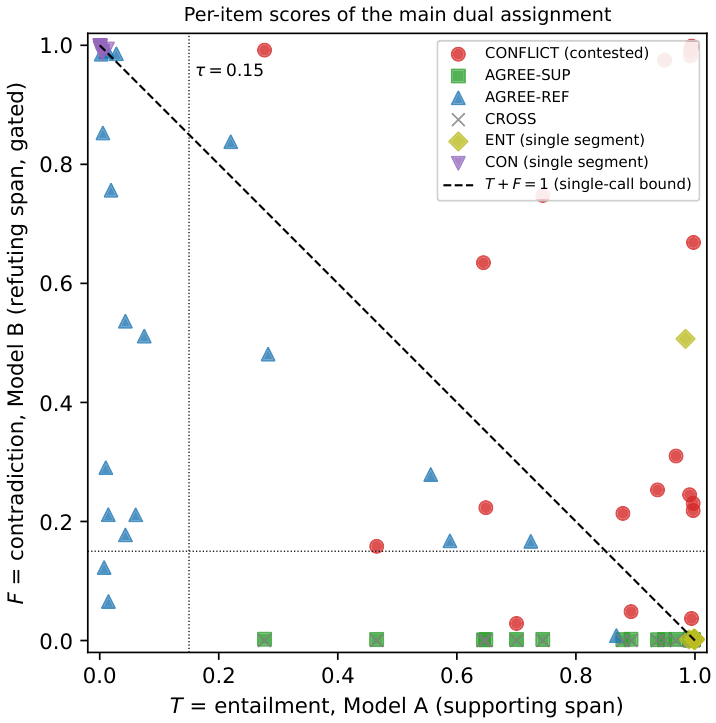
What the diagonal condition is actually for.Table 5 isolates model choice from channel count, but conflates two further things the decision rule bundles together: requiring both channels active () and additionally requiring their sum to exceed one. We separate them here by recomputing, on the same lexically gated scores, three rules side by side: the published rule , a bilateral rule that drops the diagonal requirement, , and the single-channel rule already reported in Table 5. This is a recalculation from the released per-item scores under the main dual assignment, not a new inference. To these we add a fourth, , a rectangular rule with no diagonal and asymmetric thresholds, chosen after inspecting these scores and reported for that reason as a post-hoc comparator, not as a proposal. Table 6 reports all four across every family, and the effects of the rule’s components must be attributed separately, because as sets of flagged items. Two things follow from the nesting alone, before any data: adding the diagonal cannot add recall, and adding the support requirement cannot add false positives. What the data determine is the size of each step. Requiring the support channel active () is what removes the CON false positives, 10/10 to 0/10: a single-channel rule cannot represent unanimous, correct refutation without a support channel to weigh against F. Adding the diagonal on top () changes nothing on CON (0/10 either way), removes four of the five AGREE-REF false positives (5/20 to 1/20), and drops two conflicting items (17/20 to 15/20: claims 1 and 8 of Appendix A, where is 0.62 and 0.87). An earlier version of this note credited the diagonal with the CON reduction; Table 6 shows that credit belongs to the support requirement. The rectangular comparator sharpens the point: with no diagonal at all it matches on CONFLICT (15/20, losing claim 2 with and recovering claim 8) and improves on it by one false positive (AGREE-REF 0/20). Because its thresholds were read off these very scores, this does not show that a rectangle is better; it shows that the present data cannot distinguish “the diagonal is what holds precision” from “any rule that demands substantial support does”, and that a fair test needs rules tuned under one protocol on a development split and scored on new items. On these 100 items, descriptively, has precision 15/17 and recall 15/20 and has 17/23 and 17/20; neither figure is an estimate for any population. AGREE-SUP and CROSS do not discriminate the rules under the lexical gate (all 0/20), and ENT’s one false positive (the numeral paraphrase) persists under every rule tested.
Polarity-blind selection and the cost of collapsing to one scalar. Experiments 2–6 hand each head the span it is meant to read. Experiment 7 removes that oracle role assignment: every span is scored by both heads and the coordinates are the maximum entailment and the maximum contradiction over spans, which is the selection step HallDetect performs with one head before subtracting the two [32] (Table 7). With Model A for entailment and Model B for contradiction and the lexical gate on the contradiction maximum, recall on conflicting items is unchanged (15/20 under the margin rule, 17/20 under the bilateral rule) and CROSS, AGREE-SUP, CON and NEU stay at zero; the cost is on AGREE-REF, where taking the larger of two low entailment scores raises the family mean T from 0.179 to 0.295 and the false positives from 1/20 to 3/20 (5/20 to 8/20 without the diagonal). Knowing which span supports and which refutes is therefore not what populates the excluded region; it buys two AGREE-REF items. With Model A for both maxima – HallDetect’s own configuration – recall is 4/20 with no false positives, the same 4/20 as the A-only decomposed baseline of Table 5: the selection step is not the bottleneck, the contradiction head is.
What the collapse to one difference discards, stated with its objective. We then collapse the same gated pair the two-coordinate rule reads, , to its difference , and ask how well any single interval on D separates the 20 conflicting items from the 90 controls. Three points of care, each forced by an earlier version of this paragraph that lacked them. First, the pair must be the same on both sides: an earlier draft compared the gated two-coordinate rule with an ungated difference, which changes the contradiction coordinate on every CROSS and NEU item (CROSS item 11: ungated, gated) and attributes to the collapse what the gate did. Second, “the best interval” is not a well-posed quantity without an objective: maximizing recall, maximizing and maximizing recall under a false-positive budget are different problems with different answers, so we report all of them (Table 7, lower block). Third, every number below is retrospective on these 110 items, enumerated by the released audit_a8_intervals.py, and estimates nothing about other data. At a budget of four false positives, the budget the two-coordinate margin rule spends on the same pair, the best interval recovers 8/20 (one head: 4/20); at two false positives, 7/20 (one head: 4/20); the interval that maximizes recovers 18/20 at 21 false positives (; one head: 13/20 at 22, ); full recall costs 36 false positives (one head: 60). The two-coordinate rule on the same pair recovers 15/20 at 4 false positives (bilateral: 17/20 at 9). The reason is visible in the ranges: under the dual heads the D values of 19/20 conflicting items lie inside the range spanned by AGREE-REF, and 9/20 inside the ranges of CROSS and of ENT; under Model A alone, 7/20 conflicting items have , inside the fully supported AGREE-SUP and ENT band, because that head returns almost no contradiction on attributed refutations. NEU is not a separate band either: 5/20 conflicting items fall inside its range.
What this does and does not show must be kept apart, because three different propositions are in play. (i) Theorem 1: one three-class call cannot emit . (ii) The difference is not injective on the unit square (), a one-line fact that needs no experiment. (iii) On these items, no single interval on matches the two-coordinate margin rule at its own false-positive budget. Only (iii) is empirical, and it concerns this scalar and this family of decision rules, not scalars in general: a scalar such as preserves the bilateral decision at any threshold exactly, and preserves the diagonal decision, so “two coordinates are necessary” is not a conclusion this paper can draw or does draw. What it draws is narrower: the difference score that a HallDetect-style pipeline thresholds is a poor summary of the pair on contested items, because it maps contested and unanimously refuted items to overlapping values, and the pair from which it was computed confuses them less: on the same items a bilateral rule on the pair still admits 8/20 AGREE-REF items (9/90 false positives overall), against 21/90 for the best- interval on the difference.
5.4. Results: What the Reporting Frame Does
Experiment 8 holds the propositional content fixed and varies only the frame (Table 8). We report what it licenses and no more: it measures how each head responds to six specific templates, and it does not decompose those responses into separately identified mechanisms, because the templates vary more than one thing at a time.
Model A, the support head, responds strongly to both template contrasts. Holding the source description fixed at “The document”, the two verbs differ: “confirms that X” receives mean entailment 0.992 and “claims that X” 0.063 (neutral 0.936), a paired difference of 0.928 (range 0.783 to 0.974, positive on all 20 items) against 0.999 for bare X. Holding the verb fixed at “states”, the two source descriptions differ: “The official record states that X” receives 0.734 (16/20 items above 0.5) and “A disputed pamphlet states that X” receives 0.006 (neutral 0.984), a paired difference of 0.728 (range 0.146 to 0.942, positive on all 20 items). The verb-less “According to the document” sits between them (0.524, 10/20 above 0.5). On refutations the contradiction column of the same head orders the templates the same way: bare not-X 0.998, “confirms” 0.989, “official record states” 0.189, “claims” 0.035, “disputed pamphlet states” 0.006.
Model B, the contradiction head, is far less sensitive to the frame on refutations: bare, “confirms”, “according to” and “official record” all keep contradiction at 0.99 or above, “claims” lowers it to 0.709 (range 0.32 to 1.00, still 20/20 above the margin), and only the low-credibility template cuts it, to 0.274 (12/20 above the margin). The two heads therefore do not respond alike, which is itself informative for a protocol that assigns them different roles. The unanticipated cell is in the supporting block: on supporting content under “A disputed pamphlet states that X”, Model B returns mean contradiction 0.306 and exceeds the margin on 17/20 items, although nothing in the sentence refutes the claim (Figure 2(b)). Something in that template is read as a contradiction signal irrespective of polarity; the crossed design below identifies which word. The behaviour is of the kind the annotation-artifact literature makes plausible [47,48], and we cite that literature for the plausibility, not for a demonstration about these templates and these checkpoints.
Figure 2(a) shows both contrasts item by item, and they are not alike: the verb contrast is nearly constant across claims (0.783 to 0.974) while the source contrast ranges from 0.146 to 0.942, so the means conceal very different spreads. Taken alone these are differences between whole formulations: the verb contrast is compatible with sensitivity to factivity and with a learned response to two particular verbs, and the source contrast is compatible with sensitivity to attributed credibility and with a response to the determiner, adjective or noun that change together between “The official record” and “A disputed pamphlet”. Experiment 9 tests related noun, adjective and verb contrasts in a separate factorial design.
Crossing the factors. Experiment 9 crosses the source noun (document, pamphlet) with the adjective (none, disputed) and the verb (states, claims, confirms), twelve templates in two polarities over the same 20 contents, 480 sentences, with the contrasts and the decision criteria registered before the first inference. Table 9 reports the registered contrasts in the upper block and, in the lower block, the full grid of adjective effects and contradiction counts, which we computed after seeing the data and therefore label exploratory. Intervals are percentile bootstrap over items, 5 000 resamples.
The registered contrasts hold, as simple effects in the cells where they were specified. With the verb fixed at states, adding “disputed” lowers Model A’s entailment on supporting content by 0.445 (95% CI 0.369 to 0.522) under “document” and by 0.318 (0.253 to 0.385) under “pamphlet”, positive on all 20 items in both. With no adjective and the same verb, “document” minus “pamphlet” is 0.132 (0.102 to 0.163). The adjective and the noun are not additive: the adjective’s effect is 0.127 (0.100 to 0.155) larger under “document” than under “pamphlet”. And “confirms” minus “claims” is 0.928, 0.927, 0.933 and 0.939 under the four source descriptions, positive on all 20 items in each, with the registered source-by-verb contrast at (CI to ).
The exploratory grid then shows why none of this licenses a general decomposition, and we state this rather than let the registered numbers imply more than they support. The adjective effect is itself conditional on the verb: it is 0.445 under states but 0.056 under claims and 0.057 under confirms with “document”, and 0.318, 0.045 and 0.040 with “pamphlet”. The registered verb contrast compares only confirms against claims, so its stability across sources says nothing about the interactions that involve states, which are large. The factors are not orthogonal, and the numbers above are effects of specific cells, not additive components. Nor does this design decompose the contrast of Experiment 8: that contrast is between “The official record” and “A disputed pamphlet”, and Experiment 9 contains neither “official record” nor the indefinite determiner. Its own widest gap with states, from “The document” at 0.472 to “The disputed pamphlet” at 0.023, is 0.450, not 0.728. Adding 0.132 and 0.445 would double-count the 0.127 interaction; we report the cells and do not add them.
The contradiction head is conditional in the same way. On supporting content with the verb at states, Model B exceeds the margin on 12/20 items under “The disputed document” and 12/20 under “The disputed pamphlet”, against 0/20 under either noun without the adjective: on that verb the adjective is what makes the difference, and the above-margin count is 12/20 under either noun, though not on identical items: item 20 crosses the margin with “document” and not with “pamphlet”, and item 13 does the reverse. But the pattern does not survive the other two verbs. Under confirms no template fires at all, adjective or not, and under claims the counts rise to 15/20 and 17/20 with the adjective while “The pamphlet claims that X” already fires on two items (0.241 and 0.207) without it. What we can say is therefore narrower than the earlier draft claimed: with states held fixed, adding “disputed” takes contradiction on supporting content from 0/20 to 12/20 under either noun; the effect depends on the reporting verb; and it is not the only way to elicit contradiction where no refutation is present. We do not identify a word-level trigger independent of the frame, and nothing here establishes what the model represents, only which textual changes move its scores.
What this does and does not settle. Experiment 8 measured two whole-template contrasts; Experiment 9 shows that within one verb the adjective carries far more of the source effect than the noun does, and that this pattern is verb-dependent. That is a real gain over v1.11, where neither factor was separated at all. It is not a decomposition of the earlier contrast, not a demonstration of orthogonality, and not a general property of NLI heads: the design contains two nouns, one adjective, three verbs, one determiner, twenty encyclopedic contents and two checkpoints.

Table 8.
Experiment 8. Content fixed (the 20 claims X and their negations), frame varied; each cell is the mean over 20 sentences scored against the bare claim. Columns: Model A entailment, neutral and contradiction; Model B entailment and contradiction; number of sentences with B’s contradiction at or above the margin . Rebuilt from validation_results_a9.csv.
Table 8.
Experiment 8. Content fixed (the 20 claims X and their negations), frame varied; each cell is the mean over 20 sentences scored against the bare claim. Columns: Model A entailment, neutral and contradiction; Model B entailment and contradiction; number of sentences with B’s contradiction at or above the margin . Rebuilt from validation_results_a9.csv.
| Content | Frame | entA | neuA | conA | entB | conB | |
|---|---|---|---|---|---|---|---|
| X | bare | 0.999 | 0.001 | 0.000 | 0.989 | 0.002 | 0/20 |
| X | The document claims that | 0.063 | 0.936 | 0.001 | 0.614 | 0.026 | 0/20 |
| X | The document confirms that | 0.992 | 0.008 | 0.000 | 0.983 | 0.002 | 0/20 |
| X | According to the document, | 0.524 | 0.475 | 0.001 | 0.984 | 0.002 | 0/20 |
| X | The official record states that | 0.734 | 0.265 | 0.001 | 0.981 | 0.002 | 0/20 |
| X | A disputed pamphlet states that | 0.006 | 0.984 | 0.009 | 0.260 | 0.306 | 17/20 |
| not-X | bare | 0.001 | 0.000 | 0.998 | 0.002 | 0.996 | 20/20 |
| not-X | The document claims that | 0.014 | 0.951 | 0.035 | 0.155 | 0.709 | 20/20 |
| not-X | The document confirms that | 0.006 | 0.005 | 0.989 | 0.001 | 0.996 | 20/20 |
| not-X | According to the document, | 0.007 | 0.615 | 0.378 | 0.002 | 0.994 | 20/20 |
| not-X | The official record states that | 0.014 | 0.796 | 0.189 | 0.003 | 0.990 | 20/20 |
| not-X | A disputed pamphlet states that | 0.067 | 0.927 | 0.006 | 0.408 | 0.274 | 12/20 |
Table 9.
Experiment 9: crossed source noun × adjective × verb, 12 templates × 2 polarities × 20 contents. Upper block: the contrasts registered before inference, paired by item, 95% percentile bootstrap over items, 5 000 resamples. Lower block: the full grid, computed after seeing the data and reported as exploratory; the left half is the adjective effect on Model A’s entailment for supporting content (no adjective minus disputed), the right half the number of items whose Model B contradiction on the same supporting content exceeds .
Table 9.
Experiment 9: crossed source noun × adjective × verb, 12 templates × 2 polarities × 20 contents. Upper block: the contrasts registered before inference, paired by item, 95% percentile bootstrap over items, 5 000 resamples. Lower block: the full grid, computed after seeing the data and reported as exploratory; the left half is the adjective effect on Model A’s entailment for supporting content (no adjective minus disputed), the right half the number of items whose Model B contradiction on the same supporting content exceeds .
| Registered contrasts (Model A entailment, supporting content, verb states unless stated) | ||||
|---|---|---|---|---|
| Question | Contrast | mean | 95% CI | positive |
| Q1 adjective | The document−The disputed document | 20/20 | ||
| Q1 adjective | The pamphlet−The disputed pamphlet | 20/20 | ||
| Q2 noun | The document−The pamphlet (no adjective) | 20/20 | ||
| Q3 interaction | adjective effect under document − under pamphlet | — | ||
| Q4 verb | confirms−claims, under the document | 20/20 | ||
| Q4 verb | confirms−claims, under the disputed pamphlet | 20/20 | ||
| Q4 interaction | verb contrast under document − under disputed pamphlet | — | ||
| Exploratory grid, computed after seeing the data | ||||||
| adjective effect on entA | on supporting content | |||||
| Noun | states | claims | confirms | states | claims | confirms |
| document, no adjective | — | — | — | 0/20 | 0/20 | 0/20 |
| document, disputed | 12/20 | 15/20 | 0/20 | |||
| pamphlet, no adjective | — | — | — | 0/20 | 2/20 | 0/20 |
| pamphlet, disputed | 12/20 | 17/20 | 0/20 | |||
Three readings for the rest of the paper, stated as compatible with the data rather than as established mechanisms. First, the negative result of Section 5.2 is consistent with these template effects: the refuting sources in the holistic premises are described as pamphlets, blogs and fringe theories inside non-factive reports, and both features lower the scores of both heads in Table 8. Experiment 8 cannot test that, since it scores single sentences and never the concatenated premises; Experiment 10 (Section 5.5) intervenes on those premises directly and finds that neutralizing the source descriptions moves holistic scoring from 3/20 to 9/20, so the reading is part of the story and not all of it. Second, the topicality gate of Section 4.4 removes source nouns from the overlap computation only, so nothing in the protocol neutralizes whatever those templates do to the heads. Nearly every refuting span of Appendix A carries such a marker (disputed, pseudoscientific, amateur, erroneous, retracted, conspiracy, fringe, …). The five items the decomposed protocol misses fail different conditions, which we state exactly rather than attribute: items 5, 11 and 16 have F below the margin (0.049, 0.029, 0.037) and items 1 and 8 clear both channels but fall below the diagonal ( and ). Experiment 10 removes the source descriptions from those very spans and rescores them: all five are recovered, including 1 and 8, whose failure the registered prediction wrongly attributed to their supporting span (Section 5.5). Third, the CROSS false positives of Experiment 3 and the supporting-content contradictions here point in the same direction: the contradiction head can fire on material that does not refute the claim, and a relevance constraint on the span is what the single-call design supplied implicitly and the two-call design must supply explicitly. What Experiment 8 does not do is cross its factors, separate adjective from noun, test paraphrases of each template, intervene on the original concatenated premises, or use more than one template per cell; and one of its items is not a pure frame substitution, since item 5’s refutation is carried by the verb “denies” in the original stimulus and had to be rewritten as an explicit negation. It measures the direction and rough size of two template contrasts on these items, not their generality and not their causes.
5.5. Results: Intervening on the Original Stimuli
Experiment 8 varies templates we wrote; it says nothing directly about the stimuli the protocol was evaluated on. Experiment 10 intervenes on those stimuli. In each of the twenty items the source noun phrase of a span is replaced by the neutral “The document”, and nothing else changes: the reporting verb and the propositional content are kept verbatim, so the manipulation is the source description alone (one agreement fix, item 1, “records state” to “document states”). Item 1’s refuting span, for instance, becomes “The document claims that Paris is not the capital of France”, keeping “claims”. Four arms cross which span is neutralized: original, ref-neutral, sup-neutral and both-neutral. The predictions were registered before the first inference and are released with the code. One implementation detail departs from that registration, which described the concatenated premise as the two spans joined by a space: the script joins them with “However,”, reproducing the premises of Section 5.2 exactly, so the original arm returns the published T, F and holistic counts to the digit. We record the departure rather than re-run against the shorter description.
The manipulation moves the contradiction channel and not the support channel (Table 10). Neutralizing the refuting source raises mean gated F from 0.498 to 0.847, increasing F on 19 of the 20 items with a median rise of , while mean T is unchanged at 0.853 because the supporting span was not touched. Under the published margin rule, recall goes from 15/20 to 20/20. The three items the earlier draft attributed to the credibility marker are recovered, and by a wide margin: item 5 from to , item 11 from to , item 16 from to . The lexical gate is not doing this work: every refuting span in both arms has Jaccard index above , so no gate decision changes, and the effect is entirely in F.
Two further arms discipline the reading. Neutralizing the supporting source instead leaves recall at 15/20 and mean T essentially unchanged (0.853 to 0.835), and the registered prediction that items 1 and 8 would be recovered this way is not supported. They are recovered by neutralizing the refuting source, like the other three, so the earlier draft’s account of them as failures of a weakly entailed supporting span was wrong: all five are recovered by the same intervention, which identifies a manipulation sufficient to recover them on these texts, not a cause they share. Item 1 shows the correction directly. Its T stays at 0.465 while F rises from 0.158 to 0.584, which clears the diagonal; neutralizing its supporting source instead lowers T to 0.187 and flags nothing. Neutralizing both sources gives 19/20, no better than neutralizing the refuting one alone. Finally, the same intervention on the concatenated premises, which is what Section 5.2 could only hypothesize about, moves holistic scoring from 3/20 to 9/20: source descriptions account for part of the holistic failure and clearly not all of it, since eleven items are still not flagged when the refuting source alone is neutralized, and fourteen when both are.
What Experiment 10 establishes is therefore narrow and specific: on these twenty stimuli, replacing the source description of the refuting span, with verb and content fixed, raises the contradiction score enough to take the protocol from 15/20 to 20/20 and the holistic baseline from 3/20 to 9/20. It does not tell us which feature of a description like “a disputed 2020 pamphlet” carries the effect, since determiner, adjective and noun are replaced together, and it does not license calling the behaviour a credibility mechanism in general: these are twenty items, one substitution and two checkpoints. It does close the gap the earlier draft left open, which was that the attribution reading had never been tested on the texts the protocol actually scores.
Independence diagnostic. Pearson correlation between and is over the 50 pairs of Experiment 1, and over the 30 neutral and self-qualifying pairs where the correlation is not fixed by class membership. We report these as descriptive statistics of these 50 items, not as a test of statistical independence, which a sample this size and this non-random cannot establish either way. The comparison we intend is structural, not a claim that single-call coupling forces in general: within one three-class call, , so T and are mechanically related by construction, though their correlation across items need not equal 1 unless neutral is itself constant across those items – the coupling is in the functional relationship between the two quantities for a fixed call, not necessarily in their linear correlation across a sample. What differs under dual-NLI is that and come from two entirely separate softmax distributions with no shared normalization constraint of any kind, mechanical or otherwise; the reported low, and in one subset negative, correlations are consistent with the absence of that mechanical relationship on this small, non-random sample, and no stronger claim should be read into them.
5.6. Interpretation
Three lessons. First, the 0/50 of Experiment 1 is an implementation check, not evidence: Theorem 1 is an identity and cannot fail; what the check shows is that the scoring code reads the head it claims to read. Second, reachability of the excluded region is a property of the measurement protocol, not of the two-model architecture alone: naive dual-NLI fails because each component model returns one verdict for a premise that contains both stances, for reasons the stimuli do not identify (Section 5.1, Section 5.4 and Section 7), so we expose the conflict at the input. We regard this negative result as informative: the algebraic bound of Theorem 1 has a behavioural counterpart inside trained NLI models. Third, the controls of Experiments 3–7 delimit what the recovered signal is: two agreeing sources rarely produce it (AGREE-SUP 0/20; AGREE-REF 1/20); a refutation of another claim does, unless the F channel is gated for topic; gating with the entailment model’s own judgement removes most attributed refutations, which Experiments 8 and 9 show is what these templates do to that head; the support requirement, not the diagonal, is what keeps unanimous refutation from being read as conflict; polarity-blind selection of the two maxima reaches the same region without oracle span roles; replacing the source descriptions of the refuting spans, with verb and content fixed, raises recall to 20/20, which locates part of what the protocol was measuring in how the evidence is attributed rather than in what it says; and crossing the factors shows that, with the reporting verb fixed at “states”, the adjective in a source description moves both heads far more than the noun does, an effect that largely disappears under the other two verbs tested. The clean version of the protocol is therefore decomposition plus a model-free topicality gate plus a bilateral rule with a margin; its recall on curated conflicts is 15/20, not 100%, and it stays silent on 78/80 control items across five families, of which 20 (the single-segment entailment/contradiction controls) were used to select and are reported for completeness rather than as held-out evidence (1/60 on the remaining three families).
6. Discussion
6.1. Implications for Evaluation
- Detection scores from the pipelines in scope are measured inside a space that cannot, at the level of a single call, register conflicting evidence as its own coordinate. This is a statement about what the score can represent, not about the error it makes: whether items carrying conflicting evidence are misclassified, and how often, depends on the benchmark’s reference labels and on the decision rule, and is not implied by the identity (Corollary 1). It is not a claim that reported comparisons across methods are invalid.
- Any post-hoc calibration that returns a probability vector over the same three classes preserves the bound, because the bound follows from normalization alone; temperature scaling is such a map, though it is not monotone in a single coordinate, so what it preserves is the normalization and not the ordering of T across items. Per-class isotonic regression is not such a map unless its outputs are renormalized jointly: fitting each class separately can send to , whose components sum to 1.6, and the bound then simply does not apply to the calibrated numbers. Whether a second coordinate is needed for a given task is a protocol question of the kind Section 4 tests. This says nothing about confidence-elicitation methods that do not read NLI features.
- Pipelines that aggregate per-claim verdicts read from one call each carry the representational limitation at each claim. Whether anything compounds with the number of claims is not established here and does not follow from the identity; methods that select support and contradiction separately per claim (HallDetect, ConflictScore) are outside it at the aggregate level, and the relevant question for them is what the collapse to one scalar discards (Experiment 7).
In uncertainty-quantification terms the protocol is a two-sided reading of NLI evidence at twice the inference cost of one call (Section 4), with the margin rule as an explicit decision boundary on the unit square. We do not develop a credal-set reading [23] because we would have to define the set, its extreme points and its closure properties, none of which this diagnostic supplies.
7. Limitations and Follow-up
Theorem 1 covers detectors that read T and F from one call or reduce them to one scalar and its complement; detectors that already combine several calls or hand-crafted features (Section 2.1) fall outside it at the level of the aggregate, though each underlying call remains bound individually, and should be examined case by case for how the aggregate does or does not inherit the bound.
Evidence decomposition presupposes a segmentation of the premise into supporting and refuting spans; in our stimuli the spans are oracle spans, given by construction. This makes Experiments 2-4 a diagnostic of the measurement call under known conflict, not an evaluation of an end-to-end detector; finding the spans is part of the detection problem and is untested here.
The target label is attributed stance, but every span is scored through a reporting frame that ordinary entailment treats differently from the bare content (Section 5.1): “the pamphlet claims not-X” does not contradict X. Experiments 8 to 10 address this directly (Section 5.4 and Section 5.5): the frame is varied with the content fixed, the source and verb factors are crossed with the adjective separated from the noun, and the source descriptions of the original spans are replaced by a neutral one. What they leave open is the scope of the manipulation rather than its interpretation: two nouns, one adjective, three verbs and one determiner, one template per cell, twenty encyclopedic contents and two checkpoints. Nothing here shows that these factors behave the same way on other sources, other adjectives, other domains or other models, and the size of an effect on templated sentences need not be its size in running text. Stance and sentence-level entailment were not annotated by humans. The comparisons across families (CONFLICT, AGREE-SUP, AGREE-REF) hold the claim fixed but not the frame, so they are not factorial in attribution, and we do not read them as such. Model B also fires on unrelated material without negation (Section 5.3). A factorial design crossing topic relevance, explicit negation, lexical overlap and source attribution with human labels is needed before any of these is asserted as a general property of NLI heads; what we report is what these two specific heads did on these items.
Twenty conflicting-evidence items and eighty control items, in English, over encyclopedic facts, all following one template (“Source A states X. However, Source B concludes not-X.”), constitute a controlled probe, not a corpus study. The counts in Table 1, Table 2, Table 3 and Table 4 are exact for these stimuli and should not be read as rates for any population of naturally occurring text; a corpus study with naturally occurring conflicting evidence (WikiContradict, ECon, ConflictingQA, or contested items of ChaosNLI) is needed before any population-level rate is claimed, and is not attempted here.
The margin was fixed on a tuning set whose false-positive curve is flat over and characterized by a sweep elsewhere (Table 4); it is not derived from theory, and a principled calibration procedure remains open. Table 6 runs fixed-threshold bilateral comparators and one post-hoc rectangular rule on the same scores, which is enough to attribute the rule’s effects but not to rank rules: what remains undone is tuning diagonal and bilateral rules under one protocol on a development split and scoring them on held-out items, including a comparison at matched recall. The lexical topicality gate is a surface heuristic that works on stimuli where the refuting segment restates the claim’s content words; on paraphrased or cross-lingual refutations it is expected to under-fire, and a semantic-similarity gate that does not pass through an NLI head is the natural replacement, untested here. One entailment control (a numeral paraphrase) is flagged under every gating setting tested; this is one of the ten entailment controls, which are not a sample of paraphrase pairs, and it should be read as one item, not as a rate.
Model revisions are not pinned by commit hash (Section 5.1); all results come from a single local cache downloaded on 2026-07-13 and may shift under a later default revision. We did not, within the scope of this diagnostic, run the broader battery of additional controls that would further stress-test the protocol – paraphrased low-overlap refutations, high-overlap non-refutations, contradictions without explicit negation markers, other source descriptions and other credibility adjectives than the single pair tested here, and a head-to-head with HallDetect’s and ConflictScore’s full pipelines rather than with their selection step alone – and we list these explicitly as unresolved rather than claiming the present controls already cover them.
8. Conclusions
Hallucination detection has been pursued, for a specific and common class of detectors, under an unstated bound: when the support and contradiction signals share one softmax call, or one is the other’s complement, , and the coordinate in which evidence both supports and contradicts a proposition has no representation of its own for that call. We state this (Theorem 1) with its scope, check that the scoring code respects it (0/50), and show that a naive two-model protocol fails for reasons that are themselves informative before supplying an evidence-decomposed protocol with a topicality gate and a bilateral margin rule that populates the excluded region (15/20 conflicting-evidence items) while staying silent on 78/80 control items across five families, of which 20 were used to fix the margin. The controls delimit the result more than they flatter it: the escape from the simplex is a property of scoring two spans in separate calls, not necessarily of using two different models (Model B alone recovers 17/20), and it survives polarity-blind selection of the two maxima, which is the step recent claim-level detectors already perform before collapsing the pair to one scalar; the support requirement, not the diagonal, is what keeps unanimous refutation from being read as conflict, and the diagonal’s own contribution (four AGREE-REF false positives for two conflicting items) is matched by a post-hoc rectangle, so the data do not single it out; the support channel is close to constant only across the two families that reuse the identical supporting span; and which contradiction head reads the refuting span decides between 15/20 and 4/20 recall, because the two public heads we tested fail in opposite directions.
Three controls on the stimuli themselves close the paper, and they are what the title names. An attribution-frame control with the content held fixed shows the support head’s entailment moving by about 0.93 between a factive and a non-factive reporting verb and by about 0.73 between two source descriptions with the verb held fixed. A crossed design then locates part of that movement: with “states” fixed, adding the adjective “disputed” lowers entailment by 0.445 and 0.318 under two source nouns and raises above-margin contradiction on supporting content from 0/20 to 12/20 under either noun, an effect that largely disappears under the other two verbs. And an intervention on the released items, replacing the refuting source description with “The document” while preserving the reporting verb and the propositional content, raises margin-rule detections from 15/20 to 20/20 and holistic detections from 3/20 to 9/20. These results diagnose a sensitivity to source descriptions in the configurations tested; the 20/20 is not a new accuracy figure, since the transformed controls were not scored, and none of it establishes performance on naturally occurring conflicting evidence. What the probe does not establish is how often deployed models produce simultaneous evidence on real inputs, nor how the protocol behaves when refutations are paraphrased rather than templated; both require a corpus study with hundreds of naturally occurring items, which is the next step.
Author Contributions
Conceptualization, M.Y.L.-V.; methodology, M.Y.L.-V., P.Y.P.P. and I.P.P.; software, M.Y.L.-V.; investigation, M.Y.L.-V.; validation, P.Y.P.P. and I.P.P.; formal analysis, M.Y.L.-V., P.Y.P.P. and I.P.P.; data curation, M.Y.L.-V.; writing—original draft preparation, M.Y.L.-V.; writing—review and editing, P.Y.P.P., I.P.P. and F.S.; supervision, F.S. All authors have read and agreed to the published version of the manuscript.
Funding
This research received no external funding.
Institutional Review Board Statement
Not applicable.
Informed Consent Statement
Not applicable.
Data Availability Statement
Reference implementation, stimuli and per-item scores are released under the MIT License at https://github.com/mleyvaz/hallucination-beyond-softmax, and the archive accompanying this submission contains the same files. The package contains the protocol implementation, one script per experiment (Experiments 1–10, all CPU, the last two with the pre-registration of their predictions), four aggregation scripts that rebuild the tables and the figures from the released CSV files without loading any model, the per-item CSV files with their summaries, and a README giving the order and dates in which the scripts were run. The stimuli appear verbatim in the scripts and in Appendix A. All experiment scripts call one scoring helper, so the reference implementation and the reported numbers share a code path; requirements.txt records the library versions of the verification re-run, not a frozen original environment.
Acknowledgments
The first author acknowledges institutional support from Universidad Bernardo O’Higgins, whose Centro de Investigación Institucional hosted an academic visit under Fondecyt Regular Project No. 1261961 (Chilean National Research and Development Agency, ANID, Concurso Regular 2026); no funding from that or any other grant supported the experiments reported here. Before submission the manuscript and its code package were put through five rounds of adversarial critique assisted by a large language model (ChatGPT) prompted to argue for rejection; every recalculation it produced was reproduced independently by the first author, and the resulting corrections are recorded in Section 5.3, Section 5.4 and Section 7. This was not editorial peer review.
Conflicts of Interest
The authors declare no conflict of interest.
Appendix A. The Twenty Conflicting-Evidence Items
Supporting and refuting spans as scored, with the Jaccard index of the refuting span against the claim and the main-assignment scores (supporting span) and (refuting span). Items 1-20 in the order of the released script.
| # | Claim | Supporting span () | Refuting span () | J | ||
| 1 | Paris is the capital of France. | The city’s official records state that Paris is the capital of France. | A disputed 2020 pamphlet claims that Paris is not the capital of France. | 1.00 | 0.4653 | 0.1583 |
| 2 | Water boils at 100 degrees Celsius at sea level. | The physics textbook states that water boils at 100 degrees Celsius at sea level. | The lab report concludes that water does not boil at 100 degrees Celsius at sea level. | 0.714 | 0.2769 | 0.9919 |
| 3 | The Amazon rainforest is located in South America. | The atlas indicates that the Amazon rainforest is located in South America. | The blog post asserts that the Amazon rainforest is not located in South America. | 1.00 | 0.6446 | 0.6348 |
| 4 | Einstein developed the theory of general relativity. | The biography documents that Einstein developed the theory of general relativity. | The revisionist essay argues that Einstein did not develop the theory of general relativity. | 1.00 | 0.9975 | 0.6688 |
| 5 | Photosynthesis converts sunlight into chemical energy. | The biology curriculum teaches that photosynthesis converts sunlight into chemical energy. | The pseudoscientific site denies that photosynthesis converts sunlight into chemical energy. | 1.00 | 0.8926 | 0.0486 |
| 6 | The human heart has four chambers. | The anatomy manual confirms that the human heart has four chambers. | The outdated treatise maintains that the human heart does not have four chambers. | 1.00 | 0.9682 | 0.31 |
| 7 | Mount Everest is the tallest mountain on Earth. | The geographic survey certifies that Mount Everest is the tallest mountain on Earth. | The rival almanac insists that Mount Everest is not the tallest mountain on Earth. | 1.00 | 0.997 | 0.2183 |
| 8 | The Pacific is the largest ocean on Earth. | The oceanographic institute reports that the Pacific is the largest ocean on Earth. | The amateur newsletter contends that the Pacific is not the largest ocean on Earth. | 1.00 | 0.6487 | 0.2232 |
| 9 | Shakespeare wrote Hamlet. | The literary archive attributes the play Hamlet to Shakespeare. | The fringe theory holds that Shakespeare did not write Hamlet. | 0.50 | 0.9371 | 0.2531 |
| 10 | Light travels faster than sound in air. | The acoustics handbook establishes that light travels faster than sound in air. | The confused forum post declares that light does not travel faster than sound in air. | 1.00 | 0.9924 | 0.9821 |
| 11 | Cuba is an island nation in the Caribbean. | The encyclopedia entry describes Cuba as an island nation in the Caribbean. | The erroneous flyer states that Cuba is not an island nation in the Caribbean. | 1.00 | 0.7002 | 0.0287 |
| 12 | Tokyo is the most populous metropolitan area. | The census bureau reports that Tokyo is the most populous metropolitan area. | The competing report concludes that Tokyo is not the most populous metropolitan area. | 1.00 | 0.949 | 0.9752 |
| 13 | Gold is denser than iron. | The chemistry reference lists gold as denser than iron. | The flawed worksheet answers that gold is not denser than iron. | 0.75 | 0.7444 | 0.7478 |
| 14 | Vaccines prevent infectious diseases. | The medical guideline affirms that vaccines prevent infectious diseases. | The conspiracy leaflet claims that vaccines do not prevent infectious diseases. | 1.00 | 0.991 | 0.245 |
| 15 | The Earth orbits the Sun. | The astronomy course explains that the Earth orbits the Sun. | The geocentric pamphlet asserts that the Earth does not orbit the Sun. | 0.50 | 0.8789 | 0.2136 |
| 16 | Oranges contain vitamin C. | The nutrition study finds that oranges contain vitamin C. | The retracted article claims that oranges do not contain vitamin C. | 0.75 | 0.9942 | 0.0371 |
| 17 | The bridge can support heavy trucks. | The engineering report verifies that the bridge can support heavy trucks. | The whistleblower memo warns that the bridge cannot support heavy trucks. | 0.667 | 0.9936 | 0.9952 |
| 18 | Global temperatures rose over the last decade. | The climate agency documents that global temperatures rose over the last decade. | The denialist op-ed argues that global temperatures did not rise over the last decade. | 0.667 | 0.997 | 0.2305 |
| 19 | The drug reduces blood pressure. | The clinical trial shows that the drug reduces blood pressure. | The follow-up study reports that the drug does not reduce blood pressure. | 0.80 | 0.9926 | 0.9906 |
| 20 | The company paid its taxes in full. | The audit certifies that the company paid its taxes in full. | The leaked ledger suggests that the company did not pay its taxes in full. | 0.60 | 0.9944 | 0.9987 |
Appendix B. An Injection That Encodes Two Free Degrees
For any the point has non-negative components summing to one and recovers and , so two free parameters whose sum may exceed one can be read off a point of the simplex. Yet for every such q, , and in general whatever relabelling is used. The map is injective on the square but is not onto the simplex, and its first and third coordinates are not the entailment and contradiction probabilities of the head: that is exactly the distinction Theorem 1 and Corollary 1 draw between what a vector can encode and what a detector reads from it.
References
- Ji, Z.; Lee, N.; Frieske, R.; et al. Survey of hallucination in natural language generation. ACM Comput. Surv. 2023, 55, 1–38. [Google Scholar] [CrossRef]
- Huang, L.; Yu, W.; Ma, W.; et al. A survey on hallucination in large language models: principles, taxonomy, challenges, and open questions. arXiv 2023, arXiv:2311.05232. [Google Scholar]
- Tonmoy, S.M.T.I.; Zaman, S.M.M.; Jain, V.; et al. A comprehensive survey of hallucination mitigation techniques in large language models. arXiv 2024, arXiv:2401.01313. [Google Scholar]
- Kuhn, L.; Gal, Y.; Farquhar, S. Semantic uncertainty: linguistic invariances for uncertainty estimation in natural language generation. In Proceedings of the ICLR, 2023. [Google Scholar]
- Farquhar, S.; Kossen, J.; Kuhn, L.; Gal, Y. Detecting hallucinations in large language models using semantic entropy. Nature 2024, 630, 625–630. [Google Scholar] [CrossRef] [PubMed]
- Manakul, P.; Liusie, A.; Gales, M.J.F. SelfCheckGPT: zero-resource black-box hallucination detection for generative large language models. In Proceedings of the EMNLP, 2023. [Google Scholar]
- Laban, P.; Schnabel, T.; Bennett, P.N.; Hearst, M.A. SummaC: re-visiting NLI-based models for inconsistency detection in summarization. Trans. Assoc. Comput. Linguist. 2022, 10, 163–177. [Google Scholar] [CrossRef]
- Min, S.; Krishna, K.; Lyu, X.; et al. FActScore: fine-grained atomic evaluation of factual precision in long-form text generation. In Proceedings of the EMNLP, 2023; pp. 12076–12100. [Google Scholar]
- Wei, J.; Yang, C.; Song, X.; Lu, Y.; Hu, N.; Huang, J.; Tran, D.; Peng, D.; Liu, R.; Huang, D.; et al. Long-form factuality in large language models. In Proceedings of the Advances in Neural Information Processing Systems 37 (NeurIPS 2024), arXiv:2403.18802. 2024. [Google Scholar]
- Tang, L.; Laban, P.; Durrett, G. MiniCheck: Efficient Fact-Checking of LLMs on Grounding Documents. In Proceedings of the 2024 Conference on Empirical Methods in Natural Language Processing (EMNLP), 2024. [Google Scholar]
- Kadavath, S.; Conerly, T.; Askell, A.; et al. Language models (mostly) know what they know. arXiv 2022, arXiv:2207.05221. [Google Scholar]
- Tian, K.; Mitchell, E.; Zhou, A.; Sharma, A.; Rafailov, R.; Yao, H.; Finn, C.; Manning, C.D. Just ask for calibration: strategies for eliciting calibrated confidence scores from language models fine-tuned with human feedback. Proc. EMNLP 2023, 5433–5442. [Google Scholar] [CrossRef]
- Xiong, M.; Hu, Z.; Lu, X.; et al. Can LLMs express their uncertainty? An empirical evaluation of confidence elicitation in LLMs. In Proceedings of the ICLR, 2024. [Google Scholar]
- Honovich, O.; Choshen, L.; Aharoni, R.; Neeman, E.; Szpektor, I.; Abend, O. Q2: evaluating factual consistency in knowledge-grounded dialogues via question generation and question answering. In Proceedings of the EMNLP, 2021. [Google Scholar]
- Fabbri, A.R.; Wu, C.S.; Liu, W.; Xiong, C. QAFactEval: improved QA-based factual consistency evaluation for summarization. In Proceedings of the NAACL, 2022. [Google Scholar]
- da Costa, N.C.A. On the theory of inconsistent formal systems. Notre Dame J. Form. Log. 1974, 15, 497–510. [Google Scholar] [CrossRef]
- Priest, G. The logic of paradox. J. Philos. Log. 1979, 8, 219–241. [Google Scholar] [CrossRef]
- Carnielli, W.; Coniglio, M.E. Paraconsistent logic: consistency, contradiction and negation; Springer, 2016. [Google Scholar]
- Belnap, N.D. A useful four-valued logic. In Modern uses of multiple-valued logic; Springer, 1977; pp. 5–37. [Google Scholar]
- Smarandache, F. Neutrosophy: neutrosophic probability, set, and logic; American Research Press, 1998. [Google Scholar]
- Wang, H.; Smarandache, F.; Zhang, Y.; Sunderraman, R. Single valued neutrosophic sets. Multispace Multistructure 2010, 4, 410–413. [Google Scholar]
- Leyva-Vázquez, M.Y.; Smarandache, F. Breaking the chains of probability: neutrosophic logic as a new framework for epistemic uncertainty in large language models. Neutrosophic Sets Syst. 2026, arXiv:2605.2405399. [Google Scholar]
- Hüllermeier, E.; Waegeman, W. Aleatoric and epistemic uncertainty in machine learning: an introduction to concepts and methods. Mach. Learn. 2021, 110, 457–506. [Google Scholar] [CrossRef]
- Lakshminarayanan, B.; Pritzel, A.; Blundell, C. Simple and scalable predictive uncertainty estimation using deep ensembles. In Proceedings of the NeurIPS, 2017. [Google Scholar]
- Angelopoulos, A.N.; Bates, S. Conformal prediction: a gentle introduction. Found. Trends Mach. Learn. 2023, 16, 494–591. [Google Scholar] [CrossRef]
- Sensoy, M.; Kaplan, L.; Kandemir, M. Evidential deep learning to quantify classification uncertainty. In Proceedings of the NeurIPS, 2018. [Google Scholar]
- Mündler, N.; He, J.; Jenko, S.; Vechev, M. Self-contradictory hallucinations of large language models: evaluation, detection and mitigation. arXiv 2023, arXiv:2305.15852. [Google Scholar]
- Shi, J.; Yue, X.; Liu, W.; et al. Not all inconsistency is equal: decomposing LVLM uncertainty into belief divergence and belief conflict. Proc. AAAI Conf. Artif. Intell. 2026, 40, 25339–25347. [Google Scholar] [CrossRef]
- Galitsky, B. An information-theoretic model of abduction for detecting hallucinations in explanations. Entropy 2026, 28, 173. [Google Scholar] [CrossRef] [PubMed]
- Allen, B.P.; Chhikara, P.; Ferguson, T.M.; Ilievski, F.; Groth, P. Sound and complete neurosymbolic reasoning with LLM-grounded interpretations. Neurosymbolic Artif. Intell. 2026. [Google Scholar] [CrossRef]
- Xu, R.; Qi, Z.; Guo, Z.; et al. Knowledge conflicts for LLMs: a survey. In Proceedings of the EMNLP, 2024. [Google Scholar] [CrossRef]
- Oukelmoun, A.; Semmar, N.; De Chalendar, G. Decomposed Entailment for Factuality Checking and Hallucination Detection. arXiv 2026, arXiv:2608.05823. [Google Scholar]
- Liu, S.; Halfaker, A.; Roth, D.; Xia, P. ConflictScore: Identifying and Measuring How Language Models Handle Conflicting Evidence. arXiv 2026, arXiv:2606.26437. [Google Scholar]
- Nie, Y.; Zhou, X.; Bansal, M. What can we learn from collective human opinions on natural language inference data? In Proceedings of the EMNLP, 2020; pp. 9131–9143. [Google Scholar] [CrossRef]
- Baan, J.; Aziz, W.; Plank, B.; Fernández, R. Stop measuring calibration when humans disagree. In Proceedings of the EMNLP, 2022; pp. 1892–1915. [Google Scholar] [CrossRef]
- Plank, B. The “problem” of human label variation: on ground truth in data, modeling and evaluation. In Proceedings of the EMNLP, 2022; pp. 10671–10682. [Google Scholar] [CrossRef]
- Hou, Y.; Pascale, A.; Carnerero-Cano, J.; Tchrakian, T.; Marinescu, R.; Daly, E.; Padhi, I.; Sattigeri, P. WikiContradict: A Benchmark for Evaluating LLMs on Real-World Knowledge Conflicts from Wikipedia. In Proceedings of the Advances in Neural Information Processing Systems 37 (NeurIPS 2024), Datasets and Benchmarks Track, 2024. [Google Scholar]
- Jiayang, C.; Chan, C.; Zhuang, Q.; Qiu, L.; Zhang, T.; Liu, T.; Song, Y.; Zhang, Y.; Liu, P.; Zhang, Z. ECon: On the Detection and Resolution of Evidence Conflicts. In Proceedings of the 2024 Conference on Empirical Methods in Natural Language Processing (EMNLP), 2024. [Google Scholar]
- Wan, A.; Wallace, E.; Klein, D. What Evidence Do Language Models Find Convincing? In Proceedings of the 62nd Annual Meeting of the Association for Computational Linguistics (ACL), 2024. [Google Scholar]
- Gunjal, A.; Durrett, G. Molecular Facts: Desiderata for Decontextualization in LLM Fact Verification. Proc. Find. Assoc. Comput. Linguist. EMNLP 2024, 2024, 3751–3768. [Google Scholar] [CrossRef]
- Wanner, M.; Van Durme, B.; Dredze, M. DnDScore: Decontextualization and Decomposition for Factuality Verification in Long-Form Text Generation, 2024. arXiv 2024, arXiv:2412.13175. [Google Scholar]
- He, P.; Liu, X.; Gao, J.; Chen, W. DeBERTa: decoding-enhanced BERT with disentangled attention. In Proceedings of the ICLR, 2021. [Google Scholar]
- He, P.; Gao, J.; Chen, W. DeBERTaV3: Improving DeBERTa using ELECTRA-Style Pre-Training with Gradient-Disentangled Embedding Sharing. In Proceedings of the International Conference on Learning Representations (ICLR), 2023. [Google Scholar]
- Laurer, M.; van Atteveldt, W.; Casas, A.; Welbers, K. Less Annotating, More Classifying: Addressing the Data Scarcity Issue of Supervised Machine Learning with Deep Transfer Learning and BERT-NLI. Political Anal. 2024, 32, 84–100. [Google Scholar] [CrossRef]
- Nie, Y.; Williams, A.; Dinan, E.; Bansal, M.; Weston, J.; Kiela, D. Adversarial NLI: A New Benchmark for Natural Language Understanding. In Proceedings of the 58th Annual Meeting of the Association for Computational Linguistics (ACL), 2020; pp. 4885–4901. [Google Scholar] [CrossRef]
- Xu, Y.; Qi, P.; Chen, J.; Liu, K.; Han, R.; Liu, L.; Min, B.; Castelli, V.; Gupta, A.; Wang, Z. CiteEval: Principle-Driven Citation Evaluation for Source Attribution. In Proceedings of the 63rd Annual Meeting of the Association for Computational Linguistics (Volume 1: Long Papers), see also arXiv:2506.01829. 2025; Volume 1, pp. 32759–32778. [Google Scholar]
- Gururangan, S.; Swayamdipta, S.; Levy, O.; Schwartz, R.; Bowman, S.R.; Smith, N.A. Annotation Artifacts in Natural Language Inference Data. In Proceedings of the NAACL-HLT 2018, 2018; pp. 107–112. [Google Scholar] [CrossRef]
- Naik, A.; Ravichander, A.; Sadeh, N.; Rose, C.; Neubig, G. Stress Test Evaluation for Natural Language Inference. In Proceedings of the 27th International Conference on Computational Linguistics (COLING), 2018; pp. 2340–2353. [Google Scholar]
- McCoy, T.; Pavlick, E.; Linzen, T. Right for the Wrong Reasons: Diagnosing Syntactic Heuristics in Natural Language Inference. In Proceedings of the 57th Annual Meeting of the Association for Computational Linguistics, 2019; pp. 3428–3448. [Google Scholar]
- Lin, S.; Hilton, J.; Evans, O. TruthfulQA: measuring how models mimic human falsehoods. In Proceedings of the ACL, 2022; pp. 3214–3252. [Google Scholar]
- Li, J.; Cheng, X.; Zhao, W.X.; et al. HaluEval: a large-scale hallucination evaluation benchmark for large language models. In Proceedings of the EMNLP, 2023; pp. 6449–6464. [Google Scholar]
Figure 2.
Experiment 8, per item. (a) The two paired template contrasts of Table 8 on Model A’s entailment for supporting content, one row per claim, sorted by the source contrast; the dashed and dotted lines are the two means. Both contrasts are positive on all 20 items, but the verb contrast is nearly constant (0.783 to 0.974) while the source contrast spans 0.146 to 0.942, so the two means hide very different amounts of variation. (b) Model B’s contradiction on the same supporting content under the low-credibility template, same row order; 17/20 items exceed the margin although nothing in the sentence refutes the claim. Rebuilt from the released CSV by make_fig_frames.py.
Figure 2.
Experiment 8, per item. (a) The two paired template contrasts of Table 8 on Model A’s entailment for supporting content, one row per claim, sorted by the source contrast; the dashed and dotted lines are the two means. Both contrasts are positive on all 20 items, but the verb contrast is nearly constant (0.783 to 0.974) while the source contrast spans 0.146 to 0.942, so the two means hide very different amounts of variation. (b) Model B’s contradiction on the same supporting content under the low-credibility template, same row order; 17/20 items exceed the margin although nothing in the sentence refutes the claim. Rebuilt from the released CSV by make_fig_frames.py.
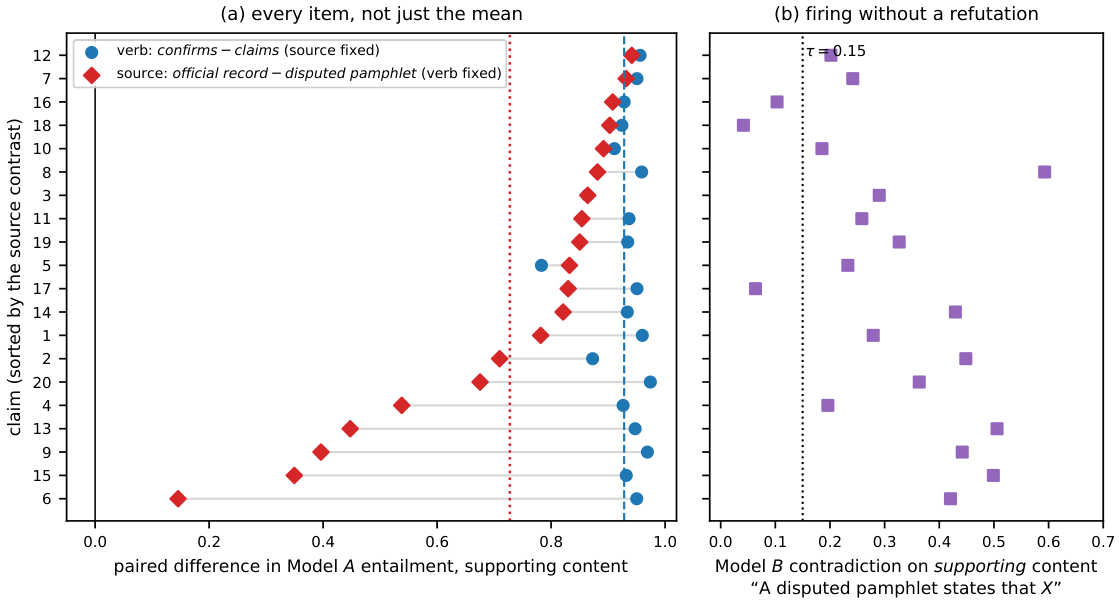
Table 1.
Experiments 1 and 2 (Model A: DeBERTa-v3-large NLI; Model B: RoBERTa-large NLI). The margin rule flags an item iff and . Per-item scores are released as CSV.
Table 1.
Experiments 1 and 2 (Model A: DeBERTa-v3-large NLI; Model B: RoBERTa-large NLI). The margin rule flags an item iff and . Per-item scores are released as CSV.
| Setting | n | mean T | mean F | mean | raw | margin rule |
|---|---|---|---|---|---|---|
| E1 all pairs, single-NLI | 50 | – | – | – | 0/50 | 0/50 |
| E1 self-qualifying, dual-NLI | 20 | 0.038 | 0.010 | 0.048 | 0/20 | 0/20 |
| E2 conflicting, holistic | 20 | 0.474 | 0.239 | 0.713 | 4/20 | 3/20 |
| E2 conflicting, decomposed | 20 | 0.853 | 0.498 | 1.350 | 16/20 | 15/20 |
| Entailment controls, dual-NLI | 10 | 0.997 | 0.053 | 1.049 | 8/10 | 1/20 combined |
| Contradiction controls, dual-NLI | 10 | 0.003 | 0.995 | 0.998 | 2/10 |
Table 2.
Experiment 3: the decomposed protocol on non-conflicting two-source premises and cross-item pairings. The conflicting-evidence row of Table 1 is repeated for reference.
Table 2.
Experiment 3: the decomposed protocol on non-conflicting two-source premises and cross-item pairings. The conflicting-evidence row of Table 1 is repeated for reference.
| Control family (decomposed) | n | mean T | mean F | mean | raw | margin rule |
|---|---|---|---|---|---|---|
| AGREE-SUP: two sources support | 20 | 0.853 | 0.002 | 0.854 | 0/20 | 0/20 |
| AGREE-REF: two sources refute | 20 | 0.179 | 0.481 | 0.661 | 3/20 | 1/20 |
| CROSS: support i + refute | 20 | 0.853 | 0.284 | 1.136 | 12/20 | 8/20 |
| E2 conflicting, decomposed (reference) | 20 | 0.853 | 0.498 | 1.350 | 16/20 | 15/20 |
Table 3.
Experiment 4: recall and false positives of the decomposed protocol without a gate, with the NLI gate , and with the lexical gate. Same margin rule throughout.
Table 3.
Experiment 4: recall and false positives of the decomposed protocol without a gate, with the NLI gate , and with the lexical gate. Same margin rule throughout.
| Family () | n | ungated | NLI gate | lexical gate () |
|---|---|---|---|---|
| Conflicting evidence (recall) | 20 | 15/20 | 5/20 | 15/20 |
| AGREE-SUP (false positives) | 20 | 0/20 | 0/20 | 0/20 |
| AGREE-REF (false positives) | 20 | 1/20 | 0/20 | 1/20 |
| CROSS (false positives) | 20 | 8/20 | 0/20 | 0/20 |
| Entailment controls (false positives) | 10 | 1/10 | 1/10 | 1/10 |
| Contradiction controls (false positives) | 10 | 0/10 | 0/10 | 0/10 |
Table 4.
Sweep of the margin threshold in the rule and , ungated F.
| recall, E2 decomposed | FP, ENT/CON | FP, AGREE-SUP | FP, AGREE-REF | FP, CROSS | |
|---|---|---|---|---|---|
| 0.00 | 16/20 | 10/20 | 0/20 | 3/20 | 12/20 |
| 0.05 | 15/20 | 1/20 | 0/20 | 1/20 | 10/20 |
| 0.10 | 15/20 | 1/20 | 0/20 | 1/20 | 9/20 |
| 0.15 | 15/20 | 1/20 | 0/20 | 1/20 | 8/20 |
| 0.20 | 15/20 | 1/20 | 0/20 | 1/20 | 8/20 |
| 0.25 | 11/20 | 1/20 | 0/20 | 0/20 | 8/20 |
| 0.30 | 9/20 | 1/20 | 0/20 | 0/20 | 7/20 |
| 0.40 | 8/20 | 1/20 | 0/20 | 0/20 | 6/20 |
Table 5.
Experiment 6. Items flagged (out of 20 per family) by the two-channel margin rule (, ) and by the single-channel rule (); both use the lexical gate. Configurations: one head for both channels (A only, B only), the main dual assignment, and its swap.
Table 5.
Experiment 6. Items flagged (out of 20 per family) by the two-channel margin rule (, ) and by the single-channel rule (); both use the lexical gate. Configurations: one head for both channels (A only, B only), the main dual assignment, and its swap.
| two-channel margin rule | single-channel rule | |||||||
|---|---|---|---|---|---|---|---|---|
| Configuration (gated) | CONFL. | A-SUP | A-REF | CROSS | CONFL. | A-SUP | A-REF | CROSS |
| A only () | 4 | 0 | 0 | 0 | 4 | 0 | 3 | 0 |
| B only () | 17 | 0 | 4 | 0 | 17 | 0 | 17 | 0 |
| dual, , (main) | 15 | 0 | 1 | 0 | 17 | 0 | 17 | 0 |
| dual, , (swap) | 4 | 0 | 0 | 0 | 4 | 0 | 3 | 0 |
Table 6.
Recalculated from the per-item scores of the main dual assignment (lexical gate, ): the published diagonal rule , a bilateral rule dropping the requirement, the single-channel rule ( for all three), and a post-hoc rectangular rule (, , no diagonal) whose thresholds were chosen after inspecting these scores. The three -rules are nested: .
Table 6.
Recalculated from the per-item scores of the main dual assignment (lexical gate, ): the published diagonal rule , a bilateral rule dropping the requirement, the single-channel rule ( for all three), and a post-hoc rectangular rule (, , no diagonal) whose thresholds were chosen after inspecting these scores. The three -rules are nested: .
| Family | n | (published) | (no diagonal) | (single-channel) | (post hoc) |
|---|---|---|---|---|---|
| CONFLICT (recall) | 20 | 15/20 | 17/20 | 17/20 | 15/20 |
| AGREE-SUP (FP) | 20 | 0/20 | 0/20 | 0/20 | 0/20 |
| AGREE-REF (FP) | 20 | 1/20 | 5/20 | 17/20 | 0/20 |
| CROSS (FP) | 20 | 0/20 | 0/20 | 0/20 | 0/20 |
| Entailment controls (FP) | 10 | 1/10 | 1/10 | 1/10 | 1/10 |
| Contradiction controls (FP) | 10 | 0/10 | 0/10 | 10/10 | 0/10 |
Table 7.
Experiment 7. Upper block: polarity-blind selection, coordinates are the maximum entailment and the maximum contradiction over both spans with no oracle assignment of span roles; the lexical gate restricts the contradiction maximum to spans with and is applied to every column, including the collapsed difference . Margin rule ; bilateral rule in parentheses. Lower block: exhaustive search over closed intervals on D (endpoints at observed values, ties grouped), 20 conflicting items against 90 controls, under stated objectives; retrospective on these items, from audit_a8_intervals.py.
Table 7.
Experiment 7. Upper block: polarity-blind selection, coordinates are the maximum entailment and the maximum contradiction over both spans with no oracle assignment of span roles; the lexical gate restricts the contradiction maximum to spans with and is applied to every column, including the collapsed difference . Margin rule ; bilateral rule in parentheses. Lower block: exhaustive search over closed intervals on D (endpoints at observed values, ties grouped), 20 conflicting items against 90 controls, under stated objectives; retrospective on these items, from audit_a8_intervals.py.
| Family | n | dual max-max, gated | A-only max-max, gated | D range, dual | D range, A only |
|---|---|---|---|---|---|
| CONFLICT (recall) | 20 | 15/20 (17/20) | 4/20 (4/20) | ||
| AGREE-SUP (FP) | 20 | 0/20 (0/20) | 0/20 (0/20) | ||
| AGREE-REF (FP) | 20 | 3/20 (8/20) | 0/20 (0/20) | ||
| CROSS (FP) | 20 | 0/20 (0/20) | 0/20 (0/20) | ||
| ENT (FP) | 10 | 1/10 (1/10) | 0/10 (0/10) | ||
| CON (FP) | 10 | 0/10 (0/10) | 0/10 (0/10) | ||
| NEU (FP) | 10 | 0/10 (0/10) | 0/10 (0/10) | ||
| Objective on the scalar D | dual heads, TP/FP | A only, TP/FP | |||
| max TP with FP | 7/20 at 2 | 4/20 at 2 | |||
| max TP with FP | 8/20 at 3 | 4/20 at 2 | |||
| max | 18/20 at 21 () | 13/20 at 22 () | |||
| full recall, minimum FP | 20/20 at 36 | 20/20 at 60 | |||
| two-coordinate margin rule, same pair | 15/20 at 4 | 4/20 at 0 | |||
Table 10.
Experiment 10: intervention on the released stimuli. In each arm the source noun phrase of the indicated span is replaced by “The document”; reporting verb and propositional content are kept verbatim. T and F are the published channels with the lexical gate; the margin rule is and . “Holistic” applies both heads to the concatenated premise, as in Section 5.2. Predictions registered before inference; per-item scores and the substitution table are released.
Table 10.
Experiment 10: intervention on the released stimuli. In each arm the source noun phrase of the indicated span is replaced by “The document”; reporting verb and propositional content are kept verbatim. T and F are the published channels with the lexical gate; the margin rule is and . “Holistic” applies both heads to the concatenated premise, as in Section 5.2. Predictions registered before inference; per-item scores and the substitution table are released.
| Arm | mean T | mean F | margin rule | holistic |
|---|---|---|---|---|
| original (as published) | 0.853 | 0.498 | 15/20 | 3/20 |
| ref-neutral (refuting source neutralized) | 0.853 | 0.847 | 20/20 | 9/20 |
| sup-neutral (supporting source neutralized) | 0.835 | 0.498 | 15/20 | 1/20 |
| both-neutral | 0.835 | 0.847 | 19/20 | 6/20 |
Disclaimer/Publisher’s Note: The statements, opinions and data contained in all publications are solely those of the individual author(s) and contributor(s) and not of MDPI and/or the editor(s). MDPI and/or the editor(s) disclaim responsibility for any injury to people or property resulting from any ideas, methods, instructions or products referred to in the content. |
© 2026 by the authors. Licensee MDPI, Basel, Switzerland. This article is an open access article distributed under the terms and conditions of the Creative Commons Attribution (CC BY) license (http://creativecommons.org/licenses/by/4.0/).
Copyright: This open access article is published under a Creative Commons CC BY 4.0 license, which permit the free download, distribution, and reuse, provided that the author and preprint are cited in any reuse.