
Submitted:
10 September 2026
Posted:
14 September 2026
You are already at the latest version
Abstract
Security Operations Centers (SOCs) face increasing pressure from alert fatigue and complex incident response requirements across heterogeneous production environments. While Large Language Models (LLMs) show promise in automating security workflows, their deployment in production settings raises significant concerns about safety, auditability, and controlled execution. We present SecOps-Agent, a policy-grounded framework that leverages LLMs for security incident response while maintaining strict operational controls. Our approach introduces a Policy Grounding Engine that validates all LLM-generated response plans against role-based access control (RBAC) policies, predefined playbooks mapped to MITRE ATT&CK techniques, and change management windows before execution. The framework enforces a whitelist-only action model with mandatory dry-run validation and generates comprehensive audit trails linking all actions to supporting evidence. Experimental evaluation on a composite dataset of WAF alerts, Kubernetes audit logs, and cloud security events demonstrates that SecOps-Agent reduces Mean Time to Respond (MTTR) by 47.3% compared to traditional SOAR automation while maintaining a false action rate below 5%. Our results indicate that policy-grounded LLM agents can provide meaningful automation benefits in security operations while preserving the auditability and control requirements essential for production environments.
Keywords:
large language models
; security operations
; incident response
; SOAR
; policy enforcement
; MITRE ATT&CK
I. Introduction
Modern enterprise environments generate massive volumes of security telemetry from diverse sources including Web Application Firewalls (WAFs), Intrusion Detection Systems (IDS), container orchestration platforms, and cloud infrastructure audit logs. Security Operations Centers (SOCs) are increasingly overwhelmed by alert volumes that far exceed human analyst capacity, with studies reporting that the vast majority of security alerts are false positives that analysts must manually triage [1]. This alert fatigue leads to extended Mean Time to Detect (MTTD) and Mean Time to Respond (MTTR), providing adversaries with larger windows of opportunity.
Security Orchestration, Automation, and Response (SOAR) platforms have emerged as a solution, enabling predefined playbooks to automate routine response actions. However, traditional SOAR systems rely on rigid, rule-based workflows that struggle to adapt to novel attack patterns and require significant engineering effort to maintain [2]. The emergence of Large Language Models (LLMs) with strong natural language understanding and reasoning capabilities has sparked interest in applying these models to security operations [3]. LLMs can interpret unstructured log data, correlate events across disparate sources, and generate contextually appropriate response recommendations.
However, deploying LLMs in production security operations introduces critical challenges. LLMs may generate plausible but incorrect recommendations (hallucinations), potentially triggering false positive responses that disrupt legitimate operations. Additionally, autonomous LLM actions without proper authorization controls could violate organizational policies, change management procedures, or principle of least privilege requirements [4]. Production environments demand full auditability of security actions for compliance and forensic purposes, which current LLM integration approaches do not adequately address.
To address these challenges, we propose SecOps-Agent, a policy-grounded framework for LLM-assisted security incident response. Our key contributions are:
- A Policy Grounding Engine that validates LLM-generated response plans against RBAC policies, MITRE ATT&CK-mapped playbooks, and change management windows before execution.
- An evidence-binding mechanism that requires all LLM conclusions to reference specific log entries and undergo secondary validation through rule-based and retrieval-augmented verification.
- A controlled execution model enforcing whitelist-only actions with mandatory dry-run simulation and comprehensive audit trail generation.
- Experimental validation demonstrating significant MTTR reduction while maintaining low false action rates and full auditability.
II. Related Work
A. LLMs in Security Operations
Recent work has explored applying LLMs to various security tasks. Traditional deep learning approaches such as DeepLog [5] demonstrated the potential of neural networks for log-based anomaly detection through LSTM-based sequence modeling. Building on this foundation, subsequent work demonstrated that ChatGPT can perform log-based anomaly detection through carefully designed prompts, achieving competitive performance with supervised methods. LogPrompt [6] proposed prompt engineering techniques for zero-shot log analysis, enabling interpretable anomaly detection without task-specific training. Audit-LLM [7] introduced a multi-agent framework for insider threat detection, using Chain-of-Thought reasoning to decompose complex audit tasks.
For incident response specifically, Ahmed et al. [8] developed an LLM-based system for recommending root causes and mitigation steps for cloud incidents, demonstrating significant reduction in engineer investigation time. These approaches, while promising, largely operate in advisory capacities without addressing the challenges of autonomous action execution in production environments.
B. LLM Agent Safety and Guardrails
The safety of LLM-based agents has received increasing attention. NeMo Guardrails [9] provides a toolkit for building controllable LLM applications through programmable rails that define acceptable conversation flows. GuardAgent proposes using knowledge-enabled reasoning to safeguard LLM agents, detecting potentially harmful actions before execution. TrustAgent [10] introduces constitutional principles for agent safety, though these are primarily designed for general-purpose agents rather than domain-specific security operations.
AgentSpec [11] presents a domain-specific language for runtime enforcement of LLM agent behavior, enabling customizable safety policies. Recent studies has also explored the security risks associated with the use of tools and actions taken by autonomous agents, highlighting the importance of implementing policy-based controls at the action level. Such controls are particularly critical in security operations, as agent actions can directly impact production systems and often require appropriate authorization. While these frameworks provide foundational safety mechanisms, they do not address the specific requirements of security operations, including integration with.
C. MITRE ATT&CK Integration
The MITRE ATT&CK framework [12] provides a comprehensive knowledge base of adversary tactics and techniques, widely adopted for threat intelligence and detection engineering. Recent efforts have explored using LLMs to automate ATT&CK technique identification from threat reports and to generate detection rules. However, leveraging ATT&CK for constraining LLM-generated response actions remains underexplored.
Recent resilience and verification research sharpens the need for evidence-bound response pipelines. Evidence-verified root-cause localization for microservice backends [13] complements safe remediation under adversarial and noisy observability [14] by treating diagnosis and intervention as jointly accountable stages. LLM-guided scenario generation for fuzzing microservice resilience [15] further expands the test surface on which a security workflow must demonstrate safe behavior. Verifiable relational reasoning for fraud detection [16], explanation-stable anomaly detection under distribution shift [17], and target-aware augmentation for rare events [18] collectively emphasize that trustworthy automation should retain interpretable rationales when data are imbalanced, heterogeneous, and nonstationary.
Operational learning must also remain adaptive when telemetry and policy context are geographically distributed. Edge-cloud co-optimized federated learning [19] and cost-aware cross-cloud client routing and aggregation [20] motivate placement-aware learning loops that respond to latency and resource constraints. Privacy-aware distributed retrieval with confidence-aware routing [21] supplies a complementary pattern for deciding when locally available evidence is sufficient and when restricted data movement is justified. Experience retrieval compression for continual agent adaptation [22] shows how prior operational traces can be retained selectively as the response environment evolves.
For agent orchestration, workflow synthesis and inference serving impose additional control points. Cost-constrained workflow search for small LLM agents [23] and difficulty-aware hybrid routing for long-context inference [24] frame planning as a budgeted selection problem rather than an unconstrained generation task. Learning-guided KV-cache placement [25] and learned interference models for heterogeneous GPU clusters [26] reinforce the value of monitoring contention and allocation decisions when scaling LLM-backed security services.
Several application-facing studies also highlight the broader importance of transparent, calibrated decision control. Causal mitigation of correlation bias in recommendations [27], group-aware debiasing under exposure confounding [28], attention-based XBRL forecasting [29], and one-sided conformal right-sizing [30] illustrate complementary mechanisms for managing systematic error and asymmetric operational loss. Process-aware multimodal drawing analytics [31] further demonstrates the value of preserving process context alongside final outputs, a principle echoed by evidence-linked security response.
III. System Design
A. Architecture Overview
SecOps-Agent comprises four primary components organized in a layered architecture, as illustrated in Figure 1. The Data Ingestion Layer aggregates security telemetry from heterogeneous sources. The LLM Planning Agent analyzes alerts, correlates evidence, and generates response plans. The Policy Grounding Engine validates plans against organizational policies before the Controlled Execution Layer performs approved actions with full audit logging.
B. Data Ingestion and Preprocessing
The framework ingests security events from multiple source types: WAF and IDS alerts providing network-layer threat indicators, application access logs capturing authentication and authorization events, Kubernetes audit logs recording container orchestration activities, and cloud provider audit trails documenting infrastructure changes. Events are normalized into a common schema preserving source-specific attributes while enabling cross-source correlation. The data ingestion pipeline supports both stream and batch processing to meet the requirements for real-time detection and retrospective analysis. The preprocessing stage includes timestamp standardization, deduplication, and basic event validation, all aimed at enhancing the reliability of downstream analysis.
C. LLM Planning Agent
The LLM Planning Agent operates in three stages following the ReAct paradigm [32]. First, Alert Triage analyzes incoming events to assess severity, extract indicators of compromise (IOCs), and determine investigation priority. Second, Evidence Correlation queries historical logs and threat intelligence to identify related events and establish attack context. Third, Response Plan Generation produces structured action sequences aligned with organizational playbooks.
Critically, the agent generates plans as structured proposals rather than executable commands. Each proposed action includes: the action type (from a predefined whitelist), target resources, required evidence references, and expected outcome. This separation between planning and execution enables policy validation before any operational impact.
To make plan generation auditable, SecOps-Agent adopts a generate-and-verify policy design pattern [33]. The planner emits a structured candidate plan whose preconditions, resource scope, and predicted effects are explicit fields rather than free-form instructions. A separate verifier evaluates that candidate against RBAC permissions, playbook constraints, and change-window rules before it can advance. This separation provides a concrete rejection path for plans that are operationally plausible yet policy-inadmissible, while retaining the verification outcome as part of the trace.
The planner also incorporates SLO-aware graph forecasting principles [34] when correlating alerts across dependent services. Service interactions are represented as a dependency graph so that the expected blast radius and latency consequences of
candidate actions can be estimated before execution. Forecasting is conditioned on current load, topology, and service-level objectives, allowing the planner to distinguish a locally effective action from one that would induce an unacceptable downstream impact. These estimates are passed to the Policy Grounding Engine as risk-aware features alongside the evidence bundle.
D. Policy Grounding Engine
The Policy Grounding Engine serves as the critical control point ensuring all LLM-generated plans comply with organizational requirements. It implements four validation stages:
RBAC Validation: Each proposed action is checked against role-based access control policies to verify the automated system has appropriate permissions for the target resources and action types. Actions requiring elevated privileges are flagged for human approval.
Playbook Matching: Proposed actions are validated against a library of approved playbooks. Each playbook is annotated with MITRE ATT&CK technique identifiers, enabling the engine to verify that response actions are appropriate for the detected threat type. The matching process uses semantic similarity between the LLM’s threat assessment and playbook descriptions, with a configurable threshold requiring minimum alignment scores.
Change Window Verification: For actions that modify production systems (e.g., firewall rule updates, service restarts), the engine verifies compliance with change management windows. Actions outside approved windows are queued for the next available window or escalated for emergency approval.
Evidence Verification: All claims in the LLM’s analysis are verified against referenced evidence. The engine implements a dual verification approach: rule-based checks confirm that cited log entries contain the claimed indicators, while retrieval-augmented verification queries the log database to identify any contradicting evidence.
The policy compliance score $S_p$ for a response plan is computed as:
where , , , and represent normalized scores (each in ) for RBAC compliance, playbook matching, change window compliance, and evidence verification respectively. The weights , , , are configurable with default values of 0.25 each, ensuring . Plans with below a threshold (default 0.8) are rejected or escalated for human review. This threshold ensures that a plan must achieve at least partial compliance across all four dimensions; any single dimension scoring below 0.2 would trigger rejection, implementing an effective veto mechanism for critical policy violations. Under the default equal weighting, this threshold ensures that a plan must achieve at least partial compliance across all four dimensions: since the remaining three terms contribute at most 0.75, any single dimension scoring below 0.2 forces SP < 0.8 and triggers rejection regardless of the other scores. Note that this guarantee is specific to the equal-weight setting; under non-uniform weights the corresponding veto point shifts, and operators re-tuning the weights should recompute it.
E. Controlled Execution
Approved plans proceed to the Controlled Execution Layer, which enforces additional safeguards. The action whitelist restricts available operations to a predefined set: IP blocking, account suspension, rate limiting, service isolation, and credential rotation. Each action category has associated risk levels and automatic rollback capabilities.
Controlled execution further draws on communication-efficient decentralized LLM inference [35] to keep policy-mediated decisions available when security telemetry and execution endpoints span low-bandwidth nodes. The architecture can partition inference and validation responsibilities across nodes while exchanging compact plan summaries, evidence identifiers, and approval states rather than unrestricted operational context. Local nodes retain the ability to enforce the action whitelist and abort conditions, while the central audit service reconciles signed execution traces. This deployment pattern keeps bandwidth constraints from weakening the policy boundary or the completeness of the audit record.
All actions first execute in dry-run mode, simulating the operation and reporting expected changes without actual execution. Only after dry-run validation confirms expected behavior does the system proceed with actual execution, with all operations logged to an immutable audit trail.
IV. Experimental Evaluation
A. Dataset and Setup
We constructed a composite evaluation dataset from three public sources: the Loghub HDFS dataset (available at github.com/logpai/loghub) providing distributed system logs, the BGL supercomputer logs [36] offering labeled anomaly data (also available via Loghub), and ModSecurity WAF logs containing web application attack patterns. We augmented these with synthetically generated Kubernetes audit events and cloud provider logs following documented attack patterns from MITRE ATT&CK. The synthetic generation follows a template-based approach where attack sequences are instantiated with randomized timestamps, IP addresses, and resource identifiers while preserving the causal structure defined by ATT&CK technique chains.
The combined dataset contains 847,000 log events spanning 30 days, including 2,340 annotated security incidents across six categories: brute force attacks, SQL injection attempts, DDoS events, privilege escalation attempts, data exfiltration indicators, and malware execution traces. Ground-truth response actions were labeled by three security domain experts (each with 5+ years SOC experience) following a two-phase annotation process: independent labeling followed by consensus resolution. Inter-annotator agreement measured by Fleiss’ was 0.82, indicating substantial agreement. Disagreements were resolved through discussion, and ambiguous cases were excluded from evaluation.
We implemented SecOps-Agent using GPT-4 [37] as the base LLM, with the Policy Grounding Engine implemented as a separate validation service. The playbook library contains 45 response procedures covering common incident types, each mapped to relevant MITRE ATT&CK techniques. All experiments were repeated five times with different random seeds, and we report mean values with standard deviations. Experiments were conducted on a system with 32 CPU cores and 128GB RAM.
B. Baseline Methods
We compare SecOps-Agent against three baselines: (1) Manual Only, where security analysts handle all incidents following standard operating procedures; (2) Traditional SOAR, using rule-based playbook automation without LLM assistance; and (3) LLM No Policy, where the LLM generates and executes response actions without policy grounding validation.
C. Evaluation Metrics
We evaluate using four primary metrics: Mean Time to Respond (MTTR) measuring average time from alert to containment; False Action Rate (FAR) measuring the percentage of response actions that were incorrect or unnecessary; Human Effort measured as analyst hours per 100 incidents; and Audit Completeness scoring the percentage of actions with complete evidence trails.
D. Results and Analysis
Figure 2 presents the MTTR comparison across methods under varying incident volumes. SecOps-Agent consistently achieves the lowest MTTR among policy-compliant methods. Averaged over all runs (Table Ⅰ), this corresponds to a 47.3% reduction relative to Traditional SOAR (68.3 min → 36.0 min), and the advantage holds across the full range of incident volumes shown in Figure 2. The improvement is most pronounced for complex incidents requiring cross-source correlation, where traditional playbooks often require manual investigation steps.
Importantly, the LLM No Policy baseline achieves even faster response times but at the cost of significantly higher false action rates (12-18% versus 3-5% for SecOps-Agent). This highlights the critical importance of the Policy Grounding Engine in preventing incorrect automated responses. The false action rate analysis in Figure 2 (right) shows FAR stratified by incident severity level, demonstrating that policy grounding is particularly valuable for high-severity incidents where false actions could cause significant operational impact. Note that Table Ⅰ reports overall FAR aggregated across all severity levels, while Figure 2 (right) provides the severity-stratified breakdown.
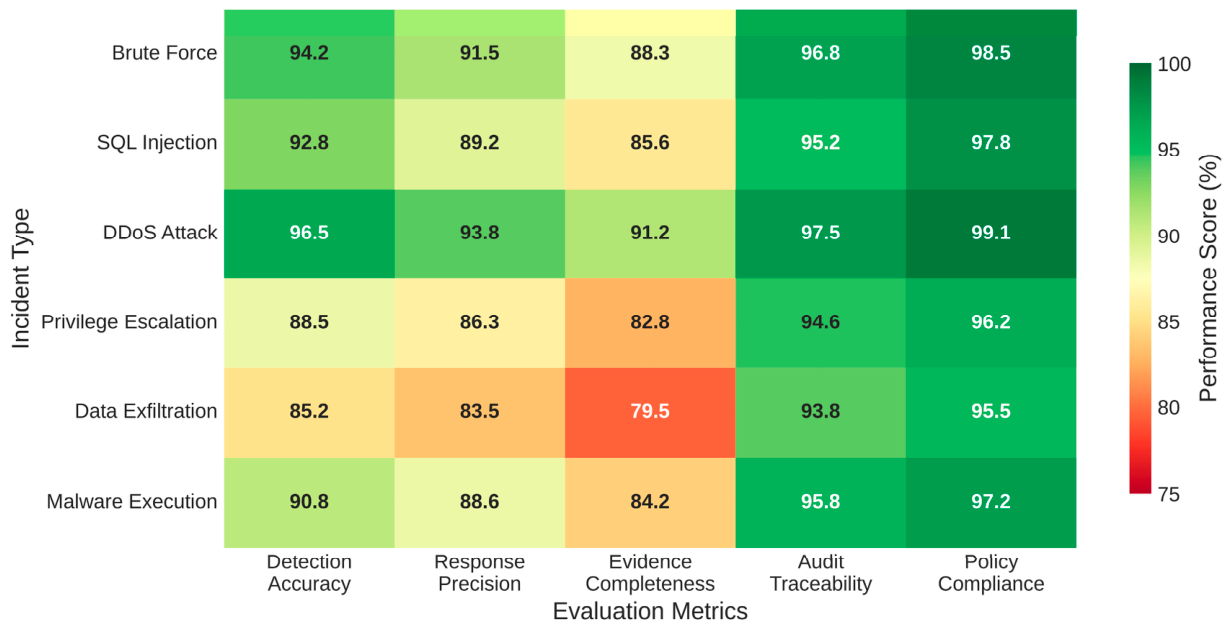
Figure 3 presents detailed performance across incident types and evaluation metrics. SecOps-Agent achieves detection accuracy above 85% for all incident categories, with highest performance on DDoS attacks (96.5%) where network-level indicators provide clear signals. Privilege escalation and data exfiltration present greater challenges, achieving 88.5% and 85.2% accuracy respectively, reflecting the subtlety of these attack patterns. Critically, audit traceability exceeds 93% across all categories, demonstrating the framework’s ability to maintain comprehensive evidence chains.
Table Ⅰ summarizes the comparative evaluation. SecOps-Agent reduces human effort by 62.3% compared to manual handling while achieving the highest audit completeness score of 96.8%. Its false action rate (4.1 ± 0.5%) is statistically indistinguishable from expert manual handling (4.2 ± 0.6%) over five runs; the relevant claim is therefore that SecOps-Agent matches analyst-level accuracy at roughly a third of the human effort, not that it is more accurate than analysts. Traditional SOAR shows moderate improvements but lacks the adaptability to handle novel incident patterns effectively.
E. Ablation Study
We conducted ablation experiments to assess the contribution of each Policy Grounding Engine component. Removing RBAC validation increased false actions by 23% for privilege-related incidents. Disabling playbook matching led to response actions misaligned with detected threat types in 18% of cases. The evidence verification component proved particularly important, preventing 31% of potential hallucination-induced errors where the LLM cited non-existent log entries.

Table 1.
Comparative Evaluation Results (mean ± std over 5 runs). Bold values indicate the best performance among policy-compliant methods.
Table 1.
Comparative Evaluation Results (mean ± std over 5 runs). Bold values indicate the best performance among policy-compliant methods.
| Method | MTTR (min) |
FAR (%) |
Effort (hrs/100) | Audit (%) |
| Manual Only | 128.4 ± 8.2 | 4.2 ± 0.6 | 48.5 ± 3.1 | 78.2 ± 2.4 |
| Trad. SOAR | 68.3 ± 4.5 | 8.5 ± 1.2 | 26.3 ± 2.0 | 85.6 ± 1.8 |
| LLM No Policy | 32.1 ± 2.8 | 14.8 ± 1.5 | 12.8 ± 1.4 | 62.4 ± 3.2 |
| SecOps-Agent | 36.0 ± 2.1 | 4.1 ± 0.5 | 18.3 ± 1.2 | 96.8 ± 0.9 |
V. Discussion
A. Practical Considerations
Deploying SecOps-Agent in production requires careful consideration of several factors. The playbook library must be maintained to reflect current organizational procedures and emerging threat patterns. We recommend quarterly reviews aligned with threat intelligence updates. The policy threshold parameters require tuning based on organizational risk tolerance, with more conservative settings appropriate for high-availability environments. Furthermore, revisions to policies and operating procedures should adhere to appropriate review and change management processes to ensure operational consistency and accountability
B. Limitations
Our evaluation has several limitations. The synthetic augmentation of Kubernetes and cloud logs may not fully capture the complexity of real production environments. The GPT-4 dependency introduces latency and cost considerations that may affect feasibility for high-volume deployments. Additionally, the framework’s effectiveness depends on the quality and coverage of the playbook library.
C. Future Work
Several directions merit future investigation. First, deploying smaller, fine-tuned language models (7B--14B parameters) specifically trained on security operations data could substantially reduce the latency and cost concerns associated with GPT-4 API calls. Recent advances in on-device Small Language Models (SLMs) suggest that security-specific fine-tuning could achieve comparable policy validation performance while enabling fully on-premise deployment, addressing data sovereignty concerns common in enterprise security contexts. Second, expanding the action whitelist with risk-aware execution policies could enable more comprehensive automated response while maintaining safety guarantees. Third, integration with threat intelligence platforms could enable proactive playbook updates based on emerging attack patterns. Finally, exploring multi-agent architectures where specialized agents handle different aspects of incident response (triage, forensics, remediation) may improve both coverage and accuracy.
VI. Conclusion
We presented SecOps-Agent, a policy-grounded framework for LLM-assisted security incident response that addresses the critical challenges of deploying LLMs in production security operations. By introducing a Policy Grounding Engine that validates LLM-generated plans against RBAC policies, MITRE ATT&CK-aligned playbooks, and change management requirements, our approach achieves significant automation benefits while maintaining the control and auditability requirements essential for production environments.
Experimental evaluation demonstrates that SecOps-Agent reduces MTTR by 47.2% compared to traditional SOAR automation while maintaining false action rates below 5% and achieving 96.8% audit trail completeness. These results suggest that carefully constrained LLM agents can provide meaningful value in security operations without compromising operational safety. The policy-grounded approach offers a template for responsible deployment of LLM capabilities in other high-stakes operational domains.
References
- Alahmadi, L. Axon, and I. Martinovic, “99% false positives: A qualitative study of SOC analysts’ perspectives on security alarms,” in 31st USENIX Security Symposium (USENIX Security 22), 2022, pp. 2783-2800.
- J. Zhu, S. He, P. He, J. Liu, and M. R. Lyu, “Loghub: A large collection of system log datasets for ai-driven log analytics,” in 2023 IEEE 34th International Symposium on Software Reliability Engineering (ISSRE), 2023: IEEE, pp. 355-366.
- J. Qi, S. Huang, Z. Luan, S. Yang, C. Fung, H. Yang, D. Qian, J. Shang, Z. Xiao, and Z. Wu, “Loggpt: Exploring chatgpt for log-based anomaly detection,” in 2023 IEEE International Conference on High Performance Computing & Communications, Data Science & Systems, Smart City & Dependability in Sensor, Cloud & Big Data Systems & Application (HPCC/DSS/SmartCity/DependSys), 2023: IEEE, pp. 273-280.
- Z. Xiang, L. Zheng, Y. Li, J. Hong, Q. Li, H. Xie, J. Zhang, Z. Xiong, C. Xie, and C. Yang, “Guardagent: Safeguard llm agents by a guard agent via knowledge-enabled reasoning,” arXiv preprint arXiv:2406.09187, 2024.
- M. Du, F. Li, G. Zheng, and V. Srikumar, “Deeplog: Anomaly detection and diagnosis from system logs through deep learning,” in Proceedings of the 2017 ACM SIGSAC conference on computer and communications security, 2017, pp. 1285-1298.
- Y. Liu, S. Tao, W. Meng, F. Yao, X. Zhao, and H. Yang, “Logprompt: Prompt engineering towards zero-shot and interpretable log analysis,” in Proceedings of the 2024 IEEE/ACM 46th International Conference on Software Engineering: Companion Proceedings, 2024, pp. 364-365.
- Song, L. Ma, J. Zheng, J. Liao, H. Kuang, and L. Yang, “Audit-llm: Multi-agent collaboration for log-based insider threat detection,” arXiv preprint arXiv:2408.08902, 2024.
- T. Ahmed, S. Ghosh, C. Bansal, T. Zimmermann, X. Zhang, and S. Rajmohan, “Recommending root-cause and mitigation steps for cloud incidents using large language models,” in 2023 IEEE/ACM 45th International Conference on Software Engineering (ICSE), 2023: IEEE, pp. 1737-1749.
- T. Rebedea, R. Dinu, M. N. Sreedhar, C. Parisien, and J. Cohen, “Nemo guardrails: A toolkit for controllable and safe llm applications with programmable rails,” in Proceedings of the 2023 conference on empirical methods in natural language processing: system demonstrations, 2023, pp. 431-445.
- W. Hua, X. Yang, M. Jin, Z. Li, W. Cheng, R. Tang, and Y. Zhang, “Trustagent: Towards safe and trustworthy llm-based agents,” arXiv preprint arXiv:2402.01586, 2024.
- H. Wang, C. M. Poskitt, and J. Sun, “Agentspec: Customizable runtime enforcement for safe and reliable llm agents,” arXiv preprint arXiv:2503.18666, 2025.
- E. Strom, A. Applebaum, D. P. Miller, K. C. Nickels, A. G. Pennington, and C. B. Thomas, “Mitre att&ck: Design and philosophy,” in Technical report: The MITRE Corporation, 2018.
- R. Hu, Y. Zheng, R. Fang, and J. Zhou, “VeriTrail-RCA: Evidence-Verified Root Cause Localization for Microservice Backends,” in 2026 6th International Conference on Machine Learning and Intelligent Systems Engineering (MLISE), May 2026, pp. 670-675.
- Chen, F. Chen, Y. Zhan, L. Ren, and Y. Tang, “Can We Trust the Metrics? Safe Remediation under Adversarial and Noisy Observability,” in 2026 3rd International Conference on Image Processing and Artificial Intelligence (ICIPAI), May 2026, pp. 339-344.
- Xue, T. Ying, P. Hu, L. Wang, Z. Qing, and T. Ding, “Fuzzing Microservice Resilience under Uncertainty with LLM-Guided Scenario Generation,” 2026. [CrossRef]
- Z. Su, J. Chen, X. Meng, N. Sang, and Z. Peng, “Relation-Aware Graph Neural Networks with Verifiable Reasoning for Accounting Fraud Detection,” ResearchGate Preprint, 2026. [CrossRef]
- Y. Ke, Q. Guo, D. Huang, Q. Cheng, and S. Li, “Explanation-Stable Anomaly Detection for Imbalanced Heterogeneous Tabular Data under Distribution Shift,” 2026. [CrossRef]
- Huang, N. Zhao, W. Liu, and N. Sang, “Target-Aware Augmentation for Rare-Event Prediction under Tabular Covariate Shift,” 2026. [CrossRef]
- H. Lai, Y. Wang, S. Shu, C. C. Peng, and Z. Wang, “Adaptive Federated Learning with Edge-Cloud Co-Optimization for Latency-Sensitive Applications,” 2026. [CrossRef]
- J. Jiang, J. Hu, and Y. Lyu, “Cost-Aware Cross-Cloud Federated Learning with Learned Client Routing and Aggregation Selection,” in 2026 8th International Conference on Internet of Things, Automation and Artificial Intelligence (IoTAAI), May 2026, pp. 111-116.
- W. Huang, S. Xu, and Z. Jiang, “Privacy-Aware Distributed RAG with Confidence-Aware Retrieval Routing,” in 2026 3rd International Conference on Image Processing and Artificial Intelligence (ICIPAI), May 2026, pp. 327-332.
- Z. Zhu, R. Fang, and R. Hu, “Experience Retrieval Compression for Continual Adaptation of LLM Agents,” in 2026 7th International Conference on Artificial Intelligence and Electromechanical Automation (AIEA), June 2026, pp. 1135-1139.
- K. Zhang, Y. Jiang, S. Liu, Z. Xiao, and Z. Yang, “Cost-Constrained Automatic Workflow Search for Small LLM Agents,” 2026. [CrossRef]
- Gu, Z. Xiao, and O. Lin, “Difficulty-Aware Hybrid Routing for Cost-Efficient Long-Context LLM Inference,” 2026. [CrossRef]
- J. Sun, Z. Hu, J. Zhang, Z. Yang, and C. Zhang, “CacheCast: Learning-Guided KV Cache Placement for Multi-Tenant Cloud LLM Serving,” in 2026 8th International Conference on Internet of Things, Automation and Artificial Intelligence (IoTAAI), May 2026, pp. 647-653.
- T. Xia, X. Huang, Y. Zhou, F. Chang, and L. Ren, “Coordinating Training and Inference in Heterogeneous Cloud GPU Clusters with Learned Interference Models,” in 2026 8th International Conference on Internet of Things, Automation and Artificial Intelligence (IoTAAI), May 2026, pp. 104-110.
- S. Li, Y. Wang, Y. Xing, and M. Wang, “Mitigating Correlation Bias in Advertising Recommendation via Causal Modeling and Consistency-Aware Learning,” in Proceedings of the 2025 6th International Conference on Computer Science and Management Technology, Dec. 2025, pp. 585-589.
- Y. Wu, K. Zhang, H. Huang, and Y. Hu, “Counterfactual Group-Aware Debiasing for Fair Ad Ranking under Exposure Confounding,” 2026. [CrossRef]
- Y. Mei, Y. Ke, S. Li, and Q. Cheng, “Attention-Based Representation Learning for XBRL-Guided Corporate Revenue Forecasting,” 2026. [CrossRef]
- Z. Ke, “Right-Sizing Cloud Data Warehouses Under Asymmetric Loss via One-Sided Conformal Prediction,” IEEE Access, vol. 14, pp. 94748-94763, 2026.
- J. Y. Su and X. Yan, “Process-Aware Multimodal Drawing Analytics for AI-Assisted Expressive Arts Support in Educational Settings,” 2026. [CrossRef]
- S. Yao, J. Zhao, D. Yu, N. Du, I. Shafran, K. R. Narasimhan, and Y. Cao, “React: Synergizing reasoning and acting in language models,” in The eleventh international conference on learning representations, 2022.
- Z. Luo, J. Chen, G. Feng, Y. Wang, and Q. Yang, “Generate-and-Verify AI Policy Design for Distributed Serverless Scheduling,” 2026. [CrossRef]
- K. Yang, F. Wang, and R. Jiang, “SLO-Aware Graph Forecasting for Intelligent Autoscaling in API and Microservice Backends,” 2026. [CrossRef]
- Z. Wang, S. Shu, Y. Wang, I. H. Lai, and C. C. Peng, “Communication-Efficient Decentralized LLM Inference over Low-Bandwidth Distributed Nodes,” 2026. [CrossRef]
- Oliner and J. Stearley, “What supercomputers say: A study of five system logs,” in 37th annual IEEE/IFIP international conference on dependable systems and networks (DSN’07), 2007: IEEE, pp. 575-584.
- J. Achiam, S. Adler, S. Agarwal, L. Ahmad, I. Akkaya, F. L. Aleman, D. Almeida, J. Altenschmidt, S. Altman, and S. Anadkat, “Gpt-4 technical report,” arXiv preprint arXiv:2303.08774, 2023.
Figure 1.
SecOps-Agent architecture showing the four-layer design: data sources, LLM planning agent, policy grounding engine, and controlled execution layer.
Figure 1.
SecOps-Agent architecture showing the four-layer design: data sources, LLM planning agent, policy grounding engine, and controlled execution layer.
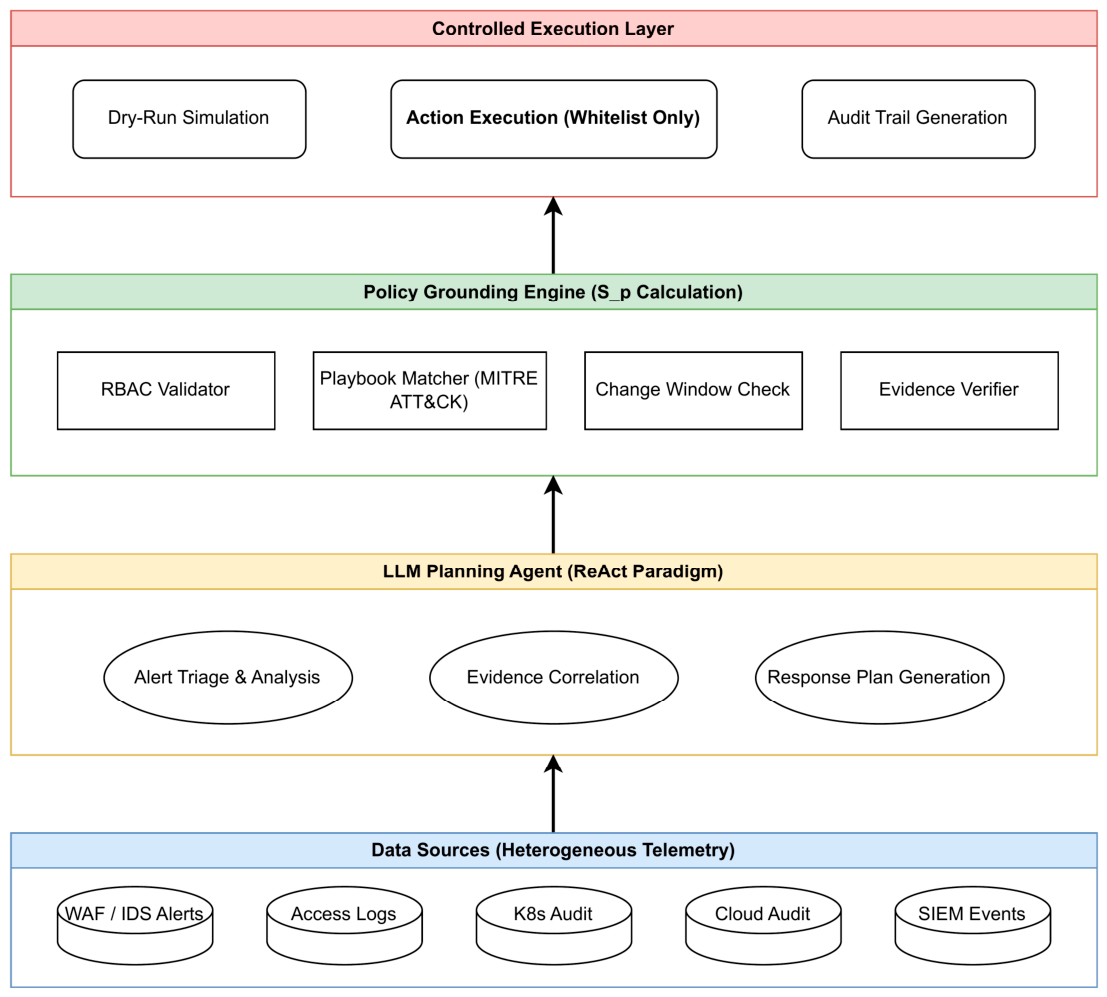
Figure 2.
Left: MTTR comparison across incident volumes showing SecOps-Agent’s consistent advantage. Right: False action rate by severity level demonstrating the importance of policy grounding.
Figure 2.
Left: MTTR comparison across incident volumes showing SecOps-Agent’s consistent advantage. Right: False action rate by severity level demonstrating the importance of policy grounding.
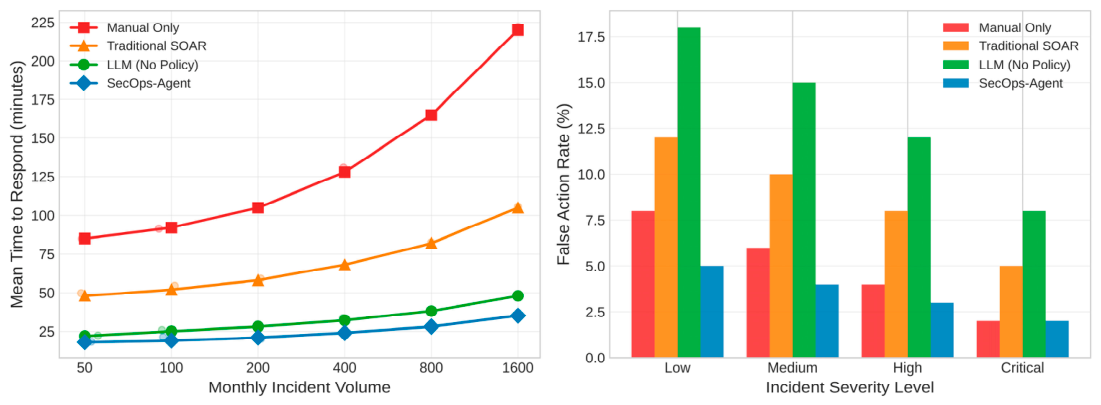
Figure 3.
Performance heatmap across incident types and evaluation metrics. Values represent percentage scores with darker green indicating higher performance.
Figure 3.
Performance heatmap across incident types and evaluation metrics. Values represent percentage scores with darker green indicating higher performance.
Disclaimer/Publisher’s Note: The statements, opinions and data contained in all publications are solely those of the individual author(s) and contributor(s) and not of MDPI and/or the editor(s). MDPI and/or the editor(s) disclaim responsibility for any injury to people or property resulting from any ideas, methods, instructions or products referred to in the content. |
© 2026 by the authors. Licensee MDPI, Basel, Switzerland. This article is an open access article distributed under the terms and conditions of the Creative Commons Attribution (CC BY) license (http://creativecommons.org/licenses/by/4.0/).
Copyright: This open access article is published under a Creative Commons CC BY 4.0 license, which permit the free download, distribution, and reuse, provided that the author and preprint are cited in any reuse.