

Submitted:
11 September 2026
Posted:
14 September 2026
You are already at the latest version
Abstract
Intelligence is commonly associated with deliberate reasoning, intention, and an internal controlling process. This article examines intelligence from a functional and physical perspective, proposing that adaptive behaviour can arise from organized systems without requiring a separate internal deliberative agent. The discussion develops a common functional framework for examining adaptive automata across different physical substrates, from biochemical signalling networks in unicellular organisms to convolutional neural networks, Transformer-based language models, and biological neural networks. In each case, environmental or input signals are transformed through structured interactions among system components, producing changes in internal states and outputs that can improve adaptation or task performance. The comparison also considers how learning and parameter modification occur through evolutionary selection, gradient-based optimization, localized learning mechanisms, and biological synaptic plasticity. Stochastic processes are examined as an important source of variability in both biological and artificial systems, while remaining distinct from the structured transformations that generate adaptive behaviour. The analysis does not claim that these systems possess identical architectures or mechanisms, nor does it attempt to resolve the philosophical question of subjective experience. Rather, it argues that the observed adaptive behaviours can be understood within a physical and functional framework in which intelligence is expressed through organized information processing, learning, and adaptation.
Keywords:
adaptive intelligence
; adaptive automata
; self-attention mechanism
; unicellular signalling
; thermodynamic constraints
; stochastic processes
; biological neural networks
; information processing
1. Introduction: Demystifying Intelligence via Physical Interactivity
Intelligence has long been treated as a mystical, almost transcendental property, exceptionally unique to conscious and self-reflective entities. This paper is a conceptual synthesis and reinterpretation of existing, previously published findings across biology, machine learning, and neuroscience, rather than a report of new experimental data or results. Historically, this perspective has created a rigid, artificial barrier between biological life and the physical universe, attributing a supernatural quality to the choices, adaptations, and survival tactics observed across the natural world. However, when stripped of anthropomorphic bias, intelligence can be entirely demystified and redefined through a purely functional lens. Rather than a metaphysical entity, intelligence is fundamentally a functional property of an organized system. It is the capacity of a biological, chemical, or artificial network to interact with its environment, transform incoming information, modify its internal state, and generate responses appropriate to prevailing conditions. In biological systems, such adaptive responses can contribute to persistence and survival; in artificial systems, they may instead be shaped by a specified learning objective or task. Under this functional definition, intelligence is not something a system has; it is something a system does as it negotiates its relationship with the external physical world. In this article, the term "automaton" is used in a broad functional sense to denote a system whose behaviour arises from the organized interaction of its components; it is not restricted to the formal definition of a finite-state or symbolic automaton in computer science.
All physical systems operate within thermodynamic constraints and are subject to fluctuations, dissipation, and degradation. Biological systems maintain their functional organization by continuously exchanging energy and matter with their environment, while artificial systems operate within physical and computational constraints. From this perspective, adaptation can be viewed as a mechanism by which an organized system maintains functional performance despite changing environmental conditions and internal perturbations. Physical systems are subject to fluctuations, perturbations, wear, and other processes that can alter their organization over time. In biological systems, molecular error correction, repair, regulation, and reproduction provide mechanisms that help preserve functional organization despite these perturbations. From this perspective, the maintenance of functional organization can be viewed qualitatively as a response to thermodynamic constraints [1]. Thermodynamic concepts such as entropy are used here only qualitatively to describe the physical constraints associated with maintaining organized states and dissipating energy; no specific entropy value or thermodynamic calculation is implied. One of the clearest rigorous links between information processing and thermodynamics is Landauer's principle, which establishes a minimum energetic cost for logically irreversible information erasure [2]. This principle establishes an important connection between information processing and thermodynamics, but it does not by itself constitute a theory of intelligence. To persist in a changing physical environment, a network must possess mechanisms capable of tolerating or correcting perturbations, dissipating energy, and maintaining its functional organization. Figure 1 illustrates environmental perturbation, feedback, adaptation, and replication in the preservation of functional organization.
Individual organisms are subject to damage, fluctuations, and eventual loss of functional integrity. Long-term persistence of biological organization therefore depends not only on mechanisms that maintain individual organisms, but also on reproduction and the transmission of heritable information across generations. Environmental selection favours configurations that reproduce more successfully under prevailing conditions, while less successful configurations become less represented in subsequent generations [3]. In this sense, evolutionary adaptation can progressively produce biological structures capable of robust responses to environmental perturbations. In the biological domain, the progeny of a species survives not because individual organisms are immortal, but because the machinery of genetic replication is remarkably adept at error correction and fidelity. When exposed to environmental pressures, networks undergo a continuous process of trial and error. Configurations that reproduce less successfully under prevailing environmental conditions become less represented in subsequent generations, whereas configurations that reproduce more successfully become more prevalent.
A related pattern of iterative optimization also appears in artificial learning systems, although the underlying mechanism is different. In biological evolution, variation and differential reproductive success operate across generations; in machine learning, an optimization procedure modifies model parameters according to an explicitly defined objective function. In both cases, repeated interaction with an evaluation process can progressively favour configurations that perform better under specified conditions. An untrained artificial network generally contains parameters that have not yet been optimized for the target task. Through repeated evaluation of its outputs and optimization of its parameters, the network can progressively develop internal representations that improve task performance. The robustness of an artificial learning system can be supported by distributed representations and the interaction of many learned parameters, although its performance ultimately depends on the architecture, training procedure, and task. By viewing intelligence as an adaptive property of organized physical systems, we can examine microbes, artificial networks, and biological brains within a common functional framework. Although their physical substrates and detailed mechanisms differ substantially, each system transforms environmental inputs through structured interactions and generates responses shaped by its internal organization, learning history, and stochastic dynamics.
2. Biochemical Automata: Adaptive Signalling in Unicellular Life
The illusion of a conscious, deliberate mind can already arise when we observe the behaviour of single-celled organisms. When observing organisms such as an amoeba hunting or a bacterium navigating a chemical environment, it is easy to attribute a rudimentary form of intentionality, choice, or biological will to their movements. However, these behaviours can be explained in terms of biochemical signalling networks operating without a nervous system or an internal deliberative process. Such organisms can therefore be viewed as thermodynamic automata whose adaptive responses arise from physically constrained interactions among molecular gradients, protein conformational changes, and chemical signalling pathways, with stochastic molecular fluctuations contributing to the variability of their behaviour (see Figure 2).
As an example, consider the classic phenomenon of chemotaxis (see Figure 2), where a bacterium like Escherichia coli navigates toward a source of nutrients or away from a toxic repellent [4]. This migration appears highly purposeful to an outside observer, yet it is entirely driven by a mechanical feedback loop operating at the scale of physics and chemistry. The cell membrane contains chemoreceptor proteins that detect changes in the surrounding chemical environment. Binding of a chemical ligand alters the activity and conformation of the receptor complex, which in turn modulates a cascade of intracellular signalling proteins. This signalling cascade modulates the phosphorylation state of the response regulator CheY. Phosphorylated CheY interacts with the flagellar motor and changes its probability of switching between rotational states. Changes in the chemical environment alter the activity of the signalling pathway and thereby change the probability of clockwise and counter-clockwise motor rotation. In E. coli, counter-clockwise rotation generally produces a relatively straight run, whereas clockwise rotation promotes a tumble and reorientation. There is no central processing unit or internal deliberative process evaluating the chemical signal. The organism does not require an internal agent that consciously "seeks" food; rather, changes in the external chemical environment are converted through the signalling network into changes in motor behaviour and the spatial displacement of the organism is the automatic byproduct.

What appears to us as a rudimentary form of intelligence can therefore be understood as the consequence of physical and chemical processes operating through highly organized molecular structures. The survival of the organism is not an act of willpower, but the physical outcome of molecular processes responding to external chemical and energetic inputs. The underlying molecular network has been shaped over many generations by evolutionary selection, producing signalling architectures that can function robustly despite molecular fluctuations and changing environmental conditions. Feedback mechanisms allow the system to adjust its behaviour as environmental conditions fluctuate, thereby helping to preserve functional performance under changing conditions. By demonstrating that complex and adaptive behaviours can arise from molecular mechanisms without an internal deliberative agent, unicellular life provides an important example supporting our broader thesis: intelligence, when defined functionally, can emerge from the dynamic organization of physical processes.
3. Silicon Pattern Extractors: Convolutional Filters and Visual Invariance
If the biological automation of a cell relies on physical chemistry, the automation of artificial computer vision relies on linear algebra. When a convolutional neural network is initially constructed, its learnable filters generally begin with weights that have not yet been optimized for the target task. At this stage, the numerical patterns do not yet represent useful image features. During training, these parameters are progressively adjusted so that the network's responses become increasingly useful for the specified task. To a human observer, these initial numerical grids generally show no task-specific structure or interpretable visual feature. However, during the training phase, the network is exposed to thousands of sample images. As forward passes are executed, a mathematical loss function (L) calculates the error between the network's initial predictions and the true labels (see Figure 3). Through backpropagation, the chain rule is used to compute the gradient of the loss with respect to the model's parameters (see Figure 3) [5]. A gradient-based optimizer then updates the parameters in the direction that reduces the loss, with the learning rate η controlling the magnitude of the update.
During training, the initially unoptimized filters can develop structured patterns that respond selectively to recurring spatial features in the training data. In early convolutional layers, learned filters often become sensitive to local contrasts and oriented structures such as edges. A classical Sobel filter provides a useful illustration of how a simple numerical kernel can extract such spatial contrasts, although the Sobel operator itself is a hand-designed filter rather than a direct demonstration of gradient descent. When a kernel contains negative and positive weights arranged on opposite sides, regions of uniform intensity can partially cancel while sharp intensity transitions produce a larger response. Similar edge-sensitive filters can emerge naturally during the optimization of convolutional networks. The filter does not "know" that it is detecting an object's boundary; it simply transforms local pixel values through numerical operations. For example, the classical Sobel kernel shown in Figure 4 contains negative and positive weights arranged on opposite sides, allowing it to act as a simple edge detector. When this filter slides across a solid, flat background color, the negative and positive products perfectly cancel each other out, yielding a sum of zero. But when it crosses a sharp boundary where a dark color transitions to a light color, the numbers fail to cancel, producing a large response in the mathematical sum (see Figure 4). This occurs entirely without any conscious awareness; the filter doesn't "know" it is looking at an object's boundary; it is merely a static numerical grid revealing spatial contrasts through basic arithmetic.
The true power of this system emerges through its layered, nesting architecture. Unlike a fully connected layer, in which each unit can receive input from all pixels of an image representation, convolutional layers use local connectivity [6]. A single cell in a Layer 1 filter is only wired to a tiny, local patch of raw pixels. When this layer completes its pass, it generates a two-dimensional grid of numbers called a feature map. Layer 2 filters are then connected exclusively to local patches of Layer 1's feature maps. Because of this structural hierarchy, successive layers can combine increasingly complex patterns: early layers often respond to local edges and contrasts, intermediate layers can combine these responses into textures and more complex shapes, and deeper layers can represent increasingly task-specific visual structures. Note: During inference, the trained values in the filter kernel are fixed weights. Each kernel multiplies the corresponding local pixel values, after which a bias term is added to the resulting sum.
To increase robustness to small spatial variations, many convolutional networks incorporate pooling layers (see Figure 4). A max-pooling operation slides across a feature map and retains the highest activation within each localized window, discarding the lower activations. This down-sampling can make the representation less sensitive to small positional shifts of a detected feature. However, pooling does not provide complete translation invariance; the degree of invariance depends on the architecture, the pooling scale, and the learned representations. Through the combination of local filtering, hierarchical feature extraction, and spatial down-sampling, convolutional networks can progressively transform local image patterns into increasingly useful representations for classification. Through this step-by-step combination of hierarchical filtering, spatial tracking, and aggressive feature selection, the network categorizes highly intricate images with high accuracy on many image-classification tasks. Like the biochemical automaton described in Section 2, the convolutional neural network (CNN) performs its transformations automatically through the physical or computational structure of its components. During inference, its trained parameters remain fixed while the input is transformed through successive numerical operations.
4. The Linguistic Matrix: Self-Attention and Contextual Transformation in LLMs
While computer vision processes spatial arrays using localized grids, natural language processing models represent linguistic information through high-dimensional vector spaces in which relationships between tokens can be transformed according to their context. When a user inputs a prompt into a Large Language Model (LLM), the text is first divided into tokens and converted into numerical token identifiers using the model's vocabulary. Each token identifier is then associated with a vector stored in the model's embedding matrix. This initial representation is commonly referred to as a token embedding. This initial vector is a static embedding. The initial token embedding provides a context-independent starting representation for a token. For example, the same token identifier for "apple" is associated with the same initial embedding whether it occurs in a sentence about an organic fruit or a technology company. The contextual distinction is developed later as the representation is transformed through the successive layers of the network. Thus, the initial embedding should not be interpreted as a complete representation of the token's meaning; it is a numerical starting point from which contextual representations are constructed. This representation contains no information about the token's immediate context; contextual information is incorporated through the subsequent Transformer layers.
The transformation of these initial token representations into context-dependent representations occurs through the repeated operations of the Transformer architecture, including the self-attention mechanism. The self-attention mechanism can be viewed schematically as a content-dependent information-routing process based on three learned linear projections: Query (WQ), Key (WK), and Value (WV) [7]. These projection matrices are learned during training and remain fixed during a particular inference pass. They therefore function as learned parameters of the language model rather than as explicitly hardcoded linguistic rules. At an attention layer, the current representation matrix X (obtained from the prompt) is multiplied by these learned projection matrices to produce Query, Key, and Value representations for the tokens in the sequence:
- The Query (): Represents the features used by a token to determine which other token representations are most relevant to it.
- The Key (): Represents the features against which other token queries are compared to determine their relevance.
- The Value (): Contains the representation that is weighted and combined according to the attention scores to produce the contextualized output.
The model constructs context-dependent representations through a sequence of matrix operations during the forward pass. First, the Query matrix is multiplied by the transposed Key matrix (Q∙Kᵀ) to produce a matrix of attention scores (see Figure 5). These scores measure the mathematical compatibility between the query representation of each token and the key representations of the other tokens. For example, in a sequence such as "the iPhone made by Apple," the attention score between the representation of "Apple" and the key representation of "iPhone" may become relatively high in a particular attention head if that relationship is useful for the model's current computation. These learned relationships arise from the statistical structure captured during training. These scores are scaled and passed through a Softmax function, producing normalized attention weights. For each query position, the corresponding attention weights form a probability distribution whose values sum to 1. The attention weights are then used to form a weighted combination of the Value representations. In this way, information from other token positions contributes to the updated representation at each position. For the token "Apple," for example, information associated with surrounding tokens such as "iPhone" may contribute strongly to the resulting representation, while in a different linguistic context other tokens may receive greater weights. The resulting vector therefore becomes context-dependent rather than remaining identical to its initial token embedding, as illustrated schematically in Figure 5.
In autoregressive decoder-style language models, causal masking is used during training and inference to ensure that the prediction at a given position cannot depend on future tokens. During training, the model can process the entire sequence in parallel, but the causal mask prevents information from future positions from contributing to the prediction at each position. During its training phase, the model is fed entire sentences at once. Without causal masking, information from future token positions would be available when computing the representation used for prediction, resulting in information leakage during training. To impose this constraint, a causal mask is applied to the attention scores before the Softmax operation, assigning effectively −∞ to disallowed future positions in the mathematical formulation. After the Softmax operation, these masked positions receive zero attention weight, producing a lower-triangular attention pattern for a causal sequence. (as shown in Figure 5: masked attention). This causal constraint ensures that the prediction at a given position can depend only on tokens available up to that position, and not on future tokens. This masked representation is passed sequentially through multiple attention and feed-forward layers. At the end of the network, the final contextual representation is projected onto the vocabulary space and converted by a Softmax function into a probability distribution over possible next tokens. A decoding procedure then selects the next token according to the chosen strategy, which may be deterministic or stochastic. In autoregressive generation, the selected token is appended to the sequence and the process is repeated one token at a time. In contrast, many image-processing architectures do not impose a causal ordering on spatial positions. For image classification, information from different spatial regions can therefore be processed without the temporal masking required for autoregressive text generation. For many vision-transformer architectures used for image classification, attention is not causally masked, allowing visual tokens to exchange information across spatial positions. The precise attention pattern, however, depends on the architecture and task. Although text and vision Transformers can use the same basic attention formulation based on Q, K, and V and can be trained with gradient-based optimization, their input representations, attention patterns, and task objectives can differ substantially. In an autoregressive text model, causal masking restricts attention to the current and preceding token positions. In vision-transformer architectures, attention is instead unmasked, allowing information to be exchanged across spatial patches.
The important point for the present argument is that contextual linguistic behaviour can arise from repeated numerical transformations of distributed representations. Contextual relationships emerge from the interaction of learned parameters, token representations, attention operations, and the sequential generation process.
5. The Learning Paradigm Shift: Global Backpropagation Versus Localized Synaptic Plasticity
It is also important to consider how these networks optimize their parameters and how this learning process differs from biological synaptic plasticity. In many standard neural-network models, including the architectures discussed in this paper, training relies on global backpropagation. Backpropagation is mathematically global: calculating the gradient update for each individual weight requires an error signal to be propagated from the final output all the way back through the entire network, layer by layer [5]. During the backward pass, gradients are propagated through the computational graph from the output toward earlier layers, creating a network-wide dependency for the parameter updates. This form of end-to-end gradient transport is not known to be the mechanism by which biological synaptic plasticity is implemented. Biological neurons operate continuously and modify synaptic efficacy through local molecular and cellular processes that are influenced by presynaptic activity, postsynaptic activity, and broader modulatory signals. There is currently no established biological equivalent of the exact gradient-backpropagation mechanism used in conventional artificial neural networks [8]. Instead, much of biological synaptic plasticity is mediated by local interactions at or near the synapse, together with modulatory signals arising from the wider neural network and cellular environment.
To explore possible alternatives to global backpropagation, researchers have developed learning frameworks with more local update mechanisms, including Forward-Forward learning and predictive coding approaches (see Figure 6). Forward-Forward learning, such as Geoffrey Hinton's proposed Forward-Forward algorithm, eliminates the conventional backward pass [9]. Instead of relying on a single end-to-end error gradient, the method uses separate forward passes and local "goodness" objectives to adjust the parameters of individual layers. In Hinton's formulation, positive and negative examples are used to encourage different layer responses.
Conversely, Predictive Coding frameworks restructure the network into a hierarchy of local prediction loops [10]. In predictive-coding frameworks, hierarchical levels exchange predictions and prediction errors, with higher levels providing predictions about activity at lower levels. When sensory information arrives from the bottom up, the model compares incoming activity with its predicted activity, generating prediction-error signals that can be used to update internal states. The resulting prediction-error signal can then be used to update the internal state and reduce the mismatch between predicted and incoming activity. These alternative frameworks illustrate that complex pattern optimization can be achieved through automated learning dynamics that rely more heavily on local information, providing computational models for exploring how biological learning might differ from conventional global backpropagation. This perspective has conceptual connections with the free-energy principle, which provides a theoretical framework in which biological systems are described in terms of maintaining viable states through processes related to prediction, inference, and the minimization of variational free energy [11].
The comparison therefore does not imply that biological brains implement Forward-Forward learning or predictive coding exactly as formulated in artificial models; rather, it highlights a broader principle: adaptive learning can arise from distributed physical interactions without requiring a single centralized mechanism equivalent to global backpropagation.
6. The Biological Bridge: The Brain as a Multi-Scale Network
The architectural principles used in artificial vision and language processing are not entirely disconnected from biological organization; they provide computational analogies to several principles observed in biological sensory and neural systems. Across biological evolution, increasingly complex organisms have incorporated molecular signalling networks into larger and more specialized cellular and neural systems. Multicellular nervous systems therefore build upon, rather than replace, the molecular mechanisms already present within individual cells. Evolution did not eliminate these underlying molecular mechanisms; rather, multicellular organisms incorporated them into increasingly complex cellular and neural architectures. The human brain provides a striking example of how localized molecular and cellular signalling can be integrated within large-scale, hierarchical neural networks.
This multi-scale organization, illustrated schematically in Figure 7, links local molecular and cellular processes with large-scale neural pathways throughout the nervous system. At the local, microscopic level, the brain functions much like the chemical automata explored in cellular biology. Each neuron operates within a complex cellular environment involving ionic gradients, membrane potentials, intracellular signalling pathways, and neurotransmitter-mediated interactions. When an action potential reaches an axon terminal, it triggers calcium influx through voltage-gated calcium channels, which promotes synaptic-vesicle fusion with the presynaptic membrane and neurotransmitter release into the synaptic cleft. These neurotransmitters bind to receptors on the postsynaptic neuron and alter ion-channel activity or intracellular signalling, thereby changing the probability and timing of subsequent neuronal activity. These local signalling processes are governed by the laws of physics and chemistry, while molecular fluctuations and probabilistic events contribute to variability in their outcomes. Unlike the simplified nodes used in many artificial neural networks, biological neurons also perform complex nonlinear processing within their dendritic trees before generating an action potential.
When vast numbers of these localized cellular interactions are integrated through neural circuits, they produce the macroscopic organization of the brain. At this larger scale, some aspects of the organization can be usefully compared with hierarchical artificial neural networks, although the underlying biological mechanisms are substantially more complex. The visual system, for example (see Figure 8), includes specialized cortical areas, beginning with V1 and extending through multiple extrastriate regions, that participate in hierarchical and recurrent processing that can be compared conceptually with the layered processing found in convolutional networks. Neurons in the primary visual cortex (V1) receive information through localized receptive fields and can respond selectively to basic visual features such as oriented edges [12]. Activity in V1 is subsequently integrated with processing in higher visual areas, including V2 and other extrastriate regions, where increasingly complex visual features and object-related representations can be constructed.
Recognizing these structural similarities provides a useful way to examine the brain as a highly complex physical and automatic system. Sensory processing, memory formation, and cognitive operations arise from interacting physical, chemical, and electrical processes within the nervous system, with both structured dynamics and stochastic fluctuations contributing to their behaviour. The biological brain operates within the same physical laws as the rest of the natural world. Evolution has shaped nervous systems to transform environmental information into internal states and behavioural responses that, on average, improve the organism's ability to regulate itself, reproduce, and persist under prevailing conditions. If intelligence is understood functionally as adaptive information processing, then increasing the scale and complexity of artificial networks raises an important conceptual question: to what extent can different physical substrates implement similar classes of adaptive transformation? Both biological and artificial systems can therefore be viewed as physical systems in which structured patterns of activity are transformed through interconnected components to produce responses to inputs. Their substrates, architectures, learning mechanisms, and timescales differ substantially, but both can exhibit adaptive behaviour without requiring a separate internal controller.
7. Probabilistic Illusion: Noise, Stochastic Patterns, and the Mimicry of Intention
Human observers readily attribute intention and agency to systems that exhibit complex, adaptive, and context-sensitive behaviour. Stochasticity can contribute to the variability of such behaviour, but it is not itself the source of the appearance of intention. In both artificial and biological systems, structured transformations can generate responses that appear purposeful even when they arise from automatic physical or computational processes.
In Large Language Models, this variability can be controlled by sampling algorithms and parameters such as temperature. When an LLM calculates a forward pass, the final linear layer does not output a single, forced word; it generates a probability distribution across its entire vocabulary. If a language model always selected the highest-probability token at each generation step, as in greedy decoding, its outputs would tend to be more predictable and less variable. To control the degree of variation during stochastic generation, a temperature parameter can be applied to the model's output logits before sampling (see Figure 9).
When temperature is increased, the probability distribution over candidate tokens becomes flatter, increasing the relative probability of lower-ranked alternatives. When temperature is decreased, the distribution becomes sharper, concentrating probability on the highest-ranked candidates. Tokens with lower, less obvious scores are given a statistical chance to be selected, and nucleus (top-p) sampling restricts the candidate set to the smallest collection of tokens whose cumulative probability exceeds a specified threshold, after which a token is sampled from that set. When the model samples a less probable but contextually acceptable token, a human reader may perceive the result as a "creative choice" or an "intentional narrative voice." From the functional perspective adopted here, however, no separate internal agent is required to make such a choice. The trained parameters determine the probability distribution, while the sampling procedure introduces stochastic variation into the generated sequence. The system's robustness is partly associated with the large number of learned parameters and the distributed nature of its representations, which allow many contextual relationships to contribute to the generated output. The resulting probabilistic behaviour can therefore produce varied and coherent responses that a human observer may interpret as evidence of a deliberate mind.
A different but conceptually related form of stochasticity is also present in biological neural systems. Biological synaptic transmission also contains substantial stochastic variability. Molecular fluctuations, probabilistic vesicle release, and other sources of cellular noise can cause synaptic responses to vary even under similar conditions [13]. When an action potential reaches a presynaptic terminal, calcium-dependent vesicle fusion and neurotransmitter release involve probabilistic molecular events. Consequently, synaptic transmission can vary in amplitude and, under some conditions, a presynaptic action potential may fail to produce a postsynaptic response. Such variability can propagate through neural networks and contribute to variability in neuronal activity and behaviour. The extent to which these fluctuations contribute to spontaneous cognitive associations remains a more complex question.
The resulting variability should not, however, be interpreted as evidence for a separate self-governing agent. Although biological synaptic stochasticity and computational sampling arise from different mechanisms, both illustrate how variable behaviour can emerge from an underlying physical system without requiring an internal deliberative controller. Both the biological brain and the artificial neural network can therefore be viewed as automatic physical systems whose behaviour emerges from structured transformations together with stochastic processes that can introduce variability. Ultimately, biological microbes, artificial neural networks, and human brains can be examined within a common physical framework: each consists of organized components through which patterns of activity are transformed and propagated (see Figure 10). From the functional perspective adopted in this paper, the appearance of intention can therefore be understood as a property attributed to highly organized systems whose complex, adaptive behaviour emerges from physical structure, learning, and stochastic dynamics. This interpretation does not attempt to resolve the separate philosophical question of subjective experience.
Different physical systems contain different sources of stochasticity. Stochasticity can modulate otherwise highly structured physical transformations, producing behavioural variability.
8. Conclusions
The examples considered in this article illustrate a common functional pattern across biological and artificial systems. From bacterial chemotaxis to convolutional networks, Transformer models, and biological neural networks, organized systems transform environmental or input signals through structured physical or computational processes and generate responses that are shaped by their internal organization. These systems differ substantially in their physical substrates, architectures, learning mechanisms, and timescales, but their adaptive behaviour can be examined within a common physical and functional framework. Biological evolution and artificial learning operate through different mechanisms and timescales, but both can progressively favour configurations that perform better under specified conditions. In biological systems, this occurs through variation, inheritance, and differential reproductive success; in artificial systems, it occurs through training procedures that modify model parameters according to an objective function.
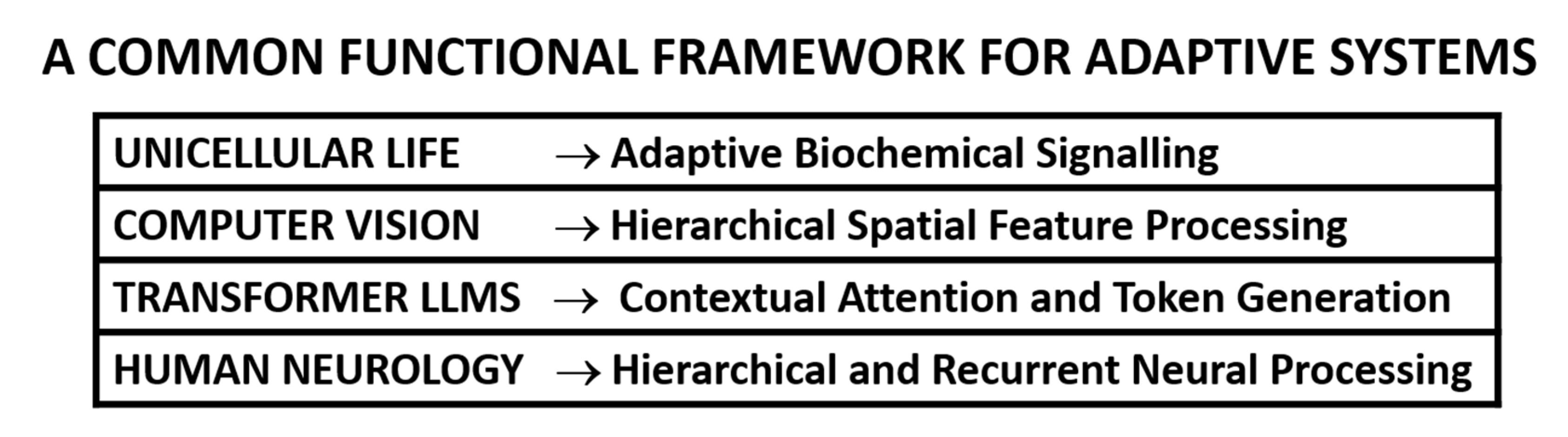
The comparison between biological and artificial systems should therefore not be understood as a claim that they are identical or that one is simply a scaled version of the other. Biological brains incorporate molecular signalling, recurrent neural interactions, dendritic processing, synaptic plasticity, neuromodulation, and multiple interacting timescales that have no direct equivalent in conventional artificial networks. Nevertheless, both biological and artificial systems can implement organized transformations of information through interconnected components, producing adaptive responses to their respective inputs and environments (summarized in Figure 11). Alternative learning frameworks, including localized and backpropagation-free approaches discussed in Section 5, illustrate that parameter adaptation need not always rely on a conventional global backward pass. These approaches provide useful computational models for exploring how learning might be implemented through more distributed or local mechanisms, although they should not be taken as direct descriptions of biological synaptic plasticity. The appearance of intention or purposeful behaviour can therefore arise from highly organized systems whose responses are generated by the interaction of structured processing, learning, and stochastic dynamics. From this perspective, biological and artificial systems can be understood as physical systems whose behaviour emerges from structured interactions among their components, with deterministic transformations and stochastic processes contributing in different ways. In biological systems, these processes operate through molecular, cellular, and neural mechanisms; in artificial systems, they operate through computational representations and numerical transformations implemented on physical hardware. We therefore adopt a strictly functional interpretation of the systems examined here. The analysis does not attempt to resolve the deeper philosophical question of subjective experience; rather, it argues that the adaptive behaviours considered in this article can be described in terms of physical structure, organized information processing, learning, and stochastic dynamics, without requiring the introduction of an additional controlling mechanism.
Under this framework, intelligence is best understood not as a separate entity residing within a system, but as a functional property expressed through the system's capacity to transform information and adapt its behaviour to prevailing conditions.
Data Availability Statement
This article does not report new experimental data. The scientific mechanisms discussed are based on previously published literature, while the functional synthesis and interpretation presented here are by the author.
AI Disclosure: Google AI search was used to assist in locating relevant scientific literature and published references. Claude and ChatGPT were used to assist with reviewing the manuscript and softening the presentation in response to review comments. The scientific ideas, arguments, and conclusions presented in this article are the intellectual work of the author. All AI-assisted edits and retrieved references were reviewed, verified, and approved by the author, who takes full responsibility for the accuracy and content of the final text.
Conflicts of Interest
The author declares no conflicts of interest.
References
- Schrödinger, E. What is Life? The Physical Aspect of the Living Cell; Cambridge University Press: Cambridge, UK, 1944. [Google Scholar]
- Landauer, R. Irreversibility and heat generation in the computing process. IBM J. Res. Dev. 1961, 5, 183–191. [Google Scholar] [CrossRef]
- Darwin, C. On the Origin of Species by Means of Natural Selection; John Murray: London, UK, 1859. [Google Scholar]
- Wadhams, G. H.; Armitage, J. P. Making sense of it all: bacterial chemotaxis. Nat. Rev. Mol. Cell Biol. 2004, 5, 1024–1037. [Google Scholar] [CrossRef] [PubMed]
- Rumelhart, D.E.; Hinton, G.E.; Williams, R.J. Learning representations by back-propagating errors. Nature 1986, 323, 533–536. [Google Scholar] [CrossRef]
- LeCun, Y.; Bengio, Y.; Hinton, G. Deep learning. Nature 2015, 521, 436–444. [Google Scholar] [CrossRef] [PubMed]
- Vaswani, A.; Shazeer, N.; Parmar, N.; Uszkoreit, J.; Jones, L.; Gomez, A.N.; Kaiser, Ł.; Polosukhin, I. Attention is all you need. Adv. Neural Inf. Process. Syst. 2017, 30, 5998–6008. [Google Scholar]
- Lillicrap, T.P.; Santoro, A.; Marris, L.; Akerman, C.J.; Hinton, G. Backpropagation and the brain. Nat. Rev. Neurosci. 2020, 21, 335–346. [Google Scholar] [CrossRef] [PubMed]
- Hinton, G. The Forward-Forward Algorithm: Some Preliminary Investigations. arXiv 2022, arXiv:2212.13345. [Google Scholar]
- Rao, R.P.; Ballard, D.H. Predictive coding in the visual cortex: A functional interpretation of some extra-classical receptive-field effects. Nat. Neurosci. 1999, 2, 79–87. [Google Scholar] [CrossRef] [PubMed]
- Friston, K. The free-energy principle: a unified brain theory? Nat. Rev. Neurosci. 2010, 11, 127–138. [Google Scholar] [CrossRef] [PubMed]
- Hubel, D.H.; Wiesel, T.N. Receptive fields and functional architecture of monkey striate cortex. J. Physiol. 1968, 195, 215–243. [Google Scholar] [CrossRef] [PubMed]
- Branco, T.; Staras, K. The probability of neurotransmitter release: variability and feedback control at single synapses. Nat. Rev. Neurosci. 2009, 10, 373–383. [Google Scholar] [CrossRef] [PubMed]
Figure 1.
Schematic representation of environmental perturbation, feedback, adaptation, and replication in the preservation of functional organization.
Figure 1.
Schematic representation of environmental perturbation, feedback, adaptation, and replication in the preservation of functional organization.
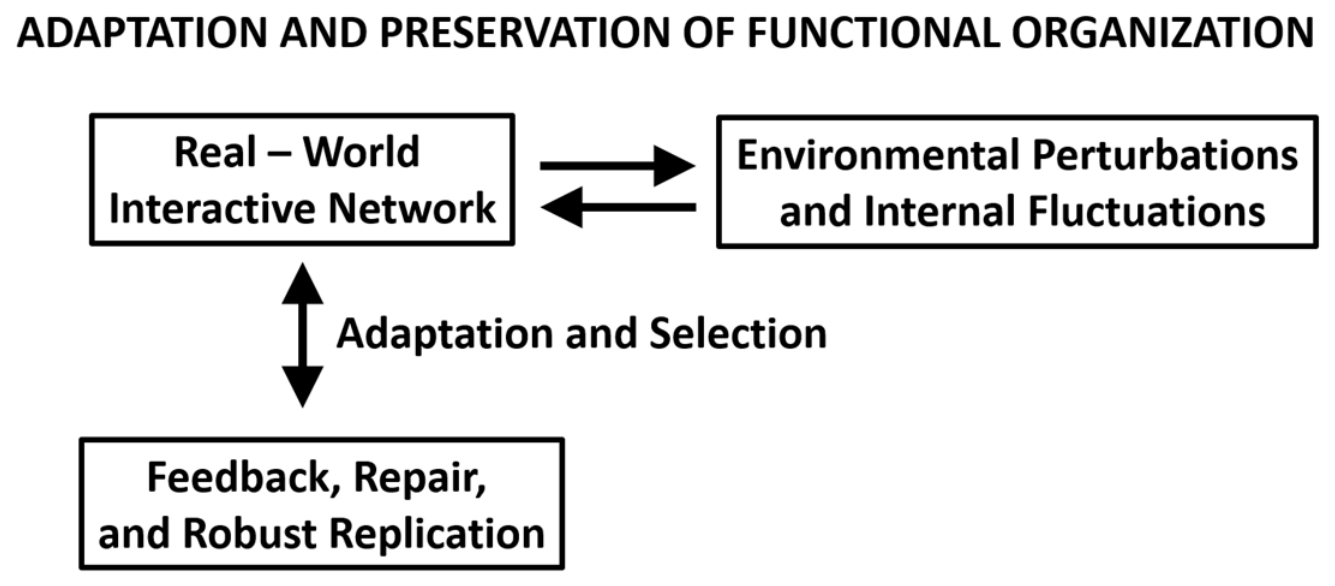
Figure 2.
Simplified signal-transduction pathway underlying bacterial chemotaxis. Changes in the chemical environment are detected by chemoreceptors and converted through intracellular signalling into changes in flagellar motor behaviour. The diagram is schematic and emphasizes the automatic transformation of environmental signals into motor responses.
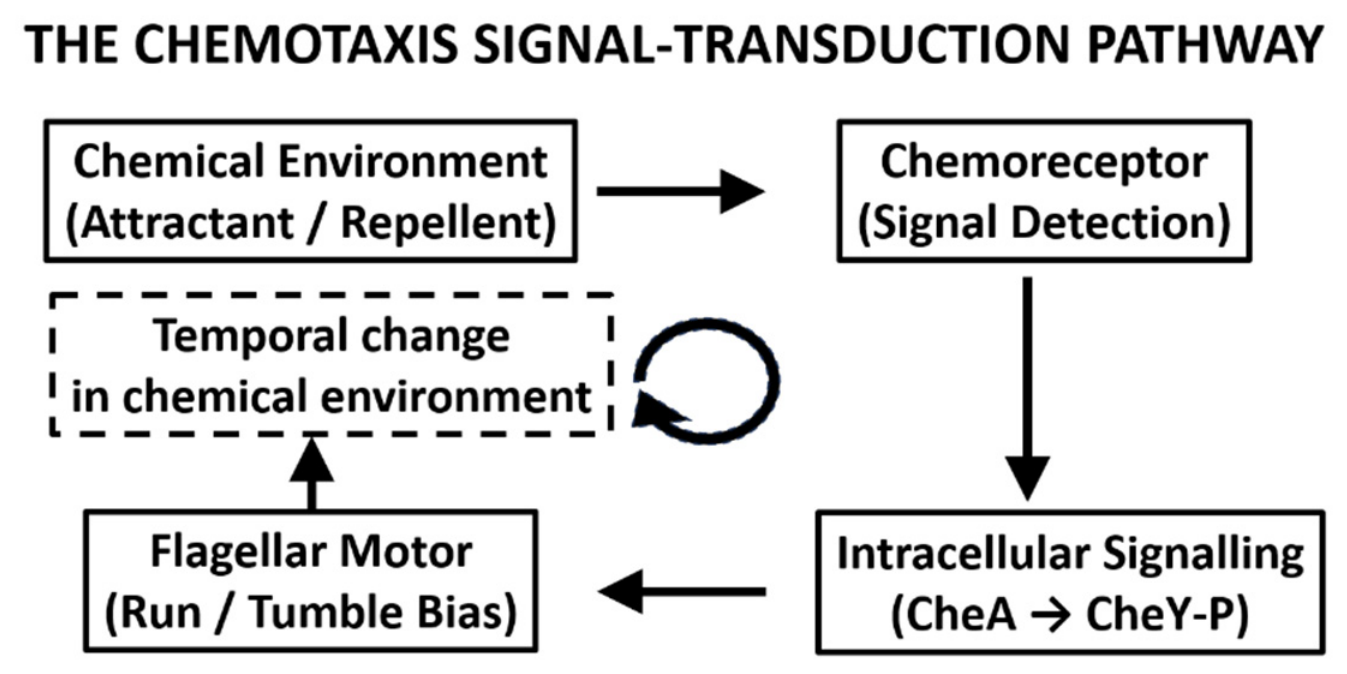
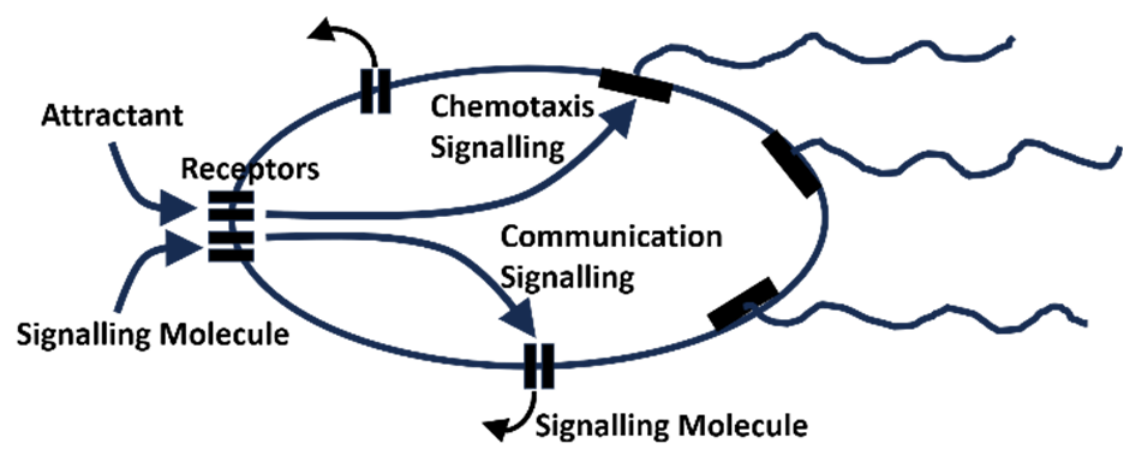
Figure 3.
Schematic workflow of forward propagation and backpropagation, illustrating how the chain rule provides gradients used to update network parameters.
Figure 3.
Schematic workflow of forward propagation and backpropagation, illustrating how the chain rule provides gradients used to update network parameters.
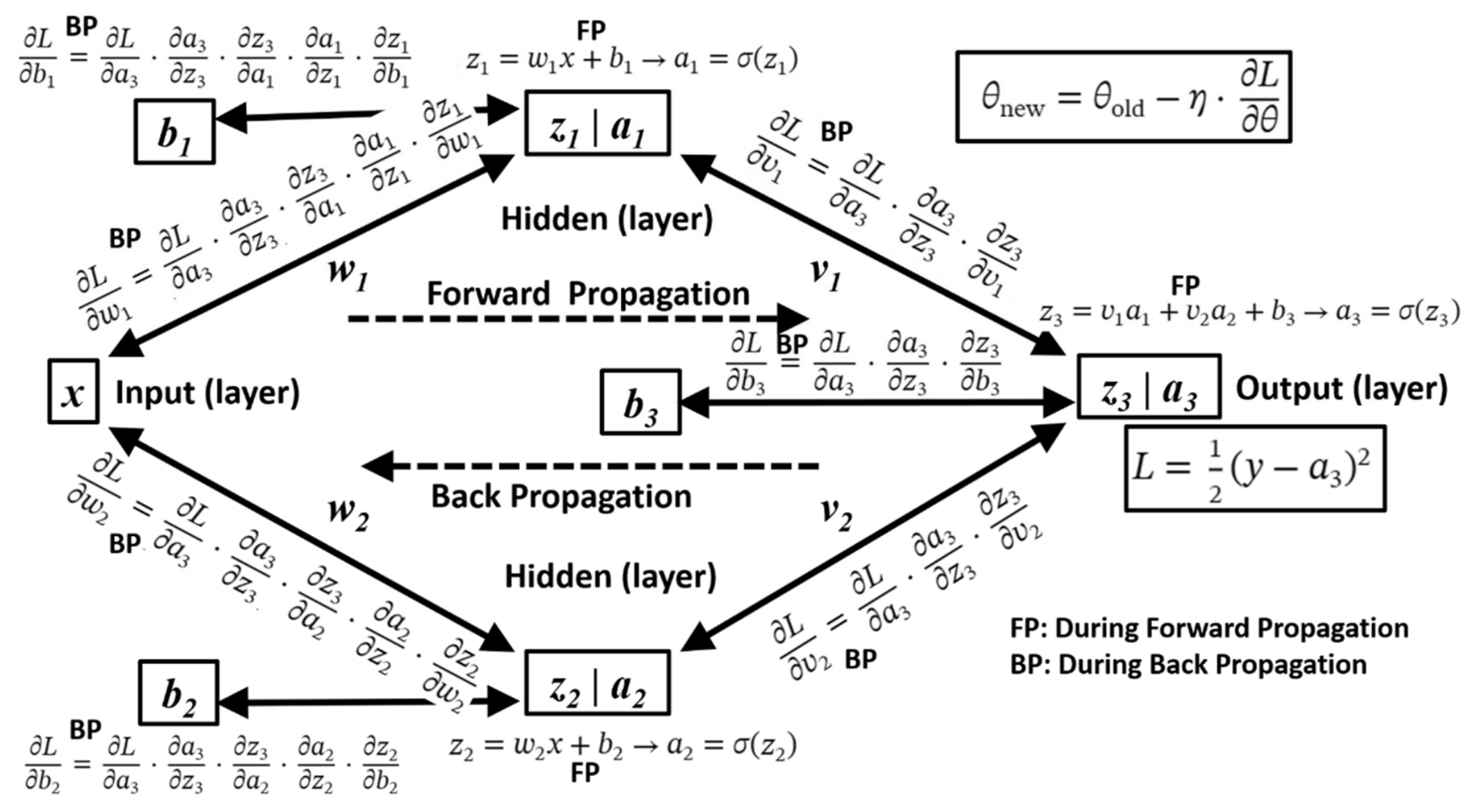
Figure 4.
Numerical illustration of a 3 × 3 convolutional edge-detection operation followed by localized max-pooling down-sampling. The Sobel kernel shown is a classical hand-designed edge detector used here to illustrate the numerical principle of local contrast extraction; it is not presented as a specific learned convolutional neural network (CNN) kernel.
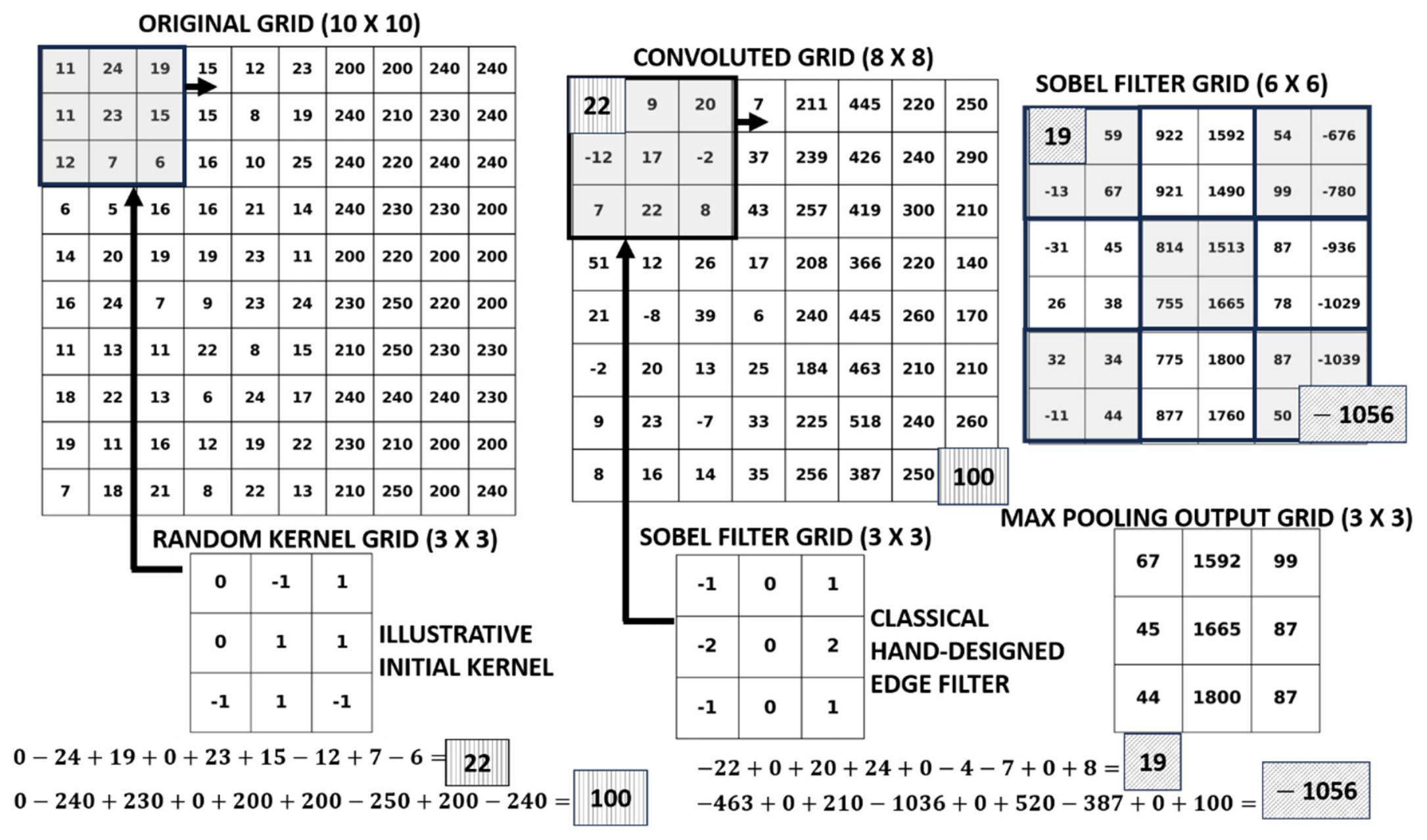
Figure 5.
Schematic matrix-operation pipeline showing how token representations are projected into Query, Key, and Value representations and combined through causal self-attention.
Figure 5.
Schematic matrix-operation pipeline showing how token representations are projected into Query, Key, and Value representations and combined through causal self-attention.
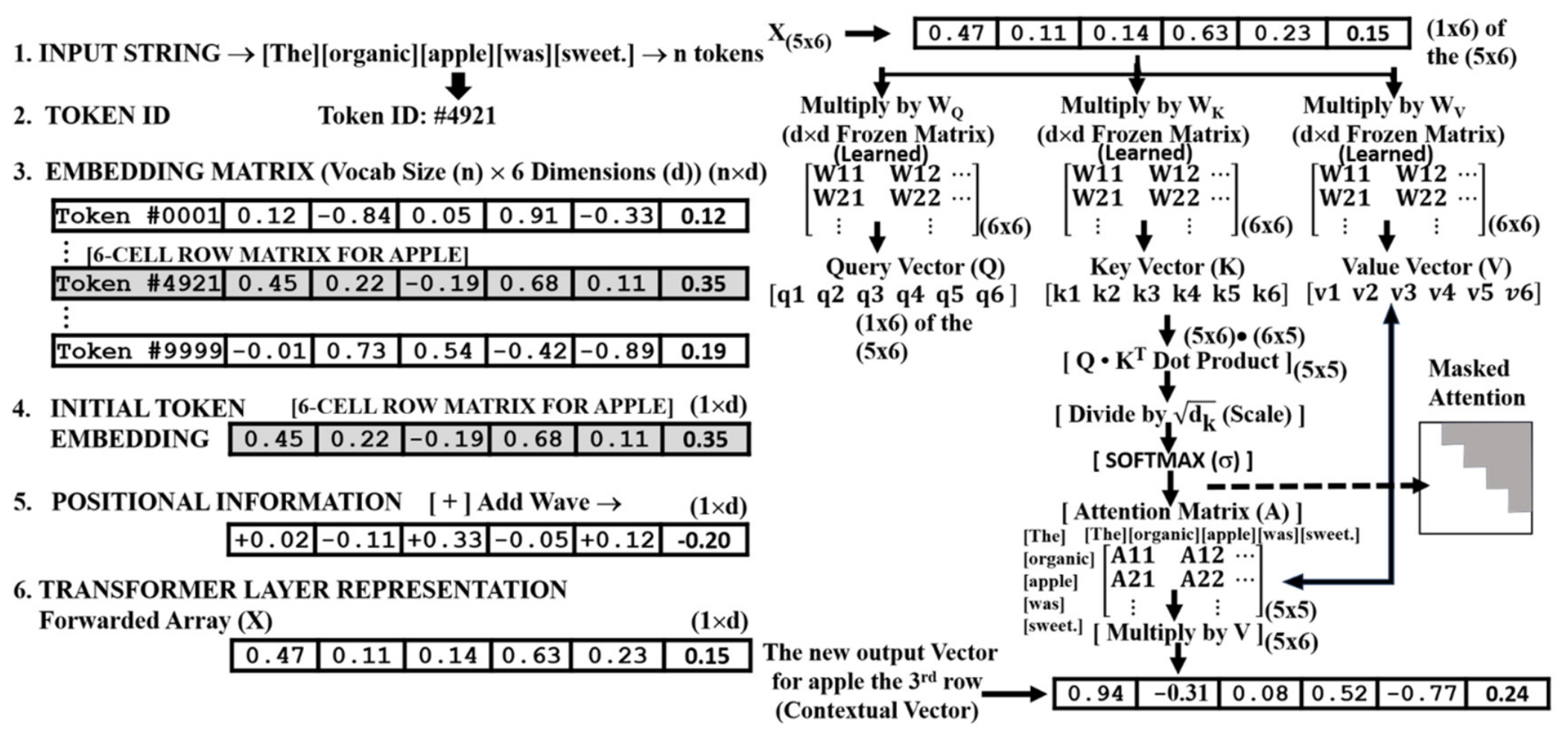
Figure 6.
Comparison of three computational and learning frameworks: global backpropagation, Forward-Forward learning, and predictive coding.
Figure 6.
Comparison of three computational and learning frameworks: global backpropagation, Forward-Forward learning, and predictive coding.
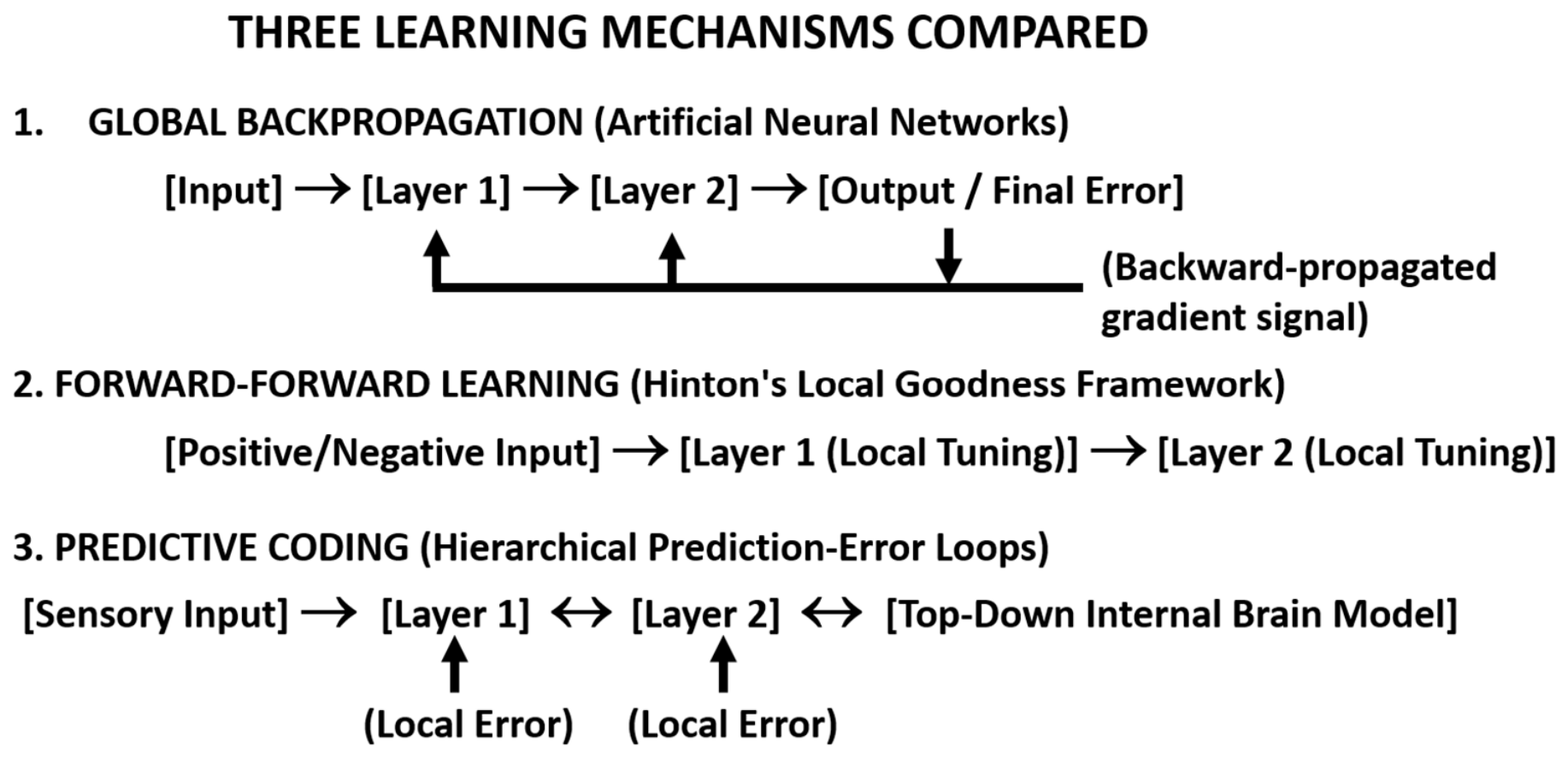
Figure 7.
Schematic representation of the relationship between microscopic molecular signalling and macroscopic hierarchical neural pathways in biological systems.
Figure 7.
Schematic representation of the relationship between microscopic molecular signalling and macroscopic hierarchical neural pathways in biological systems.
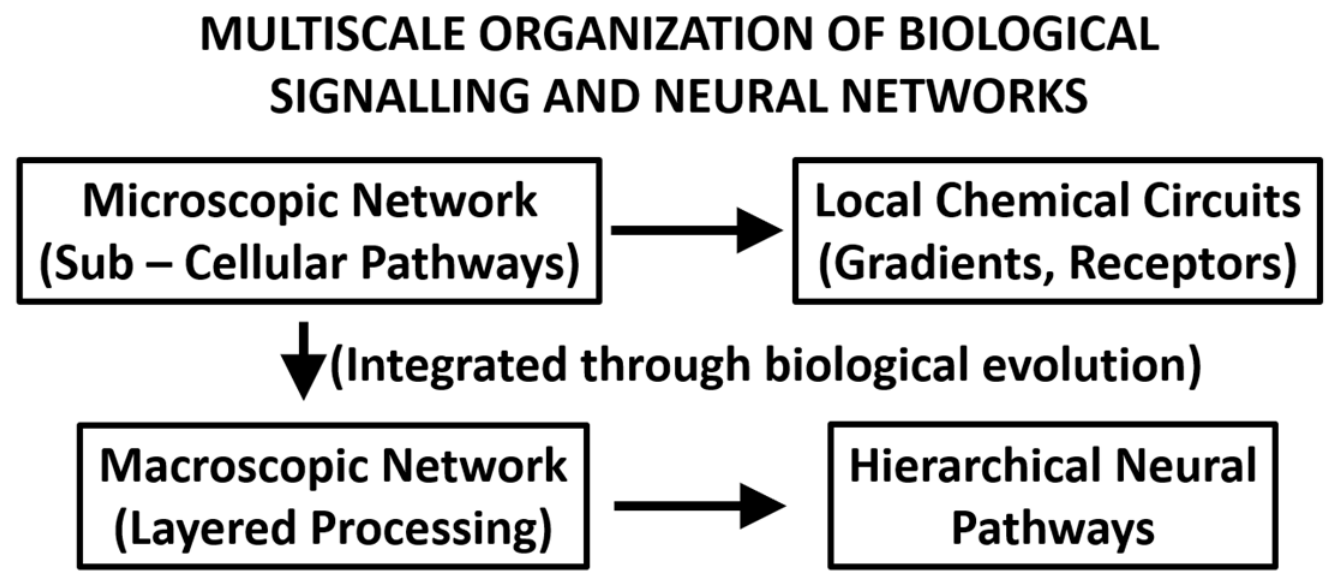
Figure 8.
Simplified schematic of hierarchical visual processing from retinal input through primary and higher visual cortical areas. The diagram emphasizes hierarchical organization and does not imply a strictly feed-forward or one-to-one correspondence with convolutional networks.
Figure 8.
Simplified schematic of hierarchical visual processing from retinal input through primary and higher visual cortical areas. The diagram emphasizes hierarchical organization and does not imply a strictly feed-forward or one-to-one correspondence with convolutional networks.
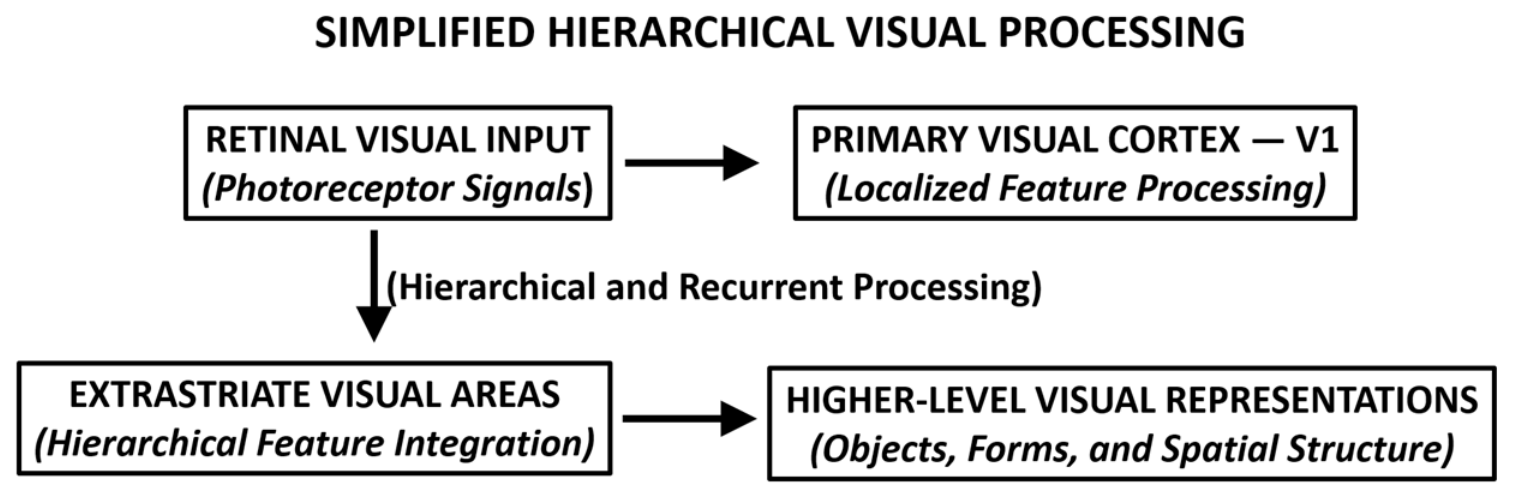
Figure 9.
Schematic illustration of how temperature changes the sharpness of a language model's output probability distribution and thereby affects the variability of stochastic token sampling.
Figure 9.
Schematic illustration of how temperature changes the sharpness of a language model's output probability distribution and thereby affects the variability of stochastic token sampling.
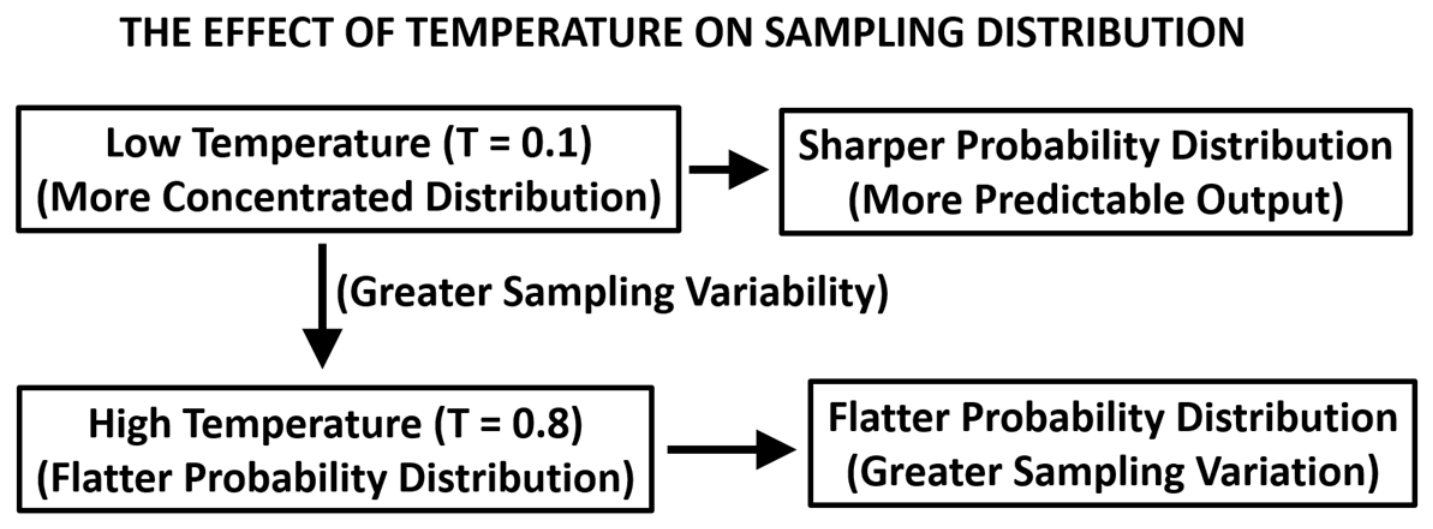
Figure 10.
Conceptual framework relating microbial signalling, artificial neural-network transformations, biological neural activity, and stochastic fluctuations within a common physical perspective.
Figure 10.
Conceptual framework relating microbial signalling, artificial neural-network transformations, biological neural activity, and stochastic fluctuations within a common physical perspective.
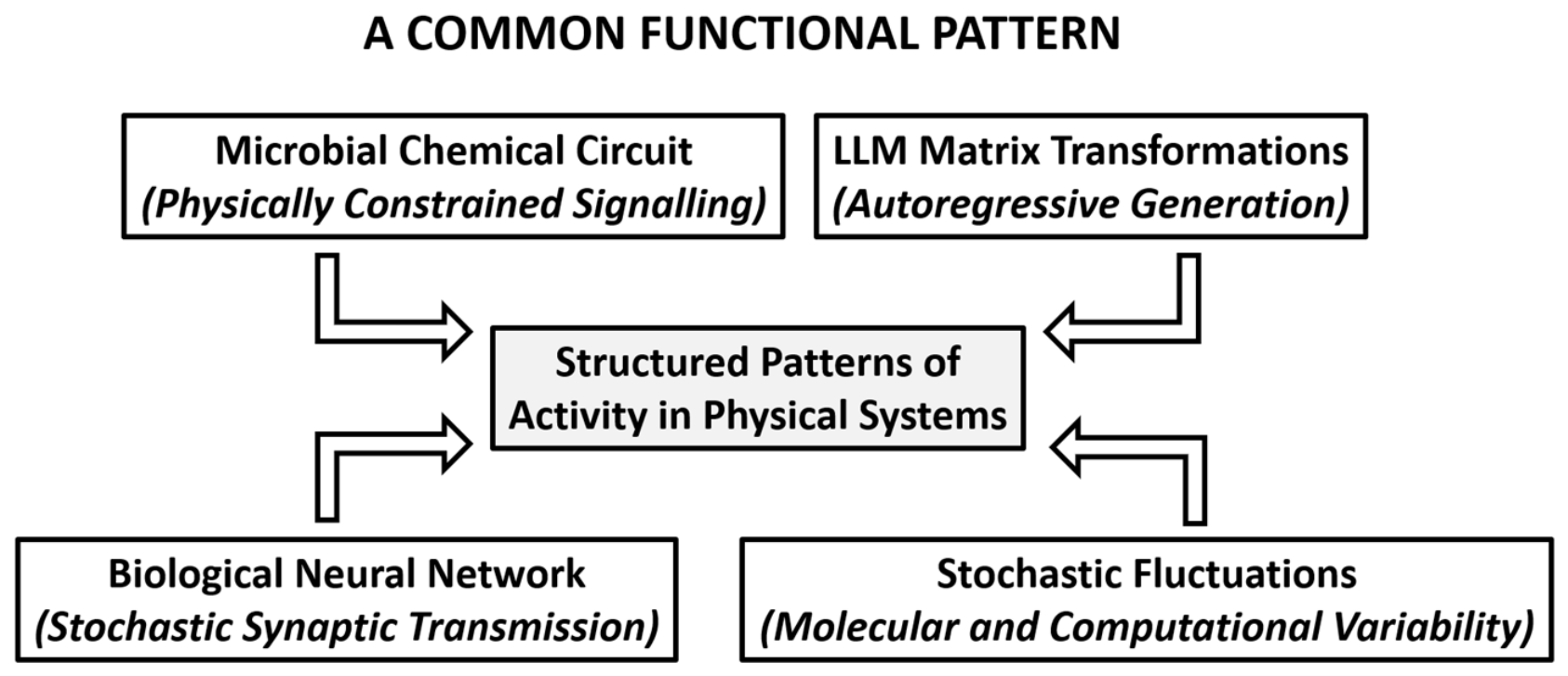
Figure 11.
Conceptual framework relating adaptive biochemical signalling, artificial neural-network processing, Transformer-based language generation, and biological neural processing. The figure emphasizes functional similarities while recognizing differences in physical substrate and mechanism.
Figure 11.
Conceptual framework relating adaptive biochemical signalling, artificial neural-network processing, Transformer-based language generation, and biological neural processing. The figure emphasizes functional similarities while recognizing differences in physical substrate and mechanism.
Disclaimer/Publisher’s Note: The statements, opinions and data contained in all publications are solely those of the individual author(s) and contributor(s) and not of MDPI and/or the editor(s). MDPI and/or the editor(s) disclaim responsibility for any injury to people or property resulting from any ideas, methods, instructions or products referred to in the content. |
© 2026 by the author. Licensee MDPI, Basel, Switzerland. This article is an open access article distributed under the terms and conditions of the Creative Commons Attribution (CC BY) license.
Copyright: This open access article is published under a Creative Commons CC BY 4.0 license, which permit the free download, distribution, and reuse, provided that the author and preprint are cited in any reuse.