

Submitted:
11 September 2026
Posted:
14 September 2026
You are already at the latest version
Abstract
Transformative sustainability education often uses disruption to unsettle taken-for-granted assumptions, yet a generic ‘demands exceed resources’ account offers little theoretical leverage. This conceptual paper develops re-anchoring as a disruption-specific instructional design construct and reframes post-disruption pedagogy through three independently testable properties: resource sufficiency, functional congruence, and temporal sequencing. The framework predicts that, at equal support dose and scaffolding contingency, demand-congruent support will outperform incongruent support; that moderate congruent support may outperform higher-dose incongruent support; and that premature action support may reduce immediate distress while weakening delayed critical reflection, a false-resolution pattern for which moral licensing offers one candidate mechanism. Four anchors—meaning and values, responsibility and complexity, relational and future orientation, and feasible action—are derived from a post-disruption demand taxonomy, with GreenComp used only as a curriculum-translation vocabulary. Tourism education is theoretically diagnostic because sustainability critique there can implicate both consumer and emerging professional identities; consumer–professional identity overlap (CPIO) is therefore proposed as a conditional moderator for identity-implicating disruption only. Developed through integrative theory-building synthesis from a 50-source sensitizing corpus, the paper specifies rival-model tests, construct operationalizations, and five falsifiable propositions, together with the conditions under which the surrounding literature could be reconstructed to a standard permitting refutation.
Keywords:
education for sustainable development
; transformative learning
; pedagogy of discomfort
; instructional design
; tourism education
; re-anchoring
; resource fit
; identity overlap
1. Introduction
Transformative sustainability learning requires more than accumulating information. It can require learners to encounter evidence, perspectives, or experiences that unsettle established assumptions about responsibility, progress, consumption, professional purpose, or a desirable future. Transformative learning theory frames such encounters as disorienting dilemmas that can initiate critical reflection [1], while a pedagogy of discomfort holds that educational transformation may require students to examine their own implication in social and ecological systems instead of remaining detached observers [2]. Sustainability-education scholarship has likewise treated disruption, dissonance, and critical reflection as routes by which existing frames become available for reconsideration [3,4,5,32,33,34,35,36,37,38].
Disruption does not reliably culminate in transformation. Research on climate and sustainability education documents anxiety, grief, anger, avoidance, powerlessness, cynicism, and disengagement alongside constructive engagement [6,7,8,9,10,11,12]. Work in the pedagogy-of-discomfort tradition warns that discomfort without adequate care can reproduce resistance, vulnerability, or ethical harm instead of critical awareness [13,14,22,23,29]. The pedagogical problem is not whether disruption is intrinsically productive or harmful. It is why comparable disruptions lead to constructive continuation for some learners and defensive closure for others, and what instructors can design before those outcomes are known.
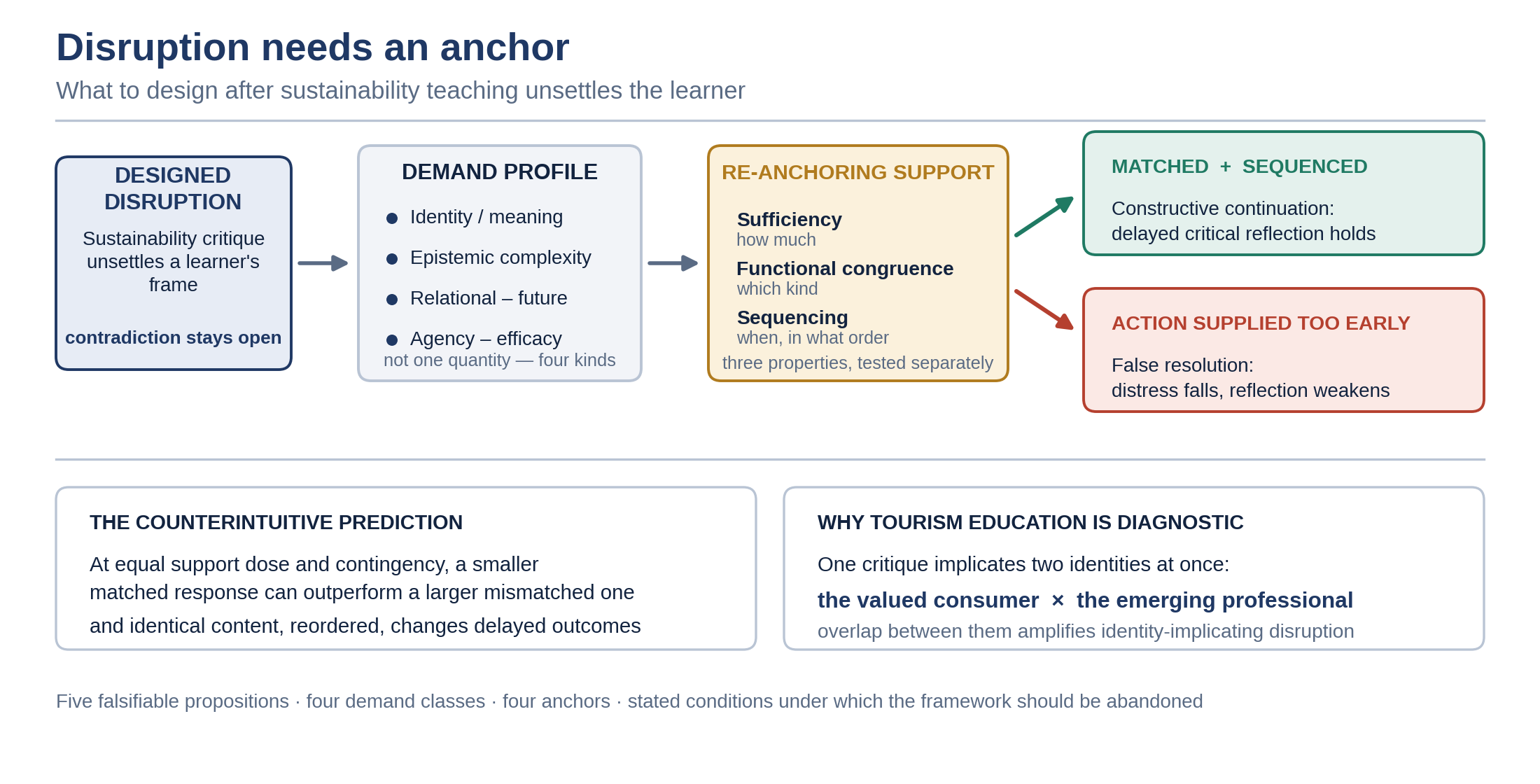
One answer is that disruption fails when its demands exceed available resources. The claim is directionally plausible but theoretically weak, since it approaches a definitional restatement: insufficient support predicts difficulty because it has already been labeled insufficient. The contribution lies elsewhere. The question is not whether learners need more support after stronger disruption, but whether the function, amount, and timing of support fit the demand profile a specific disruption creates. That shift permits predictions a generic mismatch account cannot make. High-dose but functionally wrong support can be less effective than a smaller, correctly matched intervention, and correctly matched support can still fail when it arrives in the wrong sequence.
One implication deserves statement at the outset because it is the framework’s most counterintuitive claim. The instructional reflex that follows difficult sustainability content—giving students something they can do—can itself be a pedagogical failure when it arrives too early. Where feasible-action support is supplied before learners have reconstructed meaning or examined systemic causation, it can produce false resolution: the episode feels closed, immediate distress falls, and delayed critical reflection weakens. Moral licensing offers one candidate mechanism, since an initial moral or pro-environmental act can license subsequent disengagement [79,80]; a small, easily performed action credited early in an episode may discharge the very moral tension the disruption was designed to sustain. The framework treats this as a testable ordering effect rather than an admonition: identical content, delivered in a different order, should produce different delayed outcomes.
The distinction has a theoretical lineage, and so faces a demanding redundancy test. Research on social support has long separated support quantity from support function, holding that buffering is strongest when resources correspond to stressor-elicited needs [66,67]. Scaffolding is more specific than generic assistance; its canonical characteristics are contingency, fading, and transfer of responsibility [68,74]. Person–environment fit theory distinguishes complementary fit, including needs–supplies relations in which environmental resources meet person needs [75,76]. Re-anchoring claims no novelty for matching, fit, or contingent support. Its contribution must lie in four restrictions these accounts do not jointly specify: the instructor designs the demand-generating disruption; the substantive contradiction stays open; support functions are non-substitutable across a demand profile; and sequence can reverse the value of otherwise appropriate support. The construct is useful only if those restrictions generate incremental, falsifiable predictions.
Tourism education belongs to the causal argument, not to a downstream applications section. Sustainability critique in tourism can implicate prior consumption and an emerging professional identity at the same time. Students often enter tourism and hospitality programs with valued experiences of travel, leisure, hospitality, mobility, or destination consumption while learning to become professionals in the same system [15,16,17,39,40,41]. A critique of carbon-intensive mobility, resort development, labor arrangements, visitor pressure, or extractive destination economics can then function as identity-implicating disruption and not only as difficult disciplinary content. One learner-side condition should intensify this demand: consumer–professional identity overlap (CPIO), the perceived overlap between a valued tourism-consumer identity and an emerging tourism-professional identity. We distinguish CPIO from identity fusion, which concerns personal–group oneness [42,62], because the causal problem here is the coupling of two identities held by one learner. Multiple-identity research also shows that perceived overlap and perceived conflict should not be collapsed into a single construct [70,71,72]. CPIO should amplify responses only when the stimulus implicates both identities; it should not magnify every difficult sustainability topic.
This paper asks under what post-disruption design conditions sustainability education can preserve the critical tension a disruption opens while restoring the resources learners need to keep working. We make four linked contributions. First, we define re-anchoring as a meso-level pedagogical design construct instantiated at the instructional-event level, not as a learner state. Second, we reformulate the mechanism as post-disruption resource fit, comprising resource sufficiency, functional congruence, and temporal sequencing. Third, we derive the four anchors from a demand taxonomy and map them to GreenComp only afterwards, for curriculum translation. Fourth, we make the tourism case theoretically generative by specifying identity-implicating disruption and CPIO as a measurable moderator, and we rewrite the five propositions as direct experimental or multilevel tests with explicit operational definitions. This formulation treats theoretical contribution as a requirement to specify what is added, how the relationships operate, and when the claims should hold [19].
The paper also speaks to the policy ambition of education for sustainable development (ESD). Target 4.7 of the 2030 Agenda calls for knowledge and skills supporting sustainable development, sustainable lifestyles, and global citizenship [18]. At classroom level that ambition needs a pedagogical account of what happens after difficult knowledge has unsettled a learner’s bearings. In tourism education the stakes are higher still, because educational responses shape not only sustainability attitudes but how students understand professional responsibility and which industry futures they treat as feasible [20,21,43,44,45,46,47,48,58,59].
Section 2 sets out the approach to theory construction and the evidentiary status of the argument. Section 3 then differentiates re-anchoring from adjacent constructs and specifies its theoretical margin, Section 4 develops the post-disruption demand taxonomy and the resource-fit mechanism, Section 5 completes the identity/meaning demand class in tourism education, and Section 6 specifies the four anchors, the sequencing logic, and the ethical safeguards. Section 7 states five falsifiable propositions and an operationalization plan, Section 8 develops implications and boundary conditions, Section 9 sets out the commitments governing a future evidence reconstruction, and Section 10 concludes.
2. Materials and Methods: Approach to Theory Construction
This paper is a conceptual contribution, and its method is theory construction, not evidence synthesis. We followed the integrative-review tradition, whose purpose is to generate new framings of a problem by bringing dispersed literatures into contact [28]. Three procedures structured the work. We specified the construct and its nearest theoretical neighbors, then stated the conditions under which each neighbor would render the new construct unnecessary (Table 2). We derived a demand taxonomy from the post-disruption problems reported in the sensitizing corpus and mapped anchor functions onto it, holding GreenComp back until the taxonomy was fixed. And we rewrote each proposition until it named a design that could return a result contradicting it.
The framework was built on a sensitizing corpus of 50 verified sources, assembled to surface candidate constructs, counterexamples, and adjacent literatures. We claim no exhaustive retrieval. Four rules governed selection. Sources had to bear on what happens after a learner’s frame is unsettled. The set was built to span all four candidate demand classes and anchor functions, so that no class rested on a single source. Connection-, place-, and hope-first pedagogies and work documenting harm from discomfort-based teaching were included as rivals, since a corpus that cannot embarrass the framework cannot inform it. And sources establishing the operational tradition for reactance, reflective thinking, psychological safety, identity integration, scaffolding, support matching, and person–environment fit were retained even where they sit outside sustainability education, because the propositions are stated in their vocabulary. We added sources until each demand class, anchor, and rival account had independent representation and further reading stopped altering the category structure, a saturation-style stopping rule appropriate to theory construction and not a coverage claim.
The reference list is larger than the sensitizing corpus, and the two should not be conflated. Sources cited only to fix an operational definition, to document a measurement precedent, or to record a reporting standard were consulted while writing Section 7 and Section 9 and played no part in constructing the taxonomy or the anchors. Supplementary Table S9 lists the 50-source corpus with the provenance and theory-building role of each source, which makes the boundary auditable and separates what shaped the framework from what merely supports its operationalization. Section 9 states the commitments a reproducible reconstruction of this literature would have to honor before any claim about the distribution of evidence in the field could be made.
3. Theoretical Positioning: From Generic Support to Post-Disruption Resource Fit
3.1. Re-Anchoring as an Instructional Pairing Construct
Construct clarity matters here, because re-anchoring could otherwise collapse into a loose label for supportive teaching [49]. We define it as a meso-level pedagogical design construct instantiated at the instructional-event level: a planned configuration of instructional resources paired with a bounded disruption, which restores the learner’s capacity for meaning-making, complexity engagement, relational and future orientation, and feasible agency while leaving the contradiction the disruption opened unresolved.
The unit of analysis is the disruption–response pairing, not the learner’s recovery state. A re-anchoring design can be present while an individual student remains distressed, skeptical, or resistant, and a student may cope constructively where no re-anchoring has been designed at all. The separation matters for testability. Coders must be able to identify the design condition from stimulus materials, lesson plans, timing, response format, and instructional moves before any outcome is observed. Learner distress, reactance, reflection, and engagement are consequences or mediators, not definitional components.
The construct also carries a non-palliation requirement. Re-anchoring does not succeed merely because comfort returns. A response that reassures students by restoring the pre-disruption frame, displacing structural critique with a token micro-action, or supplying a premature correct answer may reduce discomfort while defeating the reflective purpose of the disruption. Re-anchoring must restore a workable bearing under the disrupted understanding, not undo the disruption.
3.2. What Is Actually Added beyond Coping, Scaffolding, Care, and Support Matching?
The component resources of re-anchoring are not new psychological discoveries. Meaning-focused coping and constructive hope address how people regulate difficult affect and sustain engagement [6,11,12]. Pedagogies of care and trauma-informed practice set out the relational and ethical conditions of difficult learning [13,14,22,23,55,56]. Scaffolding is more than help: reviews identify contingency, fading, and transfer of responsibility as its defining characteristics, with support calibrated to learner performance and progressively handed over [68,74]. Social-support matching holds that the function of support should correspond to stressor-elicited need [66,67], and complementary person–environment fit already theorizes compatibility between needs and environmental supplies [75,76]. Against this background, a weak novelty claim is untenable. “Support should fit need” is not new.
Re-anchoring instead proposes a narrower and more demanding claim at the instructional-event level. It specifies a deliberately designed disruption as an analyzable stimulus; a multidimensional post-disruption demand profile rather than a scalar “difficulty” score; functionally non-equivalent anchor resources; a constitutive non-palliation constraint; and sequence-sensitive effects in which an otherwise relevant resource can become counterproductive when supplied too early. The theory therefore predicts non-equivalence among support packages that are equally intensive, equally caring, and equally contingent: a high-dose but functionally incongruent response can underperform a moderate-dose congruent one, and identical support content can produce different delayed outcomes solely because its order changes. Those predictions are not entailed by the generic statement that support should be responsive to need. This repositioning deliberately lowers the novelty claim while raising the burden of proof. Re-anchoring earns separate construct status only if its disruption-specific demand taxonomy, non-palliation rule, functional congruence, and sequencing constraints add explanatory or predictive value after support dose and ordinary scaffolding contingency are controlled—a redundancy criterion stated explicitly in Section 3.4.

Table 1.
Re-anchoring in relation to its nearest theoretical neighbors.
| Neighboring construct | Primary locus | Core logic | What it does not by itself specify | Re-anchoring extension |
|---|---|---|---|---|
| Transformative reintegration/action [1] | Learner change | Perspective transformation is carried into revised action | A bounded, disruption-specific teacher-designed response | Pairs support to a specific disruption before outcomes are known |
| Meaning-focused coping / constructive hope [6,11,12] | Learner regulation | Regulation can sustain engagement without eliminating concern | Instructional-event design and ex ante coding of support | Treats coping-relevant resources as designable supplies, not learner traits |
| Scaffolding [68,74] | Instructional support | Contingency, fading, and transfer of responsibility; support is calibrated to learner performance | A requirement to preserve an unresolved ethical/epistemic contradiction; a post-disruption demand taxonomy; order-specific false-resolution predictions | Holds contingency constant and tests whether support function and order still create non-equivalent outcomes |
| Optimal stress–support matching [66,67] | Support transaction | Support works best when its function matches stressor-elicited need | Designed critical disruption, curriculum content, and false-resolution risk | Specifies pedagogical demand classes and predicts matched vs mismatched anchors at equal support dose |
| Pedagogy of care / ethical safety [13,14,22,23] | Relational/ethical climate | Difficult learning requires care, non-violence, and attention to vulnerability | Which post-disruption resource function should be supplied and when | Treats care as a governing condition while specifying demand-specific instructional responses |
| Person–environment / needs–supplies fit [75,76] | Person–environment compatibility | Outcomes depend partly on compatibility between individual needs/attributes and environmental supplies | A bounded teacher-designed disruption; non-palliation; function-specific anchor taxonomy; pedagogical order effects | Treats “fit” as antecedent logic, then adds within-episode demand–support and sequencing predictions rather than claiming fit itself as novel |
3.3. The Theoretical Margin: Sufficiency × Functional Congruence × Temporal Sequencing
The mechanism distinguishes three independent properties of the pairing. Resource sufficiency concerns whether the depth, duration, and structural level of support match the magnitude of demand. Functional congruence concerns whether the kind of support supplied addresses the dominant demand the disruption produced. Temporal sequencing concerns whether support arrives at a point and in an order that allows processing to continue, avoiding both premature closure and an unsupported gap. These are not a relabeled global fit score. They are separately manipulated or coded properties that can succeed or fail independently.
Consider how the three can come apart. A response can be abundant but incongruent, as when a student whose primary problem is moral or professional identity threat receives a systems diagram and a list of technical solutions. It can be congruent but insufficient, as when an identity-implicating critique is followed by a one-minute values prompt after a highly personal, affectively charged case. It can be sufficient and congruent yet badly sequenced, as when proportionate action options arrive immediately and read as the instructor’s solution before learners have had any chance to reconstruct meaning or examine systemic causation.
The resulting theory therefore makes a stronger claim than “resource mismatch.” Holding total support constant, congruent support should outperform incongruent support; in a stronger dose × congruence test, moderate congruent support can outperform higher-dose incongruent support, showing that quantity does not compensate automatically for wrong function. Matched support supplied in the wrong order can likewise underperform a sequence in which emotional safety is secured first, interpretive work is permitted to develop, and action follows without erasing the contradiction. Primary tests should therefore manipulate demand type, support function, dose, and sequence orthogonally rather than compute a post hoc difference score between vaguely commensurate ratings. Figure 1 summarizes these three separable sources of fit and makes explicit that a high support dose cannot compensate automatically for wrong function or poor sequencing.
3.4. Theoretical Redundancy Test: What Would Make Re-Anchoring Unnecessary?
Because the framework borrows established ingredients, conceptual distinctiveness cannot be established by listing differences in terminology; the appropriate test is incremental prediction. Re-anchoring should be retained as a distinct meso-level design construct only if its disruption-specific functional congruence, non-palliation, and sequence restrictions explain outcomes beyond support dose, generic contingency, and established matching/fit accounts. Table 2 therefore states rival accounts in a deliberately strong form, allowing each to explain as much as its established theory permits and specifying the additional contrast that must survive. This converts theoretical novelty from an assertion into a research program with a stopping rule: if the rival accounts win the diagnostic tests, the relevant re-anchoring component should be removed or absorbed into the established construct.
4. Post-Disruption Demand Taxonomy and the Resource-Fit Mechanism
4.1. From “Demand” as a Scalar Quantity to a Demand Profile
A scalar mismatch model treats disruption demand as a single quantity, and that is its central weakness. Sustainability-related disruption can generate qualitatively different demands calling for different forms of instructional support. We model an episode as producing a demand profile, with one or more domains dominant for a particular learner. Four recurrent demand classes are distinguished because they imply non-substitutable instructional responses.
Identity/meaning demand arises when sustainability critique challenges a learner’s values, self-concept, moral self-understanding, or anticipated professional identity. The problem is not failure to understand the facts. It is how to retain or reconstruct a worthwhile orientation once prior commitments have been implicated. This demand matters especially in tourism, where critiques of mobility, hospitality, resort economies, visitor consumption, or industry growth can implicate valued consumer experiences and future professional belonging together [15,16,17,20,21].
Epistemic-complexity demand arises when a disruption reveals interacting causal levels, uncertainty, trade-offs, or structural contradictions beyond the learner’s current capacity to organize the problem. A learner may accept the ethical premise and still withdraw because the system looks causally unmanageable. Climate and sustainability education documents this, where the scale and interdependence of problems can produce paralysis instead of inquiry [7,8,9,10].
Relational-future demand arises when the disruption weakens connection to others, place, community, or a livable future. A learner may understand the system and endorse sustainability values yet disengage because the future looks socially isolated or existentially foreclosed. Work on relational ecological identity, place attachment, nature connectedness, and future-imagining shows why connection is a resource in its own right and not a pleasant accompaniment to cognition [50,51,52,53,54].
Agency-efficacy demand arises when learners no longer perceive a response proportionate to the problem. The risk is not simply low self-efficacy. It is a perceived collapse in the relation between what the problem requires and what an individual, professional collective, organization, or policy actor could realistically do. Research on hope and proactive engagement suggests reassurance without plausible pathways disengages, while hope linked to knowledge and action is more generative [11,12,24,31].
The four classes are not mutually exclusive. A single disruption can generate a vector of demands, and different learners can experience different profiles from the same stimulus. The taxonomy is not meant to label every emotion; it specifies what would count as a functionally congruent resource. Learner-side experienced demand is measured separately from stimulus-side disruption properties, which stops the model from calling a disruption strong merely because students reacted strongly.
4.2. Resource Sufficiency
Resource sufficiency refers to the depth, duration, structural level, and recurrence of designed support relative to the magnitude of demand. It retains one insight from the earlier mismatch account, that some disruption does require more substantial support, but treats amount as only one dimension. A brief reflection prompt may suffice after a moderately challenging case and fail after highly personal testimony, a site visit involving visible injustice, or a critique that calls an intended career morally into question.
Disruption strength remains a stimulus-side property, coded independently of outcomes. Five facets are observable from materials and delivery: frame centrality, structural level of the implicated cause, personal implication invited by the stimulus, resolvability within the material, and affective charge. Blinded coders score each 0–3. The index is formative, since the facets jointly define stimulus strength instead of reflecting a single latent trait, so coefficients such as Cronbach’s alpha are not an appropriate quality criterion. Inter-rater reliability should be reported using an intraclass correlation or a weighted agreement statistic suited to the rating design.
4.3. Functional Congruence
Functional congruence is the decisive addition. It is the degree to which the support supplied targets the dominant demand the disruption created. Identity/meaning demand calls primarily for meaning-and-values resources, epistemic-complexity demand for responsibility-and-complexity resources, relational-future demand for relational and future resources, and agency-efficacy demand for feasible-action resources. Cross-domain support can still help, but we do not assume it substitutes fully for the dominant function. The word fit is descriptive here and claims no invention: complementary needs–supplies fit is well established [75,76]. The distinctive question is whether a bounded instructional response matches the function of a deliberately generated demand while preserving the contradiction and respecting sequence.
The key prediction follows from this definition and can be tested with total support held constant. Where two post-disruption activities are matched for duration, word count, instructor attention, assessment weight, and scaffolding contingency, the activity whose function corresponds to the pre-specified demand should produce less defensive closure and more constructive continuation than the equally intensive mismatched activity. Confirmatory tests need orthogonal demand-type × support-function manipulations, not a subjective fit rating or a raw difference score. This is where re-anchoring becomes empirically distinguishable from more support, generic contingency, and unqualified fit language.
This operationalization also avoids importing a symmetry assumption from generic fit language. Different forms of misfit are not interchangeable: too little congruent support, abundant but wrong-function support, and appropriate support delivered in a palliative or premature sequence can generate different outcome signatures. The empirical object is therefore the patterned interaction among dose, function, and order, not distance from a single optimal point.
Congruence also covers structural correspondence within the feasible-action anchor. A disruption framed at industry or macro-political level should not be answered only with individual consumer tips. Such a response may be abundant and still misaligned, because it converts a structural contradiction into a micro-behavior problem. The earlier proportionality rule survives as a special case of congruence and sufficiency, not as an independent dimension.
4.4. Temporal Sequencing and False Resolution
Timing does not follow a sooner-is-better rule. Immediate ethical and emotional safety should occur within the disruption episode: acknowledging difficult content, ensuring a legitimate opt-out, preventing compelled disclosure, and communicating a path forward. Interpretive reconstruction need not benefit from the same immediacy. Critical reflection can require delay, writing, return, and revision instead of a teacher-supplied resolution before the end of class [11,12,24].
Sequence matters most for action. Where a disruption creates identity/meaning or epistemic-complexity demand, feasible-action solutions supplied before learners have reconstructed meaning or systemic understanding can produce false resolution: an immediate sense that the problem has been handled, with weaker delayed reflection, lower systemic understanding, or unstable hope when harder information arrives. Action-first sequencing can thus be inferior to interpretation-before-action even where both contain the same content and total instructional time. Moral licensing supplies a candidate mechanism: a completed and creditable action can serve as evidence of moral standing and reduce the felt need for further scrutiny [79,80]. The smallest and most available action is also the one most easily discharged as a license, and the one instructors are most tempted to offer to a distressed class.
We restrict the borrowing, because the licensing literature does not straightforwardly cover the pedagogical case. Meta-analytic estimates put the effect at modest magnitude with substantial heterogeneity, and the meta-analysts regard even that as likely inflated by low power [80]. More importantly, the mechanism presupposes that the person performs a moral act and is credited with it, and being offered a menu of actions by an instructor is not that event. We commit instead to a graded prediction: false resolution should be strongest where learners complete and receive credit for a small action, weaker where an action is presented and adopted in principle, and weakest where options are named but explicitly deferred. Since a single P3 design can measure this pattern, licensing is a mechanism the framework can be wrong about, not authority it leans on.
False resolution is an outcome pattern, not a synonym for design mismatch, and keeping the two apart avoids circularity. It should be measured through independently observed consequences: immediate relief paired with lower delayed critical reflection, weaker systems reasoning, reduced willingness to stay with unresolved contradiction, or lower persistence after a second challenging stimulus.
4.5. Defensive Closure and Constructive Continuation as Outcome Families
Defensive closure is an outcome family, not a single scale. It can include behavioral withdrawal, psychological reactance, cynical disengagement, and selective avoidance of the disciplinary or professional implications of the material. Reactance is particularly useful because it has an established operational tradition: Dillard and Shen showed that state reactance can be represented by the combination of anger and negative cognitions, and that this composite mediates responses to perceived threats to freedom [63]. In post-disruption pedagogy, reactance is a plausible short-term indicator of defensive closure, provided items are adapted to the educational context and validated rather than assumed to transfer unchanged.
Constructive continuation should not collapse into a single favorable self-report either. The framework predicts a pattern across delayed critical reflection, sustained engagement, systemic understanding, and feasible action. Kember et al.’s reflective-thinking questionnaire provides a validated basis for distinguishing habitual action, understanding, reflection, and critical reflection [64]; the critical-reflection subscale is the relevant delayed outcome, with behavioral persistence, optional task uptake, quality of systems reasoning, and action choice as complementary indicators.
One consequence of the taxonomy shapes the next section. Three of the four demand classes can be specified in the abstract: epistemic complexity, relational-future demand, and agency-efficacy demand are defined by properties of the problem, its causal structure, social horizon, and tractability, and can be recognized without knowing who the learner is. Identity/meaning demand cannot. It is defined by what the disruption implicates, and implication is a relation between a stimulus and a particular biography; left in the abstract, the class degenerates into content that feels personal, which is a mood and not a demand class.
Completing the taxonomy therefore requires a setting in which the implicated identities can be named, measured, and experimentally varied, and in which they are structurally rather than incidentally coupled to the sustainability critique the curriculum must deliver. Tourism education supplies exactly that. The section that follows is consequently not an application of a finished framework to a convenient field; it is where the framework’s first demand class acquires determinate content, and where the theory becomes falsifiable rather than merely plausible.
5. Completing the Taxonomy: Identity-Implicating Disruption in Tourism Education
5.1. Why the Identity/Meaning Class Requires This Setting
The requirement set out at the close of Section 4 is demanding. A setting completes the identity/meaning demand class only if three conditions hold together: the identities at stake can be specified independently, not inferred from distress; the critique the curriculum must deliver implicates those identities structurally, not by accident of framing; and the degree of implication varies across learners facing the same stimulus, so it can serve as a measured moderator. Most settings satisfy two at most. A critique of fossil-fuel extraction delivered to engineering students implicates a professional identity but rarely a consumer one; a fast-fashion critique in a general-education class implicates consumption but no professional future. Tourism satisfies all three, and the conjunction carries the argument.
We claim no uniqueness, and the framework would be weaker for one. Medical and veterinary education, aviation, fashion design, and agri-food science all plausibly satisfy the three conditions, and convergent findings across them would strengthen the theory. What tourism offers is tractability: the consumer identity is unusually well theorized [15], it is acquired before the professional one, the critique the curriculum must deliver implicates both by content rather than framing, and the degree of implication varies widely among students in one room. That combination makes the moderator measurable and the framing experimentally manipulable.
We do not use tourism because tourism students are assumed to be unusually fragile, unsustainable, or identity-bound. The setting is diagnostic because the same social system can be encountered first as a consumer and later as a profession. Urry’s tourist gaze established that tourism consumption is a learned mode of seeing and valuing places, difference, spectacle, and escape [15], and study abroad, tourism textbooks, and service learning can reproduce or contest that gaze [39,40,41]. Some students enter tourism and hospitality programs with a biographically meaningful consumer identity while building a professional identity inside the same industry.
The overlap changes what sustainability critique can do. A case on aviation emissions may challenge not only knowledge about decarbonization but cherished travel practices; a case on resort development may implicate aspirational images of luxury and career success; a discussion of labor or destination injustice may implicate the ethical legitimacy of an industry the learner intends to join. Tourism critique can therefore become identity-implicating in a way that intensifies identity/meaning demand even where the stimulus is identical across students.
Readers outside the field can underestimate how this feels from the learner’s side. Many students arrive in tourism and hospitality programs through pleasure, not analysis: a formative journey, a family holiday, the imagined glamour of hotels and airports, a tourist gaze practiced long before it was named [15]. The curriculum then asks them to turn that gaze on itself. The mobility they value is recoded as emissions, the destinations they admire as sites of displacement and extracted value, the industry they intend to enter as a system producing those outcomes structurally. The learner becomes at once a beneficiary of the damage and a party responsible for its repair, and neither position can be set down cheaply: distancing from the consumer identity devalues a biography, distancing from the professional identity devalues a chosen future. Ordinary difficult content lets the learner stay an observer of someone else’s problem. Identity-implicating disruption removes that position, which is why the demand it generates concerns meaning rather than information, and why a well-built systems diagram can leave the learner exactly where it found them.
The claim is probabilistic and learner-specific. Students may enter tourism from destination communities, family businesses, employment necessity, policy interests, event management, hospitality operations, or planning, with no strong leisure-travel identity at all. Sustainability critique may even strengthen professional commitment for those who read it as a mandate to reform the industry. The model rejects disciplinary membership as a proxy for identity implication.
5.2. Consumer–Professional Identity Overlap as a Measurable Moderator
Consumer–professional identity overlap (CPIO) is defined here as the perceived representational overlap or blendedness between a learner’s valued tourism-consumer identity and emerging tourism-professional identity. This wording corrects an important construct-validity risk: identity fusion describes a visceral sense of oneness between a personal self and a social group [42,62], whereas the present mechanism requires a relationship between two identity domains held by the same person. Multiple-identity integration research is the closer theoretical family. Distance/overlap and conflict/harmony between two identities are separable dimensions rather than one undifferentiated integration score [70]; identity integration is operationalized as perceived compatibility between two social identities whose relevance depends on tasks that draw on both domains [71]; and blendedness and harmony extend beyond bicultural identities [72]. For the present theory, the focal moderator is overlap/blendedness, and consumer–professional conflict or harmony is measured separately rather than built into the CPIO score.
We therefore propose a validation sequence instead of treating CPIO as a ready-made scale. Cognitive interviews should first establish how tourism students understand the two identity referents and whether the consumer identity is personally meaningful. A pictorial overlap indicator and three to four verbal overlap items should then be piloted. McDonald et al.’s single-item STEM Professional Identity Overlap measure (STEM-PIO-1) offers the closest precedent, with convergent, discriminant, and criterion evidence and six-month test–retest reliability [73], but it assesses overlap between a learner and a professional group, and its wording cannot be carried into a two-identity tourism construct unchanged. Consumer-identity centrality, professional-identity centrality, tourism involvement, and consumer–professional identity conflict should be measured as distinct constructs, with factor structure, reliability, convergent and discriminant validity, and measurement invariance evaluated before confirmatory P4 tests. P4 requires CPIO to interact specifically with identity-implicating disruption; a general main effect on all difficult content would not support the mechanism.
The tourism literature supplies a field-internal normative vocabulary for re-anchoring. The Tourism Education Futures Initiative (TEFI) emphasizes ethics, stewardship, knowledge, professionalism, and mutuality as values for tourism education [20], and critical tourism citizenship calls for graduates able to interrogate and change the systems they work in [21]. These frameworks matter because meaning-and-values re-anchoring should not amount to an instructor imposing an external ethical script after destabilizing students. It can instead reconnect difficult critique to values already legitimate within the field while leaving disagreement and contradiction open.
6. Re-Anchoring Architecture: From Demand to Anchor, Sequence, and Safeguard
6.1. Four Anchors Derived from the Demand Taxonomy
The four anchors follow from the four demand classes in Section 4, not from GreenComp. Each anchor names the function of a designed instructional resource. The mapping is primary but not exclusive: complex episodes can require more than one anchor, and a single activity can serve several functions where its design makes them explicit.
Meaning and values addresses identity/meaning demand by helping learners reconstruct what remains worth pursuing once prior assumptions, pleasures, or professional narratives have been challenged. Responsibility and complexity addresses epistemic-complexity demand by helping learners organize causal levels, distributed responsibility, uncertainty, and trade-offs without collapsing the problem into a single culprit or solution. Relational and future orientation addresses relational-future demand by restoring connection to people, place, community, and plausible futures. Feasible action addresses agency-efficacy demand by identifying proportionate response pathways at individual, collective-professional, organizational, and policy levels.
GreenComp enters only at the translation stage. Meaning and values can be mapped to embodying sustainability values; responsibility and complexity to embracing complexity in sustainability; relational and future orientation to envisioning sustainable futures; and feasible action to acting for sustainability [27]. The convergence is practically useful but is not evidence that the anchors were theoretically derived from GreenComp; the framework would retain the same four demand functions if GreenComp did not exist. This ordering is a substantive commitment rather than a courtesy to originality. Had the anchors been read off a competence framework, the theory would have inherited that framework’s policy provenance and its claims would travel only as far as its assumptions do. Deriving them from a demand taxonomy keeps them accountable to a pedagogical mechanism and leaves GreenComp to do the work it is actually good at: making the framework legible to curriculum documents that already speak that language.
Table 3.
Post-disruption demand classes, corresponding anchors, and tourism-specific enactments.
| Demand | What is destabilized | Primary anchor | Instructional function | Tourism illustration | GreenComp (translation only) |
|---|---|---|---|---|---|
| Identity / meaning | Values, moral self-understanding, professional coherence | Meaning and values | Reconstruct what remains worth pursuing without restoring the prior frame | After critiquing resort growth, students articulate which professional values remain defensible and why | Embodying sustainability values |
| Epistemic complexity | Ability to organize interacting causes, levels, and responsibility | Responsibility and complexity | Make systemic complexity workable without reducing it to a single actor or fix | Students map firm, destination, transport, policy, labor, and consumer causal relations | Embracing complexity in sustainability |
| Relational / future | Connection to others, place, community, and a livable future | Relational and future orientation | Rebuild situated connection and future possibility without reassurance-as-relief | A site-visit debrief reconnects critique to affected communities and plausible destination futures | Envisioning sustainable futures |
| Agency / efficacy | Sense that a proportionate response is available | Feasible action | Identify response pathways at a structural level commensurate with the problem, provided interpretive demands are addressed first | Students distinguish personal practice from collective professional, organizational, and policy action (after meaning and complexity have been reconstructed) | Acting for sustainability |
6.2. Sequencing Is Conditional, Not a Fixed Four-Stage Script
The framework prescribes sequencing constraints, not a universal order of the four anchors. Ethical and emotional safety must be available within the disruption episode: learners should know that difficult content is being acknowledged, that they will not be compelled to disclose trauma, and that a legitimate path forward exists. Beyond that minimum, the dominant demand determines which interpretive anchor carries the early weight.
Identity-implicating disruptions should generally leave room for meaning-and-values reconstruction before the instructor closes the episode with action. Complexity-dominant disruptions may require systems mapping or distributed-responsibility work before action alternatives are weighed. Relational and future support can come early and run concurrently where isolation or futurelessness is salient. Feasible action belongs at the point where it expands agency without offering an escape from the contradiction. Recursive revisiting at course level is an architectural principle, since later material can reopen earlier demands; recursivity is not a separate mechanism of fit.
The three-part mechanism absorbs the proximity and proportionality dimensions of earlier formulations. Proximity becomes a timing requirement specific to ethical and emotional safety, not a general rule for all anchors. Proportionality becomes part of sufficiency and structural congruence. Non-palliation remains a quality constraint on all anchors, and recursivity remains a course-level implementation principle.
6.3. Non-Palliation and Ethical Safety
Non-palliation requires that support restore bearing without pretending the contradiction is solved. Constructive hope is compatible with unresolved difficulty; reassurance that works mainly as relief is not [11,12,24]. Climate-education practice that rejects empty reassurance in favor of supported engagement with the difficulty makes the same distinction [30]. The criterion is functional, not emotional. Learners may feel better, worse, or ambivalent after re-anchoring, but the instructional move must not buy comfort by suppressing the structural or ethical problem that produced the disruption.
The distinction does its anti-circularity work only if non-palliation can be judged from the design side. Where coders can decide whether a contradiction stayed open only by consulting how students responded, the independent variable has been contaminated by its outcome. The requirement is operational. Two coders working from stimulus materials, lesson plans, response formats, and a record of the instructional move, blind to all learner data, must reach acceptable agreement on whether the substantive contradiction was left open, resolved by the instructor, or displaced by a substitute task. Three observable markers make this tractable: whether the episode supplies an instructor-endorsed resolution, whether the assigned task can be completed without engaging the contradiction, and whether disagreement with the instructor’s framing remains permissible. Establishing this agreement is a precondition for P3, and failure to reach it would show that non-palliation is not yet a design property.
Ethical safety is superordinate to resource fit. A well-matched response does not retroactively justify an ethically inappropriate disruption. Before planned difficult content, the framework requires informed notice appropriate to the course, a genuine non-penalized alternative where feasible, no compelled disclosure of personal trauma, attention to asymmetric risks for marginalized or vulnerable students, instructor competence to manage conflict and recognize limits, access to referral support beyond the classroom, and explicit recognition that reasoned resistance to the instructor’s framing is a legitimate educational response [13,14,22,23,26]. Figure 2 places this ethical floor above the causal pathway, with CPIO upstream of identity/meaning demand and classroom voice risk conditioning response format.
7. Falsifiable Propositions and Empirical Operationalization
7.1. P1 — Functional Congruence at Equal Support Dose
P1 (instructional-event level). Holding disruption strength and total instructional support constant, demand-congruent re-anchoring will produce lower defensive closure and greater constructive continuation than demand-incongruent re-anchoring. The minimum decisive test is an orthogonal demand-type × anchor-function experiment in which support time, word count, instructor attention, assessment weight, and responsiveness are equated. A stronger dose × congruence extension predicts that moderate-dose congruent support can outperform high-dose incongruent support. P1 is falsified if congruence produces no incremental advantage after dose and contingency are controlled, or if sufficiently high incongruent support performs equivalently across demand types.
Two safeguards are constitutive of the test. First, the demand × anchor matrix that assigns the congruent condition must not be authored by the reasoning it is meant to test. Read straight off Section 4, a congruence advantage could reflect no more than the face validity of our own pairings. A panel blind to the propositions and the predicted direction should build the matrix independently, and P1 should proceed only where agreement is high enough that the assignment is not investigator-specific; divergence is itself a finding about the taxonomy and is reported before any outcome analysis. Second, equating time, word count, attention, assessment weight, and responsiveness does not make two activities equally demanding, and a mismatched activity that is merely harder or less familiar would produce a congruence-shaped result for the wrong reason. Perceived task load, task difficulty, and behavioral engagement should be measured as covariates and reported; a congruence effect that disappears once they are entered does not support P1.
7.2. P2 — Differential Timing Rather than “Immediate Is Always Better”
P2 (instructional-event level). Shorter latency between disruption and ethical/emotional safety support will predict lower withdrawal and reactance, but the same monotonic timing advantage will not apply to critical reflection. Once a credible path forward is communicated, deliberately delayed reflection can equal or outperform immediate instructor-led reflection. Emotional-safety latency should therefore be measured in minutes or hours, whereas interpretive-reflection latency can be experimentally varied across the same session, 24–48 hours, or a subsequent class meeting.
P2 requires a stated failure condition, because “delay can be as good as immediacy” is otherwise too accommodating to be a proposition. It is falsified in either of two ways. If reduced latency improves delayed critical reflection monotonically across the manipulated range, the differentiated timing rule collapses into the simpler immediacy rule it was formulated against. Conversely, if shorter latency to ethical and emotional safety fails to reduce withdrawal and reactance, the claim that safety is the one function requiring proximity loses its warrant. The proposition survives only where the two support functions show opposite or unequal latency profiles in the same study; a finding that latency does not matter for either function refutes it as squarely as a monotonic advantage would.
7.3. P3 — Sequencing and False Resolution
P3 (instructional-event level). For identity/meaning- or epistemic-complexity-dominant disruptions, an interpretation-before-action sequence will produce higher delayed critical reflection and systems understanding than an action-before-interpretation sequence containing the same support content and duration. The action-first sequence is predicted to produce a false-resolution signature: greater immediate relief or closure but weaker delayed reflection, lower willingness to remain with contradiction, or greater re-collapse when exposed to a second difficult stimulus. P3 is falsified if action-first sequencing is equal or superior on the delayed outcomes while content and dose are held constant.
7.4. P4 — Tourism Identity Implication as a Conditional Moderator
P4 (individual × instructional-event level). CPIO will amplify experienced identity/meaning demand, reactance, and disciplinary disengagement when a sustainability disruption explicitly implicates both tourism-consumer and emerging professional identities. Under an equally difficult but identity-neutral version of the same sustainability issue, CPIO should show a markedly smaller or null moderating effect. A direct test can randomize learners to identity-implicating versus identity-neutral framings matched on factual content, structural complexity, length, and affective intensity, while measuring CPIO continuously. The focal coefficient is the framing × CPIO interaction; consumer-identity centrality, professional-identity centrality, tourism involvement, and identity conflict are discriminant controls rather than components of CPIO. The proposition is not supported by a general main effect of CPIO on distress.
P4 carries a measurement cost that P1–P3 do not, and that cost should not set the pace of the whole program. We distinguish two levels of test. A provisional test can use existing instruments: a pictorial overlap indicator adapted from professional-identity-overlap work, administered alongside separately measured consumer-identity centrality, professional-identity centrality, and identity conflict [73]. Multi-item measurement should be preferred to a single item, for a reason bearing directly on how a provisional null is read. Unreliability in the moderator attenuates interaction terms, and a single item of modest test–retest reliability can suppress a real framing × overlap effect below detectability at feasible classroom sample sizes. A provisional test should report the reliability obtained and a disattenuated estimate alongside the raw one, and be powered on the disattenuated expectation; without that, a provisional null is uninterpretable. A confirmatory test requires the staged development described in Section 5.2. The two levels must be reported separately, because a provisional null is ambiguous between a false proposition and a crude moderator.
Two points follow. The framework’s core resource-fit claims do not depend on CPIO: P1, P2, P3, and P5 are testable in any disciplinary setting with no new instrument, and the framework stands or falls on those tests whether or not the tourism-specific moderator is ever validated. Nor is CPIO load-bearing for the taxonomy. It specifies who experiences identity/meaning demand most acutely; the existence of the class rests on the argument in Section 5.1.
7.5. P5 — Voice Risk × Response Format
P5 (classroom-institutional boundary proposition). When perceived interpersonal or evaluative voice risk is high, anonymous or private written processing will yield more candid meaning-and-values work and lower self-censorship than instructor-led open discussion; the format difference should shrink as voice risk falls. Psychological safety provides the construct basis because it concerns whether an environment is safe for interpersonal risk taking [65]. Educational adaptations of psychological-safety measurement show that context-specific wording and validation are feasible rather than assuming the organizational scale transfers unchanged [69]. P5 should therefore be tested with a classroom-adapted voice-risk/psychological-safety measure that is validated for the target setting before confirmatory interaction tests.
7.6. Operationalization and Recommended Designs
Table 4 converts the theory into measurement decisions and separates three measurement architectures that should not be conflated. Disruption strength and re-anchoring supply are design-side formative coding systems whose facets need not covary, so internal-consistency coefficients are not evidence of quality [77]. Learner-side states such as critical reflection and voice risk are reflective or adapted measures whose factor structure, reliability, and validity must be re-examined in the target population. CPIO is a new domain-specific adaptation requiring staged item development, cognitive interviewing, dimensionality testing, and convergent and discriminant validation; related identity-overlap instruments do not validate it by association [70,73,78]. The central independent variable, functional congruence, is design-assigned from a preregistered demand × anchor matrix and never inferred from whether learners report improvement. Supplementary Table S7 reports the proposition-specific rival-model contrasts, which would otherwise duplicate the theoretical-redundancy matrix.
Empirical work should begin with a measurement and manipulation pretest, not with P1. In an independent sample, researchers should establish coder agreement for stimulus-side disruption facets and anchor-function coding, check that the intended disruption versions differentially activate the targeted demand profile without defining strength by distress, and validate any adapted learner-side measures. CPIO work begins with cognitive interviews and then a psychometric study testing overlap separately from the discriminant constructs. This staging keeps a failed manipulation from being misread as a failed theory, and since P1–P3 need no new instrument, they need not wait on CPIO development.
P1 should then receive the first confirmatory test, since it carries the framework’s strongest claim to marginal value. A minimal design crosses two intended demand types with two anchor functions, holding support time, word count, instructor attention, assessment consequences, and responsiveness constant; the focal estimand is the demand × anchor interaction, and an optional dose factor tests whether moderate matched support outperforms high-dose mismatched support. P2 and P3 follow only once an ethical floor of immediate acknowledgment, informed choice, and referral procedures is in place, since the framework does not license random assignment to a knowingly unsupported gap: the defensible manipulations are reflection latency and the order of interpretive versus action support, with minimum safety support held constant. P4 requires identity-implicating versus identity-neutral framings of the same problem with CPIO modeled continuously, and P5 follows target-context validation of classroom voice risk. Supplementary Tables S8a–S8b report progression gates, timepoints, focal estimands, and clustering requirements, entering the independent construction of the demand × anchor matrix and the blind coding of non-palliation as gates preceding P1 and P3.
8. Implications and Boundary Conditions
8.1. Theoretical Implications
The framework narrows the theoretical contribution and strengthens it. Insufficient resources producing poor outcomes is no longer the central mechanism, and fit itself is claimed as nobody’s invention: scaffolding already emphasizes contingent support [68,74], social-support theory already addresses functional matching [66,67], and person–environment fit already formalizes needs–supplies compatibility [75,76]. The margin we propose is the conjunction of a deliberately demand-generating disruption, a functionally differentiated resource profile, non-palliation, and sequence-sensitive effects. The consequential prediction is not that fit is good. It is that equally intensive and equally contingent support packages can diverge because function and order differ.
We treat the relationship to neighboring theories as an empirical redundancy problem rather than a rhetorical distinction. If support dose explains outcomes and equal-dose congruence adds nothing, a generic resource account suffices. If ordinary scaffolding contingency explains outcomes whatever the anchor function, re-anchoring is unnecessary. If matched content works equally well action-first and interpretation-first, the sequencing mechanism should go. If CPIO predicts reactivity equally under identity-neutral and identity-implicating framings, the tourism-specific identity mechanism lacks selectivity. These failure conditions are strong by design: the framework should contract into established constructs when its incremental predictions do not survive.
8.2. Implications for Tourism and Hospitality Education
For tourism education, the framework implies that sustainability critique should be designed with identity implication in view. Instructors cannot assume that industry critique is processed as external information, and they cannot assume that every tourism student has high consumer–professional overlap. In practice this means identifying whether an activity implicates leisure practices, professional aspirations, or moral self-understanding, and planning meaning-and-values support accordingly. Where critique is primarily structural or technical, the complexity or action anchors will matter more.
The feasible-action anchor needs structural calibration. Tourism sustainability problems cross individual, firm, destination, transport, governance, and policy levels routinely. An individual behavior checklist following a macro-level critique may work as false resolution instead of agency restoration. Work-integrated learning, internships, destination partnerships, and project-based assignments are promising sites for collective-professional and organizational action, since practical encounters can reshape professional intentions and school-to-work transitions [46,47].
TEFI’s values and critical tourism citizenship are useful here because they supply field-internal normative resources for meaning reconstruction, not because they validate the re-anchoring construct [20,21]. They help avoid a paternalistic design in which the instructor disrupts students and then dictates a new worldview. Re-anchoring should support disciplined reflection, not enforce ideological compliance, and reasoned resistance remains an acceptable outcome.
8.3. Boundary Conditions and Limitations
The framework is bounded in at least six ways. First, it applies only where planned disruption is educationally legitimate; ethical safety is a precondition, not a variable that better support can offset. Second, the demand taxonomy may be incomplete, and evidence of a distinct demand requiring a non-substitutable resource function would justify an additional anchor. Third, learner-side resources such as prior knowledge, personal coping capacity, peer and community support, and prior trauma can alter experienced demand and should be measured, not absorbed into the instructional construct.
Fourth, classroom power and voice risk can make a formally congruent activity unusable. The meaning-and-values anchor assumes learners can express uncertainty or disagreement without disproportionate interpersonal or evaluative cost, an assumption weakest in highly hierarchical, assessed, or identity-sensitive contexts [22,23,26]. Fifth, GreenComp is a European policy framework used here only for translation, and its provenance limits any claim of global neutrality [27]; justice-oriented tourism scholarship warns further against treating Global-North curricular assumptions as culturally universal [25]. Sixth, CPIO is not yet a validated tourism-specific measure. Multiple-identity and professional-identity-overlap precedents strengthen the proposed adaptation [70,71,72,73], but they do not establish the tourism construct by declaration. CPIO needs cognitive validation, psychometric testing, and separation from identity conflict, involvement, and simple professional identification before P4 can be treated as confirmatory.
A seventh boundary concerns the paper’s own evidentiary status. We developed the framework from a sensitizing corpus assembled for theory construction, not from a systematic review, and we claim no comprehensive retrieval. That warrant suits a conceptual contribution but licenses no statements about the distribution or weight of evidence in the field. Claims about how often particular demand–anchor mismatches occur in practice, or how prevalent false resolution is in existing curricula, lie outside what this paper can support. Section 9 states the commitments under which such claims could be established.
8.4. Practitioner Diagnostic
For practitioners, the framework works best as a pre-instruction diagnostic, not a recipe for making students comfortable. Five design questions can be answered before outcomes are observed: what demand the planned disruption is likely to dominate; which anchor function matches it; whether the support is sufficient in depth and structural level; whether it arrives in an order that defers action until interpretation has begun; and whether the substantive contradiction survives the response. Supplementary Table S10 sets these out as a working checklist with tourism-specific prompts. At program level, a validated version could eventually sit alongside established tourism-education quality frameworks such as UNWTO.TedQual [57], though that institutional extension remains untested.
9. Conditions for a Reproducible Evidence Reconstruction
The warrant of this paper is the coherence and falsifiability of its propositions, not the comprehensiveness of a retrieval process, and that warrant has a boundary. Claims about how the field currently designs post-disruption support, how often demand–anchor mismatch occurs, or whether false resolution is a widespread curricular pattern require an evidentiary corpus assembled to a reproducible standard, and a sensitizing corpus cannot supply one.
Such a reconstruction is worth conducting, but it is not a test of the framework. Even an exhaustively retrieved literature would show what has been studied and reported, not what happens when support function and order are manipulated with dose and contingency held constant; only the experimental program in Section 7.6 answers that. What a reconstruction can establish is whether the four demand classes and anchor functions exhaust the reported phenomena, whether a fifth class recurs in work we did not draw on, and whether the sequencing prediction has already been contradicted somewhere we did not look. Its value lies in its capacity to embarrass the framework, which is why the commitments below matter more than the search strings.
The executable protocol is provided in full as Supplementary Tables S0–S8: database-specific strings and field codes for ERIC, Scopus, and Web of Science Core Collection, platform filters, the eligibility codebook, deduplication and calibration rules, the extraction matrix, and a PRISMA-S-oriented flow template [60,61]. It is deposited with the reproducibility package in figshare (https://doi.org/10.6084/m9.figshare.33393826) so that it can be executed without being reconstructed from prose.
Five commitments govern it, each with the condition under which the resulting corpus should be judged untrustworthy. The search must be able to return the strongest rival to disruption-first pedagogy, which is why one strand is dedicated to connection-, place-, hope-, and agency-first sustainability education. No record may be excluded for contradicting the framework; records revealing a fifth demand class, weakening a proposed mapping, or supporting an alternative mechanism are positively retained and coded as disconfirming. Every included source carries its discovery route, citation chaining is logged separately from database retrieval, and chaining may not rescue a preferred source the eligibility rules would exclude. There is no target corpus size: every deduplicated record is screened, and the saturation-style stopping rule that produced the sensitizing corpus is inadmissible here. Each record is classified by evidentiary role and design, without which an essay, an association, and an experiment become interchangeable support for a causal claim.
The four-demand and four-anchor architecture enters as a pre-specified sensitizing hypothesis, not a fixed coding frame. Where eligible records identify a conceptually separable demand or resource function that cannot be coded without loss of meaning, the candidate revision goes into a theory-revision log before the framework or the propositions are amended, and GreenComp is applied only once coding is complete. Read with the staged agenda in Section 7.6, this defines a two-track program: one track establishes what the field already shows to a standard that lets contradiction register, the other tests whether functional congruence, non-palliation, and sequencing survive controlled comparison.
10. Conclusions
This paper reframes a recurring problem in transformative sustainability education. What should be designed after an instructional disruption, so that learners keep engaging critically instead of withdrawing, reacting defensively, or accepting premature closure? We propose re-anchoring as a meso-level pedagogical design construct instantiated at the instructional-event level, and its contribution does not rest on inventing new psychological resources. It rests on a more discriminating resource-fit claim: support must be sufficient, functionally congruent with the dominant demand, and appropriately sequenced while the contradiction stays open.
The four anchors follow from a post-disruption demand taxonomy, and GreenComp enters only afterwards as a translation vocabulary. Tourism education enters not as an application but as the setting in which the first demand class acquires determinate content, because sustainability critique there implicates consumption and professional formation at once, and to a degree that varies measurably across learners. CPIO makes that identity pathway measurable and falsifiable by predicting amplification only for identity-implicating disruption, while keeping identity conflict and disciplinary membership separate.
The framework’s strongest tests are now concrete. P1 asks whether matched support outperforms equally intensive and equally contingent mismatched support, and whether moderate matched support can outperform higher-dose mismatched support. P3 asks whether interpretation-before-action outperforms action-before-interpretation when identical content is delivered in a different sequence. P4 asks whether consumer–professional identity overlap matters specifically when the stimulus implicates both identity domains. These are redundancy tests rather than applications: if they fail, re-anchoring should be reduced to the established constructs that account for the data.
The paper stops short of adjudicating these tests, and deliberately so. What it offers is a construct specified tightly enough to be wrong in identifiable ways, together with the commitments in Section 9 under which the surrounding literature can be assembled to a standard that permits the construct to be refuted. A theory whose failure conditions are stated in advance is worth more to the field than one that accommodates every result.
Supplementary Materials
The following are available online as a single workbook (Supplementary Tables S0–S10): Table S0, protocol lock and deviation-control template; Table S1, candidate database-specific search strings by strand and platform; Table S2, search-strategy peer review and PRESS-informed quality-assurance record template; Tables S3a–S3b, eligibility codebook and screening-calibration rules; Table S3c, PRISMA-S-oriented search and screening flow template; Tables S4–S4a, construct-to-source and record-level evidence-coding matrices; Table S5, citation-chaining and full-text exclusion audit template; Table S6, empirical operationalization protocol; Table S7, theoretical-discrimination and rival-model matrix; Tables S8a–S8b, measurement-validation sequence and proposition-specific timepoint and estimand blueprint; Table S9, the 50-source sensitizing corpus with provenance and theory-building role for each source; Table S10, the pre-instruction re-anchoring diagnostic for a disruption episode. Tables S0–S8b are protocol templates for the prospective reconstruction described in Section 9: they contain no executed searches, counts, or screening decisions, and their execution fields are completed only from archived records. Table S9 differs in kind, documenting the corpus from which the framework was built. The two objects are reported separately and may not be merged or co-counted.
Author Contributions
Conceptualization, D.B. and Q.W.; Investigation, D.B. and Q.W.; Writing—original draft preparation, Q.W.; Writing—review and editing, D.B. and Q.W. All authors have read and agreed to the published version of the manuscript.
Funding
This research received no external funding.
Institutional Review Board Statement
Not applicable. This conceptual study is based on published literature and did not involve human participants or animals.
Informed Consent Statement
Not applicable.
Data Availability Statement
No new data were created or analyzed in this study. The 50-source sensitizing corpus, the eligibility codebook, the extraction matrix, the register of candidate search strings, and the remaining protocol templates are provided in full as Supplementary Tables S0–S10. The same materials, together with the reproducibility package for any subsequent evidence reconstruction, are openly available in figshare at https://doi.org/10.6084/m9.figshare.33393826, reference number 33393826.
Acknowledgments
The authors thank the editor and reviewers for comments that shaped the restructuring of this manuscript. During the preparation of this manuscript, the authors did not use any generative artificial intelligence or AI-assisted technologies for the generation of text, data, or graphics, or for study design, data collection, analysis, or interpretation. The authors have reviewed and take full responsibility for the content of this publication.
Conflicts of Interest
The authors declare no conflicts of interest.
References
- Mezirow, J. Transformative Dimensions of Adult Learning; Jossey-Bass: San Francisco, CA, USA, 1991; ISBN 9781555423391. [Google Scholar]
- Boler, M. Feeling Power: Emotions and Education; Routledge: New York, NY, USA, 1999; ISBN 9780415921046. [Google Scholar]
- Rodríguez Aboytes, J.G.; Barth, M. Transformative Learning in the Field of Sustainability: A Systematic Literature Review (1999–2019). Int. J. Sustain. High. Educ. 2020, 21, 993–1013. [Google Scholar] [CrossRef]
- Tillmanns, T. Learning Sustainability as an Effect of Disruption. Environ. Educ. Res. 2020, 26, 14–26. [Google Scholar] [CrossRef]
- Sterling, S. Learning for Resilience, or the Resilient Learner? Towards a Necessary Reconciliation in a Paradigm of Sustainable Education. Environ. Educ. Res. 2010, 16, 511–528. [Google Scholar] [CrossRef]
- Ojala, M. Facing Anxiety in Climate Change Education: From Therapeutic Practice to Hopeful Transgressive Learning. Can. J. Environ. Educ. 2016, 21, 41–56. [Google Scholar]
- Erol, D. Early Childhood Eco-Anxieties Regarding Environmental Problems. Sci. Educ. Int. 2024, 35, 311–321. [Google Scholar] [CrossRef]
- Jones, V.; Whitehouse, S. “It Makes Me Angry. REALLY Angry”: Exploring Emotional Responses to Climate Change Education. J. Soc. Sci. Educ. 2021, 20, 93–120. [Google Scholar] [CrossRef]
- Khalaim, O.; Budziszewska, M. “It Should Not Only Be Technical Education”: Students’ Climate Anxiety Experiences and Expectations toward University Education in Three European Universities. J. Environ. Educ. 2024, 55, 308–323. [Google Scholar] [CrossRef]
- Hermans, M. Geography Teachers and Climate Change: Emotions about Consequences, Coping Strategies, and Views on Mitigation. Int. J. Environ. Sci. Educ. 2016, 11, 389–408. [Google Scholar]
- Ojala, M. Regulating Worry, Promoting Hope: How Do Children, Adolescents, and Young Adults Cope with Climate Change? Int. J. Environ. Sci. Educ. 2012, 7, 537–561. [Google Scholar]
- Ojala, M. Climate-Change Education and Critical Emotional Awareness (CEA): Implications for Teacher Education. Educ. Philos. Theory 2023, 55, 1109–1120. [Google Scholar] [CrossRef]
- Zembylas, M. “Pedagogy of Discomfort” and Its Ethical Implications: The Tensions of Ethical Violence in Social Justice Education. Ethics Educ. 2015, 10, 163–174. [Google Scholar] [CrossRef]
- Zembylas, M.; McGlynn, C. Discomforting Pedagogies: Emotional Tensions, Ethical Dilemmas and Transformative Possibilities. Br. Educ. Res. J. 2012, 38, 41–59. [Google Scholar] [CrossRef]
- Urry, J. The Tourist Gaze: Leisure and Travel in Contemporary Societies; Sage: London, UK, 1990; ISBN 9780803981829. [Google Scholar]
- Walker, J.; Ngara Manyamba, V. Towards an Emotion-Focused, Discomfort-Embracing Transformative Tourism Education. J. Hosp. Leis. Sport Tour. Educ. 2020, 26, 100213. [Google Scholar] [CrossRef]
- Boyle, A.; Wilson, E.; Dimmock, K. Transformative Education and Sustainable Tourism: The Influence of a Lecturer’s Worldview. J. Teach. Travel Tour. 2015, 15, 252–273. [Google Scholar] [CrossRef]
- United Nations General Assembly. Transforming Our World: The 2030 Agenda for Sustainable Development; A/RES/70/1; United Nations: New York, NY, USA, 2015. [Google Scholar]
- Whetten, D.A. What Constitutes a Theoretical Contribution? Acad. Manag. Rev. 1989, 14, 490–495. [Google Scholar] [CrossRef]
- Sheldon, P.J.; Fesenmaier, D.R.; Tribe, J. The Tourism Education Futures Initiative (TEFI): Activating Change in Tourism Education. J. Teach. Travel Tour. 2011, 11, 2–23. [Google Scholar] [CrossRef]
- Boluk, K.A.; Cavaliere, C.T.; Higgins-Desbiolles, F. A Critical Framework for Interrogating the United Nations Sustainable Development Goals 2030 Agenda in Tourism. J. Sustain. Tour. 2019, 27, 847–864. [Google Scholar] [CrossRef]
- Cutri, R.M.; Whiting, E.F. The Emotional Work of Discomfort and Vulnerability in Multicultural Teacher Education. Teach. Teach. 2015, 21, 1010–1025. [Google Scholar] [CrossRef]
- Cullen, F.; Whelan, M. Pedagogies of Discomfort and Care: Balancing Critical Tensions in Delivering Gender-Related Violence Training to Youth Practitioners. Educ. Sci. 2021, 11, 562. [Google Scholar] [CrossRef]
- Vandaele, M.; Stålhammar, S. “Hope Dies, Action Begins?” The Role of Hope for Proactive Sustainability Engagement among University Students. Int. J. Sustain. High. Educ. 2022, 23, 272–289. [Google Scholar] [CrossRef]
- Acharya, C.N. Justice-Oriented Tourism Education: Advocacy for Reforming Global North Curricula with Global South Knowledge for Sustainability. J. Int. Stud. 2025, 15, 41–60. [Google Scholar] [CrossRef]
- Cabiles, B.M. Towards a Pedagogy of Discomfort in Culturally and Linguistically Diverse Classrooms. Issues Educ. Res. 2021, 31, 356–372. [Google Scholar]
- Bianchi, G.; Pisiotis, U.; Cabrera Giraldez, M. GreenComp: The European Sustainability Competence Framework; Publications Office of the European Union: Luxembourg, 2022. [Google Scholar] [CrossRef] [PubMed]
- Torraco, R.J. Writing Integrative Literature Reviews: Guidelines and Examples. Hum. Resour. Dev. Rev. 2005, 4, 356–367. [Google Scholar] [CrossRef]
- Zembylas, M. Revisiting “Pedagogy of Discomfort” through the Combined Lenses of “Inconvenience” and “Affective Infrastructure”: Pedagogical and Political Insights. Philos. Inq. Educ. 2023, 30, 193–206. [Google Scholar] [CrossRef]
- Jimenez, J.; Moorhead, L. “Don’t Say It’s Going to Be Okay”: How International Educators Embrace Transformative Education to Support Their Students Navigating Our Global Climate Emergency. Educ. Sci. 2021, 11, 593. [Google Scholar] [CrossRef]
- Ratinen, I. Students’ Knowledge of Climate Change, Mitigation and Adaptation in the Context of Constructive Hope. Educ. Sci. 2021, 11, 103. [Google Scholar] [CrossRef]
- O’Neil, J.K. Transformative Sustainability Learning within a Material-Discursive Ontology. J. Transform. Educ. 2018, 16, 365–387. [Google Scholar] [CrossRef]
- Bull, M. Transformative Sustainability Learning: Cultivating a Tree-Planting Ethos in Western Kenya. J. Educ. Sustain. Dev. 2013, 7, 5–21. [Google Scholar] [CrossRef]
- Burns, H.L. Transformative Sustainability Pedagogy: Learning from Ecological Systems and Indigenous Wisdom. J. Transform. Educ. 2015, 13, 259–276. [Google Scholar] [CrossRef]
- Prebel, J. Engaging a “Pedagogy of Discomfort”: Emotion as Critical Inquiry in Community-Based Writing Courses. Compos. Forum 2016, 34. [Google Scholar]
- Mortenson, L.; Chase, E.; Cerezci, B. Practicing a Pedagogy of Discomfort with Teacher Candidates: Observations and Reflections from a Year-Long Case Study. Educ. Stud. 2024, 60, 311–333. [Google Scholar] [CrossRef]
- Molderez, I. How Transformative Learning Nurtures Ecological Thinking: Evidence from the Students Swap Stuff Project. Int. J. Sustain. High. Educ. 2021, 22, 635–658. [Google Scholar] [CrossRef]
- Howlett, C.; Ferreira, J.-A.; Blomfield, J. Teaching Sustainable Development in Higher Education: Building Critical, Reflective Thinkers through an Interdisciplinary Approach. Int. J. Sustain. High. Educ. 2016, 17, 305–321. [Google Scholar] [CrossRef]
- Moreno, R. “It’s Exactly How I Pictured It!”: The Construction and Impact of the Tourist Gaze in Study Abroad. Lang. Cult. Curric. 2025, 38, 57–76. [Google Scholar] [CrossRef]
- Vinall, K.; Shin, J. The Construction of the Tourist Gaze in English Textbooks in South Korea: Exploring the Tensions between Internationalisation and Nationalisation. Lang. Cult. Curric. 2019, 32, 173–190. [Google Scholar] [CrossRef]
- Prins, E.; Webster, N. Student Identities and the Tourist Gaze in International Service-Learning: A University Project in Belize. J. High. Educ. Outreach Engagem. 2010, 14, 5–32. [Google Scholar]
- Swann, W.B., Jr.; Jetten, J.; Gómez, Á.; Whitehouse, H.; Bastian, B. When Group Membership Gets Personal: A Theory of Identity Fusion. Psychol. Rev. 2012, 119, 441–456. [Google Scholar] [CrossRef] [PubMed]
- Wattanacharoensil, W. Tourism Curriculum in a Global Perspective: Past, Present, and Future. Int. Educ. Stud. 2014, 7, 9–20. [Google Scholar] [CrossRef]
- Zeng, L.; Yoshida, W.; Chano, J. Advancing Sustainable Hospitality Education: A Systematic Literature Review. High. Educ. Stud. 2024, 14, 12–24. [Google Scholar] [CrossRef]
- Gavinolla, M.R.; Suneeth, B.G.; Kashya, S.; Mishra, J.M.; Swain, S.K. Tracing the Sustainability Components in the Indian Tourism Curricula: An Exploratory Study. J. Teach. Educ. Sustain. 2023, 25, 116–132. [Google Scholar] [CrossRef]
- Kaşlı, M.; İlban, M.O. The Influence of Problems Faced during Internships on Interns’ Views of Their Profession and Their Intention to Work in the Tourism Industry. Eurasian J. Educ. Res. 2013, 52, 79–96. [Google Scholar]
- Ko, W.-H.; Chen, C.-Y. To Explore the Research and Development Competence and School-to-Work Transition for Hospitality Students. J. Educ. Train. Stud. 2017, 5, 120–132. [Google Scholar] [CrossRef]
- Tran, L.N. A Review and Reflection on the Liberation of Hospitality Higher Education. Cogent Educ. 2022, 9, 2153432. [Google Scholar] [CrossRef]
- Suddaby, R. Editor’s Comments: Construct Clarity in Theories of Management and Organization. Acad. Manag. Rev. 2010, 35, 346–357. [Google Scholar] [CrossRef]
- Martin, T. Digging at the Root of the Tree: Conceptualizing Relational Ecological Identity. Can. J. Environ. Educ. 2020, 23, 92–112. [Google Scholar]
- Barrable, A. The Case for Nature Connectedness as a Distinct Goal of Early Childhood Education. Int. J. Early Child. Environ. Educ. 2019, 6, 59–70. [Google Scholar]
- Webber, G.; McVittie, J.; Miller, D.; Hellsten, L. The Terrain of Place-Based Education: A Primer for Teacher Education in Canada. Brock Educ. J. 2021, 30, 10–29. [Google Scholar]
- Judson, G. Supporting Ecological Understanding through In-Depth and Imaginative Study of a Place-Based Topic or Issue. Can. J. Environ. Educ. 2015, 20, 139–153. [Google Scholar]
- Henriksson, A.-C. Primary School Students’ Perceptions of a Sustainable Future in the Context of a Storyline Project. LUMAT Int. J. Math. Sci. Technol. Educ. 2023, 11, 69–90. [Google Scholar] [CrossRef]
- Kitayama, Y.; Hashizaki, Y.; Osler, A. The Ethics of Care as a Pedagogical Approach: Implications for Education for Democratic Citizenship. Educ. Stud. Jpn. Int. Yearb. 2022, 16, 31–43. [Google Scholar] [CrossRef]
- Porto, M.; Zembylas, M. The Role of Literature in Intercultural Language Education: Designing a Higher Education Language Course to Challenge Sentimental Biopower. Intercult. Commun. Educ. 2022, 5, 86–104. [Google Scholar] [CrossRef]
- World Tourism Organization (UNWTO). UNWTO.TedQual Certification System for Tourism Education Quality; UNWTO: Madrid, Spain, 2013. [Google Scholar]
- Maricato, D.; Aquino, J.; Jóhannesson, G.T. Pedagogical Practices in Tourism Higher Education: A Systematic Literature Review. Front. Sustain. Tour. 2026, 4, 1720759. [Google Scholar] [CrossRef]
- Ahmed, O.I.M.; Al-Bukhrani, M.A.; Abdulraheem, S.G.M. ESG Practices and Critical Reflection Foster Transformative Learning Outcomes in Saudi Arabian Tourism Education. Discov. Sustain. 2026, 7, 393. [Google Scholar] [CrossRef]
- Rethlefsen, M.L.; Kirtley, S.; Waffenschmidt, S.; Ayala, A.P.; Moher, D.; Page, M.J.; Koffel, J.B.; PRISMA-S Group. PRISMA-S: An Extension to the PRISMA Statement for Reporting Literature Searches in Systematic Reviews. Syst. Rev. 2021, 10, 39. [Google Scholar] [CrossRef] [PubMed]
- McGowan, J.; Sampson, M.; Salzwedel, D.M.; Cogo, E.; Foerster, V.; Lefebvre, C. PRESS Peer Review of Electronic Search Strategies: 2015 Guideline Statement. J. Clin. Epidemiol. 2016, 75, 40–46. [Google Scholar] [CrossRef] [PubMed]
- Gómez, Á.; Brooks, M.L.; Buhrmester, M.D.; Vázquez, A.; Jetten, J.; Swann, W.B., Jr. On the Nature of Identity Fusion: Insights into the Construct and a New Measure. J. Pers. Soc. Psychol. 2011, 100, 918–933. [Google Scholar] [CrossRef] [PubMed]
- Dillard, J.P.; Shen, L. On the Nature of Reactance and Its Role in Persuasive Health Communication. Commun. Monogr. 2005, 72, 144–168. [Google Scholar] [CrossRef]
- Kember, D.; Leung, D.Y.P.; Jones, A.; Loke, A.Y.; McKay, J.; Sinclair, K.; Tse, H.; Webb, C.; Wong, F.K.Y.; Wong, M.; Yeung, E. Development of a Questionnaire to Measure the Level of Reflective Thinking. Assess. Eval. High. Educ. 2000, 25, 381–395. [Google Scholar] [CrossRef]
- Edmondson, A. Psychological Safety and Learning Behavior in Work Teams. Adm. Sci. Q. 1999, 44, 350–383. [Google Scholar] [CrossRef]
- Cohen, S.; Wills, T.A. Stress, Social Support, and the Buffering Hypothesis. Psychol. Bull. 1985, 98, 310–357. [Google Scholar] [CrossRef]
- Cutrona, C.E. Stress and Social Support—In Search of Optimal Matching. J. Soc. Clin. Psychol. 1990, 9, 3–14. [Google Scholar] [CrossRef]
- Wood, D.; Bruner, J.S.; Ross, G. The Role of Tutoring in Problem Solving. J. Child Psychol. Psychiatry 1976, 17, 89–100. [Google Scholar] [CrossRef] [PubMed]
- Park, J.E.; Kim, J.-H. Nursing Students’ Psychological Safety in High Fidelity Simulations: Development of a New Scale for Psychometric Evaluation. Nurse Educ. Today 2021, 105, 105017. [Google Scholar] [CrossRef] [PubMed]
- Benet-Martínez, V.; Haritatos, J. Bicultural Identity Integration (BII): Components and Psychosocial Antecedents. J. Pers. 2005, 73, 1015–1050. [Google Scholar] [CrossRef] [PubMed]
- Cheng, C.-Y.; Sanchez-Burks, J.; Lee, F. Connecting the Dots Within: Creative Performance and Identity Integration. Psychol. Sci. 2008, 19, 1178–1184. [Google Scholar] [CrossRef] [PubMed]
- Huff, S.T.; Lee, F.; Hong, Y.-Y. Bicultural and Generalized Identity Integration Predicts Interpersonal Tolerance. J. Cross-Cult. Psychol. 2017, 48, 644–666. [Google Scholar] [CrossRef]
- McDonald, M.M.; Zeigler-Hill, V.; Vrabel, J.K.; Escobar, M. A Single-Item Measure for Assessing STEM Identity. Front. Educ. 2019, 4, 78. [Google Scholar] [CrossRef]
- van de Pol, J.; Volman, M.; Beishuizen, J. Scaffolding in Teacher–Student Interaction: A Decade of Research. Educ. Psychol. Rev. 2010, 22, 271–296. [Google Scholar] [CrossRef]
- Muchinsky, P.M.; Monahan, C.J. What Is Person–Environment Congruence? Supplementary versus Complementary Models of Fit. J. Vocat. Behav. 1987, 31, 268–277. [Google Scholar] [CrossRef]
- van Vianen, A.E.M. Person–Environment Fit: A Review of Its Basic Tenets. Annu. Rev. Organ. Psychol. Organ. Behav. 2018, 5, 75–101. [Google Scholar] [CrossRef]
- Bollen, K.A.; Lennox, R. Conventional Wisdom on Measurement: A Structural Equation Perspective. Psychol. Bull. 1991, 110, 305–314. [Google Scholar] [CrossRef]
- Boateng, G.O.; Neilands, T.B.; Frongillo, E.A.; Melgar-Quiñonez, H.R.; Young, S.L. Best Practices for Developing and Validating Scales for Health, Social, and Behavioral Research: A Primer. Front. Public Health 2018, 6, 149. [Google Scholar] [CrossRef] [PubMed]
- Merritt, A.C.; Effron, D.A.; Monin, B. Moral Self-Licensing: When Being Good Frees Us to Be Bad. Soc. Personal. Psychol. Compass 2010, 4, 344–357. [Google Scholar] [CrossRef]
- Blanken, I.; van de Ven, N.; Zeelenberg, M. A Meta-Analytic Review of Moral Licensing. Personal. Soc. Psychol. Bull. 2015, 41, 540–558. [Google Scholar] [CrossRef] [PubMed]
Figure 1.
Resource fit as three separable design dimensions. The model predicts that a high support dose can remain ineffective when its function is incongruent, and that timing/order constitutes an additional source of fit or misfit.
Figure 1.
Resource fit as three separable design dimensions. The model predicts that a high support dose can remain ineffective when its function is incongruent, and that timing/order constitutes an additional source of fit or misfit.
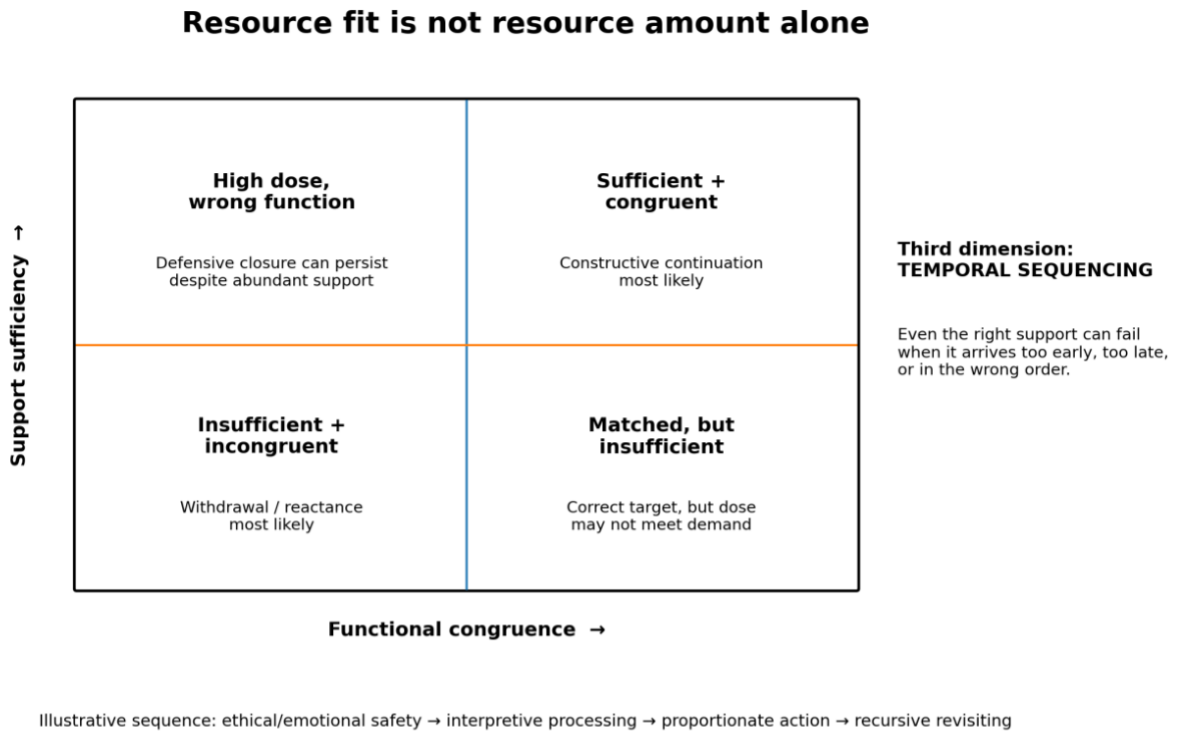
Figure 2.
Causal architecture of the framework. CPIO is located upstream as a moderator of identity/meaning demand under identity-implicating disruption; resource fit is defined by sufficiency, functional congruence, and sequencing. Ethical safety governs whether the disruptive episode is legitimate, while classroom voice risk conditions response format.
Figure 2.
Causal architecture of the framework. CPIO is located upstream as a moderator of identity/meaning demand under identity-implicating disruption; resource fit is defined by sufficiency, functional congruence, and sequencing. Ethical safety governs whether the disruptive episode is legitimate, while classroom voice risk conditions response format.
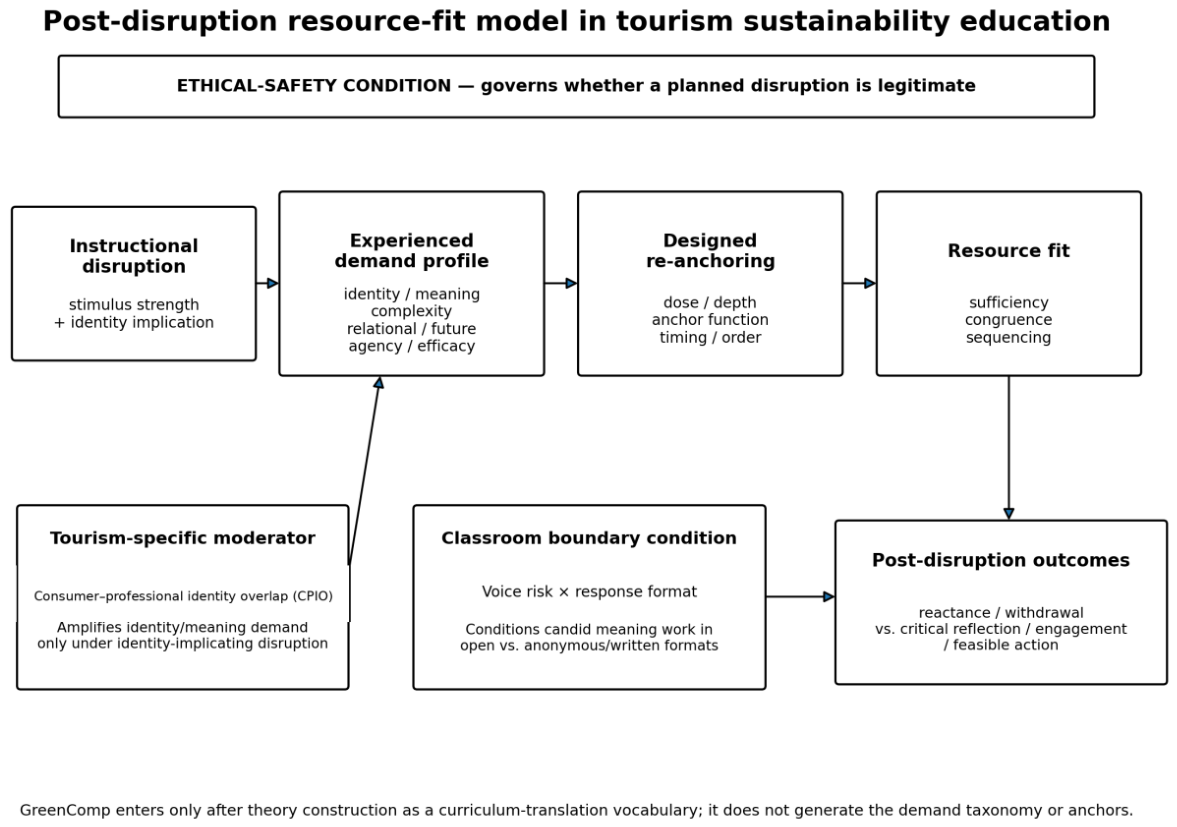
Table 2.
Rival accounts and discriminating tests for theoretical redundancy.
| Rival account | What the rival can already predict | Incremental resource-fit prediction | Decisive contrast | If the rival wins |
|---|---|---|---|---|
| Generic support-dose account | More/deeper support should reduce difficulty and sustain engagement | At equal dose, congruent support > incongruent support; moderate congruent can exceed high-dose incongruent | Dose × congruence factorial design | Drop functional-congruence claim if dose explains outcomes and congruence adds no incremental effect |
| Scaffolding contingency [68,74] | Support calibrated responsively to learner performance should improve learning | Functionally different supports remain non-equivalent even when contingency/responsiveness is equated | Hold responsiveness constant; randomize anchor function | Absorb re-anchoring into scaffolding if equally contingent supports perform equivalently across functions |
| Support matching / needs–supplies fit [66,67,75,76] | Need-matched resources should outperform poor match | Order and non-palliation matter after content/function match: identical matched resources can diverge by sequence | Randomize interpretation→action vs action→interpretation with identical content/dose | Remove sequencing/non-palliation mechanism if order adds no delayed-outcome prediction |
| Immediate debrief / safety account | Earlier support should generally reduce withdrawal/distress | Safety should be proximal, but reflection need not be immediate and action can be too early | Manipulate latency separately by support function | Replace differentiated timing with a simpler immediacy rule if earlier is uniformly superior |
| General identity vulnerability | Greater identity investment/overlap should increase reactivity to difficult content | CPIO amplifies responses selectively under identity-implicating, not identity-neutral, sustainability critique | Framing × CPIO interaction with matched factual content | Drop tourism-specific identity mechanism if CPIO shows only a generalized main effect |
Table 4.
Construct operationalization and empirical test specifications.
| Construct | Operational definition | Proposed measurement/manipulation | Quality criterion | Primary use |
|---|---|---|---|---|
| Disruption strength | Stimulus-side instructional property independent of learner reaction | Five facets scored separately 0–3: frame centrality, structural level, personal implication, resolvability, affective charge; two blind coders. A descriptive composite may be preregistered, but facet-level results remain reportable. | Facet-level ICC/weighted agreement; no Cronbach α because indicators are formative/non-interchangeable [77]; pretest stimulus versions independently of outcomes. | P1–P4 covariate/manipulation check |
| Experienced demand profile | Learner-side appraisal of what the disruption destabilized | Brief post-stimulus ratings of identity/meaning, epistemic complexity, relational/future, and agency/efficacy demand. Used as manipulation/mechanism checks, not to assign experimental condition. | Content validity, factor/discriminant evidence where a multi-item profile is used; separate from distress and from design-side strength. | Mechanism check; heterogeneity |
| Re-anchoring supply | Designed support made available by the instructional response | Anchor-specific design coding (0–3 depth for each anchor) plus total instructional time/word count/attention | Inter-rater reliability; manipulation fidelity | P1–P3 |
| Resource sufficiency | Depth/dose of support relative to pre-specified demand magnitude | Manipulate low/moderate/high dose or code duration, depth, structural level, recurrence | Dose fidelity; no outcome-based scoring | Mechanism dimension |
| Functional congruence | Match between dominant demand and primary anchor supplied | Matched vs mismatched condition under equal support dose; structural match for action tier | Pre-registered match matrix; independent coding | P1 |
| Temporal sequencing | Latency and order of support functions | Minutes/hours to safety; sessions/days to reflection/action; randomized sequence where possible | Timestamp/fidelity checks | P2–P3 |
| Psychological reactance | State defensive response to perceived threat or control | Educational adaptation of anger + negative-cognition approach from Dillard & Shen [63] | Pilot wording, reliability, convergent validity | Short-term defensive closure |
| Critical reflection | Premise-level reflective reconsideration after the episode | Delayed critical-reflection score based on Kember et al. [64], supplemented by written reasoning where possible | Reliability and factor structure in target sample | P1–P3 outcome |
| CPIO | Perceived overlap/blendedness between tourism-consumer and emerging tourism-professional identities | Initial item pool + cognitive interviews; pictorial overlap indicator plus refined verbal overlap/blendedness items. Consumer centrality, professional centrality, and identity conflict/harmony remain separate measures [70,73]. | Content review; cognitive interviewing; item reduction/dimensionality testing; reliability of multi-item component; convergent/discriminant validity; invariance only where sample size and group design justify it [78]. | P4 moderator |
| Voice risk / classroom psychological safety | Perceived interpersonal/evaluative cost of expressing unresolved disagreement | Classroom-adapted psychological-safety/voice-risk items grounded in Edmondson [65] and educational adaptation precedent [69] | Context validation; reliability; separation from general course satisfaction | P5 moderator |
| Constructive continuation | Multi-indicator continuation of learning rather than immediate comfort | One preregistered primary delayed outcome per study (e.g., critical reflection or systems reasoning), with engagement persistence and feasible-action quality as secondary indicators; no unvalidated global sum score. | Primary/secondary outcome hierarchy fixed before data collection; behavioral/rubric indicators blinded where possible. | Primary outcome family |
| False resolution signature | Premature closure that feels resolved but does not survive delayed or renewed challenge | Immediate relief/closure combined with lower delayed reflection/systems understanding or larger re-collapse after second stimulus | Pre-specified multivariate pattern; independent from mismatch coding | P3 outcome |
| Ordinary scaffolding contingency (control) | Responsiveness/calibration of support to learner performance or expressed need, conceptually separate from anchor function | Equate the diagnostic/responsiveness protocol across P1 conditions; observationally code adaptation, fading, and transfer of responsibility where applicable [68,74] | Manipulation fidelity or coder agreement; discriminant separation from support dose and anchor function | Redundancy control for P1 |
Disclaimer/Publisher’s Note: The statements, opinions and data contained in all publications are solely those of the individual author(s) and contributor(s) and not of MDPI and/or the editor(s). MDPI and/or the editor(s) disclaim responsibility for any injury to people or property resulting from any ideas, methods, instructions or products referred to in the content. |
© 2026 by the authors. Licensee MDPI, Basel, Switzerland. This article is an open access article distributed under the terms and conditions of the Creative Commons Attribution (CC BY) license (http://creativecommons.org/licenses/by/4.0/).
Copyright: This open access article is published under a Creative Commons CC BY 4.0 license, which permit the free download, distribution, and reuse, provided that the author and preprint are cited in any reuse.