

Submitted:
10 September 2026
Posted:
14 September 2026
You are already at the latest version
Abstract
Although pressure bandage immobilisation (PBI) stopped systemic venom absorption in animal experiments, the real-world utility of PBI for snake bites in humans is incompletely defined. PBI is often applied for extended periods in rural Australia where snake bites are common. We describe a case of a man with taipan envenomation who required an above knee amputation after 12 hours of PBI. We hypothesise that this was the result of overzealous PBI application leading to a compartment syndrome and tissue ischaemia. The potential harms of PBI necessitate further research to define the incremental advantage of PBI in snakebites over immobilisation alone.
Keywords:
snake bite
; first aid
; pressure bandage immobilisation
; iatrogenic injury
; clinical management
; rural medicine
Introduction
Ever since Sutherland’s paper demonstrated that pressure bandage immobilisation (PBI) stopped systemic venom absorption in live monkeys with tiger venom injected into their feet [1], PBI has been recommended as the first aid for snakebites in Australia and Papua New Guinea.
However, PBI is often performed poorly: in one study only 70% of individuals had pressure bandaging of reasonable quality, and only 45% had immobilisation applied [2]. Another report documented the harm from PBI, thought to be applied too tightly, in two non-envenomed individuals who took ≥7 hours to reach the referral hospital [3].
We now report a case where we believe that prolonged, tightly applied PBI resulted in compartment syndrome that necessitated an above knee amputation. Institutional approval for the case report’s publication was provided by the Far North Queensland Human Research Ethics Committee (EX/2026/QCH/132486).
Case
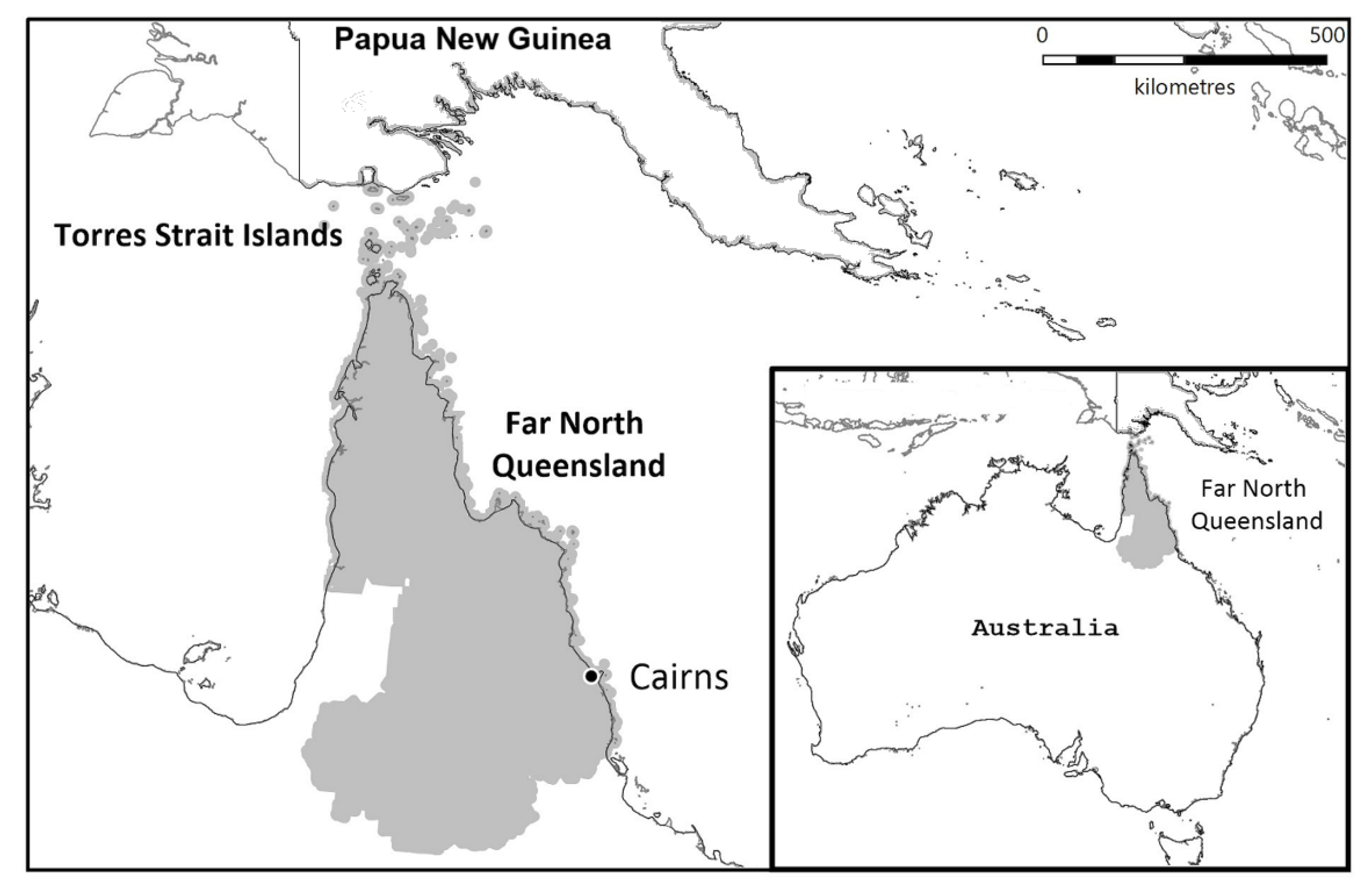
A 43-year-old man, presented to a primary health care centre in the Torres Strait islands (Figure 1) 45 minutes after a snakebite on his left ankle.
On arrival his Glasgow Coma Scale score was 10 (E:3, M:3, V:4); blood was oozing from many sites. PBI was applied to the entire leg approximately 1 hour after the bite. He had an episode of haematemesis in the clinic but was haemodynamically stable. A bite site venom detection kit was positive for Taipan venom, which was consistent with his clinical presentation. One ampoule of taipan antivenom was administered intravenously, and a retrieval team intubated and ventilated the patient, administered 1 unit of packed red cells and a second dose of antivenom.
He was transferred by helicopter to the Torres Strait islands’ main airport, 138 km to the south, and then transferred by air ambulance to the nearest referral hospital in Cairns ~800 km away. He arrived at Cairns Hospital (~10 hours post bite) and his PBI was removed in the Cairns Hospital intensive care unit (ICU) ~12 hours post bite. His left leg was noted to be swollen and indurated with absent pulses below the groin; a compartment syndrome was suspected. Due to his clinical instability, he was not taken to the operating theatre until ~40 hours post bite. At operation two orthopaedic surgeons identified a severe compartment syndrome below the knee: the muscles were grey with no twitch or response and there was significant oedema. They both agreed that an above knee amputation was necessary.
He spent five days in ICU, a month in hospital, and a further 6 weeks in Cairns receiving rehabilitation. He was discharged, with appropriate aids including a prosthesis, nearly 3 months after the bite.
Discussion
The significant envenomation, remote location and complex retrieval resulted in a 12-hour application of PBI. We hypothesise that the PBI was applied too tightly and may have acted as an arterial tourniquet, resulting in distal ischaemia and the development of a compartment syndrome, necessitating the above-knee amputation
Sutherland’s initial report described how PBI was applied within 60–90 seconds of venom injection and remained on for only 1 hour [1]. The pressure of the PBI was estimated (not measured) to be 55 mmHg by one of the authors. Serum venom levels remained static and only rose after removal of the PBI.
However, PBI is frequently applied for far longer than 1 hour for snakebites in Australia. We reviewed 177 snakebite cases presenting to Cairns Hospital over a 20-month period to October 2020 [4]. PBI was applied for a median duration of 230 minutes (range 15–1440). Forty-four (25%) had PBI applied for more than 6 hours.
Furthermore, the application of PBI is often imperfect. A simulation study found the median (IQR) pressure on applying a crepe PBI to a lower limb by 96 health professionals and first aid workers was 28 (17-42) mmHg; only 16 (17%) achieved the recommended pressure (upper limb 40-70mmHg, lower limb 50-70mmHg). There were 9 (10%) who generated a pressure >100mmHg with elasticised bandages, with one clinician achieving a reading of ~230mmHg. [5]
The largest series of snakebite in Australia included 1,548 individuals; 1,304 (84%) had PBI [6]. Although there were no reports of any adverse effects, the chief investigator acknowledged they did not specifically collect data on complications associated with PBI (personal correspondence, Prof G Isbister). It is important to highlight that the bites of Australian elapid snakes are generally not painful, suggesting pain is more likely due to PBI that has been applied too tightly [6]. They also do not cause significant local necrosis, suggesting that direct venom-induced tissue injury was unlikely to be the explanation for the compartment syndrome seen in this case [7].
This case report then highlights the potential harms of PBI and the need for further research to define the incremental advantage of PBI in snakebites over immobilisation alone as a first aid method for humans bitten by snakes, especially in rural locations where definitive assessment may be delayed [8].
Funding
None.
Ethical Approval
None declared.
Competing Interests
Institutional approval for the case report’s publication was provided by the Far North Queensland Human Research Ethics Committee (EX/2026/QCH/132486).
Acknowledgments
The authors would like to acknowledge the contribution of all of the health workers who were involved in the care of the patient.
References
- Sutherland, S.K.; Coulter, A.R.; Harris, R.D. Rationalisation of first-aid measures for elapid snakebite. Lancet 1979, 1(8109), 183–5. [Google Scholar] [CrossRef] [PubMed]
- Currie, B.J.; Canale, E.; Isbister, G.K. Effectiveness of pressure-immobilization first aid for snakebite requires further study. Emerg. Med. Australas. 2008, 20(3), 267–70. [Google Scholar] [CrossRef] [PubMed]
- Little, M. Harm due to the use of pressure bandage immobilisation in patients bitten by snakes in Australia. Clin. Toxicol. (Phila) 2023, 61(8), 611–612. [Google Scholar] [CrossRef] [PubMed]
- Smith, L.K.; Vardanega, J.; Smith, S.; White, J.; Little, M.; Hanson, J. The Incidence of Infection Complicating Snakebites in Tropical Australia: Implications for Clinical Management and Antimicrobial Prophylaxis. J. Trop. Med. 2023, 2023, 5812766. [Google Scholar] [CrossRef] [PubMed]
- Canale, E.; Isbister, G.K.; Currie, B.J. Investigating pressure bandaging for snakebite in a simulated setting: bandage type, training and the effect of transport. Emerg. Med. Australas. 2009, 21(3), 184–90. [Google Scholar] [CrossRef] [PubMed]
- Johnston, C.I.; Ryan, N.M.; Page, C.B.; et al. The Australian Snakebite Project, 2005-2015 (ASP-20). Med. J. Aust. 2017, 207(3), 119–125. [Google Scholar] [CrossRef] [PubMed]
- Steinhorst, J.; Amuasi, J.H.; Werker, P.M.N.; et al. Under pressure: Clinical management of venom-induced compartment syndrome in snakebite-A scoping review of the global literature. PLoS Negl. Trop. Dis. 2026, 20(7), e0014536. [Google Scholar] [CrossRef] [PubMed]
- Round 41 Grant Recipients: Efficacy of pressure pad versus pressure bandage immobilisation for snake bite first aid. Emergency Medicine Foundation. Accessed Juy 21, 2026, 2026. https://emergencyfoundation.org.au/news/upcoming-event-2/.
Disclaimer/Publisher’s Note: The statements, opinions and data contained in all publications are solely those of the individual author(s) and contributor(s) and not of MDPI and/or the editor(s). MDPI and/or the editor(s) disclaim responsibility for any injury to people or property resulting from any ideas, methods, instructions or products referred to in the content. |
© 2026 by the authors. Licensee MDPI, Basel, Switzerland. This article is an open access article distributed under the terms and conditions of the Creative Commons Attribution (CC BY) license (http://creativecommons.org/licenses/by/4.0/).
Copyright: This open access article is published under a Creative Commons CC BY 4.0 license, which permit the free download, distribution, and reuse, provided that the author and preprint are cited in any reuse.