
Submitted:
08 September 2026
Posted:
14 September 2026
Read the latest preprint version here
Abstract
Traditional deep learning architectures relying on standard affine layers (WX +b) partition the activation space into unbounded polyhedral regions, which inherently introduce chronic training instabilities such as gradient vanishing and severe generalization decay. To resolve this structural vulnerability, we introduce an alternative “bounded-by-design” geometric framework that completely moves beyond traditional affine transformations. By replacing them entirely with ball coverings, we reformulate layer mechanics around the fundamental metric of a feature point’s proximity to a ball centered at W. Crucially, computing the formulation using direct dot products fully preserves GPU parallelization performance without altering external network components. Empirical validation demonstrates that our bounded formulation effectively precludes overfitting, maintains numerical stability, and exhibits superior testing generalization compared to unconstrained affine layers.
Keywords:
ball neural networks (BNN)
; gradient vanishing
; vanishing gradients
; ball covering
; spherical coverings
; geometric framework
; neural network architecture
1. Problem Formulation: Unbounded Affine Layers
In standard deep learning models, a traditional dense layer executes an affine transformation mapping an input vector to an output space via:
Geometrically, each neuron acts as a hyperplane that partitions the high-dimensional feature space into an infinite number of unbounded polyhedral regions. As the network goes deeper and the parameter count grows exponentially, traveling through these unbounded regions during backpropagation causes a severe decay in the magnitude of the error signal. This structural defect ultimately leads to the chronic problem of gradient vanishing, which modern heuristics merely mitigate rather than resolve at the architectural root.
2. Proposed Solution: Bounded Ball Covered Architecture
Instead of partition strategies utilizing unbounded planes, we propose a neural network framework that is inherently bounded from the very outset, moving completely beyond traditional affine layers. We replace them entirely with solid ball boundaries.
The underlying conceptual motivation stems from a fundamental geometric intuition. Upon observing that standard neural network layers interpret classification via the comparison of unbounded affine functions, a direct cognitive link is established with the principles of Voronoi diagrams and space tessellations. Since the primary objective of the network layer is spatial classification, the foundational question shouldn’t be focused on hyperplane partitioning, but rather on a proximity evaluation: “Why are we not measuring the direct metric distance from the feature point to a specific, critical anchor center?”
Translating this intuition into architectural mechanics, we formulate the system around a fundamental metric question: “How close is an input feature point to a ball centered at the weight vector ?”
Let be the input vector, and be the center of the ball (the weight vector). We define the pre-activation output via the following bounded geometric metric:
Where is a scalable, trainable parameter representing the squared radius of the bounding ball.
We deliberately compute the subtraction first, followed by the dot product of the displacement vector with itself. By definition, the entire activation space is naturally confined and upper-bounded by B, eliminating the possibility of unconfined feature propagation.
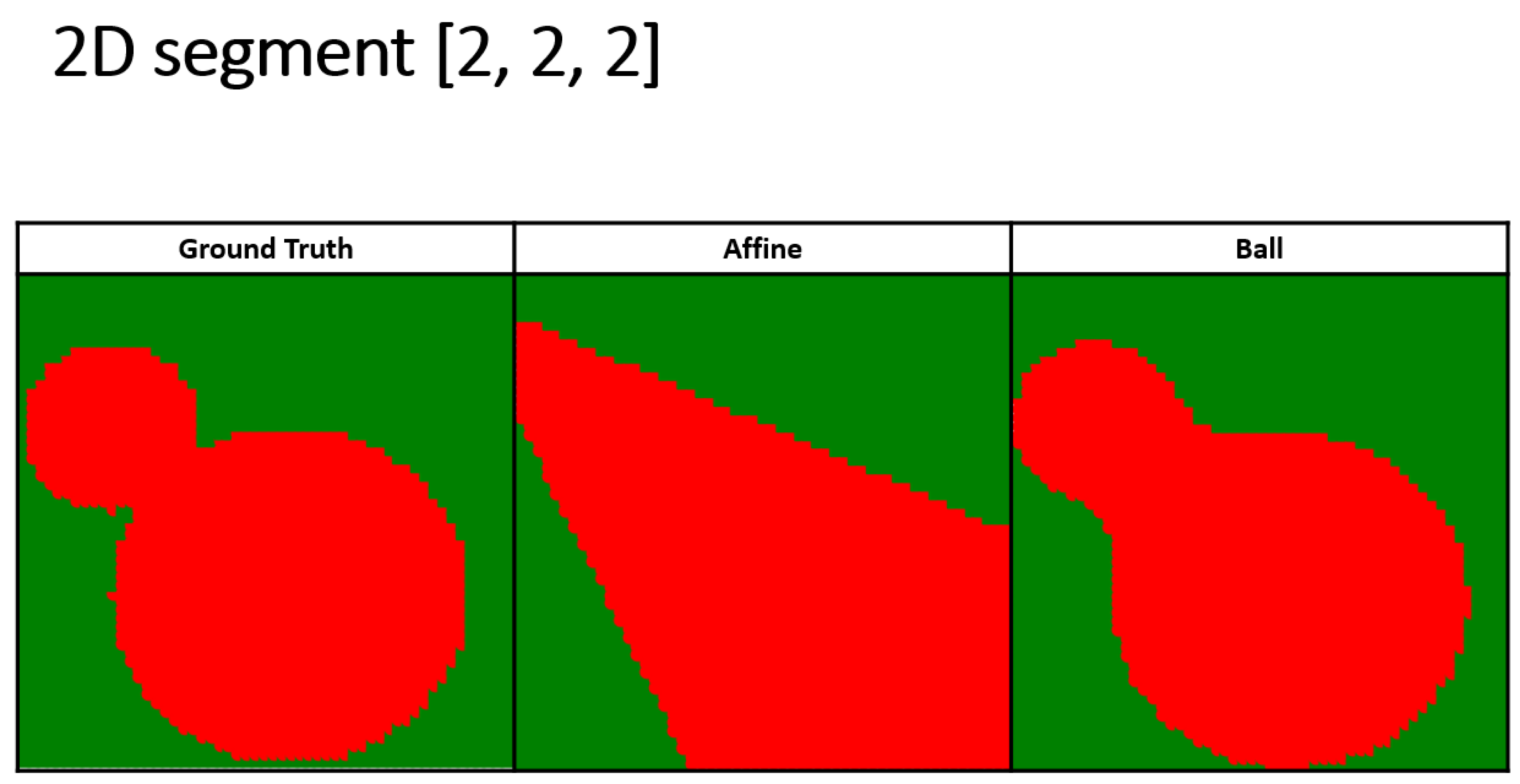
Figure 1.
Visual comparison of 2D segment approximation under dual-ball topology versus unconstrained affine hyperplanes.
Figure 1.
Visual comparison of 2D segment approximation under dual-ball topology versus unconstrained affine hyperplanes.
2.1. Concrete 2D Exemplar with Boundary Analysis
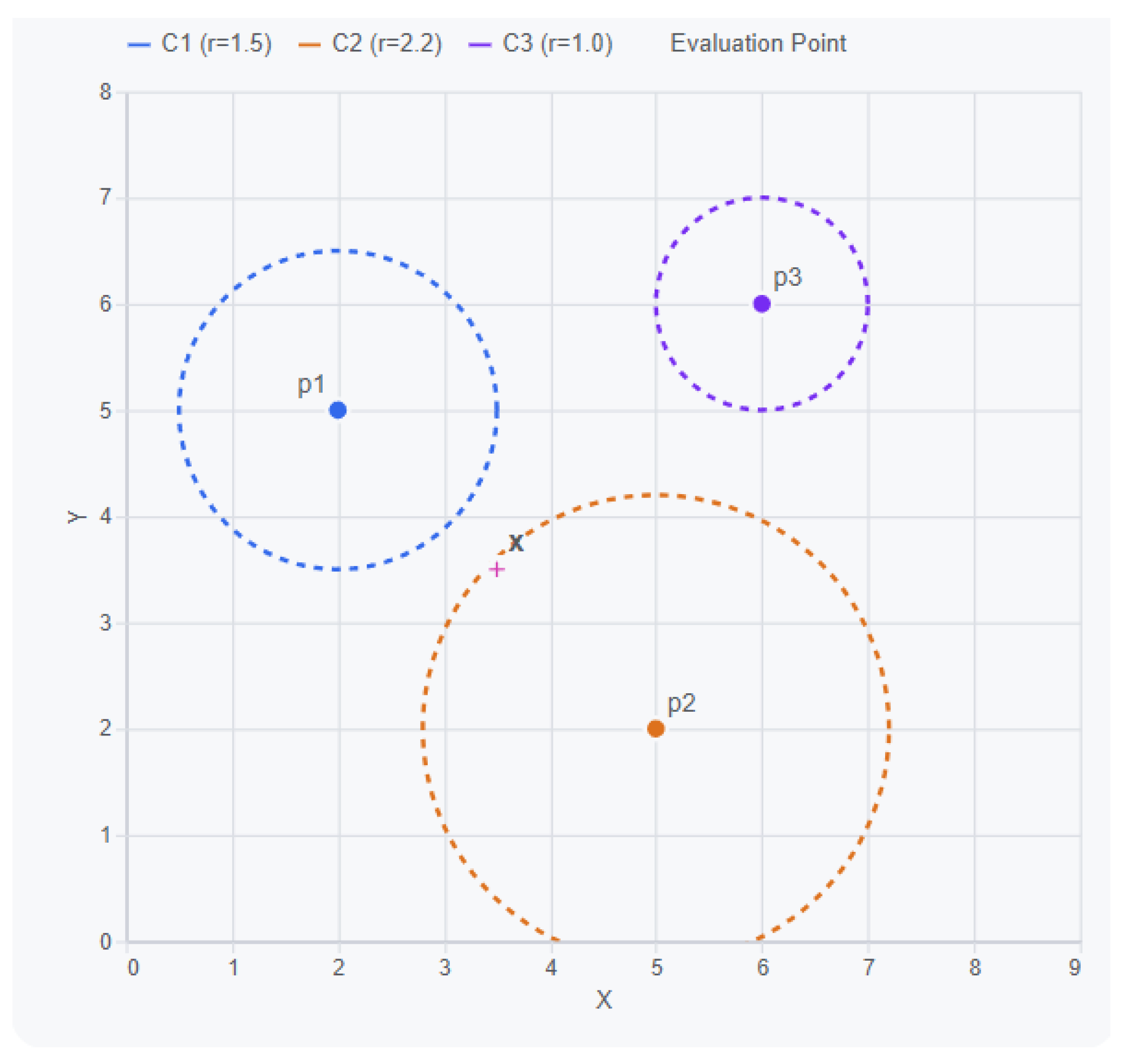
To explicitly illustrate the classification mechanics of this bounded architecture, we present an intuitive 2D example. Consider a weight matrix compiled of three discrete ball centers in general random positions, , where each denotes the geometric center of a circular partition . Let be an input evaluation point, and represent the trainable squared radius of each respective circle, where radii are explicitly non-equal.
We deliberately compute the subtraction first, evaluating the network pre-activations strictly through the dot product of each displacement vector with itself:
The collective output vector serves as the deterministic metric to identify which specific containment sphere ( or ) encompasses the input vector .
Figure 2.
2D random configuration demonstrating maximum boundary containment threshold where .
2.2. Proximity Classifier Reduction
Furthermore, this formulation exhibits an elegant geometric reduction when we constrain all radius parameters to zero ( for all j). Under this threshold boundary condition, the formulation isolates proximity metrics directly, converging toward a localized Voronoi-like classification:
By maximizing , the layer evaluates which centered coordinate or is geometrically closest to the input point , establishing a bounded proximity classifier derived entirely from first principles.
3. Computational and Generalization Advantages
A critical advantage of this framework is its absolute compliance with modern hardware acceleration paradigms. To optimize computational efficiency, we bypass explicit vector norms, square roots, or multinomial expansions, evaluating the metric strictly through the core dot product of the displacement vector. Because the forward pass maps directly to the standard inner product of , there is absolutely no loss of parallelization benefits on modern GPU hardware.
During backpropagation, the gradients required for parameter optimization are direct linear consequences of the localized displacement vector . Because the activation domain is bounded-by-design under the solid ball envelope, the local derivatives are structurally locked from vanishing to zero, precluding gradient vanishing from the source. The numerical execution follows standard chain-rule operations applied directly to inner product spaces, eliminating the need for empirical post-hoc smoothing.
3.1. Empirical Verification and Generalization Superiority
To evaluate the practical architectural benefits, extensive numerical experiments were executed from scratch on foundational benchmarks, directly comparing our bounded ball formulation against the standard affine baseline.
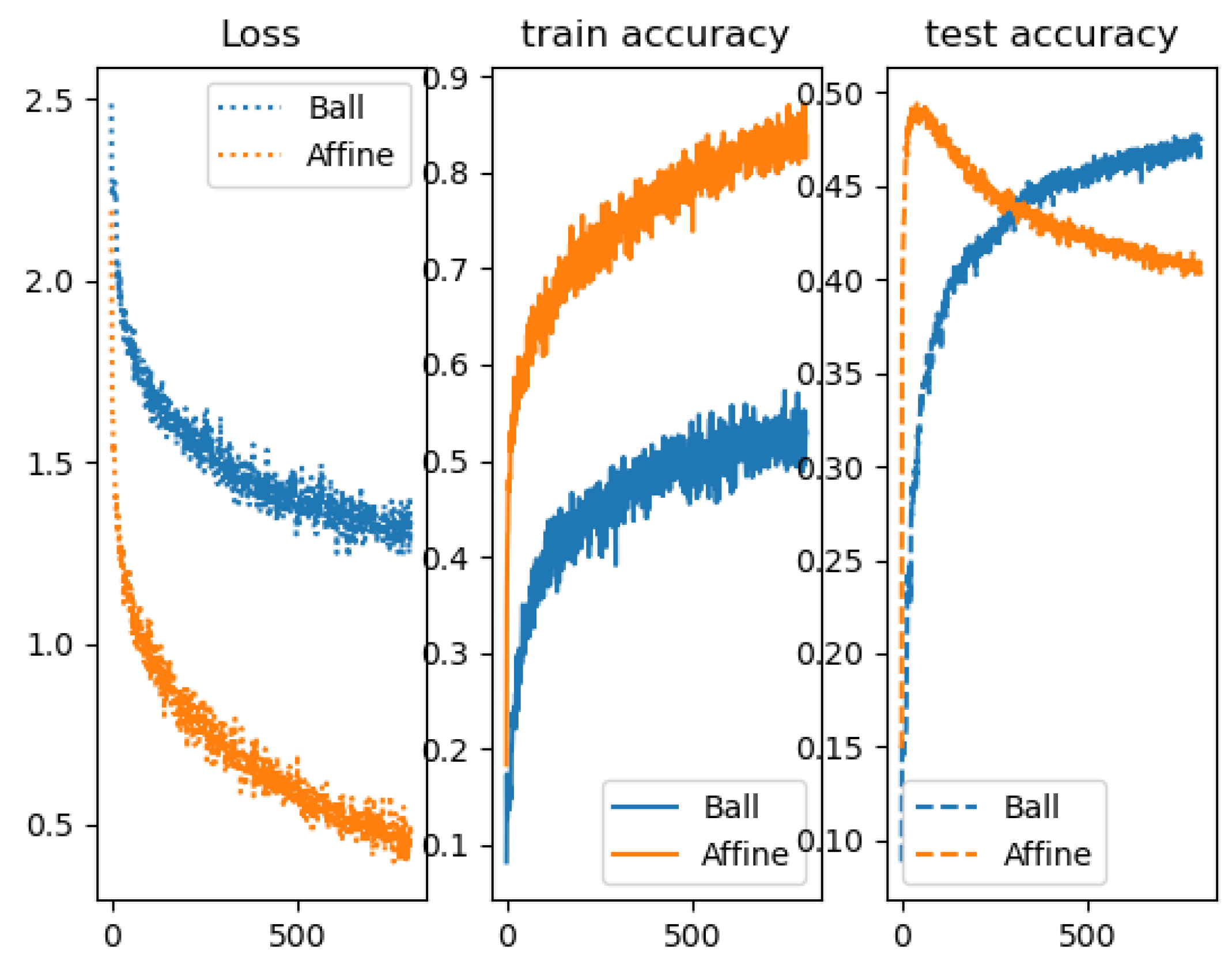
As illustrated in Figure 3, the bounded formulation maps seamlessly to large-scale categorical tasks like MNIST, achieving an optimal test accuracy of 0.91 while maintaining absolute training smoothness. To further expose the chronic overparameterization traps of traditional unconstrained models, a long-term convergence benchmark spanning 800 epochs was conducted.
As verified in Figure 4, the traditional Affine formulation (orange) triggers a massive validation inversion after epoch 100 on the testing set (right), falling from 0.49 due to unconfined boundaries. Crucially, our Bounded Ball architecture (blue) demonstrates strict numerical stability; its testing accuracy completely eliminates generalization decay, maintaining a robust upward trajectory that validates the core geometric guarantee from the very source.
4. Conclusion and Open Challenge to the AI Community
It is practically impossible for a single independent researcher to rewrite today’s massive foundation models from scratch. However, replacing traditional affine layers with our proposed bounded ball-covering framework does not require systemic structural overhaul. Whether within a global GPT scale framework or a localized development environment, execution is a straightforward procedural substitution that can be accomplished with minimal code modification by any standard practitioner.
The barrier to adoption is therefore not engineering complexity, but an existential choice of implementation willingness. Strong computational intuition dictates that this bounded formulation will be exceptionally powerful for datasets exhibiting spatial distributions with distinct geometric attributes, specific topological shapes, or clustered clustering properties. We openly challenge the broader artificial intelligence research community to demonstrate true scientific empiricism, transcend engineering inertia, and deploy this paradigm to explore the structural benefits of bounded-by-design neural mechanics.
Reference
- Saitoh, K. Deep Learning; O’Reilly Taiwan, 2017; ISBN 9789864764846. [Google Scholar]
Figure 3.
Empirical convergence on MNIST utilizing simply two ball layers ().
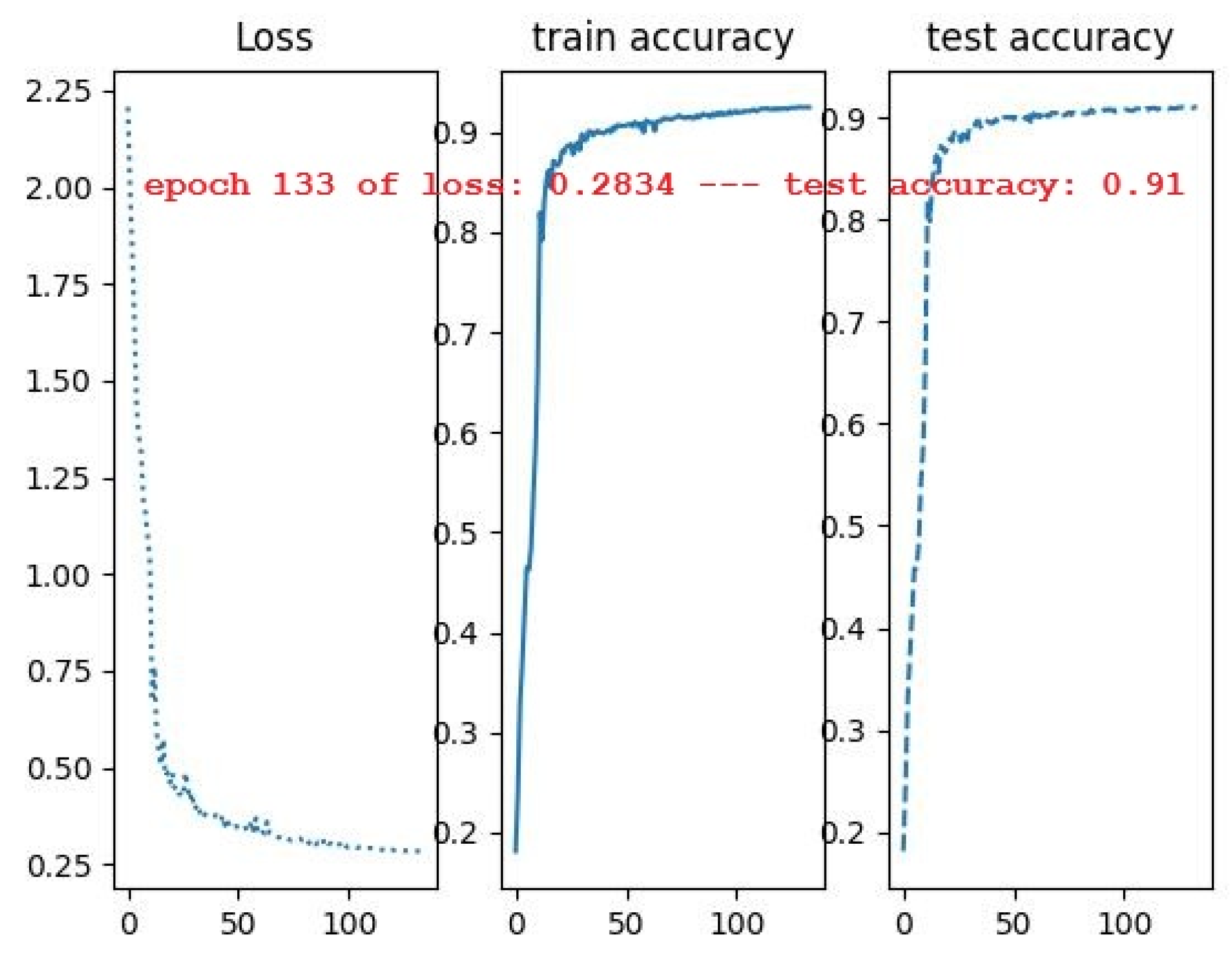
Figure 4.
Long-term 800-epoch verification revealing unconstrained baseline collapse versus robust ball covering generalization paths.
Figure 4.
Long-term 800-epoch verification revealing unconstrained baseline collapse versus robust ball covering generalization paths.
Disclaimer/Publisher’s Note: The statements, opinions and data contained in all publications are solely those of the individual author(s) and contributor(s) and not of MDPI and/or the editor(s). MDPI and/or the editor(s) disclaim responsibility for any injury to people or property resulting from any ideas, methods, instructions or products referred to in the content. |
© 2026 by the author. Licensee MDPI, Basel, Switzerland. This article is an open access article distributed under the terms and conditions of the Creative Commons Attribution (CC BY) license.
Copyright: This open access article is published under a Creative Commons CC BY 4.0 license, which permit the free download, distribution, and reuse, provided that the author and preprint are cited in any reuse.