
Submitted:
10 September 2026
Posted:
11 September 2026
You are already at the latest version
Abstract
UNESCO Global Geoparks are recognized as instruments for territorial development. However, limited research explains how emerging geoparks can transform distinctive territorial assets into sustainable and inclusive tourism destinations. This study examines the Kütralkura UNESCO Global Geopark in Chile and asks how its tourism potential can be activated by addressing governance gaps, territorial capacity constraints, and destination visibility. Adopting a pragmatic approach, we analyzed an open-ended survey of 32 tourism ecosystem actors across the Geopark. Thematic analysis identified four interrelated dimensions shaping tourism development. First, sustainable territorial competitiveness depends on strategically leveraging geo-natural capital, biocultural heritage, and territorial identity as tourism assets. Second, strategic destination governance requires multilevel coordination and sustained vertical institutional commitment. Third, territorial tourism capacity highlights the need to balance tourism development and visitor use with environmental conservation and local capabilities. Fourth, destination activation and visibility involve negotiating local and international branding while strengthening residents’ geoheritage literacy. The findings demonstrate that tourism potential in emerging geoparks depends not only on resource endowment but also on governance, territorial capacity, and destination activation. The study contributes practical insights for geopark management and proposes landscape management as an integrated approach to sustainable tourism development in emerging economies.
Keywords:
UNESCO Global Geoparks
; Kütralkura Geopark
; emerging economy
; geopark governance
; destination activation
; landscape management
1. Introduction
Geoparks are defined as distinct regions containing geological sites of international significance. As of September 2026, the UNESCO Global Geoparks (UGGps) network comprises more than 241 geoparks across 51 countries, covering approximately 882,000 square kilometers [1]. Functioning as an integrated model of landscape management, UGGps harmonize geoconservation, education, and sustainable local development through geotourism [2]. Consequently, these territories offer unique frameworks to strengthen local economies, preserve biodiversity, and celebrate cultural identity. Beyond their immediate territorial impact, UGGps are deeply aligned with the United Nations Sustainable Development Goals (SDGs). By advancing geoheritage and geodiversity awareness, they promote quality education (SDG 4), while their emphasis on community engagement fosters more sustainable lifestyles (SDG 11). Furthermore, geoparks act as catalysts for collaborative partnerships, both by uniting local stakeholders and by integrating them into a global network dedicated to sharing knowledge and best practices for geoheritage protection.
The literature increasingly conceptualizes UGGps as instruments for territorial development, given their potential to stimulate employment, investment, and economic diversification through tourism-related activities [3,4,5]. Moreover, geoparks are linked to positive social outcomes, including enhanced self-perception, social cohesion, and social development driven by education and training initiatives [6,7]. While current research acknowledges these potential benefits, there is an emerging call to investigate geopark dynamics as socio-ecological development systems, specifically to identify how socially embedded elements enable or constrain their potential. Furthermore, scholars emphasize the need to generate context-specific management frameworks, targeted interventions, and improved zoning to enhance both conservation outcomes and equitable tourism benefits [8]. Finally, there remains a critical need to contextualize these barriers and drivers within emerging markets and newly established geoparks [9].
This study focuses on the Kütralkura UGGp, which obtained UNESCO recognition in 2019 as the first geopark in Chile. This research aims to answer the following question: How can the Kütralkura UGG transform its distinctive territorial assets into sustainable and inclusive tourism development by addressing governance gaps, territorial capacity constraints, and the conditions needed to activate its tourism potential? By adopting a pragmatic philosophical approach through a thematic analysis of qualitative evidence from 32 entrepreneurs and tourism policymakers, this study illustrates the barriers to development within Kütralkura. Our thematic analysis points to four core dimensions linked to territorial development: sustainable territorial competitiveness, strategic destination governance, territorial tourism capacity, and destination activation and visibility. Based on these findings, we provide practical recommendations to unlock the potential of the Kütralkura UGG.
The manuscript is organized as follows. First, we present a literature review on geoparks, focusing on the challenges of geotourism and geopark management. Next, we outline the data collection process and the methodology employed. We then detail the thematic analysis and highlight the tensions that limit the Geopark's potential. Finally, we present the core implications of our empirical examination and discuss the limitations of the study.
2. Literature Review
Literature increasingly conceptualizes UGGPs as territorial development instruments rather than solely as spaces for geological conservation. Their distinctive contribution lies in integrating geoconservation, education, tourism, and local development through the valorization of geological, ecological, cultural, and socioeconomic resources [3,4,5]. Yet, research remains predominantly oriented toward geoscientific assessment, geosite inventories, and geotourism, with comparatively limited attention to the social processes through which geoparks become embedded in local territories [3]. This imbalance is particularly relevant because geological heritage acquires meaning through local practices, interpretations, and forms of territorial identity. Recent studies illustrate this broader potential by linking geodiversity with cultural production and local entrepreneurship, including geo-culinary products and MSME competitiveness [10], while geosite assessment and geotrail design demonstrate how geological resources can simultaneously support interpretation, education, and visitor experiences [11,12]. Systematic reviews nevertheless indicate that the socioeconomic and societal consequences of geoparks remain less developed than research on conservation and tourism [4,5]. The emerging research agenda therefore calls for a shift from assessing the existence and attractiveness of geoheritage toward understanding how geoparks transform territorial resources into locally valued and sustainable development processes.
Geotourism represents the most established pathway through which this transformation is expected to occur. Geoparks can stimulate employment, income generation, entrepreneurship, local products, and economic diversification, particularly in rural and peripheral areas [13]. Comparative evidence from Asian geoparks associates designation with increased visitation, local businesses, geofood, festivals, branded products, and community participation [14]. The Jeju case further demonstrates how resident-led programs, geotrails, and local guiding can combine economic activity with stronger territorial pride and geoheritage awareness [6]. Community-level evidence from Kinabalu similarly identifies economic, social, and environmental benefits, including income, social cohesion, and environmental stewardship [15], while these perceived benefits and support for geopark development are associated with greater community well-being. Residents in Fruška Gora, Serbia, also express generally positive attitudes toward geotourism, although social costs temper this support [7]. Importantly, however, tourism growth does not automatically produce sustainable outcomes. Evidence from Zhangye, China, reveals a tension between economic benefits and the energy, water, and waste demands generated by tourism consumption [16]. Similarly, research on Yehliu Geopark, Taiwan, and Pinnacles Desert, Australia, demonstrates how congestion, visitor behavior, and tourism infrastructure can threaten geoheritage [17]. Thus, the developmental value of geotourism depends not simply on attracting visitors, but on the capacity of geoparks to manage tourism intensity, distribute benefits, and reconcile economic use with environmental limits.
This issue directs attention toward community participation as a mechanism shaping development outcomes. Literature increasingly questions whether formal participation necessarily produces meaningful influence. Research in the Dieng Plateau shows that participatory arrangements may coexist with unequal authority, communication barriers, and hierarchies of knowledge [18]. Similarly, the El Hierro Global Geopark case , Spain, identifies a persistent gap between community recognition of the geopark and residents' expectations for greater involvement, suggesting that co-management remains incompletely institutionalized [19]. These tensions become particularly visible where tourism restructures existing livelihoods and cultural practices. In Batur, for example, tourism has generated service-sector opportunities while simultaneously contributing to the marginalization of farmers and miners and restricting access to culturally significant spaces [20]. Such findings challenge development narratives that equate tourism expansion with community empowerment.
Accordingly, governance and institutional capacity emerge as critical conditions for converting geopark designation into sustainable territorial development. Collaborative governance requires coordination among governments, communities, academia, businesses, and civil society around shared objectives, supported by institutional capacity, financing, communication, and adaptive management [21]. Institutional fragmentation can undermine this process. In the Aspiring West Geopark in Portugal, overlapping protected-area and geopark designations may strengthen conservation, but integrating social considerations and management responsibilities remains challenging [22]. Cross-national evidence likewise indicates that stable institutional foundations and financial support are important for effective geopark management [23]. The Australian case further highlights the importance of bottom-up, locally embedded governance while identifying governmental and policy barriers to geopark adoption [24]. At the territorial level, strategic priorities encompass community awareness, entrepreneurship, community-based tourism, education, partnerships, risk management, and green investment, although these priorities vary across administrative contexts and should be integrated [25,26,27]
Empirical evidence consequently broadens the sustainability debate toward justice, resilience, and legitimacy. Research on Indonesia's Ring of Fire shows how fragmented regulation and limited community participation can constrain both geotourism and renewable-energy opportunities, highlighting ecological justice and community-centered governance as prerequisites for sustainable development [28]. In Rinjani–Lombok, Indonesia, perceived fairness strengthens trust in governance, whereas greenwashing undermines it, with trust subsequently shaping tourists' willingness to contribute to conservation [29]. This highlights an important dimension of geopark sustainability: legitimacy depends on stakeholders perceiving governance and benefit distribution as credible and fair. Resilience is equally important. Evidence from Ciletuh-Palabuhanratu, Indonesia, shows how environmental shocks can shift priorities from tourism expansion toward disaster preparedness and resilience, while differences in governance capacity and human resources constrain adaptation [30]. Research on Greek geoparks reinforces the need to integrate socioeconomic and cultural dimensions with collaborative governance, environmental challenges, and geoeducation [31].
Taken together, the literature indicates a transition from viewing geoparks primarily as conservation and tourism destinations toward understanding them as socio-ecological development systems. Yet a critical gap remains as existing research documents many potential economic, environmental, educational, and social benefits, but provides less systematic explanation of how governance arrangements, community participation, local knowledge, and power relations interact to shape the patterns and distribution of territorial development. Addressing this gap would move geopark research beyond assessing impacts toward explaining the mechanisms through which geoparks generate, or fail to generate, sustainable and inclusive tourism development.
3. Data and Methods
3.1. Research Paradigm and Context
This study adopts a pragmatic philosophical approach, which, rooted in non-reductive naturalism, emphasizes problem-solving and practical knowledge above other considerations [32]. Following the maxim proposed by Charles S. Peirce, we evaluate the implications of knowledge on experience within the specific context of analysis [33]. This philosophical stance posits that the purpose of knowledge is to identify how concepts are employed in practice. Notably, this perspective has been previously utilized in research exploring grand challenges, such as climate change [34].
This research focuses on the Kütralkura UGGp in Chile (see Figure 1 for the site map). The geopark encompasses the municipalities of Curacautín, Vilcún, Lonquimay, and Melipeuco within the Araucanía Region. Covering approximately 12,000 square kilometers, the area contains around 110 geosites and six active volcanoes. These protected areas belong to the National System of Protected Wild Areas of the State (SNASPE), which is administered by the National Forestry Corporation (CONAF). The geopark is characterized by a strong presence of nature-, adventure-, and culture-based tourism. The Araucanía Region exhibits a low level of economic development, yet it holds the highest share of Indigenous population in the country. Given these contextual characteristics, since its designation as a UGGp, the region has engaged in continuous cycles of community engagement activities aimed at unlocking the geopark's potential. Consequently, this unique context provides a fruitful setting for generating practical insights into geopark management and development.
3.2. Sample and Survey
To identify the main gaps and constraints affecting Kütralkura UGGp, we employed a theoretical sampling targeting members of the local tourism ecosystem identified through the Geopark’s official website. The final sample comprised 32 actors engaged in tourism and related economic activities within Geopark. Table 1 provides an overview of the participants. The sample included a heterogeneous range of public-sector and entrepreneurial actors, including representatives from municipal tourism administration, tour guiding and tour operating, accommodation, gastronomy, handicrafts, agritourism, travel services, recreation, and other locally based tourism enterprises. This diversity was intended to capture perspectives from actors occupying different positions within the destination system. Demographic and occupational information was not disclosed for one respondent (Case 31), while information on professional experience was unavailable for two additional cases. Participants were distributed across seven municipalities within the Kütralkura UGGp: Curacautín (n = 9), Melipeuco (n = 8), Vilcún (n = 6), Lonquimay (n = 3), Lautaro (n = 3), Curarrehue (n = 1), and Cunco (n = 1). Among the 31 participants for whom gender information was available, 17 were men and 14 were women. Professional or entrepreneurial experience ranged from 3 to 21 years, with a mean of 9.3 years and a median of 9 years, indicating substantial accumulated experience in tourism and related activities across the sample.
Data were collected through a telephone survey with the identified actors between December 2025 and January 2026. The survey was administered in Spanish, the local language, and comprised four open-ended questions designed to capture respondents’ perceptions of tourism competitiveness, governance, development challenges, and future opportunities in Kütralkura UGGp. The first question examined the factors perceived to underpin the Geopark’s competitiveness: “What factors do you consider make Kütralkura UGGp competitive?” The second explored perceptions of the strategies implemented by municipal, regional, and national governments to strengthen the Geopark: “What is your perception of the strategies implemented by municipal, regional, and national governments to enhance the Geopark?” The third addressed the main challenges affecting tourism development, with particular attention to environmental, social, and cultural dimensions: “What challenges do you observe in the development of tourism activity, considering environmental, social, and cultural aspects?” The fourth examined perceived opportunities to increase destination visibility and enhance tourism potential: “What do you consider is needed to increase the visibility of the Geopark and improve its tourism potential?” The use of open-ended questions enabled participants to articulate their views in their own terms and provided the empirical basis for the subsequent thematic analysis.
3.3. Data Analysis
The qualitative data were analyzed using a structured and iterative thematic procedure that combined inductive coding with theoretically informed interpretation. For each survey question, the analysis began with the identification of salient respondent statements while preserving their contextual meaning. These statements were assigned initial codes capturing the central idea expressed in each response. Related codes were then grouped into broader subthemes reflecting recurring patterns across cases, which were subsequently organized into higher-order themes informed by relevant concepts in the tourism and geopark literature. The final stage involved interpreting the relationships among these higher-order themes to identify the underlying mechanisms shaping tourism development in Kütralkura UGGps. These interpretations were then used to derive practical implications for policymakers and entrepreneurs seeking to strengthen tourism activity, local value creation, and the broader economic contribution of Geopark.
4. Results
The analysis reveals a consistent underlying pattern. Kütralkura possesses a strong portfolio of territorially embedded natural, cultural, and symbolic assets, yet their contribution to tourism development depends on the capacity of local institutions and actors to convert them into an integrated, accessible, visible, and sustainably managed destination system. Across the four analytical dimensions, respondents moved from identifying the Geopark’s competitive assets to describing the governance conditions that constrain their valorization, the environmental and social capacities required to accommodate tourism growth, and the mechanisms needed to strengthen destination visibility and activation. The following subsections describe the core findings based on each area of inquiry.
4.1. Dimension 1. Sustainable Territorial Competitiveness
Table 2 provides the thematic analysis made on question 1. Respondents most consistently associated Kütralkura’s competitiveness with its geo-natural capital, including geosites, volcanic landscapes, biodiversity, native vegetation, lakes, rivers, mountains, protected areas, and scenic qualities. These were not understood as generic nature-based attractions, but as territorially specific assets that are difficult to reproduce elsewhere. Active volcanism was particularly important in establishing a distinctive geological identity, while the aesthetic expression of geodiversity extended geological heritage beyond scientific value into the experiential domain of tourism. Competitiveness was therefore understood as emerging from a bundle of mutually reinforcing resources rather than a single attraction. Within this configuration, Conguillío functions as an anchor attraction capable of generating substantial visitor flows and, potentially, wider spillovers to nearby geosites, enterprises, and communities if these flows can be connected more effectively to the wider territory.
This geo-natural foundation is reinforced by biocultural heritage and territorial identity. Respondents repeatedly linked geological landscapes to Mapuche heritage, settler histories, rural livelihoods, artisan production, gastronomy, and local ways of life, representing Kütralkura as a lived cultural landscape rather than simply a collection of geosites. Such cultural embeddedness provides additional differentiation because it connects tourism experiences to locally specific histories, identities, and social practices. Artisan production, gastronomy, and rural activities further translate territorial identity into visitor experiences while creating opportunities for tourism expenditure to remain within local communities. Kütralkura’s distinctiveness therefore lies partly in its capacity to combine geological heritage with living culture, rather than positioning natural and cultural resources as separate tourism products.
Respondents also identified UNESCO recognition and scientific legitimacy as forms of symbolic capital. The designation provides an internationally recognized signal of heritage significance, authenticity, and territorial uniqueness, potentially strengthening destination credibility in domestic and international markets. It also creates opportunities for specialized tourism linked to geology, scientific research, education, and geoheritage interpretation. However, respondents’ accounts also suggest that designation should not be treated as synonymous with competitiveness. UNESCO recognition creates reputational potential, but its tourism value depends on whether it is effectively communicated, interpreted, embedded in destination narratives, and converted into meaningful visitor experiences.
A further source of competitiveness lies in local value creation through complementary tourism products and experiences. Entrepreneurs highlighted artisan goods, souvenirs, gastronomy, agricultural activities, recreation, cultural experiences, education, and scientific activities as ways of extending the tourism offer beyond primary attractions. This positions local entrepreneurs not merely as supporting service providers but as constituents of the destination product itself. Connecting geosites and iconic attractions to locally embedded products can diversify the visitor experience, increase spending opportunities, and improve the local retention of tourism value. Importantly, respondents did not frame conservation and environmental stewardship as incompatible with competitiveness. Environmental quality itself was regarded as part of Kütralkura’s competitive proposition, particularly its perceived cleanliness, intactness, and relatively pristine character. This reframes destination performance away from maximizing visitor volumes and toward maintaining the ecological conditions that underpin long-term attractiveness. One respondent explicitly challenged the language of competitiveness, offering a contrasting conception of success based on preservation, low-impact visitation, quality, and territorial wellbeing. This perspective reinforces the need to situate tourism competitiveness within a sustainability framework rather than treating growth as an end.
Across these themes, however, respondents identified a fundamental resource-to-competitiveness conversion gap. Kütralkura possesses abundant natural, cultural, and symbolic resources, but these do not automatically become competitive tourism products. Their valorization depends on accessibility, infrastructure, interpretation, coordination, product development, and institutional integration.
4.2. Dimension 2. Strategic Destination Governance
Table 3 provides the thematic analysis made on question 2. The second analytical dimension concerns the institutional conditions shaping this conversion process. Respondents portrayed Kütralkura as an emerging but uneven multilevel governance system, in which municipal, regional, and national interventions are experienced differently across the territory. Some entrepreneurs recognized recent improvements, particularly at the regional level, and regarded stronger alignment between regional strategies and municipal planning as a positive development. Nevertheless, progress remains inconsistent across municipalities, indicating incomplete vertical integration and uneven institutional commitment.
These differences are reinforced by institutional fragmentation and implementation-capacity gaps. Respondents suggested that strategies and business-related activities may formally exist but are weakened in practice by limited resources, fragmented responsibilities, weak inter-institutional coordination, and uneven territorial reach. This is especially consequential in a Geopark that spans multiple municipalities, conservation areas, tourism businesses, and local communities. The resulting governance challenge is therefore operational as well as political: formal policy intentions are not always translated into coherent territorial action.
A persistent communication and internal destination-branding deficit further constrains governance effectiveness. Respondents identified a marked gap between Kütralkura’s international significance and the limited understanding of the Geopark among residents, entrepreneurs, and sometimes institutional actors themselves. Information may be available through formal or digital channels without becoming embedded in local knowledge and everyday practice. External promotion without internal understanding therefore risks producing a destination identity that local actors neither fully recognize nor reproduce.
This disconnect is compounded by a participation deficit and weak co-production of governance. Several entrepreneurs described themselves as recipients or observers of public initiatives rather than active participants in shaping them. Uneven access to meetings, business-related activities, and institutional relationships can weaken local ownership and legitimacy. Respondents’ accounts instead point toward a more collaborative model in which communities, entrepreneurs, and institutions jointly define priorities, develop projects, and interpret territorial resources.
Questions of participation also extend to distributional justice and local capture of tourism benefits. Respondents evaluated governance not only in terms of attracting visitors, but according to who controls tourism opportunities and who benefits economically. Some perceived that larger businesses, concessionaires, or external actors were better positioned to capture tourism value, while local guides, artisans, and small enterprises remained economically peripheral. Tourism development was therefore viewed as successful only when it produces broadly distributed opportunities for employment, market access, and entrepreneurship.
Governance outcomes are also spatially uneven. Some municipalities and localities benefit from proximity to established attractions and stronger promotional attention, whereas others remain peripheral or weakly connected. Even proximity to major attractions does not guarantee local economic capture if visitors pass through communities without engaging with local products or services. These patterns reveal internal core–periphery dynamics that require more territorially balanced planning. Finally, respondents distinguished short-term activation from long-term strategic governance. Events, conferences, and promotional initiatives can generate momentum and visibility, but their contribution remains limited if they are not embedded in sustained strategies with clear objectives, responsibilities, resources, and implementation pathways. The governance challenge is therefore to convert episodic institutional activity into durable destination-management capacity.
4.3. Dimension 3. Territorial Tourism Capacity
Table 4 provides the thematic analysis made on question 3. The third analytical dimension concerns the territory’s capacity to absorb tourism growth sustainably. Respondents identified an explicit tension between increasing visitation and protecting fragile ecosystems, making ecological carrying capacity a central concern. Seasonal congestion, unregulated access, inappropriate camping, waste, fire risk, and pressure on protected areas were perceived as threats to the ecological foundation of the destination. Several entrepreneurs advocated anticipatory management, suggesting that visitor standards and behavioral expectations should be established before tourism intensification generates irreversible impacts.
Relatedly, environmental stewardship was understood as a shared responsibility extending beyond tourists. Respondents identified waste management, wastewater infrastructure, forestry, air pollution, and broader land-use pressures as factors affecting tourism quality. Sustainable tourism therefore depends on environmental governance across multiple sectors, not tourism policy alone. Furthermore, connectivity, infrastructure, and inclusive accessibility were also regarded as essential to territorial capacity. Poor roads, weak inter-municipal links, difficult access to geosites, and uneven mobility conditions constrain both visitor movement and the integration of dispersed attractions. Accessibility also has an equity dimension where certain sites are effectively available only to younger or more mobile visitors. Infrastructure therefore determines not only whether visitors can access the destination, but whether tourism benefits can circulate across the wider territory.
Respondents also highlighted environmental and geoheritage literacy as a form of stewardship capacity. Residents, entrepreneurs, and visitors need to understand what the Geopark represents, why its resources matter, and how they should be protected. Education therefore becomes part of destination governance rather than simply promotion. At the same time, human-capital and service-capability gaps may limit local participation in tourism growth. Language skills, digital communication, visitor service, interpretation, and business management were identified as increasingly important competencies. Without sustained capacity building, increased tourism demand may not translate into durable local economic opportunities.
The findings also underscore the importance of cultural continuity, territorial identity, and local recognition. Mapuche heritage, local producers, artisans, and rural practices were understood as constitutive elements of the destination rather than peripheral additions. Tourism development must therefore reinforce rather than dilute sense of place. Collectively, these issues culminate in a challenge of territorial integration and strategic tourism development. Kütralkura’s assets are abundant, but dispersed attractions, services, communities, and narratives are not yet fully organized into a seamless tourism system. The principal challenge is strategic integration rather than resource creation.
4.3. Dimension 4. Destination Activation and Visibility
Table 5 provides the thematic analysis made on question 4. The final analytical dimension concerns how this latent potential might be activated. Respondents viewed integrated destination branding and strategic market visibility as essential but understood visibility as more than advertising. Tourism fairs, tour operators, social media, traditional media, and domestic and international distribution channels were all considered necessary components of a coordinated and continuous communication strategy. However, visibility must also be produced within the destination through geoheritage interpretation and visitor-information infrastructure. Signage, maps, maintained trails, digital information, and interpretive facilities can transform dispersed sites into meaningful experiences while communicating why Kütralkura is geologically and culturally significant.
Respondents further stressed collaborative destination governance and network integration, arguing that municipalities, entrepreneurs, guides, artisans, communities, and tourism institutions need to communicate and act collectively. Such coordination is critical for presenting Kütralkura UGGps as one destination rather than a fragmented set of attractions. Visibility also requires entrepreneurial capability and inclusion. Small firms need digital, marketing, service, and business capacities, as well as tangible access to fairs, commercial spaces, platforms, and tourism networks. Otherwise, destination visibility may increase without strengthening local value capture.
Similarly, enabling infrastructure and visitor-service readiness are prerequisites for translating promotion into actual tourism performance. Roads, trails, signage, sanitation, visitor services, and emergency capacity shape whether tourists can access, navigate, and safely experience the destination. Finally, respondents emphasized strategic public-sector capacity and internal place branding. Sustained tourism development requires professional management, institutional continuity, investment, and policy support across political cycles. At the same time, residents and entrepreneurs must understand and identify with the UGGps.
5. Discussion
5.1. Theoretical Implications
This study advances the theoretical conceptualization of UGGps as socio-ecological development systems by exposing a fundamental "resource-to-competitiveness conversion gap." While previous literature positions geoparks as territorial development instruments driven by the integration of geoscientific and cultural resources [3,4], our findings reveal a critical theoretical divergence as the mere presence of UNESCO recognition and biocultural entanglement does not intrinsically generate sustainable development. Instead, a deliberate conversion process is required to translate latent assets into competitive advantages. Furthermore, this conversion introduces a theoretical tension regarding carrying capacity and tourism growth. Rather than treating conservation as a barrier to competitiveness, this research reframes ecological intactness as the baseline of the tourism product itself. By introducing the concept of anticipatory management, we extend the literature's call to reconcile economic use with environmental limits [17], arguing that sustainable destination theory must prioritize preemptive visitor standards over reactive impact mitigation.
Second, this research contributes to the destination governance literature by problematizing the social processes through which geoparks become territorially embedded. While existing frameworks emphasize the necessity of robust institutional capacity, they often overlook how fragmented regulations and overlapping designations undermine management in practice [22]. Our empirical evidence highlights a severe tension between macro-level policy intentions and micro-level territorial realities within multilevel governance systems. Crucially, we introduce the concept of an internal destination-branding deficit, which theoretically expands our understanding of destination visibility. Literature frequently assumes a linear relationship between international promotion and local identity; however, our findings expose a divergence wherein global recognition outpaces residents' comprehension of the Geopark. This establishes that geopark governance theories must account for internal meaning-making as a prerequisite for external promotion to avoid risking a decoupled destination identity that local actors fail to recognize or reproduce.
Finally, this study challenges prevalent development narratives that equate formal community participation with meaningful empowerment. We substantiate concerns in the literature that participatory arrangements often mask structural inequalities [18,20]. By uncovering a persistent participation deficit and its resulting core-periphery spatial dynamics, our research illustrates that without intentional, network-integrated governance, the tourism value generated by UGGps is captured by external or larger actors, relegating local tourism agents to the periphery. Consequently, we theorize that destination activation must transcend traditional marketing to generate genuinely inclusive development.
5.2. Public Policy Implications
Public policy should reposition Kütralkura UGGps from an attraction-based model toward an integrated destination portfolio approach. Geosites, volcanic landscapes, biodiversity, Mapuche heritage, rural practices, gastronomy, artisan production, and UNESCO recognition should be managed as complementary components of a differentiated destination proposition. This requires integrated tourism circuits, interpretation systems, local product development, and stronger linkages between anchor attractions such as Conguillío and less-visited communities and geosites. Competitiveness should therefore be assessed through sustainable value creation, local economic retention, visitor experience quality, and territorial differentiation rather than visitor-volume growth alone.
A second priority is to strengthen multilevel and participatory destination governance. Because Kütralkura UGGps spans several municipalities and institutional jurisdictions, fragmented interventions can reduce the effectiveness of destination development. Governance mechanisms should support sustained coordination among municipalities, regional and national agencies, communities, entrepreneurs, conservation actors, and Geopark management. Clear responsibilities, stable resources, shared objectives, continuous communication, and meaningful participation by local businesses are essential. Policy should also address the distribution of tourism benefits to ensure that guides, artisans, microenterprises, and local communities capture a greater share of tourism value.
Tourism management should also adopt a carrying-capacity and territorial-resilience perspective. Visitor management, waste and wastewater systems, fire prevention, trail maintenance, environmental standards, and monitoring of sensitive sites should be developed alongside investments in roads, connectivity, accessibility, signage, visitor services, and human capital. Environmental education and geoheritage literacy should be integrated into destination management. Finally, destination activation should combine branding with visitor readiness. Coordinated marketing, digital platforms, distribution channels, interpretation infrastructure, signage, and engagement with tour operators should be matched by adequate service capacity and environmental management. Linking promotion with infrastructure, local enterprise participation, and conservation is therefore essential to convert increased visibility into sustainable and locally embedded tourism development.
5.3. Practical Implications
For entrepreneurs, the main practical implication is to move from stand-alone offerings toward complementary and bundled tourism experiences. Geoheritage interpretation can be combined with gastronomy, Mapuche cultural experiences, rural activities, artisan products, scientific tourism, outdoor recreation, and educational activities to create differentiated products that are difficult to replicate elsewhere. Such bundling can also encourage visitors attracted by major sites to extend their stay, increase local expenditure, and engage with a broader range of businesses. The Geopark should therefore be incorporated directly into firms’ value propositions through geological, cultural, and territorial storytelling rather than used only as a promotional label. Entrepreneurs should also act as active destination partners by participating in business networks, collaborative product development, joint promotion, and destination-management initiatives. Referral systems, shared packages, and cross-municipal partnerships among accommodation providers, guides, restaurants, artisans, transport operators, and cultural organizations can strengthen market reach and improve the circulation of tourism expenditure across the territory.
Furthermore, environmental stewardship and service quality should likewise be treated as competitive capabilities. Low-impact operations, waste reduction, local sourcing, responsible visitor management, interpretation, and conservation-oriented experiences can reinforce destination differentiation while supporting the Geopark’s sustainability objectives. Entrepreneurs should also strengthen capabilities in digital marketing, languages, interpretation, safety, customer service, and business management. Finally, aligning firm-level communication with a coherent Kütralkura destination narrative can improve market access through social media, online booking platforms, tourism fairs, tour operators, and collaborative marketing channels.
6. Conclusion and Limitations
Given the global relevance of geoparks in strengthening local economies, preserving biodiversity, and celebrating cultural identity, alongside the academic community's growing interest in unlocking the potential of these areas in emerging markets, this article addresses a central question: How can the Kütralkura Geopark transform its distinctive territorial assets into sustainable and inclusive tourism development by addressing governance gaps, territorial capacity constraints, and the conditions necessary to activate its tourism potential? Drawing on qualitative evidence gathered from tourism ecosystem members within the Kütralkura UGGp, we identified four core dimensions of territorial development. These encompass sustainable territorial competitiveness, which relies on the strategic leveraging of geo-natural capital, biocultural heritage, and territorial identity; strategic destination governance, which functions as a multilevel system requiring vertical institutional commitment; territorial tourism capacity, which highlights the imperative to balance tourism exploitation with environmental conservation; and destination activation and visibility, which addresses the tensions between local and international branding alongside the geoheritage literacy of inhabitants. This study highlights the practical significance of these dimensions for effectively managing and developing the geopark.
This study has three main limitations that also suggest directions for future research. First, the analysis draws on a purposive sample of 32 actors from the local tourism ecosystem. Although participants represented public and entrepreneurial perspectives across seven municipalities and diverse tourism activities, several relevant stakeholder groups, including residents, visitors, Indigenous organizations, conservation actors, and larger or external tourism operators, were not systematically represented. Uneven participation across municipalities may also have limited the visibility of less-represented territorial perspectives. Future research should therefore adopt broader multi-stakeholder sampling strategies and enable comparisons across municipalities and stakeholder groups.
Second, the study provides a cross-sectional assessment based on perceptions collected during December 2025 and January 2026. The findings capture a specific stage of destination development and cannot establish how governance, market conditions, environmental pressures, or stakeholder perceptions evolve over time. Longitudinal research combining repeated stakeholder assessments with indicators of visitation, environmental pressure, local value capture, and spatial distribution of tourism benefits would provide a stronger basis for evaluating destination performance.
Third, the exploratory qualitative design identifies perceived mechanisms but does not establish causal relationships or the relative importance of the four dimensions. These dimensions should therefore be interpreted as an analytical framework rather than validated determinants of tourism performance. Future studies could operationalize them through quantitative indicators and test their relationships with destination competitiveness, entrepreneurial outcomes, environmental sustainability, and territorial development. Mixed-method and comparative research across UNESCO Global Geoparks could further distinguish context-specific dynamics from more general patterns of sustainable destination management.
Author Contributions
Conceptualization, JADT, GAMR, and JAHB; methodology JADT, and GAMR; validation, JADT, GAMR, and JAHB; formal analysis, JADT; investigation, JADT; resources, JADT, and GAMR; data curation, JADT; writing—original draft preparation, JADT; writing—review and editing, JADT, GAMR, and JAHB; visualization, JADT; supervision, JADT; project administration, JADT; funding acquisition, GAMR. All authors have read and agreed to the published version of the manuscript.
Funding
This research received no external funding.
Institutional Board Statement
The study was conducted in accordance with the Declaration of Helsinki, and
the protocol was approved by the Ethics Committee of the Faculty of Law, Business and Economic Sciences at
Universidad Catolica De Temuco on letter dated 11th, September 2025.
Data Availability Statement
The raw data supporting the conclusions of this article will be made available by the authors on request.
Conflicts of Interest
The authors declare no conflicts of interest.
Abbreviations
The following abbreviations are used in this manuscript:
| UGGps | UNESCO Global Geoparks |
| SDGs | Sustainable Development Goals |
References
- United Nations Educational, S. and C.O. UNESCO Global Geoparks. [CrossRef]
- Yari, P.; Saladié, Ò.; Diaz-Soria, I. Education for Sustainability in UNESCO Global Geoparks: Findings from a Systematic Literature Review. Int. J. Geoheritage Park. 2026, 100283. [Google Scholar] [CrossRef]
- Stoffelen, A. Where Is the Community in Geoparks? A Systematic Literature Review and Call for Attention to the Societal Embedding of Geoparks. Area 2020, 52, 97–104. [Google Scholar] [CrossRef]
- Ferreira, D.R.; Valdati, J. Geoparks and Sustainable Development: Systematic Review. Geoheritage 2023, 15, 6. [Google Scholar] [CrossRef]
- Neto, K.; Henriques, M.H. Geoconservation in Africa: State of the Art and Future Challenges. Gondwana Res. 2022, 110, 107–113. [Google Scholar] [CrossRef]
- Jeon, Y.; Koh, J.-G.; Southcott, D. A Case Study of Geopark Activation through Geobranding and Geotrails at the Jeju Island UNESCO Global Geopark, Republic of Korea. Epis. J. Int. Geosci. 2023, 46, 211–227. [Google Scholar] [CrossRef]
- Obradović, S.; Stojanović, V.; Lukić, T. Geotourism and Local Communities: Measuring Residents’ Attitudes toward Sustainable Tourism in the Fruška Gora National Park. Geoheritage 2023, 15, 90. [Google Scholar] [CrossRef]
- Dang, K.B.; Pham, T.T.; Phan, T.T.H.; Nguyen, M.H.; Pham, T.P.N.; Hoang, T.T.; Hoang, T.H.N.; Nguyen, T.H.T.; Nguyen, T.H.; Le, Q.D. Bayesian Belief Network for Assessing Conservation and Tourism Development in UNESCO Geoparks. Geoheritage 2025, 17, 36. [Google Scholar] [CrossRef]
- Simbaña-Tasiguano, M.; Cabascango-Chiliquinga, E.; Sánchez-Cortez, J.L.; García-Frank, A.; Grefa-Shiguango, H. Geoeducation Strategies in the Amazon, Napo Sumaco Aspiring UNESCO Global Geopark. Int. J. Geoheritage Park. 2024, 12, 465–484. [Google Scholar] [CrossRef]
- Yuliawati, A.K.; Rofaida, R.; Gautama, B.P.; Panji, S.R.; Millah, R.S.; Aryanti, A.N.; Hadian, M.S.D. Enhancing Geo-Culinary Competitiveness of MSMEs through Sustainable Marketing in Geopark West Java Indonesia 3. J. Ecohumanism 2024, 3, 11731–11739. [Google Scholar]
- Valente, E.; Casaburi, A.; Finizio, M.; Papaleo, L.; Sorrentino, A.; Santangelo, N. Defining the Geotourism Potential of the Cilento, Vallo Di Diano and Alburni UNESCO Global Geopark (Southern Italy). Geosciences 2021, 11, 466. [Google Scholar] [CrossRef]
- Abdillah; Abdurrachman, M.; Rizal, Y.; Kurniasih, N.; Sabila, F.S.N. Integrating Geological Evolution and Spatial Connectivity in Geotrail Design: A Framework from the Ijen UNESCO Global Geopark, East Java, Indonesia. Geosciences 2026, 16, 222. [Google Scholar] [CrossRef]
- Farsani, N.T.; Coelho, C.; Costa, C. Geotourism and Geoparks as Novel Strategies for Socio-economic Development in Rural Areas. Int. J. Tour. Res. 2011, 13, 68–81. [Google Scholar] [CrossRef]
- Lee, Y.; Jayakumar, R. Economic Impact of UNESCO Global Geoparks on Local Communities: Comparative Analysis of Three UNESCO Global Geoparks in Asia. Int. J. Geoheritage Park. 2021, 9, 189–198. [Google Scholar] [CrossRef]
- Louis, A.A.; Talib, H.; Chan, J.K.L.; Kamlun, K.U. Benefits of Geopark from the Perspective of Local Communities: A Case Study of Kinabalu UNESCO Global Geopark, Malaysia. Int. J. Geoheritage Park. 2025. [Google Scholar] [CrossRef]
- Xia, B. Sustainability Assessment of Geotourism Consumption Based on Energy–Water–Waste–Economic Nexus: Evidence from Zhangye Danxia National Geopark. Land 2024, 13, 1857. [Google Scholar] [CrossRef]
- Newsome, D.; Dowling, R.; Leung, Y.-F. The Nature and Management of Geotourism: A Case Study of Two Established Iconic Geotourism Destinations. Tour. Manag. Perspect. 2012, 2, 19–27. [Google Scholar] [CrossRef]
- Rusfiana, Y.; Sudarmono, S.; Alyani, N. Participation Under Constraint: Governing Risk, Knowledge, and Authority in a UNESCO Global Geopark. Fem. Encount. A J. Crit. Stud. Cult. Polit. 2026, 10, 1–17. [Google Scholar] [CrossRef] [PubMed]
- Gutierrez, L.E.H.; Marrugat, E.P. The Pending Matter of Co-Management in Geotourism: An Analysis of the Global Geopark El Hierro. PASOS-Rev. Tur. Y Patrim. Cult. 2023, 21, 37–51. [Google Scholar]
- Jung, Y. Reshaping Landscapes and Human–Environment Relationships through Geotourism. Tour. Geogr. 2025, 27, 1580–1599. [Google Scholar] [CrossRef]
- Dwipati, U.; Ibrahim, M.A.; Abdullah, M.T. Assessing and Initiating Collaborative Governance for Sustainable Geotourism Development: A Case Study of Maros-Pangkep Geopark in Indonesia. Edelweiss Appl. Sci. Technol. 2025, 9, 1406–1412. [Google Scholar] [CrossRef]
- Dias, A.; Robina-Ramírez, R.; Sánchez-Oro Sánchez, M. Territorial Planning and Sustainable Development—Case Study: Protected Areas in the Territory of the Aspiring West Geopark, Portugal. Front. Environ. Sci. 2023, 11, 1132162. [Google Scholar] [CrossRef]
- National and Global Geoparks Management Status: Focusing on Countries with UNESCO Global Geoparks. 지질학회지 2024, 60, 191–200. [CrossRef]
- Briggs, A.; Newsome, D.; Dowling, R. A Proposed Governance Model for the Adoption of Geoparks in Australia. Int. J. Geoheritage Park. 2022, 10, 160–172. [Google Scholar] [CrossRef]
- Nugraha, R.P.; Fauzi, A.; Rustiadi, E.; Basuni, S. Strategic Policy Framework for Sustainable Geopark Development Aimed at Advancing Village Independence within the UNESCO Global Geopark Gunung Sewu Region. J. Nat. Resour. Environ. Manag. Pengelolaan Sumberd. Alam Dan Lingkung. 2026, 16, 183. [Google Scholar] [CrossRef]
- Kızılkan, Y.; Birinci, S.; Camcı, A.; Çakır, Ç. Analysis of Sustainable Development Priorities in Geopark Areas: The Case of Türkiye. Geoheritage 2026, 18, 64. [Google Scholar] [CrossRef]
- Phan, T.T.; Hoa, V.D.; Chi, N.C. Strategic Priorities for Sustainable Geotourism in the Lang Son UNESCO Global Geopark: Integrating Delphi with SWOT-AHP-TOWS. Geoj. Tour. Geosites 2026, 66, 1738–1747. [Google Scholar] [CrossRef]
- Manumayoso, B.; Jaelani, A.K.; Firdaus, W.M.K.; Ogli, T.A.Z. Sustainable Tourism in Indonesia’s Ring of Fire: Toward Ecological Justice and Green Energy. J. Sustain. Dev. Regul. Issues 2025, 3, 590–615. [Google Scholar] [CrossRef]
- Ro’is, I.; Huzaini, M.; Jufri, A. Fairness, Greenwashing, and Religious Centrality: Explaining Muslim Tourists’ Conservation Payment Intentions in a UNESCO Geopark. Tour. Hosp. 2025, 6, 224. [Google Scholar] [CrossRef]
- Rahmafitria, F.; Dede, M.; Arrasyid, R.; Hindayani, P.; Fajar, A.S.M.; Widiyantoro, S.; Gunawan, E.; Rosemary, R.; Choiruddin, A.; Suryanto, S. From Tourism-First to Disaster-First: A Trade-off in Geopark Development after Environmental Shock. Int. J. Geoheritage Park. 2026, 100304. [Google Scholar] [CrossRef]
- Koupatsiaris, A.A.; Drinia, H. Exploring Greek UNESCO Global Geoparks: A Systematic Review of Grey Literature on Greek Universities and Future Research Avenues for Sustainable Development. Geosciences 2023, 13, 296. [Google Scholar] [CrossRef]
- Shields, P.M. Pragmatism as Philosophy of Science: A Tool For Public Administration. Res. Public Adm. 1998, 4, 195–224. [Google Scholar]
- Legg, C.; Hookway, C. Pragmatism. In The Stanford Encyclopedia of Philosophy; Zalta, E.N., Nodelman, U., Eds.; Metaphysics Research Lab, Stanford University, 2008. [Google Scholar]
- Díaz Tautiva, J.A.; Barros-Celume, S.; Lecuna, A.; Barragan-Rodriguez, C. Navigating Climate Change: Climate Change Awareness and Strategies in Micro, Small, and Medium-Sized Enterprises in a Developing Economy. PLoS ONE 2025, 20, e0327165. [Google Scholar] [CrossRef] [PubMed]
Figure 1.
Site map.
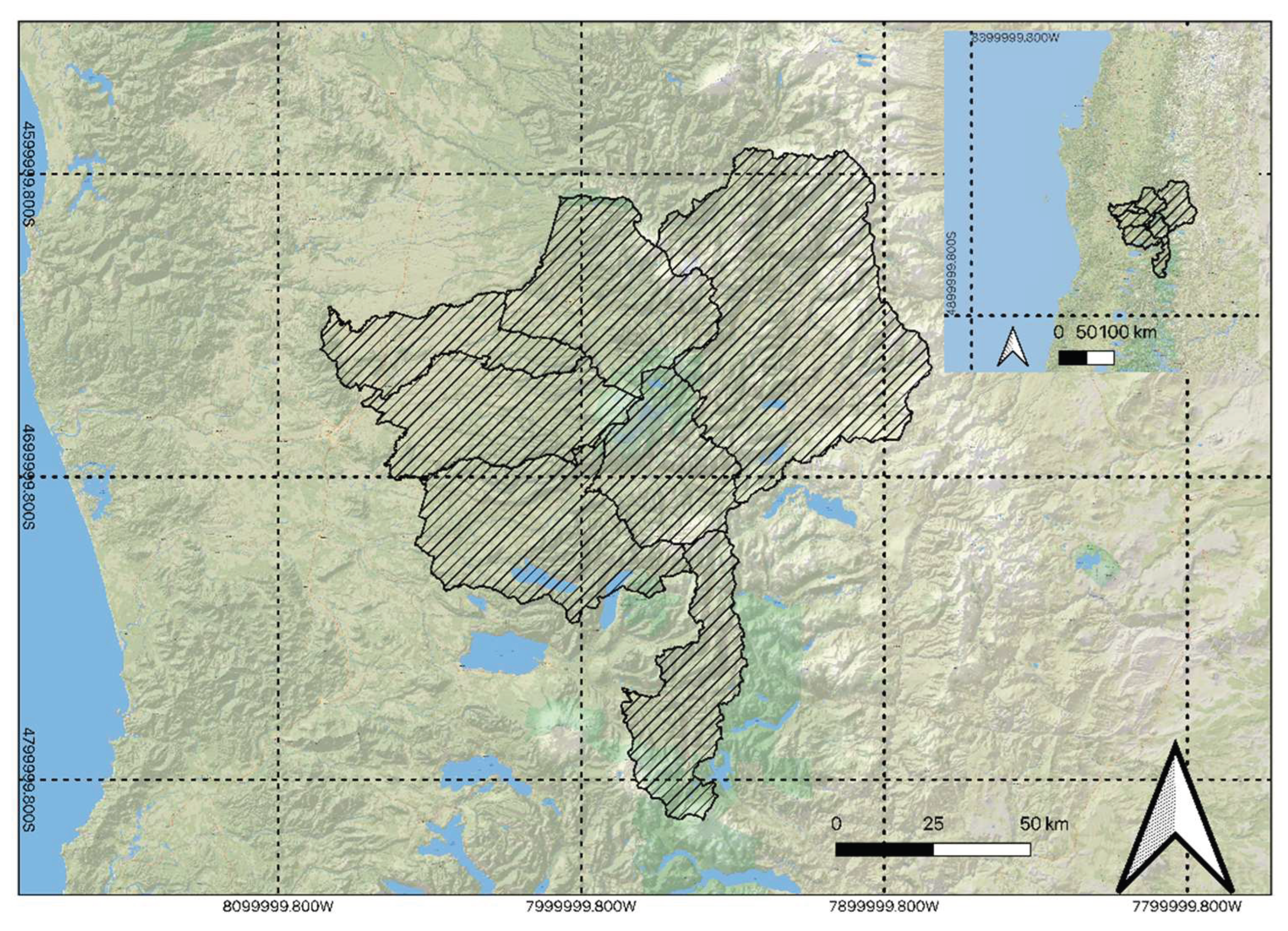

Table 1.
Sample Description.
| Case | Tourism Category | Gender | Experience | Geopark Location |
|---|---|---|---|---|
| Case1 | Municipal Tourism Administration | M | 5 | Lonquimay |
| Case2 | Municipal Tourism Administration | M | NA | Melipeuco |
| Case3 | Tour Guiding Services | M | 10 | Melipeuco |
| Case4 | Tour Guiding Services | M | 5 | Melipeuco |
| Case5 | Handicrafts and Souvenir Production | F | 5 | Vilcún |
| Case6 | Handicrafts and Souvenir Production | M | 20 | Curacautín |
| Case7 | Textile Handicrafts | F | 7 | Vilcún |
| Case8 | Accommodation and Tourism Services | M | 15 | Curacautín |
| Case9 | Food and Beverage Services | F | 10 | Melipeuco |
| Case10 | Tourism and Recreation Facility | F | 12 | Melipeuco |
| Case11 | Tourism Administration | F | 4 | Curacautín |
| Case12 | Travel Agency Services | M | 10 | Lonquimay |
| Case13 | Food and Beverage Services | F | 10 | Curarrehue |
| Case14 | Tourist Accommodation | F | 8 | Curacautín |
| Case15 | Indigenous Gastronomy | F | 13 | Melipeuco |
| Case16 | Tour Operator | M | 10 | Curacautín |
| Case17 | Camping and Outdoor Accommodation | M | 5 | Lonquimay |
| Case18 | Agritourism and Visitor Experience | F | 9 | Lautaro |
| Case19 | Tourist Accommodation | M | 21 | Vilcún |
| Case20 | Tourist Accommodation | M | 6 | Vilcún |
| Case21 | Rural Accommodation and Agritourism | F | 20 | Melipeuco |
| Case22 | Tourist Accommodation | F | 13 | Curacautín |
| Case23 | Tourist Accommodation and Wellness Services | M | 3 | Vilcún |
| Case24 | Handicrafts and Food Services | F | 15 | Lautaro |
| Case25 | Agritourism | F | 7 | Vilcún |
| Case26 | Accommodation Services | M | 5 | Curacautín |
| Case27 | Tourist Accommodation and Adventure Tourism | M | 10 | Curacautín |
| Case28 | Municipal Tourism/Public-Sector Services | M | 5 | Curacautín |
| Case29 | Tourist Accommodation | M | 3 | Lautaro |
| Case30 | Tour Operator | M | 4 | Melipeuco |
| Case31 | NA | NA | NA | NA |
| Case32 | Local Tourism Entrepreneurship | F | NA | Cunco |
Note. M= Male, F= Female, NA= No Disclosed.
Table 2.
Dimension 1- Sustainable Territorial Competitiveness: Thematic Analysis.
| Respondent statement | Initial code | Subtheme | Higher-order theme |
|---|---|---|---|
| Case 4: “principalmente son los geositios… la antigüedad de sus geositios, la importancia de sus geositios” | Importance and antiquity of geosites | Geological distinctiveness | Geo-natural capital as the core competitive resource |
| Case 19: “tenemos un volcán activo… todo rodea el volcán activo” | Active volcanism | Volcanic landscape uniqueness | |
| Case 12: “la belleza escénica… volcanes, miradores, lagunas… mucho valor… de geografía volcánica” | Scenic beauty and volcanic geography | Landscape and geodiversity | |
| Case 11: “los recursos naturales, la biodiversidad y mucho también la cultura que hay acá en el territorio” | Natural resources, biodiversity and culture | Integrated natural-cultural resources | |
| Case 32: “simbología ancestral en cultura mapuche… campesinos baqueanos descendientes de colonos, indígenas y con productos exclusivos de la zona” | Mapuche symbolism, rural identities, local products | Plural territorial identities | Biocultural heritage and territorial identity as differentiation |
| Case 23: “tiene ríos, lagos, parques nacionales, volcanes… gente linda, mapuche. tiene de todo” | Nature combined with Mapuche presence | Nature-culture assemblage | |
| Case 7: “la artesanía local… no somos muchos, pero… es buena artesanía” | Quality local craftsmanship | Material cultural expression | |
| Case 24: “atractivo turístico, recursos naturales… la gastronomía, todo” | Gastronomy complements natural attractions | Culinary heritage | |
| Case 26: “gran importancia histórica y geológica… al ser el primer geoparque y único actualmente… UNESCO” | Historical/geological significance and UNESCO status | International heritage distinction | UNESCO recognition and scientific legitimacy as symbolic capital |
| Case 16: “lo principal que es el primero en Chile… tenemos un público… sobre todo el tema de geología y científico” | National uniqueness and scientific visitors | Scientific tourism | |
| Case 5: “gente quiere llevar… souvenirs y recuerdos de dónde visitó… se complementa en ese sentido” | Souvenirs complement visitation | Tourism consumption linkage | Local value creation through complementary tourism products |
| Case 13: “hay mucha gente que se dedica también al turismo en cosas como agrícolas… hay huerteras, huerteros” | Agriculture connected with tourism | Agri-/rural tourism diversification | |
| Case 20: “se desarrollan… artísticas, recreativas, deportivas, de ciencia y de residencia” | Multiple experiential activities | Experience diversification | |
| Case 13: “la zona… tiene que estar protegida… somos parte activos… para el cuidado y la protección del lugar” | Community responsibility for protection | Environmental stewardship | Conservation and environmental stewardship as competitive value |
| Case 20: “lo que más le entusiasma es lo limpio que está, lo prístino” | Pristine environment valued by visitors | Environmental quality | |
| Case 20: “eso yo creo que es lo fundamental, de mantener, preservar, y de educar” | Preserve and educate visitors | Conservation through education | |
| Case 29: “surge la alternativa de poder gestionar turismo… siendo un lugar tan hermoso… pero no se ha explotado” | Tourism resources insufficiently developed | Unrealized tourism potential | The resource-to-competitiveness conversion gap |
| Case 31: “no creo en las facilidades de acceso… la carretera de Vilcún al Conguillío es la peor carretera que existe” | Poor access infrastructure | Accessibility constraint | |
| Case 31: “se le da muy poco énfasis a la cultura local… de colonos como cultura originaria” | Cultural heritage under-valorized | Weak cultural integration |
Table 3.
Dimension 2- Strategic Destination Governance: Thematic Analysis.
| Respondent statement | Initial code | Subtheme | Higher-order theme |
|---|---|---|---|
| Case 1: “estrategias nacionales no conozco… desde tanto comunal como regional, sí han existido alguna estrategia” | Different visibility of strategy across government levels | Uneven multilevel institutional presence | Emerging but uneven multilevel governance |
| Case 2: “se está viendo con muy buenos ojos la alianza… con el gobierno regional… [y] los instrumentos de planificación de cada uno de los siete municipios” | Regional-municipal strategic alignment | Integration of Planning instruments | |
| Case 26: “a nivel regional, existe una muy buena propuesta… a nivel comunal, en Curacautín no existe tanta visibilidad” | Stronger regional than municipal action | Vertical governance asymmetry | |
| Case 4: “hay estrategias, pero son escasas las estrategias municipales” | Insufficient municipal strategy | Limited local implementation | Institutional fragmentation and implementation-capacity gaps |
| Case 9: “deberían coordinarlo mucho mejor… no solo el gobierno, sino también CONAF” | Weak inter-institutional coordination | Horizontal fragmentation | |
| Case 17: “las instituciones no llegan a todos lados… hay pocos recursos de todas las instituciones” | Limited institutional territorial reach | Institutional capacity deficit | |
| Case 29: “hace falta aplicar una estrategia más unificada” | Lack of unified strategy | Fragmented destination governance | |
| Case 5: “existe un poco de desconocimiento de lo que es y de lo que puede aportar realmente a la comunidad. creo que falta educación” | Poor understanding of geopark concept | Community awareness deficit | Communication and internal destination-branding deficit |
| Case 11: “falta más conexión con la gente de los territorios… no hay conocimiento… de qué es realmente un geoparque” | Weak territorial communication | Disconnect between Geopark and residents | |
| Case 22: “somos muy pocas las personas que sabemos que vivimos en un geoparque” | Residents unaware of geopark status | Weak territorial appropriation | |
| Case 27: “faltó mucha interacción con los pequeños emprendimientos… poca consideración… con los lugareños” | Small enterprises insufficiently involved | Limited stakeholder participation | Participation deficit and weak co-production of governance |
| Case 32: “en la práctica real se continúa solo, sin ningún apoyo… ni los reúnen, no les hacen charlas” | Symbolic rather than practical support | Participation without substantive support | |
| Case 20: “esto tiene que ser algo comunitario, algo que la comunidad en sí misma conozca y pueda reconocer” | Demand for community-based governance | Community ownership | |
| Case 3: “cuando recién el geoparque se ha administrado por los locales, ahí recién vamos a decir que está bueno” | Demand for local control | Local empowerment | Distributional justice and local capture of tourism benefits |
| Case 3: “¿a quién contratan? contratan guías de afuera… no apoyan a los locales” | Local guides excluded from tourism value chain | Leakage of economic opportunity | |
| Case 15: “queremos llevar un producto y venderlo al parque, no nos admiten” | Barriers to local market participation | Restricted entrepreneurial access | |
| Case 19: “la actividad acá no es el beneficio de uno solo, lo beneficiamos todos” | Tourism should generate collective benefits | Shared local prosperity | |
| Case 12: “hay municipios… muy avanzados, pero también hay otros municipios… que están comenzando” | Unequal levels of development | Municipal capacity asymmetry | Spatially uneven territorial development |
| Case 14: “Curacautín es como algo de paso nomás” | Tourism bypasses locality | Unequal spatial distribution of visitor flows | |
| Case 19: “toda la publicidad se basa en el centro de Vilcún y no en su entorno y sus atractivos” | Promotion concentrated spatially | Intra-municipal tourism imbalance | |
| Case 20: “los gobiernos no tienen un proyecto consolidado, no tienen una proyección” | Absence of long-term vision | Reactive rather than strategic governance | Short-term activation versus long-term strategic governance |
| Case 19: “cuando hay eventos, sí, pero no en el momento…” | Event-centred promotion | Episodic activation | |
| Case 6: “a última hora nos dio la fiebre” | Last-minute institutional mobilisation | Reactive implementation | |
| Case 16: “ya con el evento que tuvimos reciente, se ve bastante potenciado” | Major event increases visibility | Event-driven institutional momentum |
Table 4.
Dimension 3- Territorial Tourism Capacity: Thematic Analysis.
| Respondent statement | Initial code | Subtheme | Higher-order theme |
|---|---|---|---|
| Case 2: “¿cómo hacerlo para que sea sustentable también? porque hoy día llegan muchas personas y esas personas no tienen muy buenas prácticas” | Increased visitation with poor environmental practices | Tourism pressure on protected environments | Managing tourism growth within ecological carrying capacity |
| Case 11: “marcar ciertos estándares antes de que eso pase, para que no se destruya la naturaleza” | Preventive standards before tourism expands | Proactive visitor management | |
| Case 26: “no hay una muy buena conciencia sobre los locatarios y ciertos turistas” | Poor environmental awareness among residents and visitors | Environmental responsibility deficit | |
| Case 12: tourists “acampan donde sea, hacen fuego donde sea” | Unregulated camping and fires | Visitor-induced ecological risk | |
| Case 21: “el desafío es el resguardo de todo lo que nosotros tenemos acá” | Protection of existing resources | Geoconservation and environmental stewardship | |
| Case 32: “recuperar flora y fauna local… inmensa cantidad de forestales… sembrando pinos y eucaliptos” | Forestry pressure on native ecosystems | Land-use conflict and biodiversity degradation | |
| Case 4: “el mayor desafío son los ingresos… son recintos privados generalmente” | Restricted physical access to geosites | Access constraints | Connectivity, infrastructure and inclusive accessibility |
| Case 6: “hay otros geositios que son inaccesibles y que solamente los jóvenes pueden verlo” | Geosites inaccessible to older adults | Unequal physical accessibility | |
| Case 25: “la conectividad entre un geositio y otro y entre una comuna y la otra… no es muy buena” | Weak inter-site and inter-municipal connectivity | Destination-network fragmentation | |
| Case 20: “pésima conexión con Cunco… se quejan mucho de la infraestructura vial” | Poor regional connectivity | Territorial infrastructure gap | |
| Case 1: “la mayoría de la población… sepan lo que es un geoparque, sepan que están en un geoparque” | Limited resident awareness | Geopark literacy | Environmental and geoheritage literacy as stewardship capacity |
| Case 2: “estamos concientizando… sustentabilidad, del respeto también con la cultura local” | Sustainability awareness campaigns | Visitor and resident education | |
| Case 22: “el gran desafío es la educación… porque si no, no existimos” | Education as prerequisite for recognition | Geoheritage education | |
| Case 29: “valores de cuidado del medio ambiente… cómo cuidar y respetar nuestros lugares, nuestros símbolos, nuestra gente” | Environmental and cultural values education | Territorial stewardship ethics | |
| Case 7: “debieramos nosotros como artesanos también aprender… lo básico en inglés” | Need for language skills | Tourism workforce competencies | Human-capital and service-capability gaps |
| Case 16: “informar y capacitar… con anticipación… debería hacerse con más tiempo” | Insufficient and late training | Preparedness and capacity building | |
| Case 30: “generar instancias de capacitación… mayor vinculación con la gente” | Need for training and engagement | Community capacity building | |
| Case 14: “faltan más programas culturales acá en la zona” | Limited cultural programming | Underdeveloped cultural offer | Cultural continuity, territorial identity and local recognition |
| Case 24: “me gustaría que nosotros seamos reconocidos, todas las personas que trabajamos acá de la zona” | Lack of recognition of local producers | Recognition of local actors | |
| Case 29: “presencia de personas indígenas, o mapuches… respetar nuestros lugares, nuestros símbolos, nuestra gente” | Mapuche cultural presence and respect | Indigenous cultural integrity | |
| Case 17: “el gran trabajo… es destacar estos lugares igual” | Lesser-known attractions insufficiently recognized | Peripheral geosite visibility | Territorial integration and strategic tourism development |
| Case 19: “no hay un claro objetivo de cuál es el desarrollo que queremos hacer” | No shared development objective | Absence of strategic direction | |
| Case 19: “organicemos… alojamiento… alimentación… los guías” | Need to coordinate tourism services | Tourism product integration | |
| Case 5: “se hacen muchos estudios, pero a la hora de visibilizar cosas concretas, no lo veo” | Studies without visible implementation | Knowledge-to-action gap |
Table 5.
Dimension 4- Destination Activation and Visibility: Thematic Analysis.
| Respondent statement | Initial code | Subtheme | Higher-order theme |
|---|---|---|---|
| Case 1: “participar en algunas ferias de turismo… alianzas con turoperadores extranjeros… mayor difusión… audiovisual” | Tourism fairs, foreign tour operators and audiovisual promotion | External market reach | Integrated destination branding and strategic market visibility |
| Case 2: “las redes sociales… es la herramienta principal que podemos utilizar para hacer visibilidad” | Social media as primary communication tool | Digital destination marketing | |
| Case 26: “mayor difusión a nivel local… regional, nacional… continente” | Multi-scalar promotion | Geographic market expansion | |
| Case 28: “difusión tanto de manera digital como de manera física” | Digital and physical promotion | Continuous multichannel visibility | |
| Case 10: “señalética… que vaya indicando los lugares… por dónde usted puede ir… y qué maravilla… puede encontrar” | Lack of directional/interpretive signage | Visitor orientation | Geoheritage interpretation and visitor-information infrastructure |
| Case 3: “restaurar harto mirador… letrero… medio desteñido… no hay una baliza” | Deteriorated signage, viewpoints and trails | Maintenance of interpretation infrastructure | |
| Case 22: “tal vez un museo o algo que identifique esta zona y que se conozca como geoparque” | Need for a recognisable interpretive facility | Destination interpretation hub | |
| Case 32: “habilitar la página web de Kutralcura… despejar y señalizar rutas de acceso a geositios” | Website and route signage | Integrated physical-digital information system | |
| Case 5: “trabajo en equipo… artesanos, guías turísticos, municipios y todas las entidades” | Need for inter-actor teamwork | Stakeholder collaboration | Collaborative destination governance and network integration |
| Case 25: “seguir trabajando unidas las comunas que tenemos geositios” | Intermunicipal cooperation | Territorial coordination | |
| Case 29: “promover reuniones en donde los emprendedores puedan reunirse a hablar del tema” | Spaces for entrepreneur coordination | Business-network development | |
| Case 32: “hacer reuniones con emprendedores… guías… y vecinos locales a geositios para crear conectividad entre ellos” | Connecting entrepreneurs, guides and residents | Local tourism ecosystem | |
| Case 6: “falta de capacitación… especialmente… artesanos” | Insufficient training for tourism-facing actors | Tourism capability development | Entrepreneurial capability, inclusion and local value capture |
| Case 17: “trabajar más en terreno con los pequeños emprendimientos” | Need for direct institutional engagement with SMEs | Support for peripheral/small enterprises | |
| Case 23: “apoyen con más facilidad las pymes… es un tema burocrático muy engorroso” | Administrative barriers to SME development | Entrepreneurial enabling environment | |
| Case 32: “ferias con emprendedores adheridos con stand de ventas y de servicios” | Permanent/regular market opportunities | Commercialisation channels | |
| Case 6: “mejoramiento de infraestructura vial” | Poor road infrastructure | Destination Infraestructure | Enabling infrastructure and visitor-service readiness |
| Case 3: “¿dónde está el baño?” and “implementar más seguridad respecto a los equipos de rescate” | Lack of basic amenities and rescue coordination | Visitor services and safety | |
| Case 7: “dar a conocer… la ubicación para que la gente pueda llegar acá” | Visitors struggle to locate businesses | Last-mile accessibility | |
| Case 8: “alguna política pública en favor de eso” | Need for explicit public policy | Policy support | Strategic public-sector capacity and sustained destination management |
| Case 19: “gente adecuada… profesionalismo” | Need for competent tourism personnel | Professional management capacity | |
| Case 19: “el Ironman… meses antes… viene con publicidad” versus Kütralkura where “no hay nada” | Promotion begins too late | Lack of sustained promotional planning | |
| Case 21: “políticas de gobierno… atingentes a que el geoparque se mantenga” | Need for durable government policy | Institutional continuity | |
| Case 4: “más información hacia la comunidad respecto al geoparque… sobre el cuidado de geositios” | Community information and conservation awareness | Internal awareness | Internal place branding, geoeducation and community stewardship |
| Case 11: “los mismos actores del territorio aprovechen o visibilicen que estamos dentro del geoparque” | Weak use of Geopark identity by local actors | Internal destination-brand adoption | |
| Case 21: “se necesita educación… trabajar más en reconocimientos y en dar a conocer esto” | Education linked to recognition | Community geopark literacy | |
| Case 32: “hacer charlas… en establecimientos educacionales” and “fomentar a comunidades indígenas para que sepan la realidad de geoparque” | Schools and communities as audiences | Territorial geoeducation |
Disclaimer/Publisher’s Note: The statements, opinions and data contained in all publications are solely those of the individual author(s) and contributor(s) and not of MDPI and/or the editor(s). MDPI and/or the editor(s) disclaim responsibility for any injury to people or property resulting from any ideas, methods, instructions or products referred to in the content. |
© 2026 by the authors. Licensee MDPI, Basel, Switzerland. This article is an open access article distributed under the terms and conditions of the Creative Commons Attribution (CC BY) license.
Copyright: This open access article is published under a Creative Commons CC BY 4.0 license, which permit the free download, distribution, and reuse, provided that the author and preprint are cited in any reuse.