

Submitted:
10 September 2026
Posted:
11 September 2026
You are already at the latest version
Abstract
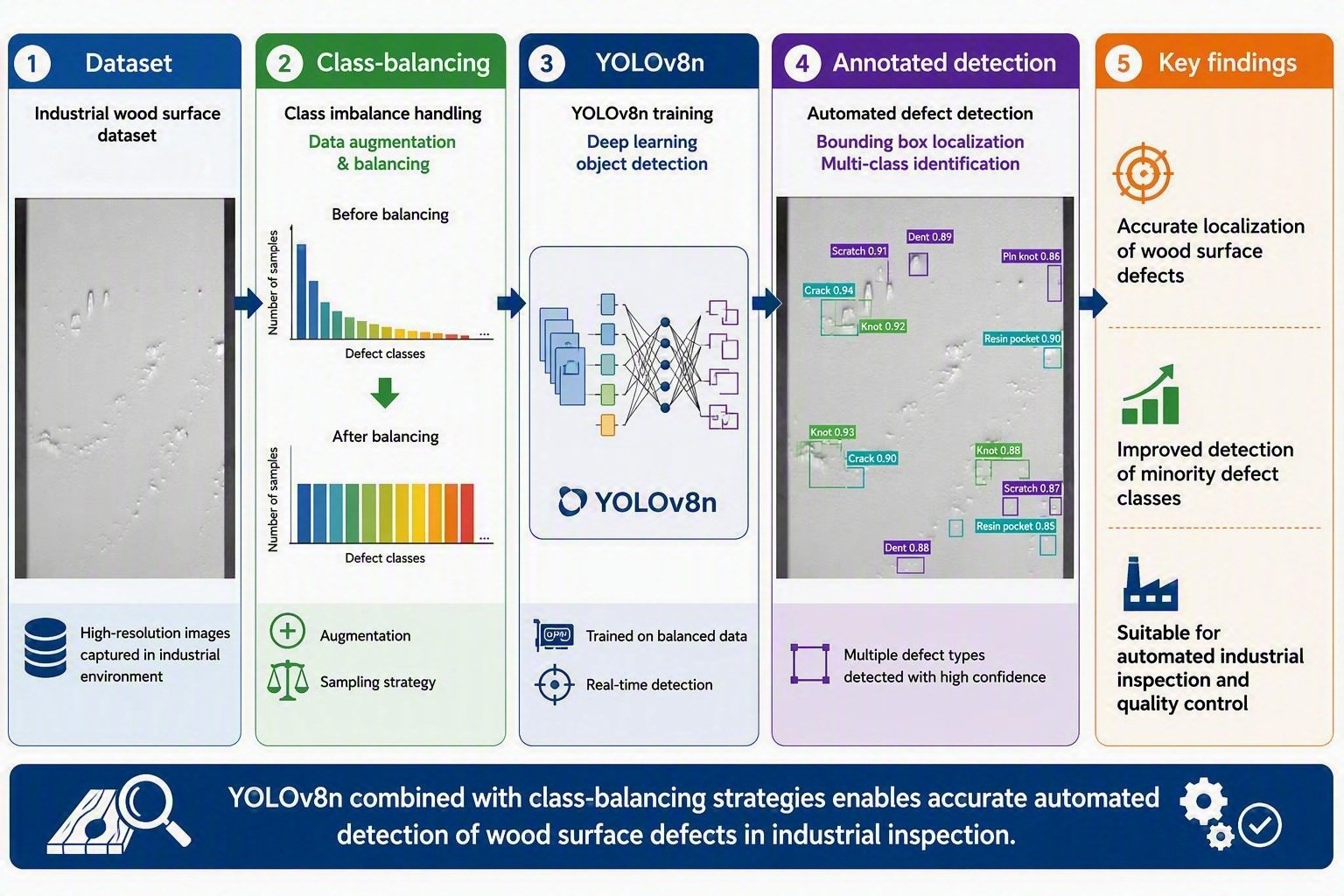
This study, presents OptiWood-YOLO, a deep learning method for automated wood-surface defect detection. Manual inspection of wood surfaces takes time and effort, and the work becomes difficult for operators who must check every board on a fast production line. We collected dataset from defective timber samples in collaboration with local wood-processing companies at a running sawmill. We first annotated the collected images using Roboflow to identify and label the different surface defects. After annotation, we applied preprocessing and augmentation techniques to improve data quality and diversity and to address common visual challenges such as motion blur, uneven lighting, and background clutter. We evaluate the method under four ablation settings: without preprocessing or augmentation, with preprocessing only, with augmentation only, and with both preprocessing and augmentation. The dataset contains seven annotated classes in total: six wood-defect classes blistering, crack, fingerjoint, planing torn, scratch, and wrinkling and one auxiliary class, Objects. We compare the final OptiWood YOLOv8n model with YOLOv11, faster region-based convolutional neural network (faster R-CNN), and the transformer-based RT-DETR model. We use precision, recall, mean average precision (mAP) at intersection over union (IoU) threshold 0.5 (mAP@0.5), mAP@0.5:0.95, and inference speed measured in frames per second (FPS). The final OptiWood YOLOv8n model achieves a precision of 0.54, recall of 0.47, mAP@0.5 of 0.46, and mAP@0.5:0.95 of 0.23. It achieves the best overall detection accuracy among the evaluated models while also maintaining the highest inference speed. Our experimental results show that preprocessing, augmentation, and class-imbalance mitigation help to improve detection performance.
Keywords:
wood defect detection
; wood surface inspection
; YOLOv8n
; industrial image dataset
; object detection
; deep learning
; class imbalance
Copyright: This open access article is published under a Creative Commons CC BY 4.0 license, which permit the free download, distribution, and reuse, provided that the author and preprint are cited in any reuse.