

Submitted:
10 September 2026
Posted:
11 September 2026
You are already at the latest version
Abstract
Lower back pain (LBP) affects an estimated 75–80% of individuals worldwide, with poor posture during strength training identified as a significant contributing factor. This study presents an intelligent, low-cost wearable system for real-time lumbar posture monitoring during Romanian Deadlifts. The system combines an MPU-9250 inertial measurement unit (IMU), an ESP32 microcontroller, a cloud-deployed Random Forest model (PostureProML), and a Flutter-based mobile application (PostureProne). The system achieved 89.2% classification accuracy on a held-out test set across three posture categories (proper, rounded, and arched), with cross-validated performance reaching 94.5%. Angular drift remained minimal (1.8°–7.1°), and battery life supported up to 4 hours of operation. Usability testing with fourteen participants (aged 18–25) indicated high acceptance, with 90% finding the app intuitive. By enabling immediate feedback and encouraging posture correction, this interdisciplinary system offers a tool to support posture awareness, with potential implications for injury risk reduction pending further validation.
Keywords:
wearable technology
; inertial measurement unit (IMU)
; machine learning
; posture monitoring
; strength training
1. Introduction
Musculoskeletal disorders (MSDs) are among the most common causes of physical disability globally, affecting mobility, function, and quality of life. A significant subset of MSDs is lower back pain (LBP), which remains a leading cause of work-related disability [1,2]. In younger populations, including those engaged in gym-based strength training, the risk of LBP is often linked to improper posture during high-load exercises such as Romanian Deadlifts (RDLs) and squats, which can impose excessive compressive and shear forces on the lumbar spine [3,4]. Left uncorrected, such mechanical stress may contribute to long-term spinal abnormalities, underscoring the need for early detection and real-time feedback during high-risk movements [5,6].
LBP affects 75–80% of individuals at some point in life, with 10–15% developing chronic conditions [7,8]. While strength training is widely recognised for musculoskeletal health benefits, poor posture during unsupervised training can predispose individuals to injury. Deadlifts and squats exert significant compressive and shear forces on the lumbar spine, with improper alignment substantially increasing the likelihood of injury [9,10]. Correct lumbar alignment is essential to mitigating these risks, yet amateur gym users often lack access to immediate feedback mechanisms. Conventional tools, such as mirrors, fixed cameras, or form-check mobile apps, offer limited accuracy and typically provide delayed, non-individualised guidance, making them inadequate for dynamic posture correction [11,12].
Recent advances in wearable inertial measurement units (IMUs) and embedded machine learning have enabled posture tracking in various health and fitness contexts [13,14,15]. These systems can detect both static and dynamic postural deviations, offering continuous monitoring in real-world environments. However, traditional sensor setups are often bulky or uncomfortable, limiting their use during high-movement activities like gym-based training [16,17]. Wearables designed with user comfort and responsiveness in mind, particularly when coupled with intuitive interfaces, hold promise for scalable, real-time posture monitoring.
Despite these advances, several limitations remain in the current literature. First, many IMU-based posture monitoring systems focus on static or low-intensity movements, limiting their applicability to dynamic strength training environments. Second, existing systems often rely on subject-specific calibration or laboratory-controlled validation, reducing their scalability for real-world deployment. Third, few studies integrate real-time feedback mechanisms capable of delivering actionable posture correction during exercise execution. These gaps highlight the need for an accessible, real-time system capable of generalising across users and capturing dynamic posture transitions during high-load movements. Additionally, many systems rely on multi-sensor configurations, increasing complexity and limiting accessibility, highlighting the need for accurate single-sensor solutions.
This paper therefore introduces a low-cost, gym-specific wearable system integrating IMU sensors, real-time machine learning classification, and a mobile feedback interface for posture correction during strength training. The prototype, which comprises an MPU-9250 sensor, ESP32 microcontroller, Random Forest-based classifier (PostureProML), and Flutter-based mobile app (PostureProne), was evaluated during Romanian Deadlift exercises. The system addresses key limitations of existing gym posture tools by providing real-time, task-specific feedback to support posture awareness and technique monitoring in high-risk movements. It is positioned as a proof-of-concept solution for enhancing biomechanical awareness during strength training in unsupervised settings.
2. Materials and Methods
2.1. Overview of System Architecture
The system (Figure 1) comprises three subsystems: (1) a wearable unit with an MPU-9250 IMU and ESP32-WROOM-32 microcontroller, (2) a cloud-hosted Random Forest model (PostureProML), and (3) a Flutter-based mobile app (PostureProne). IMU data is sampled at 50 Hz, processed via a Complementary Filter, and transmitted via Wi-Fi to a Supabase database for storage and FastAPI for inference.
2.2. Hardware Design and Data Acquisition
The wearable system was designed to provide accurate, real-time lumbar posture monitoring during high-load strength training exercises. A 9-axis MPU-9250 inertial measurement unit (IMU) was selected for its compact form factor and integrated accelerometer, gyroscope, and magnetometer capabilities. The sensor was positioned at the L4–L5 vertebral region (Figure 2a, 2b), an anatomical landmark associated with maximum mechanical loading during Romanian Deadlifts (RDLs) (Figure 2c), where compressive and shear forces can reach 18 kN and 3 kN, respectively [30,31]. The IMU, affixed to the L4–L5 region, captures external trunk angular deviations, which serve as biomechanical proxies for assessing lumbar posture during dynamic lifting movements.
The IMU was interfaced with an ESP32 microcontroller, chosen for its low-power wireless communication capabilities via Wi-Fi and integrated digital signal processing. The circuit was powered by a 3.7 V Li-ion rechargeable battery with a voltage regulator, supporting continuous operation for up to 4 hours. The hardware was compact and lightweight, designed for integration into athletic attire using an adjustable elastic strap that secured the device at the lumbar spine without restricting movement.
During loaded hip hinge movements, soft tissue deformation and underlying muscle activation may introduce relative motion between the sensor and the L4-L5 vertebral segment. The device was secured using an adjustable elastic strap designed to maintain consistent positioning during dynamic exercise. No visible slipping or displacement was observed across participants during testing, suggesting the latch design provided sufficient fixation under the study conditions. However, formal sensor-slip detection was not implemented, and minor within-set micro-displacements cannot be fully excluded. Such effects may contribute to small measurement variability during high-intensity movements. To reduce sensor drift and enhance signal fidelity, a complementary filter was applied for orientation estimation using the following equation:
where θ is the filtered angle, ω is the gyroscopic angular velocity, a is the accelerometer-derived angle, Δt is the sampling interval, and α = 0.98 represents the filter gain.
The complementary filter was implemented with a weighting factor of α = 0.98, prioritising gyroscope integration while incorporating accelerometer-based correction to reduce long-term drift. This approach provides stable orientation estimation during dynamic movement while mitigating cumulative sensor error. Residual angular deviations ranged from 1.8° to 7.1°, with higher values observed during slower or sustained movements, reflecting the inherent trade-off in complementary filtering between responsiveness and drift correction.
A flat-surface zeroing protocol was implemented during calibration to ensure consistency in initial orientation readings. Sensor data were sampled at 50 Hz and logged in CSV format for subsequent processing. Data acquisition was conducted with fourteen healthy adult participants (aged 18–25), each performing multiple repetitions of RDLs under guided supervision. A sampling rate of 50 Hz was selected as a trade-off between temporal resolution and computational efficiency. This frequency is sufficient to capture human movement dynamics during strength training, which typically occur below 10 Hz. Higher sampling rates may improve sensitivity to rapid transitions but would increase processing load and power consumption, which is a key constraint in wearable systems. Multiple repetitions were recorded per participant and treated as independent samples for classification. However, this introduces potential pseudoreplication, as repeated measures from the same individual are not fully independent. This should be considered when interpreting the results, and future analyses will incorporate statistical models that account for within-subject variability, such as mixed-effects modelling.
A trained biomechanics expert annotated each repetition as “proper,” “rounded,” or “arched” using synchronized video recordings. Classification was based on predefined criteria including trunk angle deviation, lumbar curvature, and hip hinge mechanics. While optoelectronic motion capture systems represent the gold standard for biomechanical assessment, their use was beyond the scope of this feasibility study. The expert-annotation approach adopted here is consistent with prior work in wearable-based posture classification, where supervised models are trained using annotated datasets derived from observational or video-based assessment methods [39]. All annotations were performed under standardized viewing conditions by a single trained assessor.
2.3. Machine Learning Model: PostureProML
The PostureProML machine learning module was developed to classify lumbar posture during strength training using time-series data from the MPU-9250 IMU. The dataset was labeled into three posture classes; Proper, Rounded, and Arched, based on lumbar curvature assessed through synchronised video recordings reviewed by a trained biomechanics expert. These categories reflect neutral spinal alignment, spinal flexion, and spinal extension, respectively. Proper posture required a visually neutral lumbar curve throughout the lift; rounded indicated lumbar flexion beyond neutral during the hip hinge descent; and arched indicated lumbar hyperextension at lockout. Sliding windows of 30 samples (0.6 s) with 50% overlap were used to segment the continuous IMU data prior to feature extraction.
Twelve time-domain statistical features were extracted from the raw IMU signals, including the mean, standard deviation, and peak values of the accelerometer (AccX, AccY, AccZ) and estimated spine angle (AngleX, AngleY). These features capture both the central tendency and variability of motion signals, enabling discrimination between posture states. Feature selection and preprocessing were performed in Python using the Scikit-learn library. A Random Forest classifier was selected for its robustness against overfitting and suitability for low-dimensional feature spaces. Signal noise in IMU measurements may affect classification performance, particularly during high-velocity movements. However, the use of a complementary filter and statistical feature aggregation reduces the influence of transient noise. Future work will explore adaptive filtering and noise-robust feature representations.
The dataset was partitioned at the participant level to ensure the model generalised to unseen individuals rather than memorising participant-specific movement patterns. In total, fourteen participants were included, with ten assigned to the training set (70%) and four to the test set (30%). No data from any participant appeared in both sets, preventing subject-level data leakage. Model generalisability was further assessed using k-fold cross-validation applied to the training set. Classification accuracy was defined as the proportion of correct predictions across all posture labels, with additional metrics including precision, recall, and F1-score used to evaluate performance.
Controlled augmentation was applied exclusively to the training data following subject-level partitioning. Each training recording was augmented by (i) adding Gaussian noise (σ = 0.03) to all IMU channels and (ii) introducing small random rotational perturbations (±0.1 rad) to the angular axes. This approach effectively doubled the training sample size while ensuring that augmented representations of test-set recordings were not introduced into the training data, thereby avoiding augmentation-induced data leakage.
Model interpretability was assessed using SHapley Additive exPlanations (SHAP), which identified spinal angle and linear acceleration features as the most influential predictors. The concept of deriving posture-related risk scores is exploratory and is presented as a potential extension of the system, requiring validation against clinically established metrics in future work.
For deployment, the trained model was serialized and hosted on a Flask-based REST API within a Supabase cloud backend, enabling real-time, low-latency inference. This architecture supports seamless integration with the wearable device and mobile application, providing scalable posture monitoring in gym environments.
2.4. Mobile Feedback System: PostureProne App
The PostureProne mobile application was developed using the Flutter framework to provide real-time user feedback during strength training sessions. It interfaces with the wearable hardware via Wi-Fi and communicates with the cloud-hosted PostureProML model through HTTP requests, achieving a round-trip latency of less than 500 ms (Figure 3).
The app delivers immediate audio-visual feedback to users based on posture classification outcomes. A color-coded gauge displays posture status (e.g., green for proper, red for rounded, yellow for arched) (Figure 4), accompanied by optional haptic alerts to prompt real-time correction. Additional features include session tracking, posture history visualisation, and performance summaries to support user engagement and progress monitoring over time.
Usability testing was conducted with fourteen participants aged 18–25 following structured workout sessions. The app received an average rating of 4.2 out of 5 for intuitiveness and ease of use, with 90% of participants reporting that the feedback enhanced their posture awareness. These results support the app’s potential for deployment in fitness environments lacking direct supervision.
2.5. System Integration and Testing
Comprehensive system-level testing was conducted to evaluate the performance, responsiveness, and user experience of the integrated wearable posture monitoring solution. Key evaluation metrics included classification accuracy, sensor drift, wireless data reliability, and user satisfaction.
Testing was carried out in a controlled gym environment with 14 participants performing Romanian Deadlifts (RDLs) while wearing the device. Real-time posture classification was assessed across three categories (proper, rounded, and arched) using the PostureProML model. The system achieved a cross-validated classification accuracy of 94.5%, with a held-out test-set accuracy of 89.2%, providing a more conservative estimate of real-world performance. Stable wireless connectivity was maintained between the ESP32 microcontroller and the mobile application via Wi-Fi throughout testing.
Sensor performance was analysed to assess drift and consistency. Angular deviation remained within a low range (1.8°–7.1°), validating the effectiveness of the complementary filter in reducing noise during dynamic movements. The end-to-end system achieved latency under 500 ms from data capture to feedback delivery, enabling timely corrective cues during exercise execution. Observed latency values ranged between approximately 200–340 ms across testing conditions, with a conservative upper bound of <500 ms.
User satisfaction was measured using structured post-session surveys. Participants rated the intuitiveness, usefulness, and comfort of the system. The majority (90%) found the app interface intuitive, and 80% reported increased posture awareness during lifting tasks. These findings support the feasibility of deploying the system in real-world fitness settings where expert supervision may be limited.
2.6. Ethical Considerations
All study procedures involving human participants were conducted in accordance with institutional ethical guidelines and the principles of the Declaration of Helsinki. Prior to participation, all individuals provided written informed consent after receiving a detailed explanation of the study's purpose, procedures, and potential risks.
To ensure data privacy and security, all sensor and classification data were anonymised and transmitted using Transport Layer Security (TLS) version 1.2 encryption protocols. Access to stored data was restricted to authorised personnel only. Participants were informed of their right to withdraw at any stage without consequence, and no identifying information was retained in the final dataset.
3. Results
3.1. Posture Data Collection and Labelling
Fourteen participants performed Romanian Deadlifts (RDLs) while wearing the lumbar-mounted IMU device. The MPU-9250 sensor captured tri-axial motion data at a sampling rate of 50 Hz. Postural classification was based on three categories: proper, rounded, and arched, as determined by expert labelling.
One-way ANOVA tests revealed statistically significant differences in angular deviations across posture categories. Specifically, AngleX (Table 1, Figure 5a) and AngleY (Table 2, Figure 5b) measurements showed strong discrimination between postures:
- AngleX: F(2, 39) = 68.20, p < 0.001
- AngleY: F(2, 39) = 250.58, p < 0.001
Mean angular deviations were as follows:
- Proper: 1.8° ± 0.45°
- Rounded: 7.1° ± 0.65°
- Arched: 6.4° ± 0.55°
These results validate the system’s ability to distinguish posture-specific lumbar angles during high-load exercises. The ANOVA was applied to time-stamped samples rather than participant-level summaries. As each participant contributed multiple repetitions, observations are not fully independent. This should be considered when interpreting the statistical outcomes. While the analysis demonstrates clear separation between posture categories, future work will incorporate statistical approaches that account for within-subject variability, such as mixed-effects or repeated-measures models.
3.2. Device Performance and Reliability
The wearable system demonstrated reliable hardware performance throughout all trials. Angular drift remained minimal across sessions, aided by the complementary filter and calibration routine. The ESP32 maintained stable Wi-Fi connectivity with the mobile application, and the 3.7 V Li-ion battery provided up to 4 hours of continuous operation under active gym conditions without requiring recharge.
3.3. Machine Learning Model Performance
The classification performance of the proposed PostureProML system was evaluated against baseline models including Support Vector Machine (SVM) and K-Nearest Neighbors (KNN). The Random Forest classifier achieved a cross-validated accuracy of 94.5%, outperforming SVM (92%) and KNN (90%), demonstrating improved class separation and robustness (Figure 6a) (Table 5).
F1-scores exceeded 0.90 across all posture categories, indicating a strong balance between precision and recall. Each sample represents a 0.6-second time window (30 samples at 50 Hz with 50% overlap) extracted from continuous IMU recordings. The confusion matrix (Table 3) demonstrates strong agreement between predicted and actual posture classes, with most predictions concentrated along the diagonal. Misclassifications primarily occurred between the rounded and arched postures, which exhibit similar biomechanical characteristics during transitional movement phases. The held-out test set comprised 130 windows derived from four participants.
Overall classification accuracy on the held-out test set was 89.2% (116/130 windows correctly classified), with macro-averaged precision of 90.8%, recall of 88.1%, and F1-score of 89.4% across the three posture classes (Table 4). Misclassification patterns indicate that errors were predominantly between adjacent posture categories (rounded vs arched), rather than between neutral and non-neutral postures.
From a biomechanical perspective, this reflects the challenge of distinguishing subtle transitions between flexion and extension during dynamic movement. Phase-specific analysis shows that misclassifications are concentrated in the eccentric (lowering) phase of the deadlift, consistent with the rapid angular changes during bar descent that challenge window-based classification.

Table 5.
Comparison of the proposed PostureProML system with selected state-of-the-art IMU-based posture classification approaches, highlighting model type, number of sensors, activity context, classification accuracy, and system latency.
Table 5.
Comparison of the proposed PostureProML system with selected state-of-the-art IMU-based posture classification approaches, highlighting model type, number of sensors, activity context, classification accuracy, and system latency.
| Study | Model | Sensors | Activity | Accuracy | Latency |
|---|---|---|---|---|---|
| Jenkins & Weerasekera (2022) | SVM | 1 IMU | Rehab | ~90% | Not reported |
| Tang et al. (2021) | RNN | Multiple IMUs | Upper body | 92–95% | Not real-time |
| This study | Random Forest | 1 IMU | RDL (dynamic) | 89.2% (test) / 94.5% (CV) | <500 ms |
Model interpretability was assessed using SHapley Additive exPlanations (SHAP), which identified lumbar angle (0.55) and vertical acceleration (0.35) as the most influential features contributing to classification decisions (Figure 6b).
Inference latency remained below 500 ms, supporting real-time feedback capability during dynamic exercise (Figure 6c).
3.4. User Experience and Qualitative Feedback
All 14 participants contributed to system-level testing, while 10 participants completed the detailed post-use usability evaluation. Usability testing was conducted with these ten participants (aged 18–25) following hands-on use of the integrated system in a gym setting. The PostureProne mobile application received high user satisfaction ratings:
- 90% rated the app as intuitive
- 80% reported improved posture awareness during lifts
- 70% expressed willingness to adopt the system regularly
Participants praised the real-time audio-visual cues for enabling immediate posture corrections without disrupting workout flow.
4. Discussion
This study presents an interdisciplinary wearable system for real-time lumbar posture monitoring during strength training. While IMU-based posture classification has been explored in prior work, the technical contribution of this study lies in the integration of (i) participant-level generalisable classification using subject-wise partitioning, (ii) real-time cloud-based inference with sub-500 ms latency, and (iii) application-specific modelling of dynamic lumbar posture during high-load resistance training. Unlike many existing systems that focus on static posture or rehabilitation contexts, this work addresses the challenges of rapid biomechanical transitions and signal variability inherent to free-weight exercises. Given the limited sample size (n = 14), this aligns with early-stage feasibility studies that aim to validate integrated hardware-software prototypes and machine learning pipelines under controlled experimental conditions. A power analysis for a three-class classification model (effect size f = 0.25) suggests that a minimum of 159 participants would be required to achieve 80% statistical power. Accordingly, this work is positioned as a proof-of-concept study, with the intent to inform future research using statistically powered cohorts to assess generalisability, robustness, and deployment at scale.
The system integrates low-cost, widely available components (MPU-9250, ESP32) with a supervised machine learning classifier (PostureProML) and a cross-platform mobile application (PostureProne), providing an accessible and exercise-specific alternative to traditional posture monitoring systems, which are often expensive, proprietary, and limited to general movement analytics [3,32]. Unlike prior IMU-based systems that track gross body movements in rehabilitation or daily activity contexts [33], the proposed solution is tailored to high-load, high-risk strength exercises such as the Romanian Deadlift (RDL), which are known to generate lumbar spine compressive forces up to 18 kN and shear forces of 3 kN.
While cross-validation accuracy reached 94.5%, performance on the held-out participant-level test set (89.2%) provides a more conservative estimate of real-world generalisability. This level of accuracy is comparable to prior IMU-based systems operating under dynamic conditions, particularly when constrained to a single-sensor configuration. Together with sub-500 ms inference latency, these results support the technical feasibility of the system for real-time posture monitoring in gym-based environments, advancing beyond retrospective posture analysis tools [34,35,36]. This may contribute to improved posture awareness during lifting, with potential relevance for reducing technique-related injury risk pending further validation. The total system latency (<500 ms) comprises (i) data acquisition (~20 ms), (ii) wireless transmission (~150–200 ms), (iii) cloud-based inference (~100–150 ms), and (iv) app response time (~50–100 ms). Network transmission represents the largest contributor to delay, suggesting that edge-based inference may further reduce latency in future implementations.
Further, 90% of users reported improved posture awareness, validating the user interface’s intuitiveness and the utility of multi-modal alerts (visual, haptic, audio). The current model classifies posture states within discrete windows and does not explicitly model transition dynamics between postures. This limitation is particularly relevant during eccentric phases of movement, where rapid biomechanical transitions increase classification ambiguity. However, misclassification patterns observed between rounded and arched postures suggest sensitivity to transitional movement phases. Future work will explore sequence-based models (e.g., LSTM or temporal convolutional networks) to explicitly capture posture transitions and improve classification during dynamic phases.
We acknowledge several limitations. Ground-truth labeling relied on expert visual assessment rather than instrumented motion capture, introducing potential observer bias. Inter-rater validation was not performed in this study and represents an area for future methodological strengthening. Future work will also incorporate gold-standard motion capture systems to validate model predictions. The use of a population-level classification model without subject-specific calibration introduces potential bias for individuals whose neutral spinal alignment deviates from the training set mean. This could lead to systematic misclassifications, especially in diverse populations. Future iterations will explore adaptive thresholds, personalized calibration baselines, and transfer learning frameworks to enhance model generalization and performance across users and body types.
Including ancillary components such as the battery, voltage regulator, strap, and enclosure, the total system cost is estimated to remain below approximately $25–30, supporting accessibility for personal and institutional deployment. These remain affordable in aggregate, maintaining the system’s suitability for gym-goers and clinical physiotherapy applications alike. The study’s scope was also limited to the RDL movement, chosen for its high lumbar loading and clear posture deviations. However, this limits extrapolation to broader strength training modalities. Although the system architecture is adaptable to other compound movements, empirical validation across squats, lunges, and overhead lifts is necessary to confirm its versatility and robustness.
Sensor drift was effectively mitigated using a Complementary Filter, but dynamic multi-planar movements in free-weight training environments still pose challenges for inertial accuracy, a limitation consistent with other IMU-based systems [34,37]. While peak angular deviations reached 7.1°, these occurred primarily during dynamic movement phases and are consistent with error ranges reported in single-IMU systems operating in uncontrolled environments. However, such deviations may still be biomechanically meaningful during high-load lifting and highlight the need for enhanced sensor fusion and calibration in future iterations. Future work will explore enhanced sensor fusion using Madgwick or Kalman filters and integrate magnetometer data to enable stable 3D orientation tracking under complex motion.
To address these gaps, future studies will:
- Expand participant numbers to 30–50 across gender and body types;
- Validate across multiple gym exercises (e.g., squats, lunges);
- Add multi-sensor configurations (e.g., thoracic spine, hips);
- Deploy in real-world gym environments to assess longitudinal usability, behaviour change, and system adoption dynamics.
These findings support the system’s feasibility as a real-time posture monitoring solution, while highlighting the need for validation in larger and more diverse populations.
5. Conclusions
This study presents a cost-effective wearable system for real-time lumbar posture monitoring during strength training, integrating IMU sensing, machine learning classification, and intuitive mobile feedback. The PostureProML model achieved a cross-validated accuracy of 94.5%, with a held-out test-set accuracy of 89.2% across three postural categories, while the PostureProne app delivered sub-500 ms corrective alerts with high user satisfaction. Designed for gym-based environments, the system addresses the gap in accessible, exercise-specific posture monitoring tools. Future work will expand to diverse compound movements, incorporate multi-sensor fusion and adaptive calibration, and validate long-term use in real-world training settings to support injury prevention and scalable musculoskeletal health interventions.
Author Contributions
M.A. and J.Y. designed and conducted the study, M.A. developed the wearable prototype, and performed data collection and J.Y. worked on the Machine learning model and analysis. H.T and M. G supervised the project. H.T finalised the manuscript. All authors reviewed and approved the final manuscript.
Funding
This research received no external funding.
Institutional Review Board Statement
All experimental protocols were approved by Academic City University’s Institutional Review Board. (Approval No: ACU-IRB-2025-FOE-012).
Informed Consent Statement
Written informed consent was obtained from all participants involved in the study.
Data Availability Statement
The data collected and analyzed during the current study are available from the corresponding author on reasonable request.
Conflicts of Interest
The authors declare no conflict of interest.
Clinical Trial Registration
Not applicable.
References
- Hamera, E.; Goetz, J.; Brown, C.; Van Sciver, A. Safety considerations when promoting exercise in individuals with serious mental illness. Psychiatry Res. 2010, vol. 178(no. 1), 220–222. [Google Scholar] [CrossRef]
- Hilmi, A.H.; Hamid, A.R.A.; Assyahid, W.A.R. Recent Advances in Ergonomic Posture Research: Assessing Innovations in Occupational Health and Musculoskeletal Disorder Prevention. [CrossRef]
- Panumasvivat, J.; Surawattanasakul, V.; Kwangsukstith, S.; Mahakkanukrauh, C.; Kiratipaisarl, W. The relationship between working conditions, vehicle factors, and work-related musculoskeletal disorders affecting job satisfaction and job stress among motorcycle food delivery riders. Int. J. Hyg. Environ. Health 2025, vol. 267, 114594. [Google Scholar] [CrossRef] [PubMed]
- Terry, M.A.; Alvarez-Vazquez, E. Efficacy of Wearable Devices in Monitoring and Treating Parkinson’s Disease Symptoms: A Systematic Review and Meta Analyses. IEEE Access 2025. [Google Scholar] [CrossRef]
- Ananth, F.; Rino, P.E. yogi-well: an ai-enabled wireless wearable for posture correction, yoga guidance & stress monitoring. [PubMed]
- Kb, l.S. tech yoga: the smart mat revolution. I-Manag. J. Embed. Syst. 2025, vol. 13(no. 2). [Google Scholar]
- Qin, W.; et al. Wearable real-time multi-health parameter monitoring system. Int. J. Cloth. Sci. Technol. 2024, vol. 36(no. 1), 17–33. [Google Scholar] [CrossRef]
- Hassanpour, A.; Yang, B. Contactless Vital Sign Monitoring: A Review Towards Multi-Modal Multi-Task Approaches. Sensors 2025, vol. 25(no. 15), 4792. [Google Scholar] [CrossRef] [PubMed]
- Kapil, D.; Wang, J.; Olawade, D.B.; Vanderbloemen, L. AI-Assisted Physiotherapy for Patients with Non-Specific Low Back Pain: A Systematic Review and Meta-Analysis. Appl. Sci. 2025, vol. 15(no. 3), 1532. [Google Scholar] [CrossRef]
- Heneweer, H.; Staes, F.; Aufdemkampe, G.; van Rijn, M.; Vanhees, L. Physical activity and low back pain: a systematic review of recent literature. (in eng), Eur Spine J 2011, vol. 20(no. 6), 826–45. [Google Scholar] [CrossRef] [PubMed]
- Neamah, I.; Shbeeb, H.; Al-Shammary, A.; Al-Nidawi, R. Biomechanics of the Spine: A case study on the fourth and fifth lumbar vertebrae. J. Anthropol. Sport Phys. Educ. 2024, vol. 8(no. 3), 23–27. [Google Scholar] [CrossRef]
- Eynipour, A.; Arjmand, N.; Dianat, I.; Soltanian, A.R.; Heidarimoghadam, R. Assessing musculoskeletal disorder risks in an automobile part manufacturing factory: a comparison study of biomechanical and ergonomic tools. Health Scope 2024, vol. 13(no. 2), e139610. [Google Scholar] [CrossRef]
- Marcos-Pardo, P.J.; Abelleira-Lamela, T.; Vaquero-Cristóbal, R.; Espeso-García, A.; Esparza-Ros, F.; González-Gálvez, N. Improving spinal alignment through innovative resistance training with outdoor fitness equipment in middle-aged and older adults: a randomized controlled trial. Sci. Rep. 2025, vol. 15(no. 1), 14499. [Google Scholar] [CrossRef] [PubMed]
- Mehta, S.; Sarpal, S.S. Smart Monitoring of Leg Exercises in Fitness Centers: A CNN-LSTM Model for Enhanced Gym Safety and Efficiency. In 2024 2nd International Conference on Recent Trends in Microelectronics, Automation, Computing and Communications Systems (ICMACC); IEEE, 2024; pp. 98–102. [Google Scholar]
- Lee, R.; James, C.; Edwards, S.; Skinner, G.; Young, J.L.; Snodgrass, S.J. Evidence for the effectiveness of feedback from wearable inertial sensors during work-related activities: A scoping review. Sensors 2021, vol. 21(no. 19), 6377. [Google Scholar] [CrossRef] [PubMed]
- Paloschi, D.; et al. Validation and assessment of a posture measurement system with magneto-inertial measurement units. Sensors 2021, vol. 21(no. 19), 6610. [Google Scholar] [CrossRef] [PubMed]
- Pourshahrokhi, N.; Sun, Y.; Asadipour, A. Commercial and research-based wearable devices in spinal postural analysis: A systematic review. In EAI International Conference on IoT Technologies for HealthCare; Springer, 2023; pp. 65–83. [Google Scholar]
- Wijegunawardana, I.; Ranaweera, R.; Gopura, R. Lower extremity posture assistive wearable devices: A review. IEEE Trans. Hum.-Mach. Syst. 2022, vol. 53(no. 1), 98–112. [Google Scholar] [CrossRef]
- Buisseret, F.; Dierick, F.; Van der Perre, L. Wearable sensors applied in movement analysis. 2022, vol. 22, 8239. [Google Scholar]
- Clark, B.K.; Brakenridge, C.L.; Healy, G.N. The importance of research on occupational sedentary behaviour and activity right now. 2022, vol. 19, 15816. [Google Scholar]
- Awolusi, I.; Nnaji, C.; Okpala, I.; Albert, A. Adaptation behavior of construction workers using wearable sensing devices for safety and health monitoring. J. Manag. Eng. 2024, vol. 40(no. 1), 04023055. [Google Scholar] [CrossRef]
- Kim, Y.J. A Comprehensive Approach to Intelligent Garment for Posture Correction: A Preliminary Study for Integrating Aesthetics and Sensor Interaction. J. Vib. Eng. Technol. 2025, vol. 13(no. 1), 60. [Google Scholar] [CrossRef]
- Garcia-Jaen, M.; Sebastia-Amat, S.; Sanchis-Soler, G.; Cortell-Tormo, J.M. Lumbo-pelvic rhythm monitoring using wearable technology with sensory biofeedback: a systematic review. In Healthc. 2024, vol. 12(no. 7), 758. [Google Scholar]
- Lee, O.; Park, D. Associations Between Type-Specific Sedentary Behaviour and Low Back Pain: Evidence From a Large-Scale Cohort Study. Musculoskelet. Care 2025, vol. 23(no. 2), e70118. [Google Scholar] [CrossRef] [PubMed]
- Hilmi, A.H.; Hamid, A.R.A.; Ibrahim, W.A.R.A.W. Smart Wearables in Ergonomic Applications: Recent Advances and Challenges in Human Machine Integration. Malays. J. Ergon. (MJEr) 2024, vol. 6, 24–38. [Google Scholar] [CrossRef]
- Afeez, A.; Abbey, O.; Jubril, A. Flexible and Stretchable Sensors for Health Monitoring in Smart Apparel. 2025. [Google Scholar] [CrossRef]
- Traverso, S. Integration of IMU-based Motion Tracking Algorithms into Wearable Devices for Human Joint Angle Estimation. Politecnico di Torino, 2023. [Google Scholar]
- Zhu, P.; Hu, Y. Carbon nanomaterials intelligent wearable devices for real-time athlete monitoring and performance tracking. Matéria (Rio de Janeiro) 2025, vol. 30, e20250327. [Google Scholar]
- Abhinav, V.; et al. Advancements in Wearable and Implantable BioMEMS Devices: Transforming Healthcare Through Technology. Micromachines 2025, vol. 16(no. 5), 522. [Google Scholar] [CrossRef] [PubMed]
- Sciortino, V. Advanced Biomechanical Modeling of Spine. In-vitro Testing and Finite Element Modelling 2024. [Google Scholar] [CrossRef]
- Brost, S. Wearable Sensor-Based Estimation of Spinal Loading in the Sagittal Plane during Fluoroscopic Procedures, Queen's University (Canada), 2024.
- Salaorni, F.; Bonardi, G.; Schena, F.; Tinazzi, M.; Gandolfi, M. Wearable devices for gait and posture monitoring via telemedicine in people with movement disorders and multiple sclerosis: a systematic review. Expert Rev. Med. Devices 2024, vol. 21(no. 1-2), 121–140. [Google Scholar] [CrossRef] [PubMed]
- Villa, G.; Cerfoglio, S.; Bonfiglio, A.; Capodaglio, P.; Galli, M.; Cimolin, V. Validation of a Commercially Available IMU-Based System Against an Optoelectronic System for Full-Body Motor Tasks. Sensors 2025, vol. 25(no. 12), 3736. [Google Scholar] [CrossRef] [PubMed]
- Jenkins, L.; Weerasekera, R. Sport-related back injury prevention with a wearable device. Biosens. Bioelectron. X 2022, vol. 11, 100202. [Google Scholar] [CrossRef]
- Seçkin, A.Ç.; Ateş, B.; Seçkin, M. Review on Wearable Technology in sports: Concepts, Challenges and opportunities. Appl. Sci. 2023, vol. 13(no. 18), 10399. [Google Scholar] [CrossRef]
- De Fazio, R.; Mastronardi, V.M.; De Vittorio, M.; Visconti, P. Wearable sensors and smart devices to monitor rehabilitation parameters and sports performance: an overview. Sensors 2023, vol. 23(no. 4), 1856. [Google Scholar] [CrossRef] [PubMed]
- Alatise, M.B. Pose estimation and data fusion algorithms for an autonomous mobile robot based on vision and IMU in an indoor environment, University of Pretoria, 2021.
- Ratchatanantakit, N.; Nonnarit, O.; Sonchan, P.; Adjouadi, M.; Barreto, A. A sensor fusion approach to MARG module orientation estimation for a real-time hand tracking application. Inf. Fusion 2023, vol. 90, 298–315. [Google Scholar] [CrossRef]
- Tang, H.-Y.; Tan, S.-H.; Su, T.-Y.; Chiang, C.-J.; Chen, H.-H. Upper Body Posture Recognition Using Inertial Sensors and Recurrent Neural Networks. Appl. Sci. 2021, 11(24), 12101. [Google Scholar] [CrossRef]
Figure 1.
System architecture diagram showing IMU, ESP32, cloud, and app interactions.
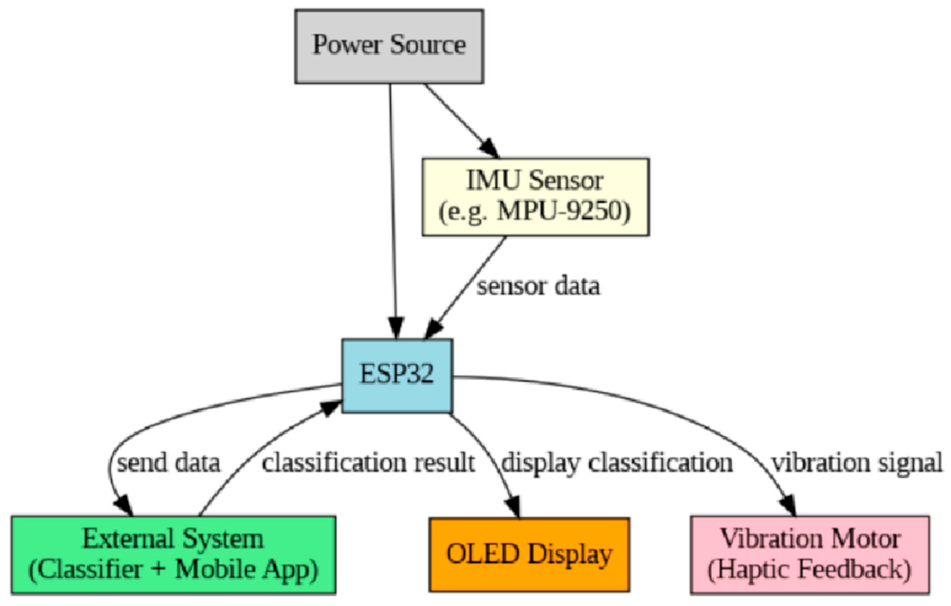
Figure 2.
(a) Participant wearing device over L4-L5 segment, (b) L4-L5 Spinal Segment [37], (c) Sensor positioning at the L4-L5 vertebral region.
Figure 2.
(a) Participant wearing device over L4-L5 segment, (b) L4-L5 Spinal Segment [37], (c) Sensor positioning at the L4-L5 vertebral region.
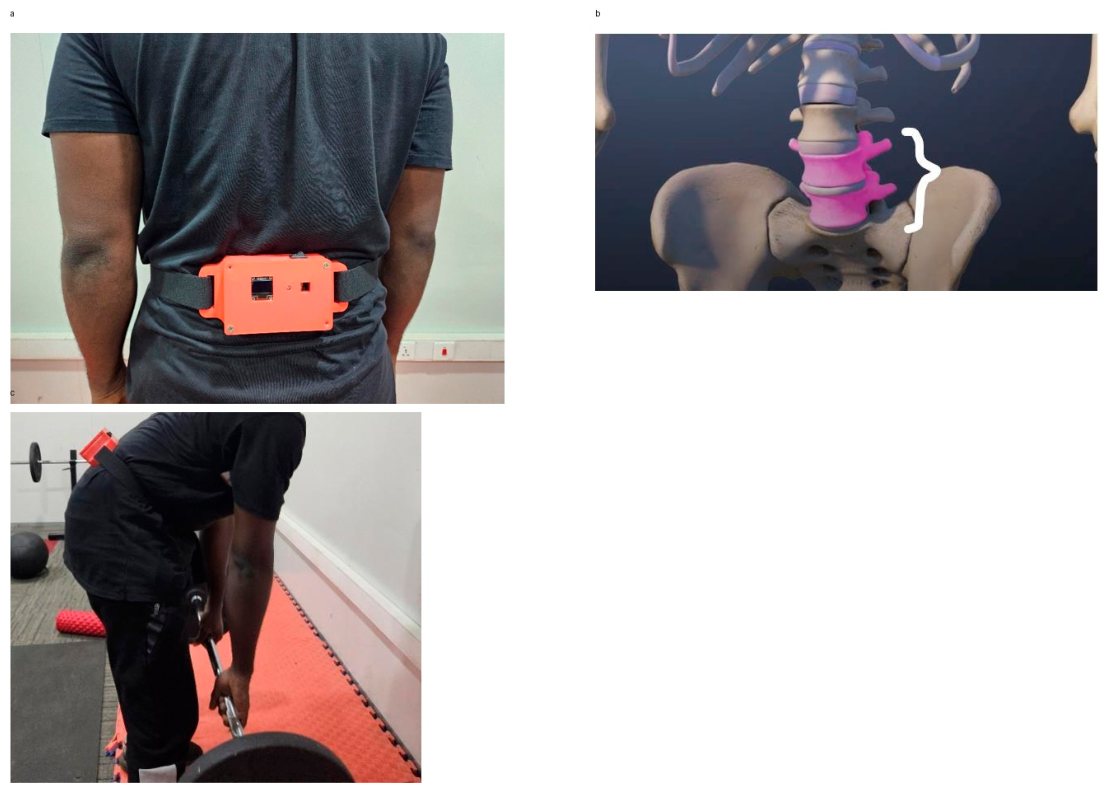
Figure 3.
Deployment architecture showing cloud processing pathways.
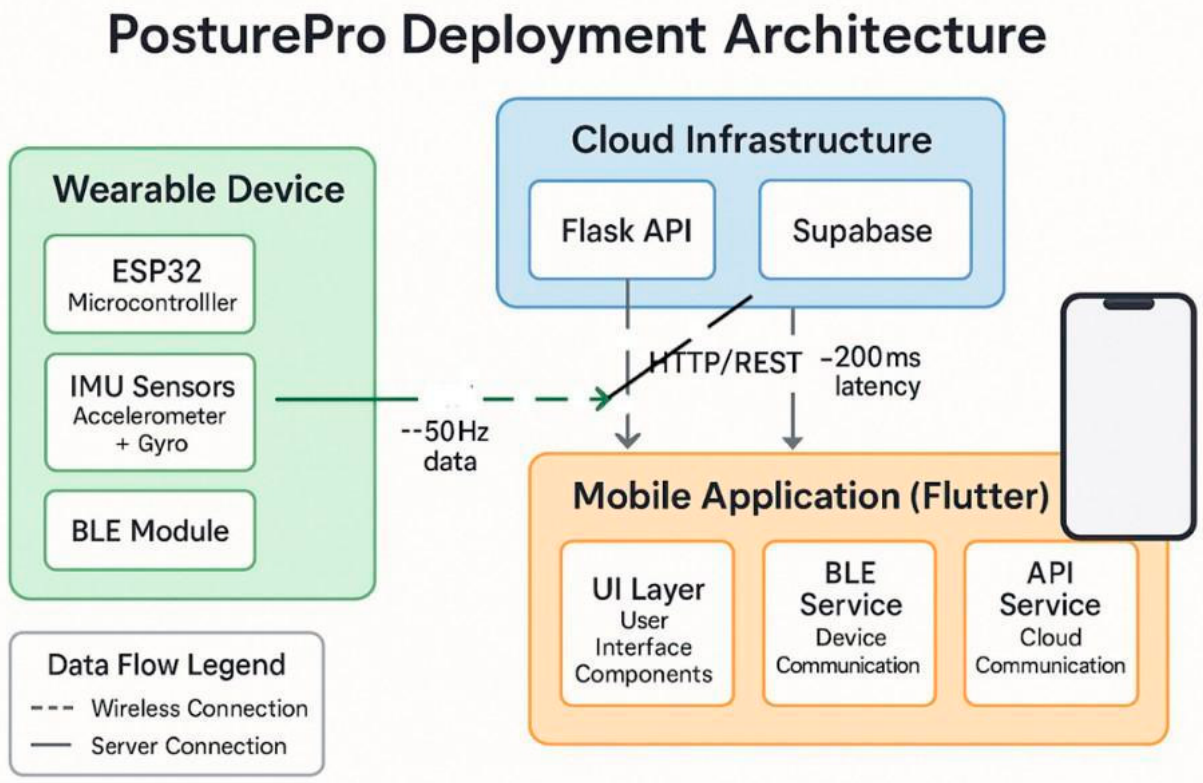
Figure 4.
Screenshot of PostureProne app showing color-coded posture gauge.
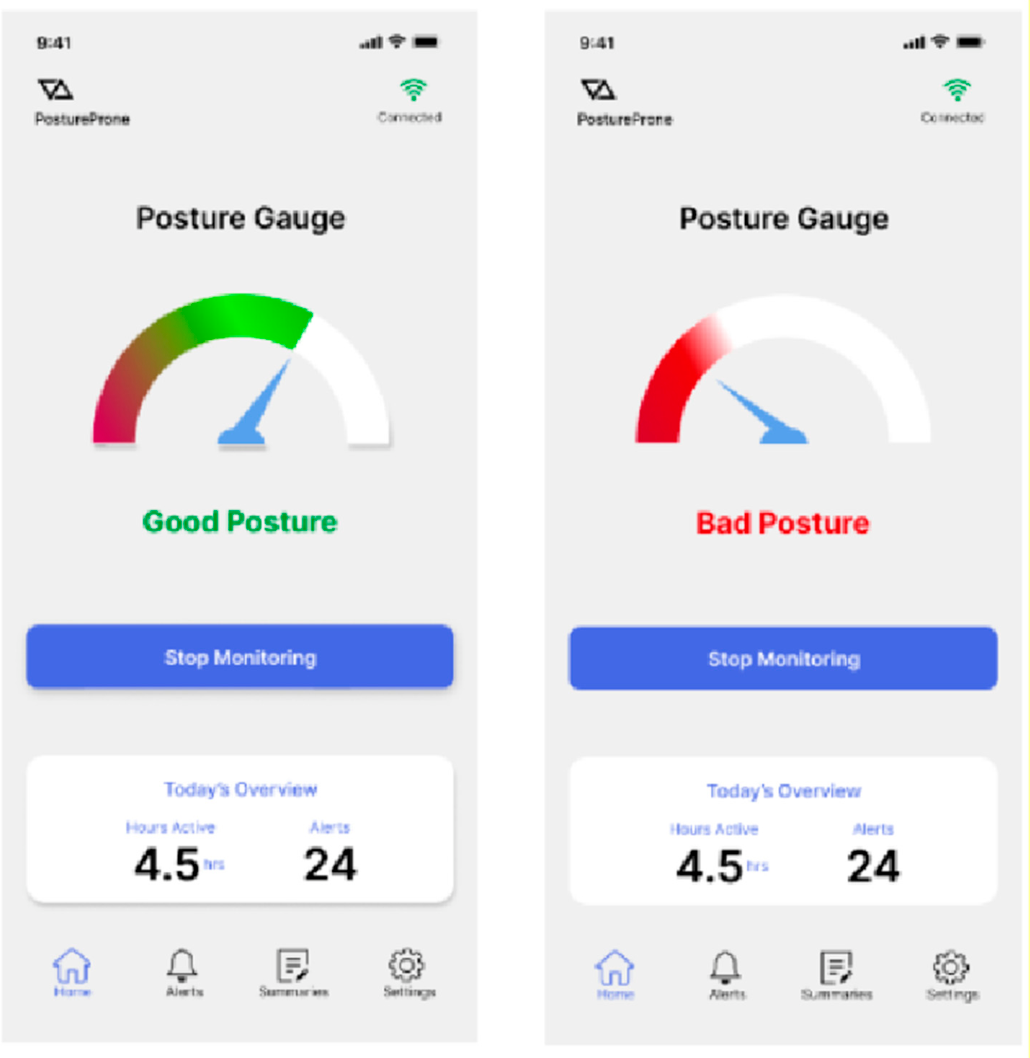
Figure 5.
(a) Sample plot of AngleX across three posture categories, (b) Sample plot of AngleY across three posture categories.
Figure 5.
(a) Sample plot of AngleX across three posture categories, (b) Sample plot of AngleY across three posture categories.
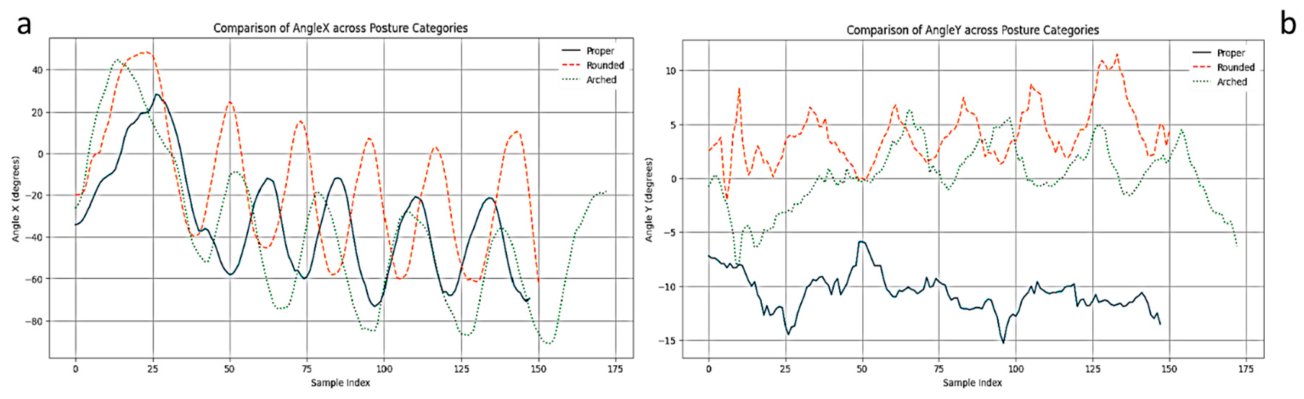
Figure 6.
(a) Comparative accuracy of PostureProML against baseline models (SVM, KNN), (b) feature importance derived from SHAP analysis, highlighting lumbar angle and vertical acceleration as key discriminative metrics for posture classification. (c) Real-time processing latency.
Figure 6.
(a) Comparative accuracy of PostureProML against baseline models (SVM, KNN), (b) feature importance derived from SHAP analysis, highlighting lumbar angle and vertical acceleration as key discriminative metrics for posture classification. (c) Real-time processing latency.
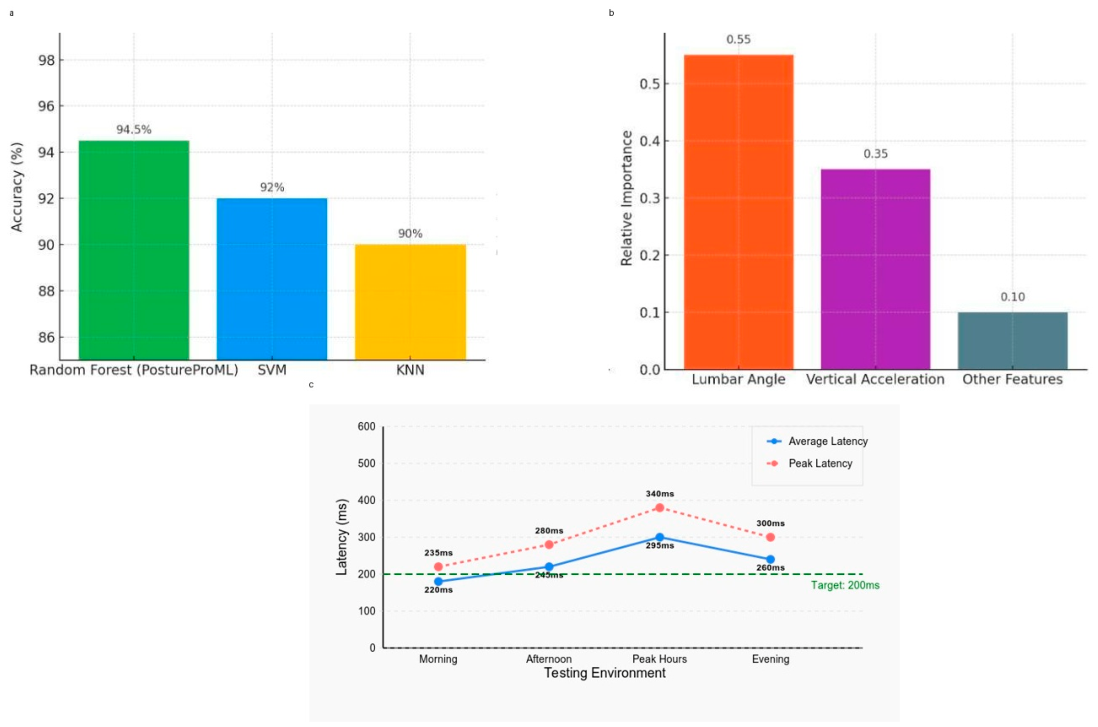
Table 1.
Tukey HSD Post Hoc Test Results for AngleX.
| Comparison | Mean Difference | P-Value | 95%CI Lower | 95% CI Upper |
Significant |
|---|---|---|---|---|---|
| Arched vs Proper | 4.7974 | <0.001 | 2.6606 | 6.9341 | Yes |
| Arched vs Rounded | 10.6425 | <0.001 | 8.5053 | 12.7797 | Yes |
| Proper vs Rounded | 5.8451 | <0.001 | 3.6622 | 8.0280 | Yes |
Table 2.
Tukey HSD Post Hoc Test Results for AngleY.
| Comparison | Mean Difference | P-Value | 95% CI Lower | 95% CI Upper | Significant |
|---|---|---|---|---|---|
| Arched vs Proper | 0.0664 | 0.9796 | -0.7383 | 0.8711 | No |
| Arched vs Rounded | 6.7818 | <0.001 | 5.9769 | 7.5867 | Yes |
| Proper vs Rounded | 6.7154 | <0.001 | 5.8933 | 7.5375 | Yes |
Table 3.
Confusion matrix showing classification performance of PostureProML across three posture categories (Proper, Rounded, and Arched) on the held-out test set.
Table 3.
Confusion matrix showing classification performance of PostureProML across three posture categories (Proper, Rounded, and Arched) on the held-out test set.
| Actual \ Predicted | Proper | Rounded | Arched |
|---|---|---|---|
| Proper | 40 | 2 | 1 |
| Rounded | 3 | 35 | 4 |
| Arched | 1 | 3 | 41 |
Table 4.
Summary of classification performance metrics for the PostureProML model, including test-set accuracy, cross-validated accuracy, precision, recall, and F1-score, demonstrating model robustness across evaluation strategies.
Table 4.
Summary of classification performance metrics for the PostureProML model, including test-set accuracy, cross-validated accuracy, precision, recall, and F1-score, demonstrating model robustness across evaluation strategies.
| Metric | Value |
|---|---|
| Accuracy (test) | 89.2% |
| Accuracy (CV) | 94.5% |
| Precision | 90.8% |
| Recall | 88.1% |
| F1-score | 89.4% |
Disclaimer/Publisher’s Note: The statements, opinions and data contained in all publications are solely those of the individual author(s) and contributor(s) and not of MDPI and/or the editor(s). MDPI and/or the editor(s) disclaim responsibility for any injury to people or property resulting from any ideas, methods, instructions or products referred to in the content. |
© 2026 by the authors. Licensee MDPI, Basel, Switzerland. This article is an open access article distributed under the terms and conditions of the Creative Commons Attribution (CC BY) license (http://creativecommons.org/licenses/by/4.0/).
Copyright: This open access article is published under a Creative Commons CC BY 4.0 license, which permit the free download, distribution, and reuse, provided that the author and preprint are cited in any reuse.