

Submitted:
10 September 2026
Posted:
11 September 2026
You are already at the latest version
Abstract
Professional sport clubs increasingly use artificial intelligence (AI) to forecast demand, personalize offers, automate service, optimize prices, and support retention across ticketing, merchandise, memberships, subscriptions, and digital products. Evidence on these applications remains fragmented across sport management, information systems, marketing, and electronic commerce. This integrative, theory-building narrative review synthesizes 80 analytical sources and uses one additional reporting-quality instrument to examine how organizational capabilities, AI-enabled practices, fan appraisals, outcomes, boundary conditions, and governance interact in club-controlled commerce ecosystems. The review develops a task-based taxonomy—sense and predict, personalize, interact and serve, price and convert, and retain and learn—and proposes a multilevel framework in which governed data, cross-functional orchestration, experimentation, ecosystem integration, and responsible-AI governance enable deployment. Fan-facing effects are proposed to operate through relevance, convenience, enjoyment, authenticity, interaction-specific trust, perceived control, and fairness, while some operational effects may arise more directly. Fan identification is proposed to amplify both positive responses to identity-congruent relevance and adverse responses to perceived opportunism. Nine proposition sets specify relationships that require direct club-level testing. The review concludes with a staged implementation sequence, a balanced measurement dashboard, and priorities for causal, longitudinal, comparative, and governance research.
Keywords:
artificial intelligence
; digital commerce
; sport management
; professional sport clubs
; fan relationship management
; personalization
; responsible AI
; customer lifetime value
1. Introduction
Professional sport clubs are no longer only producers of live contests. They operate interconnected commercial systems in which tickets, hospitality, licensed merchandise, memberships, media subscriptions, sponsorship activation, and digital services compete for the same supporter’s attention and wallet. Digital transformation has made these activities continuous rather than match-bound: discovery can begin on a social platform, authentication can occur in a club application, purchase can take place in a ticketing or retail system, and service can continue through email, messaging, or an account portal. In general management research, this type of transformation is understood not as the acquisition of isolated technologies but as the reconfiguration of value propositions, organizational structures, and data-enabled processes [1]. For clubs, the corresponding managerial problem is how to coordinate a portfolio of emotionally charged commerce journeys rather than how to optimize a single online store.
That coordination problem revives a long-standing distinction between customer relationship management (CRM) as a strategic, cross-functional process and CRM as a software installation. Strategic CRM integrates value creation, multichannel operations, information management, and performance assessment [2]. In football, the related concept of fan relationship management (FRM) was introduced to warn that supporters should not be treated as ordinary buyers whose value is exhausted by the next transaction [3]. Early research on professional clubs’ online marketing similarly described the official digital channel as both an engagement environment and a route to revenue [4]. AI raises the stakes of these insights because it allows clubs to act on customer signals at greater speed, granularity, and scale. It also makes fragmented processes, weak lawful-basis and permission management, and short-term commercial incentives more consequential.
The opportunity is material. An AI-enabled commerce system can forecast demand for a fixture, rank products for an individual fan, recommend an upgrade, answer a service question, identify a season-ticket holder at risk of non-renewal, and choose the timing or content of a retention message. It can also support sponsor offers, reduce service costs, and make scarce inventory more productive. Recent syntheses map digital value co-creation across sport [5], review AI applications and political economy across sport [6], and organize sports-business AI adoption through digital absorptive capacity [7]; complementary conceptual work theorizes generative-AI effects on fandom and integrity [8].
A related review by Mănescu et al., From Fandom to Checkout: Artificial Intelligence and Immersive Commerce in Professional Sport [9], examined interface-level conversion within immersive, club-authorized merchandise journeys. The present review operates at a different level of analysis: it moves upstream to organizational capabilities and governance routines, broadens the domain to the full recurring commerce portfolio, and adds direct operational effects, ecosystem value appropriation, and organizational learning. The two frameworks are complementary: the earlier study explains how a focal interface may affect a fan, whereas this study explains how a club manages AI as a portfolio-wide decision system.
The present review differs in both unit of analysis and explanatory aim: it models the club-controlled recurring commerce portfolio as a management system linking organizational capabilities, recurrent practices, fan appraisals, direct operational effects, multidimensional outcomes, and governance.
The problem is not a lack of potential use cases. Marketing research already explains how AI can perform mechanical, analytical, and relational tasks [10,11]; relationship-management research shows how it can reshape acquisition, development, and retention decisions [12]. The problem is that an algorithm does not independently create commercial value. A prediction must reach a decision owner, a recommendation must fit a brand and journey, an offer must be fulfilled, a service interaction must permit escalation, and the outcome must be measured against a credible counterfactual. Club data are commonly distributed among ticketing vendors, merchandise platforms, membership databases, access-control systems, media products, payment processors, sponsors, and social platforms. Consequently, a model can be technically accurate yet commercially irrelevant, operationally unusable, or ethically unacceptable.
Professional sport also imposes boundary conditions that make general e-commerce assumptions incomplete. Supporters possess different levels of team identification, psychological ownership, ritual commitment, and tolerance of sporting failure. Meta-analytic evidence links team identification with attendance and licensed-merchandise intentions [13], while studies of club members show that psychological ownership can add explanatory power beyond identification alone [14]. Team brands derive value from continuity, symbolism, and community, not only functional quality [15]. This identity intensity may improve response to a relevant club offer, but it can also increase perceived betrayal when a club appears to exploit loyalty, manipulate scarcity, or replace authentic communication with synthetic intimacy. AI therefore acts on a relationship in which commercial and communal logics coexist.
Existing sport evidence illustrates both promise and fragmentation. A cross-sectional study of AI-personalized sport experiences reports associations consistent with an indirect pathway through perceived authenticity and moderation by fan identification [16], but it does not test a club-level capability configuration, a portfolio outcome, or the proposed opportunism pathway. Other studies examine social-content response [17], digital service quality and brand congruence [18], online shopping experience [19], or the political economy of supporter data [20]. These contributions explain individual links, yet they do not provide an integrated account at the level of the club-controlled recurring commerce portfolio. In particular, prior work does not jointly specify how organizational capabilities enable AI practices, through which fan appraisals those practices affect behavior, when operational effects may arise without fan mediation, which contextual and governance conditions change the result, and how short-term gains should be evaluated against longer-run relational and rights-based costs. It also rarely separates predictive performance from the causal effect of an intervention. This unresolved integration problem, rather than a shortage of possible use cases, is the gap addressed by the present review.
This article addresses that gap through an integrative narrative review focused on AI-driven digital commerce in professional sport clubs. Digital commerce is defined here as the management of digitally mediated journeys that lead to, support, or extend exchange between a club and its supporters. It includes ticketing and hospitality, merchandise, paid media and subscriptions, memberships and loyalty programs, conversational sales and service, and digitally distributed collectibles. The unit of analysis is the club—or a club-controlled commercial ecosystem—not the league, broadcaster, betting operator, or athlete brand, except where those actors affect the club’s ability to create and appropriate value. The focal scope is the recurring commercial portfolio and the management decisions through which AI affects it.
Five research questions guide the synthesis:
- RQ1. Which AI practices support digital-commerce journeys and revenue streams in professional sport clubs?
- RQ2. Which organizational capabilities and ecosystem arrangements enable or constrain the effective deployment of these practices?
- RQ3. Through which cognitive, affective, and relational mechanisms do AI practices shape fan responses?
- RQ4. Under which contextual and governance conditions do AI-enabled practices create, redistribute, or erode transactional, relational, operational, and societal value?
- RQ5. How can the identified capabilities, practices, mechanisms, outcomes, and boundary conditions be integrated into a testable framework and a staged management approach?
Together, RQ1-RQ4 guide the synthesis of management tasks, enabling capabilities, fan mechanisms, outcomes, and boundary conditions, while RQ5 guides their integration. Section 2 develops the conceptual background, and Section 3 explains the review design. Section 4 synthesizes the evidence relevant to RQ1-RQ4. Section 5 integrates those findings into the framework and proposition sets required by RQ5. Section 6 develops the theoretical implications, staged managerial implementation, and research agenda.
The article makes five contributions. First, it develops a task-based taxonomy—sense and predict, personalize, interact and serve, price and convert, and retain and learn—that connects AI methods to decisions rather than vendor categories. Second, it specifies a multilevel chain from organizational capabilities to fan mechanisms and portfolio outcomes. Third, building on the interface-level identification asymmetry proposed in [9] and recent identification-moderation evidence, it develops a portfolio-level dual-valence hypothesis: identification amplifies both authenticity-mediated value from congruent recognition and resistance to perceived organizational opportunism. Fourth, it distinguishes engagement quality from engagement quantity. Fifth, it extends the interface-level governance logic developed in [9] into an organizational capability spanning data, models, decision rights, vendors, recourse, and learning across the club-commerce portfolio. The resulting framework supports both scholarly testing and managerial sequencing.
2. Conceptual Background
2.1. Professional Clubs as Identity-Intensive Commerce Organizations
A professional club’s commerce portfolio differs from a conventional retailer’s portfolio in three respects. First, the core product is uncertain: competitive outcomes cannot be fully controlled, demand is seasonal, and fixture attractiveness varies. Second, supporters often consume affiliation as much as function. A shirt, ticket, membership, or stream can affirm identity and signal belonging. Third, clubs manage a web of relationships with leagues, venues, sponsors, media partners, technology vendors, and resellers. These features make commerce inseparable from brand stewardship and community legitimacy. Fan engagement research captures cooperation, prosocial behavior, and tolerance of performance failure as behaviors that exceed purchase [21,22]. Community identification likewise predicts advocacy, participation, and use of personalized products [23].
The commercial implication is that the fan should be represented as a relationship trajectory rather than as a series of anonymous orders. A supporter may move between free content, single-match tickets, merchandise, streaming, membership, and season tickets; the sequence is not linear and may span years. Customer-journey research emphasizes that experiences accumulate across pre-purchase, purchase, and post-purchase touch-points and across firm-owned, partner-owned, customer-owned, and social channels [24]. In sport, match outcomes and collective conversation continually perturb that journey. AI can help clubs interpret these signals, but only if identity resolution and governance permit data to be connected without assuming that every observable interaction signals commercial intent.
A portfolio view changes optimization. Increasing ticket yield on one fixture may reduce perceived fairness among loyal members; promoting a sponsor offer may create short-term income while weakening club-brand congruence; and discounting merchandise may accelerate sales while training fans to postpone purchases. Conversely, a low-margin service intervention can prevent churn and preserve longer-run value. We use constrained relationship equity as a managerial decision criterion: the incremental economic and relational value created across the fan-club relationship, subject to non-compensatory guardrails for authenticity, fairness, autonomy, and inclusion. It is not presented as a validated one-dimensional construct or as a synonym for customer lifetime value. Empirical studies should therefore test its observable components rather than assume a single latent score. It may be operationalized either through separate commercial and relational outcomes with preregistered harm thresholds or through a preregistered composite whose construction and sensitivity are reported. Under either approach, a commercial gain counts as acceptable only when the relevant relational and rights-based guardrails are satisfied; Table 5 provides candidate measures. This criterion avoids both a purely sentimental view in which monetization is inherently suspect and a purely extractive view in which identification is treated as exploitable demand inelasticity.
Digital channels also alter the locus of value creation. Supporters create content, recommend products, help other fans, and provide behavioral signals that improve club decisions. Social-commerce theory places community interaction inside the commercial process rather than outside it [25,26,27]. In professional sport, non-transactional engagement is associated with merchandise purchase intentions [28], but purchase-relevant behaviors differ by platform and match context [29]. Thus, engagement volume is not a sufficient managerial outcome. Clubs need to distinguish reach, meaningful participation, movement through a journey, incremental purchase, and relationship effects.
This distinction matters because platform metrics can reward activity that the club cannot convert or learn from. A social network may provide efficient distribution yet retain the identity graph, constrain experiment design, or change access rules. An official club channel offers greater control but must earn adoption through service quality and distinctive value. The strategic question is not whether clubs should own every touch-point; it is which data, decisions, and customer rights they must control. A viable AI commerce architecture combines partner reach with club-governed identity, lawful-basis and permission management, measurement, and experience standards.
2.2. AI-Enabled Commerce Across the Fan Journey
In this review, AI denotes machine-based systems that infer from inputs how to generate predictions, recommendations, content, or decisions that influence a digital-commerce environment. The scope includes machine-learning prediction and optimization, recommender systems, natural-language processing, generative systems, and agentic interfaces. It excludes deterministic automation that follows fixed rules without model-based inference; however, a fixed workflow that executes a model output remains within scope because the consequential decision is model-informed. This operational definition focuses the analysis on the managerial decision and intervention rather than on vendor labels or claims of autonomy [10,11]. The distinction among mechanical AI for standardized activities, thinking AI for pattern recognition and decision support, and feeling AI for interaction and relational cues remains useful for classifying tasks [11].
At discovery and consideration, AI can classify audiences, rank content, predict propensity, and generate variants. Its immediate outputs are probabilities or creative assets, but its commercial effects depend on perceived relevance, authenticity, and timing. Studies of club social content show that format and vividness interact with team performance and seasonality [17]; fan motives include information, passion, hope, esteem, and camaraderie [30]. This implies that personalization based only on purchase propensity may suppress the relational motives that sustain long-run demand. A club should therefore distinguish service relevance—helping a supporter accomplish an intended task—from persuasive intensity—maximizing the chance of a response.
At evaluation and purchase, recommendation agents can reduce search costs and enable cross-selling. General e-commerce experiments show that recommendations materially influence choice [31], while review evidence identifies credibility, explanation quality, trust, and decision quality as central design variables [32]. In a club store, appropriate recommendations may connect sizes, player affiliations, delivery deadlines, previous purchases, and fixture context. However, inventory constraints and symbolic meaning matter: an efficient algorithm that recommends an unpopular or identity-incongruent product can appear tone-deaf. The optimization target should therefore combine conversion, margin, returns, satisfaction, and longer-run category migration.
Conversational AI spans sales, service, and recovery. A chatbot can answer ticket-access questions, identify merchandise availability, explain membership benefits, or hand a complex case to an employee. Evidence outside sport shows that social-presence cues can influence user compliance [33,34], while satisfaction and perceived usefulness support continued use [35]. Yet early disclosure of an AI agent has produced large purchase reductions in a field setting when users inferred lower knowledge and empathy [36]. For club managers, disclosure is only the starting condition. Deployment quality depends on task authorization, controlled knowledge, named escalation ownership, and an effective recovery path after error.
At purchase, revenue-management models can update ticket prices or allocate offers across segments and channels. At post-purchase and renewal, prediction models can identify churn risk, recommend service recovery, and prioritize retention resources. These applications are linked: aggressive yield management may create future churn, while overly broad retention discounts may destroy margin. AI-driven commerce therefore requires joint objectives and shared measurement. A portfolio model must make trade-offs visible rather than allowing each functional model to optimize an isolated target.
Finally, generative AI can scale product descriptions, service responses, campaign variants, and localized content. Its marginal cost advantage is attractive to clubs with global audiences and limited teams, but scale can produce sameness, factual error, undisclosed synthetic endorsement, or a loss of club voice. Algorithmic fandom scholarship warns that synthetic personalization can change what counts as authentic fan communication [8]. Generative content should consequently operate within an editorial control system defining approved sources, prohibited claims, human review thresholds, brand-language rules, and incident response.
2.3. Theoretical Lenses
No single theory adequately explains the movement from a club’s resources to a fan’s response and then to realized commercial value. The proposed synthesis therefore combines complementary lenses at different levels. Dynamic-capabilities theory explains why some clubs repeatedly convert changing data and technology into coordinated action. It distinguishes sensing opportunities and threats, seizing them through investments and business models, and transforming assets and routines [37]. In AI commerce, sensing includes demand detection and data-quality assessment; seizing includes use-case selection, workflow redesign, experimentation, and procurement; transforming includes identity integration, role redesign, governance, and the retirement of ineffective models.
CRM and FRM specify the relationship domain in which those capabilities operate. They direct attention to acquisition, development, retention, channel integration, and performance measurement rather than isolated campaigns [2,3,12]. For clubs, this lens also corrects an AI tendency to rank supporters solely by expected spend. A commercially valuable fan may contribute referrals, community labor, atmosphere, content, or future demand that is poorly captured by current revenue. Segment strategies should therefore combine economic potential, relationship stage, service need, lawful-basis and permission status, and community effects.
At the fan level, the stimulus–organism–response (S–O–R) model explains how digital stimuli affect internal states and behavior. Online retail research distinguishes task-relevant cues and atmospheric cues and shows that they influence affective and cognitive responses [38,39]. In the present context, AI-managed stimuli include a ranked offer, personalized message, price, recommendation explanation, chatbot response, or gamified challenge. Post-exposure organismic states include relevance, convenience, enjoyment, authenticity, interaction-specific trust, perceived control, and fairness. Responses include click, purchase, cross-buying, renewal, advocacy, avoidance, complaint, or data withdrawal; updated relationship trust is treated as a later relational outcome rather than as the same construct measured twice.
Trust research clarifies why identical technical performance can yield different behavior. Online purchase depends not only on usefulness and ease but also on beliefs about competence, benevolence, integrity, and risk [40,41,42]. To avoid circularity, the framework distinguishes three temporally ordered constructs: baseline institutional trust in the club before exposure (t0), interaction-specific trust appraisal after the AI-managed encounter (t1), and updated relationship trust after the outcome and any recovery process (t2). Baseline trust may condition willingness to use the channel and moderate interpretation of the encounter; interaction-specific trust may mediate an immediate response; and updated relationship trust is a relational outcome. These constructs should be measured separately and should not be used interchangeably. A club may benefit from relational capital at t0, but an error, opaque inference, or inadequate recovery can reduce trust at t1 and t2 precisely because supporters attach identity and membership meaning to the relationship.
Social identity and psychological ownership provide the sport-specific layer. Identification makes team membership self-relevant, while psychological ownership creates a sense that the club is ‘ours.’ These constructs can raise purchase, engagement, tolerance, and advocacy [13,14,21]. They also increase the diagnostic value of authenticity and fairness. A highly identified fan may welcome a message that recognizes tenure or tradition, yet react strongly when the same data are used to manufacture urgency or differential treatment. This two-sided sensitivity is the basis of the identification-amplification hypothesis developed later.
Self-determination theory helps separate engagement that supports autonomy, competence, and relatedness from engagement that controls behavior [43]. The distinction is especially useful for gamification. Challenges, recognition, and social contribution can enrich a community; opaque streaks, forced sharing, or loss-framed countdowns can create pressure and fatigue. General studies show that achievement and social-interaction mechanics can strengthen brand engagement and self–brand connection when challenge and flow are appropriate [44,45,46]. A club’s design should therefore evaluate the quality, voluntariness, and social meaning of participation, not only activity frequency.
2.4. Responsible AI as a Management Capability
Responsible AI is often framed as a constraint on innovation. In relationship-intensive commerce, it is more accurately understood as a capability that protects the conditions under which innovation produces value. Personalization evidence demonstrates a paradox: greater tailoring can improve response, but covert data collection increases perceived vulnerability and weakens effectiveness [47]. Transparency and customer control can mitigate privacy harms and support firm performance [48,49]. These are not merely legal effects; they operate through trust, legitimacy, and willingness to provide future data.
Algorithmic fairness and explainability have similar commercial relevance. Perceived fairness, accountability, transparency, and explainability influence trust and usefulness judgments [50,51]. In ticketing, the question is not only whether a price optimizes demand but whether supporters understand the basis of change and consider treatment legitimate. In recommendations, the question is not only whether an item is clicked but whether ranking systematically excludes categories or exploits vulnerable segments. Accountability requires named owners, logged decisions, audit rights, appeal or correction paths, and thresholds for human intervention.
The risks are sociotechnical. Algorithms can reproduce biased histories, obscure responsibility, and create feedback loops [52]. Interface design can also manipulate choice; experimental work on dark patterns shows that such designs can sharply increase acceptance while undermining autonomy [53]. Behavioral-advertising research further shows that awareness, perceived usefulness, privacy concern, and control jointly shape response [54]. Clubs should thus govern models, data, messages, interfaces, and incentives as one system. A technically fair model can still feed an unfair policy or a manipulative interface.
Within the European context, governance is framed by the General Data Protection Regulation (GDPR), the Artificial Intelligence Act, and the 2026 Digital Omnibus on AI [55,56,57]. The AI Act entered into force on 1 August 2024 and became generally applicable on 2 August 2026, subject to a staged timetable. Regulation (EU) 2026/1744, in force since 27 July 2026, deferred the application of Chapter III, Section 1, Section 2 and Section 3 to 2 December 2027 for Annex III high-risk systems and to 2 August 2028 for Annex I product-embedded high-risk systems [56,57]. The legal classification and obligations applicable to a system depend on its intended purpose, system role, and deployment context; this article does not provide legal advice.
Under the GDPR, consent is one lawful basis rather than a universal prerequisite. Each processing operation requires a specified purpose and a documented Article 6 basis and must satisfy purpose limitation, data minimization, transparency, retention, security, and accountability requirements. Where consent is relied upon, it must be freely given, specific, informed, unambiguous, and demonstrable, and withdrawal must be as easy as giving consent. Profiling alone does not trigger Article 22; the stricter rule concerns decisions based solely on automated processing that produce legal or similarly significant effects [55].
For club managers, the practical implication is to maintain a living inventory of AI systems; document intended purposes, system roles, data sources, lawful bases, and vendor responsibilities; define human-oversight and recourse procedures; set retention and access controls; and verify that fan-facing claims match actual practices. Governance should be designed before scale because undocumented pilots can become embedded infrastructure.
3. Materials and Methods
3.1. Review Design, Unit of Analysis, and Epistemic Aim
This study uses an integrative, theory-building narrative review. The design is appropriate when a problem spans empirical traditions, theoretical perspectives, and methodological forms and when the intended contribution is an explanatory configuration rather than an exhaustive inventory or effect-size estimate. Integrative reviews permit conceptual, qualitative, and quantitative evidence to be combined when the search logic, appraisal, comparison, and synthesis decisions are explicit [58,59,60]. Narrative review is therefore used here in a structured sense: the article does not claim systematic-review completeness, but it discloses its boundaries, source roles, analytical procedures, and limitations.
The unit of analysis is the professional sport club or a club-controlled digital-commerce ecosystem in which the club owns, commissions, or can materially govern the fan relationship and commercial decision. League, platform, and general-retail studies are included only when they illuminate a mechanism, capability, or governance condition that can plausibly transfer to that unit. The problem—how clubs can manage artificial intelligence across a commerce portfolio—was decomposed into four analytical domains: (1) organizational capabilities; (2) AI-enabled management practices; (3) fan-level value and cost mechanisms; and (4) commercial, relational, operational, and societal outcomes. Governance and contextual contingencies were treated as cross-cutting domains.
The role-sensitive, concept-centric procedure adapts the review logic used in the related interface-level study [9], but sources were evaluated against the present research questions and re-coded for management task, decision ownership, organizational capability, portfolio outcome, and governance function. Sources appearing in both reviews were retained only where they independently informed these broader constructs.
The epistemic aim is framework building, not source accumulation. Conceptual-article guidance distinguishes theory synthesis from descriptive summary and emphasizes constructs, causal logic, boundary conditions, and falsifiable propositions [61]. Sources were therefore assigned one mutually exclusive primary inferential role before synthesis. Club/sport-commerce contextual evidence grounds context-specific claims; adjacent sport evidence supplies established fan or organizational mechanisms; transfer evidence informs mechanisms whose club-level applicability remains conditional; foundational theory/method sources define constructs or procedures; and regulatory/governance sources specify legal or normative conditions. Contextual proximity, AI focality, and design warrant were coded separately; none is a proxy for causal strength.
3.2. Evidence Identification and Scope
Evidence identification was iterative and concept-centric, with a final search cut-off of August 2026. Searches were conducted in Crossref and OpenAlex and supplemented by publisher-platform searching and backward and forward citation chaining. The purpose was to obtain evidence for the predefined research questions and analytical domains, not to estimate a pooled effect or claim exhaustive retrieval.
The core Boolean structure was:
("professional sport" OR club OR team OR fan OR supporter OR football) AND ("artificial intelligence" OR "machine learning" OR recommender OR personalization OR chatbot OR "generative AI" OR "dynamic pricing" OR "churn prediction") AND (ticketing OR merchandise OR subscription OR membership OR loyalty OR CRM OR conversion OR revenue OR retention).
Focused searches added mechanism and governance terms (trust OR authenticity OR identification OR control OR fairness OR privacy OR transparency OR accountability). Terms were applied to title, abstract, and keyword fields where supported, with syntax adapted to each platform. DOI landing pages and publisher records were used to verify bibliographic metadata. Supplementary Table S1 provides the source-level evidence and coding matrix, while Supplementary Table S2 (Search architecture and bibliographic and regulatory verification protocol) documents the search and verification procedure. Because historical candidate, duplicate, screening, and exclusion counts were not prospectively retained, they are neither reconstructed nor presented as a PRISMA-style flow.
Eligibility was determined by relevance to at least one research question or predefined analytical domain, regardless of whether a source supported, qualified, contradicted, or exposed a gap in the developing explanation. A source's evidence role, framework function, and proposition linkage were assigned only after inclusion. Eligible sources were in English and contained sufficient conceptual or methodological detail for the claim attributed to them. Peer-reviewed journal articles were prioritized; official European regulatory texts and authoritative governance sources were eligible for the governance layer. Sources concerned only with athlete performance, officiating, injury prediction, betting, broadcast production, or venue security were excluded unless they contained an organizational insight directly relevant to club commerce. League, platform, and general-retail evidence was retained only when it clarified a transferable mechanism, capability, or governance condition.
Contextual proximity and AI focality were coded separately. Contextual proximity distinguished club/sport-commerce settings, adjacent sport settings, and transfer settings outside sport. AI focality distinguished studies of a focal AI intervention or application from non-AI contextual evidence and from theory, method, or governance sources. This separation prevents a contextually close sport study from being read as direct evidence of an AI intervention and prevents a methodologically rigorous transfer study from being presented as club-level evidence. The analytical corpus comprised 80 sources: 16 focal sport-commerce sources, 19 adjacent sport sources, 23 transfer sources, 18 foundational theory/method sources, and 4 regulatory/governance sources. Reference 63 is a reporting-quality instrument. Reference 9 is a related preprint cited for scope differentiation and methodological transparency; it was not included in the source-level evidence coding, analytical corpus, or proposition-evidence counts.
The search used an analytical rather than a numerical stopping rule. Iteration continued until the predefined research questions and domains were represented across the relevant evidence roles and additional searching or citation chaining no longer introduced a materially different construct, mechanism, boundary condition, or rival explanation. A missing direct test was retained as an evidence gap rather than filled with a less relevant source. Foundational CRM, trust, identity, technology, and review-method sources were retained where they remained necessary to explain recent applications. Verified 2026 EarlyCite articles were included, and bibliographic status was rechecked before submission.
The review was not designed as an exhaustive systematic review and therefore makes no exhaustive retrieval claim. Transparency rests on the explicit unit of analysis, eligibility and exclusion rules, distinction between contextual proximity and AI focality, claim-specific appraisal, source-level coding matrix, stated absence of historical flow counts, and proposition-level evidence status.
Table 1 summarizes the contextual and inferential roles assigned to the evidence and the principal caution attached to each role.
3.3. Source Appraisal and Evidence Weighting
Because the corpus combines empirical studies, conceptual articles, reviews, and legal texts, a common numerical quality score would create false equivalence. Each attributed claim was instead appraised along four distinct dimensions: (1) inferential role in the synthesis; (2) contextual proximity to club-controlled commerce; (3) design warrant, classified as conceptual, descriptive, predictive, associational, quasi-experimental, experimental, implementation, or regulatory; and (4) outcome proximity, ranging from perceptions and intentions to observed behavior, transactions, operational performance, and longitudinal outcomes. Bibliographic verifiability, construct clarity, temporal alignment, and material commercial or institutional dependencies were also checked. The dimensions were not collapsed into a single rank.
Interpretive weight followed the claim being made. Randomized experiments and credible quasi-experimental designs carried greater warrant for causal claims. Transaction records, uncontrolled field implementations, and predictive models increased behavioral or operational proximity but did not establish causality by themselves. Surveys and qualitative studies remained central for fan meanings, perceived authenticity, trust, fairness, control, and organizational constraints, provided that their findings were described as associational or interpretive. Regulatory texts were used to establish legal or normative conditions, not commercial performance. No vendor or club promotional claim was treated as causal evidence. Contextual directness and methodological warrant were assessed separately throughout.
Supplementary Table S1 reports, for each analytical source, its evidence role, design and setting, contextual proximity, AI focality, focal mechanism, observed outcome or risk, causal/design warrant, and function in the framework or propositions. This claim-level disclosure makes clear why a source is used and prevents a close setting, a behavioral dataset, or an implementation report from carrying more inferential weight than its design permits.
3.4. Concept-Centric Coding and Synthesis
Sources were coded in a source-level matrix rather than summarized article by article. The codebook was organized around the five research questions and captured evidence role, design and setting, contextual proximity, AI focality and task, commerce domain, decision owner, data input, output or intervention, organizational prerequisite, fan mechanism, outcome, time horizon, boundary condition, ethical risk, and intended function in the framework. This approach follows the information-systems recommendation to organize a literature review around concepts rather than authors [62].
A source could inform more than one construct, but each coded claim was limited to the level actually observed. For example, a churn classifier can support a claim about predictive discrimination; it cannot by itself establish that a retention intervention causes renewal. Non-AI sport studies could inform contextual mechanisms but were not coded as direct AI-effect evidence. Regulatory sources could define obligations or governance conditions but were not used to demonstrate commercial performance.
Coding and synthesis were conducted as a collaborative interpretive process by the author team rather than as an independently duplicated content-analysis exercise. The completed matrix was reviewed for reference completeness, claim-design fit, primary-role consistency, and proposition linkage. Ambiguous cases were retained at the least assertive inferential level supported by the full source text. No inter-rater reliability coefficient is claimed. Supplementary Table S1 provides the source-level audit trail; combined fields may be used for readability, but the distinctions among contextual proximity, AI focality, design warrant, and observed outcome should remain explicit.
Figure 1 summarizes the iterative sequence from evidence identification and role-sensitive appraisal through source-level coding, pattern matching, framework development, and logic auditing.
Synthesis proceeded in three passes. First, evidence was grouped by commerce domain: tickets and hospitality, merchandise, subscriptions and content, memberships and loyalty, conversational commerce, and digital collectibles. Second, it was regrouped by managerial task. This task-based representation was retained because prediction, personalization, service, pricing, conversion, retention, and learning recur across revenue streams. Third, desirable and adverse pathways were compared. Relevance, convenience, enjoyment, authenticity, interaction-specific trust, perceived control, and fairness recurred as fan appraisals; integration, experimentation, ecosystem control, and governance recurred as organizational conditions.
Pattern matching compared club/sport-commerce contextual evidence, adjacent sport mechanisms, and transfer evidence without treating convergence as proof of causality. Divergent findings, null results, missing direct tests, and rival explanations were retained as boundary conditions or research gaps. Rival explanations included selection, channel displacement, short-run promotion, team performance, seasonality, intrusion, and identity threat. The resulting framework was mapped back to the research questions and audited proposition by proposition for level consistency, temporal order, mediator-outcome separation, boundary conditions, evidence status, and a feasible empirical test.
3.5. Robustness, Transparency, and Methodological Limits
Six safeguards were applied: (1) metadata and DOI verification against publisher or DOI records; (2) a source-level audit trail in Supplementary Table S1; (3) separate coding of inferential role, contextual proximity, design warrant, and outcome proximity; (4) claim-design matching among predictive, associational, experimental, implementation, conceptual, and regulatory evidence; (5) retention of negative cases, boundary conditions, missing direct tests, and rival explanations; and (6) a logic audit separating levels, temporal positions, mediators, outcomes, managerial practices, and technical models.
SANRA's six domains—justification of importance, statement of aims, description of the search, appropriate referencing, scientific reasoning, and presentation of relevant evidence—were used as a final reporting guide [63]. No author-generated SANRA score is presented or treated as evidence that the review is systematic or methodologically complete.
The principal design constraints are nonexhaustive iterative retrieval, the absence of prospectively retained numerical screening records, heterogeneous methods, interpretive coding without an inter-rater statistic, English-language and indexing bias, and rapid evidence turnover. Section 7 states their implications. They are addressed through transparent limits, claim-design matching, explicit transfer labels, and proposition-level evidence gaps rather than through a misleading common score or an unsupported claim of systematic-review completeness.
4. Results: An Integrated View of AI-Driven Club Commerce
4.1. A Task-Based Taxonomy of AI Commerce Practices
Five recurring management tasks organize the evidence. Sense and predict practices estimate demand, propensity, churn, service volume, or inventory needs. Personalize practices select content, products, benefits, channels, or timing for a particular supporter or segment. Interact and serve practices use conversational or decision-support systems to resolve questions, facilitate purchase, and recover service failures. Price and convert practices optimize price, inventory, bundles, or next-best action. Retain and learn practices identify relationship risk, select interventions, measure incremental effects, and update policy. The categories overlap in implementation but clarify the decision logic and accountable owner.
Sense and predict is the most mature analytical task because it can often be developed from historical transactions. Ticket demand reflects fixture characteristics, seat attributes, sales timing, team performance, and market conditions. Retention prediction uses tenure, attendance, engagement, service history, and purchase patterns. Merchandise forecasting adds player, size, category, geography, and campaign effects. Prediction creates option value—it indicates where action may be useful—but not realized value. Forecast accuracy must be connected to inventory, staffing, pricing, or intervention decisions and compared with a credible baseline.
Personalization operates at several depths. Contextual personalization adapts to fixture, device, location, or journey stage. Segment personalization uses shared characteristics. Individual personalization uses a resolved profile and recent behavior. Generative personalization produces language or imagery at scale. Deeper personalization is not automatically better: each additional data field can increase relevance but also perceived surveillance, error exposure, and operational complexity. A cross-sectional sport study using moderated mediation reports estimates consistent with authenticity as an indirect pathway and fan identification as a moderator; it does not establish causal mediation [16]. Interact and serve is strategically important because digital commerce failures often occur after a model has made an attractive recommendation. Fans need accurate information about access, eligibility, delivery, refunds, renewal, and account status. A conversational interface can lower search and service costs, but it also becomes a visible representative of the club. Its quality depends less on fluent language than on source accuracy, authorization, privacy boundaries, escalation, and recovery. A generative interface should never invent ticket availability, refund rights, or membership benefits; retrieval from controlled sources and action-level permissions are essential.
Price and convert has the clearest route to short-run revenue and the greatest risk of optimizing the wrong objective. Pricing can respond to demand and inventory; recommendation can increase basket value; propensity models can prioritize offers. Yet price changes are highly salient to supporters, and conversion tactics can exploit scarcity or identification. Managerial controls should distinguish inventory efficiency from discriminatory treatment, document which attributes affect offers, and track fairness perceptions and future behavior. The same principle applies to urgency messages and gamified rewards: an immediate response can conceal long-term trust loss.
Retain and learn closes the loop. A risk score should trigger a theory-based intervention—service recovery, benefit explanation, payment flexibility, seat assistance, content value, or human contact—not a generic discount. Clubs should then estimate the intervention’s incremental effect. Learning also requires remembering negative outcomes: opt-outs, complaints, returns, bot escalation, and non-renewal following price or message exposure. Systems that learn only from clicks or purchases will systematically ignore autonomy costs and silent disengagement.
Table 2 consolidates the five recurring management tasks, their typical inputs and outputs, and their principal value and risk implications.
4.2. The Organizational Capability System
Across the literature, AI performance depends on a capability system rather than a model in isolation. Seven mutually reinforcing capabilities recur: portfolio strategy, governed first-party data, AI and domain competence, cross-functional orchestration, experimentation and measurement, ecosystem integration, and responsible-AI governance. Their complementarity explains why purchasing a mature vendor product does not equal possessing an AI commerce capability. A club may outsource infrastructure or modeling, but it cannot outsource its value priorities, supporter obligations, decision rights, or responsibility for outcomes.
The framework uses governance in two analytically distinct but connected senses. As an organizational capability, governance consists of routines for inventorying, approving, monitoring, contesting, and remediating AI systems. As a system-level design condition, those routines apply across data, models, interfaces, channels, vendors, and feedback loops. Figure 2 therefore depicts governance as a cross-cutting layer even though Table 3 lists it among the seven enabling capabilities; these are two levels of analysis of the same capability, not separate constructs.
Portfolio strategy begins with a map of supporter journeys, revenue pools, service failures, and measurable decisions. Use cases should be selected by expected incremental value, evidence strength, data and workflow readiness, fan risk, and reversibility. This prevents novelty from displacing higher-value operational problems. A demand forecast linked to staffing or allocation may create more value than a highly visible generative agent. Strategy also defines constraints: protected member benefits, price corridors, excluded attributes, content that requires human approval, and cases that must be escalated. Governed first-party data is the second capability. Clubs need a purpose-bound identity layer that can connect ticketing, retail, membership, content, and service under documented lawful bases and permission rules rather than assuming unrestricted use. Data quality includes semantic consistency, timeliness, lineage, representativeness, and the capacity to honor correction, deletion, objection, or withdrawal where applicable. Identity resolution should express uncertainty and allow multiple household or group-purchase roles. A purchaser is not necessarily the attendee or end user, and a parent account may represent a minor. Treating every observed identity as an individual decision maker creates both analytical error and governance risk.
AI and domain competence combine technical literacy with knowledge of sport operations, supporter culture, pricing, service, and measurement. Clubs do not need to internalize every engineering task, but decision owners must understand model purpose, training data, key assumptions, error asymmetry, drift, and appropriate human override. Research on the sport-industry labor market anticipates new hybrid roles and changing skill demands in sport organizations [64]. Complementary conceptual work illustrates the value proposition and integration challenges of a specific AI branch in sport management [65]. The critical competence is translation: converting a commercial problem into a testable decision rule and converting model output into a workflow that employees and fans can contest.
Cross-functional orchestration addresses the organizational silos that fragment the fan journey. Ticketing may report to operations, retail to commercial management, content to communications, membership to service, and data to IT. AI can intensify local optimization unless objectives and decision rights are shared. A commerce steering group should own portfolio priorities, common fan definitions, experiment standards, and conflict resolution. Front-line employees should participate because they observe exceptions, workarounds, and service consequences invisible in model data. Research on algorithmic control shows that technology also redistributes expertise and authority, making worker participation a design concern rather than a later change-management exercise [66].
Experimentation and measurement convert predictions into evidence. Offline model metrics such as area under the curve, precision, calibration, or forecast error are necessary but insufficient. A club must test whether an intervention changes a decision-relevant outcome relative to an alternative. Randomized holdouts are preferred when feasible; stepped rollouts, regression discontinuity, difference-in-differences, or matched comparisons can support inference when randomization is impractical. Tests should include guardrails—opt-out, complaint, return, escalation, fairness, and long-term retention—not only conversion. They should also be powered and timed for sport seasonality rather than stopped after a favorable early result.
Ecosystem integration is the ability to obtain value while operating across vendors and partners. Contract terms should specify data ownership, portability, permitted secondary use, model and prompt logging, security responsibilities, service levels, incident notification, audit evidence, subcontractors, intellectual-property allocation, and termination assistance. Interfaces should allow the club to export events and outcomes in documented formats. Small clubs may gain speed through managed services, yet dependence rises when customer identity and decision history remain proprietary. Research on AI in CRM and digital transformation similarly emphasizes integration, knowledge absorption, and organizational complementarity [67,68].
Responsible-AI governance completes the system. It includes an inventory of systems and purposes, risk-tiered approval, data protection review, model documentation, bias and performance tests, content provenance, user disclosure, human oversight, appeal, and incident management. Governance should scale with impact: a low-risk internal summary does not require the same controls as individualized ticket pricing or an agent able to alter an account. What remains constant is traceability—who approved the system, which data and rules it used, what action occurred, and how a harmful decision can be corrected.
Table 3 translates the seven enabling capabilities into observable management routines and corresponding failure signals.
4.3. Evidence by Commerce Domain
Ticketing provides the strongest club/sport-commerce contextual evidence of AI-enabled commercial decision support. A recent single-club, before–after football implementation combined conjoint-derived customer value, transaction data, machine learning, and optimization; under comparable external conditions, the deployment was associated with 14% more ticket sales and 39% higher ticket revenue than in the preceding benchmark period, but the design does not establish a randomized causal effect [69]. Major League Baseball research estimated that daily reoptimization could raise revenue by 17.2% relative to the focal policy [70]. Multi-channel models demonstrate the importance of customer heterogeneity and interaction between primary and resale markets [71]. These results show operational potential, but they do not license unconstrained price extraction.
Supporter acceptance of variable prices depends on reference points and perceived fairness. Timing, seat location, performance, demand, and market conditions affect value judgments, and price-related perceptions do not translate uniformly into purchase intention [72]. A club should therefore separate optimization mechanics from pricing policy. The policy should define floors, ceilings, protected groups, communication, refund or exchange conditions, and treatment across channels. Evaluation should include displacement, attendance, no-show, complaints, renewals, and secondary-market effects in addition to yield.
Merchandise commerce combines recommendation, inventory, identity, and channel choice. Simulation work models AI-enabled dynamic pricing and omnichannel competition for licensed sport products [73]; because this is simulated rather than observed club performance, its value is explanatory, not causal. Conjoint evidence shows that price, the official club channel, delivery, and added value influence online jersey choice and that loyalty alters channel preference [74]. Recommendations should therefore reflect symbolic fit and service feasibility as well as predicted propensity. Product rank that ignores stock, size confidence, delivery promise, or return risk can convert a relevant signal into a poor experience.
Subscriptions and paid content are governed by repeated value judgments rather than a single conversion. In sport over-the-top services, fandom, usefulness, perceived value, content quality, and ease of use were associated with adoption patterns and paid-user status [75]. In adjacent sport-streaming evidence, usefulness, enjoyment, and related beliefs were associated with willingness to pay [76]. A football-streaming study found satisfaction to be the only direct statistical predictor of continuance in its specified model; confirmation was associated with satisfaction, enjoyment and entertainment with confirmation, and interview evidence emphasized desired-content availability [77]. Neither study tested an AI intervention. AI may support discovery, highlights, localization, or service, but that possibility remains untested in the cited studies; continuation still requires a product that reliably delivers valued content. Personalization cannot compensate indefinitely for weak rights, instability, or excessive price.
Membership and season-ticket retention illustrate the difference between prediction and treatment. Machine-learning models have been compared across 118,469 renewal decisions spanning six seasons, with boosted-tree approaches performing strongly in predicting season-ticket-holder churn [78]. Such evidence justifies prioritization and capacity planning. It does not identify why a particular fan is at risk or which action will retain that fan. Interventions must be designed around plausible causes—attendance friction, financial pressure, seat dissatisfaction, service failure, changing life circumstances, or diminished value—and tested. A score should prompt diagnosis, not automatic discounting.
Digital collectibles illustrate the danger of confusing technological novelty with durable commerce. Research on sport non-fungible tokens finds that social, experiential, and functional values contribute to purchase intention, with community needs especially salient [79]. A club token case highlights opportunities for participation as well as over-commercialization [80]. More recent analysis of European football reports marginal and uneven NFT revenues and no clear stabilizing financial effect [81]. The evidence favors utility, transparent rights, and community meaning over speculative scarcity. AI may personalize discovery or service, but it does not resolve the underlying governance or value proposition.
Conversational commerce remains under-evidenced in club settings. General field and experimental studies explain social presence, satisfaction, and disclosure effects, but direct club-level causal work is scarce [33,35,36]. For club managers, disclosure is only the starting condition. Deployment quality depends on task authorization, controlled knowledge, named escalation ownership, and an effective recovery path after error. Sales autonomy should expand only after factual accuracy, authorization, privacy, and recovery are demonstrated. A helpful bot that resolves access problems may protect more revenue and trust than a persuasive bot optimized to increase basket value.
4.4. Fan-Level Value and Cost Mechanisms
For fan-facing outcomes, the framework proposes that AI affects behavior through appraisal mechanisms. Relevance reduces information overload and makes an offer or message feel appropriate to the fan’s current goal. Convenience reduces search, transaction, and service effort. Enjoyment and flow make interaction intrinsically rewarding. Recognition and belonging signal that the club understands a supporter’s history and social identity. These benefits can increase perceived value, engagement, satisfaction, and purchase. They are strongest when the technology is nearly invisible as friction reduction and when the resulting experience remains recognizably connected to the club’s voice and community.
Authenticity is a pivotal mechanism because a club brand is evaluated through continuity, credibility, integrity, and symbolism [82]. AI personalization can reinforce authenticity when it recognizes meaningful preferences or history, but weaken it when language appears generic, synthetic, or opportunistic. Cross-sectional sport estimates are consistent with authenticity as an indirect pathway between AI personalization and satisfaction [16]; they do not establish the causal mechanism. The result nevertheless suggests a managerial test that is often missing: before optimizing response, evaluate whether fans attribute the experience to genuine club understanding or to algorithmic extraction.
Interaction-specific trust (t1) reflects expectations that the club and its systems are competent, honest, and appropriately concerned with supporter interests. Accuracy and service reliability build competence; transparent purpose and consistent treatment support integrity; human recovery and restrained data use signal benevolence. Interaction-specific trust lowers perceived transaction risk and supports willingness to rely on a digital channel [18,40]. When a satisfactory outcome and any recovery update relationship trust (t2), that later trust can encourage lawful data sharing and continued interaction. These dynamics may create a virtuous loop when practices are legitimate and a destructive loop when short-term targeting consumes relational capital.
Perceived control and fairness regulate that loop. Control includes understanding relevant choices, managing preferences, declining nonessential personalization, and reaching a human. Fairness includes consistency, justified differences, avoidance of protected or illegitimate proxies, and procedures for correction. These perceptions are especially important in pricing and allocation, where supporters compare treatment with past prices, peers, membership promises, and their own contribution. Transparent choice does not require revealing proprietary model code; it requires an intelligible account of purpose, important factors, consequences, and recourse.
The cost side includes intrusion, opacity, stereotyping, manipulation, fatigue, and loss of human recognition. A highly accurate inference may feel invasive when the fan did not expect the club to connect the underlying data. A generative message may feel manipulative when it simulates intimacy. Repeated prompts and gamified streaks may turn voluntary affiliation into obligation. These costs can produce reactance, avoidance, complaint, data withdrawal, and negative word of mouth. They may remain invisible if evaluation captures only those who continue to interact.
Fan identification changes the sensitivity of this system. High identification supplies attention, knowledge, and motivation that make relevant personalization more valuable. It also increases symbolic expectations and the personal significance of unfair or inauthentic treatment. Low-identification fans may possess less relational tolerance and may perceive detailed personalization as disproportionate. The appropriate managerial response is not simply more personalization for the most identified fans; it is personalization that is identity-congruent, explainable, controllable, and calibrated to relationship stage.
4.5. Outcomes, Time Horizons, and Boundary Conditions
Four outcome classes emerge. Transactional outcomes include conversion, average order value, ticket yield, cross-buying, returns, and margin. Relational outcomes include satisfaction, updated relationship trust (t2), retention, customer lifetime value, loyalty, advocacy, and willingness to share data. Operational outcomes include forecast accuracy, service resolution, handling time, inventory utilization, content productivity, and employee workload. Societal outcomes include inclusion, autonomy, fair access, privacy, and well-being. A credible business case should state which outcome is primary, which are guardrails, and over what time horizon effects are expected.
The central measurement error is to treat engagement as revenue or prediction as impact. Social likes, model accuracy, and chatbot containment can be useful leading indicators, but each can improve while the supporter relationship worsens. Purchase intention is also not observed purchase. The evidence base remains particularly dependent on cross-sectional surveys and single-setting studies. Clubs can improve knowledge by linking exposure, interaction, transaction, service, lawful-basis and permission status, and renewal data over time while preserving purpose limitation and access controls.
Context moderates effects. The same offer can be helpful before a high-demand fixture and irritating after a poor result. In-game and out-of-game social behaviors differ in their association with purchase [29]. Content response changes with team performance and seasonality [17]. Club size affects data volume, bargaining power, and specialist capability; league rules affect price and inventory discretion; fan culture affects acceptable commercialization; channel structure affects identity resolution and measurement. These conditions should be modeled rather than treated as noise.
Relationship stage also matters. New or anonymous visitors benefit from contextual assistance and low-friction preference elicitation. Established supporters may value recognition, continuity, and cumulative benefits. At-risk members need diagnosis and recovery, not necessarily sales pressure. Lapsed supporters require sensitivity to the reason for disengagement. This stage logic helps prevent a propensity model from repeatedly targeting already loyal buyers while ignoring service failures or developmental opportunities.
Finally, club performance and commercial performance interact asymmetrically. Winning can raise demand and engagement independent of AI, creating false attribution; prolonged poor performance can depress outcomes even when commerce execution improves. Tests need fixture, opponent, competition, timing, performance, and inventory controls, as well as repeated periods. Where possible, randomized treatment within comparable fan and fixture strata offers the clearest estimate of incremental effect.
5. The AI-Enabled Club Commerce Management Framework and Propositions
Unlike the interface-level framework in [9], which begins with interface affordances and follows a focal merchandise encounter through fan-experience and relational mechanisms, the present framework begins upstream with the club's capability configuration and spans multiple commercial decisions, direct operational effects, vendor appropriation, and organizational learning.
Figure 2 integrates the review into a multilevel framework. At the organizational level, enabling capabilities condition whether a club can design and operate AI-enabled management practices. At the practice level, AI supports five recurring tasks across the commerce portfolio. At the fan level, each practice produces a configuration of benefits and costs that informs post-exposure appraisals of relevance, convenience, enjoyment, authenticity, interaction-specific trust, control, and fairness. These appraisals are proposed to shape observable responses such as engagement, purchase, renewal, advocacy, complaint, opt-out, or withdrawal. Aggregated responses may contribute to transactional, relational, and societal outcomes, while operational outcomes such as forecast accuracy, resolution time, and productivity may arise more directly. Baseline institutional trust before exposure (t0) is an antecedent or moderator, interaction-specific trust after exposure (t1) is a possible mediator, and updated relationship trust after the outcome and any recovery process (t2) is a relational outcome. Boundary conditions may alter the strength or direction of each path. Responsible-AI governance operates both as an organizational capability and as a system-wide design condition. Measured outcomes and lawfully processed, purpose-compatible interaction data can support learning, but the feedback process may reproduce exclusion when it observes only responding or high-spending fans.
Figure 2 synthesizes the relationships among organizational capabilities, AI-enabled management practices, fan appraisals, governance conditions, and multidimensional outcomes.
Building on the integrated framework, we develop nine numbered proposition sets (P1-P9); P4 contains two directional subpropositions, P4a and P4b. The sets address capability-to-practice alignment (P1), fan-response mechanisms (P2-P3), fan identification as a sport-specific amplifier (P4a-P4b), engagement quality, omnichannel congruence, and fairness (P5-P7), and governance and ecosystem value appropriation (P8-P9). They are theory-building statements to be tested, not summaries of universally established effects.
Evidence-status note: Club/sport-commerce contextual evidence anchors selected components of P2, P4a, and P7, but contextual proximity does not establish AI focality or causality. P1, P3, P4b, P5, P6, P8, and P9 rely principally on theoretical, adjacent, or transfer evidence, and the complete causal form of every proposition set requires direct club-level testing. The propositions therefore specify testable relationships and disconfirming observations; they should not be read as established universal effects.
Supplementary Table S3 maps each proposition path to its closest sport or club evidence, other retained basis, current evidentiary status, and principal untested element.
5.1. Capability-to-Practice Alignment
The first link is configurational. Data, talent, vendors, and models have limited value when they are not aligned with journey priorities and operational authority. Governed first-party data improves the ability to recognize a supporter and coordinate decisions, but value appears only when the club can act consistently across channels. Cross-functional orchestration prevents a retail recommendation from conflicting with a membership benefit or a retention policy. Experimentation reveals whether action is incremental. Governance preserves the legitimacy and data cooperation that future learning requires. The expected relationship is therefore complementary rather than additive: weaknesses in one capability can bottleneck the entire configuration [1,2,37,67,68].
P1. Across club-controlled AI-commerce initiatives, configurations that align portfolio strategy, governed first-party data, AI and domain competence, cross-functional orchestration, experimentation, ecosystem integration, and responsible-AI governance are expected to produce greater incremental portfolio performance than configurations with comparable deployment intensity but weaker alignment; severe weakness in one capability is expected to attenuate returns to the others [1,2,37,67,68].
The proposition concerns the seven-capability configuration rather than a single technology architecture. Cross-channel identity and outcome integration is one component; competence, orchestration, experimentation, ecosystem terms, and governance determine whether integrated data can be acted upon. Proposition 8 isolates the distinct longitudinal mechanism through which governance preserves legitimacy, correction capacity, trust, and lawful data cooperation.
5.2. Value Creation Through Fan Mechanisms
The second link specifies mediation. Personalization is an input configuration, not a benefit perceived directly. It creates value when it lowers effort, improves fit, recognizes meaningful preferences, or increases enjoyment; when an intervention signals knowledge of the fan–club relationship, perceived authenticity becomes a further pathway. It creates cost when it reveals unexpected inference, repeats a stereotype, or adds pressure. The effect of personalization intensity should therefore be explained by the fan’s net appraisal profile rather than by the quantity of attributes used [16,24,31,32,47,48,49,82].
P2. The effects of AI-enabled personalization on conversion and relational outcomes are expected to operate partly through perceived relevance and convenience and, when the intervention signals knowledge of the fan-club relationship, through perceived authenticity; the sign and magnitude of any residual direct effect remain empirical questions [16,24,31,32,47,48,49,82].
Existing studies support the competing pathways—greater relevance on one side and vulnerability and control costs on the other—but do not directly estimate an inverted-U response in club commerce [47,48,49]. Proposition 3 is therefore a theory-derived nonlinear hypothesis rather than a summary of an established empirical curve.
P3. In club-controlled digital commerce, the relationship between personalization intensity and the observable components of constrained relationship equity is expected to be inverted-U-shaped: initial gains in relevance and response diminish and may reverse as intrusion and loss of control increase. The turning point is expected to occur earlier when data are sensitive, inference is unexpected, purpose is opaque, or user control is weak [47,48,49].
The threshold is not fixed. It should move with relationship stage, data sensitivity, expectedness of the inference, clarity of purpose, and availability of control. Explicit preferences and current-session context may support deeper tailoring than inferences drawn from unrelated or historic behavior. A club should therefore manage personalization as a progressive, purpose-compatible process, learning what a supporter finds useful rather than equating observability with a lawful basis or permission.
5.3. The Identification-Amplification Hypothesis
Prior interface-level work linked fan identification to authenticity, belonging, and uneven incremental response in immersive merchandise journeys [9]. The present framework separates that asymmetry into two directional moderation paths and applies it across the wider club-commerce portfolio.
The third link explains why sport differs from ordinary retail. Identification increases attention to club cues and the utility of identity-consistent recognition. It can also intensify moral and symbolic evaluation. An offer that acknowledges tenure, local tradition, or community contribution may strengthen belonging; an exploitative price or synthetic message may be interpreted as a violation by an organization incorporated into the self. A cross-sectional moderated-mediation study supports the positive identification pathway at the associational level; the opportunism-triggered backlash pathway remains theory-derived and requires direct testing [16].
P4a. Fan identification is expected to strengthen the positive indirect relationship between identity-congruent AI personalization and relational responses through perceived authenticity [13,14,15,16,82].
P4b. Fan identification is expected to strengthen the adverse relationship between perceived opportunism and resistance and to magnify reductions in interaction-specific and updated relationship trust [13,14,15,16,20,82].
This proposition rejects a simple ‘best fans respond most’ segmentation rule. Highly identified fans may indeed respond more strongly, but the direction depends on perceived motive and fit. Low-identification fans, meanwhile, may reject detailed recognition because the relationship does not justify it. Empirical tests should estimate both slopes and include perceived opportunism, not only positive personalization measures.
Figure 3 illustrates the nonlinear relationship proposed in P3 and the two identification-contingent paths specified in P4a and P4b.
5.4. Engagement Quality, Omnichannel Congruence, and Fairness
Gamification illustrates the difference between activity and engagement quality. When mechanics support competence, voluntary challenge, and social relatedness, they can create enjoyment and self–brand connection. When they impose loss, repetitive obligation, or covert persuasion, they can create fatigue and reactance. No retained club-level study directly compares AI-adaptive with static gamification. Proposition 5 is therefore a transfer-based proposition derived from self-determination theory and general gamification research [43,44,45,46].
P5. Relative to static or nonadaptive mechanics, AI-adaptive gamification is expected to improve relational outcomes and subsequent commercial response only when its adaptations support autonomy, competence, relatedness, and community meaning; adaptations that increase control, loss framing, or repetitive obligation are expected instead to increase fatigue and reactance [43,44,45,46].
Omnichannel congruence is similarly relational. Fans form one judgment of the club even when functions use different systems. A benefit promised in a campaign but unavailable in the account portal, a bot answer inconsistent with staff policy, or a ticket price misaligned across channels creates uncertainty about competence and integrity. Accurate and legitimate information and policies, consistently applied across channels, are proposed to strengthen both efficiency and interaction-specific trust (t1).
P6. The positive effects of AI-managed offers and service on conversion and interaction-specific trust are expected to be stronger when identity, eligibility, benefit, price, and service information and policies are accurate, legitimate, and congruent across club-controlled and partner channels [2,18,24,67].
Pricing and persuasion expose a horizon conflict. A model can select the maximum immediate response while damaging future willingness to renew, recommend, or share data. Perceived unfairness and autonomy loss are proposed mechanisms through which immediate optimization may damage later relational outcomes. Explanation, meaningful choice, price protections, and accessible recourse are expected to reduce, but not automatically eliminate, that risk.
P7. AI pricing and persuasion optimized primarily for immediate response are expected to reduce perceived fairness and autonomy and, through these appraisals, worsen later relational outcomes. Intelligible explanations, meaningful choice, price protections, and accessible recourse are expected to attenuate, but not necessarily eliminate, these effects [47,48,49,50,51,52,53,54,70,71,72].
5.5. Governance and Ecosystem Appropriation
Responsible-AI governance may reduce the set of immediately available targeting or automation options while lowering exposure to privacy failure, unfair treatment, misinformation, uncorrected error, and loss of legitimacy. The proposed longer-run benefit is indirect: governance may preserve trust, correction capacity, and lawful data cooperation, which are inputs to repeated personalization and organizational learning [20,48,49,50,51,52,53,54,66]. This pathway is theoretically plausible but has not been established as a club-level commercial effect.
P8. Greater responsible-AI governance maturity is expected to preserve legitimacy, correction capacity, interaction-specific and updated relationship trust, and continued lawful data cooperation and, through these mechanisms, improve longer-run AI-commerce performance; its immediate effect on conversion or automation may be neutral or negative [20,48,49,50,51,52,53,54,66].
Regulatory sources [55,56,57] establish relevant obligations and governance conditions but are not used as evidence that governance improves commercial performance.
The final link concerns appropriation. Resource-constrained clubs often rely on vendors for infrastructure, models, and specialist talent. Value remains fragile if the vendor controls identifiers, event histories, model logic, or the ability to evaluate outcomes. Portability, interoperability, documentation, and proportionate audit rights allow the club to accumulate organizational learning rather than rent a black box indefinitely.
P9. Among resource-constrained clubs using vendor-provided AI, durable value appropriation is expected to be greater when contracts preserve club control over fan-relationship data, interoperability, performance evidence, proportionate audit rights, and viable exit options [1,6,7,20,37,67,68].
Table 4 translates the proposition sets into recommended empirical designs and observations that would challenge them.
6. Discussion
6.1. Theoretical Contributions
The first contribution is to shift the unit of analysis from an AI tool to a managed commerce portfolio. Prior research has produced valuable insights about individual channels, technologies, and fan behaviors. The framework proposes that these insights should be evaluated as interdependent parts of a managed commerce portfolio rather than implemented independently. Ticket pricing affects retention; content ranking affects discovery; service quality affects trust; membership policy affects the interpretation of offers. A portfolio perspective makes these interdependencies visible and replaces the question ‘Where can the club use AI?’ with ‘Which decision system improves constrained relationship equity?’
The second contribution is a proposed multilevel explanatory chain. Dynamic capabilities explain how the club senses, seizes, and transforms; S–O–R explains how AI-managed stimuli alter fan states; CRM/FRM supplies the relationship horizon; identity theory supplies the sport-specific boundary; and responsible-AI research explains legitimacy and control. Combining these lenses avoids two reductions: treating organizational readiness as a generic antecedent and treating fan response as direct output of an algorithm. The intervening mechanisms specify where implementation can fail even when a model is accurate.
The third contribution develops a portfolio-level dual-valence identification-amplification hypothesis by building on the interface-level identification asymmetry proposed in [9] and recent identification-moderation evidence. Its evidence-aligned component predicts a stronger authenticity-mediated response to identity-congruent personalization among highly identified fans; its theory-derived component predicts stronger backlash to perceived organizational opportunism and remains to be tested directly. This formulation applies the asymmetry across the wider club-commerce portfolio and separates it into two directional moderation paths.
The fourth contribution is to distinguish engagement quality from engagement quantity. Social content, gamification, and conversational systems can increase observable activity without increasing autonomy, belonging, satisfaction, or durable value. By placing these organismic states between practices and outcomes, the framework explains why the same engagement mechanic can create flow for one supporter and fatigue for another. This distinction is particularly important in sport, where community contribution and atmosphere have value beyond immediate purchase.
Prior work positioned governance inside the value model of immersive merchandise interfaces [9]. The present framework advances that argument by specifying the organizational routines—system inventory, approval, monitoring, recourse, vendor oversight, and feedback control—through which governance may preserve long-run portfolio learning and value appropriation. This mechanism requires longitudinal testing because regulatory obligations alone do not demonstrate a commercial-performance effect.
6.2. Managerial Implications
The framework supports a four-stage implementation sequence with explicit continuation gates. A club should progress only when the preceding stage has a named decision owner, documented evidence, relevant safeguards, and a feasible rollback path.
Stage 1 - Frame the decision and baseline. Managers should map one high-friction journey, such as single-ticket purchase, merchandise delivery, or membership renewal, and identify the decision owner, current rule, data available at decision time, supporter benefit, commercial outcome, possible harm, and intervention path. The baseline must distinguish prediction from action and include a comparison condition. A use case should proceed only when an employee or authorized system can act on the output and fulfillment can deliver what the intervention promises.
Stage 2 - Establish the minimum viable capability and governance foundation. The club should create a purpose-bound connection among only the data needed for the selected decision: account, transaction, attendance or access where appropriate, membership status, preferences, service cases, exposure, outcome, and the applicable lawful basis or permission status. Each field requires an owner, purpose, quality rule, retention period, and rights workflow. The same gate should establish model and vendor responsibility, permitted secondary use, portability, logging, security, incident notification, human oversight, recourse, and exit conditions. Unknown or inferred identity should remain visibly uncertain.
Stage 3 - Run a bounded and reversible pilot. Lower- or moderate-risk applications, such as demand or service-volume forecasting, bounded recommendation, renewal-risk prioritization, or a controlled service assistant, can support early learning. The pilot should use a holdout or credible alternative comparison, preregistered objectives and guardrails, a human owner, a rollback condition, and a duration that accounts for fixture and seasonal effects. Individualized pricing, autonomous sales agents, sensitive inference, and synthetic identity simulation require stronger evidence and controls before testing. Performance should be assessed across the technical, transactional, relational, operational, and responsible-AI dimensions summarized in Table 5.
Table 5 operationalizes the balanced measurement approach required at the pilot and scaling gates.

Table 5.
Balanced management dashboard for AI-enabled club commerce.
| Dimension |
Illustrative measures |
Decision use |
Guardrail / example threshold |
| Technical | Calibration; precision/recall; forecast error; drift; factual accuracy; latency | Determine whether the model is reliable enough for its intended workflow | No autonomous action below tested confidence; drift triggers review |
| Transactional | Incremental conversion; margin; average order value; yield; return/cancellation rate | Estimate near-term economic effect relative to control or counterfactual | Do not accept gain created only by higher returns, cancellations, or channel displacement |
| Relational | Satisfaction; baseline institutional trust (t0); interaction-specific trust (t1); updated relationship trust (t2); authenticity; opt-out/withdrawal; complaint; retention; CLV; advocacy | Separate antecedent, mediator, and later outcome; identify delayed effects on the fan relationship | Measure t0 before exposure, t1 after the encounter, and t2 after outcome or recovery; stop or redesign if t1/t2 trust, withdrawal, or renewal worsens materially |
| Operational | Resolution; escalation; handling time; inventory utilization; employee rework | Test whether the practice improves the end-to-end process | Containment is not success when unresolved contacts or rework increase |
| Responsible AI | Outcome disparity; explanation comprehension; appeal; correction time; incidents | Monitor legitimacy and unequal effects across relevant groups | Investigate material disparity; provide human recourse and documented resolution |
Note: Thresholds should be pre-specified for each use case, jurisdiction, and risk tier. Incremental measures require a comparison condition; raw before–after change is insufficient.
Stage 4 - Scale, integrate, and monitor. Scale should occur only when the pilot improves its primary outcome without breaching the preregistered guardrails. At this stage, the club should integrate channels, monitor drift and disparate outcomes, preserve event-level exposure and outcome data, review overrides and complaints, and test whether effects persist over time. Generative content should use approved factual sources, a documented club voice, proportionate provenance, and human review for sensitive communications. Pricing and allocation should use legitimate factors, protected benefits, price corridors, intelligible explanations, and accessible recourse. Sponsor personalization should pass a fit test, and no persuasive system should imply scarcity, endorsement, or personal knowledge that is not real.
Human oversight applies throughout the sequence as an operational workflow rather than a label. Employees need authority, information, and time to intervene, and supporters need a visible route to correction or escalation. Override, appeal, complaint, and rollback patterns should feed periodic review because they may reveal model error, policy gaps, training needs, or unrecorded exceptions. The club should retain the ability to evaluate any vendor's claimed uplift independently; a proprietary score without exposure and outcome data prevents learning and weakens bargaining power.
6.3. Research Agenda
The earlier interface-level agenda emphasized 2D/3D comparisons, disclosed-assistant experiments, and longitudinal fan responses [9]. The present agenda shifts to organization-level questions: capability configurations, cross-channel congruence, pricing legitimacy, causal retention interventions, vendor dependence, and end-to-end algorithmic inclusion. Field experiments can manipulate explanation, personalization depth, channel consistency, gamification mechanics, or service handoff while observing transaction and relationship outcomes. Where randomization is inappropriate, researchers can exploit phased rollouts, policy thresholds, or matched fixtures. Pre-registration and analysis plans would reduce outcome switching in high-dimensional digital data.
Longitudinal research is essential because immediate conversion can conflict with retention, trust, and data cooperation. Studies should connect exposures and treatments to purchases, returns, complaints, permission changes, attendance, renewal, and advocacy across seasons. Multi-level models can separate supporter, fixture, team-performance, channel, and time effects. CLV studies should report uncertainty and test whether optimization systematically deprioritizes lower-spending but socially valuable supporters.
Comparative research should include women’s sport, smaller clubs, different league structures, emerging markets, and fan cultures outside the settings that dominate current scholarship. Club resources and vendor dependence may produce different capability pathways. Research should also include employees and partners, because frontline work, data contracts, sponsorship constraints, and league rules shape what a club can implement.
Governance research should test comprehension and behavior rather than equating disclosure with transparency. Useful questions include which explanations help supporters make choices, how recourse affects trust after an error, whether disparities persist after controlling for legitimate factors, and when human escalation restores satisfaction. Audits should examine data selection, model error, intervention policy, interface design, and feedback loops together.
Table 6 summarizes six selected priorities, their recommended research designs, and relevant outcome measures.
7. Limitations
This integrative, theory-building narrative review does not claim exhaustive retrieval. Searches were iterative, limited to English-language material and selected discovery platforms, and supplemented by publisher searching and citation chaining. Historical candidate, deduplication, screening, and full-text-exclusion counts were not prospectively retained and are not reconstructed. Supplementary Table S2 (Search architecture and bibliographic and regulatory verification protocol) therefore reports the search and verification procedure rather than a PRISMA flow. Indexed journal evidence and recent English-language sources may be overrepresented, and rapid changes in AI practice and regulation can date conclusions quickly.
Source appraisal, coding, and proposition development were interpretive. The review does not claim independently duplicated screening or coding, and no inter-rater reliability statistic is reported. The source matrix, claim-design matching, contextual-proximity and AI-focality distinctions, and proposition-level logic audit improve transparency but do not eliminate author judgment. A future systematic review with database-complete searches, prospectively recorded decisions, independent coding, and sensitivity analyses could test the stability of the categories and evidence assignments.
Club/sport-commerce contextual evidence remains uneven. Ticket pricing and churn prediction provide comparatively stronger operational evidence, whereas conversational commerce, personalized merchandise recommendation, generative content, capability configurations, and governance-performance pathways have limited club-level causal evidence. Many sport studies rely on a single setting, cross-sectional surveys, or purchase intentions. Transfer evidence clarifies plausible mechanisms but may not reproduce the emotional, institutional, and cultural properties of professional clubs. The propositions should therefore be treated as testable explanations rather than established effects.
The framework also simplifies organizational and supporter diversity. Clubs vary by sport, ownership, league rules, venue control, commercial rights, geography, gender, scale, and partner dependence. Supporters can occupy overlapping roles as purchaser, attendee, member, parent, volunteer, or content contributor that an account may represent imperfectly. Future work should test the framework across these settings and examine how collective outcomes, including atmosphere and community inclusion, interact with individual optimization.
8. Conclusions
This review presents AI-driven digital commerce in professional sport clubs as a management system rather than a collection of algorithms. Across the heterogeneous evidence, seven capabilities recur: portfolio strategy, governed first-party data, AI and domain competence, cross-functional orchestration, experimentation, ecosystem integration, and responsible-AI governance. These capabilities support five management tasks—sense and predict, personalize, interact and serve, price and convert, and retain and learn—across ticketing, merchandise, subscriptions, memberships, service, and related digital products.
The proposed framework distinguishes operational effects that may arise directly from fan-facing effects expected to operate through relevance, convenience, enjoyment, authenticity, interaction-specific trust, perceived control, and fairness. Baseline institutional trust and fan identification may condition these responses, while updated relationship trust is a later outcome. Identification may amplify both positive responses to identity-congruent relevance and adverse responses to perceived opportunism. These pathways are specified as proposition sets for direct testing; they are not presented as established universal effects. Constrained relationship equity accordingly serves as a decision criterion combining economic and relational outcomes with non-compensatory guardrails, not as a presumed one-dimensional scale.
For managers, the practical sequence is to define a decision and baseline, establish the minimum viable capability and governance foundation, run a bounded pilot with a credible comparison and harm guardrails, and scale only after the continuation criteria are met. For researchers, the priority is direct club-level evidence using causal, longitudinal, comparative, and governance-sensitive designs. The central managerial question is therefore not how much activity a club can automate, but whether it can learn across the commerce portfolio while preserving the legitimacy, authenticity, and trust on which the supporter relationship depends.
Supplementary Materials
The following supporting information can be downloaded at the website of this paper posted on Preprints.org. Table S1, Source-level evidence and coding matrix for the integrative theory-building review; Table S2, Search architecture and bibliographic and regulatory verification protocol; Table S3, Evidence status and remaining empirical gap for the nine proposition families.
Author Contributions
Conceptualization, D.C.M., C.V., A.M.M. and V.T.; methodology, D.C.M., C.V., A.M.M. and V.T.; validation, D.C.M., C.V., A.M.M. and V.T.; formal analysis, D.C.M., C.V., A.M.M. and V.T.; investigation, D.C.M., C.V., A.M.M. and V.T.; resources, D.C.M., C.V., A.M.M. and V.T.; data curation, D.C.M., C.V., A.M.M. and V.T.; visualization, D.C.M., C.V., A.M.M. and V.T.; writing—original draft preparation, D.C.M., C.V., A.M.M. and V.T.; writing—review and editing, D.C.M., C.V., A.M.M. and V.T.; supervision, D.C.M., C.V., A.M.M. and V.T.; project administration, D.C.M., C.V., A.M.M. and V.T. All authors contributed equally to all stages of the study and share equal authorship. All authors have read and agreed to the published version of the manuscript.
Funding
This research received no external funding.
Institutional Review Board Statement
Not applicable. This study synthesizes published literature and did not involve human participants or identifiable personal data.
Informed Consent Statement
Not applicable.
Data Availability Statement
No new empirical dataset was created or analyzed. Supplementary Table S1 documents the 80 analytical sources and the separate SANRA reporting-quality instrument; Supplementary Table S2 (Search architecture and bibliographic and regulatory verification protocol) documents the search and verification procedure; Supplementary Table S3 reports proposition-level evidence status and remaining empirical gaps.
Conflicts of Interest
The authors declare no conflicts of interest.
Abbreviations
The following abbreviations are used in this manuscript:
| AI | Artificial intelligence |
| API | Application programming interface |
| CLV | Customer lifetime value |
| CRM | Customer relationship management |
| FRM | Fan relationship management |
| GDPR | General Data Protection Regulation |
| IT | Information technology |
| KPI | Key performance indicator |
| NFT | Non-fungible token |
| OTT | Over-the-top |
| PRISMA | Preferred Reporting Items for Systematic Reviews and Meta-Analyses |
| SANRA | Scale for the Assessment of Narrative Review Articles |
| S-O-R | Stimulus–organism–response |
References
- Verhoef, P.C.; Broekhuizen, T.; Bart, Y.; Bhattacharya, A.; Dong, J.Q.; Fabian, N.; Haenlein, M. Digital transformation: A multi-disciplinary reflection and research agenda. J. Bus. Res. 2021, 122, 889–901. [Google Scholar] [CrossRef]
- Payne, A.; Frow, P. A strategic framework for customer relationship management. J. Mark. 2005, 69, 167–176. [Google Scholar] [CrossRef]
- Adamson, G.; Jones, W.; Tapp, A. From CRM to FRM: Applying customer relationship management in the football industry. J. Database Mark. Cust. Strategy Manag. 2006, 13, 156–172. [Google Scholar] [CrossRef]
- Ioakimidis, M. Online marketing of professional sports clubs: Engaging fans on a new playing field. Int. J. Sports Mark. Spons. 2010, 11, 2–13. [Google Scholar] [CrossRef]
- Stegmann, P.; Nagel, S.; Ströbel, T. The digital transformation of value co-creation: A scoping review towards an agenda for sport marketing research. Eur. Sport Manag. Q. 2023, 23, 1221–1248. [Google Scholar] [CrossRef]
- Abeza, G. Artificial intelligence in sport: Applications, political economy and research agendas. Sport Bus. Manag. 2026, ahead-of-print, 1–15. [Google Scholar] [CrossRef]
- Rahbar, M.; Medadi Nansa, E. The role of artificial intelligence in sports business transformation: A narrative review of applications and challenges emphasizing digital absorptive capacity. Sports Bus. J. 2026, 6(2, Special(Issue 1), 81–103. [Google Scholar] [CrossRef]
- Westerbeek, H. Algorithmic fandom: How generative AI is reshaping sports marketing, fan engagement, and the integrity of sport. Front. Sports Act. Living 2025, 7, 1597444. [Google Scholar] [CrossRef] [PubMed]
- Mănescu, D.C.; Gavrilă, A.A.; Rădulescu, M.-C.; Croitoru, I.M.; Pavel, C.D.; Matac, L.M.; Zamfir, V.M.; Mănescu, A.M.; Grigoroiu, C. From Fandom to Checkout: Artificial Intelligence and Immersive Commerce in Professional Sport. Preprints 2026, 2026081898. [Google Scholar] [CrossRef]
- Davenport, T.; Guha, A.; Grewal, D.; Bressgott, T. How artificial intelligence will change the future of marketing. J. Acad. Mark. Sci. 2020, 48, 24–42. [Google Scholar] [CrossRef]
- Huang, M.-H.; Rust, R.T. A strategic framework for artificial intelligence in marketing. J. Acad. Mark. Sci. 2021, 49, 30–50. [Google Scholar] [CrossRef]
- Libai, B.; Bart, Y.; Gensler, S.; Hofacker, C.F.; Kaplan, A.; Kötterheinrich, K.; Kroll, E.B. Brave new world? On AI and the management of customer relationships. J. Interact. Mark. 2020, 51, 44–56. [Google Scholar] [CrossRef]
- Kwon, H.; Pyun, D.Y.; Lim, S.H. Relationship between team identification and consumption behaviors: Using a meta-analysis. Front. Psychol. 2022, 13, 869275. [Google Scholar] [CrossRef] [PubMed]
- Palau-Saumell, R.; Matute, J.; Forgas-Coll, S. The roles of team identification and psychological ownership in fans’ intentions to purchase team-licensed and a sponsor’s products: The case of FC Barcelona members. Sport Manag. Rev. 2022, 25, 791–819. [Google Scholar] [CrossRef]
- Bauer, H.H.; Stokburger-Sauer, N.E.; Exler, S. Brand image and fan loyalty in professional team sport: A refined model and empirical assessment. J. Sport Manag. 2008, 22, 205–226. [Google Scholar] [CrossRef]
- Lee, D.; Kwon, W.; Maeng, I.; Cho, M.; Cottingham, M. AI-personalized sports experiences: The moderating role of fan identification. Int. J. Sports Mark. Spons. 2026, ahead-of-print, 1–14. [Google Scholar] [CrossRef]
- Annamalai, B.; Yoshida, M.; Varshney, S.; Pathak, A.A.; Venugopal, P. Social media content strategy for sport clubs to drive fan engagement. J. Retail. Consum. Serv. 2021, 62, 102648. [Google Scholar] [CrossRef]
- Carlson, J.; O’Cass, A. Optimizing the online channel in professional sport to create trusting and loyal consumers: The role of the professional sports team brand and service quality. J. Sport Manag. 2012, 26, 463–478. [Google Scholar] [CrossRef]
- Paek, B.; Morse, A.; Kim, M.; Jung, H. Sport consumer flow and shopping well-being in online shopping. Int. J. Sports Mark. Spons. 2021, 22, 721–736. [Google Scholar] [CrossRef]
- Read, D.; Smith, A.C.T. Data as capital and ethical implications in digital sport business models. Convergence 2023, 29, 1389–1408. [Google Scholar] [CrossRef]
- Yoshida, M.; Gordon, B.S.; Nakazawa, M.; Biscaia, R. Conceptualization and measurement of fan engagement: Empirical evidence from a professional sport context. J. Sport Manag. 2014, 28, 399–417. [Google Scholar] [CrossRef]
- Fathy, D.; Elsharnouby, M.H.; AbouAish, E. Fans behave as buyers? Assimilate fan-based and team-based drivers of fan engagement. J. Res. Interact. Mark. 2022, 16, 329–345. [Google Scholar] [CrossRef]
- Yoshida, M.; Gordon, B.S.; Heere, B.; James, J.D. Fan community identification: An empirical examination of its outcomes in Japanese professional sport. Sport Mark. Q. 2015, 24, 105–119. [Google Scholar] [CrossRef]
- Lemon, K.N.; Verhoef, P.C. Understanding customer experience throughout the customer journey. J. Mark. 2016, 80, 69–96. [Google Scholar] [CrossRef]
- Yadav, M.S.; de Valck, K.; Hennig-Thurau, T.; Hoffman, D.L.; Spann, M. Social commerce: A contingency framework for assessing marketing potential. J. Interact. Mark. 2013, 27, 311–323. [Google Scholar] [CrossRef]
- Liang, T.-P.; Ho, Y.-T.; Li, Y.-W.; Turban, E. What drives social commerce: The role of social support and relationship quality. Int. J. Electron. Commer. 2011, 16, 69–90. [Google Scholar] [CrossRef]
- Hajli, N. Social commerce constructs and consumer’s intention to buy. Int. J. Inf. Manag. 2015, 35, 183–191. [Google Scholar] [CrossRef]
- Huettermann, M.; Kunkel, T. The influence of non-transactional fan engagement on merchandise consumption. Sport Mark. Q. 2022, 31, 48–61. [Google Scholar] [CrossRef]
- Steiner, E.; Pittman, M.; Boatwright, B. When sports fans buy: Contextualizing social media engagement behavior to predict purchase intention. Int. J. Sport Commun. 2023, 16, 136–146. [Google Scholar] [CrossRef]
- Stavros, C.; Meng, M.D.; Westberg, K.; Farrelly, F. Understanding fan motivation for interacting on social media. Sport Manag. Rev. 2014, 17, 455–469. [Google Scholar] [CrossRef]
- Senecal, S.; Nantel, J. The influence of online product recommendations on consumers’ online choices. J. Retail. 2004, 80, 159–169. [Google Scholar] [CrossRef]
- Xiao, B.; Benbasat, I. E-commerce product recommendation agents: Use, characteristics, and impact. MIS Q. 2007, 31, 137–209. [Google Scholar] [CrossRef]
- Adam, M.; Wessel, M.; Benlian, A. AI-based chatbots in customer service and their effects on user compliance. Electron. Mark. 2021, 31, 427–445. [Google Scholar] [CrossRef]
- Araujo, T. Living up to the chatbot hype: The influence of anthropomorphic design cues and communicative agency framing on conversational agent and company perceptions. Comput. Hum. Behav. 2018, 85, 183–189. [Google Scholar] [CrossRef]
- Ashfaq, M.; Yun, J.; Yu, S.; Loureiro, S.M.C. I, Chatbot: Modeling the determinants of users’ satisfaction and continuance intention of AI-powered service agents. Telemat. Inform. 2020, 54, 101473. [Google Scholar] [CrossRef]
- Luo, X.; Tong, S.; Fang, Z.; Qu, Z. Frontiers: Machines versus humans: The impact of artificial intelligence chatbot disclosure on customer purchases. Mark. Sci. 2019, 38, 937–947. [Google Scholar] [CrossRef]
- Teece, D.J. Explicating dynamic capabilities: The nature and microfoundations of sustainable enterprise performance. Strateg. Manag. J. 2007, 28, 1319–1350. [Google Scholar] [CrossRef]
- Eroglu, S.A.; Machleit, K.A.; Davis, L.M. Atmospheric qualities of online retailing: A conceptual model and implications. J. Bus. Res. 2001, 54, 177–184. [Google Scholar] [CrossRef]
- Eroglu, S.A.; Machleit, K.A.; Davis, L.M. Empirical testing of a model of online store atmospherics and shopper responses. Psychol. Mark. 2003, 20, 139–150. [Google Scholar] [CrossRef]
- Gefen, D.; Karahanna, E.; Straub, D.W. Trust and TAM in online shopping: An integrated model. MIS Q. 2003, 27, 51–90. [Google Scholar] [CrossRef]
- Pavlou, P.A. Consumer acceptance of electronic commerce: Integrating trust and risk with the technology acceptance model. Int. J. Electron. Commer. 2003, 7, 101–134. [Google Scholar] [CrossRef]
- McKnight, D.H.; Choudhury, V.; Kacmar, C. Developing and validating trust measures for e-commerce: An integrative typology. Inf. Syst. Res. 2002, 13, 334–359. [Google Scholar] [CrossRef]
- Deci, E.L.; Ryan, R.M. The “what” and “why” of goal pursuits: Human needs and the self-determination of behavior. Psychol. Inq. 2000, 11, 227–268. [Google Scholar] [CrossRef]
- Xi, N.; Hamari, J. Does gamification affect brand engagement and equity? A study in online brand communities. J. Bus. Res. 2020, 109, 449–460. [Google Scholar] [CrossRef]
- Berger, A.; Schlager, T.; Sprott, D.E.; Herrmann, A. Gamified interactions: Whether, when, and how games facilitate self–brand connections. J. Acad. Mark. Sci. 2018, 46, 652–673. [Google Scholar] [CrossRef]
- Hofacker, C.F.; de Ruyter, K.; Lurie, N.H.; Manchanda, P.; Donaldson, J. Gamification and mobile marketing effectiveness. J. Interact. Mark. 2016, 34, 25–36. [Google Scholar] [CrossRef]
- Aguirre, E.; Mahr, D.; Grewal, D.; de Ruyter, K.; Wetzels, M. Unraveling the personalization paradox: The effect of information collection and trust-building strategies on online advertisement effectiveness. J. Retail. 2015, 91, 34–49. [Google Scholar] [CrossRef]
- Martin, K.D.; Borah, A.; Palmatier, R.W. Data privacy: Effects on customer and firm performance. J. Mark. 2017, 81, 36–58. [Google Scholar] [CrossRef]
- Tucker, C.E. Social networks, personalized advertising, and privacy controls. J. Mark. Res. 2014, 51, 546–562. [Google Scholar] [CrossRef]
- Shin, D.; Park, Y.J. Role of fairness, accountability, and transparency in algorithmic affordance. Comput. Hum. Behav. 2019, 98, 277–284. [Google Scholar] [CrossRef]
- Shin, D. User perceptions of algorithmic decisions in the personalized AI system: Perceptual evaluation of fairness, accountability, transparency, and explainability. J. Broadcast. Electron. Media 2020, 64, 541–565. [Google Scholar] [CrossRef]
- Mittelstadt, B.D.; Allo, P.; Taddeo, M.; Wachter, S.; Floridi, L. The ethics of algorithms: Mapping the debate. Big Data Soc. 2016, 3. [Google Scholar] [CrossRef]
- Luguri, J.; Strahilevitz, L.J. Shining a light on dark patterns. J. Leg. Anal. 2021, 13, 43–109. [Google Scholar] [CrossRef]
- Boerman, S.C.; Kruikemeier, S.; Zuiderveen Borgesius, F.J. Online behavioral advertising: A literature review and research agenda. J. Advert. 2017, 46, 363–376. [Google Scholar] [CrossRef]
- European Parliament and Council. Regulation (EU) 2016/679 of 27 April 2016 (General Data Protection Regulation). Off. J. Eur. Union 2016, L119, 1–88. Available online: https://data.europa.eu/eli/reg/2016/679/oj.
- European Parliament and Council. Regulation (EU) 2024/1689 of 13 June 2024 laying down harmonised rules on artificial intelligence. Off. J. Eur. Union 2024, L, 2024/1689. Available online: https://data.europa.eu/eli/reg/2024/1689/oj.
- European Parliament and Council. Regulation (EU) 2026/1744 of 8 July 2026 amending Regulations (EU) 2024/1689, (EU) 2018/1139 and (EU) 2023/1230 as regards the simplification of the implementation of harmonised rules on artificial intelligence (Digital Omnibus on AI). Off. J. Eur. Union 2026, L, 2026/1744. Available online: https://data.europa.eu/eli/reg/2026/1744/oj.
- Whittemore, R.; Knafl, K. The integrative review: Updated methodology. J. Adv. Nurs. 2005, 52, 546–553. [Google Scholar] [CrossRef] [PubMed]
- Torraco, R.J. Writing integrative literature reviews: Guidelines and examples. Hum. Resour. Dev. Rev. 2005, 4, 356–367. [Google Scholar] [CrossRef]
- Snyder, H. Literature review as a research methodology: An overview and guidelines. J. Bus. Res. 2019, 104, 333–339. [Google Scholar] [CrossRef]
- Jaakkola, E. Designing conceptual articles: Four approaches. AMS Rev. 2020, 10, 18–26. [Google Scholar] [CrossRef]
- Webster, J.; Watson, R.T. Analyzing the past to prepare for the future: Writing a literature review. MIS Q. 2002, 26, xiii–xxiii. [Google Scholar] [CrossRef]
- Baethge, C.; Goldbeck-Wood, S.; Mertens, S. SANRA—a scale for the quality assessment of narrative review articles. Res. Integr. Peer Rev. 2019, 4, 5. [Google Scholar] [CrossRef] [PubMed]
- Glebova, E.; Madsen, D.Ø.; Mihaľová, P.; Géczi, G.; Mittelman, A.; Jorgič, B. Artificial intelligence development and dissemination impact on the sports industry labor market. Front. Sports Act. Living 2024, 6, 1363892. [Google Scholar] [CrossRef] [PubMed]
- Naraine, M.L.; Wanless, L. Going All in on AI: Examining the Value Proposition of and Integration Challenges With One Branch of Artificial Intelligence in Sport Management. Sports Innov. J. 2020, 1, 49–61. [Google Scholar] [CrossRef] [PubMed]
- Kellogg, K.C.; Valentine, M.A.; Christin, A. Algorithms at work: The new contested terrain of control. Acad. Manag. Ann. 2020, 14, 366–410. [Google Scholar] [CrossRef]
- Ledro, C.; Nosella, A.; Dalla Pozza, I. Integration of AI in CRM: Challenges and guidelines. J. Open Innov. Technol. Mark. Complex. 2023, 9, 100151. [Google Scholar] [CrossRef]
- Scuotto, V.; Magni, D.; Palladino, R.; Nicotra, M. Triggering disruptive technology absorptive capacity by CIOs: Explorative research on a micro-foundation lens. Technol. Forecast. Soc. Chang. 2022, 174, 121234. [Google Scholar] [CrossRef]
- Arboretti, R.; Biasetton, N.; Ceccato, R.; Molena, A.; Salmaso, L. Data-driven ticket pricing in football: Leveraging customer perceived value for revenue optimization. J. Big Data 2026, 13, 72. [Google Scholar] [CrossRef]
- Xu, J.J.; Fader, P.S.; Veeraraghavan, S. Designing and evaluating dynamic pricing policies for Major League Baseball tickets. Manuf. Serv. Oper. Manag. 2019, 21, 121–138. [Google Scholar] [CrossRef]
- Arslan, H.A.; Easley, R.F.; Wang, R.; Yılmaz, Ö. Data-driven sports ticket pricing for multiple sales channels with heterogeneous customers. Manuf. Serv. Oper. Manag. 2022, 24, 1241–1260. [Google Scholar] [CrossRef]
- Shapiro, S.L.; Drayer, J.; Dwyer, B. Examining consumer perceptions of demand-based ticket pricing in sport. Sport Mark. Q. 2016, 25, 34–46. [Google Scholar] [CrossRef]
- Li, H.; Zhang, X.; Bao, S. Smart shelves and digital storefronts: An agent-based simulation of AI-enabled dynamic pricing in licenced sport merchandise retail. Sport Bus. Manag. 2026, ahead-of-print, 1–23. [Google Scholar] [CrossRef]
- Habenstein, D.; Kirchhoff, K.; Schlesinger, T. Club fan shop or not? A conjoint analysis of online jersey purchase behavior. Sport Bus. Manag. 2021, 11, 54–71. [Google Scholar] [CrossRef]
- Xu, M.; Li, B.; Scott, O.K.M.; Wang, J.J. New platform and new excitement? Exploring young educated sport customers’ perceptions of watching live sports on OTT services. Int. J. Sports Mark. Spons. 2023, 24, 682–699. [Google Scholar] [CrossRef]
- Sun, Y.; Zhang, H. What motivates people to pay for online sports streaming? An empirical evaluation of the revised technology acceptance model. Front. Psychol. 2021, 12, 619314. [Google Scholar] [CrossRef] [PubMed]
- Samudro, B.; Susilo, M.H.; Armadito, M.R.; Handayani, P.W.; Fitriani, H. Users’ satisfaction regarding continuance intention of subscription video-on-demand platforms for watching football matches: A stimulus–organism–response perspective. SAGE Open 2024, 14, 1–17. [Google Scholar] [CrossRef]
- Yeomans, C.; Purser, D.; Karg, A.; Nguyen, J.; Shorter, K. Machine learning and churn: Predicting season ticket holder behaviour. Sport Manag. Rev. 2026, 29(4), 707–733. [Google Scholar] [CrossRef]
- Schlimm, J.; Mereu, S.; Breuer, C. Why do consumers buy sports NFTs? Decoding consumer values and needs driving purchase intention. Int. J. Sports Mark. Spons. 2024, 25, 1163–1184. [Google Scholar] [CrossRef]
- Stegmann, P.; Matyas, D.; Ströbel, T. Hype or opportunity? Tokenization as engagement platform in sport marketing. Int. J. Sports Mark. Spons. 2023, 24, 722–736. [Google Scholar] [CrossRef]
- Abdolmaleki, H. Non-fungible tokens in European football: Financial opportunities and governance challenges. Sport Bus. Manag. 2026, ahead-of-print, 1–17. [Google Scholar] [CrossRef]
- Morhart, F.; Malär, L.; Guèvremont, A.; Girardin, F.; Grohmann, B. Brand authenticity: An integrative framework and measurement scale. J. Consum. Psychol. 2015, 25, 200–218. [Google Scholar] [CrossRef]
Figure 1.
Transparent workflow for the integrative theory-building review. The process moves from problem framing and concept-block searching to role-sensitive appraisal, source-level coding, pattern matching, and logic auditing. Evidence identification or coding is revisited when a predefined domain lacks coverage or a source exposes a boundary condition; unresolved links remain explicit evidence gaps.
Figure 1.
Transparent workflow for the integrative theory-building review. The process moves from problem framing and concept-block searching to role-sensitive appraisal, source-level coding, pattern matching, and logic auditing. Evidence identification or coding is revisited when a predefined domain lacks coverage or a source exposes a boundary condition; unresolved links remain explicit evidence gaps.
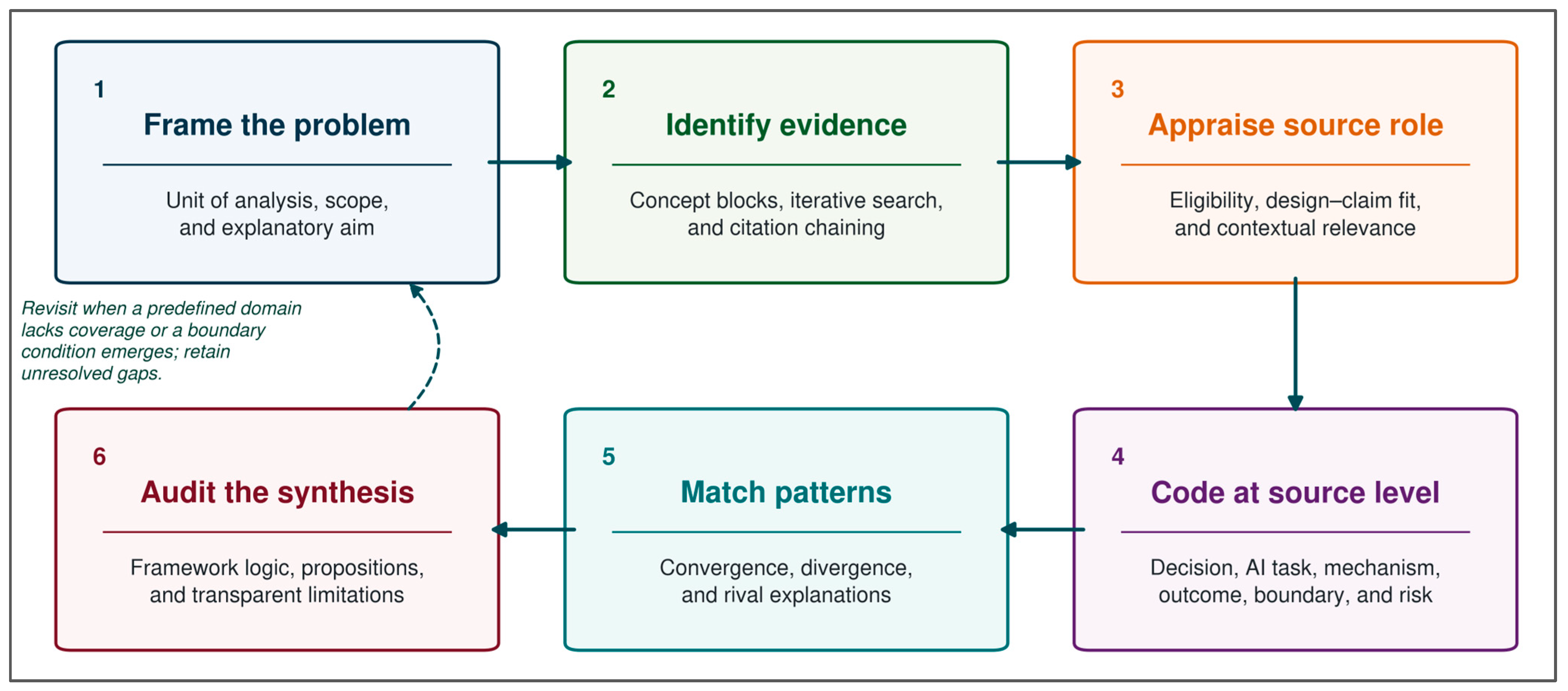
Figure 2.
AI-enabled club commerce management framework. Fan-mediated paths connect practices to transactional, relational, and societal outcomes; a separate path represents operational effects that may arise without fan mediation. Baseline institutional trust (t0), interaction-specific trust appraisal (t1), and updated relationship trust (t2) occupy distinct temporal positions. Governance is shown as a system-wide layer and is also operationalized as an enabling organizational capability in Table 3. The feedback loop represents learning from measured outcomes and lawfully processed, purpose-compatible interaction data.
Figure 2.
AI-enabled club commerce management framework. Fan-mediated paths connect practices to transactional, relational, and societal outcomes; a separate path represents operational effects that may arise without fan mediation. Baseline institutional trust (t0), interaction-specific trust appraisal (t1), and updated relationship trust (t2) occupy distinct temporal positions. Governance is shown as a system-wide layer and is also operationalized as an enabling organizational capability in Table 3. The feedback loop represents learning from measured outcomes and lawfully processed, purpose-compatible interaction data.
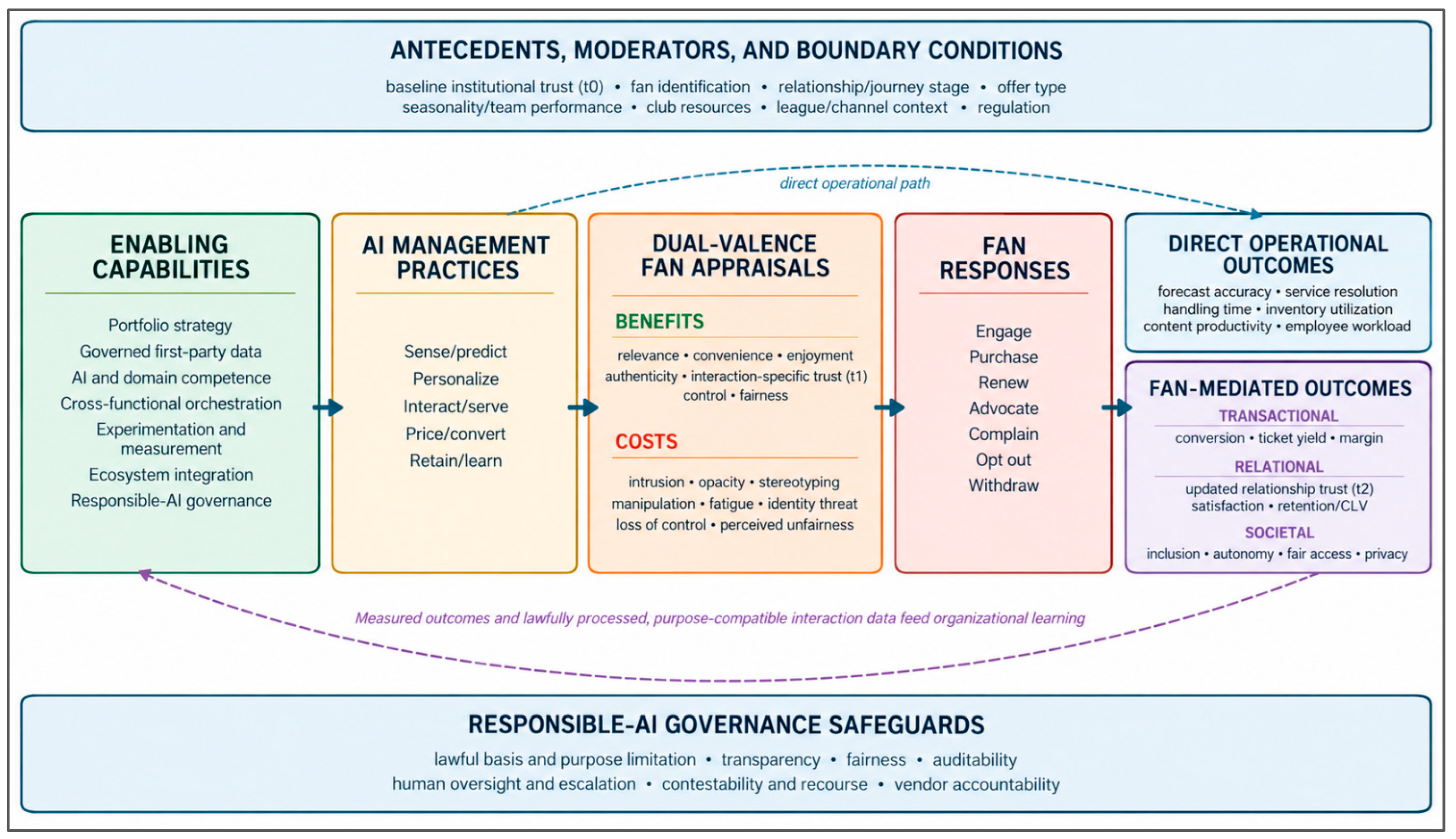
Figure 3.
Nonlinear and identification-contingent fan responses to AI personalization. Panel A illustrates the expected nonlinear pattern for net relational response, one observable component of the constrained relationship-equity criterion (P3). Panel B depicts the stronger positive response of highly identified fans to identity-congruent relevance (P4a). Panel C depicts their stronger adverse response to perceived opportunism (P4b). Panels B and C isolate slope moderation from a common illustrative baseline; they do not assume a separate main effect of identification. Curves are conceptual and do not represent estimated empirical effects.
Figure 3.
Nonlinear and identification-contingent fan responses to AI personalization. Panel A illustrates the expected nonlinear pattern for net relational response, one observable component of the constrained relationship-equity criterion (P3). Panel B depicts the stronger positive response of highly identified fans to identity-congruent relevance (P4a). Panel C depicts their stronger adverse response to perceived opportunism (P4b). Panels B and C isolate slope moderation from a common illustrative baseline; they do not assume a separate main effect of identification. Curves are conceptual and do not represent estimated empirical effects.
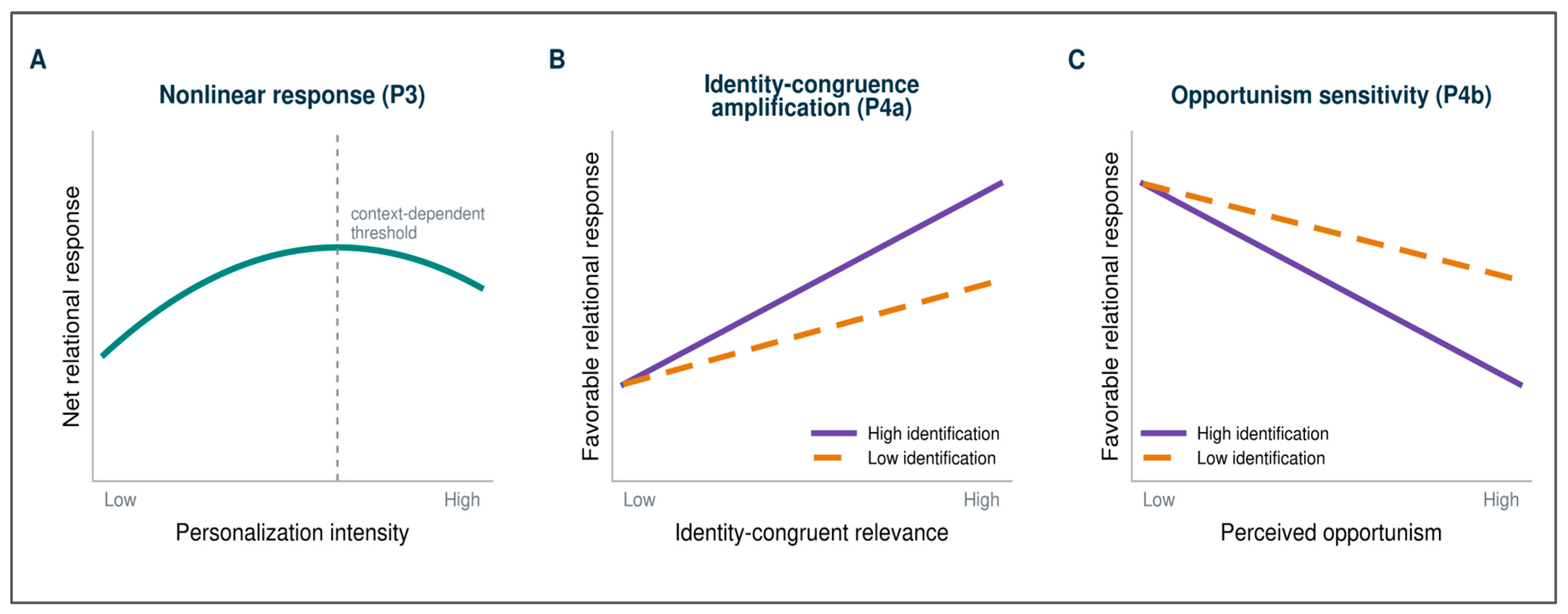
Table 1.
Analytical scope and roles assigned to the evidence.
| Evidence role | Primary question | Typical units/settings | Use in synthesis | Main caution |
|
Focal sport-commerce context (n = 16) |
What is observed in club-controlled or closely related sport-commerce settings? | Clubs, teams, supporters, ticketing, merchandise, streaming, membership | Provides the closest contextual evidence for practices, mechanisms, outcomes, and contingencies | Contextual proximity does not establish club control, AI focality, or causal strength |
|
Adjacent sport evidence (n = 19) |
Which fan and organizational mechanisms are established in sport but not tested as focal AI interventions? | Team identification, engagement, community, loyalty, and online service | Supplies sport-specific mediators, moderators, and relationship outcomes | Does not establish the incremental effect of an AI intervention |
|
Transfer evidence (n = 23) |
Which AI-commerce mechanisms are credible beyond sport? | Retail, platforms, customer service, online advertising, CRM, and revenue management | Explains recommendation, personalization, conversational service, trust, privacy, and pricing | Transfer to identity-intensive club relationships must be qualified |
|
Foundational theory/method (n = 18) |
How should constructs be connected and the evidence synthesized? | Strategy, information systems, marketing, psychology, and review methodology | Defines dynamic capabilities, S-O-R, trust, identity, autonomy, and synthesis procedures | Theory or method does not itself demonstrate club-level implementation |
|
Regulatory/ governance source (n = 4) |
Which conditions shape lawful and legitimate deployment? | Algorithmic decision systems, personal data, consumer interfaces, and EU regulation | Defines lawfulness, purpose limitation, transparency, fairness, auditability, and oversight | Applicability depends on system purpose, deployment context, and jurisdiction |
Note: S-O-R = stimulus-organism-response. Counts total 80 analytical sources. Contextual proximity, AI focality, and design warrant are coded separately; none establishes causality. Reference 63 is a reporting-quality instrument; Reference 9 is a related-work citation outside the analytical corpus.
Table 2.
Task-based taxonomy of AI-driven digital commerce in professional sport clubs.
|
Management task |
Illustrative club applications |
Typical inputs |
Decision/output |
Primary value and risk |
| Sense and predict | Fixture demand; inventory; propensity; churn; service-volume forecasting | Transactions, attendance, tenure, product and fixture attributes, service history | Forecast, risk rank, anomaly or segment | Value: better planning and targeting. Risk: bias, proxy variables, accuracy without actionability |
| Personalize | Content rank; merchandise recommendation; membership benefit; sponsor offer; message timing | Lawfully processed profile, context, preferences, journey and interaction history | Ranked item, message, bundle, channel or timing | Value: relevance and lower search cost. Risk: intrusion, stereotyping, synthetic inauthenticity |
| Interact and serve | Ticket help; product discovery; membership explanation; post-purchase support | Controlled knowledge, account permissions, conversation and case context | Answer, action, route, summary or human escalation | Value: availability and speed. Risk: hallucination, privacy leakage, low empathy, blocked recourse |
| Price and convert | Dynamic ticket price; seat upgrade; bundle; next-best offer; cart recovery | Demand, inventory, cost, channel, customer value and constraints | Price, allocation, offer or intervention | Value: yield and conversion. Risk: unfairness, discrimination, pressure, channel conflict |
| Retain and learn | Renewal risk; service recovery; loyalty action; experiment allocation; policy update | Longitudinal behavior, exposures, outcomes, complaints, and lawful-basis/permission status | Intervention priority, causal estimate, updated policy | Value: retention and CLV. Risk: over-discounting, exclusion, self-reinforcing feedback |
Note: CLV = customer lifetime value. A task category describes the managerial decision supported; it does not imply that the model acts autonomously.
Table 3.
Enabling capabilities and observable management routines.
| Capability | Core management question | Observable routines | Failure signal |
| Portfolio strategy | Which decision is worth improving, under which constraints? | Journey map; use-case portfolio; value–risk scoring; explicit optimization target | Pilots selected by novelty; conflicting models; no accountable outcome owner |
| Governed first-party data | Can the club connect relevant data lawfully and accurately? | Identity, lawful-basis, and permission layer; lineage; quality monitoring; rights workflow | Duplicate fans; unknown provenance; unhonored permissions or withdrawals; silent missingness |
| AI and domain competence | Can people interpret, challenge, and operationalize model output? | Cross-skilled teams; model cards; scenario review; override training | Blind vendor dependence; metric confusion; automation of known exceptions |
| Cross-functional orchestration | Are journey trade-offs and decision rights coordinated? | Portfolio council; shared definitions; escalation owner; frontline participation | Channel conflict; local KPI gains with relationship losses |
| Experimentation and measurement | Did the intervention cause incremental value? | Holdout policy; pre-specified metrics; guard-rails; post-test decision rule | Reporting only accuracy, clicks, or before–after changes |
| Ecosystem integration | Can value and knowledge be appropriated across partners? | APIs; portability; audit clauses; service levels; exit plan | Data lock-in; opaque subcontractors; inability to reproduce decisions |
| Responsible-AI governance | Is the system legitimate, contestable, and controlled? | Inventory; risk tiers; impact assessment; monitoring; human recourse; incident response | No system owner; unexplained disparities; hidden automation; repeated unresolved harm |
Note: Capabilities are complementary. Outsourcing an AI component does not transfer the club’s accountability for purpose, supporter treatment, or commercial consequences.
Table 4.
Proposition-level empirical tests and disconfirming patterns.
| Proposition | Level of analysis | Recommended design |
Observation that would challenge the proposition |
| P1 | Club commerce portfolio | Longitudinal multi-club configurational analysis | Alignment adds no explanatory value beyond additive capability effects, and no bottleneck pattern appears |
| P2 | Fan-offer interaction | Factorial field experiment with parallel mediation | Indirect effects through relevance, convenience, and conditional authenticity are absent |
| P3 | Fan-offer interaction | Multilevel dose-response design with a preregistered personalization-intensity index | Component outcomes remain monotonic and show no threshold over the preregistered range |
| P4a | Fan-club relationship | Preregistered moderated-mediation design | Identification does not strengthen the path from congruent personalization through authenticity to positive relational response |
| P4b | Fan-club relationship | Preregistered interaction design | Identification does not strengthen the path from opportunism to resistance or reductions in trust |
| P5 | Fan-community interaction | 2 × 2 longitudinal factorial: adaptive/static by autonomy-supportive/controlling | No interaction or effect appears for fatigue, relational outcomes, or subsequent commercial response |
| P6 | Cross-channel journey | Log-linked cross-channel experiment with accuracy and legitimacy gate | Congruence has no effect on conversion or interaction-specific trust |
| P7 | Pricing or persuasion policy | Pricing/persuasion experiment measuring fairness, autonomy, recourse, and renewal | No downstream relational costs appear, or safeguards do not attenuate them |
| P8 | Club governance system | Multilevel longitudinal study or quasi-exogenous governance change | Governance maturity has no effect on incidents, correction, trust, lawful data cooperation, or lagged performance |
| P9 | Club-vendor arrangement | Comparative contract and implementation study | Portability, audit, performance evidence, and exit rights do not affect dependence, capability accumulation, or value capture |
Note: The final column specifies observations that would challenge, rather than confirm, each proposition. Tests should report both intended outcomes and harm guardrails.
Table 6.
Priority research agenda for AI-driven club commerce.
| Priority | Research question | Recommended design | Key outcomes |
| Construct validation | How should the components of constrained relationship equity be operationalized without presuming a one-dimensional scale? | Multi-study construct-development program comparing preregistered composites and guardrail rules, with convergent and discriminant validation | Commercial and relational outcomes; authenticity; fairness; autonomy; inclusion; threshold sensitivity |
| Causal retention | Which interventions retain different types of at-risk members? | Randomized or stepped-wedge intervention linked to calibrated churn scores, with treatment-heterogeneity analysis | Incremental renewal; margin; satisfaction; fairness; treatment heterogeneity |
| Conversational-service backfire | When do task authorization, disclosure, escalation, and recovery prevent or amplify service backfire? | Task-level factorial field experiment using controlled knowledge and audited conversation logs | Factual accuracy; resolution; escalation; recovery; purchase; privacy incidents; satisfaction; t1/t2 trust |
| Long-run relationship effects | Do short-run conversion gains persist, or shift costs into later relationship outcomes? | Longitudinal randomized or quasi-experimental follow-up across fixtures or seasons | Conversion; margin; returns; complaints; withdrawal; updated trust; renewal; advocacy |
| Algorithmic inclusion | Who is unseen, misclassified, or systematically deprioritized? | End-to-end audit with missing-data and feedback-loop analysis | Error and outcome disparities; offer access; recourse; participation; silent disengagement |
| Cross-context replication | Do capability, mechanism, and governance paths replicate across women's sport, small clubs, league structures, and markets? | Preregistered multi-club, multi-context comparative study or coordinated field experiments | Effect heterogeneity; capability constraints; trust; inclusion; portfolio value |
Note: Research should report both commercial benefits and relationship or rights-based costs and should distinguish prediction performance from intervention effects.
Disclaimer/Publisher’s Note: The statements, opinions and data contained in all publications are solely those of the individual author(s) and contributor(s) and not of MDPI and/or the editor(s). MDPI and/or the editor(s) disclaim responsibility for any injury to people or property resulting from any ideas, methods, instructions or products referred to in the content. |
© 2026 by the authors. Licensee MDPI, Basel, Switzerland. This article is an open access article distributed under the terms and conditions of the Creative Commons Attribution (CC BY) license (http://creativecommons.org/licenses/by/4.0/).
Copyright: This open access article is published under a Creative Commons CC BY 4.0 license, which permit the free download, distribution, and reuse, provided that the author and preprint are cited in any reuse.