
Submitted:
09 September 2026
Posted:
11 September 2026
You are already at the latest version
Abstract
This cross-sectional pilot study examines relationships among workplace mental illness stigma, help-seeking, and work performance in 209 United States Veterans employed in civilian organizations. Using stigma and performance measures and covariance-based structural equation modeling, the study assessed interpersonal anxiety, workplace stigma, hygiene perceptions, physician-based help-seeking, and work performance. Interpersonal anxiety was positively associated with workplace stigma; stigma was negatively associated with physician help-seeking; and hygiene concerns were positively associated with physician help-seeking. Unexpectedly, workplace stigma was positively associated with work performance, whereas physician help-seeking was negatively associated with performance. The findings suggest that stigma-related distress may be masked through compensatory over-performance, although the cross-sectional design precludes causal inference. The study reframes stigma as an inclusion deficit, mental health literacy as psychological-safety infrastructure, and help-seeking as agency. Recommendations emphasize psychologically safe workplaces, culturally responsive assessment, diversified no-wrong-door access pathways, and longitudinal research examining whether over-performance precedes burnout, absenteeism, turnover, or depletion.
Keywords:
U.S. military veterans
; workplace stigma
; mental health literacy
; help‐seeking behavior
; individual work performance
1. Introduction
Behavioral health workplace stigma remains a significant challenge for military veterans transitioning into civilian work environments. These stigmas deter veterans from seeking necessary mental health care, exacerbate challenges in job performance, and perpetuate workplace exclusion. Research highlights pervasive barriers, including self-stigma, public stigma, and career-related fears, which prevent veterans from accessing timely support [1,2]. Moreover, economic disparities such as reduced earnings and higher unemployment rates among veterans reflect systemic inequalities driven by stigma and low mental health literacy [3].
The World Health Organization [4] estimates that one in four individuals globally grapples with mental illness, yet mental health literacy remains limited in most workplaces. Veterans, in particular, encounter unique stigma stemming from perceptions of strength and resilience associated with military culture. Workplace stigma manifests in absenteeism, presenteeism, and turnover, resulting in substantial economic losses across sectors [5].
Despite growing recognition of workplace mental health challenges, gaps remain in understanding how stigma interacts with mental health literacy to affect veterans’ job performance. Existing studies have examined barriers to mental health service utilization [1] and the economic implications of workplace stigma [5], but few address the moderating roles of organizational level, professional experience, or age. Furthermore, research on interventions tailored to improve mental health literacy among veterans is scarce.
The primary goal of this study is to examine the interplay between workplace stigma, mental health literacy, and job performance among military veterans. Specific objectives include identifying the effects of stigma on veterans’ engagement with mental health support systems, exploring the role of mental health literacy in mitigating stigma and improving performance, and investigating how organizational level, professional experience, and age moderate these relationships.
1.1. Literature Review and Theoretical Framework
1.1.1. Synthesis of Supporting Literature into the Study’s Context
The findings of supporting literature complement the study by providing deeper insights into the multifaceted challenges faced by veterans and the potential pathways for intervention. Richards et al. [1] highlight how stigma reduces veterans’ willingness to seek healthcare and suggest strategies for reducing these barriers, aligning with the study’s emphasis on the adverse impact of workplace stigma on mental health engagement and job performance. This literature reinforces the study’s recommendation for stigma-reduction initiatives to foster a more supportive workplace environment.
Brown and Bruce [2] extend this understanding by differentiating between self-stigma, public stigma, and career worry, identifying career worry as the most significant barrier to seeking treatment. This insight supports the study’s focus on organizational interventions that mitigate stigma and career-related fears, which can enhance veterans’ mental health literacy and willingness to engage with support systems.
Roscoe [6] examines how veterans with PTSD employ communication strategies to manage stigma. This aligns with the study’s finding that workplace stigma impedes engagement and suggests that enhancing veterans’ communication skills and resilience could be a valuable addition to mental health literacy initiatives.
Garcia et al. [5] explore burnout among mental health providers in veteran-focused clinics, revealing how organizational factors such as workload and bureaucracy contribute to burnout. This literature underscores the study’s recommendation for organizations to create supportive environments, not only for veterans but also for those providing mental health services, ensuring effective care delivery.
Lastly, Harding [3] focuses on self-stigma within veteran culture, emphasizing the need for culturally sensitive mental health interventions. This aligns with the study’s emphasis on tailoring support strategies to address the unique needs of veterans, particularly by fostering understanding and acceptance of mental health issues within organizational cultures.
1.1.2. Implications for the Study
Incorporating these insights into the study strengthens the argument for targeted, multi-dimensional interventions addressing workplace stigma, career concerns, and organizational dynamics. It supports the call for culturally sensitive, communication-based approaches and highlights the importance of addressing both individual and systemic barriers to improve mental health engagement and job performance among veterans.
1.1.3. Addressing Stigma and Career Concerns
Richards et al. [1] and Brown and Bruce [2] both emphasize the detrimental effects of stigma on veterans’ mental health engagement. While “Beyond the Uniform” identifies workplace stigma as a significant barrier to mental health engagement and job performance, Richards et al. [1] suggest that tailored stigma-reduction strategies, such as normalizing mental health conversations and enhancing confidentiality protocols, can mitigate these barriers. Brown and Bruce [2] further point out that career worry—fear of professional repercussions—has a stronger impact than stigma alone. This insight supports the recommendation for organizations to implement policies that explicitly protect veterans’ career trajectories when seeking mental health support, creating a safer and more accepting workplace environment.
1.1.4. Enhancing Mental Health Literacy
The study emphasizes the importance of mental health literacy (MHL) in reducing stigma and improving veterans’ engagement. Roscoe [6] deepens this perspective by highlighting how veterans with PTSD employ communication strategies to navigate stigma. Integrating this into the study’s context suggests that MHL programs should incorporate training on effective self-advocacy and stigma management communication. Additionally, Harding [3] notes the role of cultural values in shaping veterans’ perceptions of mental health, indicating that MHL efforts must be culturally tailored to address unique aspects of military identity, such as perceptions of strength and resilience, which may hinder help-seeking behaviors.
1.1.5. Supporting Organizational Change
Garcia et al. [5] provide an organizational lens by demonstrating that factors like excessive workload, bureaucracy, and lack of autonomy contribute to burnout among mental health providers. This aligns with the study’s focus on the role of organizational resources in mitigating stigma and enhancing job performance. Organizations could adopt a dual-focus approach by fostering supportive environments for both veterans and mental health providers. Initiatives such as mental health-friendly policies, access to evidence-based treatments, and regular wellness check-ins can reduce burnout and improve engagement across all stakeholders.
1.1.6. Broader Implications
The integration of these supporting works enhances the study’s theoretical framework and practical applications, aligning with the Job Demand-Resource (JD-R) model. By addressing both systemic barriers (e.g., organizational stigma, career concerns) and individual factors (e.g., communication strategies, cultural identity), the study provides a holistic roadmap for fostering veteran well-being and productivity.
Studies like those from Richards et al. [1] highlight that many veterans face significant barriers to seeking mental health support, with stigma being a leading factor. Public stigma (workplace), self-stigma (mental illness), and fears of career consequences often lead to underutilization of healthcare services.
Research by Brown and Bruce [2] notes that up to 50% of veterans experiencing mental health challenges such as PTSD or depression refrain from seeking help due to stigma or fear of career consequences. These barriers are compounded by low mental health literacy, which limits their ability to recognize and address mental health symptoms.
Harding [3] emphasizes that self-stigma, influenced by cultural norms around strength and resilience in military culture, exacerbates these challenges, leading to increased morbidity and lower engagement with support systems.
Workplace-specific studies, such as Garcia et al. [5], indicate that stigma in workplace environments can result in higher absenteeism and turnover, though exact prevalence rates vary across studies and industries.
1.1.7. Stigma in the Workplace
Stigma in the workplace encompasses prejudicial attitudes and discriminatory behaviors toward individuals with mental health conditions. For veterans, stigma often originates from stereotypes about their military service, such as assumptions of instability or aggression [1]. Studies by Vogt et al. [7] and Harding [3] reveal that stigma acts as a significant barrier to treatment, deterring veterans from seeking help due to fears of judgment.
1.1.8. Job Demand-Resource (JD-R) Model
The JD-R model serves as the theoretical framework for this study, positing that job demands (e.g., stigma, emotional labor) and resources (e.g., mental health literacy, organizational support) influence employee well-being and performance [8]. For veterans, stigma represents a job demand that increases stress and hinders engagement. Conversely, mental health literacy functions as a resource, enabling veterans to seek support and manage workplace challenges effectively.
1.1.9. Research Gaps
Despite growing recognition of workplace mental health challenges, gaps remain in understanding how stigma interacts with mental health literacy to affect veterans’ job performance. Existing studies have examined barriers to mental health service utilization [1] and the economic implications of workplace stigma [5], but few address the moderating roles of organizational level, professional experience, or age. Furthermore, research on interventions tailored to improve mental health literacy among veterans is scarce. Existing literature highlights the detrimental effects of stigma and low mental health literacy, but it remains unclear how these factors interact to influence job performance. There is also limited empirical evidence on how organizational and individual factors moderate these relationships.
2. Materials and Methods
2.1. Design and Sample
We analyzed a cross-sectional pilot survey of post-service Veterans employed in civilian organizations. Quality controls excluded preview and incomplete responses and enforced attention checks.
2.2. Measures
Individual Work Performance (IWP) was assessed with the 17-item IWPQ; counterproductive work behavior items were reverse-coded so higher values indicate better performance [9]. Workplace mental-illness stigma was measured with the Mental Illness Stigma Scale (MISS) with subdomains (e.g., Interpersonal Anxiety, Relationship Disruption, Poor Hygiene, Visibility, Treatability/Recovery/Professional Efficacy) [10]. Formal help-seeking was operationalized via the highest-loading observed indicator: likelihood of seeking help from a doctor/physician.
2.3. Modeling Approach
Structural paths reflected the revised conceptual model: stigma and hygiene predicting help-seeking; stigma, hygiene, and help-seeking predicting IWP. This specification aligns with pathway-to-care literature positioning primary care as a gateway to specialty mental health [11,12]. The research model is shown in Figure 1.
2.4. Data Collection Procedures
Data were collected through an anonymous online survey distributed via Qualtrics under the auspices of the University of New Orleans institutional review board (IRB) number: 05Apr24. The survey was rigorously pilot tested with 250 participants to ensure clarity and cultural sensitivity. Participants received a detailed explanation of the study’s objectives and provided electronic informed consent. Measures were taken to guarantee confidentiality and encourage candid responses, including anonymized survey links and encrypted data storage protocols [13].
2.5. Data Analysis
To empirically test the research model, we administered an online survey focused on veterans’ workplace stigma and work performance. The survey instrument was developed using scales adapted from existing literature. A panel of content validity experts, consisting of healthcare researchers and practitioners well-versed in the domain and experienced in quantitative research methods, was consulted to assess the content validity of all scales. All measures were assessed using a seven-point Likert scale ranging from 1 (strongly disagree) to 7 (strongly agree). Table 1 presents the measurement items and their sources. All latent constructs were measured using reflective items.
Participants in this study were veterans recruited through an American nonprofit organization that provides no-cost counseling through a network of volunteer mental health professionals. We received 275 responses and retained 209 (76%) after filtering out incomplete and invalid responses. The diverse profiles of veteran participants are summarized in Table 2.
To mitigate common method bias (CMB), we implemented procedural remedies during the survey design phase. Specifically, survey questions measuring exogenous constructs were separated from those measuring endogenous constructs to ensure they did not appear in a linear order [17]. In addition, we conducted Harman’s single-factor test to assess CMB. According to Podsakoff et al. [17], if common method bias is present, either a single factor will emerge from an unrotated exploratory factor analysis, or one general factor will account for the majority of the covariance among the measures.
2.6. Measurement Validation
The measurement model was assessed using multiple criteria: reliability, evaluated through composite reliability and Cronbach’s alpha; convergent validity, assessed using average variance extracted (AVE); and discriminant validity. Following established guidelines, indicator loadings were expected to exceed 0.70, while items with loadings between 0.40 and 0.70 were considered for removal only if their deletion resulted in an increase in composite reliability or AVE beyond the recommended threshold values [18].
2.7. Hypothesis Testing
To test the hypotheses, we estimated the sizes and the levels of significance of the path coefficients in the research model. Also, we evaluated the coefficients of determination (i.e., R2 values) of the endogenous constructs, which measure the explained variances of the endogenous constructs and indicate the model’s predictive accuracy [18]. These values were estimated using the Covariance-based Structural Equation Modeling (SEM) with SPSS AMOS 28.
In addition, we applied PROCESS V5.0, an SPSS macro known for its capacity to assess complex mediation effects [19]. We used the latent variable scores of the constructs to run Model 4 in the macro, with a 95% confidence interval and 5,000 bootstrap samples to ensure the robustness of our results.
3. Results
3.1. Common Method Bias
Our results indicated that neither condition occurred in our data. Common method bias was not a significant concern in this study.
3.2. Measurement Validation
After removing a small number of items, the loadings of all remaining indicators exceeded the recommended threshold of 0.70, as shown in Table 1.
Furthermore, Table 3 presents an overview of the measurement model results, including the mean values, standard deviations, reliability, and validity metrics for each measurement item. The composite reliability and Cronbach’s alpha values for all constructs exceeded 0.70, indicating strong reliability. All AVE values were above 0.50, demonstrating robust convergent validity. Furthermore, for each construct, the square root of the AVE exceeded its highest correlation with any other construct, providing evidence of adequate discriminant validity.
3.3. Hypothesis Testing
The model demonstrates robust goodness-of-fit (χ2 = 160.067, df = 85, χ2/df = 1.883, CFI = 0.954, TLI = 0.934, RMSEA = 0.065). It explains 25.9% of the variance (i.e., R2) in individual work performance, 4.7% in workplace stigma, and 6.6% in help-seeking from a doctor.
As shown in Figure 2, the results indicate that veterans’ anxiety is positively and significantly associated with perceived workplace stigma (β = 0.232, p ≤ 0.01), providing support for H1. In contrast, anxiety does not have a significant effect on help-seeking from a doctor (β = −0.051, p = 0.618) or on veterans’ individual work performance (β = 0.042, p = 0.711). Workplace stigma, however, has a significant negative effect on help-seeking behavior (β = −0.155, p ≤ 0.05), thereby supporting H3a. Interestingly, workplace stigma also exhibits a significant positive association with veterans’ individual work performance (β = 0.351, p < 0.001). Moreover, hygiene is positively and significantly related to help-seeking from a doctor (β = 0.260, p ≤ 0.01), supporting H5a, whereas its effect on individual work performance is not statistically significant (β = 0.185, p = 0.110). Lastly, as predicted, help-seeking from a doctor has a significant negative effect on veterans’ individual work performance (β = −0.211, p ≤ 0.01), supporting H6.
3.4. Indirect Effects
The findings indicate that the indirect effects of veterans’ anxiety on both help-seeking behavior and individual work performance, mediated by workplace stigma, are statistically significant (help-seeking: estimate = -0.035, 95% CI = [-0.092, -0.002]; individual work performance: estimate = 0.057, 95% CI = [0.013, 0.114]), thereby providing support for H4a and H4b.
3.5. Control Variables
In terms of the control variables, demographic characteristics, including age, education, work experience, organizational level, and industry sector, do not exhibit significant effects on individual work performance.
4. Discussion
4.1. Roadmap-Informed Interpretation
The findings are best understood through a translational public-mental-health lens rather than as a purely clinical utilization problem. Give an Hour’s published approach organizes mental-health access around four linked actions—Listen, Lean In, Learn, and Lead—and emphasizes multimodal, evidence-based, consumer-informed support for people affected by human-made trauma [20]. This roadmap is highly congruent with the present study because the core empirical signal is not simply that Veterans do or do not seek care; it is that the available care journey is filtered through stigma, visible symptoms, and physician-based gateways. In this sense, the model identifies a design problem: workplace and community systems must be built so that Veterans encounter credible, low-friction, non-punitive pathways before crisis points emerge.
The first element of the roadmap, Listen, is reflected in Give an Hour’s use of journey mapping to identify critical mental-health touchpoints [20]. Our physician-gateway finding should be interpreted similarly: “doctor” is not merely a preferred provider category but a mapped touchpoint in a constrained access pathway. Many Veterans first understand distress through a medical frame, particularly when symptoms are visible, functional, or embodied. Yet the same pathway can delay care if the individual fears workplace stigma, anticipates career penalty, or cannot access timely specialty services. A workplace-informed journey map would therefore identify the points at which stigma, uncertainty, and access bottlenecks interrupt help-seeking and would intentionally place warm handoffs at those points.
The second element, Lean In, calls for informed and tailored responses aligned with customer needs and preferences [20]. For this manuscript, that means moving beyond one-size-fits-all advice to “seek help” and toward trusted, culturally attuned routes that match Veterans’ lived experience. The data suggest that hygiene and visible-symptom concerns may push Veterans toward formal care, but interpersonal anxiety and stigma can simultaneously keep distress private. Responsive design therefore requires multiple first doors—primary care, peer navigation, chaplaincy, employee assistance, Vet Centers, tele-mental health, and community partners—so help-seeking does not depend on a single clinical gateway.
The third element, Learn, focuses on continuous improvement through iterative engagement [20]. This principle provides a methodological bridge from the present pilot to the next research phase. The findings should be treated as early evidence for refining the model rather than as a closed causal account. Future waves should test whether physician-based help-seeking remains the highest-loading pathway, whether peer-navigation indicators emerge as stronger predictors when they are made visible to respondents, and whether interpersonal anxiety predicts later depletion or merely coincides with short-run over-performance. Continuous learning also requires transparent model diagnostics, including measurement reliability, structural invariance, sensitivity analyses, and preregistered longitudinal outcomes, rather than narrative interpretation alone.
The fourth element, Lead, emphasizes resilient communities and measurement that privileges customer voice and experience [20]. This shifts the practical implication of the study from “educate individual Veterans” to “build workplace and community ecosystems that make support normal, visible, and safe.” Give an Hour’s tools and training infrastructure also offer a practical vocabulary for this work: early identification, healthy self-care, the Five Signs, and the Silent 6 can help translate latent distress into observable, non-shaming language [21]. Of particular relevance is the “people pleasing/overextension” indicator, which maps directly onto the over-performance mechanism suggested by the study--the possibility that Veterans under stigma may work harder, take on more, and mask distress until the pattern becomes costly.
Dr. Trina Clayeux’s role as CEO of Give an Hour and her background in workforce development, mental health, trauma-informed workplaces, and military/veteran family experience make this roadmap especially relevant to the present organizational framing [22]. The study’s central contribution is therefore not only empirical but translational: it connects validated stigma and performance measures to an implementation model that can be acted on by employers, community partners, and Veteran-serving systems. By reframing stigma as an inclusion deficit, help-seeking as psychological agency, and mental-health literacy as psychological-safety infrastructure, the manuscript offers a bridge between evidence, workplace practice, and Veteran-centered support.
4.2. Limitations and Future Research
This manuscript remains a pilot analysis and should not be interpreted as causal proof. The cross-sectional design prevents temporal ordering, and the single observed physician help-seeking indicator is parsimonious but incomplete. Future studies should model help-seeking as a multidimensional construct that includes peer navigation, tele-mental health, chaplaincy, Vet Centers, employee assistance programs, and community-based organizations; measure mental-health literacy directly; test measurement invariance across Veteran subgroups; and examine whether over-performance predicts later depletion, burnout, absenteeism, or turnover. Longitudinal, preregistered, and implementation-focused designs are needed to distinguish short-run compensatory performance from sustainable functioning.
4.3. Recommendations
The findings support a set of upstream, culturally responsive recommendations designed to strengthen psychological safety, diversify access pathways, and protect both well-being and sustainable work performance. These recommendations should be interpreted as implementation priorities generated from a cross-sectional pilot, not as evidence that any single intervention has already been proven effective. Consistent with Give an Hour’s Listen, Lean In, Learn, and Lead roadmap, the central design principle is to move credible support closer to the points where Veterans experience stigma, uncertainty, and access friction, before distress becomes visible through impairment or crisis [20].
4.3.1. Employers and Supervisors
Employers should treat psychological safety as performance-protective infrastructure rather than as an optional wellness message. Operational policy should explicitly separate help-seeking from adverse career consequences, protect confidentiality, normalize the use of employee assistance, leave, peer, and community resources, and hold leaders accountable for the climate in which those resources are offered. Sustained, contact-based stigma-reduction practices and routine feedback loops are more likely to alter daily behavior than episodic awareness campaigns alone [23,24,25].
Supervisory and gatekeeper training should be calibrated to meaningful changes from an employee’s baseline, not only to visible decline. For some Veterans, increased work hours, reluctance to disengage, perfectionistic overextension, reduced use of personal leave, or unusually intense task absorption may represent compensatory effort rather than evidence that support is unnecessary. These patterns should prompt a private, non-diagnostic conversation about workload, functioning, and preferred resources, not punitive monitoring or an assumption of illness. Healthy drive and discipline remain valued; the relevant signal is an abrupt or sustained departure from the individual’s established pattern. Give an Hour’s Five Signs and Silent 6 provide non-shaming language for this approach, particularly the concepts of personality change and people pleasing/overextension [21,26,27].
4.3.2. Community Partners and Veteran-Serving Organizations
Community systems should implement a no-wrong-door, low-friction access architecture. Physician access remains important, but the physician-based indicator used in this pilot should not be treated as the only legitimate gateway. Peer navigators, chaplains, Vet Centers, tele-mental health, employee assistance programs, primary care, and community-based providers should be connected through warm handoffs, shared referral protocols, and clear escalation pathways [28,29,30,31]. Journey mapping should identify where career concerns, eligibility questions, timing, uncertainty, or lack of trust cause Veterans to disengage. Some Veterans may benefit from brief upstream support, while others will require clinical care; the system should accommodate both without requiring crisis-level impairment as proof of need.
Employers, community organizations, and Veteran-serving organizations should co-design these pathways with Veterans and review them as an integrated service journey rather than as disconnected programs. The practical test is whether a Veteran can enter through any trusted door, retain choice about the next step, and receive a timely handoff without repeated disclosure or avoidable delay. This approach operationalizes the Listen and Lean In elements of the Give an Hour roadmap by aligning support with lived experience rather than requiring Veterans to adapt to a single system entry point [20].
4.3.3. Clinicians and Behavioral Health Providers
Clinical assessment should examine functioning alongside impairment and should include explicit inquiry about over-functioning. Intake and follow-up protocols can assess changes in work intensity, inability to disengage, perfectionism, people pleasing, and role overextension alongside traditional symptoms and functional losses. Cultural competence is essential to distinguish military-derived discipline, mission focus, and resilience from compensatory overwork used to contain or conceal distress. A change from baseline should trigger contextual assessment rather than automatic pathologizing, and care plans should include stepped options and warm handoffs that do not depend exclusively on a physician gateway [3,6].
The negative association between physician help-seeking and individual work performance in this cross-sectional sample should not be interpreted as evidence that care reduces performance. Temporal order is unknown, and one plausible explanation is that formal help-seeking occurs only after distress has already become costly. Clinicians and organizational partners can address this possibility by reducing delay, offering earlier and less stigmatized points of contact, and making navigation support available before a Veteran must self-identify as impaired [12].
4.3.4. Researchers and Implementation Partners
The next research phase should move beyond single-moment associations to longitudinal and intervention designs that establish temporal order. Help-seeking should be measured as a multimodal construct that includes physicians, peers, chaplains, tele-mental health, Vet Centers, employee assistance programs, crisis services, and community organizations, with attention to timing, sequence, and intensity of use. Mental-health literacy should also be operationalized directly as a multidimensional construct rather than inferred from a single help-seeking item. Repeated-measures studies should test whether apparent over-performance is transient, whether it predicts later depletion, burnout, absenteeism, or turnover, and whether these pathways differ across Veteran subgroups and employment settings.
Research partnerships with Give an Hour and other Veteran-serving organizations should be designed as continuous learning systems. Veteran advisory input, preregistered outcomes, measurement invariance testing, sensitivity analyses, and implementation metrics should accompany tests of effectiveness. Frameworks such as the Consolidated Framework for Implementation Research and RE-AIM can help determine not only whether an intervention works, but for whom, under what conditions, with what reach, and whether it can be sustained [32,33]. Each research wave should return actionable findings to employers, clinicians, community partners, and Veterans while the model is refined in practice.
4.3.5. Policymakers and System Leaders
Policy should treat stigma as heterogeneous and as an inclusion deficit rather than as a single awareness problem. The measured dimensions in this study did not behave uniformly: interpersonal anxiety was associated with workplace stigma, hygiene concerns were associated with physician help-seeking, workplace stigma was associated with lower help-seeking, and workplace stigma was also associated with higher self-reported work performance. A single educational campaign is unlikely to address these distinct mechanisms. Policy levers should therefore be matched to the barrier, including enforceable confidentiality and career protections, contact-based education, funding for peer and navigation services, reimbursement and contracting arrangements that support warm handoffs, and evaluation standards that capture trust, pathway choice, time to first contact, and sustained functioning rather than utilization volume alone [31,34,35].
5. Conclusions
This study demonstrates that Veteran workplace mental health cannot be reduced to an individual’s willingness to seek care. Workplace stigma, physician-based help-seeking, and reported performance are embedded in systems of access, identity, work norms, and trust. Workplace stigma was associated with lower formal help-seeking and higher individual work performance, while hygiene concerns were associated with greater physician help-seeking. These findings complicate the assumption that distress will first appear as diminished output. A plausible interpretation is compensatory over-performance, in which some Veterans maintain or intensify work effort while concealing strain. Because the design is cross-sectional, this remains a testable working theory rather than a causal conclusion. Likewise, the negative association between physician help-seeking and performance cannot establish that care harms performance or determine which condition occurred first.
The Give an Hour roadmap provides a coherent structure for translation: Listen to Veterans’ care journeys and changes from baseline; Lean In with culturally matched, no-wrong-door supports; Learn through longitudinal measurement and implementation feedback; and Lead by making psychological safety operational across workplaces and communities [20]. This framework connects employer, community, clinical, research, and policy action around a shared objective: creating early, credible, non-punitive pathways to support and recognizing that both under-functioning and over-functioning may warrant careful inquiry.
The study’s contribution is both scholarly and practical. It reframes workplace stigma as an inclusion deficit, mental-health literacy as psychological-safety infrastructure, and help-seeking as an expression of agency. These reframes move the field upstream from crisis response after harm has accumulated toward trusted, community-grounded systems that protect dignity, choice, and sustainable participation in civilian employment. The central implication is not that high performance is pathological; it is that performance alone is an insufficient indicator of well-being. Systems that respond to meaningful changes from baseline while preserving Veterans’ autonomy are better positioned to protect health, workforce readiness, and long-term performance.
Author Contributions
Conceptualization, S.A.P. and Y.L.; methodology, S.A.P. and Y.L.; formal analysis, Y.L.; investigation, S.A.P. and Y.L.; resources, T.C. and R.L.; data curation, Y.L.; writing—original draft preparation, S.A.P.; writing—review and editing, S.A.P., Y.L., T.C., and R.L.; visualization, Y.L.; supervision, S.A.P.; project administration, S.A.P. All authors have read and agreed to the final version of the manuscript and accept responsibility for their respective contributions.
Funding
This research received no external funding.
Institutional Review Board Statement
The study was conducted under the auspices of the University of New Orleans Institutional Review Board (reported identifier: 05Apr24).
Informed Consent Statement
Electronic informed consent was obtained from all participants after they received an explanation of the study objectives.
Data Availability Statement
Requests for access to de-identified study data, survey materials, analysis syntax, and model outputs should be directed to the corresponding author. Access will be considered subject to participant consent, University of New Orleans institutional and IRB requirements, appropriate privacy safeguards, and applicable instrument permissions or data-use agreements. Individual-level information will not be released where disclosure risks or governing permissions preclude sharing.
Acknowledgments
The authors thank the U.S. veterans who participated in this study.
Generative AI Assistance: During preparation of this IJERPH submission, ChatGPT (OpenAI) assisted with journal-template adaptation, reference-format conversion, drafting source-based public-health highlights, bibliographic checking, and drafting author-query responses. The present author-query revision used GPT-6 Astra Pro on 8 September 2026. This revision did not involve collection of participant data or re-estimation of the study’s statistical analyses. The authors reviewed and edited the AI-assisted material and take full responsibility for the accuracy, integrity, and content of this publication.
Conflicts of Interest
Trina Clayeux is Chief Executive Officer of Give an Hour, a nonprofit organization whose service roadmap and resources are discussed in this manuscript. This professional and organizational affiliation is disclosed as a potentially relevant interest. Discussion of the Give an Hour roadmap is a translational interpretation of the study findings and does not constitute an evaluation of the effectiveness of the organization’s services.
Abbreviations
AVE Average variance extracted
CMB Common method bias
CR Composite reliability
IRB Institutional review board
IWP Individual work performance
IWPQ Individual Work Performance Questionnaire
JD-R Job Demand-Resource
MHL Mental health literacy
MISS Mental Illness Stigma Scale
PTSD Posttraumatic stress disorder
SEM Structural equation modeling
References
- Richards, L.K.; Goetter, E.M.; Wojtowicz, M.; Simon, N.M. Stigma and health services use among veterans and military personnel. In Social problem solving and health; Chang, E.C., D’Zurilla, T.J., Sanna, L.J., Eds.; Springer, 2016; pp. 291–308. [Google Scholar] [CrossRef]
- Brown, N.B.; Bruce, S.E. Stigma, career worry, and mental illness symptomatology: Factors influencing treatment-seeking for Operation Enduring Freedom and Operation Iraqi Freedom soldiers and veterans. Psychol. Trauma 2016, 8, 276–283. [Google Scholar] [CrossRef]
- Harding, S. Self-stigma and veteran culture. J. Transcult. Nurs. 2017, 28, 368–375. [Google Scholar] [CrossRef]
- World Health Organization. Mental Disorders. 2025. Available online: https://www.who.int/news-room/fact-sheets/detail/mental-disorders (accessed on 8 September 2026).
- Garcia, H.A.; McGeary, C.A.; McGeary, D.D.; Finley, E.P.; Peterson, A.L. Burnout in Veterans Health Administration mental health providers in posttraumatic stress clinics. Psychol. Serv. 2014, 11, 50–59. [Google Scholar] [CrossRef]
- Roscoe, R.A. The battle against mental health stigma: Examining how veterans with PTSD communicatively manage stigma. Health Commun. 2021, 36, 1–9. [Google Scholar] [CrossRef]
- Vogt, D.; Smith, B.N.; King, L.A.; King, D.W.; Knight, J.; Vasterling, J.J. Deployment Risk and Resilience Inventory-2 (DRRI-2): An updated tool for assessing psychosocial risk and resilience factors among service members and veterans. J. Trauma. Stress 2013, 26, 710–717. [Google Scholar] [CrossRef]
- Bakker, A.B.; Demerouti, E. The Job Demands-Resources model: State of the art. J. Manag. Psychol. 2007, 22, 309–328. [Google Scholar] [CrossRef]
- Koopmans, L.; Bernaards, C.M.; Hildebrandt, V.H.; Schaufeli, W.B.; de Vet, H.C.W.; van der Beek, A.J. Construct validity of the Individual Work Performance Questionnaire. J. Occup. Environ. Med. 2014, 56, 331–337. [Google Scholar] [CrossRef]
- Day, E.N.; Edgren, K.; Eshleman, A. Measuring stigma toward mental illness: Development and application of the Mental Illness Stigma Scale. J. Appl. Soc. Psychol. 2007, 37, 2191–2219. [Google Scholar] [CrossRef]
- Goldberg, D.; Huxley, P. Mental Illness in the Community: The Pathway to Psychiatric Care; Tavistock Publications: London, UK, 1980. [Google Scholar]
- Wang, P.S.; et al. Failure and delay in initial treatment contact after first onset of mental disorders. Arch. Gen. Psychiatry 2005, 62, 603–613. [Google Scholar] [CrossRef]
- Wilson, C.J.; Deane, F.P.; Ciarrochi, J.V.; Rickwood, D. Measuring help-seeking intentions: Properties of the General Help-Seeking Questionnaire. Can. J. Couns. 2005, 39, 15–28. Available online: https://cjc-rcc.ucalgary.ca/article/view/58623.
- King, M.; Dinos, S.; Shaw, J.; Watson, R.; Stevens, S.; Passetti, F.; Weich, S.; Serfaty, M. The Stigma Scale: Development of a standardised measure of the stigma of mental illness. Br. J. Psychiatry 2007, 190, 248–254. [Google Scholar] [CrossRef]
- Koopmans, L.; Bernaards, C.M.; Hildebrandt, V.H.; de Vet, H.C.W.; van der Beek, A.J. Construct validity of the Individual Work Performance Questionnaire. J. Occup. Environ. Med. 2014, 56, 331–337. [Google Scholar] [CrossRef]
- O’Connor, M.; Casey, L. The Mental Health Literacy Scale (MHLS): A new scale-based measure of mental health literacy. Psychiatry Res. 2015, 229, 511–516. [Google Scholar] [CrossRef]
- Podsakoff, P.M.; MacKenzie, S.B.; Lee, J.-Y.; Podsakoff, N.P. Common method biases in behavioral research: A critical review of the literature and recommended remedies. J. Appl. Psychol. 2003, 88, 879–903. [Google Scholar] [CrossRef]
- Hair, J.F., Jr.; Hult, G.T.M.; Ringle, C.M.; Sarstedt, M. A Primer on Partial Least Squares Structural Equation Modeling (PLS-SEM), 3rd ed.; SAGE Publications: Thousand Oaks, CA, USA, 2021. [Google Scholar]
- Hayes, A.F. Introduction to Mediation, Moderation, and Conditional Process Analysis: A Regression-Based Approach, 2nd ed.; The Guilford Press: New York, NY, USA, 2018. [Google Scholar]
- Give an Hour. Our approach and impact. Available online: https://giveanhour.org/approach/ (accessed on 8 September 2026).
- Give an Hour. Mental health tools and training. Available online: https://giveanhour.org/tools/ (accessed on 8 September 2026).
- Give an Hour. Give an Hour team. Available online: https://giveanhour.org/team/ (accessed on 8 September 2026).
- Edmondson, A.C. Psychological safety and learning behavior in work teams. Adm. Sci. Q. 1999, 44, 350–383. [Google Scholar] [CrossRef]
- Corrigan, P.W.; Morris, S.B.; Michaels, P.J.; Rafacz, J.D.; Rusch, N. Challenging the public stigma of mental illness: A meta-analysis of outcome studies. Psychiatr. Serv. 2012, 63, 963–973. [Google Scholar] [CrossRef]
- Thornicroft, G.; et al. Evidence for effective interventions to reduce mental-health-related stigma and discrimination. Lancet 2016, 387, 1123–1132. [Google Scholar] [CrossRef]
- Hockey, G.R.J. Compensatory control in the regulation of human performance under stress and high workload: A cognitive-energetical framework. Biol. Psychol. 1997, 45, 73–93. [Google Scholar] [CrossRef]
- Johns, G. Presenteeism in the workplace: A review and research agenda. J. Organ. Behav. 2010, 31, 519–542. [Google Scholar] [CrossRef]
- Blonigen, D.M.; et al. Peer-supported mobile mental health for Veterans in primary care: A pilot. Psychol. Serv. 2022, 19, 661–674. Available online: https://pmc.ncbi.nlm.nih.gov/articles/PMC10278739/. [CrossRef]
- Chinman, M.; et al. Implementation of peer specialist services in VA primary care: A cluster-randomized hybrid effectiveness-implementation trial. Implement. Sci. 2021, 16, 66. Available online: https://pmc.ncbi.nlm.nih.gov/articles/PMC8183089/.
- Eliacin, J.; et al. Veterans’ views of PARTNER-MH, a peer-led patient-navigation intervention. Transl. Behav. Med. 2023. Available online: https://pmc.ncbi.nlm.nih.gov/articles/PMC11184508/.
- Substance Abuse and Mental Health Services Administration. 2025 National Guidelines for a Behavioral Health Coordinated System of Crisis Care. 2025. Available online: https://988crisissystemshelp.samhsa.gov/resource/2025-national-guidelines-behavioral-health-coordinated-system-crisis-care (accessed on 8 September 2026).
- Damschroder, L.J.; et al. Fostering implementation of health services research findings into practice: The Consolidated Framework for Implementation Research. Implement. Sci. 2009, 4, 50. [Google Scholar] [CrossRef]
- Glasgow, R.E.; Vogt, T.M.; Boles, S.M. Evaluating the public health impact of health promotion interventions: The RE-AIM framework. Am. J. Public Health 1999, 89, 1322–1327. [Google Scholar] [CrossRef]
- Clement, S.; et al. What is the impact of mental health-related stigma on help-seeking? A systematic review. Psychol. Med. 2015, 45, 11–27. [Google Scholar] [CrossRef]
- Rasmussen, P.W.; Glasgow, J.M.; Taitsman, J.; Wagner, T.H. The promise and challenges of VA community care. Health Aff. Sch. 2023, 1, e2200022. [Google Scholar] [CrossRef]
Figure 1.
The Research Model.
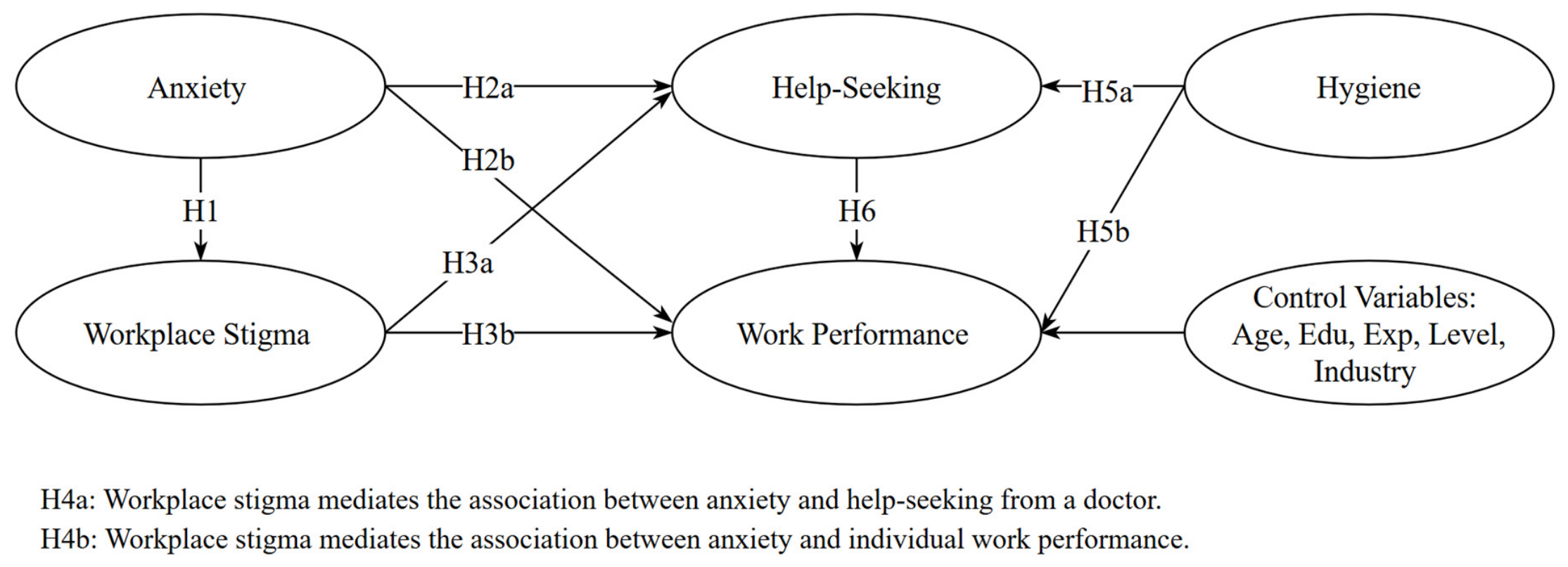
Figure 2.
The Model Analysis Results.
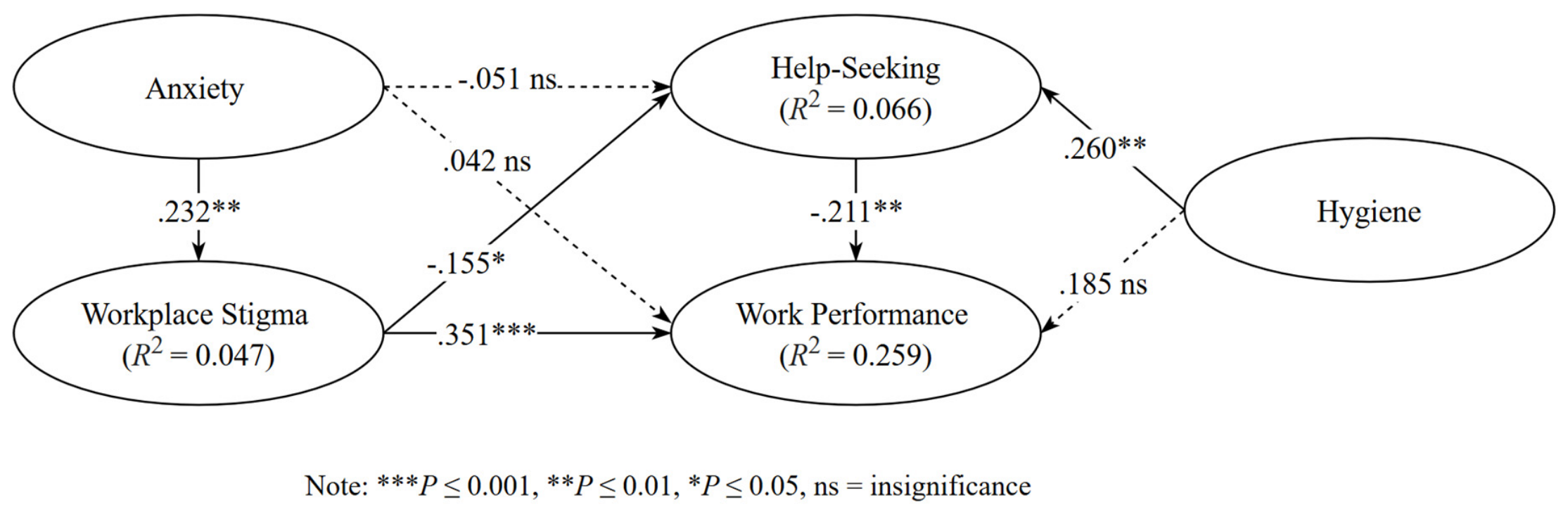

Table 1.
Constructs, Measurement Items, and Psychometric Properties.
| Construct & Measurement Items | Reliability/Loadings |
| Anxiety [10] | Cronbach’s α = 0.812 |
| 1. I feel anxious and uncomfortable when I’m around someone with a mental illness. | 0.827 |
| 2. I tend to feel anxious and nervous when I am around someone with a mental illness. | 0.753 |
| 3. I feel nervous and uneasy when I’m near someone with a mental illness. | 0.734 |
| Workplace Stigma [14] | Cronbach’s α = 0.937 |
| 1. Because of my mental health, my ability to work is impaired. | 0.907 |
| 2. Because of my mental health, my home management (cleaning, tidying, shopping, cooking, looking after the home or children, paying bills) is impaired. | 0.859 |
| 3. Because of my mental health, my social leisure activities (with other people, such as parties, bars, clubs, outings, visits, dating, and home entertainment) are impaired. | 0.855 |
| 4. Because of my mental health, my private leisure activities (done alone, such as reading, gardening, collecting, sewing, walking alone) are impaired. | 0.843 |
| 5. Because of my mental health, my ability to form and maintain close relationships with others, including those I live with, is impaired. | 0.867 |
| Hygiene [10] | Cronbach’s α = 0.817 |
| 1. People with mental illnesses tend to neglect their appearance. | 0.744 |
| 2. People with mental illnesses ignore their hygiene, such as bathing and using deodorant. | 0.774 |
| 3. People with mental illnesses do not groom themselves properly. | 0.799 |
| Individual Work Performance [15] | Cronbach’s α = 0.785 |
| 1. I am able to plan my work so that I finish it on time. | 0.708 |
| 2. I keep in mind the work result I needed to achieve. | 0.743 |
| 3. I am able to carry out my work efficiently. | 0.777 |
| Help-Seeking from a Doctor [16] | |
| 1. If you were having a personal or emotional problem, how likely is it that you would seek help from a doctor? |
Table 2.
Profiles of Participants (N = 209).
| Participant characteristic | Frequency (percentage) |
| Age group | |
| 18-26 | 11 (5.3%) |
| 26-35 | 45 (21.5%) |
| 35-42 | 66 (31.6%) |
| 43-55 | 43 (20.6%) |
| 55-60 | 24 (11.5%) |
| 61-65 | 10 (4.8%) |
| 65+ | 10 (4.8%) |
| Educational level | |
| High school diploma or GED | 11 (5.3%) |
| Some college, but no degree | 32 (15.3%) |
| Associates or technical degree | 27 (12.9%) |
| Bachelor’s degree | 57 (27.3%) |
| Graduate or professional degree (MA, MS, MBA, PhD, JD, MD, DDS, etc.) | 79 (37.8%) |
| Prefer not to say | 3 (1.4%) |
| Work experience | |
| Less than 1 | 3 (1.4%) |
| 1-5 | 31 (14.8%) |
| 6-10 | 75 (35.9%) |
| 11-15 | 22 (10.5%) |
| 16-20 | 20 (9.6%) |
| 21+ | 58 (27.8%) |
| Level within the organization | |
| Entry-level | 20 (9.6%) |
| Mid-level | 77 (36.8%) |
| Senior-level | 73 (34.9%) |
| Executive-level | 17 (8.1%) |
| C-suite | 6 (2.9%) |
| Board of advisors | 16 (7.7%) |
| Industry Sector | |
| Goods-producing industry | 56 (26.8%) |
| Service-providing industry | 80 (38.3%) |
| Public (Gov/Fed) | 73 (34.9%) |
Table 3.
Construct Descriptive Statistics, Correlations, Reliability, and Validity.
| MN | SD | CR | AVE | AX | WS | HG | WP | HS | |
| AX | 3.796 | 1.589 | 0.816 | 0.597 | 0.772 | - | |||
| WS | 2.555 | 1.845 | 0.916 | 0.733 | 0.218 | 0.856 | - | ||
| HG | 4.097 | 1.565 | 0.816 | 0.597 | 0.578 | 0.118 | 0.773 | - | |
| WP | 2.593 | 1.404 | 0.787 | 0.552 | 0.234 | 0.423 | 0.217 | 0.743 | - |
| HS | 5.130 | 1.857 | - | - | - | - | - | - | - |
MN: Mean; SD: Standard deviation; CR: Composite reliability; AVE: Average variance extracted; AX: Anxiety; WS: Workplace stigma; HG: Hygiene; WP: Work performance; HS: Help-seeking (doctor). Note: The diagonal in bold displays the square roots of the average variance extracted (AVE), which exceed the inter-construct correlations, demonstrating discriminant validity in this study.
Disclaimer/Publisher’s Note: The statements, opinions and data contained in all publications are solely those of the individual author(s) and contributor(s) and not of MDPI and/or the editor(s). MDPI and/or the editor(s) disclaim responsibility for any injury to people or property resulting from any ideas, methods, instructions or products referred to in the content. |
© 2026 by the authors. Licensee MDPI, Basel, Switzerland. This article is an open access article distributed under the terms and conditions of the Creative Commons Attribution (CC BY) license.
Copyright: This open access article is published under a Creative Commons CC BY 4.0 license, which permit the free download, distribution, and reuse, provided that the author and preprint are cited in any reuse.