

Submitted:
09 September 2026
Posted:
10 September 2026
You are already at the latest version
Abstract
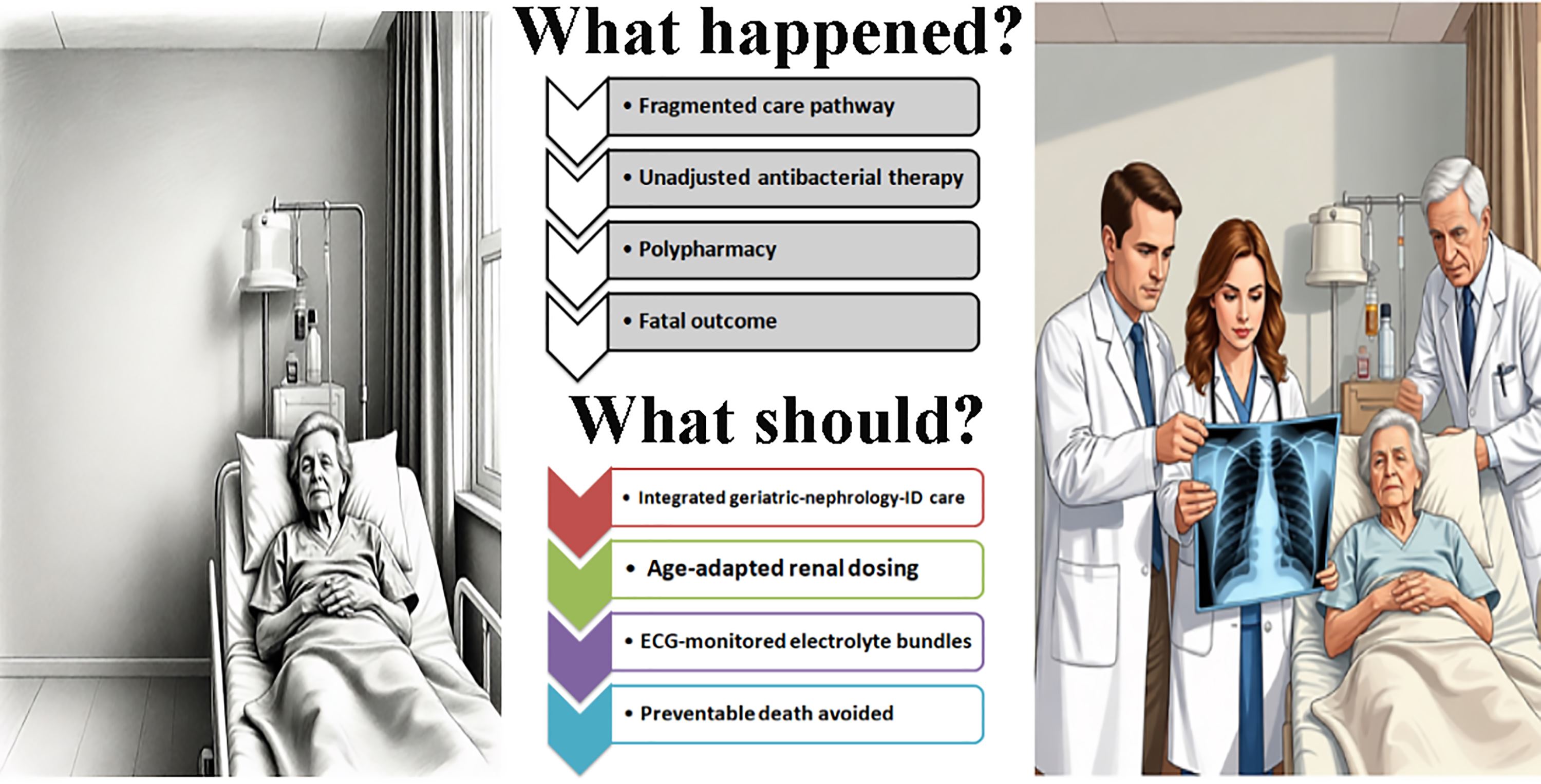
Community-acquired pneumonia carries high mortality in very old adults with multimorbidity, yet preventable medication-related harm is often under-recognised. This case report describes a woman in her late 80s with stage G3a chronic kidney disease who presented with community‑acquired pneumonia to a large multidisciplinary centre. Empiric meropenem was initiated shortly after admission and the dose was increased on day 8 despite persistent renal impairment. Amikacin 1 g once daily was then added. On the same day, the patient received furosemide, intravenous potassium chloride, and glucose infusions as metabolic abnormalities emerged. After temporary stabilisation in the intensive care unit, amikacin was discontinued, linezolid was started, and the patient was transferred to a general ward, where she died four days later. On her final day, life-threatening hyperkalaemia was documented, yet additional potassium was administered, precipitating cardiac arrest. This case illustrates how routine interventions—broad-spectrum antibiotics, aminoglycosides, diuretics, and potassium supplementation—can become iatrogenic in frail older adults when dosing and monitoring are not adjusted for age and kidney function. It underscores the need for strict renal dose adjustment, cautious potassium management, and early geriatric assessment in hospitalised multimorbid older patients.
Keywords:
community-acquired pneumonia
; chronic kidney disease
; hyperkalaemia
; antimicrobial stewardship
; electrolyte safety bundles
1. Introduction
Community-acquired pneumonia (CAP) remains a leading cause of infectious morbidity and mortality worldwide, particularly among older adults [1,2]. In patients aged 65 years and older, the annual incidence of CAP is fourfold higher than in younger populations, with disproportionately elevated rates of hospitalisation and death [1,3]. This vulnerability stems not only from age-related immunosenescence and comorbidities but also from atypical clinical presentations. The classical manifestations of lower respiratory tract infection, such as fever, productive cough, and pleuritic chest pain, are frequently absent or attenuated. Instead, CAP often manifests as delirium, functional decline, falls, or anorexia – non-specific geriatric syndromes that delay diagnosis and appropriate therapy, complicate initial risk stratification, and compromise the timely selection of appropriate diagnostic and therapeutic measures [4,5].
Chronic kidney disease is common among hospitalised older adults. Assessment of renal function in this population is challenging because serum creatinine-based estimates can be affected by reduced muscle mass and sarcopenia [6,7]. This diagnostic limitation is particularly pronounced in females, who inherently have a lower skeletal muscle mass than males. Baseline CKD and subsequent acute-on-chronic kidney injury often reduce renal clearance of medications, increase susceptibility to drug accumulation and nephrotoxicity, and complicate fluid and electrolyte management [8,9]. Renally eliminated antimicrobial agents also require dose adjustment and close monitoring [9,10]. In addition, both hypokalaemia and hyperkalaemia frequently occur in patients with impaired renal function and can produce life-threatening cardiac complications [11,12].
These risks can be amplified by polypharmacy. Early analyses of in-hospital deaths identified “inadequate drug management” and “poor clinical monitoring” as recurring and preventable factors, a pattern that persists in contemporary care settings despite advances in safety protocols [13,14]. A 2022 report, benefiting from enhanced hospital surveillance, found that the proportion of hospital admissions involving preventable medication-related harm had risen to 28.9%, with patients aged 80 years and older identified as the most vulnerable subgroup [15]. A recent study published in Swiss Medical Weekly further reported that antibiotics, together with diuretics and analgesics, were among the medications most commonly associated with preventable hospital readmissions [16].
Older patients with CKD frequently receive multiple medications, including renally cleared drugs, nephrotoxic agents, diuretics, and medicines that affect potassium homeostasis. Safe management therefore requires repeated reassessment of renal function, drug exposure, fluid status, serum electrolytes, acid–base balance, and cardiac status, rather than reliance on baseline values alone [17]. In this context, antimicrobial stewardship for older adults should not rely on pathogen coverage alone; it should integrate pharmacokinetics, renal function, and geriatric syndromes into real-time clinical decision-making. Even when guidelines for renal dose adjustment exist, they are frequently overlooked in acute settings [18,19], particularly during interdepartmental transfers. The result is a troubling disconnect between evidence and practice—one that disproportionately endangers older patients with CAP.
Hospital transfers introduce an additional layer of risk through fragmented care models [14]. Multimorbid older patients may undergo sequential transitions between emergency, critical care, surgical, cardiology, and general medical departments. At each transition, incomplete transfer of clinical information may contribute to medication discrepancies, delayed recognition of worsening acute kidney injury, inadequate review of cumulative nephrotoxic drug exposure, or failure to appreciate dynamic electrolyte trends [20].
This report presents a fatal case of CAP in an 88-year-old woman in Moscow, Russia, in which repeated system-level failures, including inappropriate antibiotic dosing in the context of known chronic kidney disease, the absence of geriatric or infectious disease consultation, and fragmented monitoring of electrolytes and renal function, culminated in a preventable death. This case uniquely illustrates how routine but guideline-discordant decisions, such as unadjusted nephrotoxic antibiotic therapy, unsafe potassium replacement, and premature invasive procedures, can cascade into fatal outcomes in a frail older patient despite care in a well-resourced hospital. It contributes to the literature not by describing a novel disease, a new perspective, a treatment option, or a successful intervention. Instead, it exposes preventable system failures and proposes actionable, integrated safeguards for vulnerable older adults with multimorbidity.
2. Detailed Case Description
An 88-year-old woman with chronic kidney disease (CKD) stage G3a, with a baseline estimated glomerular filtration rate (eGFR) of 57 mL/min/1.73 m², baseline serum creatinine of 57.2 µmol/L, and baseline serum urea of 7.4 mmol/L, was admitted to the Cardiology Department of Branch No. 1, an infectious diseases facility of the Moscow Multidisciplinary Clinical Center “Kommunarka” in Moscow, Russia. The patient had sustained a cardiac microinfarction one month before admission. On admission, the patient presented with fever and an infrequent cough. Blood pressure was 120/70 mmHg, heart rate was 85 beats per minute, and oxygen saturation was 93% on room air. The patient was largely homebound, did not engage in regular physical activity, and required minimal assistance with activities of daily living. Initial diagnostic workup included non-contrast chest computed tomography (CT), abdominal ultrasound, and routine laboratory testing. Empiric antimicrobial therapy with meropenem (1 g every 8 hours) was initiated. Laboratory testing showed moderate hyperkalaemia, with a serum potassium concentration of 5.4 mmol/L. The complete blood count showed a leukocyte count at the upper limit of the reference range, at 11.1 × 10⁹/L, and an elevated absolute neutrophil count of 9.28 × 10⁹/L. The C-reactive protein concentration was 83.3 mg/L. The chest CT demonstrated a right-sided pleural effusion, with fluid accumulation up to 30 mm in maximal thickness (estimated volume ~350 mL), accompanied by compressive atelectasis in the basal segments of the right lung. Additionally, both CT and abdominal ultrasonography identified a hypodense hepatic lesion, initially described as a “liver mass.” In the context of systemic infection, the lesion was initially interpreted as a possible hepatic abscess. However, a contrast-enhanced CT examination performed 10 days later, using iohexol as the contrast agent, demonstrated a solid hepatic lesion. The lesion was therefore reclassified as a tumour suspicious for malignancy.
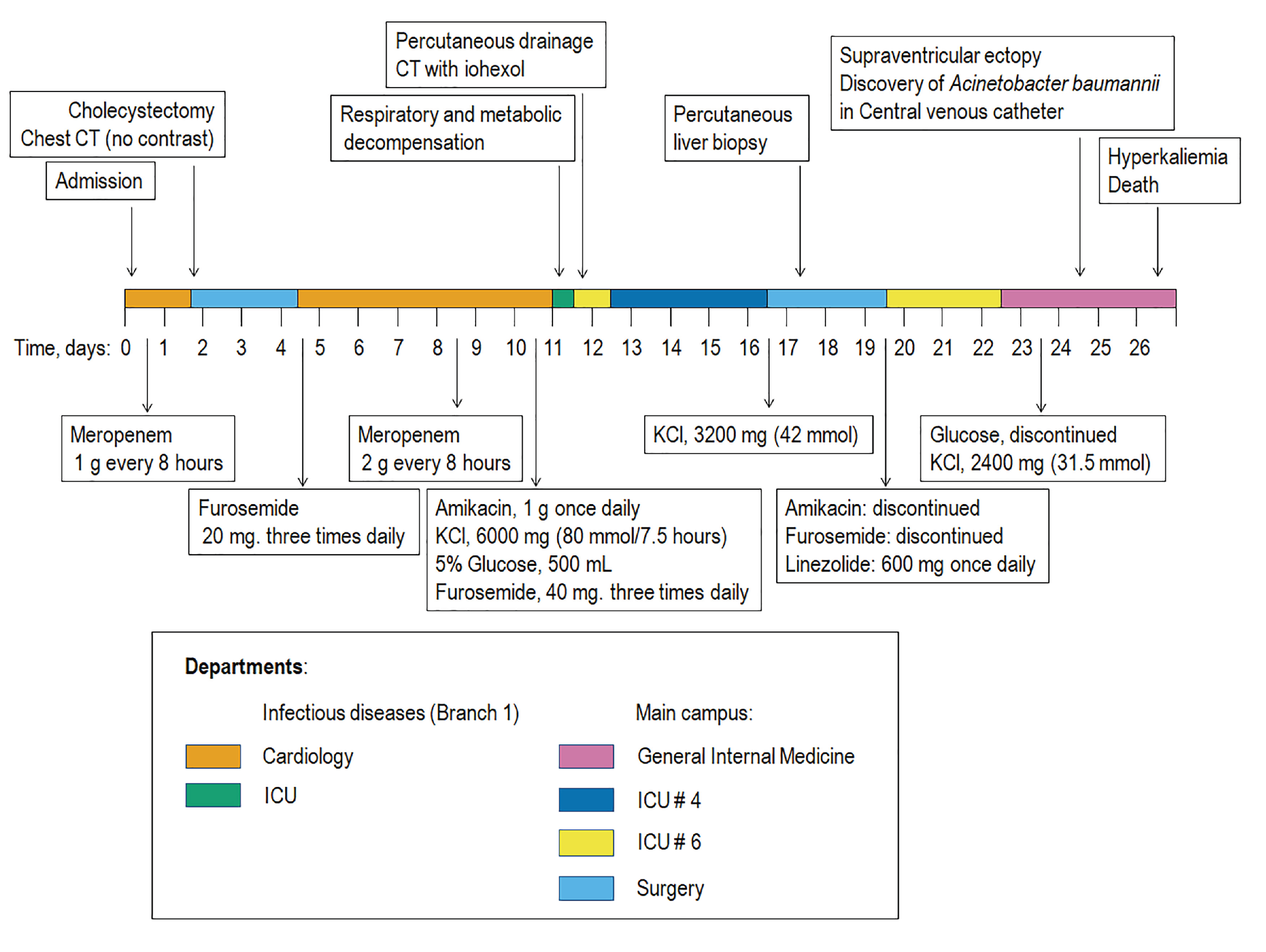
The following day (Figure 1), the patient was transferred to the Surgery Department at the main hospital campus designated for non-infectious patients for acute calculous cholecystitis and underwent cholecystectomy. The patient was subsequently returned to the Cardiology Department and continued on meropenem. Due to persistent clinical deterioration and progressive bilateral pleural effusions, the meropenem dose was escalated from 1 g to 2 g every 8 hours without adjustment for renal function. Two days later, amikacin (1 g once daily) was added. Concurrently, furosemide (40 mg three times daily) was administered for fluid overload. The patient developed hypokalaemia (serum potassium 2.5 mmol/L), prompting intravenous potassium replacement. A total of 6,000 mg (80 mmol) of potassium chloride was administered as a 150 mL infusion over 7.5 hours (rate: 20 mL/h, equivalent to ~10.7 mmol/h of potassium). This regimen exceeded typical institutional safety thresholds for potassium administration in older patients with CKD [21,22].
Following the infusion, the patient developed acute respiratory and metabolic decompensation and was urgently transferred first to the on-site intensive care unit (ICU) within the infectious diseases facility, and subsequently to the central ICU at the main hospital campus, a unit designated for non-infectious, general critical care. After temporary stabilization, an abdominal contrast-enhanced CT scan with iohexol revealed a solid liver lesion with imaging features suggestive of a malignant tumour. The patient underwent remote oncological consultation, during which the oncologist recommended gadoxetate-enhanced liver magnetic resonance imaging (MRI) to evaluate for hepatocellular carcinoma, with ultrasound-guided biopsy if clinically indicated for histological confirmation.
The following day, the patient was transferred to the Surgery Department at the main hospital campus, where the prior therapeutic regimen was resumed and a percutaneous liver biopsy was performed. Histopathological examination of three biopsy cores, each measuring up to 1.0 cm in length, was reported several days later. The report concluded that the material was insufficient for a definitive diagnosis because of extensive tumour necrosis. Only isolated residual neoplastic cells were identified. Consequently, the biopsy material was not suitable for definitive morphological classification or immunohistochemical characterisation. In the medical record, the hepatic lesion was subsequently recorded as an unclassified neoplasm of uncertain behaviour of the liver, gallbladder, and bile ducts (ICD-10 code D37.6). This designation reflected the absence of sufficient pathological material to determine the histological type and biological behaviour of the lesion definitively. The patient continued to receive intravenous meropenem 2 g every 8 hours, amikacin 1 g once daily, furosemide (40 mg three times per day), and potassium chloride (3,200 mg/day). Additionally, the patient was administered 500 mL of 5% glucose solution daily, despite persistent hyperglycaemia and hyperlactaemia documented during the ICU stay. Notably, antibiotic doses were not adjusted for the patient’s underlying CKD or evolving acute kidney injury (AKI). The combination of high-dose nephrotoxic antibiotics and aggressive electrolyte replacement, precipitated a second episode of acute clinical deterioration a few days later, necessitating readmission to the ICU.
During the ICU stay, the patient exhibited acute azotaemia, with serum creatinine increasing to 1.5 times the baseline value within 24 hours and to nearly twice the baseline value within 72 hours, reaching 91.9 µmol/L and 128 µmol/L, respectively. Serum urea exceeded 30.8 mmol/L. Liver transaminase levels were also elevated, with alanine aminotransferase (ALT) measuring 120.7 U/L and aspartate aminotransferase (AST) measuring 385.7 U/L, suggesting acute hepatocellular injury. Amikacin was discontinued because of concern for nephrotoxicity. Microbiological specimens were obtained shortly before transfer to the ICU. Five days later, microbiological culture identified Enterococcus faecium susceptible to linezolid. Treatment with linezolid, at a dose of 600 mg every 12 hours, was therefore initiated. The same specimen also yielded Pichia cactophila. This finding required confirmatory identification. Antifungal susceptibility testing was performed to assess the organism’s potential clinical significance and to guide a decision regarding antifungal treatment; however, no antifungal therapy was initiated. Following temporary clinical stabilisation, the patient was transferred to the General Internal Medicine Department at the main hospital campus for continued management.
Following transfer to the General Internal Medicine Department, the patient’s renal function continued to deteriorate. Serum creatinine reached a peak value of 135.7 µmol/L, while serum urea continued to rise and reached 39.0 mmol/L. The treating physician discontinued the glucose infusion. An electrocardiogram (ECG) demonstrated supraventricular ectopic beats. Despite this finding and the ongoing administration of potassium chloride at a daily dose of 2,400 mg, continuous cardiac monitoring was not documented. On the following day, blood cultures obtained through the central venous catheter yielded multidrug-resistant Acinetobacter baumannii. This finding raised concern for a catheter-related bloodstream infection, necessitating a clinical assessment of the catheter as a possible source. Two days later, laboratory testing demonstrated severe hyperkalaemia, with a serum potassium concentration of 6.7 mmol/L. The medical records reviewed do not document repeat potassium testing or an urgent ECG after this result was obtained. Shortly thereafter, the patient received an additional 1,600 mg of potassium chloride intravenously. The patient subsequently sustained cardiac arrest and died within hours.
A comprehensive post-mortem examination, including histopathological assessment, identified a Category I discrepancy between the clinical and pathological diagnoses. The examination revealed right-sided confluent polysegmental bronchopneumonia involving pulmonary segments II–X as the intermediate cause of death; microbiological culture of the lung tissue yielded Klebsiella pneumoniae. Taken together, these findings confirm a severe lower respiratory tract infection that had not been recognised during life. Furthermore, the principal underlying disease was identified as primary hepatocellular carcinoma, Grade 3. The tumour presented as a massive lesion of the right hepatic lobe measuring 9.0 × 6.0 × 4.0 cm, with extensive central necrosis and local invasion. The tumour directly invaded the wall of the gallbladder and the right hemidiaphragm. This extensive local tumour invasion likely accounted for the clinical presentation interpreted during life as acute cholecystitis. Finally, the autopsy identified a previously undetected low-grade endometrial stromal sarcoma of the uterine corpus, measuring 3.5 × 3.0 × 1.5 cm, which was an incidental pathological finding. The immediate cause of death was certified as terminal cardiopulmonary insufficiency.
3. Discussion
Antibiotic therapy in older adults with chronic conditions and polypharmacy carries a high risk of adverse drug reactions, drug–drug interactions, and treatment non-adherence [23]. This report describes an 88-year-old patient with stage 3A CKD who developed fatal AKI during treatment for severe CAP. This outcome was compounded by diagnostic uncertainty regarding a liver mass versus abscess, inappropriate antibiotic dosing, high-risk electrolyte management, and fragmented care. This case underscores that safe antimicrobial prescribing in this population cannot focus on the infection alone. Rather, it requires a comprehensive medication review, deliberate deprescribing, selection of antibiotics with low interaction potential, and vigilant monitoring for cascading complications. In older adults, polypharmacy is not just a risk factor. It is the essential context, in which all antimicrobial decisions must be made.
Neither meropenem nor amikacin is recommended as a first-line agent for CAP according to the international guidelines [18,19]. These guidelines reserve broad-spectrum coverage for Pseudomonas aeruginosa or MRSA only in the presence of specific risk factors and favour anti-pseudomonal β-lactams (e.g., piperacillin–tazobactam, cefepime) or fluoroquinolones over meropenem or amikacin. Amikacin, in particular, carries a high risk of nephrotoxicity, especially in older patients with impaired renal function [24]. Although “Kidney Disease: Improving Global Outcomes” (KDIGO) does not provide specific antibiotic dosing tables, it strongly advocates for cautious use and individualised dosing of renally cleared medications in the setting of kidney dysfunction.
The national clinical guidelines, Community-Acquired Pneumonia in Adults, in force during the patient’s hospitalization [25], permit the use of meropenem and amikacin in patients at high risk of pneumonia caused by Pseudomonas aeruginosa or Enterobacterales. However, Chapter 3, “Treatment,” provides that these agents should be used as part of an initial empiric combination regimen, followed by adjustment of antimicrobial therapy in accordance with the results of microbiological testing. The guidelines also recommend obtaining biological specimens from the suspected site of infection for microbiological testing before the initiation of antibacterial therapy, provided if doing so does not cause a clinically significant delay in treatment. In this case, however, the relevant specimen was obtained only on the tenth day after the patient’s admission to hospital.
Empiric antimicrobial therapy required reassessment within 48–72 hours of initiation and subsequently in light of the patient’s clinical response and available microbiological findings. In the absence of a therapeutic effect and in the context of clinical deterioration, continuation of the initial treatment strategy without a documented comprehensive reassessment was not justified. Such reassessment should have included verification of the presumed infectious diagnosis and source, evaluation of source-control measures, review of antimicrobial adequacy and dosing, and modification, discontinuation, narrowing, or expansion of therapy as clinically indicated. In the present case, despite deterioration of the patient’s condition, the previously prescribed antibiotic dose was doubled rather than undertaking a documented comprehensive reassessment of the antimicrobial regimen and the source of infection.
Standard pharmacokinetic guidance recommends dose reduction or prolongation of the dosing interval for meropenem in patients with creatinine clearance of 25–50 mL/min and for amikacin when eGFR falls below 60 mL/min/1.73 m², with therapeutic drug monitoring considered essential for aminoglycosides [7,26]. In older female patients, this risk is further compounded by a lower volume of distribution for hydrophilic antimicrobials due to a reduced percentage of total body water. Despite these established principles, and in the absence of clear indications for carbapenem or aminoglycoside therapy, meropenem was selected as the primary antimicrobial for this patient’s CAP. Moreover, rather than being reduced, the dose of meropenem was doubled two days before amikacin was initiated, even though the baseline renal function (eGFR approximately 57 mL/min/1.73 m²) was likely overestimated given the patient’s age (88 years).
The patient’s hypokalaemia (serum potassium 2.5 mmol/L) prompted intravenous replacement with 6,000 mg (80 mmol) of potassium chloride administered in 150 mL of fluid over 7.5 hours – an average infusion rate of 10.7 mmol/hour. In many Russian clinical settings, intravenous potassium chloride is routinely used even for moderate hypokalaemia, as oral formulations are typically avoided regardless of gastrointestinal function. Although this practice may explain the route of administration, it does not obviate the need for adherence to safety standards: as international guidelines require continuous ECG monitoring and serum potassium reassessment within 1-2 hours for infusions at or above 10 mmol/hour, particularly in older patients with chronic kidney disease [22,27]. In addition, 4% potassium chloride should not be administered undiluted.
Unlike the international KDIGO guidelines, which do not establish a single absolute laboratory threshold for initiating kidney replacement therapy (KRT) and instead require consideration of the broader clinical context, the trajectory of azotemia, electrolyte abnormalities, and acid–base disturbances, the Russian Clinical Guidelines for Acute Kidney Injury [28] identify a serum urea level exceeding 30 mmol/L as one of the criteria for considering the initiation of KRT in patients with progressive AKI, with the aim of preventing life-threatening complications. According to the laboratory records, the patient’s serum urea level exceeded this value during her second ICU stay. It subsequently reached a peak of 39.0 mmol/L on the General Internal Medicine ward and remained above 30.0 mmol/L for several days. At the same time, the patient demonstrated clinical deterioration and evidence of progressive organ dysfunction. A severe pain syndrome was also documented and persisted until death. Despite these findings, KRT was neither prescribed nor initiated. The absence of timely KRT may have contributed to the persistence of significant azotemia and to the lack of adequate correction of AKI-associated metabolic and electrolyte disturbances, including the hyperkalaemia documented on the day of death.
Infusions of potassium chloride were continued during the hospital course following the first ICU transfer, despite ongoing amikacin therapy and evolving renal dysfunction. Regular potassium monitoring was performed, with no severe hyperkalaemia documented until the final hospital day, when serum potassium abruptly rose to 6.7 mmol/L, likely reflecting AKI and metabolic derangements in the setting of prolonged critical illness. Despite this life-threatening value, no ECG was obtained, no repeat potassium was checked, and an additional 1,600 mg (21 mmol) of intravenous potassium chloride was administered. The patient suffered cardiac arrest shortly thereafter. This underscores a critical systems failure: despite routine monitoring, clinicians not only failed to act on a life-threatening potassium level but exacerbated the risk by administering additional potassium chloride.
The management of an indeterminate liver lesion in this patient illustrates a common but high-risk diagnostic shortcut: treating a radiologically ambiguous finding as a pyogenic abscess in the absence of microbiological confirmation or definitive imaging characteristics [29,30]. Subsequent post-mortem examination established that the lesion was a primary Grade 3 hepatocellular carcinoma measuring 9.0 × 6.0 × 4.0 cm. The tumour demonstrated extensive central necrosis and direct invasion of the gallbladder wall. These pathological findings provide a plausible explanation for why the lesion could have resembled an infectious collection and why the patient’s clinical presentation could have been interpreted as acute cholecystitis. Although markedly elevated C-reactive protein raised concern for a secondary infectious focus, this finding is non-specific in critically ill patients and cannot reliably distinguish between pyogenic abscess, necrotic malignancy, or a systemic inflammatory response [30]. In the absence of blood cultures yielding hepatobiliary pathogens and, crucially, without contrast-enhanced imaging to characterise the lesion. The clinical standards recommend that indeterminate liver lesions, particularly in older and critically ill patients, undergo contrast-enhanced multiphasic imaging before any decision is made. Guidelines from the American Association for the Study of Liver Diseases (AASLD) and the European Society of Gastrointestinal and Abdominal Radiology (ESGAR) identify hepatobiliary-specific MRI with gadoxetate as the gold standard for differentiating solid neoplasms from cystic or necrotic infectious collections [30,31]. In septic patients with significant comorbidities, misclassification of a suspicious hepatic mass as an abscess may lead to premature invasive intervention, with attendant risks of bleeding, secondary infection, bile leak, and potential tumour seeding, while also diverting clinical attention from the primary source of infection. The subsequent pathology report did not provide a definitive diagnosis. The biopsy cores were largely necrotic and contained only isolated residual neoplastic cells; therefore, the material was insufficient for morphological classification of the tumour or for immunohistochemical characterisation. Thus, the procedure established the presence of neoplastic cells but did not yield sufficient material to determine the tumour type or guide a specific oncological treatment strategy. Had contrast-enhanced MRI been performed, the solid, heterogeneously enhancing nature of the lesion would likely have prompted an oncological rather than infectious work-up, thereby avoiding an ineffective and potentially destabilising procedure.
This patient’s fatal trajectory was shaped not only by individual clinical decisions but by a cascade of systemic failures. Over twenty-seven days of hospitalisation, the patient underwent at least eight inter-unit transfers across multiple clinical departments (Figure 1), including three ICU admissions and two surgical admissions with no single team retaining longitudinal oversight. Critically, the patient was transferred to a general internal medicine ward despite a recent ICU readmission, unresolved AKI, and ongoing multidrug-resistant bacteraemia, and died four days later.
Meanwhile, the decision to initiate amikacin followed consultation with a clinical pharmacologist; however, this input was not accompanied by essential concurrent adjustments: furosemide was doubled on the same day, and a high-dose intravenous potassium chloride infusion (6,000 mg over 7.5 hours) was started despite baseline CKD and the well-documented synergistic nephrotoxicity of loop diuretics and aminoglycosides [32]. This suggests that pharmacological advice was either not operationalised, incomplete, or overridden in the absence of a closed-loop safety system.
Further compounding the risk, the patient was transferred from an infectious diseases facility to a general ICU designated for non-infectious conditions despite ongoing sepsis, raising concerns that bed logistics trumped clinical appropriateness. No formal antimicrobial stewardship protocol, renal dosing algorithm, or geriatric consultation was activated throughout the patient’s care. The absence of structured handovers and shared decision-making allowed repeated high-risk interventions to recur across settings, illustrating how fragmented care models, particularly those lacking integrated geriatric-infectious pathways, can dilute accountability and transform expert input into a performative gesture rather than an actionable safeguard.
4. Conclusions
This case illustrates how routine interventions (antibiotics, diuretics, electrolyte replacement) can become lethal in frail older adults with multimorbidity when delivered in a fragmented system. To prevent similar tragedies, the author proposes three safeguards:
- Age- and sex-adapted renal dosing protocols for medications in patients with an eGFR below age-specific thresholds (e.g., for those aged ≥65 years), using ideal body weight estimates to account for lower female muscle mass, and confirmatory cystatin C testing where creatinine-based estimates are uncertain;
- High-alert electrolyte safety bundle for older adults with CKD, mandating continuous ECG monitoring, and cautious consideration of intravenous potassium administration to mitigate hyperkalaemia risk;
- Multidisciplinary integrated care pathways that embed geriatric, infectious disease, and nephrology co-management for older adults, ensuring comprehensive longitudinal oversight, pharmacist-led deprescribing reviews, and avoidance of premature procedural interventions.
Such measures would transform reactive, compartmentalised care into proactive, patient-centred stewardship, where vulnerability is met not with protocol-driven haste, but with deliberate, multidisciplinary caution.
Author Contributions
Being the sole author of this manuscript, Dr. A. Mezentsev performed all aspects of its preparation, including Conceptualization, Methodology, Investigation, Formal Analysis, Data Curation, Writing – Original Draft, Writing – Review & Editing, and Project Administration.
Funding
This research received no external funding.
Institutional Review Board Statement
In accordance with the Declaration of Helsinki, this report presents a retrospective overview of the clinical management of a deceased patient. Institutional review board approval and specific patient consent were not required, as the study relied exclusively on de-identified clinical data collected during routine medical care, with no experimental interventions.
Informed Consent Statement
Written informed consent has been given and retained by the author.
Data Availability Statement
Data sharing is not applicable to this case report, as no new datasets were generated or analysed beyond anonymised patient records..
Conflicts of Interest
No financial conflicts of interest exist. A personal interest related to civil proceedings regarding quality of care has not influenced the presented objective clinical analysis.
Abbreviations
The following abbreviations are used in this manuscript:
| AASLD | American Association for the Study of Liver Diseases |
| AKI | Acute kidney injury |
| ALT | Alanine aminotransferase |
| AST | Aspartate aminotransferase |
| CAP | Community-acquired pneumonia |
| CKD | Chronic kidney disease |
| CRP | C-reactive protein |
| CT | Computed tomography |
| ECG | Electrocardiogram |
| eGFR | Estimated glomerular filtration rate |
| ESGAR | European Society of Gastrointestinal and Abdominal Radiology |
| ICD10 | International Classification of Diseases, 10th Revision |
| ICU | Intensive care unit |
| KDIGO | Kidney Disease: Improving Global Outcomes |
| KRT | Kidney replacement therapy |
| MRI | Magnetic resonance imaging |
References
- Pessoa, E.; Bárbara, C.; Costa, A.; Nogueira, P. Host and environmental determinants of in-hospital mortality in community-acquired pneumonia: evidence of seasonality, socioeconomic factors, and hospital differentiation in Portugal. BMC Pulm. Med. 2025, 25, 278. [Google Scholar] [CrossRef] [PubMed]
- Sharma, R.; Sandrock, C.E.; Meehan, J.; Theriault, N. Community-Acquired Bacterial Pneumonia-Changing Epidemiology, Resistance Patterns, and Newer Antibiotics: Spotlight on Delafloxacin. Clin. Drug Investig. 2020, 40, 947–960. [Google Scholar] [CrossRef] [PubMed]
- Stupka, J.E.; Mortensen, E.M.; Anzueto, A.; Restrepo, M.I. Community-acquired pneumonia in elderly patients. Aging Health 2009, 5, 763–774. [Google Scholar] [CrossRef] [PubMed]
- Putot, A.; Garin, N.; Rello, J.; Prendki, V. Comprehensive management of pneumonia in older patients. Eur. J. Intern Med. 2025, 135, 14–24. [Google Scholar] [CrossRef] [PubMed]
- Stamm, D.; Katta, S.; Stankewicz, H. Nursing Home–Acquired Pneumonia. In StatPearls [Internet]; StatPearls Publishing: Treasure Island (FL), 2025. [Google Scholar]
- Iacomelli, I.; Giordano, A.; Rivasi, G.; Rafanelli, M.; Tortù, V.; Cartei, A.; Rostagno, C.; Di Bari, M.; Marchionni, N.; Mossello, E.; et al. Low Creatinine Potentially Overestimates Glomerular Filtration Rate in Older Fracture Patients: A Plea for an Extensive Use of Cystatin C? Eur. J. Intern Med. 2021, 84, 74–79. [Google Scholar] [CrossRef] [PubMed]
- Matzke, G.R.; Aronoff, G.R.; Atkinson, A.J., Jr.; Bennett, W.M.; Decker, B.S.; Eckardt, K.U.; Golper, T.; Grabe, D.W.; Kasiske, B.; Keller, F.; et al. Drug dosing consideration in patients with acute and chronic kidney disease-a clinical update from Kidney Disease: Improving Global Outcomes (KDIGO). Kidney Int. 2011, 80, 1122–1137. [Google Scholar] [CrossRef] [PubMed]
- Pazhayattil, G.S.; Shirali, A.C. Drug-induced impairment of renal function. Int. J. Nephrol. Renov. Dis. 2014, 7, 457–468. [Google Scholar] [CrossRef] [PubMed]
- Antognini, N.; Portman, R.; Dong, V.; Webb, N.J.; Chand, D.H. Detection, Monitoring, and Mitigation of Drug-Induced Nephrotoxicity: A Pragmatic Approach. Ther. Innov. Regul. Sci. 2024, 58, 286–302. [Google Scholar] [CrossRef] [PubMed]
- Tanaka, R. Pharmacokinetic variability and significance of therapeutic drug monitoring for broad-spectrum antimicrobials in critically ill patients. J. Pharm. Health Care Sci. 2025, 11, 21. [Google Scholar] [CrossRef] [PubMed]
- Gilligan, S.; Raphael, K.L. Hyperkalemia and Hypokalemia in CKD: Prevalence, Risk Factors, and Clinical Outcomes. Adv. Chronic Kidney Dis. 2017, 24, 315–318. [Google Scholar] [CrossRef] [PubMed]
- Adedara, V.O.; Kholoki, S.; Kassar, K.; Amaechi, C.C.; Okei, J.; Ojo, O.A.; Modise, O.; Ashuarrah, B.E. Severe Hyperkalemia With Cardiac Conduction Abnormalities in a 92-Year-Old Woman: First Reported Case in Illinois, United States. Cureus 2025, 17, e95662. [Google Scholar] [CrossRef] [PubMed]
- Hogan, H.; Healey, F.; Neale, G.; Thomson, R.; Vincent, C.; Black, N. Preventable deaths due to problems in care in English acute hospitals: a retrospective case record review study. BMJ Qual. Saf. 2012, 21, 737–745. [Google Scholar] [CrossRef] [PubMed]
- Donaldson, L.J.; Panesar, S.S.; Darzi, A. Patient-safety-related hospital deaths in England: thematic analysis of incidents reported to a national database, 2010-2012. PLoS Med. 2014, 11, e1001667. [Google Scholar] [CrossRef] [PubMed]
- World Health Organization. Global burden of preventable medication-related harm in health care: A systematic review; World Health Organization: Geneva, 2022. [Google Scholar]
- Schönenberger, N.; Beck, T.; Werlen, L.; Hug, B.L.; Meyer-Massetti, C. Preventable medication-related readmissions involving older adults: a retrospective cohort analysis. Swiss Med. Wkly. 2025, 155, 4259. [Google Scholar] [CrossRef] [PubMed]
- 17. Kidney Disease: Improving Global Outcomes, C.K.D.W.G.; Stevens, P.E.; Ahmed, S.B.; Carrero, J.J.; Foster, B.; Francis, A.; Hall, R.K.; Herrington, W.G.; Hill, G.; Inker, L.A.; et al. KDIGO 2024 Clinical Practice Guideline for the Evaluation and Management of Chronic Kidney Disease. Kidney Int. 2024, 105, S117–S314. [Google Scholar] [CrossRef] [PubMed]
- Metlay, J.P.; Waterer, G.W.; Long, A.C.; Anzueto, A.; Brozek, J.; Crothers, K.; Cooley, L.A.; Dean, N.C.; Fine, M.J.; Flanders, S.A.; et al. Diagnosis and Treatment of Adults with Community-acquired Pneumonia. An Official Clinical Practice Guideline of the American Thoracic Society and Infectious Diseases Society of America. Am. J. Respir. Crit. Care Med. 2019, 200, e45–e67. [Google Scholar] [CrossRef] [PubMed]
- Albarillo, F.; Burdette, S.; Doron, S.; File, T.; Hseuh, K.; Laguio-Vila, M.; Mahoney, M.; Nagel, J.; Pulia, M.; Vaughn, V. Clinical Pathway for Community-Acquired Pneumonia in Adults; Infectious Diseases Society of America: Arlington, VA, 2023; pp. 1–8. [Google Scholar]
- Hoffmann, U. [Evaluating Kidney Function in older Adults - how to ensure accurate Assessment]. Dtsch. Med. Wochenschr. 2025, 150, 1397–1402. [Google Scholar] [CrossRef] [PubMed]
- Kim, M.J.; Valerio, C.; Knobloch, G.K. Potassium Disorders: Hypokalemia and Hyperkalemia. Am. Fam. Physician 2023, 107, 59–70. [Google Scholar] [PubMed]
- Sur, M.; Mohiuddin, S.S. Potassium. In StatPearls [Internet]; StatPearls Publishing: Treasure Island (FL), 2025. [Google Scholar]
- Womack, J.; Kropa, J. Community-Acquired Pneumonia in Adults: Rapid Evidence Review. Am. Fam. Physician 2022, 105, 625–630. [Google Scholar] [PubMed]
- Kidney Disease: Improving Global Outcomes Acute Kidney Injury Work Group. KDIGO Clinical Practice Guideline for Acute Kidney Injury. Kidney Inter 2012, 2, 1–138. [CrossRef]
- Russian Respiratory Society; Interregional Association for Clinical Microbiology; Antimicrobial Chemotherapy. Community-acquired pneumonia in adults: Clinical recommendations. Available online: https://spulmo.ru/upload/KR-vnebolnichnaya-pnevmoniya-u-vzroslyh-2024.pdf (accessed on 2026 Sep 2).
- Robinson, R. Antimicrobial Dosing in Adults with Renal Impairment; Public Health Wales: Cardiff, Wales, 2024; pp. 1–18. [Google Scholar]
- Treating acute hypokalaemia in adults. Available online: https://www.sps.nhs.uk/articles/hypokalaemia/ (accessed on 12.12.2025).
- Association of Nephrologists; Russian Scientific Society of Nephrologists; Russian Association of Anesthesiologists Reanimatologists; National Society of Professionals in Apheresis Extracorporeal Hemocorrection. Acute kidney injury: Clinical recommendations. Available online: https://rusnephrology.org/wp-content/uploads/2020/12/AKI_final.pdf (accessed on 2026 Sep 2).
- Reid-Lombardo, K.M.; Khan, S.; Sclabas, G. Hepatic cysts and liver abscess. Surg. Clin. North Am. 2010, 90, 679–697. [Google Scholar] [CrossRef] [PubMed]
- Frenette, C.; Mendiratta-Lala, M.; Salgia, R.; Wong, R.J.; Sauer, B.G.; Pillai, A. ACG Clinical Guideline: Focal Liver Lesions. Am. J. Gastroenterol. 2024, 119, 1235–1271. [Google Scholar] [CrossRef] [PubMed]
- Rosiak, G.; Podgorska, J.; Rosiak, E.; Cieszanowski, A. Comparison of LI-RADS v.2017 and ESGAR Guidelines Imaging Criteria in HCC Diagnosis Using MRI with Hepatobiliary Contrast Agents. BioMed Res. Int. 2018, 2018, 7465126. [Google Scholar] [CrossRef] [PubMed]
- Mingeot-Leclercq, M.P.; Tulkens, P.M. Aminoglycosides: nephrotoxicity. Antimicrob. Agents Chemother. 1999, 43, 1003–1012. [Google Scholar] [CrossRef] [PubMed]
Figure 1.
Timeline of key clinical events, interventions, and outcomes in an 88-year-old patient admitted to a large multidisciplinary clinical centre with suspected infectious disease. The upper segment of the horizontal bar depicts the patient’s intrahospital trajectory across departments; the lower segment indicates the duration of stay in each designated unit, with Day 0 denoting the day of admission. Vertical markers above the bar represent significant clinical events and procedural interventions; those below indicate initiation, discontinuation, or adjustment of therapeutic agents, with drug names and doses specified where applicable. This synthesis illustrates how sequential, routine clinical decisions, in the absence of coordinated geriatric and antimicrobial stewardship, contributed to an avoidable adverse outcome.
Figure 1.
Timeline of key clinical events, interventions, and outcomes in an 88-year-old patient admitted to a large multidisciplinary clinical centre with suspected infectious disease. The upper segment of the horizontal bar depicts the patient’s intrahospital trajectory across departments; the lower segment indicates the duration of stay in each designated unit, with Day 0 denoting the day of admission. Vertical markers above the bar represent significant clinical events and procedural interventions; those below indicate initiation, discontinuation, or adjustment of therapeutic agents, with drug names and doses specified where applicable. This synthesis illustrates how sequential, routine clinical decisions, in the absence of coordinated geriatric and antimicrobial stewardship, contributed to an avoidable adverse outcome.
Disclaimer/Publisher’s Note: The statements, opinions and data contained in all publications are solely those of the individual author(s) and contributor(s) and not of MDPI and/or the editor(s). MDPI and/or the editor(s) disclaim responsibility for any injury to people or property resulting from any ideas, methods, instructions or products referred to in the content. |
© 2026 by the authors. Licensee MDPI, Basel, Switzerland. This article is an open access article distributed under the terms and conditions of the Creative Commons Attribution (CC BY) license (http://creativecommons.org/licenses/by/4.0/).
Copyright: This open access article is published under a Creative Commons CC BY 4.0 license, which permit the free download, distribution, and reuse, provided that the author and preprint are cited in any reuse.