
Submitted:
09 September 2026
Posted:
10 September 2026
You are already at the latest version
Abstract
Background/Objectives: Intravesical bacillus Calmette-Guérin (BCG) adverse events are often combined into a single outcome, although local symptoms, systemic toxicity, severe toxicity, and treatment-limiting intolerance have different clinical implications. We evaluated whether diabetes mellitus, recent urinary tract infection (UTI), age, baseline renal function, and baseline bladder capacity were differentially associated with these toxicity phenotypes. Methods: This retrospective exploratory cohort included 67 adults with intermediate- or high-risk non-muscle-invasive bladder cancer who received intravesical BCG at Bamenda Regional Hospital and Nkwen Baptist Hospital, Cameroon, from November 2020 to November 2025. Local-only toxicity required local symptoms without systemic toxicity. Clinically consequential intolerance comprised dose reduction, temporary interruption, permanent discontinuation, or documented poor tolerance. Five prespecified host factors were entered simultaneously into separate Jeffreys-prior penalized logistic regressions. Odds ratios (ORs) were scaled per 10 years of age, 0.1 mg/dL creatinine, and 50 mL bladder capacity; percentile intervals were obtained from 200 bootstrap resamples. Results: Mean age was 64.9 years; 14/67 (20.9%) had diabetes and 14/67 (20.9%) had a UTI within the preceding six months. Local toxicity occurred in 42 (62.7%), including 35 (52.2%) with local-only toxicity. Systemic toxicity occurred in 10 (14.9%), Grade III-IV toxicity in 6 (9.0%), and consequential intolerance in 19 (28.4%); 14 (20.9%) interrupted treatment and 3 (4.5%) permanently discontinued. Diabetes was inversely associated with local-only toxicity (adjusted OR 0.13, bootstrap 95% interval 0.02-0.53) but showed an imprecise positive association with systemic toxicity (OR 1.80, 0.28-17.05). Higher creatinine showed a positive, imprecise association with systemic toxicity (OR 1.67 per 0.1 mg/dL, 0.84-3.87), while older age showed an imprecise association with Grade III-IV toxicity (OR 2.81 per decade, 0.69-127.98). No prespecified factor consistently predicted consequential intolerance. Conclusions: Separating toxicity phenotypes revealed non-parallel host-factor associations that would be obscured by an any-toxicity endpoint. The estimates are exploratory and require prospective validation, but support phenotype-specific surveillance and standardized recording of treatment modification during BCG therapy.
Keywords:
adverse events
; bacillus Calmette-Guérin
; Cameroon
; non-muscle-invasive bladder cancer
; treatment interruption
; treatment tolerance
1. Introduction
Intravesical bacillus Calmette-Guérin (BCG) remains a cornerstone of adjuvant therapy for intermediate- and high-risk non-muscle-invasive bladder cancer (NMIBC). Contemporary guidance recommends a six-week induction course followed by risk-adapted maintenance, because adequate BCG exposure improves recurrence control compared with induction alone or transurethral resection alone [1,2,3]. This benefit must be balanced against treatment-related inflammation, recurrent visits, access constraints, and local or systemic adverse events that may compromise delivery.
BCG toxicity is common but heterogeneous. In EORTC 30962, 62.8% of patients experienced local adverse events, 30.6% systemic adverse events, and 7.8% stopped BCG because of toxicity [4]. Severe complications and systemic BCG infection are much less frequent, but may be life-threatening [1,5,6]. A 2025 systematic review reported a mean dropout rate of 12.8% due to BCG intolerance, while emphasizing wide variation in definitions, schedules, and adverse-event reporting [7]. Thus, a prevalence estimate depends not only on the population and regimen but also on whether investigators count transient urinary symptoms, fever, high-grade organ toxicity, or treatment cessation.
Combining these events into a single binary outcome assumes a shared mechanism and clinical consequence. However, irritative cystitis may accompany the intended mucosal immune response and remain manageable; systemic manifestations raise concern for exaggerated inflammation or dissemination; severe Grade III-IV events require escalation of care; and intolerance is defined by its effect on treatment delivery rather than anatomical location alone [5,8]. Phenotype separation may therefore reveal opposing or outcome-specific associations that are diluted in an any-toxicity analysis.
Host vulnerability is clinically relevant, particularly in settings where delayed microbiology, restricted BCG supply, and limited alternatives to bladder preservation magnify the consequences of interrupted treatment. Diabetes may modify innate and adaptive immunity; symptomatic UTI or traumatic instrumentation may facilitate systemic exposure; renal dysfunction may reduce physiological reserve; reduced bladder capacity may intensify storage symptoms; and older age may affect recovery from inflammatory illness. Yet the evidence remains inconsistent. Age alone has not reliably predicted BCG toxicity [9], and asymptomatic bacteriuria appears distinct from active symptomatic infection [10,11,12]. Contemporary data also suggest that baseline urinary symptom burden, tumour size, and carcinoma in situ may predict adverse events [13], underscoring the need to study clearly specified phenotypes and covariates.
We therefore evaluated whether five prespecified host factors - diabetes, recent UTI, age, baseline creatinine, and baseline bladder capacity - showed divergent associations with local-only toxicity, systemic toxicity, Grade III-IV toxicity, and clinically consequential intolerance during intravesical BCG therapy at two hospitals in Cameroon. We hypothesized that predictors would differ across phenotypes and that symptom occurrence would not be interchangeable with treatment modification.
2. Materials and Methods
2.1. Study Design and Setting
We conducted a retrospective, two-centre exploratory cohort study at the Urology Units of Bamenda Regional Hospital and Nkwen Baptist Hospital in Bamenda, North-West Cameroon. The study covered BCG treatment delivered from November 2020 to November 2025. Reporting was guided by the Strengthening the Reporting of Observational Studies in Epidemiology (STROBE) statement [14].
2.2. Participants and Treatment Exposure
Eligible participants were adults with intermediate- or high-risk NMIBC who received at least one intravesical BCG instillation during the study period. Patients were identified from urology clinical records and BCG treatment registers. The cohort contained 67 patients. Cumulative instillations and completion of the six-week induction course were treated as measures of treatment exposure and were not included as baseline predictors because they could be consequences of toxicity.
2.3. Prespecified Host Factors
The five candidate predictors were selected a priori on clinical grounds and from variables consistently available in the records: diabetes mellitus (yes/no), UTI within the preceding six months (yes/no), age (years), baseline serum creatinine (mg/dL), and baseline bladder capacity (mL). Hypertension and NMIBC risk category were described but excluded from the primary multivariable analyses to limit overfitting. Serum creatinine was used as recorded because information required to ensure uniform retrospective eGFR calculation, including assay standardization, was unavailable.
2.4. Toxicity Phenotypes and Definitions
Local toxicity comprised documented cystitis, frequency/urgency, or haematuria. Local-only toxicity required local toxicity without a systemic adverse event. Systemic toxicity was defined by the recorded systemic adverse-event field, represented in this dataset by fever or malaise, irrespective of concurrent local symptoms. Severe toxicity was defined by a maximum recorded Grade III or IV event. Clinically consequential intolerance was a pragmatic composite of dose reduction, temporary interruption, permanent discontinuation, or documented poor tolerance. This composite describes compromised treatment delivery and is not synonymous with BCG-unresponsive disease, which is an oncological response category [1,15].
2.5. Statistical Analysis
Continuous variables are summarized using mean and standard deviation (SD) and, where appropriate, median and interquartile range (IQR); categorical variables are presented as number and percentage. Phenotype frequencies used 67 as the denominator. Unadjusted binary comparisons used Fisher exact tests. For each outcome, a separate multivariable model simultaneously included all five prespecified predictors. Jeffreys-prior penalized logistic regression was used to reduce small-sample and separation bias. Continuous effects were scaled per 10-year increase in age, 0.1 mg/dL increase in creatinine, and 50 mL increase in bladder capacity. Percentile uncertainty intervals were generated from 200 bootstrap resamples using a fixed seed. Because only 10 systemic and six severe events occurred, all multivariable estimates were considered exploratory. No automated variable selection or multiplicity correction was applied; interpretation emphasized effect magnitude, direction, and precision rather than statistical significance alone.
2.6. Ethical Considerations
The study protocol was reviewed and approved by the Cameroon Baptist Convention Health Services Institutional Review Board (CBCHS IRB No. 045/2025; 12 November 2025). Data were analysed in de-identified form and handled confidentially in accordance with the approved protocol.
3. Results
3.1. Cohort Characteristics and BCG Exposure
The cohort included 67 patients, of whom 52 (77.6%) were male and 45 (67.2%) had high-risk NMIBC. Mean age was 64.9 years (SD 7.0), mean bladder capacity was 330.5 mL (SD 53.6), and mean baseline creatinine was 0.99 mg/dL (SD 0.11). Diabetes and UTI within the preceding six months were each present in 14 patients (20.9%). Patients received a median of 9 BCG instillations (IQR 6-12; range 2-18), and 58 (86.6%) completed the six-week induction course (Table 1).
3.2. Toxicity Burden and Phenotype Distribution
Any local toxicity occurred in 42 patients (62.7%): cystitis in 34 (50.7%), frequency/urgency in 25 (37.3%), and haematuria in 16 (23.9%). Thirty-five patients (52.2%) had a local-only phenotype. Systemic toxicity occurred in 10 patients (14.9%); seven of them also had local toxicity. Maximum toxicity grade was I in 21 (31.3%), II in 18 (26.9%), III in five (7.5%), and IV in one (1.5%).
Clinically consequential intolerance occurred in 19 patients (28.4%). Fourteen (20.9%) interrupted treatment: 11 temporarily and three permanently. Seven (10.4%) received a dose reduction. Interruption occurred in 12/35 patients with local-only toxicity and 2/10 with systemic toxicity, illustrating that symptom location and treatment consequence were not interchangeable (Table 2; Figure 1).
3.3. Host Factors and Divergent Toxicity Phenotypes
In unadjusted analysis, local-only toxicity occurred in 3/14 patients with diabetes (21.4%) versus 32/53 without diabetes (60.4%; Fisher OR 0.18; p = 0.015). After joint adjustment, diabetes remained inversely associated with local-only toxicity (OR 0.13; bootstrap 95% interval 0.02-0.53). In contrast, diabetes had a positive but highly imprecise association with systemic toxicity (OR 1.80; 0.28-17.05).
Mean creatinine was 1.05 mg/dL among patients with systemic toxicity and 0.98 mg/dL among those without; the adjusted OR was 1.67 per 0.1 mg/dL (0.84-3.87). Patients with Grade III-IV toxicity were older than those without severe toxicity (mean 71.3 vs. 64.2 years), but the adjusted estimate was very imprecise (OR 2.81 per decade; 0.69-127.98). Mean bladder capacity was lower among severe cases (305.5 vs. 333.0 mL), although the adjusted OR per 50 mL was 0.86 (0.37-2.77).
Recent UTI did not show a positive association with systemic toxicity and was inversely associated with consequential intolerance (OR 0.23; 0.03-0.72). This unexpected direction may reflect selection, treatment deferral after infection, exposure misclassification, or chance. No prespecified factor demonstrated a stable positive association with consequential intolerance (Table 3).
4. Discussion
4.1. Principal Findings
This two-centre study provides a phenotype-based account of BCG toxicity in a Cameroonian cohort. Three findings are notable. First, adverse events were common but predominantly local and low grade: almost two-thirds experienced local toxicity, whereas 9.0% reached Grade III-IV. Second, host-factor directions differed by outcome. Diabetes was associated with fewer local-only symptoms yet showed a positive, imprecise association with systemic toxicity; creatinine showed its clearest positive signal for systemic rather than local toxicity; and age showed its largest estimate for severe toxicity. Third, treatment-modifying intolerance was not explained by the same factors that characterized symptom phenotypes. These observations support separating anatomical phenotype, severity, and effect on treatment delivery.
4.2. Benchmarking the Toxicity Burden
Our 62.7% local-toxicity frequency is almost identical to the 62.8% reported in EORTC 30962 [4], supporting the clinical plausibility of frequent irritative symptoms during BCG. The pattern of individual symptoms was also expected: cystitis was most common (50.7%), followed by frequency/urgency (37.3%) and haematuria (23.9%). These values fall within the broad ranges reported across clinical series and reviews, where local cystitis-type reactions substantially outnumber serious complications [5,8,16].
Systemic toxicity occurred in 14.9%, approximately half the 30.6% reported in EORTC 30962 [4]. The lower frequency may reflect our narrower systemic definition, retrospective under-ascertainment of short-lived malaise, differences in BCG schedule or strain, or variation in supportive care. Conversely, our Grade III-IV frequency of 9.0% exceeds the <5% serious-adverse-event estimate summarized in current EAU guidance [1]. Only six severe events occurred, so the percentage is unstable; nevertheless, it highlights the need for reliable early recognition and escalation pathways in resource-constrained services. Systemic BCG infection is typically reported in only 1-2% of exposed patients [1], and our dataset did not permit etiological separation of culture-negative inflammatory fever from disseminated infection.
Permanent discontinuation occurred in 4.5%, below the 7.8% toxicity-related cessation in EORTC 30962 [4] and the 12.8% mean dropout estimated by Oh and colleagues across 22 studies [7]. However, our broader consequential-intolerance composite reached 28.4%, because it included dose reduction and temporary interruption. This difference is methodologically important: discontinuation alone underestimates the operational burden of toxicity, while a broad composite may mix events of unequal severity. Reporting each component alongside the composite, as done here, makes comparisons more transparent. It also matters clinically because full maintenance schedules have low completion rates even in trials; only 34% completed three years in EORTC 30962, with 10% discontinuing because of toxicity [3].
A recent 276-patient retrospective study by Aksakalli et al. reported BCG-related local or systemic side effects in only 8.3%, far below our any-local-toxicity rate [13]. Their endpoint appears to have captured clinically recognized adverse-event presentations rather than every recorded irritative symptom. High baseline International Prostate Symptom Score, larger tumours, and carcinoma in situ independently predicted side effects [13]. Our dataset lacked these tumour- and symptom-level covariates, but baseline bladder capacity was included as a functional proxy and showed no stable independent association. The contrast reinforces that predictor studies should harmonize symptom ascertainment and adjust for baseline urinary symptom burden and disease phenotype.
4.3. Diabetes, Renal Function, and Phenotype Divergence
The inverse association between diabetes and local-only toxicity should not be interpreted as biological protection. Diabetes could plausibly blunt symptom perception or local inflammatory expression, while simultaneously increasing vulnerability to infection or systemic illness; however, retrospective ascertainment, treatment selection, unrecorded glycaemic control, and chance are equally credible explanations. The opposing adjusted directions for local-only and systemic toxicity illustrate the principal analytic argument of this study: an any-toxicity endpoint could average away clinically distinct signals. Prospective research should capture diabetes duration, treatment, glycated haemoglobin, neuropathy, and immunosuppressive comorbidity before mechanistic conclusions are drawn.
Baseline creatinine showed a positive but imprecise association with systemic toxicity. This finding is clinically plausible as a marker of reduced reserve, but creatinine is influenced by age, sex, and muscle mass and is not equivalent to measured renal function. Current evidence linking renal indices specifically to BCG toxicity is limited; many publications focus instead on oncological outcomes or rare renal complications [6,17]. Our estimate should therefore be treated as a signal for validation using standardized CKD-EPI eGFR, albuminuria, baseline chronic kidney disease stage, and longitudinal renal measurements. The narrow creatinine distribution in this cohort also limits discrimination.
4.4. Age and Bladder Capacity
Patients with Grade III-IV toxicity were older by approximately seven years, and age had the largest positive estimate for severe toxicity, but the interval was extremely wide. Matsuoka et al. found no overall increase in BCG toxicity among patients aged 75 years or older, although moderate-to-severe dysuria was more frequent in older patients [9]. Current EAU guidance similarly states that elderly patients do not appear to have more adverse events leading to discontinuation [1]. Our findings do not contradict that evidence because they concern only six severe events and do not support age as a stand-alone exclusion criterion. Frailty, performance status, cognition, renal reserve, and comorbidity burden are likely more informative than chronological age alone.
Mean bladder capacity was lower among severe cases, but capacity was not independently associated with any outcome. A reduced functional capacity could increase exposure-related urgency, frequency, and pain, yet retrospective estimates may be imprecise and influenced by baseline cystitis, tumour burden, or measurement technique. Future studies should distinguish cystometric capacity, frequency-volume-chart capacity, and clinician-estimated capacity, while also measuring baseline IPSS or validated bladder-symptom scores. This would allow direct comparison with the symptom-burden signal described by Aksakalli et al. [13].
4.5. UTI, Bacteriuria, and Treatment Safety
Recent UTI was not positively associated with systemic toxicity and was inversely associated with consequential intolerance. This unexpected result should not be used to justify BCG administration during symptomatic infection. Treatment may have been deferred until infection resolved, creating a selected lower-risk exposed group; the six-month binary variable also did not distinguish culture-confirmed infection, recurrence, antimicrobial treatment, or proximity to instillation. EAU guidance lists symptomatic UTI, visible haematuria, traumatic catheterisation, and the first two weeks after TURBT as absolute contraindications to BCG instillation [1].
This should be distinguished from asymptomatic bacteriuria. Herr reported acceptable BCG outcomes in patients with asymptomatic bacteriuria [10], and Poletajew et al. found no evidence in a systematic review that asymptomatic bacteriuria worsened BCG safety or efficacy [11]. More recent observational data likewise suggest similar tolerability and discontinuation rates in asymptomatic bacteriuria [12]. These studies address colonization without symptoms, not recent symptomatic UTI, and should not be extrapolated across those clinically different exposures.
4.6. Clinical and Research Implications
A phenotype-aware surveillance approach is feasible even where resources are constrained. Baseline diabetes and renal function may justify closer monitoring for systemic illness without assuming that urinary symptoms will be more frequent. Older or physiologically vulnerable patients may benefit from lower thresholds for clinical review. Reduced capacity or substantial baseline storage symptoms should prompt anticipatory counselling and early symptom management. Recent symptomatic UTI should trigger culture-directed evaluation and treatment deferral, while persistent fever above 38.5 °C for more than 48 hours requires permanent BCG discontinuation and urgent evaluation under current guidance [1].
Treatment tolerance should be documented at each instillation using four linked elements: symptom phenotype, maximum grade, management, and effect on delivery. Recording exact dates and counts of delivered, delayed, reduced, interrupted, and discontinued instillations would align toxicity with the concept of adequate BCG exposure [1,15]. Patient-reported symptom instruments may improve capture of short-lived events that are missed in retrospective files [18]. Multicentre prospective African cohorts should additionally record BCG strain and dose, catheter trauma, urine culture results, antibiotic exposure, tumour stage and grade, carcinoma in situ, re-resection, and time-to-event data.
4.7. Strengths and Limitations
The principal strength is the prespecified separation of four outcomes that are frequently conflated, together with penalized estimation suited to sparse events. The study also avoids adjusting for cumulative instillations, which may be a consequence rather than a cause of toxicity, and provides two-centre data from a setting underrepresented in the BCG literature.
Several limitations require emphasis. The retrospective sample was small, and systemic and severe-event analyses were underpowered; bootstrap intervals were consequently wide and unstable. The findings are exploratory associations and do not establish causation or provide a clinically deployable prediction tool. Toxicity ascertainment depended on routine documentation, and fever/malaise did not distinguish inflammatory reactions from confirmed BCG infection. Creatinine was an incomplete measure of renal function, while recent UTI and bladder capacity lacked detailed standardized definitions. Data were unavailable for BCG strain and dose, culture confirmation, antibiotic exposure, tumour stage/grade and carcinoma in situ, re-resection, catheter trauma, baseline symptom scores, frailty, concomitant medicines, hospitalization, and timing of toxicity relative to individual instillations. The intolerance composite grouped treatment actions of different clinical weight, although its components were reported separately. Finally, site-specific effects could not be estimated within the available sample.
5. Conclusions
Separating local-only symptoms, systemic manifestations, severe events, and treatment-modifying intolerance revealed non-parallel and imprecise host-factor associations during intravesical BCG therapy. Diabetes was inversely associated with local-only toxicity, creatinine showed a possible systemic-toxicity signal, and age showed a possible severe-toxicity signal, while no factor consistently predicted consequential intolerance. These findings support standardized phenotype-specific monitoring and justify prospective multicentre validation rather than immediate risk-based treatment restriction.
Author Contributions
Author Contributions: Conceptualization, Titus Ngwa-Ebogo and Fru Angwafo III; methodology, Titus Ngwa-Ebogo, Landry Mbouche and Fru Angwafo III; investigation, Titus Ngwa-Ebogo, Arielle Ngongang, Marie Manka’a and Sango Djibril Nforka; data curation, Titus Ngwa-Ebogo, Arielle Ngongang, Marie Manka’a and Sango Djibril Nforka; formal analysis, Titus Ngwa-Ebogo and Yannick Tandu; interpretation of findings, Titus Ngwa-Ebogo, Yannick Tandu, Landry Mbouche and Fru Angwafo III; writing—original draft preparation, Titus Ngwa-Ebogo; writing—review and editing, Yannick Tandu, Arielle Ngongang, Marie Manka’a, Sango Djibril Nforka, Landry Mbouche and Fru Angwafo III; supervision, Titus Ngwa-Ebogo and Fru Angwafo III. All authors have read and approved the final version of the manuscript and agree to be accountable for the work.
Funding
This research received no external funding.
Institutional Review Board Statement
The study was approved by the Cameroon Baptist Convention Health Services Institutional Review Board (CBCHS IRB No. 045/2025; 12 November 2025).
Informed Consent Statement
Not applicable.
Data Availability Statement
The de-identified data supporting the findings are available from the corresponding author on reasonable request, subject to institutional and ethical requirements.
Conflicts of Interest
The authors declare no conflicts of interest.
References
- European Association of Urology. EAU Guidelines on Non-muscle-invasive Bladder Cancer. 2026 update. Available online: https://uroweb.org/guidelines/non-muscle-invasive-bladder-cancer (accessed on 24 August 2026).
- Lamm, D.L.; Blumenstein, B.A.; Crissman, J.D.; et al. Maintenance bacillus Calmette-Guerin immunotherapy for recurrent Ta, T1 and carcinoma in situ transitional cell carcinoma of the bladder: A randomized Southwest Oncology Group study. J. Urol. 2000, 163, 1124–1129. [Google Scholar] [CrossRef]
- Oddens, J.; Brausi, M.; Sylvester, R.; et al. Final results of an EORTC-GU cancers group randomized study of maintenance bacillus Calmette-Guerin in intermediate- and high-risk Ta, T1 papillary carcinoma of the urinary bladder: One-third dose versus full dose and 1 year versus 3 years of maintenance. Eur. Urol. 2013, 63, 462–472. [Google Scholar] [CrossRef] [PubMed]
- Brausi, M.; Oddens, J.; Sylvester, R.; et al. Side effects of bacillus Calmette-Guerin in the treatment of intermediate- and high-risk Ta, T1 papillary carcinoma of the bladder: Results of the EORTC genito-urinary cancers group randomised phase 3 study. Eur. Urol. 2014, 65, 69–76. [Google Scholar] [CrossRef] [PubMed]
- Decaestecker, K.; Oosterlinck, W. Managing the adverse events of intravesical bacillus Calmette-Guerin therapy. Res. Rep. Urol. 2015, 7, 157–163. [Google Scholar] [CrossRef] [PubMed]
- Perez-Jacoiste Asin, M.A.; Fernandez-Ruiz, M.; Lopez-Medrano, F.; et al. Bacillus Calmette-Guerin infection following intravesical BCG administration as adjunctive therapy for bladder cancer: Incidence, risk factors, and outcome in a single-institution series and review of the literature. Medicine 2014, 93, 236–254. [Google Scholar] [CrossRef] [PubMed]
- Oh, C.; Bourlotos, G.; O’Callaghan, M.; Grundy, L.; Hong, M. BCG intolerance in nonmuscle invasive bladder cancer: A systematic review. ANZ J. Surg. 2025, 95, 2460–2467. [Google Scholar] [CrossRef] [PubMed]
- Jiang, S.; Redelman-Sidi, G. BCG in bladder cancer immunotherapy. Cancers 2022, 14, 3073. [Google Scholar] [CrossRef] [PubMed]
- Matsuoka, Y.; Taoka, R.; Kohashiguchi, K.; et al. Efficacy and toxicity of intravesical bacillus Calmette-Guerin therapy in elderly patients with non-muscle-invasive bladder cancer. Curr. Urol. 2021, 15, 16–21. [Google Scholar] [CrossRef] [PubMed]
- Herr, H.W. Intravesical bacille Calmette-Guerin outcomes in patients with bladder cancer and asymptomatic bacteriuria. J. Urol. 2012, 187, 435–437. [Google Scholar] [CrossRef] [PubMed]
- Poletajew, S.; Zapala, P.; Radziszewski, P. Safety and efficacy of intravesical bacillus Calmette-Guerin immunotherapy in patients with non-muscle-invasive bladder cancer presenting with asymptomatic bacteriuria: A systematic review. Urol. Int. 2017, 99, 1–5. [Google Scholar] [CrossRef] [PubMed]
- Nummi, A.; Nurminen, P.; Kesti, O.; et al. Impact of asymptomatic bacteriuria on the outcomes and tolerability of bacillus Calmette-Guerin immunotherapy. Scand. J. Urol. 2026, 61, 148–155. [Google Scholar] [CrossRef] [PubMed]
- Aksakalli, T.; Utlu, A.; Celik, F.; et al. Factors predicting local or systemic side effects related to intravesical BCG therapy: A retrospective observational study. BMC Urol. 2025, 25, 49. [Google Scholar] [CrossRef] [PubMed]
- von Elm, E.; Altman, D.G.; Egger, M.; et al. The Strengthening the Reporting of Observational Studies in Epidemiology (STROBE) statement: Guidelines for reporting observational studies. Lancet 2007, 370, 1453–1457. [Google Scholar] [CrossRef] [PubMed]
- Kamat, A.M.; Sylvester, R.J.; Bohle, A.; et al. Definitions, end points, and clinical trial designs for non-muscle-invasive bladder cancer: Recommendations from the International Bladder Cancer Group. J. Clin. Oncol. 2016, 34, 1935–1944. [Google Scholar] [CrossRef] [PubMed]
- Morales, A.; Eidinger, D.; Bruce, A.W. Intracavitary bacillus Calmette-Guerin in the treatment of superficial bladder tumors. J. Urol. 1976, 116, 180–183. [Google Scholar] [CrossRef] [PubMed]
- Liu, Y.; Lu, J.; Huang, Y.; Ma, L. Clinical spectrum of complications induced by intravesical immunotherapy of bacillus Calmette-Guerin for bladder cancer. J. Oncol. 2019, 2019, 6230409. [Google Scholar] [CrossRef] [PubMed]
- Tinay, I.; et al. Symptoms and side effects of bacille Calmette-Guerin therapy for non-muscle-invasive bladder cancer: The patients’ perspective. Cancers 2025, 17, 160. [Google Scholar] [CrossRef] [PubMed]
- Kamat, A.M.; Li, R.; O’Donnell, M.A.; et al. Predicting response to intravesical bacillus Calmette-Guerin immunotherapy: Are we there yet? A systematic review. Eur. Urol. 2018, 73, 738–748. [Google Scholar] [CrossRef] [PubMed]
- Chang, S.S.; Boorjian, S.A.; Chou, R.; et al. Diagnosis and treatment of non-muscle invasive bladder cancer: AUA/SUO guideline. J. Urol. 2016, 196, 1021–1029. [Google Scholar] [CrossRef] [PubMed]
Figure 1.
Frequency of prespecified BCG toxicity phenotypes. Systemic toxicity could coexist with local toxicity; consequential intolerance was defined by treatment modification or documented poor tolerance.
Figure 1.
Frequency of prespecified BCG toxicity phenotypes. Systemic toxicity could coexist with local toxicity; consequential intolerance was defined by treatment modification or documented poor tolerance.
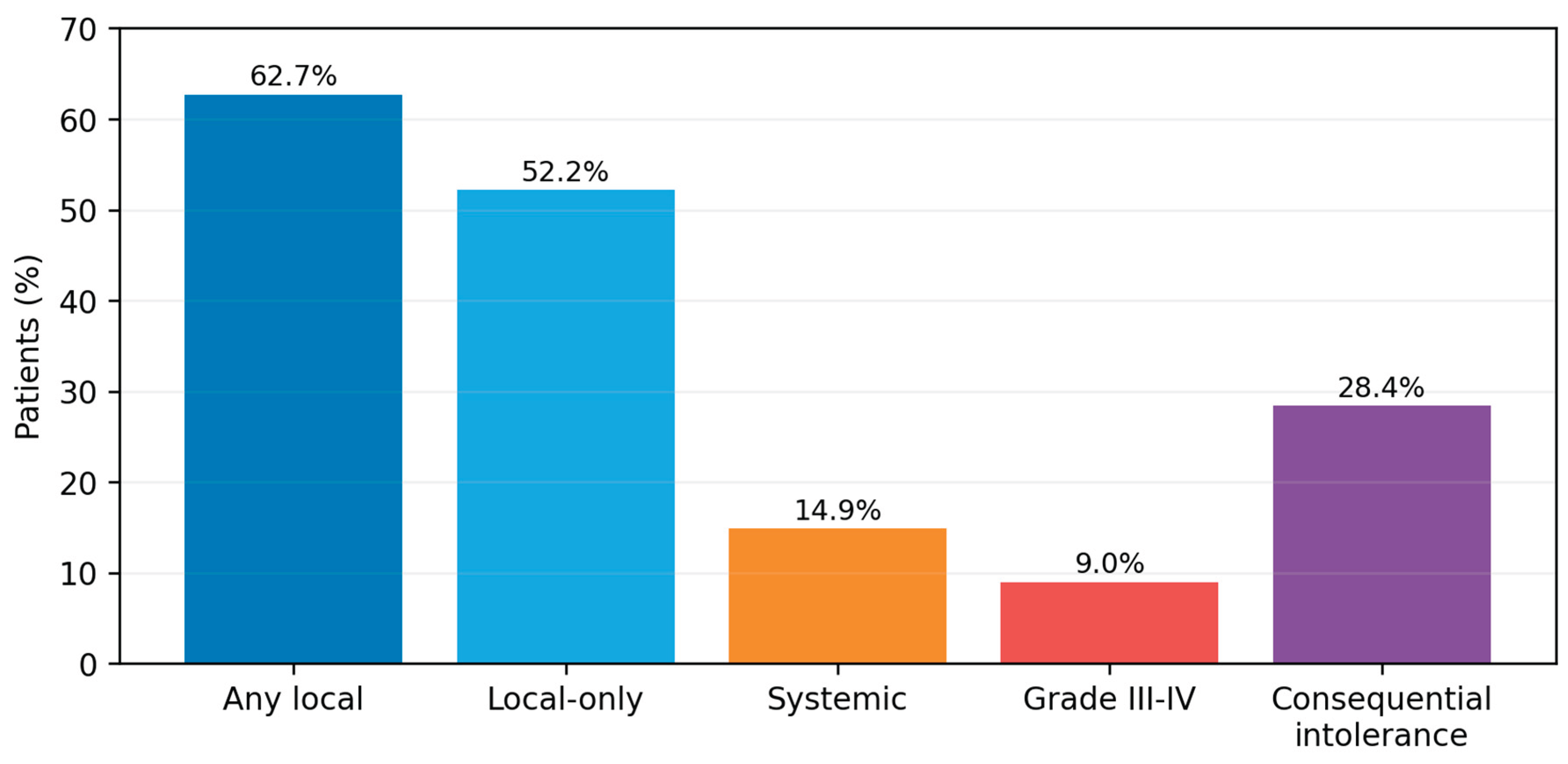

Table 1.
Baseline characteristics and treatment exposure.
| Characteristic | Overall (N = 67) |
|---|---|
| Age, years | 64.9 (7.0) |
| Male sex | 52 (77.6%) |
| High-risk NMIBC | 45 (67.2%) |
| Diabetes mellitus | 14 (20.9%) |
| Hypertension | 28 (41.8%) |
| UTI within 6 months | 14 (20.9%) |
| Bladder capacity, mL | 330.5 (53.6) |
| Creatinine, mg/dL | 0.99 (0.11) |
| Cumulative BCG instillations | 9 [6–12]; range 2-18 |
| Completed six-week induction | 58 (86.6%) |
Values are mean (SD), median [IQR], or n (%). BCG, bacillus Calmette-Guérin; NMIBC, non-muscle-invasive bladder cancer; UTI, urinary tract infection.
Table 2.
Toxicity phenotypes and treatment consequences.
| Outcome | n/N | % |
|---|---|---|
| Any local toxicity | 42/67 | 62.7 |
| Local-only toxicity | 35/67 | 52.2 |
| Systemic toxicity (with or without local symptoms) | 10/67 | 14.9 |
| Grade III toxicity | 5/67 | 7.5 |
| Grade IV toxicity | 1/67 | 1.5 |
| Grade III-IV toxicity | 6/67 | 9.0 |
| Clinically consequential intolerance | 19/67 | 28.4 |
| Temporary interruption | 11/67 | 16.4 |
| Permanent discontinuation | 3/67 | 4.5 |
| Dose reduction | 7/67 | 10.4 |
Table 3.
Penalized multivariable associations with toxicity phenotypes.
| Outcome | Predictor | Adjusted OR | Bootstrap 95% interval |
|---|---|---|---|
| Local-only toxicity | Diabetes | 0.13 | 0.02-0.53 |
| UTI within 6 months | 0.66 | 0.12-2.93 | |
| Age, per 10 years | 0.83 | 0.36-1.87 | |
| Creatinine, per 0.1 mg/dL | 1.43 | 0.85-3.52 | |
| Capacity, per 50 mL | 1.12 | 0.69-1.80 | |
| Systemic toxicity | Diabetes | 1.80 | 0.28-17.05 |
| UTI within 6 months | 0.84 | 0.11-3.68 | |
| Age, per 10 years | 0.56 | 0.12-1.53 | |
| Creatinine, per 0.1 mg/dL | 1.67 | 0.84-3.87 | |
| Capacity, per 50 mL | 0.74 | 0.24-1.46 | |
| Grade III-IV toxicity | Diabetes | 0.72 | 0.04-8.26 |
| UTI within 6 months | 0.35 | 0.07-1.33 | |
| Age, per 10 years | 2.81 | 0.69-127.98 | |
| Creatinine, per 0.1 mg/dL | 1.39 | 0.26-6.75 | |
| Capacity, per 50 mL | 0.86 | 0.37-2.77 | |
| Consequential intolerance | Diabetes | 0.68 | 0.10-3.38 |
| UTI within 6 months | 0.23 | 0.03-0.72 | |
| Age, per 10 years | 0.88 | 0.38-3.28 | |
| Creatinine, per 0.1 mg/dL | 1.09 | 0.62-2.07 | |
| Capacity, per 50 mL | 1.06 | 0.63-2.16 |
Each outcome was modelled separately with all five predictors. Intervals are percentile bootstrap intervals and should not be interpreted as confirmatory confidence intervals. OR, odds ratio; UTI, urinary tract infection.
Disclaimer/Publisher’s Note: The statements, opinions and data contained in all publications are solely those of the individual author(s) and contributor(s) and not of MDPI and/or the editor(s). MDPI and/or the editor(s) disclaim responsibility for any injury to people or property resulting from any ideas, methods, instructions or products referred to in the content. |
© 2026 by the authors. Licensee MDPI, Basel, Switzerland. This article is an open access article distributed under the terms and conditions of the Creative Commons Attribution (CC BY) license.
Copyright: This open access article is published under a Creative Commons CC BY 4.0 license, which permit the free download, distribution, and reuse, provided that the author and preprint are cited in any reuse.